Engineer Your Coding Agents Like Any Other System — Zach Lloyd, Warp
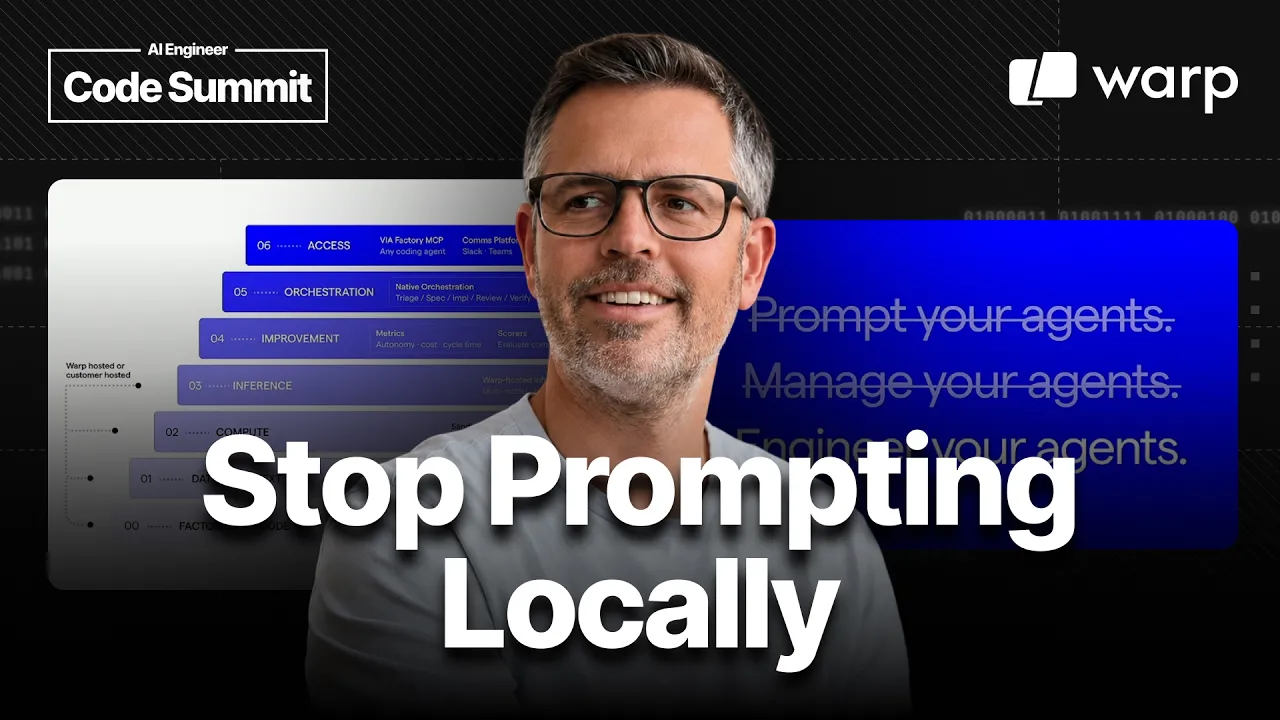
Description
Most developers still run coding agents locally and prompt them one at a time, which caps throughput and makes cost, security and governance hard to manage. Zach Lloyd, founder and CEO of Warp and former Google Docs engineering lead, defines a software factory as a code-defined, closed-loop system for continuously measuring and improving cloud coding agents. He walks through the stack: factories as code, recorded agent runs, sandboxed compute, swappable models and harnesses, and orchestration. He demos live team views, online evals, self-improvement through PRs and benchmarks on your own data. Speaker info: - https://www.warp.dev Timestamps: 0:00 - From Google Docs to Warp 0:57 - Most developers still prompt locally 1:42 - Why local agents don't scale 3:12 - What a software factory is not 3:57 - Factories defined as code 4:42 - A continuous closed loop 5:27 - Measure everything 6:57 - The new tools of factory engineering 7:42 - The factory infrastructure stack 10:42 - Demo: factories as code 11:27 - A live view of every agent 12:57 - Throughput, cost and online evals 14:27 - Self-improvement as PRs 15:57 - Benchmarks on your own data 17:27 - Engineer your agents
Summary
Generated by gpt-5.6-terraAt-a-Glance
- Verdict: Watch fully
- Core thesis: Treat coding agents as an engineered, code-defined production system—not a collection of personal tools—then improve the system continuously through centralized telemetry, evals, benchmarks, and controlled configuration changes.
- Why it matters: This is a practical control-plane model for moving from ad hoc local agent use to secure, measurable, and increasingly self-improving agentic software delivery.
- Best use: Use it as an architecture and operating-model checklist for an internal coding-agent platform, especially its factories-as-code, data capture, evaluation, and experimentation loops.
Executive Summary
Zach Lloyd argues that software engineering is shifting toward “factory engineering”: designing the systems in which coding agents operate rather than merely prompting agents one at a time. Local, interactive, developer-chosen setups constrain throughput because humans must stay in the loop, obscure cost and productivity differences among models and tools, and create governance and security gaps.
His definition of a software factory is deliberately narrow: a code-defined, closed-loop system for continuously measuring and improving cloud coding agents. The factory should define workflows, triggers, policies, repository access, tools, and execution environments declaratively, much as infrastructure is managed with Terraform. This makes changes versionable, testable, reversible, and potentially agent-generated.
The operational core is centralized observability and experimentation. Record each agent run and its artifacts; measure delivery metrics, automation levels, human interactions per PR, throughput, and cost; evaluate sessions for specific failure modes; and replay representative internal tasks across models, harnesses, skills, and factory configurations. Lloyd’s central warning is that external model or benchmark claims are not a substitute for testing against an organization’s own workload.
The most distinctive idea is self-improvement: use agents to inspect eval failures, identify recurring patterns, and propose a PR against the factory definition. The talk is promotional of Warp’s platform and light on implementation specifics or independent results, but its system design is directly useful as a blueprint for agent orchestration and governance.
Key Takeaways
- Claim: Interactive, locally configured coding agents do not scale into an organizational operating model because they cap automation at human prompting capacity and fragment cost, productivity, security, and governance controls. | Evidence: Lloyd describes the prevailing model as developers running one or more agents locally through terminals or agentic IDEs, each selecting their own models, skills, and setup; he says platform teams struggle to ensure efficient usage under this arrangement. | Implication: Ken should separate personal-agent productivity from a managed agent-production system, with shared policy, execution, and measurement layers for work that needs to scale. | Caveat: The speaker does not argue that local agents are useless; he presents them as useful primitives rather than the target end state.
- Claim: A software factory should be a declarative, code-defined workflow system rather than a loose bundle of automations, shared MCPs, AI teammates, or personal agent swarms. | Evidence: The proposed factory definition specifies agents, triggers, workflow stages, available MCPs, execution locations, policies, repository access, and blueprints in Terraform-style code files. | Implication: Representing agent operations as version-controlled configuration enables branching, A/B tests, rollback, reviewable changes, and a stable target for agent-generated improvement PRs.
- Claim: Centralized capture of agent runs and artifacts is the raw material for improving agent performance, not merely an audit or dashboarding feature. | Evidence: Lloyd says organizations should record conversations, generated artifacts, videos, and screenshots from agent sessions; Warp’s example presents a live team-wide view where a manager can inspect an agent’s task, conversation, and outputs. | Implication: Any agent control plane should make run traces, artifacts, provenance, and permissions first-class data objects before attempting advanced optimization. | Caveat: Central collection improves observability but raises data-retention, access-control, and sensitive-code handling requirements that the talk does not detail.
- Claim: Agent systems require explicit operational metrics beyond conventional software delivery metrics. | Evidence: The talk names DORA-style cycle time alongside throughput, cost, degree of automation, and human interactions per PR as metrics that become visible when agent activity is centrally tracked. | Implication: Ken should instrument both delivery outcomes and agent-operating efficiency, avoiding optimization solely for cheap runs, fewer touches, or faster PR creation. | Caveat: Metrics alone do not establish correctness or customer value; Lloyd separately says engineers remain responsible for whether shipped products solve genuine user problems.
- Claim: Online evals should score real agent sessions for concrete failure modes, then connect those failures to changes in the factory rather than relying on subjective impressions. | Evidence: Warp uses an eval that detects redundant tests, a stated coding-agent failure mode; the intended loop is to inspect when the score is poor, determine why, and alter the factory mechanism causing it. | Implication: Start with a small set of high-cost, recurring failure modes and build session-level evaluators that can guide specific interventions in prompts, skills, tools, routing, or workflow stages. | Caveat: An eval only improves the system if its score corresponds to a meaningful quality or operating outcome; the talk provides one example but no methodology for validating evaluators.
- Claim: Model, harness, skill, and workflow choices should be treated as experimental variables and selected using an organization’s own task distribution. | Evidence: Lloyd recommends creating benchmark sets from real internal data and replaying tasks across configurations; he cites trade-offs in cost and quality and says teams can test changes such as removing skills, not only switching models. | Implication: Build a representative replay corpus before standardizing on an agent stack or reacting to claims that a newly released model, harness, or skill is universally best. | Caveat: Public benchmarks such as SWE-bench and Terminal Bench may indicate broad capability but cannot answer which configuration is best for a specific organization.
- Claim: The compounding end state is a self-improving factory in which agents analyze evaluation failures and submit proposed changes to the factory configuration. | Evidence: Lloyd describes agents examining failed-run scores, looking for patterns, and expressing a possible remedy as a PR against the factory definition. | Implication: Autonomous factory tuning should begin as a PR-producing, human-reviewed workflow with canary evaluation and rollback—not as direct self-modification of production agent policies. | Caveat: The talk does not specify approval gates, blast-radius controls, or safeguards against evaluators and improvers optimizing the wrong proxy.
Detailed Brief
Reference architecture for the factory control plane
- Claims: The factory is a layered system, not simply an orchestration workflow.; Sandboxed compute is needed both for security and for repeatability, and should likely support more than one platform.; Inference should remain interchangeable because different models and agent harnesses may fit different tasks.; Orchestration moves work through the workflow but is described as less strategically differentiating than the measurement and improvement loop.; The factory should be API- and MCP-first so people and other agents can invoke it from systems where work originates.
- Evidence: Lloyd’s stack runs from factories-as-code to data/context, sandboxed compute, inference, orchestration, and API/MCP integrations.; He names Claude Code, Codex, Pi, and Warp as examples of harnesses with different properties, and notes that organizations may build a custom harness with embedded organizational context.; He names Slack, Linear, Jira, and GitHub as systems the factory should integrate with.
- Caveats: The presentation does not address identity propagation, secrets management, network egress, approval policy, tenancy boundaries, or incident response—areas that must accompany an enterprise implementation.
- Implications: Avoid hard-wiring one vendor model or one interaction surface into the architecture.; Design integration points around the sources of work and systems of record, while preserving a central execution and telemetry plane.
Notable Concepts & Terms
- Factory engineering: The emerging engineering discipline of measuring, benchmarking, testing, and improving the agentic system that produces software, alongside conventional product engineering.
- Software factory: Lloyd’s term for a code-defined, closed-loop system that continuously measures and improves cloud coding agents.
- Factories as code: Declarative version-controlled definitions for agents, workflows, policies, triggers, repository access, tools, and execution environments; this enables rollback, experiments, and improvement PRs.
- Online evals: Evaluations applied to recorded agent sessions in operation, intended to identify quality or efficiency failure modes continuously rather than only in offline tests.
- Self-improvement: Using an agent to analyze recurring evaluation failures and propose a configuration change to the factory as a pull request.
- Human interactions per PR: A proposed automation metric that measures how much human intervention agent-generated changes require, complementing cycle time and throughput.
- Agent harness: The coding-agent execution environment and behavior layer; Lloyd treats the harness, like the model and skills, as a variable to test rather than a permanent choice.
- DORA metrics: Traditional software-delivery measures such as cycle time, used here as one class of outcome metric within a wider agent-operations scorecard.
Operator Notes / Why Ken Should Care
- Create a version-controlled factory specification that separates policy, triggers, workflow stages, tool/MCP access, repository scope, execution environment, and model/harness routing.
- Establish a minimum telemetry schema for every run: task source and intent, repository and branch, model and harness version, tool calls, artifacts, cost, duration, human interventions, outcome, and evaluation scores.
- Build an internal benchmark corpus from completed and representative work items before changing default models, skills, or agent frameworks; require quality-cost comparisons on that corpus.
- Prioritize two or three measurable agent failure modes with material business cost, then deploy online evals before pursuing broad autonomous optimization.
- Keep self-improvement changes PR-based with approval, replay evaluation, canary deployment, and rollback until evaluator reliability and blast-radius controls are proven.
- Review central agent logging for code, credentials, customer data, retention, and role-based access risks before adopting full-session capture.
Source/Metadata
- Title: Engineer Your Coding Agents Like Any Other System — Zach Lloyd, Warp
- Transcript words: 4968
- Duration seconds: 1110
- Timestamp note: No usable timestamps or chapter markers were present. The latter portion of the transcript substantially repeats the earlier presentation content.
Transcript
All right, hi everyone. Excited to be here and today I'm going to chat about the evolution of software engineering and how it's becoming factory engineering. So excited to do this. First, a little bit about me. I've been an engineer for a long time. I was a principal engineer at Google. I used to lead engineering on the Google Docs suite, helped scale that product to hundreds of millions of users. I'm currently the founder and CEO of Warp. Warp builds a platform for companies to build their own internal software factories. I'm going to show a little bit of that today. Warp is also well known for our open source agentic terminal. It has about 65,000 GitHub stars. It's used by almost a million developers. Our mission has always been helping developers ship better software more quickly and it's cool to evolve what we're doing as the world changes around us. This is where I think we're still mostly at. Most developers that I talk to, most platform teams, they're working with individuals who are running their own coding agents locally. Maybe they're running multiple of them at a time. It could be through their terminal. It could be through an agentic development environment. Just show of hands quickly, actually. How many people in here are mostly working in this fashion? Local multi-threading. Okay, so still most people, but actually not everyone. I think that this is going to change and it's starting to change already. The reasons are, there's a few of them. One is if you are doing local interactive prompting as your main way of working with coding agents, you're limited by human throughput. You cannot automate if every agent needs to be interactively prompted. There's a second reason too that I hear a lot from platform teams and from engineering leaders. This mechanism of everyone choosing their own local setup, their own models, their own skills makes it very hard to actually make sure that you're using these agents efficiently from a cost perspective and a productivity perspective. And then finally there's a big security problem and governance problem when everyone is setting up and running their own local agents. And so the thing that is coming, I loosely call a software factory, that means different things to different people. I would, well I'm curious for people in this room, like how many folks are currently trying to build or building or using their own internal software factories? Show of hands. So I would say that's almost more than the interactive agents at this point. That's super cool. So I'm going to define what I think of as a software factory, but I'll start by saying what I think a software factory is not. I think it's not just a loose set of automations. I don't think of a software factory as a collection of AI teammates. I don't think it's a shared set of skills and MCPs. And I also don't think software factories are personal agent swarms. I think these are all useful primitives, but they're not the end state that we should be shooting for. And so to me, the way that I define software factory is very specific. And I'll unpack this, but I define it as a code defined closed loop system for continuously measuring and improving cloud coding agents. That's a mouthful, but let me unpack it. So if you want to build a software factory and really scale it, I believe the first thing you need to do is fully encode it in a declarative language. So you need to say, okay, these are all of the coding agents that I want to run. These are how they're triggered. When work comes into this factory, this is the workflow from triage to spec, whatever your workflow is, you need to specify what MCPs are available, where your agents run, really as much as you can in a Terraform style declarative set of code files that define your factory. I'll talk about why this matters in a bit. The second part of it is a continuous closed loop of improvement. And that closed loop can look something like this. This is the typical one. This is just the SDLC, where you have ideas that come in from people. They could come in from automated signals and then your agents do some amount of work taking that issue through various stages from triage, implementation, verification, monitoring, and so on. The important piece here is this closed loop concept, where the more that your agents run, the more efficient you can make this loop. And I'll talk about how you do that in a second. The third really key aspect, if you're building a software factory, is that everything needs to be measurable. If you're just going on vibes in terms of how you deploy coding agents, you can't be confident that you're actually getting the best, highest quality outputs at the best cost. You can't be confident you're maximizing throughput. So you really need a measurement mindset and measurement capabilities. And so if there's one thing that I'm hoping people walk away from this talk with, it's the idea that the way to work with coding agents and the way to think about them is that there's a really cool fundamental new engineering problem, which is how do you take this magic new primitive that we all have, that you've gotten in the last year, that you have these intelligent agents, and how do you engineer a system around them to use them most effectively? To me, it's not about growing a garden or following a recipe. We're all engineers. We've spent our careers learning how to solve problems from an engineering mindset. And when you think of coding agents as a new engineering primitive, then you naturally want to, you'll naturally start to build a certain way of using them. That's the mindset. So to unpack that a bit, there's continual measurement and continual learning. But there's also a new set of tools. And so when I was learning how to become a better engineer at Google, I really had to get good at using things like debuggers and profilers and Chrome Dev tools. And there were all of these tools of the trade for building software by hand that maybe are not as important now, but they really separated the best engineers from the okay engineers. And in the new world of factory engineering, there is a new set of tools that everyone should be trying to master. And so those are things like evals. Can you set up self-improvement loops that work? Can you write benchmarks? Can you A, B test your factory? And that's a really important skill set. And mastering that skill set is something that I think of as factory engineering. Now, that doesn't mean that that's the only kind of engineering you're going to be doing. You're still going to be doing product engineering, meaning you as an engineer should still feel responsible for whether the product you ship actually solves a real user or customer problem. But the best engineers, every engineer, is going to need to learn this new tool set of how do you improve the system, not just build the product. And so what does that look like? If you think from first principles about how do you engineer an agentic system, I think you come up with something like this. It doesn't have to be exactly this, but it's an infrastructure stack that you're going to want to use to engineer your agents. And so at the bottom of this is what I call factories as code. I talked about this earlier. It's defining all of your coding agent workflows in a code format. And the value of that is that you get the ability to branch off it and test different factory configurations. You can roll back. And then crucially, it opens up the way for self-improvement, which is the ability for coding agents themselves to suggest changes to how your factory works to get that continual loop going. Above that is a layer of data and context. This is also crucial. So if you are running coding agents at scale in an organization, you really must be recording everything that those agents are producing. So all of their conversations, all their artifacts, the videos that they make, the screenshots. And the reason for doing that is that's the raw material that you will use to improve the way your factory works over time. On top of that is a compute layer. So you need to have sandboxing. Sandboxing increases security. It makes your factory more repeatable. Your sandboxing should probably be multi-platform. On top of that is the inference layer. The way that I would think about inference and models in a factory is they are a degree of freedom to test. And so your factory, however you build it, should support multiple models. It should also support multiple coding agents because cloud code might be better for some things. Codex, Pi, Warp. These harnesses all have different properties. You might want to write your own coding agent harness that has some of your organizational context baked in. So your platform should support that. On top of that, you need an orchestration layer. So this is what actually moves work through the factory. In some ways, the least interesting part, but you need that. And then finally, your factory should be all API and MCP first. So that it can be used not just by people, but it can be used by other coding agents. And it can go to where the work is being done. So your factory should integrate into things like Slack, Linear, Jira, GitHub, and so on. I'm going to give a quick demo of what some of these tools look like in the context of Warp factories. But this stuff I'm going to show I think applies also if you're building your own. So let me start here. At the foundation I mentioned earlier is factories as code. And so I'm going to show some code. It's not going to be that interesting but if you're familiar with something like Terraform, you will get what's going on here. You basically want a declarative way of saying, this is my factory. My factory has certain policies. It accesses certain repos. It has certain triggers. It has a sort of blueprint that defines the workflow of work going through it. And then if you zoom out, all of these other things that are part of the factory also have code definitions. The second thing, moving up a layer, is the idea that everything that you do in the factory should be tracked across your entire team. And so this, think of what I'm showing here, is this is a sort of Google Docs style live view of what every coding agent on Warp's team across all of our engineers are doing at all times. And so I could click in and I could see, okay, I don't know what Maggie is working on, but I know I could look at it. She's implementing Opus 5.5 on the high plan. She's doing it from Slack. It has this artifact. I could look in and see the actual conversation here. I could see what it's generated. And so I could see this in real time, which is cool. But the really important thing is that you gather all this information so that it can be used for improving the factory. And so that brings me to the third thing, moving up the stack here, is once you have all of this information that's being stored centrally, you get the ability very easily, without doing any install stuff on everybody's laptop, anything like that, to understand how these coding agents are working. And you can think of that in terms of traditional output metrics, like your DORA metrics, like cycle time. But you can also think of that in terms of how automated you are, how many human interactions per PR, what's your throughput. You get, you should be able to see data very clearly here on what's your cost. Again, surfacing this, if you don't have this data, you're flying blind. So this is really important. And then there's this next layer of data, which is also really important that I mentioned earlier, which is the ability to set up online evals that run across all your coding agent sessions. And so what I mean by this, an eval is just like, as these coding agent sessions are running and they're recording their output, you want the ability to go back and have another agent look at them and score them on some dimension that might indicate how well they're doing. And to make that more concrete, so it's like we have an eval, a score here that we use that is looking for redundant tests. This is a good example. And so one common failure mode of coding agents is that sometimes they will write tests that are unnecessary. We want to catch that. And that's what this eval does. We want the ability then to see, okay, when it's writing too many tests, why is it doing that? And is there a mechanism that we could change in the factory for improving that? And so to recap here, you want a way of recording all the runs. When these runs run, all of the runs are, you want a way of specifying what is the actual loop that they're running through. You want to be able to see where they are in that loop. As the runs work, you want to be able to gather their data. Once you gather their data, you want to be able to set up these online evals. And then these online evals give you a sense of, okay, where are there opportunities for improvement? Once you have that in place, you can do something that we call self-improvement, which is rather than having humans look at the outputs of these scores, you have agents look at the output. And so the way to think about self-improvement is like, it looks at the score output. It says, okay, we saw some number of failed runs. Let's try to look for patterns in those failures and suggest a possible solution. And then the form that that solution takes is as a PR against your factory definition. And so this is the awesome thing about having your factory defined as code and being able to use coding agents is that you can then have the coding agents diagnose problems with how they're working internally and suggest fixes to them. The final tool that I'm going to point out that I mentioned earlier is the ability to create and run benchmarks. This is also essential. So if you're following this course online, you'll often see things like, this is the best model. This is the new best skill. This is the best harness. The only way to answer those questions for real is to test on your own data. And so you should have in place some mechanism where you can create a benchmark set out of your real data and replay those tasks against different configurations to see how they would have done if you had varied some model or varied some harness or varied your factory configuration. So to make this clear, this is something that looks like what you might get when a new model drops like in Sweet Venture Terminal Bench, it's showing the trade-offs of different models here in terms of cost and quality. You want to be in this upper left-hand quadrant, but it's on your own actual data. And you can test not just models, but also you want to be able to test, hey, if I got rid of these skills, does my factory perform better or worse? So these are some of the tools. And just to return to this concept, this has worked well for us. We have managed to use these tools to drastically improve our throughput and lower our cost. We are constantly doing this because this cost really matters to us where we're getting a performance baseline. We're scoring, we're benchmarking, we're testing, and we're doing factory engineering. And so that brings me back to this last point that I just want to emphasize again, engineer your agents. It's a new engineering primitive. We're all engineers. Think about how you can get the most out of them and build the system for that. I think this is very exciting. I know there's a lot of angst around what it means to be an engineer right now. I know we're not writing code, but I'm still using all the engineering skills that I spent my whole career learning. And so to me, it's still a really exciting time. If you're interested in more factories, you can check it out here. Thank you all for coming to the talk. is that there's a really cool fundamental new engineering problem, which is how do you take this magic new primitive that we all have, that we've gotten in the last year, that you have these intelligent agents, and how do you engineer a system around them to use them most effectively? To me, it's not about like growing a garden or following a recipe. We're all engineers. We've spent our careers learning how to solve problems from an engineering mindset. And when you think of coding agents as a new engineering primitive, then you naturally want to, you'll naturally start to build a certain way of using them. That's the mindset. So yeah, just to unpack that a bit. So there's continual measurement and continual learning. But there's also a new set of tools. And so when I was learning how to become a better engineer at Google, I really had to get good at using things like debuggers and profilers and Chrome Dev tools. And basically, there were all of these tools of the trade for building software by hand that maybe are not as important now, but they really separated the best engineers from the OK engineers. And in the new world of factory engineering, there is a new set of tools that everyone should be trying to master. And so those are things like evals. It's can you set up self-improvement loops that work? Can you write benchmarks? Can you A, B test your factory? And that's a really important skill set. And mastering that skill set is something that I think of as like factory engineering. Now, that doesn't mean that that's the only kind of engineering you're going to be doing. You're still going to be doing product engineering, meaning you as an engineer should still feel responsible for, you know, does the product you ship actually solve a real user or customer problem? But the best engineers, I would say like every engineer really, is going to need to learn this new tool set of how do you improve the system, not just build the product. And so what does that look like? If you think from first principles about how do you engineer an agentic system, I think you come up with something like this. It doesn't have to be exactly this, but it's kind of an infrastructure stack that you're going to want to use to engineer your agents. And so at the bottom of this is what I call factories is code. I talked about this earlier. It's defining all of your coding agent workflows in a code format. And the value of that is that you get the ability to branch off it and test different factory configurations. You can roll back. And then crucially, it opens up the way for self-improvement, which is the ability for coding agents themselves to suggest changes to how your factory works to get that continual loop going. Above that is a layer of data and context. This is also crucial. So if you are running coding agents at scale in an organization, you really must be recording every everything that those agents are producing. So all of their conversations, all their artifacts, the videos that they make, the screenshots. And the reason for doing that is that's the raw material that you will use to improve the way your factory works over time. On top of that is a compute layer. So you need to have sandboxing. Sandboxing increases security. It makes your factory more repeatable. Your sandboxing should be probably multi-platform. On top of that is the inference layer. The way that I would think about inference and models in a factory is they are a degree of freedom to test. And so your factory, however you build it, should support multiple models. It should also support multiple coding agents because, you know, cloud code might be better for some things. Codex, Pi, Warp. These harnesses all have different properties. You might want to write your own coding agent harness that has some of your organizational context baked in. So your platform should support that. On top of that, you need an orchestration layer. So this is what actually moves work through the factory. In some ways, the least interesting part, but you need that. And then finally, your factory should be all API and MCP first. So that it can be used not just by, you know, people, but it can be used by other coding agents. And it can go to where the work is being done. So your factory should integrate into things like Slack, Linear, Jira, GitHub, and so on. I'm going to give a quick demo of what some of these tools look like in the context of warp factories. But this stuff I'm going to show I think applies also if you're building your own. So Let me start here so the at the foundation I mentioned earlier is factories in code. And so I'm going to show some code. It's not going to be that interesting but if you're familiar with something like Terraform, you will get what's going on here. You basically want a declarative way of saying, this is my factory. My factory has certain policies. It accesses certain repos. It has certain triggers. It has a sort of blueprint that defines the workflow of work going through it. And then if you zoom out, all of these other things that are part of the factory also have code definitions. The second thing, moving up a layer, is the idea that, sorry, that everything that you do in the factory should be tracked across your entire team. And so this, think of what I'm showing here, is this is a sort of Google Docs style live view of what every coding agent on Warp's team across all of our engineers are doing at all times. And so I could click in and I could see, okay, I don't know what Maggie is working on, but I know I could look at it. She's implementing Opus 5.5 on the high plan. She's doing it from Slack. It has this artifact. I could look in and see the actual conversation here. I could see what it's generated. And so I could see this in real time, which is cool. But the really important thing is that you gather all this information so that it can be used for improving the factory. And so that brings me to the third thing, moving up the stack here, is once you have all of this information that's being stored centrally, you get the ability very easily, without doing any like install stuff on everybody's laptop, anything like that, to understand how these coding agents are working. And you can think of that in terms of like traditional output metrics, like your DORA metrics, like, okay, cycle time. But you can also think of that in terms of like how automated am I, like how many human interactions per PR, what's your throughput. You get, you should be able to see data very clearly here on like, what's your cost. Again, surfacing this, if you don't have this data, you're kind of flying, uh-oh. You're kind of flying blind. So this is really important. And then there's this next layer of data, which is also really important that I mentioned earlier, which is the ability to set up online evals that run across all your coding agent sessions. And so what I mean by this, an eval is just like, as these coding agent sessions are running and they're recording their output, you want, uh, the ability to, to go back and have another agent look at them and score them on some dimension that might indicate how well they're doing. And to make that more concrete. So it's like we have an eval, a score here that we use that is looking for redundant tests. This is a good example. And so one common failure mode of coding agents is that sometimes they will write tests that are unnecessary. We want to catch that. And that's what this eval does. We want the ability then to see, okay, when it's writing too many tests, why is it doing that? And is there a mechanism that we could change in the factory for improving that? And so again, just to kind of recap here, uh, you want a way of recording all the runs. When these runs run, I didn't show this, but all of the runs are, you know, you want a way of specifying, um, what is the sort of like actual loop that they're running through. You want to be able to see where they are in that loop. As the runs, uh, work, you want to be able to gather their data. Once you gather their data, you want to be able to set up these online evals. And then these online evals give you a sense of like, okay, where are there opportunities for improvement? Once you have that in place, you can do something that we call self-improvement, which is rather than having humans look at the outputs of these scores, you have agents look at the output. And so the way to think about self-improvement is like, it looks at the score output. It says, okay, we saw some number of failed runs. Um, let's try to look for patterns in those failures and suggest a possible solution. And then the form that that solution takes is, uh, as a PR against your factory definition. And so this is like the awesome thing about having your factory defined as code and being able to use coding agents is that you can then have the coding agents diagnose problems with how they're working internally and suggest fixes to them. The final tool that I'm going to point out that I mentioned earlier is the ability to create and run benchmarks. This is also essential. So if you're following this course online, you'll often see things like, okay, this is the best model. This is the new best skill. This is the best harness. The only way to answer those questions for real is to test on your own data. And so you should have in place some mechanism where you can basically create a benchmark set out of your real data. Um, and then, uh, replay those tasks. Oops, I'm on the wrong one here and replay those tasks against different configurations to see how they would have done if you had varied some model or varied some harness or varied your factory configuration. So just to make this clear, this is something that looks like what you might get, uh, when, uh, a new model drops like in sweet venture terminal bench, it's showing the trade-offs of different models here in terms of cost and quality. You want to be in this upper left-hand quadrant, but it's on your own actual data. And you can, you can test not just models, but also you want to be able to test, Hey, if I got rid of these skills, does my factory perform better or worse? So these are some of the tools. Um, and just to return to this, the concept like this has worked well for us. We have managed to use these tools to drastically improve our throughput and lower our cost. We, we are just constantly doing this because this cost really matters to us where we're getting a performance baseline. We're scoring, we're benchmarking, we're testing, and we're doing factory engineering. And so that brings me back to this last point that I just want to emphasize again, engineer your agents. It's a new engineering primitive. We're all engineers. Think about how you can get the most out of them and build the system for that. I think this is very exciting. Um, I know there's a lot of like angst around what it means to be an engineer right now. I know we're not writing code, but I'm still using all the engineering skills that I spent my whole career learning. And so to me, it's still a really exciting time. Uh, if you're interested in more factories, you can check it out here. Thank you all for coming to the talk. Thanks. Thanks. ! Thank you.