How to Build Voice Agents That Don't Fall Apart When You Interrupt - Jesse Hall, LiveKit
Description
Jesse Hall of LiveKit shows how to build voice agents for financial services that feel human, not robotic. He explains why model leaderboards mislead (they score components, but you ship a conversation), why you should measure time to first audio and time to first sentence instead of first byte or first token, and how async tool calls keep a conversation flowing while slow back-end work runs. He also covers audio-aware turn detection, the roughly 1.5-second latency budget (500-600ms feels truly human), and benchmarking your own stack with simulated callers. Chapters 00:00 Intro: real-time agents vs background agents 01:47 Humanlike voice agents for financial services 03:46 LiveKit and the voice pipeline 04:21 Cascaded pipelines vs speech-to-speech 05:05 Why leaderboards don't pick your stack 06:46 Time to first audio, not first byte 07:52 Time to first sentence, not first token 08:38 Hiding slow tool calls like a human would 10:14 Demo: hotel booking agent 12:33 Turn detection: knowing when to listen 14:02 The latency budget 15:44 Benchmarking your stack with simulated callers 18:35 Results and a pre-launch checklist Jesse Hall, LiveKit Join us in SF for the second annual AIE CODE summit: https://aie.codes our last flagship summit of 2026. Applications live now!
Summary
Generated by gpt-5.6-terraAt-a-Glance
- Verdict: Watch fully
- Core thesis: Reliable voice agents must be engineered and evaluated as end-to-end real-time conversations—not as a chatbot connected to speech-to-text and text-to-speech components selected from standalone leaderboards.
- Why it matters: For any customer-facing, tool-using agent, interruptions, noisy audio, slow backend calls, incorrect transcription of high-stakes details, and poor turn-taking can destroy trust even when each individual model appears strong.
- Best use: Use this as an implementation-oriented framework for setting voice latency SLOs, separating conversational execution from backend tool execution, and building scenario-driven regression evaluations for agent stacks.
Executive Summary
Jesse Hall argues that human-like voice interaction is a systems problem, not simply a model-speed problem. A voice agent has a finite latency budget between the caller finishing a turn and hearing the first audible agent response, but the target is not maximum raw speed: it is fitting natural turn-taking, reliable action-taking, and recovery behavior inside that budget.
The talk challenges component-level model selection. Speech-to-text, LLM, and text-to-speech leaderboards can conceal downstream conversational failures: an STT error such as hearing "the 30th" instead of "the third" propagates into planning and execution, while provider metrics such as time-to-first-byte or LLM time-to-first-token do not represent when a caller actually hears a useful answer.
The core implementation pattern is concurrent tool execution. Rather than awaiting a slow backend operation on the conversational thread, the agent should acknowledge progress, continue the dialogue, and recover or escalate if the tool returns an error. Hall demonstrates a hotel-booking agent that gathers booking information while asynchronously saving it to the backend.
For model and stack selection, Hall recommends an agent-specific benchmark: run simulated callers with identical scenarios against a working end-to-end agent, vary the stack, score both final-state correctness and process quality, then convert observed failures into regression cases. The talk also emphasizes audio-aware turn detection, identity and high-stakes-data verification, privacy checks, and avoiding unnecessary or hallucinated tool calls.
Key Takeaways
- Claim: A production voice agent should be treated as a real-time conversational system, not a text chatbot with speech interfaces attached. | Evidence: The presented architecture includes STT, an LLM, TTS, turn detection, backend tools, interruption handling, and recovery paths; Hall contrasts this with callers abandoning brittle agents by asking for an operator after interruptions derail the exchange. | Implication: Design ownership and evaluation need to span audio input, dialogue control, tool orchestration, latency, and outcome correctness rather than optimizing only prompts or a single model. | Caveat: Speech-to-speech models can replace the traditional STT-LLM-TTS cascade in some cases, but Hall says the approach is newer and not yet suitable for every use case.
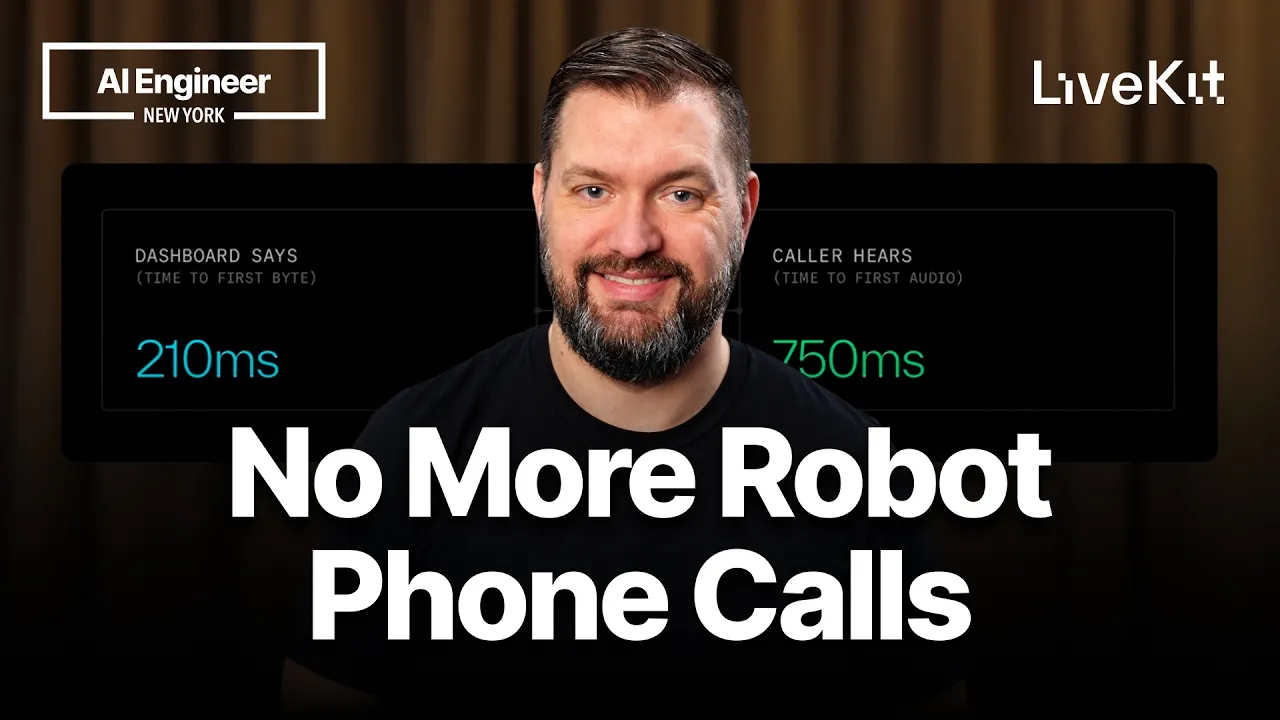
- Claim: Optimize for caller-perceived latency metrics rather than vendor-reported transport or token metrics. | Evidence: A TTS dashboard may report 210 ms time-to-first-byte while the provider still ships up to roughly 0.75 seconds of silence before audible speech; similarly, TTS generally needs a complete sentence rather than an LLM's first token before it can speak. | Implication: Instrument time-to-first-audio and time-to-first-sentence across the integrated pipeline; these are more meaningful operational SLOs than time-to-first-byte and time-to-first-token.
- Claim: The effective turn-latency budget is roughly 1.5 seconds at the outer edge, while 500-600 ms between the caller's last syllable and the agent's first audible response feels substantially more human-like. | Evidence: Hall defines the budget as the interval spanning end-of-turn detection, provisional transcription, LLM response preparation, and TTS audio generation. | Implication: Allocate latency across the whole pipeline and prioritize the interaction quality that fits inside the budget, instead of pursuing isolated model benchmarks. | Caveat: The numbers are presented as experiential guidance rather than a universal threshold; complex actions and tool calls may exceed them.
- Claim: Slow backend work must not block the conversational thread; agents should execute tools asynchronously while continuing to listen or advance the dialogue. | Evidence: Hall notes that backend operations can take 2, 10, or 40 seconds and shows a hotel agent collecting reservation details while tool calls save each field in the background. The implementation hinge is not awaiting the tool call on the conversation path, effectively handing control back to the agent. | Implication: Separate conversational orchestration from tool execution in the agent runtime; add user-facing progress language and error/reconciliation states rather than leaving silence during I/O. | Caveat: Background execution requires explicit error handling: if a save fails, the agent must verify or correct the information, and it should hand off to a human when it cannot safely recover.
- Claim: Turn detection should use acoustic signals as well as transcript content, because text-only endpointing can cut people off during natural pauses. | Evidence: LiveKit's detector uses rhythm, pitch, and intonation in addition to transcript data. Hall reports 4.5% user cutoffs in its hotel-agent test versus 9.9% for the leading alternative, and uses the example of a speaker pausing after "$500" before completing "$555.23." | Implication: Evaluate endpointing against pauses, incomplete amounts, corrections, interruptions, background noise, and overlapping speech—not just transcript completion accuracy. | Caveat: The reported interruption rates are specific to LiveKit's stated test use case; teams should run equivalent evaluations on their own traffic and audio conditions.
- Claim: Choose an end-to-end stack through scenario-based simulations, not by selecting the highest-ranked individual models from public leaderboards. | Evidence: Hall proposes simulated callers that pursue goals, change their minds, interrupt, mumble, and operate with injected background noise. Tests can be text-based for business logic or audio-based for the full voice pipeline, then score final state, required steps, excess steps, and hallucinated function calls. In the hotel benchmark, Gemma 431B on LiveKit inference outperformed the same model on another provider. | Implication: Build a reusable evaluation harness with byte-identical scenario inputs across candidate stacks, then treat every production failure as a regression scenario. | Caveat: A stack benchmark is specific to the agent's workflow, infrastructure, and scoring criteria; there is no globally best model or provider.
- Claim: High-stakes voice workflows need explicit safeguards beyond conversational fluency. | Evidence: The closing checklist calls for confirming critical dates and financial details, verifying identity before account access, testing privacy safeguards, and checking that the correct authorized amount is charged rather than merely checking whether the agent completed a task. | Implication: For financial or account workflows, make verification and authorization requirements measurable acceptance criteria in the test suite rather than relying on the LLM to infer when caution is needed.
Detailed Brief
Evaluation design: score the process as well as the final outcome
- Claims: A completed task is not sufficient evidence that an agent behaved correctly.; Each test scenario should define the caller's objective, the expected agent actions, and the expected final state.; Text simulations isolate business-logic and tool-selection behavior, while audio simulations additionally exercise recognition, interruption handling, and turn-taking.
- Evidence: For the hotel agent, the benchmark checks whether the correct reservation reached the database.; For a financial flow, the example acceptance condition is whether the correct authorized amount was charged.; The talk recommends detecting cases where an agent took 10 steps when two were sufficient or hallucinated a function call.
- Caveats: Completion-oriented scoring can be gamed by agents that reach an endpoint through excessive, unnecessary, or unsafe actions.; Clean-audio benchmark conditions are insufficient because real callers may use speakerphones in traffic or speak with children and other noise in the background.
- Implications: Maintain distinct score dimensions for final-state correctness, sequence compliance, safety/privacy, tool efficiency, and conversational quality.; Use scenario simulation as a pre-production gate whenever changing models, inference providers, prompts, tools, endpointing, or orchestration behavior.
Architecture choices and operational posture
- Claims: The conventional cascaded voice architecture composes separate speech-to-text, language, and text-to-speech models, creating error propagation across stages.; The agent can begin responding from a provisional transcript while the system finalizes the turn, provided the system is designed to handle correction and uncertainty.; LiveKit positions its tools, methodology, and hotel-agent benchmark as open source and model-agnostic.
- Evidence: Hall's date example shows an STT error changing "the third" into "the 30th," after which the LLM plans around the incorrect date because it has no independent awareness of the transcription error.; The talk says every function, model, and handoff competes within the same caller-perceived response window.
- Caveats: The example showing a performance advantage for LiveKit inference is vendor-associated and should be independently replicated in the target deployment environment.
- Implications: Make critical entity confirmation a workflow-level control, especially for dates, amounts, identity data, and actions with irreversible consequences.; Benchmark an identical model across inference providers as well as benchmarking different models, since serving behavior can materially affect voice performance.
Notable Concepts & Terms
- Cascaded voice pipeline: The conventional STT-to-LLM-to-TTS architecture; its stages compound transcription and latency errors in the resulting conversation.
- Time to first audio: The time until the caller actually hears sound, which Hall argues is a better TTS responsiveness measure than time-to-first-byte.
- Time to first sentence: The time until the LLM has produced enough coherent text for TTS to begin speaking; more operationally relevant for voice than time-to-first-token.
- Latency budget: The limited interval from the caller's last syllable to the agent's first audible response, encompassing turn detection, LLM work, TTS, and orchestration.
- Turn detection: The system's decision about when a caller has finished speaking; audio-aware detection is positioned as essential for avoiding cutoffs on pauses or incomplete utterances.
- Async tool execution: Decoupling backend tool calls from the live conversational thread so the agent can continue listening, speaking, or collecting information while I/O runs.
- Agent-specific benchmark: A scenario suite that tests the complete agent stack against its own objectives, environments, and failure modes rather than relying on generic component leaderboards.
- Regression scenario: A previously observed agent failure converted into a permanent automated test to prevent repeat breakage after stack or workflow changes.
Operator Notes / Why Ken Should Care
- Define production voice SLOs for caller-perceived time-to-first-audio, time-to-first-sentence, interruption/cutoff rate, and successful recovery from interrupted turns.
- Audit tool-call code paths for synchronous waits that block dialogue; introduce explicit concurrency, reconciliation, and human-escalation behavior before using voice flows for transactional work.
- Create a small initial adversarial simulation suite covering date/amount ambiguity, identity checks, caller corrections, barge-ins, noisy audio, slow tools, backend failures, and privacy-sensitive account access.
- Require scenario-level comparison before changing STT, LLM, TTS, endpointing, or inference providers; test identical candidate stacks against the same audio inputs and score both final state and tool trace.
- For money movement, bookings, and account access, enforce confirmation checkpoints for critical entities rather than treating transcription output as authoritative.
Source/Metadata
- Title: How to Build Voice Agents That Don't Fall Apart When You Interrupt - Jesse Hall, LiveKit
- Transcript words: 4386
- Duration seconds: 1255
- Timestamp note: No timestamps or chapter markers were present in the supplied transcript.
Transcript
All right, we're going to talk about voice agents. And most of the agents that we deal with on a day-to-day basis, they do things in the background, right? They write code for us, they do research, we give them something to do, a task, and we walk away, we come back, and we don't really care if they take an extra 10 seconds, an extra 10 minutes, maybe sometimes 10 hours, right? And we expect that. But at some point in the last year or so, you have probably interacted with another kind of agent, a real-time agent. Maybe when you called your pharmacy, maybe when you called the airline. I talked to one just the other day when I called a car dealership, and at some point in that conversation, you did the most human-like thing possible. You spoke over it, you interrupted it, you confused it, and the entire conversation fell apart. It just didn't feel natural. And then you did what I do every single time. Operator, hit zero, get me to a human, right? So how do we fix that? How do we make these agents as human-like as possible? The risk is much higher, right? So how do we fix that? So we're going to talk about how can we build human-like voice agents for financial services. And when you think about building a good voice agent, one of the first things that comes to mind is latency. We need it to be as fast as possible, right? Well, latency is part of the equation. Latency has a finite budget, and we'll talk about what that is. But the key word here is human-like. How do we make these voice agents as human-like as we can? That's the goal. So there's quite a few people that are talking about voice lately. Some of these might look familiar. We've got this guy, Sam. He's excited about voice models. He says that they're starting to change the way that we interface with AI. Isn't that true? And then this weird name here in the bottom right, Swix, I don't know if you've heard of him. He says that this is the OG modality. The correct modality for aligning AGI to our intents is very good voice AI engineering. That's a pretty bold statement there. And then LifeKit here says, we learn to speak before we learn to read, right? Voice is the most natural interface that we have. So how can we make it as natural as possible and human-like as possible? Quick show of hands, who here has ever built a voice agent and deployed it to production? All right. I see a few hands. All right. So some of you know the challenges that you might face when doing this. Others here who have not built one, maybe you have seen a very good example of one. Have you ever used ChatGPT's advanced voice mode to have a conversation with ChatGPT? Okay. So that's cool. Segue here. That OpenAI is a very good example of a good use case or a good example of a good voice agent. LifeKit is the open source real time framework and infrastructure for these human-like agents. Agents that can hear, see, and speak to a person on the other end. And so we're not just talking about voice actually. There's multiple ways to interact with agents, voice, video, data streams, even physical AI. We have a robotics division as well. But voice is the entry point. Voice is the most natural modality and voice is where there's a lot of challenges. So we're going to focus just on voice today. So in a traditional voice agent, you have what's called a cascaded pipeline. This is three models that work together. You've got your speech to text model, your LLM and your text to speech model. And these all have to work in unison. And there are also these other models, these real time models, speech to speech models, right? And they replace that pipeline. But that's a newer concept. It's getting better, but it's not quite there for every use case yet. Right? But even then, we've got the traditional pipeline with three models. We've got the speech to speech models. There's so many things to choose from. So much complexity. Where do we even get started? And here's what we have to choose from. Hundreds of models, dozens of providers, and quick show of hands here. Who has ever picked a model based on a leaderboard? Like you pick them, whatever models at the top of the leaderboard, that's what we're going to use, right? Well, we're going to talk about why that does not work for real time agents. We can't just pick models off the top of a leaderboard because leaderboards, they score these models, these components. But we're shipping a conversation. We need to be able to score them together. So we're going to talk about how we can do that. So let's go through a scenario here. Let's suppose that a caller wants to pay their bill. And they say, I want to pay on the third. But the speech to text model, here's the 30th. And then the LLM is planning now for the 30th. And that goes into the system. The LLM doesn't know any better. It doesn't know that the speech to text model got it wrong. And so all of those errors flow downhill from there. And so the leaderboard, it can't show us this. It can't judge this because it just was looking at individual models, right? And so also these leaderboards, they score these models based on clean audio. But your callers, they're calling on the speakerphone in traffic with kids in the backseat, right? So we need to be able to score our own agents based on real world use cases and examples. So let's say that we fall into this leaderboard trap. We just pick a model. Then the first question that people ask is always, which model should I pick? So they use the leaderboard, they pick a model. But the actual question that we should be asking is, which stack should I ship from my use case? And so that is what we're going to figure out. How do we answer that question? So before we answer that question, let's say that you have picked some models and you start measuring how are these models performing? Let's say you're testing your TTS provider and the TTS provider on the dashboard, it's reporting time to first bite. And that looks really fast, 210 milliseconds, time to first bite. That's super fast. But we've actually tested lots of popular providers that are shipping up to three quarters of a second of silence after that first bite. So a bite does not equal audio. So what we're actually looking for is time to first audio. How much time does it take for our user to actually start hearing something? So time to first audio is what we should be measuring, not time to first bite. So imagine, the payment went through and you're asking, did my payment go through? And then you hear two seconds of silence. That's not very reassuring, right? So we need to be able to measure this gap that the caller hears. Now the same story for large language models. So time to first token is what we get in text. It's a text based measurement. But tokens do not equate to audio either, right? Your TTS can't start speaking on a token. And TTS model, text to speech model actually needs an entire sentence to start speaking. And so that's what we need to measure is actually time to first sentence. Because an LLM that is very fast at producing tokens is not always the same LLM that produces the first sentence the fastest. So time to first sentence is what we should be looking at. And then another thing that most leaderboards don't measure is these agents, they need to do things. They're not just there to chat with us. They need to be able to do things on the back end. They have to look up a transaction, check for a payment status, submit a dispute, right? And so these take time, 2, 10, 40 milliseconds. And so how do we handle that? How do we hide 40 seconds or more of latency? Well, we can't. The answer is we can't. But ask yourself, what would a human do in this situation? Is a human just going to go silent while the system is doing something? No, they're going to say, give me a second. I'm looking that up. System's running a little slow, almost there. Or they're going to move on and they're going to ask another question while the system's doing something in the back end. So that's the human-like behavior, multitasking, right? We can do that. So why can't agents multitask and do that? Well, that was a trick question because they can. They should. They should be able to. And this is the shape of that. And so how do we handle that? How do we hide 40 seconds or more of latency? Well, we can't. The answer is we can't. But ask yourself, what would a human do in this situation? So is a human just going to go silent while the system is doing something? No, they're going to say, give me a second. I'm looking that up. System's running a little slow, almost there. Or they're going to move on and they're going to ask another question while the system's doing something in the back end. So that's the human-like behavior, multitasking, right? We can do that. So why can't agents multitask and do that? Well, that was a trick question because they can. They should. They should be able to. And this is the shape of that. This is the only code that I'm going to show you in this talk. But this is a normal tool call. And the one line is what makes the difference here. This one line, this update, this async await, this awaiting this tool call is the whole trick here. And this is what's handing the mic back to the agent. This is allowing the conversation and the tool to stop sharing a thread. They're separate now. And so this is what makes the agent more human-like because it's able to keep the conversation going as something is going on in the back end. So don't take my word for it. I've got a quick demo here and we'll listen and see what it sounds like. Thank you for calling the Gilded Rose Hotel. How can I help you? Yeah, I'd like to book a room. What dates are you looking at? Next week, Wednesday through Friday. Next Wednesday, July 30th to Friday, August 1st? That's right. How many guests will be staying? Two. I have queen, two beds, king, double queen, a suite or the penthouse? A king would be great. Would you prefer a city or ocean view? Ocean. May I have your name for the booking? Jesse Hall. Is that Jesse Hall? Yes. What's your email? Me at me dot com. Is me at me dot com correct? That's right. And your phone number? 555-123-4567. Is that 555-123-4567? That's right. I'll need a credit card to hold the room. What's the card number? We'll stop here. Okay. So you notice here that the conversation kept going. There were no awkward pauses. I even interrupted it and it just kept rolling with it, right? It didn't ever fall apart or feel unnatural. And we see here, you can see the tool calls that are happening along the way and the things that it's doing is actually communicating with the backend and it's saving every piece of information that I'm giving it. But what it's doing is it's not waiting for the backend to say, okay, that saved. Now you can move on to the next one. Okay, that saved. Move on to the next one. It's moving on to the next thing immediately. It's keeping the conversation going. And if for some reason a tool call would have come back with an error or something, it would have corrected itself. It would have said, let me verify this or that, whatever happened, right? And worst case scenario, if it was having issues, it would actually pass me over to a human in that scenario, right? So this is how our agents should operate. Now there's one more axis of this. And that is knowing, the agent knowing when to speak and when to listen, when to keep listening. And so this is called turn detection. And so LiveKit has a built-in turn detector that doesn't only listen to the transcript like most turn detectors do. It also listens to the audio. It listens to the rhythm, the pitch, the intonation. And we publish the numbers on this. It's the leading alternative still interrupts and cuts users off 9.9% of the time. In ours, 4.5% in our use case. We ran it against our hotel agent and others. And that is what the numbers that we got for our use cases. This is all open source. You can actually run these evals and run this against your data set and see what numbers you get, see if you get better numbers here. And this is just one small piece of the puzzle, to make these voice agents more human-like. Them knowing when to stop talking or when to listen. For instance, if I were trying to make a payment and I said, I'd like to pay $555.23, right? Most of the turn detectors would have stopped at $500 because they saw $500 on the transcript and they saw a two-second pause. I must be done, right? But ours would have heard my inflection, knew it wasn't done talking, and it would have waited for me. So let's look now at that latency budget, the gap. This is the gap between the caller's last syllable and the agent's first audible response. So the turn detector decides when the caller is done. The language model begins preparing a response based on a provisional transcript, and then the TTS starts generating that audio as soon as it can. And so every model that you choose, every function, every handoff, all of that is right here within this window. And this window has a finite number, a fixed window, a fixed size. And so if you can stay roughly inside one and a half seconds, the call still holds. The conversation holds. It's starting to feel a little off at one and a half seconds. But if you can get down to 500 or 600 milliseconds between the two turns, that's when it really starts to feel human-like. And so that question before, how fast can I go? We just need to go faster and faster. That's not the answer. The answer is how human-like of an agent can I fit within this latency window? So again, latency, that's a budget. And we know how to fit into that. But how can we be as human-like as possible? That's the goal. So if we add all this up, that question, which model should I pick? That was never something that we could answer. Because these scores, these leaderboards, they can't answer that because they're basing it off the models. But we are shipping a conversation. So let's answer that actual question. How can we pick the models? Which models should we pick? So this is what we have to do. We test the conversation. We take a complete working agent. So that hotel receptionist that you heard just a minute ago, we took that. It has a real back end. It's an actual, it's not just a demo. It actually works. And it's open source. You can check it out. So we take that agent and we put simulated callers against it. And these callers can pursue goals. They can change their mind. They can interrupt. They can mumble. We can add background noise. We can make sure that this is a real-world scenario. And we run all of these simulated users against that agent. We can run text-based simulations, which tests our business logic. Or we can also run audio-based simulations. That tests the speech recognition capabilities. It tests turn-taking. The entire voice pipeline is what's tested there. And so we take the scenarios. And the scenario should describe what the caller wants and what actions the agent should take. What the outcome should be. And then we score that. We score those outcomes. And so in the hotel benchmark, did the correct reservation hit the database. In a financial benchmark, did the correct authorized amount get charged, right? And so we check these agents. We make sure that all the outcomes are met. And then we don't score it based on just the completion alone, right? Because we know that agents can game completions, right? We have to make sure that they took the right steps. Did they take 10 steps when they only should have taken two steps, right? Did they hallucinate a function call? These are the things that we have to test. The entire conversation there. And then we swap the stack out. We have the same agent, the same scenarios, but we change the models. And then we run that loop again. The identical input. Every model sees identical input, byte for byte. We swap the models. We run the loop. We swap the models again. We run the loop continuously over and over. And we are building at that point a benchmark, a personalized benchmark for our use case, for our agent. So there are as many benchmarks now as there are agents. You run this against yours and you find out which models work best for your situation. And that is the only way to find out which model is best for you. Now, this is how you catch surprises. A model that gets the answer for you the quickest is the right model for you, right? And surprisingly, that model may not be the model that's at the top of a leaderboard, right? But it's best for your use case. And again, these benchmarks, the simulations, all this methodology, it's all open source. So you can check it out for yourselves. You can run it against your agent and see how yours performs. And so here's the results of that benchmark on our hotel agent. We run the loop. We swap the models again. We run the loop continuously over and over. And we are building at that point a benchmark, a personalized benchmark for our use case, for our agent. So there are as many benchmarks now as there are agents. You run this against yours and you find out which models work best for your situation. And that is the only way to find out which model is best for you. Now, this is how you catch surprises. A model that gets the answer for you the quickest is the right model for you, right? And surprisingly, that model may not be the model that's at the top of a leaderboard, right? But it's best for your use case. And again, these benchmarks, the simulations, all this methodology, it's all open source. So you can check it out for yourselves. You can run it against your agent and see how yours performs. And so here's the results of that benchmark on our hotel agent. This is the LLM that ranked the highest for our hotel receptionist agent. And that's Gemma 431B on LiveKit inference. You notice on the second line, the same model, Gemma 431B on another provider was slower. So LiveKit optimizes its inference serving for voice workloads. And LiveKit is model agnostic, so you can use any model that you want. So again, you plug those models in and you figure out which one will work best for your use case. Now, if you remember one thing from this entire talk, remember this: a voice agent isn't just a chatbot with a speaker attached. There's so much more complexity there. It's a real-time system and that needs to respond like a person. We need to make it as human-like as possible. And when we evaluate it from that viewpoint, we will be able to build that. And so here's a checklist. You can take a photo here. We need to set our latency budget that the caller hears. Measure time to first audio, time to first sentence. Confirm critical dates. Anything that's financial money. We need to make sure that we have those checks in place. Verify identity before an account is accessed. Keep listening while slow tools run. Keep the conversation going. And then run the complete conversation repeatedly through simulations. Test the final state, privacy safeguards, unnecessary tool calls, turn-taking, all these things. And then when you find these failures, you turn those into regression scenarios. And you keep testing over and over again. So start with one of those workflows or failures that you care about. Keep iterating then. Run it. Listen to the conversation. Check what happened on the back end. And at some point in the very near future, I hope that we all call one of these voice agents and we talk over it, we confuse it, and it just rolls with it. And it's a very human-like experience. That's our goal. But here's what I need from each and every one of you. I need you to go build that. Thank you. And the scenario should describe what the caller wants and what actions the agent should take. What the outcome should be. And then we score that. We score those outcomes. And so in the hotel benchmark, you know, did the correct reservation hit the database. In a financial benchmark, you know, did the correct authorized amount get charged, right? And so we check these agents. We make sure that all the outcomes are met. And then we don't score it based on just the completion alone, right? Because we know that agents can gain completions, right? We have to make sure that they took the right steps. Did they take 10 steps when they only should have taken two steps, right? Did they hallucinate a function call? These are the things that we have to test. The entire conversation there. And then we swap the stack out. We have the same agent, the same scenarios, but we change the models. And then we run that loop again. The identical input. Every model sees identical input, byte for byte. We swap the models. We run the loop. We swap the models again. We run the loop continuously over and over. And we are building at that point a benchmark, a personalized benchmark for our use case, for our agent. So there are as many benchmarks now as there are agents. You run this against yours and you find out which models work best for your situation. And that is the only way to find out which model is best for you. Now, this is how you catch surprises. A model that gets the answer for you the quickest is the right model for you, right? And surprisingly, that model may not be the model that's at the top of a leaderboard, right? But it's best for your use case. And again, these benchmarks, the simulations, all this methodology, it's all open source. So you can check it out for yourselves. You can run it against your agent and see how yours performs. And so here's the results of that benchmark on our hotel agent. This is the LLM that ranked the highest for our hotel receptionist agent. And that's Gemma 431B on LiveKit inference. You notice on the second line, the same model, Gemma 431B on another provider was slower. So LiveKit optimizes its inference serving for voice workloads. And LiveKit is model agnostic, so you can use any model that you want. So again, you plug those models in and you figure out which one will work best for your use case. Now, if you remember one thing from this entire talk, remember this, that a voice agent isn't just a chat bot with a speaker attached. There's so much more complexity there. It's a real-time system and that needs to respond like a person. We need to make it as human-like as possible. And when we evaluate it from that viewpoint, we will be able to build that. And so here's a checklist. You can take a photo here. We need to set our latency budget that the caller hears. Measure time to first audio, time to first sentence. Confirm critical dates. Anything that's financial money. We need to make sure that we have those checks in place. Verify identity before an account is accessed. Keep listening while slow tools run. Keep the conversation going. And then run the complete conversation repeatedly through simulations. Test the final state, privacy safeguards, unnecessary tool calls, turn-taking, all these things. And then when you find these failures, you turn those into regression scenarios. And you keep testing over and over again. So start with one of those workflows or failures that you care about. Keep iterating then. Run it. Listen to the conversation. Check what happened on the back end. And at some point in the very near future, I hope that we all call one of these voice agents and we talk over it, we confuse it, and it just rolls with it. And it's a very human-like experience. That's our goal. But here's what I need from each and every one of you. I need you to go build that. Thank you. Thank you.