AI Coding Agents Are Breaking Big Codebases — Dan Adler, Sourcegraph
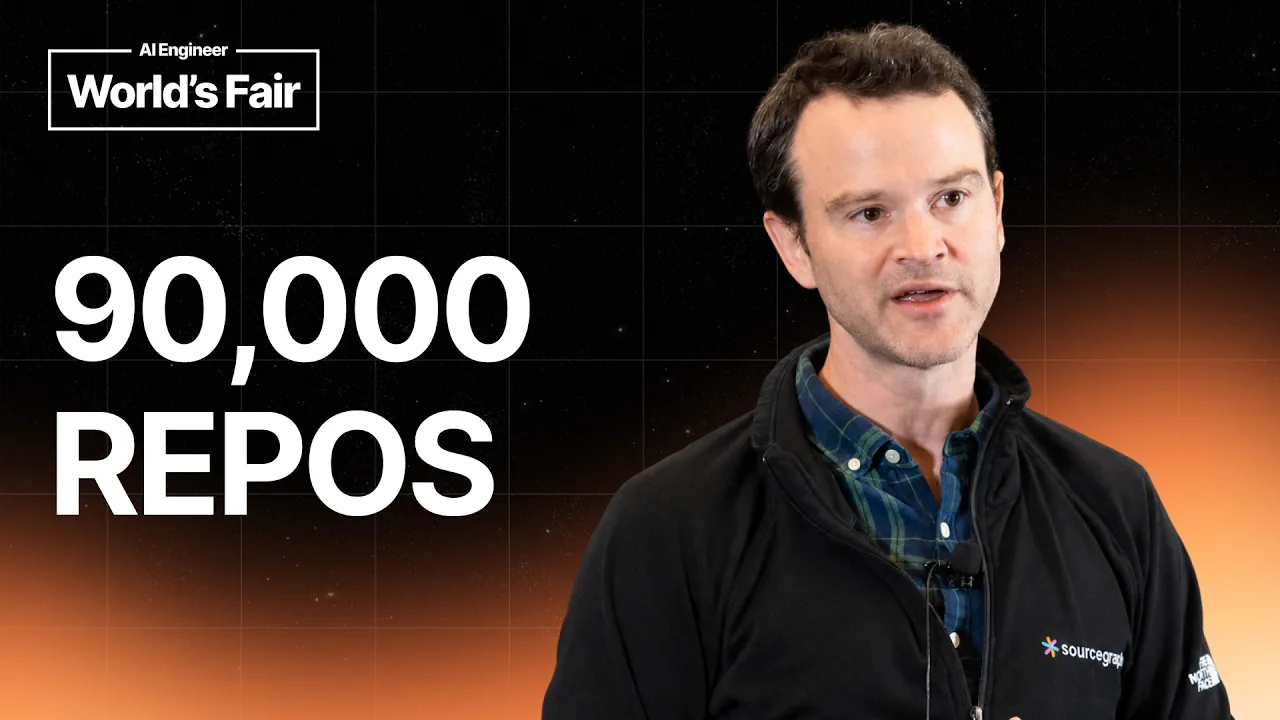
Description
Claude Code can make the change. But what if you have 90,000 repositories to make it in? Dan Adler, CEO of Sourcegraph, makes the case for the people who own the huge, decades-old codebases that run banks, cars and airlines. Coding agents are producing a tidal wave of code, and those codebases are starting to decay through duplicated code, drifting standards, brittle dependencies and new vulnerabilities. Agents understand code by searching, but you can't grep what you can't see. Dan argues that large-scale code visibility is infrastructure, and introduces Sourcegraph's Agentic Batch Changes for making changes across thousands of repos from a single prompt. In this talk: • Why most software engineers work in large, long-lived codebases • How AI-generated code accelerates codebase decay • Why context, not model quality, is the bottleneck at enterprise scale • Making and auditing changes across thousands of repos SPEAKER Dan Adler, CEO, Sourcegraph LinkedIn: https://www.linkedin.com/in/danielnealadler/ X: https://x.com/DanielNealAdler LINKS Sourcegraph: https://sourcegraph.com Introducing Agentic Batch Changes: https://sourcegraph.com/blog/introducing-agentic-batch-changes CHAPTERS 0:00 Intro 0:12 Owning a large codebase 0:37 The software that runs the world 2:02 A tidal wave of AI-generated code 2:57 Codebases are starting to decay 3:57 Owning a codebase is harder than ever 4:31 "I don't know what this code does" 5:11 Codebase owners deserve better 6:06 A call to dev tools builders 6:31 "I have 90,000 repositories" 7:21 Agents love to search 7:51 You can't grep what you can't see 8:21 There will be much more code 8:56 The code graph 9:21 Agentic Batch Changes 10:21 Case study: Mercari 11:11 How many repos do you really have? Recorded at the AI Engineer World's Fair 2026 in San Francisco. Subscribe for more talks from the engineers building with AI. AI Engineer: https://ai.engineer YouTube: https://www.youtube.com/@aiDotEngineer X: https://x.com/aiDotEngineer Li
Summary
Generated by gpt-5.6-terraAt-a-Glance
- Verdict: Watch fully
- Core thesis: AI coding agents will increase the rate at which large enterprises accumulate inconsistent, duplicative, vulnerable code unless they are paired with codebase-wide visibility, dependency intelligence, and controlled mechanisms for executing changes across thousands of repositories.
- Why it matters: For any organization deploying coding agents beyond isolated repositories, the limiting problem shifts from generating code to maintaining global understanding, security coverage, standards, and auditability across a distributed software estate.
- Best use: Use this as a strategic framing for an agentic engineering control plane: agents need searchable, compiler-aware codebase context plus governed rollout workflows, not merely better prompts or repository instruction files.
Executive Summary
Dan Adler argues that AI coding agents are improving local developer productivity while worsening the operational problem of owning large, long-lived enterprise codebases. Enterprises run thousands to tens of thousands of repositories, much of it legacy code supporting critical systems. As agents rapidly create patches and features, they also amplify code volume, inconsistent conventions, duplicate implementations, brittle cross-service dependencies, and the security review burden.
His central distinction is between local coding competence and global codebase understanding. An agent can often make a requested change in one repository, but it cannot safely assess or apply that change throughout an organization if it cannot discover all relevant repositories, dependencies, deployed versions, and usage patterns. Adler frames this as a context and visibility problem: LLMs rely heavily on search, but agents cannot search code they cannot see.
The proposed answer is codebase infrastructure rather than another point coding assistant: a searchable, compiler-accurate code graph spanning the organization, coupled with an orchestration layer for large-scale changes. Sourcegraph's product pitch is an agentic batch-change system that can identify affected locations, choose agents for judgment-heavy work and deterministic scripts for repeatable edits, respond to CI and PR feedback, and maintain rollout tracking and auditability.
The strongest practical example is a Mercari early-access user who began with a known GitHub code-injection configuration issue in two repositories, then expanded the search across a large microservice estate and found 80 additional potential vulnerabilities. The talk is promotional, but its architecture lesson is useful: agentic coding at enterprise scale needs discovery, scoped execution, verification, and evidence of complete coverage.
Key Takeaways
- Claim: The main enterprise risk from coding agents is not simply incorrect code in a single pull request; it is accelerated codebase decay caused by substantially more code arriving across a fragmented repository estate. | Evidence: Adler cites enterprises with millions of lines of code and tens of thousands of repositories, including a top-10 U.S. bank leader describing a supply-chain remediation problem across 90,000 repositories. He identifies inconsistent standards, duplicate code, brittle cross-service dependencies, and newly exposed vulnerabilities as the resulting failure modes. | Implication: Engineering leadership should treat AI-generated-code volume as an architectural governance and maintenance-capacity issue, not only a developer-tool adoption metric. | Caveat: The talk offers a strategic argument rather than measured comparative data proving that agents are already the primary cause of these failures.
- Claim: Repository-level prompts, instructions, and local context windows are insufficient for safe agent operation in large organizations because the relevant change surface often spans many repositories and services. | Evidence: Adler says a 50,000-repository environment cannot fit in a context window or be cloned and grepped in real time, and characterizes agents.md-style repository architecture instructions as only marginally helpful for organization-wide understanding. | Implication: Agent systems should retrieve from an organization-wide knowledge layer that represents repositories, dependencies, and production relevance, rather than relying exclusively on the checked-out repository. | Caveat: A global index reduces the discovery problem but does not itself establish business intent, ownership, or whether a technically matching location should be changed.
- Claim: Searchable, compiler-accurate code intelligence is foundational infrastructure for agents that need to understand and safely evolve a large codebase. | Evidence: Adler's proposed foundation is a 'code graph' combining broad search with compiler-accurate analysis, which he says lets agents determine how code relates and where changes should be made. | Implication: When evaluating coding-agent platforms, prioritize cross-repository search, semantic/dependency analysis, and freshness of indexing alongside model quality and IDE experience. | Caveat: The transcript does not specify graph freshness requirements, supported languages, handling of dynamic runtime dependencies, or the false-positive/false-negative rate of its analysis.
- Claim: Enterprise-wide remediation needs a controlled orchestration workflow that mixes agent reasoning with deterministic automation instead of delegating every edit to an LLM. | Evidence: Sourcegraph's beta agentic batch-changes product is described as starting from one prompt and iteratively rolling changes across hundreds or thousands of repositories, reacting to CI status and PR comments, using coding agents where judgment is needed and deterministic scripts for repeatable changes. | Implication: Design bulk-change systems with explicit task decomposition: semantic investigation and exception handling can use agents, while uniform transformations should use versioned deterministic tooling with human approval gates. | Caveat: This is a vendor product description; the transcript provides no independent reliability, rollback, approval, or cost results.
- Claim: Coverage and auditability are first-class requirements for agentic remediation, especially for vulnerabilities and policy-driven changes. | Evidence: Adler repeatedly emphasizes proving that changes reached '100%' of affected locations, and says the batch workflow provides tracking and auditability across the rollout. | Implication: Do not judge remediation agents solely by the quality of generated patches; require a record of asset discovery, candidate matches, actions taken, CI/PR outcomes, exceptions, and remaining unremediated scope. | Caveat: Complete coverage depends on the system accurately discovering all repositories, forks, copies, deployed artifacts, and relevant configurations—an inventory problem the transcript recognizes but does not solve in detail.
- Claim: A codebase-wide agent can surface previously unknown security exposure when it expands a known pattern beyond the initially identified repositories. | Evidence: At Mercari, an early-access user addressing a GitHub code-injection issue involving environment-variable configuration started with two known repositories, searched the broader microservice environment, and found 80 additional potential vulnerabilities; Adler says the changes could be applied consistently with a deterministic script. | Implication: Use known incidents and CVEs as seed patterns for codebase-wide discovery campaigns, but preserve triage and validation stages before treating pattern matches as confirmed findings. | Caveat: These were described as 'potential vulnerabilities,' and the transcript does not state how many were confirmed, merged, deployed, or remediated without manual intervention.
Detailed Brief
The operational asymmetry between code generation and code ownership
- Claims: Adler argues that the same tools making individual developers faster are increasing the burden on the people responsible for the long-term health of shared systems.; He positions large-enterprise code ownership as unglamorous but load-bearing work because critical business and physical-world processes depend on old, interconnected software.; His framing rejects the startup-centric assumption that software can be understood as a small number of clean, newly built repositories.
- Evidence: He states that 72% of software-industry employment is in companies with more than 500 employees.; Examples of systems dependent on complex legacy software include bank transaction limits, insurance reimbursement calculations, warehouse-scanner logistics, Uber arrival estimates, aircraft radar trajectory adjustments, payroll, and building HVAC.; A technology executive at a top-10 car manufacturer reportedly overheard a developer say, 'I don't know what this code does. AI wrote it for me,' which Adler presents as particularly alarming in a vehicle-autopilot environment.
- Caveats: The 72% employment figure is asserted without a source or methodology in the transcript.; The automotive anecdote is second-hand and illustrative rather than evidence of a general incidence rate.
- Implications: The adoption decision for coding agents should include a funded ownership model for system-level quality, dependency management, and incident response.; Organizations with safety-critical or regulated workloads should set a higher bar for traceability and comprehension than teams using agents for isolated application work.
What a scalable batch-change control plane should expose
- Claims: The speaker's target user is a codebase owner who needs to initiate a broad change from a single intent statement while retaining operational visibility.; The system must account not only for canonical repositories but also forks, copies, internally introduced repositories, and code that may be live in production through libraries or APIs.
- Evidence: Adler asks operators to consider how many repositories, forks, and copies exist, and whether developer-imported repositories are now connected to production systems.; He describes the desired workflow as iteratively rolling out changes, responding to CI and pull-request comments, and tracking the whole remediation campaign.
- Caveats: The transcript does not explain how deployment inventory is joined to source-code inventory, which is necessary to answer what code is actually running.
- Implications: A practical control plane should integrate source inventory with ownership, CI, code review, artifact/deployment, and exception-management data rather than stopping at repository search.; Discovery results should be classified into confirmed targets, candidates requiring review, inaccessible assets, and out-of-scope copies to avoid a misleading claim of complete remediation.
Notable Concepts & Terms
- Codebase decay: The speaker's term for the gradual degradation of a large software estate through incompatible standards, duplication, dependency brittleness, and unmanaged vulnerability exposure as change volume rises.
- Code graph: A foundational representation of code relationships intended to combine broad search with compiler-accurate analysis so agents can reason beyond one repository.
- Visibility is infrastructure: Adler's core architectural principle: agents need organization-wide access to relevant source and relationships before they can make reliable global changes.
- Agentic batch changes: Sourcegraph's beta workflow for using one prompt to coordinate changes across hundreds or thousands of repositories, with iterative feedback from CI and pull requests.
- Deterministic scripts: Repeatable, non-LLM transformations used for uniform edits, positioned as safer and more consistent than agent-generated changes when judgment is not needed.
- Coverage and auditability: The ability to establish where a required patch applies, what was changed, what failed or was excluded, and whether remediation reached the full discovered scope.
- Context problem: The limitation that an LLM cannot infer or search across repositories and dependencies outside its accessible context, even if it can code well locally.
Operator Notes / Why Ken Should Care
- Define an enterprise coding-agent acceptance checklist requiring cross-repository discovery, semantic/dependency analysis, CI and PR feedback handling, approval gates, rollback support, and campaign-level audit logs.
- Run a pilot using one known, low-risk but broadly distributed issue—such as a configuration policy, deprecated library, or CVE—to measure discovery recall, false positives, patch consistency, review burden, and time to verified deployment.
- Build or reconcile a source-to-production inventory before authorizing autonomous bulk remediation; explicitly include repositories, forks, vendored code, artifacts, services, and accountable owners.
- Route repeatable mechanical edits through tested deterministic transformations and reserve LLM agent execution for investigation, adaptation, and exception handling.
- Require developers to attest to or document understanding for high-risk AI-authored changes; do not let 'AI wrote it' become an acceptable ownership boundary in safety-critical or regulated code.
Source/Metadata
- Title: AI Coding Agents Are Breaking Big Codebases — Dan Adler, Sourcegraph
- Transcript words: 3805
- Duration seconds: 743
- Timestamp note: No usable timestamps or chapters were present. The supplied transcript substantially repeats the core talk content.
Transcript
[SPEAKER_00] Dan Adler Hey, welcome everybody. I'm Dan Adler, CEO at Sourcegraph. It is great to see you all here today. Thank you so much for coming out and joining us. This is a talk today about the unglamorous but load-bearing work of owning a large complex code base and why AI and agentic coding tools today make that job more difficult and more important than ever before. Just to start, the software that runs the world is not pretty. It's not new. It's not clean. It's how everything actually works. 72% of software industry employment is in companies with more than 500 people. These are the large enterprises of the world. These are the companies managing thousands of repositories and decades of code base history. Few of your peers work at startups, at the hot companies you may hear about on social media, and even fewer of them are actually ex-solopreneurs making a living off of their social feeds. Most of us work in large, long-lived code bases. Those code bases are how your bank account will reject the transaction in real time if you hit your limit. They're how your insurance carrier calculates the reimbursement rate for a policyholder with dual coverage. It's how a chip in a warehouse scanner will allow Amazon to tell you when your socks arrive. It's how your Uber estimates an arrival time. It's how an airplane uses radar to adjust trajectories. How your paycheck gets issued. It's how your office air conditioner ticks on and on and on and on and on. These are the things that keep the world moving. We are all completely, utterly dependent on massive, decades-old, super complex code bases that have been built over many years by thousands of engineers. And coding agents are writing more, better code today faster than we have ever seen before. A tidal wave of code is coming for you. It's coming for your code base and for all of your engineers on your team who are trying to just keep their heads above water. Every one of us has felt this pain, this flood of AI-generated code that we now have to review and make sure is healthy for our code base. And we're exhausted by it. And look, there are now code review agents. I'm sure there's a lot of them around this room right now. There are tools designed to help you measure your code base's health and so on. And the major coding agents will start to pull this stuff in. The models will get better. Over time, we'll keep putting sandbags down to keep this flood held back. We're going to keep finding these local maxima to help ourselves avoid this problem. But meanwhile, what's happening is that these code bases, these massive ones that keep the world running, are beginning to decay. Millions of lines of code, tens of thousands of repositories, way too much to fit into a context window, or even just to clone and grep in real time. That's just not possible. And this is causing big problems. We're publishing new features, new patches at record speed. There are different coding standards being applied in different places by different agents across the code base. There's duplicated code proliferating. You already have a library that does this, but your agent doesn't know that. There's cross-service dependencies that are becoming more brittle. There are slight deviations in standards that are creating more insidious hidden issues across the code base. And maybe more important than anything else here, there are new vulnerabilities being uncovered by agents every single day. They require constant oversight and upkeep of all of these massive legacy code bases that nobody wants to think about or deal with. The job of owning a code base is harder today than it has ever been before. And at the end of the day, the problem here is actually the volume of code. The call is coming from inside the house. The very tools that are speeding all of us up and letting us write more code faster than ever are also the tools that are creating the conditions that will cause these massive code bases that run our world to begin to fail. Every day I talk to technology executives at these large companies and they are feeling this so viscerally. The same pain that I imagine many of you are feeling too. I want to give my devs the best tools possible. But just today, I overheard a dev say, I don't know what this code does. AI wrote it for me. This is a tech leader and executive at a top 10 car manufacturer. When you're writing vehicle autopilot code and you have thousands of engineers in your org that you have to manage, you want to enable. This is terrifying. All right, here we go. So what I deeply believe is that these code base owners deserve better. Today's agentic dev tools are not meeting the moment for this. The infrastructure to see and understand a 50,000 repo code base is not being built or sold by OpenAI, by Anthropic, by Cursor, by the rest of them. This is a hard and unique problem. Their agents are so incredibly good at solving the small scale problems that most developers deal with every day that their demand is growing faster than ever before. And this bigger problem of these code bases beginning to fall apart is going unnoticed. So this session is a call, first of all, to celebrate the people, the owners of these code bases, people around the world who are actually keeping them alive and keeping them running. Most of our software engineer peers around the globe. So thank you all so much for what you're doing. But this session is also a call to dev tools companies out there, to the agent harness builders, to people who are building the infrastructure for these agents, to help build the ability to go see and understand these massive scale repositories and give that to their agents. This is a great quote that I heard from a tech leader at one of the top 10 US banks, tens of trillions of dollars in assets in custody or administration. Sure, Cloud Code can make this change, but I have 90,000 repositories to make it in. This is actually a specific quote about a specific supply chain vulnerability, an NPM thing. But if you're a bank and you're seeing agents uncover and create these new vulnerabilities at an unprecedented pace, and you're being told to go use Cloud Code to solve this, that's a problem. Good luck doing that in 90,000 repositories, mapping out how these code bases all come together, what's actually living in production across your company, across your product offerings. Because at the end of the day, what's really funny about all this is that if we know anything about LLMs, it's that they just love to search. It's how a new hire gets up to speed on the code base. It's how agents build models of the world. The repo architecture that you're plugging into your agents.md files, that's barely moving the needle here. This agent is going to grep, grep, grep, grep, grep, grep, grep its way to code base understanding. That's simply how it works. But understanding is a context problem. You can't grep what you literally cannot see. This is the tools and infrastructure that's needed. And the infrastructure to go see and search and really deeply understand a 500 or 5,000 or 50,000 or half a million repo code base is not being built by the agent builders today. And so that's what we're solving, what we're working on as a company. This is what Sourcegraph is built around. Give this a second. If you'll let me sort of take a moment and predict the future of our industry. These massive code bases are not going away. In fact, there will be more code. There will be much, much, much more code out there in the future. And we believe very deeply that building tools to give agents the ability to actually see and understand and evolve those large code bases is essential for the future. And where this comes from at the end of the day is having a code graph in mind. The foundational graph of your code base, including search and then the actual compiler accurate output, if you go and do that analysis, that is essential to give your agents the ability to go and understand how to make changes effectively. Visibility is infrastructure. And we actually built a lot on top of this. We're not stopping here. Actually, just today we launched our new agentic batch changes product into beta. This is a frontier agent. And its job is to let the owner of a massive code base actually execute code changes across hundreds or thousands of repositories at once, starting with a single prompt. This is a product that will iteratively roll out changes across that code base, self-heal, respond to CI status, PR comments, use coding agents where it makes sense, where judgment is needed, use deterministic scripts where it's not, and provide tracking and auditability to be sure that you've covered 100% of the places where that patch is needed, where that change is needed. Because like I keep saying here, at the end of the day, this is an infrastructure problem. When you're putting code out there into the world, you need to make sure that it's actually going to keep your code base healthy, that it's actually going to be able to adapt to the places where your code base is beginning to fall apart. Here's a great quote from an early access user, actually at Mercari, a global shopping tool out of Japan, incredible company, massive code base, hundreds and hundreds of independent microservices running in production. This user was using this product to patch a GitHub code injection issue where you have to set environment variables correctly. He ran this on two repos where he knew this issue existed and then said, yeah, go explore the rest of our code base and found 80 other potential vulnerabilities across their code base in other places. This is config files. This is basically just going and doing that scan. Patching them all in one go with a deterministic script that can go make sure it's making that change consistently, effectively across 100 of the places where that risk exists, that is what confidence is all about in the agentic coding era. So yeah, I'll stop here. If you're wondering right now about how many repos in your code base, how many forks are there out there, how many copies of repos are there out there, how many repos have your developers brought into your company and are now being plugged in as a library or an API somewhere in your code base that's live in production that you're not aware of, that's the sort of thing that we're here to help. If you're wondering what code is deployed right now and how you can go scan it all and see it all and make sure it's all updated, come talk to me. And tonight we're actually hosting an event here in SF called Code Cocktails and Cutovers. Come on out, join us, come find us, bring your gnarliest code base stories. This is where we want to talk and hear from all of you about what you're trying to deal with and how you're dealing with the tidal wave of code that's coming for you. Cool. Thank you. I'll stop there. Any questions? in real time if you hit your limit. They're how your insurance carrier calculates the reimbursement rate for a policyholder with dual coverage. It's how a chip in a warehouse scanner will actually allow Amazon to tell you when your socks arrive. It's how your Uber estimates an arrival time. It's how an airplane uses radar to adjust trajectories. How your paycheck gets issued. It's how your office air conditioner ticks on and on and on and on and on. These are the things that keep the world moving. We are all completely, utterly dependent on massive, decades-old, super complex code bases that have been built over many, many years by thousands of engineers. And coding agents are writing more better code today faster than we have ever seen before. A tidal wave of code is coming for you. It's coming for your code base and for all of your engineers on your team who are trying to just keep their heads above water. Every one of us has felt this pain, this flood of AI-generated code that we now have to review and make sure is healthy for our code base. And we're exhausted by it. And look, there are now code review agents. I'm sure there's a lot of them around this room right now. There are tools designed to help you measure your code base's health and so on. And look, the new, the major coding agents will start to pull this stuff in. The models will get better. Over time, we'll keep putting sandbags down to keep this flood held back, right? We're going to keep finding these local maxima to help ourselves sort of avoid this problem. But meanwhile, what's happening is that these code bases, these massive ones that keep the world running, are beginning to decay. Millions of lines of code, tens of thousands of repositories, way too much to fit into a context window, or even just to clone and grep in real time. That's just not possible. And this is causing big problems. We're publishing new features, new patches at record speed. There are different coding standards being applied in different places by different agents across the code base. There's duplicated code proliferating. You already have a library that does this, but your agent doesn't know that. There's cross-service dependencies that are becoming more brittle. There are slight deviations in standards that are creating more insidious hidden issues across the code base. And maybe more important than anything else here, there are new vulnerabilities being uncovered by agents every single day. They require constant, constant oversight and upkeep of all of these massive legacy code bases that nobody wants to think about or deal with. The job of owning a code base is harder today than it has ever been before. And at the end of the day, the problem here is actually the volume of code. The call is coming from inside the house, right? The very tools that are speeding all of us up and letting us write more code faster than ever are also the tools that are creating the conditions that will cause these massive code bases that run our world to begin to fail. Every day I talk to technology executives at these large companies and they are feeling this so viscerally. The same pain that I imagine many of you are feeling too, right? I want to give my devs the best tools possible. But just today, I overheard a dev say, I don't know what this code does. AI wrote it for me. This is a tech leader and executive at a top 10 car manufacturer. When you're writing vehicle autopilot code and you have thousands of engineers in your org that you have to manage, you have to manage. You want to enable. This is terrifying. All right, here we go. So what I deeply believe is that these code base owners deserve better. Today's agentic dev tools are not meeting the moment for this. The infrastructure to see and understand a 50,000 repo code base is not being built or sold by open AI, by anthropic, by cursor, by the rest of them. This is a hard and unique problem. Their agents are so unbelievably good at solving the small scale problems that most developers deal with every day that their demand is growing faster than ever before. And this bigger problem of these code bases beginning to fall apart is going unnoticed. So this session, this is a call, first of all, off to celebrate the people, the owners of these code bases, people around the world who are actually keeping them alive and keeping them running. Most of our software engineer peers around the globe. So thank you all so much for what you're doing. But this session is also a call to dev tools companies out there, to the agent harness builders, to people who are building the infrastructure, the infrastructure for these agents, to help build the infrastructure, the ability to go see and understand these massive scale repositories and give that to their agents. This is a great quote that I heard from a tech leader at one of the top 10 US banks, tens of trillions of dollars in assets in custody or administration. Sure, cloud code can make this change, but I have 90,000 repositories to make it in. This is actually a specific quote about a specific supply chain vulnerability, an NPM thing. Won't get into it. But if you're a bank and you're seeing agents uncover and create these new vulnerabilities at an unprecedented pace, and you're being told to go use cloud code to solve this, that's a problem. Good luck doing that in 90,000 repositories, mapping out how these code bases all come together, what's actually living in production across your company, across your product offerings. Because at the end of the day, right, what's really funny about all this is that if we know anything about LLMs, it's that they just love to search. It's like a new hire getting up to speed on the code base. It's how agents build models of the world. The repo architecture that you're plugging into your agents.md files, like let's be real, that's barely moving the needle here. This agent is going to grep, grep, grep, grep, grep, grep, grep, grep, grep, grep its way to code base understanding. That's simply how it works. But understanding is a context problem. You can't grep what you literally cannot see. This is tools and infrastructure that's needed. And the infrastructure to go see and search and really deeply understand a 500 or 5,000 or 50,000 or half a million repo code base is not being built by the agent builders today. And so that's where what we're solving, what we're working on as a company. This is what Sourcegraph is built around, right? Give this a second. If you'll let me sort of take a moment and predict the future of our industry. These massive code bases are not going away. In fact, there will be more code. There will be much, much, much more code out there in the future. And we believe very deeply that building tools to give agents the ability to actually see and understand and evolve those large code bases is essential for the future. And where this comes from at the end of the day is having a graph, that code graph in mind. The foundational graph of your code base, including search and then the actual compiler accurate output, if you go and do that analysis, that is essential to give your agents the ability to go and understand how to make changes effectively. Visibility is infrastructure. And we actually built a lot on top of this, right? We're not stopping here. Actually, just today we launched our new agentic batch changes product into beta. This is a frontier agent. And its job is to let the owner of a massive code base actually execute code changes across hundreds or thousands of repositories at once, starting with a single prompt. This is a product that will iteratively roll out changes across that code base, self-heal, respond to CI status, PR comments, use coding agents where it makes sense, where judgment is needed, use deterministic scripts where it's not, and provide tracking and auditability to be sure that you've covered 100% of the places where that patch is needed, where that change is needed. Because like I keep saying here, at the end of the day, this is an infrastructure problem. When you're putting code out there into the world, you need to make sure that it's actually going to keep your code base healthy, that it's actually going to be able to adapt to the places where your code base is beginning to fall apart. Here's a great quote from an early access user, actually at Mercari, a global shopping tool out of Japan, incredible company, massive code base, hundreds and hundreds of independent microservices running in production. This user was using this product to go actually patch a GitHub code injection issue where you have to set environment variables correctly. He ran this on two repos where he knew this issue existed and then said, yeah, go explore the rest of our code base and found 80 other potential vulnerabilities across their code base in other places. This is like config files. This is basically just going and doing that scan. Patching them all in one go with a sort of deterministic script that can go make sure it's making that change consistently, effectively across 100 of the places where that risk exists, that is what confidence is all about in the agentic coding era. So yeah, I'll stop here. If you're wondering right now about like how many repos in your code base, how many forks are there out there, how many copies of repos are there out there, how many repos have your developers brought into your company and are now being plugged in as a library or an API somewhere in your code base that's live in production that you're not aware of, that's the sort of thing that we're here to help. Right? If you're wondering what code is deployed right now and how you can go scan it all and see it all and make sure it's all updated, come talk to me. And tonight we're actually hosting an event here in SF called Code Cocktails and Cutovers. Come on out, join us, come find us, bring your gnarliest code base stories. This is where we want to talk and hear from all of you about what you're trying to deal with and how you're dealing with the tidal wave of code that's coming for you. Cool. Thank you. I'll stop there. Any questions? Thank you.