Let's build the GPT Tokenizer
Description
The Tokenizer is a necessary and pervasive component of Large Language Models (LLMs), where it translates between strings and tokens (text chunks). Tokenizers are a completely separate stage of the LLM pipeline: they have their own training sets, training algorithms (Byte Pair Encoding), and after training implement two fundamental functions: encode() from strings to tokens, and decode() back from tokens to strings. In this lecture we build from scratch the Tokenizer used in the GPT series from OpenAI. In the process, we will see that a lot of weird behaviors and problems of LLMs actually trace back to tokenization. We'll go through a number of these issues, discuss why tokenization is at fault, and why someone out there ideally finds a way to delete this stage entirely. Chapters: 00:00:00 intro: Tokenization, GPT-2 paper, tokenization-related issues 00:05:50 tokenization by example in a Web UI (tiktokenizer) 00:14:56 strings in Python, Unicode code points 00:18:15 Unicode byte encodings, ASCII, UTF-8, UTF-16, UTF-32 00:22:47 daydreaming: deleting tokenization 00:23:50 Byte Pair Encoding (BPE) algorithm walkthrough 00:27:02 starting the implementation 00:28:35 counting consecutive pairs, finding most common pair 00:30:36 merging the most common pair 00:34:58 training the tokenizer: adding the while loop, compression ratio 00:39:20 tokenizer/LLM diagram: it is a completely separate stage 00:42:47 decoding tokens to strings 00:48:21 encoding strings to tokens 00:57:36 regex patterns to force splits across categories 01:11:38 tiktoken library intro, differences between GPT-2/GPT-4 regex 01:14:59 GPT-2 encoder.py released by OpenAI walkthrough 01:18:26 special tokens, tiktoken handling of, GPT-2/GPT-4 differences 01:25:28 minbpe exercise time! write your own GPT-4 tokenizer 01:28:42 sentencepiece library intro, used to train Llama 2 vocabulary 01:43:27 how to set vocabulary set? revisiting gpt.py transformer 01:48:11 training new tokens, example of prompt compression 0
Summary
Generated by gpt-5.6-terraAt-a-Glance
- Verdict: Watch fully
- Core thesis: Tokenizer design is a first-order part of LLM capability, efficiency, reliability, and security—not a minor preprocessing detail—and byte-pair encoding (BPE) explains both its utility and many of its failure modes.
- Why it matters: For anyone building or operating agent systems, tokenization changes context utilization, multilingual and code performance, structured-output reliability, prompt-edge behavior, tool/chat formatting, cost, and potential attack surface.
- Best use: Use this as a technical foundation for evaluating model/tokenizer fit, debugging anomalous prompt behavior, designing special-token protocols, and deciding when custom tokenizer work or tokenizer-aware testing is warranted.
Executive Summary
The speaker builds a GPT-style tokenizer from first principles and argues that tokens—not characters or words—are the atomic units an LLM actually receives, embeds, attends over, and predicts. A tokenizer translates Unicode text into integer IDs; the model then maps each ID through an embedding table. Because context windows, training-data quantities, inference costs, and output softmaxes are all denominated in tokens, the tokenizer materially shapes what the model can learn and efficiently process.
The core implementation is byte-level BPE. Text is encoded in UTF-8, yielding a universal base vocabulary of 256 byte values. Training repeatedly finds the most frequent adjacent token pair, replaces it with a new token ID, and records the merge. More merges yield shorter sequences but a larger vocabulary, embedding table, and output classifier. The trained merge table and vocabulary support reversible encode/decode behavior, though arbitrary predicted byte sequences may be invalid UTF-8 and require replacement-character error handling.
The video then shows why production tokenizers are more than naive BPE. GPT-2/GPT-4 use regex pre-tokenization rules that prevent merges across selected categories such as letters, numbers, and punctuation; GPT-4 expands vocabulary from roughly 50K to 100K, improves whitespace handling for code, makes contractions case-insensitive, and limits numeric chunks to at most three digits. SentencePiece, used by Llama and Mistral families, instead runs BPE over Unicode code points and can fall back to byte tokens for unseen characters. These choices affect language coverage, code density, arithmetic behavior, and operational edge cases.
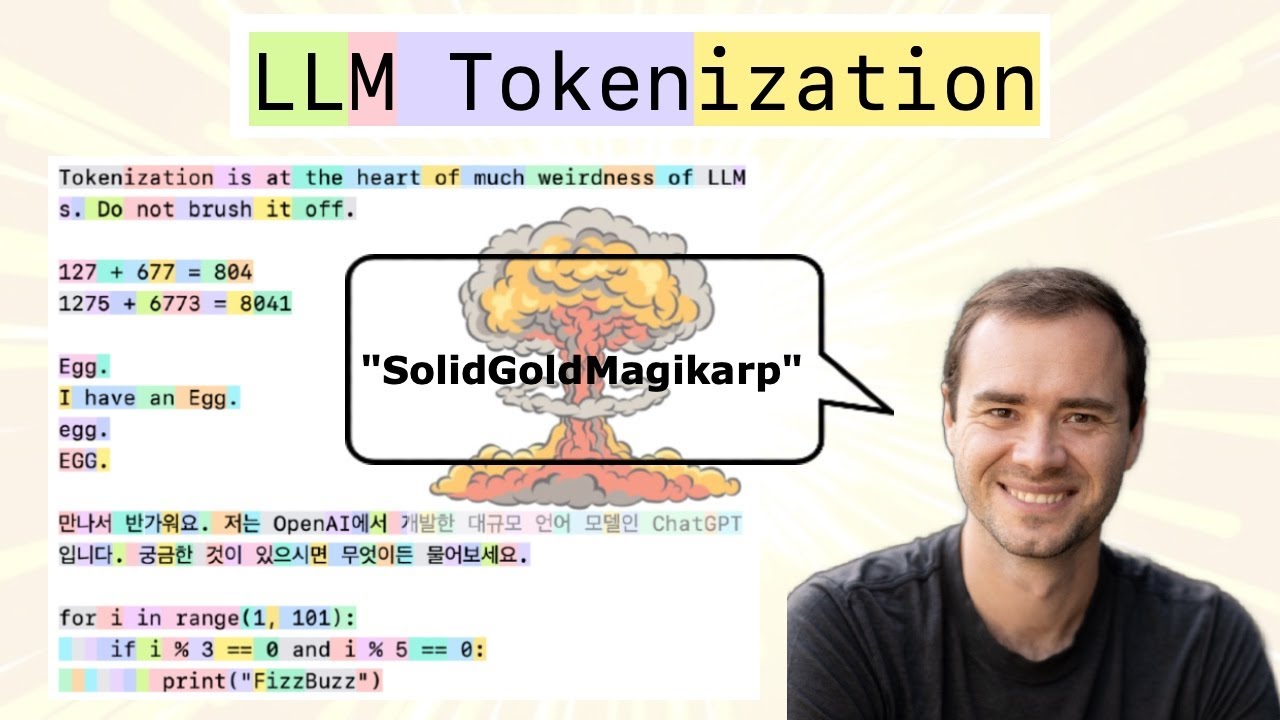
The strongest practical section connects tokenization to otherwise puzzling LLM behavior: poor spelling/reversal, inconsistent arithmetic, weaker non-English performance, trailing-space degradation, malformed partial-token completions, special-token injection risks, and the famous "SolidGoldMagikarp" failure mode. The central operating lesson is to treat tokenizer behavior as part of the model interface and test it explicitly wherever an application depends on exact strings, code formatting, multilingual input, numeric reasoning, or serialized protocols.
Key Takeaways
- Claim: Tokenization is an architectural and product-performance decision because it determines the sequence that the transformer actually sees, not merely a lossless text-preprocessing step. | Evidence: In GPT-2, a vocabulary of 50,257 tokens and a 1,024-token context window means the model attends over token chunks rather than characters; each token has an embedding-table row and an output-classifier target. GPT-4-class tokenizers use roughly 100K vocabulary entries. | Implication: Compare models and estimate workflow capacity in tokenizer-specific tokens, especially for long-context agents, code-heavy workloads, and multilingual inputs; character counts are an unreliable proxy. | Caveat: A larger vocabulary improves text compression and effective context coverage but increases embedding/output-layer parameters and computation, and rare token representations can receive less training.
- Claim: Byte-level BPE offers universal text coverage while allowing vocabulary size to trade off against sequence length. | Evidence: The implementation begins with UTF-8 bytes (256 base tokens), repeatedly merges the most frequent adjacent pair, and assigns each merge a new token ID. On the speaker's longer example, only 20 merges reduced approximately 24,000 raw-byte tokens to approximately 19,000 tokens, a compression ratio of about 1.27. | Implication: If training or adapting a model, curate tokenizer-training data intentionally—language mix, code, whitespace conventions, and domain syntax determine which inputs become dense versus fragmented. | Caveat: A tokenizer is trained separately from the LLM and on its own corpus; its merge statistics may not represent the language-model training mix or production workload.
- Claim: Tokenizer training-data imbalance directly disadvantages non-English text by consuming more tokens for the same meaning and thus reducing usable context. | Evidence: The speaker illustrates an English phrase tokenizing to five tokens while its Korean translation takes 15; even a common Korean greeting is split into three tokens while English "hello" can be one. More English corpus exposure creates longer English merges, while underrepresented scripts remain fragmented. | Implication: For international agent products, benchmark token counts, costs, context retention, and task quality by language; do not assume nominal context windows or per-token economics are equitable across locales. | Caveat: Non-English model quality also depends on the LLM's language-model training data and model capability, not tokenization alone.
- Claim: Production GPT tokenizers impose regex-based merge boundaries and special rules, so their behavior cannot be inferred from BPE alone. | Evidence: GPT-2 pre-splits text across letters, numbers, punctuation, contractions, and whitespace before applying BPE, preventing certain merges such as letter-to-space boundaries. GPT-4 changes these rules, including case-insensitive contraction handling and a rule that numeric chunks can contain only one to three digits. | Implication: Treat exact tokenizer behavior as implementation-specific and versioned. For reliable prompt, parser, completion, or protocol behavior, test against the deployed tokenizer rather than assuming generic BPE semantics. | Caveat: The speaker notes that OpenAI released GPT-2 inference code and tokenizer artifacts, not the full tokenizer-training code; some training-time constraints are therefore undocumented.
- Claim: Tokenizer improvements can account for meaningful coding gains independently of model-scale or architecture improvements. | Evidence: Under GPT-2 tokenization, Python indentation spaces commonly appear as separate token 220 instances; GPT-4's tokenizer groups runs of whitespace, including examples of four and seven spaces as single tokens. On the shown text, switching from GPT-2 to CL100K/GPT-4 tokenization reduces count from 300 to 185. | Implication: When selecting models for code agents, inspect tokenization of representative repositories, indentation, syntax, and generated patches—not only coding benchmark scores. | Caveat: The speaker frames tokenization as one contributor to coding performance, alongside model architecture, data, optimization, and scale.
- Claim: Special tokens are essential control-plane primitives for document boundaries, chat turns, fill-in-the-middle, and tool/message protocols, but require both model changes and input-safety controls. | Evidence: GPT-2's 50,257th token is an end-of-text delimiter inserted between documents. GPT-4-family encodings include end-of-text plus fill-in-the-middle prefix/middle/suffix tokens; chat formats add message start/end markers. Adding a token requires extending the embedding table and output projection, often initializing the new row/column randomly. | Implication: Separate untrusted user content from reserved control tokens, explicitly configure special-token acceptance, and regression-test serialization boundaries for agents that use tool calls, message templates, or internal delimiters. | Caveat: The video demonstrates apparent abnormal behavior when a user supplies the literal end-of-text string and warns that special-token handling of attacker-controlled text can become an attack surface; it does not establish OpenAI's exact backend implementation.
- Claim: Many seemingly irrational LLM failures are predictable consequences of token chunks, partial tokens, and undertrained token embeddings. | Evidence: The speaker links poor spelling and string reversal to long multi-character tokens such as ".defaultstyle"; arithmetic suffers because digit boundaries are arbitrarily merged; a trailing standalone space creates an out-of-distribution token sequence relative to the common space-prefixed word token; and "SolidGoldMagikarp" is hypothesized to be a tokenizer-corpus merge whose token was absent from LM training, leaving its embedding effectively untrained. | Implication: Avoid relying on raw LLM generation for character-exact operations, numerical algorithms, or malformed-prefix continuation; route these tasks through deterministic tools, constrained decoding, or tokenizer-aware transformations. | Caveat: The SolidGoldMagikarp account is presented as a plausible reconstruction rather than a definitively proven explanation, and tokenization is not the sole source of all model mistakes.
Detailed Brief
Implementation model: train once, encode/decode everywhere
- Claims: The tokenizer is a separate trained artifact, not a component learned jointly during ordinary LLM pretraining.; Its essential learned state can be represented by a merge mapping and a vocabulary mapping between token IDs and byte sequences.; A typical pipeline tokenizes the full LLM corpus in advance, stores token IDs rather than raw text, and trains the model over that token stream.
- Evidence: The BPE trainer stores each frequent pair-to-new-ID merge, creating what the speaker calls a binary forest rooted in base byte tokens.; Decoding expands IDs to bytes and then UTF-8-decodes them; encoding begins with UTF-8 bytes and applies eligible merges in training order.; The implementation must handle empty or one-token input specially because no adjacent-pair statistics exist.
- Caveats: Not every arbitrary sequence of token IDs produces valid UTF-8, because byte-level token sequences can end or begin mid-character; decoding should use replacement behavior rather than strict failure in serving paths.; Merge order matters: later tokens may depend on earlier merges, and relying on dictionary insertion order requires modern Python semantics in the demonstrated implementation.
- Implications: Persist tokenizer version, vocabulary, merge rules, regex/preprocessing configuration, and special-token map alongside every model artifact.; Add encode-decode round-trip, malformed-byte, empty-input, and unseen-text tests to tokenizer validation rather than testing only model outputs.
SentencePiece versus TikToken: two incompatible design philosophies
- Claims: TikToken/GPT-style tokenization applies BPE over UTF-8 bytes, guaranteeing coverage of arbitrary text at the base-token layer.; SentencePiece typically applies BPE to observed Unicode code points and handles rare or unseen characters using either an unknown token or optional UTF-8 byte fallback.; SentencePiece can train and infer efficiently and is widely used in Llama and Mistral, but has a broader and more historically accumulated configuration surface.
- Evidence: In the speaker's Llama-like SentencePiece setup, vocabulary ordering is special tokens, 256 byte-fallback tokens, merge tokens, then observed raw code-point tokens.; With byte fallback enabled, unseen Korean text is encoded through UTF-8 byte tokens; with it disabled, the unseen content collapses to the single unknown-token ID.; Llama-style settings include a dummy leading whitespace prefix so sentence-initial words can share the same whitespace-prefixed representation as mid-sentence words.
- Caveats: The speaker expresses a preference for byte-level TikToken as conceptually cleaner, but this is an engineering judgment rather than a benchmark-backed universal conclusion.; SentencePiece normalization, sentence limits, character coverage, digit splitting, whitespace handling, and fallback options can substantially change behavior; defaults should not be assumed to match Llama.
- Implications: When adapting an open-weight model, use the model's released tokenizer artifact and exact preprocessing settings; replacing it with a superficially similar tokenizer invalidates token IDs and model semantics.; For custom multilingual vocabularies, byte fallback is a critical robustness decision because unknown-token collapse destroys distinctions among unseen inputs.
Vocabulary expansion and tokens as learned interfaces
- Claims: Vocabulary size is an empirical hyperparameter balancing compression against embedding/output-layer cost and token-frequency dilution.; A pretrained model can be extended with new special tokens through modest model surgery: resize the input embeddings and final vocabulary projection, then train selected parameters.; New tokens can encode more than delimiters; they can serve as trainable compressed representations of long prompts or non-text modalities.
- Evidence: Vocabulary size only enters the demonstrated GPT architecture directly in the token embedding table and final language-model head, but each additional token enlarges both.; The cited GIST-token approach freezes the model and trains only newly added token embeddings to approximate the behavior of a much longer prompt.; The speaker describes an emerging multimodal pattern: tokenize image, video, or audio representations and process them through transformer systems as token sequences.
- Caveats: Fresh token embeddings/output weights begin untrained and require sufficient targeted training exposure; merely registering a token does not create reliable semantics.; Overly large vocabulary chunks can reduce the model's effective opportunity to reason over fine-grained structure, despite improving compression.
- Implications: Prefer compact, explicitly trained control-token schemes over proliferating ad hoc protocol strings.; Evaluate learned prompt compression or modality-token projects as model-interface changes with dedicated quality, safety, and distribution-shift testing.
Notable Concepts & Terms
- Byte-pair encoding (BPE): An iterative compression algorithm that adds a token for the most frequent adjacent pair; it is the core mechanism used in the constructed GPT-style tokenizer.
- UTF-8 byte-level tokenization: Using UTF-8 bytes as the 256-token universal base vocabulary before BPE merges, ensuring arbitrary Unicode text can be represented.
- Pre-tokenization: Regex or rule-based segmentation before BPE that controls which character categories may merge; it is a major source of model-specific tokenizer behavior.
- TikToken / CL100K base: OpenAI's tokenizer library and a GPT-4-era encoding with roughly 100K vocabulary entries, improved whitespace grouping, and distinct regex rules.
- SentencePiece: A tokenizer library used by Llama, Mistral, and others; it can train tokenizers and differs from TikToken by operating primarily on Unicode code points with optional byte fallback.
- Byte fallback: SentencePiece behavior that encodes unseen code points as UTF-8 byte tokens rather than collapsing them into an unknown token.
- Special tokens: Reserved IDs outside normal BPE behavior that delimit documents, conversations, fill-in-the-middle regions, or other structured protocol states.
- Unstable or partial tokens: Prompt suffixes that end inside the character span of a common token, creating unusual token sequences and potentially degraded completion behavior.
Operator Notes / Why Ken Should Care
- Add tokenizer-level regression fixtures to agent/platform CI: multilingual prompts, indentation-heavy code, JSON/YAML/tool payloads, numeric strings, trailing whitespace, and reserved-token literals.
- Audit every prompt/message serialization layer to ensure user-controlled content cannot be interpreted as special control tokens; define explicit escaping or disallow-list behavior.
- Instrument token counts by customer language, workflow type, and payload format before setting context budgets, price assumptions, retrieval chunk sizes, or truncation policies.
- Use deterministic calculators, parsers, formatters, and string libraries for character-level, arithmetic, and schema-critical operations instead of asking the base LLM to perform them directly.
- For any open-weight adaptation, pin the exact released tokenizer files and special-token configuration with the model checkpoint; never substitute a tokenizer based only on apparent algorithmic similarity.
- If evaluating custom vocabularies or token additions, require evidence that added tokens receive sufficient training exposure and do not degrade existing token distributions or protocol safety.
Source/Metadata
- Title: Let's build the GPT Tokenizer
- Transcript words: 25150
- Duration seconds: 8014
- Timestamp note: No timestamps or chapters were present in the supplied transcript. The transcript is substantive but appears to cut off near the end of the video's final discussion.
Transcript
Hi everyone. In this video I'd like us to cover the process of tokenization in large language models. Now you see here that I have a sad face, and that's because tokenization is my least favorite part of working with large language models, but unfortunately it is necessary to understand in some detail because it is fairly hairy, gnarly, and there's a lot of hidden foot guns to be aware of, and a lot of oddness with large language models typically traces back to tokenization. So what is tokenization? In my previous video, Let's Build GPT from Scratch, we actually already did tokenization, but we did a very naive, simple version of tokenization. So when you go to the Google Colab for that video, you see here that we loaded our training set, and our training set was this Shakespeare dataset. Now in the beginning, the Shakespeare dataset is just a large string in Python. It's just text. And so the question is, how do we plug text into large language models? And in this case here, we created a vocabulary of 65 possible characters that we saw occur in this string. These were the possible characters, and we saw that there are 65 of them, and then we created a lookup table for converting from every possible character, a little string piece, into a token, an integer. So here, for example, we tokenized the string hi there, and we received this sequence of tokens. And here we took the first 1000 characters of our dataset and encoded it into tokens. And because this is character level, we received 1000 tokens in a sequence. So token 1847, etc. Now later we saw that the way we plug these tokens into the language model is by using an embedding table. And so if we have 65 possible tokens, then this embedding table is going to have 65 rows. And roughly speaking, we're taking the integer associated with every single token, using that as a lookup into this table, and plucking out the corresponding row. And this row is trainable parameters that we're going to train using backpropagation. And this is the vector that then feeds into the transformer. And that's how the transformer perceives every single token. So here we had a very naive tokenization process that was a character-level tokenizer. But in practice, in state-of-the-art language models, people use a lot more complicated schemes, unfortunately, for constructing these token vocabularies. So we're not dealing on the character level, we're dealing on chunk level. And the way these character chunks are constructed is using algorithms such as, for example, the byte pair encoding algorithm, which we're going to go into in detail and cover in this video. I'd like to briefly show you the paper that introduced a byte-level encoding as a mechanism for tokenization in the context of large language models. And I would say that that's probably the GPT-2 paper. And if you scroll down here to the section input representation, this is where they cover tokenization, the kinds of properties that you'd like the tokenization to have. And they conclude here that they're going to have a tokenizer where you have a vocabulary of 50,257 possible tokens. And the context size is going to be 1024 tokens. So in the attention layer of the transformer neural network, every single token is attending to the previous tokens in the sequence, and it's going to see up to 1024 tokens. So tokens are this fundamental unit, the atom of large language models, if you will. And everything is in units of tokens. Everything is about tokens. And tokenization is the process for translating strings or text into sequences of tokens, and vice versa. When you go into the LAMA2 paper as well, I can show you that when you search token, you're going to get 63 hits. And that's because tokens are, again, pervasive. So here they mentioned that they trained on 2 trillion tokens of data, and so on. So we're going to build our own tokenizer. Luckily, the byte-bearing coding algorithm is not that super complicated. And we can build it from scratch ourselves. And we'll see exactly how this works. Before we dive into code, I'd like to give you a brief taste of some of the complexities that come from tokenization. Because I just want to make sure that we are motivated sufficiently for why we are doing all this and why this is so gross. So tokenization is at the heart of a lot of weirdness in large language models. And I would advise that you do not brush it off. A lot of the issues that may look like just issues with the neural network architecture or the large language model itself are actually issues with the tokenization and fundamentally trace back to it. So if you've noticed any issues with large language models not being able to do spelling tasks very easily, that's usually due to tokenization. Simple string processing can be difficult for the large language model to perform natively. Non-English languages can work much worse. And to a large extent, this is due to tokenization. Sometimes LLMs are bad at simple arithmetic, which also can be traced to tokenization. GPT-2 specifically would have had quite a bit more issues with Python than future versions of it due to tokenization. There's a lot of other issues. Maybe you've seen weird warnings about a trailing white space. This is a tokenization issue. If you had asked GPT earlier about solid gold Magikarp and what it is, you would see the LLM go totally crazy, and it would start going off about a completely unrelated tangent topic. Maybe you've been told to use YAML over JSON in structured data. All of that has to do with tokenization. So tokenization is at the heart of many issues. I will loop back around to these at the end of the video. But for now, let me just skip over it a little bit. And let's go to this web app, the tick tokenizer.versele.app. So I have it loaded here. And what I like about this web app is that tokenization is running live in your browser in JavaScript. So you can just type here stuff, hello world, and the whole string retokenizes. So here what we see on the left is a string that you put in. On the right, we're currently using the GPT-2 tokenizer. We see that this string that I pasted here is currently tokenizing into 300 tokens. And here they are shown explicitly in different colors for every single token. So, for example, this word tokenization became two tokens, the token 30,642 and 1,634. The token space is token 318. So be careful. On the bottom you can show white space. And keep in mind that there are spaces and slash n newline characters in here, but you can hide them for clarity. The token space at is token 379. The token space the is 262, etc. So you notice here that the space is part of that token chunk. Now, so this is how our English sentence broke up, and that seems all well and good. Now here I put in some arithmetic. So we see that the token 127 plus and then token 6 space 6 followed by 77. So what's happening here is that 127 is feeding in as a single token into the large language model, but the number 677 will actually feed in as two separate And keep in mind that there are spaces and slash n newline characters in here, but you can hide them for clarity. The token space at is token 379. The token space the is 262, etc. So you notice here that the space is part of that token chunk. Now, this is how our English sentence broke up, and that seems all well and good. Now here I put in some arithmetic. So we see that the token 127 plus and then token 6 space 6 followed by 77. So what's happening here is that 127 is feeding in as a single token into the large language model, but the number 677 will actually feed in as two separate tokens. And so the large language model has to take account of that and process it correctly in its network. And see here, 804 will be broken up into two tokens. And it's all completely arbitrary. And here I have another example of four-digit numbers, and they break up in a way that they break up, and it's totally arbitrary. Sometimes you have multiple digits, single token. Sometimes you have individual digits as many tokens, and it's all pretty arbitrary and coming out of the tokenizer. Here's another example. We have the string egg. And you see here that this became two tokens. But for some reason, when I say I have an egg, you see when it's a space egg, it's two token. It's sorry, it's a single token. So just egg by itself in the beginning of a sentence is two tokens. But here as a space egg is suddenly a single token for the exact same string. Okay. Here, lowercase egg turns out to be a single token. And in particular, notice that the color is different. So this is a different token. So this is case sensitive. And of course, capital egg would also be different tokens. And again, this would be two tokens arbitrarily. So for the same concept egg, depending on if it's in the beginning of a sentence, at the end of a sentence, lowercase, uppercase, or mixed, all this will be very different tokens and different IDs. And the language model has to learn from raw data, from all the internet text that it's going to be training on, that these are actually all the exact same concept. And it has to group them in the parameters of the neural network and understand just based on the data patterns that these are all very similar, but maybe not almost exactly similar, but very, very similar. After the egg demonstration here, I have an introduction from OpenAI's Chachipt in Korean. So, mannaso, pangaboya, etc. So this is in Korean. And the reason I put this here is because you'll notice that non-English languages work slightly worse in Chachipt. Part of this is because, of course, the training data set for Chachipt is much larger for English than for everything else. But the same is true not just for the large language model itself, but also for the tokenizer. So when we train the tokenizer, we're going to see that there's a training set as well. And there's a lot more English than non-English. And what ends up happening is that we're going to have a lot more longer tokens for English. So how do I put this? If you have a single sentence in English and you tokenize it, you might see that it's 10 tokens or something like that. But if you translate that sentence into, say, Korean or Japanese or something else, you'll typically see that the number of tokens used is much larger. And that's because the chunks here are a lot more broken up. So we're using a lot more tokens for the exact same thing. And what this does is it bloats up the sequence length of all the documents. So you're using up more tokens. And then in the attention of the transformer, when these tokens try to attend each other, you are running out of context in the maximum context length of that transformer. And so all the non-English text is stretched out from the perspective of the transformer. And this just has to do with the training that's used for the tokenizer and the tokenization itself. So it will create a lot bigger tokens and a lot larger groups in English. And it will have a lot of little boundaries for all the other non-English text. So if we translated this into English, it would be significantly fewer tokens. The final example I have here is a little snippet of Python for doing FizzBuzz. And what I'd like you to notice is, look, all these individual spaces are all separate tokens. They are token 220. So 220, 220, 220, 220, 220, and then space if is a single token. And so what's going on here is that when the transformer is going to consume or try to create this text, it needs to handle all these spaces individually. They all feed in one by one into the entire transformer in the sequence. And so this is being extremely wasteful, tokenizing it in this way. And so as a result of that, GPT-2 is not very good with Python. And it's not anything to do with coding or the language model itself. It's just that if you use a lot of indentation using space in Python, like we usually do, you just end up bloating out all the text, and it's separated across way too much of the sequence. And we are running out of the context length in the sequence. That's roughly speaking what's happening. We're being way too wasteful. We're taking up way too much token space. Now we can also scroll up here and we can change the tokenizer. So note here that GPT-2 tokenizer creates a token count of 300 for this string here. We can change it to CL100k base, which is the GPT-4 tokenizer. And we see that the token count drops to 185. So for the exact same string, we are now roughly halving the number of tokens. And roughly speaking, this is because the number of tokens in the GPT-4 tokenizer is roughly double that of the number of tokens in the GPT-2 tokenizer. So we went from roughly 50k to roughly 100k. Now you can imagine that this is a good thing because the same text is now squished into half as many tokens. So this is a lot denser input to the transformer. And in the transformer, every single token has a finite number of tokens before it that it's going to pay attention to. And so what this is doing is we're roughly able to see twice as much text as a context for what token to predict next because of this change. But of course, just increasing the number of tokens is not strictly better infinitely, because as you increase the number of tokens, now your embedding table is getting a lot larger. And also at the output, we are trying to predict the next token, and there's the softmax there, and that grows as well. We're going to go into more detail later on this, but there's some kind of a sweet spot somewhere where you have a just right number of tokens in your vocabulary where everything is appropriately dense and still fairly efficient. Now, one thing I would like you to note specifically for the GPT-4 tokenizer is that the handling of the white space for Python has improved a lot. You see that here, these four spaces are represented as one single token for the three spaces here and then the token spasif. And here, seven of tokens, now your embedding table is getting a lot larger. And also at the output, we are trying to predict the next token, and there's the softmax there, and that grows as well. We're going to go into more detail later on this, but there's a sweet spot somewhere where you have a just right number of tokens in your vocabulary, where everything is appropriately dense and still fairly efficient. Now, one thing I would like you to note specifically for the GPT-4 tokenizer is that the handling of the white space for Python has improved a lot. You see that here, these four spaces are represented as one single token for the three spaces here, and then the token spasif. And here, seven spaces were all grouped into a single token. So we're being a lot more efficient in how we represent Python. And this was a deliberate choice made by OpenAI when they designed the GPT-4 tokenizer. And they group a lot more white space into a single character. What this does is densify Python, and therefore we can attend to more code before it when we're trying to predict the next token in the sequence. And so the improvement in the Python coding ability from GPT-2 to GPT-4 is not just a matter of the language model and the architecture and the details of the optimization, but a lot of the improvement here is also coming from the design of the tokenizer and how it groups characters into tokens. Okay, so let's now start writing some code. So remember what we want to do. We want to take strings and feed them into language models. For that, we need to somehow tokenize strings into some integers in some fixed vocabulary. And then we will use those integers to make a lookup into a lookup table of vectors and feed those vectors into the transformer as an input. Now, the reason this gets a little bit tricky, of course, is that we don't just want to support the simple English alphabet. We want to support different kinds of languages. So this is Annyeonghaseyo in Korean, which is hello. And we also want to support many kinds of special characters that we might find on the internet. For example, emoji. So how do we feed this text into transformers? Well, what is this text anyway in Python? So if you go to the documentation of a string in Python, you can see that strings are immutable sequences of Unicode code points. Okay, what are Unicode code points? We can go to Wikipedia. So Unicode code points are defined by the Unicode Consortium as part of the Unicode standard. And what this really is, is that it's just a definition of roughly 150,000 characters right now, and, roughly speaking, what they look like and what integers represent those characters. So this is 150,000 characters across 161 scripts as of right now. So if you scroll down here, you can see that the standard is very much alive. The latest standard, 15.1, is September 2023. And this is just a way to define lots of types of characters. For example, all these characters across different scripts. So the way we can access the Unicode code point given a single character is by using the ORT function in Python. So, for example, I can pass in ORT of age. And I can see that for the single character H, the Unicode code point is 104. Okay. But this can be arbitrarily complicated. So we can take, for example, our emoji here, and we can see that the code point for this one is 128,000. Or we can take un, and this is 50,000. Now keep in mind, you can't plug in strings here, because this doesn't have a single code point. It only takes a single Unicode code point character and tells you its integer. So in this way, we can look up all the characters of this specific string and their code points. So ORT of x, 4x in this string, and we get this encoding here. Now, see here, we've already turned the raw code points already have integers. So why can't we simply just use these integers and not have any tokenization at all? Why can't we just use this natively as is and just use the code point? Well, one reason for that, of course, is that the vocabulary in that case would be quite long. So in this case, for Unicode, this is a vocabulary of 150,000 different code points. But more worryingly than that, I think, the Unicode standard is very much alive, and it keeps changing. And so it's not a stable representation necessarily that we may want to use directly. So for those reasons, we need something a bit better. So to find something better, we turn to encodings. So if we go to the Wikipedia page here, we see that the Unicode Consortium defines three types of encodings: UTF-8, UTF-16, and UTF-32. These encodings are the way by which we can take Unicode text and translate it into binary data or byte streams. UTF-8 is by far the most common. So this is the UTF-8 page. Now, this Wikipedia page is actually quite long. But what's important for our purposes is that UTF-8 takes every single code point, and it translates it to a byte stream. And this byte stream is between one to four bytes. So it's a variable-length encoding. So depending on the Unicode point, according to the schema, you're going to end up with between one to four bytes for each code point. On top of that, there's UTF-8, UTF-16, and UTF-32. UTF-32 is nice because it is fixed length instead of variable length, but it has many other downsides as well. So the full spectrum of pros and cons of all these three different encodings is beyond the scope of this video. I'd just like to point out that I enjoyed this blog post, and this blog post, at the end of it, also has a number of references that can be quite useful. One of them is UTF-8 Everywhere Manifesto. And this manifesto describes the reason why UTF-8 is significantly preferred and a lot nicer than the other encodings and why it is used a lot more prominently on the internet. One of the major advantages, just to give you a sense, is that UTF-8 is the only one of these that is backwards compatible to the much simpler ASCII encoding of text. But I'm not going to go into the full detail in this video. So suffice it to say that we like the UTF-8 encoding. And let's try to take this string and see what we get if we encode it into UTF-8. The string class in Python actually has .encode, and you can give it the encoding, which is, say, UTF-8. Now, what we get out of this is not very nice because this is the bytes, is a bytes object, and it's not very nice in the way that it's printed. So I personally like to take it through a list because then we actually get the raw bytes of this encoding. So this is the raw bytes that represent this string according to the UTF-8 encoding. We can also look at UTF-16. We get a slightly different byte stream. And here we start to see one of the disadvantages of UTF-16. You see how we have zero something, zero something, zero something. We're starting to get a sense that this is a bit of a wasteful encoding. And indeed, for simple ASCII characters or English characters here, we just have is a bytes object, and it's not very nice in the way that it's printed. So I personally like to take it through a list because then we actually get the raw bytes of this encoding. So this is the raw bytes that represent this string according to the UTF-8 encoding. We can also look at UTF-16. We get a slightly different byte stream. And here we start to see one of the disadvantages of UTF-16. You see how we have zero something, zero something, zero something. We're starting to get a sense that this is a bit of a wasteful encoding. And indeed, for simple ASCII characters, or English characters here, we just have the structure of zero something, zero something, and it's not exactly nice. Same for UTF-32. When we expand this, we can start to get a sense of the wastefulness of this encoding for our purposes. You see a lot of zeros followed by something, and so this is not desirable. So suffice it to say that we would like to stick with UTF-8 for our purposes. However, if we just use UTF-8 naively, these are byte streams. So that would imply a vocabulary length of only 256 possible tokens. But this vocabulary size is very, very small. What this is going to do, if we just were to use it naively, is that all of our text would be stretched out over very, very long sequences of bytes. And so what this does is that certainly the embedding table is going to be tiny, and the prediction at the top of the final layer is going to be very tiny, but our sequences are very long. And remember that we have pretty finite context length and the attention that we can support in a transformer for computational reasons. And so we only have as much context length, but now we have very, very long sequences. And this is just inefficient, and it's not going to allow us to attend to sufficiently long text before us for the purposes of the next token prediction task. So we don't want to use the raw bytes of the UTF-8 encoding. We want to be able to support larger vocabulary size that we can tune as a hyperparameter, but we want to stick with the UTF-8 encoding of these strings. So what do we do? Well, the answer, of course, is we turn to the byte-pair encoding algorithm, which will allow us to compress these byte sequences to a variable amount. So we'll get to that in a bit, but I just want to briefly speak to the fact that I would love nothing more than to be able to feed raw byte sequences into language models. In fact, there's a paper about how this could potentially be done from summer last year. Now, the problem is you actually have to go in and you have to modify the transformer architecture, because, as I mentioned, you're going to have a problem where the attention will start to become extremely expensive because the sequences are so long. And so in this paper, they propose a hierarchical structuring of the transformer that could allow you to just feed in raw bytes. And so at the end, they say, together, these results establish the viability of tokenization-free autoregressive sequence modeling at scale. So tokenization-free would indeed be amazing. We would just feed byte streams directly into our models. But unfortunately, I don't know that this has really been proven out yet by sufficiently many groups and at sufficient scale. But something like this at one point would be amazing, and I hope someone comes up with it. But for now, we have to come back, and we can't feed this directly into language models, and we have to compress it using the byte-pair encoding algorithm. So let's see how that works. So, as I mentioned, the byte-pair encoding algorithm is not all that complicated. And the Wikipedia page is actually quite instructive as far as the basic idea goes. What we're doing is we have some kind of an input sequence. For example, here we have only four elements in our vocabulary, A, B, C, and D, and we have a sequence of them. So instead of bytes, let's say we just had four, a vocab size of four. The sequence is too long, we'd like to compress it. So what we do is that we iteratively find the pair of tokens that occur the most frequently. And then, once we've identified that pair, we replace that pair with just a single new token that we append to our vocabulary. So, for example, here, the byte-pair AA occurs most often, so we mint a new token. Let's call it capital Z, and we replace every single occurrence of AA by Z. So now we have two Zs here. So here we took a sequence of 11 characters with vocabulary size 4, and we've converted it to a sequence of only nine tokens, but now with a vocabulary of five, because we have a fifth vocabulary element that we just created, and it's Z standing for concatenation of AA. And we can again repeat this process. So we again look at the sequence and identify the pair of tokens that are most frequent. Let's say that that is now AB. Well, we are going to replace AB with a new token that we mint, called Y. So Y becomes AB, and then every single occurrence of AB is now replaced with Y. So we end up with this. So now we only have one, two, three, four, five, six, seven characters in our sequence, but we have not just four vocabulary elements, or five, but now we have six. And for the final round, we again look through the sequence, find that the phrase Zy, or the pair Zy, is most common, and replace it one more time with another character, let's say X. So X is Zy, and we replace all occurrences of Zy, and we get this following sequence. So after we have gone through this process, instead of having a sequence of 11 tokens with a vocabulary length of four, we now have a sequence of one, two, three, four, five tokens, but our vocabulary length now is seven. And so in this way, we can iteratively compress our sequence as we mint new tokens. So in the exact same way, we start out with byte sequences. So we have 256 vocabulary size, but we're now going to go through these and find the byte pairs that occur the most. And we're going to iteratively start minting new tokens, appending them to our vocabulary, and replacing things. And in this way, we're going to end up with a compressed training dataset and also an algorithm for taking any arbitrary sequence and encoding it using this vocabulary, and also decoding it back to strings. So let's now implement all that. So here's what I did. I went to this blog post that I enjoyed, and I took the first paragraph, and I copy-pasted it here into text. So this is one very long line here. Now, to get the tokens, as I mentioned, we just take our text and we encode it into UTF-8. The tokens here at this point will be raw bytes, a single stream of bytes. And just so that it's easier to work with, instead of just a bytes object, I'm going to convert all those bytes to integers, and then create a list of it, just so it's easier for us to manipulate and work with in Python and visualize. And here I'm printing all that. So this is the original paragraph, and its length is 533 code points. And then here are the bytes encoded in UTF-8. and I copy-pasted it here into text. So this is one very long line here. Now, to get the tokens, as I mentioned, we just take our text and we encode it into UTF-8. The tokens here at this point will be raw bytes, a single stream of bytes. And just so that it's easier to work with, instead of just a bytes object, I'm going to convert all those bytes to integers and then create a list of them, just so it's easier for us to manipulate and work with in Python and visualize. And here I'm printing all that. So this is the original paragraph, and its length is 533 code points. And then here are the bytes encoded in UTF-8. And we see that this has a length of 616 bytes at this point, or 616 tokens. And the reason this is more is because a lot of these simple ASCII characters, or simple characters, just become a single byte. But a lot of these Unicode, more complex characters, become multiple bytes, up to four. And so we are expanding that size. So now what we'd like to do as a first step of the algorithm is iterate over here and find the pair of bytes that occur most frequently, because we're then going to merge it. So if you are working along in a notebook on the side, then I encourage you to click on the link, find this notebook, and try to write that function yourself. Otherwise, I'm going to come here and first implement the function that finds the most common pair. Okay, so here's what I came up with. There are many different ways to implement this. But I'm calling the function getStats. It expects a list of integers. I'm using a dictionary to keep track of the counts. And then this is a Pythonic way to iterate consecutive elements of this list, which we covered in the previous video. And then here, I'm just keeping track of incrementing by one for all the pairs. So if I call this on all the tokens here, then the stats come out here. So this is the dictionary. The keys are these tuples of consecutive elements. And this is the count. So just to print it in a slightly better way, this is one way that I like to do that, where it's a little bit compound here. So you can pause if you like, but we iterate all the items. The items call on a dictionary returns pairs of key and value. And instead, I create a list here of value and key, because if it's a value-key list, then I can call sort on it. And by default, Python will use the first element, which in this case will be value, to sort by if it's given tuples, and then reverse. So it's descending, and print that. So it looks like 101 comma 32 was the most commonly occurring consecutive pair, and it occurred 20 times. We can double-check that that makes reasonable sense. So if I just search 101, 32, then you see that these are the 20 occurrences of that pair. And if we'd like to take a look at what exactly that pair is, we can use char, which is the opposite of ord in Python. So we give it a Unicode code point, 101 and 32. And we see that this is E and space. So there's a lot of E space here, meaning that a lot of these words seem to end with E. So here's E space as an example. So there's a lot of that going on here. And this is the most common pair. So now that we've identified the most common pair, we would like to iterate over the sequence. We're going to mint a new token with the ID of 256, right? Because these tokens currently go from zero to 255. So when we create a new token, it will have an ID of 256. And we're going to iterate over this entire list. And every time we see 101 comma 32, we're going to swap that out for 256. So let's implement that now. And feel free to do that yourself as well. So first, I commented this just so we don't pollute the notebook too much. This is a nice way in Python of obtaining the highest- ranking pair. So we're calling max on this dictionary, stats. And this will return the maximum key. And then the question is, how does it rank keys? So you can provide it with a function that ranks keys. And that function is just stats.get. Stats.get would return the value. And so we're ranking by the value and getting the maximum key. So it's 101 comma 32, as we saw. Now, to actually merge 101 32, this is the function that I wrote. But again, there are many different versions of it. So we're going to take a list of IDs and the pair that we want to replace. And that pair will be replaced with the new index IDX. So iterating through IDs, if we find the pair, swap it out for IDX. So we create this new list. And then we start at zero. And then we go through this entire list sequentially from left to right. And here we are checking for equality at the current position with the pair. So here we are checking that the pair matches. Now here's a bit of a tricky condition that you have to append if you're trying to be careful. And that is that you don't want this here to be out of bounds at the very last position when you're on the rightmost element of this list. Otherwise, this would give you an out-of-bounds error. So we have to make sure that we're not at the very, very last element. So this would be false for that. So if we find a match, we append to this new list that replacement index, and we increment the position by two. So we skip over that entire pair. But otherwise, if we haven't found a matching pair, we just copy over the element at that position and increment by one and then return this. So here's a very small toy example. If we have a list 566791 and we want to replace the occurrences of 67 with 99, then calling this on that will give us what we're asking for. So here the 67 is replaced with 99. So now I'm going to uncomment this for our actual use case, where we want to take our tokens, we want to take the top pair here and replace it with 256 to get tokens 2. If we run this, we get the following. So recall that previously we had a length of 616 in this list. And now we have a length of 596, right? So this decreased by 20, which makes sense because there are 20 occurrences. Moreover, we can try to find 256 here, and we see plenty of occurrences of it. And moreover, just to double-check, there should be no occurrence of 10132. So this is the original array, with plenty of them. And in the second array, there are no occurrences of 10132. So we've successfully merged this single pair. And now we just iterate this. So we are going to go over the sequence again, find the most common pair, and replace it. So let me now write a while loop that uses these functions to do this iteratively. And how many times do we do it? Well, that's totally up to us as a hyperparameter. The more steps we take, the larger our vocabulary will be, and the shorter our sequence will be. And there is some sweet spot occurrence of 10132. So this is the original array, plenty of them. And in the second array, there are no occurrences of 10132. So we've successfully merged this single pair. And now we just iterate this. So we are going to go over the sequence again, find the most common pair, and replace it. So let me now write a while loop that uses these functions to do this iteratively. And how many times do we do it for? Well, that's totally up to us as a hyperparameter. The more steps we take, the larger will be our vocabulary, and the shorter will be our sequence. And there is some sweet spot that we usually find works the best in practice. And so this is a hyperparameter, and we tune it, and we find good vocabulary sizes. As an example, GPT-4 currently uses roughly 100,000 tokens. And, ballpark, those are reasonable numbers currently in state-of-the-art large language models. So let me now write, putting it all together and iterating these steps. Okay, now before we dive into the while loop, I wanted to add one more cell here, where I went to the blog post, and instead of grabbing just the first paragraph or two, I took the entire blog post, and I stretched it out in a single line. And just using longer text will allow us to have more representative statistics for the byte pairs, and we'll just get more sensible results out of it because it's longer text. So here we have the raw text, we encode it into bytes using the UTF-8 encoding. And then here, as before, we are just changing it into a list of integers in Python, just so it's easier to work with instead of the raw bytes objects. And then this is the code that I came up with to actually do the merging in loop. These two functions here are identical to what we had above. I only included them here just so that you have the point of reference here. So these two are identical, and then this is the new code that I added. So the first thing we want to do is we want to decide on the final vocabulary size that we want our tokenizer to have. And as I mentioned, this is a hyperparameter, and you set it in some way depending on your best performance. So let's say for us, we're going to use 276, because that way we're going to be doing exactly 20 merges. And 20 merges, because we already have 256 tokens for the raw bytes. And to reach 276, we have to do 20 merges to add 20 new tokens. Here, this is one way in Python to just create a copy of a list. So I'm taking the tokens list, and by wrapping it in the list, Python will construct a new list of all the individual elements. So this is just a copy operation. Then here, I'm creating a merges dictionary. So this merges dictionary is going to maintain the child one, child two mapping to a new token. And so what we're going to be building up here is a binary tree of merges. But actually, it's not exactly a tree, because a tree would have a single root node with a bunch of leaves. For us, we're starting with the leaves on the bottom, which are the individual bytes. Those are the starting 256 tokens. And then we're starting to merge two of them at a time. And so it's not a tree, it's more like a forest as we merge these elements. So for 20 merges, we're going to find the most commonly occurring pair. We're going to mint a new token integer for it. So I here will start at zero. So we're going to start at 256. We're going to print that we're merging it. And we're going to replace all the occurrences of that pair with the newly minted token. And we're going to record that this pair of integers merged into this new integer. So running this gives us the following output. So we did 20 merges. And for example, the first merge was exactly as before, the 101, 32 tokens merging into a new token 256. Now keep in mind that the individual tokens 101 and 32 can still occur in the sequence after merging. It's only when they occur exactly consecutively that that becomes 256 now. And in particular, the other thing to notice here is that the token 256, which is the newly minted token, is also eligible for merging. So here on the bottom, the 20th merge was a merge of 256 and 259 becoming 275. So every time we replace these tokens, they become eligible for merging in the next round of the iteration. So that's why we're building up a small binary forest instead of a single individual tree. One thing we can take a look at as well is we can take a look at the compression ratio that we've achieved. So in particular, we started off with this tokens list. So we started off with 24,000 bytes. And after merging 20 times, we now have only 19,000 tokens. And so, therefore, the compression ratio, simply dividing the two, is roughly 1.27. So that's the amount of compression we're able to achieve of this text with only 20 merges. And of course, the more vocabulary elements you add, the greater the compression ratio here would be. Finally, that's the training of the tokenizer, if you will. Now, one point that I wanted to make is that, and maybe this is a diagram that can help illustrate, is that the tokenizer is a completely separate object from the large language model itself. So everything in this lecture, we're not really touching the LLM itself. We're just training the tokenizer. This is a completely separate preprocessing stage, usually. So the tokenizer will have its own training set, just like a large language model has a potentially different training set. So the tokenizer has a training set of documents on which you're going to train the tokenizer. And then we're performing the byte pair encoding algorithm, as we saw above, to train the vocabulary of this tokenizer. So it has its own training set, it has a preprocessing stage that you would run a single time in the beginning. And the tokenizer is trained using the byte pair encoding algorithm. Once you have the tokenizer, once it's trained, and you have the vocabulary, and you have the merges, we can do both encoding and decoding. So these two arrows here. So the tokenizer is a translation layer between raw text, which is, as we saw, the sequence of Unicode code points. It can take raw text and turn it into a token sequence. And vice versa, it can take a token sequence and translate it back into raw text. So now that we have trained the tokenizer and we have these merges, we are going to turn to how we can do the encoding and the decoding step. If you give me text, here are the tokens, and vice versa. If you give me tokens, here's the text. Once we have that, we can translate between these two realms. And then the language model is going to be trained as a step two afterwards. And typically, in a state-of-the-art application, you might take all of your training data for the language model, and you might run it through the tokenizer and translate everything into a massive token sequence. And then you can throw away the raw text. You're just left So now that we have trained the tokenizer and we have these merges, we are going to turn to how we can do the encoding and the decoding step. If you give me text, here are the tokens, and vice versa. If you give me tokens, here's the text. Once we have that, we can translate between these two realms. And then the language model is going to be trained as a step two afterwards. And typically, in a state-of-the-art application, you might take all of your training data for the language model, and you might run it through the tokenizer and translate everything into a massive token sequence. And then you can throw away the raw text. You're just left with the tokens themselves. And those are stored on disk. And that is what the large language model is actually reading when it's training on them. So that's one approach that you can take as a single, massive preprocessing step stage. So I think the most important thing I want to get across is that this is a completely separate stage. It usually has its own entire training set. You may want to have those training sets be different between the tokenizer and the large language model. So, for example, when you're training the tokenizer, as I mentioned, we don't just care about the performance of English text, we care about many different languages. And we also care about code or not code. So you may want to look into different kinds of mixtures of different kinds of languages and different amounts of code and things like that. Because the amount of different language that you have in your tokenizer training set will determine how many merges of it there will be. And therefore, that determines the density with which this type of data has in the token space. And so, roughly speaking, intuitively, if you add some amount of data, say you have a ton of Japanese data in your tokenizer training set, then that means that more Japanese tokens will get merged. And therefore, Japanese will have shorter sequences. And that's going to be beneficial for the large language model, which has a finite context length that it can work on in the token space. So hopefully that makes sense. We're now going to turn to encoding and decoding, now that we have trained a tokenizer. So we have our merges. And now, how do we do encoding and decoding? Okay, so let's begin with decoding, which is this arrow over here. So, given a token sequence, let's go through the tokenizer to get back a Python string object. So, the raw text. So this is the function that we'd like to implement. We're given the list of integers, and we want to return a Python string. If you'd like, try to implement this function yourself. It's a fun exercise. Otherwise, I'm going to start pasting in my own solution. So there are many different ways to do it. Here's one way. I will create a preprocessing variable that I will call vocab. And vocab is a mapping, or dictionary in Python, from the token ID to the bytes object for that token. So we begin with the raw bytes for tokens from 0 to 255. And then we go in order of all the merges. And we populate this vocab list by doing an addition here. So this is basically the bytes representation of the first child followed by the second one. And remember, these are bytes objects. So this addition here is an addition of two bytes objects, just concatenation. So that's what we get here. One tricky thing to be careful with, by the way, is that I'm iterating a dictionary in Python using .items. And it really matters that this runs in the order in which we inserted items into the merges dictionary. Luckily, starting with Python 3.7, this is guaranteed to be the case. But before Python 3.7, this iteration may have been out of order with respect to how we inserted elements into merges. And this may not have worked. But we are using modern Python, so we're okay. And then here, given the IDs, the first thing we're going to do is get the tokens. So the way I implemented this here is I'm iterating over all the IDs, I'm using vocab to look up their bytes. And then here, this is one way in Python to concatenate all these bytes together to create our tokens. And then these tokens here, at this point, are raw bytes. So I have to decode using UTF-8 now, back into Python strings. So previously, we called .encode on a string object to get the bytes. And now we're doing the opposite. We're taking the bytes and calling .decode on the bytes object to get a string in Python. And then we can return text. So this is how we can do it. Now this actually has an issue in the way I implemented it. And this could actually throw an error. So try to think, figure out why this code could actually result in an error if we plug in some sequence of IDs that is unlucky. So let me demonstrate the issue. When I try to decode just something like 97, I am going to get a letter A here back. So nothing too crazy is happening. But when I try to decode 128 as a single element, the token 128 is what in string or in Python object? Unicode decoder. UTF-8 can't decode byte 0x80, which is this in hex, in position 0, invalid start byte. What does that mean? Well, to understand what this means, we have to go back to our UTF-8 page that I briefly showed earlier. And this is Wikipedia UTF-8. And there's a specific schema that UTF-8 bytes take. So, in particular, if you have a multi-byte object for some of the Unicode characters, they have to have this special envelope in how the encoding works. And so what's happening here is that invalid start byte, that's because 128, the binary representation of it, is 1 followed by all 0s. So we have 1 and then all 0. And we see here that that doesn't conform to the format, because 1 followed by all 0 just doesn't fit any of these rules, so to speak. So it's an invalid start byte, which is byte 1. This 1 must have a 1 following it, and then a 0 following it, and then the content of your Unicode in X is here. So we don't exactly follow the UTF-8 standard, and this cannot be decoded. And so the way to fix this is to use this errors equals in bytes.decode function of Python. And by default, errors is strict. So we will throw an error if it's not valid UTF-8 bytes encoding. But there are many different things that you could put here on error handling. This is the full list of all the errors that you can use. And in particular, instead of strict, let's change it to replace. And that will replace with this special marker, this replacement character. So errors equals replace. And now we just get that character back. So not every single byte sequence is valid UTF-8. And if it happens that your large language model, for example, predicts your tokens in a bad manner, then they might not fall into valid UTF-8. And then we won't be able to decode them. So the standard practice is to use errors equals replace. And this is what you will also find in the OpenAI code that they released as Different things that you could put here on error handling. This is the full list of all the errors that you can use. And in particular, instead of strict, let's change it to replace. And that will replace with this special marker, this replacement character. So errors equals replace. And now we just get that character back. Not every single byte sequence is valid UTF-8. And if it happens that your large language model, for example, predicts your tokens in a bad manner, then they might not fall into valid UTF-8. And then we won't be able to decode them. So the standard practice is to use errors equals replace. And this is what you will also find in the OpenAI code that they released as well. But whenever you see this kind of a character in your output, in that case, something went wrong, and the LM output was not a valid sequence of tokens. Okay, and now we're going to go the other way. So we are going to implement this error right here, where we are going to be given a string, and we want to encode it into tokens. So this is the signature of the function that we're interested in. And this should print a list of integers of the tokens. So again, try to maybe implement this yourself if you'd like a fun exercise, and pause here. Otherwise, I'm going to start putting in my solution. So again, there are many ways to do this. So this is one of the ways that I came up with. So the first thing we're going to do is we are going to take our text and code it into UTF-8 to get the raw bytes. And then, as before, we're going to call list on the bytes object to get a list of integers of those bytes. So those are the starting tokens, those are the raw bytes of our sequence. But now, of course, according to the merges dictionary above, and recall, this was the merges, some of the bytes may be merged, according to this lookup. In addition to that, remember that the merges was built from top to bottom. And this is the order in which we inserted stuff into merges. And so we prefer to do all these merges in the beginning before we do these merges later, because, for example, this merge over here relies on the 256, which got merged here. So we have to go in the order from top to bottom if we are going to be merging anything. Now, we expect to be doing a few merges. So we're going to be doing while true. And now we want to find a pair of bytes that is consecutive that we are allowed to merge according to this. In order to reuse some of the functionality that we've already written, I'm going to reuse the function getStats. So recall that getStats will give us the, will count up how many times every single pair occurs in our sequence of tokens and return that as a dictionary. And the dictionary was a mapping from all the different byte pairs to the number of times that they occur, right? At this point, we don't actually care how many times they occur in the sequence. We only care what the raw pairs are in that sequence. And so I'm only going to be using the keys of this dictionary. I only care about the set of possible merge candidates, if that makes sense. Now we want to identify the pair that we're going to be merging at this stage of the loop. So what do we want? We want to find the pair or the key inside stats that has the lowest index in the merges dictionary, because we want to do all the early merges before we work our way to the late merges. So again, there are many different ways to implement this, but I'm going to do something a little bit fancy here. So I'm going to be using the min over an iterator. In Python, when you call min on an iterator, and stats here is a dictionary, we're going to be iterating the keys of this dictionary in Python. So we're looking at all the pairs inside stats, which are all the consecutive pairs. And we're going to be taking the consecutive pair inside tokens that has the minimum what? The min takes a key, which gives us the function that is going to return a value over which we're going to do the min. And the one we care about is we care about taking merges and getting that pair's index. So for any pair inside stats, we are going to be looking into merges at what index it has. And we want to get the pair with the min number. So as an example, if there's a pair 101 and 32, we definitely want to get that pair. We want to identify it here and return it. And pair would become 101, 32 if it occurs. And the reason that I'm putting a float inf here as a fallback is that in the get function, when we call, when we consider a pair that doesn't occur in the merges, then that pair is not eligible to be merged, right? So if in the token sequence, there's some pair that is not a merging pair, it cannot be merged, then it doesn't actually occur here. And it doesn't have an index. And it cannot be merged, which we will denote as float inf. And the reason infinity is nice here is because, for sure, we're guaranteed that it's not going to participate in the list of candidates when we do the min. So this is one way to do it. So a long story short, this returns the most eligible merging candidate pair that occurs in the tokens. Now, one thing to be careful with here is this function here might fail in the following way. If there's nothing to merge, then there's nothing in merges that is satisfied anymore. There's nothing to merge. Everything just returns float infs. And then the pair, I think, will just become the very first element of stats. But this pair is not actually a mergeable pair. It just becomes the first pair inside stats arbitrarily because all of these pairs evaluate to float inf for the merging criterion. So it could be that this doesn't succeed because there are no more merging pairs. So if this pair is not in merges that was returned, then this is a signal for us that actually there was nothing to merge. No single pair can be merged anymore. In that case, we will break out. Nothing else can be merged. You may come up with a different implementation, by the way. This is really trying hard in Python. But really, we're just trying to find a pair that can be merged with the lowest index here. Now, if we did find a pair that is inside merges with the lowest index, then we can merge it. So we're going to look into the mergers dictionary for that pair to look up the index. And we're going to now merge that into that index. So we're going to do token sequels, and we're going to replace the original tokens. We're going to be replacing the pair pair, and we're going to be replacing it with index IDX. And this returns a new list of tokens where every occurrence of pair is replaced with IDX. So we're doing a merge. And we're going to be continuing this until eventually nothing can be merged. We'll come out here, and we'll break out. And here we just return tokens. And so that's the We're going to look into the mergers dictionary for that pair to look up the index. And we're going to now merge that into that index. So we're going to do token sequels, and we're going to replace the original tokens. We're going to be replacing the pair pair, and we're going to be replacing it with index IDX. And this returns a new list of tokens where every occurrence of pair is replaced with IDX. So we're doing a merge. And we're going to be continuing this until eventually nothing can be merged. We'll come out here, and we'll break out. And here we just return tokens. And so that's the implementation, I think. So hopefully this runs. Okay, cool. Yeah, and this looks reasonable. So, for example, 32 is a space in ASCII. So that's here. So this looks like it worked. Great. Okay, so let's wrap up this section of the video, at least. I wanted to point out that this is not quite the right implementation just yet, because we are leaving out a special case. So, in particular, if we try to do this, this would give us an error. And the issue is that if we only have a single character or an empty string, then stats is empty, and that causes an issue inside min. So one way to fight this is if len of tokens is at least two. Because if it's less than two, it's just a single token or no tokens, then let's just, there's nothing to merge. So we just return. So that would fix that case. Okay. And then second, I have a few test cases here for us as well. So first, let's make sure about, or let's note the following. If we take a string, and we try to encode it, and then decode it back, you'd expect to get the same string back, right? Is that true for all strings? So I think, so here it is the case. And I think in general, this is probably the case. But notice that going backwards is not, you're not going to have an identity going backwards. Because, as I mentioned, not all token sequences are valid UTF-8 byte streams. And so, therefore, some of them can't even be decodable. So this only goes in one direction. But for that one direction, we can check here. If we take the training text, which is the text that we trained the tokenizer on, we can make sure that when we encode and decode, we get the same thing back, which is true. And here, I took some validation data. So I went to, I think, this webpage, and I grabbed some text. So this is text that the tokenizer has not seen. And we can make sure that this also works. Okay, so that gives us some confidence that this was correctly implemented. So those are the basics of the byte pair encoding algorithm. We saw how we can take some training set and train a tokenizer. The parameters of this tokenizer really are just this dictionary of merges. And that creates a little binary forest on top of raw bytes. Once we have this, the merges table, we can both encode and decode between raw text and token sequences. So that's the simplest setting of the tokenizer. What we're going to do now, though, is we're going to look at some of the state-of-the-art large language models and the kinds of tokenizers that they use. And we're going to see that this picture complexifies very quickly. So we're going to go through the details of this complexification one at a time. So let's kick things off by looking at the GPT series. So, in particular, I have the GPT-2 paper here. And this paper is from 2019 or so, five years ago. And let's scroll down to input representation. This is where they talk about the tokenizer that they're using for GPT-2. Now, this is all fairly readable, so I encourage you to pause and read this yourself. But this is where they motivate the use of the byte-pair encoding algorithm on the byte-level representation of UTF-8 encoding. So this is where they motivate it, and they talk about the vocabulary sizes and everything. Now, everything here is exactly as we've covered it so far, but things start to depart around here. So what they mention is that they don't just apply the naive algorithm as we have done it. And, in particular, here's a motivating example. Suppose that you have common words like dog. What will happen is that dog, of course, occurs very frequently in the text, and it occurs right next to all kinds of punctuation, as an example. So dog dot, dog exclamation mark, dog question mark, etc. And naively, you might imagine that the BPE algorithm could merge these to be single tokens. And then you end up with lots of tokens that are just like dog with slightly different punctuation. And so it feels like you're clustering things that shouldn't be clustered. You're combining semantics with punctuation. And this feels suboptimal. And indeed, they also say that this is suboptimal according to some of the experiments. So what they want to do is they want to, top down, in a manual way, enforce that some types of characters should never be merged together. So they want to enforce these merging rules on top of the byte pair encoding algorithm. So let's take a look at their code and see how they actually enforce this and what kinds of mergers they actually do perform. So I have the tab open here for GPT-2 under OpenAI on GitHub. And when we go to source, there is an encoder.py. Now, I don't personally love that they called it encoder.py because this is the tokenizer. And the tokenizer can do both encode and decode. So it feels awkward to me that it's called encoder, but that is the tokenizer. And there's a lot going on here. And we're going to step through it in detail at one point. For now, I just want to focus on this part here. They create a regex pattern here that looks very complicated. And we're going to go through it in a bit. But this is the core part that allows them to enforce rules for what parts of the text will never be merged for sure. Now, notice that re.compile here is a little bit misleading because we're not just doing import re, which is the Python re module. We're doing import regex as re. And regex is a Python package that you can install, pip install regex. And it's basically an extension of re. So it's a bit more powerful re. So let's take a look at this pattern and what it's doing and why this is actually doing the separation that they are looking for. Okay, so I've copy-pasted the pattern here to our Jupyter notebook where we left off. And let's take this pattern for a spin. So in the exact same way that their code does, we're going to call an re.findAll for this pattern on any arbitrary string that we are interested in. So this is the string that we want to encode into tokens to feed into an LLM like GPT2. So what exactly is this doing? Well, re.findAll will take this pattern and try to match it against this string. The way this works is that you are going from left to right in the string, and you're trying to match the pattern. And re.findAll will get all the occurrences and organize them into a list. separation that they are looking for. Okay, so I've copy-pasted the pattern here to our Jupyter notebook where we left off. And let's take this pattern for a spin. So in the exact same way that their code does, we're going to call re.findAll for this pattern on any arbitrary string that we are interested in. So this is the string that we want to encode into tokens to feed into an LLM like GPT2. So what exactly is this doing? Well, re.findAll will take this pattern and try to match it against this string. The way this works is that you are going from left to right in the string, and you're trying to match the pattern. And re.findAll will get all the occurrences and organize them into a list. Now, when you look at this pattern, first of all, notice that this is a raw string. And then these are three double quotes just to start the string. So really, the string itself, this is the pattern itself, right? And notice that it's made up of a lot of ors. So see these vertical bars? Those are ors in regex. And so you go from left to right in this pattern and try to match it against the string wherever you are. So we have hello, and we're going to try to match it. Well, it's not apostrophe s. It's not apostrophe t or any of these, but it is an optional space followed by slash p of l one or more times. What is slash p of l? It is coming to some documentation that I found. There might be other sources as well. Slash p of l is a letter, any kind of letter from any language. And hello is made up of letters, h e l l o, etc. So optional space followed by a bunch of letters, one or more letters, is going to match hello. But then the match ends because a white space is not a letter. So from there on begins a new attempt to match against the string again. And starting in here, we're going to skip over all of these again until we get to the exact same point again. And we see that there's an optional space. This is the optional space followed by a bunch of letters, one or more of them. And so that matches. So when we run this, we get a list of two elements, hello, and then space world. So how are you? If we add more letters, we would just get them like this. Now, what is this doing? And why is this important? We are taking our string, and instead of directly encoding it for tokenization, we are first splitting it up. And when you actually step through the code, and we'll do that in a bit more detail, what it's really doing on a high level is that it first splits your text into a list of texts, just like this one. And all these elements of this list are processed independently by the tokenizer. And all of the results of that processing are simply concatenated. So hello world. Oh, I missed how. Hello world. How are you? We have five elements of a list. All of these will independently go from text to a token sequence. And then that token sequence is going to be concatenated. It's all going to be joined up. And roughly speaking, what that does is you're only ever finding merges between the elements of this list. So you can only ever consider merges within every one of these elements individually. And after you've done all the possible merging for all of these elements individually, the results of all that will be joined by concatenation. And so effectively, you are never going to be merging this E with this space, because they are now parts of the separate elements of this list. And so you are saying, we are never going to merge E space, because we're breaking it up in this way. So using this regex pattern to chunk up the text is just one way of enforcing that some merges are not to happen. And we're going to go into more of this text. And we'll see that what this is trying to do on a high level is we're trying not to merge across letters, across numbers, across punctuation, and so on. So let's see in more detail how that works. So let's continue now. We have slash p of n. If you go to the documentation, slash p of n is any kind of numeric character in any script. So it's numbers. So we have an optional space followed by numbers, and those would be separated out. So letters and numbers are being separated. So if I do hello world one, two, three, how are you? Then world will stop matching here because one is not a letter anymore. But one is a number, so this group will match for that. And we'll get it as a separate entity. Let's see how these apostrophes work. So here, if we have apostrophe v as an example, then apostrophe here is not a letter or a number. So hello will stop matching. And then we will exactly match this with that. So that will come out as a separate thing. So why are they doing the apostrophes here? Honestly, I think that these are just very common apostrophes that are used typically. I don't love that they've done this because let me show you what happens when you have some Unicode apostrophes. For example, you can have if you have house, then this will be separated out because of this matching. But if you use the Unicode apostrophe like this, then suddenly this does not work. And so this apostrophe will actually become its own thing now. And so it's hard-coded for this specific kind of apostrophe. And otherwise, they become completely separate tokens. In addition to this, you can go to the GPT-2 docs. And here, when they define the pattern, they say, should have added re.ignore case. So bp mergers can happen for capitalized versions of contractions. So what they're pointing out is that you see how this is apostrophe and then lowercase letters. Well, because they didn't do re.ignore case, then these rules will not separate out the apostrophes if it's uppercase. So house would be like this. So if I did house, if I'm uppercase, then notice, suddenly the apostrophe comes by itself. So the tokenization will work differently in uppercase and lowercase, inconsistently separating out these apostrophes. So it feels extremely gnarly and slightly gross. But that's how that works. So let's come back. After trying to match a bunch of apostrophe expressions, by the way, the other issue here is that these are quite language-specific, probably. So I don't know that all the languages, for example, use or don't use apostrophes, but that would be inconsistently tokenized as a result. Then we try to match letters. Then we try to match numbers. And then if that doesn't work, we fall back to here. And what this is saying is, again, optional space followed by something that is not a letter, number, or a space, and one or more of that. So what this is doing effectively is this is trying to match punctuation, roughly speaking, not letters and not numbers. So this group will try to trigger for that. So if I do something like this, then these parts here are not letters or numbers, but all the languages, for example, use or don't use apostrophes, but that would be inconsistent. Tokenized as a result. Then we try to match letters. Then we try to match numbers. And then if that doesn't work, we fall back to here. And what this is saying is, again, optional space followed by something that is not a letter, number, or a space, and one or more of that. So what this is doing effectively is this is trying to match punctuation, roughly speaking, not letters and not numbers. So this group will try to trigger for that. So if I do something like this, then these parts here are not letters or numbers, but they will actually get caught here. And so they become its own group. So we've separated out the punctuation. And finally, this is also a little bit confusing. So this is matching white space. But this is using a negative look-ahead assertion in regex. So what this is doing is it's matching white space up to, but not including, the last white space character. Why is this important? This is pretty subtle, I think. So you see how the white space is always included at the beginning of the word. So space are, space you, etc. Suppose we have a lot of spaces here. What's going to happen here is that these spaces, up to and not including the last character, will get caught by this. And what that will do is it will separate out the spaces up to, but not including, the last character so that the last character can come here and join with the space you. And the reason that's nice is because space you is the common token. So if I didn't have these extra spaces here, we just have space you. And if I add tokens, if I add spaces, we still have a space you. But now we have all this extra white space. So the GPT2 tokenizer really likes to have a space letters or numbers. And it prepends these spaces. And this is just something that it is consistent about. So that's what that is for. And then finally, we have the last fallback, which is whitespace characters. So that would be just if that doesn't get caught, then this thing will catch any trailing spaces and so on. I wanted to show one more real-world example here. So if we have this string, which is a piece of Python code, and then we tried to split it up, then this is the kind of output we get. So you'll notice that the list has many elements here. And that's because we are splitting up fairly often, every time a category changes. So there will never be any mergers within these elements. And that's what you are seeing here. Now, you might think that in order to train the tokenizer, OpenAI has used this to split up text into chunks, and then run just a BP algorithm within all the chunks. But that's not exactly what happened. And the reason is the following. Notice that we have the spaces here. Those spaces end up being entire elements. But these spaces never actually end up being merged by OpenAI. And the way you can tell is that if you copy-paste the exact same chunk here into Tiktokenizer, you see that all the spaces are kept independent, and they're all token 220. So I think OpenAI at some point enforced some rule that these spaces would never be merged. And so there's some additional rules on top of just chunking and BPE that OpenAI is not clear about. Now, the training code for the GPT-2 tokenizer was never released. So all we have is the code that I've already shown you. But this code here that they've released is only the inference code for the tokens. So this is not the training code. You can't give it a piece of text and train the tokenizer. This is just the inference code, which takes the merges that we have up above and applies them to a new piece of text. And so we don't know exactly how OpenAI trained the tokenizer, but it wasn't as simple as chunk it up and BPE it, whatever it was. Next, I wanted to introduce you to the Tiktoken library from OpenAI, which is the official library for tokenization from OpenAI. So this is Tiktoken, pip install Tiktoken, and then you can do the tokenization inference. So this is again not training code. This is only inference code for tokenization. I wanted to show you how you would use it. Quite simple. And running this just gives us the GPT-2 tokens or the GPT-4 tokens. So this is the tokenizer used for GPT-4. And so in particular, we see that the white space in GPT-2 remains unmerged, but in GPT-4, these white spaces merge, as we also saw in this one, where here they're all unmerged. But if we go down to GPT-4, they become merged. Now, in the GPT-4 tokenizer, they changed the regular expression that they use to chunk up text. So the way to see this is that if you come to the Tiktoken library, and then you go to this file, Tiktoken-ext-OpenAI-public, this is where the definition of all these different tokenizers that OpenAI maintains is. And so necessarily, to do the inference, they had to publish some of the details about the strings. So this is the string that we already saw for GPT-2. It is slightly different, but it is actually equivalent to what we discussed here. So this pattern that we discussed is equivalent to this pattern, and this one just executes a little bit faster. So here you see a slightly different definition, but otherwise it's the same. We're going to go into special tokens in a bit. And then if you scroll down to CL100K, this is the GPT-4 tokenizer, you see that the pattern has changed. And this is the major change, in addition to a bunch of other special tokens, which we'll go into in a bit again. Now, I'm not going to actually go into the full detail of the pattern change because, honestly, this isn't mind-numbing. I would just advise that you pull out ChatGPT and the regex documentation and just step through it. But really, the major changes are, number one, you see this I here? That means that the case sensitivity, this is case-insensitive match. And so the comment that we saw earlier on, oh, we should have used re.uppercase, we're now going to be matching these apostrophe s, apostrophe d, apostrophe m, etc. We're going to be matching them both in lowercase and in uppercase. So that's fixed. There's a bunch of different handling of the white space that I'm not going to go into the full details of. And then one more thing here is you will notice that when they match the numbers, they only match one to three numbers. So they will never merge numbers that are in more than three digits. Only up to three digits of numbers will ever be merged. And that's one change that they made as well to prevent tokens that are very, very long number sequences. But again, we don't really know why they do any of this stuff, because none of this is documented. And we just get the pattern. So, yeah, it is what it is. But those are some of the changes that GPT-4 has made. And then one more thing here is you will notice that when they match the numbers, they only match one to three numbers. So they will never merge numbers that are more than three digits. Only up to three digits of numbers will ever be merged. And that's one change that they made as well to prevent tokens that are very, very long number sequences. But again, we don't really know why they do any of this stuff, because none of this is documented. And we just get the pattern. So, yeah, it is what it is. But those are some of the changes that GPT-4 has made. And of course, the vocabulary size went from roughly 50k to roughly 100k. The next thing I would like to do very briefly is to take you through the GPT-2 encoder.py that OpenAI has released. This is the file that I already mentioned to you briefly. Now, this file is fairly short and should be relatively understandable to you at this point. Starting at the bottom here, they are loading two files, encoder.json and vocab.bpe. And they do some light processing on it, and then they call this encoder object, which is the tokenizer. Now, if you'd like to inspect these two files, which together constitute their saved tokenizer, then you can do that with a piece of code like this. This is where you can download these two files, and you can inspect them if you'd like. And what you will find is that this encoder, as they call it in their code, is exactly equivalent to our vocab. So remember here where we have this vocab object, which allowed us to decode very efficiently. And it took us from the integer to the bytes for that integer. So our vocab is exactly their encoder. And then their vocab.bpe, confusingly, is actually our merges. So their BPE merges, which are based on the data inside vocab.bpe, end up being equivalent to our merges. So they are saving and loading the two variables that, for us, are also critical: the merges variable and the vocab variable. Using just these two variables, you can represent a tokenizer, and you can both do encoding and decoding once you've trained this tokenizer. Now, the only thing that is actually slightly confusing inside what OpenAI does here is that, in addition to this encoder and the decoder, they also have something called a byte encoder and a byte decoder. And this is actually, unfortunately, just a spurious implementation detail. It isn't actually deep or interesting in any way, so I'm going to skip the discussion of it. But what OpenAI does here, for reasons that I don't fully understand, is that they not only have this tokenizer, which can encode and decode, but they have a whole separate layer here in addition that is used serially with the tokenizer. And so you first do byte encode and then encode, and then you do decode and then byte decode. So that's the loop, and they are just stacked serially on top of each other. And it's not that interesting, so I won't cover it, and you can step through it if you'd like. Otherwise, this file, if you ignore the byte encoder and the byte decoder, will be algorithmically very familiar to you. And the meat of it here is what they call the BPE function. And you should recognize this loop here, which is very similar to our own while loop, where they're trying to identify the bigram, a pair, that they should be merging next. And then here, just like we had, they have a for loop trying to merge this pair. So they will go over all of the sequence, and they will merge the pair whenever they find it. And they keep repeating that until they run out of possible merges in the text. So that's the meat of this file, and there's an encode and decode function, just like we have implemented. So long story short, what I want you to take away at this point is that, unfortunately, it's a little bit of messy code that they have, but algorithmically, it is identical to what we've built up above. And what we've built up above, if you understand it, is algorithmically what is necessary to actually build a BPE tokenizer, train it, and then both encode and decode. The next topic I would like to turn to is that of special tokens. So in addition to tokens that are coming from raw bytes and the BPE merges, we can insert all kinds of tokens that we are going to use to delimit different parts of the data or introduce to create a special structure of the token streams. So if you look at this encoder object from OpenAI's GPT-2 right here, we mentioned this is very similar to our vocab. You'll notice that the length of this is 50,257. And as I mentioned, it's mapping, and it's inverted from the mapping of our vocab. Our vocab goes from integer to string, and they go the other way around for no amazing reason. But the thing to note here is that the mapping table here is 50,257. Where does that number come from? Where are the tokens? As I mentioned, there are 256 raw byte tokens. And then OpenAI actually did 50,000 merges. So those become the other tokens. But this would have been 50,256. So what is the 50,257th token? And there is one special token. And that one special token, you can see, is called end of text. So this is a special token, and it's the very last token. And this token is used to delimit documents in the training set. So when we're creating the training data, we have all these documents, and we tokenize them, and we get a stream of tokens. Those tokens only range from 0 to 50,256. And then in between those documents, we put a special end of text token. And we insert that token in between the documents. And we are using this as a signal to the language model that the document has ended, and what follows is going to be unrelated to the document previously. That said, the language model has to learn this from data. It needs to learn that this token usually means that it should wipe its memory of what came before, and what came before this token is not actually informative to what comes next. But we are expecting the language model to just learn this, but we're giving it the special delimiter of these documents. We can go here to tick tokenizer, and this is the GPT-2 tokenizer, our code that we've been playing with before. So we can add here, right? Hello, world, how are you? And we're getting different tokens. But now you can see what happens if I put end of text. You see how, until I finished it, these are all different tokens. End of text, still separate tokens. And now when I finish it, suddenly we get token 50,256. But we are expecting the language model to just learn this, but we're giving it the special delimiter of these documents. We can go here to tiktokenizer, and this is the GPT-2 tokenizer, our code that we've been playing with before. So we can add here, right? Hello, world, how are you? And we're getting different tokens. But now you can see what happens if I put end of text. You see how, until I finished it, these are all different tokens. End of text, still separate tokens. And now when I finish it, suddenly we get token 50,256. And the reason this works is because this didn't actually go through the BPE merges. Instead, the code that actually outputs the tokens has special-case instructions for handling special tokens. We did not see these special instructions for handling special tokens in the encoder.py. It's absent there. But if you go to tiktoken library, which is implemented in Rust, you will find all kinds of special-case handling for these special tokens that you can register, create, add to the vocabulary, and then it looks for them. And whenever it sees these special tokens like this, it will actually come in and swap in that special token. So these things are outside of the typical algorithm of byte-pair encoding. So these special tokens are used pervasively, not just in base language modeling of predicting the next token in a sequence, but especially when it gets later to the fine-tuning stage and all of the ChatGPT aspects of it. Because we don't just want to delimit documents, we want to delimit entire conversations between an assistant and a user. So if I refresh this tiktokenizer page, the default example that they have here is using not base model encoders, but fine-tuned model tokenizers. So, for example, using the GPT-3.5 Turbo scheme, these here are all special tokens. IM start, IM end, etc. This is short for imaginary monologue underscore start, by the way. But you can see here that there's a start and end of every single message, and there can be many other tokens, lots of tokens, in use to delimit these conversations and keep track of the flow of the messages here. Now we can go back to the tiktoken library. And here, when you scroll to the bottom, they talk about how you can extend tiktoken. And you can create, you can fork the cl100k_base tokenizer as you're using GPT-4. And, for example, you can extend it by adding more special tokens. And these are totally up to you. You can come up with any arbitrary tokens and add them with the new ID afterwards. And the tiktoken library will correctly swap them out when it sees this in the strings. Now, we can also go back to this file, which we looked at previously. And I mentioned that the GPT-2 in tiktoken, openai_public.py, we have the vocabulary, we have the pattern for splitting, and then here we are registering the single special token in GPT-2, which was the end of text token, and we saw that it has this ID. In GPT-4, when they define this here, you see that the pattern has changed, as we've discussed. But also the special tokens have changed in this tokenizer. So we, of course, have the end of text, just like in GPT-2, but we also see three, sorry, four additional tokens here. FIM prefix, middle, and suffix. What is FIM? FIM is short for fill in the middle. And if you'd like to learn more about this idea, it comes from this paper. And I'm not going to go into detail in this video. It's beyond this video. And then there's one additional serv token here. So that's that encoding as well. So it's very common to train a language model. And then, if you'd like, you can add special tokens. Now, when you add special tokens, you, of course, have to do some model surgery to the transformer and all the parameters involved in that transformer. Because you are adding an integer, and you want to make sure that, for example, your embedding matrix for the vocabulary tokens has to be extended by adding a row. And typically, this row would be initialized with small random numbers or something like that, because we need to have a vector that now stands for that token. In addition to that, you have to go to the final layer of the transformer, and you have to make sure that that projection at the very end into the classifier is extended by one as well. So there's some model surgery involved that you have to couple with the tokenization changes if you are going to add special tokens. But this is a very common operation that people do, especially if they'd like to fine-tune the model, for example, taking it from a base model to a chat model like ChatGPT. Okay, so at this point, you should have everything you need in order to build your own GPT-4 tokenizer. Now, in the process of developing this lecture, I've done that, and I've published the code under this repository, minBPE. So minBPE looks like this right now as I'm recording, but the minBPE repository will probably change quite a bit because I intend to continue working on it. In addition to the minBPE repository, I've published this exercise progression that you can follow. So if you go to exercise.md here, this is me breaking up the task ahead of you into four steps that build up to what can be a GPT-4 tokenizer. And so feel free to follow these steps exactly and follow a little bit of the guidance that I've laid out here. And anytime you feel stuck, just reference the minBPE repository here. So either the tests could be useful or the minBPE repository itself. In addition to the minBPE repository, I've published this exercise progression that you can follow. So if you go to exercise.md here, this is me breaking up the task ahead of you into four steps that build up to what can be a GPT-4 tokenizer. And so feel free to follow these steps exactly and follow a little bit of the guidance that I've laid out here. And anytime you feel stuck, just reference the minBPE repository here. So either the tests could be useful or the minBPE repository itself. I try to keep the code fairly clean and understandable. And so feel free to reference it whenever you get stuck. In addition to that, once you write it, you should be able to reproduce this behavior from Tiktoken. So, getting the GPT-4 tokenizer, you can encode this string, and you should get these tokens. And then you can encode and decode the exact same string to recover it. And in addition to all that, you should be able to implement your own train function, which the Tiktoken library does not provide. It's, again, only inference code. But you could write your own train. minBPE does it as well. And that will allow you to train your own token vocabularies. So here's some of the code inside minBPE, meaning BPE, that shows the token vocabularies that you might obtain. So on the left here, we have the GPT-4 merges. So the first 256 are raw individual bytes. And then here I am visualizing the merges that GPT-4 performed during its training. So the very first merge that GPT-4 did was merge two spaces into a single token for two spaces. And that is token 256. And so this is the order in which things merged during GPT-4 training. And this is the merge order that we obtain in minBPE by training a tokenizer. And in this case, I trained it on a Wikipedia page of Taylor Swift. Not because I'm a Swifty, but because that is one of the longest Wikipedia pages, apparently, that's available. But she is pretty cool. And what was I going to say? Yeah. So you can compare these two vocabularies. And so, as an example, here GPT-4 merged IN to become IN. And we've done the exact same thing on this token 259. Here, space T becomes space T. And that happened for us a little bit later as well. So the difference here is, again, to my understanding, only a difference in the training set. So, as an example, because I see a lot of whitespace, I expect that GPT-4 probably had a lot of Python code in its training set. I'm not sure, for the tokenizer. And here we see much less of that, of course, in the Wikipedia page. So, roughly speaking, they look the same. And they look the same because they're running the same algorithm. And when you train your own, you're probably going to get something similar, depending on what you train it on. Okay. So we are now going to move on from Tiktoken and the way that OpenAI tokenizes its strings. And we're going to discuss one more very commonly used library for working with tokenization in LLMs. And that is SentencePiece. So SentencePiece is very commonly used in language models because, unlike Tiktoken, it can do both training and inference and is quite efficient at both. It supports a number of algorithms for training vocabularies, but one of them is the byte-pair encoding algorithm that we've been looking at. So it supports it. Now, SentencePiece is used both by Llama and Mistral series and many other models as well. It is on GitHub under Google slash sentencepiece. And the big difference with SentencePiece, and we're going to look at an example because this is hard and subtle to explain, is that they think differently about the order of operations here. So in the case of Tiktoken, we first take our code points in a string. We encode them using UTF-8 to bytes, and then we're merging bytes. It's fairly straightforward. For SentencePiece, it works directly on the level of the code points themselves. So it looks at whatever code points are available in your training set, and then it starts merging those code points. And the BPE is running on the level of code points. And if you happen to run out of code points, so there are maybe some rare code points that just don't come up too often, and the rarity is determined by this character coverage hyperparameter, then these code points will either get mapped to a special unknown token like unk. Or if you have the byte fallback option turned on, then they will take those rare code points, encode them using UTF-8, and then the individual bytes of that encoding will be translated into tokens. And there are these special byte tokens that get added to the vocabulary. So it uses BPE on the code points, and then it falls back to bytes for rare code points. And so that's the difference. Personally, I find the Tiktoken way significantly cleaner, but it's a subtle but pretty major difference between the way they approach tokenization. Let's work with a concrete example because otherwise this is hard to get your head around. So let's work with a concrete example. This is how we can import SentencePiece. And then here we're going to take, So it uses BPE on the code points and then it falls back to bytes for rare code points. And so that's the difference. Personally, I find the tick token way significantly cleaner, but it's a subtle but pretty major difference between the way they approach tokenization. Let's work with a concrete example because otherwise this is hard to get your head around. So let's work with a concrete example. This is how we can import sentence piece. And then here we're going to take, I think I took the description of sentence piece and I just created a little toy dataset. It really likes to have a file. So I created a toy.txt file with this content. Now, what's a little bit crazy about sentence piece is that there's a ton of options and configurations. And the reason this is so is because sentence piece has been around, I think, for a while, and it really tries to handle a large diversity of things. And because it's been around, I think it has quite a bit of accumulated historical baggage as well. And so, in particular, there's a ton of configuration arguments. This is not even all of it. You can go to here to see all the training options. And there's also quite useful documentation when you look at the raw protobuf that is used to represent the trainer spec and so on. Many of these options are irrelevant to us. So maybe to point out one example, dash dash shrinking factor, this shrinking factor is not used in the byte pairing coding algorithm. So this is just an argument that is irrelevant to us. It applies to a different training algorithm. Now, what I tried to do here is I tried to set up sentence piece in a way that is very, very similar, as far as I can tell, to maybe identical, hopefully, to the way that LAMA2 was trained. So the way they trained their own tokenizer. And the way I did this was you can take the tokenizer.model file that meta released and you can open it using the protobuf file that you can generate. And then you can inspect all the options. And I tried to copy over all the options that looked relevant. So here we set up the input. It's raw text in this file. Here's going to be the output. So it's going to be footer talk400.model and .vocap. We're saying that we're going to use the BP algorithm and we want a vocab size of 400. Then there's a ton of configurations here for preprocessing and normalization rules, as they're called. Normalization used to be very prevalent, I would say, before LLMs, in natural language processing. So in machine translation and text classification and so on, you want to normalize and simplify the text. And you want to turn it all lowercase and you want to remove all double white space, etc. And in language models, we prefer not to do any of it. Or at least that is my preference as a deep learning person. You want to not touch your data. You want to keep the raw data as much as possible in raw form. So you're basically trying to turn off a lot of this if you can. The other thing that sentence piece does is that it has this concept of sentences. So sentence piece, it's back, it was developed, I think, early in the days where there was an idea that you're training a tokenizer on a bunch of independent sentences. So it has a lot of how many sentences you're going to train on, what is the maximum sentence length, shuffling sentences. And so, for it, sentences are the individual training examples. But again, in the context of LLMs, I find that this is a very spurious and weird distinction. Sentences are just don't touch the raw data. Sentences happen to exist. But in the raw data sets, there are a lot of in-betweens. What exactly is a sentence? What isn't a sentence? And so I think it's really hard to define what an actual sentence is if you really dig into it. And there could be different concepts of it in different languages or something like that. So why even introduce the concept? It doesn't honestly make sense to me. I would just prefer to treat a file as a giant stream of bytes. It has a lot of treatment around rare word characters. And when I say word, I mean code points. We're going to come back to this in a second. And it has a lot of other rules for splitting digits, splitting white space and numbers and how you deal with that. So these are some merge rules. So I think this is a little bit equivalent to tick token using the regular expression to split up categories. There's equivalence of it if you squint at it in sentence piece where you can also, for example, split up the digits and so on. to this in a second. And it has a lot of other rules for splitting digits, splitting white space and numbers, and how you deal with that. So these are some merge rules. So I think this is a little bit equivalent to tick token using the regular expression to split up categories. There's equivalence of it if you squint at it in sentence piece, where you can also, for example, split up the digits and so on. There's a few more things here that I'll come back to in a bit. And then there are some special tokens that you can indicate. And it hardcodes the unk token, the beginning of sentence, end of sentence, and a pad token. And the unk token must exist, from my understanding. And then some systems things. So we can train. And when I press train, it's going to create this file, talk400.model and talk400.vocab. I can then load the model file, and I can inspect the vocabulary of it. And so we trained vocab size 400 on this text here. And these are the individual pieces, the individual tokens that sentence piece will create. So in the beginning, we see that we have the unk token with the id zero. Then we have the beginning of sequence, end of sequence, one and two. And then we said that the pad id is negative one. So we chose not to use it. So there's no pad id here. Then, these are individual byte tokens. So here we saw that byte fallback in llama was turned on. So it's true. So what follows are going to be the 256 byte tokens. And these are their IDs. And then at the bottom, after the byte tokens, come the merges. And these are the parent nodes in the merges. So we're not seeing the children. We're just seeing the parents and their ID. And then after the merges comes, eventually, the individual tokens and their IDs. And so these are the individual tokens. So these are the individual code point tokens, if you will. And they come at the end. So that is the ordering with which sentence piece represents its vocabularies. It starts with special tokens, then the byte tokens, then the merge tokens, and then the individual code point tokens. And all these raw code point tokens are the ones that it encountered in the training set. So those individual code points are all the entire set of code points that occurred here. So those all get put in there. And then those that are extremely rare, as determined by character coverage. So if a code point occurred only a single time out of a million sentences or something like that, then it would be ignored, and it would not be added to our vocabulary. Once we have a vocabulary, we can encode into IDs, and we can get a list. And then here, I am also decoding the individual tokens back into little pieces, as they call it. So let's take a look at what happened here. Hello space. Hello. So these are the token IDs we got back. And when we look here, a few things jump to mind. Number one, take a look at these characters. The Korean characters, of course, were not part of the training set. So sentence piece is encountering code points that it has not seen during training time. And those code points do not have a token associated with them. So suddenly, these are unknown tokens. unknown tokens. But because byte fallback is true, instead, sentence piece falls back to bytes. And so it takes this, it encodes it with UTF-8, and then it uses these tokens to represent those bytes. And that's what we are getting here. This is the UTF-8 encoding, and it is shifted by three because of these special tokens here that have IDs earlier on. So that's what happened here. Now, one more thing that, first, before I go on, with respect to the byte fallback, let me remove byte fallback. If this is false, what's going to happen? Let's retrain. So the first thing that happened is all of the byte tokens disappeared, right? And now we just have the merges, and we have a lot more merges now because we have a lot more space, because we're not taking up space in the vocab size with all the bytes. And now if we encode this, we get a zero. So this entire string here, suddenly, there's no byte fallback. So this is unknown, Let's retrain. So the first thing that happened is all of the byte tokens disappeared, right? And now we just have the merges, and we have a lot more merges now because we have a lot more space, because we're not taking up space in the vocab size with all the bytes. And now, if we encode this, we get a zero. So this entire string here, suddenly, there's no byte fallback. So this is unknown, and unknown is unk. And so this is zero because the unk token is token zero. And you have to keep in mind that this would feed into your language model. So what is a language model supposed to do when all kinds of different things that are unrecognized because they're rare just end up mapping into unk? It's not exactly the property that you want. So that's why I think Llama correctly used byte fallback true, because we definitely want to feed these unknown or rare code points into the model in some manner. The next thing I want to show you is the following. Notice here, when we are decoding all the individual tokens. You see how spaces, space here, end up being this bold underline. I'm not 100% sure, by the way, why sentence piece switches white space into these bold underscore characters. Maybe it's for visualization. I'm not 100% sure why that happens. But notice this. Why do we have an extra space in the front of hello? Where is this coming from? Well, it's coming from this option here: add dummy prefix is true. And when you go to the documentation, add dummy white space at the beginning of text in order to treat world in world and hello world in the exact same way. So what this is trying to do is the following. If we go back to our tick tokenizer, world as a token by itself has a different ID than space world. So we have, this is 1917, but this is 14, etc. So these are two different tokens for the language model. And the language model has to learn from data that they are actually a very similar concept. So to the language model in the tick token world, words in the beginning of sentences and words in the middle of sentences actually look completely different. And it has to learn that they are roughly the same. So this add dummy prefix is trying to fight that a little bit. And the way that works is that it adds a dummy prefix. So as a part of preprocessing, it will take the string and it will add a space. It will do this. And that's done in an effort to make this world and that world the same. They will both be space world. So that's one other preprocessing option that is turned on. And Llama2 also uses this option. And that's, I think, everything that I want to say for my preview of sentence piece and how it is different. Maybe here what I've done is I just put in the raw protocol buffer representation of the tokenizer that Llama2 trained. So feel free to step through this. And if you would like your tokenization to look identical to that of the meta Llama2, then you would be copy-pasting these settings as I've tried to do up above. And, yeah, I think that's it for this section. I think my summary for sentence piece from all this is, number one, I think that there's a lot of historical baggage in sentence piece, a lot of concepts that I think are slightly confusing and I think potentially contain foot guns, like this concept of a sentence and its maximum length and stuff like that. Otherwise, it is fairly commonly used in the industry because it is efficient and can do both training and inference. It has a few quirks, like, for example, unk token must exist, and the way the byte fallbacks are done and so on, I don't find particularly elegant. And unfortunately, I have to say it's not very well documented. So it took me a lot of time working with this myself and just visualizing things and trying to really understand what is happening here because the documentation, unfortunately, is, in my opinion, not super amazing. But it is a very nice repo and the way the byte fallbacks are done and so on, I don't find particularly elegant. And unfortunately, I have to say it's not very well documented. So it took me a lot of time working with this myself and just visualizing things and trying to really understand what is happening here because the documentation, unfortunately, is, in my opinion, not super amazing. But it is a very nice repo that is available to you if you'd like to train your unktokenizer right now. Okay, let me now switch gears again as we're starting to slowly wrap up here. I want to revisit this issue in a bit more detail of how we should set the vocab size and what are some of the considerations around it. So for this, I'd like to go back to the model architecture that we developed in the last video when we built the GPT from scratch. So this here was the file that we built in the previous video, and we defined the transformer model. Let's specifically look at vocab size and where it appears in this file. So here we defined the vocab size. At this time, it was 65 or something like that, an extremely small number. So this will grow much larger. You'll see that vocab size doesn't come up too much in most of these layers. The only place that it comes up is in exactly these two places here. So when we define the language model, there's the token embedding table, which is this two-dimensional array where the vocab size is the number of rows, and each vocabulary element, each token, has a vector that we're going to train using backpropagation. That vector is of size and embed, which is the number of channels in the transformer. And as vocab size increases, this embedding table, as I mentioned earlier, is going to also grow. We're going to be adding rows. In addition to that, at the end of the transformer, there's this LMhead layer, which is a linear layer. And you'll notice that that layer is used at the very end to produce the logits, which become the probability for the next token in a sequence. And so intuitively, we're trying to produce a probability for every single token that might come next at every point in time of that transformer. And if we have more and more tokens, we need to produce more and more probabilities. So every single token is going to introduce an additional dot product that we have to do here in this linear layer for this final layer in the transformer. So why can't vocab size be infinite? Why can't we grow to infinity? Well, number one, your token embedding table is going to grow. Your linear layer is going to grow. So we're going to be doing a lot more computation here because this LMhead layer will become more computationally expensive. Number two, because we have more parameters, we could be worried that we are going to be under-training some of these parameters. So intuitively, if you have a very large vocabulary size, say we have a million tokens, then every one of these tokens is going to come up more and more rarely in the training data because there's a lot more other tokens all over the place. And so we're going to be seeing fewer and fewer examples for each individual token. And you might be worried that the vectors associated with every token will be under-trained as a result because they just don't come up too often and they don't participate in the forward-backward pass. In addition to that, as your vocab size grows, you're going to start shrinking your sequences a lot, right? And that's really nice because that means that we're going to be attending to more and more text. So that's nice. But also you might be worrying that too large chunks are being squished into single tokens. And so the model just doesn't have as much time to think per some number of characters in a text. You can think about it that way, right? So we're squishing too much information into a single token, and then the forward pass of the transformer is not enough But also you might be worrying that too large of chunks are being squished into single tokens. And so the model just doesn't have as much time to think per some number of characters in a text. You can think about it that way, right? So we're squishing too much information into a single token, and then the forward pass of the transformer is not enough to actually process that information appropriately. And so these are some of the considerations you're thinking about when you're designing the vocab size. As I mentioned, this is mostly an empirical hyperparameter, and it seems like in state-of-the-art architectures today, this is usually in the high 10,000s or somewhere around 100,000 today. And the next consideration I want to briefly talk about is what if we want to take a pre-trained model and we want to extend the vocab size? And this is done fairly commonly, actually. So, for example, when you're doing fine-tuning for chat GPT, a lot more new special tokens get introduced on top of the base model to maintain the metadata and all the structure of conversation objects between a user and an assistant. So that takes a lot of special tokens. You might also try to throw in more special tokens, for example, for using the browser or any other tool. And so it's very tempting to add a lot of tokens for all kinds of special functionality. So if you want to be adding a token, that's totally possible, right? All we have to do is resize this embedding. So we have to add rows. We would initialize these parameters from scratch, which would be small random numbers. And then we have to extend the weight inside this linear. So we have to start making dot products with the associated parameters as well to calculate the probabilities for these new tokens. So both of these are just a resizing operation. It's a very mild model surgery and can be done fairly easily. And it's quite common that you would freeze the base model, introduce these new parameters, and then only train these new parameters to introduce new tokens into the architecture. And so you can freeze arbitrary parts of it, or you can train arbitrary parts of it, and that's totally up to you. But minor surgery is required if you'd like to introduce new tokens. And finally, I'd like to mention that actually there's an entire design space of applications in terms of introducing new tokens into a vocabulary that go way beyond just adding special tokens and special new functionality. So just to give you a sense of the design space, this could be an entire video just by itself. This is a paper on learning to compress prompts with what they called GIST tokens. And the rough idea is, suppose that you're using language models in a setting that requires very long prompts. Well, these long prompts just slow everything down because you have to encode them, and then you have to use them, and then you're tending over them, and it's just heavy to have very large prompts. So instead, what they do here in this paper is introduce new tokens. And imagine having a few new tokens. You put them in a sequence, and then you train the model by distillation. So you are keeping the entire model frozen, and you're only training the representations of the new tokens, their embeddings, and you're optimizing over the new tokens such that the behavior of the language model is identical to the model that has a very long prompt that works for you. And so it's a compression technique of compressing that very long prompt into those few new GIST tokens. And so you can train this, and then at test time you can discard your old prompt and just swap in those tokens, and they stand in for that very long prompt and have an almost identical performance. And so this is one technique in a class of parameter efficient fine-tuning techniques where most of the model is fixed and there's no training of the model weights. There's no training of LoRa or anything like that of new parameters. The parameters that you're training are now just the token embeddings. So that's just one example, but this could again be an entire video. But just to give you a sense and have an almost identical performance. And so this is one technique in a class of parameter-efficient fine-tuning techniques where most of the model is fixed and there's no training of the model weights. There's no training of LoRa or anything like that of new parameters. The parameters that you're training are now just the token embeddings. So that's just one example, but this could again be an entire video. But just to give you a sense that there's a whole design space here that is potentially worth exploring in the future. The next thing I want to briefly address is that I think recently there's a lot of momentum in how you actually could construct transformers that can simultaneously process not just text as the input modality, but a lot of other modalities. So be it images, videos, audio, etc. And how do you feed in all these modalities and potentially predict these modalities from a transformer? Do you have to change the architecture in some fundamental way? And I think what a lot of people are starting to converge towards is that you're not changing the architecture. You stick with the transformer. You just tokenize your input domains and then call it a day and pretend it's just text tokens and just do everything else in an identical manner. So here, for example, there was an early paper that has a nice graphic for how you can take an image and you can chunkate it into integers. And these sometimes, so these would become the tokens of images, as an example. And these tokens can be hard tokens where you force them to be integers. They can also be soft tokens where you don't require these to be discrete, but you do force these representations to go through bottlenecks like in autoencoders. Also in this paper that came out from OpenAI Sora, which I think really blew the mind of many people and inspired a lot of people in terms of what's possible. They have a graphic here, and they talk briefly about how LLMs have text tokens. Sora has visual patches. So again, they came up with a way to truncate videos into tokens with their own vocabularies, and then you can either process discrete tokens, say with autoregressive models, or even soft tokens with diffusion models. And all of that is being actively worked on, designed on, and is beyond the scope of this video, but just something I wanted to mention briefly. Okay, now that we have gone quite deep into the tokenization algorithm and we understand a lot more about how it works, let's loop back around to the beginning of this video and go through some of these bullet points and really see why they happen. So first of all, why can't my LLM spell words very well or do other spell-related tasks? So fundamentally, this is because, as we saw, these characters are chunked up into tokens, and some of these tokens are actually fairly long. So as an example, I went to the GPT-4 vocabulary and I looked at one of the longer tokens. So .default style turns out to be a single individual token. So that's a lot of characters for a single token. So my suspicion is that there's just too much crammed into this single token, and my suspicion was that the model should not be very good at tasks related to spelling of this single token. So I asked, how many letters L are there in the word .default style, and of course my prompt is intentionally done that way, and you see how default style will be a single token. So this is what the model sees. So my suspicion is that it wouldn't be very good at this, and indeed it is not. It doesn't actually know how many L's are in there. It thinks there are three, and actually there are four, if I'm not getting this wrong myself. So that didn't go extremely well. Let's look at another kind of character-level task. So, for example, here I asked GPT-4 to reverse the string default style, and it tried to use a code interpreter, and I stopped it and I said, just do it, just try it, and it gave me jumble. So it doesn't actually really know how to reverse So that didn't go extremely well. Let's look at another character level task. So, for example, here I asked GPT-4 to reverse the string default style, and it tried to use a code interpreter, and I stopped it, and I said, just do it, just try it, and it gave me jumble. So it doesn't actually know how to reverse this string, going from right to left, so it gave a wrong result. So again, working with this working hypothesis that maybe this is due to the tokenization, I tried a different approach. I said, okay, let's reverse the exact same string, but take the following approach. Step one: just print out every single character separated by spaces, and then, as step two, reverse that list. And it again tried to use a tool, but when I stopped it, it first produced all the characters, and that was actually correct, and then it reversed them, and that was correct once it had this. So somehow it can't reverse it directly, but when you go just first listing it out in order, it can do that somehow, and then it can, once it's broken up this way, this becomes all these individual characters, and so now this is much easier for it to see these individual tokens and reverse them and print them out. So that is interesting. So let's continue now. Why are LLMs worse at non-English languages? And I briefly covered this already, but it's not only that the language model sees less non-English data during training of the model parameters, but also the tokenizer is not sufficiently trained on non-English data. And so here, for example, hello, how are you is five tokens, and its translation is 15 tokens. So this is a three times blowup. And so, for example, on-English is just hello in Korean, and that ends up being three tokens. I'm actually surprised by that, because that is a very common phrase. There's just a typical greeting of hello, and that ends up being three tokens, whereas our hello is a single token. And so everything is a lot more bloated and diffuse, and this is, I think, partly the reason that the model works worse on other languages. Coming back, why is LLM bad at simple arithmetic? That has to do with the tokenization of numbers. And so you'll notice that, for example, addition is very, there's an algorithm that is character level for doing addition. So, for example, here we would first add the ones, and then the tens, and then the hundreds. You have to refer to specific parts of these digits. But these numbers are represented completely arbitrarily, based on whatever happened to merge or not merge during the tokenization process. There's an entire blog post about this that I think is quite good: Integer tokenization is insane. And this person systematically explores the tokenization of numbers in, I believe, this is GPT-2. And so they notice that, for example, for four digit numbers, you can take a look at whether it is a single token or whether it is two tokens that is a 1-3, or a 2-2, or a 3-1 combination. And so all the different numbers are all the different combinations. And you can imagine this is all completely arbitrarily so. And the model unfortunately sometimes sees a token for all four digits, sometimes for three, sometimes for two, sometimes for one, and it's in an arbitrary manner. And so this is definitely a headwind, if you will, for the language model. And it's incredible that it can do it and deal with it, but it's also not ideal. And so that's why, for example, we saw that Meta, when they train the LAMA2 algorithm and the sentence piece, they make sure to split up all the digits as an example for LAMA2. And this is partly to improve simple arithmetic performance. And it's incredible that it can do it and deal with it, but it's also not ideal. And so that's why, for example, we saw that Meta, when they train the LAMA2 algorithm and the sentence piece, they make sure to split up all the digits, as an example, for LAMA2. And this is partly to improve simple arithmetic performance. And finally, why is GPT-2 not as good in Python? Again, this is partly a modeling issue in the architecture and the data set and the strength of the model, but it's also partially tokenization, because, as we saw here with the simple Python example, the encoding efficiency of the tokenizer for handling spaces in Python is terrible, and every single space is an individual token, and this dramatically reduces the context length that the model can attend across. So that's almost a tokenization bug for GPT-2, and that was later fixed with GPT-4. Okay, so here's another fun one. My LLM abruptly halts when it sees the string end of text. So here's a very strange behavior. Print a string end of text is what I told GPT-4, and it says, could you please specify the string? And I'm telling it, give me end of text, and it seems like there's an issue. It's not seeing end of text. And then I give it end of text as the string, and then here's the string, and then it just doesn't print it. So obviously, something is breaking here with respect to the handling of the special token, and I didn't actually know what OpenAI is doing under the hood here and whether they are potentially parsing this as an actual token instead of this just being end of text as individual pieces of it without the special token handling logic. And so it might be that someone, when they're calling .encode, they are passing in the allowed special, and they are allowing end of text as a special character in the user prompt. But the user prompt, of course, is is attacker-controlled text, so you would hope that they don't really parse or use special tokens from that input, but it appears that there's something definitely going wrong here, and so your knowledge of these special tokens ends up being an attack surface, potentially. And so if you'd like to confuse LLMs, then just try to give them some special tokens and see if you're breaking something by chance. Okay, so this next one is a really fun one: the trailing white space issue. So if you come to Playground, and we come here to GPT 3.5 Turbo Instruct, this is not a chat model. This is a completion model. So think of it more like it's a lot closer to a base model. It does completion. It will continue the token sequence. So here's a tagline for Ice Cream Shop, and we want to continue the sequence, and so we can submit and get a bunch of tokens. Okay, no problem. But now, suppose I do this, but instead of pressing submit here, I do here's a tagline for Ice Cream Shop space. So I have a space here before I click submit. We get a warning. Your text ends in a trailing space, which causes worse performance due to how API splits text into tokens. So what's happening here? It still gave us a completion here, but let's take a look at what's happening. So here's a tagline for Ice Cream Shop, and then what does this look like in the actual training data? Suppose you found the completion in the training document somewhere on the internet, and the LLM trained on this data. So maybe it's something like, oh yeah, maybe that's the tagline. That's a terrible tagline, but notice here that when I create O, you see that because there's the the space character for Ice Cream Shop and then what does this look like in the actual training data? Suppose you found the completion in the training document somewhere on the internet, and the LLM trained on this data. So maybe it's something oh yeah, maybe that's the tagline. That's a terrible tagline, but notice here that when I create O, you see that because there's the the space character is always a prefix to these tokens in GPT. So it's not an O token. It's a space O token. The space is part of the O, and together they are token 8840. That's space O. So what's happening here is that when I just have it like this and I let it complete the next token, it can sample the space O token. But instead, if I have this and I add my space, then what I'm doing here when I encode this string is I have here's a tagline for an ice cream shop, and this space at the very end becomes token 220, and so we've added token 220. And this token otherwise would be part of the tagline, because if there actually is a tagline here, so space O is the token. And so this is suddenly out of distribution for the model, because this space is part of the next token, but we're putting it here like this. And the model has seen very, very little data of actual space by itself, and we're asking it to complete the sequence, add in more tokens. But the problem is that we've begun the first token, and now it's been split up, and now we're out of distribution, and now arbitrary bad things happen. And it's just a very rare example for it to see something like that. And that's why we get the warning. So the fundamental issue here is, of course, that the LLM is on top of these tokens, and these tokens are text chunks. They're not characters in a way you and I would think of them. They are, these are the atoms of what the LLM is seeing, and there's a bunch of weird stuff that comes out of it. Let's go back to our default cell style. I bet you that the model has never, in its training set, seen default cell star without LE in there. It's always seen this as a single group because this is some kind of a function in I don't actually know what this is part of. This is some kind of API, but I bet you that it's never seen this combination of tokens in its training data because, or I think it would be extremely rare. So I took this, and I copy-pasted it here, and I tried to complete from it, and it immediately gave me a big error. And it said the model predicted a completion that begins with a stop sequence, resulting in no output. Consider adjusting your prompt or stop sequences. So what happened here when I clicked submit is that immediately the model emitted end of text token, I think, or something like that. It predicted the stop sequence immediately, so it had no completion. And so this is why I'm getting a warning again, because we're off the data distribution, and the model is just predicting totally arbitrary things. It's just really confused. This is this is giving it brain damage. It's never seen this before. It's shocked, and it's predicting end of text or something. I tried it again here, and in this case it completed it, but then for some reason, this request may violate our usage policies. This was flagged. Something just goes wrong, and there's some jank. You can just feel the jank. It brain damage. It's never seen this before. It's shocked, and it's predicting end of text or something. I tried it again here, and in this case it completed it, but then, for some reason, this request may violate our usage policies. This was flagged. Something just goes wrong, and there's some jank. You can just feel the jank because the model is extremely unhappy with this, and it doesn't know how to complete it because it's never occurred in a training set. In a training set, it always appears like this and becomes a single token. So these kinds of issues, where tokens are either you complete the first character of the next token, or you are you have long tokens that you then have just some of the characters off, all of these are issues with partial tokens, is how I would describe it. And if you actually dig into the TukToken repository, go to the Rust code and search for unstable, and you'll see encode unstable native, unstable tokens, and a lot of special-case handling. None of this stuff about unstable tokens is documented anywhere, but there's a ton of code dealing with unstable tokens, and unstable tokens is exactly what I'm describing here. What you would like out of a completion API is something a lot more fancy. If we're putting in default cell star, if we're asking for the next token sequence, we're not actually trying to append the next token exactly after this list. We're actually trying to append we're trying to consider lots of tokens that, if we were I guess, we're trying to search over characters that, if we retokenized, would be of high probability, if that makes sense, so that we can actually add a single individual character instead of just adding the next full token that comes after this partial token list. So this is very tricky to describe, and I invite you to maybe look through this. It ends up being extremely gnarly and hairy topic, and it comes from tokenization fundamentally. So maybe I can even spend an entire video talking about unstable tokens sometime in the future. Okay, and I'm really saving the best for last. My favorite one by far is the SolidGold Magikarp. It was just okay, so this comes from this blog post, SolidGold Magikarp, and this is internet famous now for those of us in LLMs. And I would advise you to read this blog post in full, but what this person was doing is this person went to the token embedding stable and clustered the tokens based on their embedding representation. And this person noticed that there's a cluster of tokens that look really strange. So there's a cluster here: PatRot, eStreamFame, SolidGold Magikarp, SignetMessage, really weird tokens in this embedding cluster. And so, where are these tokens, and where do they even come from? What is SolidGold Magikarp? It makes no sense. And then they found a bunch of these tokens, and then they noticed that actually the plot thickens here, because if you ask the model about these tokens, you ask it some very benign question like, please, can you repeat back to me the string SolidGold Magikarp, then you get a variety of totally broken LLM behavior. So either you get evasion, so I'm sorry, I can't hear you, or you get a bunch of hallucinations as a response. You can even get back insults. So you ask it about StreamerBot, and it tells the model actually just calls you names, or it comes up with weird humor. You're actually breaking the model by asking about these very simple strings, like AtRoth and SolidGold Magikarp. So, what the hell is happening? And there's a variety of documented behaviors here. There's a bunch of tokens, not just SolidGold Magikarp, that have that kind of behavior. and it tells the model actually just calls you names or it comes up with weird humor. You're actually breaking the model by asking about these very simple strings, AtRoth and SolidGold Magikarp. So, what the hell is happening? And there's a variety of documented behaviors here. There's a bunch of tokens, not just SolidGold Magikarp, that have that behavior. And so, there's a bunch of trigger words, and if you ask the model about these trigger words, or you just include them in your prompt, the model goes haywire and has all kinds of really strange behaviors, including ones that violate typical safety guidelines and the alignment of the model, like it's swearing back at you. So what is happening here, and how can this possibly be true? Well, this again comes down to tokenization. So what's happening here is that SolidGold Magikarp, if you actually dig into it, is a Reddit user. So there's a u slash SolidGold Magikarp, and probably what happened here, even though I don't know that this has been really definitively explored, but what is thought to have happened is that the tokenization dataset was very different from the training dataset for the actual language model. So in the tokenization dataset, there was a ton of Reddit data, potentially, where the user SolidGold Magikarp was mentioned in the text. Because SolidGold Magikarp was a very common person who would post a lot, this would be a string that occurs many times in a tokenization dataset. Because it occurs many times in the tokenization dataset, these tokens would end up getting merged to a single individual token for that single Reddit user, SolidGold Magikarp. So they would have a dedicated token in a vocabulary of, was it 50,000 tokens in GPT-2, that is devoted to that Reddit user. And then what happens is the tokenization dataset has those strings, but then later, when you train the model, the language model itself, this data from Reddit was not present. And so therefore, in the entire training set for the language model, SolidGold Magikarp never occurs. That token never appears in the training set for the actual language model later. So this token never gets activated. It's initialized at random in the beginning of optimization. Then you have forward, backward passes, and updates to the model, and this token is just never updated in the embedding table. That row vector never gets sampled. It never gets used, so it never gets trained, and it's completely untrained. It's like unallocated memory in a typical binary program written in C or something like that. So it's unallocated memory, and then at test time, if you evoke this token, then you're plucking out a row of the embedding table that is completely untrained, and that feeds into a transformer and creates undefined behavior. And that's what we're seeing here: this completely undefined, never-before-seen in-training behavior. And so any of these weird tokens would evoke this behavior because fundamentally the model is out of sample, out of distribution. Okay, and the very last thing I wanted to just briefly mention and point out, although I think a lot of people are quite aware of this, is that different kinds of formats and different representations and different languages, and so on, might be more or less efficient with GPT tokenizers or any tokenizers for any other lalum, for that matter.