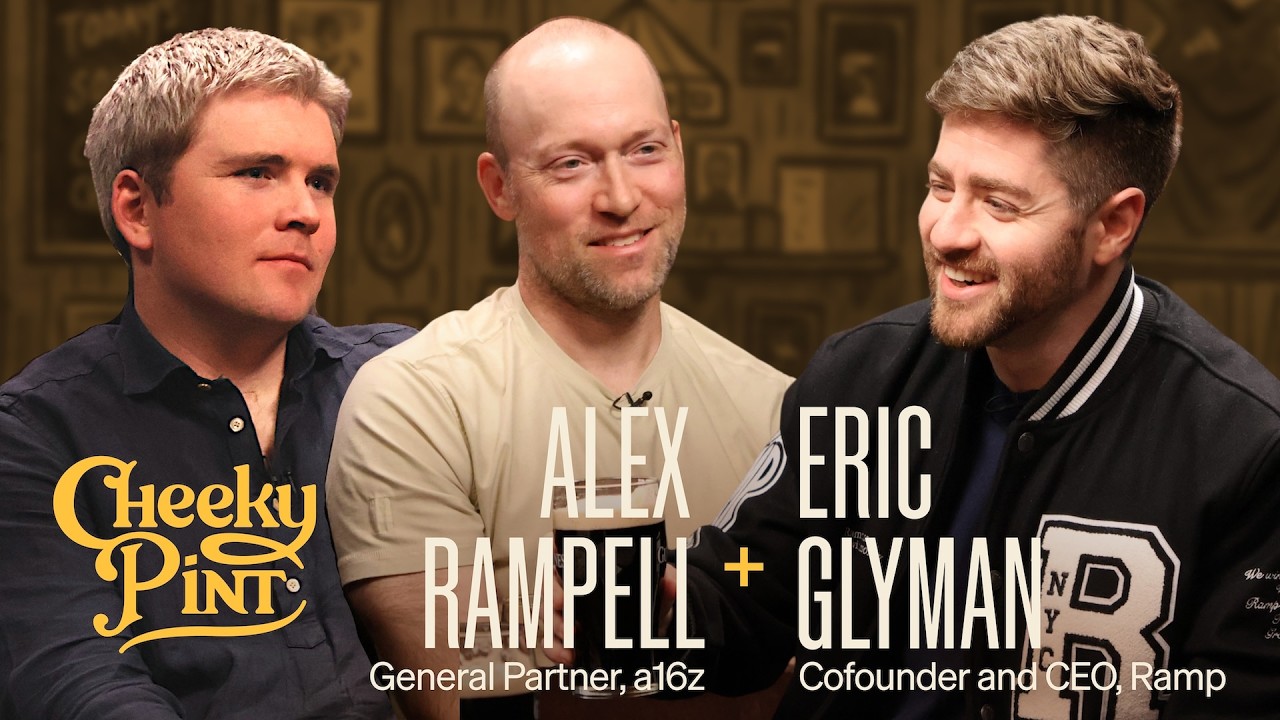
Ramp founder Eric Glyman on the many ways AI is changing corporate spending
Description
Eric Glyman is the cofounder and CEO of Ramp, the finance automation platform that now powers over 2% of all corporate spend in the US. He sits down with John and co-host Alex Rampell to discuss how Ramp scaled to over $1 billion in revenue in just seven years, and why the future of fintech is "selling time, not money." They cover the "SaaS apocalypse" (and why lines of code are becoming a liability), how Ramp uses AI agents to review 100,000 expenses a day with 99% accuracy, and why their internal data suggests the US economy is much stronger than the Census Bureau reports. Full transcript on Substack: https://open.substack.com/pub/cheekypint/p/ramp-founder-eric-glyman-on-the-many Subscribe to Cheeky Pint Spotify: https://open.spotify.com/show/2IHbGJJMpiFoz5YrvRfTFw Apple Podcasts: https://podcasts.apple.com/us/podcast/cheeky-pint/id1821055332 Substack: https://cheekypint.substack.com/ Key moments: 00:00:21 Ramp business today 00:04:27 The *correct* expense policy 00:11:07 Bill Pay 00:16:52 AI and software 00:32:23 Stablecoin-backed cards 00:33:06 Ramp data 00:36:25 How to cut your expenses 00:41:13 Ramp strategy 00:57:08 Capital One 01:06:34 Treasury
Summary
Generated by gpt-5.6-solAt-a-Glance
- Verdict: Watch fully
- Core thesis: AI is turning corporate finance platforms from systems that record spending into context-aware operating layers that review transactions, perform financial work, optimize liquidity, and advise where each marginal dollar should go.
- Why it matters: Ramp offers a concrete production example of agentic workflow design at financial scale while explaining how AI changes software-team structure, product moats, procurement leverage, and the boundary between SaaS and outsourced knowledge work.
- Best use: Use the video as an architecture and strategy reference for building agents around policy, proprietary operational context, auditability, exception handling, and measurable economic outcomes rather than standalone chat or workflow features.
Executive Summary
Ramp has expanded from an interchange-funded corporate card into a broader financial operating platform spanning bill payments, paid software, treasury, procurement, and travel. Glyman says Ramp passed $1 billion in annual revenue at roughly six years old, its software line exceeded $100 million annually after a little over two years, and several billion dollars now sit in its approximately one-year-old treasury product. Card still represents the largest revenue line, but he expects the other businesses collectively to produce most of Ramp's contribution or gross profit by year-end.
The clearest AI implementation is agentic expense review. Companies provide policies written in plain English, and Ramp combines those policies with transaction metadata, receipts, timing, and other context to determine whether expenses comply. Glyman says the system reviews more than 100,000 expenses per day, is over 99% accurate, and preserves an audit trail explaining its decisions. His broader point is that AI can replace rigid rules with contextual judgment while maintaining the separation of duties required by financial controls.
Glyman expects AI to collapse the cost of both software creation and routine knowledge work. Ramp already has designers and customer-support staff shipping production code, and marketing reports to the CTO. This erodes the defensibility of narrow applications that perform only a few cognitive steps. Durable advantages instead shift toward proprietary historical data, deeply encoded organizational procedures, financial and regulatory infrastructure, network effects, and the accumulated edge cases that a superficial AI-generated clone cannot reproduce.
Ramp's strategic destination is an intelligent capital-allocation layer. Its transaction, receipt, invoice, contract, and vendor data can already enforce merchant and budget limits, benchmark contract pricing, support procurement negotiations, and automate liquidity movement. Glyman believes corporate dollars will increasingly carry policies and reasoning: funds will move into higher-yield accounts when idle, arrive in checking when obligations come due, and eventually be directed toward uses expected to produce the best return.
Key Takeaways
- Claim: Ramp is becoming a diversified financial operating platform rather than remaining primarily a corporate-card issuer. | Evidence: Glyman says Ramp passed $1 billion in annual revenue when it was roughly six years old; paid software has become a greater-than-$100-million annual business in just over two years; treasury holds several billion dollars of deposits after about a year; and bill pay, procurement, travel, and software should collectively comprise most contribution or gross profit by year-end. | Implication: The more important Ramp thesis is platform control over the full spend lifecycle—request, payment, accounting, procurement, and liquidity—not card interchange alone. | Caveat: These are management-provided figures from a private company, and the transcript does not provide audited results or a precise definition for every profitability metric cited.
- Claim: Agentic expense review demonstrates how an LLM can operationalize natural-language policy while preserving compliance controls and explainability. | Evidence: Ramp gives the agent the company's written expense policy plus transaction metadata, receipt information, timing, and related context. Glyman says it reviews more than 100,000 expenses per day, produces a reasoning audit trail, exceeds 99% accuracy, and satisfies separation-of-duties requirements because the employee is not approving their own expense. | Implication: For high-stakes agents, the reusable pattern is policy plus complete operational context plus an immutable rationale plus human handling of exceptions—not an unconstrained model making isolated decisions. | Caveat: The transcript does not disclose evaluation methodology, false-positive rates, escalation thresholds, or whether the reported accuracy applies uniformly across customer policies and transaction types.
- Claim: AI is compressing the interval between identifying a problem and shipping a fix, which will reorganize software teams around smaller, more autonomous product owners. | Evidence: At Ramp, designers and customer-support staff ship production code, marketing reports to CTO and co-founder Kareem, and an internal tool can change a button, spin up the implementation, and verify it within minutes. The discussion contrasts the traditional product-manager-plus-designer-plus-five-to-eight-engineer team with individuals increasingly functioning as self-contained pods using Cursor or Claude Code. | Implication: The operating-model opportunity is not merely giving every specialist a coding assistant; it is redesigning ownership, review, testing, and staffing assumptions around people who can take an outcome from diagnosis through deployment. | Caveat: The speakers note that established companies with real customers, legacy systems, and reliability requirements may adopt these structures more slowly; access to AI coding tools does not automatically make an existing team more efficient.
- Claim: AI-generated software may become outcome-specified and continuously rewritten, but this approach is appropriate only where failures are tolerable. | Evidence: Glyman imagines expressing the desired outcome and allowing models to regenerate the underlying implementation as their capabilities improve, raising performance from 90% toward 95%, 98%, 99%, or 100%. He says a leading-edge growth engineering team may already work this way but explicitly excludes systems requiring four-nines accuracy and uptime. | Implication: Agentic code generation should be segmented by risk tier: aggressive regeneration can serve experiments and low-blast-radius workflows, while financial, security, and availability-critical paths need deterministic controls and stronger release gates. | Caveat: The self-healing or annually rewritten codebase is presented as a possible future architecture, not a proven production standard, and it creates unresolved concerns around reproducibility, validation, and change control.
- Claim: As implementation costs fall, defensibility shifts away from visible features and toward proprietary data, embedded procedures, networks, and accumulated edge cases. | Evidence: The discussion cites vLex, whose decades of legal records helped its SaaS business reportedly grow from $20 million to $100 million in one year; DomainTools, whose daily historical WHOIS archive cannot be recreated retroactively; and Ramp's own receipts, invoices, MSAs, and hundreds of millions of annual purchase records. The hosts call hidden operational complexity the 'dark matter moat' and use Waymo's behavior during a San Francisco power outage as an example of edge cases discovered only through real-world operation. | Implication: A credible AI moat should be evaluated by whether competitors can reconstruct the underlying context and exception history—not whether they can reproduce the interface or nominal feature set. | Caveat: Operational complexity is valuable only when it is encoded into better reliability, decisions, or customer outcomes; untreated technical debt can still be a liability rather than a moat.
- Claim: The strongest AI businesses may sell completed knowledge work rather than software seats, especially to companies without internal technical teams. | Evidence: Glyman argues that a narrow expense app involving capture, recording, and approval requires very little cognitive work and may be custom-generated cheaply. By contrast, underwriting, financing, and accounting automation require deeper context. He describes Ramp as potentially selling outcomes such as 'expenses done' or 'accounting done,' where work that previously cost dollars can be delivered for pennies of model tokens. | Implication: Product strategy should price and measure the completed business outcome while preserving an internal efficiency advantage over customers or competitors attempting to recreate the same work with general-purpose models. | Caveat: The model assumes token and infrastructure costs remain low relative to customer value and that the provider can reliably absorb operational, compliance, and exception-handling responsibilities.
- Claim: Corporate cash will become policy-aware and dynamically allocated rather than remaining passively parked in low-yield checking accounts. | Evidence: Glyman cites a 0.07% national average yield for U.S. business checking accounts and describes Ramp Treasury moving money into checking when payroll is due while keeping other funds in higher-yielding instruments. He envisions systems that continuously reason about obligations, yield, counterparties, and whether reinvesting in a business earning an 8% margin is preferable to earning 2% or 4% overnight. | Implication: Treasury agents should be designed as capital-allocation systems with explicit liquidity buffers, return thresholds, and counterparty controls, rather than as simple yield-sweeping automations. | Caveat: This is a forward-looking vision whose implementation depends on forecasting quality, liquidity constraints, regulatory requirements, counterparty risk, and the distinction between accounting profit margins and risk-adjusted returns on incremental spending.
Detailed Brief
Why bill payment remains resistant to modernization
- Claims: Accounts payable and accounts receivable contain structurally opposing incentives: buyers benefit from paying later, while suppliers want to collect earlier, so some payment friction persists because it creates float rather than because modernization is impossible.; A shared identity and routing layer for businesses could remove deadweight losses such as mistyped bank details and invoice phishing without eliminating legitimate payment-timing choices.; Connecting a supplier's receivable to the buyer's payable could improve credit pricing because the supplier's risk may depend more on the creditworthiness of the large buyer than on the supplier's own balance sheet.
- Evidence: The hosts contrast card purchases, where both parties generally want immediate authorization, with paper checks, where mailing and clearing delays may economically benefit the payer.; They propose a 'DNS for companies' through which verified payment details could be looked up rather than repeatedly transmitted in PDF invoices.; A hypothetical small supplier awaiting payment from Google may borrow at approximately 18% to 20% even though its receivable is ultimately backed by a counterparty able to borrow much more cheaply.
- Caveats: The proposed shared directory and receivables-based financing model would require reliable identity, permissioning, fraud controls, data standards, and legal treatment across institutions.
- Implications: The control point in business payments may accrue to the platform that unifies verified counterparties, invoice context, settlement status, and financing rather than to the payment rail alone.
Scale-derived procurement advantages
- Claims: Ramp can convert payment scale into customer-facing procurement intelligence by benchmarking pricing, identifying renewals, aggregating demand, and potentially recommending alternatives.; The company's differentiation could therefore evolve from product velocity into Costco-like bargaining leverage that comes directly from aggregate transaction volume.
- Evidence: Ramp receives receipts, invoices, and MSAs and says it can compare software pricing down to the seat level, warn that a customer is paying 20% above market, and identify whether timing or negotiated discounts explain differences.; Glyman says Ramp sends billions of dollars to each of dozens of merchants and could estimate the next 12 months of buyer demand when negotiating bulk discounts.; He also describes notifying a customer 90 days before renewal that a fast-growing competing vendor is offering a 20% introductory discount.
- Caveats: Benchmarks are strongest for standardized per-seat products; usage-based infrastructure such as AWS is harder to compare without workload and configuration context.; Vendor recommendations and sponsored discounts could create advertising-like conflicts unless ranking and disclosure rules protect the buyer's interests.
- Implications: Transaction platforms can create a compounding loop in which more spend produces better benchmarks and negotiating leverage, which attracts more spend and further improves the data asset.
Capital One as an operating model for fintech
- Claims: Capital One's foundational advantage was first-principles experimentation with segmented credit risk rather than simply copying the prevailing premium-card model.; Acquiring a bank gave Capital One a durable, low-cost deposit base but constrained its earlier culture of broad experimentation through bank regulation.; Its long-term industry impact includes becoming a training ground for modern fintech risk leaders by hiring for learning velocity rather than conventional banking pedigree.
- Evidence: Rich Fairbank and Nigel Morris tested progressively lower credit-score segments and adjusted pricing rather than treating card eligibility as a single cutoff.; After repeated rejection by banks, Signet Bank in Virginia allowed them to build the approach internally; Capital One later became an exceptionally large user of postal direct-mail experimentation.; The discussion names Ramp risk leader Sri Srinivasan as a Capital One alumnus and compares Capital One's talent lineage to the pedagogical lineage of Carl Czerny and Beethoven.
- Caveats: The speakers correct an overly tidy history: Capital One also experimented with areas such as cell-phone and healthcare financing before later returning to greater focus.
- Implications: In regulated markets, the best talent source may be an institution known for experimentation under risk constraints rather than the largest incumbent with the most conventional domain experience.
Notable Concepts & Terms
- Agentic expense review: An LLM-based control process that applies natural-language policy to transaction context, records its reasoning, and escalates or resolves compliance decisions.
- Trust but verify: A permissive spending philosophy in which employees retain discretion while visibility, automated review, and targeted scrutiny constrain abuse.
- Outcome-specified software: A proposed development model in which teams define desired behavior and evaluation criteria while models generate or periodically rewrite the implementation.
- Dark matter moat: The hidden accumulation of edge cases, procedures, integrations, and operational knowledge that is invisible in a product's interface but difficult for a clone to reproduce.
- Token fitness function: Glyman's proposed test for defensibility: whether reproducing a company's result with general-purpose model tokens would cost more than using the specialized system it has built.
- DNS for companies: A proposed verified directory mapping business identities to payment details, intended to reduce phishing, routing mistakes, and repetitive exchange of bank information.
- Group purchasing organization: A model for combining buyer demand to negotiate supplier discounts; Ramp's transaction scale could support a software-enabled version of this structure.
- Money that can think: Glyman's description of corporate funds governed by real-time policies and reasoning about liquidity, yield, obligations, counterparties, and expected returns.
Operator Notes / Why Ken Should Care
- Define a risk-tier matrix for agent-created code, specifying where autonomous generation, automated testing, human approval, and deterministic implementation are each required.
- Instrument every financial or operational agent with decision inputs, policy version, model version, rationale, confidence, outcome, override, and exception category.
- Measure pilots in completed work, avoided spend, cycle-time reduction, and exception rates rather than seats deployed or prompts executed.
- Audit whether proprietary workflow history and exception data are being retained in a reusable context layer instead of disappearing into tickets, chats, and manual interventions.
- Test organizational redesign with one cross-functional owner operating as a self-contained product pod before applying headcount reductions to teams that merely adopted coding assistants.
- Separate procurement recommendations from monetized vendor placement and establish disclosure and ranking rules before introducing marketplace or referral economics.
- For treasury automation, set explicit minimum-liquidity, counterparty-concentration, forecast-error, and emergency-recall constraints before optimizing yield or deploying capital.
- Evaluate fintech and AI-ops investments by asking whether their advantage survives a capable competitor with abundant coding agents but no historical data, licenses, integrations, or edge-case corpus.
Source/Metadata
- Title: Ramp founder Eric Glyman on the many ways AI is changing corporate spending
- Transcript words: 14679
- Duration seconds: 4289
- Timestamp note: No timestamps or chapter markers were present in the supplied transcript; the extraction also contained several duplicated passages.
Transcript
I don't know if we need it, if we want to do this, but... I already look like that naturally. Oh, this is Kevin from The Office. Yeah, yeah, yeah. Eric Lyman is the co-founder and CEO of Ramp, the corporate card and finance automation platform. Founded in 2019, Ramp has taken the industry by storm. Oh, sure. Oh, sure. It's safe. Can you describe maybe a good framing, just the Ramp business today? What's the biggest part of the business in terms of where you make money? What are the new growth lines? Any metrics you can share on the scale? But I think Alex and I have a million questions. Maybe you can start by just framing it up for us. Yeah, of course. So first, just the pace that this has come together has been pretty remarkable. Seven years, yeah. I think by the time we were six years and change, the company had passed over a billion a year in revenue. The largest portion of that is card. And so that might be a classic interchange-based model. But behind it— This is people in their business. They have spend cards. Everyone walking around the company has a Ramp card, and you earn an exchange on those. [SPEAKER_01] That's right. That's right. Next, you can think about bill payments and software. Software is a two-something-year-old business line, just about two years and some months. That's over a hundred-million-a-year business line in and of itself. And that can be advanced functionality to maybe manage lots of entities, to automate aspects of accounting, maybe aspects of procurement. Right. Bill payments. So this can be sending checks, wires, ACH, and that's predominantly a float as well, in some cases, a foreign exchange transaction business. Treasury. That's a product that is about a year old, with several billion dollars of deposits. Some of that is checking-like products. Some of that is more of an investment- and money-ladder-type product. And then the last, the other ones, are procurement and then travel, which is a bit of an in-kind. And what's been so interesting is that if you break down and look towards maybe, let's say, contribution profit, gross profit of the business, a few years ago, it would have been 90-plus percent card. I think by the end of this year, the second, third, fourth, and fifth lines of business will comprise, in aggregate, the majority of Ramp's business. And so it's evolved into this platform by which, if you're trying to operate your company, it's just a lot more efficient. You spend less. I think people know Ramp for—we help the average company cut their expenses by about five percent per year. The thing that's been really fascinating is people starting to use these products in aggregate. Not only are they not paying for five or six sets of point solutions, but they're also not wasting time. They're growing faster. I think that the average customer last year on Ramp grew their revenue by, I think it was, 16 percent, which compared to the average business in the United States—yeah, I think it's five percent in the U.S. And so it's, I think, in some sense, what we're trying to do: be not just a better platform, but a better, almost digital brain for organizations to allocate resources and make sure spend is not wasted. [SPEAKER_02] Yeah. So you start by selling, say, spend cards into a business. The CFO likes it; the employees like it. And then that gives you permission to go sell some of this other functionality. And so it's a classic multi-product cross-sell. Is it all starting with spend cards, or do you [SPEAKER_01] now have multiple front doors into the business? That's been the big story of the past year. I think there were, in the last quarter, thousands of businesses that came in just for bill payments. There are accounting firms that are coming in. They say, "We're a Ramp shop here. If you want to work with us, we'll bring in bill payments, treasury. We use Ramp to go power that," and they can manage 10, 100, 200 clients all through one platform. And we're excited. Probably the fastest-growing line of business is procurement, where there are single clients that are looking to bring in and do full-scale purchase orders across, whether it's single or a dozen-plus entities, all the way through. And so that's been, I think, the really fun story of the past year. [SPEAKER_02] Do you have a view on what the right policy is for employee spend within a business? I love the justice. Yeah, yeah. 37signals or someone will say companies are so lame, you just give everyone a credit card and trust people, and it's fine. And then, meanwhile, large companies are like, "Well, this hotel is in a tier-two city, and therefore there's this dollar limit and it must be booked 14 days in advance." And so you see companies operate at really two ends of the spectrum in terms of how much flexibility they give people. What is correct for a company, or does it just vary by size? [SPEAKER_01] I love this question. And the interesting part, if you really dig into Ramp's businesses, is we have ways of back-testing and actually understanding, based on how strict your policy is, how things are running. Does that have an impact on how much time your employees are, let's say, doing expenses, how quickly you're growing? And you can start to actually compare, based on the operating hygiene of the company, what are margins? What is the pace of growth that occurs at the company? And I bring this back to—so you do a correlational study between expense policies and company growth? Yeah. And look, it's pretty interesting. First, there's an aspect of, in most companies, particularly high-growth companies, it tends to resemble something closer to the no-rules-rules, netbook approach of, "We're going to trust but verify and shine a light on it." Spend tends to be reasonably permissive. But then part of the breakthrough the past year is you could take an expense policy. Let's say it's written in plain English: "If the flight is more than five hours, you can take business. If it's under—" Things that would have been horrible to have your managers verify, now you can run through an LLM. So, I think that we're processing over 100,000 expenses a day that are being reviewed agentically. Yeah. This is a very fast-growing subset of the business. [SPEAKER_02] So, sorry, you give the Ramp agent this company's expense policy, and then it applies [SPEAKER_01] to the transactions that are going through. Exactly. And so, you can start to do things... The past year is you could take an expense policy. Let's say it's written in plain English: If the flight is more than five hours, you can take business. If it's under—things that would have been horrible to have your managers verify, now you can run that through an LLM. So, I think that we're processing over 100,000 expenses a day that are being reviewed agentically. Yeah. This is a very fast-growing subset of the business. [SPEAKER_02] So, sorry, you give the Ramp agent this company's expense policy, and then it applies to the transactions that are going through. Exactly. And so, you can start to do things. I think the episode you had with Susan Lee was incredibly instructive, where she says it would feel so silly, and it's not a great use of my time, in some sense, to be a very expensive machine learning algorithm to review expenses. But yet, somehow, a lot of people in companies are reduced to that, thanks to Sarbanes-Oxley and the rules around it. Yeah. Now you can have an agent, functionally, that does that, that takes that aspect of the job. And so, it has access to the full set of data that you would: all the transaction-related metadata, the receipt data, the time data, the policy data. It then can, in real time, review whether this was in or out and can have the full audit trail explaining its reasoning. [SPEAKER_01] And today, it's over 99% accurate, which turns out is much more accurate than people are. Yes. Most people don't know the expense policy, and expenses are pretty automated. And I find this thing super interesting, in part because I don't think it really should be anyone's job to review people's expenses. But somehow—well, it's no one's JD—the law requires everyone to waste an hour of their time every month if they're a manager. [SPEAKER_02] And does the law allow for it to be reviewed agentically and then just signed off on by a human? [SPEAKER_01] It does. Yeah. The goal of this is separation of duties: [SPEAKER_01] that you yourself are not reviewing your own expenses. [SPEAKER_01] Sure. [SPEAKER_01] Yeah. [SPEAKER_01] It leads to this set of procedures that govern and actually are effective through the action of: [SPEAKER_01] Okay, the rule says this. Did you take some steps to do this? It can be a system that does. Yeah, you can self-certify. Yeah. Yeah. The funny thing is that one way of doing this—actually, we used to do this—is: Why not just post your expense reports in the public eye? Mm-hmm. [SPEAKER_00] Right? And the reason to do this is it actually could go wrong. You could say, "I'm going to spend. You stay at the Four Seasons; I'm going to stay at the Five Seasons." Yeah. You could go that direction. But what you want is a moral code. Yep. Right? If you were the owner of the business, it is your own money. [SPEAKER_01] Yes. So, if you were staying at the Five Seasons—I've just made that hotel chain up— you're stealing from yourself. Why would you do that? So, the problem is that once you get to tens of thousands of people, how do you impose that moral code? And actually, the two tent poles that you just mentioned, they're both bad. Yep. Right? Because if you have to stay at a crappy hotel and you're about to sign a $2 million contract, right, and you didn't get any sleep—it's the Motel 6, and you take a two-hour taxi—it's: "All right, you saved the company money." That's it. That does not make sense. Stay at the Four Seasons. Yep. But you can't really embody that in "if this, then that." Because what you want— Nailed it. [SPEAKER_00] —is this moral code. That's what you want. And how do you actually instill that? [SPEAKER_00] And there's almost a behavioral psychology way, which is: "Hey, we'll just show what people [SPEAKER_00] are spending. If you're at the top of the leaderboard, we might trust but verify—and verify [SPEAKER_00] a lot more." But that's the hard thing to do and actually preserve as the company goes from [SPEAKER_00] the founder to the founder plus the founder's brother, to many, many more [SPEAKER_00] people. How do you keep that same esprit de corps, or this informal code? I think it comes back to—what was the name of the movie?—12 Angry Men. Yeah. I think it was where, as you're watching the film, you get some level of detail, and someone seems very guilty. It's a dead showcase. And as more evidence emerges, you realize, actually, this may be different, different, and you need more context in order [SPEAKER_01] to arrive at maybe a moral conclusion. Did it relate to closing a project? How does it relate [SPEAKER_01] to an outcome that maybe you'll see emerge one month, two months after this? You stayed at the [SPEAKER_01] Five C's and closed the deal that changed the company, whatever the example is. I would argue [SPEAKER_01] in favor of tools that have more context, that do more jobs of work, because [SPEAKER_01] not only can you do the narrow job better, but you can start to get at the answer of what actually [SPEAKER_01] is right for shareholders. Where should we be allocating capital? Because it's so interesting [SPEAKER_00] to hear, because every company approaches this differently. I'm on the board of Wise, [SPEAKER_00] and Christo flies coach everywhere. Everybody flies—that's just the policy. [SPEAKER_00] Yeah. [SPEAKER_00] But it might be penny-wise, pound-foolish. [SPEAKER_00] Not for me to say, but I also really admire the corporate code. It's cultural. It's weird to say expenses are cultural, but they are. [SPEAKER_01] For sure. Yeah. [SPEAKER_01] It's a shared belief system. It's a shared belief system. What is the culture of the company? When you talked about your expansion to bill pay, it seems bill payment has proven, over the past 40 years, uniquely resistant to automation and modernization. If you look at how a typical business pays their rent, or if you order a keg of Guinness, you'll get a PDF emailed to you by some person who has a relationship with you. And there'll be [SPEAKER_02] bank account details, which hopefully are correct. And you send a payment to those. And [SPEAKER_02] even bill-paying products—you guys have a bunch of technology here—but it's: [SPEAKER_02] We scan the PDF in an automated way, or we ensure that the bank account details weren't mistyped, or [SPEAKER_02] of the company? When you talked about your expansion to bill pay, it seems bill payment [SPEAKER_02] has proven, over the past 40 years, uniquely resistant to automation and modernization. If you look at how [SPEAKER_02] a typical business pays their rent, or if you order a keg of Guinness, [SPEAKER_02] you'll get a PDF emailed to you by some person who has a relationship with you. And there'll be [SPEAKER_02] bank account details, which hopefully are correct. And you send a payment to those. And [SPEAKER_02] even bill-paying products—you guys have a bunch of technology here—but it's: we scan the PDF in an automated way, or we ensure that the bank account details weren't mistyped or something. But it's putting a little bit of lipstick on the pig of the whole system being super antiquated. Why is the system so antiquated when it comes to bill payment in particular? [SPEAKER_01] I think this is some of what Alex was bringing up. The constraints of programming [SPEAKER_01] things in an if-this-then-that world are very heavy. There's a lot of [SPEAKER_01] complexity. And when you think about the nuance and algorithms that govern why [SPEAKER_01] companies spend money under some circumstances, how hard it can be to record—I wouldn't [SPEAKER_01] overlook, let's say, that you're a manufacturer and you're buying some asset which [SPEAKER_01] you're going to use for five years, and it's going to depreciate. It's a very different accounting [SPEAKER_01] treatment versus buying a pay-as-you-go SaaS app. All the complexities around that [SPEAKER_01] might govern whether or not you decide to spend. And then finally, once you get all this [SPEAKER_01] detail, how you review this and decide where to allocate your next marginal dollar is very complicated. But many systems are upgraded in place despite the fact that that's pretty complex. So credit cards started with no real-time authorization system, which is crazy. And you just hope that they were good for it. Exactly. Yeah, yeah. Yeah, exactly. The machine with the pleasing sound. They do great in the current ASMR environment. But then they added: you could [SPEAKER_02] call up and get an authorization. And then they obviously added the current systems we know [SPEAKER_02] here. The modem. Exactly. Yeah, yeah. And then the modem. And so, in place, credit cards were [SPEAKER_02] upgraded with much better capabilities. And similarly, if you look at checks and how they work, [SPEAKER_02] even though we think of checks as antiquated, it used to be the case that physical [SPEAKER_02] checks had to be flown all around the country to be physically settled. And then there was the [SPEAKER_02] Check 21 Act in 2000, where they said a scan of a check is good enough. And so they could be [SPEAKER_02] digitized by the banks and then shredded. And then there was: you can take a photo of a check with [SPEAKER_02] your phone. And so we've managed to take this super old-timey check system, and despite the fact [SPEAKER_02] it's super old-timey in some ways, it has actually been meaningfully upgraded. If you looked [SPEAKER_02] at the bill-pay system from the outside, you would say, we should have DNS for companies. So rather [SPEAKER_02] than a company sending you their bank account details, you should look them up in some [SPEAKER_02] central clearinghouse. And that way, you confirm that you're not being phished. And a lot of spear-phishing attacks. Although you referenced this. So there's actually an indifference point that you [SPEAKER_00] can graph: if interest rates go up high enough, if I send you a check, right, which is a paper [SPEAKER_00] mail check. Yes. And that takes five days, and hopefully the USPS goes on strike for two more [SPEAKER_00] weeks, right? So I've got the postmark. I actually benefit. It's actually cheaper for me to— [SPEAKER_00] You're legally paid, right? It's crazy. Yeah. [SPEAKER_00] No, it's crazy. So this is the problem: credit cards—everybody, I'm in the store, [SPEAKER_00] I want the TV. You want to sell me the TV. We both want this done right away. And in the knuckle-crunching [SPEAKER_00] ASMR carbon-copy days, they might not have been willing to sell that to me because they didn't know if I was good for the money. They'd never seen me before. And the interesting thing is that AR and AP are almost an adversarial process. You mentioned this, right? It's: what do you want to do as a controller? Well, you want to pay as late as possible, and you want to collect as early as possible. And then you have this weird thing where checks—it's not just an accident that they stick around for a long time. There's [SPEAKER_02] a financial incentive for one party. That's true on payment timing. I agree with that. [SPEAKER_02] But there are some things that are just a deadweight loss, such as the ability to fat-finger a bank [SPEAKER_02] account detail. No one benefits from that. Everyone has a horrible time. [SPEAKER_02] The Nigerian guy. Yeah, that's true. There are some people who benefit. [SPEAKER_02] Nigerian princes. Think of everyone. Yeah, think of everyone. [SPEAKER_02] I will posit that many networks have been upgraded in place, but somehow the loose [SPEAKER_02] network of businesses paying each other via PDF invoices has proven very resistant to in-place upgrades. Well, also, if you understand, I love your notion of DNS for payments or for expenses. So I don't know if you saw this: Google wanted to issue a 100-year bond. Yes. Yeah. So why is [SPEAKER_00] that interesting? So imagine that I am owed money by Google. I am one of the small businesses that you [SPEAKER_00] reference. Their job is to pay me as late as possible. Yes. Right. They can borrow money for 100 years at [SPEAKER_00] 3% or whatever it is, cheaper than the US government, probably. T plus 100. Yeah. [SPEAKER_00] It's a little more expensive than the US government, but they are borrowing. That's crazy. Yeah. [SPEAKER_00] I can borrow money at 20%, but why do I need to borrow money? Because Google's paying me late. [SPEAKER_00] Those jerks, right? So I should be able to borrow money at the rate at which Google [SPEAKER_00] is borrowing money because my AR is their AP. Yes. But the problem is, unless you put all this [SPEAKER_00] together, you would just look at me and you're: well, you're just a little schmuck. [SPEAKER_00] I'm not going to—I'm going to charge you 18%. It's: yeah, but it's Google. Yeah. They [SPEAKER_00] could borrow money at T plus whatever, live software plus 100. 100%. [SPEAKER_00] That's not fair. But the only way to really solve that is with more data and actually entangle— [SPEAKER_00] not entangling, but just connecting these things together. For sure. What's your vision for [SPEAKER_02] once AI is doing a lot of software engineering? What does that look like in three or four years' time? Is the competitive equilibrium similar, but just the expectations for the amount of software and functionality businesses are shipping are much higher? Are software teams similar-looking, different? [SPEAKER_00] I'm not going to—I'm going to charge you 18%. It's, yeah, but it's Google. Yeah. They [SPEAKER_00] could borrow money at T plus whatever, live software plus 100. 100%. [SPEAKER_00] That's not fair. But the only way to really solve that is with more data and actually entangle— [SPEAKER_00] not entangle, but just connect these things together. For sure. What's your vision for [SPEAKER_02] once AI is doing a lot of software engineering? What does that look like in three or four years' time? [SPEAKER_02] Is the competitive equilibrium similar, but the expectations for the amount of software and [SPEAKER_02] functionality businesses are shipping are much higher? Are software teams similar-looking, different- [SPEAKER_02] looking? Again, you're doing a lot of AI engineering. What does the future hold? It's all blurry. It's totally crazy. There's a designer shipping code. Marketing at Ramp reports to our CTO, Kareem, my co-founder, who's doing some of the best marketing I've ever experienced and seen. We have customer support agents shipping code to production too. I just think that the half-life from when you see a problem to how long it takes for you to fix it and do something about it is shrinking immensely. Or if you want to change the color of a button, you can just say, at Ramp, "Inspect, can you change the color of this button?" And it goes and spins it up, and it does it. Within minutes, it verifies and validates it. And so, I actually think, in some sense, these classic barriers that software businesses had are clearly going to erode, right? It's—yes, but there's the old joke: [SPEAKER_02] It's much more fun to write code than recode, which explains a lot of software engineers' behavior. [SPEAKER_02] And it becomes easier to change the button. Is that another instance of it being more fun [SPEAKER_02] to write code than recode, where lines of code are a liability and not an asset because [SPEAKER_02] they're something you have to reckon with? And so, are companies, at some level, incurring [SPEAKER_02] some tech debt now, where they're adding a bunch of code that will maybe be harder to reason with [SPEAKER_02] later? Or do you just get bailed out by the models getting better? It's really interesting. By the way, one of the other interesting sub-conversations I'm hearing a lot, too, is: When you think about where tech debt comes from, there's a set of conditions and trade-offs you make. You write things in a discrete and deterministic way. Under these circumstances, follow this code path. Under these circumstances, follow this other one. In a world where there are LLMs and the models themselves are improving, I think it's entirely possible that the way code is written is that you say, "Here's what I'm solving for under these conditions. Here's what I want to occur. Go write the code that drives this outcome." And maybe with the models as they are today, you can get it done in a spaghetti-code-written fashion, but it works, even though it's some Rube Goldberg machine underneath the hood. But if these models get much smarter, you might write your codebase in such a way that you say, "Every year, rewrite the underlying code, but here's the outcome I can drive. And today you accomplished my outcome 90% of the time: 95, 98, 99, 100." And do you just have self-healing and self-writing code all the way through? And this notion of underlying code just goes away because we're writing things in this different manner. Obviously, there are real conditions in which that's not going to occur. If you're writing code that needs to have four nines of accuracy and uptime, that's probably not the method you're using. But if you're a growth engineering [SPEAKER_01] team, that's probably what you're doing today if you're on the leading edge of this stuff. [SPEAKER_01] And so, I find this stuff very fascinating. And when I think about the deeper [SPEAKER_01] implications of this stuff, I think that if you are completing a small amount of cognitive work, [SPEAKER_01] right, let's say you just are an expense app: the spend has occurred, [SPEAKER_01] you need to go get it, write it down somewhere, and get someone's approval. And that's [SPEAKER_01] all the knowledge work that you're doing. That's very few tokens in order to accomplish that, [SPEAKER_01] both to create the infrastructure in order to facilitate it. That probably evaporates. [SPEAKER_01] I think anyone can probably custom-write that kind of app. Whereas if you're [SPEAKER_01] doing much deeper work, such as underwriting a company, providing financing, [SPEAKER_01] or automating areas of accounting, I think the fitness function for companies becomes: [SPEAKER_01] Can you actually do things in such a way that, even if you could spend tokens on it, [SPEAKER_01] it would take more tokens to create the thing or do that work than the system that you've [SPEAKER_01] built to drive that outcome? Yeah, yeah, yeah. [SPEAKER_01] So, I just think the rules of what it means to be a software company are changing. I think network [SPEAKER_01] effects and what you're building are more important than ever. If you think about [SPEAKER_01] the classic set of moats that are there, I think this question of where there are moats in a world [SPEAKER_01] where—I like Dario's way of putting this—if you have a country of geniuses [SPEAKER_01] living somewhere, and they're writing code and they're incentivized to compete with you too, [SPEAKER_01] if you're not really following what the classic four moats are and building toward [SPEAKER_02] that, I think life just gets a lot harder. Yes, yes. Do you guys have a hypothesis on [SPEAKER_02] the new competitive equilibrium with a lot of AI engineering really working? [SPEAKER_00] Well, I think there are a couple of things. So, I think Mark talked about this a little while ago, but what is an EPD team—an engineering, product, design team; a product development team? You'll normally have one product manager, maybe five to eight engineers, and one designer. And now everybody has Cursor or Claude Code. So the designer is, "I don't need any of these bozos," right? The product manager is, "I don't need any of those bozos." And each of the engineers is, "I don't need any of these bozos." It's the start of The Dark Knight. Yes. And they're all right. It really is the story. Exactly. And they're all right. It's as if they're all wearing the Joker mask, or the Joker mask is Claude Code or Cursor. But the problem is—because I was talking to one of my CEOs; this is a pretty skilled company, lots of revenue— they use all these tools. They're not more efficient. And he's, "Why aren't you" Right? The product manager is, “I don't need any of those bozos.” And each of the engineers, “I don't need any of these bozos.” It's the start of The Dark Knight. Yes. And they're all right. It really is the story. Exactly. And they're all right. It's like they're all wearing the Joker mask, or the Joker mask is Claude Code or Cursor. But the problem is, because I was talking to one of my CEOs—this is a pretty skilled company, lots of revenue— they use all these tools. They're not more efficient. And he's like, “Why aren't you more efficient?” And it's two things. Number one, it's a real company. They have real customers. They can't just push things and hope for the best. But you actually have an HR problem, in that if you're building from scratch, granted, you have nothing, you have [SPEAKER_00] no tech debt, you don't really have to worry about customers, you don't have any, but you wouldn't [SPEAKER_00] have an eight-person EPD team. Yeah. You would probably just have each person. You'd have, [SPEAKER_00] “All right, we have eight different product managers slash engineers slash whatever.” [SPEAKER_00] Each one is a pod unto themselves. So that's one thing. I totally agree on the data moats, where that [SPEAKER_00] has become more important. I'll tell you a story that you might like. So I met this company, [SPEAKER_00] vLex. It's a 25-year-old company. This guy, Alex, bought up every legal record in Spain, probably going back to 1492. He buys the—and then here's Ferdinand and Isabella— [SPEAKER_00] “Here's the document. I'm going to take a picture of that. I'll sell it to every [SPEAKER_00] law firm.” And he built—it was a $20-million-a-year SaaS business, bootstrapped for 25 years. And then it went to a hundred million in one year. Now, why is that? Because he used to sell this document, or he used to sell a subscription to Kirkland & Ellis and Latham & Watkins and all these big law firms. And they would take— a paralegal would take that. They would turn it into a document. They'd charge the client $10,000. And ChatGPT can't do that. Gemini can't do that. But who can do that? vLex. And now, another good example of this, of who has proprietary data: a lot of times, the data is free. This is the really cool thing. Or it's sitting—I wouldn't call your data free, but it's not for-sale data sets. So, do you know DomainTools.com? It's my favorite business. DomainTools runs a cron job every day on every single internet website. They do a WHOIS lookup. So, a WHOIS lookup every single day. They made a historical record of that, which no one has. So, if you want to see who owned Stripe.com in 1999, well, it was free in 1999. So, if you invent a time machine, go run that WHOIS query in your terminal, but you can't do that. Yeah. So, you have to pay them. But all that data is free. Or FlightAware with ADS-B data. So you have a lot of these weird businesses. And, of course, this is not a new idea. FactSet, [SPEAKER_00] Bloomberg—you have aggregators of data—but that becomes so much more valuable. Totally. Because your 10,000 geniuses cannot do that. [SPEAKER_01] Yeah. 100%. 100%. And you always experience this: you hire someone extraordinarily [SPEAKER_01] talented, top of the class at MIT, and you say, “All right, join the [SPEAKER_01] engineering team and go ship the code.” And they ship something crazy on the first day, and it's [SPEAKER_01] slow. And you can have someone who is intellectually an absolute [SPEAKER_01] giant, but learning how a company does things the way it does, learning the [SPEAKER_01] procedures and nuance of an organization, takes time. It's part of what makes working with [SPEAKER_01] interns or junior engineers fun. I think their learning curve is obviously immensely steep. [SPEAKER_01] And I think that the speed at which, with sufficient access to the data and the procedures [SPEAKER_01] of a company, they're going to get there is very, very fast. But these moats are real. Anyone who's—well, the other moat, I would argue, is the dark matter moat. Yes. And what I mean is, like the Milky Way, nobody could figure out why the mass is the mass because of all the observed stars and planets and everything else. No, actually, the vast majority of the matter or energy, because they're the same thing, is dark matter, dark energy. And what does that mean? Nobody the hell knows, but it's just, we don't know it. And for products, if I tell Claude, “Go clone Ramp,” right? Because this is the SaaSpocalypse that's happening right now. It's, “Oh, of course. Well, now I have a website that looks like Ramp.” No, no, no. There are 9 million edge cases. The tech debt sounds bad because it's a pejorative—debt, bad. But actually, it's good because what you've done is you've uncovered every single problem that can go wrong. Yep. The fact that—a great example: remember when the power went out in San Francisco a month and a half ago? So, we have this amazing thing called Waymo. Waymo had not figured out this corner case of, “What if the power goes out?” It was a thundering herd problem with customer service or the human overrides. Yeah. But they had no idea. And it's actually great that that happened. Yeah. You need these problems to happen. For sure. And just because of my background, I used to write shareware, this try-before- you-buy software. Shareware was a big thing. That's a blast from the past. And then—it's a blast from the past. So, there's a website that's part of CNET. It might come back. It's freemium, but this is where I'm going with the story, and you'll like this. So, Download.com was the preeminent site for downloading shareware. CNET was one of the most popular properties in 1999, 2000. So, all the top downloadable software products were there. Download.com sounds like a company that had a Super Bowl ad back then. They would have. I bet they did, actually. They probably had two. I'd be shocked. They probably had five, right between Pets.com and something else. But Download.com had all the popular products. And then this site called Elance shows up. And Elance is now download.com was the preeminent site for downloading shareware. CNET was one of the most popular properties in 1999, 2000. So, all the top downloadable software products were there. Download.com sounds like a company that had a Super Bowl ad back then. They would have. I bet they did, actually. They probably had two. [SPEAKER_00] I'd be shocked. They probably had five, right between pets.com and something else. But, so, [SPEAKER_00] download.com had all the popular products. And then this site called Elance shows up. And Elance is now [SPEAKER_00] called Upwork. This connected you with work that you would want done by very smart people [SPEAKER_00] in the developing world. So, I want a software product built. Here's everybody in Romania and Russia and India. I want translation. I want graphics. So, what ended up happening is [SPEAKER_00] people would look at the download.com top list because before, it was a very cottage industry of [SPEAKER_00] who wrote shareware. And it was very profitable: ID Software, shareware company; McAfee, shareware company. [SPEAKER_00] Mm-hmm. Actually, CyberSource started off processing payments for shareware companies. [SPEAKER_00] Ah, okay. I thought you were going to— [SPEAKER_00] That's how they got McAfee. That's funny. [SPEAKER_00] Very interesting history to this that we talked about some other time. But [SPEAKER_00] what happened is people found Elance. Oh, I could pay anybody $500 to clone anything on this [SPEAKER_00] list. Everything on this list makes tens of millions of dollars a year. Let's go. And the cloning never [SPEAKER_00] worked, right? It functionally worked. Because if I say, I'm going to clone Eric, I might not know that you have a [SPEAKER_00] pancreas. Yep. Right? I'm sure you do. Right? I might not know that you have two kidneys. So, [SPEAKER_00] the problem is that the cloning just—it goes skin deep. And that's the embedded advantage of these companies. [SPEAKER_02] Now—so, do you then think the SaaSpocalypse is irrational? [SPEAKER_00] I think it depends. I think some of it is very rational. Because if I want—if I have a feature that became a company, [SPEAKER_00] and I don't—I know this sounds like a very negative thing to say, but I want to get paged if my server goes down. [SPEAKER_00] It's a very, very logical reason to build a company called PagerDuty. That now has a lot of stuff around [SPEAKER_00] it. But I might just say, hey, whenever my server is—there are corner cases. There is [SPEAKER_00] the proverbial: the power goes out in San Francisco, do something differently. That's very, very different [SPEAKER_00] than NetSuite, which is—I have a saying that I like, which is the best companies have hostages, [SPEAKER_00] not customers, at least in enterprise software, not for you. Because you actually have IMPS. But [SPEAKER_00] they're much, much harder to go rip out. And a lot of it is the Goldilocks zone [SPEAKER_00] that you operate in. Right? If you're too expensive, of course I'm going to try to rip [SPEAKER_00] that thing out. If it's so cheap, then I forgot nobody even used it. So you have to be in this [SPEAKER_00] Goldilocks zone. You have to have enough complexity. And ideally, the front end is different from the [SPEAKER_00] back end. So Workday, I think, is—nobody's going to get rid of Workday. Yeah. And I actually [SPEAKER_00] credit David Ricardo with this: 1870, comparative advantage. Sure, you could grow your own [SPEAKER_00] food. Right? You could plumb your own plumbing. Yeah. Yeah. But you're not going to do that. [SPEAKER_01] And somebody—you could do your own HR system. I think it's the one, maybe, pitch for Stripe and [SPEAKER_01] others that I would say here. I do think that that is right. And there is a lot of complexity in [SPEAKER_01] local tax law for payments and things that make Workday, I think, an extraordinary business. [SPEAKER_01] There is this overarching macro question of how work gets done. And— [SPEAKER_00] Yeah, that's the important thing. If you believe that work's going to get done through tokens and models, presumably, it probably doesn't go through payroll. It probably goes through a credit card or check to these types of companies. And so if the share of—it's almost this simple math that if you x-rayed the P&L of most companies, the majority of it classically, at least for asset-light firms, is payroll. You're paying for people to do things, and SaaS is maybe a small percentage of a company's income or a company's cost base. Does that share suddenly grow to high single digits, low double digits, significant double digits? And does the share actually move where the payroll economy itself, even though maybe it grows, becomes less relevant? And I think this is the really funny part. Even as this has been going on, what do I know as a private company, other than seeing our own payment data? But you start to see these companies beating their earnings in a way they never have before, where the terminal value perhaps is falling out. But they're saying, shareholders, we're reaccelerating. We haven't seen this since 2021. We're going faster, and you're going to have multiple progressive quarters of this actually occurring for certain types of businesses. And so it's a really interesting time. What I very violently agree with your view is: yeah, it depends. There are some businesses that are doing really well. It's my brilliant comment: it depends. Yeah, you mentioned. [SPEAKER_02] Me too. [SPEAKER_02] How very Howard Marks of you. [SPEAKER_02] As you're hearing from Eric, Ramp has become the default way a lot of American companies manage [SPEAKER_02] spend. Stablecoins allowed that functionality to work in many countries all at once. With Ramp's [SPEAKER_02] stablecoin-backed corporate cards, businesses can fund a balance with stablecoins, issue cards against [SPEAKER_02] those balances instantly, and allow employees to spend anywhere cards are accepted without the [SPEAKER_02] business having to think about stablecoins all the time. Same card experience, same controls, [SPEAKER_02] just a much more global set of rails underneath. This is one of the many practical ways we're seeing [SPEAKER_02] businesses on Stripe use stablecoins by launching card programs in many more countries and doing so in [SPEAKER_02] much less time than it would have taken otherwise. If you're thinking about using stablecoins to expand, [SPEAKER_02] Stripe can help. [SPEAKER_02] You mentioned your spend data. What does the spend data that Ramp sees tell us about the economy? It is—I think it is stronger than many people understand in lots of ways. First, I'll go back to one of the things that perplexed maybe our team for a long time, and our economists are on the team. They saw this data even as recently as last year, where the Census Bureau would do these periodic surveys where they go out and ask, “How much is your business using AI to [SPEAKER_01] produce goods or services?” It is a very refined economic way of wording the questions. And [SPEAKER_01] they would come back with these pronouncements saying a single-digit percent of businesses in the U.S. [SPEAKER_01] have adopted AI. When we looked at our data, we support over 55,000 businesses. We lean It is, I think it is stronger than many people understand in lots of ways. First, [SPEAKER_01] I'll go back to one of the things that perplexed our team for a long time. Our economists on [SPEAKER_01] the team saw this data even as recently as last year, when the Census Bureau would do these periodic surveys where they go out and ask how much your business is using AI to produce goods or services—a very refined economic way of wording the questions. And they would come back with these pronouncements saying a single-digit percentage of businesses in the US [SPEAKER_01] have adopted AI. When we looked at our data—and we support over 55,000 businesses—we lean [SPEAKER_01] a little bit toward tech, but not heavily. It resembles the distribution of businesses you would see in the States. And the majority of businesses have used AI. You look at [SPEAKER_01] businesses, whether they're paying for— [SPEAKER_01] As in, they subscribe to ChatGPT or Anthropic or something like that. Exactly. Or maybe a business that is a true agentic cognition or a coach or something like that, where this is a vertically, vertical application. And so, one, there is this disconnect between the use of tools, if you look at how quickly businesses are adopting and responding to these new tools, versus what people report on. Next, growth. I think [SPEAKER_01] it's been clear over the last few quarters that the US itself is reaccelerating. GDP growth has gone [SPEAKER_01] from maybe the 1% to 2% area to 4% to 5%. And you could argue how much of this is a little artificial with subsidies, but it's been pretty significant. But subsidized by what? Some of the big, beautiful bill—Okay. [SPEAKER_01] As well as some of the tariffs—Yeah, yeah, yeah. And where that's been reallocated. I think some people, I would argue on the whole maybe unfairly— Yeah. Said this. I think that there's more durable growth inside the businesses. But I would say overall business health is much stronger. And I think that the really interesting thing, and again, some of this is specific to the data that we see, but I think that businesses are generally getting more and more savvy about finding tools that help them be more efficient. And I think what skews our data [SPEAKER_01] is maybe the savings we drive for people. So, as a way of explaining it, people know the Ben Franklin phrase, “A penny saved is a penny earned.” And this is an awesome aphorism, but the average American business has an 8% profit margin. And so, mathematically speaking, a penny saved is equivalent to 12 pennies of revenue earned. And so, if you save businesses a lot, you end up with these outcomes of the average Ramp business materially outgrowing the regular US average. And we think that we can clearly see this and demonstrate this for our own set of customers. I suspect these types of things are occurring at businesses adopting these new sets of technologies, I would argue probably faster, very clearly, than what the classic sources are seeing. So I think it's much healthier. [SPEAKER_02] Ben Franklin, when a business saves money on Ramp, what happens? The [SPEAKER_02] CFO comes in and says, “Oh my God, we're spending way too much money exactly on confetti. [SPEAKER_02] We don't need this much confetti.” Ben Franklin, who's buying the confetti? [SPEAKER_02] Ben Franklin, yeah, yeah, yeah. And we have huge stockpiles that we don't need. [SPEAKER_02] What happens when a business saves 5%? What are we actually cutting? Ben Franklin, yeah, yeah. So there are two pieces of it primarily. One is these hard-dollar cost savings. And then some of this is time. And I'll start with the time because it's the squishy one, but I think that it's, in some cases, actually much more important. [SPEAKER_02] Oh sure, they save time on their expense reconciliation. [SPEAKER_02] Yeah. That makes sense. Yeah, yeah. [SPEAKER_02] So they're no longer going through line by line, and therefore there's [SPEAKER_02] one person who is freed up to go do something else. Yeah, yeah, yeah. And it's, I think, one of the classic biases that people forget: people chronically undervalue their own time. Yeah. [SPEAKER_01] It's maybe a principle in business: everyone—everyone has an hourly rate. Within a business, human time is incredibly expensive. I think the lean companies got this [SPEAKER_02] right by eliminating the bottlenecks there. So, okay, that's one form. What else? That's one form. Next, all right, when you start to have these fine-tuned controls, this part has been, I think, probably the biggest lion's share of this. [SPEAKER_02] Mm-hm. If you—let's go back to one of the earlier conversations: Why do people use checks, this horrible system, and purchase orders? Well, one of the advantages of checks is that unless you mail it to someone and you sign it, no money can leave your company. And what every person knows who's ever had a credit card, gone to a gym once, and had a good New Year's resolution is: You go a couple of times, “God damn it, this gym is charging me.” [SPEAKER_02] The difficulty of sending a check is a feature, not a bug. [SPEAKER_01] Yeah, exactly. But part of what Ramp was the first to build— [SPEAKER_01] One-time-use cards. [SPEAKER_01] ...single-use cards, but also more than that, merchant blocking. [SPEAKER_01] Mm-hm. [SPEAKER_01] So you can, whether it's on one card or 10,000 cards at once, build in a kill switch to say, [SPEAKER_01] “Okay, we've signed this new deal with this merchant. We're only on Uber. We are no longer [SPEAKER_01] taking Lyfts.” And anytime someone goes and tries to go on merchant A or B, you can do this. Or you sign [SPEAKER_01] a new contract and you say, “I'm going to spend only $10,000 with Salesforce.” And on the $10,001st [SPEAKER_01] dollar they try to charge you, it declines. And what gets to happen? You get to have a conversation [SPEAKER_01] with their sales team, who really wants to make their budget. And if you look at this mathematically, [SPEAKER_01] for most companies that come over, on the low end—maybe a very hygienic company that was giving out [SPEAKER_01] a few cards in the old world—you could durably cut their expenses about 2% a year by doing this. [SPEAKER_01] Some of these very laissez-faire businesses are saving just 10% just through these types of things. [SPEAKER_01] Next, you start ending up with these more fine-tuned controls where you can say, under these [SPEAKER_01] circumstances, I want to go and have charges occur. Maybe you have an engineer stay [SPEAKER_01] till 8 PM at night; you can go and buy a meal. But if you take an Uber on a Saturday, that should turn [SPEAKER_01] off. And so you have the cards: If it's an Uber on a Saturday, auto-decline. But you can text and say, [SPEAKER_01] A few cards in the old world could durably cut their expense about 2% a year by doing this. [SPEAKER_01] Some of these very laissez-faire businesses are saving 10% just through these types of things. [SPEAKER_01] Next, you start ending with these more fine-tuned controls where you can say, under these [SPEAKER_01] circumstances, I want to go and have charges occur. Maybe you have an engineer stay until 8 PM; you can go and buy a meal. But if you take an Uber on a Saturday, that should turn off. And so you have the cards auto-decline if it's an Uber on a Saturday. But you can text and say, “Actually, it's for work.” You send back a yes, and it turns on. And so it's all these little tiny paper cuts that actually start to go into run. Next, it's vendor data. One of the unique assets of RAMP is that anytime you spend money, you upload a receipt. Maybe you upload an invoice or an MSA. This takes us back to the Parabas days. We know across hundreds of millions of purchases every year not just that you spent money at a software vendor, but what you spent per seat. And so if you're a customer on RAMP and you're about to go and pay this large bill to a random SaaS vendor, we can show you in real time, before you send the funds, that you are paying 20% more than the rest of the market. Here's the cost curve—what others are paying. And by going and empowering your [SPEAKER_02] procurement team—do you have enough data to do that? Because my AWS bill is not your AWS [SPEAKER_02] bill. But don't you need to know how many instances we're running to know if this is a good deal or not? You can, but you can still get down to the level of whether there is a bulk discount or not and start to know if there is a negotiated aspect. There are other types of things where I'd argue maybe a lot of classic software as a service ends up in this way. Your pricing is really dependent on whether you signed that deal on January 1st or on December 31st, when the sales team really needs to hit the quota. And you can see down to the seat level that you're paying $30. It's a great time to be signing a Salesforce contract. Exactly. And so you can get down to the seat level and say, “Okay, you're about to auto-renew. The market price has actually moved for the set of services.” And so it can be very, very useful to procurement teams to know where they compare with the market. That was actually—yeah, that was my question for you. [SPEAKER_00] That was an aggregation question. [SPEAKER_00] So, if you remember Groupon—a much beleaguered Groupon—Groupon started off as a site called thetippingpoint.com/Groupon. That's right. Originally it was, “Hey, I don't like the fact that Starbucks uses paper cups. If I get 10,000 other people to donate a dollar, we'll fly a plane in front of Howard Schultz's house”—which also emits carbon, so it's a bad example. But you only want—it's a collective action thing. That's right. And then, because I met Andrew Mason and Brad Kiewold when they were first starting this business, it was eight people. It was Tipping Point. And downstairs, there was a pizza restaurant or something. “Oh, well, we got 50 people to agree to buy pizza. Maybe they'll give us a lower [SPEAKER_02] price.” Right. The cost became discounted. Yes. But then the thing is, Groupon wasn't known for this—it has to tip—because they always had the demand. So they never had to worry about it because before, it's: you've got supply, you've got demand. Right? So I guess my question for you is: Can you be the arbiter of pricing? Can you aggregate the demand? In the same way that Costco—who shops at Costco? Every small restaurant shops at Costco, right? And Costco uses that collective bargaining power, if you will, to say, “Hey, Coca-Cola, give us a very, very low price.” They take very, very little of that because right now I'm using RAMP to buy stuff. Yes. But I would imagine that if you could say, “Hey, I have $100 billion. I didn't know it was that high. That's amazing. I have $100 billion to spend. I can hopefully direct it this way or that way. Please give me a 20% discount.” Can you do that? Or is that further in the funnel of the purchase [SPEAKER_01] process? There is this large swath of businesses that I've been fascinated by called group [SPEAKER_01] purchasing organizations. A lot of these—I came out of that in the healthcare [SPEAKER_01] world—have a very small set of— [SPEAKER_01] PVMs. Yeah, exactly. [SPEAKER_01] Suppliers. But if you can go and aggregate demand, you could say, “Okay, for these types of purchases, [SPEAKER_01] you're going to offer this procedure at this account for this type of equipment. You're going to give [SPEAKER_01] this level of bulk discount,” and you've gone and done that. And I think these are very [SPEAKER_01] popular now in the private equity world. When I look at RAMP data today, there are dozens of [SPEAKER_01] merchants—more and more every year—where we are sending billions [SPEAKER_01] of dollars. It is truly—it is the clients' money. They are going where they're going, [SPEAKER_01] but we have a sense of where this is actually going. And can you go and say, [SPEAKER_01] “Across the RAMP buyer base over the next 12 months, this is how many dollars will go [SPEAKER_01] toward you. Can we negotiate a discount?” The other way—which maybe starts to, [SPEAKER_01] sometimes, veer closer to advertising—but where it gets really interesting [SPEAKER_01] is that we see the fastest-growing businesses. What are the businesses that people are getting really [SPEAKER_01] excited about and are adopting really quickly? And we might have a signal that these are actually good businesses and good tools, and most businesses should move toward that. Could you go and start to say, “Hey, your renewal is coming up in 90 days. Have you considered this other business, which has provided a 20% complimentary welcome lower price to you?” And so there are multiple forms that can take place. The short version of it is, I think, one, it's—it's yes, I think you can offer a bulk discount. But two, you end up almost getting closer to this other theme of: Can you start to go and maybe show businesses that directing their next marginal dollar will lead to this outcome? But it feels like there's—there's even a third thing, [SPEAKER_00] Yes. Which is, I would call it a merchant-specific balance. So imagine that it's December 31st, [SPEAKER_00] I'm buying something at Whole Foods, and then I see an offer—not “Donate a dollar to [SPEAKER_00] whatever charity they're pushing,” but, “Why don't you commit $2,000 of spend for 2026?” of time. We want to do both. I think that you want to save people the maximum amount of time, the maximum amount of money that you can. But I think part of what makes us so different in this world that we operate in is that we have this obsession with sources of drag, with the things that slow down purchases and lead you to overspend versus other companies. [SPEAKER_02] But just to push on that, I feel that the differentiation for companies often has to change [SPEAKER_02] as time goes on because they start in one competitive equilibrium, and then, as time goes on, [SPEAKER_02] they are in another competitive equilibrium. It's dynamic. And it feels to me that Ramp got its start [SPEAKER_02] with very fast product velocity and this great product experience. And as you grow up, [SPEAKER_02] you can build scale into the product. The scale-derived product advantages, [SPEAKER_02] not just “we're big,” but Costco—the advantage comes from the scale, and they really [SPEAKER_02] pass it on to the customer. And it feels that there could be a second stage to this rocket where [SPEAKER_02] you get going with faster product velocity, but then there's actually a pretty different set of product differentiations as you scale up. I think it's true. I think it's well said. And there's this question of, in every line of business that we're building, where are we on the S-curve? How far are we? Is this a product that is serving these tinkerers, early adopters? Are we in the early majority? Are we in the late stage, where we need to shift the business to harvesting contribution, optimize price, not quantity, or toward the end? And the thing that is so shocking, and I think maybe that's part of why I love this business—and I think, too, about Stripe and many of the great businesses in payments that have been built—I believe today Ramp powers more than 2% of all corporate and small business card transactions in the United States, which is amazing for a business whose product you couldn't even sign up for six years ago. And yet, that's a really fancy way of saying 98% of spend is not on us. Yeah. It's un-Ramped. And let's say we do it again. We grew faster last year than we did the year before. I feel very good about the way this year is starting off. And maybe it's closer to four. Ninety-six percent is still big. Ninety-two percent is still big. It is so large. And by the way, there are more ways to buy things than just cards. Think about bill payments. And so, I think that, for most people, there's so much drudgery around it. [SPEAKER_01] I think people are doing artisanal expense reports. It's fun to be a hipster [SPEAKER_01] and spend an hour making coffee, but it's a little crazy that— [SPEAKER_01] The Blue Bottle of expense reports. But unfortunately, you're in Concur, and you're [SPEAKER_01] watching this spinning wheel. It's a pour-over expense report. [SPEAKER_01] Yeah. It's a pour-over. We love it that way. [SPEAKER_01] Single origin. [SPEAKER_01] Try it. It's the experience. But no— [SPEAKER_00] You're the Nespresso. Yeah. [SPEAKER_00] Much more efficient. That's right. But what I would say is that most people have not experienced how this thing they know is just a fact of life or of building a business— that's been hard—doesn't need to be hard. Doing your books doesn't need to be hard. And so, I still think, in some sense, about where we are on the S-curves of our business. I lean that way. But you're totally right: when you're at this level, in the not-too-distant future, you're processing trillions of dollars per year in economic activity. And we aspire to be there in the not-too-distant future. Sounds like you'll be there pretty soon. We're working our hardest, but— Exponential growth is— Yeah, a hell of a thing. Yeah. It's definitely giving me good things to think about and work toward. [SPEAKER_00] So, I was thinking about when we met, when you were running Paribus. [SPEAKER_00] Mm-hm. [SPEAKER_00] And it feels that one of the first-, second-, or third-order effects of AI is that the [SPEAKER_00] marginal cost of arguing has gone down to zero. Yes. Right? No, I'm serious. Right? It's just, [SPEAKER_00] my wife got into an argument with some company, and she used ChatGPT to argue with them. [SPEAKER_00] They used it to argue back with her. And I just saw the future. This is incredible. [SPEAKER_02] We won. Your agent will talk to my agent. Yeah. [SPEAKER_00] But think about this from a chargeback perspective, where it's, “Hey, [SPEAKER_00] this price went down.” This is how we—I remember you saying, “This is such a good idea.” [SPEAKER_00] The price went down. You have these breakage models that the card networks had. [SPEAKER_00] Yep. And Best Buy has to write you a check, or Visa has to write you a check, because that TV [SPEAKER_00] fell by 20%. But nobody does that. Yep. And now everybody's going to do that. A hundred percent. Or you do a chargeback for $5. It's just not worth it. For sure. Right? “I thought it was Pepsi that I was buying at McDonald's. It was Coke. [SPEAKER_00] Chargeback.” Right? Nobody's going to dispute that because the cost is too high. But now the cost goes [SPEAKER_00] to zero. That's right. So I'm just going to care. What do you think? It's hard to [SPEAKER_00] picture five years from now what the actual full effects of this are. But if you [SPEAKER_00] think about that as the macro abstraction, the marginal cost of argument goes to zero. What changes? I think, to be really explicit, what's happening is that the marginal cost of time, of knowledge— Yes. That is a much better abstraction. —is what's going down so rapidly. And I think about our customer base. Most of our customers don't have a single software engineer, let alone a software engineer for their finance team. And if what we are very good at doing is selling, functionally, sets of work—maybe it's embedded in a financial operating platform—but expenses done, accounting done, some type of [SPEAKER_01] knowledge work done, and you can deliver that, that is immense, high-leverage value for these customers. [SPEAKER_01] If, let's say, it cost $5 before, they didn't do it. Now they can get $5 of value. But [SPEAKER_01] maybe the cost is a software-type cost. Maybe it's pennies of tokens to actually go and do that. [SPEAKER_01] That is a great business to be in because it's very high customer value. We can capture just a small [SPEAKER_01] amount of that and build this business. And when you go back to the original insight of Ramp, [SPEAKER_01] Embedded in a financial operating platform, but expenses done, accounting done, some type of [SPEAKER_01] knowledge work done, and you can deliver that. That is immense, high-leverage value for these customers. [SPEAKER_01] If, let's say, it cost $5 before, they didn't do it. Now they can get $5 of value. But [SPEAKER_01] maybe the cost—it's a software-type cost—is pennies of tokens to actually go and do that. [SPEAKER_01] That is a great business to be in because it's very high customer value. We can capture just a small [SPEAKER_01] amount of that and build this business. And when you go back to the original insight of Ramp, [SPEAKER_01] we entered into this industry where it was very profitable, but it was not only misaligned; [SPEAKER_01] people were also fighting over basis points. Every last dollar that went into rewards [SPEAKER_01] could have meant tens or hundreds of millions of dollars in profit for the business, [SPEAKER_01] for them. But if you think about a customer, let's say that in order to [SPEAKER_01] make one extra basis point as a business, you would try to incent them to spend a hundred more dollars. [SPEAKER_01] For that customer, let's say they buy something—that gym membership they didn't need, or that [SPEAKER_01] subscription keeps going—they have lost a hundred dollars. It's gone out the door, and maybe they go to the gym, maybe they don't. But that is out of their bank account. And if you just try to say, "I'm going to have a better rewards program," sure, maybe you can get that customer a dollar or a dollar ten back, or some amount. That pales in comparison to helping them not spend that hundred dollars—cancel the subscription. The economic leverage of that [SPEAKER_02] activity is much higher. You sold your last business, Paribus, to Capital One. Capital One is [SPEAKER_02] one of the biggest founder-run financial firms that people in Silicon Valley don't talk about. [SPEAKER_02] What should we all be—and it has been extraordinarily successful—what should we all be learning from [SPEAKER_02] Capital One and its success? And actually, just start: What product really broke [SPEAKER_02] out for them? What is Capital One's success? I think there's a lot that makes them amazing as a company. Both founders are excellent: Rich Fairbank and Nigel Morris. I think it's worth people reading up on their stories. [SPEAKER_02] He founded it in the '90s, is that right? Not quite. [SPEAKER_02] Okay. From a legal standpoint— [SPEAKER_02] I'm very woolly on my Capital One history. I think that legally, the incorporation, in some sense, for Capital One was in 1994, 2004, but the actual start traces back to the '80s. At the time, Rich and Nigel had met. They were consultants, and they had this insight that the business of credit cards, while lucrative, was not serving most of the country. The way you could think about credit cards back then— the writer's club, maybe others have heard of it—it was a way for rich business [SPEAKER_01] people to get together and have lunch. They put the card down, and the restaurant [SPEAKER_01] would pick up the tab, and they could go and pay the restaurant back later. And they had [SPEAKER_01] navigated that. And the simplification is: If you had a very high credit score, you could get [SPEAKER_01] one of these cards with the benefits that it had. And if you didn't have a credit score that met that, [SPEAKER_01] you could have a debit card. And that was it. It was a very linear cutoff. And the insight that Rich and Nigel had was that there must be some curve. We should be able to test this. Maybe we give cards to people who have above an 800 credit score or something like that, but what about 790? There might be people there who can pay for this. And the way we could take on the cost of this: Maybe we charge them a somewhat higher interest rate until they prove their efficacy. And if 790 works, go to 780. [SPEAKER_02] So it's the BNPL of its day. There is a population who are, for whatever reason, [SPEAKER_02] just below the threshold where banks are giving them good access to credit, and you can actually very profitably lend to them. This is right. Exactly. And so, in the '80s, they were functionally pitching all these different banks to say, "We should go on this exploration. We'll even run this for you. Let us go and run this." And they went door to door to door to door to door. And the banks didn't buy it. They didn't buy it. And then, finally, there was a bank in Virginia, Signet Bank, that said, "Fine, we'll let you run it. You can come join. We'll give you this group and some resources to go build this." So they built this as a division inside of it. And it started to work. As this was going on, the computer revolution was taking off. And it was an unfortunate acronym, but they called it IBS. It's not— almost a decade in building to actually go and do this. I think that there was a lot that they got really right. One, I think that they took much more of a first-principles view of the business, [SPEAKER_01] whereas others said, "This is a profitable product. I'm going to do it like the other person and use [SPEAKER_01] scale and distribution advantages." They said, "Well, let's think about the product nature itself. There's different pop. Everyone's making money in interchange. Maybe lending could work, and you could have different strategies for different types of populations." They did this on such a large scale that I think, at one point, they were the largest customer of the U.S. Postal Service. They would send out so many offers. I think until Amazon took them over, there was a period of time that they did this. So it's incredibly experimental. They carved the path and showed how you go from credit facilities to, for FinTech founders, eventually, maybe becoming a bank or buying a bank, and carved that path. So there are some tactical lessons. I also think they've done a great job of building a great and durable brand. One of the things that Capital One has done very, very well, I think, has focused on what the consistent visual message is, what the aesthetic is, and how you stand out in this busy and different world. So there are a lot of pieces to what's made that company work. And they've also remained focused. [SPEAKER_01] time that they did this. So it's incredibly experimental. They carved the path [SPEAKER_01] and showed how you go from credit facilities for FinTech founders to, eventually, maybe becoming [SPEAKER_01] a bank or buying a bank and carving that path. So there are some tactical lessons. I also think they've done a [SPEAKER_01] great job of building a great and durable brand. One of the things that Capital One has done very, [SPEAKER_01] very well, I think, is focus on what the consistent visual message is, what the aesthetic is, [SPEAKER_01] and how you stand out in this busy and different world. So there are a lot of pieces to [SPEAKER_01] what's made that company work. And they've also remained focused, [SPEAKER_01] which a lot of banks haven't, right? I would say so. Well, I think that is a rewrite of history. [SPEAKER_01] They were doing cell phone financing, healthcare financing. They were a part of this thing. [SPEAKER_01] They've come back to focus after wandering in the woods. They had some JV—it was called America One, [SPEAKER_01] I think—to compete with Amazon. They were actually the most experimental [SPEAKER_01] business ever in a lot of ways. And I think it was Hibernia Bank in Louisiana. This was after [SPEAKER_01] Hurricane Katrina. I think it was maybe during it or just after that they were able to buy it. It was— [SPEAKER_01] it was an existential question for them. And I think many people worried about—you knew this [SPEAKER_01] well too from the BNPL businesses—where, if you're a lending-based business, it's fine [SPEAKER_01] when interest rates are low, but if there's a crisis and people don't want to lend to you, [SPEAKER_01] it can just break your business. And so they had had these scares. And they said, we need a stable cost base. Eventually they bought a bank, which was, in a lot of ways, [SPEAKER_01] very good. They had the deposits as this durable, stable, low-cost, consistent capital base. [SPEAKER_01] But the flip side of buying it was that they had to reconcile their culture of crazy [SPEAKER_01] experimentation, of trying everything, with: We're a regulated bank now. We’ve got to be bank people. And it's more than just an attitude thing. If you are a nationally chartered bank— [SPEAKER_01] Yeah, there are real strictures. Yeah. [SPEAKER_01] Look, it's to the level of, let's say the bank fails on Monday night. [SPEAKER_01] There is personnel—those guys in windbreakers in your office, actually. [SPEAKER_01] Yeah, and they've probably been working there for some time before. [SPEAKER_01] Yeah. And so, I think there was a change. [SPEAKER_01] In some sense, there was experimentation, I think, within certain constraints. That would be how I would describe Capital One post-buying a bank versus before. That would be my read of it. But when you look [SPEAKER_01] at them in the ’90s and 2000s, it was them and, in some ways, name the high-flying tech company: they were right up there in terms of share price growth. And they started re-achieving it, I think, [SPEAKER_01] in the late 2010s, but it's a fascinating company. Yeah. [SPEAKER_00] I think the talent pool—so at Affirm, our first really good risk person—but this is [SPEAKER_00] true for every fintech company. Actually, this is cool. I played the piano. [SPEAKER_02] Billy Alvarado, our first CEO, grew up in Capital One. [SPEAKER_00] I played the piano, and my teacher was taught by somebody who was taught by somebody. There's [SPEAKER_00] actually a chart; you can look this up. Czerny and Beethoven taught everybody who ever taught anybody. [SPEAKER_00] So, Lang Lang or Yu Jo Wen—pick any famous pianist today. [SPEAKER_00] Yes. They can always trace their lineage, 100% of the time, to Czerny, Carl Czerny, or Beethoven. [SPEAKER_01] Yes. Capital One is the Czerny. Our head of risk, Sri Srinivasan, is amazing. He came from [SPEAKER_01] Capital One—the same boss 10 years apart, actually, in some sense. And all the heads of risk for all [SPEAKER_01] modern fintechs came from Capital One. Well, because it's one of these things where [SPEAKER_00] you don't want to just hire for intercept; you want to hire for slope. And this [SPEAKER_00] is the problem: You find, not to pick on Bank of America or Chase or somebody, [SPEAKER_00] that this person clearly knows how to do their job. The bank that they work in is [SPEAKER_00] worth a lot of money, but they don't necessarily have—how do I put this delicately?—the slope. [SPEAKER_00] Yes. They won't know what that means because they don't know what slope means. But seriously, [SPEAKER_00] the guy that we hired—he was very, very smart. And that was the key thing about Capital [SPEAKER_00] One: They didn't hire banking people; they just hired smart people. And it became known as [SPEAKER_00] the place where smart people went. And actually, the fact that companies would poach people from Capital One [SPEAKER_00] added to the allure. I want to work at McKinsey because, at the end of McKinsey, [SPEAKER_00] I'm going to get a better job somewhere else. Capital One actually had—it did have—that imprimatur. [SPEAKER_00] And I think part of it is that it's the only founder-led institution. [SPEAKER_02] Last question, Eric. We're talking about banking here. You have a treasury product. [SPEAKER_02] Yes. In five years, where do businesses keep their money? Is that mostly with traditional banks? [SPEAKER_02] Statistically, you mentioned 2% on Ramp. It's even higher today at traditional banks, such as Chase or Bank of [SPEAKER_02] America. There are also neobanks, the bank-like entities such as Mercury, [SPEAKER_02] Revolut, or Monzo. There are companies like Ramp, where you started in spend [SPEAKER_02] cards but may be moving more into treasury. How do you think that shakes out as a market? So, as a macro point, I think there is an incredible amount of money made by institutions that are enjoying the profit pool and sharing very little with their end customers. If you think about the implications of the federal overnight funds rate, this is saying, hey, if you want to go and… It's insane that there's so little yield sharing in the current market. It's crazy. I think that the national average for businesses, right—these are sophisticated entities with personnel; they're supposed to be able to manage and put their funds someplace that's higher yield— I think the national average on checking accounts is 0.07% in the US. [SPEAKER_02] And so I'm guessing you don't believe that Bank of America and JP Morgan and all these folks will wake up [SPEAKER_02] more altruistic one day. And so what is the competitive process by which you think we'll get there? [SPEAKER_01] I think that new businesses, whether they have their own charter or work with banks too… This is not a monopoly. [SPEAKER_01] They have—everyone has—competitors, [SPEAKER_01] and it is a market that evolves. I think that rate will go up. The easier it is for [SPEAKER_01] people to create depository institutions, create accounts at these institutions, or create stores of value, maybe even outside of these systems, maybe in a stable currency. [SPEAKER_02] And so I'm guessing you don't believe that Bank of America and JP Morgan and all these folks will wake up [SPEAKER_02] more altruistic one day. And so what is the competitive process by which you think we'll get there? I think that new businesses, whether they have their own charter or they work with banks too, they're—this is not a monopoly. They have—everyone has competitors, and it is a market that evolves. I think that that rate will go up, that the easier it is for people to—whether it's to create depository institutions, create accounts at these institutions, or create stores of value, maybe even outside of these systems, maybe in a stable currency. And so I think that rate goes up. I think part of what's driven the extremely rapid growth of Ramp Treasury is it's just a vastly better deal for customers. Why are—maybe you keep three months of just walking-around money in your checking account. But if you know the funds you're going to receive and what you're paying out, well, we can move funds on the day payroll is coming due into that account. And then every other day, make sure the funds are earning the highest rate possible. And so I think, from a macro perspective, these things tend to go up in terms of the relative yield. I think there's another question of slack in the system. If you have more and more money that can think, right? If the dollars in your company have some level of intelligence, right? It's able to determine when it can be spent and under what circumstances. It's increasingly recorded in real time. And there's some reasoning around this, some ability to opine on where the next marginal dollar should go. And you have systems that are able to think infinitely about these things, even at 3 a.m. when most of your team is asleep. Well, once you determine—maybe you'll determine I should keep the funds at some level in a 2% or a 4% yielding account. But I think more of those dollars will go in flight, actually, to go spend, too. If you have a business that makes an 8% profit margin a year, that's a lot higher than what you can earn in the overnight rate. And so, in some sense, I think you have the dual—smarter capital allocation. I think more dollars will be put to work. I think—I agree with Alex's macro point that if you understand counterparties, you understand more information. I think that, one, the cost of financing should go down, and I think more dollars should be in the system. In some sense, it's actually a waste for everyone to have their dollars just sitting in a bank account. Who does that benefit? But it goes back to your time point. [SPEAKER_00] Yeah. And the reason why [SPEAKER_00] I got mad at Chase a while ago—and I still have a Chase account. And why is that? I [SPEAKER_00] have a life insurance policy. I don't remember the login for it. It's just too much work. [SPEAKER_02] I wrote—this is a true story. Isn't this an issue if you die? [SPEAKER_00] Yeah. Well, but they'll pay my wife. I just don't know how to log in and change the bank [SPEAKER_00] account, right? So they'll send her a nice letter. I'm sure, and some flowers. But [SPEAKER_00] yeah. But why? Well, actually, this is a true story. I wrote a check for somebody's bar mitzvah. [SPEAKER_00] Mazel tov. It has not been deposited. Do I want to be the schmuck who [SPEAKER_00] has the bounced check? Right? No, I don't. So I have to be… [SPEAKER_02] This kid is keeping you at Chase. Yes. [SPEAKER_02] Well, great to see you. You too. [SPEAKER_01] Eric, thank you. Yeah. Thanks for the Guinness. It was a great time. [SPEAKER_01] You too. You too. You too. You too. You too. You too. Yes. Capital One is like the churn. Our head of risk, Sri Srinivasan, he's amazing. Came from Capital One, the same boss 10 years apart, actually, in some sense. And all the heads of risk for all modern fintechs that are, came from Capital One. Well, because it's one of these things where like, you know that you don't want to just hire for intercept, you want to hire for slope. And this is the problem. It's like you find, oh, here, not to pick on Bank of America or Chase or somebody, but it's like, all right, this person clearly knows how to do their job. The bank that they work in is worth a lot of money, but like they don't necessarily have, how do I put this delicately, the slope. Yes. They won't know what that means because they don't know what slope means. But seriously, like the guy that we hired just so, he was very, very smart. And that was the key thing about Capital One is that like they didn't hire banking people, they just hired smart people. And it became known as the place where smart people went. And actually the fact that companies would poach people from Capital One, actually added to the alert. It's like, I want to work at McKinsey because at the end of McKinsey, I'm going to get a better job somewhere else. Capital One actually had, it did have that imprimatur. And I think part of it is it's the only founder led institution. Last question, Eric. We're talking about banking here. You have a treasury product. Yes. In five years, where do businesses keep their money? Is that with, I mean, statistically, mostly, you mentioned 2% on ramp. It's even higher today in traditional banks, like a Chase or Bank of America. There's also neo banks, you know, the, I mean, kind of bank like entities like Mercury or Revolut or Monza or things like that. There are companies like ramp where you started and spend cards, but maybe moving more into treasury. How do you think that shakes out as a market? So as a macro point, I think there is an incredible amount of money made by institutions who are enjoying the profit pool and sharing very little with their end customers. You know, if you think about the implications of like the federal overnight funds rate, this is basically saying, hey, if you want to go and… It's insane that there's so little yield sharing in the current market. It's crazy. I think that the national average for businesses, right? These are sophisticated entities with personnel, they're supposed to be able to manage and put their funds in some place that's more high yield. I think the national average, you know, on checking accounts is 0.07% in the US. And so I'm guessing you don't believe that Bank of America and JP Morgan and all these folks will wake up more altruistic one day. And so what is the competitive process by which you think we'll get there? I think that new businesses, whether they have their own charter or they work with banks too, that, you know, they're, you know, this is not a monopoly. Like they have, everyone has competitors and it is a market that evolves. Like I think that that rate will go up, that the easier it is for people to, whether it's to, you know, create depository institutions, create accounts at these institutions or create stores of value, maybe even outside of these systems, maybe in a stable currency. And so I think that rate goes up. I think part of what's driven the extremely rapid growth of ramp treasury is it's just a vastly better deal for customers. Like why are, you know, maybe you keep three months of just walking around money in your checking account. But, you know, if you know the funds you're going to receive and what you're paying out, well, we can move funds on the day payroll is coming due into that account. And then every other day, make sure the funds are earning the highest rate possible. And so I think from a macro perspective, these things tend to go up in terms of the relative yield. I think there's another question of slack in the system. If you have more and more money can think, right? If the dollars in your company have some level of intelligence, right? Like there's, it's able to kind of, you know, determine when can it be spent under what circumstances. It's increasingly recorded in real time. And there's some reasoning around this, some ability to kind of opine of where should the next marginal dollar go. And you have systems that are able to think infinitely about these things, even at 3am in the morning when most of your team is asleep. Well, once you determine, like maybe you'll determine I should keep the funds in some level and like a 2% or a 4% yielding account. But I think more of those dollars will go in flight actually to go spend to if you have a business that makes an 8% profit margin a year, that's a lot higher than what you can earn in the overnight rate. And so in some sense, I think you have the dual- Smarter capital allocation. I think more dollars will be put to work. I think, I agree with Alex's macro point of if you kind of understand counterparties, you understand more information. I think that one, the cost of financing should go down and I think more dollars should be in the system. In some sense, it's actually a waste for everyone to have your dollars just sitting in a bank account. Who does that benefit? But it goes back to your time point. Yeah. And it's like the reason why, I got mad at Chase a while ago and I still have a Chase account. And like, why is that? It's like, I have a life insurance policy. I don't remember the login for it. It's just too much work. I wrote, this is a true story. Isn't this an issue if you die? Yeah. I mean, well, but they'll pay my wife. I just don't know how to log in and change the bank account. Right. So they'll send her a nice letter. I'm sure it's some flowers, but, yeah. But you know, why, well, actually this is true story. I wrote a check for somebody's bar mitzvah. Mazel tov. Has not been deposited. Do I want to be the schmuck who has the bounce check? Right? No, I don't. So it's like, I have to be… This kid is keeping you at Chase. Yes. Well, great to see you. You too. Eric, thank you. Yeah. Thanks for the Guinness. It was a great time. You too. You too. You too. You too. You too. You too.