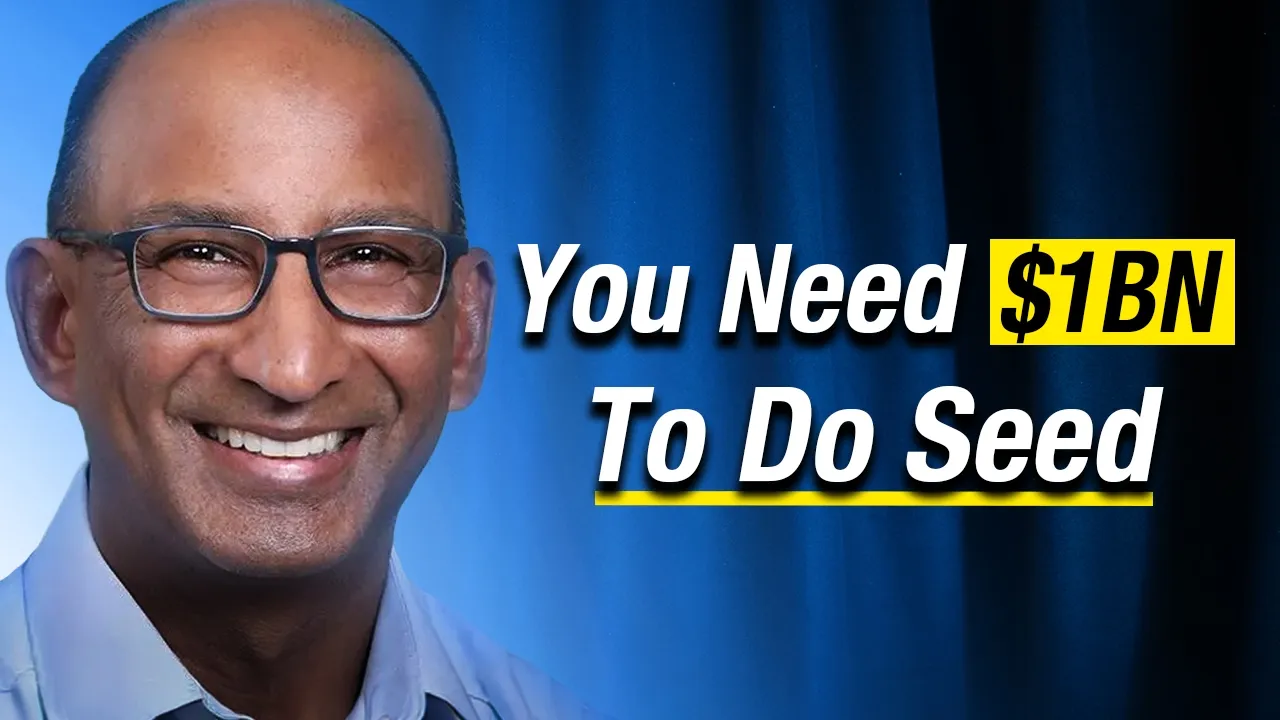
Who Wins in the Next Decade of VC | Margin and Price Matter Less in a World of AI | Sameer Dholakia
Description
Sameer Dholakia is a Partner @ Bessemer, the first that has just raised $5.75BN across a $1.75BN seed fund and $4BN growth fund. Sameer has led investments into the likes of Anthropic, Fireworks and Legora to name a few. Prior to venture, Sameer was the CEO of SendGrid, taking it from $30M in ARR to over $200M. ----------------------------------------------- Timestamps: 00:00 Intro 00:59 Why AI Is a Bigger Supercycle Than Cloud and the Internet 04:41 How Bessemer Underwrote Anthropic at a $15BN Valuation 07:37 Why Anthropic Was Bessemer’s Lowest-Voted Deal 08:44 Do Open Models Threaten Frontier Labs? 10:35 Will Enterprises Use Chinese Open-Source Models? 12:23 Is There Actually a Bear Case for Frontier Models? 14:11 The OpenAI Investment Sameer Passed On 15:33 Does Entry Price Still Matter in a World of $2TN AI Companies? 18:48 How Sameer Underwrites Revenue Quality and Margins 20:54 The Bull Case for Legora at a $1.8BN Valuation 23:22 Why Capital Has Become a Moat in AI 26:04 Is Triple-Triple-Double-Double No Longer Enough? 28:22 Does It Now Take a $1BN Fund to Win at Seed? 30:32 Why Venture Is Splitting Into Mega-Platforms and Specialists 33:05 Are Early-Stage Investments Really Just Options? 36:32 How Bessemer Builds a $4BN Growth Portfolio 42:42 Why Culture Is a Competitive Advantage 52:31 When Should VCs Take Money Off the Table? 56:08 Why Companies Will Stay Private Longer 1:02:16 The Bull Case for Fireworks Becoming a $250BN Company 1:05:10 Why Sameer Believes in Sovereign AI Models 1:08:28 Can $5.75BN Venture Funds Still Return 5x? 1:14:40 Why the Open-Model Economy Is Bigger Than Sameer Expected 1:15:17 Why Robotics Could Be at Its “2021 GenAI” Moment 1:16:59 Why Waymo Could Become a $1TN Company 1:18:29 Why AI Drug Discovery Could Compress 50 Years Into 10 ---------------------------------------------------------------------------------------------- Subscribe on Spotify: https://open.spotify.com/show/3j2KMcZTtgTNBKwtZBMHvl?si=85bc9196860e4466 Subscri
Summary
Generated by gpt-5.6-terraAt-a-Glance
- Verdict: Watch fully
- Core thesis: Dholakia argues that AI is an unusually large, capital-intensive intelligence supercycle in which both frontier and open-model businesses can win, but investors and operators must underwrite scale, durable revenue, capital access, and execution rather than anchor on current valuation multiples or margins.
- Why it matters: It offers a concrete investor/operator view of how AI economics are reshaping model infrastructure, vertical applications, fund construction, competitive moats, liquidity, and the next waves in autonomy and therapeutics.
- Best use: Use it to calibrate AI-company underwriting: distinguish transient current metrics from forward gross profit and retention, assess whether a company can finance and execute its scaling path, and identify where open-model ownership and vertical AI may produce durable enterprise value.
Executive Summary
Sameer Dholakia frames AI as a generational “intelligence” market larger than prior internet and cloud cycles because every consumer, enterprise, and government can consume more intelligence. His investment model is deliberately pluralistic: frontier closed-model labs, open-weight infrastructure, sovereign models, and purpose-built applications can all become large businesses because the addressable market is too large for a single winner-take-all forecast to be useful.
His central underwriting argument is that price and near-term margins have not become irrelevant, but must be evaluated against the next 12 months of revenue and gross profit rather than trailing ARR. He cites investments in Anthropic, Bridge, and Legora/Lawyer AI as examples where apparently extreme trailing multiples made sense because growth was extraordinary. Still, he strongly prefers sticky enterprise revenue with high gross and net retention over prosumer or consumer revenue, where churn changes the valuation logic.
Dholakia also argues that capital is now a necessary moat in compute-intensive AI markets: it funds scarce compute, accelerates distribution and brand, attracts talent, and creates a self-reinforcing customer flywheel. It is not sufficient, however; a winner still needs a superior product and execution. This shapes Bessemer's bar for concentrated follow-on investing: seed investments are options that must earn additional capital, while proven companies can receive $200–$400 million, with late-growth positions typically 5–10% of a fund and occasionally much more.
At the industry level, he expects venture to consolidate between giant global platforms and sharp specialists, making undifferentiated middle-sized firms vulnerable. He expects companies to stay private longer but predicts an IPO reopening driven by public-market demand for pure-play AI exposure. His forward-looking bets are enterprise-owned intelligence/open-token infrastructure, sovereign models in specific markets, embodied autonomy, and AI-enabled therapeutics.
Key Takeaways
- Claim: AI is a broader and potentially larger supercycle than the internet or cloud because intelligence can augment every human-driven market and workflow. | Evidence: Dholakia compares intelligence to oil: oil powers machines, while intelligence powers all humans across consumer, SMB, enterprise, government, and professional use cases. He describes prior “magic” moments around the internet and virtualization/cloud, each followed by trillion-dollar cycles. | Implication: Ken should avoid treating the AI stack as a zero-sum choice between models, infrastructure, and applications; the better question is where a company can retain differentiated value as the market expands. | Caveat: This is a market-size thesis, not evidence that every AI company or model layer will capture durable economics.
- Claim: Closed frontier models and open models can both be major businesses; the future token mix is less important than the scale of total intelligence demand. | Evidence: Bessemer invested in Anthropic and Fireworks, with Dholakia explicitly rejecting an either/or framing. He changed his view over the prior 12 months toward a much larger open-token economy and points to Fireworks and Fal as relevant open-model/open-media infrastructure exposure. | Implication: For enterprise agent systems, local or provider-managed open models are strategically credible where ownership, provenance, performance, and deployment control matter—not merely as a low-cost fallback to closed APIs. | Caveat: Enterprise buyers may still reject models with Chinese provenance even when they are locally hosted; Dholakia says CIO resistance exists and sees room for a leading US-based open-weight model.
- Claim: In hypergrowth AI businesses, underwriting should look forward no more than roughly 12 months, emphasizing forward gross profit and revenue quality rather than trailing ARR multiples. | Evidence: He says 10–15x next-12-month revenue can be reasonable for companies growing at unprecedented rates, while refusing to underwrite 18–24 months forward. He cites Bridge at roughly $5 million ARR and a $700–800 million valuation, Anthropic at $15 billion and roughly 100–150x current ARR, and Legora at $20 million ARR and a $1.8 billion round; he says Legora subsequently grew from 20 to 200. | Implication: Ken should assess AI products on a forward unit-economics model: retention, strategic importance, gross-profit trajectory, scale economies, and credible 12-month execution—not static SaaS benchmarks. | Caveat: Lower gross margins can be acceptable only with a defensible mechanism for improvement, such as economies of scale, stronger market position, or other demonstrated drivers; he warns against spreadsheet assumptions that margins will simply reach 60–70%.
- Claim: Capital is a necessary but insufficient moat in compute-heavy AI markets, because it enables a compounding flywheel of compute access, pace, brand, talent, and customer adoption. | Evidence: Dholakia says that large war chests at companies such as Anthropic, Harvey, and Legora intensify competition. He argues capital enables scarce, expensive compute and signals market leadership; talent and customers then follow. But he insists the product and leadership must still be exceptional for customers to rave about it. | Implication: When evaluating an AI platform or vendor, distinguish firms merely funded to survive from firms using capital to convert technical capacity into customer love, distribution, and a defensible operating lead. | Caveat: Capital does not “kingmake” a weak product: Dholakia calls it necessary but not sufficient.
- Claim: Venture capital is professionalizing toward two viable positions: a global multi-stage platform or an extreme specialist; firms in the middle face structural pressure. | Evidence: Dholakia contrasts the formerly Silicon Valley-centric, early-stage software industry with a global asset class spanning sectors and stages through IPO. His analogy is mature industries with large consolidators at one end and specialists such as Porsche or Ferrari at the other. Bessemer raised $5.75 billion, including $1.75 billion for seed/early and approximately $4 billion for growth. | Implication: For fundraising and partnership strategy, Ken should position clearly around a unique specialist advantage or a genuinely broad platform advantage; vague “generalist AI” positioning is likely to be less fundable and less differentiated. | Caveat: This is his industry-structure judgment, not a universal rule; he acknowledges there may be paths to success for others.
- Claim: AI investing increasingly rewards concentrated follow-on allocation to proven winners, while seed investments should be understood as options that must earn the next round of support. | Evidence: Bessemer keeps reserves in its early fund but says it will go beyond pro rata when a company inflects; Dholakia cites a nearly $200 million Lease AI investment. For late growth, he describes $200–$400 million cumulative investments, average single-company exposure of 5–10% of a fund, and a prior growth fund with roughly 20% in Anthropic. | Implication: Ken should build explicit stage gates into capital and resource allocation for agent initiatives: small options early, then aggressive concentration only after measurable product pull, retention, and scalability are proven. | Caveat: Not receiving a large follow-on is an explicit market signal that a company has not yet demonstrated sufficient acceleration; Dholakia does not view protecting founders from that signal as a priority.
- Claim: The next high-conviction AI frontiers are enterprise-owned intelligence, sovereignty-specific models, embodied autonomy, and AI-driven therapeutics. | Evidence: The Fireworks thesis is that enterprises will not want only to rent intelligence; they will want to own some of it. Dholakia backs Sarvam in India, where Indic-language and local-data needs matter, and Mistral for sovereign/regulated use cases. He says Bessemer invested nearly $200 million in Waymo and sees personal vehicles, trucking, logistics, construction, mining, and agriculture as extensions beyond ride hailing; he also expects AI and automatable wet labs to compress decades of biology discovery. | Implication: Ken should monitor ownership/control-plane demand in enterprise AI and treat robotics and biology as medium-term platform shifts rather than assume near-term deployment maturity across all sectors. | Caveat: He characterizes embodied robotics as roughly analogous to generative AI around 2021—promising but still a few years before broader acceleration.
Detailed Brief
How Dholakia distinguishes durable AI applications from inflated growth
- Claims: Vertical AI can support very large outcomes without needing to dominate its full market, particularly where AI expands demand by lowering the cost of previously inaccessible professional services.; The relevant market for legal AI is not just software spend; it can include a share of labor and services spend displaced or expanded by cheaper intelligence.; Not all fast-growing application companies are equivalent: horizontal intelligence platforms may have a larger ceiling, but a vertical company can still generate attractive growth-stage MOIC if entry price is right.
- Evidence: For Legora, Dholakia accepts a rough legal-market calculation but expands it globally, noting the US is about 40% of the market. He references roughly $1 trillion in global legal-services spend and invokes Jevons paradox: cheaper legal intelligence can surface latent legal demand.; He cites Fieldguide, an AI product for auditors, as an early-growth investment made below $10 million ARR at just under a $200 million entry valuation; he says model improvements in January/February materially improved its product and adoption.; He differentiates a company at $20–40 million revenue and a $0.5–1 billion valuation from a $15 billion Fireworks investment because business visibility, risk, and check size differ, while agreeing both can potentially generate 10–20x outcomes.
- Caveats: Dholakia does not claim every vertical AI company is a $100 billion-plus market-cap business; he explicitly concedes that this is a different bar from building horizontal infrastructure for “intelligence for the world.”; The transcript provides investor assertions about Legora's growth and market potential rather than independently verified operating data.
- Implications: A vertical agent product should be evaluated against service-spend capture and demand expansion, not just existing software-budget substitution.; For a control-plane or infrastructure thesis, horizontal scope may justify a higher outcome ceiling, but vertical wedges can produce superior risk-adjusted returns through faster proof of value and cheaper entry.
Operating and liquidity discipline
- Claims: Dholakia believes companies will structurally remain private longer because private capital is deeper, but expects an eventual IPO reopening as public investors seek more pure-play AI exposure.; He favors selective secondaries and partial realizations even in companies that continue compounding, because DPI matters to LPs.; He views being “IPO worthy” as an operating standard: the ability to predictably meet commitments under external scrutiny creates a more disciplined company.
- Evidence: He predicts a later-next-year and 2028 IPO unlock driven by supply and demand for dozens or hundreds of public pure-play AI exposures.; He says founders commonly take secondaries for family security and that doing so can improve long-term decision-making by letting them take bigger swings.; He acknowledges private-company advantages such as latitude for large product investments and temporary losses, while noting public-company advantages including liquid acquisition currency and credibility with certain buyers.
- Caveats: The IPO forecast is explicitly his opinion and is not tied to a stated macroeconomic trigger beyond investor demand.; The discussion treats secondaries as rational at late stages but does not specify an objective sale framework or percentage.
- Implications: Set an internal standard for IPO-grade forecasting, controls, and customer credibility even if remaining private is strategically preferable.; For any concentrated illiquid positions, plan liquidity and secondary policy before a need for DPI or founder de-risking becomes urgent.
Culture as execution infrastructure
- Claims: Dholakia sees team cohesion as a strategic advantage because building companies requires coordinated human effort under stress.; Values must be behaviorally specific and enforceable, including against high performers who violate them.; Deliberate non-work social time creates trust that reduces blame and attrition when operating conditions deteriorate.
- Evidence: At SendGrid, the four values were “happy, hungry, humble, and honest.” “Humble” meant “we, not I”; interviewers asked candidates about an accomplishment and informally counted use of “we” versus “I.”; He defines “happy” not as cheerfulness but as a positive, problem-solving orientation rather than becoming an Eeyore-like negative force under pressure.; SendGrid flew the entire company to Mexico annually: one day for mission and goals, then a day requiring employees to spend informal time with colleagues from other offices.
- Caveats: The culture prescriptions reflect his leadership style and may select against highly individualistic but otherwise capable employees.; The claimed effectiveness is anecdotal; no retention, performance, or engagement metrics are provided.
- Implications: Translate culture into observable hiring, feedback, and escalation behaviors rather than generic values language.; For distributed teams building complex systems, create recurring cross-functional relationship-building time before a crisis tests collaboration.
Notable Concepts & Terms
- Intelligence as a market larger than oil: Dholakia's central analogy: intelligence is an input to every human economic activity, making AI's TAM broader than industrial energy markets.
- Tyranny of the or: His rejection of closed-versus-open model framing; he believes both token economies can be huge.
- NTM underwriting: He uses next-twelve-month revenue and gross profit, rather than trailing ARR, to value unusually fast-growing AI businesses.
- Capital as a necessary but insufficient moat: Large funding enables compute, speed, brand, and talent flywheels, but cannot replace product-market fit and execution.
- Kingmaking: The idea that heavily financing a company can help create a category winner; Dholakia accepts the advantage but rejects it as sufficient on its own.
- Seed as an option: Early-stage capital buys the right, not obligation, to invest far more after a startup demonstrates it deserves to scale.
- DPI: Distributed to Paid-In capital; Dholakia stresses that LPs require actual realized returns, supporting prudent late-stage secondary sales.
- Sovereign model: A model aligned to a country's language, data, geopolitical, regulatory, or national-security needs, such as Sarvam in India or Mistral in Europe.
Operator Notes / Why Ken Should Care
- Adopt a 12-month-forward underwriting template for AI products: revenue, gross profit, retention, compute costs, scale-driven margin changes, and the concrete assumptions required for each.
- For OpenClaw or related enterprise deployments, map where customers need to own or control their intelligence stack—model provenance, private data, inference location, fine-tuning, and auditability—rather than assuming API rental is the default architecture.
- Make follow-on investment and internal resource escalation conditional on explicit traction gates; avoid maintaining equal support across projects that have not earned scale.
- Audit whether the company’s position is genuinely specialist or platform-level; sharpen the differentiated wedge if it currently occupies an undistinguished middle.
- Create a culture operating system with observable behaviors: define values that can exclude candidates, allow peer enforcement regardless of performance, and schedule cross-functional non-work interaction for distributed teams.
- Monitor embodied-AI data infrastructure, enterprise-owned model infrastructure, and AI-biology platforms as adjacent medium-term opportunity areas rather than conflating their maturity with current LLM application markets.
Source/Metadata
- Title: Who Wins in the Next Decade of VC | Margin and Price Matter Less in a World of AI | Sameer Dholakia
- Transcript words: 27300
- Duration seconds: 4790
- Timestamp note: No usable timestamps or chapters were present in the supplied transcript; the transcript also contains substantial repeated passages.
Transcript
Intelligence is going to be bigger as a market than oil. I've been in software for 31 years now, and the handful of other moments where I have felt magic, a trillion dollar super cycle followed every single time. And it doesn't happen very often. $5.75 billion—that is how much Bessemer Venture Partners just raised. Well, I saw this and I thought we've got to have Samir on the show. Samir is one of the leaders at Bessemer today. He led investments in Lagora and Fireworks, and he's one of the best growth investors in the market today. It's a spicy show. Samir was patient, he put up with me, and we had a discussion about not being a giant global platform or an incredible specialist who can add differentiated value and be better at picking because you are a specialist. I think it's a hard world to make money. I absolutely believe capital is a moat. Ready to go. Samir, last time that we did a show, I was about 12 years old. You put up with some very poor questions then, so I'm hoping that this will be an improvement. So thank you for joining me, dude. Dude, I was so fired up to see you. As they always say, long time listener, now second time caller. I'm fired up to be here, man. Thanks for having me. So we were just chatting beforehand and we said are USV and like 900 million and you know you guys just raised a size of the US treasury, it would seem. I think it was a $1.75 billion seed fund. We'll get into that. Seed and early. I'll talk about that later. Seed and early. And I think five more in growth. And so we'll get into that. But you said, oh, well, for those that have seen it before, this is that time. Man, when you're in one of these, I refer to it as magic. I've been in software for 31 years now. And the handful of other moments where I have felt magic, a trillion dollar super cycle followed every single time. And it doesn't happen very often. I graduated college in 1995, back in the dark ages, but it was at the birth of the internet. And I was graduating in the heart of Silicon Valley. And it was magic. You could just see how people could create content and share it with everybody on the planet. And you're like, this is magical. And oh my gosh, we could actually do commerce on this thing, and I don't have to go somewhere to go get something. That was magical. And then later in my career, VMware created this layer of software that disintermediated the hardware from the OS and said, I can spin up virtual machines. I can put 10 of them on that one box. And by the way, you want to see magic. I can move that running workload from over there on machine number two to machine number eight and shut the other one down whenever I want, and it won't interrupt the workload. Dude, that is magic. And I looked at that and I was like, holy cow. I didn't appreciate that the super cycle it would create was called cloud, right? Because there is no hyperscaler. There's no public cloud without the ability to do virtualization and motion VMs around, up and spin them up and spin them down—the elasticity of cloud. And so every time I felt magic, I was like, holy cow, this is cool. I got to jump into that. And then this one, I remember I started. I was actually on my sabbatical. I wasn't between Twilio. I thought I might be retiring, got bored. But I was doing some advisory work, and this young guy, Dave Robenmoser, over at Jasper, said, "Hey, can you spend some time with me on what we're building here? It's growing really fast." And I was like, "Yeah, I'd love to learn more about it." And he shows me a demo of Jasper. That's this AI marketing app sitting on top of GPT-3, right. And this was like in the winter of 2021. And I was like, magic. This is magic again. And so here we are now, five years later, and it's been magical. You just see these transformational technologies. And this one is bigger than the last two combined, in my humble opinion. Why do you say that? The analogy I often try to draw is intelligence is going to be bigger as a market than oil, because oil powers all the machines. Intelligence powers all the humans—not some of the humans, all the humans—consumers, prosumers, SMB, mid-market, enterprise, government. I don't care who you are or what you are doing. You need more intelligence. And when you think about a market of that scale and scope, you understand this is magic, and it's going to be really big. So if we actually go through the stack, then you did Anthropic. Let's start at the heartbeat of intelligence that you mentioned. Yeah, you did Anthropic. Can you talk to me about the rationale, the underwriting, what you saw, what you didn't see? When you look back now—I mean, yeah, I'm really proud that we did it in the Series D. What price was that, dude? I think it was $15 billion pre, $18 billion post. It was early. It was the round that Menlo led and Lightspeed and Bessemer joined. And this is, by the way, we were talking about my legendary partner, Byron Deeter. Thank God for him, because he and Matt Murphy go back a long ways. And Matt called up his buddy Byron and said, "Hey, we're looking to build a syndicate here for this startup named Anthropic, and you should check it out." And Byron said, "Hey, Samir, you want to come look at this thing with me?" And I was like, "Yeah, I'm all in on all the intelligence in the market." And I'll tell you, I think Byron and I grew up during our careers probably centered during those cloud days. And so we all pattern match—you just kind of use these mental frameworks. So for myself, maybe I won't speak for Byron—when I looked at it, I looked at it as, look, I think this market is going to be a cloud redux. That was my analogy. In the cloud era, you had a handful of hyperscalers, right there—you have AWS and Azure and GCP. And the reason is because it's massively capital intensive to build cloud infrastructure. Well, it turns out that in the market we were looking at here, it was going to be the same thing. It was massively compute intensive and therefore capital intensive. And so it's going to consolidate to a handful of players. But just like in the cloud era, we believed then and I still believe now, there would be hundreds of AI applications of apps built on top of them, just like you had hundreds of SaaS apps. You would have hundreds of AI apps that were purpose-built for particular things. And so if you have that mental model, then you say, okay, great. If it's really capital intensive, who are the people that have the balance sheet to actually go into the scaling laws that were being talked about? It's a pretty short list of players who could actually afford it. And you went across them and you're like, okay, Microsoft—yep, they partnered with OpenAI. Google—yep, they're going to go build their own called Gemini. And then you got to AWS, and AWS at the time had an internal model, I think it was called Nova, that was not particularly distinctive. I'll be generous. And they had just invested a very sizable amount of money into Anthropic. And at the time, it was very non-obvious that Anthropic was one of, I don't know, probably half a dozen or more other labs that were also trying to build intelligence. Was it controversial in Bessemer? Oh, Harry, you have no idea. That was, according to Byron, the lowest voted deal in the history of the firm of the time he had been there. But the fact that we were both there and had conviction. And one of the things I love about Bessemer is empowerment. Empowerment is one of the values of the place. And they're like, "Dude, that's where alpha comes from. If you guys really believe, go do it." What did you not see that you wish you had seen? I wish I had the ability to convince us all to do a bigger check that round. I feel like we saw it, we knew it. But there are so many risks at that stage of the company. But we knew that the AWS relationship was pivotal, that it would provide both the compute for the... Oh, Harry, you have no idea. That was, according to Byron, he said it was the lowest voted deal in the history of the firm at the time he had been there. But the fact that we were both there and had conviction. And one of the things I love about Bessemer is empowerment. Empowerment is one of the values of the place. And they're like, dude, that's where Alpha comes from. If you guys really believe, go do it. What did you not see that you wish you had seen? I wish I had the ability to convince us all to do a bigger check that round. I feel like we saw it, we knew it. And there are so many risks at that stage of the company. But we knew that the AWS relationship was pivotal, that it would provide both the compute for the training critically. And that was really important. And then distribution at that early stage. And I just wish we had written a bigger check. That's all I wish we knew then that we didn't know now. When we look at concerns today, one concern is the cost of intelligence shifts to open source, because it's simply too expensive in frontier models. And we see that in a lot of data that's being produced by Vaszel and Guillermo who publishes it. And we're both big investors in Fireworks. And so we both believe in open models too. To what do open models not deprecate the business model for the majority of frontier providers? Look, I'm a genius on this one versus the tyranny of the or. It is and not or here. As I said, I come back to my comments about the scale of the market for intelligence. We just can't get our heads around it. I mean, when we invested, I think my bullish bull case was that we could get to some massive valuation. And I'll just say that I missed the mark on how big of a business could be created at the frontier by factors. And so when you're in a market that big, predicting with any precision the mix between closed tokens and open tokens is irrelevant. You just, it's going to be big. You're in, right? Do you understand what I'm saying? When it's that large of a market, the ratio is actually not a concern. And I really do believe that there are all those different use cases from consumers up through enterprise and government. And they're all going to want intelligence of different types and different flavors. And that is why we're both investors in Anthropic and in Fireworks and the closed tokens and the open tokens. We'll have exposure as a fund and as a firm to both. But I think both are going to be huge. Do you think US enterprises are willing to use open source Chinese models? I think that once that Chinese model is hosted by Fireworks, it's no longer a Chinese model first. Do you think they see it like that? Me and you both know that to be true. But when you speak to CIOs, they go, I don't want it. If the provenance is China, I don't want it. And you're like, it's downloaded code on your local drives. And I still don't want it. Yeah. Listen, I've talked to some CIOs who share that opinion for sure. There's no question that is out there. And by the way, I do think that we should have a great open weight model that is US based. And I think that would be awesome. I think there's a big hole in the model in that market. Is that a great business? Right. It can be. For sure it can be. Yeah. But if you look at the thinking machines at a $40 billion price today, is there a $500 billion open model US to be built? Or is it just open a much harder business model to monetize and therefore it won't be that large? I believe it absolutely can build a big business. Whether it's at that particular scale, I don't know. But you can build a very large business and get venture returns. If you are the leading provider of an open source solution, I mean, just look at history across all these other categories, whether you're going from Red Hat to the database market. I mean, you can build a very large business. You can find ways to monetize it for sure. And most enterprises don't want to be responsible for the open source. They're going to want some provider with the right talent behind it. All the reasons that open source businesses have been great businesses for decades now. Totally get that. Can I ask you, if you were to present a bear case for frontier models, what would it be? Do I think there's a bear case for the frontier labs? I really don't, because I believe that at the frontier, intelligence solving problems that were heretofore unsolvable, or solving them at a pace that was heretofore unimaginable. I just think there's no shortage. Humans have so many problems to solve, Harry. We've got a lot of problems in this world. We have a lot of them. It's not like we're on the 99th percentile of problems solved and we're just trying to get to the last one. We have a lot of problems to go solve, and that's what these things will help us solve. The majority of people on the pod come on and say we'll see 99% of token traffic flow through open models, but we'll see 99% of dollars flow through closed models. Do you think that's apt, or do you think that's kind of a bullshit throwaway comment? I think that ratio is wrong. I really do. I don't think that's quite the mix. But to my previous comment, I don't think we have to get the mix precise. I think everybody just has to understand that you just have to look at the size of the TAM. 15 billion. It seems now ridiculously cheap. How could you? That's amazing. 15 billion at the time was freaking wild. I got brought OpenAI at 30 billion. To my stupidity, I said, oh my God, if this is 100 billion, I just 3X it, not including dilution. Oh my God. 15 billion. I thought the small mindedness that I had was just unbelievable. I think it's important. Harry, get out of my mind, man. I went through the exact same thing. So how did you get over it? It was because in the intervening time. You remember that OpenAI opportunity that I also passed on. I had the exact same thought pattern that you did, and that was right after the ChatGPT moment. Whatever that was, December, the conversation was in December. And then in that intervening time, that little OpenAI went from 40 million to the time that we then looked at that first round of Anthropic. OpenAI had gone from 40 million to about, I want to say, I'd have to go back and look at the numbers. You could fact check me, but it was something well north of a billion, billion and a half, maybe approximating two. And clearly we got it wrong. And that is one of the both, I think one of the most humbling things about this job is that you will get them wrong. And sometimes you'll get them wrong on really, really important decisions. And you have the opportunity to fix it. You have the, it's not a once in a lifetime opportunity. You could go back and fix it. And that was when Anthropic came along. The imagination was stretched to your point. We were, our imaginations were capped at a certain, even if it got to a hundred billion. And now obviously, you could see the growth potential of how big this market could be because of what OpenAI had done in calendar 23. In a world of $2 trillion assets, do you care about price anymore? Is LP focus on price misplaced? Entry price always matters. Every venture capitalist has taught me that. By the way, I mean, I'm four and a half years into this second career of mine. So I'm still learning. I appreciate that it is a craft like every other. And so I don't pretend to have all the answers by any stretch, but I know how important entry price is. And I will say that what matters most is whether or not you believe it can grow at scale and compounded for a very long time and still make you a venture return. And so I'm just very focused on the looking out the windshield, as opposed to the rear view mirror, and if I look at some of my investments of which I'm most proud, they were at current ARR multiples that would make most venture capitalists throw up. I mean, and they were difficult conversations in our firm IC, in our investment committee. I mean, I think of when we invested in Bridge, they were at 5 million of ARR and we were paying whatever it was, seven, $800 million. And so I don't pretend to have all the answers by any stretch, but I know how important entry price is. And I will say that what matters most is whether or not you believe it can grow at scale and compounded for a very long time and still make you a venture return. And so I'm just very focused on looking out the windshield, as opposed to the rear view mirror, and if I look at some of my investments of which I'm most proud, they were at current ARR multiples that would make most venture capitalists throw up. I mean, they were difficult conversations in our firm IC, right? In the investment committee. I mean, I think of when we invested in Bridge, they were at 5 million of ARR and we were paying whatever it was, seven, $800 million valuation. When we invested in Anthropic and Anthropic in that 15 billion round, I think they were at a hundred million, 150 times current ARR. Lagora, 20 million of ARR when we invested and led that $1.8 billion round. That's insane. And if you're only looking at present and backwards, you'll say, Samir, do you not understand math? A hundred times, that's what you're paying to get in. But if your view as was mine in each of those instances was that, yeah, but on an NTM basis, and that's what I care about, I'm looking at what do I think in the next 12 months this thing can be, and do I feel like that's a reasonable multiple in the next 12 months? So you look at end of year next year, again, this is me trying to learn, you look at end of year next year, and then you look at gross profit on that. Not even end of year next year, I'll go NTM, next 12 months. And yeah, depending on the business, next 12 months only, because depending on where you are in the year, that could be more like 18 or 24 months. And I won't pay that far forward because it's really hard to see that far forward in any business. And I've been an operator, I've been a CEO, I know how hard it is to predict that far into the future when you're scaling at these rates, but next 12 months, you should be able to get your arms around, at least get closer. What is exciting enough in that respect then? When you look at NTM, what is green versus red? You know, depending on the business, it'll vary, but something that's in the 10 to 15 times NTM, I don't think is crazy, especially if there are these businesses that are growing at rates that I have never seen in the history of business. And I've certainly never seen in my career of 31 years. I don't feel like paying 10 to 15 times NTM is all that crazy because they're going to blow through it. And I look at Lagora, we invested at 1.8 billion leading that round. And that seemed insane at the time, but the company just went 20 to 200. And I know where, I think we're in that together. I know Maxwell, they're on fire. And I feel pretty good about that 1.8 billion. We're going to get to Lagora and I completely get that. Does your feeling good about that 1.8 billion change depending on customer makeup, quality of revenue, run rate versus enterprise revenue? We see some ways to calculate revenue today. Does that change? For sure. Quality of revenue matters deeply. I'm old school. I've been in enterprise B2B software since 1995. So that is my bias. I prefer gross dollar retention rates, the net dollar retention rates of highly sticky customers for whom your thing is super strategic and they're going to keep expanding. So I would pay a much lower multiple for a prosumery business or a consumer business. Churn can kill you. What about margins? You look at someone like Lagora who we both love, their margins are good. They're not enterprise. I think margins, so this is where, having done this for a while, it depends on your lens. Am I worried about their gross margins in the next 12 months? I am not. I have a hold period of five to seven years at a growth stage check. And so when I think of it over the next five years, what do I think that's going to grow into and why? You have to be really thoughtful on if the gross profit picture doesn't look pretty and you're envisioning something that all of a sudden it's going to be magically hit 60 or 70% in five years, you sure as hell better defend that. You better know why you think that is possible. But in a lot of businesses, economies of scale really matters. Share and position really matters. And I can remember most of the businesses I invested in, gross margins at the time we invested in this AI world were meaningfully lower than they are at scale today. I mean, meaningfully lower. And factors improve inside of 12 to 24 months. When we look at say Lagora of the world, okay, I'm an investor. I always hold my hands. I'm a big fan. You did it at 1.8 billion. Okay. The legal market is 300 billion in the U.S. If we assume a 20% take for software, and that is $60 billion. And we assume that it's split up between a couple of different players, including your Harvey of the world. You can get to a five to 10 billion, maybe in revenue. Is that how you thought about it? And how do you get to a 10, 20 X when you enter at 2 billion on a company like Lagora? Help me. Well, I mean, that math is not terribly off. I would just say we included the whole world because you and I both know Max and he has global ambitions. And when you add in the rest of the world, you don't grow the TAM a little bit, you add another 60%, you know, the U.S. market is only 40% of it. But yeah, I think that math is not way off. I do believe you can get after the labor spend, the services dollars that go into the legal market. It is the cliche that everybody keeps talking about Jevons Paradox. I do believe there's a lot of legal needs that don't get served today because the prices are too high. So I just think there's this market when you're just thinking about this, that size of the TAM, I just believe that they don't have to take any meaningful share of that to go build a massive business. And when you put any multiple on that, that is reasonable and you're going to make a very good return. Totally will. The thing that's interesting when you look at all markets today is the competitiveness has changed. Dude, when you were building, I know Salesforce, there weren't that many competitors. There were several, but not the depth that we have today. And when we look at a Lagora and a Harvey, I'm going to be unpopular. I think both will do very well. When we look at Fireworks, I think Base 10 and Modal do well too. I think Fireworks will win, which is why my money is there. Has the competitiveness changed in your mind? And does that shape how you think about investing and market outcomes? I actually don't believe that the competitive breadth has changed. What's changed is the capital intensity behind the competition. And therefore it leads to this competitive intensity, right? If you looked at the war chest, the amounts of money that Lagora and Harvey have both raised, that leads to a competitive intensity that absolutely is different than what I dealt with in my era. Is capital a moat today? Is that the differentiator? By the way, I absolutely believe capital is a moat, and I've always said that markets— I'm going to be unpopular. I think both will do very well. When we look at fireworks, I think base 10 and modal do well too. I think fireworks will win, which is why my money is there. Has the competitiveness changed in your mind? And does that shape how you think about investing and market outcomes? I actually don't believe that the competitive breadth has changed. What's changed is the capital intensity behind the competition. And therefore it leads to this competitive intensity, right? If you looked at the war chest, the amounts of money that Anthropic and Harvey have both raised, that leads to a competitive intensity that absolutely is different than what I dealt with in my era. Is capital a moat today? Is that the differentiator? By the way, I absolutely believe capital is a moat. I've always said that markets pick winners and then it becomes a self-fulfilling prophecy, right? In our day, SendGrid and Twilio were the API building blocks to plug into your application to send communications. And then once developers had decided that it was game over, we had won. You were the default, you became the market winner. And that does happen. And we see it in these markets. If we take that as an example, there are lots of legal tech companies, lots of AI legal providers. But if you asked anybody at a big law firm who are the major legal AI companies, they would name those two. And so I do believe that the capital creates both the ability to scale at an extraordinary pace. And it creates brand for those businesses. Talent then ends up flocking and then you just get this reinforced flywheel. Then they win more customers. And then the virtuous cycle continues. Do you believe in kingmaking? I do, to your point that capital is a moat. If capital is a moat, excessive amounts in short amounts of time give inherent advantages. Do you agree with kingmaking or not? Yes and no, Harry. Yes, because I believe everything you said, which is that capital is a moat. And it is a signal to the market. Having built software companies for a very long time, your product has to be exceptional. Your company leadership has to be exceptional. I would say in math speak it is necessary, but not sufficient. It is a necessary condition for you to win the market that you have the biggest war chest, that you have the most capital. I really do believe that you are in that kind of game. And it's because the compute is so scarce and therefore the compute is so expensive that if you don't have that, you just can't play. So yes, I agree with you at the first part of your statement, but it is not sufficient. You have to then deliver an amazing product that your customers rave about, love, tell their friends about if you want to be the king. Otherwise you have no chance. So I agree with you completely there. And I also agree with what you said earlier, which is the 10 to 12 X growth rates now are very different to what they were. When you look at what you're seeing today, growth rate wise, is the triple, triple, double, double that SaaS metrics and I and Jason always talked about, is that wrong? Is that not enough anymore? It is not enough to attract capital from venture capitalists who have opportunities to put them into these hyper growth companies that are growing much, much faster. And all of us as venture capital funds, your capital, as big as these funds are, we just raised $5.75 billion. It's still scarce capital. There are deals to be done at crazy hyper growth rates now. All that said, I do still believe in finding companies that are doing the T2 D3, because the entry prices on those in this environment can be dramatically different, a very different multiple, and you can still make a great venture return on those. I just think that right now, if you buy that, do you remember the Excel deals? Remember the Excel growth deals, like OnePassword, Qualtrics, where they found these amazing assets in less obvious locations that were maybe more capital efficient? They then juiced them up with some growth capital, and then it turns into an even better business. Do you believe those will exist in the next gen, or not? You have to have that capital to get to the scale. I think that over time we'll see a bunch of application companies that can look like what you just described. I just don't think that's where the venture dollars are going to flow in the near term. When you have opportunities to invest in things that are 10Xing at scale, and your opportunity is something that's doubling, of course you're going to go to the 10Xing. That's just an intelligence test. We call it cake or death. You ever seen Eddie Izzard? He goes, cake or death? And you go, cake, please. Cake? Wow. What a surprise. I wasn't expecting that. What a tough question. But all that said, do I think we can make money investing in companies that are T2, T3? Absolutely. You can. And so then it comes to a mixed question. How much do you want to have in one versus the other? You mentioned the $5.75 billion. It's quite a lot, to be honest. Let's start with the $1.75 billion seed and early. Seed and early. Yeah. Do you need a billion dollars to do seed today? We just saw earlier today USV announced their $900 million fund. Do you need a billion to do seed? Yeah. Seeing the prices that I'm seeing, valuations we are seeing for the early stage deals coming in from my teammates on the early stage side. If you just think about the number of shots on goal you need to have to find the winner, I don't know how I don't know how you would have a small seed fund and be successful. I don't. What are you seeing in that pricing and ownership level? Well, depending on the business, if it is a capital compute intensive business, and a lot of these AI businesses are that right? It also depends on where you want to play, where in the stack do you want to play, how capital intensive of a business do you want to invest in? If you're like, hey, I don't want to invest in something that requires hardware, robotics, or I don't want to invest in something that's training a model for compute, maybe there are places where you don't need that capital intensity. But I just think in this era of intelligence and AI, I think a lot of them do. And so if you assume that that's the case, you're going to be paying the math. It just won't work for the entrepreneur or you if you're not paying what in my day, look, I've been doing this for 31 years, I've been in software 31 years. A seed check in the day was three to $5 million on a $20 to $40 million valuation. It was a dramatically different time. And that just doesn't get it done now. And what is it today? I don't have the specific numbers, but I know that it's factors higher. I know it's way more. And when your factors higher off of that, you really got to hope that you're a great picker. And this is where I get into one of my other worldviews. I'm just a humble business guy, Harry. And I think about the venture industry as any other industry. And so when I was evaluating coming in and starting it as a second career, I looked at the venture capital asset class. And I said, this looks nothing like what I grew up with in the mid-late nineties, where everything was hardware, software in Silicon Valley and principally early stage. And now it is global. Every sector you could imagine and everything from a pre-seed check through IPO, where you're investing. # Cleaned Transcript And when your factors higher off of that, you really have to hope that you're a great picker. And this is where I get into one of my other worldviews. I'm just a humble business guy, Harry. And I think about the venture industry like any other industry. And so when I was evaluating, coming in and starting it as a second career, I looked at the venture capital asset class. And I said, this looks nothing like what I grew up with in the mid-late nineties, where everything was hardware, software in Silicon Valley and principally early stage. And now it is global. Every sector you could imagine and everything from a pre-seed check through up into IPO, where you're investing hundreds of millions of dollars. Every one of the vectors that I just mentioned—location, stage and sector—are dramatically different and broader. It's just the professionalization of this asset class. And so if you think of it in that context, you're like, okay, well, in most industries, when they professionalize and they get to scale, you either have to be on this end of the spectrum, which is a giant global platform that consolidates a whole bunch over here, or you need to be an extreme specialist over here that is doing—fill in the blank. I'm doing AI deals in San Francisco early stage, right? You got to optimize specialty on all three dimensions. You could be one of those two. And if you're in between, good luck. I think that's a rough place to be. I really do. And it's the reason that Bessemer is going—we have, I think Bessemer is a big global platform, but man, not being a giant global platform or an incredible specialist who can add differentiated value and be better at picking because you are a specialist—I think it's a really hard job. I think it's a hard world to make money. So what happens to the billion dollar funds? I don't know, but I'm glad I'm not one of them. I'll tell you that. I think you have to be on either end. I really do. I really do. And look, I'm sure there's a path to success for everybody. Good luck. I'm just giving you my outside-in, unvarnished view as a business guy looking at an industry. I'm just analyzing it clinically. And I'm telling you what I've seen in the history of business is when markets get big, they consolidate and they have specialists. I mean, you take automotive, it doesn't matter what industry you pick—your big three in the U.S. or the Toyotas, Hondas in Japan. You get a handful of giant players on one end. And then you can be like, I am a Porsche or a Ferrari or a specialty player on the other side of the spectrum. But being in the middle is a tough place to be. It is. I think it's a very tough place to be. Can I ask you, when you look at the two different vehicles today? I had Venki from Manlo on the show, mutual friend of ours. And he got some stick for saying that early stage and seed investments were option bets and you build a portfolio of option bets. Yeah. It's hard not to have seen that. I think we're at about 5 million views. But he's by definition, right? If you have the majority of your dollars at late stage, by nature of doing early stage—unless you said I'm deliberately not going to invest in anything that I do early, which would be utterly moronic and irrational—it by nature has to be an option. Yeah. I look, having been on both sides of the operator and venture thing, I think what people were taking umbrage with was the notion that maybe this is what they're—I don't know. Was that the, "I'm an entrepreneur of a small thing. I don't want to just be an option"? I know Venki well. I know him personally. He's a great dude. They're a great firm. That is not what he meant, but what he meant intellectually is a hundred percent correct, right? It is an option. And if it works, then I'm going to put more capital behind it. I mean, anybody in venture capital, I believe, that listened to that or thought through that understands that to be a truism. And I think there may have been a little bit of flack on the human entrepreneurs that are doing the hard work of trying to build these things. And I don't want to just be an option, but I would challenge those entrepreneurs, having been one myself. And I would say, no, man, understand that your business—you have to earn the right to keep scaling, to earn the right to the next round, to get more capital, to keep building towards your dream. That is the game. And if you don't think that is true, you're not understanding the game. Can you help me understand? I totally agree. When you have the 1.75, does that have reserves baked in, or is the idea that you have no reserves there and then you double down from the 4 billion, which is growth? Both. We absolutely have reserves baked in to the 1.75, but we don't want to just be doing pro rata checks. Like in the companies that we believe are taking off, we want to back up the truck. As we've done—like we just announced a round with Lease AI where we're going to be investing nearly $200 million that we just announced. And so when we see the winners that we think are in big markets and are going to build great companies, we're like, yep, let's go. What does that look like then, that interplay? And do you worry about the signaling risk of Bessemer jumping all over one company and not another company? No, I don't. At the end of the day, I believe the truth will set you free. Just like if the signaling risk is they haven't backed up the truck of my company yet, the signaling there is simply, yeah, the business hasn't yet demonstrated that it is going to be going like this. That's okay. I led one of those. It takes a while. It's hard to build businesses, man. I don't worry about the optics on stuff like that because I've been in the seat and I think the entrepreneurs and the CEOs—they know the business they have, they know what they're working on. They know what they have to do to take it to the next level. And if they're not yet at the next level, I don't think most CEO entrepreneurs are going to want to try to pretend that they're not. So you have $4 billion then in growth going to your segment of the market. How does that look when you look at the portfolio there? How concentrated is that? What does the check size look like? What does the reserves look like? I'm just fascinated how you construct a $4 billion portfolio. Yeah. It's incredible. The numbers are obviously kind of staggering. They're large. But I don't think that the fundamentals are perhaps all that crazily different in that we still want to have concentrated bets. And so what that means is a concentrated bet means we may write $200 to $400 million into a given opportunity, into a given company, if we have that much conviction. And it'll probably be over a couple of rounds, but you're still looking for a relative concentration, of whatever it is. What percent of the fund would you be happy to go up to for a single company? Up to 10%. Five to 10% is sort of what I think our average check size will be. And for late-stage growth, to be clear—for our late growth funds, early growth is a little bit different, but late growth—five to 10% feels fine. And I'll just tell you our last growth fund, our Century Two, I think we had 20% into one name. The name was Anthropic. I feel pretty good about it. So we will flex it up. And it'll probably be over a couple different rounds, but you're still looking for a relative concentration of whatever it is. What percent of the fund would you be happy to go up to for a single company? Up to 10, if on a five to 10% is what I think our average check size will be. And for late stage growth, to be clear for our late growth funds, early growth is a little bit different, but late growth, five to 10% feels fine. And I'll just tell you our last growth fund, our Century Two, I think we had 20% into one name. The name was Anthropic. I feel pretty good about it. So we will flex it up if we believe it is a generational company. You have an early growth and a late growth? We do. Yeah. Oh, fucking hell. Fucking hell. What the fuck? What? Oh, fuck off, Stamit. Early growth is very different than late growth. Come on. It's so different. Why? No, it's not. Okay. Tell me, go ahead. They're both growth. No, no, no, no, no. Companies— Why don't we do a mid growth? Why don't we do an early growth, a mid growth, a not so late growth, a late growth, a pre IPO growth? You got to draw. I will concede, Harry, that there is an arbitrary distinction cutoff line somewhere, but I will tell you qualitatively, there is a big difference between investing in a company that is in the 20 to 40 million of revenue range, or is between half a billion to a billion dollar valuation versus I'm coming into a Fireworks at 15 billion. That's a very different stage of company. What you know about the business is different. The risk profile is different. The check size is going to be different. All the things are going to be different. I get all of that, but I think what matters is your multiple on invested cash. And actually, I think if you look at Fireworks, I think the upside is enormous. Enormous, yeah, sure. And I adore Lagora, but by nature, I think the upside is less, because it's a vertical market. It's not intelligence for the world. I think Max would agree with that. It is law. And even if it's tax and compliance as well, it is still relatively verticalized. And so I think your multiple on invested cash is what you should be looking at, which I would argue would be the same, actually. I would agree. I agree with you that many of the opportunities that we are investing in, because we are only trying to invest in the very best in both of those stages of early growth and late growth, I do believe that on both sides of those, you can find 10 and 20X companies. We want nothing less than a five. And that's a really high bar in growth. What did you do from your early growth that you rue not putting in your late growth? That's a good question. I'm really excited about one of my another vertical AI company called Field Guide that is in AI for auditors. So we've done AI for doctors with a Bridge and AI for lawyers with Even Up and Lagora and Field Guide is AI for auditors. And I did that one early. They were, I think they were sub 10 million of ARR at the time we invested, probably about a little under a $200 million entry price. And they're just ripping. They're growing really fast. I'm really excited for them and proud of them. And we haven't yet been able to back up the truck. Their inflection has been extraordinary. I think post January, February when the models took a leap forward, all of a sudden, their solution became wildly more compelling and the uptake is showing it. I'm going to push you, but is that really a generational company? No offense. Yes. It's fascinating. But no, but Fireworks is. I think Cognition or Factory could be. Sure. I mean it with zero disrespect to Field Guide. It can be a phenomenal business, a 10, 20 billion business. But to be in the late growth as Excel calls it, the Leaders Fund for Excel, is this really the generational? Well, it depends on your view of where you would define generational. If generational now is you got to get to $100 billion market cap, then yeah, I agree with you. It's probably not that. And some of those others certainly can be. But I think it's an extraordinary business. And that's one I wish I backed up the truck on more. And if the price is right, then to the point that we said earlier, the multiple on invested cash can actually be the same. So I totally get you there. Exactly right. Do you have separate teams for early to late growth? No. Same group. We've got four great GPs, an amazing team of VPs and associates that are going after this thing. We've been working on it. Man, I'll tell you, Harry, I am so fired up about our growth team and the practice we have built over the last few years. I'd put our growth portfolio up against any growth team in the world. I really do. I think we're going to have one of the best portfolios in all of growth, in all of venture capital. I spoke to many people on your team beforehand, and they said the real focus you have on culture. And I thought, oh gosh, how boring. Come on, man. It's the most important topic. Oh, for every CEO is like, I want to talk about culture. And then you speak to their team and it's different. And it's just like every marketing team is like, talk about culture, talk about culture. I did hear something though, that I would like to ask. Talia told me to ask you about teammates and friends beat colleagues and co-workers every day. Every day and twice on Sunday. That's right, man. I have used that line repeatedly for a decade now. How does that impact how you build a venture firm today then? Well, look, first, I'll explain the genesis of the line. And then I'll talk about why I think it's so important, even in firm building as much as it was. It came from when I was leading and serving at SendGrid. And I have always believed building businesses, the hardest thing to do is to align masses of humans, so many people to work in a coordinated and orchestrated way towards a singular goal. That is really effing hard to do, man. And every CEO listening is like, yep, they hear that. They know that. That is the hard bit. And I have found it was a strategic competitive advantage. If your team, if your humans actually liked each other, if they actually cared about each other and they thought of each other as teammates and not colleagues, teammates, and the reason, Harry, is that teammates work harder for each other. They're not working for themselves. They're working for their teammates and they're working for their team. And you never want to effing let down your teammates. Okay, I get you. I obviously agree. You can't disagree. But then how do I teach me? How do I then put that into practice to turn co-workers and colleagues into teammates? What can be done? I'm going to start with the most important basics. You have to be aligned on culture and values. How we do our work has to be super clear and everybody lines up to it. There's no changing of the standard. You can't have the asshole that's a great performer that doesn't abide by the rules, if you say, or whatever it is, whatever your culture and values are, you have to get everybody working in the same way. You got to protect that. And everybody has to be empowered on the team to be like, nope, I'm going to call that out if you are deviating from our culture and values. So culture and values, I think a good value is something that could be argued for or against. What is the culture? Disagree. The value isolated from the organization, sure, anybody could agree or disagree. But you have to have a set of them that you're like, David I'm going to start with the most important basics. You have to be aligned on culture and values. Jason Vale How we do our work has to be super clear and everybody lines up to it. There's no changing of the standard. You can't have the asshole that's a great performer that doesn't abide by the rules, if you say, or whatever it is, whatever your culture and values are, you have to get everybody working in the same way. You got to protect that. And everybody has to be empowered on the team to be like, nope, I'm going to call that out if you are deviating from our culture and values. Jason Vale So culture and values, I think a good value is something that could be argued for or against. What is the culture? Jason Vale Disagree. No. The value isolated from the organization, sure, anybody could agree or disagree. But you have to have a set of them that you're like, this is our way. This was the SendGrid way of doing things. We had our four Hs, happy, hungry, humble, and honest. Four Hs. Happy, hungry, humble, honest. And those were our four. And everything we did had to reinforce those four if you deviated. Jason Vale You can't argue that you shouldn't be happy, you shouldn't be hungry. We want unhappy, unambitious liars. Jason Vale No. I'll push back. I'll push back. Here's the example. I always said that, and I love SendGrid, our culture. I thought it was amazing. I think our teammates, if you could go track down any gridder out there and say, hey, did you enjoy working at SendGrid? Was it a special team? I know to my bone that 100 out of 100 of them will say yes, it was. And the reason for that, though, is take the humble H. But it would have been seventh hell as a place to work for a certain group of humans. Our humble H was we, not I. It was about, we would ask people in interviews, you know, Harry, tell me about a professional accomplishment of which you are most proud. And then we would sit back and do a pronoun count. How often does Harry say we? How often does Harry say I? I want the people that say we. Now that was just, that was our value. That was SendGrid's value. That doesn't mean it's the right value. To your point, you could argue either side of that. I don't care. But for our company, our team, the way we work together is this way. And if you're not that way, that's fine. It's a big labor market. Go find another place to work. That's great. No harm, no foul. But man, it matters that the people you bring in want to work together in a certain way. And that's how you build a team and not colleagues and coworkers. And by the way, so that's number one. But number two, I think it's number two. Number two, which is also equally important to get teammates and not just colleagues, is you go spend time together not doing work. I know it sounds so crazy. When I was leading SendGrid, we flew the entire company every January down to Mexico for an annual kickoff, the whole company, not a sales team, president's club. I mean, the whole company. And we'd lock them in a room for a day and we would get lined up on here's the vision, here's the mission, this is why we're doing what we're doing, here are the goals for the year, blah, blah, blah. And then they would have the whole second day was go find somebody from another office and go kayaking together, go mountain biking together, go sit by the pool and have a drink together. I don't care what you do, just do it together. And the reason this matters here is that for all the CEOs listening out there, they will understand when I say this. Shit goes wrong when you're building businesses, it's hard. And when you have a group of colleagues and coworkers, you know what they do first when shit goes wrong? They either go like this. And for those listening, I'm pointing my fingers as if you're pointing at each other. Right? It's blame placing. Sales isn't responding to the leads fast enough. Marketing isn't generating enough pipe for me. Right? When things aren't going well, they point fingers or worse, they just head for the doors. Because they're just, well, I go to the next company. Because I'm just a colleague, this is just a job. But a teammate, teammates and friends in hard moments when you're building a business, and believe me, there are many, that group of people in a team are going to come together. They don't start pointing fingers, they come together. And they go across and be, Harry, dude, I spent time with you mountain biking or kayaking or sitting by the pool having a beverage. You're a good dude. We got to figure this out for our team. That's how you solve problems. And when times are hard, and I'm just telling you, man, teammates and friends will beat colleagues and coworkers every day and twice on Sunday. No, I totally get that. I completely agree with that headline. I think I'm very trained and strongly believed in the values being differentiated and arguable. We believe that hardest of work leads to better results. I don't buy the rest days. Amen. I don't buy rest days in the gym. You train a different body part. You do cardio, not wait. Phelps won. No, but a lot of people don't agree with that. I'm chastised for it in Europe. I'm the spawn of Satan. Seriously, dude, it's not popular. I will get booed on stage by labor conferences. No kidding. Well, listen, I'll tell you this, man, I couldn't agree with you more. I think I'm the son of two immigrants. Work ethic is everything. That hungry age. My line was always, I want to work with people who are going to run through walls to be successful, who will not relent. We quote the Eminem song, success is my only option. Failure is not. I want people like that to work with. Yeah. Number two for us, feelings are expensive in investment committees. Samit, if me and you are in investment committee, I want to say you're an idiot for thinking that we should pay that price for X company. And why is that? I don't want to have to tread around it. Samir, thank you for bringing this. I appreciate the time you spent with the entrepreneur, but I think we should consider. I'm sorry, we're both big enough. Yeah, sure. And again, that can be great for your team and culture and people that are going to opt into that are going to be awesome together. And they're going to appreciate the directness. I would say the intellectual honesty in the IC is actually what matters most. My point is actually, it's great that you can debate, because I'm not right. It's just our way. But what I don't understand is the values like Zoom, which is, I think, happiness. No one's advocating for unhappiness. Yeah, yeah, yeah. No, I hear that. I hear that. I'll just say on the happiness one, by the way, at SendGrid, our happiness, I did find when I had to write down, what do we mean by each of these four Hs? And the happy for me was, of course, you want employees to be happy, but that's not what I meant by the happy H. And SendGrid was, I want people who are going to see the world and our business as half full. The glass is half full, not half empty. And there are just people who are going to be negative, people who are going to be Eeyore and Winnie the Pooh, or just going to be downers. I'm, no, man, I want people who are optimists, who are fired up to go tackle problems. And that's what I meant by happy, not I'm joyful. That's great too. I hope you're joyful, but I want you to be a positively disposed person who, when things go bad or are hard, you're not going to go negative and bring the team down with you. Totally agree with that. Can I ask you, if we go back to venture, we're seeing some of the most incredible value accumulation from these businesses. We've mentioned Lagor, we've mentioned Fireworks. I think you're in FAL as well. How do you think about when's the right time to sell? With IPOs being continuously pushed, maybe as many more Stripes, how do you think about liquidity events? I joke about being new to the business four and a half years into venture, but I do know that DPI matters. Not that new. I know that liquidity matters. DPI matters. Our LPs are not in the business of handing us the money for perpetuity. So we got to get it back to them in multiples. And I get that. # Transcript Joyful, but I want you to be a positively disposed person who, when things go bad or are hard, you're not going to go negative and bring the team down with you. Totally agree with that. Can I ask you, if we go back to venture, we're seeing some of the most incredible value accumulation from these businesses. We've mentioned Lagor, we've mentioned Fireworks. I think you're in FAL as well. How do you think about when's the right time to sell? With IPOs being continuously pushed, maybe as many more Stripes, how do you think about liquidity events? I joke about being new to the business four and a half years into venture, but I do know that DPI matters. Not that new. I know that liquidity matters, DPI matters. Our LPs are not in the business of handing us the money for perpetuity. So we got to get it back to them in multiples. And I get that. Right now, I think because we're still so early in this AI wave, it's not a principal concern, but I would say, because I think these businesses are going to keep compounding and keep compounding at scale. But I do think that we should look for opportunities just practically, just being prudent, risk-aware business people. You should take some chips off the table along the journey to make sure that you're getting some DPI and locking in gains for your LPs and your funds. You should. It's crazy not to. Do you find that you're able to, given the brand of Bessemer is often a very premium brand in a round? Yeah. Yeah. No, I appreciate that. And I do think we have a great brand. I think that when we're looking for a little bit of liquidity to take some chips off the table and bring DPI back, it tends to be at very late stages of the journey. And most people see it for what it is, which is yeah, they've got an enormous position here. They're going to make lots and lots of money and the whole thing is going to continue to compound. But to take a little bit off the table to get back to LPs, I just find people are more matter of fact about that now. And this is back to the whole professionalization of the asset class. What used to feel like a personal decision, and like, do you not believe in me anymore? Do you not believe in my business anymore? People are, I just think that at the scale of the businesses that we're building, the size of the checks that we are now writing at the valuations that we're writing them, I think people get it. I think I do. I think CEOs are very, I've been on the other side. They're sophisticated business people. They understand. They understand the math. I totally agree with you there. And I think people oscillate too much on the, oh, they'd be so upset if you sold. I think founders are actually very rational and smart about it. Super rational. Look, I mean, you tell me, what percentage of the founders that you're working with that get to crazy late stage don't take any in secondary themselves as the rounds of financing go through? Most of mine are. And they're doing the right thing for their families, right? And I tell them to. I'm like, shoot, you should probably sell a little bit here, bud, to make sure that you're financially secure for your family. And I think that's great. No problem. I think it makes better founders. I completely agree with you. You think with a much longer term vision. Yeah, and then they're willing to swing for the fences, right? Yeah. Yeah. Completely agree with you. Can I ask, do you think we see the number of IPOs drastically reduce as Stripe shows that public markets can be harder than private markets if done well? How do you think about that? I will say a few comments here. One, I believe that it is a permanent structural shift that companies will stay private longer. The asset class of private venture capital is just that much bigger. There are that many more dollars in the market and that many more firms. It's just so that will, that will, they will stay private longer. And I think that is a given. And I think, you know, see crossovers that are spending more time here. I think LPs are allocating more to the asset class because they get that. They can't reap the rewards of this generational boom if they're waiting for them in the public markets. Most of that run up will have already happened in the private markets. So I absolutely believe that is true. I also believe that we will see an unlock in the IPO markets next year, later next year and in 2028. I think a lot of companies will go public. And I just think we've had this, you know, the window has been shut for so long. Well, can I ask you, why will that unlock happen? What will cause it? I believe in, you know, I'm an economist by training. And so supply and demand is a thing. It's just a thing. And so what's going to happen in my humble opinion is you'll see a bunch of great businesses go public that will have a lot of success in the market, but there will be an obvious appetite from investors in the public markets to get pure play AI exposure. And they don't want it from just a few companies. They're going to want it in dozens or hundreds of companies that are pure play AI exposed. And I just think the supply and demand, the demand will be so incredible that they will be willing to pay prices and then supply and demand works, prices move. And I think we'll see a lot of companies that the window will be open. A lot of people will come out. I'll say one last point on the IPO thing, which is having done it myself. I believe it makes for a better company, deeply believe like you, you run a tighter ship when you are a public company. I always used to say it's angry. I said, I, we need to be IPO worthy. When we were building up to our IPO, I was like, we got to be IPO worthy. And what does that mean? It means it is a high bar to withstand the scrutiny of the public eye. That is hard. Quarter in, quarter out, predictably deliver on what you say you will do. That is hard. But you build a really rigorous and operationally disciplined machine. And I hope a lot of companies will take advantage of that. I do. Do you still buy that? And what I mean by that is like, you know, when you look at a lot of Canva released their numbers and when they release their numbers, or the great numbers, you have similar kind of reactions. Like the expectations have just shifted and these companies have those expectations anyway. And I would argue that actually Stripe is able to do a lot of things because of their private nature that ADN is not able to do, which make them structurally advantaged. I think you are forced, you are enabled to be better because you're private rather than the discipline. Yeah. I look, I hear that. I think there are pros and cons to anything. I think you're right. You do have latitude to make, you know, particularly big product investments. You can go deep in the red for periods of time if you think you need a shift. I got to take a big hit, whatever. But on the flip side, there are things that you can do as a public company. Like I have a currency, I can go do M and A. I can do lots of things. There are pros and cons on both sides. I get you, but Stripe did an M and A for OpenRoute of $8 billion. I mean, they wanted to buy PayPal for $55 million. Like you have that now. You have liquidity for employees and investors. I'm just wondering actually, are we seeing really the winnowing of that IPO attractiveness? Yeah, maybe, maybe. I don't know. I just, when I talk to our companies that we're invested in, I think a lot of them are still talking about it. Yeah, they still are. And by the way, in certain markets, it's still, you know, it's a badge of credibility, right? Like those companies, their customers care. They're like, okay, these guys are legit. They're real. They're at scale. They're public. It connotes something. Ironically, for things like Aura, I think it also totally makes sense. A consumer brand, one where retail wants to be part of it. Do you think retail should be a much larger part of the LP base of venture funds? If we have so much more gains now in private markets, do you think retail should play a large part in the LP basis of venture? Harry, I think it's hard to argue in terms of the, you know, what we would call kind of the Yeah, they still, it is. And by the way, in certain, in certain markets, it's still, it's a badge of credibility, right? Those companies, their customers care. They're like, okay, these guys are legit. They're real. They're at scale. They're public. It connotes something. Ironically, for things like Aura, I think it also totally makes sense. A consumer brand, one where retail wants to be part of it. Do you think retail should be a much larger part of the LP base of venture funds? If we have so much more gains now in private markets, do you think retail should play a large part in the LP basis of venture? Harry, I think it's hard to argue in terms of what we would call the democratization of access to that. I think it's hard to argue against. I do. You know, what do you—because I could argue against, sorry, I mean, really, I'm going through this because I do. You know, honestly, Bessemer is a very overfunded product. There's so many people that want access to it. If you just had a random people's fund, I don't know if it would beat out the hospitals and pension funds. And so then you have adverse selection and then retail just goes into shit funds would be an argument. By the way, retail should only go into, back to our earlier part of the conversation, either giant global platforms with brand and leverage and power or super, super specialized folks. And you know, you're taking risk. And that's that, and if that doesn't feel comfortable for the retail investor, they shouldn't play, because it is a high risk game. And you know, there's a lot of argument in this day, especially when the public markets have been ripping like they are. If you're a retail investor, just put it in the public market and don't take the liquidity hit and just let it compound in the public markets. But yeah, obviously I believe when I look at our portfolio of companies, I'm like, these things are going to continue to grow and compound and deliver gains that are not accessible in the public markets. And so that's where I would go. Can you paint, and one of my favorite companies, period, is Fireworks. I think Lynn is generational. Can you paint the bull case for how this is a $250 billion business? Look, I think, and by the way, I couldn't agree more. Lynn is extraordinary. And so is George Hu that just joined her team as president. On the first call with me, I get on, I've never met him before. First call, Lynn gives me to him and this is before it's like to determine whether I'll be able to invest. I go, George, I've heard so much from Mark and I'm trying to be charming. He goes, yeah, yeah, cool. So tell me, how are you going to increase the value of this business? That is my man. That is my man, George. He's going to cut right to it. No talk about the weather. Sure, George, let's go straight into it. Let's get to it. George, I interrupted. You were saying, I'm just telling you, Harry, we worked together at Twilio. He was deeply involved in the diligence when we were doing the Twilio SendGrid acquisition, we were in the same executive leadership team room with Jeff Lawson, who's extraordinary and a bunch of great people. And we're in those trenches together for 18 months. And I'll just tell you, I've been doing this for 31 years. He is absolutely one of the very best software executives in the industry, period, full stop. And so when you pair— Why? What makes him so good? So first off, George, he's an exceptional thinker. He's super strategic. He's very analytical. He has been doing this for decades and he knows how to run. He knows how to build a go-to-market engine. Harry, very few people in technology in the market today know how to build. And so when he's joining Lynn and Fireworks, I'll just say, preceded our investment by about a month or two because George joined. And I'm like, dude, these guys are going to crush because you have the brilliance of Lynn, strategic thinker, deep technologist, unbelievable technical team from Meta, and now George building the go-to-market engine. I mean, that is the pitch right there. You asked me for the bull case. You take those two together at the top of that company leading, they're going to build an enormous business. So I'll leave it there. I will say though, in terms of the TAM and the market and what they're doing, I think their general pitch of enterprises are not going to want to rent intelligence from somebody else. They're going to want to own their own. I just think it's the simplest and really compelling tagline for any enterprise CIO buyer. And personally, I think there'll be a healthy amount of both. But man, it's hard to imagine a business saying, yeah, no, I don't want to own any of my intelligence. Every business is going to want to own some of their intelligence for sure. Do you buy the sovereign model argument? I do. We're invested in two. We're invested in Sarvam in India, and we are investing in Mistral right now. And so you think that, hey, countries and geopolitical regions will, for obvious geopolitical concerns, need to have access to their own. Is that it? And to what extent then, do we just go down the stack of we need our own energy providing, we need our own— Yeah, yeah, yeah. I'll say in certain markets and for certain use cases, right? And they're different. Like in India, I think one of the things that makes India such a ripe opportunity for intelligence local to their market is the Indic languages. There are so many different languages and training the models on their own content. And that's multimodal. It's voice, it's text, it's all the things. There's a very particular argument there. And not to mention, of course, they have some of the best technologists at scale in India who can work on the problem. In the case of Mistral, look, at the end of the day, if you're trying to determine my military strategy for fill in the blank, there are certain use cases where if it's a government use case or a regulated industry or whatever, that having it be a sovereign model is probably going to feel more comfortable to that buyer. And again, when you've got a market as big as intelligence, it doesn't have to be all the buyers. Some of the buyers decide that they want to use that sovereign model for some of the use cases in some of the industries, and you're going to build a very large business. When you're writing a check, how does the upside requirement change depending on the vehicle that it's in? And so for us, I'll put it very simply, from the early fund, we need to see a fund returner, which means a 50x. And from a growth fund for us, we need to see a 10x. It doesn't need to be a fund returner, but a 10. How does that upside requirement change for you and look? What you said actually is very consistent with how we think about it also, like that to get to, we want the 5x plus funds, right? That's just really hard to do at any stage. But the math, you can only get to that if at the later stage, you're putting big dollars behind businesses, some of which may be lower than that, but some of which are going to be way higher than that. And in the early stage, you know, by definition, your hit rate is going to be so much lower because they are earlier stage. There's just less developed businesses. You're going to need some 50xs to account for and pull up all the ones that don't work out. Obviously, it's de-risked when you get to the growth stage a lot more. And so the upper bound doesn't need to be quite that high. You don't need 50xs in growth, although some of ours, I think, may approach that. But that's not the same bar in terms of the MOIC. I think the blended gets to the same place. Do you think you can still do a 5x given the fund sizes being as large as they are? A hundred percent. No hesitation. A hundred percent. Especially in this era. A hundred percent. I mean, when you see businesses scaling at the rates we are scaling them, Harry, the value creation. And so it's not a hypothetical anymore. I sounded like a crazy # Cleaned Transcript Some 50xs to account for and pull up all the ones that don't work out. Obviously, it's de-risk when you get to the growth stage a lot more. And so the upper bound doesn't need to be quite that high. Preston Pyshko: You don't need 50xs in growth, although some of ours, I think, may approach that. But that's not the same bar in terms of the moig. I think the blended gets to the same place. Preston Pyshko: Do you think you can still do a 5x given the fund sizes being as large as they are? Preston Pyshko: A hundred percent. No hesitation. A hundred percent. Especially in this era, when you see businesses scaling at the rates we are scaling them, Harry, the value creation is there. And so it's not a hypothetical anymore. I sounded like a crazy person three years ago when I would say this stuff, but now everybody just looks at me like, oh, yeah, that's true. I can think of 10 examples. And so there's no debating that we're seeing value creation in this era unlike anything we have ever seen. And so absolutely, I believe we can generate those kinds of returns. Preston Pyshko: You can only invest in one of those funds—early growth or late growth. Which one do you invest in? Preston Pyshko: If I could only pick one? Yeah, me personally, obviously, I'm focused on the growth stage. And I really do like the opportunities of late stage growth. But I actually think we'll do better there. I think outcome scenarios are bigger than they've been in a long time, which means the upside in the multiple invested cash is much bigger. I think there's a 20x in there for us. Preston Pyshko: I agree. A hundred percent. And so when you can get early venture return moix on late stage de-risk companies, I'm with you. That is a great spot. I will say that we have a world-class early stage franchise that's been doing pre-seed, seed, early series A's for a very, very long time. If you can buy 10 and 20% ownership early for small checks, that's fantastic too. I would love—we're going to continue to keep doing that all day long, but it's definitely an and. That's why I love our model as a giant platform, because the synergy of that practice with our early growth practice, with our late practice—it is really, really something. Preston Pyshko: I want to do a quick fire where I pepper you with questions and you give me your immediate. Preston Pyshko: Okay. Who's the best picker in all of Bassema? Preston Pyshko: I think we got a bunch. I think Byron Jeremy, Adam Fisher in Israel and David Cowan out here has been doing it for three decades. But if I had to pick one, I will say Byron Dieter, mostly because when we were going public, the morning of the IPO, we're in the New York Stock Exchange. We brought out every SendGrid employee who had been in the company for more than four or five years. So we have this room full of SendGrid employees. The president of the New York Stock Exchange comes out to welcome and greet us before the bell ringing ceremony. And he says, I just want to welcome all you SendGrid employees that are here. You should be so proud. SendGrid management, so great to have you all. Esteemed board members, thanks for coming and being part of this special moment. Byron, great to see you again. And he just pauses. He's like, Byron, how many times have I seen you here in the last... Mind you, this is a decade ago. And Byron sheepishly, because he's a very humble guy, says, I don't know, he flashed up something like six. And we just laughed, knowing that he had been there for multiple of these IPOs in the recent time. And then I was sitting right in front of Byron, and I just started to count in my head. And I could come up with more than six. I'm like, no, no, you've done more than six. And I turned back and I was like, no, it's more than that. And he said, six here. NASDAQ was another big number. He has had so many from early stage all the way through IPO. I mean, it's hard not to say Byron Dieter. Guy's amazing. Preston Pyshko: Okay. Byron is the picker. Who is the winner? And what I mean by that is when you're like, oh, Sequoia around this, founders around this, Benchmark—who is the one person who closes founders better than anyone else? Preston Pyshko: Oh, that's a good one too. So can I revise my answer then? Knowing both of those two, I would go with David Cowan as the picker because he finds stuff that everybody thinks is crazy, like Rocket Lab that then becomes an enormous business and nobody knows what he's doing. But when it comes to closing is Byron Dieter every time, for sure. Nick Hickman: 100%. That guy is a force of nature. He's charming. He's funny. He's smart as all get out. His experience is ridiculous. He knows how to have a good time. He'll host people, whether it's at a 49ers football game or up skiing at his house in Montana. I mean, the guy is an amazing, amazing closer. Preston Pyshko: What company is Bassam and not in that universally the firm rues and wishes it wasn't? Nick Hickman: Oh, so many. I would say Stripe. I mean, think about it—we were the developer API venture capital firm. We led the seed and I think series B and Twilio, led the series B in SendGrid. We had Auth0 that David Cowan led. I mean, we were the developer API company and we weren't in Stripe. That hurts. That's probably the one. Nick Hickman: You can add one person to the venture partnership that is not there currently. It's a dream add. It's not realistic, but who would that be? Nick Hickman: If I could convince Ravi Matre to come join us, I would love Ravi over here. He's from Lightspeed. Ravi is an incredible, deep thinker, goes deep on the technology and the markets. You look at some of the investments that he has led and made, not the least of which was a billion dollar check into Anthropic in the $60 billion round. That guy is really good and he's willing—he's not just really good, but he's willing to take these giant risks that seem almost borderline insane. And I have deep, mad respect for both. Nick Hickman: Billion dollar check. That is some serious bulls. Nick Hickman: That's a lot of numbers. Nick Hickman: What have you changed your mind on in the last 12 months? Nick Hickman: In the last 12, I would say just my deep appreciation for how big the open token economy is going to be. I just didn't see it 12 months ago. I didn't appreciate it. It's a big part of the reason we're investing as much as we are behind Fall and Fireworks. Both fall on the GenMedia side, on the infrastructure side there. And they're going up and down the stack. They're an amazing, amazing business, amazing team. And Fireworks, obviously, we talked a lot about those two. I just didn't appreciate how big that market was going to be 12 months ago. Nick Hickman: Final one for you. What are you most genuinely excited about moving forwards? Nick Hickman: I'll say two. One is I'm wildly fired up about all things robotics and embodied AI. We invested nearly $200 million into Waymo. And I just think that autonomy and what that changes and how that changes the way we work and live, I think is awesome. Nick Hickman: Is that humanoids or is that not humanoids? Nick Hickman: I think it can be. And certainly an area that we've been looking at. And I think we're probably in the equivalent in embodied robotics in that sense. I think we're probably at circa 2021 relative to the generative AI era. So I think we're still got a couple few years to go, but it's on one of these curves, man. It's going to go—it's happening fast. So I think we will get there. **Nick Hickman:** What are you most genuinely excited about moving forwards? **Nick Hickman:** I'll say two. One is I'm wildly fired up about all things robotics and embodied AI. We invested nearly $200 million into Waymo. And I just think that autonomy and what that changes and how that changes the way we work and live, I think is awesome. **Nick Hickman:** Is that humanoids or is that not humanoids? **Nick Hickman:** I think it can be. And certainly an area that we've been looking at. And I think we're probably in the equivalent in embodied robotics in that sense. I think we're probably at circa 2021 relative to the generative AI era. So I think we've got a couple of years to go, but it's on one of these curves, man. It's going to go fast. It's happening fast. So I think we will get there faster than most people think. And it's an area of deep interest for the firm. **Nick Hickman:** Are you in any of the robotic data companies? We saw Mecca just get done by Sequoia yesterday. You've got Micro AGI in Europe. Are you in them? And how do you see the data market for robotics? **Nick Hickman:** We are not yet that I know of, or that I can think of offhand. But I know that we have spent a lot of time around robotics. And so I'm sure there's my early stage partners listening going, Samir, come on, man, we met with like 20 of these. We're going to make this pick. I don't actually know offhand. But I know that I think there's a lot of excitement in the firm around that area. I'm personally looking at the autonomy. We did Waymo, but now you're like, okay, what about autonomy in construction? What about autonomy in mining? What about autonomy in agriculture? There's tons of areas. **Adam Werner:** This is a good quickfire. You do Waymo at 115, and Uber has a market cap of 120, 125. Why am I a moron? **Nick Hickman:** Because you're looking at the ride hailing market as the only market. That's not the only market, Harry. I have a 16-year-old son that I just bought a car for. If I could have bought that car with an option to have a Waymo driver on it, and pay them a subscription every single month on that car, or any car that we bought as a family, it'd be a default purchase. Of course I would do it. Just like Tesla and Elon's got it for his FSD on his cars. I think Waymo has the opportunity to do that for every other OEM on the planet. Are they doing that today? It's not their near-term focus. They're focused on ride hailing. They're crushing it. They're rolling out both nationally and globally to every city, and they're going to build an enormous business on that side. They're going to unlock use cases in ride hailing that didn't exist before for folks like your mom, or for my teenage daughter, coming back from whatever. There's so many more things. That will be a very big business, but when you take that same technology and capability and apply it to personal car ownership, and then apply it to trucking, and then apply it to logistics, Waymo is going to be an extraordinary, I think, a trillion dollar business. Easy. Okay, good. One is that. What was the second one? It follows your lead, which is therapeutics, using AI to, as they say, drug the undruggable, to figure out cures is by far the greatest, I think, potential and impact that we'll see out of this technology. And I believe, you're just seeing the pace of things. We're going to automate the wet labs are going to become automatable, and you put an AI brain that can see and reason over mass sums of data sets and in ways that a single human simply can't. And I think we're going to have a pace of discovery in biology and therapeutics and drug development over the next decade that we have. I really do believe what Dario says in Machines of Love and Grace. I think we're going to see in the next decade what would have taken us half a century. I really believe that. Dude, I think you've been so patient with me today. I mean, you have been. I mean, you're coming for a nice chat, dude. And then you're just like, bam. I mean, I love this. Harry, you always do this. You're so entertaining and you're smart and you ask great questions. if you're only looking at present and backwards, you'll say, Samir, do you not understand math? Like a hundred times, that's what you're paying to get in. But, but if your view as was mine in each of those instances was that, yeah, but on an NTM basis, and that's what I care about, I'm looking at what do I think in the next 12 months this thing can be, and do I feel like that's a, this is a reasonable multiple in the next 12 months? So you look at end of year next year, again, this is me trying to learn, you look at end of year next year, and then you look at gross profit on that. Not even the end of year, not end of year next year, I'll go NTM, next 12 months. And yeah, depending on the business, next 12 months only, because, you know, depending on where you are in the year, that could be, that could be more like 18 or 24 months. And I won't pay that far forward forward because it's really hard to see that far forward in any business. And I've been an operator, I've been a CEO, I know how hard it is to predict that far into the future when you're scaling at these rates, but, but next 12 months, you should be able to get your arms around, at least, at least get closer. What is exciting enough in that respect then? When you look at NTM, what is green versus red? You know, I think, you know, depending on the business, it'll, it'll, it'll vary, but you know, something, something that's in the 10 to 15 times NTM, I don't think is crazy, especially if there are these, these businesses that are growing at rates that I, that I have never been seen in the history of business. And I've certainly never seen in my career of 31 years. I don't feel like paying 10 to 15 times NTM is all that crazy because they're going to blow through it. And I look at, you know, Lagora, we invested at 1.8 billion leading that round. And that seemed insane at the time, you know, but the company just went, you know, 20 to 200. And I know where, I think we're in that together. I know, you know, Maxwell, you know, they're, they're, you know, they're on fire. And I feel pretty good about that 1.8 billion. We're going to get to Lagora and I completely get that. Does your feeling good about that 1.8 billion change depending on customer makeup, quality of revenue, run rate versus enterprise revenue? We see some quirky ways to calculate revenue today. Does that change? For sure. Quality of revenue matters deeply. You know, I prefer I'm an old school. I've been in enterprise B2B software since 1995. So that is my bias. I prefer the gross dollar retention rates, the net dollar retention rates of highly sticky customers that for whom your thing is super strategic and they're going to keep, they're going to keep expanding. So I will, I would pay a much lower multiple for like a prosumery business or a consumer business. You know, churn can kill you. What about margins? You look at someone like a Lagora who we both love, their margins are good. They're not enterprise. Look, I think margins. So this is where, you know, again, having done this for a while, like it depends on your lens. Am I worried about their gross margins in the next 12 months? I am not. I have got a hold period of five to seven years at a growth stage check. And so when I think of it over the next five years, what do I think that's going to grow into and why? You have to be really thoughtful on if it's, if the gross profit picture doesn't look pretty and you're envisioning some like, you know, fun with math and a spreadsheet that all of a sudden it's going to be magically hit 60 or 70% in five years, you sure as hell better defend that. You better know why you think that that is possible. But in a lot of businesses, economies of scale really matters. Share and position really matters. And, you know, I can remember most of the businesses I invested in gross margins at the time we invested in this AI world were meaningfully lower than they are at scale today. I mean, meaningfully lower. And so like factors, uh, improvement inside of 12 to 24 months. When we look at say, uh, Lagora of the world, okay, I'm an investor. I always hold my hands. I'm a big fan. You did it at 1.8 billion. Okay. The legal market is 300 billion in the U S. If we assume a 20% take for software, and that is $60 billion. And we assume that it's split up between a couple of different players, including your Harvey of the world. You can get to like a, a five to 10 billion, maybe in revenue. Is that how you thought about it? And how do you get to a 10, 20 X when you enter at 2 billion on a company like Lagora? Help me. Well, I mean, uh, that, that math, not, not terribly off. I would just say we included the whole world because you and I both know Max and he has global ambitions. Um, and when you add in the rest of the world, by the way, you don't grow the tame a little bit, you add another 60%, you know, it's the U S market is only 40% of it. Um, but, uh, but yeah, I think that that math is, is, is not way off. I do believe you can get after, um, the labor, the labor spend, uh, that is the services dollars. I'll say that go into, into the legal market. It is, you know, the cliche that everybody keeps talking about Jevon's paradox. I do believe there's a lot of legal needs that don't get served today because the prices are too high. So I, I just think there's this market when you just have the way we thought about it very simplistically, I'll say is there's about a trillion dollars of legal services spend in the world. And when, when you're just thinking about this, that size of the TAM, I just, I believe that, um, they, they, they don't have to take any meaningful share of that to go build a massive business. And by the way, you know, you put any multiple on that, that is, that is reasonable and you're going to make, you're going to make a very good return. Totally will. The thing that's interesting when you look at all markets today is the competitiveness has changed. Dude, when you were building, you know, you know, uh, you know, I know offense, there weren't that many competitors. There were, there were several, but not the depth that we have today. And when we look at like a, a Lagor and a Harvey, I'm going to be unpopular. I think both will do very well. When we look at a fireworks, I think base 10 and modal do well too. I think fireworks will win, which is why my money is there. Has the competitiveness changed in your mind? And does that shape how you think about investing and market outcomes? I actually don't believe, um, that the competitive breadth has changed. What's changed is the capital intensity behind the competition. And therefore it leads to this competitive intensity, right? Like if you looked at the, the war chest, the amounts of money that take a Lagor and Harvey have both raised, that leads to a competitive intensity that absolutely is different than, than what I dealt with in my era. Is capital a moat today? Is that the differentiator? By the way, I absolutely believe capital is a moat, uh, that I've always said that, uh, markets pick winners and then it becomes a self-fulfilling prophecy, right? Like in our day, you know, SendGrid and Twilio were the API building blocks to, to plug into your application, to go send communications. And then once developers had decided that it was game over, we had won like that. You, you, you were the default that you became the market winner. And that does happen. And we see it in, in our, in these markets. Um, if we take that one as a, as an example, there are lots of legal tech companies, lots of AI legal providers. But if you asked anybody, uh, at a, at a big law firm, who are the major legal AI companies, they would, they would name those two. And so, um, I, I do believe that the capital creates the, both the ability to scale at an extraordinary pace. And it also, and it creates, uh, and therefore a brand, um, for those businesses talent, uh, then ends up flocking and then you just get this reinforced flywheel. Then they win more customers. And then that just, you know, the virtuous cycle continues. Do you believe in kingmaking? I, I, I do to your point that capital is a moat. If capital is a moat, excessive amounts in short amounts of time give inherent advantages. Do you agree in kit with kingmaking like I do or not? Yes and no, Harry. Um, yes, because I believe everything you said, which is the capital is a moat. Um, and, and it is a signal to the market and having built software companies for a very long time, your product has to be exceptional. Your company leadership has to be excited. It's, I would say in, in, you know, in math speak is necessary, but not sufficient. It is a necessary condition for you to win the market that you have the biggest war chest that you have the most capital. I really do believe that you are in that kind of a game. And it's because the compute is so scarce and therefore the compute is so expensive that if you don't have that, you just can't play. So yes, I agree with you at the first part of your statement, but it is not sufficient. You have to then deliver an amazing product that your customers rave about, love about, tell their friends about if you want to be the king. David Steinberg. Otherwise you have no chance. So I agree with you completely there. Um, and I also agree with what you said earlier, which is like, you know, the 10 to 12 X and the growth rates now are very different to what they were. When you look at what you're seeing today, growth rate wise, is the triple, triple, double, double that Sasta and me and Jason always talked about, is that, is that wrong? Is that not enough anymore? It is not enough to attract capital from venture capitalists who have opportunities to put them into these hyper growth companies that are growing much, much, much faster. And, and, uh, you know, all of us as venture capital funds, you know, your, your capital, as big as these funds are, we just raised $5.75 billion. It's still scarce capital. There are, there are deals to be done at, at crazy hyper growth rates. Now, all that said, um, I do still believe in finding companies that are doing the T2 D3, um, because the entry prices on those, um, in this environment can be dramatically different, a very different multiple, and you can still make a great venture return on those. Um, I just think that right now, if you buy that, like, do you remember the, the, I call it the Excel deals. Remember the Excel growth deals, like the one passwords, the Qualtrics, where they found these kind of amazing assets in less obvious locations that will maybe more capital efficient. They then juice them up with some gross capital, and then it turns into an even better business. Do you believe those will exist in the next gen, or actually not? You have to have that capital to get to the scale. I think that over time, we'll, we'll see a bunch of application companies that, that can look like what you just described. Um, I just don't think that that's where the venture dollars are going to flow in the near term. When you have opportunities to invest in things that are 10Xing at scale, and your opportunity is something that's doubling, of course you're going to go to the 10Xing. That's just like an intelligence test. We call it cake or death. You ever seen Eddie Izzard? He goes, uh, cake or death? And you go, cake, please. Cake? Wow. What a surprise. I wasn't expecting that. What a tough question. I, so I, I, but all that said, like, do I think we can make money investing in companies that are T2, T3? Absolutely. You can. Um, and so then it comes a little bit of a, of a mixed question. Like how many, how much do you want to have in one versus the other? You know? So you mentioned the $5.75 billion. Um, it's quite a lot, to be honest. Let's just, let's just, let's start with the $1.75 billion seed and early. Seed and early. Yeah. Seed and early. Do you need a billion dollars to do seed today? We just saw literally earlier today, USV announced their $900 million funds. Do you need a billion to do seed? Yeah. Seeing the prices that I'm seeing, valuations we are seeing for the early stage deals coming in from my teammates on the, on the early stage side. If you just think about the number of shots on goal you need to have to find the winner, I don't know how, um, I don't know how you would have a small seed fund and be successful. I don't. What are you seeing in that pricing and ownership level? Well, I think, you know, um, depending on the business, if it is a capital compute intensive business, and a lot of these AI businesses are that, right? So it also depends a little bit on where you want to play, where in the stack do you want to play, how capital intensive of a business do you want to invest in? If you're like, hey, I don't need to invest in, I don't know, something that requires hardware, robotics, or I don't want to invest in something that's like training a model for compute or, you know, maybe there are places where, where you don't need that capital intensity, but I just think in this era of, of intelligence and AI, I just, I think a lot of them do. And so if you assume that that's the case, man, um, you're, you're going to be paying the math, just won't math for the, for the entrepreneur or you, if you're not paying, uh, what, you know, in my day, look, I've been doing this for, you know, I've been in software 31 years, like a seed check in the day was like three to $5 million on a 20 to $40 million valuation. Like, you know, it was a dramatically different time. And that just doesn't get it done now. And what is it today? Dan Heldon, I don't know that I don't, I don't have the specific numbers. Um, but, but I know that it's factors higher that I know that I know it's, it's way more. Um, and, and when, when your factors higher off of that, you know, you really, you, you really got to hope that you're a great picker. And this is where I get into my, one of my other kind of worldviews, if you will, I'm just a busy, just a humble business guy, Harry. And I think about the venture industry like any other industry. And so to me, I, I, when I was evaluating, coming in and starting it as a second career, I looked at the venture capital asset class. And I said, this looks nothing like what I grew up with in the mid late nineties, um, where everything was hardware, software in Silicon Valley and principally early stage. And now it is global. Every sector you could imagine and everything from a pre-seed check through up into IPO, where you're investing hundreds of millions of dollars. Every one of the vectors that I just mentioned of location, stage and sector are dramatically different and broader. It's just the professionalization of this asset class. And so if you think of it in that context, you're like, okay, well, in most industries, when they professionalize and they get to scale, you either have to be on this end of the spectrum, which is a giant global platform that consolidates a whole bunch over here, or you need to be an extreme specialist over here that is doing fill in the blank. You know, I'm doing AI deals in San Francisco early stage, right? You got to optimize specialty on all three dimensions. You could be one of those two. And if you're in between, uh, good luck. I think that's a rough place to be. I really do. And it's the reason that Bessemer is going, you know, we have, I think Bessemer is a big global platform, but man, I tell you, like not being a giant global platform or an incredible specialist who can add differentiated value and be better at picking because you are a specialist. I think it's a really hard job. I think it's a hard world to make money. So what happens to the billion dollar funds? I don't know, but I'm glad I'm not that one of them. I'll tell you that. I think you have to be on either end. I really do. I really do. And, and look, you can, I mean, I'm sure there's a path to success for everybody. Good luck. I just, I'm just giving you my outside in unvarnished view, uh, just as a business guy, looking at an industry, you know, I'm, I'm just analyzing it clinically. And I'm telling you what, that's what I've seen in the history of business is when markets get big, they consolidate and they have special, I mean, you take like automotive, it doesn't matter what industry you pick, there will be, you know, your big three in the U S or, you know, the Toyota Honda's in Japan. Like you get a handful of giant players on one end. And then you can be like, I am a Porsche or a Ferrari or a specialty player on the, on, uh, on the other side of the spectrum. But being in the middle is a tough place to be, I think. It is. I think it's a very tough place to be. Can I ask you, when you look at the two different vehicles today, I had Venki from Manlo on the show, mutual friend of ours. And he, Yeah. I love Venki. He, he, yeah, he got some stick for saying that, um, early stage and seed investments were option bets and you build a portfolio option bet. Yeah. It's hard not to have seen that. I think we're at about 5 million views, but he's by definition, right. If you have the majority of your dollars at late stage by nature of doing early stage, unless you said, I'm deliberately not going to invest in anything that I do early, which would be utterly moronic and irrational. It by nature has to be an option. Yeah. Yeah. I look, I, I, um, I think, um, having been on both sides of the operator and venture thing, I think what people were taking, uh, Umbridge with was the notion that maybe, maybe this is what they're, I don't know. Um, was that the, I'm an entrepreneur of a small thing. I don't want to just be an option. I don't, I know Venki well. I know him personally. He's a great dude. They're a great firm. That is not what he meant, but what he meant intellectually is a hundred percent correct, right? It is an option. And if it works, then I'm going to put more capital behind it. I mean, anybody in venture capital, I believe that, that listened to that or thought through that understands that to be a truism. And I think there may have been a little bit of flack on the, maybe on the, the human entrepreneurs that are doing the hard work of trying to build these things. And I don't want to just be an option, but I actually, I would, I would challenge those entrepreneurs having been one myself. And I would say, uh, no, man, like understand that your business, you have to earn the right to keep scaling, to earn the right to the next round, to get more capital, to keep building towards your dream. That is the game. And, uh, if you're, if you don't think that is true, you're not understanding the game. Can you help me understand? I totally agree. When, when you have the 1.75, does that have reserves baked in, or is the idea that you have no reserves there and then you double down from the 4 billion, which is growth? Uh, both. Uh, we, we absolutely have reserves baked in, uh, to the 1.75, but, but, um, we don't want to just be like doing pro rata checks. Like in the companies that we believe are taken off, we want to back up the truck. Um, as we've done, like we just announced a round with the lease AI where, you know, we, we're going to be investing nearly, uh, in nearly $200 million that we just announced. And so like, when we see the winners that we think are in big markets are going to build great companies, like we're like, yep, let's go. What does that look like then that interplay? And do you worry about the signaling risk of like Samir jumping all over one company and not another company? No, I don't, I don't. Um, I just, at the end of the day, I believe the truth will set you free. Just like if the signaling risk is they haven't backed up at the truck of my company yet. The signaling there is simply, yeah, the business hasn't yet demonstrated that it is going to be going like this. That's okay. I led one of those. It takes a while. It's hard to build businesses, man. Like, uh, I don't, I don't worry about the optics on stuff like that. Um, uh, cause I've been in the seat and I think, I think the entrepreneurs and the CEOs, they know the business they have, they know what they're working on. They know what they have to do to take it to the next level. And you know, uh, if they're not yet at the next level, I don't think they're, uh, most CEO entrepreneurs aren't going to want to try to pretend that they're not. So you have $4 billion then in growth going to your segment of the market. How does that look when you look at the portfolio there? How concentrated is that? What does the check size look like? What does the reserves look like? I'm just fascinated how you construct a $4 million portfolio. Yeah. It's, it's incredible. Cause the numbers are obviously kind of are staggering. They're, they're, they're large. Uh, but, but I, I don't think that the, the fundamentals are, are perhaps not all that crazily different in that we still want to have concentrated bets. But, and so what that means is a concentrated bet means, shoot, we may write, you know, 200 to $400 million into a given opportunity, into a given company, if we have that much conviction. And it'll probably be over a couple different rounds, couple of few rounds, but, but, but you're still looking for a relative concentration, you know, of whatever it is. What percent of the fund would you be happy to go up to for a single company? Up to 10, if on a five to 10% is sort of what I think our average check size will be. Um, and, uh, for late stage growth, to be clear for our, for our late growth funds, um, early growth is a little bit different, but, but late, late growth, um, five to 10% feels fine. And I'll just tell you our last growth fund, our, our century two, um, I think we had 20% into one name. The name was Anthropic. I feel pretty good about it. So I, we will flex it up if we believe it is a generational company. You have an early growth and a late growth? We do. Yeah. Yeah. Yeah. Oh, fucking hell. Fucking hell. What the fuck? What? Oh, fuck off, Stamit. Early growth is very different than late growth. Come on. It's so different. Why? No, it's not. Okay. Tell me, tell me, tell me, go ahead. They're both growth. That- No, no, no, no, no, no. Companies- Why don't we do a mid growth? Why don't we do an early growth, a mid growth, a not so late growth, a late growth, a pre IPO growth? You got to draw. I will concede, Harry, that there is a arbitrary distinction cutoff line somewhere, but I will tell you qualitatively, there is a big difference between investing in a company that is in there in the 20 to 40 million of revenue range, or is between, you know, call it, I don't know, half a billion to a billion dollar valuation versus I'm coming into a fireworks at 15 billion. That's a, I mean, you're talking about a very different stage of company. You know, what you know about the business is different. The risk profile is different. The check size is going to be different. All the things are going to be different. I get all of that, but I think what matters is your multiple on invested cash. And actually, I think if you look at say a fireworks, I think the upside is just fricking enormous. Steve McLaughlin Enormous, yeah, sure. Steve McLaughlin And I adore Lagora, but by nature, I think the upside is just less, because it's a vertical market. It's not intelligence for the world. I mean, I think Max would agree with that. It is law. And even if it's tax and compliance as well, it is still relatively verticalized. And so I think your multiple on invested cash is what you should be looking at, which I would argue would be the same, actually. Steve McLaughlin I would agree. I agree with you that many of the opportunities that we are investing in, because we are only trying to invest in the very best in both of those stages of early growth and late growth. I do believe that on both sides of those, you can find 10 and 20X companies. We want nothing less than a five. And that's a really high bar in growth. Steve McLaughlin What did you do from your early growth Steve McLaughlin That's not in your late growth that you rue not putting in your late growth? Steve McLaughlin Ooh, that's a good question. I'm really excited about one of my another vertical AI company called Field Guide that is in its AI for auditors. Steve McLaughlin So we've done AI for doctors with a bridge and AI for lawyers with even up and Lagora and Field Guide is AI for auditors. And I did that one Steve McLaughlin Early. They were, I think they were sub 10 million of ARR at the time we invested is probably about a little under a $200 million entry price. And they're just ripping. They're growing really fast. I'm really excited for it for them and and and proud of them. And we haven't yet been able to back up the truck. Their inflection has been extraordinary. I think like a lot of companies post this January, February magical time when the models took a leap forward, all of a sudden, their solution became wildly more compelling and the uptake is showing it. Steve McLaughlin I'm going to push you, but is that really a generational company? No offense. Steve McLaughlin Yes. Steve McLaughlin It's fascinating. But no, no, but like fireworks is. I think cognition or factory could be. Steve McLaughlin Sure. Steve McLaughlin I mean it with zero disrespect to Field Guide. It Steve McLaughlin It can be a phenomenal business, a 10, 20 billion business. But to be in the late growth as Excel calls it like the leaders fund for Excel. Is this really the generational? Steve McLaughlin Well, it depends on your view of where you would define generational. If generational now is you got to get to $100 billion market cap, then yeah, I agree with you. It's probably not that. Steve McLaughlin And some of those others certainly can be. But I think it's an extraordinary business. Steve McLaughlin And that's one I wish I backed up the truck on more. Steve McLaughlin And if the price is right, then to the point that we said earlier, the multiple on invested cash can actually be the same. So I totally get you there. Steve McLaughlin Exactly right. Steve McLaughlin Do you have separate teams for early to late growth? Steve McLaughlin No. Same group. We've got four great GPs, an amazing team of VPs and associates that are going after this thing. We've been working on it. Man, I'll tell you, Harry, I am so fired up about our growth team and the practice we have built over the last few years. I'd put our growth portfolio up against any growth team in the world. I really do. I think we're going to have one of the best portfolios in all of growth, in all of venture capital. Steve McLaughlin I spoke to many people on your team beforehand, and they said the real focus you have on culture. And I thought, oh, gosh, how boring. Steve McLaughlin Come on, man. It's the most important topic. Steve McLaughlin Oh, for every CEO is like, I want to talk about culture. And then you speak to, you know, their team and it's different. And you're, you know, it's just like every marketing team is like, talk about culture, talk about culture. I did hear something though, that I would like to ask. Talia told me to ask you about teammates and friends beat colleagues and co-workers every day, Dave Kuntz Every day and twice on Sunday. Dave Kuntz That's right, man. I have used that line repeatedly for a decade now. Steve McLaughlin How does that impact how you build a venture firm today then? Dave Kuntz Well, look, first, I'll explain the genesis of the line. And then I'll talk about why think it's so important, even in firm building as much as it was. It came from when I was leading and serving at SendGrid. And I have just always believed like building businesses, the hardest thing to do is to align masses of humans, so many people to work in a coordinated and orchestrated way towards a singular goal. That is really effing hard to do, man. And every CEO listening is like, yep, they hear that. They know that. That is the hard bit. And I have found it was a strategic competitive advantage. If your team, if your humans actually liked each other, if they actually cared about each other and they thought of each other as teammates and not colleagues, teammates, and the reason, Harry, is that teammates work harder for each other. They're not working for themselves. They're working for their teammates and they're working for their team. And you never want to effing let down your teammates. Jason Vale Okay, I get you. I obviously agree. You can't disagree. But then how do I teach me? How do I then put that into practice to turn co-workers and colleagues into teammates? What can be done? David I'm going to start with the most important basics. You have to be aligned on culture and values. Jason Vale How we do our work has to be super clear and everybody lines up to it. There's no changing of the standard. You can't have the asshole that's a great performer, that doesn't abide by the rules, if you say, or whatever it is, whatever your culture and values are, you have to get everybody working in the same way. You got to protect that. And everybody has to be empowered on the team to be like, nope, I'm going to call that out if you are deviating from our culture and values. Jason Vale So culture and values, I think a good value is something that could be argued for or against. What is the culture? Jason Vale Disagree. No. The value isolated from the organization, sure, anybody could agree or disagree. But you have to have a set of them that you're like, this is our way. This was the SendGrid way of doing things. We had our four Hs, happy, hungry, humble, and honest. Four Hs. Happy, hungry, humble, honest. And those were our four. And everything we did had to reinforce those four if you deviated. And so- Jason Vale You can't argue that you shouldn't be happy, you shouldn't be hungry. We want unhappy, unambitious liars. Jason Vale No. Jason Vale I'll push back. I'll push back. Here's the example. I always said that, and I love SendGrid, our culture. I thought it was amazing. I think our teammates, if you could go track down any gridder out there and say, hey, did you enjoy working at SendGrid? Was it a special team? I know to my bone that 100 out of 100 of them will say, yes, it was. And the reason for that, though, is take the humble H. But it would have been seventh hell as a place to work for a certain group of humans. Our humble H was we, not I. It was about, we would ask people in interviews, you know, Harry, tell me about a professional accomplishment of which you are most proud. And then we would sit back and do a pronoun count. How often does Harry say we? How often does Harry say I? I want the people that say we. Now that was just, that was our value. That was SendGrid's value. That doesn't mean it's the right value. To your point, you could argue either side of that. I don't care. But for our company, our team, the way we work together is this way. And if you're not that way, that's fine. It's a big labor market. Go find another place to work. That's great. No harm, no foul. But man, it matters that the people you bring in want to work together in a certain way. And that's how you build a team and not colleagues and coworkers. And by the way, so that's number one. But number two, I think it's number two. Number two, which is also equally important to get teammates and not just colleagues, is you go spend time together not doing work. I know it sounds so crazy. Like when I was leading SendGrid, we flew the entire company every January, down to Mexico for an annual kickoff, the whole effing company, not like a sales team, president's club. I mean, the whole company. And we'd lock them in a room for a day and we would get lined up on here's the vision, here's the mission, this is why we're doing what we're doing, here are the goals for the year, blah, blah, blah. And then they would have the whole second day was go find somebody from another office and go kayaking together, go mountain biking together, go sit by the pool and have a drink together. I don't care what you do, just do it together. And the reason this matters here is that for all the CEOs listening out there, they will understand when I say this. Shit goes wrong when you're building businesses, it's hard. And when you have a group of colleagues and coworkers, you know what they do first when shit goes wrong? They either go like this. And for those listening, I'm pointing my fingers as if you're pointing at each other. Right? It's blame placing. Sales isn't responding to the leads fast enough. Marketing isn't generating enough pipe for me. Right? When things aren't going well, they point fingers or worse, they just head for the doors. Because they're just like, well, I go to the next company. Because I'm just a colleague, this is just a job. But a teammate, teammates and friends in hard moments when you're building a business, and believe me, there are many, that group of people in a team are going to come together. They don't start pointing fingers, they come together. And they go across and be like, Harry, dude, I spent time with you mountain biking or kayaking or sitting by the pool having a beverage. You're a good dude. We got to figure this out for our team. That's how you solve problems. And when times are hard, and I'm just telling you, man, teammates and friends will beat colleagues and coworkers every day and twice on Sunday. No, I totally get that. I completely agree with that headline. I think I'm very trained and strongly believed in the values being differentiated and arguable. We believe that hardest of work leads to better results. I don't buy the rest days. Amen. I don't buy rest days in the gym. You train a different body part. You do cardio, not wait. Phelps won. No, but a lot of people don't agree with that. I'm chastised for it in Europe. I'm the spawn of Satan. Seriously, dude, it's not popular. I will get booed on stage by labor conferences. No kidding. Well, listen, I'll tell you this, man, I couldn't agree with you more. I think I'm the son of two immigrants. Work ethic is everything. That hungry age. My line was always, I want to work with people who are going to run through effing walls to be successful, who will not relent. We quote the Eminem song, like, success is my only mother effing option. Failure is not. I want people like that to work with. Yeah. Number two for us, feelings are expensive in investment committees. Samit, if me and you are in investment committee, I want to say you're an idiot for thinking that we should pay that price for X company. And why is that? I don't want to have to tread around it like, Samir, thank you for bringing this. I appreciate the time you spent with the entrepreneur, but I think we should consider, I'm sorry, we're both big enough. Yeah, sure. And again, that can be great for your team and culture and people that are going to opt into that are going to be awesome together. And they're going to appreciate the directness. I would say, the intellectual honesty in the IC is actually what matters most. My point is actually, it's great that you can debate, because I'm not right. It's just our way. But what I don't understand is the values like Zoom, which is like, I think, happiness. No one's advocating for unhappiness. Yeah, yeah, yeah. No, I hear that. I hear that. I'll just say on the happiness one, by the way, at SendGrid, our happiness, I did find when I had to write down, what do we mean by each of these four H's? And the happy for me was, of course, you want employees to be happy, but that's not what I meant by the happy H. And SendGrid was, I want people who are going to see the world and our business as half full. The glass is half full, not half empty. And there are just people who are going to be negative, man, who are going to be like Eeyore and Winnie the Pooh, or just going to be downers. I'm like, no, man, I want people who are optimists, who are fired up to go tackle problems. And that's what I meant by happy, not like I'm joyful. That's great too. I hope you're joyful, but I want you to be a positively disposed person who, when things go bad or are hard, you're not going to go negative and bring the team down with you. Totally agree with that. Can I ask you, if we go back to venture, we're seeing some of the most incredible value accumulation from these businesses. We've mentioned Lagor, we've mentioned fireworks. I think you're in FAL as well. How do you think about when's the right time to sell? With IPOs being continuously pushed, maybe as many more stripes, how do you think about liquidity events? I joke about being new to the business four and a half years into venture, but I do know that DPI matters. Not that new. I know that liquidity matters, DPI matters. Our LPs are not in the business of handing us the money for perpetuity. So we got to get it back to them in multiples. And I get that. Right now, I think because we're still so early in this AI wave, it's not a principle concern, but I would say, because I think these businesses are going to keep compounding and keep compounding at scale. But I do think that we should look for opportunities just practically, just being prudent, risk-aware business people. You should take some chips off the table along the journey to make sure that you're getting some DPI and locking in gains for your LPs and your funds. You should. It's crazy not to. Do you find that you're able to, given the brand of Bessemer, is often a very premium brand in a round? Yeah. Yeah. No, I appreciate that. And I do think we have a great brand. I think that when we're looking for a little bit of liquidity to take some chips off the table and bring DPI back, it tends to be at very late stages of the journey. And most people see it for what it is, which is, yeah, they've got an enormous position here. They're going to make lots and lots of money and the whole thing is going to continue to compound. But to take a little bit off the table to get back to LPs, I just find people are more matter of fact about that now. And this is back to the whole professionalization of the asset class. What used to feel like a personal decision, and like, do you not believe in me anymore? Do you don't believe in my business anymore? People are, I just think that at the scale of the businesses that we're building, the size of the checks that we are now writing at the valuations that we're writing them, I think people get it. I think, I do. I think CEOs are very, I've been on the other side. Like they're sophisticated business people. They understand. They understand the math. I totally agree with you there. And I think people oscillate too much on the, oh, they'd be so upset if you sold. I think founders are actually very rational and smart about it. Super rational. Look, I mean, you tell me, what percentage of the founders that you're working with that get to crazy late stage don't take any in secondary themselves as the rounds of financing go through? Most of mine are. And they're doing the right thing for their families, right? And I tell them to. I'm like, shoot, you should probably sell a little bit here, bud, to make sure that you're financially secure for your family. And I think that's great. No problem. I think it makes better founders. I completely agree with you. You think with a much longer term vision. Yeah, and then they're willing to swing for the fences, right? Yeah. Yeah. Completely agree with you. Can I ask, do you think we see the number of IPOs drastically reduce as Stripe shows that public markets can be harder than private markets if done well? How do you think about that? I will say a few comments here. One, I believe that it is a permanent structural shift that companies will stay private longer. The asset class of private venture capital is just that much bigger. There are that many more dollars in the market and that many more firms, that many. It's just so that will, that will, they will stay private longer. And I think that is a given. And I think, you know, see crossovers that are spending more time here. I think LPs are allocating more to the asset class because they get that. They can't reap the rewards of this generational boom if they're waiting for them in the public markets. Most of that run up will have already happened in the private markets. So I absolutely believe that is true. I also believe that we will see an unlock in the IPO markets next year, later next year and in 2028. I think a lot of companies will go public. And I just think we've had this, you know, the window has been shut for so long. Well, can I ask you, why will that unlock happen? What will cause it? I believe in, you know, I'm an economist by training man. And so supply and demand is a thing. It's just a thing. And so what's going to happen in my humble opinion is you'll see a bunch of great businesses go public, um, that, uh, will have a lot of success in the market, but there will be an obvious appetite from investors in the public markets to get pure play AI exposure. And they don't want it from just a few companies. They're going to want it in dozens or hundreds of companies that are pure play AI exposed. And, and I just think the supply and demand, the demand will be so incredible that they will be willing to pay prices and then supply and demand works, prices move. And I think we'll see, um, a lot of companies that the window will be open. A lot of people will come out. I'll say one last point on the IPO thing, which is having done it myself. Um, I believe it makes for a better company deeply believe like you, you run a tighter ship when you are a public company. I always used to say it's angry. I was, I said, I, I, we need to be IPO worthy before when we were building up to our IPO, I was like, we got to be IPO worthy. And what does that mean? I mean, it is a high bar to be, to withstand the scrutiny of the public eye. That is hard to like quarter in, quarter out, predictably deliver on what you say you will do, um, is hard, but you build a really rigorous and operationally disciplined machine. And, um, and I hope a lot of companies, um, will, will take, take advantage of that. I do. Do you, do you still buy that? And what I mean by that is like, you know, when you look at a lot of Canva released their numbers and when they release their numbers or the great numbers, you have similar kind of reactions. Like the expectations have just shifted and these companies have those expectations anyway. And I would argue that actually Stripe is able to do a lot of things because of their private nature that ADN is not able to do, which make them structurally advantaged. I think you are forced, you are enabled to be better because you're private rather than the discipline. Yeah. I look, I hear that. I think there's, there are pros and cons to anything. I think, um, you're right. You do, you have latitude to make, you know, particularly big product investments. You can go, you know, deep in the, um, in the red for periods of time. If you think you need a shift, I got to take a big hit, whatever. Like, but on the flip side, there are things that you can do as a public company. Like I have a currency, I can go do M and A. I can, there are lots of, there are pros and cons on both sides. I get you, but Stripe do an M and A for open route of $8 billion. I mean, they wanted to buy, obviously, um, PayPal for $55 million. Like you have that now. You have liquidity for employees and investors. I'm just wondering actually, are we seeing really the winnowing of that IPO attractiveness? Yeah, maybe, maybe. I, I don't know. I just, when I talk to our companies, uh, that we're invested in, I think a lot of them are still talking about. Yeah, they still, it is. And by the way, in certain, in certain markets, um, it's still, uh, it's, you know, it's a badge of credibility, right? Like those companies, um, their customers care. They're like, okay, these guys are legit. They're real. They're at scale. They're public. Like, you know, it connotes something. Ironically, for things like, for things like Aura, I think it also totally makes sense. A consumer brand, one where retail wants to be part of it. Um, do you, do you think retail should be a much larger part of the LP base of venture funds? If we have so much more gains now in private markets, do you think retail should play a large part in the LP basis of venture? Harry, I think it's hard to argue in terms of the, you know, what we would call kind of the democratization of, uh, access to that. I think it's hard to argue against. I do. Um, you know, what do you, because I could argue against, sorry, I mean, really, I'm going through this because I do you honestly, Bessemer is a very over funded product. There's so many people that want access to it. If you just had a random people's fund, I don't know if it would beat out the hospitals and pension funds. And so then you have adverse selection and then retail just goes into ship funds would be an argument. Uh, by the way, I, uh, retail should only go into, back to our earlier part of the conversation, either giant global platforms with brand and leverage and and power or super, super specialized folks. And you know, you're taking risk. Um, and you know, and, and that's that, that, and if that doesn't feel comfortable for the retail investor, they shouldn't play, um, because it is a high risk game. And, and, uh, uh, and, uh, you know, there's a lot of argument in this day, especially when the public markets have been ripping like they are. If you're a retail investor, just put it in the public market and, you know, don't take the liquidity hit and just let it compound in the public markets. But, but yeah, obviously I believe when I look at our portfolio of companies, I'm like, these things are going to continue to grow and compound and deliver gains that are not accessible in the public markets. And so that, that's where I would go. Can you paint, and one of my favorite companies, period, is fireworks. I think Lynn is generational. Um, can you paint the bull case for how this is a $250 billion business? Look, I think, um, and by the way, I couldn't agree more. Uh, Lynn is extraordinary. And, uh, and so is George Hu that just joined her team as president. On the first call with me, I get on, I've never met him before. Okay. First call, Lynn gives me to him and, and this is before, it's like to determine whether I'll be able to invest. I go, George, I've heard so much from Mark and I'm trying to be charming. He goes, yeah, yeah, cool. So tell me, how are you going to increase the value of this business? That is my man. That is my man, George. He's going to cut right to it. No talk about the weather. Sure, George, let's go straight into it. Let's get to it. George, I interrupted. You were saying, I'm just telling you, Harry, we worked together at Twilio. He was deeply involved in the diligence to, when we were doing the Twilio SendGrid acquisition, we were in the same executive leadership team room with Jeff Lawson, who's extraordinary and a bunch of great people. And we're in those trenches together for 18 months. And I'll just tell you, I've been doing this for 31 years. He is absolutely one of the very best software executives in the industry, period, full stop. And so when you pair- Why? What makes him so good? So first off, George, he's an exceptional thinker. He's super strategic. He's very analytical. He has been doing this for decades and he knows how to run. He knows how to build a go-to-market engine. Harry, like very few people in technology in the market today know how to build. And so when he's joining Lynn and Fireworks, I'll just say, preceded our investment by about a month or two because George joined. And I'm like, dude, these guys are going to crush because you have the brilliance of Lynn, strategic thinker, deep technologist, unbelievable technical team for Meta, and now George building the go-to-market engine. I mean, that is the pitch right there. You asked me for the bull case. You take those two together at the top of that company leading, they're going to build an enormous business. So I'll leave it there. I will say though, in terms of the TAM and the market and what they're doing, I think their general pitch of enterprises are not going to want to rent intelligence from somebody else. They're going to want to own their own. I just think it's like the simplest and really compelling tagline for any enterprise CIO buyer. And personally, I think there'll be a healthy amount of both. But man, it's hard to imagine a business saying, yeah, no, I don't want to own any of my intelligence. Every business is going to want to own some of their intelligence for sure. Do you buy the sovereign model argument? I do. We're invested in two. We're invested in Sarvam in India, and we are investing in Mistral right now. And so you think that, hey, countries and geopolitical regions will, for obvious geopolitical concerns, need to have access to their own. Is that it? And to what extent then, do we just go down the stack of we need our own energy providing, we need our own- Yeah, yeah, yeah. I'll say in certain markets and for certain use cases, right? And they're different. Like in India, I think one of the things that makes India such a ripe opportunity for intelligence local to their market is the Indic languages. There are so many different languages and training the models on their own content. And that's multimodal. It's voice, it's text, it's all the things. There's a very particular argument there. And not to mention, of course, they have some of the best technologists in it at scale in India who can work on the problem. In the case of Mistral, look, at the end of the day, if you're in trying to determine my whatever, my military strategy for fill in the blank, there are certain use cases where if it's a government use case or a regulated industry or whatever, that having it be a sovereign model is probably going to feel more comfortable to that buyer. And again, when you've got a market as big as intelligence, it doesn't have to be all the buyers. Some of the buyers decide that they want to use that sovereign model for some of the use cases in some of the industries, and you're going to build a very large business. Preston Pyshko When you're writing a check, how does the upside requirement change depending on the vehicle that it's in? And so for us, I'll put it very simply, from the early fund, we need to see a fund returner, which means a 50x. And from a growth fund for us, we need to see a 10x. It doesn't need to be a fund returner, but a 10. How does that upside requirement change for you and look? Preston Pyshko What you said actually is very consistent with how we think about it also, like that to get to, we want the 5x plus funds, right? That's just really hard to do at any stage. But the math, you can only get to that if at the later stage, you're putting big dollars behind businesses, some of which may be lower than that, but some of which are going to be way higher than that. And in the early stage, man, you know, by definition, your hit rate is going to be so much lower because they are earlier stage. There's just less developed businesses. You're going to need some 50xs to account for and pull up all the ones that don't work out. Obviously, it's de-risk when you get to the growth stage a lot more. And so the upper bound doesn't need to be quite that high. Preston Pyshko You don't need 50xs in growth, although some of ours, I think, may approach that. But that's not the same bar in terms of the moig. I think the blended gets to the same place. Preston Pyshko Do you think you can still do a 5x given the fund sizes being as large as they are? Preston Pyshko A hundred percent. No hesitation. A hundred percent. Especially in this era, Preston Pyshko A hundred percent. I mean, when you see businesses scaling at the rates we are scaling them, Harry, the value creation. And so it's not a hypothetical anymore. I sounded like a crazy person three years ago when I would say this stuff, but now everybody just looks at me like, oh, yeah, that's true. I can think of 10 examples. And so there's no debating that we're seeing value creation in this era unlike anything we have ever seen. And so absolutely, I believe we can generate those kinds of returns. Preston Pyshko You can only invest in one of those funds early, early growth or late growth. Preston Pyshko Which one do you invest in? Preston Pyshko If I could only pick one. Yeah, me personally, obviously, I'm focused on the growth stage. And I really do like the opportunities of late stage growth. Preston Pyshko But I actually think we'll do better there. I think outcome scenarios are bigger than they've been in a long time, which means the upside in the multiple invested cash is much bigger. I think we both did fireworks at like a 15 price. I think there's a 20x in there for us. Fantastic. Preston Pyshko I agree. A hundred percent. And so when you can get Preston Pyshko Early Venture Return Moix on late stage de-risk companies, man, I'm with you. That is a great spot. I will say that we have a world-class early stage franchise that's been doing pre-seed, seed, early series A's for a very, very long time. If you can buy 10 and 20% ownership early for small checks, man, that's fantastic too. I would love, we're going to continue to keep doing that all day long, but it's definitely an and. That's why I love our model as a giant platform, right? Because the synergy of that practice with our early growth practice, with our late practice, like it is really, really something. Preston Pyshko I want to do a quick fire where I pepper you with questions and you give me your immediate. Preston Pyshko Okay. Who's the best picker in all of Basema? The picker? Preston Pyshko I think we got a bunch. I think Byron Jeremy, Adam Fisher in Israel and David Callen out here has been doing it for three decades. But if I had to pick one, I will say Byron Dieter, mostly because when we were going public, the morning of the IPO, we're in the New York Stock Exchange. We brought out every SendGridter who had been in the company for more than four or five years. So we have this room full of SendGrid employees. The president of the New York Stock Exchange comes out to welcome and greet us before the bell ringing ceremony. Preston Pyshko And he says, I just want to welcome all you SendGrid employees that are here. You should be so proud. SendGrid management, so great to have you all. Esteemed board members, thanks for coming and being part of this special moment. Byron, great to see you again. And he just pauses. He's like, Byron, how many times have I seen you here in the last... This is by the... Mind you, this is a decade ago. Preston Pyshko And Byron sheepishly, because he's a very humble guy, says, you know, and I can't remember the number at the time he flashed up, like, I don't know, like six. And, you know, we just laughed, like, you know, that he had been there for like multiple of these IPOs in the recent time. And then I was sitting right in front of Byron, and I just started to count in my head. And I could come up with more than the six. I'm like, no, no, you've done more than six. And I turned back and I was like, no, it's more than that. And he said, six here. NASDAQ was another big number. He has had so many from early stage all the way through IPO. I mean, it's hard not to say Byron Dieter. Guy's amazing. Preston Pyshko Okay. Byron is the picker. Who is the winner? And what I mean by that is when you're like, oh, Sequoia around this, founders around this, benchmark, who is the one person who closes founders better than anyone else? Preston Pyshko Oh, that's a good one, too. So can I revise my answer then? Knowing both of those two, I would go with David Cowan as the picker because he finds stuff that everybody thinks is crazy, like Rocket Lab that then becomes, you know, an enormous business and nobody knows what he's doing. You know, and then and but but when it comes to closing is Byron Dieter every time, for sure. Nick Hickman 100%. That guy is he is he is a force of nature. He's charming. He's funny. He's smart as all get out. His experience is ridiculous. He knows how to have a good time. He'll host people, whether it's at a 49ers football game or up skiing at his house in Montana. I mean, the guy is as is an amazing, amazing closer. Preston Pyshko What company is Bassam and Not in Preston Pyshko That universally the firm roos and wishes it wasn't? Nick Hickman Oh, so many. I would say Stripe. I mean, think about like we were the developer API venture capital firm. We were, you know, led the seed and and I think in B and Twilio led the series B in SendGrid. We had Auth0 that David Cowan led. I mean, we were the developer API company and we weren't in Stripe. That hurts. That's probably I'll use that one. Nick Hickman You can add one person to the venture partnership that is not there currently. It's a dream ad. It's not like a realist, but who would that be? Nick Hickman If I could convince Ravi Matre to come join us, I would love Ravi over here. He's from Lightspeed. Ravi is an incredible, deep thinker, goes deep on the technology and the markets. You know, you look at some of the investments that he has led and made, not the least of which was a billion dollar check into Anthropic in the $60 billion round. That guy, he's really good and he's willing, he's not just really good, but he's willing to take these giant risks that seem almost borderline insane. And I have deep, mad respect for both. Nick Hickman Billion-Billion dollar check. That is some serious bulls. Nick Hickman Billion- I'm messing around. Nick Hickman Billion- The finance director, typing those zeros must just be like, wow. Nick Hickman That's a lot of numbers. Nick Hickman What have you changed your mind on in the last 12 months? Nick Hickman In the last 12, I would say just my deep appreciation for how big the open token economy is going to be. I just didn't see it 12 months ago. I didn't appreciate it. It's a big part of the reason we're investing as much as we are behind Fall and Fireworks. Both fall on the GenMedia side, on the infrastructure side there. And they're going up and down the stack. They're an amazing, amazing business, amazing team. And Fireworks, obviously, we talked a lot about those two. I just didn't appreciate how big that market was going to be 12 months ago. Nick Hickman Final one for you. Nick Hickman What are you most genuinely excited about moving forwards? Nick Hickman I'll say two. One is I'm wildly fired up about all things robotics and embodied AI. Like, we invested nearly $200 million into Waymo. And I just think that, you know, autonomy and what that changes and how that changes the way we work and live, I think is awesome. Nick Hickman Is that humanoids or is that not humanoids? Nick Hickman I think it can be, can be. And certainly an area that we've been looking at. And I think we're probably in the equivalent in embodied robotics in that sense. I think we're probably at circa 2021 relative to the generative AI era. So I think we're still, we've got a couple few years to go, but it's on one of these curves, man. It's going to go, it's happening fast. So I think we will get there faster than most people think. And it's an area of deep interest for the firm. Nick Hickman Are you in any of the robotic data companies? We saw Mecca just get done by Sequoia yesterday. You've got Micro AGI in Europe. Are you in them? And how do you see the data market for robotics? Nick Hickman We are not yet that I know of, or that I can think of offhand. But I know that we have spent a lot of time around robotics. And so I'm sure there's my early stage partners listening going, Samir, come on, man, we met with like 20 of these. We're going to make this pick. I don't actually know offhand. But I know that that, I think there's a lot of excitement in the firm around that area. I'm personally looking at the autonomy. We did Waymo, but now you're like, okay, what about autonomy in construction? What about autonomy in mining? What about autonomy in agriculture? There's tons of areas. Adam Werner This is a good quickfire. You do Waymo at 115, and Uber has a market cap of 120, 125. Why am I a moron? Nick Hickman Because you're looking at the ride hailing market as the only market. That's not the only market, Harry. I have a 16-year-old son that I just bought a car for. If I could have bought that car with an option to have a Waymo driver on it, and pay them a subscription every single month on that car, or any car that we bought as a family, it'd be a default purchase. Of course I would do it. Just like Tesla and Elon's got it for his FSD on his cars. I think Waymo has the opportunity to do that for every other OEM on the planet. Are they doing that today? It's not their near-term focus. They're focused on ride hailing. They're crushing it. They're rolling out both nationally and globally to every city, and they're going to build an enormous business on that side. They're going to unlock use cases and ride hailing that didn't exist before for folks like your mom, or for my teenage daughter, coming back from whatever. There's so many more things. That will be a very big business, but when you take that same technology and capability and apply it to personal car ownership, and then apply it to trucking, and then apply it to logistics, Waymo is going to be an extraordinary, I think, a trillion dollar business. Easy. Okay. Good. One is that. What was the second one? It kind of follows your lead, which is therapeutics, using AI to, as they say, drug the undruggable, like to figure out cures is by far the greatest, I think, potential and impact that we'll see out of this technology. And I believe, I mean, you're just seeing the pace of things. We're going to automate, you know, the wet labs are going to become automatable, and you put an AI brain that can see and reason over mass sums of data sets and in ways that a single human simply can't. And I think we're going to have a pace of discovery in biology and therapeutics and drug development over the next decade that we have. I really do believe what Dario says on that in Machines of Love and Grace. I think we're going to see in the next decade what would have taken us half a century. I really believe that. Dude, I think you've been so patient with me today. I mean, you have been, I mean, you're like, I came for a nice chat, dude. And then you're just like, bam. I mean, I love this. Harry, you always do this. You're so frigging entertaining and you're smart and you ask great questions. So.