2 business ideas, moats and the best stuff we found on X
Description
*Database of 300+ business ideas:* https://clickhubspot.com/d51n Episode 875: Shaan Puri ( https://x.com/ShaanVP ) and Sam Parr ( https://x.com/theSamParr ) are joined by Ben Levy ( https://x.com/benmlevy ) to react to the best stuff on X this week. — Show Notes: (0:00) Idea: Wedding Crashers (3:10) Idea: Clavicular's Billion-Dollar Business Opportunity (7:55) Elon's Flying Tesla Roadster (12:25) Elon Wants to Give Every Kid a Share of SpaceX (16:50) Inside Andrew Huberman's Fridge (20:10) Peter Levels on Moats (26:40) Bryan Johnson's Quest to Dunk at 49 (35:15) The Craziest Rich-Guy Purchase (41:30) Jensen Huang's Algorithm — Check Out Sam's Stuff: • Hampton (joinhampton.com): My community for founders. Average member does $25m/year. Many of the guests are members. Get after it...apply: http://joinhampton.com/mfm — Check Out Shaan's Stuff: • Shaan's weekly email - https://www.shaanpuri.com • Visit https://www.somewhere.com/mfm to hire worldwide talent like Shaan and get $500 off for being an MFM listener. Hire developers, assistants, marketing pros, sales teams and more for 80% less than US equivalents. • Mercury - Shaan uses Mercury across all of his companies. you can too: http://mercury.com/ Mercury is a fintech company, not an FDIC-insured bank. Banking services provided by Choice Financial Group, Column, N.A., Members FDIC • I run all my newsletters on Beehiiv and you should too + we're giving away $10k to our favorite newsletter, check it out: beehiiv.com/mfm-challenge My First Million is a HubSpot Original Podcast // Brought to you by HubSpot Media // Production by Arie Desormeaux // Editing by Ezra Bakker Trupiano /
Summary
Generated by gpt-5.6-terraAt-a-Glance
- Verdict: Skim
- Core thesis: The useful argument is that AI will compress generic software advantages, so founders should build around durable moats and move faster by identifying fear-driven avoidance; the rest is a loose tour of consumer-business and media observations.
- Why it matters: It offers two applicable operating lenses for AI-era businesses: choose markets where AI lowers delivery cost without replacing the core value, and treat founder psychology and decision speed as major growth constraints.
- Best use: Skim the Peter Levels moat discussion and the Alexander Wang/James Currier speed discussion; use the local pest-control example as a lightweight validation pattern for brand-led service businesses.
Executive Summary
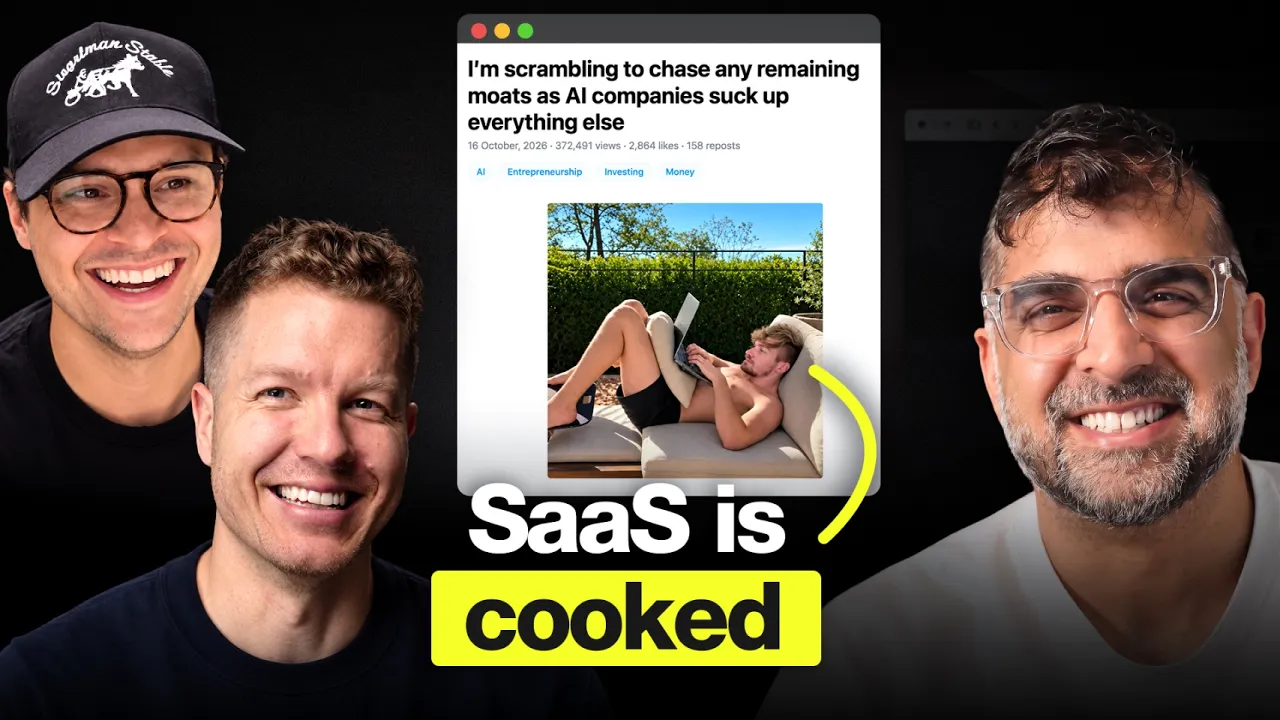
This is largely a conversational “best things found on X” episode rather than a rigorous strategy briefing. Its most substantive segment responds to indie hacker Peter Levels' claim that SaaS is becoming structurally less defensible under AI. The hosts do not fully endorse abandoning SaaS, but agree that generic software is increasingly uncomfortable territory and that companies need advantages AI cannot cheaply replicate.
They rank network effects and brand especially highly, using Craigslist, eBay, and marketplaces as examples of products people use because the other users are already there. Their broader heuristic is to favor businesses in which AI does not perform the essential job but reduces costs or improves operations—Amazon's physical-goods logistics is their primary example. They also see human-centered experiences such as in-person communities, sports, art, and events as comparatively defensible.
A second strong segment frames operating speed as a founder-psychology problem. Drawing on Alexander Wang's description of Mark Zuckerberg and James Currier's “speed talk,” the hosts argue that fear of being wrong, changing one's mind, or facing rejection creates more drag than operational complexity. Currier's claimed intervention is to find what founders are avoiding; urgency often makes products simpler and decisions faster.
The concrete business idea is not novel but is practical: package an unsexy local service with consumer-grade branding. Ben Levy's brother reportedly launched Howdy Pest in Phoenix by buying a truck, building a site, hiring a technician, and booking $1,000 in first-week revenue. The episode treats this as an instance of the “Pink's” playbook—localized service delivery plus memorable DTC-style brand presentation.
Key Takeaways
- Claim: AI pressure makes undifferentiated SaaS a riskier place to operate, while businesses with durable moats should become the priority. | Evidence: Peter Levels says he no longer believes in SaaS and is pivoting toward proprietary data/content, network effects, audience/distribution, physical assets, capital, and regulatory advantages. The hosts cite a recent debate over Beehive's replicability and note that only an asserted 2% of Americans have paid GPT or Claude accounts, suggesting adoption still has substantial room to grow. | Implication: For AI products and investments, distinguish feature-level substitutability from business-level defensibility; do not assume an AI-enabled product is defensible merely because its current feature set is complex. | Caveat: The speakers explicitly call Levels somewhat alarmist and acknowledge that Beehive founder Tyler argued convincingly that copying a mature product requires far more than cloning visible features. The 2% adoption figure is mentioned without a source.
- Claim: Network effects and brand are the most compelling moats because they create habitual demand that survives mediocre product quality and new entrants. | Evidence: The hosts point to Craigslist, eBay, and other marketplaces: users continue using them because that is where other buyers and sellers already are. They add that major companies benefit from customer groups willing to buy new offerings because the brand is trusted. | Implication: Prioritize workflows that accumulate users, transaction liquidity, reputation, or proprietary relationships—and ensure distribution compounds rather than resetting with each acquisition campaign. | Caveat: They treat brand as closely related to network effects, but these are distinct mechanisms: brand is trust and preference, whereas a network effect is increasing product utility as participation grows.
- Claim: The strongest AI-era positions are businesses where AI lowers the cost of serving stable demand but cannot replace the underlying value customers seek. | Evidence: Amazon is the example: people still need physical goods delivered, while robotics can lower manufacturing, fulfillment, and delivery costs through picking, packing, drones, or autonomous vehicles. The hosts similarly identify human gatherings, sport, art, concerts, and communities as experiences people may specifically prefer to remain human. | Implication: Look for “AI as margin expansion” opportunities rather than only “AI as product replacement” opportunities—especially in logistics, local services, and relationship-driven communities. | Caveat: This is a strategic heuristic rather than proof that every physical or in-person business is protected; AI can still reshape discovery, pricing, customer support, and operational competition.
- Claim: Founder fear and avoidance are often the highest-leverage constraints on company speed and growth. | Evidence: Alexander Wang characterizes Zuckerberg as having internalized that failure matters less than how large the eventual win can be. James Currier's reported “speed talk” starts by challenging founders' belief that they are moving quickly, then traces slowness to fear of being wrong, being judged for changing direction, or being rejected when fundraising. | Implication: In operating reviews, explicitly ask which decision, customer outreach, launch, hiring move, or strategic change is being delayed—and what feared consequence is sustaining that delay. | Caveat: The discussion can be misread as endorsing indiscriminate speed. It supplies no decision-quality framework for separating reversible experiments from irreversible, high-downside decisions.
- Claim: Crisis-level urgency can improve execution because it forces decisive choices, simpler products, and less founder preciousness. | Evidence: Currier reportedly observed that companies often improve at the “effort moment,” when founders recognize they are nearly out of cash and must make the business work. He says decisions become faster and the product becomes materially simpler; Poshmark allegedly gave him 1% advisory equity because faster growth could create disproportionate valuation upside. | Implication: Use short, explicit constraints—deadline, owner, success threshold, and kill criterion—to recover the focus that otherwise appears only when runway is threatened. | Caveat: Manufacturing existential pressure is not automatically healthy and can produce rash decisions; the transferable lesson is to create clarity and constraints before a cash emergency, not to wait for one.
- Claim: A viable small-business launch pattern is to modernize an operationally ordinary local service with an appealing consumer brand while outsourcing technical delivery. | Evidence: Ben Levy's brother, a Phoenix real-estate agent, reportedly launched Howdy Pest after experimenting with roughly 15 prior ideas. He bought and wrapped a truck, built a website using mostly AI plus outside help, hired a technician rather than doing pest-control work himself, and booked $1,000 in first-week revenue. The hosts frame it as applying the “Pink's” blueprint to pest control. | Implication: For local-service experiments, separate the business into brand/distribution, scheduling/sales, and licensed field execution; validate paid demand rapidly before overinvesting in fleet or marketing. | Caveat: The acquisition channel for the first $1,000 was not disclosed; Ben speculates it came from friends and hustling. The initial revenue is encouraging but does not establish repeatability, unit economics, licensing compliance, or scalable demand.
Detailed Brief
Influencer-led consumer brands need an operator behind the personality
- Claims: A high-attention creator can potentially expand a category, such as men's skincare or makeup, but personal fame alone is not equivalent to company-building capacity.; The hosts view Brian Johnson as an unusually skilled social-media operator whose provocative content has converted into the Blueprint business, and see this as a model for attention-driven product demand.
- Evidence: They claim Blueprint reached roughly $40 million to $50 million annual revenue within one or two years and that Johnson's premium protocol waitlist represented more than $100 million of pipeline; these figures are discussed without primary-source verification.; Congo Brands is offered as the complementary operating model: relatively unknown Ohio-based operators reportedly built Alani Nu, sold it for $1 billion to $2 billion, and developed Prime with Logan Paul and KSI while retaining more ownership than the influencers.
- Caveats: The revenue, sale-value, ownership, and waitlist figures are conversational assertions, not substantiated in the transcript.; The hosts stress that running a company while maintaining a highly public, hedonistic creator lifestyle is rare; influencer businesses need a strong, execution-focused counterpart.
- Implications: When assessing creator-led ventures, underwrite the operator, supply chain, ownership structure, and distribution system separately from audience size.; A better partnership design may pair a creator who generates attention with an invisible operator who retains responsibility for execution and durable economics.
Media packaging, public performance goals, and creative practice
- Claims: Simple, concrete media formats can outperform abstract expertise packaging: the hosts praise “Gym and Fridge” as an intuitive men's-health format and brainstorm a comparable personality-plus-portfolio format.; Brian Johnson's attempt to dunk is interpreted as a smart public benchmark: a visible athletic outcome attracts more interest than longevity biomarkers.; A regular creative practice can function as a “creative gym” that creates flow and restores energy even when it has no commercial output.
- Evidence: The “Gym and Fridge” format shows guests' training setup and food choices; the hosts praise its brand clarity rather than its health advice.; Johnson, described as 49 and approximately 6'1", is pursuing a basketball dunk; the discussion notes that jumping mechanics and the penultimate step matter alongside raw strength.; Tim Ferriss is quoted secondhand as dedicating roughly 45 minutes to creative work—drawing, music, brainstorming, or similar—as a way to “charge” his battery. Epic Gardening founder Kevin is presented as someone who publicly learned sketching and became highly capable through practice.
- Caveats: The health, fitness, and dunking portions are anecdotal and should not be interpreted as training guidance.; The business relevance of creative practice is personal-performance oriented, not an evidenced causal claim about company outcomes.
- Implications: For content and GTM, translate expert value into a recurring, visual, easily understood format with natural sponsorship or affiliate surfaces.; Public, legible performance goals can turn otherwise technical work into an audience-building narrative.
Notable Concepts & Terms
- AI-resistant moat set: Peter Levels' listed defenses: proprietary data/content, network effects, audience/distribution, physical assets, capital, and regulation; the hosts add brand as a major omitted moat.
- AI as margin expansion: The preferred position where AI or automation makes fulfillment cheaper while customer demand for the core product or experience persists.
- Speed talk: James Currier's reported founder intervention: reset a founder's internal definition of fast, then diagnose fear and avoidance as root causes of delay.
- Effort moment: The cash-constrained point at which founders allegedly become more decisive, simplify the product, and stop being overly precious.
- Pink's playbook: Taking a mundane local service and wrapping it in polished, distinctive, consumer-friendly branding to create differentiation and word-of-mouth.
- Creator-operator pairing: A venture structure in which a public creator supplies demand and attention while a separate, high-quality operating team builds and runs the company.
- Creative gym: A scheduled non-commercial creative practice intended to create flow, exercise creative capacity, and restore energy.
Operator Notes / Why Ken Should Care
- Run a moat audit across current and prospective AI products: identify which advantage compounds through proprietary data, liquidity, reputation, audience, regulated access, physical execution, or capital—not just feature velocity.
- Add an avoidance question to leadership and project reviews: “What action are we delaying, what outcome do we fear, and what reversible experiment resolves it this week?”
- For any local-service thesis, test the Howdy Pest pattern with a constrained launch: branded landing page, licensed/operator partner, one geography, tracked source attribution, and repeatable acquisition economics before purchasing operational assets.
- When evaluating creator-led opportunities, require an explicit operator map covering ownership, product development, supply chain, fulfillment, and customer retention; do not underwrite attention as the moat by itself.
- Explore content formats that make technical capability visibly legible through a repeatable setting, challenge, benchmark, or teardown rather than relying on expert commentary alone.
Source/Metadata
- Title: 2 business ideas, moats and the best stuff we found on X
- Transcript words: 17328
- Duration seconds: 2938
- Timestamp note: No usable timestamps or chapter markers were provided. The transcript contains substantial duplicated passages, especially from the SpaceX, SaaS/moats, founder-speed, creative-practice, and pest-control sections.
Transcript
All right, here's how we'll kick this off. First, introducing Ben. This is my business partner, Ben, the guy who's usually behind the scenes, but like in the Wizard of Oz, we're pulling back the curtain. We're showing who's actually pulling all the strings around here, and it's always Ben. Ben is a prolific Twitter user. Ben, how many hours a day are you spending on Twitter? I think if I checked my screen time, it'd be eight hours a day on Twitter. Maybe too much. Ben, let's do this. Let's put those eight hours on Twitter to good work. Show us the most interesting stuff going on, and then we will react to it. So, Ben, take it away. All right, what's up, fellas? All right, so I got five things. Technically, it's a lot more than five things, but it's less than 100 to show you guys, and let's get it rolling. So I saw this tweet this weekend that went viral. It's basically about how you can now buy tickets to go to someone else's wedding. Supposedly, according to Sheil, there's also one of these in India. It's crazy. It's vibe-coded, but if you look at the website, they already have 20,000 users. Wait, so this is not you paying for someone to come to your wedding because you need friends. It's you paying to go to someone's wedding? People want this? People want to do that? This is you paying to go to someone else's wedding with an empty seat. Would you do this, Sam? This is ridiculous. No, not a chance. Absolutely not. Not only do I not want to do that, I'm a big fan of not giving gifts for children's birthday parties, or going to a wedding that's outside of a 50-mile radius. A general Scrooge mentality, huh? Yeah, not a chance. No, I'd rather sit home and watch Netflix. I'm not going to a wedding. You read The Grinch, and you're like, this guy's just misunderstood. Yeah, he's figured it out. He's got some quality ideas. Absolutely not. I am not going to this. Not a chance. Do you think this will work? What does work really mean? Do I think it will work? Is this like Airbnb, where we think it's weird that people are going to be sleeping on an air mattress, and somebody's going to serve you porridge in the morning, and then suddenly it's like a $100 billion company? Is it that? No. I don't think it's that. So I thought it was a generally accepted fact of life that nobody wants to go to someone else's wedding. I heard a comedian say this once. He goes, if you invite me to your wedding, you're an asshole. And I agreed with that. You know I don't want to go. You know I don't want to go cross-country. I don't want to go to Detroit for this, but I have to now that you've invited me, and I guess we'll just do this. And it's a cost of doing business as a friend. I can't imagine that people want to go to weddings voluntarily. Dude, T&D's wedding, though, it says the dress code is Enchanted Woodland. Kind of like that. I mean, yeah. I've been looking for an excuse to whip out my finest flannel. I guess that's all right. Not for me. What do we say? Cornrows and sleeve tattoos. Cool, but not for me. I'm going to put paying other people's weddings in that category. I was way more down with the Korean fake dopamine sites where you get to fake shop for things that will never arrive. And you can buy vacations that you'll never go on because it's all fake. But you get this thrill of shopping without the cost of actually buying the things. That made way more sense to me than this does. All right, verdict is in. So Clavicular, obviously this really popular looks-maxing influencer. He went to the All In Summit and he basically talked about how he invented the peptides movement, which I don't think is true, but he took a claim for it. A claim that Sam also makes. Yeah. Same, same, but different. Another common thing you have with Clavs. But then he was talking about his new business idea, which is basically to start a men's skincare and makeup line. And he asked people to email him that are interested in being a part of it. Sam and Sean, would you email him? Do you want to be a part of this? Do you think it's a good idea? I will not email him. Yeah, it's a fine idea. Are you going to email him, Sean? Well, you know, think about it this way. I actually have this belief that Brian Johnson is the greatest social media player of all time, that he is the Michael Jordan of social media. He figured something out and plays the game of social media like a fiddle. And he used that starting on this podcast in many ways. He came on this podcast very early on in his content creator career. We were literally the first podcast he ever did. Okay, so we saw him at Squirtle and now he's Blastoise. This guy has evolved into a social media juggernaut. He's doing shrooms on livestream. He's talking about his wife's pee-pee. He's got all kinds of things going on that will get reactions. He knows how to get reactions. And so it turned into a very big business in Blueprint. So I think for his, he released a wait list. Right, Ben? He has a wait list for his million dollar a year product where you can have his protocol. Like you can do the same things he does for a million dollars a year. He also has a cheaper thing like the supplements that he sells. And I think he said it does 40 million a year. Yeah, it was like 50 million a year after a year or two. And the wait list for his protocol, I think was over 100 million in revenue of just pipeline from just letting people know that it exists. No marketing besides that. So would it surprise me if this guy Clavicular does the, you know, Kylie Jenner, what's her brand called? The makeup line or whatever. Like whatever she did for the women's skincare market and women's beauty market, could he not do for the men's market and actually make the market because it's sort of small today? I don't know anything about this guy except for the three clips that I've seen of him that have gone viral. I think that starting a company, even if you have a straight edge operator, is quite challenging when you live a hedonistic lifestyle where you're always out doing crazy shit. And I think that there's more to it than just I'm going to Instagram this product. Yeah, you got to find somebody who is equally as genius as you in the behind the scenes business side, right? So, you know, Emma Greed has done this with the Kardashians and launched multiple businesses with them. I know that, what's that brand called? Ben Congo Brands? Is that the name of those guys? Yeah, Congo, guys that did Prime. Sam, you know these guys, Congo? It was a 26 year old kind of genius guy, wasn't he? Yeah, it was two guys in Ohio that you've never heard of. There's no photos of them on the internet. Literally the opposite of a famous influencer. Yet, they built Alani New, I think sold that for one or two billion. They built Prime with Logan Paul and KSI and they own more of the business than those guys do. I think if you do something like that, it can work. If you're going to try to juggle being mega famous on the internet with also being the CEO of these things, that seems extremely rare and difficult to pull off. Google Congo Brands founder and you'll see a photo of a guy in a yellow shirt, if that's really him. It's a guy in a yellow shirt in front of a really dingy garage that looks like it's out of Kentucky. Yeah. A guy who just went for a run in his front lawn. Is that the founder? That's him. That's the only photo of him on the internet. By the way, that is awesome. What a choice. Yeah. That is really cool. All right, Ben, what do we got? Okay, so Elon announced two big things in the last week. Hey, I want to tell you about something pretty cool. We have a database of all of the business ideas that have been discussed on this podcast. So hundreds of episodes, the team at HubSpot went through. They pulled out all the simple, relatable, interesting, profitable ideas that we have brainstormed and they're all available for download for free. Just click the link. if that's really him. It's a guy in a yellow shirt in front of a really dingy garage that looks like it's taken out of Kentucky. Yeah. A guy who just went for a run in his front lawn. Is that the founder? That's him. That's him. That is awesome. That's the only photo of him on the internet. By the way, that is awesome. What a choice. Yeah. That is really cool. All right, Ben, what do we got? Okay, so Elon announced two big things in the last week. Hey, I want to tell you about something pretty cool. We have a database of all of the business ideas that have been discussed on this podcast. So hundreds of episodes the team at HubSpot went through. They pulled out all the simple, relatable, interesting, profitable ideas that we have brainstormed and they're all available for download for free. Just click the link in the description below. Thank you to our friends at HubSpot for sponsoring this podcast and putting together this free resource for you guys. Back to the show. Won the Roadster. Yeah, announcing the Roadster, crazy car. Wait, I've never seen this video. Click it. You didn't see this, Sam? No. Was there a big denim convention? How did you miss this? I don't really use Twitter. I don't like logging to Twitter. How did it fly like that? Okay, we got to take three steps back. Elon's been teasing the new Roadster for like 10 years and he did a demo a couple days ago that he promised would be the craziest product demo of all time and basically showed that the new Roadster, it was a collab with SpaceX and had SpaceX rocket boosters built into the car. So the very first thing, he starts off with a ramp that goes, curls all the way around. So the car drives up and goes upside down and is just suctioned to the top of the ramp because— Because it's going so fast? No, it's going slow. It just has so much downward force using air suction that it essentially can go upside down. But why do I want that? Because that makes for insane speed and handling if you're racing. So tires can only go so fast. I think at some miles per hour, they just start spinning and you need this ability to suck the air under you to stick to the ground in order to continue moving faster, break that speed. This doesn't make sense to me. That's real? That's real. I don't know why I want it. I don't know why I want it, but I don't know how they do it. That's amazing. Basically, the car can kind of fly and apparently this car is coming next year and you can buy it with a normal car or you can upgrade to the rocket package and you have the SpaceX rockets in it. When do I use it? When is the wrong question. The question is why? Like why do I want rockets on it? The only answer is because it's awesome. Well, you can't fly a car in Manhattan. Right. Not yet. Not yet. But what would be— It's going to be for people who want to take it on a private track and just do crazy stuff. It's like when people buy guns, you can't just go shooting people, but you can take it to a gun range and shoot your gun. It's kind of like that. Yeah, but there's not flying car ranges, but I think that, okay, so yeah, I think my take on this is what would have been the coolest demo if there was a proven way that the car was going to be delivered at the time when they said it was going to be delivered. A little punctuality would have been nice as a demo. Yeah, like if they just had a big calendar and they said, this is when it's going to be delivered. Here's proof because it's been years. I mean, I think people have been putting deposits on these forever, haven't they? Yeah, yeah. So this is new deposits now for this thing. I was at San Francisco this week and of course, this got brought up because anybody in tech has paid attention to this. Except Sam, apparently. Except Sam. Sam's not in tech. I'm not in tech. Sam's in fashion. Sam's in men's fashion. Bodybuilding or something. I'm into my kid's birthday this weekend. Yeah. So at the table, I started, somebody said, did you see this? And I was, yeah, kind of crazy. I mean, it's not legal. Like, I don't really understand the point. And then it went around the table where everyone was like, literally the next guy goes, what I loved about it was it was a Rorschach test. Where they were like, it just shows who has vision and who doesn't. And I was, oh yeah, forget me, right? It was like, anybody who doesn't get it is just fundamentally lame at their core. And I was, oh yeah, yeah, yeah. What I said earlier, I meant to say that's what I saw other people saying. And I totally disagree with it. I'm with you guys. Best car ever. Putting down a deposit. No. I mean, I think it's awesome. Yeah. Our boy Nikita had a good tweet. Diego's reminding me that, Ben, did you see Nikita's tweet about this? No. Oh dude, I saw something on Twitter you didn't. So he goes, sometimes a demo is simply meant to remind the world that your competition has no desire to dream and no ability to evolve. 21,000 likes. Okay, that's— That's pretty insightful. Sorry we don't all have pink eye. Can't see the vision. All right, what have we got now? What have you got, Ben? All right. And this morning, Elon kind of announced that he's going to give one of his SpaceX shares to every kid in America. Do you think this is the start of a redemption arc? I don't think so. No. But I do think that's pretty awesome. I do think that the Trump accounts are pretty amazing. This is a really good way to get America bought into your shtick, obviously, right? If everyone has a share. That's kind of insane. I think Anthropic said they're going to do the same, right? Yeah. This morning. Anthropic said not to every kid. Anthropic was like, we're going to give it to our effective altruism foundation or whatever. They're going to give it to something like that. They're setting up for the public thing, but you don't get it. Right? This is basically saying, Sam, your children get a share of SpaceX each. That's pretty wild. I think that's awesome. Ari, show this chart I just sent you. This is a favorability score of Elon Musk just in the last two years. So the purple line, the green line is people who are favorable towards Elon Musk, meaning it's like a president has an approval rating. So two years ago was more favorable than disfavorable. And now you can see the purple line, which is people who don't like, have an unfavorable view of Elon Musk and how it is now the majority of people. And so I actually think this is the start of the redemption arc. Now, the problem is it's like OJ, just when he got acquitted and the glove didn't fit, he got it. He has to come out and write a book called, "If I Did It, Here's Exactly How I Did It." And so I do think Elon, although this is very generous and I think the start of what could be a very favorable arc, I don't think he's got the behavior control to not upset people over the next four years. But if you think about this, how many shares is this? So I think this is something like 70 million or something. There's 72 million kids in America. 72 million kids is something like $10 billion that he's giving directly to people, not to a nonprofit that might help people. It's in your account. Check. Go. It's there for you. And so I think this is amazing. I do think this has a pretty big impact. I've seen this with my kids. Like when you give them something, they become incredibly invested in that thing. You could give them a Pokemon card. Even though they didn't care about Pokemon cards, if you say this is a really rare one, this is a good one, they'll start to care about other Pokemon cards and suddenly have a binder. to not upset people over the next four years. But if you think about this, this is, how many shares is this? So I think this is something like 70 million or something like that. There's 70 million kids in America or something. 72, 72 million kids. And so 72 million kids is something like $10 billion that he's giving directly to people, not to a nonprofit that might help people. It's in your account. Check. Go. It's there for you. And so I think this is amazing. I do think this has a pretty big impact. I've seen this with my kids. When you give them something, they become incredibly invested in that thing. You could give them a Pokemon card. Even though they didn't care about Pokemon cards, if you say this is a really rare one, this is a good one, they'll start to care about other Pokemon cards and suddenly have a binder full of them. And I noticed I have a family member who shall remain unnamed. And in her retirement account, she had for a long time just left cash. She was very conservative. And I was telling her about SpaceX or whatever. And her kids were telling her about SpaceX. And she decided, when SpaceX was going to IPO, she decided to buy $3,000 of SpaceX stock. And accidentally bought, I think like 3,000 shares of SpaceX. So it was like half a million dollars instead of $3,000. And guess who then became the biggest analyst of SpaceX? Who was following the Starship launch and the prediction markets and reading every bit of news and studying the feasibility of this thing, became incredibly invested in this because she was now aligned with the success of SpaceX. So I think this is actually a pretty powerful move. I'm surprised more companies don't do this. Wait, so one of your aunts or whoever accidentally bought half a million dollars worth of SpaceX stock? Really? Yes. Yes. That's hilarious. And does she read the reports on them and stuff? And she's coming to you with...? Constantly now. Every day. She's like, she said no to an event because the Starship launch was happening that day and she needed to be on the live stream. Like she was not going to not see how that went. And it went well and she was ecstatic about it. She was fully aligned. And her take on it was once she bought it, she was like, it's just too inconvenient to click sell. I just have to do it. Well, it went down right away and you know how people are with loss aversion. So selling right then would be a small defeat of 30 grand or something. And so she did not want that. She's like, well, let me just wait till it goes up. And now she's just in on the ride. We should have her on. She would hate that. But yeah, I wish she would. Come on. All right. What's the next one? All right. So I recently started watching this men's health YouTube series called Gym and Fridge where basically they interview everyone. I saw it. Andrew Huberman did one. I didn't see the roadster but you saw this, Sam. Yeah, I saw this. Look at that thumbnail. That's my type. And there's one specific 10 second part of this video that I wanted to show you guys. All right. Click play. Yep. And now I own cucumbers. Yeah. They called me that for a different reason. So you saw this, Sam? You've already seen this video? Oh yeah, of course, Doug. Yeah, I thought it was awesome. He also talks about peptides in there which I invented. That tea brand he's got in there. I like that. Yeah, I've seen it. Wait, so what are his best things? So he eats three cucumbers a day. I did not know that despite him putting out 3,000 hours of podcast content a week. He talks about his favorite protein brand. I think it was Momentus. Inside the fridge was an affiliate code. Just use Huberman 15 at checkout. It's just pasted in there. What makes me mad about him is whenever he suggests stuff, he always starts off by saying, now you should talk to your doctor. You should do things right. You are my doctor, Andrew. Yeah, and I'm just going to blindly follow what you say. It's when you get stock investing tips from us. But yeah, I mean, it's awesome. And he showed off his gym. Dude, he's a guy's guy. He could single-handedly bring back Grey's Anatomy, but for men, just reboot the whole thing. And he's like, you know, he's McDreamy. You just start again with him as the lead doctor. I think that would be very possible. Yeah. Have you ever seen him without a shirt on? No, I won't let myself go there. Yeah. Yeah. It's a slippery slope. Yeah. What interested you about this, Ben? The fact that he eats two cucumbers a day? I mean, mainly, I just like the branding of Gym and Fridge. I just thought that was an A-plus brand for men's health. Dude, we need something like that for MFM, right? It's got to be, stocks and jocks or something. You know, it's like, show us your, what boxers do you wear and your portfolio? And we just go to every famous person. We do that. Tell me you wouldn't click that. Mark Hendryson, tidy whities and tons of pallet deer. You know, that's where he's at. Sean, have you seen this new podcast? I'll have to find it to you. But they just had Blake Griffin on. It's the one where he's trying to agree with Blake Griffin, but he smacks him on the thigh, but it's really inner thigh. It's like, oh, two bros, we agree. And he grabs, the host grabs his thigh and he goes, that's really, really inner thigh grab. And I was thinking, can you and I have something like that? But it was no accident. That's his thing. That's his thing. Could we do something like that digitally to make someone uncomfortable? Would you just keep winking at the end? Yeah. Or just... This has been really good. I knew we would see a part of you we didn't see, but not that part. Or just mid episode, act like you're taking off your sweater and your undershirt accidentally comes off and we just nonchalantly put the shirt back on. It's a very long shirt change. A lot of midriff is showing for too long. All right, Ben, what do we got? All right. This next one is, I guess, back to serious, but Peter Levels. So he basically tweeted and made this blog post about how in 2022, he pivoted to AI apps. Yeah. And then now he's basically saying, I no longer believe in SaaS. I now only believe in these moats. So I'm trying to pivot everything. And the moats we can go through real fast are proprietary data or content, network effects, audience or distribution, physical, I think capital is the next one, and then regulatory. So I'm curious, one, do you guys believe, do you believe he's right? Like if you own an app or you make SaaS, should you be pivoting out to one of these things? And then, dude, what do you think? So I think it was FDR had a picture of Abe Lincoln on his desk because before making a big decision, he would often say, what would Abe do in this situation? I think that with Peter Levels all the time, I love how he thinks. I think he's so awesome. I think that he's being an alarmist here, but I think that his points are really interesting. So yeah, when I think of SaaS, I do think, I think three weeks ago, I was saying, it can't be that bad. It might be. It might be that bad. What changed? There was this debate where our Fred Tyler has this company called Beehive and he had a great rebuttal where he's saying, everyone's trying to replicate me. Here's all the things they have to make. And it was really a huge list of stuff and I thought it was a great reply and I think he might be right. But I just think that we're just touching the surface on what people do with AI. I think I saw somewhere that I think only 2% of Americans have a paid GPT or Claude account and the rate of speed at which it's growing, I do think software, I would not want to own a software company necessarily right now, would you? I mean, it definitely doesn't seem like the place to be, right? You never want to be the one where you're in scramble mode, right? I'd rather, you know, live in, if there's a hurricane coming... What changed? There was this debate where our Fred Tyler has this company called Beehive and he had a great rebuttal where he's like, everyone's trying to replicate me. Here's all the things they have to make. And it was really a huge list of stuff and I thought it was a great reply and I think he might be right. But I just think that we're just touching the surface on what people do with AI. I think I saw somewhere that only 2% of Americans have a paid GPT or CLAW account and the rate of speed at which it's growing, I do think software—I would not want to own a software company necessarily right now, would you? It definitely doesn't seem like the place to be, right? You never want to be the one where you're in scramble mode, right? I'd rather live in—if there's a hurricane coming, I don't want to be in Louisiana at the time, right? Like that's not my preferred place to be where I have to figure out some new move. What moat do you believe in? Like if you were betting on a moat, which one do you want? Well, network effects is probably the biggest one, I would think. Network effects or one thing he didn't have is brand. I think network effects are brand. If you look at the top 20 companies in the world, a large percentage of them have this massive contingency of customers who will just buy anything they put out because they're a trusted brand. So I think that one's real and I think network effects is real. If you look at some of the greatest companies of all time, their products might totally suck. Craigslist, eBay, a bunch of different marketplaces fall into this, but you use them because that's where everyone else is. And so I think that network effects is probably one of the most important. Yeah, I think you want to be doing things where AI doesn't do the core of what you do—like fundamentally can't do the core of what you do—but it makes what you do easier. So for example, I think a company like Amazon has a really good position because people are still going to want physical things to come to their house, but now if all those physical things become cheaper because they're made more by robots than humans and then the delivery and logistics becomes robots picking and packing orders, putting them in drones or autonomous vehicles and then they get to your house for cheaper. So it's basically like, people are going to want it—demand either goes up or stays the same, but your cost to provide it goes down and you were already very successful before that. That's a good position to be in. So stuff like that's good. Really anything that's in person, right? So where is the value, the human connection and touch, right? So I think things that were previously fringe, like art and sport, become a little bit more defensible because that's the concert that people want to go to, that's the show that people want to see, that's the sport that people want to watch is humans doing it because that's their night out or humans getting together in some way. Those are good businesses to be a part of. Same, I think Hampton's is at a good spot, for example, because I think you're getting humans together and that's not something that somebody wants to replace with AI for themselves. Yeah, Hampton's is in a good spot because all the serious people are doing things that can make a lot more money. There's a lot more entrepreneurs too, right? Like there's a lot more people trying stuff. I'm joking, but what's the quote where it says, take something dumb really serious? That's basically what I'm doing. I want to release a whole book of quotes that you just modify—like the same meaning but totally different words. Like go out there, have fun, and break an egg. Exactly. Or like Cadillac reflexes. Are you doing these on the spot? It's incredible. I do find it, by the way, Peter Levels builds himself a kind of two, three million dollar a year income stream just doing this, sitting in Bali on his laptop in his boxers, and I think we've met a lot of very successful, rich, admirable people on this podcast. I believe that amongst our audience at least, but I honestly think this is just where the masses are. Peter Levels' life is the life that people actually want. People want to live in cool places, not have a huge team, just work on their laptop, make a bunch of money. You don't need a billion dollars, but if you're making millions of dollars a year coding fun stuff on your laptop by yourself, creating cool projects, and then you spend the rest of your time hanging out with friends and lifting weights, I think that's for a lot of people more aspirational than the high-powered billion-dollar founder who's ultra busy and ultra stressed all the time. My father-in-law, for roughly 30 years, owned a moving company—like a commercial moving company in New York City—and he's wildly successful, but when he was young, he was this normal blue-collar guy, and he was telling me these stories. He's like, yeah, I basically worked six days a week because we did our moves on Saturday, and so I would, I lived in the suburbs, so I had to get up at 6 a.m., I had to go to the office, and I'd be home at 7 p.m., and I did that basically six days a week for almost 20 years in order to provide for my family, and I was thinking, how crazy is it that you don't have to do any of that and you can make the same or way more money, and I complain, I'm like, ugh, I don't want to have to write a blog post today. I got to record another podcast. It's just crazy what our heroes do or our peers do versus what we had to do 40 years ago. All right, let's do a few more. What else have we got? All right, so Brian Johnson's newest adventure is dunking, which I think Sean's was going to be Sean's adventure this year too, but check, all right, hit play. What is he holding? I can't see. It's like a tennis ball. It's a little ball. He's holding a little ball on a nine—I think he said nine foot eight rim. Pretty good. You think he can do it? You think he'll be able to get there? So he wants to dunk a basketball. How old has he been? He's almost 50, right? Yeah, I think technically he's 49. Wow. But he is the youngest man in the world at the same time, so is he really 49? So to prove that he is getting younger and fitter and healthier, he's decided to use a performance benchmark. Again, he's the greatest social media player in the world, and he knew that if I just continue to talk about my hemoglobin levels, that will only attract so many eyeballs, but if I show that a 49-year-old white guy can start to dunk, that will get people's attention and inspire them in a different way. Sam, as a white guy who can dunk, what do you have to say about this? Are you a believer? Do you think he'll be able to dunk? Does it say how tall he is? He's like 6'1", something like that? Yeah, I think he can do it. I think he can do it. I can't dunk because I have— I've seen you dunk. What are you talking about? Well, I'm not particularly coordinated, but I have attributes except for the coordination one. It's not particularly easy for me to do it, but yeah, I think you can train to do this. I think most people can probably get a 28-inch vertical, or many people can, which is oftentimes high enough. The hard part is doing it with a ball. Ben Wilson could dunk, and he's not a high jumper, but he does it perfectly. So yeah, I think he can do it. How great would this be? I think this would be pretty great. So he's 6'1", 80", and he says he needs how much vert? Like 27. He says, my standing reach is 91 inches. Oh no, no. He says that's a 39-inch vertical, which exceeds that of an NBA player—average NBA player, which is 35 and a half. So here's what I need, blah, blah, blah. I don't think he's saying he has it. He's saying he needs it. He needs to get to that to be able to dunk, he says. If it's flat-footed, no, he won't ever do that. Sean, can we talk more about this? What you were trying to dunk this year? I had a fitness challenge for the year, Fitness Misogi. And he's not a high jumper, but he does it perfectly. So yeah, I think he can do it. How great would this be? I think this would be pretty great. So he's 6'18", and he says he needs how much vert? 27. He says, my standing reach is 91 inches. Oh, no, no. He says that's a 39-inch vertical, which exceeds that of an NBA player, average NBA player, which is 35 and a half. So here's what I need, blah, blah, blah. I don't think he's saying he has it. He's saying he needs it. He needs to get to that to be able to dunk, he says. If it's flat-footed, no, he won't ever do that. Sean, can we talk more about this? What you were trying to dunk this year? I had a fitness challenge for the year, Fitness Misogi, which was to do the Murph. And so I said, I was going to do the Murph, I was going to hit this weight goal, and I was going to try to dunk. Now, so people have asked me, how's the dunking going? And the answer is, I haven't even attempted to dunk, and I haven't even done anything on the dunking, because what I, the whole plan all along was, if I get to that weight, I think I'll be able to dunk. No, Murph training and dunking are way different. No, no, but I already could, I already can, I can touch rim with the top, I can grab with the tips here, and that's, so if I'm down 25 pounds, I think I would be able to dunk an alley-oop, and also, I grew, it's as you said about Ben Wilson, Ben Wilson grew up playing basketball. I've grown up playing basketball, so that motion is natural to me, which was my big argument against Brian Johnson being able to dunk, which is, he's thinking it's about ground force, and doing these power deadlifts and all that. Jumping has a lot more to do with coordination, but then you said, it's, you're uncoordinated, so you negated my argument. What I'm saying is, no, what I'm saying is, I can jump super high, and I'm very strong, and so my hand can get more than high enough, and it's just hard, because I don't know that motion, and so half the time when I'm jumping, I'm jumping too far away, or, and so what I'm saying is, it's actually, if you are a basketball player who's used to that motion, you don't have to jump that high in order to dunk. I played volleyball in high school and basketball, and in both of those, you do something called the penultimate step, and the penultimate step is basically an approach jump that gets you to your max. If you've never done the penultimate step, or you didn't do it growing up, that alone is a learning curve you have to work on to be able to do this. There's actually a good video, Ben, did you see Jason Kelsey, Travis Kelsey's brother, did the same thing, trying to dunk? Yeah. He did a six month thing, and he was able to dunk, he kind of went in, you know, he got close enough, I would say, to be able to do it, but he's also six four, a professional, he was a professional football player, can palm the ball, you know, he had a lot more attributes going in his favor. So unfortunately, I think Brian Johnson will not end up dunking. I think there's, but I think it's a, I'll take the opposite of that bet. I salute you. Oh, you think he's going to do it? Yeah, I think he'll do it. All right, we'll see. I'll bet you a Five Guys burger. Okay, sounds good. All right, next thing I found was, so Alexander Wang went on the David Center podcast last week, and he had this one great quote, it's about a 40 second clip. Play at Ari. I think he really has internalized that failure doesn't matter. It matters how big you win. And I think this overall concept enables him to operate truly without fear in a lot of circumstances, because he's just very comfortable taking lots of risk. He's got that great line where it's, in a world that's changing all the time, the biggest risk is not taking any. Yeah, exactly. I think he's internalized this quite deeply. Like, there's certainly versions of the world where Meta looks a lot more like Google in some sense. You know, more slow moving and more bureaucratic and just looks very different as a company. But I think because he's internalized some of these lessons so deeply, keeps the thing dynamic and moving and live. Dude, Sean, what you said about Zuck about two episodes or one episode ago, where he's, you're like, he's more like Napoleon and how he internalizes stuff was so good. He's so awesome when it comes to operating. He's the best. I did a podcast the other day at James Currier's house. He teaches at Stanford and I was basically, hey, can you just teach me the thing? I didn't get into Stanford and neither did any of our listeners. So can you just give us the class real quick? And he did. And one of the things he does, he calls it the speed talk. So he's, you know, it's when your parents give you the birds and the bees talk. Well, this is what you give to founders is the speed talk, which is, you think you're moving fast? You're not. You could be moving far faster. I have to, unfortunately, I have to break your speed bar and then we're going to reset it where it needs to be. And he talked about a bunch of examples of people moving fast. And one of the things he talked about moving fast is, well, why don't you move fast? You start with that. What slows you down? And one of the core things that slows you down is fear. Fear that you're wrong. Fear that if you change your mind, people are going to judge you. Fear that if you go out and ask a bunch of people for money, they're going to reject you. It's fear. Fear is one of the biggest things. And he said, there's some pretty big companies. I think Poshmark gave him 1% of the company to advise on growth. He was, you know, it made sense for them because if I can get the company growing 20, 30, 40% faster, obviously the valuation goes way up. It's a good trade. And so they expect me to come in and talk about growth. And instead it's all just founder psychology because the highest point of leverage in every business is the founder psychology. And the highest point of leverage within the founder psychology is what are they afraid of and what are they avoiding? And if you could just get them to work around their fear and work around what they're avoiding, they will be much better off. And he goes, you see this because so many great things happen in business when the founders reach the effort moment. It's when they realize they're out of cash. They realize that if this doesn't work, nothing, you know, then it's over. And all of a sudden they start making decisions way more decisively, way faster. They make better decisions. Their product becomes dramatically simpler because they're not being so precious about the whole thing anymore. And your preciousness is what gets in your own way. That's so good. That's awesome. I'm taking notes here. I'm going to go yell at my partner about why we should be moving faster. I'm going to go change. No, I'm going to tell him, I'm going to go yell. This is what's wrong with you, buddy. I found it. I found the problem with you. That's what great leaders do. Everybody loves that, right? I listen to this podcast and I realize that's your problem. I realize I'm failing at not yelling at you enough. That's so awesome. That's great. I like that. I don't know what else to say except I like that. I'm ruminating on it, but that's awesome. All right. I got a few more here. All right, Ari, let's hit the next one. All right, hit play on this. This is a great video. It gets in your own way. That's so good. That's awesome. I'm taking notes here. I'm going to go yell at my partner about why we should be moving faster. I'm going to go change. No, I'm going to tell him, I'm going to go yell. This is what's wrong with you, buddy. I found it. I found the problem with you. That's what great leaders do. Everybody loves that, right? I listen to this podcast and I realize that's your problem. I realize I'm failing at not yelling at you enough. That's so awesome. That's great. I like that. I don't know what else to say except I like that. I'm ruminating on it, but that's awesome. All right. I got a few more here. All right, Ari, let's hit the next one. All right, hit play on this. This is a great video. Let's hit play before it spoils it. My favorite purchase, I think my best, my most favorite purchase for me was I bought a harp. I bought a gold harp. I got it upstairs. That's a harp, a music thing. Yeah. So I bought a harp and I got a harpist that comes play like twice a week while the sun is going down. I'm like, my chef is in the kitchen. What? Is that the craziest rich guy purchase you ever heard? This is an NBA player, Sam, Jalen Brown. Who are the two guys? That's Jalen Brown, NBA star, or very good, very good player. And I think that's Lil Baby, rapper, I think. That's what I thought. In Lil? Lil Baby. Lil Baby. Come on, man. That's like a hard R. You can't put the T in there. Inspired by you, Sean. So you were saying that you learned the piano this year and I don't want to learn the piano, but I did think like the harp? Not the harp, but I was thinking I would like to use my artistic side a little bit more and I think we had someone on the podcast, maybe it was Joe Hudson, someone like that, they said something that struck me where it was like use your art side a little bit more, like that's one of the facets of a holistic person and so I bought a book to teach me how to sketch and it has not stuck, but I would like it to. It has not stuck at all. So you're saying you're tired of using your artistic side and you decided to start using your artistic side instead, the other side of that coin. Have you seen Plant Daddy sketching? No, is it awesome? Oh my God, yeah. Ari, find this. So the Plant Daddy, I think he's been on the podcast, right? You did it? Did you do an episode with him? I think I wasn't there for that one. Explain who he is and then while she pulls up this thing. Kevin is an amazing guy. He started a YouTube channel, TikTok page. He's basically this kind of cool dude. I think it's called Epic Gardening. He's like this really handsome, cool dude who you would not think is into gardening, but he loves it and he started a website, TikTok, Instagram, YouTube on gardening and then eventually he raised money from the Churning Group, which is a very reputable firm for media creators building businesses and now he has a business selling gardening supplies that if I had to guess, is definitely approaching $100 million a year in revenue and he came on MFM. I begged him twice to invest. I was like, bro, I just believe so much. Just please let me in just because when this is right, I just need to feel that validation of being right which was not a very compelling pitch in retrospect and he did not get back to me either time. He ignored you? No, he was like, yeah, yeah, for sure, man, for sure. If that's what he's drawing now? This guy's awesome. Show the journey. He did the same thing. I think I bought one of the first 10, I think. I have no idea where it is, but I bought one. It's how me and Brian Johnson both said we're going to dunk and then he actually started training and can now almost dunk. This guy also said he's going to start sketching and now is amazing at drawing. And he's like, yeah, I just taught myself and learned and it's so great and I have so much fun every day. I want to do this. You know who inspired me to do stuff like this, the piano thing too? Tim Ferriss once said, yeah, just I have one hour that I dedicate to my body for the gym. He's like, I basically have 45 minutes that I'll do a creative gym session. So he's like, I just do something creative. Could be drawing, could be music, could be brainstorming, could be whatever. And he goes, it just gets my mind working the same way that I'll go do cardio to get my body working, to work on my heart. I was like, I would do the same thing for creativity. And I just thought, I've never heard anybody say that. It makes perfect sense to me. Obviously, if you have the luxury of a little bit of time, that makes more sense. But that really inspired me and then he said it a second way. He goes, is it because—I was like, do you have any plans to do anything with that skill or that thing? He's like, no. He goes, but it charges my battery. And he goes, if your battery gets—it doesn't matter if one thing charges your battery, you could still use that battery anywhere now. And you can still use it when you go over there because now the battery's full. And he goes, this charges my battery. It has been one of the very few times that I can get in flow. Like before it was exercising, but now I use so much stuff when I work out that I'm addicted to my phone and I use it to track my workout. So that makes it challenging. And I've noticed that doing the creative stuff is one of the very few times that I'm able to do that. I'm just dead at the end of the day. After I put my kids asleep, I just want to do bad stuff with my friends and my friend being my wife and the bad stuff is watching TV. Honey, honey, you want to do some bad stuff tonight? Yeah. Click TV on, you're like, oh yeah. Here we go. I should do this at the beginning of the day. She just started East of Eden. I like Mobland, this new thing on Paramount. Right. She also does—you and her are like in a little fan club for the Challenge. Is there a Challenge going on right now? Yeah. We're about to be on the finale. They just made the final. What are you watching? I'm watching the Challenge. I'm watching Survivor season 51. I think we're on—I don't know if I'm watching a whole lot else right now. I don't have any good binge worthy shows right now. I've been watching. I've been reading. Yeah. I'm reading the Mistborn series. Do you like stuff like fantasy, like the good like Game of Thrones, Harry Potter type stuff? I occasionally, usually I'll do the big hits like Project Hail Mary. Nice. Things like that. But I do fiction. Yeah. Have you read like Ender's Game or Ready Player One or anything? No. It's a movie. I've seen that movie, right? Yeah, yeah. No, but I would. They're really good. Yeah. I love that genre. So anyway, I got into those. The audiobooks for those things are really good though. Like Project Hail Mary audiobook was one of the best audiobooks I've ever heard. Put me right to sleep if that's what you mean by good. No, I don't understand. How do people stay awake with audiobooks? What are you doing? You do it while you're cleaning the house. That's the problem. Don't do that. Yeah. What's another option? That's it. That's literally it. Okay. What do we got, Ben? Let's do the last one. We got a few more. Last one. Skip this one, Ari. Let's hit the next one. So Lex Friedman just flew overseas to spend a day with Jensen Huang. Play this video, Ari, for 30 seconds. Jensen, I've heard you make amazing fried rice. I do. I watch videos on AI and fried rice. It's absolutely true. That's his whole algorithm. He's working and I hear the— AI, I have fried rice. Is that his wife? I have no idea, but his whole algorithm is fried rice, geopolitics, dogs, and panda bears. I don't understand. How do people stay awake with audiobooks? What are you doing? You do it while you're cleaning the house, dog. That's the problem. Don't do that. Yeah. What's another option? That's it. That's literally it. Okay. What do we got, Ben? Let's do the last one. We got a few more. Last one. Skip this one, Ari. Let's hit the next one. So Lex Friedman just flew overseas to spend a day with Jensen Huang. Play this video, Ari, for 30 seconds. Jensen, I've heard you make amazing fried rice. I do. I watch videos on AI and fried rice. It's absolutely true. That's his whole algorithm. He's working and I hear the... AI, I have fried rice. Is that his wife? I have no idea, but his whole algorithm is fried rice, geopolitics, dogs, and panda bears. So I got to ask, what's your algorithm? Mine was modern wisdom with seven hard truths you need to hear with Sean. What? Is that not it? No, no, no. You got it right. You got it right. Were they a little too harsh for you? Or those truths? They weren't harsh enough. They were not harsh enough. I wish they were harsher. Kevin, soft core truths from a modern man. True things that I wanted to hear. That's what it was. Stuff I've heard Sean say before. Part seven. I thought it was great. I thought it was a great podcast. People loved it. They go, Sean's going to be known more as a storyteller than a podcaster. The unintentional slap of a compliment. Honestly, it was a great episode. I walked out of there thinking, that was some of my finest work. That was a good performance. It was a solid performance. I was happy with my play on the field that day. My YouTube feed is succession clips, live music, studying or work music, and track and field. Mine are piano tutorials, podcast clips, conspiracies about aliens and Jesus, and Luka Doncic highlights. Luka Doncic is my fried rice if I was Jensen. That's pretty good. Leave in the comments, what is your fried rice in your YouTube algorithm? The thing we wouldn't expect, but it's there and you enjoy it and you're not ashamed to say it. Lately, last night, I let my kid, because her mom was out, so it was just me and my eldest, and before bed, I let her watch 10 minutes of a Disney clip, and so I get so much kid stuff on my YouTube. Oh, yeah, yeah, yeah. Yeah, that's a major problem. I'm totally bought in. Yeah, it's also Gabby's Dollhouse, True in the Wishing Tree. Yeah, we got a lot of stuff going on there. I'm so bought into Frozen. Actually, YouTube kind of knows. It knows not to show me in the recommendation for some reason, even though we have hours and hours of that. I mean, I'm not ashamed to admit this. Actually, I should say that. I am pretty ashamed, but I will admit it. For my youngest, who's now two, she's a third child, and our good parent stamina meter ran out, and so she has never eaten a meal without YouTube on. Actually, once our nanny was feeding her and didn't have YouTube on, and I was like, well, it works. Don't show my wife this. Don't let her know that we could do this without. She watches a cartoon every meal. Ari, make that face again. Yeah, yeah. I want everyone in the comments. I'll take your judgments. Throw your stones at my glass house. Judge, judge, judge. I'm Cersei walking the streets with the shame. Ben, thank you for gathering this stuff. Is there any last things you want to say? Last one I'll show you is my brother, inspired by MFM, started a new business a week ago. He wrapped the truck, and he's doing pest control and booked his first $1,000 of revenue. Ben, tell the full story. So Sam, let's give a shout out. His name is Sam. He listens to the podcast, and for years, he's been thinking, planning, plotting. He's a real estate agent by day, right? Ben, tell the story. Yeah, so he's a real estate agent by day. He's been selling real estate for 10 years in Phoenix, Arizona. Listening to the pod every week. But we gave him that itch. Every week, him and my dad listen to the pod, send me notes, tell me things that Sean and Sam have said that I didn't notice or listen to in some cases. Tell him to send that to us. Yeah. It's a lot of, hey, Sam said this thing that's awesome, or Ben said this, or Sean said this thing. Check it out. So my brother's been trying to figure out what he should do. He bought into a restaurant. He started a soft serve business. He started 15 things, but he texted me, this is the one he's doing for real. Bought a truck, made this website, hired a technician, and they booked $1,000 of revenue in their first week. So what he's doing here, wait, hold on. $1,000 of revenue in a week. Let's go. Is that him? So what he's doing is, so look at this. That's not him. We know what this is, right? Yeah. What is this, Sean? Inspired by MFM and Pinks. Pinks. The best. We gave the blueprint, which was, take an unsexy service business that serves your location, serves your locale, but do that sexy D2C packaging on it. Put a lovable, put a lovable hipster brand on it. And he kind of did. Did he use AI for the branding or did he make this himself? What did he do? I think he used AI mostly and then he hired someone to do some of it, but mostly AI. How did he go get that first $1,000 of revenue? What did he do? I kept asking him and he kept saying, I'll tell you when, I'll tell you when it's much bigger. So I think he called friends. I think he hustled and found a way. He actually sent me a photo of a check that he also sent Sean that was from a trust. And I was like, damn, dude, your first customer is a trustee from a checking account. What an amazing photo. Does he know how to do, what is pest control? Is that spraying stuff? Yeah, it's you have mosquitoes or something and someone comes out and they spray. You have roaches. That's what he does. So he found a technician to do it. What's the URL? What's the URL? The URL is howdypest.com. If you're in Phoenix, Arizona, check it out. Yeah, if you're in Phoenix, go become a... Listeners, let's get this man to $3,000 in revenue. Let's get this guy to $10,000 in revenue just off the back of this. Dude, this is so funny. Look at his website. Scroll to the very bottom. Look at that old, that old Bronco he's got in there. That's awesome. Do they drive around in cool cars or is it a truck? It's a branded truck, but I told him we should go buy cool cars once it gets a little bigger. That's awesome. Is he older or younger than you? He's two years younger. We should have him come on and coach him every couple of months to get to a million. That'd be fun. I'm in. But is he coachable, Ben? I feel like he doesn't listen to your advice, but that might just be because you're his brother. He won't listen to me, but he might listen to you guys. Maybe, maybe. Well, thank you, Ben. And Sam, congratulations. That's awesome. Sam Levy, same last name? Yeah, same last name. He's a... All right, I'm going to look him up. Ben, if people want to send you interesting stuff, where should they find you? Find me on Twitter, Ben M. Levy on Twitter. That's it. That's the pod. That's it. There's like 70 million kids in America or something. 72, 72 million kids. And so 72 million kids is something like $10 billion that he's giving directly to people, not to a nonprofit that might help people. Like just, it's in your account. Check. Go. It's there for you. And so I think this is kind of amazing. I do think this has a pretty big impact. I've seen this with my kids. Like when you give them something, they become incredibly invested in that thing. You could give them a Pokemon card. Even though they didn't care about Pokemon cards, if you say this is a really rare one, this is a good one, they'll start to care about other Pokemon cards and suddenly have a binder full of them. And I noticed, I have a family member who shall remain unnamed. And in her retirement account, she had for a long time just left cash. She was very conservative. And you know, I was telling her about SpaceX or whatever. And her kids were telling her about SpaceX. And she decided, when SpaceX was going to IPO, she decided to buy $3,000 of SpaceX stock. And accidentally bought, I think like 3,000 shares of SpaceX. So it was like half a million dollars instead of $3,000. And guess who then became the biggest analyst of SpaceX? Who was following the Starship launch and like the prediction markets and reading every bit of news and studying the feasibility of this thing, like became incredibly invested in this because, you know, she was now aligned with the success of SpaceX. So I think this is actually a pretty powerful move. I'm surprised more companies don't do this. Wait, so one of your aunts or whoever accidentally bought half a million dollars worth of SpaceX stock? Really? Yes. Yes. That's hilarious. And does she read the reports on them and stuff? And she's coming to you with... Constantly now. Every, like every day. She's like, yeah, you know, she said no to like an event because the Starship launch was happening that day and she needed to be on the live stream. Like she was not going to not see how that went. And it went well and she was ecstatic about it. She was fully aligned. And her take on it was once she bought it, she was like, it's just too inconvenient to click sell. Like I just have to do it. Well, it went down like right away and you know how people are with like loss aversion. So like selling right then would be like a small defeat of 30 grand or something. And so she did not want that. She's like, well, let me just wait till it goes up. And now she's just like in on the ride. We should have her on. She would hate that. But yeah, I wish she would. Come on. All right. What's the next one? All right. So I recently started watching this men's health YouTube series called Gym and Fridge where basically they interview everyone. I saw it. Andrew Huberman did one. I didn't see the roadster but you saw this, Sam. Yeah, I saw this. Look at that thumbnail. That's my type. And there's one specific 10 second part of this video that I wanted to show you guys. All right. Click play. Yep. And now I own cucumbers. Yeah. They called me that for a different reason. So you saw this, Sam? You've already seen this video? Oh, yeah. Of course, Doug. Yeah, I thought it was awesome. He also talks about peptides in there which I invented. That tea brand he's got in there. I like that. Yeah, I've seen it. Wait, so what are his best things? So he eats three cucumbers a day. I did not know that despite him putting out 3,000 hours of podcast content a week. He talks about his favorite protein brand. I think it was Momentus. Inside the fridge was an affiliate code. Just use Huberman 15 at checkout. It's just pasted in there. What makes me mad about him is whenever he suggests dope stuff, he always starts off by saying, now you should talk to your doctor. You should do things right. You are my doctor, Andrew. Yeah, and I'm like, I'm just going to blindly follow what you say. It's sort of like when you get stock investing tips from us. But yeah, I mean, it's awesome. And he showed off his gym. Dude, he's a guy's guy. He could single-handedly bring back Grey's Anatomy, but for men, just reboot the whole thing. And he's the, like, you know, he's McDreamy. You just start again with him as the lead doctor. I think that would be very possible. Yeah. Have you ever seen him without a shirt on? No, I won't let myself go there. Yeah. Yeah. It's a slippery slope. Yeah. What interested you about this, Ben? The fact that he eats two cucumbers a day? I mean, manly, I just like the branding of gym and fridge. I just thought that was an A-plus brand for men's health. Dude, we need something like that for MFM, right? It's got to be, like, stocks and jocks or something. You know, it's like, show us your, what boxers do you wear and your portfolio? And we just go to every famous person. We do that. Tell me you wouldn't click that. Like, Mark Hendryson, tidy whities and tons of pallet deer. You know, that's where he's at. Sean, have you seen this new podcast? I'll have to find it to you. But they just had, they just had Blake Griffin on. It's the one where he's like, this guy, he's like trying to agree with Blake Griffin, but he smacks him on the thigh, but it's really inner thigh. It's like, oh, two bros, we agree. And he like grabs, like the host grabs his thigh and he goes, that's really, really inner thigh grab. And I was thinking like, can you and I have something like that? But it was no accident. That's his thing. That's his thing. Could we do something like that digitally to make someone uncomfortable? Would you just keep winking at the end? Yeah. Or just like- This has been really good. I knew we would see a part of you we didn't see, but not that part. Or just like mid episode, like change, like act like you're taking off your sweater and your undershirt accidentally comes off and we just nonchalantly put the shirt back on. It's just a very long shirt change. A lot of midriff is showing for too long. All right, Ben, what do we got? All right. This next one is, I guess, back to serious, but Peter Levels. So he basically tweeted and made this blog post about how in 2022, he pivoted to AI apps. Yeah. And then now he's basically like, I no longer believe in SaaS. I now only believe in these moats. So I'm trying to pivot everything. And the moats we can go through real fast are proprietary data or content, network effects, audience or distribution, physical, I think capital is the next one, and then regulatory. So I'm curious, one, do you guys believe, do you believe he's right? Like if you own an app or you make SaaS, should you be pivoting out to one of these things? And then, dude, what do you think? So I think it was FDR had like a picture of Abe Lincoln on his desk because before making a big decision, he would often say, what would Abe do in this situation? I think that with Peter Levels all the time, I love how he thinks. I think he's so awesome. I think that he's a little bit being an alarmist here, but I think that like his points are really interesting. So yeah, when I think of SaaS, I do think, I think I like three weeks ago, I was like, it can't be that bad. It might be. It might be that bad. What changed? There was this debate where our Fred Tyler has this company called Beehive and he had a great rebuttal where he's like, everyone's trying to replicate me. Here's all the things they have to make. And it was really a huge list of stuff and I thought it was a great reply and I think he might be right. But I just think that we're just touching the surface on what people do with AI. I think I saw somewhere that I think only 2% of Americans have a paid GPT or CLAW account and the rate of speed at which it's growing, I do think software, like I would not want to own a software company necessarily right now, would you? I mean, it definitely doesn't seem like the place to be, right? You never want to be the one where you're in scramble mode, right? Like I'd rather, I would rather, you know, live in, if there's a hurricane coming, I don't want, even if it's not going to affect me, I'd rather just not be in Louisiana at the time, right? Like that's not my preferred place to be where I have to figure out some new move. What moat do you believe in? Like if you were betting on a moat, which one do you want? Well, network effects is probably the biggest one, I would think. Network effects or one thing he didn't have is brand. I think network effects are brand, brand, if you look at the top, you know, 20 companies in the world, a large percentage of them have this massive contingency of customers who will just buy anything they put out because they're a trusted brand. So I think that one's real and I think network effects is real. If you look at some of the greatest companies of all time, their products might totally suck. Craigslist, eBay, a bunch of different marketplaces fall into this, but you use them because that's where everyone else is. And so I think that network effects is probably one of the most important. Yeah, I think you want to be doing things where AI doesn't do the core of what you do, like fundamentally can't do the core of what you do, but it makes what you do easier. So for example, I think a company like Amazon has a really good position because people are still going to want physical things to come to their house, but now if all those physical things become cheaper because they're made more by robots than humans and then the delivery and logistics becomes, you know, robots picking and packing orders, putting them in drones or autonomous vehicles and then they get to your house for cheaper. So it's basically like, hey, people are going to want the demand either goes up or stays the same, but your cost to provide it goes down and you were already very successful before that, that's a good position to be in. So I think like, you know, stuff like that's good. Really anything that's in person, right? So like, where is the value, the human connection and touch, right? So I think things that were previously fringe, more fringe like art and sport become a little bit more defensible because, you know, that's the concert that people want to go to, that's the show that people want to see, that's the sport that people want to watch is humans doing it because that's their night out or humans getting out, humans getting together in some way, you know, those are good businesses to be a part of. Same, I think like Hampton's, Hampton's at a good spot, for example, because I think you're getting humans together and that's not something that somebody wants to replace with AI for themselves. Yeah, Hampton's in a good spot because all the serious people are doing things that can make a lot more money. There's a lot more entrepreneurs too, right? Like there's a lot more people trying stuff. I'm joking, but what's the quote where it says, take something dumb really serious? That's basically what I'm doing. I want to release a whole book of quotes that you just modify, like the same meaning but totally different words. Like go out there, have fun, and break an egg. Exactly. Or like Cadillac reflexes. Are you doing these on the spot? It's incredible. I do find it, by the way, Peter Levels builds himself a kind of like a two, three million dollar a year income stream just doing this, sitting in Bali on his laptop in his boxers, and I think we've met a lot of very successful, rich, admirable people on this podcast. I believe that amongst our audience at least, but I honestly think this is just where the masses are. Peter Levels' life is the life that people actually want. People want to live in cool places, not have a huge team, just work on their laptop, make a bunch of money. You don't need a billion dollars, but if you're making millions of dollars a year coding fun shit on your laptop by yourself, creating cool projects, and then you spend the rest of your time hanging out with friends and lifting weights, I think that's for a lot of people more aspirational than the high-powered billion-dollar founder who's ultra busy and ultra stressed all the time. My father-in-law, for roughly 30 years, owned a moving company, like a commercial moving company in New York City, and he's like, he's wildly successful, but like when he was young, he was like this normal blue-collar guy, and he was telling me these stories. He's like, yeah, I basically worked six days a week because we did our moves on Saturday, and so I would, I lived in the suburbs, so I had to get up at 6 a.m., I had to go to the office, and I'd be home at 7 p.m., and I did that basically six days a week for almost 20 years in order to provide for my family, and I was thinking, how crazy is it that you don't have to do any of that and you can make the same or way more money, and I complain, I'm like, ugh, I don't want to have to write a blog post today. Oh, I got to record another podcast. Like, it's just crazy what our heroes do or our peers do versus what we had to do 40 years ago. All right, let's do a few more. What else have we got? All right, so Brian Johnson's newest adventure is dunking, which I think Sean's, that was going to be Sean's adventure this year too, but check, all right, hit play. What is he holding? I can't see. It's like a tennis ball. It's a little ball. He's holding a little ball on a nine, I think he said nine foot eight rim. Pretty good. You think he can, you think he'll be able to get there? So, he wants to dunk a basketball. How old has he been? He's like, almost 50, right? Yeah, I think technically he's 49. Wow. But he is the youngest man in the world at the same time, so is he really 49? So, to prove, to prove that he is getting younger and fitter and healthier, he's decided to use a performance benchmark. Again, he's the greatest social media player in the world, and he knew that if I just continue to talk about my hemoglobin levels, that will only attract so many eyeballs, but if I show that a 49-year-old white unk can start to dunk, that will get people's attention and inspire them in a different way. Sam, as a white guy who can dunk, what do you have to say about this? Are you a believer? Do you think he'll be able to dunk? Does it say how tall he is? He's like 6'1", something like that? Yeah, I think he can do it. I think he can do it. I can't dunk because I have... I've seen you dunk. What are you talking about? Well, I'm not particularly coordinated, but I have attributes except for the coordination one. It's not particularly easy for me to do it, but yeah, I think you can train to do this. I think most people can probably get a 28-inch vertical, or many people can, which is oftentimes high enough. The hard part is doing it with a ball. Ben Wilson could dunk, and he's not a high jumper, but he does it perfectly. So yeah, I think he can do it. How great would this be? I think this would be pretty great. So he's 6'180", and he says he needs how much vert? Like 27. He says, my standing reach is 91 inches. Oh, no, no. He says, that's a 39-inch vertical, which exceeds that of an NBA player, average NBA player, which is 35 and a half. So here's what I need, blah, blah, blah. I don't think he's saying he has it. He's saying he needs it. He needs to get to that to be able to dunk, he says. If it's flat-footed, no, he won't ever do that. Sean, can we talk more about this? What you were trying to dunk this year? I had a fitness challenge for the year, Fitness Misogi, which was to do the Murph. And so I said, I was going to do the Murph, I was going to hit this weight goal, and I was going to try to dunk. Now, so people have asked me, like, how's the dunking going? And the answer is, I haven't even attempted to dunk, and I haven't even done anything on the dunking, because what I, the whole plan all along was, if I get to that weight, I think I'll be able to dunk. No, Murph training and dunking are way different. No, no, but I already could, I already can, like, kind of touch rim with the top, like, I can kind of, like, not a full grab, but grab with the tips here, and that's, so if I'm down 25 pounds, I think I would be able to, to dunk an alley-oop, and also, like, I grew, it's like you said about Ben Wilson, Ben Wilson grew up playing basketball. I've grown up playing basketball, so that, that motion is natural to me, which was my big argument against Brian Johnson being able to dunk, which is, he's thinking it's about, like, ground force, and, you know, like, doing these, like, he's doing these, like, power deadlifts and shit like that. Jumping has a lot more to do with coordination, but then you said, it's, you're uncoordinated, so you kind of negated my argument. What I'm saying is, no, what I'm saying is, I can jump super high, and I'm very strong, and so, I can, my hand can get more than high enough, and it's just hard, because I don't know how, I don't know that motion, and so, half the time when I'm jumping, I'm jumping too far away, or like, and so, what I'm saying is, it's actually, if you are a basketball player who's used to that motion, you don't have to jump that high in order to dunk. Like, I played volleyball in high school and basketball, and in both of those, you do something called the penultimate step, and the penultimate step is basically, like, an approach jump that gets you to your max. If you've never done the penultimate step, or you didn't do it growing up, that alone is like, a learning curve you have to work on to be able to do this. There's actually a good video, Ben, did you see Jason Kelsey, Travis Kelsey's brother, did the same thing, trying to dunk? Yeah. He did like a, he released the whole video, it was like a six month thing, and he like, arguably, was able to dunk, like, he kind of went in, you know, he got close enough, I would say, to be able to do it, but he's also, six four, a professional, he was a professional football player, can palm the ball, like, you know, he had a lot more attributes going in his favor. So, unfortunately, I think Brian Johnson will not end up dunking, I think there's, but I think it's a, I'll take the opposite of that bet. I salute you. Oh, you think he's going to do it? Yeah, I think he'll do it. All right, we'll see. I'll bet you a, five guys burger. Okay, sounds good. All right, next thing I found was, so Alexander Wang went on the David Center podcast last week, and he had this one great quote, it's about a 40 second clip play at Ari. I think he really has internalized that failure doesn't matter. It matters like, when you win, how big you win. And I think this overall concept, I think, enables him to operate, I think truly without fear in a lot of circumstances, because I think he is just very comfortable taking lots of risk. He's got that great line where it's like, in a world that's changing all the time, the biggest risk is not taking any. Yeah, exactly. I think he's internalized this quite deeply. Like, there's certainly like, versions of the world where meta looks a lot more like Google in some sense. Like, it's just like, you know, more slow moving and more bureaucratic and just like, looks very different as a company. But I think he, because he's internalized some of these lessons so deeply, keeps the thing dynamic and moving and live. Dude, Sean, what you said about Zuck about two episodes or one episode ago, where he was, you're like, he's more like Napoleon and how he like, internalizes stuff was so good. He's so awesome when it comes to operating. He's the best. I did a podcast the other day at James Currier's house. He teaches at Stanford and I was basically like, hey, can you just teach me the thing? I didn't get into Stanford and neither did any of our listeners. So can you just give us the class real quick? And he did. And one of the things he does, he calls it the speed talk. So he's like, you know, it's kind of like when your parents give you the birds and the bees talk. Well, this is what you give to founders is the speed talk, which is, you think you're moving fast? You're not. You could be moving far faster. I have to, unfortunately, I have to break your speed bar and then we're going to reset it where it needs to be. And he talked about like a bunch of examples of people moving fast. And one of the things he talked about moving fast is like, well, why don't you move fast? You start with that. What's, what slows you down? And one of the core things that slows you down is fear. Fear that you're wrong. Fear that, fear that if you change your mind, people are going to judge you. Fear that if you go out and ask a bunch of people for money, they're going to reject you. It's a fear. It's like fear is one of the biggest things. And he said, there's some pretty big companies. I think like Poshmark gave him like, you know, 1% of the company to advise on growth. He was like, you know, it made sense for them because if I can get the company growing 20, 30, 40% faster, obviously the valuation goes way up. Like it's a good trade. And so they expect me to come in and talk about growth. And instead it's all just founder psychology because the heart, the highest point of leverage in every business is the founder psychology. And the highest point of leverage within the founder psychology is what are they afraid of and what are they avoiding? And if you could just get them to work around their fear and work around what they're avoiding, they will be much better off. And he goes, you see this because so many great things happen in business when the founders reach the effort moment. It's when they're, they realize they're out of cash. They realize that if this doesn't work, nothing, you know, then it's over. And all of a sudden they start making decisions way more decisively, way faster. They make better decisions. Their product becomes dramatically simpler because they're not being so precious about the whole thing anymore. And your preciousness is what gets you in the way. It gets in your own way. That's so good. That's awesome. I'm taking notes here. I'm going to go yell at my partner about why we should be moving faster. I'm going to go change. No, I'm going to tell him, I'm going to go yell. This is what's wrong with you, buddy. I found it. I found the problem with you. That's what great leaders do. Everybody loves that, right? I listen to this podcast and I realize that's your problem. I realize I'm failing at not yelling at you enough. That's so awesome. That's great. I like that. I don't know what else to say except I like that. I'm ruminating on it, but that's awesome. All right. I got a few more here. All right, Ari, let's hit the next one. All right, hit play on this. This is a great video. Let's hit play before it spoils it. My favorite purchase, I think my best, my most favorite purchase for me was I bought a harp. I bought like a gold harp. I got it upstairs. That's a harp, like a music thing. yeah, So I bought a harp and I got a harpist that come play like twice a week while the sun is going down, I'm like, my chef is in the kitchen. What? Is that the craziest rich guy purchase you ever heard? This is an NBA player, Sam, Jalen Brown. Who are the two guys? That's Jalen Brown, NBA star, or very good, very good player. And I think that's Lil Baby rapper, I think. That's what I thought. in Lil? Lil Baby. Lil Baby. Come on, man. That's like a hard R. You can't put the T in there. Inspired by you, Sean. So you were saying that you learned the piano this year and I don't want to learn the piano, but I did think like The harp? I was, not the harp, but I was thinking like I would like to use my artistic side a little bit more and I think we had someone on the podcast, maybe it was Joe Hudson, someone like that, they said like a woo-woo thing that struck me where it was like, use like, you know, your art side a little bit more, like that's like one of the facets of a holistic person and so I bought a book to teach me how to sketch and it has not stuck, but I would like it to. It has not stuck at all. So you're saying you're tired of using your artistic side and you decided to start using your artistic side instead, the other side of that coin. Have you seen Plant Daddy sketching? No, is it awesome? Oh my God, yeah. Ari, find this. So the Plant Daddy who's, I think he's been on the podcast, right? You did it? Did you do an episode with him? I think I wasn't there for that one. Explain who he is and then while she pulls up this thing. Kevin is an amazing guy. He started a YouTube channel on a TikTok page. He's basically this kind of like- I think it's called. Yeah, Epic Gardening. He's like this like really handsome, like cool dude who you would not think is into gardening, but he loves it and he started a website, TikTok, Instagram, YouTube on gardening and then eventually he raised money from the Churning Group, which is a very reputable firm for media creators building businesses and now he has a business selling gardening supplies that if I had to guess, is definitely approaching $100 million a year in revenue and he came on MFM. I begged him twice to invest. I was like, bro, I just believe so much. Just please let me in just because when this is right, I just need to feel that validation of being right which was not a very compelling pitch in retrospect and he did not get back to me either time. He ignored you? No, he was like, yeah, yeah, for sure, man, for sure. If that's what he's drawing now? This guy's awesome. Show the journey. He did the same thing. I think I bought one of the first 10, I think. I have no idea where it is, but I bought one. It's kind of like how me and Brian Johnson both said we're going to dunk and then he actually started training and can now almost dunk. This guy also said he's going to start sketching and now is amazing at drawing. And he's like, yeah, I just taught myself and learned and it's so great and I have so much fun every day. I want to do this. You know who inspired me to do stuff like this like the piano thing too? Tim Ferriss once said, he goes, yeah, just like I have one hour that I dedicate to my body for the gym. He's like, I basically have like 45 minutes that I'll do a creative gym session. So he's like, I just do something creative. Could be drawing, could be music, could be like brainstorming, could be whatever. And he goes, it just gets my mind working the same way that I'll go do cardio to get my body working, to work on my heart. I was like, I would do the same thing for creativity. And I just thought, I've never heard anybody say that. It makes perfect sense to me. Obviously, if you have the luxury of a little bit of time, that makes more sense. But that really inspired me and then he said it a second way. He goes, is it because, you know, I was like, you know, do you have any plans to do anything with that skill or that thing? He's like, no, he goes, but it charges my battery. And he goes, and if your battery gets, it doesn't matter if one thing charges your battery, you could still use that battery anywhere now. And like, you know, you can still use it when you go over there because now the battery's full. And he goes, this charges my battery. It has been one of the very few times that I can get in flow. Like before it was exercising, but now I use so much crap when I work out that like I'm, I'm addicted to my phone and I use it to track my workout. So that makes it challenging. And I've noticed that doing the creative stuff is one of the very few times that I'm able to do that. I'm just dead at the end of the day. After I put my kids asleep, I just want to like do bad stuff with my friends and my friend being my wife and the bad stuff is watching TV. Honey, honey, you want to do some bad stuff tonight? Yeah. Like, click TV on, you're like, oh yeah. Here we go. I should do this at the beginning of the day. She just started East of Eden. I like Mobland, this new thing on Paramount. Right. She also does, you and her are like in a little like fan club for the challenge. Is there a challenge going on right now? Yeah. We're about to be on the finale. They just made the final. What are you watching? I'm watching the challenge. I'm watching Survivor season 51. I think we're on. I don't know if I'm watching a whole lot else right now. I don't know if I have any, I don't have any good like binge worthy shows right now. I've been watching. I've been reading. Yeah. I read, I'm reading the Mistborn series. Do you like the stuff like fantasy, like kind of like the good like Game of Thrones, Harry Potter type shit? I occasionally, usually I'll do like the big, the big hits like Project Hail Mary. Nice. Things like that. But I do fiction. Yeah. Like have you read like Ender's Game or Ready Player One or anything? No. It's a movie. I've seen that movie, right? Yeah, yeah. No, but I would. They're really good. Yeah. I love that genre. So anyways, I got into those. The audio books for those things are really good though. Like Project Hail Mary audio book was one of the best audio books I've ever heard. put me right to sleep if that's what you mean by good. No, I don't. I don't understand. How do people stay awake with audio books? What are you doing? You do it while you're cleaning the house, dog. That's the problem. Don't do that. Yeah. What's another option? That's it. That's literally it. Okay. What do we got, Ben? Let's do the last one. We got a few more. Last one. Skip this one, Ari. Let's hit the next one. So Lex Friedman just flew overseas to spend a day with Jensen Huang. Play this video, Ari, for 30 seconds. Jensen, I've heard you make amazing fried rice. I do. I watch videos on AI and fried rice. It's absolutely true. That's his whole algorithm. He's working and I hear the... AI, I have fried rice. Is that his wife? I have no idea, but his whole algorithm is fried rice, geopolitics, dogs, and panda bears. So I got to ask, what's your algorithm? Mine was modern wisdom with seven hard truths you need to hear with Sean. What? Is that not it? No, no, no. You got it right. You got it right. Were they a little too harsh for you? Or those truths? They weren't harsh enough. They were not harsh enough. I wish they were harsher. Kevin, soft core truths from a modern man. Like, true things that I wanted to hear. That's what it was. Stuff I've heard Sean say before. Part seven. I thought it was great. I thought it was a great podcast. People loved it. They go, Sean's going to be known more as a storyteller than a podcaster. The unintentional slap of a compliment. Honestly, it was a great episode. I walked out of there thinking, that was some of my finest work. That was a good performance. It was a solid performance. I was happy with my play on the field that day. My YouTube feed is succession clips, live music, studying or work music, and track and field. Mine are piano tutorials, podcast clips, conspiracies about aliens and Jesus, and Luka Doncic highlights. Luka Doncic is my fried rice if I was Jensen. That's pretty good. Leave in the comments, what is your fried rice in your YouTube algorithm? The thing we wouldn't expect, but it's there and you enjoy it and you're not ashamed to say it. Lately, like last night, I let my kid, because her mom was out, so it was just me and my eldest, and before bed, I let her watch 10 minutes of like a Disney clip, and so I get so much kid shit on my YouTube. Oh, yeah, yeah, yeah. Yeah, that's a major problem. I'm totally bought in. Yeah, it's also Gabby's Dollhouse, True in the Wishing Tree. Yeah, we got a lot of stuff going on there. I'm so bought into Frozen. Actually, YouTube kind of knows. It knows not to show me in the recommendation for some reason, even though we have hours and hours of that. I mean, I'm not ashamed to admit this. Actually, I should say that. I am pretty ashamed, but I will admit it. For my youngest, who's now two, she's a third child, and our like good parent stamina meter ran out, and so she has never eaten a meal without YouTube on. Actually, once our nanny was feeding her and didn't have YouTube on, and I was like, well, it works. Don't show my wife this. Don't let her know that we could do this without. She watches a cartoon every meal. Ari, make that face again. Yeah, yeah. I want everyone in the comments. I'll take your judgments. Throw your stones at my glass house. Judge, judge, judge. I'm Cersei walking the streets with the shame. Ben, thank you for gathering this stuff. Is there any last things you want to say? Last one I'll show you is my brother, inspired by MFM, started a new business a week ago. He wrapped the truck, and he's doing pest control and booked his first $1,000 of revenue. Ben, tell the full story. So Sam, let's give a shout out. His name is Sam. He listens to the podcast, and for years, he's been kind of thinking, planning, plotting. He's a real estate agent by day, right? Ben, tell the story a little bit. Yeah, so he's a real estate agent by day. He's been selling real estate for 10 years in Phoenix, Arizona. Listening to the pod every week. But we gave him that itch. Every week, him and my dad listen to the pod, send me notes, tell me things that Sean and Sam have said that I didn't notice or listen to in some cases. Tell him to send that to us. Yeah. It's a lot of like, hey, Sam said this thing that's awesome, or Ben said this, or Sean said this thing. Check it out. So my brother's been trying to figure out what he should do. He bought into a restaurant. He's like started a soft serve business. He started 15 things, but he texted me, this is the one he's doing for real. Bought a truck, made this website, hired a technician, and they booked $1,000 of revenue in their first week. So what he's doing here, wait, hold on. $1,000 of revenue in a week. Let's go. Is that him? So what he's doing is, so look at this. That's not him. We know what this is like, right? Yeah. What is this like, Sean? Inspired by MFM and Pinks. Pinks. The best. We gave the blueprint, which was, take a unsexy service business that serves your location, serves your locale, but do that sexy D2C packaging on it. Put a lovable, put a lovable hipster brand on it. And he kind of did. Did he use AI for the branding or did he make this himself? What did he do then? I think he used AI mostly and then he hired someone to do some of it, but mostly AI. How did he go get that first $1,000 of revenue? What did he do? I kept asking him and he kept saying, I'll tell you when, I'll tell you when it's much bigger. So I think he called friends. I think he hustled and found a way. He actually sent me a photo of a check that he also sent Sean that was from a trust. And I was like, damn, dude, your first customer is a trustee from a checking account. What an amazing photo. Does he know how to do, what is pest control? Is that spraying stuff? Yeah, it's like you have mosquitoes or something and someone comes out and they spray. You have roaches. That's what he does. So he found a technician to do it. What's the URL? What's the URL? The URL is howdypest.com. If you're in Phoenix, Arizona, check it out. Yeah, if you're in Phoenix, go become a... Listeners, let's get this man to $3,000 in revenue. Let's get this guy to $10,000 in revenue just off the back of this. Dude, this is so funny. Look at his website. Scroll to the very bottom. Look at that old, like that old Bronco he's got in there. That's awesome. Do they drive around in cool cars or is it like a truck? It's like a branded truck, but I told him we should go buy cool cars once it gets a little bigger. That's awesome. Is he older or younger than you? He's two years younger. We should have him come on and coach him every couple of months to get to a million. That'd be fun. I'm in. But is he coachable, Ben? I feel like he doesn't listen to your advice, but that might just be because you're his brother. He won't listen to me, but he might listen to you guys. Maybe, maybe. Well, thank you, Ben. And Sam, congratulations. That's awesome. Sam Levy, same last name? Yeah, same last name. He's a... All right, I'm going to look him up. Ben, if people want to send you interesting shit, where should they find you? Find me on Twitter, Ben M. Levy on Twitter. That's it. That's the pod. That's it. That's it. That's it. That's it. That's it. That's it. That's it. That's it.