The Internet Is Fighting Back Against Your AI Agent
Description
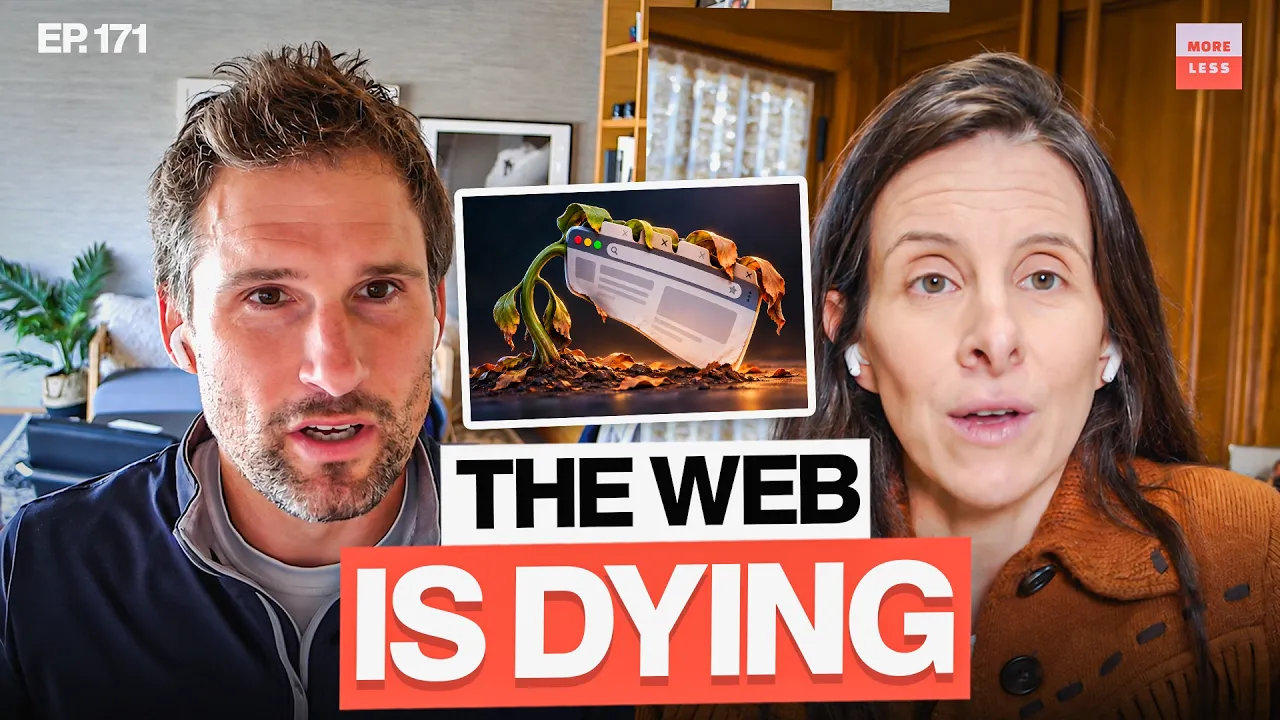
Jess went full send on Muse and reports that about 70% of the use cases she was excited about have stopped working, because the internet is fighting back: Good Eggs now wants her to check out in the app, her kid's school portal refuses the login, and JP Morgan and Amazon are blocking agents outright. Dave's version is worse. Instinct booked a dinner reservation in LA instead of San Francisco, and he's out. Sam has seen this exact movie, because he and Andrew Kortina ran Fin ten years ago and shut it down once they worked out you become liable for every provider down the chain with no margin to cover your own mistakes. His call now is the death of the web, plus APIs that negotiate access back and forth like Hollywood agents. Meanwhile Anthropic is meeting investors behind closed doors while they tape, the market is getting hammered, and Brit's three years of hip pain vanished in six days on peptides, which Sam insists is placebo. Timestamps: 01:09 Jess Is Back, Dave's Birthday, and the October Cold 03:04 Nasal Rinses and Fall Immunity 04:02 Brit's Peptide Results: Three Years of Pain Gone in Six Days 06:43 Anthropic Is Meeting Investors While We Tape 07:34 The Market Is Getting Hammered: VIX, Private Credit, Apollo 08:16 Infrastructure IPOs Stall and Nvidia Becomes the Last Investor 10:01 Slowing Revenue, CFOs Cracking Down, Tokens Moving to Open Models 10:36 Sam: Would You Rather Be Rich or Right? 11:11 The Models Are a Commodity and There Is No Lock-In 12:15 Brit Won't Give Muse Her Whole Computer 13:41 Why Sam Trusts Meta More Than OpenAI or Anthropic 15:16 Jess: 70% of My Muse Use Cases Don't Work Anymore 16:54 Dave: Instinct Booked the Restaurant in the Wrong City 18:18 Sam on Fin, the Assistant Company He Ran Ten Years Ago 20:30 Why the Economics of Mistakes Break Agent Services 22:31 Sam: What's Inevitable Is the Death of the Web 23:09 APIs as Constant Negotiation, and Agents With Reputations 24:51 Agent Credit Scores: FICO for Bots 25:56 Amazon's Rufus Still
Summary
Generated by gpt-5.6-terraAt-a-Glance
- Verdict: Skim
- Core thesis: Consumer AI agents will be constrained less by model quality than by hostile service providers, brittle end-to-end execution, trust boundaries, and the economics of taking responsibility for costly mistakes.
- Why it matters: The discussion identifies the practical control-plane problems that can block agent adoption: delegated authentication, site/API access, provider incentives, error recovery, liability, and trust-mediated permissions.
- Best use: Use this as a strategic stress test for agent-product assumptions, especially any workflow that depends on browser automation, third-party commerce, or unattended execution.
Executive Summary
The core argument is that capable consumer agents are arriving into an Internet that has strong incentives to resist them. The speakers see foundation models becoming interchangeable enough that model quality alone will not create durable lock-in, while websites and service providers increasingly block agentic traffic that can commoditize their interfaces, undermine their customer ownership, and force price competition.
Their most concrete evidence comes from Meta's Muse: one speaker says roughly 70% of the high-value tasks she tried no longer close the loop. Reordering groceries through Good Eggs repeatedly stopped at checkout, and logging into a child’s school system required manual browser takeover. This is not framed as a failure of the underlying model so much as a failure of authorization, payments, anti-bot friction, and third-party service access.
A former operator of Finn, a human-backed concierge product, adds that even a broadly capable assistant faces a difficult service business: it must handle many task types, inherits responsibility for downstream vendor failures, and cannot economically absorb occasional large mistakes such as an incorrect $1,000 flight. Users also have near-zero tolerance for errors from a digital agent because firing it is frictionless.
The speakers expect a transition from static API keys and generic permissions toward negotiated, reputation-based access among agents and providers. In their view, agent platforms with trusted brands, strong user identity, commercial partnerships, and financial/legal accountability will have an advantage over anonymous open agents. The surrounding discussion on AI-company valuations and Gen-Z meme culture is more speculative and less useful than the agent-access analysis.
Key Takeaways
- Claim: The main bottleneck for personal agents is increasingly the Internet’s refusal to permit completion of high-value actions, not raw model capability. | Evidence: A speaker reports that about 70% of her anticipated Muse use cases fail: Good Eggs reorders now repeatedly require her to enter payment information or complete checkout in the app, and a child-school login cannot be completed without manual browser control. | Implication: Any agent roadmap that claims autonomous commerce or administrative work should treat delegated login, payment authorization, browser handoff, and provider cooperation as first-class product dependencies. | Caveat: These are anecdotal experiences with a very new product and may reflect individual integrations or temporary product limitations rather than a universal agent failure rate.
- Claim: Service providers are likely to restrict unmediated agent access because agents erase provider differentiation and threaten their economics. | Evidence: The speakers compare the moment to the early web/API era, when open access later narrowed once services realized scripted access reduced lock-in and value capture. They argue that a perfect agentic marketplace choosing the lowest-price flight, for example, would be destructive to travel providers’ direct customer relationships. | Implication: Open browser automation is unlikely to be a durable acquisition channel; long-term agent systems need explicit commercial agreements, provider value exchange, or interfaces that preserve provider control.
- Claim: The future API model may be dynamic, negotiated delegation rather than a static API key with fixed scopes. | Evidence: One speaker proposes an agent identifying itself to Amazon, presenting a particular customer and requested actions, then exchanging information with Amazon to negotiate what access is allowed. They liken the eventual trust layer to a reputation or credit system, though they doubt it will consolidate cleanly into one universal score. | Implication: Build agent identity, auditable user consent, capability scoping, policy negotiation, and portable reputation signals into the architecture rather than assuming a permanent all-or-nothing credential vault. | Caveat: This is a forward-looking design hypothesis, not a reported emerging standard or deployed protocol.
- Claim: An agent that executes real-world tasks becomes liable for the whole downstream service chain, making reliability and error economics central to the business model. | Evidence: Drawing on Finn, an earlier concierge service using humans behind an AI-like interface, a speaker says the company had to support nearly every task category to be valuable and became responsible when downstream providers failed. A wrong restaurant booking or a $1,000 plane-ticket error can be disproportionately expensive relative to a low-margin assistant service. | Implication: Constrain early agent products to bounded workflows with clear confirmation points, reversibility, exception handling, and explicit loss limits before accepting open-ended purchase or scheduling responsibility. | Caveat: The Finn example concerns a human-operated concierge model from roughly a decade earlier; automation can lower fulfillment cost but does not eliminate downstream-error liability.
- Claim: Digital assistants face unusually harsh retention dynamics because users will abandon them after one consequential error. | Evidence: Finn users would cancel after mistakes and sometimes return later because they missed the service, but the speaker argues a digital assistant has no human relationship or switching cost to buffer failure. A Muse/Instinct example—booking a restaurant in Los Angeles rather than San Francisco despite a confirmation check—prompted an immediate reaction of being done with the product. | Implication: Measure trust by outcome severity, not only average task success rate: a low aggregate error rate can still be unacceptable when failures affect location, money, access, or commitments.
- Claim: Large, established platforms may be structurally advantaged in agent adoption because users and providers can trust their accountability and distribution. | Evidence: One speaker says she would be more willing to grant broad permissions to Meta or Google than to smaller AI companies or local/open-agent software because public, profitable companies are legible, can be sued, and have incentives to manage security. The group also argues that platforms such as Amazon can reduce commerce friction more directly within their own ecosystems; Amazon’s shopping assistant can still buy an item from a photo. | Implication: For an independent agent, compensate for the platform-accountability gap with strong security posture, transparent auditability, narrow permissions, user-controlled local execution, and provider partnerships rather than relying only on model differentiation. | Caveat: Corporate size and legal exposure do not inherently make a platform privacy-safe or aligned with users; this is a speaker’s trust heuristic.
Detailed Brief
AI market context: commoditization shifts value from models to distribution and execution
- Claims: The speakers believe consumers increasingly see leading AI products as 'good enough,' weakening the premise that one model company will capture the entire market.; They argue that enterprise token spending is partly moving to open models, while CFO scrutiny and competitive releases from Meta, Google/Gemini, Microsoft, OpenAI, and Anthropic may slow growth narratives.; Their view is that startups will have difficulty surviving an environment where frontier-model differentiation compresses while access, capital, and distribution become more important.
- Evidence: They reference reports or rumors of an Anthropic IPO process amid uncertain public markets and claim OpenAI reached $50 billion against a September target of $68 billion.; Meta’s Muse and Google’s new Gemini models are cited as examples of competitive offerings reducing perceived scarcity.; They mention infrastructure companies such as Nscale and XP Energy slowing IPO plans over pricing concerns, and characterize Nvidia as a potential investor of last resort for capital-intensive AI companies.
- Caveats: The financial and operating figures are conversational claims, sometimes explicitly described as rumors, rather than independently substantiated analysis.; The episode offers no rigorous comparison of model performance, pricing, retention, or enterprise workload migration.
- Implications: Evaluate AI opportunities around proprietary workflow integration, trusted access, distribution, and operational reliability rather than a presumption of durable model superiority.; Be cautious about business cases dependent on continued premium model pricing or winner-take-all valuation narratives.
Product design observations: local utility and low-friction ecosystems can still win
- Claims: The group distinguishes between ambitious Internet-spanning autonomy and narrower, reliably completed tasks.; A task that emails and prints children’s piano practice material is cited as delightful precisely because it avoids difficult Internet interactions.; For routine commerce, users may choose whichever ecosystem minimizes cognitive load rather than a standalone general-purpose personal agent.
- Evidence: The speaker says Muse still reliably performs email-to-printer work even while many browser-mediated tasks fail.; Another speaker frames the buying decision for commodities such as paper towels as minimizing brain activity, suggesting Amazon has a natural advantage when it owns the catalog, payment relationship, and fulfillment path.
- Caveats: The conversation does not establish whether printing and closed-ecosystem commerce generalize into a defensible standalone agent product category.
- Implications: Prioritize workflows with controlled endpoints and immediate, observable completion.; Treat cross-domain autonomy as a partnership and policy problem, while finding value in local, device-level, or vertically integrated workflows now.
Notable Concepts & Terms
- Muse: Meta’s consumer AI agent product, used here as the central example of strong agent UX colliding with website, login, and checkout restrictions.
- Harness: The speakers’ term for an agent runtime/interface that connects models, tools, user data, and execution; they criticize the emerging idea of a 'harness of harnesses' as unnecessary layering.
- OpenClaw: Referenced as a more open or unlocked agent harness relative to giving a major platform broad access to an entire computer.
- Treaties: A proposed framing for negotiated agreements between agent platforms and service providers, intended to replace unrestricted automated access.
- Dynamic API negotiation: The predicted shift from a reusable API key with fixed privileges to contextual, back-and-forth authorization based on agent, user, request, and provider policy.
- Agent reputation / agent score: A possible trust signal combining the agent platform’s credibility and the user’s value or behavior, analogous to creditworthiness, that could influence what actions providers allow.
- Finn / AAI: An earlier concierge company described as 'artificial artificial intelligence': it built an AI-assistant experience but inserted humans to fulfill work while learning the workflows and failure modes.
- Forward-deployed holding company: A buy-and-improve model discussed in relation to Ithaca’s Bumble acquisition: acquire an existing business and apply frontier intelligence/operational capabilities to improve it.
Operator Notes / Why Ken Should Care
- Run a dependency audit for every autonomous agent workflow: identify required provider permissions, login methods, payments, CAPTCHA/anti-bot exposure, manual handoffs, and the business owner of each endpoint.
- Set task-specific risk tiers before allowing unattended execution; require confirmation or limit authority for location-sensitive bookings, financial commitments, account changes, and irreversible actions.
- Instrument agent reliability by severity-weighted failures, recovery time, and user trust loss—not merely successful tool-call rates.
- Design an agent identity and authorization layer that can present user consent, requested scope, audit logs, and policy-relevant metadata to external providers.
- Avoid positioning a product around generic browser autonomy alone; develop a partnership strategy or focus on owned/controlled workflow surfaces where closing the loop is demonstrably reliable.
- Treat large platform agents as likely channel competitors in commerce and personal productivity; identify workflows where neutrality, privacy controls, cross-system orchestration, or domain expertise can remain differentiated.
Source/Metadata
- Title: The Internet Is Fighting Back Against Your AI Agent
- Transcript words: 15939
- Duration seconds: 3024
- Timestamp note: No usable timestamps or chapters were provided; the transcript also contains repeated sections after the apparent episode close.
Transcript
[SPEAKER_00] As we are taping this pod, Anthropic is meeting with its investors in closed-door meetings to talk about going public. Meta turning on Muse as a consumer product and having such traction with it narratively and practically. But then also their new models being good and competitive. This stuff is commodity. Plus Gemini launched all their new models too. Everyone's going to launch all the things and the consumers are already at the point where it just doesn't matter. The stuff is all good enough, which is classic race to the bottom. There is no lock-in. And then you have the Anthropics and OpenAI. Their whole pitch has been the infinity story of one company takes all because they can't possibly justify their existence if that's not true. A solid 70% of my Muse use cases that I was so excited about do not work. I think it's very hard for startups to survive what's coming. [SPEAKER_01] Hello friends. Welcome to More or Less. Did you miss me? I missed you guys. A week without More or Less is just sad. [SPEAKER_00] We did miss you. The boys were not really last week when I tried to moderate them. So thanks for coming back. But we got good comments on it. [SPEAKER_02] Yeah. People liked it. People seemed to like it. [SPEAKER_00] People like the unruly boys. Okay. Boys gone wild. Well, I'm happy to be back. I'll take my shirt off. I have a whole pile of shirts over there. [SPEAKER_02] Did you take your shirt off on the episode? [SPEAKER_01] No, I said I would take my shirt off. He has done that in former episodes. But guys, today is Dave's birthday. So maybe he should take his shirt off. Happy birthday, Dave. Except he's six. So he won't do that. He's got a weird voice today. Sorry, y'all. [SPEAKER_00] Thanks, guys. Dave, you've got the October cold. [SPEAKER_01] Yeah, I just got the test back and I have a standard garden variety coronavirus, not COVID. [SPEAKER_02] What is a garden variety? I guess that's what we used to call colds. [SPEAKER_01] Yeah, and flus. Don't you think we're going to cure the cold in the next five years? Isn't it a thousand things? [SPEAKER_00] I would prefer to cure Lyme disease in the next five years if I had to cure something. [SPEAKER_02] Oh, it's happening. Trump made an executive order. [SPEAKER_00] Well, I'm actually happy to hear that. Trump made an executive order. [SPEAKER_02] There is no more Lyme disease. It's called Lyme inconvenience. He just renamed it. It's going to be eradicated by 2028, he says. [SPEAKER_00] I like that. It's Lyme inconvenience. Lyme disease no longer exists. [SPEAKER_02] No, he also said that mosquitoes are going to be 90% down by 2028 in Washington, D.C. only. [SPEAKER_01] You know, that's funny about that, the mosquitoes thing. You realize that's been the issue with Washington, D.C. since Washington, D.C. was invented. Mosquitoes? [SPEAKER_02] Yes. [SPEAKER_01] Is it because of all the fountains? [SPEAKER_02] No, it's just marshy. It's a bog. It's built in the shittiest climate land. But it's literally this has been—I bet there was an Andrew Jackson era order for the same thing. America has been fighting mosquitoes in D.C. for its entire history. [SPEAKER_00] Well, there are mosquito drones now and lasers. So there are new mosquito killers. [SPEAKER_02] Okay, guys, we're not talking about mosquitoes. But I do on things we're not talking about, Dave. Have you heard of the nasal rinse? [SPEAKER_01] I'm sorry to bring this up, but I am convinced that this is the key to fall immunity for parents. [SPEAKER_00] Oh, yeah. You just have to keep nasal rinsing all the time. Jessica is constantly washing her sinuses out and saying that's what the Koreans do. [SPEAKER_02] It is. It's great. [SPEAKER_00] Hello. I have, knock on wood, had my best immunity, fall immunity of the last five or six years this year. [SPEAKER_01] There was a bunch of science that was actually done. [SPEAKER_02] It's not even it's barely fall yet. How do you have any data? [SPEAKER_00] Oh, by now I would have been sick three times. Sam can attest to this. We've had multiple things flow through the house with kids. And I'm not feeling tip-top shape, but I'm definitely not down for the count. [SPEAKER_02] And it's not the peptides for you? [SPEAKER_00] I don't peptide. I have zero peptides over here. I'm one weekend. [SPEAKER_02] Let's get the peptide update, Britt. [SPEAKER_00] I just need to talk about one thing. [SPEAKER_02] Just what? I want the whole update. [SPEAKER_00] Guys, for three years, I've had this crazy hip pain, lower back pain, glute pain. I went and got MRIs. It was free. I had frayed tissue. I had a lot of inflammation. I injected this Wolverine clothing last week that has all this stuff in it—called BPC 157 and copper and stuff. And it's gone. I promise you for the last six days, it's been gone. [SPEAKER_02] Oh my God. Britt, did you discover this? Should I try this? [SPEAKER_00] I just didn't know it would work that quickly. [SPEAKER_02] Why? How did it work so quickly? [SPEAKER_00] It's great. [SPEAKER_02] It's not placebo because I have real MRI results. [SPEAKER_01] It doesn't work that fast. [SPEAKER_00] Well, that's what I thought. But why am I not feeling pain? [SPEAKER_02] It's placebo. [SPEAKER_00] This is not just my brain. [SPEAKER_02] But Sam, when were you convinced that yours wasn't placebo? [SPEAKER_01] Pretty quickly, actually. They're supposed to take a few weeks to really kick in. But I actually am—as much as I'm making fun of Britt, I'm totally with you. This stuff works, right? And it works really fast for me too. So congratulations. Welcome to the peptide world. [SPEAKER_00] Maybe I'm a fast peptide reactor. [SPEAKER_02] We're now 50-50 peptides on the pod. [SPEAKER_01] Yeah, More or Less peptides. [SPEAKER_02] We should probably make our own branded peptides. Britt and I should splinter off. We can have Britt and Sam's Peptide Corner. We just talk about the new peptides we're trying every week. [SPEAKER_00] More or Less Peptides coming soon. I am going to hawk nasal rinse and electrolytes over here. [SPEAKER_02] Neomed. Neomed, nasal rinse. [SPEAKER_00] Neomed. [SPEAKER_02] But Britt, it's pretty good, right? [SPEAKER_00] I mean, I'm into it. I don't really love how much it hurts and itches, this particular peptide. The copper initially—your body doesn't like the copper at the injection site, but it's fine now. I moved it to my butt, though, and it's better. I've got the most tissue back there, so we're good. [SPEAKER_02] Yeah, you do. [SPEAKER_01] Wow. [SPEAKER_02] Only tech podcast to talk about butt injections. Five minutes in, right here. You're welcome, audience. [SPEAKER_00] Okay, so Britt's on the peptide train. Dave, I'm nowhere close to the peptide train. Are you peptide curious? [SPEAKER_01] I'm not currently. I'm definitely curious. I just got really sick, so I haven't had a chance to schedule my— [SPEAKER_00] So I'm going to be the lone holdout? [SPEAKER_01] You are. [SPEAKER_02] The venture capitalists are going peptides? [SPEAKER_01] That's exactly correct. [SPEAKER_02] Of course we are. We live in the future over here. [SPEAKER_00] You're the skeptical journalist. [SPEAKER_02] I think you should get into it, Jess. Jess is going to be a long holdout on peptides. [SPEAKER_00] I think you'll eventually end up taking them, but you'll be a long holdout. That's probably right. [SPEAKER_02] But Britt, Dave, and I are going to be living our best lives in the meantime. We're going to look so good. Look how good my skin looks with that copper in it. [SPEAKER_00] I'm going to have to work out five times as much as you guys to keep up. [SPEAKER_02] Britt, Dave, and I are going to get all the thumbnail clippings by our editorial team at More or Less. Now you're talking my language. Now no one's going to be really shameful. [SPEAKER_00] Okay, guys, so as we are taping this pod, Anthropic is meeting with its investors in closed-door meetings to talk about going public. So we unfortunately do not yet have an update out of those secret meetings. [SPEAKER_02] How are you not in those meetings? When will we know? [SPEAKER_00] They're breaking for lunch now, so I'm pretty plugged in. But I don't have an update for you in the first two hours that I can share. But the significance of this is the IPO is still a go. And the market is getting hammered. What a great day to be discussing this. [SPEAKER_02] We need to talk about the bigger picture here. But Anthropic, still a go. But big question will be what happened to them in the third quarter. Some rumors of a slowdown. So yeah, Sam, what's happening in the market's bigger picture? [SPEAKER_01] I don't know. I'm just looking at Google Finance. Numbers go down, except the VIX is up a lot. So I think people are worried, confused. Where are my IPOs? Where does my number go up? [SPEAKER_00] Yeah, people are freaked out by the private credit debt world. [SPEAKER_02] Absolutely. [SPEAKER_00] You mean Apollo? [SPEAKER_02] It's all Apollo's fault. It's always Apollo's fault. [SPEAKER_00] It's not their fault. It's just like—as someone smart told me today, Apollo's the entire market. But the significance of this is the IPO is still a go. And the market is getting hammered. What a great day to be discussing this. We need to talk about the bigger picture here. But Anthropic, still a go. But big question will be what happened to them in the third quarter. Some rumors of a slowdown. So yeah, Sam, what's happening in the market's bigger picture? I don't know. I'm just looking at Google Finance. Numbers go down, except for the VIX is up a lot. I think people are worried, confused. Where are my IPOs? Where does my number go up? Yeah, people are freaked out by the private credit debt world. Absolutely. You mean Apollo? It's all Apollo's fault. It's always Apollo's fault. It's not their fault. It's just that, as someone smart said to me today, Apollo's the entire market. Yeah. Here's what I think—is that true? That is what a smart person said to me today. Well, smart people can say dumb shit. It doesn't make it true. All the time. Yeah. We do it professionally on this podcast. Our ratio of smart to dumb, though, is very high. Yeah, it's very high. Look, it's a really interesting moment. We know if you circle back three to six months, there was pretty high exuberance in Silicon Valley that Anthropic and OpenAI would be public companies by the end of the year. Well, by September 1st. Like, that wasn't the end of the year. Everyone for weeks has been, this is the week. I was at a cocktail party mid-August and I was, shit, this thing is coming. And I sent a lot of alarm bells off because there was a lot of activity. Okay. But things have changed. Markets are very uncertain, big picture with everything going on. Very specifically, these infrastructure IPOs, companies like Nscale, XP Energy, the information's been all over them, are basically slowing their role on their IPO in various phases due to pricing issues. So the public investors, you have some like firmists, I believe, that have just totally done a 180 and are now doing private rounds. So public investors aren't chomping at the bit for this. I think one of the big questions now is what are the private markets going to do? The private credit markets are pulling back. My guess is honestly that NVIDIA is going to be left as the investor of last resort. Not as public companies, but who is going to come and do the next rounds of all these big companies that were hiring the private markets, but maybe they could go out at far lower prices. So I don't know. You basically, the capital you have left is traditional private capital or strategic capital. Well, and at the same time, the revenue growth is slowing at these big companies, OpenAI and Anthropic. And so I think we had OpenAI talk about they got to 50 billion, but their target was 68 billion in September. Right. Oh, my God. Do we have to talk about that whole issue? Maybe I don't know if we have to talk about the accounting issue. We can decide. But anyway, this is not an accounting podcast. They're all their tokens. All the enterprise token spend is not all, but some is moving to open models. And CFOs are cracking down on spend and Meta is launching their own models and Microsoft's pulling off. That are good. I think this is the key part. The funny part is I was texting with Dave this morning about, do I want to be rich or intellectually right? It's a very hard choice because. Sam always wants to be intellectually right. Yeah. It turns out I'm much more interested in being right than rich. To me, it's none of this is surprising. This is exactly what we all talked about. And the reality is Meta turning on Muse as a consumer product and having such traction with it narratively and practically, and then also their new models being good and competitive. This stuff is commodity. Right. Plus, Gemini launched all their new models, too. Everyone's going to launch all the things. And the consumers are already at the point where it just doesn't matter. The stuff is all good enough. Right. Which is classic race to the bottom. There is no lock in. And then you have Anthropic and OpenAI. Their whole pitch has been the infinity story of one company takes all because they can't possibly justify their existence if that's not true. I think all the things are just coming home to roost that we've been talking about for months and in some cases years. Right. The problem is, it's kind of that I'm ambivalent about it because the party being over makes me poorer because all the numbers are correlated. Right. The reality is there are no numbers. The numbers are just baseline leather numbers. Right. So it's just a really interesting moment we're in where sobriety and rationality is starting to show up, which is good. But that sobriety and rationality of the 40 trillion dollar debt and the structure of our current markets and what the markets need and narratives, capitalism, all that stuff are just not super stokeful for everyone who's around the table. You're connecting a bunch of points here. Right. So we're talking I was making this point that there's this concern about the infrastructure piece, which obviously is a signal of confidence way into the future. Related to that is just competition. Right. I mean, let's check in on everyone's Muse usage. Where are we at here? What are people experiencing? Oh, I can tell you one thing. I've never been a heavy Muse user. And then I updated my Muse yesterday. Never even in two weeks. I've never in the two weeks it's existed been a heavy Muse user. Well, Jess has gone full send mode on Muse, but I try to go full send. The Internet won't let me. But yes, continue. Well, yeah. Now you're getting blocked by JP Morgan and Amazon and all kinds of things. But also I got a little creeped out yesterday. I did the update and then my starting screen was, you by clicking this button enable Muse to use your whole computer even when you're not there. Store everything. And I'm just, I don't like this. I've seen this before. And I think that's why I choose things like open claw or open harnesses to be my really open and unlocked harness. And giving Muse and Meta literally my whole computer is the scariest thing ever to me. So I've not gone that far. I think a lot of people are having this conversation right now. I'm in a lot of WhatsApp groups and everyone's, how much information are you guys giving all your agents? And a lot of people are going full send mode at the same time. It's very binary. A lot of people are, no way. Muse is the one I'm most willing to give complete information to, ironically. I actually trust Muse the most, but I don't give any of them local access. Why? It's an old Bob lesson, my dad line, which is when I was a kid, I was scared at Disney World on a roller coaster. And he said, don't worry, Sam. Disney's a public company. Right. And the basic point is it's a real company. They can be sued. It's meaningful to them. They care about the security angles. Right. So I think the problem with even OpenAI and Anthropic is if you sue them, it's not clear you'll ever get any money out from them. Again, this goes back to the whole internalizing the profits or the value and externalizing the risks. Right. They might cause a national crisis, but you're never going to sue them. Right. Whereas Meta is a highly legible, profitable, suitable company with every single booze and therefore can be trusted a lot more. Same with Google. I would trust Google the same way. I know. I would trust Google first. And I'm waiting for Google to roll theirs out. I think the Gemini stuff was a step in the right direction, but they haven't fully connected the dots yet. It's the trust. And then it's the whole on the other side. It's who can just do the BD deals to keep stuff open? Because that's the other thing we're seeing is there's nothing surprising about anything going on. Turns out that once you see a ton of agentic traffic, which is completely commoditizing your underlying servers, you're going to turn it off. Right. And so that's the other thing that's happening. It's the early days of APIs and websites where everything was open and it was totally fun. Yeah. And then all the services grew up and, wait, we can't have APIs now that everyone can script against them because then we have no lock in and no value. And they all got quashed. Right. We're just playing that game all over again. I think the Gemini stuff was a step in the right direction, but they haven't fully connected the dots yet. It's the trust. And then it's also the whole on the other side. It's like who can just do the BD deals to keep stuff open? Because that's the other thing we're seeing is there's nothing surprising about anything going on. Turns out that once you see a ton of agentic traffic, which is completely commoditizing your underlying servers, you're going to turn it off. Right. And so that's the other thing that's happening. It's like the early days of APIs and websites where everything was open and it was totally fun. Yeah. And then all the services grew up and like, wait, we can't have APIs now that everyone can script against them because then we have no lock in and no value. And they all got quashed. Right. We're just playing that game all over again. I just know to everyone at Meta who's going to be mad for me saying this, I'm sorry I speak the truth. But this isn't a fault of theirs, but a solid 70 percent of my Muse use cases that I was so excited about do not work. I cannot complete things. The Internet is just standing in my way 100 percent of the time. The Internet's fighting back. What's an example? OK, I'll give you all these examples. I used to be able to say Muse reorder my latest Good Eggs order. Good Eggs. Basic. Not Amazon. Not grocery shop. Right. A hundred percent of the time now it tells me that I have to enter my payment information or check out from the app. And I've done this three times. So it's not like the browser was stalling once or twice. I even check because I know, and each time it hasn't done it. A hundred percent of the time it hasn't done it. My grand AGI of parenthood challenge logging into my kid's school thing. It will not do. It just won't do it anymore. And it's like, I need you to take control of the browser and log in. And I'm like, why? And they're like, because I need you to. And so, I think it's a great product. And I'm still using it as much as I humanly can. But the magic of closing the loop in my core use cases is completely gone. I think this is a real thing for what it's worth. It is still printing out the kids' piano practice lessons. So email to printer still works. But it doesn't involve Internet. To Meta's great credit, I think they've built a great product here. And they spent a lot of time trying to get the details right and do it at consumer scale, which is very difficult and takes a lot of details. I mean, it's crazy the amount of details. Like, you have to build a great model. You have to build a great harness. You have to build a great front end. You have to think about all these things that you're talking about that need to just work. And what's kind of wild about this product category is that it really does need to just work. Otherwise, you lose people and churn people. And I think it's even more aggressive than the 2010 social era where people would try things and if it didn't work, they'd bail. Then they get invited by another friend. And these things can really do harm. Like, Britt and I had an experience of this with Instinct over the weekend. She had booked and then double-checked a reservation. We had some friends coming into town. We wanted to take them to somewhere specific and booked, double-checked the reservation. We thought we were good. We'd get to the restaurant. Turns out Instinct had booked it in L.A., not San Francisco. And it's like, what happens? I immediately am like, this doesn't work. I'm done. I'm out on Instinct. I got so mad at my Instinct. I was like, I told it, I'm so frustrated with you right now. How are you going to fix this and make it up to me? Just don't taunt it. Yes. So, look, I can't not chime in here because I had all these experiences 10 years ago with Finn. I'll tell you a really funny story. Explain what Finn is for anyone who doesn't know. Lick the cookie on Finn, please. I got it. Because it's the straight up middle. Look, 10 years ago, Andrew Cortina, who co-founded Nemo and I, left what we were doing and started a company called Finn. It was what we called AAI at the time, or artificial artificial intelligence. And we basically said, in the future, there are going to be assistants that do exactly what they're all trying to do right now, but we're not there yet. So what we're going to do is figure out the product experience, build the entire thing. There's still not, but this will get to this. Build the entire experience, figure it all out, and then we'll slot humans in to just do the minimum that we can and chip away at it in the transaction. So requests would come in, we'd understand what they are, we'd categorize them, we had a credentials vault for your credit card, we had a graph of everything we knew as a system as well as about you personally. You'd make a request, I need a dinner reservation with my friends here, or every week make sure I send Jessica flowers or whatever you want. We'd categorize, we'd understand, we'd have recipes for completing them. We built the entire thing and then multi-threaded, voice activated. It was great. And people loved it. In fact, hilarious, you talk about booking the wrong restaurant recommendation. Marc Andreessen was a user at one point and got livid because we screwed him, Finn did, the same exact way, booking effectively a work lunch at the wrong place for him and telling the wrong thing. It's the exact same story, right? And so here's what we learned doing this. I've talked to several entrepreneurs over the years about exactly the moment we're in now and the problems. One is the biggest problem with running these assistant services is that you have to do everything to make the service valuable. You can't just do scheduling. You have to do all the tasks and you become liable for every service provider down the chain from you, right, that you say. So if you say, hey, there's going to be a car there for you and I'm going to book it for you, it is now your responsibility that the car is there, even if something else screws up down the line. Problem one. Problem two, which is associated. If you want to run these efficiently and cheaply at low margin, the problem is that some of the mistakes become massively expensive. Like, if you book someone the wrong plane ticket or someone to the wrong restaurant, that's not a small deal. Normally, what you do is say, well, I'm very sorry, I'll pay for it. Like, DoorDash says, hey, I screwed up your food order. No worries, I'll just pay for it. The problem is, and DoorDash can do that because they take a ton of margin and food isn't that expensive. If you're booking someone's $1,000 plane ticket or doing something really important and screw it up, you don't have the money. You don't have the margin to pay for the mistakes. And so there's a fundamental problem with running this service. And then, unlike a human assistant, which is what we're all trying to proxy, everyone is a hairline trigger. Like, if you screw me once, it's so easy to fire a digital assistant effectively. There's no emotional bond. I didn't hire the person. It didn't take me a bunch of time. Like, if your human assistant screws up, which they do all the time, you don't instantly fire them. Like, you're like, I have to work with you. There's some stickiness. There's this whole human... But people, if you turn into a service and say, we have a service for doing this stuff, the tolerance for mistakes goes to zero. Now, with Finn, people would constantly cancel and then be like, oh, man, I really missed that and come back a month later, right, once there was a mistake. But the problem is you're always going to run an error rate, whether it's 1% or 0.1%. You're going to have that. And that's before you get into the adversarial service abstraction component. And I don't know how these services are going to be able to do it because that is the real reason. People always ask me repeatedly over the last few years, why don't you restart Finn? Why don't you restart Finn? You could do it now. It'll work. And I'm like, you guys don't understand why we stopped doing Finn. There's this whole human thing. But people, if you turn into a service and say we have a service for doing this stuff, the tolerance for mistakes goes to zero. Now, with Thin, people would constantly cancel and then be like, oh, man, I really missed that and come back a month later, right, once there was a mistake. But the problem is you're always going to run an error rate, whether it's 1% or 0.1%. You're going to have that. And that's before you get into the adversarial service abstraction component. And I don't know how these services are going to be able to do it because that is the real reason. People always ask me repeatedly over the last few years, why don't you restart Thin? Why don't you restart Thin? You could do it now. It'll work. And I'm like, you guys don't understand why we stopped doing Thin. It was not that we couldn't provide a great service and not that the economics didn't work. Both of those were fine. The problem was, what does it mean to take on that level of responsibility as a service? And can you make the economics of mistakes work? But at some level, it does feel inevitable, too. And so the question, I think, is what gets us through this period? And Sam, you've written about treaties and you think doing treaties at scale. I do feel like it is inevitable that we're just in an intense early adopter growing pain period. That's how it feels to me. You can't stop this. I think what's inevitable is the death of the web. I think what's inevitable is a bunch of simple shim types. Yes, you will obviously use these things, right, and for a bunch of stuff. And they'll be good at a bunch of stuff. But the problem is going to be there's going to be a holy war of access to services and a lot to figure out about mistakes and what you do and don't trust them with and how you operate. That I think is going to be really messy for the coming years. I think it's very hard for startups to survive what's coming. Are the harnesses going to have to strike a ton of specific deals with the biggest service providers? Yes. That's what we were talking about last week. That was the framework. The treaty thing is interesting. I think there's another piece I was thinking about this week about this. So the treaties thing is, look, everyone's going to shut it down because you've got to be top of wallet and have a brand where you have no value. Right. If I say I need a plane ticket and instead of even having to click on links, it's literally a perfect agentic marketplace for the lowest price, you're screwed. No one's going to survive in the travel industry that way. But I actually have another piece I've thought of recently about this, which is I think the way APIs work is going to change a lot. Because right now the way an API works is you get a key. Maybe it's trusted. Maybe it's not. And you have a set of things or capabilities you have access to in a given service provider. I actually think it's going to move to a world where every API is actually a back and forth negotiation for access. Right. The way it'll work is you'll show up at a company like Amazon and say, hey, Amazon, I'm Instinct here. I'm News here. I have this great customer over here. His name is Dave. He's awesome. You want to work for Dave. Dave's really rich and great. He's going to spend a lot of money. I'd really like you to let me do X, Y, and Z. And then Amazon's going to say, oh, interesting. Well, I'd love to know X, Y, and Z about your person you're working for. And then the API will respond back and forth and negotiate the level of access and what they get to do. So I think it's going to be a constant negotiation between service providers for passing access through where the value becomes if you're a high quality brand, almost like Hollywood. If you have Ari Gold as your agent, you're like, OK, this guy's going to keep playing. He's trustworthy and his clients are good. So I'm more likely to do business with you. Whereas if you show up as an unwashed agent out of nowhere and you're like, hey, I'm some open source agent you've never heard of, I'm like, I'm not going to talk to you. Well, don't you think it's going to be more like a credit score? Dave, we'll all have an agent score. And it's the score of our agent times ourselves and how trustworthy we are, how much credibility we have, influence we have, how much we buy. The S&P five million or five billion. It's clout for agents. I have good clout. Well, kind of, but I don't think it'll be a score. I mean, if you or the company could pull that off and centralizing the scores, that would be a really interesting thing to achieve is the upshot. I feel like it's going to be this pretty bad middle ground, Sam, where something like this is going to happen. I feel like it will happen. It's going to be some shitty. Well, I think there'll be it's like FICO. Guys, I saw three things this week of multi-agent harnesses, a harness of harnesses. Have you seen all these things? Why do we talk harnesses? No one cares about harnesses. Just drop harnesses. I don't even know what a harness is. It's you could put your Grok and your Muse and your Open Claw and your everything in one UI and then you can talk to all of them in different ways. And I'm like, now we're doing a turducken. I don't understand what's happening here. I also like to think of it this way. What would Amazon have to build to get me off this use case of using these other services? Right. So I mean, and I do believe that personal agents will be a thing and there's space for that market. But right now I'm in the mode of literally how much brain activity do I have to spend on buying more paper towels? And I'm going where that number is as close to zero as possible. And if it's Amazon, great. So I actually, when Muse made me log into Good Eggs for the 13th time, I was like, how's good old Rufus? Now, I think they've changed the name, thankfully, but Rufus was Amazon's agent. It's in the app. And I was just checking and Rufus or whatever it's called now actually still works to take a picture and buy something. What idiot named it Rufus? That's some terrible branding. I thought they changed it. They did, but to me, it's always Rufus. Isn't Rufus a sci-fi throwback of some kind? It's not Rufus. This is why tech people are not marketing people. It's Alexa for shopping. Thank God, what it always should have been. But anyway, it's not that bad. Rufus sounds like calling Homer Simpson. Yeah. Anyway, so that's where we are at this moment. And I also, can I bring this to a slightly different place, which is as a journalist, I have views about this. But what do you guys think about the incredible seesawing of narratives around who is the golden child in the space and who is doomed? I just cannot get over every day. Alex Wang is either the best entrepreneur to have ever graced the United States of America and beyond, or he's a horrible person. Why is he running a lot? Not horrible. But does the entire industry recognize how quick to build people up and tear them down? I don't know, you're the journalist. Shouldn't you be the one who can buy it? Isn't it your industry? How many articles does it take to tear them down? No, but we're not doing this. I think this is just the metabolism of social media. But it's to the point that it's nonsensical. I understand that. But that is the story, Jess. The story is that the metabolism is so fast now. Everybody rises and falls intraday. Intrahour. It's day trading your personal brand these days. And whatever you're going to do today, nobody's going to remember next week. There's people doing podcast tours all week. And then you forget about it and move on to the next thing next week. And it is the story. Someone told me they were busy. They were like, oh, sorry, we were busy with the Sam Altman interview. I was like, wait, which? Oh, that one, the one that was a disaster with Vanity Fair. I forgot about that. The most interesting thing I saw on Twitter this week, I talk about the state of this, where Jess is like, why are we doing these hyper cycle narratives coming largely from media and the Internet? It's how unhinged Gen Z media is. Everybody rises and falls intraday. Intrahour. It's day trading your personal brand these days. And whatever you're going to do today, nobody's going to remember next week. There's people doing podcast tours all week. And then you forget about it and move on to the next thing next week. And it is the story. Someone told me they were busy. They were like, oh, sorry, we were busy with the Sam Altman interview. I was like, wait, which? Oh, that one, the one that was a disaster with Vanity Fair. I forgot about that. The most interesting thing I saw on Twitter this week, I talk about the state of this, where Jess is like, why are we doing these hyper cycle narratives coming largely from media and the Internet? It's how unhinged Gen Z media is. Yeah, that was, by the way, Sam, going to be my other take on this, which is that it's Gen Z culture. What part is Gen Z culture? These Internet accounts that are posting these wild videos about Muse as sperm and these crazy psychedelic videos. Have you seen some of these? Wait, what? No, Muse is sperm? What does this mean? The little character, you know, the little... The little Muse character has found its way into... Oh, he's a sperm? It's been memed to death. Yeah. The Muse meme canon is incredible. And so, the thing for me that I think is happening is, in some ways, we're now the old people. So we're here being like, wow, not only is no one pursuing truth... I'm like, where's my quill and ink? Like that, you know? Well, that's what we're sounding like. Because then the medium is, oh, the hyper narrative is this person is the greatest ever and the worst ever. And then all the young people are like, this is obviously all ridiculous and stupid. Yeah, that's the whole thing. And so, their entire media culture is now psychedelic, AI, weird shit that makes no sense. Okay, but what is a business decision maker to do? You have to play the game. More memes. You can play the game, but what's true and what's important? It doesn't matter. I think that's, to Mark's great credit, he hired Alexander Wang, who was a Gen Z entrepreneur who knew how to play this game. He's playing it excellently, you know? It's exactly how to play the game. I remember seeing there was a study at some point a couple years ago about this in high schools and Gen Z culture and things. And they literally do believe that the game is so rigged and everything is so messed up that they might as well just do memes crazy and do things that don't make sense because the world that came before them was a world that made too much sense. And so it's a big reaction to that. What ages are Gen Z exactly? It's people born between 1995 and 2010. So, 31 to 16. Yeah. And I do think I saw a really funny video on the internet that was also about— It's punk rock in another form. Where this person was like, the 30 years trading at 5%. Should I be worried? And the account was like, no, you have no assets. You're poor. This is not your fight. And then it's just the whole thing about how the economy's rigged. All this stuff is crazy. So let's just make weird memes, right? And I just think understanding that that cultural undercurrent is there. Maybe what's happening right now in some ways with the stock market and some of these even IPOs, Anthropic, that was the last hurrah, the most extreme version of winner-take-all meaningful moment, right? Where oh my God, Anthropic opening is going to be the only company left in the world. And there's a bunch of people our age who get sucked into that narrative and believe it to some degree. And they get really into it. And that becomes the dominant narrative that capital flows. But then this new wave, right, of, oh, shit, all this AI is fine. Lots of stuff will change. None of this is the greatest or the worst. It's all just whatever. Let's make weird memes is, culturally, the moment we're entering where Gen Z takes over effectively. At which point no one knows how to trade anything, right? Because it's what are we doing? This feels scary for our futures. No, I think that's why I'm making an argument is you have to take the gestalt of it all. You have to pay attention to the whole thing, not isolated things inside of it. You kind of have to really interpret it as the whole story is the crocs on stage and the crazy shirts and the all the same thing. It's punk rock by a different name. It's an absolute rejection of the prior generation. But what if you aren't punk rock asking for friends? How do you grow a business if you're decidedly not punk rock or not Gen Z? Well, but Jess, this punk rock stuff is just marketing. At the end of the day, we talk about business a lot on this pod and we talk about the realities of these business models. And we can debate that and get into that really deeply. But what we're really talking about here on the cultural side, this is just marketing stuff, right? How do you pierce through? But, Dave, I think it is more than marketing. I think there's something in the middle I'd say about it, which is I think there is an undercurrent of this that will drive business and culture and who wins and who raises capital. I don't think it's just some isolated thing off to the side. But isn't narrative just marketing, Sam? I mean, I guess that's what I'm saying. Who raises capital is a marketing game, right? If you establish the narrative. But that does matter for business. I just don't think you can dismiss it too much. I think there is a cultural shift that will define a lot of how the world works going forward that's happening here. There will be a reaction to it. Just for your sake and business readers, plenty of people will still believe in a return of rationality and sanity and normalcy. And there will always be a counter revolution. There will be plenty big to support truth-seeking businesses. We kind of went from, oh, wait, COVID. Now this AI super cycle of it's going to kill us all. I think it's all just this sweep, right, of nothing matters. This is all wild. Let's all gamble. And where are we going? And by the way, maybe China loves this because they're America is getting so culturally unhinged at the youth that we're just going to dominate it all. I think it's really hard to miss the hallmarks here. No, I think you're absolutely right. It's happening. It's wild to watch in real time. And I think people who are playing this game well, it's working for them. But I also think it will work to a point. If they're not building great products and building trust, then they won't, you know. I think in history we've seen that there's the CEO or the founder who's the punk rock leader, but then they hire in the loaded guns, the Sheryls, the Eriks, the people behind them to help build the business. So maybe there's a combination of that. Or maybe Mark Benioff has to hire a Gen Z meme lord to make Salesforce. Yeah, I think every company needs a Gen Z meme lord. People are going to try all this stuff. But what if it's not authentic to you, right? Does the information need a Gen Z meme lord, Jess? Is that what you're thinking about right now? No, but we couldn't have a Gen Z meme lord. I just wouldn't. No, you totally could. You could create a brand that's a magazine that's a different cover. You could definitely do it. You wouldn't do it under your main brand. It's like The Economist. You should totally do that. I like that idea for you. Well, but it's interesting. I do see these memes go around. The latest one, Britt, you and I were on about who's a good hang and a fun time based on how much beer they drink following the cheeky pie appearance. Yeah, I think every company needs a Gen Z meme lord. People are going to try all this shit. But what if it's not authentic to you, right? Does the information need a Gen Z meme lord, Jess? Is that what you're thinking about right now? No, but we couldn't have a Gen Z meme lord. I just wouldn't. No, you totally could. You could create a brand that's like a magazine that's a different cover. You could definitely do it. You wouldn't do it under your main brand. It's like The Economist. You should totally do that. I like that idea for you. Well, but it's interesting. I do see these memes go around. The latest one, Britt, you and I were on about who's a good hang and a fun time based on how much beer they drink following the cheeky pie appearance. And I'm reading this thing had beers with half the people on the list. And I'm like, this is completely wrong. All the people listed as heavy drinkers have not touched alcohol in a decade. And actually, the best hangs, the people I'd want to have a beer with, are over there. But I'm like, I could spend an hour coming up with a clever meme refuting this meme. You're not the meme lord, Jess. Newsflash. Just a quick newsflash for you. It's like, you have to be on peptides to be a meme lord. Yeah, yeah. Sam and I are the closest. Here's the thing. Jess is a meta meme lord. She's like a meme lord above the meme lords. But look, I'd actually say, Jess, I'm not stressed for you or what you want to do or belief in your systems and values of rationality. I think you're going to be fine. Because the reality is, the other thing that's going on is subcultures are getting really deep. There are plenty of people that are going to be super deep into rational, real subculture. You just need to stay true to that. We're the truth subculture, guys. You are the truth. That's 100% what you are. I'm happy to own that subculture. I think the thing that's always been true, and you've known for a long time, is most people don't care about the information or truth. It just happens that the people who do care about the information and truth and what's actually going on are the richest, most valuable customers, right? And so you just have to be okay with the fact, which I know a lot of journalists aren't. This is the New York Times problem. The vast majority of the world doesn't care, right? They just want an entertaining story. They're very nihilistic. They're going to make crazy videos about whatever. And then there's a small number of people who, at least to date, have run things and do care a lot. And I think that's going to be the split. But the question is whether the meme lords get in the building, the nihilists end up running things or not, right? That's the real question. Yeah. And not only are the people who are in the truth subculture wealthy off accurate information, but they are also powerful in the decisions they make, too, for now. Historically. That's your point. Yeah. That could change. Speaking of which, Guy, we only have a couple more minutes. I'm really excited and only mildly nervous to be interviewing Barry Weiss at WTF that I announced today. And it is related to all of this because if you think about it, so Barry is the editor-in-chief of CBS News. Definitely the most controversial person scrutinized in media. There are publications, I hope that none of you people read, tech media industry trade sub-stacks that write about her 24 hours a day. I mean, it's insane. Jewish. They're almost certainly supported by certain lobbies. I mean, her meetings are recorded. Anyway, so for a year, she hasn't said a single thing. Yonkville, October 27th, 28th. It's happening. I say a lot. So I'm very excited, but I'm also bracing for every level of criticism. You're bracing for it for you? It's going to be great for you. No, it's going to be great for you. This is becoming a meme lord. There are people on X who have already decided that I'm either going to be too hard on her or too soft on her or too. People, I mean, bots, basically. But already just by having literally added her to the speaker page. Yeah, which is how you grow your account. There are people with strong opinions. Yeah, and then a week later, no one will care about anything because they have forgotten. If you're not canceled by at least some people, you're not doing anything. Yeah, no worries, Jess. Just go hard. Of course I'm going to go hard. But I also think people should be interested in what she actually has to say in her mind about her own freaking strategy instead of people just reading about leaked audio meetings. Are you worried that this off-the-record conversation with only women will be biased and that only women will be able to steer the words? You think I'm doing it? None of this is off-the-record. It's so on-the-record. No queens, Sam. No queens. No queens. Down with the matriarchy. I have to decide what my media strategy is. And let's face it, who I let in and who I let out. I don't know. Got to have a little perks to this job. But no, this is very much on the record. I don't have my t-shirts with me. My down with the matriarchy t-shirts. Just have Muse listen in real time create Gen Z memes for you. Oh, that's a good idea. Oh, yeah. Just have a little bug in your ear. We've been thinking about a new app to launch. We should do the information meme app nuts. That's apparently how, Alex Wang was saying on X the other day. That's how he does it. He just has his Muse generate all the memes. You should hire this guy, Steve Jobs, but it's Steve Sobs, who made the best meme thing of Muse I've ever seen. I'll send you his link. Oh, I've seen that. But wait, we had one more topic, which is sort of related because I'm also interviewing her at WTF. But Britt, we want to talk about Bumble going private. I know. Did you know this when she was being booked? No, I did not know this when she was being booked. It's a $1.3 billion deal to go private, right? Is there debt in that or is it all equity? No, I think there's some debt in it. They gave some details on it. It's at least, I think, half debt. Yeah, I mean, I get the sense that building dating apps are hard. You've watched most of them get consolidated into match group. I will say I know Whitney personally, and she is a beast. Nobody has the slightest clue how to solve this problem, by the way. I think this is a really tough category, and I think the public market pressure doesn't make it easier. So our friend John and Robbie, his partner, took it private. This is a really hard product challenge. John's great. I don't know Robbie as well, but John's amazing. Here's my only funny thing. Their holding company is called Ithaca. I think it's really funny that Ithaca is now in the business of suitors, because. Just getting into Greek mythology. Sam, explain the joke to the audience. Well, Ithaca is Odysseus' homeland. It's also the homeland of Cornell. Okay. So it's just really funny, because the whole thing is Odysseus comes home, and there are all these suitors for Penelope, kind of like suitors on Bumble. But then Odysseus kills them all. You can't kill all the suitors. Those are your customers. Oh my God. This is a cautionary tale. But no, in Bumble, the woman is Penelope is the suitor, because Bumble, the women reach out first. The women have control. Yeah, yeah, yeah. But Penelope's not interested in any of them. That's her whole thing. She's just waiting for Odysseus. We're going to have to rewrite history or something, because there's some issue with this narrative here. It's just a funny acquisition from a narrative perspective. This was Ithaca's first thing, right? We have to see what their second one is, and if there's a trend line. It's going to be a lot of work. So Ithaca, which again is, a holding company started by John Hageman and Ravi, who was at Sequoia? Yeah. Yes. Oh my God. This is a cautionary tale. But no, in Bumble, the woman is... Penelope is the suitor, because Bumble, the women reach out first. The women have control. Yeah, yeah, yeah. But Penelope's not interested in any of them. That's her whole thing. She's just waiting for Odysseus. We're going to have to rewrite history or something, because there's some issue with this narrative here. I feel like it's just a funny acquisition from a narrative perspective. This was Ithaca's first thing, right? We have to see what their second one is, and if there's a trend line. It's going to be a lot of work. So Ithaca, which again is, as Sam and Dave said, a holding company started by John Hageman and Ravi, who was at... Ravi was at Sequoia? Yeah. Yes. Their thesis is to take things and bring frontier intelligence to businesses that can leverage it to be way more successful, way more profitable, right? Forward deployed holding company. Forward deployed holding company, right? There are many of these out there right now. There are many of them, but they're in accounting and roll-ups, right? But Thrive has one. A lot of people have them. Offline holdings, we have one. On what level makes a ton of sense? I just sometimes think it's easier to build things to be honest. From scratch? Yeah. Well, Bumble has a big brand. It has a ton of users. Yeah, that's true. I do think data matters in dating, probably. But by the way, I worked on Hinge for over seven years, and this is really difficult. You did? How did I miss that? I was on the board of Hinge until we sold it to Match Group with Justin and those guys. So I've worked in dating apps, and it's extremely difficult. And no one has come up with a new mechanic that works. Actually, 2-2-2 has. Yeah, it's just not at scale yet. You mean a mechanic, like swiping? I don't think I've ever been on a dating app. There's this new type of dating app that gets you to meet in person, and it's hockey sticky. Yeah, there's a bunch of these. Yeah, so offline is the place to be. I've been pitched a few dating app mechanics that I think are pretty innovative, and AI does help in certain interesting ways. I agree it's a hard category. Maybe they'll just turn it into an OnlyFans competitor, Sam. How would you feel about that? Well, at the end of the day, you have to compete with Instagram because Instagram is just a dating app. It's not just. I don't date on Instagram. For Sam, it's a shopping. It's a commerce app for Sam. It's an everything app. To me, I'm on the fence about it. I really think that just is right. Historically, in a lot of categories, it's way easier to go de novo, especially when you're dealing with humans and all these people. But in certain things, like dating, I actually backed this very small dating agentic-y dating startup a year ago with a tiny angel check. Just a cool idea. And getting traction is so difficult, right? And the reality is that liquidity is so hard. You have to have... It's a marketplace and you have to have liquidity on both sides of the marketplace. And that's actually my big question about Bumble: it appears their liquidity has dramatically disappeared. And so whether or not they can get an advantage to get distribution again and drive liquidity on both sides of the market is extremely hard. It's harder than social networking. Do you mean having hot people on both sides? No, just having people on both sides. Do you think they rank their people based on matchability scores internally? Internally? Absolutely. Yeah, of course they do. Isn't that how dating apps work? No, but do you think internally they're like, oh, we've got 40% real hotness here versus Hinge has 60%? Yeah, they know everything. That would be really funny if a public dating app was like, we're doing very well because of our 100 million users, 90 million of them are really hot. Or another one's like, we have a problem. We have an enormous network, but it's all the most ugly people. What do we do with this? By the way, this is not dissimilar to... There's an adjacent business story here, which is that Airbnb and Booking.com are the tale of two wildly different business strategies in the same market. And Bumble is kind of like Airbnb. They stuck on their same mechanic for five years, didn't work out very well, stock went sideways. Match Group, on the other hand, bought every single vertical dating app in the game. So they have Hinge, they have Match, they have eHarmony, they've got whatever, they have everything. They have the farmer one, farmer dating. Yeah, they went completely horizontal across a ton of different verticals. And so they've been driving a much better business. They also aren't doing that well, but it's an interesting business strategy question as to which way you have to play in order to get all these different verticals. It'll be fun to watch. Smart people taking on a hard problem. Yeah, totally. I'm rooting for them. Someone needs to do it because it's a sad situation out there. It's actually a really important mission. No one likes to date anymore. It's really sad. Well, we will be watching. They're just making memes. The memes are so good, though. Jess, are you going to buy the new Apple Home View Center thing? Don't need it. I didn't know if it was a meme. It's the Facebook Portal slash an iPad on your kitchen table. I have six of those things sitting in a closet from four different companies. Why do I need a fifth? Yeah, but are they connected through all your iOS devices? Because you've got your photo rolls and Siri AI, which is better now. I'm trying to get screens out of my kids' face. I want screens out of their face. I'm not putting them in my kids' views. Apple would do, but to that point, you know what I would buy from Apple? An Apple printer. I'd buy a button to buy more paper towels. I want to reduce the friction in commerce. You used to make printers back in the old days. I know. I had a dot matrix printer. Bring back the ImageWriter. If you had an ImageWriter 50,000, and it was a beautiful modern ImageWriter, but it was smart about what it printed for you and kept you off your phone, that would be—you could do banners around your office with little dot paper. That's a very Gen Z coded thing for them to do. We had to bring back the printer, and that would be sick. Maybe Mod Retro should do that. I just heard the printer automatically going off because of one of my Muse tasks still working really well, and I was delighted by it. I just felt, in my physical environment, it was great. Jess, wouldn't you want an ImageWriter 10 million? Wouldn't you want it to make a slightly different tone for different people so you know whose paper is up? There's all these cool things you could do. Guys, we're just teaching our kids that the only way through the world is through an Apple screen. I don't want them anywhere near me. Well, no, through an Apple printed piece of paper. Whatever. You already have an Alexa and a Google. We have all the things. I'm just going to unify it all. There's not a single one in our house. There's not a single one. They're all in closets. What are you talking about? I've seen Google things in all your houses. They are not visible. They are all put away in cabinets. I literally have two phones on me in front of me right now. The Morans over here are going to go full Apple Home, and we'll report back in three months and tell you how much more awesome our life is. I don't even like Apple, and I have more Apple products than anything. No, it's not having—it's specifically the era of the HomePod with the screen. It's the Alexas with the screens, the Googles with the screens, the Facebook Portal. Remember that? The most tech people that I know are the most anti-screens. It's really funny. It's not funny. There's a canary in the coal mines. I am so excited. They're all in closets. What are you talking about? I've seen Google things in all your houses. They are not visible. They are all put away in cabinets. I literally have two phones on me in front of me right now. The Morans over here are going to go full Apple Home, and we'll report back in three months and tell you how much better our life is. I don't even like Apple, and I have more Apple products than anything. No, it's not having—it's specifically the era of the HomePod with the screen. It's the Alexas with the screens, the Googles with the screens, the Facebook portal. Remember that? The most tech people that I know are the most anti-screens. It's really funny. It's not funny. There's a canary in the coal mines. I am so excited. I'm going to finally see the Elizabeth Holmes movie this weekend. Sam's seen it. Yeah, gotta see it. Oh my God, guys. I'm so excited to see it a second time. I may be the first person in the world to see it twice. This is so exciting. I cannot wait. Will we be able to do spoilers on the pod? I don't know. Well, I think this comes—it'll be an interesting question, because you'll see it, Jess, and you'll feel the art and the importance and decide whether it's the rare thing that is worth people just seeing. Oh, I can keep my mouth shut when it's— I think everybody's going to go. Dave, I hope the rest of your birthday is full of fun and minimal nasal congestion. We're thinking of you, buddy. Yeah, thanks. Hang in there. Thanks, Jess. Okay, and dear listeners, we'll see you again next week for another episode of More or Less. Bye! If you enjoyed this show, please leave us a virtual high five by rating it and reviewing it on Apple Podcasts, Spotify, YouTube, or wherever you get your podcasts. Find more information about each episode in the show notes, and follow us on social media by searching for at moreorless, at Dave Morin, at Lesson, at Jay Lesson, and as for me, I'm at Brit. See you guys next time. See you guys next time. Well, I think there'll be like it's like FICO. Yeah. Guys, I saw three things this week of like multi-agent harnesses, a harness of harnesses. Have you seen all these things? Why do we talk harnesses? No one cares about harnesses. Just drop harnesses. I don't even know what a harness is. It's like you could put your grok and your muse and your open claw and your everything in one UI and then you can talk to all of them in different ways. And I'm like, now we're doing a turducken. I don't understand what's happening here. I also like to think of it this way. What would Amazon have to build to get me off this use case of like using these other services? Right. So, I mean, and I do believe that personal agents will be a thing and there's space for that market. But right now I'm in the mode of literally how much brain activity do I have to spend on buying more paper towels? And I'm going where that number is as close to zero as possible. And if it's Amazon, great. So, I actually, when Muse made me log into Good Eggs for the 13th time, I was like, how's good old Rufus? Now, I think they've changed the name, thankfully, but Rufus was Amazon's agent. It's in the app. And I was just checking and Rufus or whatever it's called now actually still works to take a picture and buy something. What idiot named it Rufus? That's some terrible branding. I thought they changed it. They did, but to me, it's always Rufus. Isn't Rufus a sci-fi throwback of some kind? It's not Rufus. This is why tech people are not marketing people. It's Alexa for shopping. Thank God what it always should have been. But anyway, it's not that bad. A Rufus sounds like calling Homer Simpson. Yeah. Anyway, so that's like where we are at this moment. And I also, can I bring this to a slightly different place, which is as a journalist, I have views about this. But what do you guys think about the incredible seesawing of narratives around who is the golden child in the space and who is doomed? I just cannot get over every day. Alex Wang is either the best entrepreneur to have ever graced the United States of America and beyond, or he's like a horrible person. Why is he running a lot? Not horrible. But like, does the entire industry recognize how quick to build people up and tear them down? I don't know, you're the journalist. Shouldn't you be the one who can buy it? Like, isn't it your industry? How many articles does it take to tear them down? No, but we're not doing this. I think this is just the metabolism of social media. But it's to the point that it's nonsensical. I understand that. But that is the story, Jess. The story is that the metabolism is so fast now. Everybody rises and falls intraday. Intrahour. It's like day trading your personal brand these days. And whatever you're going to do today, nobody's going to remember next week. Like, yeah, there's people doing podcast tours all week. And then, like, you know, you forget about it and move on to the next thing next week. And it is the story. Someone told me they were busy. They were like, oh, sorry, we were busy with, like, the Sam Altman interview. I was like, wait, which? Oh, that one, the one that was like a disaster with Vanity Fair. I forgot about that. The most interesting thing I saw on Twitter this week, I talk about, like, the state of this, where Jess is like, why are we doing these, like, hyper cycle narratives coming largely from media and the Internet? It's kind of how unhinged Gen Z media is. Yeah, that was, by the way, Sam, going to be my other take on this, which is that it's Gen Z culture. What part is Gen Z culture? These, like, Internet accounts that are posting these wild videos about Muse as, like, sperm and, like, these crazy psychedelic videos. Have you seen some of these? Wait, what? No, Muse is sperm? What does this mean? The little character, you know, like the little... The little Muse character has found its way into, like... Oh, he's a sperm? It's been memed to death. Yeah. The Muse meme canon is incredible. And so, basically, the thing for me that I think is happening is, in some ways, we're now the old people. So, we're here being like, wow, not only is no one pursuing truth... I'm like, where's my quill and ink? Like that, you know? Well, that's kind of what we're sounding like. Because then the medium is, oh, the hyper narrative is this person is the greatest ever and the worst ever. And then all the young people are like, this is obviously all ridiculous and stupid. Yeah, that's the whole thing. And so, their entire media culture is now, like, psychedelic, AI, weird shit that, like, makes no sense. Okay, but what is a business decision maker to do? You have to play the game. More memes. You can play the game, but what's true and what's important? It doesn't matter. I think that's, to, like, Mark's great credit, he hired Alexander Wang, who was a Gen Z entrepreneur who knew how to play this game. He's playing it excellently, you know? Like, it's exactly how to play the game. I remember seeing there was a study at some point a couple years ago about this in high schools and Gen Z culture and things. And, like, they literally do believe that the game is so rigged and everything is so messed up that they might as well just, like, fuck it. And just, like, do memes crazy and do things that don't make sense because the world that came before them was a world that made too much sense. And so, it's a big reaction to that. What ages are Gen Z exactly? Oh, I know. It's people born between 1995 and 2010. So, 31 to 16. Yeah. And I do think, like, I saw a really funny video on the internet that was also about- It's punk rock in another form. Where this person was, like, the 30 years trading at, like, 5%. Should I be worried? And, like, the account was, like, no, you have no assets. You're poor. This is not your fight. And then it's just, like, and it's, like, this whole thing about how, like, and the whole point is the economy's rigged. All this shit is crazy. So, like, let's just make weird memes, right? And, like, I just think understanding that that cultural undercurrent is there. Like, maybe what's happening right now in some ways with the stock market and some of these even IPOs, the Anthropoc, that was, like, the last hurrah, the most extreme version of winner-take-all meaningful moment, right? Where, like, oh, my God, Anthropoc opening eyes is going to be the only company left in the world. And there's a bunch of people our age who get sucked into that narrative and believe it to some degree. And they get really into it. And that becomes, like, the dominant narrative that capital flows. But then this new wave, right, of, like, oh, shit, like, all this AI is fine. Lots of stuff will change. None of this is the greatest or the worst. It's all just whatever. Let's make weird memes is kind of, like, culturally the moment we're entering where, like, Gen Z takes over effectively. At which point no one knows how to trade anything, right? Because it's, like, like, what are we doing? This feels scary for our futures. No, I think that's why I'm making an argument is you have to take the gestalt of it all. It's, like, you have to pay attention to the whole thing, not isolated things inside of it. You kind of have to really interpret it as, like, the whole story is, like, it's the crocs on stage and the crazy shirts and the, like, all the same thing. It's punk rock by a different name. It's an absolute rejection of the prior generation. But what if you aren't punk rock asking for friends? Like, how do you grow a business if you're decidedly not punk rock or not Gen Z? Well, but Jess, this punk rock stuff is just marketing. At the end of the day, we talk about business a lot on this pod and we talk about the realities of these business models. And, like, we can debate that and get into that really deeply. But what we're really talking about here on the cultural side, this is just marketing stuff, right? Like, how do you pierce through? But, Dave, I think it is more than marketing. I think there's something in the middle I'd say about it, which is I think there is, like, an undercurrent of this that will drive business and culture and who wins and who raises capital. I don't think it's just, like, some isolated thing off to the side. But isn't narrative just marketing, Sam? I mean, I guess that's what I'm saying. Like, who raises capital is a marketing game, right? Like, if you establish the narrative. But that does matter for business. I just don't think you can dismiss it too much. Like, I think there is a cultural shift that will define a lot of how the world works going forward that's happening here. There will be a reaction to it. Just for your sake and business readers, like, plenty of people will still believe in, like, a return of rationality and sanity and normalcy. And there will always be a counter revolution. There will be plenty big to support truth-seeking businesses. We kind of went from, like, oh, wait, COVID. Now this AI super cycle of it's going to kill us all. Like, I think it's all just, like, this sweep, right, of nothing matters. This is all wild. Let's all gamble. And where are we going? And, like, by the way, maybe China loves this because they're, like, America is getting so culturally unhinged at the youth that we're just going to dominate it all. I think it's, like, really hard to miss the hallmarks here. No, I think you're absolutely right. It's happening. It's sort of wild to watch in real time. And I think people who are playing this game well, it's sort of working to them. But I also think it will work to a point. Like, if they're not building great products and building trust, then they won't, you know. I think in history we've seen that there's the CEO or the founder who's the punk rock leader, but then they hire in the loaded guns, the Sheryls, the Eriks, the people behind them to, like, help build the business. So maybe there's a combination of that. Or maybe, like, Mark Benioff has to hire, like, a Gen Z meme lord to make Salesforce. Yeah, I think every company needs a Gen Z meme lord. People are going to try all this shit. But what if it's not authentic to you, right? Like, I don't know. Does the information need a Gen Z meme lord, Jess? Is that what you're thinking about right now? No, but, like, we couldn't have a Gen Z meme lord. Like, I just wouldn't. No, you totally could. You could create a brand that's like a magazine that's a different cover. You could definitely do it. You wouldn't do it under your main brand. It's like The Economist. You should totally do that. I like that idea for you. Well, but it's interesting. I do see these memes go around. Like, the latest one, Britt, you and I were on about who's a good hang and a fun time based on how much beer they drink following the cheeky pie appearance. And I'm reading this thing had beers with half the people on the list. And I'm like, this is completely wrong. All the people listed as heavy drinkers have not touched alcohol in a decade. And actually, the best hangs, like the people I'd want to have a beer with, are over there. But I'm like, I could spend an hour coming up with a clever meme refuting this meme. You're not the meme lord, Jess. Newsflash. Just a quick newsflash for you. It's like, you have to be on peptides to be a meme lord. Yeah, yeah. Sam and I are the closest. Here's the thing. Jess is a meta meme lord. She's like a meme lord above the meme lords. But look, I'd actually say, like, Jess, I'm not stressed for you or what you want to do or belief in your systems and values of rationality. I think you're going to be fine. Because the reality is, the other thing that's going on is just like subcultures are getting really deep. There are plenty of people that are going to be super deep into rational, real subculture. You just need to stay true to that. We're the truth subculture, guys. You are the truth. That's 100% what you are. I'm happy to own that subculture. I think the thing that's always been true, and you've known for a long time, is like, most people don't care about the information or truth. It just happens that the people who do care about the information and truth and what's actually going on are like the richest, most valuable customers, right? And so like, you just have to be okay with the fact, which I know a lot of journalists aren't. Like, this is the New York Times problem. Actually, the vast majority of the world doesn't care, right? They just want an entertaining story. They're very nihilistic. They're going to make crazy videos about whatever. And then there's a small number of the people who, at least to date, have run things do care a lot. And like, I think that's going to be the split. But the question is whether the meme lords get in the building, the nihilists end up running things or not, right? That's the real question. Yeah. And not only are the people who are in the truth subculture wealthy off accurate information, but they are also powerful in the decisions they make, too, for now. Historically. That's your point. Yeah. That could change. Speaking of which, Guy, we only have a couple more minutes. I'm really excited and only mildly nervous to be interviewing Barry Weiss at WTF that I announced today. And it is related to all of this because if you think about it, so Barry is the editor-in-chief of CBS News. Definitely the most controversial person scrutinized in media. There are publications, I hope that none of you people read, tech media industry trade sub-stacks that write about her 24 hours a day. I mean, it's insane. Jewish. They're almost certainly supported by certain lobbies. I mean, like... I mean, her meetings are recorded. Anyway, so for a year, she hasn't said a single thing. Yonkville, October 27th, 28th. It's happening. I say a lot. So I'm very excited, but I'm also... I'm just bracing for every level of criticism. Like, you know, it's just so, so turbulent. You're bracing for it for you? It's going to be great for you. No, it's going to be great for you. This is just becoming a meme lord. There are people in X who have already decided that I'm either going to be too hard on her or too soft on her or too... Like, people... I mean, bots, basically. But already just by having literally added her to the speaker page. Yeah, which is how you grow your account. There are people with strong opinions. Yeah, and then a week later, no one will care about anything because they have forgotten. If you're not canceled by at least some people, you're not doing anything. Yeah, no worries, Jess. Just go hard. Of course I'm going to go hard. But I also think, like, people should be interested in what she actually has to say in her mind about her own freaking strategy instead of people just reading about leaked audio meetings. Are you worried that this off-the-record conversation with only women will be biased and that only women will be able to steer the words? You think I'm doing it? None of this is off-the-record. It's so on-the-record. No queens, Sam. No queens. No queens. Down with the matriarchy. I have to decide what my media strategy is. And let's face it, who I let in and who I let out. I don't know. Got to have a little perks to this job. But no, no. This is very much on the record. I don't have my t-shirts with me. My down with the matriarchy t-shirts. Just have Muse listen in real time create Gen Z memes for you. Oh, that's a good idea. Oh, yeah. Just have a little bug in your ear. We've been thinking about a new app to launch. We should do the information meme app nuts. That's apparently how, like, Alex Wang was saying on X the other day. That's how he does it. He just has, like, his Muse generate all the memes. You should hire this guy, Steve Jobs, but it's Steve Sobs, who made the best, by far, meme thing of Muse I've ever seen. I'll send you his link. Oh, I've seen that. But wait, we had one more topic, which is sort of related because I'm also interviewing her at WTF. But Britt, we want to talk about Bumble going private. I know. Did you know this when she was being booked? No, I did not know this when she was being booked. It's a $1.3 billion deal to go private, right? Is there debt in that or is it all equity? No, I think there's some debt in it. They gave some details on it. It's at least, I think, half debt. Yeah, I mean, I get the sense that building dating apps are hard. You've watched most of them get consolidated into match group. I will say I know Whitney personally, and she is like a beast. Nobody has the slightest clue how to solve this problem, by the way. I think this is a really tough category, and I think the public market pressure doesn't make it easier. So our friend John and Robbie, his partner, like took it private. This is a really hard product challenge. John's great. I don't know Robbie as well, but John's amazing. Here's my only funny thing. Their holding company is called Ithaca. I think it's really funny that Ithaca is now in the business of suitors, because like... Just getting into Greek mythology. Sam, explain the joke to the audience. Well, Ithaca is Odysseus' homeland. It's also the homeland of Cornell. Okay. So it's just really funny, because like the whole thing is like Odysseus comes home, and there are all these suitors for Penelope, kind of like suitors on Bumble. But then Odysseus kills them all. You can't kill all the suitors. Those are your customers. Oh my God. This is a cautionary tale. But no, in Bumble, the woman is... Penelope is the suitor, because Bumble, the women reach out first. The women have control. Yeah, yeah, yeah. But Penelope's not interested in any of them. That's her whole thing. She's just waiting for Odysseus. We're going to have to rewrite history or something, because... There's some issue with this narrative here. Like, I feel like it's just a funny acquisition from a narrative perspective. This was Ithaca's first thing, right? We have to see what their second one is, and if there's a trend line. It's going to be a lot of work. So Ithaca, which again is, as Sam and Dave said, a holding company started by John Hageman and Ravi, who was at... Ravi, was at Sequoia? Yeah. Yes. Their thesis is to take things and bring frontier intelligence to businesses that can leverage it to be way more successful, way more profitable, right? Forward deployed holding company. Forward deployed holding company, right? There are many of these out there right now. There are many of them, but they're in, like, accounting and, like, roll-ups, right? And, but, like, Thrive has one. Like, a lot of people have them. Offline holdings, we have one. On what level makes a ton of sense? I just sometimes think it's easier to build things, to be honest. From scratch? Yeah. Well, Bumble has a big brand. It has a ton of users. Yeah, that's true. I do think data matters in dating, probably. But, by the way, I worked on Hinge for over seven years, and this is really difficult. You did? How did I miss that? I was on the board of Hinge until we sold it to Match Group with Justin and those guys. So I've, like, worked in dating apps, and it's extremely difficult. And no one has come up with a new mechanic that works. Actually, 2-2-2 has. Yeah, it's just not at scale yet. You mean a mechanic, like, swiping? I don't think I've ever been on a dating app. There's this new type of dating app that gets you to meet in person, and it's, like, hockey sticky. Yeah, there's a bunch of these. Yeah, so, you know, offline is the place to be. I've been pitched a few dating app mechanics that I think are pretty innovative, and AI does help in certain interesting ways. I agree it's a hard category. Maybe they'll just turn it into an OnlyFans competitor, Sam. How would you feel about that? Well, at the end of the day, you have to compete with Instagram because Instagram is just a dating app. It's not just. I don't date on Instagram. For Sam, it's a shopping. It's a commerce app for Sam. It's an everything app. To me, I'm kind of on the fence about it. Like, I really think that just is right. Historically, in a lot of categories, it's way easier to go de novo, especially when you're, like, humans and, like, all these people. But in certain things, like, there are just, like, dating. I actually backed this very small dating agentic-y dating startup, like, a year ago with a tiny angle check. Just a cool idea. And the getting traction is so difficult, right? And the reality is that, like... Liquidity is so hard. Like, you have to have... It's a marketplace and you have to have liquidity on both sides of the marketplace. And that's actually my big question about Bumble is it appears their liquidity has dramatically disappeared. And so whether or not they can get an advantage to get distribution again and drive liquidity on both sides of the market is, like, extremely hard. It's harder than social networking. Do you mean having hot people on both sides? No, just having people on both sides. Do you think they rank their people based on, like, matchability scores internally? Internally? Absolutely. Yeah, of course they do. Isn't that how dating apps work? No, but, like, do you think internally they're, like, oh, we've got 40% real, like, hotness here versus Henge has 60%? Yeah, they know everything. That would be really funny if a public dating app was, like, we're doing very well because of our 100 million users, 90 million of them are really hot. Or another one's, like, we have a problem. It's, like, we have an enormous network, but it's all the most ugly people. What do we do with this? By the way, this is not dissimilar to... There's, like, an adjacent business story here, which is that, like, you know, Airbnb and Booking.com are, like, the tale of two wildly different business strategies in the same market. And Bumble is kind of like Airbnb. They stuck on their same mechanic for five years, didn't work out very well, stock went sideways. Match Group, on the other hand, bought every single vertical dating app in the game. So they have Hinge, they have Match, they have Eat, Harmony, they've got whatever, they have everything. They have, like, the farmer one, farmer dating. Yeah, they went completely horizontal across a ton of different verticals. And so they've been driving a much better business. They also aren't doing that well, but it's an interesting business strategy question as to, like, which way you have to play in order to, like, get all these different verticals. It'll be fun to watch. Smart people taking on a hard problem. Yeah, totally. I'm rooting for them. Someone needs to do it because it's kind of a sad situation out there. It's actually, like, a really important mission. No one likes to date anymore. It's really sad. Well, we will be watching. They're just making memes. The memes are so good, though. Jess, are you going to buy the new Apple Home View Center thing? Don't need it. I didn't know if it was a meme. It's the Facebook portal slash an iPad on your kitchen table. I have six of those things sitting in a closet from four different companies. Why do I need a fifth? Yeah, but are they connected through all your iOS devices? Because you've got your photo rolls and Siri AI, which is better now. I'm trying to get screens out of my kids' face. I want screens out of their face. I'm not putting them in my kids' views. Apple would do, but to that point, you know what I would buy from Apple? Is, like, an Apple printer. I'd buy a button to buy more paper towels. I want to reduce the friction in commerce. You used to make printers back in the old days. I know. I had a dot matrix printer. Bring back the image writer. If you had an image writer, 50,000, and it, like, was a beautiful modern image writer, but it, like, was smart about what it printed for you and, like, kept you off your phone, that would be—you could do banners around your office with little dot paper. That's a very Gen Z coded thing for them to do. We had to bring back the printer, and that would be sick. Maybe Mod Retro should do that. I just heard the printer automatically going off because of my—one of my Muse tasks still working really well, and I was delighted by it. I just felt, in my physical environment, it was great. Jess, wouldn't you want, like, image writer 10 million? Wouldn't you want it to make, like, a slightly different time for different people so you know whose paper is up? Like, there's all these, like, cool things you could do. Guys, we're just teaching our kids that, like, the only way through the world is through, like, an Apple screen. I don't want them anywhere near me. Well, no, through an Apple printed piece of paper. Whatever. You already have an Alexa and a Google. We have all the things. I'm just going to unify it all. There's not a single one in our house. There's not a single one. They're all in closets. What are you talking about? I've seen Google things in all your houses. They are not visible. They are all put away in cabinets. I literally have two phones on me in front of me, like, right now. The Morans over here are going to go full Apple Home, and we'll report back in, like, three months and tell you how much awesome, more better our life is. I don't even like Apple, and I have more Apple products than anything. No, no, it's not having—it's specifically the era of the HomePod with the screen. It's the Alexas with the screens, the Googles with the screens, the Facebook portal. Remember that, puppy? The most tech people that I know are the most anti-screens. It's really funny. It's not funny. There's, like, a canary in the coal mines. I am so excited. I'm going to finally see the Elizabeth Holmes movie this weekend. Sam's seen it. Yeah, gotta see it. Oh, my God, guys. I'm so excited to see it a second time. I may be the first person in the world to see it twice. This is so exciting. Like, I cannot wait. Will we be able to do spoilers on the pod? I don't know, but, like— Well, I think, again, this comes—it'll be an interesting question, because you'll see it, Jess, and you'll feel the art and the importance and decide whether it's the rare thing that is worth people just seeing. Oh, I can keep my mouth shut when it's— I think everybody's going to go. Dave, I hope the rest of your birthday is full of fun and minimal nasal congestion. We're thinking of you, buddy. Yeah, thanks. Hang in there. Thanks, Jess. Okay, and dear listeners, we'll see you again next week for another episode of More or Less. Bye! If you enjoyed this show, please leave us a virtual high five by rating it and reviewing it on Apple Podcasts, Spotify, YouTube, or wherever you get your podcasts. Find more information about each episode in the show notes, and follow us on social media by searching for at moreorless, at Dave Morin, at Lesson, at Jay Lesson, and as for me, I'm at Brit. See you guys next time. See you guys next time.