How Revolut Cut AI Coding Costs 90% With Self-Hosted Open Models - David Abitbol, Revolut
Description
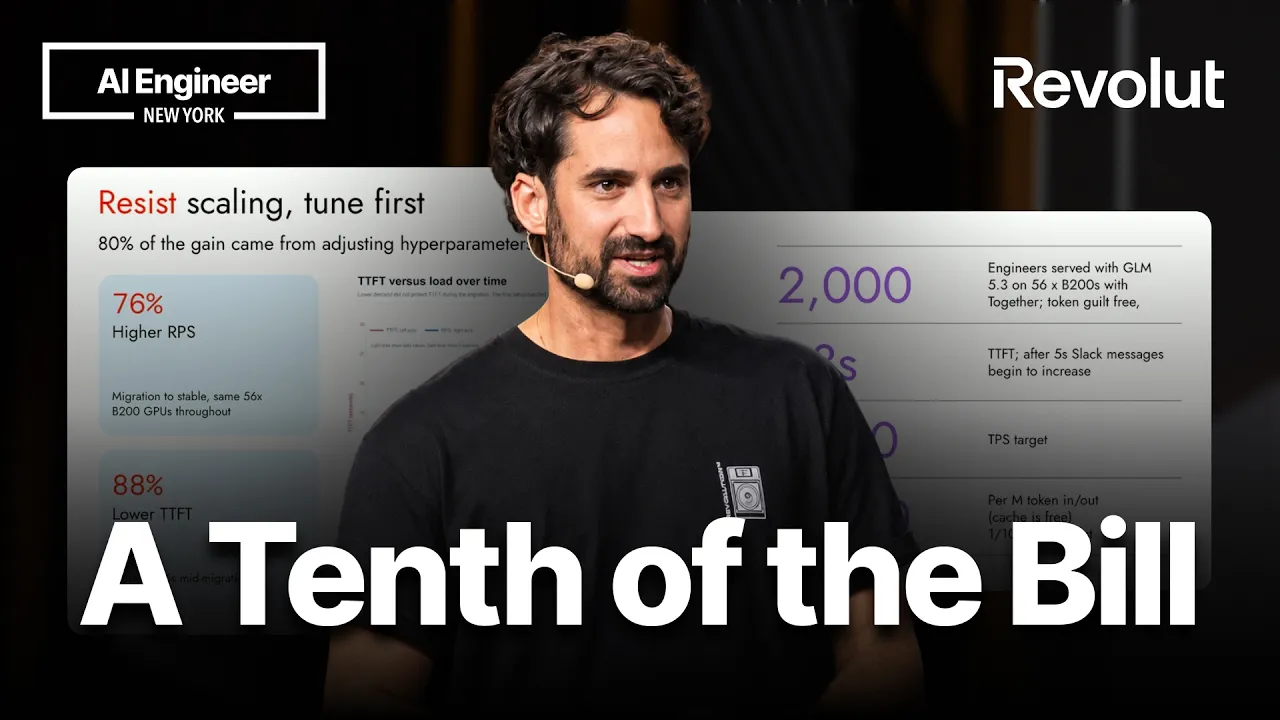
David Abitbol, who leads AI operations at Revolut, shares data from 2,000 engineers on what AI tools did to coding time and lead time, and why self-hosting open-source GLM models made the biggest difference: about 60-70% faster delivery at roughly a tenth of what they were paying frontier labs. He covers the GPUs needed, the latency targets that keep engineers happy, the tuning that made the same hardware 88% faster, and how an EU-regulated bank keeps it compliant. Chapters: 0:00 Intro 0:36 Who Revolut is 1:18 What AI did to 2,000 engineers' lead time 2:45 Why they started self-hosting 3:33 Coding isn't the bottleneck 4:24 What it takes to self-host GLM 5:46 Tuning: same GPUs, 88% faster 7:06 The parameters that matter 8:14 Production setup 9:23 For the CIO: compliance and safety David Abitbol https://www.revolut.com Join us in SF for the second annual AIE CODE summit: https://aie.codes our last flagship summit of 2026. Applications live now!
Summary
Generated by gpt-5.6-terraAt-a-Glance
- Verdict: Watch fully
- Core thesis: Revolut argues that carefully tuned self-hosted open coding models can deliver materially better engineering-flow outcomes at roughly one-tenth the API cost of frontier providers, provided the company treats inference performance, routing, sandboxing, and observability as first-class operations problems.
- Why it matters: This is a concrete enterprise case study for replacing the default "buy frontier-model API capacity" assumption with a hybrid control plane: cheap local open models for high-volume coding work and frontier models only for exceptions.
- Best use: Use it as a practical benchmark for evaluating a self-hosted coding-model stack, especially its latency targets, GPU-sizing logic, optimization priorities, model-routing design, and regulated-environment controls.
Executive Summary
David Abitbol, who leads AI operations at Revolut, presents self-hosted open models as an engineering-economics and developer-productivity play rather than a blanket rejection of Claude, Gemini, or OpenAI. Revolut, an EU-regulated digital bank with 80 million customers, moved from initial Gemini access to scaled use of "Cloud Code," then to self-hosted GLM for coding workloads after API use created high and unpredictable spend.
The central operational finding is that generous, effectively unconstrained access matters as much as model capability. Revolut reports that Gemini initially improved lead time by 10% and coding time by 20%, while its later self-hosted GLM deployment coincided with a 60% improvement in coding time and a 70% improvement in lead time. Abitbol interprets the larger lead-time gain as evidence that AI reduces coordination, documentation, inbox, and Jira overhead—not merely code-writing time.
Revolut claims its all-in self-hosted GLM cost is $0.30 per million tokens and that its invoice became one-tenth of prior Anthropic/OpenAI spending. Its operating model is hybrid: GLM handles the routine text-based coding workload locally, while Claude or Gemini remain exceptions for frontier capability and image-related tasks. The company exposes the local deployment through OpenAI-compatible streaming endpoints so existing developer tools and clients can use it.
The technical message is that GPU count alone is not the answer. On the same 56 B200 GPUs serving roughly 2,000 engineers, Revolut says it increased demand from roughly 3 to more than 7 requests per second while cutting time to first token from over 10 seconds to about 1.6 seconds. The proposed levers include context limits, FP4 quantization, tensor-parallelism choices, high cache-hit rates, and inference optimizations. For a regulated company, the corresponding controls are local hosting, human-in-the-loop sandboxes, restricted operations, data-residency discipline, and detailed telemetry.
Key Takeaways
- Claim: Self-hosting an open coding model can radically reduce AI coding cost while making usage predictable enough to remove developer token anxiety. | Evidence: Revolut reports an all-in cost of $0.30 per million tokens for self-hosted GLM and says its resulting invoice was one-tenth of what it had spent on Anthropic and OpenAI; Abitbol also says billing became flat rather than prone to monthly bill shock. | Implication: For high-volume internal coding use, a hybrid model portfolio may have a substantially lower total cost than routing all traffic to frontier APIs, especially when predictable capacity encourages broader usage. | Caveat: The economics are presented as Revolut-specific results and depend on sufficient utilization of dedicated GPU capacity plus the ability to operate the inference stack well.
- Claim: The strongest developer benefit is not limited to writing code faster; AI can reduce end-to-end feature lead time by absorbing engineering-adjacent work. | Evidence: In Revolut's sample of 2,000 engineers, Gemini was associated with a 10% lead-time improvement and 20% coding-time improvement; after its self-hosted GLM rollout, it reports 70% better lead time and 60% better coding time. Abitbol attributes the difference to reduced time spent on documentation, Stack Overflow, inboxes, Jira, and meetings. | Implication: Evaluate coding AI on workflow-level measures such as idea-to-merge lead time, not just code-generation speed or accepted suggestions. | Caveat: These are internal before/after operational figures, not a controlled causal study; rollout timing, workflow changes, and model evolution may also affect the measured outcomes.
- Claim: For interactive coding assistance, time to first token is the critical service-level objective, while extreme generation throughput is less important. | Evidence: Abitbol sets a target below three seconds for time to first token and says user complaints begin once it exceeds five seconds. Revolut serves about 200 tokens per second interactively, which he says is adequate because engineers now run tasks in parallel and return when work is complete. | Implication: Design capacity planning around perceived responsiveness and queueing at request start; do not overpay for maximum tokens-per-second if users primarily delegate longer tasks asynchronously. | Caveat: The stated latency threshold is empirical to Revolut's developer workflow and may vary by interface and task type.
- Claim: Inference tuning can unlock major capacity and latency gains without purchasing more GPUs, so scaling hardware should be a late—not first—response. | Evidence: Using the same 56 B200 GPUs, Revolut says it moved from roughly 3 requests per second with more than 10-second time to first token to more than 7 requests per second at around 1.6 seconds. The speaker describes this as an 88% performance improvement while demand rose 76%. | Implication: Before expanding a GPU fleet, establish an inference-optimization program with measured targets for queueing, cache behavior, parallelism, context size, and quantization. | Caveat: The presentation does not provide a reproducible configuration, workload distribution, concurrency profile, or full benchmark methodology.
- Claim: The recommended production architecture is a routed, OpenAI-compatible hybrid rather than a single-model standard. | Evidence: Revolut uses text-only GLM for its main coding workload, routes image-recognition needs to Gemini or Claude through a local router such as Open Code, and notes that GLM 5 Flash can cover vision use cases for some teams. Local endpoints provide response streaming and an OpenAI-compatible API for use inside existing tools. | Implication: Build an internal model gateway that normalizes tool integration while routing requests by modality, capability requirement, cost, data sensitivity, and latency target. | Caveat: A text-first local model introduces feature gaps, particularly for multimodal tasks, so routing quality and fallback policies become part of the product.
- Claim: Self-hosted open models can fit a regulated environment if autonomy and data-handling controls are explicit. | Evidence: Abitbol says Revolut obtains model weights and runs them on US-based infrastructure rather than calling a China-hosted dedicated endpoint. Its coding tasks remain human-in-the-loop, enforced through a sandbox that can permit or block specific operations; it also emphasizes approved data-residency regions, zero-retention infrastructure defaults, and strong OpenTelemetry logs. | Implication: Treat sandbox policy, human approval boundaries, audit logs, and deployment geography as core architecture requirements—not post-deployment compliance documentation. | Caveat: The statement that local hosting is "totally fine" is Revolut's operating interpretation, not universal legal or regulatory advice; model provenance, provider contracts, regional rules, and internal controls still require independent review.
Detailed Brief
Specific inference-tuning guidance
- Claims: Abitbol argues that long-context capacity should not be treated as automatically valuable for coding inference.; He recommends FP4 rather than higher precision on Blackwell-generation GPUs, subject to workload validation.; Tensor parallelism should be chosen around KV-cache needs and workload shape, not merely around the minimum configuration that fits model weights.
- Evidence: He says that although systems may support one million tokens of context, 256 is what is actually needed for the relevant workload.; He claims FP4 versus FP8 yields roughly 40% GPU-footprint savings with no precision loss.; For GLM, he says TP4 may fit the model but TP8 can work better when larger KV cache is needed.; He recommends maintaining cache-hit rates above 90% for coding workloads and examining speculative decoding, sequential prefill, and PDDzag.
- Caveats: The presentation uses prescriptive language such as "long context is a scam," but gives no task-level quality evaluation showing which coding tasks fail under the proposed context limit.; Quantization and parallelism trade-offs must be benchmarked against the target model, hardware, context distribution, and quality bar.
- Implications: A self-hosting evaluation should measure actual prompt-length distributions, cache-hit rate, KV-cache pressure, and quality regressions before adopting broad context or precision defaults.; The relevant optimization objective is cost-adjusted user experience under peak concurrency, not raw model-fit or isolated throughput benchmarks.
Developer behavior and capacity utilization
- Claims: Developer interaction has shifted from watching token streams to issuing multiple delegated tasks and checking back later.; Off-peak usage can expose substantially higher available throughput for users willing to work outside peak GPU demand.
- Evidence: At normal interactive service levels Revolut provides about 200 tokens per second; Abitbol says engineers connecting after 5 PM can see up to 800 tokens per second when GPU load is lower.
- Caveats: A system optimized for asynchronous parallel work may feel inadequate for pair-programming or highly iterative debugging that requires continuous real-time interaction.
- Implications: Capacity policies can distinguish interactive latency tiers from best-effort batch or agentic execution, increasing utilization without holding every workload to the most expensive latency target.
Notable Concepts & Terms
- Lead time: The speaker's preferred outcome metric: elapsed time from an engineer picking up a feature until it is merged and deployable, capturing coordination and process overhead beyond code writing.
- Time to first token (TTFT): The key interactive latency metric; Revolut targets under three seconds and sees five seconds as a practical user-satisfaction boundary.
- GLM: The open model family Revolut self-hosts as the main text-based coding model, positioning it as the economical default for high-volume work.
- FP4 quantization: A low-precision inference format the speaker recommends for Blackwell GPUs to reduce GPU footprint while claiming no meaningful loss of precision for this workload.
- Tensor parallelism (TP): A technique for splitting model inference across GPUs; Revolut's example stresses that KV-cache capacity can justify higher parallelism even when fewer GPUs can fit the weights.
- KV cache: Inference memory used to retain prior-token state; it materially affects context handling, concurrency, and the tensor-parallel configuration required for serving.
- OpenAI-compatible API: The compatibility layer that lets local model endpoints integrate with existing coding tools and clients without requiring each client to adopt a proprietary interface.
- Human-in-the-loop sandbox: A control model in which coding actions are bounded by allowed operations and human oversight, used to distinguish assisted coding from an autonomous agent in a regulated setting.
Operator Notes / Why Ken Should Care
- Run a build-versus-buy model using internal coding token volume, utilization assumptions, GPU and operations costs, and a frontier-model exception budget; compare it with current API spend rather than comparing per-token list prices alone.
- Define an internal coding-assistant SLO with TTFT as the primary interactive metric, a user-visible alert threshold near five seconds, and separate best-effort capacity for asynchronous task execution.
- Instrument the complete path from task pickup to merge before measuring value; segment coding time from documentation, ticketing, review, and coordination work to test the lead-time thesis.
- Prototype a model gateway with OpenAI-compatible streaming interfaces, explicit multimodal/fallback routing, and policy-based selection of local versus frontier models.
- Require a security and compliance design review before using open-weight models: weight provenance, hosting geography, retention commitments, operation-level sandbox policy, approval flows, and incident-grade telemetry should be verified rather than inferred.
Source/Metadata
- Title: How Revolut Cut AI Coding Costs 90% With Self-Hosted Open Models - David Abitbol, Revolut
- Transcript words: 1781
- Duration seconds: 707
- Timestamp note: No timestamps or chapters were present in the supplied transcript.
Transcript
Revolute Reviewer Reviewer Reviewer Reviewer Reviewer Reviewer My name is David. I lead AI operations at a company called Revolute. We have 15 minutes today together. We'll talk about high-performance engineering and self-hosting open-source models on dedicated GPU. How does that sound? Cool. So it's going to be a technical one, so bear with me. So maybe to start off, because I know this is the US and you may not know Revolute, quick words about our company. We're a digital bank in Europe. We have 80 million customers. We're live in 45 markets with the most downloaded financial app in Europe for the last year. And as of July, we're Europe's largest private company. So we're doing okay. The emphasis of Revolute is shipping a lot of product, and so there's a high focus on engineering culture and excellence on that demand. And so we'll talk about that. So let's talk about some AI. We have a chart here. I'm going to see two lines. This is a sample of 2,000 engineers' performance over the last year. So the green line is going to be lead time. So it's going to be when an engineer picks up a feature until a feature is merged and ready to be deployed. The blue line is going to be coding time. So the green line is in days. The blue line is in hours. Just to reset the timeline in case people forget because AI moves really fast. Cloud Code came out around February 2025. And that's the Cloud Code Sonnet 3.7, the one that would delete your production database. Not the safe Cloud Code that we have today. So bear in mind when we talk about adoption. So what you see on this chart is January 25, first introduced AI in the company. Gemini. First time people were able to use private data within AI. Around February, we started playing around with Cloud Code. And then January is when we first launched Cloud Code at scale. What you see is Gemini had 10% improvement in lead time, 20% improvement in coding time, so that people no longer need to look at Stack Overflow and reading documentation. But then Cloud Code, not so much impact at the time. So when we launched it, we were highly skeptical about the cost of AI. We were seeing engineers spend $1,000 a month, $10,000 a month with not so much ROI. And so when we launched it, we launched it with strict budget limits. And so we're looking at the next thing. So how can we provide limited tokens to our engineers so they can use AI guilt-free for a fraction of the cost? And so we looked into open source. So around April 26 is when we started self-hosting open source models. We're a big fan of GLM for coding. So around that time, what you see, April 26, GLM 5.1, we see 60% improvement in coding time, 70% improvement in lead time. So dramatic impact. What do we learn from this? Well, there's more impact on the lead time than on the coding time. So what we find is the bottleneck for engineering is not necessarily coding. You can save a lot of time not having to dig through your inbox or messing with Jira and meetings. And so when you have unlimited tokens, you're free to do that. You no longer have to save your tokens for the end of the quarter or the most difficult task. So where do we stand? Well, open source is now a priority at Revolute. So we have a lot of results. New economics are favorable. The billing is flat. We don't have any bill shock any month. And the frontier is the exception. So obviously we keep using Claude and Cloud Code. The latest models are fantastic. Gemini is very good as well. But we keep them as exception. So how do we get there? Some metrics that matter when you're self-hosting models. So to serve 2,000 engineers, we roughly need 56 B200. And that's to host GLM 53. GLM is a big model. 8 million parameters. What you want to aim for is sub-3 second time-to-first token. This is empirical evidence. As soon as you exceed five seconds, my Slack inbox starts to blow up. And so we know that's the limit. In terms of throughput, it doesn't really matter as much. So we serve, in terms of interactivity, 200 tokens per second. People are fine. You don't need to go higher. The way people work has changed. We no longer look at the stream of thinking tokens. People run tasks in parallel and check in when the task is done. But if you're in a high throughput and you're an engineer at Revolute, you just connect after 5 PM when load is on GPU, and you can get 800 TPS. That's a dream. In terms of cost, in terms of impact, self-hosting GLM, all-blended cost of tokens is 30 cents per million. And so our invoice is one-tenth of what we were spending on Anthropic and OpenAI. So there's a lot of tuning that goes into running open-source models. If you just get GPUs and upload weights on a GPU, and you start doing inference, you're going to get terrible performance. It's because your workload is going to be very dependent on the parameters that you set. So if you look all the way to the left of that chart, the blue line is going to be demand. So that's requests per second. That's going to be what's going to be the bottleneck for your latency on your GPUs. And the red line is what we're optimizing for. That's the time to first token. So when we started back in April, you could see requests per second around 3, which is high but not so high. And time to first token over 10 seconds, which is very slow. All of the data that you see is the same number of GPUs. We didn't increase GPU count. We still have 56. And by the end, you see in August, requests per second, we're over 7, and time to first token, we're around 1.6. So we've had 88% improvement in performance for 76% increased demand. So the learning from this is there's a lot of parameters that you can improve on, and you really need to resist scaling if you're looking to self-host a model. So let's talk parameters. There's no secret recipe, but the things you could consider are the following. First one, long context is a scam. You really need to be mindful that even though you can serve one million tokens, 256 is really what you need. Quantization, if you're running Blackwell generation GPU, you don't want to run anything higher than FP4. And FP4 is best. Roughly going from FP4 to FP8 is a 40% saving in GPU footprint for zero loss in precision. Other parameters to consider: tensor parallelism. Even though GLM fits on TP4, you don't have enough KV cache, and so maybe TP8 works better, depending on how large your workload is. And then on the more esoteric side, check your cache hit. Coding tests need to be above 90% cache hit. And you can look into optimize, spec decoding, sequential pre-fill, PDDzag, all of these. Cool. So now let's talk about production setup. GLM obviously is a text-only model, which is a limitation for some people. The trade-off I would say we would make every time is get the smarter model and figure out how to do image recognition another way. You can easily have a local router. Open Code is one. You would route any image recognition to Gemini or Claude, and keep GLM for the main task. If you really need a vision model, GLM 5 Flash works really well. We have our UI designer making great use of it. Turnaround for UI product has improved a really long way. And then the last one is going to be about the harness. So all of these endpoints are going to be OpenAI compatible API with response streaming, and so you can use them inside Open Code, Claude, etc. as well. Works really well. And so that's what we recommend. And then the last message, and this one is for the CIO in the room. There's been a lot of stigma in using Chinese open source models. So the thing to consider is, you're not using the inference dedicated endpoint that goes to China. You're just getting the weights and putting them on a US-based service. So from data sharing side, this is totally fine. Revolute in particular, because we're an EU regulated bank, we fall under the most strict regime in terms of compliance. And so what we find that works is, all of these coding tasks are not considered autonomous agents. They're always with a human in the loop. And so how do you give reassurance that you have a human in the loop? You start by creating a sandbox that guarantees that. And the sandbox means, now if you've used Code Code, it has all of these features of "approve for me." You just have to set the rules for the operations that you don't want to allow. So you can allow grep but not gradle, for instance. And that's going to give confidence to your regulator that it's not an autonomous agent that needs different supervision. The sandbox also protects you from rogue use. You may have bad actors inside your company and you want to shield for that. You'd be surprised what you find in a large company. And then the last one is prompt injection. Not so much a thing now given how smart models are, but always a thing. In terms of data privacy, we spoke about it. So as long as the data sits in one of the countries that are in the data equivalency framework, so US, EU, UK, Israel, you're fine. You can get your GPUs there. All of your inference providers or GPU providers are going to have zero data retention by default. And then the last thing you need is very strong open telemetry, so that if you ever have an incident, you need to be able to go deep and look at the logs. Also gives you some analytics. All right. Thanks, everyone. That was all for my talk. Thank you. Thank you. Thank you. Thanks, everyone. Thanks, everyone.