How to Generate Mergeable Code with a Context Engine — Peter Werry, Unblocked
Description
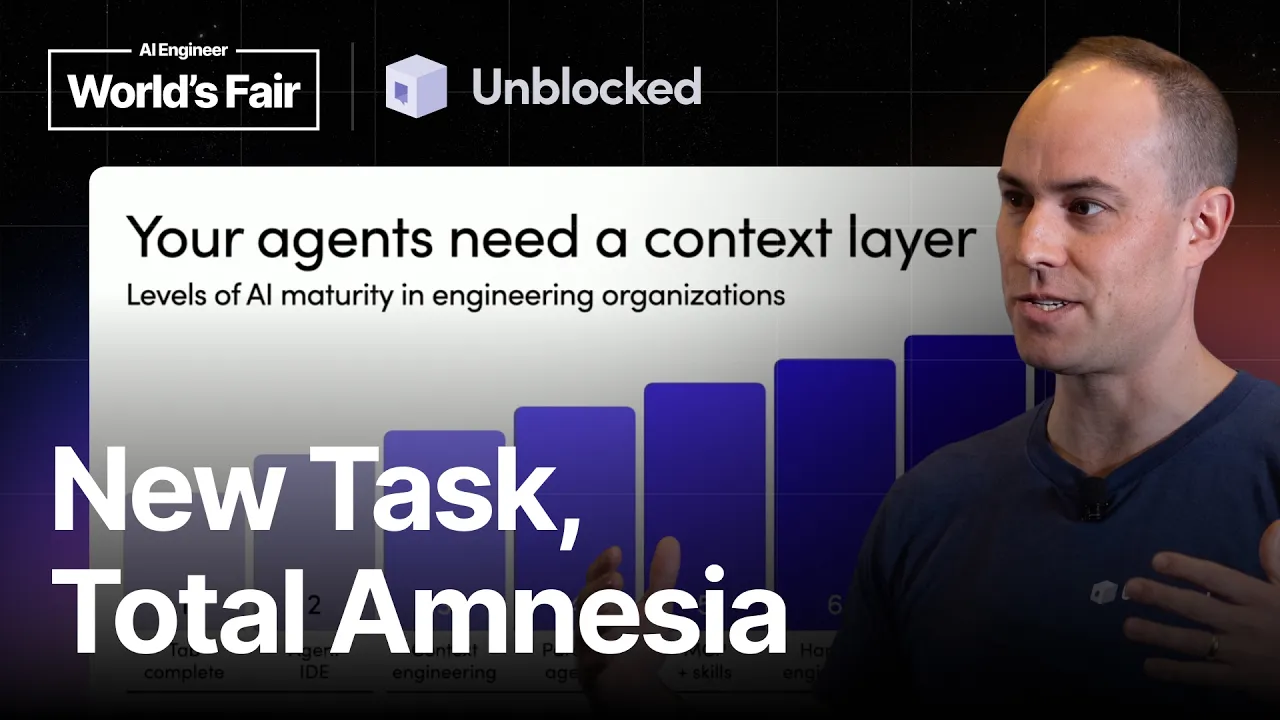
Radiologists call the failure satisfaction of search: you read a scan, find one indicator, stop looking, and miss the others that would have changed the diagnosis. Peter Werry says agents do exactly this to a codebase. Attach a wiki and an agent will search it, land on something plausible, and quit, which is why he argues access to information is not understanding. Before agents you were the context layer, trawling discussions, reading code, carrying the tribal knowledge yourself. An agent is closer to an expert engineer on their first day, rediscovering how you build, test, and deploy on every task, then forgetting it. A million token window does not fix it: the context does not fit, and the agent gets distracted. He demos the alternative on Unblocked's own repository, where a question about an internal component returns an architecture diagram that did not exist before, sources attached so a human can check it. Then the same optimization plan twice in Claude Code, with the context engine and without. With it, under a dollar and about a minute; without, roughly double the time and more cost, because the agent has to discover things and discovers the wrong ones, so later steps run on bad assumptions and loop. The compounding is the point, not the first task. He closes on a review agent that boosts comments by reviewer seniority, a drop in flagged issues traced back to the Slack thread that explained it, and two open source pieces: a query engine over your GitHub history and a social graph showing thin review coverage. Speaker info: - https://getunblocked.com Timestamps: 0:00 - Before agents, you were the context layer 1:46 - An agent is a new employee who resets every task 2:25 - The maturity curve: autocomplete to software factories 4:19 - Satisfaction of search, borrowed from radiology 6:37 - The iceberg: intent, conventions, past decisions 7:29 - Demo: asking about a component, and showing the work 10:03 - The same plan with and without a context engine 12:44
Summary
Generated by gpt-5.6-terraAt-a-Glance
- Verdict: Watch fully
- Core thesis: Reliable, mergeable agent-generated code requires a context engine that retrieves and synthesizes task-relevant organizational knowledge—code, PR history, Slack decisions, architecture rationale, conventions, and expertise—rather than merely exposing a wiki or repository search.
- Why it matters: This is directly relevant to building agent control planes: poor context does not just increase token cost, it compounds into wrong plans, repeated loops, weak reviews, and changes that conflict with prior engineering intent.
- Best use: Use it as a product and architecture pattern for a persistent organizational-memory layer around coding agents, then evaluate which parts should be implemented as retrieval, provenance, policy, expertise routing, and review feedback loops.
Executive Summary
Peter Werry frames organizational context as the central bottleneck between coding assistants and autonomous software delivery. Human engineers accumulate context through code exploration, incident response, PRs, Slack discussions, and architectural decisions; agents effectively begin as a newly onboarded engineer on every task. The missing information is not just source code, but hidden intent: why prior choices were made, team conventions, dependency relationships, historical exceptions, and future plans.
His central distinction is between access and understanding. Giving an agent an MCP connection, a wiki, a CLAUDE.md file, or even a very large context window does not ensure it finds the relevant evidence or connects it correctly. Agents can stop after finding a plausible answer—a failure mode he calls "satisfaction of search"—or become distracted by overly broad context. A context engine should therefore assemble a focused, task-specific evidence set and make its sources visible so people and downstream agents can inspect and extend the reasoning.
The Unblocked demo compares Claude Code planning an optimization from the codebase alone versus planning with retrieved PR discussions, Slack conversations, Notion material, and architecture documents. The context-assisted run reportedly took about one minute and cost under a dollar, versus roughly two minutes and higher cost without it. Werry argues the larger benefit is avoiding compounding rework when an initially plausible plan rests on incomplete or incorrect assumptions.
The talk extends the pattern into code review and operations: mine historical PR comments into codebase-specific best practices, weight guidance by demonstrated seniority or expertise, map reviewer relationships through an engineering social graph, and let a cloud agent trace a production-quality issue back through prior Slack discussion before proposing a PR. The presentation is product-led rather than a technical implementation walkthrough, but it offers a clear blueprint for persistent context, provenance, and organizational-learning layers around developer agents.
Key Takeaways
- Claim: Agents need durable organizational context because they repeatedly behave like newly hired engineers, rediscovering how the codebase, tests, deployment process, and team practices work for each task. | Evidence: Werry contrasts human engineers' accumulated "battle scars" from incidents, code changes, architecture work, and discussions with agents that reset their working knowledge when a new task starts. | Implication: Treat context acquisition as shared infrastructure rather than making each agent task independently search the repository and documentation.
- Claim: Repository access and documentation search are insufficient because agents can find one plausible fact and prematurely stop, without discovering related constraints or intent. | Evidence: Werry borrows the radiology term "satisfaction of search": after finding one possible indicator in an X-ray, a reviewer may miss others; he says agents similarly stop after locating something that appears correct. | Implication: Agent workflows should explicitly retrieve across multiple organizational evidence types and preserve links to the evidence, rather than trusting the first code or wiki match. | Caveat: The talk identifies the failure mode but does not specify retrieval-evaluation metrics or a concrete method for proving that the engine consistently finds all material evidence.
- Claim: More context is not automatically better; dumping the entire codebase and document set into a large context window creates distraction, token waste, and weaker task focus. | Evidence: Werry argues that even a one-million-token window cannot practically contain all organizational context and says irrelevant material sends the agent "this way and that way" rather than keeping it on the task. | Implication: A context layer should optimize for relevance, scoping, and progressive drill-down—not maximum raw context-window utilization.
- Claim: The practical value of a context engine is compounding execution quality, not merely lower cost on an isolated prompt. | Evidence: In a demo involving an optimization plan for Unblocked's "source mark calculator," a Claude Code run with Unblocked used PRs, Slack, Notion, and architecture documents; Werry reports it took about one minute and cost under one dollar, compared with about two minutes and a higher cost without it. | Implication: Measure context systems by avoided replanning, fewer invalid assumptions, reduced review churn, and downstream task success—not only token savings or first-pass latency. | Caveat: This is a vendor-controlled internal demo, not a controlled benchmark; the transcript provides no exact baseline dollar amount, task distribution, or independent quality measurement.
- Claim: Provenance is a core trust and control feature: context answers should show their work so humans and agents can verify, correct, and follow the supporting sources. | Evidence: The demo generated an architecture explanation and diagram for the internal "source mark engine," then exposed the underlying sources; Werry says those sources are returned to Claude so it can jump directly to them when more detail is needed. | Implication: Require cited context packets and source-level traceability before allowing agents to make consequential code changes or before asking humans to approve their PRs.
- Claim: Code review quality can be made codebase-specific by synthesizing historical PR behavior and prioritizing feedback from recognized experts. | Evidence: Unblocked analyzes pull-request data to generate best practices for its review agent. A comment attributed to senior engineer Richie was surfaced because he had made that comment previously; the system uses seniority or expertise as a signal to boost important guidance. | Implication: Build review agents around versioned team conventions with expertise and recency signals, while retaining a mechanism for owners to override or retire inferred rules. | Caveat: Historical reviewer behavior can encode outdated conventions or individual preferences, and the talk does not describe recency controls, disagreement handling, or governance for changing standards.
- Claim: An engineering social graph can provide both expertise routing and risk visibility by modeling who reviews which code and where expert coverage is thin. | Evidence: Werry describes graphing team clusters and code-review relationships, generating team labels, showing codebase coverage, and identifying areas lacking expert coverage; Unblocked uses this information within its context engine. | Implication: Use contribution and review relationships to route agent questions, request human approval, and flag ownership gaps before agents modify poorly covered systems.
Detailed Brief
Context engine capabilities demonstrated
- Claims: The same organizational context layer serves both humans and agents; the human accountability layer remains necessary because a person still merges the PR.; A context engine can operate inside collaboration surfaces such as Slack, replying when it has sufficiently high confidence or when directly invoked.; A cloud-hosted agent with organizational context can diagnose a change in review behavior and generate a related fix PR.
- Evidence: The system answered a human question about the source mark engine and generated an architecture diagram from current code plus future-architecture proposals.; In Slack, Unblocked could proactively chime in or be directly addressed for an answer.; When the volume of surfaced code-review issues dropped, Richie used Unblocked to investigate; the agent connected the behavior to a switch to "Cloud for eight" and linked the underlying Slack conversation in the resulting PR context.
- Caveats: The cloud-agent repair capability is described as an internal experiment.; The transcript does not detail authorization boundaries, data-access controls, merge permissions, or safeguards for an agent operating across code, chat, and PR systems.
- Implications: The highest-value design is not a standalone chatbot but an embedded context service callable from IDE, chat, review, and cloud-agent workflows.; Cross-system read access and evidence linkage raise the value of context, but they also make identity, least privilege, audit trails, and approval gates first-class design requirements.
Open-source and evaluation entry points
- Claims: Unblocked offers a document query engine that turns GitHub repository and historical PR material into a queryable schema for agent chat.; Its context engine simulator performs a per-task comparison between a task run with constructed context and one without context.
- Evidence: The document query engine ingests historical pull requests, samples documents, synthesizes a schema, and supports questions through agent chat.; Werry closes with a customer quote claiming "50% fewer tokens, faster triage, better answers."
- Caveats: The customer quote and simulator description do not establish generalizable performance results across repositories, models, or task types.
- Implications: A useful evaluation harness should compare context strategies on the same task and score mergeability, factual grounding, review findings, latency, token use, and human correction effort.
Notable Concepts & Terms
- Context engine: A persistent system that delivers task-relevant organizational knowledge to humans and agents, rather than leaving each task to rediscover it.
- Organizational context: The hidden operating knowledge beyond code: engineering intent, team conventions, historical decisions, Slack discussion, architecture rationale, PR history, expertise, and future plans.
- Satisfaction of search: A search failure mode in which an agent finds one plausible answer and stops before locating other relevant evidence or constraints.
- Unknown unknowns: Material facts the agent does not know it should search for; the talk treats finding these as a key context-engine objective.
- Source mark engine / source mark calculator: Unblocked's internal demo component used to show that richer context changes an agent's optimization plan.
- Engineering social graph: A model of developer clusters and code-review relationships used to infer expertise, team structure, ownership coverage, and gaps.
- Document query engine: An open-source Unblocked project that ingests GitHub and historical PR material, synthesizes a schema, and enables agent-based querying.
- Context engine simulator: A tool that compares task execution with per-task constructed context versus without it, intended to demonstrate context impact.
Operator Notes / Why Ken Should Care
- Define a context-packet contract for coding agents: task scope, relevant code paths, prior PRs, decision records, operational history, conventions, source citations, and explicit uncertainty.
- Instrument agent workflows to detect premature retrieval stopping: require multiple evidence categories for high-impact changes and log which sources were considered versus omitted.
- Evaluate context systems on compounding outcomes—replans, failed tests, review iterations, reverted changes, escalation rate, and merge success—alongside token and latency metrics.
- Create governance for inferred code-review rules: attach rule provenance, owner, recency, confidence, and expiration/override controls before using them to block or rank PRs.
- If deploying cross-system agents, separate read retrieval from write authority and require auditable approval gates for PR creation, review comments, and any production-facing action.
- Consider using reviewer/contributor graph data to identify single-expert modules and proactively assign human ownership or verification requirements before delegating changes to agents.
Source/Metadata
- Title: How to Generate Mergeable Code with a Context Engine — Peter Werry, Unblocked
- Transcript words: 4903
- Duration seconds: 1115
- Timestamp note: No timestamps or chapters were present. The latter portion of the supplied transcript substantially repeats earlier content.
Transcript
What we do at UnBlock is we build a context engine. I just want to do a quick sound check at the back to make sure everyone can hear me fine. Can you guys, yeah, we're good? Awesome. So at a high level, a context engine delivers organizational context to both your human workers and now increasingly your agents. So why is that important? Before we go too deep on the mechanics of how our context engine works, I just want to talk briefly about the problem. So what we're going to do is we're going to hop into our time machines and we're going to travel back to the before times, before agents, and discuss a little bit about what we used to do as humans before agents came into the picture. And so for years, you were the context layer. You had to go and do things like this. You had to find things you were looking for, trawl all over different data sources, different discussions taking place, and then through the code base, of course, to try to build up tribal knowledge. And throughout time, as your code base progressed, you'd be fighting incidents and things like that. And your organization over time builds up battle scars from all these different things: building code, documenting architecture, and dealing with outages and things like that. But now we have a new problem because, as we introduce agents to the picture, they suffer from all of these challenges except for one thing. Agents are like new employees. They reset their knowledge every time you start a new task. Okay? And so you can think of an agent like an expert software engineer who's a new employee onboarding for the first time every time. They have to rediscover your code base, how your organization builds tests, and how they deploy software with each and every task. Can I just put a show of hands for everyone that's seen this slide before by the seam? So this is a good way to view where people are on what we call the AI maturity curve. Starting at the far left, this is representative of autocomplete back in the GPT-3.5 days. You remember Copilot and things like that. And then move on to using Cursor. And then from there, you're talking about how you can start to solve the context problems. So some people are building organizational wikis. Just smile if this is bringing up memories for you. And all these things are great, except how do you give agents access to this? And what are the compounding problems, the scaling problems, as you move forward? Well, if you give MCP and skills to your agents to teach them how to navigate and build context, that's where people are today, most people. They're at the stage four to five level, okay? And they understand that context is the bottleneck. And they're trying to build solutions to solve it for their engineering teams. So looking ahead all the way to eight with software factories, this is where the puck is going. I'm not sure if folks were at the keynote this morning, but it's all about delivery of context and unknown unknowns. And this becomes increasingly important as people start thinking about full automation of agents. They just can't operate without organizational context. They get lost. So that's the real problem. Access to information doesn't equal understanding. I know that folks are probably familiar with Claude.md and wiki layouts and all these things. If you attach a wiki, it still doesn't tell the agent where the information is that it needs. It can search for things in the wiki. But then what happens is it'll suffer from something that radiologists call satisfaction of search. So this is a term in radiology where you look at an x-ray and you're trying to find a region that might be an indicator for cancer, okay? And you discover one indicator. And if you stop there, you might miss other important indicators that might lead to diagnoses of even more issues. So this is what happens with agents. They find something that they think is correct, and then they stop. The other thing about agents is that they don't distill understanding. They can look around, they can find information, but they don't understand how all the pieces fit together. Because without doing that legwork ahead of time, they don't understand how your dependencies interact with each other and how your architecture and future planning is going to scope the work that it does next. And so some people will then ask, well, what if we just take the entire code base and all of our architecture documents and just slam it into the context window? And then yes, maybe your agents will reason about everything all at once. And in practice that, of course, doesn't work. Not just because you've got way more organizational context than can fit into a context window, even one that's a million tokens in size, but because it causes the agent to get distracted. When you're working on a task, you want task-specific flow. And so your agent is going to get distracted easily if you give them things that cause them to look this way and that way. And it'll just waste tokens and time. So in this morning's keynote, Tariq from Cloud Code mentioned unknown unknowns. I just want to harp on that phrase again. And it can be phrased a different way, which is finding the things that really matter. And so this is what your agent can see at the top of the iceberg. They can see the code and they can operate on the code. What they don't see are things like the actual intent, the team conventions, past decisions, things that you've discussed in Slack, for example, architecture rationale, and so on. And that's why your agents need a context engine to get real work done. So I'm going to now attempt a live demo, and hopefully the demo gods are kind. So I want to pop back up conceptually. Oops, I think I'm on the wrong tab. We'll get to that one in a sec. So for now, sorry about that. And here we are. So I'm going to ask a question as if I'm a human and I want to get some information about my code base. And the human layer hasn't gone away. We talk about agents and their need for context, but humans are still asking questions about the code base. And we need that level of understanding because ultimately the accountability stops with us. When you hit merge on a PR, you need to understand what it's doing and you need to understand how the architecture works. So this question I asked here is about an internal component of our system called the source mark engine. And you can see that it is able to articulate it fairly well, understands the architecture. This diagram here is generated. So this diagram doesn't exist. It just figures it out based on the way the code operates today and then some proposals for future architecture. And then what's really important is that you show your work. This is a trust-building thing more than anything, but it allows people to see if the answer is maybe not entirely correct, then you can look into the knowledge base that you have and make corrections. Increasingly, agents are doing this for you. So now, what I want to show you is another place where humans spend their time, which is in Slack. And this is where a lot of the decisions get made, of course. So I can do something like this, and Unblocked will sit and listen for things that it thinks it can chime in on when it provides a high degree of—oh, sorry. We went to the wrong—You guys can't see that. Thank you, Claire. Oh, come on down. Let's see if I can bring it up. There we go. Perfect. So I can ask questions like this, and Unblocked, if it thinks it can chime in on the answer, then it will chime in. Otherwise, I can just address Unblocked directly and ask the same question. And when it thinks that it has an answer to give, then it will give an answer. And so we can get quite a bit of interesting content there from Unblocked. Thank you, Unblocked. I'm going to switch up and show you the really interesting thing, which is the agents. Okay. So in that question, the source mark engine, I'm not sure if people picked up, but there was a little thing at the bottom there that said there's some optimization opportunities. So what I did here is I went into clock code and I asked it, without using Unblocked, to generate a plan to optimize the source mark calculator. And it did that. And it happily went and searched through the code and tried to figure out how the algorithm works and so on. And it reached a conclusion. That's great. It does a pretty good job. But it maybe could do a little bit better. So I asked that question again using Unblocked this time. And it really nails the nuances because it picks up on the PRs where we discussed future possibilities for improvement, some Slack conversations that we had, and, of course, Notion and architecture documents. And it shows its work. And this is really important because all of these things here, the sources, come back to Claude, and then Claude knows exactly where to jump to next if it needs to elaborate on that context. And so I just want to show you what the impact of that is. So if I—whoops. Thank you. If I pull up usage here, you can see that with Unblocked, the total cost was sub-dollar to create the plan and took about a minute. Ignore the wall clock time because I've had this open for about an hour. But it's about a minute. And then if I look at the usage without Unblocked, you can see that it's about two minutes. And it costs more to generate all that context. Now the reason that happens is because it has to do more work. It has to look around. It has to discover things. And this compounds. Not only does it have to do more work to discover things, it doesn't discover the right things. So when you get further down in your execution, it may be operating on the wrong plan or the wrong assumptions. And then you have to go back and you have to loop over and over again. So the real value of a context engine is not the upfront cost on these short tasks. It's the compounding effect. The other Tariq from Sonar mentioned this in the keynote this morning. And it's true. The loops compound. And you have to be efficient the entire way through with your context. I'm just going to jump back to Safari, and I'm going to point out some really interesting things. So we also have a code review agent. And when we say organizational context, we're talking about more than just the underlying data. We're talking about real intelligence. So what Unblock does is it looks at pull request data, and there are other data sources for this, and it generates a series of best practices that help align agents to your code base. But we thought that this would be really helpful to surface for the review agent as well. So what you can see here is Unblock chimed in. And then Richie here said, oh, that's cool. That's something I would say. And that's because that actually was something he said. So it surfaced the previous comments. Richie's one of the senior engineers, and we use seniority or expertise as a signal to boost comments that are important, okay? So another interesting interaction by Richie: he discovered that the number of code review issues that were being surfaced dropped precipitously. And he was debugging it with Unblocked. He got all the way to the bottom and realized roughly what the problem was, and then asked Unblocked to fix it. Now this is something that we have internally that we're experimenting with. So Unblocked can run as an agent in the cloud. But what's really cool about this is that it has all your organizational context at its fingertips. And the results are pretty magical. So it can do things like generate this PR. And then what you'll see here is that not only does it generate the fix, it also is able to relate it to all the conversations that were happening. So this PR was created because—and you read that context thing—it's mind-blowing. After this PR, we switched to Cloud for eight, and it dropped a ton in issues because the behavior is quite a bit different. So then it said Richie directly correlated the drop. Now what's this thing here? Let's click on it. It is a Slack conversation. So it found the Slack conversation, correlated all of that past history back again, and then we ended up with a final PR. So I've got only a few minutes left. I'm just going to close this out really quickly. We have a couple of open source projects that are interesting if people want to play with them. One is the document query engine. That was something that I talked about on Monday in my workshop. I may talk about it again tomorrow, but I just want to give folks a sense of what this thing does. Whoops. If you want to play with it, it's open source. So you can just download it and have a go. It basically runs over your GitHub repository, ingests your historical pull requests, and then synthesizes a schema based on the documents that it can sample. And then from there, you can issue any kind of queries that you like and get all kinds of insights out of it through the agent chat. You can ask all kinds of questions. And then lastly, the engineering social graph. So this is the thing that I was talking about earlier that helps us pin down expertise and team relationships. So what you can see here is the rough breakdown of our team structure at Unblocked. As you can see, we're a fairly small team. And so we've got these clusters of people, and how they relate to each other indicates the kind of review relationships that they have. So these lines show we review each other's code. We can then cluster that and generate team labels for that or show the coverage across your code base. This is really cool. You can see where the holes are, where you might be lacking expert coverage. And that's exactly what we use within the context engine itself. All right. One last thing. For those that want a taste of what a context engine can do but don't want to sign up for Unblocked right away, you can use something that we call the context engine simulator, which will basically build up context behind the scenes on a per-task basis and then use that context to drive the task. It'll do it with context and without context so that you can see what the differences might be. This is a QR code for that if you want to just take a quick snap. Awesome. And I'll just land on a quote from one of our customers: 50% fewer tokens, faster triage, better answers. And that's exactly what a context engine can do. One last shout-out before we end. My colleague Brandon is giving a talk in 10 minutes in room 2020. He's going to speak in a lot more detail about some of the higher-level things that context engines can do. I'm going to run over there right after this, and I think all of you should follow me. Awesome. Oh, and don't forget to get a coconut. it still doesn't tell the agent where the information is that it needs. It can search for things in the wiki. But then what happens is it'll suffer from something that radiologists call satisfaction of search. So this is a term in radiology where you look at an x-ray and you're trying to find a region that might be an indicator for cancer, okay? And you discover like one indicator. And if you stop there, you might miss other important indicators that might, you know, lead to diagnoses of even more issues. So this is what happens with agents. They find something that they think is correct and then they stop. The other thing about agents is that they don't distill understanding. They can look around, they can find information, but they don't understand how all the pieces fit together. Because without doing that legwork ahead of time, they don't understand how, you know, your dependencies interact with each other and how your architecture and sort of future planning is going to scope the work that it does next. And so some people will then ask, well, what if we just take the entire code base and all of our architecture documents and just slam it into the context window? And then yes, maybe like your agents will reason about everything all at once. And in practice that, of course, doesn't work. Not just because you've got way more organizational context than can fit into a context window, even one that's a million tokens in size. But it causes the agent to get distracted. When you're working on a task, you want task specific flow. And so your agent is going to get distracted easily if you give them things that cause them to look this way and that way. And it'll just waste tokens and time. So in this morning's keynote, Tariq from Cloud Code mentioned unknown unknowns. I just want to harp on that phrase again. And it can be phrased a different way, which is finding the things that really matter. And so this is what your agent can see at the top of the iceberg. They can see the code and they can operate on the code. What they don't see are things like the actual intent, the team conventions, past decisions, things that you've discussed in Slack, for example, architecture rationale and so on. And that's why your agents need a context engine to get real work done. So I'm going to now attempt a live demo and hopefully the demo gods are kind. So I want to pop back up conceptually. Oops, I think I'm on the wrong tab. We'll get to that one in a sec. So for now, sorry about that. And here we are. So I'm going to ask a question as if I'm a, you know, I'm a human and I want to get some information about my code base. And, you know, the human layer hasn't gone away. We talk about agents and their need for context, but humans are still asking questions about the code base. And we need that level of understanding because ultimately the accountability stops with us. When you hit merge on a PR, you need to understand what it's doing and you need to understand how the architecture works. So this question I asked here is about an internal component of our system called the source mark engine. And you can see that it is able to articulate it fairly well, understands the architecture. This, this diagram here is, is generated. So it, this diagram doesn't exist. It just figures it out based on the, the way the code operates today and then some proposals for future architecture. And then what's really important is that you show your work. This is a trust building thing more than anything, but it allows people to see if, if the answer is maybe not entirely correct, then you can look into the, the knowledge base that you have and make corrections. Increasingly agents are doing this for you. So now, what I want to show you is another place where humans spend their time, which is in Slack. And this is where a lot of the decisions get made, of course. So I can do something like this and unblocked will sit and kind of listen for things that it thinks that can chime in on when it provides a high degree of, Oh, sorry. We went to the wrong. You guys can't see that. Thank you, Claire. Oh, come on down. Let's see if I can bring it up. There we go. Perfect. So I can ask questions like this and unblocked and if it thinks it can chime in on the answer, then it will chime in. Otherwise I can just address unblocked directly and ask the same question. And when it thinks that it has an answer to give, then it will give an answer. And so we can get quite a bit of interesting content there from unblocked. Thank you, unblocked. I'm going to switch up and show you the really interesting thing, which is the agents. Okay. So in that question, the source mark engine, I'm not sure if people picked up, but there was a little thing at the bottom there that said, you know, there's some optimization opportunities. So what I did here is I went into clock code and I asked it without using unblocked to generate a plan to optimize the source mark calculator. And it did that. And it happily went and, you know, searched through the code and tried to figure out how the algorithm works and so on. And it reached a conclusion. That's great. You know, it does a pretty good job. But, you know, it maybe could do a little bit better. So I asked that question again using unblocked this time. And it really kind of nails the nuances because it picks up on the PRs that we, where we discussed future possibilities for improvement. Some Slack conversations that we had. And of course, you know, notion and architecture documents. And it shows its work. And this is really important because all of these things here, the sources come back to Claude and then Claude knows exactly where to jump to next. If it needs to elaborate on that context. And so I just want to show you what the impact of that is. So if I, whoops. Thank you. If I pull up usage here, you can see that with unblocked, the total cost was, you know, sub dollar to create the plan. And took about a minute, ignore the wall clock time because I've had this open for about an hour. But it's about a minute. And then if I look at the usage without unblocked, you can see that it's about two minutes. And it costs more to generate all that context. Now the reason that happens is because it has to do more work. It has to look around. It has to discover things. And this compounds. Not only does it have to do more work to discover things, it doesn't discover the right things. So when you get further down in your execution, it may be operating on the wrong plan or the wrong assumptions. And then you have to go back and you have to loop over and over again. So the real value of a context engine is not like the upfront cost on these short tasks. It's the compounding effect. The other Tariq from Sonar mentioned this in the keynote this morning. And it's true. Like the loops compound. And you have to be like efficient the entire way through with your context. I'm just going to jump back to Safari. And I'm going to point out some really interesting things. So we also have a code review agent. And when we say, you know, organizational context, we're talking about more than just the underlying data. We're talking about real intelligence. So what Unblock does is it looks at not like it looks at pull request data. And there are other data sources for this. And it generates a series of best practices that help align agents to your code base. But we thought that this would be really helpful to surface for the review agent as well. So what you can see here is it Unblock chimed in. And then Richie here said, oh, that's cool. That's something I would say. And that's because that actually was something he said. So it surfaced the previous comments. Richie's one of the senior engineers. And we use the sort of seniority or expertise as a signal to boost comments that are important. Okay. So another interesting interaction by Richie. He discovered that the number of code review issues that were being surfaced dropped precipitously. And he was debugging it with Unblocked. He got all the way to the bottom and realized roughly what the problem was. And then asked Unblocked to fix it. Now this is something that we have internally. You know, that we're experimenting with. So Unblocked can run as an agent in the cloud. But what's really cool about this is that it has all your organizational context at its fingertips. And the results are pretty magical. So it can do things like generate this PR. And then what you'll see here is that not only does it generate the fix. It also is able to relate it to all the conversations that were happening. So this PR was created because, and you read that context thing, it's mind blowing. After this PR, we switched to Cloud for eight. And it dropped a ton in issues because of the behavior is quite a bit different. So then it said Richie directly correlated the drop. Now what's this thing here? Let's click on it. It is a Slack conversation. So it found the Slack conversation, correlated all of that, you know, past history back again. And then we ended up with a final PR. So I'm going to, I've got only a few minutes left. I'm just going to close this out really quickly. We have a couple of open source projects that are kind of interesting if people want to play with them. One is the document query engine. That was something that I talked about on Monday in my workshop. I may talk about it again tomorrow, but I just want to give folks a sense of what this thing does. Whoops. If you want to play with it, it's open source. So you can just download it and have a go. It basically runs over your GitHub repository, ingests your historical pull requests, and then synthesizes a schema based on the documents that it can sample. And then from there, you can issue any kind of queries that you like and get all kinds of insights out of it through the agent chat. You can ask all kinds of questions. And then lastly, the engineering social graph. So this is the thing that I was talking about earlier that helps us pin down expertise and team relationships. So what you can see here is this sort of like the rough breakdown of our team structure at Unblocked. As you can see, we're a fairly small team. And so we've got these clusters of people and how they relate to each other indicates the kind of review relationships that they have. So these are, you know, these lines show like we review each other's code. We can then cluster that and generate team labels for that or show the coverage across your code base. This is really cool. You can see kind of where the holes are, where you might be lacking expert coverage. And that's exactly what we use within the context engine itself. All right. One last thing. We have for those that want a taste of what a context engine can do but don't want to sign up for Unblocked right away. You can use something that we call the context engine simulator, which will basically build up a context behind the scenes on a per task basis and then use that context to drive the task. It'll do it with context and without context so that you can see what the differences might be. This is a QR code for that if you want to just take a quick snap. Awesome. And I'll just land on a quote from one of our customers. 50% fewer tokens, faster triage, better answers. And that's exactly what a context engine can do. One last shout out before we end. My colleague Brandon is giving a talk in 10 minutes at room 2020. He's going to speak to a lot more detail about some of the higher level things that context engines can do. I'm going to run over there right after this and I think all of you should follow me. Awesome. Oh, and don't forget to get a coconut.