If Your AI Scores 100%, Your Eval Is Wrong - Ramakrishnan Lokanathan, eslams.com
Description
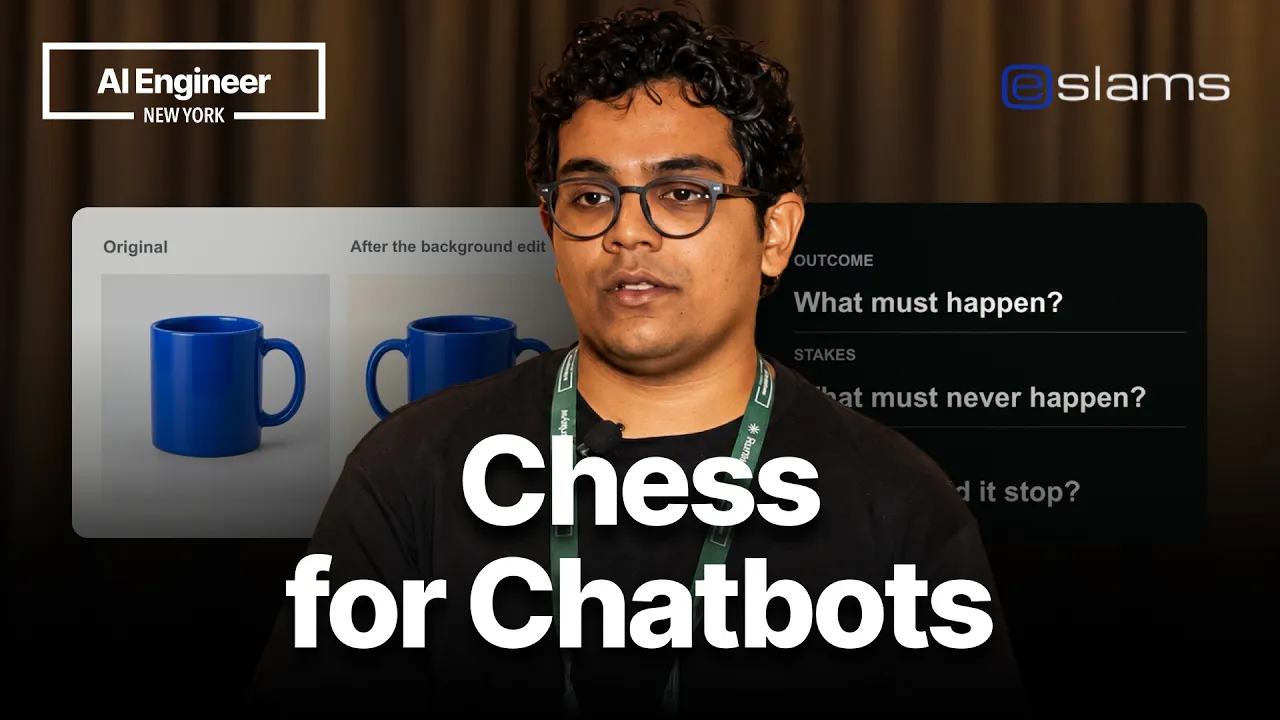
Ramakrishnan Lokanathan, an AI safety researcher and former startup founder, lays out how to build evals for high-stakes AI applications. Define the most ambitious version of success, test every step of the workflow and not just the final answer, combine automated checks with human review and adversarial tests, keep testing what used to work so upgrades don't break it, and turn real user failures into new tests. He also introduces eSlams, an open-source package that has AI models play games like chess, Go and poker against each other as another way to see how they reason. Chapters: 0:00 Intro 0:37 What is an eval, really? 2:58 About me 4:51 Why evals matter now 5:34 1. Define the most ambitious success 6:43 2. Test the whole workflow 7:28 3. One score is not the system 8:52 Games as evals: eSlams 12:06 4. Keep testing what used to work 13:35 5. Turn real failures into tests 15:08 Recap Ramakrishnan Lokanathan https://eslams.com Join us in SF for the second annual AIE CODE summit: https://aie.codes our last flagship summit of 2026. Applications live now!
Summary
Generated by gpt-5.6-terraAt-a-Glance
- Verdict: Watch fully
- Core thesis: An AI eval should verify whether an agent reliably delivers its real product promise across an entire workflow, not whether it achieves a high score on a static final-answer benchmark.
- Why it matters: For production agents, model upgrades, prompt changes, and tool integrations can preserve an apparently good answer while breaking the actual job, making workflow-level regression and failure-driven evaluation essential.
- Best use: Use this as a practical design review for Ken's agent-eval system: define the job and stop conditions, instrument each workflow stage, establish regression gates in CI, and convert production failures into permanent tests.
Executive Summary
Ramakrishnan Lokanathan argues that evals are frequently broken because teams mistake them for a single benchmark score. His first-principles definition is simpler: an eval is an examination that supplies evidence on whether a system performs the promise made to its user. Like the SAT, any single eval is only one signal—not a complete measure of capability.
The operational recommendation is to start with the most ambitious definition of success before writing tests: what must happen, what must never happen, and when should the agent stop? The resulting test suite should assess the whole job and each component of the workflow, rather than accepting a correct-looking final answer that may conceal bad intermediate actions, incorrect tool use, or unintended changes.
He proposes a holistic, continually evolving eval system: automated checks in the deployment pipeline, human review of outputs, adversarial scenarios, regressions for prior working behavior, and a loop that turns real customer failures into test cases. His Google Assistant-to-Gemini reminder example illustrates why a more capable successor can regress on a basic but critical product behavior.
A secondary proposal is eSlams, an open-source game-based evaluation package intended to expose longer-horizon planning, hidden-information decisions, adaptation after mistakes, and cooperation. This is presented as an additional evidence source—not a replacement for domain-specific, workflow-level evaluation—and the speaker acknowledges that its value for agent evaluation is still being explored.
Key Takeaways
- Claim: The purpose of an eval is to establish whether production performance matches the user-facing promise, not to maximize a benchmark score. | Evidence: The speaker compares AI evals with examinations such as the SAT, GMAT, bar exam, SWE-bench, and Humanity's Last Exam: each measures a bounded capability and should be treated as one signal rather than a complete capability verdict. | Implication: Define success criteria from the concrete customer job and service promise first, then select multiple measures that provide evidence for that promise. | Caveat: A benchmark can still be useful when it measures a capability relevant to the product; the error is treating it as sufficient evidence of readiness.
- Claim: An eval that reaches 100% is likely too easy or insufficiently ambitious for a frontier system. | Evidence: Lokanathan says teams should aim at the job needed rather than the score available, arguing that leading model benchmarks generally do not reach 100%; he recommends refreshing the suite once systems reach roughly 85–90%. | Implication: Separate non-negotiable correctness and safety gates from a frontier/challenge suite that remains capable of revealing new weaknesses. | Caveat: This is a heuristic, not a universal numeric threshold: safety-critical deterministic checks may appropriately target 100%, while the broader capability suite should retain difficult cases.
- Claim: Evaluate the complete workflow and its individual stages, because a successful final answer can mask invalid intermediate behavior. | Evidence: The speaker uses an image-editing example in which a request to change only the background produces the desired cream background but also adds an unwanted handle; he also describes a hypothetical 100-step workflow where each input, output, and expected result must be checked. | Implication: For an agent system, attach stage-specific assertions to planning, retrieval, tool selection, tool-call arguments, state transitions, execution, and final response—not just an end-to-end answer grader.
- Claim: The correct eval for a workflow step must measure that step's own function, especially for tool-using agents. | Evidence: He says a workflow component whose task is obtaining information through tools should be evaluated for tool-call ability and tool-call accuracy, rather than with an unrelated generic response-quality test. | Implication: Build a typed eval matrix mapping each agent component to its local success measures, so failures can be diagnosed as retrieval, routing, authorization, tool invocation, execution, or response failures.
- Claim: Evals must operate continuously as a production-quality system, combining CI checks, human review, adversarial testing, and regression coverage. | Evidence: The speaker recommends asking eval questions on every production deployment, retaining human review rather than allowing agents to self-certify, and deliberately seeking ways to break the workflow through adversarial cases. | Implication: Treat evals as release gates and operational monitoring rather than a one-time model-selection exercise; establish ownership and escalation for failed gates. | Caveat: Human review can be accelerated by AI-assisted triage, but he explicitly argues it should not be eliminated for high-stakes evaluation.
- Claim: Every observed production failure should become a reproducible regression test, because real users expose edge cases static suites miss. | Evidence: His example is Google Assistant's transition to Gemini: a feature he relied on—setting reminders—stopped working even though the newer system was more capable in other respects. He recommends collecting observability data and user thumbs-up/down feedback, reproducing failures, locating the failed workflow stage, and adding the case to the eval pipeline. | Implication: Create a closed-loop incident process in which user reports and traces are deduplicated, reproduced, classified, converted into fixtures, and retained permanently in the regression suite. | Caveat: The Google example is an anecdote rather than evidence of Google's internal eval process, but it clearly illustrates the product-regression risk during system replacement.
- Claim: Game-based tests may add useful evidence about agentic behavior such as planning, adaptation, hidden-information decisions, and cooperation. | Evidence: The speaker's eSlams project supports about 50 games across 90 providers; proposed categories include chess and Go for planning, poker for hidden information, cooperation games for shared goals, and arcade-game trials. He suggests comparing an old and new agent through how they play, rather than declaring the winner categorically better. | Implication: If adopted, use game arenas as supplemental stress tests for long-horizon decision behavior, never as a substitute for task-specific operational and safety evals. | Caveat: The speaker characterizes games as an exploratory additional paradigm, and no validation is supplied showing that game performance transfers reliably to a specific production workflow.
Detailed Brief
A practical architecture for a living eval program
- Claims: The speaker frames evaluation as a changing body of evidence rather than a fixed leaderboard.; A mature suite needs coverage of both the past and the future: known regressions remain protected while fresh cases continuously push beyond current capability.; The last edge cases are most likely to emerge from customer behavior and human judgment rather than an initially designed benchmark.
- Evidence: Recommended input channels include automated observability data, explicit user feedback such as thumbs-up/down signals, and classic QA reproduction of reported issues.; The speaker cites a reported MIT generative-AI adoption gap, claiming that 95% of organizations fail to see returns because delivered production behavior does not meet the promise; this statistic is presented without source detail in the transcript.
- Caveats: The cited organizational-return statistic should not be used as decision-grade evidence without independently verifying the underlying MIT report and its methodology.; Broadly increasing the number of eval paradigms can create noise and maintenance burden unless each test is linked to a concrete risk, workflow stage, or product promise.
- Implications: A useful eval backlog should be prioritized by user harm, business impact, recurrence, and diagnostic coverage—not by benchmark novelty alone.; Maintain provenance for every test: the promise or risk it protects, originating incident or hypothesis, workflow stage, pass criterion, and owner.
What eSlams contributes—and what it does not establish
- Claims: The project is positioned as an open-source Python/PyPI package and web preview for making models or agents play games against one another.; Its central measurement idea is that a sequence of decisions under changing conditions can reveal qualities that one-shot tasks do not, such as recovering from blunders and changing strategy.
- Evidence: The transcript describes chess and Go as planning-oriented games, poker as a hidden-information decision environment, and cooperation games as shared-goal settings.; It gives a tic-tac-toe match between model variants as an illustrative tie, while the transcript's model names differ between duplicated passages, suggesting transcription inconsistency.
- Caveats: The video does not provide a methodology for controlling prompts, game interfaces, model access, stochasticity, or statistical significance in cross-model comparisons.; Game results can be confounded by tool integration and game-specific competence, so they should not be interpreted as a general ranking of production-agent quality.
- Implications: Before incorporating game evals, require an explicit hypothesis linking each game behavior to a production risk, such as planning persistence, adaptation, or coordination.; Use repeated, logged runs and behavior-level analysis rather than a simple win/loss leaderboard.
Notable Concepts & Terms
- Test the job, not just the answer: The video's central principle: assess whether the system completed the intended real-world task correctly, including its process and side effects.
- Most ambitious success: A pre-test definition of ideal agent performance, framed through what must happen, must never happen, and should trigger stopping.
- Workflow-level eval: Evaluation that inspects intermediate stages and local success criteria, rather than grading only the final output.
- Regression cases: Tests preserving functionality that previously worked, particularly important when changing models, prompts, tools, or orchestration.
- Adversarial tests: Deliberately difficult or failure-inducing scenarios designed to expose where a workflow can be broken.
- eSlams: The speaker's open-source game-based evaluation project, proposed as a supplementary way to observe sequential agent behavior.
- Holistic evidence: The combination of automated checks, human review, adversarial cases, customer feedback, and multiple evaluation paradigms instead of a single score.
Operator Notes / Why Ken Should Care
- Create a release-gating eval inventory that maps every agent workflow stage to its explicit success criterion, prohibited outcome, stop condition, and test owner.
- Implement a regression-fixture pipeline: every verified production incident must produce a reproducible trace and durable automated test before the issue is closed.
- Separate deterministic contract/safety tests, which should have hard pass requirements, from evolving capability challenge tests, which should intentionally retain failure headroom.
- Require human sampling and review for material agent changes; use model judges only as triage or scalability aids, not as sole certification.
- Run a small controlled pilot of game-based agent tests only if a particular production capability—long-horizon planning, recovery, hidden-state reasoning, or cooperation—has a clearly stated transfer hypothesis.
Source/Metadata
- Title: If Your AI Scores 100%, Your Eval Is Wrong - Ramakrishnan Lokanathan, eslams.com
- Transcript words: 5438
- Duration seconds: 1125
- Timestamp note: No usable timestamps or chapters were present in the supplied transcript. The latter portion contains substantial duplicated material, and a few model names differ across duplicate passages.
Transcript
I think why all of us are here primarily is because evals are currently very broken, right? And that is what we're trying to explore and understand how to go about it. More often than not, I think evals are broken because we overcomplicate it and we don't really understand, right? We hear things like the eval is more important than the model and the eval is more important than the hardness or whatnot, but what even is an eval? It's a question that we all come to and this is something I consistently hit when I speak with people building high-stake applications to even understand to the first principle level of what an eval is, right? And what is an eval is just an abbreviation of the term evaluation, right? And how we understand evaluation is like we know exams, which are examinations, and this is a concept that we understand in human beings, right? And if you think about it, as people, we write a variety of exams through our life, like we write the SATs, the GMAT, the bar exam, and regardless of what we do, that is the same sort of idea you can apply as a parallel into evals, and then you can think about evals as those examinations for AI systems, right? You have the SWE bench, the humanities last exam, and all of this. In multiple ways, this is trying to evaluate and try to understand how a model or an agent will be working in something, right? At the end of the day, examinations and evals are just tasks, standards, and evidences to evaluate and understand how something is to perform as you expect, right? And I think that brings us to a very key distinction here as well. An exam must answer a bounded question, and let's take the example of the SATs. It's a college entrance exam, and it tells you how good a student is on language and math, but it's just one signal of college readiness, right? I come from India, and even today in India, your college admissions are done with a single examination. However, let's say you look at the US exam, SAT is one signal of college readiness, right? And I think that's extremely key. You should not index on one eval or one test, and it should just be one signal of your readiness to the platform rather than trying to over-index on your model being really good at humanities class exam or SW bench, right? So no eval or no test is a measure of someone's complete abilities, and that should always be clear going into that. So at the end of the day, what we try to answer with evals is, is our performance matching the promise that we're making to the consumer or the user at any given point in time, right? And that's the job of an eval, to make sure that we go ahead and ensure that the promise of the product or the agent that we're providing is meeting its performance to the consumer. Before we move ahead, I wanted to give a small brief on who I am. I'm Ramakrishnan. I come from the city called Cochin in south of India. I started coding very early on and started building machine learning classifiers in high school and whatnot. And I started my career with an Indian Tech Unicorn, which gave me the opportunity in 21 to get a demo of a GPT-3-based product on how to better our content flow, which changed my mind being someone who really loved machine learning from an early age. And I was like, this is going to really change the world, right? And my claim to fame or what I was right in doing was in September 2022, we decided that there is a new wave of applications that are going to be possible that are going to be built on the GPT-3 API, right? And about two months after we went full-time, OpenAI released a research preview for GPT-3.5 called ChatGPT. And that literally changed life for us and it validated us and killed us as well, right? So we went through multiple pivots and then we eventually landed on a pet carrier system and we monetized it using e-commerce and recommendations engines on top of it. And we got acquired in India and that was the end of that journey, right? After that, I've been super interested in understanding how these systems evolved. And because we were super early on building on GPT-3, evals were critical for us to build. So that took me to being a red teamer for the Nemo-203 models. I work at the Lawrence Berkeley Lab right now on our AI safety research and also with the London Business School of Data Science and AI Initiative. Broadly to explore how to look at the new technology that we are working on and how we see and explore, right? So I am not aligned with anybody here. So I'm not going to sponsor a vendor. It's just to understand how do you think about eval and build these high-stake applications, right? And a consolidation of the conversations that I've had over time with multiple implementations that we have done with millions of users using our AI products, right? So this is something I strongly believe. So evals are not going to be relevant in a decade's time because if we are to believe that model capability is to keep improving, we will not have to have as much eval as we do. However, in the midterm, production cannot wait. The problem is if you don't have the right amount of eval structure, you get reports like the MIT Gen AI divide where 95% of organizations are not able to get any returns because you are not delivering the promise in production that you're trying to make with the LLM, right? And that is what we have to solve with evals today. And in 10 years' time, evals is just going to be a validation of this. But today, it is to make sure that in production, you are delivering the promise that you're going ahead for, right? So the first thing that you have to think about as you build evals for high-stake applications is to define the most ambitious success, right? Before designing any test. Like, assume in a world of AGI, what is your AI agent going to do? Or what is the best outcome you can get out of it, right? And setting this goal really gives you the scope of what you can go ahead and design further, right? And you start with the job. The first question that you ask is what must happen? And what must never happen? And when should it stop? And you can extend it into other WH questions and first principles to go ahead and think about what could be the most ambitious outcome that you can get out of it, right? And aim at the job you need and not the score you can get. If you have an eval that is scoring 100 of 100, your eval is wrong, right? And you are not ambitious enough. You are not testing enough, right? If you look at any model eval today, people are at like 85, 86 max. Nobody gets to 100. So you have to make sure that the evaluation and your ambition is beyond what the model ability today is for you to make sure that you are putting it into the stress test and not making it easy, right? And always test the whole workflow, right? And not just the final answer. And this is the original picture. And my request would be only change the background, right? And I am just looking at the output. And the output has changed the background to a cream background, but it has two handles now, right? So it has to be very clear that you have to always test the work. And this is a very simplified example of this. Let's say you have 100 steps in your workflow. Each step has to be evaluated for what goes into that step and what comes out of that step and what is the expected outcome. You can't look at the start point and the end point and be like, okay, if you look at the start point and the end point, the background has changed, but is that the objective that you're going to achieve, right? So always look at the whole workflow when you're approaching things, right? And the third thing, and I'm going to talk a little bit about something I've been working on in this space as well, is one score is not the system, right? And the idea is to build a holistic evaluation system. When we started off with models in 2022 and 2023, you were measuring for coding ability or let's say you were measuring for writing ability, etc. But today you have agentic persistent systems that have to do multiple things, right? So you have to make sure that you're designing a holistic evaluation system at all points in time. And the first element of that is automated checks and eval being part of your CI pipeline, right? And your eval questions have to be asked to your agent every time they are going through a production deployment process, right? So that being part of the automated checks makes sure that it's not one eval score you are taking at the time you're deciding the model. Continuously human review and make sure that the results make sense. Don't rely on your agents to be the reviewer of your eval at any point, always, right? You can fast track your eval process with it, but make sure you're doing human review. And the third part is adversarial tests, right? You were measuring for coding ability or let's say you were measuring for writing ability, etc. But today you have agentic persistent systems that have to do multiple things, right? So you have to make sure that you're designing a holistic evaluation system at all points in time. And the first element of that is that automated checks and eval being part of your CI pipeline, right? And your eval questions have to be asked to your agent every time they are going through a production deployment process, right? So that being part of the automated checks makes sure that it's not like one eval score you are taking at the time you're deciding the model. Continuously human review and make sure that the results make sense. Don't rely on your agents to be the reviewer of your eval at any point, always, right? You can fast track your eval process with it, but make sure you're doing human review. And the third part is adversarial tests, right? Where can you break the workflow and put it into challenging situations where you can have adversarial testing? And one thing I've been recently working on and would love to talk about is the idea of how you can choose a test for the failures it can reveal, right? And the idea of a test that can fight back. Today you have a task on SWbench. The agent or the model is asked to go ahead and perform one task in given output. But there is no continuous thinking or evaluation, right? And getting one right answer more and more is not the same as making a good sequence of decisions. And you need agentic action and long-chain reasoning and all of these things. For the longest time, the best measure of agentic action and long-chain reasoning in human beings have been board games like chess and Go. And even when we go ahead to evaluation of models, AlphaGo is a very important step to AI development. But there were very specifically trained models for playing Go. Today's general purpose LLMs, we don't test on Go or chess. And that is what I'm trying to solve with an open source repo called eSlams, which is electronic slams, and we make AI play games, right? So you can just install the package. It's a Python PyPI package and you can make your agent and your model play games and see how it works. And how can you put it to test, right? You're replacing an agent with an improved model. You might want your old agent to play with a new agent on a game of chess. And let's say I'm not saying the winner of that match is a better model, but how they enter that match and play that match will tell you a lot more about how to go ahead with that model. Because playing chess, you are changing your strategy. You have to get out of blunders and moves that you make can become liabilities for you in the past. So how is your agent reasoning through that? That is an additional paradigm to the holistic evaluation you can have. And the idea here is do a coding evaluation, do a writing evaluation, do humanity's last exam, and try to have as many paradigms as possible. And that's what I'm trying to build with eSlams, right? So we support about 50 games and 90 different providers. We have chess and go, which looks at planning invisible state. We have poker, which is decision based on hidden information. And we have cooperation games based on shared goals and cooperation. And we also have trials for arcade games, right? And all of this tells you a lot about models and how they think. And on our platform, we have a preview on eSlams.com of how you can use the repo. And this is an example of Claude 5.1 playing tic-tac-toe against GPT-4o Astral. And you can look at how Claude and Astral are looking at each other's turn and how they go ahead and play this. And this match, interestingly, ends in a tie. And most cases, a model wins. But Claude and Astral ended up knocking their heads to each other. And let's say you are deploying an agent in production. You want to go ahead and play against these AI models and see how they are. You can come on eSlams.com and play against these AI models on any different game that you want to. And you can do all of this using the open source repo and make it play with your own agents and evaluate your systems. And we are going to host the Grand Slams of AI in February. And the idea is to put an Olympics for AI models to go ahead and compete and know who will stand out of all of this. So please do check out eSlams to know where we are going with it. And this could be one paradigm of model evaluation you can add into your stack. So now we're coming back. The main key part after all of this, right, is to make sure that you keep testing the evaluation workflow. Right? And the most important part of that is keeping what works in the flow. And my best example of this is Google Assistant moving to Gemini. I used to use Google Assistant for all of my reminders. And one day it moved to Gemini and it stopped giving me reminders. And it said it's a language model that cannot set up reminders, right? So it was excellent in the old Google Assistant model they had and before they moved it to Gemini. And it stopped working. And this is an example of Google not doing eval on what used to work, right, when they went ahead and launched the Gemini product. And that's extremely important to make sure that you keep testing the regression cases, right, and known tasks and past failures. Because a model that is extremely better than the old one could very well be incapable of something that the old one did very well. For example, setting a reminder, right? And fresh challenge cases at all points goes back to what I was saying in terms of setting the most ambitious target. The idea is that you have to keep pushing your model. If you feel that your model is getting to an 85 or a 90 on your eval test, it's time that you better your eval and push the frontier, right? And make sure that your model is challenged and has cases where it is not able to perform to expectations. And at all points, right, and I think this has been true in software throughout history, is that you have to turn real-world failures into future tests, right? Your customer and your user is the most important evaluator of your agent and your model. So every failure should have a proper workflow for it to enter into your system and make sure that it can be there, right? So one is to keep observing, and there are multiple ways of making sure that you can observe. There are multiple observability tools that give you automatic data, give option for your users to report it to you with your simple thumbs up or a thumbs down, and collect as much data where your customers are telling you where there is a failure in the pipeline, right? Classic QA on software, go ahead and reproduce that issue and try to understand where is the model failing, is it a tool call, and what part of your eval suite failed in going ahead and doing that, right? And review it, add it to the pipeline, and add that to the eval pipeline. This becomes extremely important to keep this feedback loop going so that you go ahead and access new frontiers of things that you are missing out at every point in time. And I think the two ways to go ahead and get to eval that is as holistic as possible is one, to consistently human review your process and then ensure that your customer feedback is part of your eval pipeline, right? Because these are the last 5% edge cases that really come out which a model or an existing eval framework might not catch. So to conclude, test the job and not just the answer, right? And that's extremely key to the whole process. And I'll just wrap up with all the things that we've discussed: one is always define your most ambitious success. Think about what life would be in AGI, right? And think about life in a model that has no inabilities and can absolutely perform like the human that you're trying to emulate and try to define in this process, right? Second is continuously test the workflow at every part of the workflow. Don't assume things in the workflow or assume for an input and output to be the outcome of anything, right? And when you test the workflow, I think something I slightly missed on here is to make sure that your tests are designed for what that element of the workflow does. For example, let's say in your workflow, there's a specific part that is doing tool calls consistently to get the information. Your eval has to be designed for tool calling and not for any different process separately, right? Because the objective in that workflow process is to know what is your tool call ability and the tool call accuracy, right? At that point. So every time, make sure that when you're testing the workflow, you design the test to that specific part of the workflow and measure what is the success in that element of the workflow as well. And continuously gather evidence holistically. In an agentic world, what evidence for agentic action eval is something that keeps evolving? And games is something I'm exploring to see how it works out. But there are so many different frontiers for you to go ahead and look at, right? For example, let's say in your workflow, there's a specific part that is doing tool calls consistently to get the information. Your eval has to be designed for tool calling and not for any different process separately, right? Because the objective in that workflow process is to know what is your tool call ability and the tool call accuracy, right? At that point, so every time, make sure that when you're testing the workflow, you design the test to that specific part of the workflow and measure what is the success in that element of the workflow as well. And continuously gather evidence holistically. In an agentic world, what evidence for agentic action eval is something that keeps evolving? And games is something I'm exploring to see how it works out. But there are so many different frontiers for you to go ahead and look at, right? Something super interesting that I came across while I'm here is the parallel search model index, right? And how models are good at fetching search from parallels like AI search index. And that becomes very important for you to evaluate when you are designing a model that needs real-time data, right? So make sure that you as a company or a person building these products is consistently looking for more evidence and more arenas and more paradigms for you to evaluate your models. And that is one sure, short way to making sure that you cover most edge cases. The fourth one is to evolve the test as time flows and making sure that you cover all aspects from the past and the future into the test. And the simplest thing is if your test is scoring high, is that 85, 90? That is the time you change your test and you have to make it harder, right? The simplest thing is if you think everyone is scoring in the 99th percentile for the SATs, it is time that the test has to change in and of itself, right? And always learn from reality. Reality is going to be your best teacher. And the idea of evals that I started off with is to make sure that we deliver the promise that we are making to the consumer and the user in production. And that is most defined in the customer feedback and the reality that really happens, right? So consistently think about how you can incorporate real user feedback and real world tests and how you can have human review and human testing into the workflow as you go ahead and get started. And I think with these five thought processes and the idea that you go ahead and test the job and not just the answer, you will have a good mental framework to go ahead and build evals for high stake applications. Thank you for coming. Happy to catch up for questions afterwards. Thank you. You have to get out of blunders and moves that you make can become liabilities for you in the past. So how is your agent reasoning through that? Is an additional paradigm to the holistic evaluation you can have. And the idea here is do a coding evaluation, do a writing evaluation, do humanity's last exam, and try to have as many paradigms as possible. And that's what I'm trying to build with eSlams, right? So we support about 50 games and 90 different providers. We have chess and go, which looks at planning invisible state. We have poker, which is decision based on hidden information. And we have cooperation games based on shared goals and cooperation. And we also have trials for arcade games, right? And all of this tells you a lot about models and how they think. And on our platform, we have a preview on eSlams.com of how you can use the repo. And this is an example of Fable 5.1 playing tic-tac-toe against GPT-6 Astra. And you can look at how Fable and Astra are looking at each other's turn and how they go ahead and play this. And this match, interestingly, ends in a tie. And most cases, a model wins. But Fable and Astra ended up knocking their heads to each other. And let's say you are deploying an agent in production. You want to go ahead and play against these AI models and see how they are. You can come on eSlams.com and play against these AI models on any different game that you want to. And you can do all of this using the open source repo and make it play with your own agents and evaluate your systems. And we are going to host the Grand Slams of AI in February. And the idea is to put an Olympics for AI models to go ahead and compete and know who will stand out of all of this. So please do check out eSlams to know where we are going with it. And this could be one paradigm of model evaluation you can add into your stack. So now we're coming back. The main key part after all of this, right, like you keep evolving, you keep adding paradigms, is to make sure that you keep testing the evaluation workflow. Right? And the most important part of that is keeping what works in the flow. And my best example of this is Google Assistant moving to Gemini. I used to use Google Assistant for all of my reminders. And one day it moved to Gemini and it stopped giving me reminders. And it said it's a language model that cannot set up reminders, right? So it was excellent in the old Google Assistant model they had and before they moved it to Gemini. And it stopped working. And this is an example of Google not doing eval on what used to work, right, when they went ahead and launched the Gemini product. And that's extremely important to go ahead and make sure that you keep testing, like, the regression cases, right, and known tasks and past failures. Because a model that is extremely better than the old one could very well be incapable of something that the old one did very well. For example, setting a reminder, right? And fresh challenge cases at all points goes back to what I was saying in terms of setting the most ambitious target. The idea is that you have to keep pushing your model. If you feel that your model is getting to an 85 or a 90 on your eval test, it's time that you better your eval and, like, push the frontier, right? And make sure that your model is challenged and has cases where it is not able to perform to expectations. And at all points, right, and I think this has been true in software throughout history, is that you have to turn real-world failures into future tests, right? Your customer and your user is the most important evaluator of your agent and your model. So every failure should have a proper workflow for it to enter into your system and make sure that, like, it can be there, right? So one is to keep observing, and there are multiple ways of making sure that you can observe. There are multiple observability tools that give you automatic data, give option for your users to report it to you with your simple thumbs up or a thumbs down, and collect as much data where your customers are telling you where there is a failure in the pipeline, right? Classic QA on software, go ahead and reproduce that issue and try to understand where is the model failing, is it a tool call, is it, is it, and what part of your eval suit failed in going ahead and doing that, right? And review it, add it to the pipeline, and add that to the eval pipeline. This becomes extremely important to keep this feedback loop going so that you go ahead and access new frontiers of things that you are missing out in every point in time. And I think the two ways to go ahead and get to eval that is as holistic as possible is one, to consistently human review your process and then ensure that your customer feedback is part of your eval pipeline, right? Because these are the last 5% edge cases that really come out which a model or an existing eval framework might not catch. So to conclude, test the job and not just the answer, right? And that's extremely key to the whole process. And I'll just wrap up with all the things that we've discussed is, one is always define your most ambitious success. Think about what life would be in AGI, right? And think about life in a model that has no inabilities and can absolutely perform like the human that you're trying to sort of emulate and try to define in this process, right? Second is continuously test the workflow at every part of the workflow. Don't assume things in the workflow or like assume for an input and output to be the outcome of anything, right? And when you test the workflow, I think something I slightly missed on here is to make sure that your tests are designed for what that element of the workflow does. For example, let's say in your workflow, there's a specific part that is doing tool calls consistently to get the information. Your eval has to be designed for tool calling and not for any different process separately, right? Because the objective in that workflow process is to know what is your tool call ability and the tool call accuracy, right? At that point. So every time, make sure that when you're testing the workflow, you design the test to that specific part of the workflow and measure what is the success in that element of the workflow as well. And continuously gather evidence holistically. In an agentic world, what evidence for agentic action eval is something that keeps evolving? And games is something I'm exploring to see how it works out. But there are so many different frontiers for you to go ahead and look at, right? Something super interesting that I came across while I'm here is the parallel search model index, right? And how models are good at fetching search from parallels like AI search index. And that becomes very important for you to evaluate when you are designing a model that needs real-time data, right? So make sure that you as a company or a person building these products is consistently looking for more evidence and more arenas and more paradigms for you to evaluate your models. And that is one sure, short way to making sure that you cover most edge cases. The fourth one is to evolve the test as time's flow and making sure that you cover all aspects from the past and the future into the test. And the simplest thing is if your test is scoring high, is that like 85, 90? That is the time you change your test and you have to make it harder, right? The simplest thing is if you think everyone is scoring like in the 99th percentile for the SATs, it is time that the test have to change in and of itself, right? And always learn from reality. Reality is going to be your best teacher. And the idea of evals that I started off with is to make sure that we deliver the promise that we are making to the consumer and the user in production. And that is most defined in the customer feedback and the reality that really happens, right? So consistently think about how you can incorporate real user feedback and real world test and how you can have human review and human testing into the workflow as you go ahead and get started. And I think with these five thought processes and the idea that you go ahead and test the job and not just the answer, you will have a good mental framework to go ahead and build evals for high stake applications. Thank you for coming. Happy to catch up for questions afterwards. Thank you. Thank you. Thank you.