Does Code Quality Still Matter? It Depends on This — Max Kanat-Alexander, Capital One
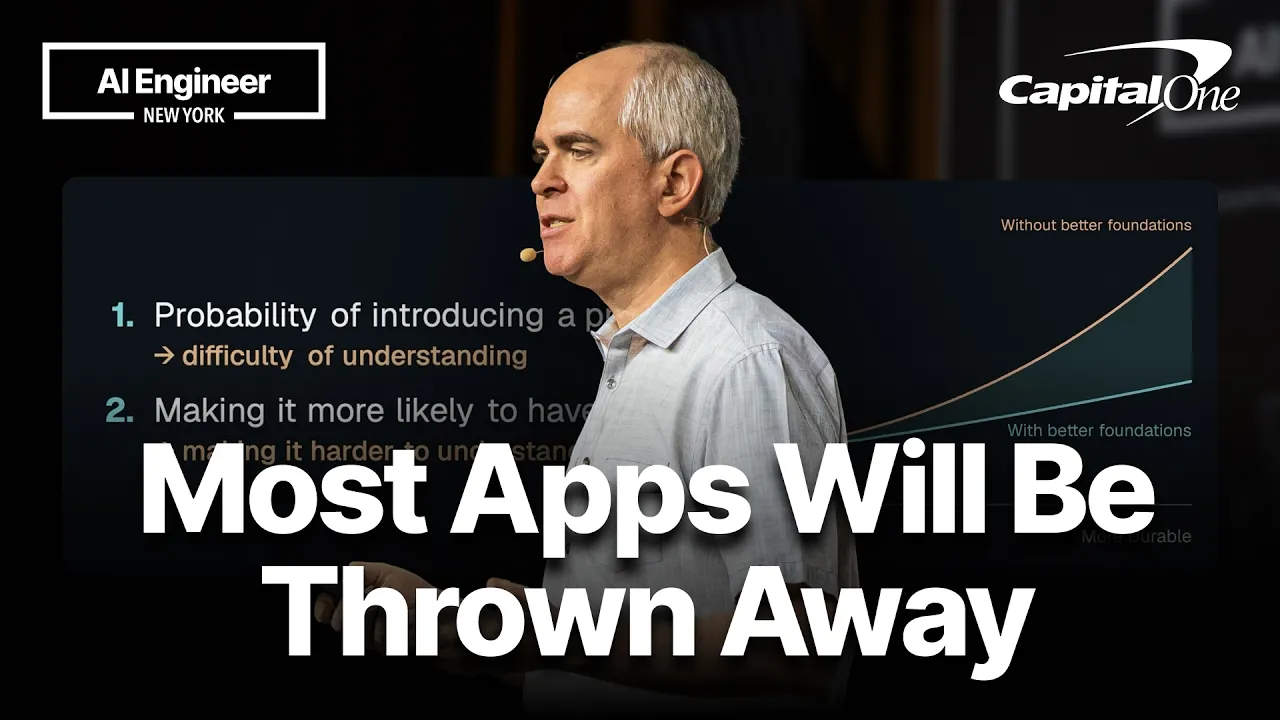
Description
Every senior engineer's answer is "it depends." Max Kanat-Alexander says what it actually depends on. Code quality always existed for two things: understanding a system and safely changing it. AI is making a new kind of software common: disposable software, with low consequences, few dependents and near-zero cost to replace or maintain. For that software, quality doesn't matter. For durable software it matters more than ever. He also shows how to make systems more disposable and how to make rigor cheap through standards, in-workflow tooling, easy testing and maximum strictness. Chapters: - 00:00 "It depends" — on what? - 01:14 Understanding and execution - 02:42 Why structure matters - 04:47 The two risks of every change - 06:56 Disposable software - 07:59 Durable software - 09:54 Making software more disposable - 12:05 Lowering the cost of rigor - 15:50 The answer Max Kanat-Alexander, Capital One: https://www.capitalone.com Join us in SF for the second annual AIE CODE summit: https://aie.codes our last flagship summit of 2026. Applications live now!
Summary
Generated by gpt-5.6-terraAt-a-Glance
- Verdict: Watch fully
- Core thesis: Code quality matters in proportion to software durability: rigor is essential for systems with meaningful failure consequences, dependencies, maintenance burden, or replacement cost, but can be minimized for safely disposable software.
- Why it matters: AI coding will dramatically expand disposable software while also increasing the volume of durable systems; the operating challenge is to classify software correctly, create safe disposable environments, and make rigor cheap by default.
- Best use: A practical framework for setting engineering-governance tiers for agent-built tools, internal workflows, and production systems.
Executive Summary
Max Kanat-Alexander reframes “does code quality still matter?” as a classification and systems-design question rather than a debate about craftsmanship. Software engineering exists to preserve two forms of understanding: what a system actually does and how to modify it safely. Code quality—especially understandable structure—matters because it reduces the cost and risk of those two tasks.
He argues that every change creates two risks: an immediate failure or unwanted outcome, and an increase in the difficulty of future changes. The latter compounds nonlinearly: unclear architectures, opaque configurations, and emergent system behavior make later modifications progressively riskier. In his framing, many incidents and postmortems reduce to a failure of system understanding or a change that made understanding worse.
AI changes the landscape by making “disposable software” far more common: narrowly scoped tools that can be replaced in hours or days, have few users and dependencies, carry little consequence of failure, and require little maintenance. For these systems, traditional quality investment may not be economical. But durable systems remain essential—and likely grow in absolute number as AI lowers the cost of building more software. The practical distinction is a spectrum, assessed through consequences of failure, replacement cost, dependencies, and maintenance cost.
The strategic answer is not merely to relax standards for AI-generated code. It is to deliberately engineer safe disposability through isolation, constrained data access, dependency boundaries, redundancy, and limited scope—while making rigor inexpensive for systems that need it. Standardization, automatic in-workflow controls, fast deterministic tests, in-memory service fakes, and strict defaults reduce the marginal cost of quality and make it easier to upgrade a tool from disposable to durable when its importance changes.
Key Takeaways
- Claim: The real purpose of code quality is preserving understanding, not satisfying abstract ideals of “correctness” or developer preference. | Evidence: The speaker identifies two core engineering needs: knowing a system’s actual behavior and knowing how to change that behavior safely; he positions debuggers, observability, evaluations, and tests as mechanisms that improve those capabilities. | Implication: Evaluate quality practices by whether they improve system legibility and change safety, especially for humans and agents operating a shared codebase.
- Claim: Structure is the central quality property because it makes large systems comprehensible as components rather than as undifferentiated instructions. | Evidence: He contrasts recognizable, structured source code with a low-level sequence that produces the same “hello world” output but has no obvious component identity; Chromium is used to illustrate why whole-system understanding must be decomposed into understandable parts. | Implication: Agent-generated systems need explicit modular boundaries, named responsibilities, and locally understandable components—not just working output.
- Claim: Technical degradation compounds because each hard-to-understand change raises the probability that later changes will fail. | Evidence: He separates modification risk into immediate problems—bugs, overruns, missed user expectations—and future risk created by making the system harder to understand; he argues this dynamic becomes nonlinear in large, long-lived codebases. | Implication: Treat avoidable complexity as an accumulating operational liability, not merely a code-review concern. | Caveat: The talk presents a conceptual framework rather than empirical incident-rate data.
- Claim: Software should receive engineering rigor according to its degree of durability, not according to a universal standard. | Evidence: The proposed classification uses four variables: consequences of failure, cost of replacement, dependencies, and maintenance cost. Low values indicate disposable software; high values indicate durable software. | Implication: Establish explicit governance tiers for experiments, personal/internal tools, team workflows, customer-facing products, and core production infrastructure.
- Claim: AI will make disposable software vastly more numerous, but does not eliminate the need for durable engineering. | Evidence: Examples include a one-off party-planning app, a user-specific calculator, and quickly generated front ends; the speaker nevertheless expects the absolute amount of durable software to increase because AI makes more systems feasible to build. | Implication: Do not equate “AI coding” with permission to weaken production controls; instead, separate low-stakes generation from durable system ownership.
- Claim: Organizations can deliberately increase software disposability by reducing blast radius and ensuring fallback options. | Evidence: Suggested mechanisms include isolated environments, prohibition of customer/PII access, no inbound production dependencies, narrow scope, and a durable backup system behind experimental or “vibe-coded” interfaces. | Implication: Safe sandbox architecture can enable fast agent experimentation without allowing temporary tools to become hidden production dependencies.
- Claim: The highest-leverage quality strategy is to make rigor cheap and automatic. | Evidence: The speaker recommends standardizing languages, frameworks, and protocols; embedding reliable, fast tooling in the workflow; making tests deterministic; providing in-memory fakes; and applying strict linting early rather than remediating a large legacy backlog later. | Implication: Platform investment should aim to lower the default cost of tests, policy checks, security controls, and migration to production-grade standards.
Detailed Brief
A decision model for disposable versus durable software
- Claims: “Disposable” is not synonymous with low-quality work; it is software for which failure and replacement impose little practical cost. “Durable” is software whose life, dependency graph, user impact, and maintenance demands justify sustained engineering rigor.
- Evidence: The speaker describes disposable software as having minimal consequences of failure, few dependent users or systems, little change-management burden, near-zero replacement cost, and low maintenance needs. Durable systems may persist for years, serve thousands or millions of users, create potentially catastrophic business consequences on failure, and require ongoing maintenance.
- Caveats: The classification is a spectrum rather than a binary. The speaker explicitly advises erring toward a durable classification because teams will misjudge future adoption, dependency growth, and business importance.
- Implications: A tool initially built for one analyst, team, or event can silently become durable if others begin relying on it. Governance should therefore include promotion triggers—such as customer data access, production integration, multiple teams depending on it, or a lack of viable fallback—not just initial project labels.
Designing environments that make experimentation safely disposable
- Claims: The organization can change a tool’s classification risk profile by architectural design, rather than relying solely on developers to write better code.
- Evidence: Proposed controls include deployment environments restricted to non-sensitive or owner-only data, no access to customer data or PII, enforced independence from inbound production API calls, narrow functional scope, and redundant durable alternatives. The example is allowing quick custom front ends while retaining an older, reliable fallback workflow if the new interface fails.
- Caveats: Isolation does not automatically make software disposable if users operationally depend on it, if its outputs drive irreversible decisions, or if informal data exports and manual processes create hidden coupling.
- Implications: Agent-enabled internal tooling should be built around bounded permissions, reversible operations, clear ownership, and a retained escape hatch. The key unit of control is the system’s blast radius and dependency surface, not whether its code was AI-generated.
Reducing the cost of rigor through platform defaults
- Claims: Standardization and automation are economic tools: they remove choices, reduce the number of possible failure modes, and lower the repeated cost of doing engineering correctly.
- Evidence: The talk cites limiting language and framework proliferation, standardizing RPC protocols, running controls automatically within developer workflows, requiring fast and deterministic testing, and using coding agents to create reusable in-memory fakes for services. It also argues for high lint strictness from the start to avoid later remediation such as a hypothetical 100,000-line cleanup in a million-line codebase.
- Caveats: Strict automatic controls must remain fast, reliable, and low in false positives; otherwise developers bypass them and the claimed “free” rigor becomes friction.
- Implications: The platform roadmap should prioritize paved roads over policy documents: templates, test harnesses, service fakes, preconfigured policy gates, and opinionated deployment boundaries that require little individual judgment to use correctly.
Notable Concepts & Terms
- Disposable software: Software with low failure impact, few dependencies, low maintenance burden, and low replacement cost; the category AI is likely to expand most rapidly.
- Durable software: Long-lived, relied-upon software with consequential failure modes and ongoing maintenance needs; it requires substantial engineering rigor.
- Degree of disposability: The continuum between disposable and durable, assessed through failure consequences, replacement cost, dependency level, and maintenance cost.
- Structure: The organization of code into recognizable, understandable components; the speaker treats it as the fundamental mechanism that enables safe comprehension and modification.
- Cost of rigor: The time, expertise, friction, and recurring effort required to apply testing, standards, security checks, and other quality practices.
- In-workflow tooling: Fast, reliable controls that run automatically rather than requiring developers to remember, select, or understand separate quality processes.
- Standardization as possibility reduction: The idea that constraining languages, frameworks, and protocols lowers the number of tools, vulnerabilities, exceptions, and practices an organization must support.
Operator Notes / Why Ken Should Care
- Define a lightweight durability scorecard for every agent-built application before granting production access: failure consequence, sensitive-data access, inbound/outbound dependencies, replacement time, maintenance owner, and fallback path.
- Make “disposable by construction” a platform capability: isolated environments, least-privilege data access, blocked production integrations by default, and explicit expiry or deletion paths for temporary tools.
- Set promotion gates for tools that cross into durable use—e.g., handling PII, serving customers, being used by multiple teams, initiating consequential actions, or becoming operationally difficult to replace.
- Invest in an agent-ready paved road: repository templates, deterministic test environments, reusable service fakes, automated security and lint controls, standard protocols, and deployment policies embedded in the workflow.
- Monitor for shadow durability: internal agent tools initially treated as throwaway but becoming business-critical through adoption, integrations, or dependency accumulation.
Source/Metadata
- Title: Does Code Quality Still Matter? It Depends on This — Max Kanat-Alexander, Capital One
- Transcript words: 5259
- Timestamp note: No timestamps or chapters were available; the supplied transcript contains a substantial repeated segment.
Transcript
So today I figured I'd just pick a nice uncontroversial topic that nobody has any opinions about, right? Nobody's said anything on this about social media, and of course every take about this on social media is really deeply nuanced. People have lots of depth and really big thoughts. Maybe there's a little bit more to it than yes or no. And of course if you ever ask a senior engineer a question, we always have the same answer to every question, which is it depends. Now that's not a very helpful answer though, frankly, because what does it depend on? So let's start with this. Why did code quality ever matter in the first place? I see a lot of people say, well, it made me feel good. That's not really a sufficient justification. So let's see if we can inject some nuance into this conversation and help everybody at least be able to have a basis for reasoning about it while we're discussing it. So let's see if we can make a framework here. That's what we're going to try to do with this talk. Okay, so we're going to start off with everything you want to ever accomplish with a piece of software depends on two factors and two factors alone. That is understanding and executing on that understanding, whether that's aligning a model, scaling a system, driving adoption, anything—all software success is determined by these two factors. This is why we have things like debuggers and observability and evals and even tests. All those things actually are there to improve your understanding or ability to execute on that understanding. People think that they're there for other reasons, but fundamentally they're there for that reason. Everything we have ever done in the field of code quality is exclusively and only for these two things. It's not for anything else and doesn't have something to do with correctness or something else. It has to do only with these two things. Now, there's two understandings that are the most important to have if you're going to be a software engineer. There are other understandings to have about software if you're going to be in product or sales. But if you're a software engineer, these two are the most important. The first is, what is the behavior of the system? Concretely, not what does a doc say the behavior of the system is, but what is the actual behavior of the system? And the second one is, how do I correctly and safely modify that behavior? On a very small system, if you want to understand what the system does, I just tell you what it does. It prints hello world. You say, I wanted to say hi world. I say, okay, I will make it say hi world now. There's very little to understand about it other than purely what it does. That's all of the understanding that you need. However, any real software system is enormously complex. This is a real map of the code base of Chromium, which is the open source project behind Chrome. If you think about all of the different ways that these components can interact, they have essentially infinite possible behaviors. I could not describe to you in words the behavior of Chromium as a whole system. However, what I can describe to you, and as we all know, everybody's been a software engineer for a while, I can describe to you components of the system. I can successfully describe to you how a component of the system behaves. So this is the URL parser, the actual functions for the URL parser of Chromium. It figures out all the different parts of the URL. And this is the whole reason that code exists. The whole reason that we have code at all in the first place is for structure. What do I mean by that? Both of these two things, on the left and on the right, will print hello world if run on a Linux machine. However, on the left, you can see that it is hello world. It has the identity and structure of hello world. On the right, you just see a series of instructions with no particular identity, recognizable or understandable identity. It's not a component, it's just a bunch of instructions. While that's understandable there, if that was millions or billions of lines of that, it would be much harder to grok. In the past, we've talked about things like readability or testability or things that seemed like human concepts about code. But what actually mattered the most always was that the system had some sort of understandable structure. So it's the structure that actually matters. When this matters the most is when you want to modify the system, the second understanding that we talked about. All modifications to a system carry two categories of risk. The first is that you will introduce some sort of problem. And a problem isn't just a bug. It's anything bad that could happen. Your project could take much longer than you expect. It could not behave in the way that you wanted it to for your users. The project could fail because you have budget overruns. Any kind of problem could happen from just you trying to go through the process of making this change. And the second is you could make it harder to make future changes. In particular, what that means is you could make it more likely to have future problems. You could increase future risk of the system. These two things are caused by problems with understanding. The first has to do with the difficulty of understanding the system in the first place. And the second is you make the system harder to understand. I can reduce every postmortem I have ever read for any incident to these two factors in one way or another. The production configuration was too hard to understand. Somebody made something impossible to understand. There were emergent properties of the system that were impossible to understand. Whatever. Point two feeds into point one in a vicious cycle that compounds in a non-linear fashion. The difficulty of understanding does not grow linearly. It compounds over time. You will eventually reach a point, and all systems eventually tend to reach this point, where every modification involves some sort of problem. Some systems get to the point where you can't modify them at all. If you think of some of your giant 100 million, 500 million line mainframe code bases, then every change is some sort of problem. You'll see it in organizational issues. You'll see it all over the place. You'll see it in timelines. And look, there's a lot of arguments about maybe future models will fix this. Maybe they will. Maybe future models will have infinite ability to deal with complexity somehow. But we don't have to discuss that today, because I think models are doing something else really interesting right now. They are creating a new kind of software, a new category of software. This category has always existed, but it's about to become 100,000 times more common than any other form of software. And that is disposable software. So what is that? Okay. Imagine a world in which the consequences of failure for your system are very minimal or nonexistent. Imagine that there's very few people that depend on it and almost no other systems depend on that piece of software. Change management is very minimal or nonexistent. Imagine the cost of replacement went to near zero. You could replace the whole thing in hours or days. And it had basically no cost of maintenance. In that world, code quality does not matter. Because all of those things we were trying to prevent about the compounding risks over time don't exist. Traditionally, we've always built durable software. It lives for years. It's depended on by millions or thousands of people. There's huge consequences of failure, potentially business catastrophic consequences of failure. And it requires enormous maintenance. Most of the software engineers in the world spend most of their time maintaining these giant durable systems. I expect this to continue to exist. Durable systems will continue to probably be the most important systems in the world. And there will be probably more of them. But the most numerous systems will be disposable software. They will be replaceable in hours. They will be depended on by a few or change management just won't matter. If it doesn't work, you will give everybody agents. They'll make a version of it themselves. Maintenance will be unimportant or nearly free. Don't like the calculator on your OS? Make your own. Want to plan a party for your kids? Write a party planner software just for that one party. Throw it away. Code quality doesn't matter. Nobody cares. In the future, we will apply engineering rigor to the degree of disposability of the software. On the left, nothing. None of our practices of engineering rigor matter at all. On the right, all the practices of engineering that we have built up over the last many decades matter greatly. We can determine where you are on this scale by those four factors that I have been talking about. Consequences, cost of replacement, dependencies, and cost of maintenance. If they're all low, it's disposable software. If they're all high, it's durable software. And look, any person who's written software for a long time knows you should err on the side of it being durable. You should err on these all being higher than you expect them to be. But there's also a new thing you can do in the world. You can make software more disposable. So what does that involve? Well, come up with better isolated environments. You can only deploy to this environment that has access to only your data. No customer data, no personally identifiable information. You can enforce independence. You can say, okay, no inbound API calls from other production systems are allowed to this system in this environment. Everything deployed to that environment is disposable. Redundancy. You can have an old clunky backup system. And then look, if people want to code their own more efficient front ends, you let them code their own more efficient front ends. Because there is an old durable clunky backup system that they can use if their crappy little coded thing fails. Which it will fail. That's fine. But it doesn't matter if it fails. And you can limit scope, just like I talked about. It's just a calculator for this one person. It just plans this one party. There's so much more we could do here and talk about ways of increasing disposability. In fact, I think this is a whole new discipline of software engineering, not to think about how we improve the rigor of durable systems, but how do we take our systems and how do we encourage disposability or allow more disposability, allow people to throw these things away? Now, I want to reemphasize that durable software engineering is not going away, because this is the biggest confusion that I see on social media today. In fact, I believe the absolute amount of durable software in the world will increase, because AI coding tools make it easier and easier to make more durable software. And another important thing to understand is that disposable and durable are not black and white. There's a spectrum. But that spectrum, what changes across the spectrum is how much effort you're going to put into engineering rigor. And that's both immediate effort and effort over time, just like we've always talked about for software. However, what you want to do, and what you want to care about the most, is reducing the cost of effort, reducing the cost of rigor. If rigor is cheaper, if it's easier and easier you make it to be rigorous, the less you have to worry about where you are on the scale. So this is another approach you can take. If you change your mind, it's much easier. You're like, oh, I thought this was going to be disposable, and now it needs to be durable. The cheaper you make it to make it durable, the easier it is to change your mind or to be wrong, because you're never going to be 100% right all the time on that estimate. So that involves a different set of practices that are not engineering rigor themselves, but that are about how to decrease the cost of engineering rigor. Now, I could talk about this for hours. I have spent a tremendous amount of my career doing this. I don't have 10 hours. I have about five minutes left. So I'll talk about what I can. Let's talk about standardization. Why do we do standardization? People are like, well, I don't know, because the boss said so. Well, no. We do standardization because it removes possibilities. If you don't have any PHP in your system, you don't have to figure out what are all the linters for PHP, what are all the practices, what are all the security holes I have to fix. You just eliminate possibilities through standardization, and it reduces the cost of rigor. Same thing with frameworks. Why don't you want to have every front-end framework or every back-end framework in existence? Because it makes rigor more expensive. Yes, rigor is still possible. Yes, you could still have the agent code up all your tools, but you have to do it every single time. Protocols, why do you want to have standardized RPC protocols? All the same thing. Standards are all for this reason. What I call in-workflow tooling. In-workflow tooling is tooling that just occurs. The programmer doesn't have to choose to run it. They don't have to understand how it runs. It just happens. If it's there, it feels and seems free, and it is reliable. Reliability is very important. It doesn't have a ton of false positives. It's fast. It just happens. And the more that's true, you can apply it to your disposable software too. If it's free and fast, who cares? Making testing easier. This is not just about, how do we do better testing? How do you make it so that nobody has to think about how to do better testing? How do you make it so that every test is fast and deterministic without anybody having to be a deep expert in testing? There's a ton of work that you have to put into test infrastructure to make that possible. For example, one of the great dreams that I've always had as a test owner is that everybody would provide in-memory fake versions of their services, and I could just run those in-memory fake versions of their services. Guess what? The coding agent can do that, so you can just do that now. But you have to choose to do it and make it available to everybody. And another thing is, look, maximum strictness. You just turn the strictness up everywhere. You set all your lint rules to maximum. You never compromise on anything. And it just eliminates—it's very similar to standardization—it eliminates a ton of conversations. Sometimes the linter is wrong. As long as the false positive rate is relatively low and doesn't have catastrophic consequences, it doesn't matter because all of a sudden, there's a bunch of future lint errors or future issues that you don't have to deal with. Ask anybody who's been like, oh, I suddenly want to turn on my linter in this million line codebase. And they're like, oh, wow, now here's my 100,000 line change that I need to make. Much easier to just do that up front and have it on for everybody. Now, I could literally stand here and talk to you about this for 10 hours. There is much more you can do here. This is just a few areas, but also a whole area of software engineering discipline that you can apply on the other axis. So this lets us now answer our question, not just it depends, but yes or no. So does code quality even matter? For disposable software, no. For durable software, yes. Yes, and we get to answer a third and even more interesting question, which is, does it have to be expensive? No. Thank you very much. what it does. That's all of the understanding that you need. However, any real software system is enormously complex. This is a real map of the code base of Chromium, which is the open source project behind Chrome. And if you think about all of the different ways that these components can interact, they have essentially infinite possible behaviors. Like, I could not describe to you in words the behavior of Chromium as a whole, as a system. However, what I can describe to you, and as we all know, everybody's been a software engineer for a while, I can describe to you components of the system. I can successfully describe to you how a component of the system behaves. So this is the URL parser, the actual functions and stuff for the URL parser of Chromium. It figures out all the different parts of the URL. And this is the whole reason that code exists. The whole reason that we have code at all in the first place is for structure. Because it, what do I mean by that? Okay. So both of these two things, on the left and on the right, will print hello world if run on a Linux machine. However, on the left, you can see that it is hello world. It has the identity and structure of hello world. On the right, you just see a series of instructions with no particular identity, recognizable or understandable identity. It's not a component, it's just a bunch of instructions. While that's understandable there, if that was millions or billions of lines of that, it would be much harder to grok. In the past, we've talked about things like readability or testability or things that seemed like human concepts about code. But what actually mattered the most always was that the system had some sort of understandable structure. So it's the structure that actually matters. And when this modifies, when this matters the most, is when you want to modify the system, the second understanding that we talked about. All modifications to a system carry two categories of risk. The first is that you will introduce some sort of problem. And a problem isn't just a bug. It's anything bad that could happen. Like your project could take much longer than you expect. It could not behave in the way that you wanted it to for your users. The project could fail because you have budget overruns. Any kind of problem could happen from just you trying to go through the process of making this change. And the second is you could make it harder to make future changes. In particular, what that means is you could make it more likely to have future problems. You could increase future risk of the system. These two things are caused problems with understanding. So the first has to do with the difficulty of understanding the system in the first place. And the second is you make the system harder to understand. I can reduce every postmortem I have ever read for any incident to these two factors in one way or another. The production configuration was too hard to understand. Somebody made something impossible to understand. There were emergent properties of the system that were impossible to understand. Whatever. Point two feeds into point one in a vicious cycle that compounds in a non-linear fashion. So the difficulty of understanding does not grow linearly. It compounds over time. You will eventually reach a point, and all systems eventually tend to reach this point, where every modification involves some sort of problem. And some systems get to the point where you can't modify them at, like, if you think of, like, some of your giant 100 million, 500 million line mainframe code bases, then everything, every change is some sort of problem. You'll see it in organizational issues. You'll see it all over the place. You'll see it in timelines, whatever. And look, there's a lot of arguments about maybe future models will fix this. Look, maybe they will. Maybe future models will have infinite ability to deal with complexity somehow. But we don't have to discuss that today, because I think models are doing something else really interesting right now. So, they are creating a new kind of software, a new category of software. This category has always existed, but it's about to become 100,000 times more common than any other form of software. And that is disposable software. So what is that? Okay. So imagine a world in which the consequences of failure for your system are very minimal or nonexistent. Imagine that there's very few people that depend on it, and almost no other systems depend on that piece of software. Change management, very minimal, nonexistent. Imagine the cost of replacement went to near zero. You could replace the whole thing in hours or days. And it had basically no cost of maintenance. In that world, code quality does not matter. Because all of those things we were trying to prevent about the compounding risks over time don't exist. Traditionally, we've always built durable software. You know, it lives for years. It's depended on by millions or thousands of people. There's huge consequences of failure, potentially business catastrophic consequences of failure. And it requires enormous maintenance. Most of the software engineers in the world spend most of their time maintaining these giant durable systems. I expect this to continue to exist. So this is one of the areas where I think sometimes the conversation goes a little astray. Okay? Okay? Durable systems will continue to probably be the most important systems in the world. And there will be probably more of them. But the most numerous systems will be disposable software. They will be replaceable in hours. They will be depended on by a few or change management just won't matter. And look, if it doesn't work, you will give everybody agents. They'll make a version of it themselves. You know? Maintenance will be unimportant or nearly free. Don't like the calculator on your OS? Make your own. Want to plan a party for your kids? Write a party planner software just for that one party. Throw it away. Code quality doesn't matter. Nobody cares. In the future, we will apply engineering rigor to the degree of disposability of the software. On the left, nothing. None of our practices of engineering rigor matter at all. On the right, all the practices of engineering that we have built up over the last many decades matter greatly. We can determine where you are on this scale by those four factors that I have been talking about. Consequences, cost of replacement, dependencies, and cost of maintenance. If they're all low, it's disposable software. If they're all high, it's durable software. And look, any person who's written software for a long time knows you should err on the side of it being durable. You should err on these all being higher than you expect them to be. But there's also a new thing you can do in the world. You can make software more disposable. So what does that involve? Well, come up with better isolated environments. Right? So, hey, you can only deploy to this environment that has access to only your data. No customer data, no personally identifiable information, whatever. You can enforce independence. You can say, okay, no inbound API calls from other production systems are allowed to this system in this environment. Right? And so everything deployed to that environment is disposable. Redundancy. You can have an old clunky backup system that is like hard to use. And then like, look, if people want to vibe code their own like more efficient front ends, you let them vibe code their own more efficient front ends. Because there is an old durable clunky backup system that they can use if their, you know, crappy little vibe coded thing fails. Which it will fail. Right? That's fine. But it doesn't matter if it fails. And you can limit scope, just like I talked about. Right? It's just a calculator for this one person. It just plans this one party. It's just a reality. There's so much more we could do here and talk about ways of increasing disposability. In fact, I think this is a whole new discipline of software engineering, not to think about how we improve the rigor of durable systems, but how do we take our systems and how do we encourage disposability or allow more disposability, allow people to throw these things away? Interesting thought. Now, I want to reemphasize that durable software engineering is not going away, because this is the biggest confusion that I see on social media today. In fact, I believe the absolute amount of durable software in the world will increase, because AI coding tools make it easier and easier to make more durable software. And another important thing to understand is that disposable and durable are not black and white. There's a spectrum, like I showed before. But that spectrum, what changes across the spectrum is how much effort you're going to put into engineering rigor. And that's both immediate effort and effort over time, just like we've always talked about for software. However, what you want to do, and I think what you want to care about the most, is reducing the cost of effort, reducing the cost of rigor. Like, if rigor is cheaper, if it's the easier and easier you make it to be rigor, the less you have to worry about where you are on the scale. So this is another approach you can take. If you change your mind, it's much easier to, like, you're like, oh, I thought this was going to be disposable, and now it needs to be durable. The cheaper you make it to make it durable, the easier it is to change your mind or to be wrong, because you're never going to be 100% right all the time on that estimate. So that involves a different set of practices that are not engineering rigor themselves, but that are about how to decrease the cost of engineering rigor. Now, I could talk about this for hours. I have spent a tremendous amount of my career doing this. I don't have 10 hours. I have about five minutes left on that timer. So I'll talk about what I can, OK? Let's talk about standardization. Why do we do standardization? People are like, well, I don't know, because the boss said so. Well, no. We do standardization because it removes possibilities. If you don't have any PHP in your system, you don't have to figure out what are all the linters for PHP, what are all the practices, what are all the security holes I have to fix. You just eliminate possibilities through standardization, and it just reduces the cost of rigor. Same thing with frameworks. Why don't you want to have every front-end framework or every back-end framework in existence? Because it makes rigor more expensive. Like, yes, rigor is still possible. Yes, you could still have the agent code up all your tools, but you have to do it every single time. You know, protocols, why do you want to have standardized RPC protocols? All the same thing. Standards are all for this reason, OK? What I call in-workflow tooling. So in-workflow tooling is tooling that just occurs. The programmer doesn't have to choose to run it. They don't have to understand how it runs. It just happens. If it's there, it feels and seems free, and it is reliable. Reliability is very, very important. Like, it doesn't have a ton of false positives. It's fast. It just happens. And the more that's true, you can apply it to your disposable software, too. If it's free and fast, who cares? Making testing easier. So this is not just about, like, hey, how do we do better testing? Look, how do you make it so that nobody has to think about how to do better testing? How do you make it so that every test is fast and deterministic without anybody having to be a deep expert in testing? There's a ton of work that you have to put into test infrastructure to make that possible. For example, one of the great dreams that I've always had as a test owner is that everybody would provide in-memory fake versions of their services, and I could just run those in-memory fake versions of their services. Guess what? The coding agent can do that, so you can just do that now. But you have to choose to do it and make it available to everybody. And another thing is, look, maximum strictness. You just turn the strictness up everywhere. You set all your lint rules to maximum. You never compromise on anything. And it just eliminates, it's very similar to standardization. It eliminates a ton of conversations. Sometimes the linter is wrong. Like, as long as the false positive rate is relatively low and doesn't have catastrophic consequences, it doesn't matter because all of a sudden, there's a bunch of future lint errors or future issues that you don't have to deal with. Ask anybody who's been like, oh, I suddenly want to turn on my linter in this million line codebase. And they're like, oh, wow, now here's my 100,000 line change that I need to make. Much easier to just do that up front and have it on for everybody. Now, look, like I said, I could literally stand here and talk to you about this straight for 10 hours. There is much, much more you can do here. This is just a few areas, but also a whole area of software engineering discipline that you can apply on the other axis. So this lets us now answer our question, not just it depends, but yes or no. So does code quality even matter? For disposable software, no. For durable software, yes. Yes, and we get to answer a third and even more interesting question, which is, does it have to be expensive? No. Thank you very much. Thank you, Herr Herr, thank you, Herr Herr, thank you, thank you, Herr Herr, thank you, Herr Herr, thank you, thank you, Herr Herr, thank you, Herr Herr, thank you, thank you, Herr Herr, thank you, Herr Herr, thank you, thank you, Herr Herr, thank you, Herr Herr, thank you, Herr Herr, thank you, Herr Herr, thank you, Herr Herr, thank you, Herr Herr, thank you, Herr Herr, thank you, Herr Herr, thank you, Herr Herr, thank you, Herr Herr, thank you, Herr Herr, thank you, Herr Herr, thank you, Herr Herr, thank you, Herr Herr, thank you, Herr Herr Herr, thank you, Herr Herr, thank you, Herr Herr, thank you,