The Creator Playbook Brands are Using to Print Millions (4 Formats)
Description
Building a lucrative creator business is easy... if you know where to start. Every video should begin with research into winning formats, angles and hooks to stop the scroll. Watch the full episode for the rest of your process. In this episode Brian covers: - Guinea Pig Content (trend testing) - How to tell a compelling story - Building desire and relatability through ungatekeeping - Competitor callout and trust jacking - The new creator community: Hit Makers Enjoy! 📱Follow Us On Social: -------------------- Instagram Alex https://www.instagram.com/alexgarcia_atx/ Brian: https://www.instagram.com/brian_blum/ Twitter www.twitter.com/@alexgarcia_atx www.twitter.com/@brian_blum1 -------------------- Make ads that win (without getting lucky): https://motionapp.com Turn your customer support into a revenue engine: https://www.richpanel.com/ ------------------- 🔥Want Free Game? Send us a picture of your Apple & Spotify reviews to podcast@marketingexamined.com and we'll make you a playbook in a future episode. -------------------- 🎥Checkout Brians Content Agency https://www.nibble.studio -------------------- 📈Growth Playbooks, Directly To Your Inbox For growth playbooks, deep dives, and marketing case studies, get subscribed at https://www.marketingexamined.com -------------------- CHAPTERS: 00:00 — Intro 00:41 — Patterns That Go Viral: Guinea Pig Content 05:00 — Motion: AI-Powered Creative Analytics 05:36 — Patterns That Go Viral: Storytime 08:00 — Example of How to Create a Great Storytime 09:19 — Patterns That Go Viral: Ungatekeeping 09:43 — Our 'Sweat Equity' Goal 10:04 — Why Ungatekeeping Works: What Do People Feel? 10:50 — Build Desire and Create the Perfect Setup 12:13 — Leverage Specificity: Own Your Niche 12:55 — Ungatekeeping Examples 13:21 — How to Not Look Like an Ad 13:43 — Richpanel: AI-Powered Customer Service Tool 14:30 — Failed — Solution Prize 15:34 — Patterns That Go Viral: Competitor Callout 15:50 — Korean vs. American: Why It Works 18:00 — Tr
Summary
Generated by gpt-5.6-terraAt-a-Glance
- Verdict: Skim
- Core thesis: High-volume creator programs can produce scalable paid-social winners when creators repeatedly deploy four native-feeling formats—guinea-pig tests, story time, un-gatekeeping, and competitor callouts—then brands promote proven posts through Meta.
- Why it matters: The video offers a usable creative-production model for turning UGC from isolated influencer deliverables into a high-volume, commission-aligned performance-ad pipeline.
- Best use: Use it as a creative-brief template and operating model for testing creator-led ads, while rejecting unsupported health claims, deceptive comparison tactics, and platform-policy assumptions.
Executive Summary
The speakers argue that creator commerce is heavily power-law distributed: although more than 3.9 million TikTok Shop creators tried to sell in the prior year, only 0.49% reportedly generated over $10,000 in a month for promoted brands. Their answer is not better one-off content but systematic creative volume: modularize a small set of proven formats, test hooks and angles continuously, and move winners into Meta ad accounts for scale.
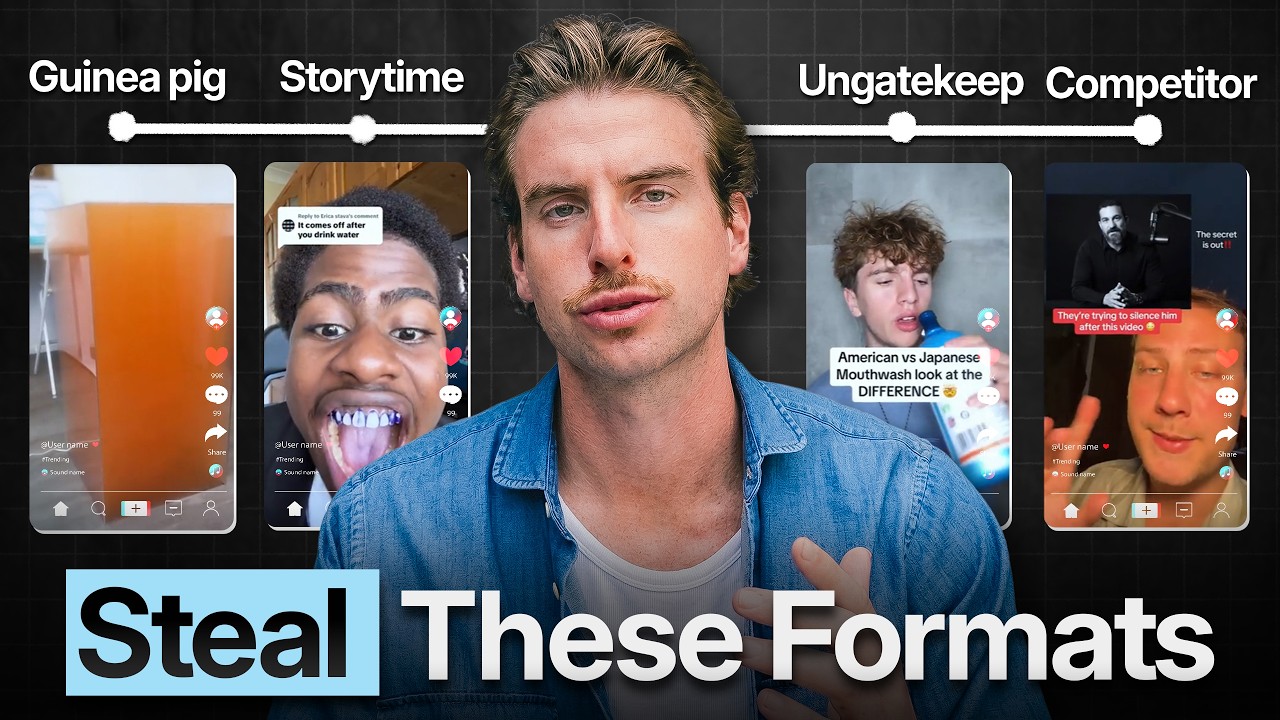
The four formats all delay the product pitch in favor of a credible-looking setup. Guinea-pig content frames the creator as testing a viral product or trend; story time uses a specific problem, a failed prior solution, and third-party discovery; un-gatekeeping presents the creator as revealing withheld information; and competitor callouts visually compare the product against a recognizable incumbent. Across all four, the repeated mechanisms are specificity, visual contrast, a concrete transformation window, social proof, and withholding the brand/product reveal until desire has been built.
The business model is a shift from low-volume flat-fee UGC to creator retainers with substantial output and 10-20% commissions. The speakers claim that 200 UGC assets have fallen from roughly $60,000 in 2024 to under $10,000, enabling brands to commission enormous asset volume and creators to earn ongoing upside from an occasional breakout post. They position AI avatars as a multiplier for a creator's sales skill rather than a replacement for it.
The actionable framework is useful, but several examples rely on insinuation, fear-based messaging, health or ingredient claims, and visually misleading product demonstrations. The claimed economics, platform enforcement rules, and performance outcomes are anecdotes from the speakers' former agency and should be validated against actual incrementality, creative fatigue, consumer-protection rules, and advertising-platform policies.
Key Takeaways
- Claim: Treat UGC as a high-volume creative-testing system, not a small set of sponsored posts. | Evidence: The speakers cite nearly 8,000 UGC ads shipped at their former agency, say sophisticated brands optimize for creative volume plus hit rate, and claim leading creator programs produce 10,000-20,000 videos per month. | Implication: Build a pipeline that can source, brief, version, score, and promote many assets, with success measured by hit rate and scalable downstream ad performance rather than by any individual creator post. | Caveat: The cited volume and performance assertions are not independently substantiated in the transcript; extreme volume can create review, attribution, brand-safety, and creative-fatigue costs.
- Claim: Guinea-pig content earns attention by making the creator an apparent independent tester rather than an immediate spokesperson. | Evidence: Suggested hooks include "I'm trying the viral whitening strips so you don't have to" and "I saw the viral air purifier, so I bought it so you don't have to." The speaker recommends anchoring the experience to a timeframe and showing split-screen or half-face/half-body contrast, such as whitening only the top teeth. | Implication: For demonstrable products, brief creators to show an observable test protocol, a specific use window, and a controlled visual comparison rather than relying on generic endorsement language. | Caveat: A paid placement must still comply with disclosure obligations, and artificial or misleading before/after demonstrations can undermine trust and invite policy or regulatory action.
- Claim: Story-time UGC should use problem-agitate-solution, where the agitation is a failed prior solution, not merely a testimonial. | Evidence: The proposed structure is a specific identity-linked problem (for example, a 30-year-old man noticing eye wrinkles or someone drinking three coffees daily), a named product or approach that failed, a discovery via a doctor/TikTok/social proof source, and a measured result such as a day-one versus day-14 comparison. | Implication: Build briefs around audience-specific pain signals and credible proof points; require claims substantiation and clear creator guidance on what competitors, experts, results, and timelines may be referenced. | Caveat: Invoking doctors, scientific mechanisms, ingredients, or comparative product failures without substantiation is especially risky in beauty, wellness, health, and regulated categories.
- Claim: The un-gatekeeping format works by framing the content as novel information that relieves the audience of blame for an unresolved problem. | Evidence: The core hook is "I can't gatekeep this anymore," followed by a problem and delayed solution. A B2B example taught how to build a creator program before naming Social Snowball at the end; the speaker reports it generated 900 comments asking for the platform. | Implication: Use the format for genuinely useful education and defer the CTA until after the audience has received standalone value; prohibit unsupported "they don't want you to know" narratives. | Caveat: The format can easily drift into manipulative conspiracy framing, especially when it implies audiences have been deceived by institutions or suppressed information.
- Claim: Competitor callouts can transfer attention and category trust from a market leader to a challenger when paired with a visible head-to-head demonstration. | Evidence: The example contrasts an unnamed major American mouthwash with a Japanese product, uses the visual difference in rinse output as proof, and then adds a surprising-affordability explanation. The speaker calls this "trust jacking" and advises targeting the recognizable category leader without naming it directly. | Implication: If comparative creative is used, design tests that are fair, repeatable, substantiated, and legally reviewed rather than relying on suggestive nationality, ingredient, or "chemical" narratives. | Caveat: Avoiding a competitor's name does not eliminate legal, platform, or deceptive-advertising exposure; visual outputs alone may not establish efficacy, safety, or superiority.
- Claim: Creator compensation and AI production are shifting toward performance-aligned, scalable asset generation rather than low-volume flat-fee work. | Evidence: The speakers say 200 UGC assets that cost about $60,000 in 2024 can now cost under $10,000; recommend creators deliver roughly 30 videos per month on a $1,500 retainer plus 10-20% commissions; and cite a Te Salud horchata/Core protein-shake video allegedly earning its creator passive TikTok Shop income for 14 months from February 2025 through April 2026. | Implication: Structure creator agreements around output, performance attribution, paid usage rights, and a transparent upside model; test AI avatars as a way to create controlled variations, not as a substitute for validated creative strategy. | Caveat: Commission economics depend on reliable attribution, clear usage rights, returns handling, fraud controls, and an agreed distinction between organic-shop revenue and paid-media revenue; the cited breakout is anecdotal.
Detailed Brief
Creative system design: modular variation over bespoke production
- Claims: The speakers recommend having creators use the same four format families every day while varying hooks, bridges, angles, settings, and product framing.; They argue the product should not appear as an overt advertisement in the opening seconds because audiences immediately identify and skip conventional ad structures.; They characterize creators as "video salespeople" whose durable value is their ability to create growth-driving assets, rather than acting ability or a particular platform identity.
- Evidence: Their operational target is 30 assets per creator per month, created by turning each format into a modular template.; They claim briefs requiring a software brand mention within the first seven seconds are likely to fail because the video reads as an ad immediately.; The video promotes Motion as a system for reviewing creative metrics such as three-second stop rate, angles, formats, and competitor research, though this is a sponsorship claim rather than independent analysis.
- Caveats: Optimization around three-second stop rate or comments alone can select sensational creative that harms conversion quality, brand trust, or compliance.; A creative-analytics platform does not solve the core requirements of clean attribution, a controlled holdout methodology, rights management, or claim review.
- Implications: A mature creator program needs a structured taxonomy for format, hook, audience problem, proof mechanism, offer, CTA, and outcome so learnings can be reused rather than buried in individual videos.; Separate organic engagement metrics from paid-media outcomes when deciding which creator assets graduate into the ad account.
Channel and platform assertions
- Claims: The speakers present TikTok Shop as a source of long-tail creator commissions and say the same creative playbooks are now shifting into Meta paid media.; They explicitly distinguish Meta ad accounts from Meta/Instagram Shops, which they describe as "totally cooked."
- Evidence: The cited Te Salud creator allegedly continued receiving TikTok Shop income from a single video for 14 months.; The opening statistic claims 0.49% of over 3.9 million TikTok Shop creators made more than $10,000 in a month for brands they promoted.
- Caveats: No source, cohort definition, attribution methodology, geography, or time period is provided for the 3.9 million/0.49% statistic.; The verdict on Instagram Shops is an opinion, not an operational assessment, and should not drive channel allocation without current first-party performance data.
- Implications: Treat shop affiliate commerce and paid social as different distribution and measurement systems even when they use the same creative asset.; Validate creator economics and channel decisions by category, customer acquisition cost, incrementality, and payout persistence rather than adopting platform-wide conclusions.
Notable Concepts & Terms
- Guinea-pig content: A creator frames a paid product trial as an independent test of a viral product or trend, using time-bound results and visual contrast to make the transformation feel credible.
- Problem-agitate-solution: A copywriting sequence in which a failed previous solution intensifies the audience's pain before the promoted product is introduced.
- Un-gatekeeping: A reveal format that promises previously withheld information, builds desire around an unresolved problem, and delays the brand CTA until the end.
- Trust jacking: Using a recognizable incumbent or category assumption as a reference point, then redirecting the audience's trust toward the promoted alternative.
- Creative volume plus hit rate: The operating belief that paid-social performance comes from testing enough creative variations to repeatedly discover winners, not from predicting a single perfect ad.
- Creator graduation into Meta: Moving an organic or creator-produced winning asset into a Meta ad account for broader paid distribution and scaling.
- AI UGC / AI avatars: Synthetic or avatar-based versions of creator content used to reproduce proven scripts, settings, and formats at greater variation and scale.
Operator Notes / Why Ken Should Care
- Create a controlled pilot with the four formats, but require pre-approved claim libraries, mandatory sponsorship disclosures, and legal review for comparative, health, scientific, and expert-reference language.
- Implement an asset taxonomy and experiment ledger that records creator, hook, format, audience, proof type, product, organic signals, paid spend, CPA, conversion rate, and fatigue curve.
- Define creator contracts before scaling: monthly output, commission attribution window, organic versus paid revenue credit, whitelisting/usage rights, AI-avatar rights, returns, and fraud handling.
- Run paid holdouts or geo/audience experiments before treating high-engagement creator content as a scalable winner; do not infer incrementality from views, comments, or platform-reported sales alone.
- Avoid briefs that depend on fear, conspiracy, unnamed-but-obvious competitor disparagement, manipulated before/after visuals, or unverified physiological explanations.
Source/Metadata
- Title: The Creator Playbook Brands are Using to Print Millions (4 Formats)
- Transcript words: 8676
- Duration seconds: 1350
- Timestamp note: No timestamps or chapter markers were provided. The transcript contains substantial duplicated segments and repeated sponsor reads.
Transcript
Last year, over 3.9 million TikTok Shop creators posted a video and tried to make a sale. Only 0.49% actually made above $10,000 in revenue that month for any of the brands they were promoting. This is a huge problem in most brands' balance sheets, but this is also a huge problem for most creators. So I want to give some of the behind-the-scenes to fix this problem. When I was at Nibble, my TikTok Shop agency, which I sold last year, we worked with 87 different brands to help grow that channel for them. We're going to dig into four formats that every single content creator should be using, talk a little bit about the negotiation process, the workflow as well, and how we're graduating any sort of winner into the Meta ad account for scale. All right, let's get into the episode. I think what creators need to understand is there are patterns that go viral, right? So one of the biggest patterns right now that we're seeing, and this is cranking no matter what brand it is, is guinea pig content, right? So I'm trying the viral whitening strips so you don't have to. That is such a powerful concept. I like how you label that too. I saw the viral air purifier, so I bought it so you don't have to. And then the bro will use some sort of crazy visual, right? He'll literally start a fire, cover it, and then put the air purifier in it afterwards. A lot of these people are doing this whitening strips with skincare bundles, whatever it is. And so it's this concept called guinea pig content. How you do it is you just say, everyone's been talking about this thing. I want to get to the bottom of it. I'm going to be your guinea pig. I'm going to test-drive this thing and give you an honest review. It doesn't matter if you got that product attached and it's an ad, people are still going to stick around. A couple of ways to make that video super strong are, you want to anchor the experience with time, right? So you want to say, all right, I just put on the whitening strip. I got to wait 30 minutes, so I'll be back in a little bit, right? All of a sudden, you give the illusion of, you're just building truth at the end of the day. This is a true experience. This is a true review. Same thing with the air purifier, same thing with the skincare bundle, whatever it is. You're always going to want to anchor the transformation that the product is giving you, whether it's cleaning the air, whether it's whitening your teeth, whether it's making your skin look clearer, in a timeframe, right? Because then, as the viewer, I'm like, oh, if I buy this product, then it's only going to take me 30 minutes to get whiter teeth. The second thing. It's good expectation setting. It's very good expectation setting. And the second thing that people should be doing is introducing visual contrast, right? So this is the easiest example. Again, we're going to keep with the Dr. Dent teeth whitening, or HiSmile is another one that's pretty viral right now. They're these purple strips, basically, that you put on your teeth and you leave it on for 30 minutes. And when you pull it off, your teeth are purple, and you literally have to scrub it off, but it does whiten them, right? And what all of these creators have learned to do to show impact is only do it on the top. So you keep the yellow teeth on the bottom, and then you only do the transformation on the top. A lot of the skincare brands that are doing this, she'll be like, this is my forehead before MediCube. This is after. This is my eyes before MediCube. This is after. Now that you say that, I actually thought about somebody made a video that was like testing out my girlfriend's drainage, what is it? Lymphatic drainage. Lymphatic drainage tools to see if it actually works. And he did half his face. Yeah. This half is cracked, right? It looks terrible. And then this side looks amazing. Yeah, because ultimately what you're selling is transformation, right? And you're selling transformation, transformation, but the format of being a guinea pig is the thing that creates trust, right? I even think about in the consumable space, one of our biggest clients for a long time at Nibble was this company, Te Salud, and they had flavors. They're flavored electrolytes, right? So they're not necessarily leaning into, this electrolyte is going to solve all your life's problems. They're like, you like electrolytes, we got the best flavors. And so when you get into that, you get tapped into cocktail mixes, right? Yeah. We had a viral trend about Core Protein Shake plus horchata. Yeah, because it tastes like fire. And I don't know, Andy Shops, she was the one responsible for that. She's a hit maker. And basically what you want to do with that is, I'm trying the viral trend. Yeah. Is the trend viral? I don't know. You make it viral, right? I saw this thing on TikTok, so I had to test it out. So guinea pig content is number one. All right, so over the last two years of building Nibble, shipping nearly 8,000 UGC ads and getting performance data on every single one of them, it became super clear. There are two types of brands: those that understand creative volume and those that don't. The core difference was what they focused on. Brands that focused on volume plus hit rate were never complaining that Meta changed the algorithm. Their stuff just worked. And anytime we did work with one of those savvy brands, it was always on the same platform: Motion. Motion is by far the best tool to optimize your creative pipeline, provide structure, visibility, and insights that your creative team needs to make better decisions. I like to think of it as what Meta would actually show you if they cared about your success. All the key metrics like three-second stop rate, winning angles, formats, competitor research, it's all built into their platform so you can make quicker and better decisions. They even just launched our new AI agent, Runneth, which functions as a 24/7 creative strategist providing recommendations to your ad account. Y'all make sure to go check them out at motionapp.com. All right, let's get back to the episode. Number two is story time. So this one is fairly obvious, but it's a little bit deeper than a testimonial, right? You don't want to just come on and say, I'm Brian and I was able to fix my skin because I tried this thing. You want to say, I just turned 30 last year and the wrinkles under my eyes were really starting to show up. Okay, now there's some relatability. There's a clear problem statement. What's he going to tell me that he solved, right? I looked over and over again and I couldn't find anything on the shelves that was made for men. So I wasn't able to really find a solution. I eventually tried this thing. And I think a lot of times in the storytelling world, what people look over is the concept of a failed solution. So you shouldn't just hook somebody and tell them what solved it. You should actually, and this is something we talked about with Sam on the copywriting episode, it's problem-agitate-solution. It's not just problem-solution, it's problem-agitate-solution, which is a copywriting framework. And that agitation can be done through what's called a failed solution. So a failed solution would, the easiest way would be like, I tried Tart Cosmetics or, I don't know, we'll keep using MediCube, right? I tried MediCube and their stuff just didn't work for my, I have soft skin, so it just didn't work for me. It didn't remove anything. And it's because they had this ingredient, this linoleic acid, that didn't interact well with me. But then I saw this guy on TikTok, or then I saw a doctor on TikTok. You always kind of want to use little social proof lines, a little bit of authority figure. Don't make it seem like you discovered it, make it seem like serendipity discovered it, right? And somehow this solution just came to you. And I saw this guy on TikTok talking about if you have soft skin, then you need to use this form of acid, right? You need to use magnesium or whatever it is, right? And now all of a sudden you've told a story where there's a relatable problem. soft skin. So it just didn't work for me. It didn't remove anything. And it's because they had this ingredient, this linoleic acid, that didn't interact well with me. But then I saw this guy on TikTok, or then I saw a doctor on TikTok. You always want to use little social proof lines, a little bit of authority figure. Don't make it seem like you discovered it. Make it seem like serendipity discovered it, right? And somehow this solution just came to you. And I saw this guy on TikTok talking about if you have soft skin, then you need to use this form of acid, right? You need to use magnesium or whatever it is, right? And now all of a sudden you've told a story where there's a relatable problem. There's a little bit of trust through that failed solution. You tried to solve it. This person that's watching your video has also probably tried to solve it, so they're looking for a new thing, right? And then use a little bit of third-party social proof. Use that, whatever. Maybe it's the doctor, maybe it's a nurse, maybe it's your boy. It doesn't matter. And then you say, I discovered the solution. So an example could be: for the last 14 days, I've been wanting to get whiter teeth, so I used coal, the Colgate whitening wash, and this was day one, this is day 14. It's still not working, even though they said it would, until I heard this doctor on TikTok say that I should use this X product. This is day one. This is day three, or day, not even day 30. This is an hour later. Look at the difference, right? Using the Colgate as the failed solution and then moving it, transitioning into. And I would also probably get a little more specific with the problem statement and the hook. Be like, I'm someone who drinks three cups of coffee a day, so my teeth are cooked for sure. And the qualifying, right? Because what you want to create is a very specific way for someone to relate to you, right? You want to call out a very specific, wide-reaching problem. Instead of just getting into, and day 30 of trying something is very good, right? Because you want to demonstrate it only took me 14 days to white my teeth. That's a really easy hill for someone to climb. If they're looking to purchase that product, they're like, 14 days from now, I can have a white smile. That's great. Okay, so the next one that I want to talk through, and this is arguably one of the most powerful formats I've seen emerge over the last couple of years, is the un-gatekeeping format. So I wouldn't do well with this format. Well, I gatekeep. Yeah, you do. You do. You cannot ask this man a single piece of information about his fit. He wouldn't tell you shit. Me and Brian have a huge and audacious crazy goal of trying to get to 100,000 subscribers by the end of the year. We're far from it. In all reality, we're far from it. So if you're right here, you hitting subscribe and adding a plus one to this goal is actually huge for us. As you could tell, we're in New York right now doing a bunch of guest episodes, trying to up the production quality, the clips, all of it, just so that we can make this a better show for you. So please subscribe. No, un-gatekeeping is super, super powerful because people feel as though they've been misled. That's very much something in our society. You can look at macro trends, whether it's seed oils, whether it's microplastics, whether it's toxins in your home. No matter what, people feel like they've been deceived by the modern world, whether that's news, whatever. And so you got to capitalize on that with the concept of un-gatekeeping, right? Like, I can't gatekeep my solution to looking 35 at 50 anymore, right? I can't gatekeep the reason that I have abs. It's not because I diet religiously or I work out well. It's because I'm taking yerba mate and that shit makes me not eat, right? So there's different ways to use un-gatekeeping, but the core principle is you want to say, I can't gatekeep anymore, or I'm not going to gatekeep this thing. Y'all deserve to know it. And then you mention the problem, right? You don't say, I'm going to, you just never go right into the product. That's the core through-line of all this stuff, is you have to build desire. There's such a good setup. You have to have setup, right? And if you don't do that, I mean, a lot of people, it's so funny. You probably get briefs like this all the time from these software companies. And they're like, mention us within the first seven seconds. I'm like, all right, I can virtually guarantee you that that's going to flop and not do anything. Because if I mention in the first seven seconds, boom, boom, boom, it's going to be an ad. Ad, right out the gate. And I've actually done un-gatekeeping on the B2B side quite a bit, where I'll be like, this is how to build a best-in-class creator program, right? I'm going to drop you all the sauce on how I did it for all these brands. Can't gatekeep this anymore. And then I talk about how to build it. And then at the very end of the video, I was like, yo, I use Social Snowball to do this. Yeah. 900 comments of people being like, send me the platform. If I had just been like, Social Snowball is the best tool to build your affiliate program, no one gives a shit. They're like, oh, okay, another B2B ad, right? It has to feel organic from the beginning. It has to feel like almost one of our pieces of content. Nothing's changed. Just the last five seconds actually has a CTA or a plug, right? Right. And another thing about un-gatekeeping content is you really need to leverage the specificity component, right? Who you are as a creator, you're going to have to really own up to. You have to talk like the most common example that I've been seeing is these older ladies. They're like, I'm un-gatekeeping my solution for how I stay fit. Or I'm not. There's a couple of crazy ones in the shapewear world. There was also the crazy ones of, my mom was a Victoria's Secret model back in the day, right? I mean, those AI headlines were crazy. Or they're trying to silence this guy, and then they put up an image of a guest on Joe Rogan. And they'll be like, they don't want you to feel like you're high testosterone or something. And this guy will be like, take this Nigerian shrub, whatever it is, right? But basically, they're trying to silence, or this person is getting taken out of the news media, whatever it is. There's a million different ways to un-gatekeep, but it's so powerful because of people's lack of trust in the mainstream. And you got to think about where you're meeting them on the feed. They're scrolling by a cat video that's scrolling by the most entertaining meme you've ever seen. Everything amplified to the For You page is very, very entertaining and captivating. And so for you to also get their attention, you can't just be an ad. You have to be revealing something. You have to be providing novel information. You have to be as engaging as a cat video. Now y'all already know we are super skeptical on this show about most AI tools promising the world. They have flashy demos, huge promises, and ultimately under deliver. But I do have to tell you about one that has blown me away and saved my team countless hours of time, and that's Richpanel. Imagine a 24/7 customer support engine that handles all of your tickets seamlessly, escalates anything requiring human intervention, and here's the best part, upsells your customers in the process. Their onboarding process is frankly one of the craziest things I've ever seen. You input your brand, and within 15 minutes, it has full context on the latest drops, product information, and plugs into all of your apps. That's not even to mention the cost savings. They're like three times more affordable than their competitors. I couldn't recommend this enough. So if you're a brand looking to turn support into an asset, go check out richpanel.com and tell on this show about most AI tools promising the world. They have flashy demos, huge promises, and ultimately underdeliver. But I do have to tell you about one that has blown me away and saved my team countless hours of time. And that's Richpanel. Imagine a 24/7 customer support engine that handles all of your tickets seamlessly, escalates anything requiring human intervention, and here's the best part, upsells your customers in the process. Their onboarding process is, frankly, one of the craziest things I've ever seen. You input your brand, and within 15 minutes, it has full context on the latest drops, product information, and plugs into all of your apps. That's not even to mention the cost savings. They're three times more affordable than their competitors. I couldn't recommend this enough. So if you're a brand looking to turn support into an asset, go check out richpanel.com and tell them we saw you. Again, I think a key component of this is that failed solution piece, right? As long as you can relieve the viewer of the guilt of their failure, you tell someone it's not your fault that you haven't been able to fix this problem. It's not your fault. You just didn't have the right information. I'm ungatekeeping that information right now. You have cravings all the time. It's because you're drinking this. You're drinking coffee, and everyone says that's an appetite suppressant, but it's not because of the way it interacts with your stomach. But if you drink yerba mate, which has berberine in it, then that's actually going to quiet the glucagon. Glucagon? Glycogen? Yeah, I think it's glucagon or something. That was from the telehealth days, but it would quiet your appetite, right? Because of the way it interacts with this very specific molecule. And that's where, all of a sudden, it's not my fault I'm eating too much. I'm just not doing the right things, because I was never told this stuff. And I think as we grow up, no matter what, everyone has some version of that in their mind. And so that's the ungatekeeping format. And the fourth one is the competitor callout. So this one is so powerful, and you want to do some similar stuff in terms of not conspiracy, but one really common format right now, and to use another skincare example, is Korean versus American skincare. I'm going to test-drive American versus Japanese mouthwash. And so this guy did an American versus Japanese mouthwash face-off. And he's like, all right, I'm going to try the American one. We know it's probably loaded with all these chemicals because our system's all messed up, whatever. The Japanese don't play that. They have all these strict laws, regulations, whatever. So I got this Japanese one. And so he's like, all right, we're going to do both of them and see which one does better. Visually demonstrates. He does the American mouthwash, comes out clean, it looks clear, and he spits it out into a plastic bag. He's like, all right, now we're going to try the Japanese one. And he does the Japanese one. It comes out brown, which is gross. Got everything out. Yeah. Yeah. But basically, again, we're talking visual contrast, clear transformation. And so once he has demonstrated the effectiveness of this product, he called out the competitor, which is the American Listerine or whatever it is. Bonus points right here. When you're doing a competitor callout, go after the big dog. He went after TheraBreath, which is the number one mouthwash on Amazon. He didn't say TheraBreath. He just said, I'm going to, because if you say TheraBreath, you'll get flagged by Meta, whoever it is. But he's like, yeah, this is one of these American mouthwashes. One of them, right? It's the biggest one. It's the most recognizable one. And once he has your attention, he demonstrated the quality of the Japanese product, but he then introduces, he's like, this is also surprisingly affordable, right? I would have expected it to be so pricey. I would have thought it was going to be so expensive because they use such good ingredients. But because it's from Japan, I don't have the same supply chain things. And so again, you're basically providing novel information, you're demonstrating the quality and the impact of the product, and you're using these different illusions and associations to really make it clear to somebody, okay, I recognize TheraBreath. I recognize American products are probably lower quality. I recognize all these things. So yeah. And it was trust jacking too. Your trust jacking. Taking the trust that people have around this product and bringing it over to yours, which is huge. Yeah. And so those are four formats that, whether you're a creator or whether you're building a creator program, you should have creators making these videos every single day. Just trying a different hook, but doing the guinea pig style, doing ungatekeeping, doing competitor callouts, doing a story time. Introduce those different elements that we just described. Make it modular so that you do different hooks, you do a different bridge, do a different way, maybe a different angle, whatever it is. You can quickly get to that 30 pieces of content a month as a creator, get your $1,500 retainer. The biggest thing that I've seen shift and why this opportunity is so powerful right now on both sides is because the fixed cost to a brand has shrunk, right? If you wanted to go get 200 UGC assets in 2024, that was going to cost you 60 racks, right? It was going to be very, very expensive. Now you're getting 200 assets for under 10K. Which is huge. That's such a different ballgame. It's a completely different ballgame. And the biggest brands that are doing this are getting 10,000 to 20,000 videos a month. And they're building these massive creator programs, but it's because if you can incentivize a creator on 10% to 20% commission, then you're mutually aligned, right? The creator can make a bag off of one video. Girl from Salud who made the Orta Tata video, she's been printing on that thing since February of 2025. It is currently April of 2026. She's had passive income off of one video for 14 months, right? That is the longevity of this. Now that's on TikTok Shop only. The whole thing has shifted to Meta, is running the same playbooks. Not Meta Shops, Instagram Shops is totally cooked. The last thing I want to touch on is that people are talking about AI UGC as something that's going to disrupt content creators for some reason. And if you're a UGC creator, think about how powerful it is to be able to make AI avatars of yourself and then use these different formats. No matter what, you're not learning how to be an actor. You're learning how to be someone who can drive growth for a brand. You're learning how to be a video salesperson. So if you use those four formats and you're filming yourself, you can also use those things to film AI UGC. You can replicate these different formats across different avatars, different settings, different formats, different products. It doesn't really matter what the actual video is. You are the person creating the asset, right? And so whether you're worried about your own UGC career, your own TikTok Shop career, try using these formats. If you're a brand, try introducing these as a brief to your creators, see which ones really stick with them. And you can actually play with these AI avatars as a marketer. You don't have to be a UGC creator. You don't have to be a TikTok Shop creator. You can be a brand and use these different formats for your AI avatars as well. All of that's just a sample of the stuff that we go over every single week in our new community, Hitmakers. So Hitmakers is a platform for UGC creators, TikTok Shop creators, to build predictable, consistent income from their brand deals. The biggest thing that people need to understand is the volume game has changed. It used to be you wanted to get a retainer for five, 10 videos a month and try and stack three of those to maybe make five, $6,000. That's no longer a thing, right? Brands like Comfort Clothing, Mary Ruth's, NeuroGum, all these different folks have built massive creator programs on the basis of volume. You have to get And you can actually play with these AI avatars as a marketer. You don't have to be a UGC creator. You don't have to be a TikTok Shop creator. You can be a brand and use these different formats for your AI avatars as well. All of this is just a sample of the stuff that we go over every single week in our new community, Hitmakers. So Hitmakers is a platform for UGC creators and TikTok Shop creators to build predictable, consistent income from their brand deals. The biggest thing that people need to understand is that the volume game has changed. It used to be you wanted to get a retainer for five, 10 videos a month and try and stack three of those to maybe make $5,000 to $6,000. That's no longer a thing, right? Brands like Comfort Clothing, Mary Ruth's, NeuroGum, and all these different folks have built massive creator programs on the basis of volume. You have to get 30 videos out as a creator to really be valuable to a modern brand. And so where does that come from? You have to get 10 to 20% commissions on your retainer deals. All that negotiation, all of the how to batch content in an afternoon, how to never run out of content ideas, how to research winning formats and angles. All that stuff is what we cover in our community. So if you're interested, we got a link in the description to get in contact with the team and see if it's a good fit. We'd love to have you if you're someone who's interested in pursuing this as a career. But no matter what, we're going to keep giving free game on sweat equity, talking about all these UGC formats that are printing money for creators and for brands in their ad account. So make sure to subscribe for more content marketing tips. If you love the podcast, leave a comment and let us know which aspect of it you found valuable. Otherwise, we'll see you next week. Peace. learned to do is how to show impact is only do it on the top. So you keep the yellow teeth on the bottom and then you only do the transformation on the top. A lot of the skincare brands that are doing this, she'll be like, this is my forehead before Metacube. This is after this is my eyes before Metacube. This is after. Now that you say that, I actually thought about somebody made a video that was like testing out my girlfriend's, uh, what is it? Like the drainage? Oh, lymphatic drainage. Lymphatic drainage tools to see if it actually works. And he did half his face. Yeah. This half is cracked. Right. Right. It looks terrible. And then this, this side looks amazing. Yeah. Cause ultimately what you're selling is transformation, right? And you're selling transformation, transformation, but the format of being a Guinea pig is the thing that creates trust. Right. So like, and I mean, I, I even think about like in the consumable space, like, you know, one of our biggest clients for a long time at Nibble was this company, Te Salud, and they had flavors. Like they're just a flavor, they're flavored electrolytes. Right. So they're not necessarily like leaning into, you know, this electrolyte is going to solve your, all your life's problems. They're like, you like electrolytes. We got the best flavors. And so when you get into that, you get tapped into like cocktail mixes, right? Yeah. We, we had a viral trend about core, core protein shake plus horchata. Yeah. Cause it tastes like fire. And, um, I don't, Andy shops. She was the one responsible for that. She's a hit maker. And, um, like basically what you want to do with that is I'm trying the viral trend. Yeah. Is the trend viral? I don't know. You, you make it viral, right? Like just, I saw this thing on Tik TOK. So I had to test it out. So Guinea pig content is number one. All right. So over the last two years of building Nibble, shipping nearly 8,000 UGC ads and getting performance data on every single one of them, it became super clear. There are two types of brands, those that understand creative volume and those that don't. The core difference was what they focused on. Brands that focused on volume plus hit rate were never complaining that meta changed the algorithm. Their stuff just worked. And anytime we did work with one of those savvy brands, it was always on the same platform. Motion. Motion is by far the best tool to optimize your creative pipeline, provide structure, visibility, and insights that your creative team needs to make better decisions. I like to think of it as like what meta would actually show you if they cared about your success. All the key metrics like three second stop rate, winning angles, formats, competitor research, it's all built into their platform. So you can make quicker and better decisions. They even just launched our new AI agent runneth, which functions as a 24 seven creative strategist providing recommendations to your ad account. Y'all make sure to go check them out at motionapp.com. All right, let's get back to the episode. Number two is story time. So, uh, this one is, you know, fairly obvious, but it's a little bit deeper than a testimonial, right? You don't want to just come on and say, I'm Brian and I was able to fix my skin because I tried this thing. You want to say, you know, I just turned 30 last year and the wrinkles under my eyes were really starting to show up. Okay. Now there's like, you know, some relatability. There's a clear problem statement. Like what's he going to tell me that he solved, right? I looked over and over again and I couldn't find anything on the shelves that was made for men. So I was able to, you know, I wasn't able to really find a solution. I eventually tried this thing. And I think a lot of time in the storytelling world, what people look over is, uh, the concept of a failed solution. So you shouldn't just like hook somebody and tell them what solved it. You should actually, and this is something we talked about with Sam on the copywriting episode. It's like problem agitate solution. It's not just problem solution. It's problem agitate solution, which is a copywriting framework. And that agitation can be done through what's called a failed solution. So a failed solution would, the easiest way would be like, you know, I tried, um, I tried, uh, like, I mean, Tart Cosmetics or like, I don't know, we'll keep using MediCube, right? I tried MediCube and you know, their stuff just didn't work for my, I have, uh, soft skin. So it just didn't work for me. It didn't remove anything. And it's because they had this ingredient, this linoleic acid that didn't interact well with me. But then I saw this guy on TikTok or then I saw a doctor on TikTok. You always kind of want to use like, you know, little social proof lines, a little bit of authority figure, like, don't make it seem like you discovered it, make it seem like serendipity discovered it. Right. And like, somehow this solution just came to you. And, you know, I saw this guy on TikTok talking about if you have soft skin, then you need to use this form of acid, right? Like you need to use magnesium or whatever it is. Right. And now all of a sudden you've told a story where there's a relatable problem. There's a little bit of trust through that failed solution. You tried to solve it. This person that's watching your video has also probably tried to solve it. So they're looking for a new thing. Right. And then use a little bit of third party social proof use that, you know, whatever, maybe it's the, you know, the doctor, maybe it's a nurse, maybe it's your boy, it doesn't matter. And then you say, I discovered the solution. So like an example could be for the last 14 days, I've been wanting to get whiter teeth. So I used coal, the Colgate whitening wash in this was day one, this is day 14. It's still not working, even though they said it would until I heard this doctor on TikTok say that like, I should use this X product. This is day one. This is day third or day, you know, not even day 30. Like this is an hour later. Look at the difference, right? Using the Colgate as like the failed solution and then moving it transitioning into. And I would also probably get a little more specific with the problem statement and the hook be like, I'm someone who drinks three cups of coffee a day. So my teeth are cooked for sure. And like the qualifying, right? Because what you want to create is like a very specific way for someone to relate to you, right? Like you want to call out a very specific wide reaching problem. Um, instead of just kind of getting into like, and day 30 of, you know, trying something is like very good, right? Because you want to demonstrate like it only took me 14 days to wipe my teeth. That's a really easy hill for someone to climb. If they're looking to purchase that product, they're like 14 days from now, I can have a white smile. That's great. Um, okay, so the next one that I want to talk through, and this is arguably like one of the most powerful formats I've seen emerge over the last couple of years is the un gatekeeping format. So I wouldn't do well with this format. Well, I gatekeep. Yeah, you do. You do. You cannot ask this man a single piece of information about his fit. He wouldn't tell you shit. Me and Brian have a huge and audacious crazy goal of trying to get to 100,000 subscribers by the end of the year. Uh, we're far from it. In all reality, we're far from it. So if you're right here, you hitting subscribe and adding a plus one to this, to this goal is actually huge for us. As you could tell, we're in New York right now doing a bunch of guest episodes, trying to up the production quality, the clips, all of it, just so that we can make this a better show for, for you. So please subscribe. No, un gatekeeping is super, super powerful because people feel as though like they've been misled. That's very much so something in our society. Like you can look at macro trends, whether it's seed oils, whether it's microplastics, whether it's toxins in your home, like no matter what people feel like they've been deceived by the modern world, whether that's news, whatever. And so you got to capitalize on that with the concept of un gatekeeping, right? Like I can't gatekeep my solution to looking 35 at 50 anymore, right? I can't gatekeep the reason that I have abs. It's not because I diet religiously or I work out well, it's because I'm taking yerba mate and that shit makes me not eat. Right. So like there's different ways to kind of use un gatekeeping, but the core principle is you want to say, I can't gatekeep anymore, or I'm not going to gatekeep this thing. Y'all deserve to know it. And then you mentioned the problem, right? You don't say like, I'm going to, you don't, you just never go right into the product. That's like the core through line of all this stuff is you have to build desire. There's such a good setup. You have to have setup, right? And if you don't do that, I mean, a lot of people, it's so funny. We, you probably get briefs like this all the time from like these software companies. And they're like, mention us within the first seven seconds. I'm like, all right, I can virtually guarantee you that that's going to flop and not do anything. Because if I mentioned in the first seven seconds, like boom, boom, boom, it's going to be an ad. Ad. Right. Out the gate. And I've actually done un gatekeeping on the B2B side quite a bit, where I'll be like, this is how to build a best in class creator program. Right. I'm going to drop you all the sauce on how I did it for all these brands. Can't gatekeep this anymore. And then I talk about how to build it. And then at the very end of the video, I was like, yo, I use social snowball to do this. Yeah. 900 comments of people being like, send me the platform. If I had just been like social snowball is the best tool to build your affiliate program. No one gives a shit. They're like, oh, okay. Like another like B2B ad, right? It has to feel organic from the beginning. Like it has to feel like almost one of our pieces of content. Nothing's changed. Just the last five seconds actually has a CTA or a plug. Right. Right. And you know, another thing about like un gatekeeping content is you really need to leverage like the specificity component, right? Like who you are as a creator, you're going to have to really own up to, you know, like you have to talk like the most common example that I've been seeing is this older ladies, you know, they're like, I'm un gatekeeping my solution for how I, you know, stay fit. Like, or like, I'm not like, there's a couple of crazy ones in the shapewear world. There was also the, the crazy ones of like, my mom was a Victoria's Secret model back in the day. Right. I mean, those AI headlines were crazy. Or they're trying to silence this guy. And then they like put up like an image of a guest on Joe Rogan. And they'll be like, they don't want you to feel like you're high testosterone or something. And this guy will be like, you know, take this Nigerian shrub, whatever it is, right. But basically, like, they're trying to silence or, you know, this person is like getting, you know, taken out of the news media, whatever it is, like, there's a million different ways to un gatekeep, but it's so powerful because of people's lack of trust in the mainstream. And you got to think about where you're meeting them on the feed, you know, like, they're like, scrolling by a cat video that's scrolling by like, you know, the most entertaining meme you've ever seen, like, everything amplified to the for you page, is very, very entertaining and captivating. And so for you to also get their attention, you can't just be an ad, you have to be revealing something, you have to be providing novel information, you have to be as engaging as a cat video. Now y'all already know we are super skeptical on this show about most AI tools promising the world. They have flashy demos, huge promises and ultimately under deliver. But I do have to tell you about one that has blown me away and saved my team countless hours of time. And that's rich panel. Imagine a 24 seven customer support engine that handles all of your tickets seamlessly escalates anything requiring human intervention. And here's the best part upsells your customers in the process. Their onboarding process is frankly, one of the craziest things I've ever seen. You input your brand in within 15 minutes, it has full context on the latest drops product information and plugs into all of your apps. That's not even to mention the cost savings. They're like three times more affordable than their competitors. I couldn't recommend this enough. So if you're a brand looking to turn support into an asset, go check out richpanel.com and tell them we saw you again, I think, you know, a key component of this is that failed solution piece, right? Like, as long as you can relieve the viewer of the guilt of their failure, you tell someone it's not your fault that you haven't been able to fix this problem. It's not your fault. You just didn't have the right information. I'm on gatekeeping that information right now. Like, oh, you have cravings all the time. Like, it's because you're drinking this. It's like, you're just not, you're drinking coffee. And everyone says that's an appetite suppressant, but it's not because of the way it interacts with your stomach. But if you drink yerba mate, which has berberine in it, then that's actually going to quiet, you know, the glucagon, glucagon, glucagon? Lycogen? Yeah, I think it's glucagon or something, but like, I just, that was from the telehealth days, but like, basically it would, it would quiet your appetite, right? Because of the way it interacts with this very specific molecule. And that's where all of a sudden, it's not my fault I'm eating too much. I'm just not doing the right things, because I was never told this stuff, you know? And I think as we grow up, no matter what, everyone has some version of that in their mind. And so that's the own gatekeeping format. And the fourth one is the competitor callout. So this one is so powerful, and you want to kind of do some similar stuff in terms of not conspiracy, but like, you know, one really common format right now, and to use another skincare example, is like Korean versus American skincare. Like, I'm going to test drive American versus Japanese mouthwash. And so this guy, he did a American versus Japanese mouthwash face-off, basically. And he's like, all right, I'm going to try the American one. We know it's probably loaded with all these chemicals, because our system's all messed up, whatever. Like, the Japanese don't play that. Like, they have like all these strict laws, regulations, whatever. So I got this Japanese one. And so he's like, all right, we're going to do both of them and see which one does better. Visually demonstrates. He does the American mouthwash, comes out clean, like it looks clear, and he spits it out into a plastic bag. He's like, all right, now we're going to try the Japanese one. And he does the Japanese one. It comes out like brown, as if he like, which is gross. Got everything out. Yeah. Yeah. And, but basically like, again, we're talking visual contrast, clear transformation. And so once he has demonstrated the effectiveness of this product, he called out the competitor, which is the American Listerine or whatever it is. Bonus points right here. Like, when you're doing a competitor call out, go after the big dog. Like, like he went after TheraBreath, which is like the number one mouthwash on Amazon. He didn't say TheraBreath. He just said, you know, I'm going to like, because if you say TheraBreath, you'll, you'll get flagged by Meadow, whoever it is. But like, he's like, yeah, this is like one of these American mouthwashes. You know, one of them, right? It's the biggest one. It's the most recognizable one. And once he has your attention, he demonstrated the quality of the Japanese product, but he then introduces, he's like, this is also surprisingly affordable, right? It's like, I would have expected it to be so pricey. I would have thought it was going to be so expensive because they use such good ingredients, but because it's from Japan, like that, I don't have the same supply chain things. And so again, you're basically like providing novel information, you're demonstrating the quality and the impact of the product. And you're using these different kind of like illusions and associations to really make it clear to somebody, okay, like I recognize TheraBreath. Like I recognize like American products are probably lower quality. Like I recognize all these things. So yeah. And it was like trust, trust jacking too. Your trust jacking. Taking the trust that people have around this product and bringing it over to yours, which is huge. Yeah. And so, you know, that, those are four formats that like, whether you're a creator or whether you're building a creator program, like you should have creators making these videos every single day. Like just trying a different hook, but doing the guinea pig style, doing ungate keeping, doing competitor callouts, doing a story time, like introduce those different elements that we just described, make it modular so that, you know, you do different hooks, you do a different bridge, do a different way, like, you know, maybe a different angle, whatever it is. You can quickly get to that 30 pieces of content a month as a creator, get your $1,500 retainer. The biggest thing that I've seen shift and why this opportunity is so powerful right now on both sides is because the fixed cost to a brand has shrunk, right? Like if you wanted to go get 200 UGC assets, you know, in 2024, that was going to cost you 60 racks, right? It's going to be very, very expensive. Now you're getting 200 assets for like under 10K. Which is huge. That's such a different ballgame. It's a completely different ballgame. And the biggest brands that are doing this are getting 10 to 20,000 videos a month. And they're building these massive creator programs, but it's because if you can incentivize a creator on 10 to 20% commission, then you're mutually aligned, right? Like the creator can make a bag off of one video. You know, girl from Salud who made the Orta Tata video. She's been printing on that thing since February of 2025. It is currently April of 2026. She's had passive income off of one video for 14 months, right? Like that is the longevity of this. Now that's on TikTok shop only. The whole thing has shifted to meta is running the same playbooks, not meta shops, like Instagram shops is totally cooked. The last thing I want to touch on is that people are talking about AI UGC is something that's going to disrupt content creators for some reason. And if you're a UGC creator, think about how powerful it is to be able to make AI avatars of yourself and then use these different formats. Like no matter what, you're not learning how to be an actor. You're learning how to be someone who can drive growth for a brand. You're learning how to be a video salesperson. So if you use those four formats and you're filming yourself, you can also use those things to film AI UGC. Like you can replicate these different formats across different avatars, different settings, different formats, different products. It doesn't really matter what the actual video is. You are the person creating the asset, right? And so whether you're worried about your own UGC career, your own TikTok shop career, like try using these formats. If you're a brand, you know, try introducing these as a brief to your creators, see which ones, you know, really stick with them. And you can actually play with these AI avatars as a marketer. Like you don't have to be a UGC creator. You don't have to be a TikTok shop creator. You can be a brand and use these different formats for your AI avatars as well. All of that's just a sample of the stuff that we go over every single week in our new community, Hitmakers. So Hitmakers is a platform for UGC creators, TikTok shop creators to build predictable, consistent income from their brand deals. The biggest thing that people need to understand is the volume game has changed. It used to be you wanted to get a retainer for five, 10 videos a month and try and stack three of those to maybe make five, $6,000. That's no longer a thing, right? Brands like Comfort Clothing, Mary Ruth's, NeuroGum, all these different folks have built massive creator programs on the basis of volume. You have to get 30 videos out as a creator to really be valuable to a modern brand. And so where does that come from? You have to get 10 to 20% commissions on your retainer deals. All that negotiation, all of the how to batch content in an afternoon, how to never run out of content ideas, how to research winning formats and angles. All that stuff is what we cover in our community. So if you're interested, we got a link in the description, get in contact with the team, you know, see if it's a good fit. We'd love to have you if you're someone who's interested in pursuing this as a career. But no matter what, we're going to keep giving free game on sweat equity talking about all these over UGC formats that are printing money for creators and for brands in their ad account. So make sure to subscribe for more content marketing tips. If you love the podcast, you know, leave a comment, let us know which aspect of it you found valuable. Otherwise, we'll see you next week. Peace.