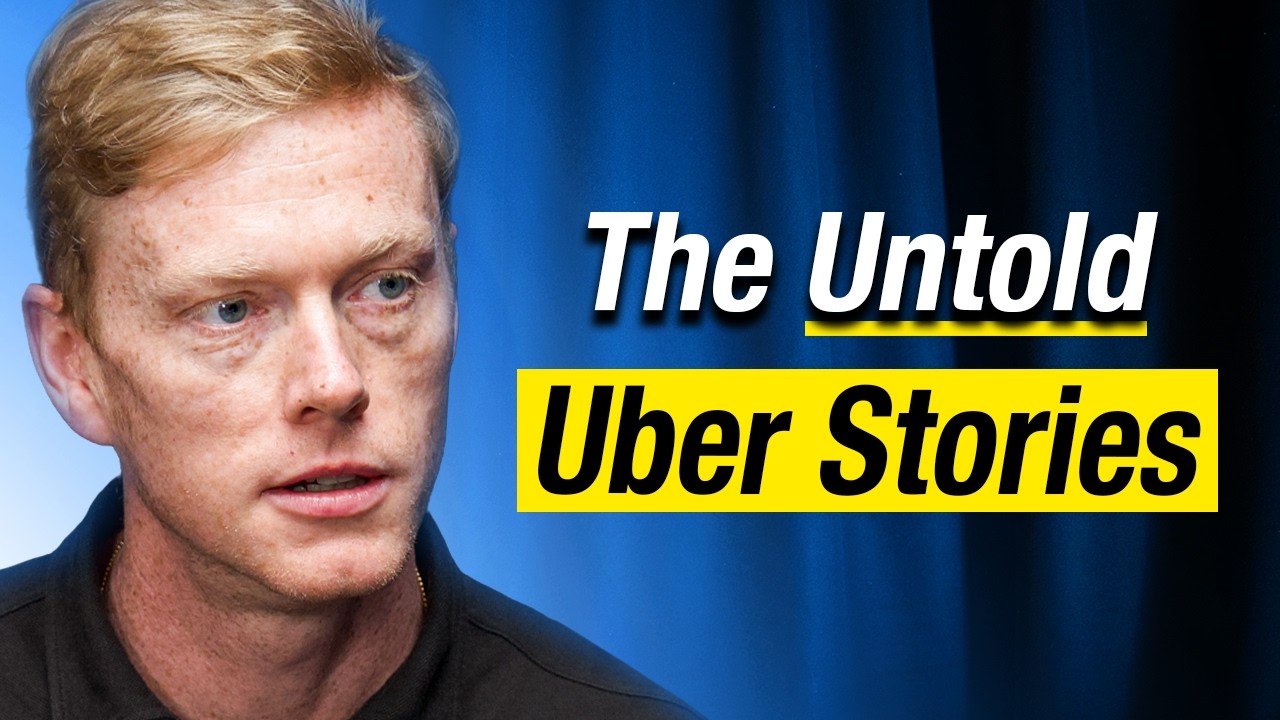
Uber President on Travis, China & Self-Driving | Why Autonomy Is Existential | How to Beat DoorDash
Description
Andrew Macdonald (Mac) is the longest-serving employee at Uber. Today, he is the President and COO. No one on the planet has spent more time mastering ride-sharing than Mac. Uber now does 300M rides per week, has 200M users, and is one of the most recognised brands on the planet. Mac never does interviews and so this was a rare look behind the scenes at the Uber machine. ----------------------------------------------- Timestamps: 00:00 Intro 01:51 How Andrew Retains Execution Drive While Being Liked 03:07 Where Andrew Has Been Wrong: Resisting Membership Longer Than He Should 06:32 The Most Efficient Dollar at Uber: Why Membership Beats Price Incentives 08:34 Why Uber One Is Not Yet Amazon Prime 10:08 New Revenue Lines: The Innovator's Dilemma at $250B Scale 11:54 How Uber Incubates New Businesses From Inside a Giant 18:33 Waymo vs Uber 23:56 The China Exit 34:09 Uber Blew Its AI Budget in 4 Months 36:49 The Real AI ROI Question 39:32 How to Budget for AI When Usage Is Vertical and Unpredictable 43:44 Will Uber Have More or Less Employees in 5 Years? 45:44 Should Enterprises Fear Frontier Model Providers? 51:00 How Uber Is Using AI Agents Internally 57:25 Andrew Now Running Uber Eats Directly: The Three-Sided Marketplace Problem 59:45 Why Uber Eats Is Not #1 in the US 01:02:29 Quick-Fire Round ---------------------------------------------------------------------------------------------- Subscribe on Spotify: https://open.spotify.com/show/3j2KMcZTtgTNBKwtZBMHvl?si=85bc9196860e4466 Subscribe on Apple Podcasts: https://podcasts.apple.com/us/podcast/the-twenty-minute-vc-20vc-venture-capital-startup/id958230465 Follow Harry Stebbings on X: https://twitter.com/HarryStebbings Follow Andrew Macdonald on X: https://twitter.com/andrewgordonmac Follow 20VC on Instagram: https://www.instagram.com/20vchq Follow 20VC on TikTok: https://www.tiktok.com/@20vc_tok Visit our Website: https://www.20vc.com Subscribe to our Newsletter: https://www.thetwentyminutevc.com/contac
Summary
Generated by gpt-5.6-terraAt-a-Glance
- Verdict: Watch fully
- Core thesis: Uber's defensibility over the next decade rests on owning consumer distribution and operationally managing complex physical-world transactions while using autonomy, membership, delivery scale, and AI productivity to lower prices and deepen platform engagement.
- Why it matters: This is a high-signal operator view on how a scaled marketplace allocates capital, approaches autonomous-vehicle platform risk, extracts enterprise AI value, and protects its customer interface from agent-led disaggregation.
- Best use: Use it as a strategic operating case study for AI adoption, model-cost governance, marketplace control points, and the distinction between owning the customer relationship versus merely supplying capacity.
Executive Summary
Uber President and COO Andrew Macdonald frames the company as a distribution and marketplace business rather than simply a ride-hailing operator. Its core mobility proposition remains price, reliability, and safety, but Uber One is now its strongest long-term consumer investment because membership increases cross-product usage, reduces churn, and compounds customer lifetime value more effectively than one-off discounts. The company’s broader goal is to make transportation and delivery cheap enough to replace more private-car ownership and capture far more frequent consumer use.
Macdonald calls autonomy existential because autonomous rides will increasingly be a safer and more private, preferred product. Yet he does not assume Uber must own the AV stack: he expects several winners, including Waymo and Tesla, whose costly vehicle fleets will require utilization. Uber’s bet is that its 200 million monthly consumers, demand liquidity, and operational layer will let it remain the primary distribution partner—even where AV providers also operate their own apps.
The most reusable segment is Uber’s pragmatic AI operating model. Macdonald rejects both the claim that AI has no ROI and the claim that ROI is automatic. Uber has paired a 30-person AI-engineering pod with business and G&A teams to redesign specific workflows, reporting reductions from 15 to two hours for capital allocation, eight to two hours for forecasting, and two weeks to two days for marketing QA. He argues that savings do not automatically become P&L gains unless leadership converts productivity into harder headcount or growth constraints.
On agent-led consumer interfaces, Macdonald identifies the key strategic risk: a generic agent can originate a request such as “get me my usual Uber,” but a comparison layer that commoditizes Uber into the cheapest interchangeable option threatens first-party demand. Uber will participate with major AI platforms, but wants to negotiate data access and responsibility boundaries carefully because mobility and delivery are managed transactions full of exceptions, support needs, payments, pickup issues, and service recovery.
Key Takeaways
- Claim: Uber One changed Macdonald’s view of capital allocation: it is Uber’s most efficient long-term consumer-growth lever, exceeding direct price incentives in cumulative value. | Evidence: Uber evaluates spend through incremental gross bookings (IGB). Membership cohorts ride more over time, consolidate mobility spend onto Uber, gain Uber Eats benefits, churn less, and become more resilient from a market-share perspective; Macdonald says the measured efficiency improves as cohorts age. | Implication: For multi-product platforms, loyalty should be judged on longitudinal cross-product behavior and retention rather than immediate promotion ROI; high-perceived-value, low-marginal-cost benefits are especially valuable. | Caveat: Membership benefits are structurally harder to fund in Uber’s mostly variable-cost model: a free ride still requires paying a driver, unlike giving away excess hotel inventory.
- Claim: Autonomy is existential to Uber because AVs should become a superior transport product, but Uber believes distribution and fleet utilization will preserve its platform role. | Evidence: Macdonald says AVs will become safer, increasingly better every day, and attractive because riders value privacy and the ability to work, sleep, or talk in-car. Uber is making its largest standalone investment across AV equity stakes, vehicle commitments, infrastructure, and data-collection fleets. He compares AV operators to McDonald's or Starbucks: even strong first-party operators use marketplaces to raise utilization of expensive fixed assets. | Implication: A control plane with demand, trust, payments, service recovery, and distribution can retain leverage against infrastructure suppliers—but only if the supply layer remains multi-vendor rather than monopolistic. | Caveat: Uber's position fails if a single AV company reaches the technological finish line alone and gains durable exclusive leverage. AV adoption will also vary radically by market: Brazil fares average roughly $3.50-$4 and India roughly $2.50-$3, making labor-replacing autonomy uneconomic there for much longer.
- Claim: The relevant AI ROI unit is a redesigned business process, not generic tool adoption or a direct headcount-reduction calculation. | Evidence: Uber formed a pod of 30 top AI engineers paired with business and G&A counterparts. Reported workflow outcomes include reducing weekly pricing-capital allocation across thousands of markets from 15 hours to two, finance forecasting from eight hours to two, and marketing QA from two weeks to two days. | Implication: Ken should assess AI systems through measurable cycle-time, quality, and decision-capacity improvements per workflow, then deliberately convert those gains into tighter operating targets rather than expecting savings to materialize automatically. | Caveat: Time saved usually gets absorbed by other higher-value work, so process-level improvements do not cleanly translate into a count of eliminated roles or immediate bottom-line savings.
- Claim: AI budget governance should treat headcount and compute as a combined capital pool, while routing tasks to fit-for-purpose models and exposing usage and cost. | Evidence: Macdonald proposes giving a technology leader a combined headcount-plus-compute budget so they can trade engineers against inference spending based on expected ROI. Uber uses external providers and internal systems for model routing, has created usage and cost dashboarding, and distinguishes expensive frontier-model tasks from simple queries that do not require them. | Implication: Build an AI control plane that combines model routing, per-task cost visibility, and role-specific adoption metrics, but evaluate usage against output quality and business value rather than raw spend or prompt volume. | Caveat: Leaderboards can become counterproductive when employees optimize their rank rather than value created; being highest or lowest cost is not inherently good.
- Claim: Agentic interfaces create a real disaggregation risk when they turn branded services into interchangeable, price-ranked suppliers, but managed transactions make full abstraction harder than it appears. | Evidence: Uber has historically refused aggregator apps seeking real-time API access to Uber inventory and pricing alongside Lyft and other providers. Macdonald distinguishes an agent request for “my usual Uber,” which Uber can fulfill, from “compare Uber, Lyft, and Waymo and get the cheapest,” which erodes Uber's current first-look advantage. He points to operational exceptions—incorrect pickups, rider-driver coordination, lost items, payment issues, and service recovery—as unresolved ownership problems for third-party agent layers. | Implication: For agent-mediated commerce, preserve ownership of the exception-handling layer and carefully constrain APIs that expose real-time inventory and price in a way that collapses differentiated service into a commodity comparison feed. | Caveat: Uber is not refusing the channel outright: it will work with OpenAI and other large AI companies, with data scope, handoff points, communications, and liability negotiated case by case.
- Claim: Large incumbents need protected incubation capacity because core-business scale otherwise consumes attention, resources, and decision bandwidth before new products can reach relevance. | Evidence: Uber runs a Growth Bets program with dedicated resources; Macdonald gives an illustrative target of 100-150 people working on new bets within a roughly 2,000-person mobility organization. He endorses weekly, not quarterly, operating cadence and recurrent funding reviews, citing Revolut CEO Nik Storonsky's practice of running 26 experiments with $2 million each, weekly 20-minute check-ins, and annual continuation decisions. | Implication: For new agent or platform bets, ring-fence dedicated teams, use frequent evidence-based continuation gates, and prevent parent-company resources from substituting for product-market fit. | Caveat: Internal ventures can become resource-heavy and slow because they lack startup constraints; Uber's distribution advantage only matters after it has built a genuinely compelling product.
- Claim: Uber's delivery strategy is a scale-and-localization expansion play, not merely a belief that it can eventually outlast competitors such as DoorDash. | Evidence: Macdonald says delivery is nearly as large as mobility, growing faster, and had historically expanded into fewer countries because of capital constraints. He describes the planned Delivery Hero transaction as a way to gain geographic scale, strong local consumer brands, and localized operations in markets including Argentina, Korea, and the Middle East. He characterizes delivery as a more complex three-sided marketplace than mobility and acknowledges Uber is not number one in the U.S. | Implication: In local, operationally dense marketplaces, buying entrenched brand, market knowledge, and liquidity may be faster and more defensible than greenfield expansion—even for a company with global distribution. | Caveat: The Delivery Hero transaction remains subject to regulatory and shareholder processes, and Macdonald does not claim that Uber can simply dominate DoorDash through execution alone.
Detailed Brief
Scale, affordability, and the private-car replacement thesis
- Claims: Uber's largest growth constraint is affordability, not simply awareness or app access.; Reaching 500 million users and increasing average usage from roughly six trips per month to 25 requires lower average transaction costs and a broader mode mix.; Macdonald expects a long-run world in which private-car ownership declines materially as ride hail, autonomous vehicles, transit, bikes, and scooters substitute for ownership.
- Evidence: Uber reports 300 million weekly core-platform trips and 200 million monthly app consumers.; Macdonald describes a $35 each-way UberX commute in New York as still a luxury product relative to most urban transportation.; He argues privately owned cars sit idle 98% of the day while depreciating and incurring continuing ownership costs.; Uber already lets users book trains through the app in London and sees bikes and scooters as important components of a multi-modal offering.
- Caveats: This is a long-horizon thesis rather than a near-term forecast; Macdonald suggests the car-ownership shift may take 15-20 years rather than five.; Micromobility and public-transit integration face local infrastructure, regulation, and consumer-preference constraints not explored in detail.
- Implications: The enduring marketplace opportunity may be demand aggregation across modes rather than winning one transport modality.; Lowering total trip cost through operational, modal, and autonomy improvements can expand frequency and TAM more powerfully than conventional user-acquisition spending.
China as a lesson in capital intensity and local structural advantage
- Claims: Uber's China competition became a subsidized capital war after product-market fit was already proven.; A Western platform's local disadvantage can be structural rather than a matter of operating execution.; The Didi exit was viewed internally as a pragmatic outcome rather than a desired victory.
- Evidence: Macdonald recalls Uber burning $52 million per week in China on price subsidies during the final phase of negotiations with Didi.; Uber at one point lacked access to WeChat, which Macdonald compares to competing in the U.S. without email or a phone number.; He notes that Didi and Kuaidi reportedly discovered 200 employees appearing on both payrolls after their merger, illustrating unusually intense competitive conditions.; Uber concluded that becoming China's leading mobility service was implausible, including for geopolitical reasons.
- Caveats: The discussion is retrospective and does not provide financial details of Uber's ultimate Didi stake or return.; The lesson should not be generalized mechanically to every international market; China had distinctive platform, capital, and geopolitical dynamics.
- Implications: When a local platform controls a critical distribution surface, capital alone may not overcome the access disadvantage.; A negotiated minority or partnership outcome can be economically superior to persisting in a structurally unwinnable subsidy war.
Leadership operating principles from the Travis-to-Dara transition
- Claims: Macdonald attributes his ability to drive execution without losing trust to a visible company-first decision filter combined with deep domain knowledge.; He treats changing one's mind as a leadership requirement, citing the idea that being right often requires frequent updates.; From Travis Kalanick, he values creative problem-solving and explaining the reasoning behind decisions; from Dara Khosrowshahi, he values leadership that creates followership through low ego, personal commitment, and care.
- Evidence: Macdonald acknowledges he was too short-termist about membership, favoring direct price reductions and driver supply over funding Uber One.; He describes Kalanick's ability to enter an expert meeting, ask pointed questions, and reshape thinking within 15 minutes.; He summarizes Khosrowshahi's approach as: “Management comes from an org chart, leadership comes from the heart.”; His career advice, attributed to former communications leader Rachel Whetstone, is “always say yes” to difficult new opportunities.
- Caveats: These are personal leadership observations rather than a tested management framework.; Macdonald flags current organizational strain: Uber teams are pushing hard and may not be able to operate above the red line indefinitely.
- Implications: To scale judgment, leaders should publish decision principles and reasoning, not just decisions.; High-intensity execution cultures need active capacity management; a crisis orientation can be productive but becomes a burnout risk when sustained.
Notable Concepts & Terms
- IGB (Incremental Gross Bookings): Uber's baseline metric for evaluating growth investments: how much additional transaction volume a dollar of spending produces, distinct from immediate profit ROI.
- Uber One: Uber's membership program; presented as a compounding retention and cross-sell mechanism across mobility and delivery rather than merely a discount product.
- Growth Bets: Uber's internal incubation structure intended to protect dedicated people and attention for new businesses that would otherwise be overwhelmed by the core.
- Managed transaction: A transaction requiring ongoing coordination, exception handling, payment support, and service recovery; Uber uses this to argue that agent interfaces cannot trivially replace its operational front end.
- Model routing: Selecting different AI models for different tasks based on cost and capability rather than defaulting every request to a frontier model.
- Combined headcount and compute budget: A proposed budgeting mechanism that lets leaders allocate between people and AI inference/compute based on expected return from a shared resource pool.
- ATG: Uber's former internal autonomous-technology group, divested during COVID after Uber concluded it was not leading the AV field and needed to focus on restoring core-business cash generation.
- First look: The strategic advantage of consumers beginning their purchase journey in Uber's app before any competitor or price-comparison layer enters the decision.
Operator Notes / Why Ken Should Care
- Adopt a workflow-by-workflow AI deployment scorecard: baseline cycle time, quality/error rate, human escalation rate, cost per completed task, and resulting decision throughput; do not use generic seat adoption as the primary ROI measure.
- Set a shared people-plus-compute budget for agent operations, with explicit model-routing policies and cost telemetry at the task level; require teams to justify frontier-model use for low-complexity work.
- Translate demonstrated AI productivity into operating constraints during planning—e.g., flatter headcount growth, fixed headcount, or higher output targets—otherwise reclaimed time will be absorbed without economic capture.
- For any agent-facing API or channel partnership, specify who owns identity, payment, customer communication, exception handling, service recovery, and liability before exposing real-time inventory or pricing.
- Maintain first-party product surfaces for high-frequency managed workflows; participate in external agent channels selectively through handoffs that preserve the operating relationship rather than permitting pure price aggregation.
- Ring-fence small teams for new agent products, run them on weekly evidence reviews and staged funding, and avoid allowing abundant parent-company resources to mask weak product-market fit.
- Monitor AV suppliers as potential upstream bargaining-power risks; prioritize integrations and demand-side leverage that keep supply multi-homed rather than dependent on a single autonomous provider.
Source/Metadata
- Title: Uber President on Travis, China & Self-Driving | Why Autonomy Is Existential | How to Beat DoorDash
- Transcript words: 22103
- Duration seconds: 4184
- Timestamp note: No usable timestamps or chapter markers were present in the supplied transcript; substantial passages were duplicated.
Transcript
We're doing 300 million trips a week. We were burning 52 million a week in China. We were competing in China with one hand tied behind our back. Andrew McDonald, he's the president and COO at Uber. He is Uber's longest tenured active employee. And today, Uber's an absolute monster. They have a market cap of 160 billion, revenues of 52 billion in the full year of 2025. They have 200 million consumers that use the app monthly. This was a behind-the-scenes look at Uber we haven't seen before. Autonomy is as bad as it's ever going to be today, right? And every single day it's going to get better. I think, in the end, distribution wins. We could do everything we do today with fewer people in five years because of the power of AI. No one's been at the company longer than me at this point. Ready to go? Mac, I am so excited for this, dude. I've wanted to make this happen, and we've been DMing for a long time. It's so good to do it in person. So great to be here. And you're right. I remember the first Twitter DM from you, and I was a bit of a fan from afar, as you probably hear often. But great to be here now. I'm so glad to do it in person. So I spoke to Dara before the show, and I said, what's his superpower? He's been here for over a decade, whatever, 12, 13 years. 14 years, 15 in May. No one's been at the company longer than me at this point. My God. And I said, what's his superpower? And he said, oh, very simple. People really like him, but he is an execution machine, and he is very good at driving people. And I suck at that. So can you put them in seriously? How do you do that but retain people liking you? I get the question in the context of career advice. People start, they join Uber, they say, you've been very successful at Uber. How should I be successful here? What did you do to get successful? And it's hard because every formula is different. But there's a couple of things I say. One is, and I think the most important thing is, if you genuinely are just trying to do what you think is the right thing for the company, and that is your filter, and you build trust that that's what you're optimizing for all the time on every decision, big decisions and small decisions, that you are using the lens of what is the best thing for Uber. You're not always going to get the decision right, but if people know that you're filtering on that, then I think that builds followership and trust over time. And then you can move people because if you're pushing on something, they know it's because you genuinely think it's the right thing to do. And then if you pair that with a deep knowledge of the business, and I've grown up in this business, so I know, especially ride hailing, I know that better than anyone in the world at this point. Those two things together I think are pretty powerful. You do literally know it better than anyone else in the world. Yeah. It's hard. I mean, it's only been around since 2009. I've been working on it since 2012. And most folks from that time period are not working on it anymore. You said when you genuinely believe it's the right thing for the company. Yeah. What did you genuinely believe was the right thing for the company? And it turned out you were wrong. I mean, the first thing I say is, I am wrong every single day. Big things and small things, right? I actually love the, I think it's a Bezos quote, which is if you want to be right most of the time, you've got to change your mind a lot, or something to that effect, right? Which is effectively, you're going to be wrong a lot. And actually, the people who are successful over time are willing to change their mind. So I think that's true. So I'm wrong a lot. This is probably the most common running debate that Dara and I will have, as I think of his tenure as CEO, which is, and thematically it's the tension between short-term levers and long-term levers for the business. So a short-term lever for ride hail is price, right? Every dollar that we can put back into lower pricing, I think is valuable. Even if long term, there may be other things you want to do, like acquire new users or build a membership program or build new business units, you should be weighing those investments versus I could just put a dollar back into price. And so I think I have been too short-termist on certain issues, like membership, Uber One, for example. I was running the mobility business. You're smiling. So I suspect you maybe thought, I don't know. Well, I'm smiling because I said to Dara, what is the single, when I say the biggest disagreement that you've had with Mac that comes to mind first? And he's like, say it's from me. Say it's from me. Normally people anonymize this. Say it's from me. He was reticent about membership programs. Yeah. And I think now he's changed. Totally. And I've turned out to be wrong. I mean, the reason I've changed is because our... First of all, Uber One is, I think on many metrics, one of the more successful membership programs in the world. I mean, we're not at Amazon Prime or Costco levels, but we're getting to within spitting distance. And from a company lever perspective, it's highly efficient. And when we look at efficiency, we usually look at, if I put a dollar in, what am I getting back in terms of top line? And it's one of the best levers we have. And the longer we can measure it, the more efficient it gets and the better it stacks up versus other levers. So you're like, okay, Mac, well, how did you get that wrong? If that's what the data showed you, then why weren't you all in on membership? And when he says, when I say I wasn't all in on membership, what I mean by that is, I would constrain the capital envelope that we would have in the mobility business to invest in this. So if I had 40 million bucks next quarter to invest, my gut was always, put as much of that into pricing as you can or put as much of that into driver supply to improve the health of the marketplace so that service is more reliable. Because ride sharing at the end of the day is price, reliability, and safety. That's all it is. That's what it was 10 years ago. I think that's what it's going to be 10 years from now, even when it's autonomous vehicles. It's price, reliability, safety. And putting money into something like membership, where people get a suite of benefits, part of which is price, but a whole other host of things, you're explicitly choosing not to put that dollar back into price. And that's just the tension. And I probably was too short-term in my thinking there. You said there about dollar leverage, putting in dollars to what you get out. What is the single most efficient dollar in to dollar out business for you today? I think membership is the most efficient long-term consumer lever that we've got. And the reason for that is ultimately we are looking at IGB as a critical input metric for any dollar I deploy. Is IGB? Incremental gross bookings. Think of it as incremental revenue. Okay. Right? If I put a dollar of incentive into the market, if I give Harry a dollar, and I give a million other consumers a dollar discount, how much incremental revenue do I get back at that? And by the way, the ROI on that is different because ROI is, if I get $2 of revenue back from Harry by offering you a dollar, you might be like, okay, that's great. That's a two-to-one ratio. But actually we only make seven and a half percent of your dollar from a profit margin perspective. So you're still negative ROI, but you make those sorts of investments to grow the platform over time because I've increased Harry's engagement, and then your LTV goes up over time. So we're typically looking at a very baseline IGB-type or incremental revenue-type metric for any dollar we're putting into the marketplace. Membership just gets better over time. The reason it gets better over time is, if Harry becomes a member, not only do you ride more next month, but actually that cohort of members we acquired in that month tends to ride more over time. They consult, and part of that is because they're consolidating more of their mobility business onto Uber. Part of it is because you get some Uber Eats benefits with your membership program too. So now you start using Uber Eats instead of DoorDash or Deliveroo. And so the LTV of Harry just goes up over time with membership. You're less likely to churn. You're more resilient from a market share perspective. of investments to grow the platform over time because I've increased Harry's engagement, and then your LTV goes up over time. So we're typically looking at a very baseline IGB type or incremental revenue type metric for any dollar we're putting into the marketplace. Membership just gets better over time. The reason it gets better over time is, if Harry becomes a member, not only do you ride more next month, but actually that cohort of members we acquired in that month tends to ride more over time. They consult, and part of that is because they're consolidating more of their mobility business onto Uber. Part of it is because actually you get some Uber Eats benefits with your membership program too. So now you start using Uber Eats instead of DoorDash or Deliveroo. And so the LTV of Harry just goes up over time with membership. You're less likely to churn. You're more resilient from a market share perspective. There's all these downstream long-term impacts that multiply the value of that first dollar I put into membership. With shorter-term levers like price or promotion, there's some tail. If I give you a dollar to take a trip next week, there's some value in the following weeks, but it tends to dissipate faster. And so that's often the debate. You said it's not quite Amazon or Costco, say, in terms of membership dominance. Yeah. I think that's fair. They've had a little bit more head start than you. When you look at that chasm between you, what do you not have that you would need to have to reach their dominance? From my perspective, we need to put more consumer value into the membership program. So today, I think, especially if you're a mobility rider, typically on mobility you're getting 5% cash back, right, is our standard offer. The consumer comprehension of that is still relatively low. For a membership program as big as we are, I think there's still a lot of people who have Uber 1 and don't actually fully realize the benefits they're getting on mobility. The other thing we need to do is we're looking for features that are high perceived value, low cost, right? That's the sweet spot of any membership type program or rewards program, for example. With our business, that's tough because I don't have a lot of free to give away on the platform, right? If I want to give you a ride because you're a loyal member, either through a membership program or a rewards program, I still have to pay the driver to provide that ride, right? It's not like a hotel where you might have excess inventory, and so your marginal cost of giving away a room night is pretty low. The beauty of our model is we're primarily a variable cost model, right? It means when demand drops, great, our costs scale down with it, but it also means that we just don't have a fixed capacity to give away. And so it just makes the challenges for building a membership or a rewards program a little tougher for us. What line of revenue do you not have today that will be very significant in five years' time? It's hard, right? Because significant for us is really fucking big at this point, right? Like a billion? We're approaching a quarter billion dollars in GB, right? So if you think about that top-line metric, what is our GMV or GB number? We're not far off from being a $250 billion company. So for anything to pass the significance test, it has to be a multi-billion dollar business in terms of transaction volume, right? So I'm thinking of a new product I want to stand up, and it's a mobility service that we're going to offer through the Uber app. For that to even be interesting, I have to see a path within a few years to multiple billions of dollars of GMV. And it actually constrains your thinking a little bit. Do you worry that that prevents you trying new things? Yeah, totally. Totally. Do you like a Google Labs? Go on, try Gmail, Paul Buchheit. Do you know what I mean? Yeah, I mean, we do. We try to set up structures to solve this problem. It's a classic innovator's dilemma problem, right? Which is, the thing you've already built is so big that it just swallows up your organizational capacity to do anything else. And even if you're able to stand up other businesses, it's impossible for those businesses to get the resourcing, attention, distribution, marketing dollars, engineering capacity, whatever it is. It just gets swallowed up by the whole. And part of it is even management focus, right? It's very hard to focus on the new thing when you've got this $225 billion blob that you've got to manage over here. So how do you solve that? We run a program called Growth Bets, which is intended very much to incubate new businesses within Uber. How does that work? So basically, what we try to do is, A, create dedicated resources. So if I've got 2,000 people, made-up number, but 2,000 people that work on our mobility business, I want to try to have 100 to 150 of them working on the new stuff, the small stuff, the stuff that we don't have product-market fit or unit economics figured out, but that could be a big future business. But it requires dedicated capacity and thinking. If you try to do it as 5% of your job, I run the marketplace for UberX in the US, but I'm also trying to incubate this other thing with 2% of my time, it's really hard. Do you know who the best in the world is at this? Nik Storonsky from Revolut. Oh, interesting. I've interviewed 1,000 founders. He's the single best founder I've ever interviewed, and it's because he runs 26 product experiments at once. He gives them $2 million, tells them to run for a year. Every single week, he checks in for 20 minutes with each of the leaders, and then he determines whether to fund their next round or not. Yeah. I love that. We have a version of that. It's not the... I love the cadence of that, by the way. Operating on weeks, not months or quarters, is how a new business should run. I think also having to sing for your supper, come back and ask for money. The challenge, again, the other challenge of standing up a new business within a big company, with a big P&L and a big balance sheet, is people just get fat on the resources, right? And so you don't build it the way you would build it if you were a startup because you just have more resources. So you end up moving slower, consuming more cash, getting more heads than you otherwise would if you were actually starting up from zero to one. And as a result, it's not that you necessarily build something better. You just are slower, and you're constantly actually chasing the people who are doing it from first principles. And so I think that's hard. Now, we should... you have advantages. We have distribution, right? Distribution is... Which is the mother of advantages. 100%. And so if you can actually build something interesting and then plug it into 200 million consumers who use our app monthly, you're just going to be able to scale way faster than anyone who's doing it without that distribution advantage. And even figuring out how to do distribution right, the 200 million number is attractive. But even within that 200 million, of course, there's tons of internal discussion and debate around how we spend our pixels, right? Every new product wants CRM support. Every new product wants to be featured on the masthead of Uber Eats or wants to be in the product selector for rides. And so how you make those decisions as an organization is tough, but you still have this built-in distribution that is super interesting. And so it's an advantage, but you've got to figure out the other stuff, which is, how do you stand up new products in a company? Other than time, what is the one inhibitor to getting to 500 million users? You mentioned 200 million. I would say our IR team is not going to love this answer because I would say price. And the reason our IR team won't love that answer is because when you start talking about price in the context of public markets, people are like, oh, you're going to get into a price war, and margins are going to come down, and it's a less attractive business. But that's not really what I mean. What I mean by price is when you think about the businesses we operate, primarily mobility and delivery, the vast majority of the transactions in delivery of things, or the vast majority of the transactions in transportation broadly, happen at a price point that is way lower the other stuff, which is, how do you stand up new products in a company? Other than time, what is the one inhibitor to getting to 500 million users? You mentioned 200 million. I would say our IR team is not going to love this answer because I would say price. And the reason our IR team won't love that answer is because when you start talking about price in the context of public markets, people are like, oh, you're going to get into a price war and margins are going to come down, and it's a less attractive business. But that's not really what I mean. What I mean by price is when you think about the businesses we operate, primarily mobility and delivery, the vast majority of the transactions in delivery of things or the vast majority of the transactions in transportation broadly happen at a price point that is way lower than our core products, right? Taking an UberX to and from work every day in New York City for 35 bucks a direction, that's still a luxury product, right? The vast majority of transportation in New York City is not happening at that price point. And so, if we want to get to 500 million users and we want to go from people using us on average six times a month to using us on average 25 times a month, that average cost of that transaction has to come down. And so, how do you get that down? There's all sorts of ways in doing that. You have more modes that are cheaper. You can get trains on Uber here in London. You have alternative modes like bikes and scooters, et cetera, because once you deconstruct car ownership, it's not just about UberX, it's about all the other things you do. But you have to get price down. A la Pubelle. I fucking hate these bikes that litter the pavements. Oh my God, they're so annoying. You do. Oh my gosh, I'm an old man. But Londoners love them generally. London is such a significant market for micromobility. I know, I know. It's why I didn't get out much. Would you rather have more cars on the road? Would I? Yeah. To be fair, I live around the corner. But to be fair, I use Uber as an argument every single day because I don't have a driver's license because I have Uber. I love that. And my girlfriend has a car that's, what, 20 grand, and then insurance is three or four. Yeah. And I'm like, do you know how many Ubers I'd have to take to get to 24 grand? Totally. I mean, the car, the individually owned car, is the most inefficient asset that anyone owns, and certainly at any level of price point, right? It sits idle 98% of the day. Depreciating. It's depreciating. The ongoing operating costs are actually high even if you're not driving, and you're paying for that insurance clip, which is why I do think in some future world, maybe not five years, but 15 or 20 years, everyone's going to be like Harry. Nobody's going to own a car. Nobody's going to have their driver's license because you'll be able to get around. And I think bikes and scooters will be part of that. I think autonomous vehicles will be part of that. I think public transportation will be a big part of that. But I don't think you need to own a car. One way to bring down price is to remove cost. And one way to remove cost is to think about robo-taxis, autonomous. You said before it was existential. Why is it existential? And how do you think about that and how it changes the business forever? It's existential because at the end of the day, it's a better product than our core product in many use cases. And I think those use cases grow over time. And eventually, it's better in all use cases. You can quibble along the edges on current autonomous vehicle experiences, right? In most cases, it is going to be slower than a human driver. The pickup point may not be right in front of your door as you would get with a human driver. It's not going to work in all weather conditions, all geographies, all pickup points. You can quibble on that today. But I think increasingly over time, autonomy is not only going to be safe, it's going to be safer. And I think it's going to be a better experience because people like the in-car experience. The in-car experience of having privacy and being able to work or sleep or talk with your partner or whatever it is you want to do, that is better, and people prefer that for the most part. So when you have a better product that is only going to get better over time, and autonomy is as bad as it's ever going to be today, right? And every single day it's going to get better, then that's going to be the business and that's going to be how people get around. And if Uber doesn't have autonomy on our platform, and we will, we are investing actively and aggressively to bring it to market. But if we didn't, then it certainly would be existential for our core business. Is it the largest investment that you make? It is. I mean, I think it kind of depends on how you define it a little bit. If you look at our autonomy investments, we are making a mix of equity investments in companies, vehicle purchase commitments, building out autonomous infrastructure, building out data collect fleet. There's a lot of different ways we're spreading the dollars. And we're pretty confident in the ROI in those dollars long term. So, yeah, it's the largest single standalone investment we make. Now, don't get me wrong. At a P&L our size, we're moving billions of dollars around every month. But yes, it's the largest single area of investment. I'm a venture investor also. Yeah. Which means I love to pontificate. And I also love to say, I told you so. Yes. You and Travis kind of went down this road already. Do you look at that with annoyance, that you stop-started? And would you be materially ahead had you just been able to continue as planned? First off, I'll say when we started our autonomous efforts, this was a secret project within Uber. I was not involved in starting that. I don't want to take any credit for having that foresight because I think it was foresight, right? I think this was 2016. No, well before 2016, I think Travis had, I don't want to get it wrong, but years earlier than that, knew that this would be the future. And like many visionary founder types, he could see ahead of where the rest of us could see and started taking the company in that direction. So this would have been 2012, 2013, 2014. We would have quietly started working on this, and I wasn't involved in it at all. And at that time, autonomy, the narrative was ahead of the reality by a lot, right? I mean, you can go back and read various prognostications, and not just from Elon, from many people in the industry saying next year, next year, next year, and it was never next year. But look, I think it would be rose-colored glasses to say, oh, see, if we just stayed in the game, we'd have the leading autonomous vehicle company and this existential threat for us wouldn't exist or we'd completely control our own destiny. I mean, when we ultimately divested ATG, which was our internal autonomy group, we were in the depths of COVID. Our mobility business had lost 84% of our top line in three weeks. The company was burning billions annually. We didn't have a core business producing cash. The billions were not coming from investments and other stuff. Our core was burning money. We did not believe we were leading in autonomy at the time. We were trailing. You can debate about whether we were trailing the field or whether we were just trailing Waymo, but we were not in the pole position. And Uber had a lot to prove, that we could just lead and win and make money in our core business. And so, we divested ATG. We turned the core businesses into cash-flowing machines. We took the company public. We've grown the value, grown the business. Almost any metric you pick from that point in time is up and to the right. And so, on all those dimensions, I think the focus strategy played out. But yes, of course, today, if you could snap your fingers and say ATG would turn into one of the leading autonomous players globally and we completely control our destiny, yeah, I think that would be a good thing for us. Can I ask you, when you fast forward five years' time, what percent of rides will be human-driven versus robo-taxi-driven? It's so hard to predict, I mean, for a few reasons. One is, Uber had a lot to prove: that we could lead and win and make money in our core business. And so, we divested ATG. We turned the core businesses into cash-flowing machines. We took the company public. We've grown the value, grown the business. Almost any metric you pick from that point in time is up and to the right. And so, on all those dimensions, I think the focus strategy played out. But yes, of course, today, do I wish we, if you could snap your fingers and say ATG would turn into one of the leading autonomous players globally and we completely control our destiny? Yeah, I think that would be a good thing for us. Can I ask you, when you fast-forward five years' time, what percent of rides will be human-driven versus robo-taxi-driven? It's so hard to predict for a few reasons. One is, the denominator is huge here, right? We're doing 300 million trips a week on our core platforms. That is just massive scale. So, we do a few million trips in AVs on that platform today, a month, but it's just such a small part of the business that it's going to grow triple-digit percentages month on month and month and month, and it will still be a relatively tiny drop in the overall bucket. The second thing that makes it hard to predict is our human-driven business is going to keep growing, right? And so, we found even in the largest AV markets, where today we don't have AVs, like San Francisco and LA, our human-driven business is growing faster than the rest of the US. So, it's hard for me to know what the—it's a moving target. The third piece is, Uber's so global, right? In mobility, we operate across 75 countries. Two of our three largest countries by volume are India and Brazil. The average fare in Brazil is $3.50, $4 USD. In India, it's $2.50, $3 USD, or something like that. It's going to be decades until the cost of autonomy compresses to the point where it competes with that cost of human labor. And those markets make up the majority of our trips. And so, if you want to say, when will the majority of trips at Uber be autonomous, I can't tell you, because I can tell you it's probably not going to be until autonomy gets to Brazil and India, and I can tell you that's going to be a long time. So, what's really interesting there is actually it could still be a very low volume of trips. Low volume, but significant. In terms of dollar amount, it could actually be significantly higher. Dollar amount, yeah, because if it's in the U.S. and if it's in the largest cities in the U.S., then that's where the rubber meets the road. That's the, for sure, that's the counter to what I'm saying. I'm saying, oh, it's going to be more complex and we have all this other—but yes, of course, if autonomy starts to make up the majority of markets in San Francisco, LA, DC, Miami, New York, Boston, Chicago, that's a big chunk of our bookings. That's a big chunk of our dollars. And so that's kind of the ultimate question. Can I ask you, who do you think is a bigger threat, Waymo or Tesla? Yeah, I don't know how many spicy takes I want to have here, but I think there's going to be more than two winners. Do I think Waymo and Tesla will ultimately be winners? Yes, I do. I don't know who's going to bet against either of those, but I think there will be more winners. I also think, even in a world of strong winners, a very natural question, or often feedback we get from investors or smart types who follow our business, is like, so yeah, I believe that there will be a few players that get to autonomy and I think they're ultimately going to work with you guys, but they're going to have such strong leverage in the market that your share of every dollar is going to get squeezed. And so I just don't know, even in a world where you have access to autonomy, how are your margins going to look? Because today you guys benefit from fragmentation. And that's true. I think it's a true statement, but there's a couple counterpoints to that. One is, if you look at delivery as a comparable vertical here, McDonald's and Starbucks also are strong leaders in their individual verticals. They've spent billions building out fixed assets in terms of stores and all the infrastructure that goes into their supply chain. They have 1P channels. You can walk in the front door of a McDonald's. You can order through the McDonald's app. But they also ultimately work with the marketplaces, and we're able to come to a good economic agreement that works for both sides because, at the end of the day, they have expensive fixed assets and you want to drive as high utilization as possible. And whether that's a store or a car, I think that's going to be true. And so I think whether Waymo or Tesla ends up being the bigger threat, I don't know. I think ultimately it's in both of their interests to put their vehicles on our network, even if they have their own RoboTaxi apps or their own 1P apps, even if they work with our competitors on the rideshare side or on the delivery side. I think everyone will work with us because ultimately we have distribution, and ultimately they have expensive fixed assets that need utilization. What's interesting there is you say then that distribution is more important than superior technology. I think in the end, distribution wins. And look, of course, if only one player gets to the finish line on the technology side, then that is a problem for us. But that is not the future that I think we think will exist. And even if you look at what's happened in China, there's not one AV company that is emerging as a winner there. There are already four or five. So I don't know why China would have four or five, which by the way will over time become eight or ten, and the rest of the world would converge around one player. I just don't see it emerging that way. You were at Uber when you did Uber China, no? I was. Yeah, we exited our China business in 2016. You've got kids, right? I do. I have three daughters. Okay. So with kids, you tell them story time. Yes. Right? I pretend like it's story time. What's the wildest story from Uber China? So I was only over China for a few months before we ultimately did the deal with Didi. And even just those few months were like, I felt like I lived years, right? Just seeing the deal process play out, all the regular emotional highs and lows that come with the deal process, but also then the specific China-specific, Travis-specific—it was just crazy. And ultimately, we got a successful outcome that I think folks would say most Western companies did not have. Even though we didn't win, even though we took the silver medal in China, I think we got a better outcome than the vast majority of Western companies and the vast majority of Western technology companies that try to do business in China. Do you have a crazy story? Like story time for the girls? So in China, the crazy thing was you'd be negotiating, and to be clear, others were running the negotiation. We were running the business, but the sort of mandate behind the scenes of the negotiation was, we got to push on investment because it gives you leverage at the table, right? So if one side saw the other was gaining share as you were negotiating this deal, it kind of gave you relative strength. And this was happening day by day, and both sides were just so well capitalized, right? Travis used to have a saying, which is, we need to raise more money than all our competitors in the world combined, because the basis for competition for rideshare, which is product-market fit, was clear. So it was just a land grab at that point, and money helped you solve the land grab. And so we had raised immense amounts of capital. On the other hand, so had Didi, right? And the notion that we were going to be able to raise more than everyone in the world combined, it was just never going to happen past a certain point because you had players like SoftBank investing in the market as well. And you remember those days, that was the free-money era, and Uber was best in the world at capitalizing the free-money era, but there were many others that were good at it as well and ran the same playbook as us. So all that is to say, I remember the last few weeks in the negotiation, we were burning 52 million a week in China just on price subsidies because there was this heated behind-the-scenes battle happening to get to the best economics and the ultimate surrender, or the ultimate truce. So that was crazy. Another story I heard, which I thought was nuts, And so we had raised immense amounts of capital. On the other hand, so had Didi, right? And the notion that we were going to be able to raise more than everyone in the world combined, it was just never going to happen past a certain point because you had players like SoftBank investing in the market as well. And you remember those days. That was free money era, and Uber was best in the world at capitalizing the free money era, but there were many others that were good at it as well and ran the same playbook as us. So all that is to say, I remember the last few weeks in the negotiation, we were burning 52 million a week in China just on price subsidies because there was this heated behind-the-scenes battle happening to get to the best economics and the ultimate surrender or the ultimate truce. So that was crazy. Another story I heard, which I thought was nuts, and this was not an Uber story, but before, when Uber and Didi did our deal, we were the two largest players. But before, there was a third player, I think it was called Quaddi, and Didi and Quaddi merged. And they merged the companies, they did a deal, you're combining HR systems, and they realized that of the 2,000 employees here and the 2,000 employees here, there were 200 employees that were on both payrolls. And so you had this dynamic where you realize, oh, okay, this is real, deep, competitive, gnarly. You have employees that are wearing both hats, which was crazy to me to hear because that notion, just in competing in the US, it's not something that I, in a million years, could see happening. Feels like a frontier AI lab employee. Wild, wild. And so there was all sorts of stuff like that. Remember, we were competing in China with one hand tied behind our back. Because of the nature of the investor basis in each company, at one point, we were not able to operate on the WeChat platform. Trying to compete in China and not having access to WeChat, it's like trying to compete in the US without email or a phone number. It's very difficult to run your business, but we did have our own local partners that were helpful. Were you pleased to get out? I mean, look, nobody, you're never pleased to take the silver medal. I don't think it was plausible that we were ultimately going to be the market winner. Even for geopolitical reasons alone, the notion that a US tech company would ultimately be the largest mobility service in China, I just don't think it's something that was ever plausible. And so it was always going to be about some exit to a local player. And I think, all things considered, we got a pretty good exit. I don't think Xi Jinping is going to give you employee of the month award, is he? No, it's hard, right? It's hard. And I think the hardest part of exiting, not the market opportunity that was obvious, not the growth because that was something that was exciting in our business, but was also heavily subsidized, but the Uber China team, these were people who bet on Uber, who joined Uber. I'm sure when many of their friends and families were like, what are you doing? Don't join those guys. They were heart and soul Uber employees. And I think one of the awesome things we did at the time was we tried to give as many of those folks who wanted it roles in the global machine. And many of those folks, and there's still some that are at Uber today, but that was hard. And Travis is actually a pretty loyal guy for people who are all in on the company. And our Uber China team was all in on the company. And so that was a hard moment for us. It'd be wild freaking time. Wild. Wild. Wild. It makes today with AI less wild. It's all relative, right? When you're in it, some of these things, when you're in it, it's just your reality. And so you don't quite realize, but then you have the benefit of 10 years of hindsight and you're like, that was crazy. Speaking of wild and crazy and China letting US companies do well, China competing, you blew through, what was it, a year's budget for AI in four months. Sorry. I'm just laughing. It's like you go to this meeting and you're like, so how's the budget going? Well, first of all, it's not like that was a big spreadsheet reveal and you're like, oh, it's gone. I think budgeting for new stuff is tough, right? It's like me and my mother and Chanel. I'm like, oh, it's gone. I'll stay away from that. Yeah, terrifying. Is that evidence of incredibly effective tools or is that evidence of a desperate need for guardrails? I firmly believe multiple things can be true at once. So let's come to that. Let me give a little bit of backstory on this because Uber had two big AI headlines in the first half of this year, I think both of which caught at least the people involved by surprise. One was Praveen was speaking at an event and generated this headline by saying we were through our AI budget in the first few months of the year. Praveen's our CTO. And then I did another podcast and said it was hard to draw a direct line from our AI spend through to useful consumer features. And both of those comments caught fire in a way that I think neither of us expected, right? Praveen wasn't making a comment about runaway spend, like we're going to bankrupt ourselves. He was just saying, effectively, it's hard to predict usage. Usage has been more than I thought. We've been trying to drive usage, and here we are blowing through a budget, but you're setting a budget number in November for a tool that's growing vertical in terms of usage. Of course, it's hard to pinpoint where you're going to be. And then my comment, honestly, first of all, it wasn't insightful at all. It was held up as this insight. It showed to me the power of people reinforcing their preconceived notions, taking a statement, which is fairly innocuous on its surface, and either using it to prove their point on one side or the other. So on the one side, it was kind of like, I think AI skeptics were saying, see, the Uber COO is saying there's no return on AI, which is obviously not what I was saying. On the other side, there was this, if you were a fundamentalist AI evangelist, you were saying, this guy has no idea what he's talking about. They're obviously doing it wrong because AI is God and I don't touch my computer without engaging AI, right? And obviously, there's just nuance in the middle that is true. So the point around ROI, for me, it's a couple of things. One is, at the end of the day, we do want to get efficiency or we want to get new and cool stuff built. And we are seeing examples of that every single day. We have stood up a pod of 30 of our best AI engineers that are partnered with business people or partnered with folks in the GNA functions to go in and go process by process and start ground up with AI. How do you improve that process? And if you can take a capital allocation process, like every week, we're allocating pricing dollars across thousands of markets globally, and I can take that from being a 15-hour process to a two-hour process, which is what we've done, that is tremendous, tangible ROI because now you get two days of someone's time back. If you're able to take a forecasting process, which our finance team is constantly re-forecasting every inch of our business, and you're able to turn that from eight hours of work into two hours of work, you're able to now do that not only with more precision because you can put an additional layer of nuance into those forecasts, but you're just able to have your folks do other stuff. There's clear ROI there. If you're able to take marketing QA from two weeks to two days, there's so many examples of that that we see. And the way we've done that, again, is by pairing the business folks with the AI engineers. The second thing I think that... Are you actually seeing that today? Because Alex Karp came on CNBC or CNN and said, no, the ROI question is still there, to validate what you said, to be clear. Outside of coding and customer support, with the greatest of respects, I think anyone who runs a budget in a large enterprise would say, yes, it's still not material at best. I think it's just hard to know. These things are just hard to quantify. And so you do have to be a bit top down not only with more precision, because you can put an additional layer of nuance into those forecasts, but you're just able to have your folks do other stuff. There's clear ROI there. If you're able to take marketing QA from two weeks to two days, there are so many examples of that that we see. And the way we've done that, again, is by pairing the business folks with the AI engineers. The second thing I think that... Are you actually seeing that today? Because Alex Karp came on CNBC or CNN and said, no, the ROI question is still there, to validate what you said, to be clear. Outside of coding and customer support, with the greatest of respects, I think anyone who runs a budget in a large enterprise state would say, yes, it's still not material at best. I think it's just hard to know. These things are just hard to quantify. And so you do have to be a bit top-down and belief-based about it, right? I think three examples I just gave there. Assume there are dozens more of those. The natural question is, okay, great. How many of those people can I take out of my organization so that I get the cost back and that flows through to the bottom line, or I can put it into other things? But formulaically doing that is really hard because, guess what? The eight hours of value that was created, or the eight hours of excess time, gets filled with some other activity, which is also presumably high value. And maybe before, it wouldn't have gotten done or wouldn't have been done to a level of precision. So it's just very hard. So I think the way companies ultimately have to extract AI efficiency, at least from a pure OPEX perspective, is just in your target setting, hold the constraints tighter. If we really believe that AI is making our employees 10% or 20% or 30% more efficient, then next year we should just not increase headcount, or we should increase it by 2% instead of 10%, or we should decrease it by 5% and say, you all should be getting more done with less. And here are all these sub-examples of people doing that. But drawing the direct line between I transform this process and therefore I need two fewer operations analysts is really tough to do. So I do think there's ROI there, but to be able to precisely quantify it is challenging. How do you think about effective budgeting, then, having been through what you've been through with this kind of blowing through it in four months, with the difficulty of budgeting and both acknowledging that? Well, I think what you have to do is create combined pools of budgets and then let the people that you trust allocate where they see a higher ROI. So if you're talking about our CTO, I think it would be totally reasonable for Dara to say, your headcount budget is X, our compute budget is Y, just add X and Y together and then spend it as you see fit. And so if you want to spend relatively more money on compute, on inference, on whatever, because you believe that's the highest ROI, do that, but it means you have less for heads. If you actually think it's more efficient to just add more engineers because there's a compounding value to the new and novel products they will build, or it's not just about throughput, then do that. But if you combine the pools, I think that's an interesting approach. The other thing I'd say is, remember, even at the beginning of this year, the idea that you would be doing things like smart routing internally in terms of which models you're using for which tasks, the idea that you would not only publish an AI usage leaderboard but also an associated cost leaderboard just so people were aware, the idea that you might choose different models for different tasks from the outset or give different levels of employees different models for different tasks from the outset, all these things were not really happening. Do you work with providers like Fireworks to enable efficient routing? Yes. So we work with external providers. We also do some of this internally. We've done things like build dashboarding so folks are aware. I mean, we have an internal... Is that helpful? Usage and costs. I might be brilliant, but I'm number one on the cost, and I feel a bit guilty, and I'm using an intense amount of compute. Is that good or is it bad? Well, I think at some point it's wasteful. I mean, you do not need the latest and greatest model from Anthropic or OpenAI to ask, tell me who the president was in 1945, and then run that again for the next five presidents, and then run it again for the next five. Did the leaderboards help? I didn't understand the point of them. Why would I create them? I definitely think visibility helps for both the usage and the cost side of the equation, right? So if I literally imagine a counter in the top right of whatever tool I'm using that is just showing me the equivalent cost of what I'm doing, and that scales, that will make you more cognizant as a user, right? If you're at the grocery store... Do I want to be number one or do I want to be bottom? Well, I think either extreme is probably wrong at this point, right? Because it's a question of how much value you're creating. So I want to be mid. That's where human judgment still matters. Well, then there's a bad leaderboard. Well, I do agree that sometimes tools can be so blunt as to become useless because folks are optimizing for the metric versus the outcomes. And I do think, though, there is value in everyone in our organization using the latest and greatest tools in their specific domain, right? I don't need every person in the company using cloud code. Not every customer support rep needs to be doing that. But for the AI assistant agent that is helping them be a better customer support agent, I want every single agent using that tool. And so an adoption leaderboard for that is helpful, right? And if you're not, I want to ask the question as to why. When you think about size of companies in terms of people, will you have more or fewer people in five years? I think it's interesting because I am tempted to say I think we'll have fewer. And I think one of the reasons I'm tempted to say that is when you look at the largest teams from a numbers-of-people perspective, you do have disproportionate headcount in more producing-type functions, right? Whether it's customer support, whether it's sales, or even content production or analytics where you're producing reports and dashboards and these sorts of things. And I think those sorts of functions lend themselves well to first augmentation by AI and eventually, I think, at least partial replacement by AI. And so I'm tempted to say fewer. The reason I won't emphatically state that is because I think that's been proven wrong the last few years as AI's rolled out and employment in companies continues to grow and you find new and different ways. Does it? If you look at your Shopifys and the generation that you're in, actually, hasn't headcount stayed flat and the companies have become much more efficient? Yeah. No, I think you could probably find examples to prove any point that you want to believe, right? I mean, I'm not an AI doomerist from an economy perspective. I think there's going to be productivity benefits, but I also think there are whole new industries and fields stood up that we can't predict today, just like every other industrial revolution that's happened. But I can't tell you exactly what that's going to be. So within companies, I think if you took everything Uber does today and held it static and said, in five years, you're going to need more or fewer people, I'd say, well, we could do everything we do today with fewer people in five years because of the power of AI, but we're going to be doing a whole bunch of new interesting stuff. And so maybe we need more employees to do that stuff. You said about the AI ROI question, and that was one thing that Alex Scott mentioned. The other thing that he mentioned in this kind of very pertinent interview was that the biggest companies would be nervous to work with Frontier Labs. Do you agree with that as someone who runs the PNL for one of the biggest businesses in the world? I mean, we work with the Frontier Labs. I think if... I think I watched some of the same... He's brilliant to watch. Yeah, I mean, amazing and insightful. And the risk, one of the risks that I saw him highlight, was this notion that you feed all of your data to the Frontier Labs and then they stand up a competing product effectively, and so you're sort of... what's the expression? No, this is getting cannibalized. Yeah, the fox in the henhouse, you're opening the gate. For us, our experience of working with the Frontier Labs has been great. The other thing that he mentioned in this very pertinent interview was that the biggest companies would be nervous to work with Frontier Labs. Do you agree with that as someone who runs the PNL for one of the biggest businesses in the world? We work with the Frontier Labs. I think if, I think I watch some of the same. He's brilliant to watch. Yeah, amazing, and I think insightful. One of the risks that I saw him highlight was this notion that you feed all of your data to the Frontier Labs, and then they stand up a competing product effectively, and so you're, what's the expression? No, this is getting cannibalized. Yeah, the fox in the henhouse, you're opening the gate. For us, our experience of working with the Frontier Labs has been great, and I think we have experimented on multiple fronts. We are moving from experimentation to implementation and scale on a bunch of areas where we're seeing ROI. So I haven't seen that yet, but I certainly get that argument, and I think there are companies that have fallen victim to that, and he gave a bunch of examples. I totally get it. I think you put Uber in the less penetrable by Frontier Labs. I would really give it. Look, we have this physical world component to our business that makes it challenging to do that. I don't know that I see OpenAI launching a ride-sharing service anytime and going around to tens of thousands of cities around the world and getting locally licensed and then putting boots on the ground to run a physical world service. I think many of the places we play, it just doesn't lend itself well to that extensibility of their model. See, I disagree. I've always known that Dario, in particular, was very passionate about last mile delivery in Barcelona for convenience food. Yes. One of his gay things. AGI and refreshments in Barcelona. Look, the physical world aspect to our business is hard, but it also means some of the worst prognications haven't come true, right? Even the transaction level, right? The big conversations we were having in our leadership team 18 months ago were, what's going to happen to the consumer front end? The disaggregation risk on both delivery and mobility is that people want to start their Uber ride with a plain language query, and that's interesting. Where do you land on that? Because I was talking about this with really smart people, and they talk about agents and how agents will route you to provider, and you have no customer loyalty. How do you think about the disaggregation of UI and an agent-led decision making? So this is where I think there are some interesting questions about what information do you provide to the various consumer front ends, either from the frontier labs or others, because at some point, maybe you're giving away that front end of the consumer experience in a way that is non-strategic. So I don't want to be aggregated on price, right? We've not participated historically in the aggregation apps where somebody will come to us and pitch and say, hey, give us APIs that give us real-time info on every car, every Uber car in the network, what the price of that ride is, whatever other characteristics you can feed us, because we're going to build an app and then we're also going to put Lyft in there and we're going to put other providers in there, and then that'll be incremental business for you. I've been against that. I want to be the front end. I want people to start at the Uber app for the Uber experience. And I think today we win that first look with 200 million consumers and growing every month. So there's a real question there. We've been worried and discussing, hey, if I, is somebody going to just put into ChatGPT or Claude, get me my usual Uber? And I could imagine a world where the query starts there. The challenge is we have a very managed transaction. Does that damage your business, like get me an Uber transaction? It's still you. It doesn't damage the business, and I would, of course, fulfill that query, right? I think there's a question as to, compare the prices of Uber, Lyft, and Waymo and get me the cheapest one. Does that damage my business? Well, no, if we're winning on the cheapest price every time. But if today 80% of people just start with Uber, do I need, do I want them to migrate over to a service where they go to a comparison app, or they just say, get me a car, and then they're indifferent? Yeah. I think the challenge, though, is that it's a managed transaction, both on the delivery side and on the transportation side. All the little things that happen between saying, get me an Uber, and you being done that ride that go wrong, the interaction between the driver and the rider, the visual experience of the pickup experience, I left something in the car, your payment credentials, all these pieces that you take for granted, that needs to be figured out, right? This is not an e-commerce transaction where you set it and forget it. You don't think about it until the package is on your doorstep. It is a managed transaction. And so that worst fear hasn't played out yet. And I'm not saying it won't. Brian Chesky got roasted, but I thought it was an insightful point when he said it's not clear to him that the right interface for hotel booking is a chat interface. And he was called a Luddite and this and that. But I think he was right. Some experiences are more visual, some experiences are more managed. I think it depends if it's transactional. It depends. Which is like, hey, get me a hotel for my trip to London to see Harry. You probably don't care about it having a sea view and being romantic for you and your wife, but you want it close to the office and efficient from a pricing perspective and compliant with your HR. Yeah. That denigrates the market. Yeah. I host a show, which is very popular, actually, with two other investors who are much more insightful than me, and they talk about the fortnightification of markets, which is just the shrinking of markets. Yeah. And don't get me wrong, Airbnb is an amazing business. Yeah, no, I think it's a... But if you remove the transactional booking travel, then it just becomes experiential booking travel. Yeah. Smaller. Yeah. No, I think it's a reasonable perspective, and it hasn't happened yet. What do you do then to get ahead of it? A, I want to be where the consumers are. So ultimately, we've chosen to participate. Participate with the open AIs. Yeah, but really, any of the large companies, if they want to do something interesting with us on the consumer front end, we'll have that conversation. Can you participate, though, if you won't give them the data? Well, I think that's always a negotiation or discussion around how much do you need? There's 15 different flavors to this, right? The transaction can originate in different channels and then end in the Uber app. You have to define who has responsibilities for things along the way. So if you go into ChatGPT and say, or even this hotel booking example, what happens if the hotel needs to send Harry a message because you ask for early check-in and they can't give it to you? Is that back through the AI? Is that coming directly from the hotel? Who bears the cost of that? These operational elements to the experience need to be sorted. And I'm not saying this can't get sorted, but it's not as simple as the... You shouldn't picture the experience that goes right as the archetype of what this usually looks like, because it's the experience that goes wrong or requires some level of management that needs to be solved for. One of my very dear friends is a CEO of one of the largest airlines in the world. He says, you have no fucking idea how hard my business is. If your baggage is 12 minutes late, I will have 50 fucking emails, and I do 5,000 flights every single day. Yeah, totally. And I'm not, we're not naive or being like, no, no, our business is different. It's hard. Every business is hard. But I do think these things need to be sorted out. Gosh. there's operational elements to the experience that need to be sorted. And I'm not saying this can't get sorted, but it's not as simple as the... You shouldn't picture the experience that goes right as the archetype of what this usually looks like because it's the experience that goes wrong or requires some level of management that needs to be solved for. One of my very dear friends is a CEO of one of the largest airlines in the world. He says, you have no fucking idea how hard my business is. If your baggage is 12 minutes late, I will have 50 fucking emails, and I do 5,000 flights every single day. Yeah, totally. And I'm not, I'm not, we're not naive or being, no, no, our business is different. It's hard. Every business is hard. But I do think these things need to be sorted out. Gosh, you bought Delivery Hero. Yeah. I know Nicholas really well. Interviewed him. Really like him. Brilliant guy. Know Oscar Wilde from Glovo. Really like him. Why buy it, not just dominate? Is it not just a market maturation question, and you will slowly crush over time? Look, I think it's, so first of all, I'll say Uber has been on this journey, right? I often get asked the question of what business is going to be bigger long term or where is there a larger TAM? But, Well, food or mobility. Food or mobility. Yeah. Because even this, the existential questions we get about AV tend to ignore the fact that we have basically an equally sized food delivery business that's in market-leading positions in most of our markets around the world. We get almost zero credit for that. But putting that aside, delivery has also been growing faster, right? So it's almost as big as mobility, been growing faster, and has been more constrained from a country's perspective, right? We actually did some rationalization of our country portfolio. We didn't launch as many of the frontier markets or emerging markets. We were more capital constrained when we were scaling delivery. And so Delivery Hero, I think, presented a unique opportunity to, in one fell swoop, expand our geographic footprint. And it's not that we could never go launch and scale new markets. We have been launching new countries in delivery, but it takes a lot of time. It just takes time. And it's, back to what we were discussing earlier, what's relevant scale? How quickly does it take for a new business line or a new country to get to a relevant scale that matters for Uber? The other thing is, Delivery Hero has built a lot of local brands that are really strong, right? And they have exclusivity in lock-in. Well, whether that's true or not, they have consumer mindshare, right? And they've built, Argentina, Korea, the Middle East. These are leading brands that consumers identify with, have high household awareness, and are not easily supplanted. And so, I think there's value in those brands. They've also localized their services really well. I think the combined mobility delivery offerings we'll now be able to offer in those markets is going to be really compelling for consumers. So it's scale, it's some of the local brands that they've built, it's the platform. And for us, when this deal, we have to go through the requisite regulatory and shareholder processes, but delivery will be a much bigger business for mobility, and that's an exciting version of Uber for sure. Are you more passionate about one than the other? I know it sounds weird. Do you, which of your kids do you love the most? The oldest one. Actually, my baby right now, she's the most daddy's girl of our three, so she's got a special heart. She's 18 months. Okay. She's doing one sleep. Yeah, one nap a day right now. Like a venture investor. About 2 p.m. with a siesta. Welcome to Europe, Mac. Hopefully less grumpy. Look, I grew up in the mobility business, right? From 2012 to 2025, I spent 90% of my waking hours and most of my sleeping hours thinking about mobility and rideshare primarily, but all the other mobility verticals we built. As I said, I don't think there's anyone in the world who spent more hours thinking about rideshare. Delivery, I've managed teams over the years that have serviced the delivery business. It came into my portfolio, quote, unquote, 14 months ago. Actually, for the last couple of months, I've been directly running the delivery business. We had our leader of the delivery business leave, and I took her role, and I've been doing two jobs, my day job and my night job, and I literally have had to schedule an evening shift because there's just no way to fit my operating cadence in. Are you just a machine? You're an efficient executor, dude. And even the way that you present it, it's efficient. It's, well, look, everyone is struggling to find enough hours for the day. And Uber right now, the teams are pushing hard, and I'm worried that some of our teams are going to run out of gas. You can only push above the red line for so long because we just have a lot of opportunity but also a lot of challenges, and we're best in a crisis. We're best with a challenge in front of us. We're best when we feel like we're up against the world a little bit. That's our DNA, and so I'm inspired by that, but it's hard right now. And personally, as I said, I'm working two jobs. But back to your, which is your favorite business? I'm working in the delivery business and directly pulling the levers myself for the first time ever in my tenure at Uber, and I'm really enjoying it. It's a very complex business, three-sided marketplace versus two. I think much more complexity in terms of what the consumer actually values, the inputs that matter, the speed, the price, reliability, safety on the mobility side. It's a longer list on the delivery side of things that you have to nail. And so it's interesting. It's hard. We are not number one in the U.S., which also makes it harder because I think operating from a position of strength just gives you a nice tailwind. And so we're having to play the challenger role, which we relish, but it also changes the game a bit. Some of my friends who are old Uberites, who I'm sure you know, but I'll keep them out, say, if Travis were here, we'd be number one in food. Is that true? I love Dara. No, no. I don't know Travis. No, and look, the reality is, I think anyone who operates anything that says, if X were this, this would be different, it's a little bit of that in the arena quote. If you're not in the arena, it's easy to sit on the sidelines and say, oh, if I were in the arena or if so-and-so were in the arena, it would be different. And it's fair to have that opinion. But when you're operating a business, it's hard and you have trade-offs to make and you get things wrong and you get things right and you don't get credit for the things you get right. You certainly feel the blame and take the blame for the things you get wrong. So I don't know that there's an alternative history. DoorDash is an excellent company. I think Tony's a tremendous entrepreneur and founder. They operate really well. They move quickly. They're aggressive. They take risk. They're well-capitalized. It's like, we have lots of competitors. Did you ever have the chance to buy them? You hear things. As I said, I was on the mobility side of the business. I don't know if that was ever a realistic possibility or not. Of course, there's always speculation. But I don't know. Do you know one of the best answers I got advised on? Dear friend Shaquille Khan, who is Daniel X's right-hand man. Okay. He says, if you get a question you don't want, just go, hey, mate, that's above my pay grade. I'm just a podcast to me. That's a good way to handle it. It's just like, mate, nah. No, I honestly don't know the answer to that question. Was Postmates a good acquisition? Because that seemed like a bit of a nuts one, to be honest. They were running out of cash. It was a challenged business. When I saw that, I was like, they've got balls at Uber. I mean, look, I think it's, in my opinion, I think we probably get I don't know if that was ever a realistic possibility or not. Of course, there's always speculation. But I don't know. Do you know one of the best answers I got advised on? Dear friend Shaquille Khan, who is Daniel X's right-hand man. Okay. He says, if you get a question you don't want, just go, "Hey, mate, that's above my pay grade. I'm just a podcast to me." That's a good way to handle it. It's just like, "Mate, nah." No, I honestly don't know the answer to that question. Was Postmates a good acquisition? Because that seemed like a bit of a nuts one, to be honest. They were running out of cash. It was a challenged business. When I saw that, I was like, they've got balls at Uber. Look, I think it's, in my opinion, I think we probably get a harder rep on M&A than is deserved because, in many cases, a deal that, from the outside, you question or you're not sure what you got out of it actually leaps forward internal capabilities that you didn't know. You learn things from the acquisition, you get good talent, you see where you have gaps, et cetera. I think in the case of Postmates, and again, this is where I'm a sideline observer, right? I could sit here and tell you that was the greatest deal in the world or, no, we shouldn't have done it, but the reality is I wasn't in the game at that time on the delivery side, so I don't actually know the answer to that. But Postmates has a strong brand, a strong followership, and some strong geographic pockets, and I think we've been able to build on those. Are you ready for a quick fire? Sure, let's do it. Otherwise, I'm going to get in trouble from NERF taking too much of your time, and you actually have to be productive in London. What have you changed your mind on most significantly in the last 12 months? I'm a humanity bull, and I'm really becoming more interested and obsessed with longevity. I actually do think we're going to solve all of human disease at some point, and the idea of, I don't know if live forever, but live a very long time is going to be a possible thing, and I've gotten more conviction there. I saw the whoop. OpenAI or Anthropic? OpenAI. For me, I use both. As we were chatting about earlier, I use voice so much. It's my single most-used AI feature by a mile. Probably 50x anything else is I record notes, emails, thoughts, lists. I'm constantly working via voice, and I find OpenAI's voice engine incredible. I write my investor updates by voice. Yeah, I totally agree with you. Okay, what's one thing that you most took from working with Travis? Single biggest lesson? I want to give you two. He's a problem solver. He will define what he is and what he looks for in others as creative problem solving. The ability for him to walk into any meeting on any topic, ask a few pointed questions, float a few ideas, and in 15 minutes change the minds, or change the thinking, or evolve the thinking of the people in the room who have spent weeks as experts on this topic is amazing. And to then go through every day, every week, half an hour, half an hour, half an hour into the evenings, and just do that muscle over and over and over again is so value-add. And so I think if, as leaders, we can play that role, do a microcosm of that, maybe not that good, you can move the ball forward a lot. So creative problem solving as a skill that is valued in an organization is probably the top thing I took. I think the second is, and I think back to the all-hands that he would host, where he would not only give an answer to a question, but he would explain his thinking on why that was the answer. I think that's exceptionally valuable in leaders, to take people through why what you say is, is, and it helps them. It creates many versions of yourself, right? And so I think if you can do that across your organization, where you tell people how you got to an answer, you're amplifying the power of the organization. So the way I try to do that is by setting down principles, right? For having principles for how I want to think about a given problem, a given solution area, or whatever, and then having my people try to use those principles as they think about the problem themselves. What's your biggest takeaway from working with Dara on the flip side? I think the most impactful quote I've heard from Dara that I think speaks to who he is is, "Management comes from an org chart, leadership comes from the heart." And what he means by that is we can create rules and structures and hierarchy, and we can try to follow what the bureaucracy says, but at the end of the day we have leaders at all levels of the company that are the ones who actually push the company forward, and those are the people who are leading with both the head and the heart, and those are the people that build followership, and that's exactly who Dara is. He will not ask you to do anything he wouldn't do himself. He's the first one over the fence. He's the first one on the plane to go where the company needs him. Low ego, lots of heart. He pushes, but it generally comes from a good place, which makes people want to be successful for him and makes people want to say, "What do you need me to do?" And that's really powerful. You worked with both. We both know the politics that was around. Very few people were able to work with both, and they were like, "I'm a Travis," or, "I'm the Dara era," with the greatest of respects, and they didn't want to get in. What made you able to be an OG with both? I think, for me, first of all, I think they're both excellent in their own domains, and I think Dara was exactly the right leader for Uber when he came in and continues to be exactly the right leader for the company today. And they're different, but it's not any easier. For me, it comes back to where we started, almost your first question in the interview, which is when times have been hard at Uber, I've not wanted to leave because I felt like it was the wrong thing for Uber. I'd be leaving my teammates behind, and it just didn't feel like the right thing to do. And then when times are good at Uber, I want to stay because this is fun. We're building, we're conquering the world. And so it's been hard for me, through the worst times and the best times, to ever think about leaving, and that's true regardless of who the CEO has been. I also firmly believe that people need to take what they can get from their leaders, from their managers, from their boss, and you're not going to get everything from any one individual. And so I've been able to learn a lot from both of them, and I think that's been really great. Final one for you, what's the best piece of advice you've ever been given? We hired a woman, Rachel Whetstone, to run our communications and policy team, let's say around 2015 or 2016, and she sent the speech of a commencement address she gave to the whole company in her first week. And in that, the central thesis was always say yes. Just jump at the next adventure. And it really resonated with me because I think you can always analyze a career opportunity. Should I tackle this problem? I'm being asked to do X. I'm not sure if I'm going to be good at it. Seems like there's a lot of risk. And I always just tell people, just say yes because, A, bet on yourself. You're going to get in there, it's going to be hard, you're going to figure it out, you're going to be better off for it, and the company will be better off. Or maybe it will be too much for you, but you'll learn a lot from that failure, and you'll just be a better version of yourself. So I think just say yes. Honestly, dude, I really enjoyed this. I do lots of shows, and episodes like this remind me why I love what I do so much, so thank you so much for doing it, for being so brilliant. Honestly, amazing. Thank you, awesome. So great to be here. like, that's a big chunk of our bookings. That's a big chunk of our dollars. And so that's kind of the ultimate question. Can I ask you, who do you think is a bigger threat, Waymo or Tesla? That's, yeah, I mean, I don't know how many spicy takes I want to have here, but I think there's going to be more than two winners. Do I think Waymo and Tesla will ultimately be winners? Yes, I do. I don't know who's going to bet against either of those, but I think there will be more winners. I also think, even in a world of strong winners, like a very natural question or often feedback we get from investors or smart types who follow our business is like, so yeah, I believe that there will be a few players that get to autonomy and I think they're ultimately going to work with you guys, but they're going to have such strong leverage in the market that your share of every dollar is going to get squeezed. And so I just don't know, even in a world where you have access to autonomy, like, you know, how are your margins going to look? Because today you guys benefit from fragmentation and that's true. I think it's a true statement, but there's a couple counterpoints to that. One is, if you look at delivery as a sort of comparable vertical here, McDonald's and Starbucks also are strong leaders in their individual verticals. They've spent billions building out fixed assets in terms of stores and all the infrastructure that goes into their supply chain. They have 1P channels. You can walk in the front door of a McDonald's. You can order through the McDonald's app, but they also ultimately work with the marketplaces and we're able to come to a good economic agreement that works for both sides because at the end of the day, they have expensive fixed assets and you want to drive as high utilization as possible. And whether that's a store or a car, I think that's going to be true. And so I think whether Waymo or Tesla ends up being the bigger threat, I don't know. I think ultimately it's in both of their interests to put their vehicles on our network, even if they have their own RoboTaxi apps or their own 1P apps, even if they work with our competitors on the rideshare side or on the delivery side, I think everyone will work with us because ultimately we have distribution and ultimately they have expensive fixed assets that need utilization. What's interesting there is you say then that distribution is more important than superior technology. I think in the end, distribution wins. And look, of course, if only one player gets to the finish line on the technology side, then that is a problem for us. But that is not the future that I think we think will exist. And even if you look at what's happened in China, there's not one AV company that is emerging as a winner there. There are already four or five. So I don't know why China would have four or five, which by the way will over time become eight or ten and the rest of the world would converge around one player. I just don't see it emerging that way. You were at Uber when you did Uber China, no? I was. Yeah, we exited our China business in 2016. You've got kids, right? I do. I have three daughters. Okay. So with kids, you tell them story time. Yes. Right? I pretend like, you know, it's story time. What's the wildest story from Uber China? So I was only like sort of over China for a few months before we ultimately did the deal with Didi. And like, even just those few months were like, I felt like I lived years, right? Just seeing the deal process play out, all the regular emotional highs and lows that come with the deal process, but also then the specific, you know, China specific, Travis specific, like it was just crazy. And ultimately, we got a successful outcome that I think, you know, folks would say, like most Western companies did not have this, even though we didn't win, even though we took the silver medal in China, I think we got a better outcome than the vast majority of Western companies and vast majority of Western technology companies that try to do business in China. Do you have a crazy story? Like story time for the girls? So in China, the crazy thing was you'd be negotiating and to be clear, like others were running the negotiation. I was, we were running the business, but the sort of mandate behind the scenes of the negotiation was like, we got to push on investment because like, give you leverage at the table, right? So if one side saw the other was gaining share as you were negotiating this deal, it kind of gave you relative strength. And this was happening like day by day and both sides were just so well capitalized, right? I mean, Travis used to have a saying, which is like, we need to raise more money than all our competitors in the world combined because the basis for competition for ride share, which is like product market fit was clear. So it was just a land grab at that point and money helped you solve the land grab. And so we had raised immense amounts of capital. On the other hand, like so had Didi, right? And the notion that we were going to be able to raise more than everyone in the world combined, it was just never going to happen past a certain point because you had players like SoftBank investing in the market as well. And, you know, you remember those days like that was free money era and Uber was best in the world at capitalizing the free money era, but there were many others that were good at it as well and ran the same playbook as us. So all that is to say, I remember the last few weeks in the negotiation, we were burning 52 million a week in China just on price subsidies because there was this heated behind the scenes battle happening to get to the best economics and the ultimate sort of surrender or the ultimate sort of truce. So that was crazy. Another story I heard which I thought was nuts, and this was not an Uber story, but, you know, before, like when Uber and Didi did our deal, we were the two largest players. But before, there was a third player, I think it was called Quaddi, and Didi and Quaddi merged. And they sort of merged the companies, they did a deal, you're combining HR systems, and they realized that like, of like the 2,000 employees here and the 2,000 employees here, there were like 200 employees that were on both payrolls. And so you sort of had this dynamic where you sort of like realize like, oh, okay, like, you know, this is like real, like deep, competitive, gnarly, like you have employees that are wearing both hats, which was crazy to me to hear because that notion just in like competing in the US, it just, it's not something that I, in a million years, I could see happening. Feels like a frontier AI lab employee. Wild, wild. And so there was all sorts of stuff like that. I mean, remember, like we were competing in China with one hand tied behind our back. We, because of the nature of the sort of investor basis in each company, you know, at one point, we were not able to operate on the WeChat platform. That, like trying to compete in China and not having access to WeChat, you know, it's like trying to compete in the US without like email or a phone number. Like it's very difficult to run your business, but we did have our own local partners that were helpful. Were you pleased to get out? I mean, look, nobody, you're never pleased to take the silver medal. I don't think it was plausible that we were ultimately going to be the market winner. I mean, even for geopolitical reasons alone, like the notion that a US tech company would ultimately be the largest mobility service in China. I just don't think it's something that was ever plausible. And so it was always going to be about some exit to a local player. And I think all things considered, we got a pretty good exit. I don't think Xi Jinping is going to give you employee of the month award, is he? No, it's hard, right? It's hard. And like, I think like the hardest part of exiting, not the market opportunity that was obvious, not the growth because that was something that was exciting in our business, but was also heavily subsidized. But like the Uber China team, like these were people who bet on Uber, who joined Uber. I'm sure when many of their friends and families are like, what are you doing? Like, don't join those guys. They were like heart and soul Uber employees. And I think one of the awesome things we did at the time was we tried to give as many of those folks who wanted it roles in the global machine. And many of those folks, and there's still some that are at Uber today, but that was hard. And like, Travis is actually a pretty loyal guy for people who are like all in on the company. And our Uber China team was all in on the company. And so that was a hard moment for us. It'd be wild freaking time. Wild. Wild. Wild. It makes today with AI less wild. It's all relative, right? When you're in it, like some of these things when you're in it, it's just like your reality. And so you don't quite realize, but then you have the benefit of like 10 years of hindsight and you're like, that was crazy. Speaking of wild and crazy and like China letting US companies do well, China competing, you blew through, what was it? A year's budget for AI in four months. Sorry. I'm just laughing. It's like you go to this meeting and you're like, so how's the budget going? Well, first of all, it's not like that was like a big spreadsheet reveal and you're like, oh, it's gone. I think like budgeting for new stuff is tough, right? It's like me and my mother and Chanel. I'm like, oh, it's gone. I'll stay away from that. Yeah, terrifying. Is that evidence of incredibly effective tools or is that evidence of a desperate need for guardrails? I firmly believe multiple things can be true at once. So let's come to that. Let me give a little bit of backstory on this because Uber had two big AI headlines in the first half of this year. I think both of which caught at least the people involved by surprise. One was Praveen was speaking at an event and generated this headline by saying we were through our AI budget in the first few months of the year. Praveen's our CTO. And then I did another podcast and said, you know, it was hard to draw a direct line from our AI spend through to useful consumer features. And both of those comments like caught fire in a way that I think neither of us expected, right? Praveen wasn't making a comment about like runaway spend like we're going to bankrupt ourselves. He was just saying like, you know, effectively, like it's hard to predict usage. Usage has been more than I thought. We've been trying to drive usage. And here we are blowing through a budget, but you're setting a budget number in like November for a tool that's growing vertical in terms of usage. Of course, it's hard to like pinpoint where you're going to be. And then my comment, honestly, first of all, it wasn't insightful at all. Like it was like held up as this insight, either as if you, it sort of showed to me the power of people reinforcing their preconceived notions, like taking a statement, which is fairly innocuous on its surface, and either using it to prove their point on one side or the other. So on the one side, it was kind of like, I think AI skeptics were sort of like, see, the Uber COO is saying there's no return on AI, which is obviously not what I was saying. On the other side, there was sort of this, like, if you were like a fundamentalist AI evangelist, you were saying, this guy has no idea what he's talking about. They're obviously doing it wrong because AI is God and like, I don't touch my computer without engaging AI, right? And obviously, like there's just nuance in the middle that is true. So the point around like ROI, for me, it's a couple of things. One is, at the end of the day, we do want to get efficiency or we want to get new and cool stuff built. And we are seeing examples of that every single day. We have stood up a pod of 30 of our best AI engineers that are partnered with business people or partnered with folks in the GNA functions to go in and go process by process and start sort of ground up with AI. How do you improve that process? And if you can take like a capital allocation process, like every week, we're allocating pricing dollars across thousands of markets globally. And I can take that from being a 15-hour process to a two-hour process, which is what we've done. That is tremendous, tangible ROI because now you get two days of someone's time back. If you're able to take a forecasting process, which our finance team is constantly re-forecasting every inch of our business, and you're able to turn that from eight hours of work into two hours of work, you're able to now do that not only with more precision because you can put an additional layer of nuance into those forecasts, but you're just able to have your folks do other stuff. There's clear ROI there. If you're able to take marketing QA from two weeks to two days, like there's so many examples of that that we see. And the way we've done that, again, is by pairing the business folks with the AI engineers. The second thing I think that... Are you actually seeing that today? Because Alex Karp came on CNBC or CNN and said like, no, the ROI question is still there. To validate what you said, to be clear. Outside of coding and customer support with the greatest of respects, I think anyone who runs a budget in a large enterprise state would say, yes, it's still not material at best. I think it's just hard to know. These things are just hard to quantify. And so you do have to be a bit top down and belief based about it, right? I think three examples I just gave there. Assume there are dozens of more of those. The natural question is, okay, great. Like how many of those people can I take out of my organization so that I get the cost back and that flows through to the bottom line or I can put it into other things. But formulaically doing that is really hard because guess what? The eight hours of value that was created or the eight hours of excess time gets filled with some other activity, which is also like presumably high value. And maybe before wouldn't have got done to or wouldn't have been done to a level of precision. So it's just very hard. So I think the way companies ultimately have to extract AI efficiency, at least from like a pure OPEX perspective, is just in your target setting, hold the constraints tighter. like if we really believe that AI is making our employees 10% or 20% or 30% more efficient, then next year we should just not increase headcount or we should increase it by 2% instead of 10% or we should decrease it by 5% and say, you all should be getting more done with less. And here are all these sub examples of people doing that. But drawing the direct line between I transform this process and therefore like I need two less operations analysts is really tough to do. So I do think there's ROI there, but to be able to like precisely quantify it is challenging. How do you think about effective budgeting then? Having been through what you've been through with this kind of blowing through it in four months with the difficulty of budgeting and it's both acknowledging that? Well, I think what you have to do is you have to create combined pools of budgets and then let the people that you trust allocate where they see a higher ROI. So if you're talking about our CTO, I think it would be totally reasonable for Dara to say, you know, your headcount budget is X, our compute budget is Y, just add X and Y together and then spend it as you see fit. And so if you want to spend relatively more money on compute, on inference, on whatever, because you believe that's the highest ROI, do that, but it means you have less for heads. If you actually think it's more efficient to just add more engineers because there's sort of a compounding value to the new and novel products they will build or it's not just about, you know, throughput, then do that. But like if you make, if you combine the pools, I think that's an interesting approach. The other thing I'd say is like, remember, like even at the beginning of this year, the idea that you would be doing things like smart routing internally in terms of which models you're using for which tasks, the idea that you would like not only publish a AI usage leaderboard, but also a associated cost leaderboard, just so people were aware, the idea that you might choose different models for different tasks from the outset or give different levels of employees different models for different tasks from the outset. Like all these things were not really happening. Do you work with providers like fireworks to enable efficient routing? Yes. So we work with external providers. We also do some of this internally. We've done things like build dashboarding so folks are aware. I mean, we have an internal... Is that helpful? Like usage and costs. Like I might be brilliant, but I'm number one on the cost and I feel a bit guilty and I'm using an intense amount of compute. Is that good or is it bad? Well, I think at some point it's wasteful. I mean, you do not need the latest and greatest model from an anthropic or open AI to ask like, you know, tell me who the president was in 1945 and then like run that again for the next five presidents and then run it again for the next five. You know what I mean? Like... Did the leaderboards help? I didn't understand the point of them. Why would I create them? I definitely think visibility helps for both the usage and the cost side of the equation, right? So if I literally, you know, imagine a counter in the top right of whatever tool I'm using, that is just showing me the equivalent cost of what I'm doing and that's that scales. That will make you more cognizant as a user, right? If you're at the grocery store... Do I want to be number one or do I want to be bottom? Well, I think either extreme is probably wrong at this point, right? Because it's a question of how much value you're creating. So I want to be mid. That's where human judgment still matters. Well, then there's a bad leaderboard. Well, I do agree that like sometimes tools can be so blunt as to become useless because folks are optimizing for the metric versus the outcomes. And I do think, though, there is value in everyone in our organization using the latest and grading greatest tools in their specific domain, right? I don't need every person in the company using cloud code. Not every customer support rep needs to be doing that. But for the AI assistant agent that is helping them be a better customer support agent, I want every single agent using that tool. And so an adoption leaderboard for that is helpful, right? And if you're not, I want to ask the question as to why. When you think about size of companies in terms of people, will you have more or less people in five years? I think it's interesting because I am tempted to say, I think we'll have less. And I think one of the reasons I'm tempted to say that is when you look at the largest teams from like a numbers of people perspective, you do have sort of disproportionate headcount in like more producing type functions, right? Whether it's customer support, whether it's sales or even sort of content production or analytics where you're producing reports and dashboards and these sorts of things. And I think, you know, those sorts of functions lend themselves well to first augmentation by AI and eventually, I think, at least partial replacement by AI. And so I'm tempted to say less. The reason I won't emphatically state that is because I think that's sort of been proven wrong the last few years as AI's rolled out and employment in companies continues to grow and you find new and different ways. Does it? Like if you look at your Shopify's and the generation that you're in, actually it hasn't headcount stayed flat and the companies have become much more efficient. Yeah. No, I think that's, I think you could probably find examples to prove any point that you want to believe, right? I mean, I'm not an AI doomerist from like an economy perspective. I think there's going to be like productivity benefits, but I also think there's just a whole new industries and fields stood up that we can't predict today, just like every other industrial revolution that's happened. But I can't tell you exactly what that, what that's going to be. So within companies, I think if you thought, if you took everything Uber does today and held it static and said, you know, in five years, you're going to need more or less people, I'd say, well, we could do everything we do today with less people in five years because of the power of AI, but we're going to be doing a whole bunch of new interesting stuff. And so maybe we need more employees to do that stuff. You said about the AI ROI question, and that was one thing that Alex Scott mentioned. The other thing that he mentioned in this kind of very pertinent kind of interview was that the biggest companies would be nervous to work with Frontier Labs. Do you agree with that as someone who runs the PNL for one of the biggest businesses in the world? I mean, we work with the Frontier Labs. I think if, you know, I think I watch some of the same. He's brilliant to watch. Yeah, I mean, amazing and I think insightful and, you know, the risk, one of the risks that I saw him highlight was this notion that, you know, you feed all of your data to the Frontier Labs and then they stand up a competing product effectively and so you're sort of, what's the expression? No, this is getting cannibalized. Yeah, you know, the fox in the henhouse, like you're sort of opening the gate. For us, like our experience of working with the Frontier Labs has been great and I think we have experimented on multiple fronts. We are moving from experimentation to implementation and scale on a bunch of areas where we're seeing ROI. So I haven't seen that yet but I certainly get that argument and I think there are companies that have fallen victim to that and he gave a bunch of examples. I totally get it. I think you put Uber in the less penetrable by Frontier Labs. I would really give it. Look, I mean, we have this, like, physical world component to our business that makes it challenging to do that. Like, I don't know that I see OpenAI launching a ride-sharing service anytime and going around to tens of thousands of cities around the world and getting locally licensed and then putting boots on the ground to run a physical world service. I, you know, I think, you know, many of the places we play, it just doesn't lend itself well to that extensibility of their model. See, I disagree. I've always known that Dario, in particular, was very passionate about last mile delivery in Barcelona for convenience food. Yes. One of his gay things. AGI and refreshments in Barcelona. look, the physical world aspect to our business is, like, hard, but it also means, like, I think some of the worst prognications haven't come true, right? I mean, even the transaction level, right? The big conversations we were having in our leadership team, like, 18 months ago is, like, what's going to happen to the consumer front end? The disaggregation risk on both delivery and mobility is that people want to start their, you know, their Uber ride with a plain language query and, like, that's interesting. Where do you land on that? Like, because I was talking about this with really smart people and they talk about kind of agents and how agents will route you to provider and you have no customer loyalty. How do you think about the disaggregation of UI and an agent-led decision making? So, this is, this is where, I think there's some interesting questions about what information do you provide to the various consumer front ends, either from the frontier labs or others, because at some point, maybe you're giving away that front end of the consumer experience in a way that is non-strategic. So, you know, I don't want to be aggregated on price, right? I, you know, we've not participated historically in the aggregation apps where, you know, somebody will come to us and pitch and say, hey, you know, give us, give us APIs, that give us real-time info on every car, every Uber car in the network, what the price of that ride is, whatever other characteristics you can feed us, and, because we're going to build an app and then we're also going to put Lyft in there and we're going to put other providers in there and then that'll be incremental business for you. I've been against that. I mean, I want to be the front end. I want people to start at the Uber app for the Uber experience. And I think today we win that front that first look with 200 million consumers and growing every month. So, there's a real question there. Like, and we were, we've been worried and discussing, like, hey, you know, if I, is somebody going to just put into chat GPT or Claude, like, you know, get me my usual Uber. And I could imagine a world where, like, the query starts there. The challenge is, like, we have a very managed transaction. Does that damage your business, like, get me an Uber transaction? It's still you. It doesn't damage the business and I would, of course, fulfill that query, right? I think there's a question as to, you know, compare the prices of Uber, Lyft, and Waymo and get me the cheapest one. Like, does that damage my business? Well, no, if we're winning on the cheapest price every time. But if today, 80% of people just start with Uber, do I need, do I want them to merge, to migrate over to a service where they say, they go to a comparison app, whether that's a, or they just say, get me a car and then they're indifferent. Yeah. I think the challenge, though, is that, like, it's a managed transaction, both on the delivery side and on the transportation side. All the little things that happen between saying, get me an Uber and you being done that ride that go wrong, the interaction between the driver and the rider, the visual experience of the pickup experience, I left something in the car, your payment credentials, like, all these pieces that you sort of take for granted, that needs to be figured out, right? This is not an e-commerce transaction where you sort of set it and forget it. You don't think about it until the package is on your doorstep. It is a managed transaction. And so, that sort of worst fear hasn't played out yet. And I'm not saying it won't. I mean, Brian Chesky got kind of roasted, but I thought it was an insightful point when he said, it's not clear to him that, like, the right interface for hotel booking is a chat interface. And he was kind of called a Luddite and this and that. But, like, I think he was right. Like, some experiences are more visual, some experiences are more managed. I think it depends if it's transactional. It depends. Which is like, hey, get me a hotel for my trip to London to see Harry. You probably don't care about it having a sea view and being romantic for you and your wife, but you want it close to the office and efficient from a pricing perspective and compliant with your HR. Yeah. That denigrates the market. Yeah. Like, you know, I host a show, which is very popular, actually, with two other investors who are much more insightful than me and they talk about the fortnightification of markets, which is just like the shrinking of markets. Yeah. And like, don't get me wrong, Airbnb is an amazing business. Yeah, no, I think it's a... But if you remove the transactional booking travel, well, then it just becomes experiential booking travel. Yeah. Smaller. Yeah. No, I think it's a reasonable perspective and it hasn't happened yet, What do you do then to get ahead of it? A, like, I want to be where the consumers are. So, like, ultimately, we've chosen to participate. Participate with the, like, open AIs. Yeah, but, like, really, any of the large companies, if they want to do something interesting with us on the consumer front end, we'll have that conversation. Can you participate, though, if you won't give them the data? Well, I think that's always a negotiation or discussion around, like, how much do you need? Where's the trans... like, there's 15 different flavors to this, right? The transaction can originate in different channels and then end in the Uber app. You have to define who has responsibilities for things along the way. What is the... So, if you go into ChatGPT and say, or even this hotel booking example, what happens if the hotel needs to send Harry a message because you ask for early check-in and they can't give it to you? Is that back through the AI? Is that coming directly from the hotel? Who bears the cost of that? Like, these sort of like, there's operational elements to the experience that need to be sorted. And I'm not saying this can't get sorted, but it's not as simple as the... You shouldn't picture the experience that goes right as the sort of archetype of what this usually looks like because it's the experience that goes wrong or requires some level of management that needs to be solved for. One of my very dear friends is a CEO of one of the largest airlines in the world. He says, you have no fucking idea how hard my business is. If your baggage is 12 minutes late, I will have 50 fucking emails and I do 5,000 flights every single day. Yeah, totally. And I'm not like, you know, I'm not like, we're not naive or being like, no, no, our business is different. It's hard. Like, every business is hard. But I do think these things need to be sorted out. Gosh, you bought Delivery Hero. Yeah. I know Nicholas really well. Interviewed him. Really like him. Brilliant guy. Know Oscar Wilde from Glovo. Really like him. Why buy it, not just dominate? Is it not just like a market maturation question and you will slowly crush over time? Look, I mean, I think it's, so first of all, I'll say like, Uber has been on this journey, right? I often get asked the question of, you know, what business is going to be bigger long term or like, where is there a larger TAM? But like, Well, food or mobility. Food or mobility. Yeah. Because, I mean, even this sort of like, the existential questions we get about AV tend to ignore the fact that we have basically an equally sized food delivery business that's in market leading positions in most of our markets around the world. We get almost zero credit for that. But putting that aside, delivery has also been growing faster, right? So it's almost as big as mobility, been growing faster and has been more constrained from a country's perspective, right? We actually did some rationalization of our country portfolio. We didn't launch as many of the sort of frontier markets or emerging markets. We were more capital constrained when we were scaling delivery. And so Delivery Hero, I think, presented a unique opportunity to, in one fell swoop, expand our geographic footprint. And it's not that we, you know, could never go launch and scale new markets. You know, we have been launching new countries in delivery, but it takes a lot of time. Like, it just takes time. And it's sort of, back to what we were discussing earlier, like, what's relevant scale? Like, how quickly does it take for a new business line or a new country to get to a relevant scale that matters for Uber? The other thing is, Delivery Hero has built a lot of local brands that are really strong, right? And they have exclusivity in lock-in. Well, whether that's true or not, they have consumer mindshare, right? And they've built, you know, Argentina, Korea, the Middle East. Like, these are leading brands that consumers identify with, have high household awareness and are not, like, easily supplemented. And so, I think there's value in those brands. They've also localized their services really well. I think the combined mobility delivery offerings will now be able to offer in those markets is going to be really compelling for consumers. So, it's scale, it's some of the local brands that they've built, it's the platform. And for us, like, when this deal, you know, we have to go through the sort of requisite regulatory and shareholder processes, but delivery will be a much bigger business for mobility and that's an exciting version of Uber for sure. Are you more passionate about one than the other? I know it sounds weird. Like, do you, which of your kids do you love the most? The oldest one. Actually, my baby right now, she's the most daddy's girl of our three, so she's got a special heart. She's 18 months. Okay. She's doing one sleep. Yeah, one nap a day right now. Like a venture investor. About 2 p.m. with a siesta. Welcome to Europe, Mac. Hopefully less grumpy. Look, I grew up in the mobility business, right? For, from 2012 to 2025, I spent 90% of my waking hours and most of my sleeping hours thinking about mobility and rideshare primarily, but all the other mobility verticals we built. As I said, I don't think there's anyone in the world who spent more hours thinking about rideshare. Delivery, I've kind of managed teams over the years that have serviced the delivery business. It came into, like, my portfolio, quote, unquote, 14 months ago. Actually, for the last couple of months, I've been directly running the delivery business. We had our leader of the delivery business left, and I took her role, and I've been doing sort of two jobs, my day job and my night job, and I literally have had to schedule an evening shift because there's just no way to fit my operating cadence in. Are you just a machine? You're an efficient executor, dude. And even the way that you present it, it's efficient. It's, well, look, I mean, everyone is, like, struggling to find enough hours for the day. And Uber right now, like, the teams are pushing hard, and I'm worried that, like, some of our teams are going to run out of gas. Like, you know, you can only push above the red line for so long because, you know, we just have a lot of opportunity but also a lot of challenges, and we're best in a crisis. We're best with a challenge in front of us. We're best when we feel like we're up against the world a little bit. That's our DNA, and so I'm kind of inspired by that, but it's hard right now. And personally, as I said, I'm working sort of two jobs, but back to your, like, which is your favorite business? I'm working in the delivery business and directly pulling the levers myself for the first time ever in my tenure at Uber, and I'm really enjoying it. It's a very complex business, you know, three-sided marketplace, versus two. I think much more complexity in terms of what the consumer actual values, the inputs that matter, you know, the speed, the sort of price, reliability, safety on the mobility side. It's a longer list on the delivery side of things that you have to nail. And so it's interesting. It's hard. We are not number one in the U.S., which also makes it harder because I think operating from a position of strength just gives you a nice tailwind. And so we're having to play the challenger role, which we relish, but it also changes the game a bit. Some of my friends who are old Uberites, who I'm sure you know, but I'll keep them out, say, if Travis were here, we'd be number one in food. Is that true? I love Dara. No, no. I don't know Travis. No, and look, the reality is, I think anyone who operates anything that says, if X were this, this would be different. Like, you know, it's a little bit of that like in the arena quote. Like, if you're not in the arena, it's easy to sit on the sidelines and say, oh, if I were in the arena or if so-and-so were in the arena, it would be different. And it's fair to have that opinion. But when you're operating a business, it's hard and you have trade-offs to make and you get things wrong and you get things right and you don't get credit for the things you get right. You certainly feel the blame and take the blame for the things you get wrong. So I don't know that there's an alternative history. Like, DoorDash is an excellent company. I think Tony's a tremendous entrepreneur and founder. They operate really well. They move quickly. They're aggressive. They take risk. They're well-capitalized. It's like, we have lots of competitors. Did you ever have the chance to buy them? You know, you hear things. As I said, I was on the mobility side of the business. I don't know if that was ever a realistic possibility or not. Of course, there's always speculation. But I don't know. Do you know one of the best answers I got advised on? Dear friend Shaquille Khan, who is Daniel X, right-hand man. Okay. He says, if you get a question you don't want, just go, hey, mate, that's above my pay grade. I'm just a podcast to me. That's a good way to handle it. It's just like, mate, nah. No, I mean, I honestly don't know the answer to that question. Was Postmates a good acquisition? Because that seemed like a bit of a nuts one, to be honest. They were running out of cash. It was a challenged business. When I saw that, I was like, they've got balls at Uber. I mean, look, I think it's, in my opinion, I think we probably get a harder rep on M&A than is deserved because in many cases, a deal that from the outside, like you question or you're not sure what you got out of it, like actually leaps forward internal capabilities that you didn't know. You learn things from the acquisition, you get good talent, you see where you have gaps, et cetera. I think in the case of Postmates, and again, this is where I'm a sideline observer, right? I could sit here and tell you that was the greatest deal in the world or no, we shouldn't have done it but the reality is I wasn't in the game at that time on the delivery side so I don't actually know the answer to that but Postmates has a strong brand, a strong followership and some strong geographic pockets and I think we've been able to build on those. Are you ready for a quick fire? Sure, let's do it. Otherwise, I'm going to get in trouble from NERF taking too much of your time and you actually have to be productive in London. What have you changed your mind on most significantly in the last 12 months? I mean, I'm a humanity bull and I'm really sort of becoming more interested and obsessed with longevity and I actually do think we're going to solve all of human disease at some point and the idea of I don't know if live forever but live a very long time is going to be a possible thing and I've gotten more conviction there over there. I saw the whoop. Open AI or Anthropic? Open AI. For me, I use both. As we were chatting about earlier, I use voice so much. It's my single most used AI feature by a mile. Probably 50x anything else is I record notes, emails, thoughts, lists. I'm constantly working via voice and I find Open AI's voice engine incredible. I write my investor updates by voice. Yeah, I totally agree with you. Okay, what's one thing that you most took from working with Travis? Like single biggest lesson? I want to give you two. He's a problem solver. Like he will define what he is and what he looks for in others as creative problem solving. the ability for him to walk into any meeting on any topic, ask a few pointed questions, float a few ideas and in 15 minutes sort of change the minds or change the thinking or evolve the thinking of the people in the room who have spent like weeks as experts on this topic is amazing. and to then go through every day, every week, half an hour, half an hour, half an hour into the evenings and just like do that muscle over and over and over again is so value add. And so I think if as leaders we can play that role on like do a microcosm of that, maybe not that good, you can move the ball forward a lot. So it's sort of creative problem solving as a skill that is valued in an organization is probably the top thing I took. I think the second is, and I think back to sort of the all hands that he would host where he would not only give an answer to a question but he would explain his thinking on why that was the answer. I think that's exceptionally valuable in leaders to take people through why what you say is, is and it helps them, it creates many versions of yourself, right? And so I think if you can do that across your organization where you tell people how you got to an answer, you're amplifying the power of the organization. So the way I try to do that is by setting down principles, right? For having principles for how I want to think about a given problem, a given solution area or whatever and then having my people try to use those principles as they think about the problem themselves. What's your biggest takeaway from working with Dara on the flip side? I think the most impactful quote I've heard from Dara that I think speaks to who he is is management comes from an org chart, leadership comes from the heart. And what he means by that is we can create rules and structures and hierarchy and we can try to follow what the bureaucracy says, but at the end of the day we have leaders at all levels of the company that are the ones who actually push the company forward and those are the people who are leading with both the head and the heart and those are the people that build followership and that's exactly who Dara is. He will not ask you to do anything he wouldn't do himself. He's the first one over the fence. He's the first one on the plane to go where the company needs him. Low ego, lots of heart, he pushes, but it generally comes from a good place which makes people want to be successful for him and makes people want to say like, what do you need me to do? And that's really powerful. You worked with both. We both know the politics that was around. Very few people were able to work with both and they were like, I'm a Travis or I'm the Dara era with the greatest of respects and they didn't want to get in. What made you able to be an OG with both? I think for me, like first of all, I think they're both excellent in their own domains and I think Dara was exactly the right leader for Uber when he came in and continues to be exactly the right leader for the company today and they're different but it's not any easier. For me, it kind of comes back to where we started, like almost your first question in the interview which is like when times have been hard at Uber, I've not wanted to leave because I felt like it was the wrong thing for Uber. I'd be leaving my teammates behind and it just didn't feel like the right thing to do and then when times are good at Uber, I want to stay because this is fun. We're building, we're conquering the world and so it's been hard for me through the worst times and the best times to ever think about leaving and that's true regardless of who the CEO has been. I also firmly believe that you, like people need to take what they can get from their leaders, from their managers, from their boss and you're not going to get everything from any one individual and so I've been able to learn a lot from both of them and I think that's been really great. Final one for you, what's the best piece of advice you've ever been given? We hired a woman, Rachel Whetstone, to run our communications and policy team let's say around 2015 or 2016 and she sent the speech of a commencement address she gave to the whole company in her first week and in that the sort of central thesis was always say yes, just jump at the next adventure and it really resonated with me because I think you can always analyze a career opportunity, should I tackle this problem, I'm being asked to do X, I'm not sure if I'm going to be good at it, seems like there's a lot of risk and I always just tell people just say yes because A, bet on yourself, you're going to get in there, it's going to be hard, you're going to figure it out, you're going to be better off for it and the company will be better off or maybe it will be too much for you but you'll learn a lot from that failure and you'll just be a better version of yourself so I think just say yes. Honestly dude, I really so enjoyed this, I do lots of shows and episodes like this remind me why I love what I do so much so thank you so much for doing it, for being so brilliant, honestly amazing. Thank you, awesome, so great to be here.