Your Team's Agents Are All Shipping to the Same Code at Once - Patrick Debois, Tessl
Description
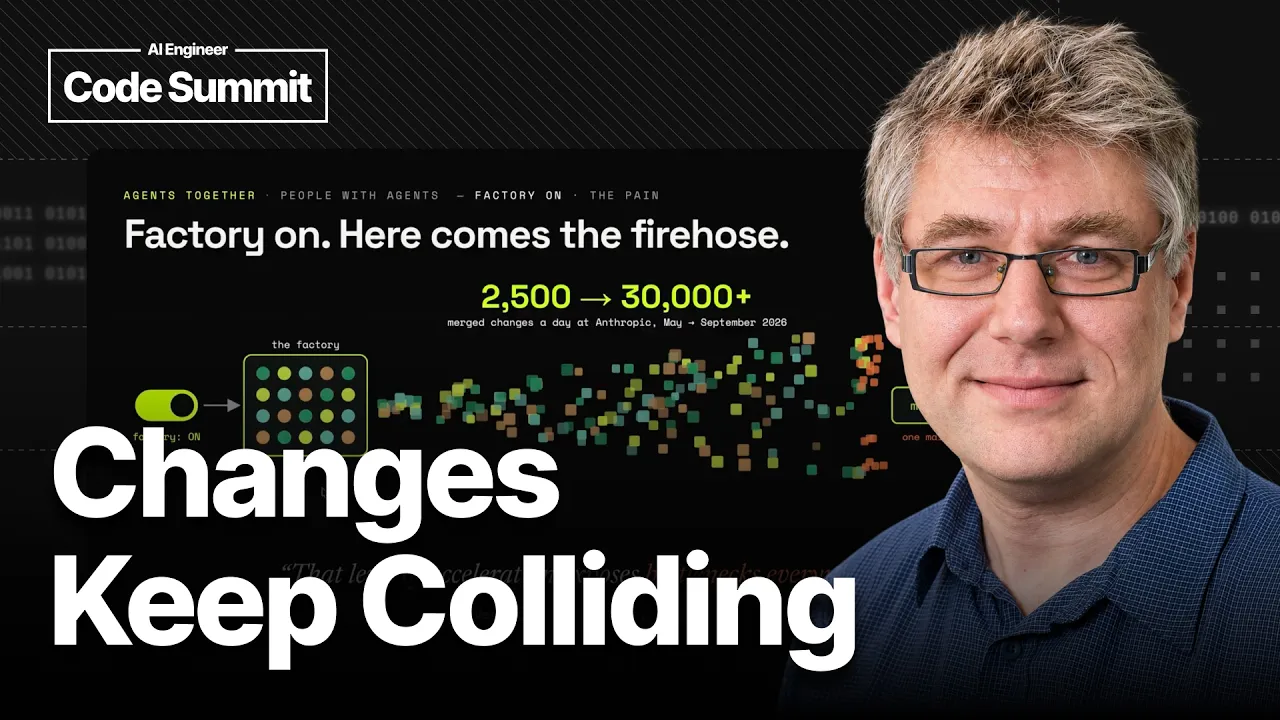
Your whole team runs coding agents now, and all of them land on the same main branch. Continuous delivery wasn't built for that. Patrick Debois maps what breaks when a software factory goes multiplayer, and the patterns that fix it: one main for the agents, one board for the people. Patrick Debois, Tessl: https://x.com/patrickdebois | https://tessl.io
Summary
Generated by gpt-5.6-terraAt-a-Glance
- Verdict: Watch fully
- Core thesis: As coding agents multiply, software delivery must evolve from serial CI/CD and isolated "solo factories" into a shared concurrent-delivery control plane that coordinates work ownership, intent-aware merges, human escalation, and risk-based release decisions.
- Why it matters: The practical bottleneck in agentic engineering is shifting from code generation to coordinating many autonomous changes safely across a shared codebase, delivery pipeline, and organization.
- Best use: Use this as an architecture and operating-model brief for designing multi-agent coding workflows, especially the coordination primitives, escalation patterns, and platform-team responsibilities that OpenClaw-like systems will need.
Executive Summary
Patrick Debois argues that teams are moving from individual developers running coding agents locally to "multiplayer software factories," in which multiple humans and agents operate concurrently on the same backlog and codebase. The productivity upside is substantial—he says pull requests can increase by roughly 10x—but conventional serial merge-and-release workflows become the constraint: queues build, rebases trigger retesting, CI becomes slower and more expensive, and agents may overwrite or undo one another's work.
His answer is concurrent delivery: explicitly coordinate work before and during execution rather than merely launching agents in parallel. Agents should claim tickets, announce intended files and changes, work in isolated environments, detect collisions, wait or requeue when necessary, renegotiate task boundaries, and eventually reason about likely incoming changes. Critically, coordination must address semantic or intent conflicts, not just line-level merge conflicts.
The talk extends the model beyond code. A shared board, chat-integrated agents, shared decision logs, and structured questions let engineering and non-engineering teams collaboratively refine requirements and initiate work without bypassing engineering controls. Humans should not be removed; they should be routed the exceptions and presented bounded choices when agents lack confidence.
Finally, Debois frames review and release as risk management rather than an attempt to inspect every generated line. Automation, adversarial agents, evidence artifacts, gradual rollout, rapid rollback, and restore capability should determine how much human review a change receives. He expects a new "factory team," analogous to a platform team, to own the shared agent skills, context, integrations, observability, and ongoing maintenance of this delivery fabric.
Key Takeaways
- Claim: Multi-agent development increases delivery throughput but makes serial PR, CI, and release processes the primary bottleneck. | Evidence: Debois says activating a multiplayer factory can produce roughly 10x more pull requests; each merge can force other PRs to rebase and rerun tests, creating longer waits, CI/CD slowdown, higher cost, and a growing queue of feature work, agent incidents, and factory-maintenance changes. | Implication: Adding more coding agents without redesigning the merge queue, test strategy, and work coordination can turn nominal productivity gains into integration debt. | Caveat: The 10x figure is presented as an observed directional claim, not a benchmark with methodology or a universal expected result.
- Claim: The first control mechanism for concurrent agents is explicit work partitioning and reservation before coding begins. | Evidence: The proposed workflow splits work by domains such as authentication versus payments, potentially using an AST graph to identify separable components; agents then claim tickets and announce the files and changes they intend to make. Worktrees provide local isolation. | Implication: Agent orchestration needs a shared task registry with ownership, scopes, declared touch-points, and dependency awareness—not just a pool of independently prompted workers. | Caveat: File-level declarations reduce overlap but do not prevent conflicts created by shared behavior, contracts, or business intent.
- Claim: Safe concurrent delivery requires isolation at more layers than Git branches or worktrees. | Evidence: Debois describes giving each agent its own machine, frozen context, locked API version, database snapshot and test data, plus mocked external systems or digital twins. | Implication: Treat execution environment isolation, reproducible context, and controlled external dependencies as core orchestration primitives for autonomous coding agents. | Caveat: The presentation identifies the desired isolation model but does not specify the infrastructure, cost, or consistency trade-offs of provisioning it at scale.
- Claim: Merge automation must reason about semantic intent and compatible merge sets, not only syntactic conflicts. | Evidence: Debois gives an invoice example: one PR changes totals from dollars to cents while another changes reporting; both can pass tests and merge cleanly but still disagree on whether the report should display cents. He also advocates speculative merge trains that pre-test compatible PR combinations so one failing PR does not block all unrelated ones. | Implication: A multi-agent control plane should retain structured task intent and acceptance criteria, run compatibility checks across pending changes, and distinguish code conflict from requirement conflict. | Caveat: Intent checking is proposed as a needed capability; the talk does not show a proven implementation or reliability data for agents making those judgments.
- Claim: The shared factory should turn agents into collaborative requirement-refinement and decision-support participants, not merely code generators. | Evidence: Agents can join team chat, synthesize clues from multiple participants into a refined ticket, ask clarifying questions about tests and requirements, and present decision options rather than repeatedly asking open-ended questions. Decisions are recorded in a shared, queryable ledger attributed to their makers. | Implication: Build agent workflows around structured deliberation, durable decision memory, and human approval of bounded choices, especially when multiple stakeholders contribute requirements. | Caveat: A decision ledger is useful only if decision capture, provenance, retrieval, and expiration are governed; otherwise it can become stale context that misleads later agents.
- Claim: Human review should be allocated by impact and recoverability, with automation handling routine quality checks and humans handling consequential exceptions. | Evidence: The speaker recommends adversarial agent review, better context, test evidence, screenshots or screen-flow videos, and proof artifacts before human review. Low-impact documentation may progress automatically, while authentication changes warrant stronger human review; gradual releases, rapid rollback, and fast restore mitigate production risk. | Implication: Define explicit policy tiers for agent-generated changes: autonomous merge/release for low-risk work, conditional rollout for moderate-risk work, and mandatory human/security review for high-impact surfaces. | Caveat: Evidence artifacts and automated reviewers reduce uncertainty but are not substitutes for controls on high-impact domains such as authentication or data-loss scenarios.
- Claim: Multiplayer factories require a dedicated operating function that owns the agentic delivery system itself. | Evidence: Debois describes a "factory team" analogous to a cloud or Kubernetes platform team, responsible for skills, current context, correct integrations, maintenance, and monitoring of the coding fabric. He also notes that rapid code output requires translated change communication for marketing, support, and other non-engineering functions. | Implication: Agent systems should have named operational ownership and cross-functional change-distribution mechanisms; leaving skills, context, and monitoring to individual developers will not scale. | Caveat: The talk does not define organizational boundaries, staffing, or accountability between this team and existing platform, security, and developer-experience teams.
Detailed Brief
Human-in-the-loop operating patterns
- Claims: The optimal workflow is hybrid rather than fully autonomous: people should be able to enter an agent's active context for fast experimentation and then hand work back to the factory.; Agents should route ambiguity to people as constrained alternatives rather than generic requests for help.; Non-engineering stakeholders can initiate or refine work inside the same governed delivery pipeline, avoiding the historical handoff in which sales, marketing, or support file a ticket and wait weeks for engineering attention.
- Evidence: Debois cites an idea from HelixML: when an agent is stuck, launch an IDE containing the agent's exact context and files; a human resolves the uncertainty or experiments, then returns control to the agent.; He contrasts chat-integrated collaboration with individual "vibe coding," arguing that a shared factory applies the same engineering knowledge, skills, loops, and pipeline controls to contributions from across the organization.
- Caveats: Broadening access to feature initiation must not be confused with broadening authority to deploy; the transcript advocates shared process and refinement, not removal of risk-based controls.; The speaker acknowledges the model is still emerging: "we're not there yet," and presents it as a direction rather than a mature, settled operating standard.
- Implications: Design escalation as a context-preserving handoff, so human intervention resolves only the local uncertainty rather than restarting the task from scratch.; Expose role-appropriate summaries of delivered changes to support, marketing, and other functions, because raw code-volume growth will otherwise outpace organizational comprehension.
Emerging infrastructure thesis
- Claims: Debois sees concurrent delivery as a new developer-infrastructure layer beyond traditional CI/CD loops.; The future system includes merge coordination, planning, analytics, agent skills, context management, decision memory, execution isolation, and exception routing.; Personal agents may eventually participate on shared boards, answer other agents, and make delegated decisions for individual users.
- Evidence: He characterizes many current agent factories as "glorified loops" and argues that rising concurrency will force new infrastructure and vendor capabilities.; He points viewers to concurrent.cd as a collection of people, tools, and techniques addressing concurrency, and describes Tessl's factory work around loops, skills, and multiplayer operation.
- Caveats: The product references are directional examples from the speaker's own company context and should not be treated as independent validation of a particular platform.
- Implications: Evaluate agent-development platforms on their coordination and governance layer—not only their model quality or ability to generate an individual patch.; Expect strategic differentiation to migrate toward control-plane capabilities: shared state, scheduling, policy, observability, and safe delegation.
Notable Concepts & Terms
- Multiplayer software factory: A shared engineering environment where multiple humans and coding agents concurrently work from one task board against the same delivery pipeline and codebase.
- Solo factory: The current common model of an individual developer running one or more agents locally while personally retaining integration decisions and working memory.
- Concurrent delivery: Debois's proposed evolution of continuous delivery: make parallel work the standard and provide coordination mechanisms for planning, merging, review, and release.
- Speculative merge trains: Pre-testing combinations of queued PRs to identify compatible changes and allow unaffected work to proceed when another candidate fails.
- Intent conflict: A conflict where changes merge syntactically and tests pass but jointly violate expected business behavior or requirements.
- Decision ledger: A shared, queryable record of who decided what, intended to preserve operational context across people, agents, and later sessions.
- Adversarial agent review: Using agents to challenge or inspect generated changes before human review, reducing routine defects and improving reviewer signal.
- Factory team: A proposed platform-like team that owns shared agent skills, context, integrations, monitoring, and maintenance of the agentic delivery system.
Operator Notes / Why Ken Should Care
- Create a minimal multi-agent coordination schema: ticket owner, declared files/functions, dependency links, expected behavior, risk tier, and escalation owner.
- Separate merge policy from release policy: use compatibility/speculative testing for integration flow, then apply risk-tiered approval and rollout rules for production exposure.
- Require high-impact agent changes to attach machine-verifiable evidence plus reviewer-oriented artifacts; define authentication, authorization, data migration, and data deletion as mandatory human-review classes.
- Prototype an interrupt/resume handoff that preserves the agent's workspace, context, task plan, and experiment history when a human takes over.
- Assign explicit ownership for shared skills, context freshness, decision-log retention, agent observability, and incident response before scaling concurrent agents.
- Measure integration throughput separately from code generation: queue age, rebase frequency, rerun/test load, conflict type, human-intervention rate, rollback rate, and time to recovery.
Source/Metadata
- Title: Your Team's Agents Are All Shipping to the Same Code at Once - Patrick Debois, Tessl
- Transcript words: 6781
- Duration seconds: 1369
- Timestamp note: No timestamps or chapters were present in the supplied transcript; the transcript also contains substantial duplicated passages.
Transcript
Welcome to our session on multiplayer software factories, where I'll walk you through what the tensions are, what the solutions are, when multiple people and multiple agents are working on the same software delivery pipeline. Software delivery pipelines are of course not new and existed before AI. We have the typical build, test, and then wait for the release and the merge to go out into main. This is pretty much a serial flow and it has helped us automate and be more robust in the delivery. At the same time, people are building factories and I call them solo factories on their laptops, on their systems, within their coding agents and increasingly they're using multiple agents and doing delivery with agents. Now they often have to still make the decisions and they also have to do the merges and they are a little bit of the central piece or almost like they have to keep the memory of what they're doing and so on. I'm talking not single player but multiplayer and there's probably a gradation in between. Currently people are doing it on our laptops, then people sharing their setups like their context, their skills, their loops within their factories. Pretty much the state of many factories out there. And then the multiplayer factories of people collaborating at the same time in the same ticket board on their same code base. And that's what I'll work you through today. Now on the left the tension is everybody wants to merge into main. On the right there's multiple people on the board and they have to collaborate and work together. So that's the two parts of this talk. Let's start with the first part, the code and how to make that a central piece of agents being able to work together. One of the first things when you turn on a factory or a multiplayer factory you'll see that there's definitely an increase in pull requests. It's almost a factor of 10 more pull requests landing. That's good because we're being more productive, we get more changes done, but that also builds up some of the tension. For example, we have a lot more merges and they have to make sure that they're not conflicting. And if we're unlucky the agents also spend time going in rounds. One agent changing something then the other agent changing it back. These conflicts are real when you turn on a multiplayer factory. One of the most noticeable things is we start to wait more for releases because when we merge to change all the other PRs need to rebase and they typically rerun their tests and you have to wait. And at the same time that means your CI/CD system is becoming a lot slower because of that multi thing. And also more costly, but that's a side effect. The PR queue is building up not just with features. There's also the agent incidents that we have to solve as I mentioned. And then there's factory maintenance on its own like the improvement of the skills, the improvement of the loops that we've been using. All more work that needs to get approved by us. So why can't we flip this from concurrency being an exception to becoming the routine? And this is what I call concurrent delivery and going from continuous delivery to concurrent delivery and design for people to work and agents to work together on the same code base. One of the simple things that we can do is instead of just running agents in parallel, we can get smarter about this. Almost like splitting up the work like we would do with humans. Like you get to do this task, you get to do that task. And there's different ways of splitting this in a way that we can say, well, you work on authentication, I work on payment, I work on other parts. And we can use even the AST graph to determine which pieces are able to split quite well. And then we can have the agents go on a more granular level. And they would do, hey, this file, this function, and they would go on certain keystrokes, in certain files doing together. So this is a way of dealing with splitting up the work before you actually do the actual coding. This is a better way of planning the changes. And then once you start planning and you start actually executing the plan, much like you would do on your Scrum board, you would say, I'm going to take care of this. And the agent writes and says it claims the ticket. It says, I want to do that ticket. So no other agent can actually step in at the same time. And it also announces which files and which changes it's going to make. So this is something that is helpful for other agents to see that they're not starting to overlap during the planning and the execution. Now, to make sure that they can keep executing, a lot of people use work trees to separate them. When you think about this broader, there is a lot more splitting that you could do. You basically are phrasing the world of an agent. You give them their own machine. You give them their own freeze of the context. You give them their own version of the API that's being locked. And even the database gets their snapshot, their test data, and even outside world like digital twins and making sure that everything's mocked and that they can do these things without having to deal with any impact of the outside world. Now, when two agents do collide during the work, there's a couple of strategies. They can either start waiting for each other, one after the other. They can retry after the wait. They can say, okay, I'm going to wait, but I'll requeue and I'll wait until it's done. Or they can start changing and optimizing the plan. Like you do this, I do that, and that's renegotiation in the end. So they're changing the planning while they're doing the execution to make sure that they don't interfere with each other. So you can see if you're merging today. On a conflict, you could rerun it. And within your merging today, you say, okay, there's a conflict. What do I do? You rerun and see if it merges on the rerun, which was typically our PR change. Or you could just make sure that the agents do that for you instead. So they can see whether they can merge instead of just by code lines. They can merge by function and it becomes smarter. And then the agent maybe can fix the merge. So you don't have to do that again. And ultimately, it can even start seeing changes coming. So, hey, this agent is probably going to change this. I'm going to see this coming and I'm already adapting my code at the same time. So this is thinking in concurrency instead of being serial in the changes. Now, one of the things you can see is that agents have been optimized to merge stuff, right? With the merging of code, this is clear. But what if two changes land at the same time? In this case, you're calculating and changing the function of calculating the total for an invoice. And say it's not just in dollars, but in dollar cents. Now, at the same time, there is another PR that changes the reporting. Now, two merges that consistently could merge within the test succeeding. But at the same time, it was a different intent. And the report doesn't want to have it in euro cents or in dollar cents, right? So they're not conflicting in code, but they're conflicting on intent. So we could have agents actually look at the intent, whether they're still consistent across the multiple merges. And warn us or change the PR accordingly. Now, if you want to start merging, the PRs are able to merge, they're good to merge. But what if one of those merges doesn't merge well, right? So if you want to merge, then you'll typically rebase all the others. They'll have to do rework and so on. Now, there's a better way of dealing with these merge strains by looking at a concept called speculative merge strains. And it looks at all the PRs coming in and it sees which ones are compatible with each other. And it already checks them in pairs. And then it says one that is landing and this one isn't landing, but you could still do the others. It goes faster because all the others that can go through already go through in the merge queue. Now, these are just some examples of new strategies of dealing with merges and conflicts and reviews and better planning. I think in general, there's a new infralayer coming and you see that almost from the vendors. It's a new developer infrastructure. Merges are going to handle differently. There's now analytics. There's now better planning. There's now better tools for anything. And that's what we're building up. Right now, a lot of the factories are just glorified loops as we would do with the CI/CD, but the concurrency will only increase. Now, I told you there was a flip side to this. There's also the humans working together, not just the agents. And typically, the change is that you're working together in one task board. It goes faster because all the others that can go through already go through in the merge queue. Now, these are just some examples of new strategies of dealing with mergers and conflicts and reviews and better planning. I think in general, there's a new infralayer coming and you see that almost from the vendors. It's a new developer infrastructure. Mergers are going to handle differently. There's now an analytics. There's now a better planning. There's a better tool for anything. And that's what we're building up. Right now, a lot of the factories are just glorified loops as we would do with the CI/CD, but the concurrency will only increase. Now, I told you there was a flip side to this. There's also the humans working together, not just the agents. And typically, the change is that you're working together in one task board. Right. And all the humans are being able to see what changes are coming, what tasks are being done. And this creates the visibility where in your solo factory, you would have that doing that all alone. But it wouldn't be a central board that you're working on. Now, they all need your attention. And that's probably the easy part. Right. So we want to reduce also that attention from the agents having to call you all the time. So this is a side effect of having multiple agents working at the same time. Now, one of the nice features is, and it's been interesting to see, that agents can join your chat. And this is a different way of coding. It is not you prompting, but it's you pulling an agent into a conversation. And that's really powerful because the agent is picking up clues, not just from you, from your team members at the same time. And what it's actually doing, it is refining the ticket from all the input. And that is really powerful because you actually not only had adversarial review by agents, but you also get multiple input by humans on the same ticket during the conversation. And what it's really good at is prompting you with questions instead of having to ask everything over and over again. So one thing that is helpful is that it clarifies what is the test, what should it do, what are the requirements that it needs to do. And the ticket actually becomes almost like a plan, the plan mode in your coding agent. But now as a shared feature within your board of looking at all the requirements. Now, what's even more powerful is that it doesn't only have to be engineers. Think of this as in the past sales, marketing, support, they were filing tickets to the engineering. That would get somewhere on a board and they'll have to wait until an engineer comes. That could have taken weeks. Right now, what we see in our factory at Tesla is that people are just sharing and doing a chat within the organization. And the agent is there. Now, they don't need to build the code all the time. And before they were maybe doing Vibe coding. But one of the problems with the Vibe coding is it didn't fit according to engineering practices. Now, with a multiplayer factory, people are using the same pipeline, the same knowledge, the same skills, the same loops to actually fit into that flow of engineering itself. So they can experiment. They can refine the feature. And they can also even build a feature where before we would wait, they can just kickstart it and engineer and refine that. That's a very powerful flow of giving everybody on board and being in the flow of that one multiplayer factory. Now, sometimes the agent while executing is unsure. And you might have the same feeling that sometimes the ticket mode within a factory is slow and you want to do fast iteration. Now, there's a way to do this hybridly. When, for example, your agent is stuck. There was a very interesting idea from HelixML where when your agent is stuck, it actually starts a new coding IDE with the exact context that the agent was working on. You as a human almost jump in to help the agent figure out, with all the context available, with all the files available. And then when you made the right choices, when you did the right experiments, you hand it back to the agent and the factory to continue. So this is a nice way of finding the middle ground between a personal coding agent, fast iterations and still doing the factory. And the agent can use it as well to clarify and help and ask for help. Now, what we really want to do is reduce the choices that it has to make. And what is really powerful is that it represents questions to us for decisions, not just what should I do and open questions. You see that in coding agents as well. It gives you a couple of options that you can choose for and then it goes off. This is really powerful and it is less trained on having to tell the agent all the time what to do by presenting options there as well. Of course, you can override, but this is really a powerful multiplayer thing. Now, every decision that people make actually goes onto a ledger. This is like your context locally, maybe that you have in your coding agent. But if you are in a multiplayer factory, this is shared somewhere on the decision log. And that can be used either by agents, it could be used by humans to find. And you can trace things back like who made what decision. And when that context is being used in the next session, you can also query that as well. Now, we want that to be small because big changes, they are not very readable. So, while I said in the beginning you could automize for agents not being conflicting, there is also another thing you have to think about, which is the human review. How much change can a human review? But you can build separate PRs in multiple merge chains for people to do fast reviewing of those things. So, a lot of people are focused on when the PR and we want to reduce the number of PR reviews, is that there is some kind of automated review. Now, the first part is typically to reduce the failures, which is great, right? Like we want to provide better context, better tools. We have adversarial agents looking at the code before it comes to us. That is a good way of reducing the risk by it being better quality. Now, at the same time, we're optimizing that we can actually see what it did. We are asking for screen flow shots, for videos, for proof, for testing, all the things that could help a reviewer. And then ultimately, how far do you go? Several people tell me like, hey, I'm not looking at the code anymore. And I ask them, okay, but what is the impact of this going to production? Some is documentation that is limited impact, maybe. Some don't have real customers, which is also great, right? Like the impact is not a lot. But if you really start thinking about what you're doing is you're selecting by what risk you can take. So some of the tests will say, well, if it's maybe in the documentation part, you can go ahead. If it's a more impactful change, like within authentication, you do more review by a human. And sometimes there's a middle ground. Hey, this feature can just roll out. We'll check what the output is, whether there's any errors, gradual releases. So instead of only optimizing for quality and reducing the likelihood, you also have a way of looking at it from a risk perspective. And when it moves out of production, you can also see how you can mitigate the risk, right? Because if the impact is that you lose data, do you have a fast restore strategy? Or you can think about this, what if one node fails? Or can I fast roll back? Those are architectural decisions as well. So what you want to do is when things go wrong, you want to have it being cheap to restore or to fix. And that is important in not only optimizing, but there's multiple ways of dealing with the risk on the PR review. Now, one of the funny things when you work in a multiplayer factory is that before people were chatting, and I personally, for example, work remote, where most of the team is in a central place in London. Now they get together, they do a lot of chats and so on. And me sometimes from remote, I had a hard time catching up what has changed. Now, when you turn on the multiplayer factory, everybody needs to keep up, right? There's so much code being produced that maybe marketing support and other places can't keep up. They need to have a translation in their changes that have happened in their language. So communication and radiating change is actually a very important feature in a multiplayer factory. How do you keep up within your domain, within your understanding, for your part of the job? Now, in a nutshell, you can do a lot of automation and you will use a lot of skills and context and better improvement on those pieces. And you kind of reserve the people for the exceptions. And that's the way that I want you to think about is automate what you can, but make sure you are able to route to a human to make the right decision. Now they get together, they do a lot of chats and so on. And me sometimes from remote, I had a hard time catching up what has changed. Now, when you turn on the multiplayer factory, everybody needs to keep up, right? There's so much code being produced that maybe marketing support and other places can't keep up. They need to have a translation in their changes that have happened in their language. So communication and radiating change is actually a very important feature in a multiplayer factory. How do you keep up within your domain, within your understanding, for your part of the job? Now, in a nutshell, you can do a lot of automation and you will use a lot of skills and context and better improvement on those pieces. And you reserve the people for the exceptions. And that's the way that I want you to think about: automate what you can, but make sure you are able to route to a human to make the right decision. So, with all that infrastructure, with all those ways of working together, there is a new team that is forming, which is almost like the factory team, similar to a platform team that was dealing with Kubernetes or with a cluster or with the cloud. But right now, they are dealing with the coding agents and the coding fabric of working all together. They make sure that who owns the skills, the context is up to date, they make sure that things are connected to the right pieces, and that the whole factory is being maintained and being monitored as well. So in a nutshell, there's a lot more to it. But this was in a nutshell two things: the pressure is building up on agents working more together in the code base. And then the humans are working with the agents more and more together in a concurrent way and delivering more output at the same time. And for that, there needs to be a lot of change. Now, one of the things that we're playing with now is they're not just the coding agents, they're not just the people that do things in the board. Now, they're being those personal agents and they will work in the board. They will make decisions for you. They will provide answers to other agents as well. This is a new way of building. This is a new way of delegating some of the tasks that you are doing in the factory. So my advice is, brace yourself. We're not there yet. The coding agents were a good step on your solo factories. Multiplayer factories will bring new dynamics both to the agents coding and both to the organizational working together. And that's it. And thank you very much for listening. You can find the slides by asking me in DM on LinkedIn. I happily send you in exchange for some feedback. And you can of course try the Tesla factory where we implement and are working on loops, factories and skills for you being in a multiplayer mode. And I'd also share the research at a site on concurrent.cd where I find people and tools and techniques that people are solving this concurrency altogether. Thank you very much for listening. And I hope you learned some new things today. And feel free to leave some comments and I'll happily have a look and respond to that. Thank you very much. Thank you. Have a good night. Have a good night. Have a good night. Have a good night. Have a good night. Have a good night. the actual coding. This is a better way of planning the changes. And then once you start planning and you start actually executing the plan, much like you would do on your Scrum board, you would say, I'm going to take care of this. And the agent writes and says it claims the ticket. It says, I want to do that ticket. So no other agent can actually step in at the same time. And it also announces which files and which changes it's going to make. So this is something that is helpful for other agents to see that they're not starting to overlap during the planning and the execution. Now, to make sure that they can keep executing, a lot of people use work trees to kind of separate them. When you kind of think about this broader, there is a lot more splitting that you could do. You basically are phrasing the world of an agent. You give them their own kind of machine. You give them their own freeze of the context. You give them their own version of the API that's being locked. And even the database gets their snapshot, their test data, and even outside world like digital twins and kind of making sure that everything's mocked and that they can do these things without having to deal with any impact of the outside world. Now, when two agents do collide during the work, there's a couple of strategies. They can either start like waiting for each other, one after the other. They can retry after the wait. They can say like, okay, I'm gonna wait, but I'll requeue and I'll wait until it's done. Or they can start changing and optimizing the plan. Like you do this, I do that, and that's renegotiation in the end. So they're changing actually the planning while they're doing the execution to make sure that they don't interfere with each other. So you can see if you're merging today. Now, on a conflict, you could rerun it. And within your merging today, you say, okay, there's a conflict. What do I do? You rerun and see if it merges on the rerun, which was typically our PR change. Or you could just kind of make sure that the agents do that for you instead. So they can see whether they can merge instead of just by code lines. They can merge by function and it becomes smarter. And then the agent maybe can fix the merge. So you don't have to do that again. And ultimately, it can even start seeing changes coming. So, hey, this agent is probably going to change this. I'm going to see this coming and I'm already kind of adapting my code at the same time. So this is thinking in concurrency instead of being kind of serial in the changes. Now, one of the things you can see is that, you know, agents have been optimized to merge stuff, right? Like with the merging of code, this is clear. But what if two changes land at the same time? In this case, you're calculating and changing the function of calculating the total for an invoice. And say it's not just in dollars, but in dollar cents. Now, at the same time, there is another PR that changes the fact of reporting out. Now, two mergers that consistently could merge within the test succeeding. But at the same time, it was a different intent. And the report don't want to have it in euro cents or in dollar cents, right? So they're not conflicting in code, but they're conflicting on intent. So we could have agents actually look at the intent, whether they're still consistent across the multiple mergers. And warn us or change the PR accordingly. Now, if you want to kind of start merging, the PRs are able to merge, they're good to merge. But what if one of those mergers doesn't merge well, right? So if you want to merge, then you'll typically rebase all the others. They'll have to do rework and so on. Now, there's a better way of dealing with these merge strains is by looking in a concept called speculative merge strains. And it looks at all the PRs coming in and it sees which ones are compatible with each other. And it kind of already checks them in pairs. And then it says like one that is landing and this one isn't landing, but you could still do the others. It goes faster because all the others that can go through already go through in the merge queue. Now, these are just some examples of kind of new strategies of dealing with mergers and conflicts and reviews and better planning. I think in general, there's a new kind of infralayer coming and you see that almost from the vendors. You know, it's a new developer infrastructure. Mergers are going to handle differently. There's now an analytics. There's now a better planning. There's no a better tool for anything. And that's kind of what we're building up. Right now, a lot of the factories are just glorified loops as we would do with the CIO CD, but the concurrency will only increase. Now, I told you there was a flip side to this. There's also the humans working together, not just the agents. And typically, the change is that you're working together in one kind of task board. Right. And all the humans are being able to see what changes are coming, what tasks are being done. And this creates the visibility where in your solo factory, you would have that doing that all alone. But it wouldn't be a central kind of board that you're working on. Now, they all need your attention. And that's probably the easy part. Right. So we want to reduce also that attention from the agents having to call you all the time. So this is a side effect of having multiple agents working at the same time. Now, one of the nice features is, and it's been kind of interesting to see, that agents can join your chat. And this is a different way of coding. It is not you prompting, but it's you kind of pulling an agent into a conversation. And that's really powerful because the agent is picking up clues, not just from you, from your team members at the same time. And what it's actually doing, it is refining the ticket from all the input. And that is really powerful because you actually not only had like adversarial review by agents, but you also get multiple input by humans on the same ticket while during the conversation. And what it's really good at is prompting you with questions instead of having to ask everything over and over again. So one thing that helpful is that it clarifies what is the test, what should it do, what are the requirements that it needs to do. And the ticket actually becomes almost like a plan, the plan mode in your coding agent. But now as a shared feature within your board of looking at all the requirements. Now, what's even more powerful is that it doesn't only have to be engineers. Think of this as in the past sales, marketing, support, they were kind of filing tickets to the engineering. That would get somewhere on a board and they'll have to wait until an engineer comes. That could have taken weeks. Right now, what we see in our factory at Tesla is that people are just sharing and doing a chat within kind of the organization. And the agent is there. Now, they don't need to build the code all the time. And before they were maybe doing Vibe coding. But one of the problems with the Vibe coding is it didn't fit according to engineering practices. Now, with a multiplayer factory, people are using the same pipeline, the same knowledge, the same skills, the same loops to actually already fit into that flow of engineering itself. So they can experiment. They can refine the feature. And they can also even build a feature where before we would wait, they can just kickstart it and engineer and refuse that. That's a very powerful flow of giving everybody on board and being in the flow of that one multiplayer factory. Now, sometimes the agent while executing is unsure. And you might have the same feeling that sometimes the ticket mode within a factory is slow and you want to do fast iteration. Now, there's a way to do this hybridly. When, for example, your agent is stuck. There was a very interesting idea from HelixML where when your agent is stuck, it actually starts a new kind of coding IDE with the exact context that the agent was working on. You as a human almost jump in to help the agent figure out, like with all the context available, with all kind of the files available. And then when you made the right choices, when you did the right experiments, you hand it actually back to the agent and the factory to continue. So this is a nice way of finding the middle ground between a personal coding agent, fast iterations and still doing the factory. And the agent can use it as well to kind of clarify and help and ask for help. Now, what we really want to do is reduce kind of the choices that it has to kind of make. And what is really powerful is that it represents actually questions to us for decisions, not just what should I do and open questions. You know, you see that in coding agents as well. It gives you a couple of options that you can choose for and then it goes off. This is really powerful and it is less trained on like having to tell the agent all the time what to do by presenting options there as well. Of course, you can override, but this is really a powerful multiplayer thing. Now, every decision that people make actually goes onto a ledger. This is like your context locally, maybe that you have in your coding agent. But if you are in a multiplayer factory, this is shared somewhere on the decision log. And that can be used either by agents, it could be used by humans to find. And you can trace things back like who made what decision. And when that context is being used in the next session, you can also query that as well. Now, we want that to be small because big changes, they are not very readable. So, while I said in the beginning you could automize for agents not being conflicting, there is also another kind of thing you have to think about, which is the human review. How much change can a human review? But you can build like separate PRs in multiple merge chains for people to do fast reviewing of those things. So, a lot of people are focused on kind of, you know, when the PR and we want to reduce the number of PR reviews, is that there is some kind of automated review. Now, the first part is typically to reduce the failures, which is great, right? Like we want to provide better context, better tools. We have adversarial agents looking at the code before it comes to us. That is a good way of reducing kind of the risk by it being better quality. Now, at the same time, we're optimizing that we can actually see what it did. We are asking for screen flow shots, for videos, for proof, for testing, all the things that could help a reviewer. And then ultimately, how far do you go? Several people tell me like, hey, I'm not looking at the code anymore. And I ask them, okay, you know, but what is the impact of this going to production? Some is documentation that is limited impact, maybe. You know, some don't have real customers, which is also great, right? Like the impact is not a lot. But if you really start thinking about what you're doing is you're selecting by what risk you can take. So some of the tests will kind of say, well, if it's maybe in the documentation part, you can go ahead. If it's like a more impactful change, like within authentication, you kind of do more kind of review by a human. And sometimes there's a middle ground. Hey, this feature can just roll out. We'll check what the output is, whether there's any errors, like gradual releases. So instead of only optimizing for quality and reducing of the likelihood, you also kind of have a way of looking at it from a risk perspective. And when it moves out of production, you know, you can also see how you can mitigate the risk, right? Because if the impact is that you lose data, do you have a fast restore strategy? Or you can think about this, like what if one node fails? Or can I fast roll back? Those are architectural decisions as well. So what you want to do is when things go wrong, you want to have it being cheap to restore or to fix. And that is important in not only optimizing, but there's multiple ways of kind of dealing with the risk on the PR review. Now, one of the funny things when you work in a multiplayer factory is that, you know, before people were chatting, and I personally, for example, work remote, where most of the team is in a central place in London. Now they get together, they do a lot of chats and so on. And me sometimes from remote, I had a hard time catching up what has changed. Now, when you turn on the multiplayer factory, everybody needs to keep up, right? There's so much code being produced that maybe marketing support and other places can't keep up. They need to have a translation in their changes that have happened in their language. So communication and radiating change is actually a very important feature in a multiplayer factory. How do you keep up within your domain, within your understanding, for your part of the job? Now, in a nutshell, you can do a lot of automation and you will use a lot of skills and that like context and better improvement on those pieces. And you kind of reserve the people for the exceptions. And that's the way that I want you to think about is automate what you can, but make sure you are able to route to a human to make the right decision. So, with all that infrastructure, with all those kind of ways of working together, there is kind of a new team that is forming, which is almost like the factory team, similar to a platform team that was dealing with a Kubernetes or with a cluster or with the cloud. But right now, this is, they are dealing with the coding agents and the coding fabric of working all together. They make sure that who owns the skills, the context is up to date, they make sure that things are connected to the right pieces, and that the whole factory also itself is being maintained and being monitored as well. So this is a nutshell. There's a lot more to it. But this was in a nutshell two things like the pressure is building up on agents working more together in the code base. And then the humans also kind of working with the agents more and more together in a concurrent way and delivering more output at the same time. And for that, there needs to be a lot of change. Now, one of the things that we're playing now with is they're not just the coding agents, they're not just the people that do things in the board. Now, they're being those personal agents and they will work in the board. They will make decisions for you. They will provide answers to other agents as well. This is a new way of building. This is a new way of kind of delegating some of the tasks that you are doing in the factory. So my advice is, brace yourself. We're not there yet. Like the coding agents were a good step on your solo factories. Multiplayer factories will bring new dynamics both to the agents coding and both to the organizational working together. And that's it. And thank you very much for listening. You can kind of find the slides by asking to me in DM on LinkedIn. I happily send you in exchange for some feedback. And, you know, you can of course try the Tesla factory where we implement and are working on kind of loops, factories and skills for you being in a multiplayer mode. And I'd also share the research at a site on concurrent.cd where I find like people and tools and techniques that people are solving this concurrency altogether. Thank you very much for listening. And I hope you learned some of the new things today. And feel free to leave some comments and I'll happily have a look and respond to that. Thank you very much. Thank you. Have a good night. Have a good night. Have a good night. Have a good night. Have a good night. Have a good night.