Summary
Generated by gpt-5.6-terraAt-a-Glance
- Verdict: Skim
- Core thesis: Monologue is prototyping a low-cost, push-to-talk voice hardware companion that makes intentional dictation, note capture, and eventual agent triggering more reliable than phone-only workflows.
- Why it matters: The useful idea is not the current device itself but the emerging pattern of a dedicated, feedback-rich physical interface for routing voice intent into agents without adopting always-on recording.
- Best use: Use this as product-research input on voice-agent interfaces, hardware control surfaces, and intentional capture UX; the stream is exploratory and repetitive rather than a finished product briefing.
Executive Summary
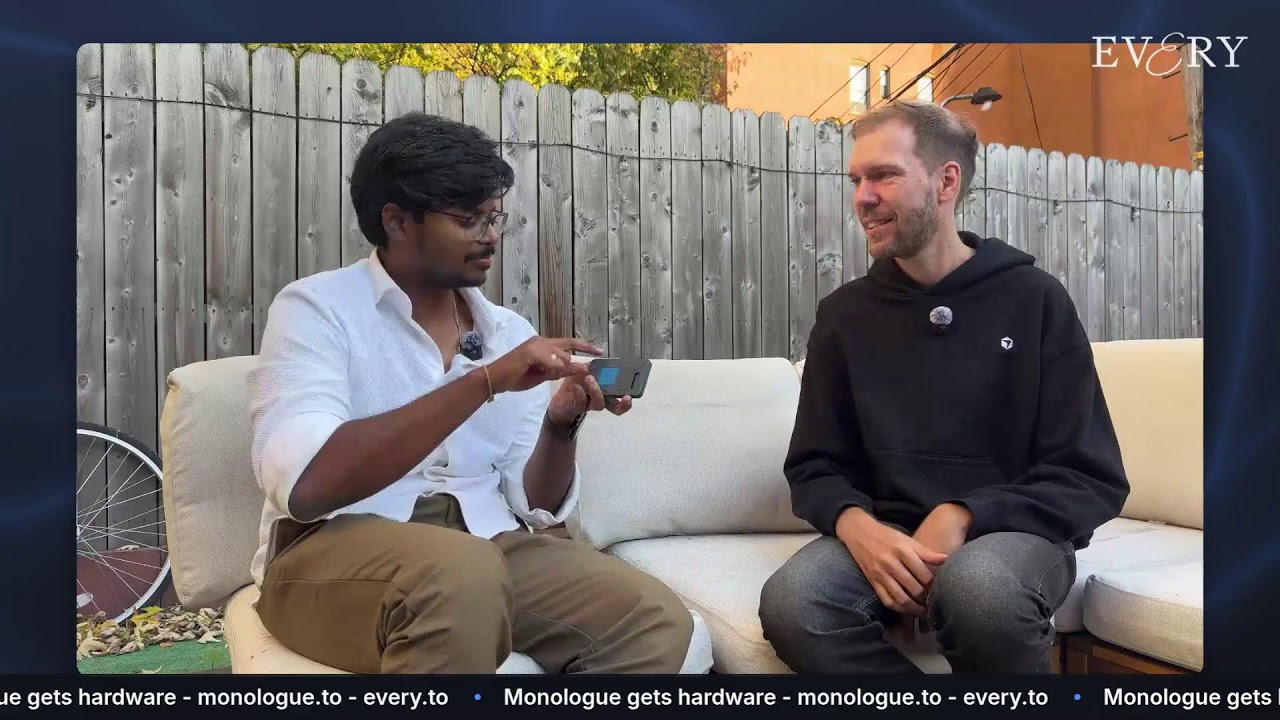
Naveen presents an early Monologue hardware prototype: a roughly credit-card-sized Bluetooth device intended to attach to or travel with a phone. Its immediate purpose is push-to-talk dictation and deliberate audio-note capture, using Monologue's custom dictation stack rather than replacing the phone or becoming an always-listening wearable.
The strongest product argument is interaction reliability. A physical button, display, vibration, local storage, better microphones, and long battery life address common failures of phone-based voice capture: microphone-session friction, uncertainty about whether recording worked, interrupted audio playback, and phone battery drain. The proposed two-button model separates immediate dictation from stored notes, although the team has not settled the interaction design.
The conversation becomes most relevant to agent systems when the host proposes mapping presses, trigger words, or webhooks to specific agents such as Claude, Dot, or Duet. Naveen agrees that first-party agent support could differentiate the device, framing it as a physical way to send selected thoughts and commands to agents rather than dumping an always-on life log into them.
This remains a very early prototype, not a product announcement. The team is still testing form factors, including a smaller Mono Key for walking use; admits the current card is not yet a good walking device; has not finalized openness, security, MagSafe attachment, or commercial manufacturability; and targets a sub-$100 price only as an aspiration.
Key Takeaways
- Claim: The prototype is designed around intentional, push-to-talk voice capture rather than continuous passive recording. | Evidence: The large blue button is for dictation and the white button is for notes; Naveen says users must long-press to capture audio and explicitly says he does not want it to be an always-on listening device. | Implication: For agent workflows, explicit capture and routing may create higher-quality, more actionable inputs than wholesale ambient-memory products. | Caveat: The device may be able to capture phone-call audio through a piezo component, which raises meaningful consent, privacy, and platform-policy questions despite the intentional-capture positioning.
- Claim: A dedicated hardware interface is being justified by workflow reliability, not merely novelty. | Evidence: The speakers cite phone microphone-session friction, the need to reopen the Monologue app, finicky action-button use, loss of audio playback, uncertain recording state, phone battery drain during long recordings, and the risk of discovering a dead recorder after two hours. | Implication: If Ken builds voice entry points for agents, visible state and confirmation feedback are product requirements, not polish: users need to know capture started, is ongoing, and will be delivered.
- Claim: The potential strategic differentiation is a hardware control plane for agents, not basic transcription. | Evidence: The host suggests mapping single or multiple presses and trigger words to Claude, Dot, or Duet via webhooks/MCP events; Naveen responds that first-party agent support is something he now wants to pursue. | Implication: A useful design direction is a small number of deliberate physical intents that invoke agent workflows, with software resolving context, identity, and downstream actions. | Caveat: No concrete agent integration, command schema, permission model, or launch timeline is presented.
- Claim: Monologue is exploring multiple form factors because the desired behavior differs between desk dictation, portable capture, and walking use. | Evidence: The card is optimized for carrying on the back of a phone and holding near a desk, while a separate smaller 'Mono Key' is being explored for more wearable/walking-oriented capture. Naveen concedes the card is currently not a very good walking device. | Implication: Avoid treating voice hardware as a generic device category: physical form should follow the capture context and intended duration of interaction. | Caveat: The team has not validated which form factor users will carry daily, and it explicitly says the current prototype is only one candidate.
- Claim: Local hardware features are intended to make the device independently useful when the phone is inconvenient or unavailable. | Evidence: The current prototype reportedly stores about three hours of audio locally, with an ambition of about 60 hours; Naveen cites a two-week battery target/current claim, a planned OLED display, vibration feedback, dual microphones, and noise reduction. | Implication: For mobile agent capture, offline buffering, long battery life, and local interaction feedback can be more valuable than adding another screen-heavy computing device. | Caveat: These are prototype-stage statements and planned specifications, not independently validated shipping capabilities.
- Claim: AI-assisted prototyping is compressing early hardware iteration, but manufacturing remains the bottleneck. | Evidence: Naveen contrasts prior PCB cycles of roughly four weeks with this prototype reaching a shippable stage from an early-October idea by the end of October; the two-person team used a 3D-printed enclosure, a custom PCB made with an at-home PCB maker, an off-the-shelf ESP-C6 controller, and Claude-assisted design/testing. | Implication: Ken can increasingly test physical interfaces cheaply and quickly, but should separate prototype velocity from a hardware business case and production readiness. | Caveat: He explicitly notes suppliers and manufacturing still require specialized work; rapid prototype creation does not demonstrate scalable production, certification, reliability, or security.
- Claim: Monologue intends to remain opinionated while leaving some room for developer modification. | Evidence: Naveen does not commit to open-sourcing Monologue or the device, but says the ESP-C6-based hardware can be reflashed today and that he does not want to lock users into Monologue-only use. He compares this to Monologue's existing dictation API, which is used within Quora. | Implication: For a credible agent peripheral ecosystem, firmware access must eventually be paired with supported integration primitives, secure permissions, and predictable lifecycle management. | Caveat: The openness model is unresolved; 'can flash firmware' is not the same as a supported SDK, stable APIs, documentation, or secure extensibility model.
Detailed Brief
Prototype architecture and planned industrial design
- Claims: The current enclosure is deliberately overbuilt and thicker because it is 3D printed; the team believes a production aluminum enclosure could be materially thinner.; The device is intended to feel premium enough to keep with the user, with Apple hardware cited as the quality benchmark.; The card is envisioned as a phone-adjacent 'action device' rather than a standalone phone replacement.
- Evidence: The enclosure is described as credit-card sized, with thickness driven by the prototype shell rather than the electronics.; The internals use an off-the-shelf ESP-C6 microcontroller, while the PCB itself was custom made.; The team discusses a magnetic attachment but acknowledges the fit is not yet resolved even on a new iPhone.
- Caveats: The device currently lacks a finalized magnetic mounting system and the speakers flag debris entering the hinge/attachment area as a concern.; A premium aluminum design and reliable attachment mechanism could conflict with the stated sub-$100 retail aspiration.
- Implications: The product's retention risk is physical: it must be easy to carry, hard to forget, pleasant to touch, and unobtrusive on a phone.; The commercial design challenge is to deliver trustworthy interaction hardware at consumer-accessible pricing without turning the device into a fragile phone accessory.
Data handling and security are unresolved product risks
- Claims: The speakers recognize that voice capture involves sensitive data and say commercial release would require stronger security.; The team sees intentional capture as a privacy advantage over ambient, always-on recorders.
- Evidence: When asked whether the prototype is secure, Naveen answers, 'I think so,' then says users should not ask questions they do not want to ask and that commercial release would be secured.; The planned piezo capability could listen to the other side of a phone conversation, prompting the host to call it 'basically an espionage device.'
- Caveats: There is no stated encryption model, device authentication flow, retention/deletion policy, consent mechanism, or threat model.; Recording counterpart audio may create legal and trust problems that cannot be solved merely by requiring a long press.
- Implications: Any deployment in sensitive work contexts should be gated on explicit recording indicators, secure pairing, encrypted local storage, auditable transfer, and jurisdiction-aware consent controls.; Agent routing compounds the security surface because captured voice may become executable requests or sensitive context sent to multiple downstream systems.
Notable Concepts & Terms
- Monocard: The early, card-shaped Monologue hardware prototype for push-to-talk dictation, notes, local audio storage, and possible phone attachment.
- Mono Key: A smaller alternative form factor under exploration, potentially better suited to walking or wearable capture than the larger card.
- Mono1: Monologue's custom dictation model, presented as part of the software quality layer the hardware would feed.
- Intentional capture: The product philosophy of user-triggered recording and selected sharing, positioned against always-on lifelogging devices such as Limitless.
- Hardware control plane for agents: The implied model in which button presses, touch gestures, trigger words, or webhooks dispatch requests to specific agents or workflows.
- ESP-C6: The off-the-shelf microcontroller used in the prototype; it is central to the claim that users could flash alternate firmware.
- Vibe hardware design: The speakers' label for using AI tools such as Claude to accelerate PCB and prototype design, analogous to AI-assisted software development.
- Piezo phone-audio capture: A proposed component that can pick up audio from the phone's other side, creating both a call-recording capability and a material privacy risk.
Operator Notes / Why Ken Should Care
- Evaluate a deliberately triggered voice-to-agent interface for Ken's workflows: define 3-5 high-value physical intents rather than starting with ambient recording.
- Require a visible capture-state contract for any voice hardware or wearable integration: start confirmation, live recording state, battery/storage status, successful handoff, and failure notice.
- Treat counterpart/call-audio capture as a red-line feature until consent, local-law compliance, retention, and transmission controls are specified.
- If testing similar hardware, separate desk dictation, walk-and-think capture, and phone-attached quick commands into distinct user tests; do not assume one form factor serves all three.
- Ask Monologue for its future supported agent integration model—webhooks, MCP, APIs, authentication, permission scopes, and event schemas—rather than relying on reflashing as an extensibility strategy.
- Monitor whether the team can reconcile premium materials, robust mounting, dual microphones, display/haptics, and sub-$100 pricing; this is the core feasibility tension.
Source/Metadata
- Title: Every Think Week: Monologue HARDWARE?!
- Transcript words: 10242
- Duration seconds: 1954
- Timestamp note: No usable timestamps or chapters were present in the supplied transcript; substantial portions appear duplicated.
Transcript
We'll take a few seconds. Hello, everyone. We're on air. Yes, we can. Okay. Talking with Naveen about exciting monologue hardware. Oh, you can't tag? Touch. You can't tag? No. Oh. All right. Think Week. Okay. Go live. We are live on my account. And we're live. Yep, we're live. Hello, everyone. We are trying to do a live stream. We're sitting here in the beautiful yard. Can someone check if you can hear what we say? We're on YouTube, X, and other platforms. Or maybe we can share it as well. The YouTube. Oh, yeah. Let's share it to everyone. Yeah. We are here live from the back of the building, just hanging. We are here in New York. The whole team flew from the entire world into New York to do Think Week. And we have thesis as well on Thursday. So that's nice. And we're going to talk about something cool because Naveen yesterday showed me something or he said what's next with Monologue? And he said I have to confess I made some hardware. It's funny because Naveen has been wanting to make hardware for a while. You've been wanting to make hardware for quite some time. Maybe a year? Always been like I have that itch. Yeah. And I want to do it. So I think I finally we are there where Monologue can spend some time to start investing in the hardware as well. Yeah. And it's really cool because with AI obviously you can do hardware iterations so quickly. And yesterday you said I did hardware, actually two things, and I was like oh, I want to see it. And he said yeah, I don't have it with me. But this is the first time I see it. And I really love my Limitless, which yeah, it does not exist anymore. But I really like the form factor of having hardware that's not on your phone or on your watch to record. So I'm curious if this will be the piece, the missing piece that I can use. Let's check if we're live everywhere. We have some people here. Hello everyone. Awesome. Hey everyone. So yeah. Anyway, I'm going to maybe do the demo. Yeah. This is the first time I'm showing this hardware. I'm hiding it right now. I'm not showing it yet. So this is the hardware. Is this a final prototype? What is this? So this is our first iteration, I would say. This is still a live prototype. This is a development build. I'm using a dock board. Yeah. So I just made it. Whether I'm using it for myself or not. So I've been using it for the past couple of days and I feel like there's something. I'm going to keep using it. So that's why I'm like yeah. So this is okay. I can do hardware now because it's possible. Are we just using it yourself? Will you use it? So for me the bar is always whether I'm using it or not first. Second one is whether people at every are using it. So right now we are at the second stage. But let me talk a little bit. Yeah. Yeah. So how do you arrive at this design? Because there are many form factors. There are rings, there are clips, there are things, there are glasses. Yeah. To be honest, it's still quite early. Yes. I want to prototype all other form factors as well. So we initially came up with two form factors. One is the mono key, which is a small pendant kind of thing. That's not there yet. Yeah. And second one is this. Yeah. The main thing or the benchmark right now I have is which is you know are people going to buy this and keep it with them. Yeah. On top of their phone. Yeah. The main thing is okay. Monologue has already an iPhone. Yeah. Because you have an iPhone that you can use. Which is you can do a sidebar. So it's pretty easy. So why would people buy a separate hardware? That's one thing. And why would they carry it with them every day? Yeah. Right. Being a pendant, it's still a thing that you wear. Yeah. Which I'm not sure. Thing to bring it. And that's kind of a pain. And sometimes you forget it. But when I have it I like it. So you kind of you say it should be attached to your phone because your phone is always with you. Always with you. And then oh. Sorry. Yeah. But you can attach it back of your phone. You can just keep it like this. And then you can record your phone calls. Yeah. And you can record your in-person calls and everything. And then ah. Yeah. Let's say I'm going to do a quick demo. So this is already connected through Bluetooth. Oh. I think you have to reshare your screen. I'm okay. Let me reshare my screen. Also, can anyone confirm you can hear us? Okay. Glad we're not talking in the air to each other. Either way, I'm very happy that I even talked to Naveen because it's always fun. Yeah. Okay. So we have your screen. Boom. Boom. Let's go. Here. Yeah. We see your screen. Awesome. So you know, this is already connected. And okay. Is connected. Is that Bluetooth? Yes. So here you can see the Monocard which is connected. Oh. Yeah. Bluetooth. And even within Monologue app we have settings for hardware now. I think it's not available to everyone. But you can see only for the non-losers. Everyone except yeah. Holy U. WebEx. Yeah. Right now I'm the only way using it. Hopefully you'll start using it. I hope so. Yeah. Whenever you have. So one cool thing is you know, it has a very good microphone compared to on-device your microphone. Yeah. So right now I have this blue button. It says M. I'm going to. Hey. How's it going. I'm talking using Monocard. So you can see the text got pasted. And did you hear what I said? No. I had no idea. Maybe you guys hear it because we're mic'd up. So maybe people might hear. Let me try more. Yeah. Let's see if this gets working or not. And this way that's pretty cool. Yeah. So you can use this in person. I know this is something that you can hold on your phone. If you see the main reason why we have like one big blue button, it's the key. Yeah. If you're in an office setting and then you can just hold it. Press. And but you think people will attach it to their phone like this? Yeah. There's no magnetic connection. But you talk like this. Yeah. Okay. Or that's one thing. Or you think the use case is also like you can take it off because you brought it with you. You're at the office. At the office you can press it. It has a screen as well. Oh. Yeah. I didn't talk much. But it has a small display that here. It tells you what you're doing and stuff. So you get much better feedback. It also says how long you have been talking. Right now the screen is not that good screen. But we want to put a really good OLED screen there. So it works nicely. Other thing is with phone. Magnetic connection. It's like you talk like this. Okay. Or that's one thing. Or you think the use case is also like, you can take it off because you brought it with you. You're at the office. You can press it. It has a screen as well. Yeah, I didn't talk much, but it has a small display here. It tells you what you're doing and stuff. So that you get much better feedback. It also says how long you have been talking. Right now the screen is not that good, but we want to put a really good OLED screen there. So yeah, it works nicely. Other thing is with phone, you need to go to the main app, come back because of the microphone session. Yeah, because the keyboard. You can use the action button, but still it's finicky. But with this, because it doesn't take all your microphone on, you can use this to dictate with your keyboard only or with other keyboards too. It's still the text doesn't get pasted. You have to open the monologue keyboard open. Then you can press this button but your audio will keep playing. Yeah, audio will keep playing. You don't have to open the main app and stuff. So it makes the user experience a little better. Yeah, if you're using it for long term. So this mode, where do you use it? Is this for your cold coat sessions while stretching? Or when do you do this? Do you walk away from your laptop or do you sit behind your laptop? What is the main use case at this point? Because the limitless for me, how I use it is mostly I go on a walk. Yeah, have it here. And sometimes I don't talk for ten minutes and then suddenly I have an idea and I just say some stuff. And then it's more of that flow state. Yes, how does it relate to that? So we have another button to that. I don't know if you saw that. We have this white button. Ah yeah, okay yeah. So the main thought process is this big button is dictate. Yeah. So you are dictating on your iPhone or your Mac and then maybe it also. Other thing is even if you are not connected, yeah, it has inbuilt memory. So you can keep it for how long? Right now it captures around three hours of audio. Okay. But we can make it bigger because it's a prototype. Yeah. In future we want to get to some 60 hours. Yeah, yeah, multi-day, at least three days, four days, yeah of audio. You can save it on this. Yeah. So you can just press this, record it. But coming to your question which is limitless, yeah, you can use this button which starts the notes. Yeah, and I'm still not sure whether we want to have two buttons or one button. Yeah. Because I'm just thinking like when would I hold this and press it. Yeah. Because normally if you do that you're with your computer. Maybe yes yes mostly on your phone or not. Or like I can also envision that this button just goes to my agents immediately and there's a web hook that when I say this, there's a web hook that does it. Because yeah, I do use my limitless for that as well. Yeah, where I just have a trigger word or a few trigger words that I, and you can click on the side button there as well to mark it. And then I can do different things. So I can see maybe it's like two presses is Claude. One press is Dot or Duet. And then yeah, something like that. And I do like the screen because you can provide feedback. Because what I want is I want feedback that it worked. Because the worst thing with this is you do it and you do this for two hours and you realize that the battery is dead. That's the thing. Other thing is yeah, all the other hardware that's on the market, you always have to check your phone or your laptop. With Limitless it doesn't give you any feedback. Yeah, yeah, yeah. So I do like it's a small screen. But you can write things here. I'm curious like maybe why not a light or why not something more fun than a screen? No, the screen here. The reason is obviously the reason. Yeah. Other hardware is like, will it actually be a phone at some point? Whereas like this is my monologue phone where like it needs your input. You know, it actually has the. Oh, it has? Yeah. Oh really? Yeah, there is an inbuilt. So it gives you feedback. We rename the stream. This is Naveen creates new kind of phone. No, right. But maybe phone to your agents. Yeah. No. No. But I can see like there are points where I like when I take a walk I don't really need my phone or like I listen to music on my phone and if I device like a dedicated device. Yeah. Like it's kind of like an action device or like a thing to take action. Yeah. That's kind of how I see it. Okay. Why one button? Why not four buttons or why not like where you have a button on the top left or right or like different gestures? Because then you can say this goes to Codex, this goes. Yeah, we really want the touchscreen that we have is very basic. Yeah. But maybe hopefully in future it can be a touch where you can swipe. No, but I don't want more. Like I just want the one button. Yeah, like I like the one button aspect. But if you can be more rich with the inputs. Yes, that will be kind of cool. Yeah, like this can be a trackpad. Yeah, or yeah, exactly. Yeah, yeah, the whole thing is like a capacitor touch where you can swipe. Yeah, you can control your map and then you can see from the feedback what it will do. Okay. So is this hard or not? Tell me, did you buy something somewhere and just glammed your logo on top? No, no, this is completely 3D printed. The internals as well? The thing is this is done by Raven, a team member on monologue. So what he did is he's training all the models. Yeah, so he initially worked on model training. So we have our own custom dictation model. Right. Where we call it Mono1. And he did that work as well. And then he's also very good at building hardware, electronics. So what he did, you know, we're gonna talk more about that as well once we. So he has a PCB maker at home. So and that PCB maker he made it. There is a PCB maker. So the chip that is inside, the PCB that's inside is custom made PCB. That's cool. Yeah. And why not buy something? Because obviously I would say for a prototype it's just because he finds it fun. Yeah, yeah, he finds it fun. And then other thing is obviously the controller that we have, it's off the market. We. Mono1... And he did that work as well. And then he's also very good at building hardware electronics. So what he did, we're gonna talk more about that as well once we, so he has a PCB maker at home, at home. So that PCB maker, he made it the same way how 3D printer works. Yeah. So there is a PCB maker. So the chip that is inside the PCB, that's inside, is custom made PCB. That's cool. Yeah. And why not buy something because obviously I would say for a prototype it's just because he finds it fun. Yeah. Yeah. He finds it fun. And then other thing is obviously the controller that we have, it's off the market. We didn't make our own controller like chip microcontroller. It just uses ESP C6. But you know, the PCB, the way because right now it looks bit thicker. It's but actually it's just the thickness. It comes from okay, so the 3D printed because I would say if this is on my phone it's chunky. Chunky. But I do like the size in like the it's just a credit card really. Yeah. But it will be half the thickness because yes, because of the 3D printed one we're gonna get to aluminium finish. Okay. So you can go really really premium premium. But it's also reliable. You can just throw it out. But right now Limitless is aluminium aluminium. Yeah. So you can just you know, reliability is good. But if you see the thickness of the 3D printer, yeah it's really thick. It's really thick. Yeah. We made it because I'm not gonna accidentally you know, crush my own card. But you're trying this out to see if this form factor is there something to it. But it's we can make it much much much thinner. Yeah. So I'm we are confident. Even the batteries are now flattened out. Yeah. So yeah. And okay. And what about so the microphone is in the front. Yes. Faces me. Which is good. But what if I wanna walk. Yeah. Because if I walk, that's the thing right. Do I keychain it like this or something. To be honest, it's like I'm at a conference like this. Yeah. Yeah. To be honest, like this. As of now, it's not a really good walking device yet. Yeah. That might be the case. But if you are thinking about replacing it with Limitless, maybe the Mono Key. The smaller. Okay. So Mono Key is another hardware device. Other hardware device. And you don't have it here. No. I don't have it. Okay. But it's a smaller device. Smaller device. It will be it doesn't have any screen anything yet. But the hardware is basically the same. Same. It's basically the same other than this having. Why make two things if you, if you. Yeah. We are still exploring. Or maybe it will this will be it. And maybe that one won't be it. Or that will be it. You're just exploring. The main reason here, this, we lean more towards the card because of the portability. You can attach back to your phone. And you always bring it. Always bring. The smaller key device we are not sure yet. I know a lot of people have tried it. Yeah. When I talk with them, where people using it, but there are others that have this as well right? Yeah. Yeah. I think this, there are competitors. So how, like, why are you special? It's just right now, I'm we are not special yet. Yeah. It's just doing what everyone everything else is doing. But that doesn't disgrace me from trying out the hardware. Yeah. After talking with you, now I'm like I think I don't know what other hardware support agents first party agents. But I really want to now have a first party agent support. Yeah. You can talk to your Dot. You can talk to your Muse Instinct. And especially with Web MC or MCP events. Yeah. MCP events. You can immediately like that would be kind of cool where you have a hardware interface to that. Yeah. I think the main thing here for me is not why me or why Monologue should do this. It's more about it should happen. Yeah. It should like this should exist. And we can do it. Yeah. We can do it. And we are just a team of two people then this. Yeah. Which is crazy. And yeah. So what do you learn like so what do you learn doing hardware versus software. Is it now the same like for software engineers that use AI to work. Is hardware now the same or is it still different. Yeah. So before I'm actually from electrical background. Yeah. I dabbled into software. And then I loved software. Yeah. This is your core. Because it's quicker. It's quicker. The feedback that you get out of software is crazy right. Now it's even better because you can get the whole feedback. Yeah. Under five minutes now. But with hardware when I did the initial hardware prototypes maybe six years ago eight years ago. Yeah. It used to take us four weeks. Yeah. Because the PCB the printing you need to ship it get back test it out. It's very hard because there are no agents as well at that time. So yeah. Now what happened is can you guess how much time it took us to get to this stage. Two months. Two weeks. Two weeks. Two weeks. We did. Yeah. My problem statement to Raven and we started discussing this. Okay. There's these are conferences coming think Quick coming. Let's do something crazy. Mm-hmm. And then okay why not do hardware. Yeah. Yeah. This thought came in October first week of like October. And then we did it by October end. We did it. And we shipped it as well. Yeah. So the cycles now have become very very short for hardware as well. You can make your own PCB with Claude and help. It will do the whole testing as well and everything. So I think now doing hardware is same as software. But only thing is you still need suppliers and manufacturing. Yeah. You need to know. I think it's getting there. More people are like trying to be okay with DIY. More people are like the same way how initially apps only a few engineers started doing it. And then slowly everyone can do it. And there's ecosystem built around it. I feel like in future by one year there will be really rich ecosystem where you can ask Claude and then it will go order vibe hardware design vibe hardware design. And we did this like this is completely vibe coded. Yeah. That's cool. Is it secure? Secure? I think so. Don't ask questions that you don't want to ask. But when if we release it commercially we will make sure it's secure. In the same way our monologue is very secure right? We take because yeah yeah. We are working with sensitive data. So I just want to make sure this is tight growth as well there. Like I see you have two. Can I try. Like can I. Yeah. Or not. Oh. The second one. I just want to give it out to people. Yeah. Can I try it a little bit to see. Now I need to flash. No. I mean later. Later. Yeah. I'm gonna give this this week. I wanna try it for like a day or so. Yeah, that's cool. Is it secure? Secure? I think so. Don't ask questions that you don't want to ask. But when, if we release it commercially, we will make sure it's secure in the same way our monologue is very secure, right? We take, because yeah, yeah, we are working with since 2 data. So I just want to make sure this is tight growth as well there. I see you have 2. Can I try? Can I? Yeah, or not? Oh, the second one, I just want to give it out to people. Yeah, can I try it a little bit to see now? I need to flash. No, I mean later, later, yeah. I'm gonna give this this week. I wanna try it for a day or so. Yeah, but I think wearing it around your neck is not something this device does well. No, no, but yeah, I know, I hear. But I already think what kind of sensors are in there? So right now, at least the final version, we want to my vision for this is it's an aluminum build. Yeah, so it's really beautiful. You want to keep you know, if you hold it, you want to actually feel good. Yeah, yeah, well crafted. That's one. And second one is it has the inbuilt vibration as well. Yeah, so you get the feedback whenever you're doing dictation, notes, yeah. That is very, even when you're not seeing, have a great dual microphone set. Yeah, so that even if you're talking from any direction, it picks up nicely. And then you have a high quality and the noise reduction. Everything is good. And then it has a physio. What? Physio? Yeah, yeah, physio. What it does is you can connect it back to your phone, right? Oh, yeah, then it listens to your phone, the other side, what's happening. So it can pick up the other people's. Basically an espionage device. Yeah, that's the thing, right? And then always I want to make sure this is not an always on listening device. Yeah, compared to Limitless, that's where you used. I think this is more tailored towards always on. But I never used it, I don't, I always turn it on. Yeah, turn it on. So this is by default. Use cases are notes. You need to long press this microphone as well. And then continuously keep the singing. So and then Tim. So you can just put it. Yeah, nice. And what about like you tap it? Or there's, I guess you could even use the microphone or signal. Like if you tap the back or something that you say to do something? Yeah, we can do a lot of with hardware. That's a fun part of hardware. Like this world goes open. Before it's always okay. Let's say with iPhone app, I always wanted to do a lot of things with for monologue. But iOS doesn't let you. Yeah, but with my own hardware, yeah, I can always now go crazy, test out all the. And I, okay, so if this will really, like how open will this be? Will it be that I can flash the firmware too? Like, are you open sourcing that part? Or part of it? Like, are people able to tinker, make their own versions? Because that will be cool. And I know some others have that as well. Yeah, like I'm not sure. I just want to make this. You first want to make it for yourself. Yeah, so it's always tough. Like people ask me, why not make monologue open source? There are a lot of open source apps as well where you can buy for. But I'm coming from this opinionated way. Okay, this is how I want people to use it. But you can open source like DHH, where it's like, yeah, it's mine. And only whatever I like will go in. Yeah, yeah, I don't know. Okay, I love no open source because I'm figuring this out. Yeah, as I'm going. But it's a platform for you to experiment. Like what's hard? Because there needs to be some form of hard where everyone knows everyone is experimenting with it. Yeah, and this is just you being able to have good ideas and see. Because and that's the most. It doesn't mean it's the best or the biggest. But you might have ideas in here that will be mainly adopted at some point. Yeah, yeah, and then other thing. If you really want to flash your own firmware and stuff, it's essentially you can. Yeah, yeah, you can. I'm not ESP C6. So you can always ask. Yeah, I think with Limitless you might have. Did you flash your own? Yeah, yeah, you can. I'm not obviously if you really love the hardware, the form, like we want to make a beautiful device. That's yeah, for sure. But I'm not gonna lock it down. And then okay, you can only use it for your log. You can always write code your own stuff on top. Yeah, but obviously yours should be very good and very extensible enough to use it in your way. Yeah, same way how monologue now has its own dictation API. Yeah, where you are using it within Quora. So you can use it within your own application because we care about the quality of the dictation which we are spending a lot of time on. Same thing, we'll make sure we spend a lot of time on the hardware. Yeah, just go deep and solve that really. Yeah, and then you can maybe write code if you don't like what monologue is doing with this hardware. I mean, it won't be, I'm, I'm now maybe I should try to hack this thing this week a little bit. But yeah, go ahead. Right now you can flash any firmware you want on top and obviously I'll give you monologue's default flash. Yeah, yeah, I would love to try it out. Yeah, yeah, and I'm curious for the form factor. And I always had this thing of the walking thing. But yeah, maybe holding it is fine too. Actually, yeah, I don't know. Yeah, we'll see. So I think I made this device by keeping few use cases. One of the use cases, you're at the desktop. Yeah, and then you're holding this and then talking. Yeah, you know, that's one. One of the, I do like that because if your laptop is there, you always have to go there. And this you can be like more, like your work, collaborating with someone or something. And you say, I don't know, this idea. And then I don't know how many people relate to this, but I have this walking walkpad at my desk. I want to get my 10,000 steps. But it's you don't want to go outside. Yeah, I don't want to go outside. So it's far my key. Maybe I'm just finding. No, I sometimes put my laptop in my living room somewhere. And then I kick off a task. And then go do something else or play some piano. And I can see. I take this with me. And then tap record. And then the second one is 10 minutes. We're gonna start. And then the second one is this button. Like for example, right now we have we talk. I want to record this. But I don't want to use my phone to record because battery. It just gets like my phone gets one day. But I started using monologue to record long one hour. My battery is gonna die down. This, it's a two-week battery by the way. Two, okay, that's two weeks is great because it's a bigger form factor. So I was you can put a bigger battery, bigger battery. So it's a two-week battery. In my living room somewhere, and then I kick off a task, and then go do something else or play some piano. And I can see, I take this with me, and then tap record. And then the second one is 10 minutes. We're gonna start, and then the second one is this button. For example, right now we have, we talk, I want to record this, but I don't want to use my phone to record because battery. My phone gets one day. But I started using Monologue to record long, one hour. My battery is gonna die down. This is a two-week battery by the way. Two weeks is great because it's a bigger form factor. So you can put a bigger battery. So it's a two-week battery. But one question, because you just bought a new iPhone? Yeah, I got one. Okay, are we gonna jump from this hardware to new? Are you doing it here as well? Yes. If you see, it doesn't fit well, but we're gonna work. I think even Apple's own MagSafe doesn't fit. This is crazy good hardware. I'm actually already started loving this. So you're like, it has to feel this good? Yes, always. Apple, yeah, the benchmark. The hinge feels very good. But I'm worried about desk going in. That's the main worry point right now. Yeah, this is really good hardware. Thank you for whoever wanted to join. I'm gonna talk more about the hardware coming in months. Because what will happen is you're going to test this for more weeks. Can people reach out if they want whenever alpha or other versions come out? Yes, are you looking for people? Yeah, I think I'm gonna be in New York this whole next week. So anyone who has opinion, if you're in New York, go to Thesis. You can see this. Reach out to me. I would love to demo you guys. This is not the final form factor. This is one of the form factors. This is early, early engineering coming in the future. This is for voice. This is for voice. And then how Monologue can help you have this unfiltered thoughts to your agents. That's one of my goals. You don't want to be like Limitless where you give everything to agents. But at the same time, that doesn't work. Because it's just an overflow and then you have so much stuff that you don't know what to do with anymore. So you're also intentional of what you're sharing with. My goal is to be pulling out all your thoughts and then sharing it with your agents and with people. This is one of my experiments to see how far I can go. It's really cool. And it's doing hardware. It's like a new world where you can do hardware. And I really want to make this very affordable. I don't know how much Limitless is, is it $150? I think I paid with the early version like $99 or something like that. I want it to be less expensive. I think it was $150 or maybe $200. I want this to be very, very affordable. So maybe $79, $99, something. I think anything less than $100 is my goal. So all my decisions like will be around that. We're just randomly doing this. Maybe we'll do some more live things. Now we're here. There's just a mess. We have to go inside because we have to show what we do now. Thank you everyone for hanging and send messages to Naveen. Yes, ping me. You can reach out to me in Discord or on X. And then let's chat. Thank you Kaden. See you. So you can use this... In person... I know this is something... That you can hold on your phone... If you see the main reason... Why we have like... One big blue button... It's like the... The key... The key... Yeah... Yeah... If you're in... In... Like in an office setting... And then you can just hold it... Press... And... But you... You think people will like... Attach it to their phone... Like this... Like... Yeah... There's no... Magnetic... Connection... But like... It's like you... You talk... Like this... Yeah... Okay... Or... That's one thing... Or you... Or you think the use case is also like... You can take it off... Because you brought it with you... You're at the office... At the office... You can press it... It has a screen as well... Oh... Yeah... I... I didn't talk... Yeah... Much... But it has a small... Uh... Display that here... It's... Tells you... What you're doing... And stuff... So that you get much better... Feedback... It also says... How long... You have been talking... Right now the screen is like... Like... You know... Uh... Not that... Uh... Good screen... But we want to put a... Really good OLED... Screening... Screen there... So that... Yeah... It works nicely... Other thing is... Uh... With phone... You know... You need to... With monologue... You need to... Uh... Go to the main app... Come back... Because of the microphone session... Yeah... Because the keyboard... You can... The action button... Action button... But still... But still... It's finicky... But with this... Because it doesn't take all your microphone on... Mm-hmm... You can use this... And... So can you use this... To dictate... Uh... With your keyboard only... Or... With... Other keyboards too... Other keyboards... It's still... The text doesn't get pasted... Okay... You have to open the monologue... So you have the monologue keyboard open... Then... You can press this button... But your audio will keep playing... Yeah... Audio will keep playing... You don't have to open the main... On... And... Main app... And stuff... So it makes the user experience... A little better... Yeah... If you're using it for long term... Okay... So... Yeah... So this mode... Where you... Like... Do this... Like... For what do you use it? Is this for like... Your cold coat sessions... While stretching... Or... Like... When do you do... This... Like... Do you walk away from your laptop... Or do you sit behind your laptop... Like... What is the... Um... Yeah... What is the... Main... Like... What do you use it for... At this point... Because... I... Like... The limitless for me... How I use it is mostly... I go on a walk... Yeah... Have it here... And sometimes I don't talk for like... Ten minutes... And then suddenly I have an idea... And I just... Say some stuff... And then like... It's... It's more of that... Flow state... Yes... Is... Is... Like... How... Does it relate to that? So... We have actually... Another button... To that... I... Don't know if you saw that... We have this... White button... Ah... Yeah... Okay... Yeah... So this... The main thought process is... This big button... Is dictate... Yeah... So you are doing on the go... Like you are dictating on your iPhone... Or your Mac... And then maybe... It also... Other thing is... Even if you are not connected... Yeah... It has a... Inbuilt memory... So you can keep... For how long... Uh... So... Right now it... Captures around 3 hours of audio... Okay... Okay... But... We can make it bigger... Because it's a prototype... Yeah... In future we want to get to... Some 60 hours... Yeah... Yeah... Multi-day... At least 3 days... 4 days... Yeah... Of audio... You can save it on this... Yeah... So you can just press this... Record it... But coming to your question... Yeah... Which is limitless... Yeah... You can use this... Button... Which starts the notes... Yeah... And I'm still not sure... Whether we want to have two buttons... Or one button... Yeah... Yeah... Because... So... Yeah... I'm just thinking... Like when would I hold this... And press it... Yeah... Um... Because... Normally... If you do that... You're with your computer... Maybe... Yes... Yes... Mostly on your phone... Or not... Or not... Like I can also envision... That this button just goes to my agents... Immediately... And there's like a web hook... That when I say this... There's a web hook that does it... Because... Yeah... I do use my limitless for that as well... Yeah... Where I just... I have a trigger word... Or a few trigger words... That I... And you can like... Click on the side button there as well... To mark it... And then I can do different things... So I can see... Maybe it's like... Two presses is Claude... One press is Dot... Or Duet... And then like... Uh... Yeah... Something like that... And I do like the screen... Screen... Because you can provide feedback... Because what I want is... I want feedback that it worked... Because the worst thing with this... Is like... You do it... And you do this for two hours... And you realize that the battery is that... And then... That's the thing... Other thing is... Yeah... All the other hardware that's on the market... You always have to check your phone... Or your laptop... With Limitless... It doesn't give you... Any feedback... Yeah... Yeah... Yeah... So I do like... Like it's a small screen... Small screen... Um... But you can... You can write things here... I'm curious... Like maybe... Like... Why not a light... Yeah... Or... Why not something more fun... Than a screen... No... The screen here... The reason is... Obviously... The reason... Yeah... Other hardware is... Yeah... Um... Like... Will it actually be a phone... At some point... Whereas like... This is my monologue phone... Where like... It needs your input... You know... It actually has the... Oh... It has? Yeah... Oh... Really? Yeah... There is a... Inbuilt... So it gives you feedback... We rename the stream... This is... Naveen creates new kind of phone... No... Right... That... But... Maybe phone to your agents... Yeah... No... No... But I... But I can see... Like there are points... Where I... Like when I take a walk... I don't really need my phone... Or like... I listen to music on my phone... And if I... Device... Like an... Dedicated... Device... Yeah... Like... It's kind of like... An action device... Or like... A thing to take action... Yeah... That's kind of how I... Okay... Why one button... Why not... Four buttons... Or why not like... Where you have a button... Like where you press... On the top left... Or right... Or like... Different gestures... Because then you can say... This goes to codex... This goes... Yeah... We really want... The touchscreen that we... The screen that we have... Is like very basic... Yeah... The screen... But... Maybe... Hopefully in future... It can be a touch... Where you can swipe... No... But I... I don't want like... More... Like I just want the one button... Yeah... Like I like the one button... Aspect... But if you can... Be more rich... With the inputs... Yes... That will be kind of cool... Yeah... Like this can be a trackpad... Yeah... Or yeah... Exactly... Yeah... Yeah... The whole thing is like... A capacitor touch... Yeah... Where... You can swipe... Yeah... You can control your map... And then you can see... From the feedback... What it will do... Okay... So is this hard... Or not... Like... Tell me... Like... Did you buy something... Somewhere... And just... Glammed your logo... On top... No... No... This is completely 3D printed... Are you not seeing this... I... No... I mean... The internals... Is this not... Is this... Oh... The internals... As well... The thing is... This is done by Raven... Like team member... On... Yeah... Monologue... So... What he did is... He's... Training all the models... Like... Yeah... You like... Yeah... So he initially worked on... Model training... So we have our own... Custom dictation model... Right... Where... We call it... Mono1... And he did that work... As well... And then he's also... Very good at building... Hardware... Electronics... So what he did... You know... We're gonna talk more... About that as well... Once we... So... He has a... PCB maker... Oh... At home... At home... So... And... That PCB maker... He made it... You know... We... Like the same way... How 3D printer works... Yeah... So there is a... PCB maker... So... The chip that is inside... The PCB... That's inside... Is custom made... PCB... That's cool... Yeah... And why not buy something... Uh... Because... Obviously... I would say for a prototype... It's just because he... He finds it fun... Yeah... Yeah... He finds it fun... And then... Other thing is... Obviously... The controller that we have... It's like... Off the market... We... We didn't make our own... Controller... Like chip... And... Micro controller... It just uses... ESP... C6... Uh... But... You know... The PCB... The way... Because right now... It looks... Bit... Thicker... It's... But actually... It's just the thickness... It comes from... Okay... So... The 3D printed... Because... I would say... If this... Is on my phone... It's kind of chunky... Chunky... But... But I do like the size... In like... The... It's just a credit card... Really... Yeah... But... It will be half the... The thickness... Because... Yes... Because of the 3D printed one... We're gonna get to... Aluminium finish... Okay... So... You can go really... Really... Premium... Premium... But it's also... Reliable... Like... You can just throw it out... But right now... Limitless is... Aluminium... Aluminium... Yeah... So you can just... You know... Reliability is good... But... If you see the thickness... Of the 3D printer... Yeah... It's really thick... It's really thick... Yeah... We made it... Because I'm not gonna like... Accidentally... You know... Crush my own card... But you're trying this out... To see if this form factor... Is there something to it... But it's... We can make it... Much... Much... Much thinner... Yeah... So I'm... We are confident... Even the batteries are now like... You know... Flat out... Yeah... So... Yeah... And... Okay... And... What about... So the microphone is in the front... Yes... Faces me... Which is good... But like... What if I wanna walk... Yeah... Because if I walk... Like... That's the thing... Right... Like... Do I like... Keychain it... Like this... Or something... To be honest... It's like... It's like I'm at a conference... Like this... Yeah... Yeah... To be honest... Like this... As of now... It's not like a really good... Walking device yet... Yeah... Uh... That might be the case... But if you are like... Thinking about... Replacing it with... With Limitless... Maybe the Mono Key... The smaller... Okay... So Mono Key is... Is like... Another hardware device... Other hardware device... And you don't have it here... No... I don't have it... Okay... But it's a smaller device... Smaller device... It will be... It doesn't have any screen... Anything yet... But the hardware... Is basically the same... Same... It's basically the same... Other than... This having... Why make two things... If you... If you... Yeah... Like... We are still exploring... Or you... Maybe it will... This will be it... And maybe that one... Won't be it... Or that will be it... You're just... Just... Just exploring... Uh... The main reason... Here... This... We lean more towards... The card... Because... Of the portability... You can attach... Back to your phone... And you always bring it... Always bring... The smaller... Key device... We are not sure yet... I know a lot of people... Have tried it... Yeah... When I talk with them... Like... Where people using it... But there are others... That have this as well... Right? Yeah... Yeah... I think this... There are... Competitors... So how... Like... Why are you special? Uh... It's just... Right now... I'm... We are not special yet... Yeah... Like... It's just doing what... Everyone... Everything else is doing... But that doesn't... Disgrace me from... Trying out the hardware... Yeah... You know... Like... After talking with you... Now I'm like... I think... I don't know... What other hardware... Like... Support agents... First party agents... But I really want to now... Have a first party agent support... Yeah... You can talk to your... Dot... You can talk to your... Muse... Instinct... And especially with... Web MC... Or like... MCP events... Yeah... MCP events... You can... Like... You can... Like... Immediately... Like... That would be... Kind of cool... Where you have like... A hardware interface... To that... Yeah... I think... The main thing here... For me... Is not... Why me... Or why... Monologue should do this... It's more about... It should happen... Yeah... It should... Like... This should exist... And we can do it... Yeah... We can do it... And we are just a... Team of two people... Then this... Yeah... Which is crazy... And... Yeah... So... What do you learn... Like... So... What is... What do you learn... Doing hardware... Versus software... Is it... Is it now the same... Like... For software engineers... That... Use AI... To... Work... Is hardware now the same... Or is it still different... Yeah... So... Before... I'm actually from electrical background... Yeah... I... Dabbled into software... And then... I loved software... Yeah... This is your... Your core... Because it's quicker... It's quicker... Like... The feedback that you get... Out of... Software is crazy... Right... Like... Now... It's even better... Because you can get the whole feedback... Yeah... Under five minutes... Now... But with hardware... When I did the initial hardware... Prototypes... Maybe six years ago... Eight years ago... Yeah... It used to take us four weeks... Like... You know... Yeah... Like... Because the PCB... The printing... You need to... Ship it... Get back... Test it out... Like... It's very hard... Because there are no agents... As well... At that time... So... Yeah... Now... What happened is... Can you guess... How much time it took us... To get to this stage... Two months... Two weeks... Two weeks... Two weeks... We did... Yeah... My problem statement to Raven... And like... We started discussing this... Okay... There's a... These are... Conference coming... Think quick coming... Let's do something crazy... Mm-hmm... And then... Okay... Why not do hardware... You know... Yeah... Yeah... This thought came... In October... First week of... Like October... And then we did it... By October end... We did it... And we shipped it... As well... Yeah... So... The cycles... Now have become... Very very... Short... For hardware as well... You can make your own... PCB... With Claude... And help... Like... It will do the whole... Testing as well... And everything... So... It's like... I think... Now doing hardware... Is same as software... But only thing is... But you still need... Suppliers... And manufacturing... Yeah... You need to know... I think it's getting there... More people are... Like trying to be... Okay with... Obvious... Or like DIY... More people are like... You know... Same way how... Initially apps... Only a few engineers... Started doing it... And then slowly... Everyone can do it... And there's ecosystem... Built around it... I feel like... In future... By one year... There will be... Really rich ecosystem... Where... You can ask Claude... And then... It will go order... Vibe hardware design... Vibe hardware design... And... We did this... Like this is completely... Vibe coded... Yeah... That's cool... Is it secure? Secure? I think so... Don't ask questions... That you don't want to ask... But... When... If we release it... Commercially... We will make sure... It's secure... In the same way... Our monologue is very secure... Right? Like... We take... Because... Yeah... Yeah... We are working with... Since 2 data... So I just want to make sure... This is like... Tight growth... As well there... Like I see... You have 2... Can I like... Try... Like... Can I... Yeah... Or not... Oh... The second one... I just want to give it out to people... Yeah... Can I try it a little bit... To see... Now... I need to flash... No... I mean... Later... Later... Yeah... I'm gonna give this... This week... I wanna try it for... Like a day or so... Yeah... But... I think... Wearing it around your neck... Is not something... This device does well... No... No... But... Yeah... I know... I hear... But I already think... Like what kind of sensors are in there... So... Right now... At least the final version... We want to... Like... My vision to... For this is... It's an aluminium build... Yeah... So it's like... Really beautiful... You want to keep... Like... You know... If you hold it... You want to actually... Like feel good... Yeah... Yeah... Well crafted... That's one... And second one is... It has the... Inbuilt vibration... As well... Yeah... So you get the feedback... Whenever you're doing dictation... Notes... Yeah... That is very... Even when you're not seeing... Uh... Have a great... Dual... Uh... Dual... Dual... Microphone set... Yeah... So that even if you're talking from... Any direction... It picks up nicely... And then you have a high quality... And the noise reduction... Noise reduction... Everything is good... And then it has a... Physio... What... Physio... Yeah... Yeah... Physio... What it does is... You can connect it back to your phone... Right... Oh... Yeah... Then it listens to... Your phone... Phone... Other side... What's happening... So it can pick up the... Other people's... Basically an espionage device... Yeah... That's the thing... Right... And then... Always I want to make sure... This is not an... Always on... Listening device... Yeah... Compared to Limitless... That's where you used... I think... This is more tailored towards... Always on... But I never used it... I don't... I always turn it on... Yeah... Turn it on... So this is by default... Use cases are notes... You're like... They... You need to long press this... Microphone as well... And then continuously... Keep the singing... So... And then... Tim... So you... You can just put it... Yeah... Nice... And what about like... Like you tap it... Or like there's... I guess you could even use the microphone... Or... Signal... Like if you tap the... The back or something... That you say... To do something... Yeah... We can do a lot of... With hardware... That's a fun part of hardware... Like this world goes open... Open... Before it's always... Okay... Let's say... With iPhone app... I always wanted to do a lot of things... With... For monologue... But... iOS doesn't let you... Uh... Yeah... But with my own hardware... Yeah... I can always like... Now go crazy... Test out all the... And I... Okay... So... If this will really... Like how open will this be... Will it be that... I can like... Flash the... The... The firmware too... Like... Are you open sourcing... That part... Or part of it... Like... Are people able to tinker... Make their own versions... Because that will be cool... And I know some other... Others have that as well... Yeah... Like I'm not sure... I just want to make this... You first want to make it for yourself... Yeah... So... It's always tough... Like people ask me... Why not make monologue open source... There are a lot of open source... Yeah... Apps as well... Where you can buy for... But... I'm coming from this... Uh... Opinated... Way... Okay... This is how I want... People to use it... But you can... Open source like DHH... Where it's like... Yeah... It's mine... And only whatever I like... Will go in... Yeah... Yeah... I don't know... Okay... I love no... No open source... Because I'm figuring this out... Yeah... As I'm going... But... But it's a platform for you... To experiment... Like what's hard... Because there needs to be... Some form of hard... Where everyone knows... Everyone is experimenting with it... Yeah... And this is just you... Being able to... Have good ideas... And see... Because... And that's the most... It doesn't mean... It's like... Will it be the best... Or the biggest... But you might have... IDs in here... That will be... Mainly adopted... At some point... Yeah... Yeah... And then... Other thing... If you really want to... Like... Flash your own... Firmware and stuff... It's like... Essentially... You can... Yeah... Yeah... You can... Like... I'm not... ESP... C6... So you can always... Like ask... Yeah... I think... With Limitless... You might have... Did you... Did you... Flash your own... Yeah... Yeah... You can... I'm not... Like... Obviously... If you really love... The hardware... The form... Like... We want to make... A beautiful device... That's... Yeah... For sure... But I'm not... Like... Gonna lock it down... And then... Okay... You can only use it... For your log... You can always... Wipe code your own stuff... On top... Yeah... But obviously... But yours should be... Very good... And very... Extensible enough... To... Use it in your way... Yeah... Same way... How... Monologue now... Has its own dictation... API... Yeah... Where you are using it... Within Quora... So you can use it... Within your own application... Because we care about... The quality of the dictation... Which we are spending... A lot of time on... Same thing... We'll make sure... We spend a lot of time... On the hardware... Yeah... Just go deep... And solve that really... Yeah... And then... You can maybe... Swipe code... If you don't like... What Monologue is doing... With this hardware... I mean... It won't be... I'm... I'm now... Like... Maybe I should... Like... Like... Try to hack this thing... This week... A little bit... But... Yeah... Go ahead... Like... Right now... You can... Flash... Flash any firmware... You want on top... And obviously... I'll give you... Monologue's default... Flash... Yeah... Yeah... I would love to try it out... Yeah... Yeah... And I'm curious... For the form factor... And I always had this thing... Of like... The walking thing... But... Yeah... Maybe holding it... Is fine too... Actually... Yeah... I don't know... Yeah... We'll see... So... I think... I made this device... By keeping... Few use cases... One of the use cases... You're at the desktop... Yeah... And then... You're holding this... And then talking... Yeah... You know... That's one... One of the... I do like that... Because... If your laptop is there... You always have to... Go there... And like this... You can be... Like more... Like your... Your work... Collaborating with someone... Or something... And you say... I don't know... This idea... And then like... I don't know how many people... Relate to this... But I have this... Like walking... Walkpad... At my desk... I want to get my... 10,000 steps... But it's like... But you don't want to go outside... Yeah... I don't want to go outside... So it's far... My key... Maybe I'm just like... Finding... No... I sometimes... Put my laptop... In my living room somewhere... And then I kick off a task... And then like... Go do something else... Or play some piano... And I can see... I take this with me... And then like... Tap record... And then second one is... 10 minutes... We're gonna start... And then second one is... This button... Like for example... Right now... We have... We talk... I want to record this... But I don't want to use my phone... To record because... Battery... Like... It just gets... Like my phone... Gets like... One day... But I started using... Monologue to record long... One hour... My battery is gonna... Die down... This... It's a two-week... Battery by the way... Two... Okay... That's... Two weeks is great... Because it's a bigger form factor... So I was... You can put a bigger battery... Bigger battery... So it's a two-week battery... Okay... But one... One question... Because you just bought... A... A new iPhone... Yeah... I got... Ow... Okay... Are we gonna... Jump from... This hardware to... New... Are you... Are you like... Doing it here as well? Yes... If you see... It doesn't fit... It doesn't fit well... But we're gonna... Work... I think... Even... Okay... Apple's own... MagSafe... Don't fit... But do... This is crazy... Good hardware... I'm actually... Already started... Loving this... So you're like... It has to feel this good... Yes... Always... Apple... Yeah... The benchmark... Yeah... The hinge... Feels very good... Very good... But I'm worried about... Desk going in... That's the main... Worry point right now... I have... Little bit... But yeah... This is really good hardware... It is... Yeah... Cool... Okay... Thank you... For whoever... Wanted to join... Yeah... I'm gonna talk more about... The hardware coming... In months... Yeah... Because... Like... What will happen... Like... You're going to test this... For more weeks... So... Can people reach out... If they wanna like... Whenever... Alpha... Or other versions... Come out... Yes... Are you looking for people... Or... Yeah... I think one... I'm gonna be in New York... This whole... Next one week... So anyone who has... Like... Opinion... If you're in New York... Go to... Thesis... You can see this... Yes... Reach out to me... I would love to demo you guys... And then... Let me know how... What... Let's think about the hardware... Again... This is not the final form factor... This is one of the form factors... Yeah... This is like... Early... Early... Early... Engineering is gonna be in the future... This is for voice... This is for voice... And then... How... Monologue can help you... Have this unfiltered thoughts... To your agents... That's one of my goals... Yeah... Is... You don't want to be like... Limitless... Where you give everything to agents... But at the same... Yeah... That doesn't work... Yeah... Like... Imagined... Because it's just an overflow... And then like... You have so much stuff... That you don't know what to do with... Anymore... So you're also intentional... Of what you're sharing with... And then... Monologue... Monologue... My goal is to be... It's pulling out all your thoughts... And then sharing it with your agents... And with people... So... And... This is one of my... You know... Experiments... To see how far I can go... Yeah... It's really cool... Yeah... And it's just... Doing hardware... Yeah... It's like a new world... Where you can do hardware... Hardware... Yeah... And I really want to make this... Very affordable... Like... I don't know... How much is limitless... Is it $150... I think I paid... With the early... Like... I was early... Early... Like $99... Or something like that... I want to... But it was more expensive... I think it was $150... Or maybe $200... Yeah... I want this to be... Very, very affordable... So maybe... $79... $99... Something... I think anything... Like $99... Less than $100... Like... That's my... Yeah... Goal... So that... All my decisions... Like... Will be around that... Yeah... So... Yeah... Well... We're just randomly doing this... Maybe we'll do some more... Uh... Live... Things... Now we're here... There's just a mess... We have to go inside... Because we have to show... What we do now... So... Yes... But... Thank you... Yeah... Thank you... Thank you... Thank you everyone... For hanging... And send messages... To Naveen... Yes... Ping me... Uh... You can reach out to me... In Discord... Or on X... And then... Let's chat... Let's chat... Nice... Yes... Thank you... Kaden... See you...