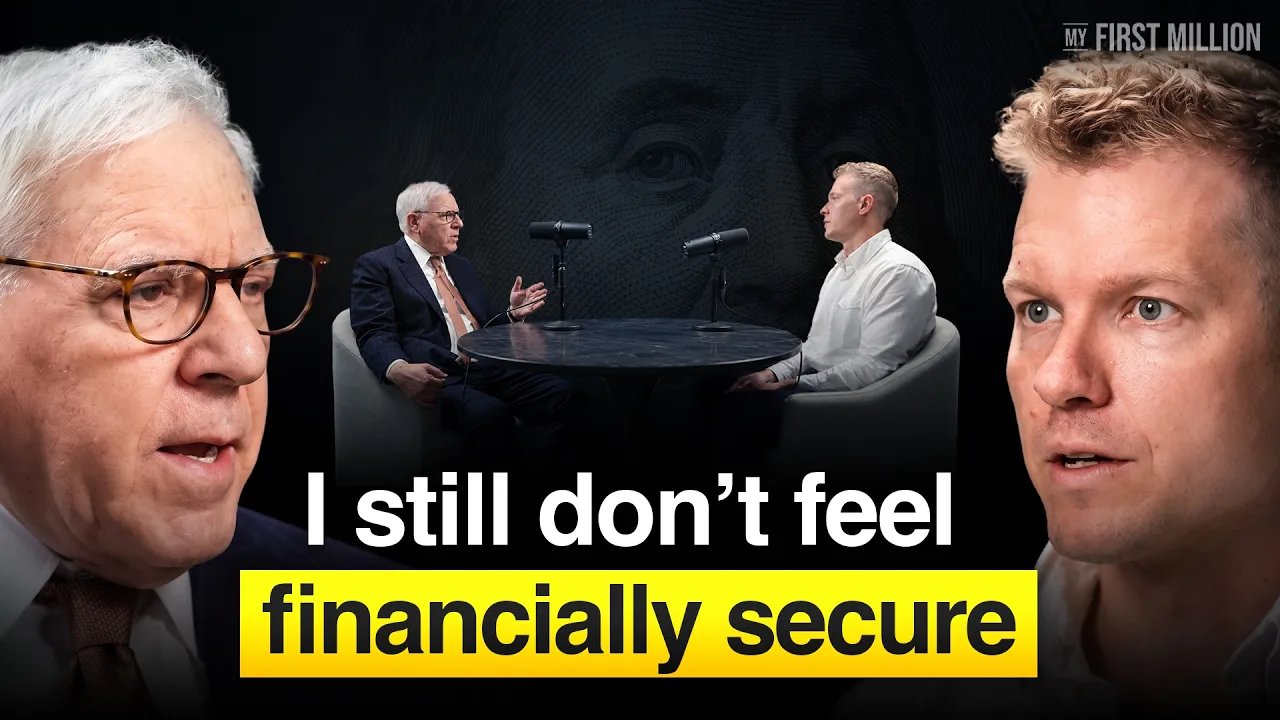
From blue collar to billionaire: How David Rubenstein built his $500B investment firm
Description
*Sam's database on how long it takes to become a millionaire:* https://clickhubspot.com/738i Episode 861: Sam Parr ( https://x.com/theSamParr ) sits down with David Rubenstein ( https://x.com/DM_Rubenstein ) to talk about turning Carlyle into $500B, his $14B miss, and the greatest business lessons in history. — Show Notes: (0:00) Turning $5M into $500B (5:13) Scrappy private equity (11:58) Don’t fool yourself (14:14) Turning down 20% of Amazon (16:23) Recruiting big shots (20:40) Finding the right partner (22:02) Trade-offs (27:39) Witnessing ascents to power (31:40) The Greatest Sentence Ever Written (33:37) History that repeats itself (35:49) Recommended Reading — Links: • Carlyl - https://www.carlyle.com/ • David’s books - https://www.davidrubenstein.com/books/ — Check Out Sam's Stuff: • Hampton (joinhampton.com): My community for founders. Average member does $25m/year. Many of the guests are members. Get after it...apply: http://joinhampton.com/mfm — Check Out Shaan's Stuff: • Shaan's weekly email - https://www.shaanpuri.com • Visit https://www.somewhere.com/mfm to hire worldwide talent like Shaan and get $500 off for being an MFM listener. Hire developers, assistants, marketing pros, sales teams and more for 80% less than US equivalents. • Mercury - Shaan uses Mercury across all of his companies. you can too: http://mercury.com/ Mercury is a fintech company, not an FDIC-insured bank. Banking services provided by Choice Financial Group, Column, N.A., Members FDIC • I run all my newsletters on Beehiiv and you should too + we're giving away $10k to our favorite newsletter, check it out: beehiiv.com/mfm-challenge My First Million is a HubSpot Original Podcast // Brought to you by HubSpot Media // Production by Arie Desormeaux // Editing by Ezra Bakker Trupiano /
Summary
Generated by gpt-5.6-terraAt-a-Glance
- Verdict: Skim
- Core thesis: David Rubenstein built Carlyle from a $5 million, deal-by-deal startup into a $500 billion alternative-investment platform by specializing roles, recruiting credibility, building a repeatable track record, and expanding across products and geographies.
- Why it matters: It offers a grounded institutional-founder playbook: use an initially unfashionable positioning, pair business development with domain-expert partners, convert individual wins into durable fundraising capacity, and retain permanent downside vigilance.
- Best use: Use it for founder and capital-formation lessons, especially the early Carlyle sections; skip or fast-forward the lengthy history, book, and personal-lifestyle discussion unless those subjects are independently useful.
Executive Summary
Rubenstein presents Carlyle's origin as a high-uncertainty, capital-constrained institutional startup rather than a grand master plan. After leaving the Carter White House at 31, struggling to find legal work, and deciding at 37 that he needed to act on his entrepreneurial instinct, he raised $5 million from four investors in 1987. The firm initially financed transactions one at a time before raising a $100 million first fund and then a $1 billion second fund.
His operating model was deliberate division of labor. Partners with MBAs and investment expertise assessed transactions; Rubenstein focused on fundraising, recruiting, and being the public face of the firm. Carlyle differentiated itself by offering multiple investment strategies rather than only a conventional buyout fund, then globalized those funds across Europe and Asia. It also turned Washington, D.C.'s perceived disadvantage versus New York into a thesis that it understood government-affected companies better than Wall Street rivals.
The interview's most reusable lesson is that credibility compounds through proof, not positioning alone. Carlyle recruited figures such as Frank Carlucci and James Baker to open doors, particularly with overseas capital, but Rubenstein says access only mattered insofar as the firm could turn successful exits into a track record for the next transaction. He also emphasizes that founders should expect extended insecurity: even after major institutional milestones, he says he remained preoccupied with payroll, bad deals, and operational failures.
The latter half broadens into Rubenstein's worldview: high-confidence founders still need luck; historical reading is both an intellectual practice and a way to keep his mind active; wealth should be paired with philanthropy; and leadership models such as Lincoln and Washington matter because of humility and institutional stewardship. These are revealing but less actionable than the Carlyle-building material.
Key Takeaways
- Claim: Carlyle began with transaction-by-transaction fundraising because it lacked the credibility and committed capital required for a conventional blind-pool fund. | Evidence: Rubenstein raised $5 million from four investors in 1987, then found a deal and raised capital for that specific deal repeatedly before Carlyle raised its first $100 million fund; its second fund reached $1 billion. | Implication: When institutional trust is absent, structure the business around smaller proof points and expect fundraising friction; successful individual outcomes can become the evidence base for larger, pre-committed capital pools. | Caveat: Deal-by-deal fundraising was operationally slow and particularly difficult when Carlyle was pursuing public-company opportunities, because sharing deal information could enable recipients to trade on it.
- Claim: A founder does not need to be the strongest technical operator if they can clearly own the complementary jobs of capital formation, talent acquisition, and external representation. | Evidence: Rubenstein says his MBA-holding partners were better equipped to assess investment deals, while he spent more than 30 years raising money globally, recruiting people, and serving as Carlyle's face. | Implication: Design founding teams around explicit functional asymmetry rather than trying to make every founder a generalist; capital access and recruiting can be as strategically central as product or investment judgment.
- Claim: Carlyle scaled by broadening both its product set and geographic footprint ahead of what was standard in private equity. | Evidence: Rather than relying only on a buyout fund, Carlyle built buyout, growth, real-estate, and debt funds, then established offerings in Europe, Asia, and Japan when Rubenstein says such multi-fund globalization was novel. | Implication: Once a core capability is proven, adjacent strategies can deepen LP relationships and diversify revenue, but only if the organization can recruit genuine domain expertise and support a larger fundraising machine. | Caveat: Product and geographic expansion required substantial ongoing fundraising and senior recruiting, so diversification increased organizational complexity rather than providing effortless scale.
- Claim: Perceived disadvantages can become a credible market narrative when linked to a specific customer or investment advantage. | Evidence: Operating from Washington was initially a handicap because private equity was associated with New York, but Carlyle argued that its location gave it better insight into companies materially affected by federal policy. | Implication: For a non-consensus location or positioning, articulate a concrete mechanism that converts it into differentiated access, insight, or execution—not a generic claim of uniqueness. | Caveat: Rubenstein acknowledges the claim may or may not have been fully true; its initial value was that it was a compelling explanation for why the firm could win.
- Claim: Elite advisors can accelerate access, but they do not substitute for a repeatable operating record. | Evidence: Former Defense Secretary Frank Carlucci, former Secretary of State James Baker, Dick Darman, George H. W. Bush, and John Major gave Carlyle institutional credibility and opened doors; Rubenstein notes that traveling with Baker to raise Middle Eastern capital was more compelling than traveling alone. | Implication: Use high-trust advisors selectively to overcome initial distribution barriers, while ensuring that the core business produces measurable results independent of borrowed reputation. | Caveat: Rubenstein explicitly says the firm ultimately had to build a track record: a successful exit was what allowed it to credibly raise capital for the next similar deal.
- Claim: Entrepreneurial confidence must coexist with persistent downside management because business survival remains fragile well beyond launch. | Evidence: Rubenstein cites a 99.9% five-year failure rate for U.S. startups, recalls spending Carlyle's limited cash pursuing a bankruptcy acquisition it initially lost and worrying about payroll, and says he still expects something bad could happen every day. | Implication: Build operating systems around cash preservation, payroll visibility, compliance, and deal-risk controls; do not confuse a growing valuation or brand with immunity from failure. | Caveat: The startup-failure statistic is presented without a source and should be treated as rhetorical emphasis rather than a verified planning metric.
- Claim: Exceptional founder traits improve odds but do not make outcomes predictable; luck and market-structure decisions matter materially. | Evidence: Rubenstein describes Bezos as smart, driven, hardworking, and unusually self-confident, yet Carlyle declined an early 20%-25% Amazon equity offer in favor of $100,000 annually for five years to license a book bibliography, later sold the stock it did acquire at the IPO, and estimates the original stake might now be worth $14 billion. | Implication: When evaluating asymmetric opportunities, separate the quality of the founder from the economics and structure of the offer; preserve option value where possible rather than treating early-stage equity as categorically inferior to cash. | Caveat: The Amazon anecdote is a hindsight lesson, not evidence that founders should broadly accept illiquid startup equity or that observer conviction reliably identifies winners.
Detailed Brief
Founder psychology, ambition, and personal operating style
- Claims: Rubenstein rejects the idea that most founders begin with a precise vision of an eventual giant enterprise; he says overly grand initial plans can amount to self-deception.; He attributes company-building partly to extraordinary self-confidence, but says he had less of it than founders such as Gates, Bezos, Zuckerberg, and Jobs and compensated by surrounding himself with more capable people.; He regards chronic concern as a core entrepreneurial trait rather than a temporary startup phase, describing himself as a workaholic who continually scans for what can go wrong.
- Evidence: He declined even a free option on an additional 5,000 square feet in Carlyle's first office because he feared being tempted to expand too quickly; Carlyle later became the building's largest tenant.; Carlyle had four people at the beginning, including Bill Conway, formerly CFO of MCI, and a senior Marriott executive.; He says he did not feel personally secure even after CalPERS bought roughly 5% of Carlyle at an approximately $2 billion-$2.5 billion valuation around 2009; a later 7.5% sale to Mubadala implied roughly a $20 billion valuation before the public listing.
- Caveats: Rubenstein's career includes unusually valuable political networks, which makes the exact path less replicable for ordinary founders.; His aversion to rapid expansion is a personal anecdote, not a universal rule; some businesses require speed to secure a market.
- Implications: Treat ambition as directionally useful but subordinate it to staged execution and financial survivability.; Counterbalance a risk-sensitive founder with partners who have distinct technical confidence and decision authority.
Worldview: long-term stewardship, history, and wealth
- Claims: Rubenstein sees philanthropy and civic stewardship as an obligation of wealth, rooted in his blue-collar Baltimore upbringing and the fact that neither parent completed high school.; He uses reading and interviewing as disciplined cognitive exercise, choosing interview subjects partly because the commitment forces him to read deeply.; He warns that U.S. federal debt, which he places at $40 trillion, is a major long-term concern and predicts that repayment pressure will likely involve dollar devaluation.
- Evidence: He was an original signer of the Giving Pledge, says he has already given substantially, and intends to give away most of his remaining wealth.; His historical-document collecting began with the Magna Carta, which he put on permanent display at the National Archives; he also acquired copies of the Declaration of Independence, the Emancipation Proclamation, and the 13th Amendment and supported restoration of major Washington memorials.; He convenes private Library of Congress history sessions for members of Congress from both parties, without press present, and has assembled interviews from that program into a book.
- Caveats: The macroeconomic view on debt and dollar devaluation is Rubenstein's opinion in the interview, not a substantiated forecast presented with analysis.; The health rationale for reading is personal and should not be interpreted as medical guidance.
- Implications: Long-duration institutions can build legitimacy by pairing commercial success with visible public goods and durable cultural investments.; A recurring learning practice can be designed as an operating commitment rather than left to discretionary consumption.
Notable Concepts & Terms
- Deal-by-deal fundraising: Carlyle's early capital model: identify a specific transaction first, then obtain investor commitments for it before the firm had a large committed fund.
- Blind-pool fund: The conventional private-equity model Rubenstein contrasts with Carlyle's start: investors commit capital to a fund before knowing each investment.
- Multiple-fund platform: Carlyle's expansion from buyouts into growth, real estate, debt, and regional strategies, allowing broader LP relationships and a larger asset-management franchise.
- Franchise value: The idea, initially doubted in private equity, that an investment firm's recurring platform, brand, and fundraising capacity have saleable enterprise value beyond its individual funds.
- CalPERS: The California Public Employees' Retirement System; its purchase of about 5% of Carlyle was an early validation that the firm itself could be valued as a durable franchise.
- Mubadala: Abu Dhabi's investment arm; its later purchase of 7.5% of Carlyle implied a much larger valuation and illustrates the importance of global institutional capital.
- Giving Pledge: A philanthropic commitment Rubenstein signed early, consistent with his stated intent to give away the bulk of his wealth.
- Everett Dirksen's parade maxim: "When you're getting kicked out of town, get out in front and pretend you're leading a parade"—Rubenstein's framing for turning Carlyle's Washington location into a strategic story.
Operator Notes / Why Ken Should Care
- For any new venture or fund, explicitly assign ownership of technical judgment, capital formation, recruiting, and external narrative; identify gaps where one individual is currently carrying incompatible functions.
- Build a proof-to-platform sequence: define the smallest credible win, the evidence it will generate, and the specific next capital, customer, or partnership ask that evidence unlocks.
- Audit whether current geographic, sector, or organizational constraints can be reframed into a defensible advantage with a real causal mechanism.
- Create a downside dashboard that includes cash runway, payroll exposure, concentrated counterparties, compliance/security risks, and failure scenarios; review it even during periods of apparent momentum.
- When offered early strategic equity, assess it with a structured option-value framework rather than defaulting to near-term cash; document dilution, liquidity, downside, and upside cases.
- Treat prominent advisors as distribution accelerants, not validation of product-market fit; require a clear access thesis, defined role, and measurable return for each relationship.
Source/Metadata
- Title: From blue collar to billionaire: How David Rubenstein built his $500B investment firm
- Transcript words: 15160
- Duration seconds: 2687
- Timestamp note: No timestamps or chapter markers were provided. The supplied transcript also contains substantial duplicated passages in its latter portion.
Transcript
[SPEAKER_00]: I raised $5 million from four investors in 1987. Today, Carlisle manages not $5 million, but $500 billion. [SPEAKER_01]: How old were you then when you started Carlisle? [SPEAKER_00]: 37. I said, geez, if I don't do it now, I'll never do it. [SPEAKER_01]: Do you have any habits that you think would shock people? [SPEAKER_00]: I always view myself as being from a blue-collar family in Baltimore. But even in year 10, you weren't thinking, all right, I can breathe a little. This is going to work. I think I'm safe. No, because if you're an entrepreneur, you always think something bad is going to happen. [SPEAKER_01]: You still feel that way? [SPEAKER_00]: Every day. 99.9% of the companies that started in the United States are not in business five years later. If you go back and look at anybody that built a company, they have self-confidence that is staggering. I met Jeff Bezos for the first time. He said, well, I'll give you 20% of the company that I'm about to build. Later, after a company was going somewhere, I said, we should have taken that deal. That was stupid. That stock's probably worth $14 billion now. [SPEAKER_01]: Can I ask you about seeing people get power? [SPEAKER_00]: Well, I was looking at this photo. There's this photo here of, I think it's you and your parents. [SPEAKER_01]: Yes. It's with President Carter. And, you know, I was 27 years old. I got a job as the deputy domestic policy advisor. I obviously wasn't qualified and wasn't experienced. But in our system, if you work in a campaign, you win, you might get a job in the White House. And so my parents, who were blue-collar workers, never graduated from high school. When I got a job at 27 at the White House, they couldn't believe it. Then I took them in to meet the president, which is what that picture shows. And they were in awe because they were what we call yellow dog Democrats. [SPEAKER_01]: What's that? [SPEAKER_00]: It is an old expression. It means that I'm a Democrat and I would vote for a Democrat, for a candidate, for a president or for any office, even if it was a yellow dog. [SPEAKER_01]: So they're just hardcore Dems. [SPEAKER_00]: Absolutely. [SPEAKER_01]: What do you do your first month when you're in office? Because getting any type of new job is a big deal, particularly one where it's like one of the most powerful things on earth. What do you do your first month? Do you remember? [SPEAKER_00]: Carter had a lot of promises. And what I did is I worked on compiling what his promises were. See, there wasn't an Internet then. And so Carter had wanted to know what he actually promised in the course of his two-year campaign. Well, you have to go dig it out—talks, interviews, questionnaires. What did he actually promise? And I got to sit in a lot of Carter's meetings because I knew his promises better than anybody. And so I would be able to object and say, Mr. President, it's a good idea, this person has, but it's a violation of a campaign promise. Every administration, the current administration, every administration has young people who are in their 20s or 30s who work in the campaign. And they're energetic and eager and they get jobs and some of them will turn out to be great and some will turn out to be not as great. But how did you figure out how to make good decisions? Because you are so young. I mean, I didn't have a lot of policy experience. I'd worked on Capitol Hill for about a year or so. I didn't really have that much policy experience. My boss did. And then we hired a staff of really talented people. They were all young, but they were talented in their area—energy or environment or whatever it would be. And then we'd have issues and we'd come up with positions. Remember, the president has policy positions that he wants to take because of campaign promises. So we would articulate how we could fulfill his promises. [SPEAKER_01]: So you were there for four years. What did you feel like when it was done? [SPEAKER_00]: Well, when you work in the White House, people come to you and tell you how great you are. Nobody says, yeah, you're an idiot. They come and tell you, you're a smart guy, you're great. And by the way, can you help me on this or that? And they always will say, and by the way, if you ever want to leave, call me because I'm going to hire you. But I always said, well, I don't want to be hired, but I'm going to be here for four years and we win. I'll be maybe the senior domestic advisor in the next four years. After we lost the election, I started calling these people saying, you remember me? I'm the bright young guy. You said I was so great. I didn't get calls back because you're out of power. People want to get contacted with the Reagan people. So I struggled for a while to find a law firm that would take me because nobody really wanted a junior White House aide who was a Carter person. [SPEAKER_01]: And you're 32? [SPEAKER_00]: I left the White House at 31. So at 31, I'm trying to figure out, I didn't want to tell my mother, look, your son is unemployable. Nobody wants a Carter White House aide. Not unlike the experience that the Biden people have had—the Biden people have found it more difficult to get reestablished than they would have preferred. And when you lose an election, you're out of power. So as Harry Truman said, you want a friend in Washington, get a dog. Eventually, I got a job practicing law and I realized I wasn't that great a lawyer. I didn't really like it. And so I started an investment firm about a year or a couple years later. [SPEAKER_01]: I think the best way to become successful is to see how other people did it, whether you're going to copy them or just use it as inspiration. Because then now you know what's possible. So starting at the age of 24, I did this relentlessly and I was very methodical about it. And I created a spreadsheet where I tracked roughly 50 people who were uber successful. And I looked at the year that they were born, the year that they started their apprenticeship, and then the year that they started the first thing that made them successful, finally the year that they broke through. And I aggregated all this data along with the stories of what they did to be an apprentice and what they did to finally break through. And I put it together in a database. And HubSpot went and found this thing that I frankly even forgot about, but it did change my life. And they resurfaced it. They made it even better. And they put it into a thing that you can download for free right now. So if you click the link in the description or click the QR code right here, you can see this database that I made when I was 24 and it changed my life. And so if you're looking to become successful or you're already successful and just want some more inspiration, check it out. [SPEAKER_00]: How old were you then when you started Carlisle? [SPEAKER_01]: I was 37 because I read that an entrepreneur will start his or her first company between the ages of 28 and 37. Now, obviously, there's the Mark Zuckerbergs and Bill Gateses of the world that are different, but an average person will start a first company between 28 and 37. If you haven't done it by 37, I read, you probably will never start a company. So if you have an entrepreneurial instinct, you better do something by the age of 37, was what I read. And I was then 37. I said, geez, if I don't do it now, I'll never do it. [SPEAKER_00]: Did you think, a lot of times when people start businesses, they're thinking, how much runway do I have? [SPEAKER_01]: When I started Carlisle, I was married. When I left the White House, I wasn't married. I got married a couple of years before I started Carlisle. So you had the pressure of, I need to provide. [SPEAKER_00]: Well, I have some pressure, but it was pressure. But the pressure of getting a company off the ground is considerable. As you know, you started your own company. You never know when you start a company if you're going to be able to pay the rent the next day or next month. And are people going to want your services? You don't know. [SPEAKER_01]: Yeah. When I started my first company, that was one that led to some success. I was lucky because I was 24 or 25 and I was single and I only spent $1,500 or $2,000 a month. And so I had saved up maybe, I don't remember, $50,000. So I'm like, I'm good. I have 36 months or something like that. [SPEAKER_00]: Well, remember, 99.9% of the companies that started in the United States are not in business five years later. 99.9%. So it's a small percentage of companies that are there five years later and a very small percentage that are there 10 years later. So most companies that are started just don't work out. You never know when you start a company if you're going to be able to pay the rent the next day or next month. And are people going to want your services? You don't know. Yeah. When I started my first company, that was one that led to some success. I was lucky because I was 24 or 25 and I was single and I only spent $1,500 or $2,000 a month. And so I had saved up maybe, I don't remember, $50,000. So I'm thinking I'm good. I have 36 months or something like that. Well, remember, 99.9% of the companies that started in the United States are not in business five years later. 99.9%. So it's a small percentage of companies that are there five years later and a very small percentage that are there 10 years later. So most companies that are started just don't work out. What did you do the first handful of weeks after you decided to start the company? Well, I had to recruit people. And then we raised money. I had to raise money to get it started. I raised $5 million from four investors in 1987. Today, Carlyle manages not $5 million, but $500 billion. So it's grown to be one of the larger private equity firms in the world, with the help of a lot of people. But I did that for many, many years. Who was your first few hires? Well, I had a couple partners. I hired a person who had been the chief financial officer of a company called MCI, which was a long-distance telephone company. And he became my co-CEO with me for some 30 years. His name is Bill Conway. And we hired another person, a senior officer from Marriott. So we hired a number of people at the beginning, four of us at the beginning. And then we grew it. But the companies Carlyle controls have about a million and a half employees. And Carlyle itself has got about 2,300 core. It sounds like whenever I started my last company, the people who are in this company, the people who I initially hire, they're basically rejects. It's smart, ambitious, rebellious. But it sounds like the people you hired early on were very pedigreed. Well, they have pedigrees in the sense that they went to good schools. I was probably a sucker for hiring people that went to good schools. But in the end, everybody is leaving somewhere because they're not happy there and they're not thinking it's working well for them. So everybody is really incented to try to get a better position in life. And a lot of people at the age of 20 or 30, they realize the job that they currently have may not be so great. So they take a chance. And some people work out and some people it doesn't work out. I know your job was recruiting and your job was helping fundraise. And I already know because I've listened to so many of you. You're very charming and you're very persuasive. You do. You're very good with words. I don't know about that. But I would say that my partners had MBAs. I didn't have an MBA. So they really knew the investment world. So I figured, OK, they can really assess deals better than I can. What I'll do is I'll raise the money and then I'll ultimately recruit people. And then I'll be the face of the firm because I was better at that than maybe they were. And so that's what I did for 30 plus years, run around the world raising money and then recruiting people to build our new firms. So what we did that was different was we had multiple funds. In private equity, historically, you had a buyout fund if you're a buyout business. And you had a venture fund. Every four years, you raise a new one if your track record was good enough to justify it. I came up with the idea of having a buyout fund, a growth fund, a real estate fund, a debt fund. And I had multiple funds. And then I had the idea of globalizing. I have a fund in Europe, in Asia, Japan, so forth. That was novel at the time. But to do that, I had to run around the world recruiting people and raising the money. And so that took a lot of time. Do you remember how you got your first $5 million fund? How long did that take to raise? Well, there was one person who was a friend of mine who helped me raise the $5 million from four investors. And we did things what's called deal by deal. We didn't have money to do a big fund. So we'd find a deal and then go raise money for that deal. And if it worked out, then we'd go raise money for another deal. And we did that for a number of years before we raised our first fund, which was $100 million. And the second fund was $1 billion. And so we got bigger. How did you pay your team then if you don't have a fund, if you're doing deal by deal? Well, it's harder because if you do it deal by deal, you have to go to people and say, here's a good deal. Give me some money for it. And they say, I'll get back to you. I'm not sure. So it takes time. And it's hard to do what we were trying to do at the time because we were buying publicly traded stocks. And you can't tell people, here's the opportunity, because they could trade on it if they didn't give you the money. And legally, they could trade on it that they shouldn't have. So it took a while to get funding. But that's true of everybody. Anybody that's built a successful company is always going to have a hard time at the beginning. And we had a hard time at the beginning. But Blackstone and Apollo and KKR, they all had similar stories of having no money at the beginning. And then they started Blackstone, which is the biggest of the private equity firms these days. Steve Schwartzman wrote in his autobiography that they got turned down by 97% of the people they went to to raise their first fund. Yeah, and the first one was huge, wasn't it? It was about $800 million, I think. Yeah, it was huge. But what I'm curious about, I don't think that you don't talk too much about your entrepreneurial side. And I'm always very curious about that. Do you remember, like, the scrappy stories of what your first office looked like? When I started the firm, we didn't have any money. We had no credibility. So there was a new office building that had been built in Washington. It looked like a building that was a classic building for a wealthy set of tenants. And they had a little space left because they had filmed the movie called Broadcast News with Jack Nicholson in that space. So the space was now available. I said I would take the space. It was 5,000 square feet. And the leasing agent said, look, you can have another 5,000 if you want. You have an option for 5,000. I said, no. I didn't take it. I said, I don't want it. She said, it's free. You just signed the thing here. You get the option to have 5,000 square feet more. I said, I don't want it because I don't want to be tempted to ever grow that big a firm. Why didn't you want to grow that big? At the time, I didn't know much about business compared to what I know about government or I knew about practice of law. And I was afraid if I took a bigger space that we would try to expand too rapidly. So that's probably why we didn't do it. Then later we had to expand. And now we're the biggest tenant in the building. About one night a week, I'll be laying in bed with my wife, doing pillow talk. And I'm thinking, you know, one day if we nail this, this, and this in the next 10 years, maybe we can be this. Or maybe in 50 years we can be this. And you have these vision sessions. Were you doing that with your spouse? Every day was a challenge because we're trying to start a firm. Remember, private equity was not as big as it is today. In fact, the phrase private equity wasn't even invented yet. We were in Washington, D.C. Washington, D.C. was not New York. People didn't take you seriously. And people asked me, why did you do it in Washington? Well, Senator Everett Dirksen, used to be a Senate minority leader, said famously, when you're getting kicked out of town, get out in front and pretend you're leading a parade. What does that mean? It means take advantage of the situation you're in. So I said, we're in Washington. We understand that companies are heavily affected by the federal government better than the guys in New York. Maybe it was true, maybe it wasn't, but it sounded good. And some people gave us money. You're the second person in the past couple weeks. So over here, we've had Ray Dalio recently. Remember, private equity was not as big as it is today. In fact, the phrase private equity wasn't even invented yet. We were in Washington, D.C. Washington, D.C. was not New York. People didn't take you seriously. And people asked me, why did you do it in Washington? Well, Senator Everett Dirksen, used to be a Senate minority leader, said famously, when you're getting kicked out of town, get out in front and pretend you're leading a parade. What does that mean? It means take advantage of the situation you're in. So I said, we're in Washington. We understand that companies are heavily affected by the federal government better than the guys in New York. Maybe it was true, maybe it wasn't, but it sounded good. And some people gave us money. You're the second person in the past couple weeks. So over here, we've had Ray Dalio recently. And I asked him the same question. I was like, when you were first getting Bridgewater going, what were some crazy ambitions? Did you say like, oh, it would be awesome if we made $100 million or a billion dollars or had 10,000 employees or whatever? And he was like, I just wanted to make $100,000 a year so I could pay for my family. That was my goal. In Ray's case, I think he started the business out of his apartment. Yeah, and he had to ask his dad for money one time because he went broke. He had to borrow money from his father. That's correct. Yeah, and so it's funny hearing you say this because you've built such an amazing company that I can't believe that there was no aspirations early on just for the sake of motivation. You know, if you have grandiose expectations or plans in the beginning, you might be fooling yourself. I don't think Bill Gates when he started thought he was going to build what he built or Mark Zuckerberg or all these others. For example, Mark Zuckerberg was at Harvard. My now son-in-law was one of his classmates. And I heard about the opportunity that this guy was building his company and they asked me to invest. And I said, I'm not going to invest in that. It's a dating company because the original idea was simply to help people get dates at Harvard. You have pictures of people, their faces, and you can do it through social media. And then they thought maybe that expanded to Yale or Princeton. That was it. The idea of doing non-students really hadn't surfaced then. I don't think Mark Zuckerberg actually thought he would ever build what he built. Yeah, I think I remember some awesome story of Jeff Bezos at a pitch. He goes, look, if we really nail this, I think we can make $100 million a year. Look, I saw Jeff at the beginning because he had to get a bibliography of books in print to better sell books on the Internet. One of our companies had bibliography of books in print. He came to rent it from us and we said, we don't rent it. He said, well, I'll give you 20% of the company that I'm about to build. And our guy said, we don't want a piece of an illiquid company, a startup. That's not more than we want cash. Ultimately, we agreed to, I think, $100,000 a year for five years. We rented the bibliography. Wait, you owned a company that was a book publisher and it had a book that had a list of every book ever written? And the offer was 25%? It was 20% to 25%. Later, after the company was going somewhere, I said, we should have taken that deal. I flew out and met Jeff Bezos for the first time. And he had one office and he was doing the books himself. And he would take them to the post office every night. It was very small. And I said, you know, you're going to compete against Barnes & Noble. He says, yeah, but I understand how to do this better than they do. And so I said, this guy is not going to really make it. I said, look, we'll take some stock now. We'd like some stock. 20% is okay. He said, well, David, that was a couple years ago. Now I don't need you quite as much, but I'll give you some stock. We got some stock, but then we sold it at the IPO. That was stupid. That stock's probably worth $14 billion now. Did he have any attributes back then that you saw this guy is going to be the guy? He's very smart and had a lot of self-confidence. And he said he had a lot of good computer skills and maybe he did. I couldn't judge that. But he was very driven, very smart, hardworking, like a lot of entrepreneurs. Entrepreneurs, people that build companies are not shrinking violets. You know, if you go back and look at anybody that built a company, they have self-confidence that is staggering. Because if you're a shrinking violet, you're not going to build a company. Bill Gates as a young man and Jeff Bezos or Mark Zuckerberg or Steve Jobs, the enormous amount of self-confidence, and that's what it takes to really build a company. Did you have that? I didn't have as much as they did because I didn't think I was as smart as they were. But I was surrounded by people that had more. I recruited people that knew more than I did. And you got really good at not just recruiting talented people, but you got really good at recruiting big shots. Like you had a bunch of big shots who were, I don't know the right terminology there, advisors. Well, what happened was when we were starting the company or right after we started it, they started in '87, Ronald Reagan's presidency was over in '88. And a former law partner of mine said that a man who had been the secretary of defense was going to go on a lot of corporate boards. But in those days, if you were not a lawyer, you couldn't join a law firm. So he was looking for a place to be a base. And my former law partner knew about what I was doing. And since we were in a law firm, he said, why don't you interview Frank Carlucci, the former secretary of defense or about to be former secretary of defense, and he can join your firm. He's going to be on a lot of corporate boards, and maybe he can open some doors for you. So we interviewed Frank Carlucci. He joined us. And then he could open doors that I couldn't open. He was a former secretary of defense. Four years later, Jim Baker was leaving as secretary of state. He's the ultimate great man of the world, secretary of state, secretary of treasury, White House chief of staff, and I was able to recruit him. How many other options did they have? Why would they trust a startup? I mean, they always had all the things that we weren't doing. In Frank Carlucci's case, he was joining six or seven corporate boards. That was his main activity. In Jim Baker's case, he went back to his family's law firm. He was a partner in there, but he's also a partner in our firm. And then after Baker, we had Dick Darman, who had been one of his proteges, who had been the head of OMB. And then later, George Herbert Walker Bush, former president of the United States, became an advisor to us. And then John Major, former prime minister, became an advisor to us as well. So we did open doors with these people because if your last name is Rubenstein and you go to the Middle East to raise money, it might not be as compelling as if you go with Jim Baker. Do you remember what the pitch looks like or sounds like when you're swinging above your weight? Oh, it's saying, look, we're a firm in Washington. We understand companies heavily affected by the federal government. We're buying an aerospace defense company. We have a former secretary of defense. And you know, in the end, you have to build your track record. So if you did one deal and it exited well, then you can go and use that to say, we're going to do another deal similarly. So it worked out, but we made some mistakes and everybody makes mistakes and, you know, but it worked out. Yeah, that's crazy. But it seems like you guys had a pretty good trajectory. Do you remember any times where you're like, this is not going to work? One time we had a limited amount of cash and then we were trying to buy a company and it was in bankruptcy court. We're trying to buy a bankruptcy and we basically spent all our money trying to buy it. And then we lost in bankruptcy court. So we'd spent all our money. We didn't get the company. We had no more cash. So we said, hey, what are we going to do to meet the payroll? But in the end, we actually got the company and the end turned out to be a very successful deal. But, you know, I remember waking up in the middle of the night thinking, hey, how am I going to pay the rent? What year or how many years into the company did you feel like you personally were like, But it worked out. Yeah, that's crazy. But it seems like you guys had a pretty good trajectory. Do you remember any times where you're like, this is not going to work? One time we had a limited amount of cash and then we were trying to buy a company and it was in bankruptcy court. We're trying to buy a bankruptcy and we spent all our money trying to buy it. And then we lost in bankruptcy court. So we'd spent all our money. We didn't get the company. We had no more cash. So we said, hey, what are we going to do to meet the payroll? But in the end, we actually got the company and the end turned out to be a very successful deal. But I remember waking up in the middle of the night thinking, hey, how am I going to pay the rent? What year or how many years into the company did you feel like you personally were like, all right, I'm financially stable? Maybe yesterday. It takes a while. When we were building the company, we ultimately sold a piece of it to CalPERS, I think about 5% to California retirement system. And they valued the company at something being worth like $2 billion. The company was worth $2 billion or $2.5 billion. Nobody thought that a private equity firm in those days had franchise value and could be sold. But we sold 5% to CalPERS. That was probably 2009 or something like that. And then a few years later, we sold 7.5% to Mubatala, which was an Abu Dhabi investment arm. And that valued the company at being worth $20 billion. And then we later took the company public. But even like in year 10 or so, you weren't thinking like, all right, I can breathe a little. This is going to work. I don't know how well it's going to work, but it's actually going to work. And personally, I think I'm safe. No, because if you're an entrepreneur, you always think something bad is going to happen. And so I'm always worried that something bad is going to happen. Tomorrow, somebody will do something they shouldn't have done or a deal won't work out. So I never felt comfortable. I tend to be a workaholic. So I'm always working on things and I'm always thinking what can go wrong. Do you still feel that way? Every day. Really? Look, I'm always thinking bad things can happen. Maybe that's what entrepreneurs do because you have to have certain self-confidence, but you always have to assume something bad can happen. You have to protect against it. But it seems like you've had good partners. I'm highly neurotic. My business partner who runs Hampton is not neurotic at all. And he's very calm and steady. And it's the greatest pair ever because he's the only one who I will be neurotic with. Well, I have two people that I really built the company with. And one of them is now 80 years old and has all dark hair and then one gray hair. So he may be not as neurotic as I am. And then Bill Conway has gray hair. But he doesn't seem to worry about some of the things as much as I do, maybe because he has more self-confidence about his abilities to be an investor. But look, you're always worried something bad's going to happen. I'm worried every day. I'm now the principal owner of the Baltimore Orioles. I'm worried every day that something bad can happen. What are you worried about with the Orioles? I want to make the playoffs. And we're now one game out of the playoff, but one game away from being able to get into the playoffs. But one game behind the Cleveland Guardians. And then there are other teams that could catch up to us. So I'm always worried that I didn't do a good enough job in helping the team. I get worried about looking stupid on the Internet. And the comments, I act like they don't bother me. They do. Do you get bothered by comments or people criticizing an interview? Advisors have trained me not to read social media. Because you're inevitably going to find people saying something critical of you. Does that bother you? Well, nobody wants to be criticized. So I tend not to read the social media. Sure. So I generally don't go into social media. I was reading about how I think you said you were traveling like 200 plus days a year. So how old were your kids when you were doing that? And how did you balance being a good dad? Well, it's always a challenge, of course. But as you know, all three of my kids have MBAs. And they all are in private equity. So you can say I either did something wrong or did something right. But look, parents who are driven and have businesses that are required to travel, you have to depend on your spouse and other people that help make sure the kids grow up. And when I came back on weekends from my travels, I would try to spend time with them. Do you get to work with them on a weekly or daily basis now? Like, are they part of an organization that you're a part of? No. I have a family investment office. And very often a family investment office will be something where you can bring your children to work in it. Some people do it that way. I didn't want to do that. So they have their own businesses that I've helped support. But now they're on their own. And I have a family investment office, which is owned largely by the people that work there, professionals. And I own a piece of it as well. And then when I drop dead, my children will get something probably out of it. But I'm committed to giving away most of my money. I was an early original signer of the Giving Pledge and I've given away a lot of money. And I intend to give away the bulk of what I have left. One of the reasons I respect you is because you seem like a very fulfilled person. Have you ever thought about who you know in your life who seems fulfilled and has a really rich life, like a well-rounded rich life? Because a lot of times successful people, you don't want to trade spots with them. Well, there are very few people who everything works perfectly for. There may be some people like that, but everybody's got their challenges. And this weekend I hosted in Nantucket friends of mine from high school from 60 years ago. When I was growing up, I wasn't a great athlete. Some of the people I had at my home this weekend were great athletes. Now they often have artificial hips or artificial knees because they were such great athletes, they hurt themselves. So I don't really have that problem. But when you think of, do you ever think of, like, who do you admire most, not just for their business ability, but for their holistic approach, like, this person under these circumstances has mostly nailed aspects of life that I admire? Well, there are a lot of people. There's a person who was in my firm. I thought his professional career was extraordinary, and that was Jim Baker. Great job in the federal government and a very well-respected person. There are lots of business people that I've looked at and admired over the years. And people have great personal lives, professional lives, and people want to emulate. Yeah, a lot of people like that. But there's nobody that's out there that's perfect. I talked to someone who worked with you at Carlisle. He was an associate. He was saying something. He was like, I love working for David because I think he's lived in mostly the same house for a very long time. When you walk into the office, his office, you don't see a lot of fancy stuff. He's pretty low-key. When he leaves the office, there's not a limousine driver or whatever you would think of, like, the stereotype. And he said that's one of the reasons why I really respect him and I really like him is because he seems like he's still very down-to-earth regardless of how successful he's got. Well, I always view myself as being from a blue-collar family in Baltimore. And I always realized that neither of my parents graduated from high school. I got lucky in life. And I've tried to give back to society. And I've given a lot of things in philanthropy. And I've tried to chair a lot of nonprofit boards and so forth to give back to society. But in the end, I'm not that fancy a person, I guess. When we had Lloyd in, he told a story about how I think his father was a post office worker. His father had the same job my father had, postal clerk. His father did it in New York, I think Brooklyn, and my father did it in Baltimore. I forget if his father was a high school graduate. But my parents didn't graduate from high school. And my father came back from World War II. The only job he could get was this postal job. And that's the job he had his entire life. And you wouldn't have predicted what would have happened to me. I've tried to give back to society. I've given a lot of things in philanthropy. I've tried to chair a lot of nonprofit boards and so forth to give back to society. But in the end, I'm not that fancy a person, I guess. When we had Lloyd in, he told a story about how I think his father was a post office. His father had the same job my father had, postal clerk. His father did it in New York, I think Brooklyn, and my father did it in Baltimore. I forget if his father was a high school graduate. But my parents didn't graduate from high school. And my father came back from World War II. The only job he could get was this postal job. And that's the job he had his entire life. And he told the story, he was like, I still have the lower tier of Netflix. He was like, it's funny. He was like, I could afford these things. But I definitely like being broke or not having a lot of money at a young age, it still has impacted me. Does it still impact you? Do you have any habits that you think would shock people? I still go to the same barber for $15 to get a haircut or something in my neighborhood. So I am wealthy, but not so wealthy that I have yachts. And I guess I'm somewhat old school and I still have this suit I'm wearing. I've had it for 10 years. The trick is being able to fit in your suit for 10 years. That's a trick. How many do you have? Because that's the only thing I've ever seen you wear. We have a lot of suits. And it's an interesting phenomenon. Today, in the business world, not wearing a suit is considered more normal. But I guess my father was a blue-collar worker and he had this obsession with never wearing a tie. He just thought ties were terrible. And I guess to show that I had achieved more than he had achieved, I guess I bought a lot of suits and I have a lot of ties and I'm amortizing them. I'm still wearing the same ties and suits I've had for many years. Well, it looks good. I mean, that photo when you were 27, you looked sharp there too. By the way, they dressed, the presidents and government officials dressed amazing during that era. Like when you look at Ronald Reagan's suits, he was a sharp dresser. He was very good at dressing compared to a lot of people now. He was an actor and he wanted to look good. And Carter was a little cheaper than Reagan was probably. He had his suits made in Plains, Georgia or someplace like that. But he wasn't a fashion plate, I think it's fair to say. But can I ask you about seeing people get power? Because I've read, I think, is it the governor of Virginia was an intern with you guys? Glenn Youngkin worked at Carlisle for 25 years and he got elected governor Glenn Youngkin, yes. And then you also know world leaders. You know a lot of really successful entrepreneurs. What is it like when you see someone go from just knowing them as a young person or someone without as much power or money or success and then seeing them become the man? Is there something that power can change you? Power does change some people. And Glenn Youngkin, I hired him pretty much out of McKinsey right out of Harvard Business School. He worked for us for 25 years. And then he decided to leave and run for governor. I didn't think he would get elected because he'd never been in politics before. He got elected. And all of a sudden people were talking about him being potential president of the United States. So look, I met a lot of people over the years who I thought were modestly talented or very talented. And you never know which ones are going to be the ones that actually go on. You don't think you can predict that? It's impossible. You just have lucky breaks. I mean, who would have predicted Bill Gates dropping out of Harvard and building a company that became Microsoft? Or Steve Jobs didn't even go to college. Who would have predicted any of these things? Yeah, but there are some traits or anecdotes or stories that you hear about these guys where they just sound unstoppable. Like, I heard this story. And a lot of these stories, they could be myths at this point. But it was a story about Bill Gates. And apparently he didn't have a radio in his car because he said that distracts me from thinking about Microsoft just in my 20-minute drive. And you hear these things and you're like, I don't know if it's going to work amazingly well. But you got something where you seem a little bit unstoppable. Well, but there are a lot of people that have those qualities and they don't make it. You have to have some luck, too. Microsoft had some very good fortune at the very beginning. IBM, in effect, made, I think, a mistake. When IBM was looking for a software or operating system for its PC, they hired Microsoft to provide it. But they didn't own the operating system. Had they owned the system, Microsoft wouldn't have made all that money by selling the operating system to other computer operators or by building a whole system of software. If IBM had said, well, buy Microsoft at the beginning because they have the operating system, it would have been different. Can I ask you about owning all these awesome documents? Yeah, sure. How much have you spent on some? I've never added it up. I don't really honestly know. But what happened was I stumbled into buying the Magna Carta. I didn't really intend to, but somebody told me it was about to be sold and it was the only copy in the United States and it was the only one in private hands and it would leave the country, blah, blah, blah. So I bought it. And then I put it on display at the National Archives on a permanent display. And then I started getting other historic documents, the Emancipation Proclamation, Declaration of Independence. I owned, I think, more rare copies than anybody of that. And then the 13th Amendment, which freed slaves, and other historic documents. And I started fixing up buildings at the Washington Monument, Jefferson Memorial, Lincoln Memorial. And the reason is I want people to know more about American history. And if you have original documents, people may be more likely to look at them, learn more about history. And the same is true of these buildings. If they're restored, people might go visit them and learn more about American history. When you're bidding on them, are there other bidders typically? Well, there typically are, sure. When I bought the Magna Carta, I was bidding, but I was in a room. They put me in a little room and a telephone and they said, aren't you going to bid? The auction's almost over. And I said, okay, I'll bid. I put a bid in and they said, sold right away. I don't know if anybody else ever bid. I never found out. How big is the market of people buying these documents? Yeah, it wasn't as big as it's now becoming because now some art buyers who spend $300 million for a painting are now getting by documents for a lot less. And they now gravitated to that. So it's more competition. And look, the Declaration of Independence, because of the semi-quincentennial, become a document of greater interest to people. So the prices have gone up dramatically to buy these historic copies. I think it's Walter Isaacson. He's got a new book about the greatest sentence ever written. And it's awesome. And I didn't realize how amazing the founding fathers were when it came to a bunch of different stuff, thinking really long term. And the idea of we hold these truths to be self-evident, that's interesting. And it's a self-amending document. There's a lot of really interesting parts. Did you think that when they were writing this that they thought someone is willing to pay all this money to own this and save this and cherish it? Well, they didn't treat the document that well. When the Declaration of Independence, after it was drafted and signed, they basically folded it. They hid it, placed it. They put it in sunlight. No, I don't think they thought that at all. Not until 1823, when John Quincy Adams was Secretary of State, he realized that the document was fading so much, they better get some copies. The sooner nobody would be able to see it. And they made copies then. Yeah, I often think about that, about what they were like, where their mind space was when they were doing it. Because it's pretty amazing. How old was Thomas Jefferson? I think 33? 33. There's a lot of really interesting parts. Did you think that when they were writing this that they thought someone is willing to pay all this money to own this and save this and cherish it? Well, they didn't treat the document that well. When the Declaration of Independence, after it was drafted and signed, they folded it. They hid it, placed it. They put it in sunlight. No, I don't think they thought that at all. Not until 1823, when John Quincy Adams was Secretary of State, he realized that the document was fading so much, they better get some copies. Soon nobody would be able to see it. And they made copies then. Yeah, I often think about that, about what they were like, where their mind space was when they were doing it. Because it's pretty amazing. How old was Thomas Jefferson? I think 33? 33. Remember, there were 3 million people in the United States at the time of the Declaration of Independence and half a million slaves and 2.5 million whites. And it was on the eastern seaboard. And nobody really thought this country would amount to that much, even if we won the war, which no one thought we would do. But even after winning the war, it was not clear the country would survive. Jefferson didn't think it would survive for more than 20 years. He said that? He did. He wasn't at the Constitutional Convention, but he wrote with Madison back and forth, and he thought 20 years would be about what it would take. And so that's a common trend of what I was asking earlier about Jeff Bezos and how it's hard to have big ambitions when you're just getting going. Yeah, look, the founding fathers, if they were to come back today, they'd be astounded that the country that was a tiny country on the eastern seaboard has been, for at least since World War II, the most powerful country in the world in every category you can mention. They would never have dreamed that. One of my favorite parts about reading history is that there's a handful of rules or axioms or trends that tend to repeat themselves. For example, I was reading about Winston Churchill, and he was talking about how he said to someone, I think the world might end. And it was funny that there were different periods of time where people always think the worst is going to happen, and we end up working it out. Are there any sets of rules or axioms or trends that you have seen repeat themselves over and over again that have helped you deal with whatever you're dealing with at the current time? Well, you're always worried about things. I worry about the federal debt, for example. We have $40 trillion of federal debt. Our ability to pay this off is virtually nonexistent. And so what we're really going to have to do is, in effect, pay it off and devalue dollars, and the dollar will go down in value almost certainly. And you always worry, if you have children, as you do, right, that are they going to grow up in a world that's going to be more difficult than the world that you grew up in? And will they be ready to deal with the world? Are they going to be educated appropriately? And what are they going to turn out to be? And it's a more complicated situation. Every parent worries about whether the world will be good enough for their children to be able to do what they did. So I've read a lot of great books. And the reason I do it is, one, I have some TV shows where I interview authors, and I feel it's a courtesy to the author to read the book. Yeah. Secondly, I generally interview people about books I am interested in reading, and this forces me to do it. Third, it's my anti-Alzheimer's device. Because they tell you when you reach a certain age, if you don't have a genetic predisposition to Alzheimer's, you could still get it if maybe your brain is allowed to not be exercised enough. They tell you to learn a musical instrument, do a crossword puzzle, or learn a foreign language. I'm not good at any of those things. So one of the things I do is I read a lot and I interview people. And when you interview people, you've got to keep your brain sharp, as you can see. You've got to go back and forth, listen to what a person's saying. Think of the next question while you're listening to the person. And you've got to keep your brain active. And it's a good way to keep your brain active when you reach my age. So I do it as my anti-Alzheimer's device. What are some of the favorite things that you've read in the last six or eight or 12 weeks? I've read a book on Roy Cohn. It's called American Scoundrel, which is a really good book by Kai Bird, a previous book on Robert Oppenheimer that won the Pulitzer Prize. And it's amazing what Roy Cohn was. Recently read Beverly Gage's book on J. Edgar Hoover, which is an astounding book and won the Pulitzer Prize, a really terrific book. So I'm always reading books. And one of the programs, I have another book coming out this year on my best interviews at the Library of Congress. About 15 years ago, I started a program where I interview a great historian about an American history subject in front of members of Congress only. And I pay for it. I host it. And we have a dinner. Members of Congress come. They sit with people from the opposite party. No press is there to see them fraternizing with somebody from the opposite party. And then we have a great person, Doris Kearns Goodwin, or somebody like that. I'll interview them. And members of Congress are fascinated by American history, as they should be. And then they ask questions after the interview's done. And I've now taken the best of those interviews and put them in a book coming out in a couple weeks. Who do you think the audience learned from most, given what they needed to learn at that time? Well, I'll give you one example of a story. I interviewed John Roberts, the Chief Justice of the United States. I wanted members of Congress to learn more about the court. And he did a really good job explaining the court. And at one point I said, Mr. Chief Justice, do you always want to be Chief Justice of the United States? No. Well, did you want to be a lawyer? No. Well, what did you want to be when you were growing up? I wanted to be an American history professor. That's all I cared about. It's American history. My father said, John, you'll starve to death. There's no money in American history. Get a real profession. But John went to Harvard and he majored in American history. And after his junior year, he came back from spring break, got into the airport at Logan in Boston, got into the cab line, got into the cab, and said to the cab driver, take me to Cambridge. And the cab driver said, are you a student at Harvard? Yes, I am. What are you majoring in? I'm majoring in American history. Cab driver said, well, when I was a student at Harvard, that's what I majored in also. So John concluded maybe you didn't want to be a cab driver. Maybe you shouldn't be a cab driver. Well, I history is my passion. American history, particularly from 1880 to 1940, that's my favorite era. Well, there are a lot of great books in that era. I just started reading, finally reading The Power Broker. Power Broker is a historic book considered one of the 50 best books of the 20th century. Yeah. And the American History Museum, up here in the Upper West Side, just did a big exhibit on Robert Caro when he was writing that book. That's the New York Historical. Yeah, sorry. And it was awesome. And so I saw that, and then I also saw you say that it was one of your favorites. So I started reading it last week. It's a great book. But he's now everybody's waiting for him to finish the fifth volume of his series on Lyndon Johnson, a 35-year project. I don't think I can read five volumes on that. Maybe, but that's a lot. Well, one of the volumes won the Pulitzer Prize. That might be the best one. But, you know, people would really want to see. Remember, the fourth volume ended when John Kennedy was assassinated and Lyndon Johnson sworn in. So the entire Johnson presidency we're waiting to see what he thinks after all these years of working on that fifth volume. He's now 90 years old. I also love Titan. That's probably my most favorite business biography. On John D. Rockefeller. Oh, yeah. He was a very fascinating character. And so I saw that, and then I also saw you say that it was one of your favorites. So I started reading it last week. It's a great book. But he's now, everybody's waiting for him to finish the fifth volume of his series on Lyndon Johnson, a 35-year project. I don't think I can read five volumes on that. Maybe, but that's a lot. Well, one of the volumes won the Pulitzer Prize. That might be the best one. But people would really want to see. Remember, the fourth volume ended when John Kennedy was assassinated and Lyndon Johnson sworn in. So the entire Johnson presidency we're waiting to see what he thinks after all these years of working on that fifth volume. He's now 90 years old. I also love Titan. That's probably my most favorite business biography on John D. Rockefeller. Oh, yeah. He was a very fascinating character. He seemed to be a good dad and a good husband and a ruthless businessman. And I like that combination. I think that's super interesting. Carnegie is one of my favorites. I got married at Carnegie Hall because I loved his book so much. Well, he was famous for saying you should give away all your money. And there's a book of that era, 1929, by Andrew Ross Sorkin. If you really care about the early twenties, it's a great book. Yeah, I thought that was awesome. Other than you cite Lincoln all the time, you cite JFK, and I think Washington. When you think back to some of the early presidents or really early leaders or business folks, who do you often refer to when you're thinking how would this person handle this situation? Well, look, Lincoln was in a league by himself as president because he saved the Union and he emancipated the slaves. And he did it with grace and humility. He didn't say, guess what, everybody? Look how great I am. I just won the Civil War. Or I just wrote the Gettysburg Address by myself. He's humble. Humility. George Washington set the tone for what a president should be. And he really got us off to a very good start. So those are people that I often cite as really great leaders as presidents. And we obviously had some great ones in the 20th century as well. Have you read Manhunt about Lincoln's assassination? I did. That is an interesting book in the sense that John Wilkes Booth thought he would be a hero. And interestingly, what happened there is that had Ulysses S. Grant taken the invitation to go to Lincoln that night to see Ford's theater, he would have had 20 military aides around him. Probably John Wilkes Booth would not have gotten into that presidential box because there would have been a lot of military aides. Lincoln only had one military aide. And he was drinking at a bar at the time the shot occurred. He wasn't there. One of my, so I've read, there's been four presidents, I think, have been successfully assassinated. And I've read, I don't know if there's one on McKinley, but there's a bunch on Kennedy. There's a few on Lincoln. And then Garfield has his most famous one. There's a book, a famous book that—Garfield, the book that's written, is a good book this way. Yeah, it's awesome. I didn't know anything about him. He seemed to be a really good guy. I didn't realize how great of a person he was. And what's crazy when I'm reading these books is the Secret Service really wasn't a thing until the seventies. They talk about JFK's Secret Service. It was pretty lacking. Well, I wouldn't use that word, but I would say the mistake that was made on the Kennedy assassination was this. The Secret Service allowed the route to be put in the newspapers. They shouldn't have done that. Secondly, it was raining that day, and they had a bubble top on the convertible. The Secret Service asked whether they should take the bubble top off or not because it wasn't clear whether it was going to be raining or not. And President Kennedy's chief of staff said no, the president wants to be seen and take the bubble top off. Secret Service should not have listened to a political advisor. They should have kept the bubble top on. Had they done that, Kennedy would have lived. And I think one of his whole things was, look, my father is this big-shot rich guy. People think that I'm out of touch. It's important that I'm a man of the people. Well, remember, that was the first time that Jackie Kennedy had gone with him on any political trip. First time she'd been west of the Mississippi as First Lady. And it was a big deal that she did that. And he wanted to show her off for sure. Yeah, and then I think a week prior in Miami, there, he didn't have the bubble top either. And they're driving through downtown Miami. And the Secret Service was, we've got to be more careful. And he's, look, guys, I've got to be a man of the people. And I think, is this right? Right before, or miles before he got shot, he stopped the car and ran over to a young family that was holding a sign as he was driving by and thanked them and stuff. It's crazy to think. That would never happen today. When I worked for Carter, there were no metal detectors at the White House. You could walk in with a bazooka. There were no metal detectors. And I remember a couple times Carter would stand on the roof of the presidential limousine with a microphone and talking to people. I mean, incredibly exposed. Today, we're much more careful. I appreciate you doing this. I've had a lot of admiration for you for years. I'm so happy to talk to you. Well, I hope I don't disappoint you. So now you've met me, you say, hey, this guy wasn't as good as I thought, right? No, not, but you know, I feel that way about reading a lot of books. Has there anyone who you've read about where you're thinking, not my guy anymore? Well, usually biographers write books about people they like. They don't usually write about people they don't like. The other book on Roy Cohn is not one where the author liked that person. Most of the times, you find somebody to admire. Doris Kearns Goodwin always says she falls in love with the people she—Yeah. And because she has to spend 10 years with them. And you don't want to spend 10 years with somebody you hate. So generally, people write books about people they tend to admire, generally. And we have so many books about the same people. We have 10,000 books on Lincoln, 10,000 books on Kennedy. Why do we have so many books on the same people? Because people buy these books. People like them, and so people and authors write more about them. Well, and you've done the ultimate thing when it comes to writing a book where you just do interviews. I don't have what it takes to write a book, but if I did, that's the style. It seems awesome. I agree. So I love your style of books. I love that style. Well, thanks very much. Yeah. Thanks for doing this, man. You're the man. My pleasure. Appreciate you. I love you. I love you. I love you. I love you. I love you. I love you. When he leaves the office, there's not, like, a limousine driver or whatever you would think of, like, the stereotype. And he said that that's one of the reasons why I really respect him and I really like him is because he seems like he's still very down-to-earth regardless of how successful he's got. Well, I always view myself as being from a blue-collar family in Baltimore. And I always, you know, realized that neither of my parents graduated from high school. I got lucky in life. And, you know, you wouldn't have predicted what would have happened to me. And, you know, I've tried to give back to society. And I've given a lot of things in philanthropy. And I've tried to chair a lot of nonprofit boards and so forth to kind of give back to society. But, you know, in the end, you know, I'm not that fancy a person, I guess. When we had Lloyd in, he was like, he told a story about how I think his father was a post office. His father had the same job my father had, postal clerk. His father did it in New York, I think Brooklyn, and my father did it in Baltimore. I forget if his father was a high school graduate. But my parents didn't graduate from high school. And my father came back from World War II. The only job he could get was this postal job. And that's the job he had his entire life. And he told the story, he was like, I still have the lower tier of Netflix. He was like, it's kind of funny. He was like, I could afford these things. But I definitely like being broke or not having a lot of money at a young age, it still has impacted me. Does it still impact you? Do you have any habits that you think would shock people? You know, I still go to the same barber for like $15 to get a haircut or something in my neighborhood. So, I am wealthy, but not so wealthy that I have yachts. And I don't know, I guess I'm somewhat old school and I still have this suit I'm wearing. I've had it for like 10 years. The trick is being able to fit in your suit, say, for 10 years. That's a trick. How many do you have? Because that's the only thing I've ever seen you wear. We have a lot of suits. And it's an interesting phenomenon. Today, in the business world, not wearing a suit is considered more normal. But I guess my father was a blue-collar worker and he had this obsession with never wearing a tie. He just thought ties were terrible. And I guess to kind of show that I was achieved more than he had achieved, I guess I bought a lot of suits and I have a lot of ties and I'm amortizing them. I'm still wearing the same ties and suits I've had for many years. Well, it looks good. I mean, that photo when you were 27, you looked sharp there too. By the way, they dressed, the president's and government official, they dressed amazing during that era. Like when you look at Ronald Reagan's suits, he was a sharp dresser. He was very good at dressing compared to a lot of people now. He was an actor and he wanted to look good. And Carter was a little cheaper than Reagan was probably. He had his suits made in Plains, Georgia or someplace like that. But he wasn't a fashion plate, I think it's fair to say. But can I ask you about seeing people get power? Because I've read, I think, is it the governor of Virginia was an intern with you guys? Glenn Youngkin worked at Carlisle for 25 years and he got elected governor Glenn Youngkin, yes. And then you also know world leaders. You know a lot of really successful entrepreneurs. What is it like when you see someone go from just knowing them as a young person or someone without as much power or money or success and then seeing them become like the man? Is there something that power can change you? Power does change some people. And Glenn Youngkin, I hired him pretty much out of McKinsey right out of Harvard Business School. He worked for us for 25 years. And then he decided to leave and run for governor. I didn't think he would get elected because he'd never been in politics before. He got elected. And all of a sudden people were talking about him being potential president of the United States. So, look, I met a lot of people over the years who I thought were modestly talented or very talented. And you never know which ones are going to be the ones that actually go on. You don't think you can predict that? It's impossible. You know, you just have lucky breaks. I mean, who would have predicted Bill Gates dropping out of Harvard and is going to build a company that became Microsoft? Or Steve Jobs didn't even go to college. Who would have predicted any of these things? Yeah, but there are some, like, traits or little antidotes or stories that you hear about these guys where they just, like, they sound like animals. Like, I heard this story. And a lot of these stories, they could be myths at this point. But it was a story about Bill Gates. And apparently he didn't have a radio in his car because he said that distracts me from thinking about Microsoft just in my 20-minute drive. And, like, you hear these things and you're like, I don't know if it's going to work amazingly well. But, like, you got something where you seem a little bit unstoppable. Well, but there are a lot of people that have those qualities and they don't make it. You know, you have to have some luck, too. Microsoft, you know, had some very good fortune at the very beginning. IBM, in effect, made, I think, a mistake. When IBM was looking for a software or operating system for its PC, they hired Microsoft to provide it. But they didn't own the operating system. Had they owned the system, Microsoft wouldn't have made all that money by selling the, in effect, operating system to other computer operators or by building a whole system of software. If IBM had said, well, buy Microsoft at the beginning because they have the operating system, it would have been different. Can I ask you about owning all these awesome documents? Yeah, sure. How much have you spent in some? I've never added it up. I don't really honestly know. But what happened was I stumbled into buying the Magna Carta. I didn't really intend to, but somebody told me it was about to be sold and it was the only copy in the United States and it was the only one in private hands and it would leave the country, blah, blah, blah. So I bought it. And then I put it on display at the National Archives on a permanent display. And then I started getting other historic documents, the Emancipation Proclamation, Declaration of Independence. I owned, I think, more rare copies than anybody of that. And then the 13th Amendment, which freed slaves, and then other historic documents. And I started fixing up buildings at the Washington Monument, Jefferson Memorial, Lincoln Memorial. And the reason is I want people to know more about American history. And if you have original documents, people may be more likely to look at them, learn more about history. And the same is true of these buildings. If they're restored, people might go visit them and learn more about American history. When you're bidding on them, are there other bidders typically? Well, there typically are, sure. When I bought the Magna Carta, I was bidding, but I was in a room. They put me in a little room and a telephone and they said, aren't you going to bid? The auction's almost over. And I said, okay, I'll bid. I put a bid in and they said, sold right away. I don't know if anybody else ever bid. I never found out. How big is the market, though, of people buying these documents? Yeah, it wasn't as big as it's now becoming because now some art buyers who spend $300 million for a painting are now getting by documents for a lot less. And they now gravitated to that. So it's more competition. And look, the Declaration of Independence, because of the semi-quintentennial, become a document of greater interest to people. So the prices have gone up dramatically to buy these historic copies. I think it's Walter Isaacson. He's got a new book about the greatest sentence ever, ever written. And it's awesome. And I didn't realize how amazing the founding fathers were when it came to a bunch of different stuff, like thinking really long term. And like the idea of like we hold these truths to be self-evident, that's kind of interesting. And that it's a very, it's a self-amending document. Like there's a lot of like really interesting parts. Did you think that when they were writing this that they thought someone is willing to pay all this money to own this and save this and like cherish it? Well, they didn't treat the document that well. When the Declaration of Independence, after it was drafted and signed, they basically folded it. They hid it, placed it. They put it in sunlight. No, I don't think they thought that at all. Not until 1823, when John Quincy Adams was Secretary of State, he realized that the document was fading so much, they better get some copies. The sooner nobody would be able to see it. And they made copies then. Yeah, I often think about that, about what they were like, where their mind space was when they were doing it. Because it's pretty amazing. How old was Thomas Jefferson? I think 33? 33. Remember, there were 3 million people in the United States at the time of the Declaration of Independence and half a million slaves and 2.5 million whites. And it was on the eastern seaboard. And nobody really thought this country would amount to that much, even if we won the war, which no one thought we would do. But even after winning the war, it was not clear the country would survive. Jefferson didn't think it would survive for more than 20 years. He said that? He did. He wasn't at the Constitutional Convention, but he wrote with Madison back and forth, and he kind of thought 20 years would be about what it would take. And so, that's kind of like a common trend of what I was asking earlier about Jeff Bezos and how it's kind of hard to, like, have big ambitions when you're just getting going. Yeah, look, the founding fathers, if they were to come back today, they'd be astounded that the country that was a tiny country on the eastern seaboard has been, for at least since World War II, the most powerful country in the world in every category you can mention. They would never have dreamed that. One of my favorite parts about reading history is that there's, like, a handful of rules or axioms or trends that, like, tend to repeat themselves. For example, I was reading about Winston Churchill, and he was talking about how he was, he, like, said it, like, to someone, he was like, I think the world might end. Like, and, like, it was just, like, funny that there was, like, different periods of time where people always think, like, the worst is going to happen, and we end up working out. Are there any, like, sets of rules or axioms or trends that you have seen repeat themselves over and over again that have helped you deal with whatever you're dealing with at the current time? Well, you're always worried about things. I worry about the federal debt, for example. We have $40 trillion of federal debt. Our ability to pay this off is virtually nonexistent. And so what we're really going to have to do is, in effect, pay it off and devalue dollars, and the dollar will go down in value almost certainly. And you always worry, if you have children, as you do, right, that are they going to grow up in a world that's going to be more difficult than the world that you grew up in? And will they be ready to deal with the world? Are they going to be educated appropriately? And what are they going to turn out to be? And it's a more complicated situation. Every parent worries about whether the world will be good enough for their children to kind of be able to do what they did. So I've read a lot of great books. And the reason I do it is, one, I have some TV shows where I interview authors, and I feel it's a courtesy to the author to read the book. Yeah. Secondly, I actually generally interview people about books I am interested in reading, and this kind of forces me to do it. Third, it's my anti-Alzheimer's device. Because they tell you when you reach a certain age, if you don't have a genetic predisposition to Alzheimer's, you could still get it by maybe your brain is allowed to not be exercised enough. They tell you to learn a musical instrument, do a crossword puzzle, learn how to do crossword puzzles and do that frequently, or learn a foreign language. I'm not good at any of those things. So one of the things I do is I read a lot and I interview people. And when you interview people, you've got to keep your brain sharp, as you can see. You've got to go back and forth, listen to what a person's saying. Think of the next question while you're listening to the person. And you've got to keep your brain active. And it's a good way to keep your brain active when you reach my age. So I do it as my anti-Alzheimer's device. What are some of the favorite things that you've read in the last six or eight or 12 weeks? I've read a book on Roy Cohn. It's called, I think, American Scoundrel, which is a really good book by Kai Bird, a previous word, a book on Robert Oppenheimer that won the Pulitzer Prize. And it's just amazing what Roy Cohn was and so forth. Recently read Beverly Gage's book on J. Edgar Hoover, which is an astounding book and won the Pulitzer Prize, a really terrific book. So I'm always reading books. And one of the programs, I have another book coming out this year on my best interviews at the Library of Congress, about 15 years ago, I started a program where I interview a great historian about an American history subject in front of members of Congress only. And I pay for it. I host it. And we have a dinner. Members of Congress come. They sit with people from the opposite party. No press is there to see them fraternizing with somebody from the opposite party. And then we have a great person, Doris Kearns, Goodwin, or somebody like that. I'll interview them. And members of Congress are fascinated by American history, as they should be. And then they ask questions after the interview's done. And I've now taken the best of those interviews and put them in a book coming out in a couple weeks. Who do you think the audience learned from most, given what they needed to learn at that time? Well, I'll give you one example of a story. I interviewed John Roberts, the Chief Justice of the United States. I wanted members of Congress to learn more about the court. And he did a really good job explaining the court and so forth. And at one point I said, Mr. Chief Justice, do you always want to be Chief Justice of the United States? No. Well, did you want to be a lawyer? No. Well, what did you want to be when you were growing up? I wanted to be an American history professor. That's all I cared about. It's American history. My father said, John, you'll starve to death. There's no money in American history. Get a real profession. But John went to Harvard and he majored in American history. And after his junior year, he came back from spring break, got into the airport at Logan in Boston, got into the cab line, got into the cab, and said to the cab driver, take me to Cambridge. And the cab driver said, are you a student at Harvard? Yes, I am. What are you majoring in? I'm majoring in American history. Cab driver said, well, when I was a student at Harvard, that's what I majored in also. So John concluded maybe you didn't want to be a cab driver. Maybe you shouldn't be a cab driver. Well, I'm like, history is my passion. American history, particularly from like 1880 to like 1940, that's my favorite era. Well, there are a lot of great books in that era. I just started reading, finally reading The Power Broker. Power Broker is a historic book considered one of the 50 best books of the 20th century. Yeah. And the American History Museum, or I forget what it's called, up here in the Upper West Side, just did a big exhibit on Robert Caro when he was writing that book. That's the New York, it's the New York historical. Yeah, sorry. And it was awesome. And so I saw that, and then I also saw you say that it was one of your favorites. So I started reading it last week. It's a great book. But he's now, everybody's waiting for him to finish the fifth volume of his series on Lyndon Johnson, a 35-year project. I don't think I can read five volumes on that. Maybe, but that's a lot. Well, one of the volumes won the Pulitzer Prize. That might be the best one. But, you know, people would really want to see. Remember, the fourth volume ended when John Kennedy was assassinated and Lyndon Johnson sworn in. So the entire Johnson presidency were waiting to see what he thinks after all these years of working on that fifth volume. He's now 90 years old. I also love Titan. That's probably my most favorite business biography. On John D. Rockefeller. Oh, yeah. He was a very fascinating character. He seemed like a mostly a good dad and a good husband and a ruthless businessman. And I like that combination. I think that's super interesting. Carnegie is one of my favorites. I got married at Carnegie Hall because I loved his book so much. Well, he was famous for saying you should give away all your money. And there's a book of that era, 1929, by Andrew Ross Sorkin. If you really care about the early 20s, it's a great book. Yeah, I thought that was awesome. Other than you cite Lincoln all the time, you cite JFK, and I think Washington. When you think back to some of the early presidents or really early leaders or business folks, who do you often refer to when you're like, how would this person handle this situation? Well, look, Lincoln was in a league by himself as president because he saved the Union and he emancipated the slaves. And he did it with grace and humility. He didn't say, guess what, everybody? Look how great I am. I just won the Civil War. Or I just wrote the Gettysburg Address by myself. He's humble. Humility. George Washington set the tone for what a president should be. And he really got us off to a very good start. So those are people that I often cite as really great leaders as presidents. And we obviously had some great in the 20th century as well. Have you read Manhunt about Lincoln's assassination? I did. That is an interesting book in the sense that John Wilkes Booth thought he would be a hero. And interestingly, what happened there is that had Ulysses S. Grant taken the invitation to go to Lincoln that night to see Ford's theater. He would have had 20 military grades or A's around him. Probably John Wilkes Booth would not have gotten into that presidential box because there would have been a lot of military A's. Lincoln only had one military A's. And he was drinking at a bar at the time the shot occurred. He wasn't there. One of my—so I've read—there's been four books. Four presidents, I think, have been successfully assassinated. And I've read—I don't know if there's one on McKinley, but there's a bunch on Kennedy. There's a few on Lincoln. And then Garfield has his most famous one. There's a book, a famous book that— Garfield, the book that's written, is a good book this way. Yeah, it's awesome. I didn't know anything about him. He seemed like a really good guy. I didn't realize how great of a person he was. And what's crazy when I'm reading these books is the Secret Service really wasn't a thing until, like, the 70s. Like, they talk about JFK's Secret Service. It was pretty rinky-dink. Well, I wouldn't use the word rinky-dink, but I would say the mistake that was made on the Kennedy assassination was this. The Secret Service allowed the route to be put in the newspapers. They shouldn't have done that. Secondly, it was raining that day, and they had a bubble top on the convertible. The Secret Service asked whether they should take the bubble top off or not because it wasn't clear whether it was going to be raining or not. And President Kennedy's chief of staff said, no, the president wants to be seen take the bubble top off. Secret Service should not have listened to a political advisor. They should have kept the bubble top on. Had they done that, Kennedy would have lived. And I think one of his whole schticks was, like, look, my father is this big-shot rich guy. People think that I'm out of touch. It's important that I, like, I'm, like, a man of the people. Well, remember, that was the first time that Jackie Kennedy had gone with him on any political trip. First time she'd been west of the Mississippi as First Lady. And it was a big deal that she did that. And he wanted to show her off for sure. Yeah, and then I think, like, a week prior in Miami, there, he didn't have the bubble top either. And they're driving through, like, downtown Miami. And the Secret Service was like, we've got to be more careful. And he's like, look, guys, I've got to be a man of the people. And I think, is this right? Right before, or miles before he got shot, he, like, stopped the car and ran over to, like, a young family that was holding a sign as he was driving by and thanked them and stuff. It's crazy to think. I mean, that would never happen today. When I worked for Carter, there were no metal detectors at the White House. You could walk in with a bazooka. There were no metal detectors. And I remember a couple times Carter would stand on the roof of the presidential limousine with a microphone and talking to people. I mean, incredibly exposed. Today, we're much more careful. I appreciate you doing this. I've had a lot of admiration for you for years. I'm so happy to go to talk to you. Well, I hope I don't disappoint you. So now you've met me, you say, hey, this guy wasn't as good as I thought, right? No, not, but, you know, I feel that way about reading a lot of books. Has there anyone who you've read about where you're, like, not my guy anymore? Well, usually biographers write books about people they like. They don't usually write about people they don't like. The other book on Roy Cohn is not one of somebody that the author liked. You know, most of the times, you find somebody to admire. Doris Kearns Goodwin always says she falls in love with the people she— Yeah. And because she has to spend 10 years with them. And, you know, you don't want to spend 10 years with somebody you hate. So generally, people write books about people they tend to admire, generally. And we have so many books about the same people. We have 10,000 books on Lincoln, 10,000 books on Kennedy. Why do we have so many books on the same people? Because people buy these books. People like them, and so people—and authors write more about them. Well, and you've done, like, the ultimate thing when it comes to writing a book where you just—it's interviews. I don't have what it takes to write a book, but if I did, that's the style. It seems awesome. I agree. So I love your style of books. I love that style. Well, thanks very much. Yeah. Thanks for doing this, man. You're the man. My pleasure. Appreciate you. I love you. I love you. I love you. I love you. I love you. I love you.