We Trust AI Agents That Break Every Day - Shy Ruparel, Temporal
Description
Temporal's State of Development survey found that 80.8% of engineers use agents daily, but only 49.1% run them in production. Developer advocate Shy Ruparel walks through the four gaps behind that number (usage vs. production, trust vs. reality, prototype vs. enterprise, seeing vs. recovering), then demos a $2,500 payout workflow with a local model that survives having its workers killed mid-flight, without losing state, repeating tool calls or re-spending tokens. Chapters: 0:00 Intro 0:34 Finance runs on long-running workflows 2:05 The State of Development survey 3:16 Gap 1: Usage vs. production 4:33 Gap 2: Trust vs. reality 7:18 Gap 3: Prototype vs. enterprise 8:55 Gap 4: Seeing vs. recovering 10:53 Demo: a payout that survives a crash 13:06 Durable execution explained 18:12 What the demo solved 20:10 Who runs this in production 20:50 Wrap-up Shy Ruparel https://temporal.io Join us in SF for the second annual AIE CODE summit: https://aie.codes our last flagship summit of 2026. Applications live now!
Summary
Generated by gpt-5.6-terraAt-a-Glance
- Verdict: Watch fully
- Core thesis: Production agents should be treated as failure-prone participants in durable business workflows: the workflow system, not the model, must own state, retries, approvals, audit history, and recovery.
- Why it matters: The talk directly addresses the operational gap between agent demos and dependable systems handling real actions, money, long-running tasks, and human approvals—core concerns for agent orchestration and control planes.
- Best use: Use it to pressure-test agent architecture: separate deterministic workflow control from non-deterministic model work, persist execution history, and design recovery so crashes do not re-run completed tool calls or lose human inputs.
Executive Summary
Shy Ruparel frames enterprise agent adoption as four gaps: daily use versus production deployment, high trust versus frequent failures, fast prototypes versus slow enterprise rollout, and being able to observe failures versus actually recover from them. The central claim is not that agents can be made failure-free, but that their failures can be made non-destructive through durable workflow execution.
The speaker cites Temporal's survey of 554 active agent users to argue that agent usage is widespread while production reliability remains weak. Although 80.8% use agents daily and 85.5% trust outputs at least somewhat, only 49.1% report agents in production or core to shipping, while 41.1% encounter agent issues daily or more often. The stated bottlenecks are operational rather than model-centric: cross-service state tracking, debugging, lost work after crashes, approvals, and retry/recovery logic.
The technical prescription is to let a deterministic workflow own business state and irreversible actions, while placing LLM calls, tools, and external APIs inside individually durable activities. A persisted event history becomes both the replay/recovery mechanism and the debugging record. Human decisions arrive as durable signals, meaning an approval can be captured even when no worker is currently online.
The payout demo illustrates the pattern: an agent investigates a suspicious transfer and drafts a brief, a human approves it, and workers are deliberately killed before and after approval. On restart, new workers resume at the last completed event rather than rerunning prior LLM/tool activity, preserving the approval and avoiding duplicate token spend. The talk is necessarily a Temporal product argument, but its workflow-versus-agent separation is broadly useful.
Key Takeaways
- Claim: The meaningful production gap is not agent adoption but reliable deployment: many teams use agents daily without making them part of core production workflows. | Evidence: In Temporal's survey of 554 engineers and engineering leaders actively using agents, 80.8% reported daily use, but only 49.1% said agents were in production or core to how they ship. | Implication: Ken should distinguish internal assistant usage and prototype success from production-grade agent operations; the latter requires explicit workflow, state, and recovery architecture. | Caveat: The figures are self-reported survey results from Temporal rather than independently audited deployment metrics.
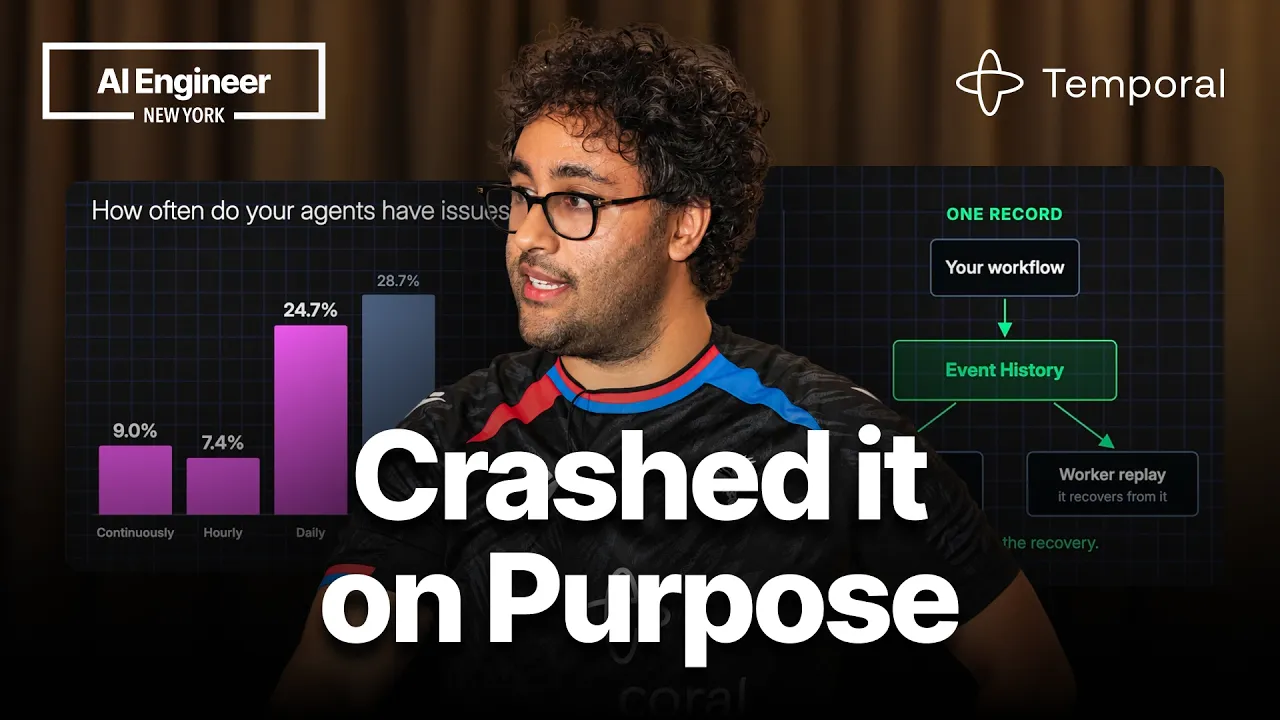
- Claim: Trust in agent output does not imply operational reliability; failures remain routine even for teams that view their agent efforts as successful. | Evidence: 85.5% trusted agent output at least somewhat, yet 41.1% experienced agent issues daily or more often and 16.4% experienced them hourly. Teams describing themselves as successful were 1.7 times more likely to report continuous issues; the speaker notes agent count itself was not correlated with issue frequency. | Implication: Reliability design should assume frequent partial failures, including model, tool, worker, and deployment failures, rather than relying on perceived model quality or team maturity. | Caveat: The explanation for the 1.7x result is speculative: successful teams may simply detect and report failures more rigorously.
- Claim: State management and debugging—not model capability—are the leading productivity blockers for teams running agents. | Evidence: 35.7% identified tracking state across services as their top blocker, 30.9% cited isolating and debugging issues, and 22.2% reported losing progress and redoing work after crashes or restarts. Only 13% were very confident they could observe and debug AI workflows at scale. | Implication: Agent platforms should be evaluated first on durable state, event history, replay, and diagnosis—not only on prompting, model routing, or tracing dashboards.
- Claim: Observability alone is insufficient: a system that can tell an operator an agent failed but cannot resume safely still leaves recovery to humans. | Evidence: The speaker characterizes the common gap as a person reading traces at 2 a.m. and manually repairing state. She argues that conventional observability records and recovery state drift apart, whereas a single persisted event history can be used both to inspect execution and replay it. | Implication: Require an execution record that is operationally actionable—able to resume from known checkpoints—not just logs, traces, and post-hoc LLM observability. | Caveat: A durable history does not resolve bad business decisions, incorrect model outputs, or unsafe authorization; it primarily protects workflow progress and enables deterministic recovery.
- Claim: The workflow should own critical state and side effects; the agent should provide bounded advice rather than control the business process. | Evidence: In the payout design, the workflow owns funds and state, while the LLM investigates a suspicious payment and drafts a brief. The human makes the approval decision. The speaker says that if the model fails, the payout can continue without the brief, so a model outage does not degrade the core transaction path. | Implication: For OpenClaw-style systems, place agent reasoning behind deterministic policy gates, permissions, approval paths, and compensating transaction logic; do not make the LLM the source of truth for durable business state. | Caveat: Whether a transaction should continue without model input is domain-specific; in high-risk workflows, a model or policy failure may need to trigger a hold or escalation instead.
- Claim: Durable execution can prevent duplicate agent work and preserve human inputs across worker crashes. | Evidence: The demo uses a nine-stage payout workflow in which funds are reserved, an agent performs customer/payout lookups and writes a review brief, workers are killed, and a human approval is submitted while no workers run. Once a worker returns, it consumes the stored approval signal and continues from the last completed event; completed AI activities are not rerun. | Implication: Persist checkpoints around every consequential tool/API action, make side effects idempotent, and retain approvals/events independently of ephemeral agent workers to avoid duplicate payments, duplicate actions, and unnecessary token spend. | Caveat: A call that was in flight when the worker died may be retried, so external actions still require idempotency and careful handling of uncertain side-effect completion.
- Claim: Enterprise deployment delays are likely driven by requirements that prototypes evade: approval controls, audit trails, and guarantees around irreversible actions. | Evidence: 51.3% reported getting an AI prototype to production in hours or less, but among organizations with 5,000+ employees, roughly one in five said the process takes months, versus approximately one in twenty elsewhere. The speaker links the difference to regulated environments such as banks, insurers, and payment companies that need approvals, auditability, and protections against losing payments. | Implication: Treat enterprise readiness as a separate engineering product from prototype velocity, with first-class identity, authorization, audit, approval, recovery, and operational ownership requirements. | Caveat: The survey does not directly attribute the delay to those controls; the causal explanation is the speaker's interpretation.
Detailed Brief
Durable workflow pattern demonstrated in the payout example
- Claims: Deterministic workflow code decides sequencing and retains ordinary state as workflow fields rather than requiring custom state tables or caches.; Non-deterministic and side-effecting work is isolated into activities: LLM calls, agent tool calls, and bank API calls.; Human approval/rejection is modeled as a durable signal that can be recorded while workers are offline.; Retry behavior is declared as policy rather than handwritten retry loops distributed throughout business logic.
- Evidence: The workflow covers validation, funds reservation, FX-related checks, fraud investigation, a human review step, bank submission, and completion handling.; The speaker says the event history records individual agent steps, including investigation selection, customer lookup, payout lookup, and brief generation.; The demo intentionally stops workers twice: before human approval and while awaiting bank completion; later workers resume based on the persisted history.; The speaker says the pattern addresses seven reported blockers in one workflow: state, debugging, cost, retries, approvals, long-running work, and crash recovery.
- Caveats: Durability does not eliminate the need for business-level compensation, idempotency keys, timeout design, and reconciliation where external systems may have acted but acknowledgement is uncertain.; The nine-stage payment example is deliberately shorter and simpler than a production financial workflow.
- Implications: A useful agent control plane should model workflow execution as a durable state machine with explicit event/signal semantics, rather than as a continuously running chat or agent process.; Long-lived agent tasks can safely wait for humans or external systems for extended periods only if state, timers, and inbound events survive worker lifecycle changes.
Cost and adoption signals
- Claims: Crash recovery has a direct AI-cost dimension because rerunning an agent may repeat LLM inference and tool work.; Cost constrains agent usage for a large majority of surveyed teams.
- Evidence: The speaker states that eight in ten respondents say cost limits how they use agents.; In the demo, previously completed AI activities run once and their results are retained, avoiding a second spend for the same drafted fraud-review brief and completed lookups.; The speaker references OpenAI Codex and Replit Agent as production users of Temporal, and cites Replit's concern that it is a poor user experience when an agent progresses far before encountering a catastrophic error.
- Caveats: The production-user references are endorsements/examples offered in a vendor presentation, not detailed architectural case studies in the transcript.
- Implications: Token economics should be incorporated into reliability design: checkpoint expensive work, reuse completed results, and prevent retries from blindly replaying multi-step agent trajectories.; User-facing agents need resumability not only for backend correctness but also to avoid destroying progress users believe has already been made.
Notable Concepts & Terms
- Durable execution: Temporal's core concept: code should complete despite process failure because execution state and history persist outside the worker.
- Workflow: The deterministic coordinator that owns sequencing, business state, timers, and decisions about what happens next.
- Activity: An isolated unit for non-deterministic or side-effecting work, such as an LLM call, tool invocation, or bank API request, with recorded completion and retry handling.
- Signal: A durable external event delivered to a workflow, used in the example for a human approval that remains available even if no worker is running.
- Event history / replay: The persisted record that both explains what happened operationally and lets a worker reconstruct workflow state to continue execution.
- Human in the loop: A control boundary in which the agent produces analysis or a brief while a person authorizes a consequential action.
- Deterministic control plane: The architectural principle that critical workflow behavior should be reproducible and policy-governed, with LLM nondeterminism confined to bounded components.
Operator Notes / Why Ken Should Care
- Audit active agent workflows for any business state, approval, or tool-result data held only in worker memory, chat context, or transient queues; prioritize migration of consequential paths to durable execution records.
- Adopt a design rule that every external side effect has an idempotency strategy, explicit retry policy, and a recovery path for ambiguous in-flight completion.
- Separate agent roles into advisory/reasoning components and workflow-owned authority components; define what proceeds, pauses, escalates, or compensates when a model is unavailable or returns unusable output.
- Test crash recovery deliberately: kill workers before and after tool execution, submit approvals while workers are unavailable, and verify that completed LLM/tool actions are neither lost nor duplicated.
- Evaluate orchestration platforms on whether the same durable record supports state reconstruction, human-event capture, audit review, and recovery—not merely tracing visibility.
Source/Metadata
- Title: We Trust AI Agents That Break Every Day - Shy Ruparel, Temporal
- Transcript words: 4865
- Duration seconds: 1292
- Timestamp note: No timestamps or chapter markers were present in the supplied transcript; the transcript includes repeated portions of the latter presentation/demo.
Transcript
Hi, everyone. I'm Shy. I'm a developer advocate at Temporal. I cannot see anyone in the room. So if you boo me or want to throw tomatoes or something, I will have no idea. Oop. Clickers are difficult. There we go. I guess I'm not using a clicker today. So agents, they are everywhere. I'm guessing if you are in this room, you are probably building an agent or shipping an agent. Does that sound about right? Yeah? So last year, KPMC conducted a survey, and they figured out that we have seen $3 trillion in terms of corporate productivity gains in 2025, and that's from their agentic AI report. And from that $3 trillion, it's really financial services that are leading the way here. So 94% of fintech are saying that AI is core to how their businesses operate, and they've decided that AI isn't just a side project, but it's part of the business now. This is how we operate. And 62% of those teams lose measurable time or revenue to reliability issues. So deciding that AI is something we're doing isn't necessarily the same as shipping it. There's definitely still a gap between those two things there. Now, to break it down, part of this is the shape of the work. Finance runs on long-running workflows, not on individual models. For some examples of their process, you can think of loan origination, KYC and AML, fraud review, paying people. Each of these processes spans multiple days, multiple systems, and usually multiple people. So there's many steps. There's many systems, and there's real money involved. So they can't mess anything up. And now imagine that we're going to go ahead and put an agent into the middle of that process. So at Temporal, we wanted to understand how things are actually going. So we conducted a survey. This is our second year running this survey, the State of Development Survey. We surveyed 554 engineers and engineering leaders who are actively using AI agents right now. Every number on this slide deck is either from that report, or it'll be qualified in the bottom left from the report that I'm pulling it from. So to start things off, we can take a look at the demographic of that survey. 48.4% have 11-plus years of experience working in industry. So we're not talking about hobbyists. And then another third of that segment also has six to ten years. So none of these people are hobbyists. They're all professionals working every day. It's a mix of engineers, AI engineers, data engineers, platform teams, IT leaders. Two-thirds of them were from the US. A third of them were from the UK and EMEA. And what we found is four gaps. I promised you all that this talk was about gaps in the title. And the data shows that there are four major gaps. And I wanted to walk through each of them and then close with one big idea. So let's go into gap one. And that's the gap between usage versus production. So daily agent use from our 2025 version of this survey had us at about 47.3% of the folks that we talked to were using agents daily. Today, nearly a year later, we've doubled that to 80.8% of users are using agents in their day-to-day. Now, using agents isn't necessarily the same thing as shipping agents. And so if we take a look at those teams again and ask them what they're doing, about half of them are running those agents in production. Or they say that those agents are core to how they ship. And then the other half of that is still experimenting or still only really using assistants. So we've got 49.1% of the folks that we talked to, half of the folks that we talked to are running agents in production, or saying that those agents are core to how things ship. So that's a huge gap, right? That's a 30% gap between 80% of the people are using agents every day and 50%, 49.1%, are actually shipping them and using them in production. So far fewer people in production than actually using them daily. And something seems to keep breaking on the way to production. And let's talk about what that is. And that brings us to gap number two, which is trust versus reality. Now, one of the things we asked folks in this survey was how much do you actually trust your agent output? And trust is really high, actually. I'm really impressed by this number. A quarter of the folks that we surveyed trusted the agent output almost completely. Most people trusted it somewhat. And almost no one distrusted it. I did not get asked to participate in this survey because I'm in that complete somewhat distrust category myself. So I'm actually really surprised by this number from that survey. Yeah, 85.5% trust agent output, at least somewhat. And that's going to be an important number. Let's come back to that 85.5 in a little bit. So we also asked how often do your agents have issues? The pink bars are daily or worse. And that's a lot of pink for a number that 85% of people trust. That's a lot more pink than I would expect for an 85% trust rating. 41.1% of those folks hit those agent issues daily or more. So that's four in ten of the people that we talk to see issues every day. And then 16.4 hit them every hour. So one in six of the people that we surveyed were getting an agent issue every hour. And then that brings us back to that trust, that 85.5% gap versus the 41.1% system breaking. So we trust the output and the system, but it still breaks every day. Both of those things are true at the same time. And getting good at agents doesn't seem to make this go away. You can't skill your way out of this. We were seeing teams that call themselves successful were actually 1.7 times more likely to hit issues continuously. So be in that hourly or daily category. And it's not because they've run more agents, right? The report found that agent count and issue frequency aren't actually correlated in any way. I'm guessing, and the team at Temporal are guessing, that maybe those folks are just looking harder for issues. And so they're finding those issues more. That's definitely something we need to dig into a little more when we do next year's version of this survey. But the important takeaway is that even with how much you trust your agents, failure isn't going away. You have to account for it. You have to plan for it. So the goal isn't zero failures, right, when we're using agents in production. It's just how do we make it so these failures don't cost us anything? Now, a really interesting stat is saying that 40% of the teams that we talked to says, security is truly the thing that is blocking them from autonomous agents. And that's its own talk. Mason from the Temporal team and Kim from the Keycard team actually gave a talk about this yesterday on the workshop day. So I'm going to defer to the recording of that talk rather than going to it myself. And let's jump into that third gap. The prototype that we were probably all seeing and working on last year versus the enterprise deployment. Customers are actually touching it. That prototype to production ready code system. And most teams going from an AI prototype want to go to production ready code really fast. We're seeing it in really low numbers. 51.3% are able to get an AI prototype to production ready in hours or faster. That's startup speed, right? That's traditional startup speed. This falls apart though if you work somewhere big. So if you work somewhere 5,000 plus employees, it tends to take months. And the data breaks down at that point. The biggest companies about one in five says it takes months. Everywhere else it's about one in 20 saying that it takes months to get an AI agent deployed into production. So big companies are shipping at very different speeds. We're using the same tools at very different speeds. Half are shipping in hours and then at these large companies we're doing it one in five taking five months. Big companies, regulated work. We're talking about banks. We're talking about insurers. We're talking about payment companies. I'm guessing there's a lot of those in the room right now. And those companies all need something really, need a bunch of things that are really important, right? They need approvals. They need audit trails. They need systems that will not lose a payment. They need to get a little bit more into a system. My read is that's where the five months are going into the auditability and the trust of all of those things. And the survey doesn't break that down, right? But it's not bureaucracy for its own sake or at least I hope it's not. I hope it's bureaucracy for something productive and getting to that reliability bar. Which brings us to that last reliability gap. Seeing versus recovering. And this is one of the ones that was in the title, right? So we asked what limits your team's productivity? Number one is tracking state and number two is debugging. We're talking about insurers. We're talking about payment companies. I'm guessing there's a lot of those in the room right now. And those companies all need something really, need a bunch of things that are really important, right? They need approvals. They need audit trails. They need systems that will not lose a payment. They need to get a little bit more into a system. My read is that's where the five months are going into the auditability and the trust of all of those things. And the survey doesn't break that down, right? But it's not bureaucracy for its own sake or at least I hope it's not. I hope it's bureaucracy for something productive and getting to that reliability bar. Which brings us to that last reliability gap. Seeing versus recovering. And this is one of the ones that was in the title, right? So we asked what limits your team's productivity? Number one is tracking state and number two is debugging. The models aren't in the top two at all. 35.7% were saying tracking state across service is their top blocker. And then 30.9% says that it's isolating and debugging issues. 22.2% of that survey are losing progress and redoing work because of crashes and restarts. So that's one in five losing work. And then last year in a different survey, 27% called their state management fragile. This year it's the number one blocker. Different surveys, different questions. So it's not a trend line. But the story is consistent. State got more important as agents got more real. And one of the wildest responses that we got was when an agent breaks where you go for help. And the number one answer to that being YouTube is wild to me. I don't really code with YouTube. And so this is very different from me and the way that I build things. But that's what debugging looks like when your system can't tell you what happened. You end up going to YouTube and trying to find someone that can. Observability right now just tells you your agent failed. Most teams have that, right? Traces, logs, LLM observability tools. But reliability means that failure doesn't cost you anything. Only 13% of the people that we talked to were very confident that they can observe and debug AI workflows at scale. And then 22% of the people that we talked to lose progress because of crashes. And so the gap between seeing and recovering is a person reading a trace at 2am in the morning and then fixing their state by hand. And that's not realistic, right? That's not a realistic thing to expect is someone fixing things at 2am in the morning. So I want to show a quick demo, right? Of what this looks like. And I'm going to move $25,000. This is a synthetic customer, but it's a real temporal workflow. It's a real LLM running on this laptop. I have Qen 36B 9B running on this laptop right now. And I'll show you a demo of what we're about to go through. But basically we're running a payout workflow. So this is going to be a nine stage workflow, which is going to be much shorter than I think it would be in production. Money is going to move. The money is going to look kind of weird. And so an agent is going to jump in and is going to do a fraud investigation. The agent is going to take a look at the transaction and decide, do we need to escalate this to a human being or is this good to just wave it through? And then we're going to have a human in the loop that actually makes the decision and decides whether or not to make the final call of this transaction getting approved or not. We're going to validate the request, reserve the funds, check in with the FX quote, and those funds will be reserved. So the real state will exist in another system. And then I'm going to go ahead and kill. Sorry. And we're going to have that agent do the real work, do those tool calls, and then I'm going to kill the process. So I'm going to just tell the worker to die. I'm going to stop the worker. And so our process will die. And that could be for any reason, right? It could be a timeout. It could be a deploy error. We could run out of memory. I'm going to just intentionally kill it to simulate a worker crash. And we'll see what we lose. What we would lose traditionally is that the funds would be reserved with no payouts. And a brief would get produced that never actually makes its way to the approver. So we're going to have to re-spend our LLM tokens traditionally to regenerate that AI draft or summary for the check. In that tickle, in a traditional stack, all of that is going to live in process memory. And when that worker crashes, it's all gone. And so the reserve funds are still reserved. It's just not in our system. It's in the bank system. So traditionally, we'd have to write recovery code. We'd have to build state tables. We'd have to build retry logic. We'd have to create reconciliation jobs. And that's all code that's unrelated to the core business logic that I'm building to just do a payment transaction. And that's something that 30% of our respondents complained about, is that they're building all of this code unrelated to business logic. Or you could use a platform that remembers you. And that's where durable execution comes in. So durable execution is a temporal concept that code essentially should run to completion, even when the process doesn't. We know that crashes happen. But with temporal, state survives. Progress survives. And every step is recorded in an event history that looks like this. And so we've also recorded the AI in this state. So there's a timeline that we'll see in a second live that's a run from the payout demo that we're going to run in a second. Each of those steps, each of those AI steps, choosing the investigation, the tool calls that the agentic loop is going to make for the lookup of the customer and then drafting the brief. Each of those is its own individual activity with a recorded result. And the yellow bar is going to be our essentially activity waiting for human approval. The workflow code is deciding what's next and it's deterministic. Anything non-deterministic or side effecting, the LLM is going to be run in an activity. So a tool call or a bank API call is going to be an activity. And then the person, when they approve or reject the transaction, is going to be an event too. It's a signal is what we call them in temporal, which is recorded in history, everything else is recorded in the temporal history. Even though the worker is not running, that signal is still going to get captured and get processed. So when the worker dies, another worker is able to resume from the last previous success. Yeah, and the history lives in the temporal service. And we're not running our LLM tool calls multiple times. So we're not wasting tokens on multiple tool calls. We're going to retain the agent's work and not redo it. If the call was mid-flight while the worker died, we would retry that activity. But everything before that is kept. And that matters. Eight in ten people say that cost limits how they use their agents. So being able to hold on to the agent's memory is really helpful. Rerunning an agent after every crash is a lot of money that you're burning right there. So let's go into the quick demo. And yeah, so this is my payment transfer. So I'm going to go ahead and set it to $2,500. I'm going to say that it's a new recipient. I'm going to say it's an unusual amount for this customer. And just to make sure that our AI flags it as something that needs an investigation, we're going to go ahead and set the customer record to say that there's an unresolved account alert. I'm going to go ahead and start this job, which is going to trigger this new workflow. And you can see down here in the timeline, all of those nine steps that we talked about are happening. So we're going to reserve our funds, validate. The AI is doing an agentic loop and deciding, okay, we're going to look at the customer profile. We're going to look at the payouts and then we're going to draft a brief for a human being to review. So I've got an approve or reject button that I can click right here. But before I click them, I'm going to intentionally kill my workers. I'm just going to hit stop. And you can see that there are no workers running at this point. So I'm going to go ahead and approve my transaction. And we can see the approval gets logged as a signal. Now, traditionally, that would be something that just gets lost. We'll get a timeout in a second, but that's not really a big deal. Because we're going to have a retry policy that will handle this automatically. So as soon as I return on my worker, it's just going to pick up that signal and resume the behavior and continue on from that last successful event. So we'll start a worker. This will take a second. Of course, it takes longer when I'm demoing it live. Usually it's instantaneous. So I've got an approve or reject button that I can click right here. But before I click them, I'm going to intentionally kill my workers. I'm just going to hit stop. And you can see that there are no workers running at this point. So I'm going to go ahead and approve my transaction. And we can see the approval gets logged as a signal. Now, traditionally, that would be something that just gets lost. We'll get a timeout in a second, but that's not really a big deal because we're going to have a retry policy that will handle this automatically. So as soon as I return my worker, it's just going to pick up that signal and resume the behavior and continue on from that last successful event. So we'll start a worker. This will take a second. Of course, it takes a little longer when I'm demoing it live. Usually it's instantaneous. Let me just go ahead and give it a refresh. I have a video for just this scenario. So we can go ahead and skip straight forward in the video and see what it's like if the video plays. Let me see if I can skip to the middle of this. It's in the other tab. So I'm going to approve while the worker is dead. And then I'm going to go ahead and resume the worker right below. And it should go ahead and just pick things up and resume. So the agent is going to investigate, write the brief, and then I give the approval. And then I can go ahead and crash the worker again while we're waiting for the bank to approve the transaction or mark that it was completed. Again, the signal logs. And then whenever I turn the worker back on, it's going to pick it up and rerun again. So this is what happened according to the event history. Let me full screen that again for you all. So reading from top to bottom, each of our AI activities ran once. They attempted once. They worked once. And they didn't run again. We didn't rerun that workflow. We didn't re-spend those tokens. We just ran it once. And so we got that one-time cost. Our approval signal came through while there were no workers running. And then our bank submission also came through while no workers were running. And both of those things happened on new workers. We stopped the workers each time. And then we got new workers that just picked things up. So zero workers. The payout waited. The approval landed. And we didn't have to rerun anything from the beginning. So what are the full list of what those engineering leaders are saying slow them down? Our demo just handled seven of the top use cases right there that they gave us for problems: state, debugging, cost, retries, approval, long-running work, and crash recovery. And we can take a look at the code for each of them. So state management in Temporal is the number one blocker. It was the number one blocker in that survey. In a workflow, state is just fields. It's plain variables. There's no database that I built. There's no cache. After a crash, the replay just rebuilt them exactly. Our LLM calls would cost us normally for multiple runs. In this run, the agent, we maintained the state. So we only ran it once. The tool run was held, was sustained. So we didn't need to spend any new tokens. Retries themselves were a policy, not a loop. We declared the retry policy in our configuration once. And then it applied to every single call in that transaction. There's no loop anywhere in that code. This is probably the most important slide for the room. So the agent itself gave us advice. The workflow itself owned the money and the state. And the AI had a really bounded attempt to jump in. And if the model had failed, the payout would have continued without the brief. A model outage wouldn't have degraded anything. We had our human approval. And we could have set that timer for as long as we wanted. And it would have been the same code. We could have waited for a year and resumed that worker. And it would have been fine. And then I didn't write any crash recovery code. That was all built into Temporal. So debugging. In most stacks, observability and recovery are two separate records that drift apart. And then a human brings them together. Here, we were able to have the history that we debugged in the UI be the same history that our worker replays, which closed gap four. So we had seven blockers and we solved them with one workflow. And this isn't just a demo. So there are people using this stuff in production for real right now. OpenAI's Codex runs on Temporal. The coding agent that you use a lot of the day is running on Temporal. Replit runs their Replit agents on Temporal. Their engineering team says it's a bad user experience when the agent gets far into something and then hits a catastrophic error. And that's what we watched happen or watched not happen. So from the AI engineer's side, you write the prompt, you run it, and if the output's bad, you throw it away. And then Temporal retries it for you. Bad model output is just an activity failure. So similar retry policy as well. So back to the four gaps. One record, close them all. And to re-summarize that, reliability and observability were just one record. And every number of this talk that I mentioned is in that Temporal I.O. report State of Development. And I'll leave that up screen if anyone wants to take a photo and come check it out. And there's a bunch of us that will be at the Temporal booth running this demo live if anyone wants to come see it or say hi. So that's my talk. Thank you. So what are the full list of what those engineering leaders are saying slow them down? Our demo just handled seven of the top use cases right there that they gave us for problems. So state, debugging, cost, retries, approval, long-running work, and crash recovery. And we can take a look at the code for each of them. So state management in Temporal is the number one blocker. Or sorry, was the number one blocker in that survey. In a workflow, state is just fields. It's plain variables. There's no database that I built. There's no cache. After a crash, the replay just rebuilt them exactly. Our LLM calls would cost us normally for multiple runs. In this run, the agent, we maintained the state. So we only ran it once. The tool run was held, was sustained. So we didn't need to spend any new tokens. Retries themselves were a policy, not a loop. We declared the retry policy in our configuration once. And then it applied to every single call in that transaction. There's no loop anywhere in that code. This is probably the most important slide for the room. So the agent itself gave us advice. The workflow itself owned the money and the state. And the AI had a really bounded attempt to jump in. And if the model had failed, the payout would have continued without the brief. A model outage wouldn't have degraded anything. We had our human approval. And we could have set that timer for as long as we wanted. And it would have been the same code. We could have waited for a year and resumed that worker. And it would have been fine. And then I didn't write any crash recovery code. That was all built into temporal. So debugging. In most stacks, observability and recovery are two separate records that drift apart. And then a human brings them together. Here, we were able to have the history that we debugged in the UI be the same history that our worker replays, which closed GAP4. So we had seven blockers and we solved them with one workflow. And this isn't just a demo. So there are people using this stuff in production for real right now. OpenAI's codex runs on temporal. The coding agent that you use a lot of the day is running on temporal. Replit runs their Replit agents on temporal. Their engineering team says it's a bad user experience when the agent gets super far into something and then hits a catastrophic error. And that's just what we watched happen or watched not happen. And I'm going to skip through this because I know I'm running out of time. So from the AI engineer's side, you write the prompt, you run it, and if the output's bad, you throw it away. And then temporal retries it for you. Bad model output is just an activity failure. So similar retry policy as well. So back to the four gaps. One record, close them all. And just to skip through what those four gaps were again and re-summarize that, yeah, reliability and observability were just one record. And so every number of this talk that I mentioned is in that temporal I.O. report state of development. And I'll leave that up screen if anyone wants to take a photo and come check it out. And there's a bunch of us that will be at the temporal booth running this demo live if anyone wants to come see it or say hi. So, yeah, that's my talk. Let's hope. Thank you. Thank you.