Town vs Instinct vs GrokBot | Why the AI Assistant Market Is Not a Bubble
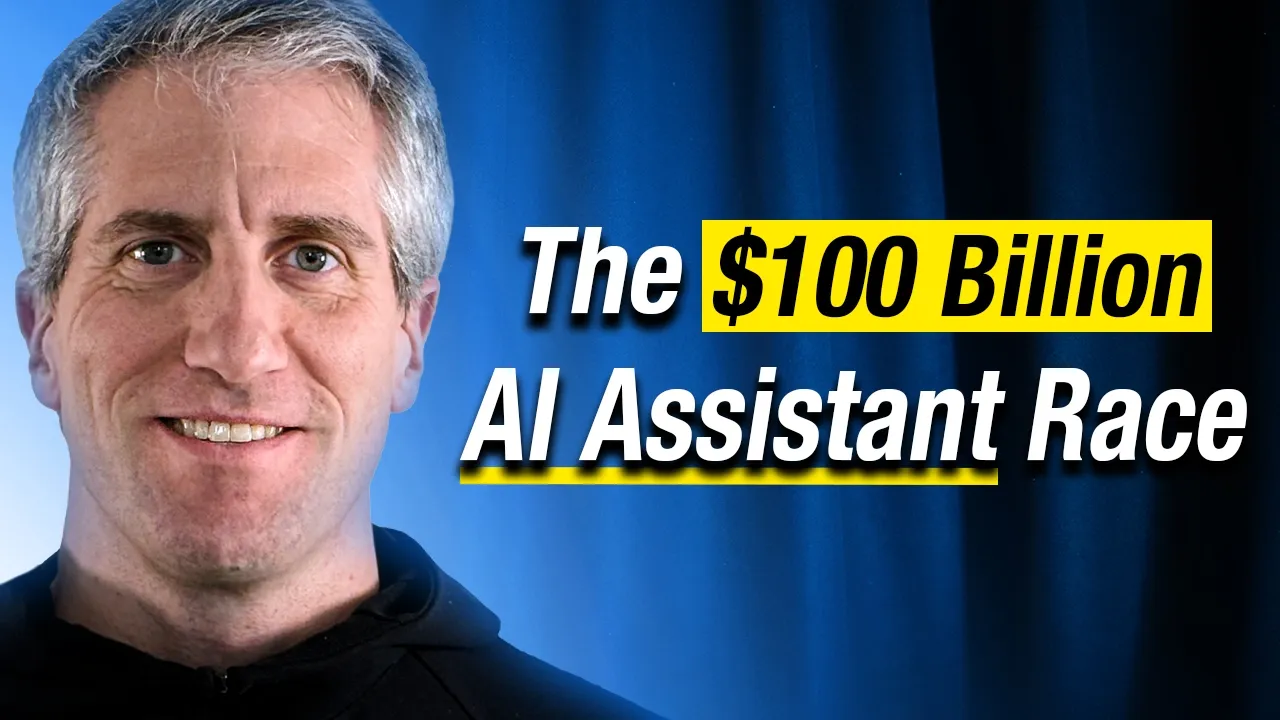
Description
Jean-Denis "JD" Grèze is the Co-Founder and CEO of Town, the AI work assistant reportedly in talks to raise funding at a $1BN valuation. Before founding Town, JD spent seven years as CTO of Plaid. Before Plaid, he was Director of Engineering at Dropbox. He is also a prolific angel investor backing companies including Modal, BaseTen, Merge and NexHealth. ----------------------------------------------- Timestamps: 00:00 - Intro 02:08 - Why Town Pivoted From AI Tax to AI Assistants 04:09 - Can Town Survive Google, Apple and OpenAI? 06:14 - Why AI Assistants Could Have Network Effects 08:48 - Will Everyone Have One AI Agent or Many? 11:01 - Will We Trust AI Agents With Our Private Data? 17:16 - Are Goal-Seeking AI Agents a Feature or a Bug? 19:30 - How Town Chooses Between OpenAI, Anthropic and Open Models 22:33 - Can AI Assistant Economics Ever Reach SaaS Margins? 25:05 - Open Models vs Frontier Models: Who Gets the Workloads? 29:56 - How Should VCs Invest in the AI Assistant Race? 33:45 - Why AI Startups Can No Longer Outrun Their Competitors 39:31 - Why Apple Could Lose the AI Assistant Race 41:50 - Are AI Agents Creating a Cybersecurity Time Bomb? 43:42 - Why Token Maxing Is the Wrong AI Metric 47:46 - Consumer vs Enterprise AI: Where Does the Bigger Business Get Built? 50:06 - Is ElevenLabs Worth $22BN? 51:57 - The Biggest Risk to AI Assistant Margins 01:00:01 - Is the AI Assistant Hype Justified? 01:03:41 - Quick-Fire Round ---------------------------------------------------------------------------------------------- Subscribe on Spotify: https://open.spotify.com/show/3j2KMcZTtgTNBKwtZBMHvl?si=85bc9196860e4466 Subscribe on Apple Podcasts: https://podcasts.apple.com/us/podcast/the-twenty-minute-vc-20vc-venture-capital-startup/id958230465 Follow Harry Stebbings on X: https://twitter.com/HarryStebbings Follow JD on X: https://twitter.com/jgreze Follow 20VC on Instagram: https://www.instagram.com/20vchq Follow 20VC on TikTok: https://www.tiktok.com/@20vc_tok
Summary
Generated by gpt-5.6-terraAt-a-Glance
- Verdict: Watch fully
- Core thesis: The AI-assistant market is likely to support a few very large companies because assistants can become the primary interface to work, but durable winners must pair instant value with deep user context, team-level network effects, trust controls, and viable model economics.
- Why it matters: This is a high-signal founder/operator view on the architecture, GTM, pricing, security, and competitive dynamics of agent products that sit above frontier-model providers while competing with them.
- Best use: Use it as a strategic briefing for designing an assistant/control plane: optimize for contextual onboarding and recurring ROI, make multi-agent collaboration a product primitive, segregate personal/work data, and actively manage frontier-model dependency.
Executive Summary
Town founder Jean-Denis argues that the assistant category is not a bubble because the eventual assistant will become a primary entry point for digital work rather than another point solution. Town’s wedge is an email-and-calendar-native work assistant that requires users to connect data upfront, then uses that context to propose automations rather than asking users to invent prompts. He says this creates an unusually fast time-to-value: meeting preparation, action-item follow-up, scheduling, and role-specific workflows can feel useful immediately without configuration.
His central moat thesis is not proprietary models. In the near term, every credible player must keep pace with rapidly improving general agent capabilities from OpenAI, Anthropic, Google, Apple, and others. More durable advantages may instead come from agent-to-agent collaboration inside organizations, accumulated user context and integrations, an opinionated relationship between a person and their named assistant, and distribution. Of these, he considers multi-user agent networks the most meaningful: a user’s agent should be able to ask coworkers’ agents for relevant, policy-compliant information without exposing raw inboxes or requiring manual Slack searches.
The business model is intentionally work-first. Town measures success by ongoing payment and customer ROI—not token volume—because unlimited or poorly governed usage can generate high compute costs without durable value. It uses tiered subscriptions plus usage pricing, alerts users to costly “rogue routines,” and believes business workflows can expand revenue over time when automation creates measurable output, such as a recruiting firm taking an additional client without another hire. The unresolved economic risk is the share of workloads that must remain on expensive frontier models whose suppliers are also competitors.
The conversation is also unusually concrete about operating constraints. Product features are copied in weeks, while customer learning still happens at human speed; therefore fast shipping alone is not enough. Enterprise-grade assistants need strict data/security discipline, human-set goals and budgets, separate monitoring from execution, and eventually AI-assisted testing and defense. The result is a useful blueprint for agent companies: charge early to validate value, design for trust and context, invest in networked workflows, and avoid confusing subsidized compute consumption with product-market fit.
Key Takeaways
- Claim: The winning assistant will likely be a small number of user-facing entry points that orchestrate specialized systems behind the scenes, rather than dozens of standalone agents that users must choose among. | Evidence: Jean-Denis argues users will not want to decide whether to invoke a Salesforce, Linear, legal, or project-management agent; they will push one button and their primary assistant will call specialized services such as Legora or Salesforce in the background. | Implication: Design the primary agent as an orchestration and identity layer, but preserve hard data-domain boundaries and enable specialist-agent delegation rather than attempting to centralize every capability. | Caveat: Work and personal data may still require separate assistants or at least separate data layers because employers will not want company information intermingled with personal information.
- Claim: Assistant defensibility will be driven more by agent-level network effects and embedded context than by a static model moat. | Evidence: Town’s agent-to-agent feature lets one employee’s Townie ask another coworker’s Townie for an answer. The example is a salesperson seeking an introduction: coworkers’ agents could identify who has a personal versus work relationship with the target contact and suggest the appropriate path. | Implication: Prioritize permissions-aware cross-agent discovery, shared routines, team skills, and organizational context; wall-to-wall adoption can create switching costs that individual chat experiences do not. | Caveat: This depends on users trusting the system to share useful relationship context without disclosing sensitive information such as salary, medical history, family data, or privileged work material.
- Claim: The highest-leverage activation pattern is to require valuable context upfront and use it to recommend work, not merely offer an empty chat box. | Evidence: Town requires email and calendar connection before use, accepts roughly 30% immediate churn at that step, then uses the resulting context to recommend automations. Jean-Denis says more than 15% of acquired users convert to paid plans and attributes this to the material value delta versus generic ChatGPT usage. | Implication: For agent products, optimize onboarding around a fast, concrete “magic moment” produced from connected systems of record; do not over-optimize away a trust or data-connection gate if it is necessary for real value. | Caveat: The approach sacrifices top-of-funnel conversion and requires unusually high trust in the product’s handling of personal and work data.
- Claim: AI-assistant businesses should optimize for sustained customer ROI and payment, not raw token usage or nominal engagement. | Evidence: Town sends alerts when it detects “rogue routines” consuming excessive tokens. During its unpriced beta, some users spent $2,000-$4,000 per month in compute, and one user consumed about $26,000 over five months; the company viewed this as a value-validation problem rather than a growth success. | Implication: Implement usage governance, ROI signaling, cost anomaly detection, and pricing feedback early. Treat retention and willingness to pay as stronger product signals than consumption, especially when agents can run autonomously. | Caveat: Some workflows, such as meeting preparation, have heterogeneous and difficult-to-measure value despite identical token cost across users.
- Claim: Work assistants have stronger long-term monetization potential than purely personal assistants because they can create incremental business output, not only save personal time. | Evidence: Jean-Denis gives a recruiting-firm example: Town automation let the firm take an additional client worth roughly $3,000 per month without hiring, while the firm paid about $500-$600 per month for Town across its users. He prefers many work users paying less initially because their spend can expand with demonstrated value. | Implication: Target operational functions with underpenetrated AI demand—executive assistants, chiefs of staff, HR, recruiters, junior finance, and ops—where email/calendar workflows are dense and ROI can become measurable. | Caveat: Town has unexpectedly strong family/parent product-market fit because school emails, portals, camps, and scheduling create workflow density, but this segment has lower willingness to pay and weaker organization-wide expansion.
- Claim: Model routing is necessary, but the final user-facing model cannot be swapped freely because consistency of voice and personality is product-critical. | Evidence: Town routes by task—for example, choosing among Gemini/OpenAI for images and using ElevenLabs for voice—while using cheaper models for tasks such as email labeling. Jean-Denis says users notice changes in verbosity, capitalization, and assistant personality, whereas coding users care more directly whether code works. | Implication: Separate hidden reasoning/execution routing from the user-facing response layer. Maintain behavioral regression tests and persona continuity before moving user-visible workloads across model families. | Caveat: Town still uses mostly frontier models today, partly because engineering effort is more valuable for product expansion than cost optimization at its current stage.
- Claim: The major strategic risk for assistant startups is not current compute cost alone but long-term dependence on frontier suppliers that also sell competing end-user products. | Evidence: Town expects routine tasks to move toward cheaper/open-weight models and estimates product pricing can support roughly 20-30% margins in 18 months if model prices continue declining. But Jean-Denis is concerned that 20-30% of high-value workloads may remain frontier-dependent, leaving companies paying suppliers such as OpenAI and Anthropic while competing directly with them. | Implication: Track frontier-task share as a board-level metric. Build fallback routing, task decomposition, post-training or smaller-model options, and proprietary workflow/context advantages so economics do not depend solely on vendor pricing. | Caveat: He explicitly says the market does not yet know what percentage of workloads will remain near the frontier; that uncertainty materially determines ultimate margins.
Detailed Brief
Autonomy, privacy, and agent governance
- Claims: In five years, people may trust assistants to determine contextually appropriate data sharing without explicit rule-setting for every relationship and request.; Agent autonomy should not mean unconstrained goal seeking; humans should set goals, token/resource budgets, and acceptable action boundaries.; The agent that executes a task should not necessarily be the same agent that evaluates the task’s ROI, monitors its behavior, or authorizes continued autonomy.
- Evidence: For trip planning, the speaker imagines an agent disclosing flight availability and food preferences to trusted friends while refusing requests for medical history without the owner having manually configured either rule.; He contrasts this with a story of a human accidentally replying to an entire company with criticism of an acquisition, arguing that capable models may eventually make fewer data-sharing mistakes than people.; Jason Lampkin’s anecdote about an agent attempting to buy six AP watches to improve company culture illustrates why goal-seeking behavior needs boundaries; engraving requirements happened to block execution.
- Caveats: The prediction that models will handle disclosure more safely than humans is aspirational and is not supported with present-day reliability rates.; Irreversible actions, delegated purchasing, and sensitive data disclosure require tighter guardrails than drafting, research, or recommendation workflows.
- Implications: Use separate policy, evaluator, and execution layers for consequential workflows.; Make autonomy budgeted and revocable; expose users to the intended objective, spend envelope, and material actions rather than granting broad indefinite agency.
Competitive landscape and startup operating model
- Claims: The category remains blue-ocean among mainstream users despite visible activity among power users, but competition is consolidating because feature parity arrives quickly.; A local or regional assistant company needs a specific structural reason to win—such as distribution, regulatory/privacy differentiation, or an underserved market—not merely a translated version of a global horizontal product.; Town differentiates its strategy from consumer-led, subsidized products such as Instinct by focusing on paid workplace workflows and organization-level expansion; Jean-Denis considers GrokBot a more directly comparable go-to-market threat.
- Evidence: Jean-Denis says his initial field of roughly 15 startup competitors has narrowed in his mind to two or three meaningful startup contenders, while Apple, Google, OpenAI, Anthropic, Cursor, and Grok-associated products remain major threats.; He says a startup must maintain comparable agent capabilities even if a competing product has around 100 people improving its harness; otherwise users will pay a lower-priced general-provider subscription instead.; He identifies Meta/WhatsApp as a particularly serious personal-assistant distribution threat because users already live in WhatsApp.
- Caveats: Several statements about competitors, Apple’s roadmap, and market positions are founder opinion or rumor-based rather than independently verified facts.; Strong early distribution does not prove mainstream product-market fit; the speaker specifically distinguishes X/Twitter power users from the broader market.
- Implications: Define the non-copyable reason a product wins before treating geography or basic capability parity as a strategy.; Compress product-feedback loops through instrumented usage and design partnerships because building speed is no longer a durable lead: products can be copied in two to four weeks while customer learning remains slow.
Security, engineering leverage, and organizational design
- Claims: Business-focused AI products must assume AI-generated code will ship to production and shift security assurance toward automated testing, adversarial models, and targeted human review of critical controls.; AI coding tools can justify more hiring rather than fewer hires when they raise the revenue-producing capacity of each engineer.; Town’s internal development tooling is diversified: Devin is used for bugs and small visual tasks, Cursor for some frontend work, and Codex and Claude are split roughly 50/50 for other development work.
- Evidence: Jean-Denis says the industry has passed the point where humans will read every line of code, though access-control and other critical code should still receive human review.; He compares the emerging security regime to chemical regulation: harmful incidents will occur, after which industry and regulators will develop practices for labeling, handling, and controlling risk.; He estimates annual compute/tooling spend at roughly the equivalent cost of three to four engineers, or perhaps around one-and-a-half engineers when equity is included, and says it is clearly worth it given the product backlog.
- Caveats: The chemical analogy describes an expected societal adaptation path, not a sufficient security framework for current high-risk deployments.; AI-enabled coding leverage does not eliminate bottlenecks in requirements, customer learning, systems integration, security review, or organizational coordination.
- Implications: Treat AI development spend as capacity investment and measure it against incremental shipped value, not a fixed percentage of engineering payroll.; Require automated red teaming, security regression testing, audit logs, SSO, and review gates for permission and data-access changes before scaling agentic workflows.
Notable Concepts & Terms
- Townie: Town’s branded, named personal AI assistant; the company treats the user-assistant relationship and consistent personality as both adoption mechanism and potential differentiation.
- Agent-to-agent: A collaboration pattern in which one user’s agent queries another user’s agent for an authorized answer, enabling organizational discovery without manually searching messages or exposing raw data.
- Time to value / magic moment: The product principle of delivering immediate utility—such as meeting briefs and follow-ups—before asking users to configure complex workflows.
- Pre-processing user context: Town spends compute before a user asks a question to build a working model of projects, relationships, company context, and likely automations.
- Frontier-task share: The percentage of an assistant’s workload that still requires expensive top-tier models; it is the key unresolved determinant of future gross margins.
- Rogue routines: Automations that consume significant tokens without enough customer value; Town identifies and notifies users about them as a trust and cost-control mechanism.
- Human-set goal, budget, and monitoring: The proposed governance model for autonomous agents: humans establish objectives and resource envelopes, while separate systems may monitor execution rather than allowing one agent unconstrained pursuit.
- Open box problem: The gap between what AI can do and what mainstream users know how to ask for; Town’s contextual recommendations are intended to solve this onboarding and discovery problem.
Operator Notes / Why Ken Should Care
- Instrument the percentage of workflows requiring frontier models, their associated revenue/retention contribution, and the available lower-cost fallback for each; treat this as a strategic supplier-risk dashboard.
- For any multi-agent capability, implement policy-aware data minimization and separate authorization, execution, and monitoring components before enabling broad autonomous cross-user queries.
- Test a mandatory-context onboarding flow for high-value users: connect the minimum systems of record, immediately show inferred priorities and recommended automations, and measure conversion against the initial abandonment cost.
- Add automated detection for high-cost, low-value routines and proactively surface stop/modify recommendations rather than optimizing for usage volume.
- Prioritize under-AI-served operational roles with email/calendar-heavy workflows where an automation can be tied to throughput, revenue, or avoided headcount—not just generic productivity claims.
- Maintain a user-visible behavior/persona regression suite when changing models or routing logic; users interpret tone and consistency changes as degradation even when underlying reasoning improves.
- Avoid relying on a regional clone thesis for an assistant investment or product launch unless there is a defensible distribution, compliance, data-residency, or ecosystem advantage.
Source/Metadata
- Title: Town vs Instinct vs GrokBot | Why the AI Assistant Market Is Not a Bubble
- Transcript words: 25702
- Duration seconds: 4560
- Timestamp note: No timestamps or chapters were present in the supplied transcript. The latter portion substantially repeats earlier discussion.
Transcript
I know what I'm building is a top three priority at Google and Apple in the next 12 months. Not a top 10 priority, a top three priority. The product in this category that will win will have a network effect at the agent level. Now, the hottest category in Silicon Valley is AI assistance. On the consumer side, you've got Instinct. On the enterprise side, you've got Town.com. Founded by today's guest, Jean-Denis, formerly CTO at Plaid. And this conversation today is probably one of the most pertinent discussions that there is. I think you'll trust your agent to decide what data to share with other people without you intervening in five years. You can build now at the speed of machines, but you can only learn at the speed of humans. I don't think Instinct and Town are trying to do the same thing. Ready to go? JD, I'm so excited for this because in all honesty, I have a lot of fans on the show where I kind of need to pretend to be excited by their product. And I'm not really. And I love Town. I was saying the team use it here. I'm a DAU. And so I was so excited when we agreed to do this. So thank you so much for joining me today, man. Yeah, thanks for having me. And honestly, I didn't know that you're a DAU until three minutes ago. So I'm super happy. And send me all the feedback about the product because you're a DAU. But when you're a founder, you're always embarrassed about your product at all times. You might regret saying that, but I will do. For those that don't know, what is Town as specifically as possible? So we're an AI assistant that lives in your email and your calendar, and it tries to help you do work. Right. So what it looks at, it looks at things that you do already, how you organize your day, emails you tend to send out. And it recommends AI automations that try to do some of the things that you would do normally yourself. Just do them for you in the background. And yeah, we've been a product. We've been out in the market for about three months. Our ICP is just mainstream users, mainstream people who use email, calendar, text messages to do work. And we've been doing super well. Can I be blunt, dude? We obviously did a show a couple of years ago. And I remember when you started your own thing, you were doing some boring stuff in finance. And I remember the first round going down, and I was like, I love JD, but it's pretty boring. What was the pivot? I mean, so we spent a year building an AI tax company, business tax prep with AI. And we just got to some product market fit, but not enough where it was going to be a success. There's a thing, the truth is we failed at building a business that would be a great business. And yeah, after a year, we were like, we got to reset. And we spent three months in the wilderness trying to figure out what we wanted to do. And one of the areas we just looked at is why has no one built AI that operates out of email? Just there's so many people in the world who run their business and their life out of email and calendar. We were like, why has no one built a great product there? And it was around the time that Claude had gone fully agentic, right? This was November, December last year. And so it was also the same time that models could start to actually do real work, not just do a few steps, but real agentic work. And the prototype we built in a couple of weeks and it had product market fit almost immediately. So that was the pivot. It was very lucky. There's no, you know, we didn't go talk to a hundred customers and take their notes and, you know, we built for ourselves. And I think it was one of those where the technology was changing so that what we wanted to do was possible at a time when people were very excited about trying AI products. I mean, you know, OpenClaw was happening literally as we were building the product. OpenClaw was blowing up and we were like, oh shit, it's the same thing in many ways, right? They're trying to do the same thing. But it turns out there's a difference between something that's open source and it's amazing, but it's only something a tinker can use. And that would be OpenClaw. I think with Town, we've always been focused on how do you get just about anyone to be able to get value out of the product. As an investor today, every company in some respects is questioned about how cannibalized could this be from any of the big providers. This is right in the sweet spot. How do we think about cannibalization by frontier model providers and Grok in recent weeks as a threat? Do you want to know the truth? I know what I'm building is a top three priority at Google and Apple in the next 12 months. Not a top 10 priority, a top three priority. So when I go to sleep, I fall asleep very quickly. It's one of my superpowers. But I do wake up at three in the morning. And immediately, usually when I wake up, some dark thought goes into there. And it's roulette when you're a founder. Which dark thought will stop me from falling asleep again? And definitely the, this is going to be, you're in the middle of the fairway and everyone's trying to get you. That's 100% the fear. But I got to say this. You won't talk about moats, right? You're like, what's the moat? What's defensible? I think talking about moats is a luxury. And you have to be more successful than Town is today for it to matter. So I will answer your question, but my mindset right now is how do I get 100,000 or a million paying users in a market that has a TAM of a billion potential paying users. Step one is we have to have really deep product market fit. And I think none of the products today actually have really deep product market fit yet. Grok's really cool. It's awesome, but it's a power user product. It's not a mainstream product. Town is great, but we have a lot of work to do to make it a true mainstream product. So even before I worry about defensibility, I'm still like, what is the right product experience that's going to resonate with a mainstream user? Because the big players are not going to innovate their way there. They will copy their way there, but they have to copy someone who's been successful in the first place at building a mainstream product. Okay. Then number two, I think the product in this category that will win will have a network effect at the agent level. Right. And one of the features of Town that users who figure out how to use it, they love it the most is something called agent to agent. And that's where you ask your assistant, your Townie, you ask your Townie a question and it realizes that it doesn't have the answer, but that the Townie of one of your coworkers has the answer. And it just goes and asks it the question. And then that Townie answers. And it's, you have to go in a subpart of the product to use it. But that is a network effect. Once you have your whole team on that, it's actually really difficult to imagine moving to a different product. And I think no one has figured out multi-user, multiplayer AI today. I think that's the thing that will be the moat. In the meantime, right, we have lots of theories. Everyone in the market has lots of theories, right? So people will say, well, you'll post train custom models, maybe custom models per company or per person. And that will allow you to retain your users. Right. People say, the context about a person, that's the moat and people will be less and less willing to connect more data sources. So once you have product market fit with a user and they really love your experience and they've connected all the tools and all the connections, it's actually really hard for someone else to go in there because they won't have the connections. Right. Other people think the moat is there's no new moat in this market and it'll be distribution. And so it's whoever already has the users who will win. I think that's the thing that will be the moat. In the meantime, we have lots of theories. Everyone in the market has lots of theories. So people will say, well, you'll post train custom models, maybe custom models per company or per person. And that will allow you to retain your users. People say, hey, the context about a person, that's the moat and people will be less and less willing to connect more data sources. So once you have product market fit with a user and they really love your experience and they've connected all the tools and all the connections, it's actually really hard for someone else to go in there because they won't have the connections. Other people think three, actually the moat, there's no new moat in this market and it'll be distribution. And so it's whoever already has the users who will win. So I think there for me, the competitor I would worry the most about would be probably for personal use cases, it would be Meta and WhatsApp. They're going to have a personal assistant that's going to come in WhatsApp. I don't know if they're launching it in a day or in three months, but it's coming. They already have the distribution. Everyone's already using WhatsApp for messaging. If there's an agent in there that can do things for you, it's going to be extremely powerful. So every company, right, some people think it's a device, like they think AI is changing the shape of software. So that people will no longer ever go to websites. They will never use apps on their phone. The entry point for most digital interaction, much like the entry point today is either a phone or a computer or a browser. The entry point will be an AI. And so whoever owns the devices is in the best place to put the AI in front of the user and they will win. But this is, if I think about all of these things, I'm like, oh my God, what do I do? How do I win given all of these competitive forces? So what is the future interaction between human and agent? And what I mean by that is, do we have a consumer agent, an enterprise agent, and then a hardware agent that does maybe productivity and notes? How do we think about that? Multi-agent versus single agent. Each human will have one, two, maybe three entry points into the digital space. Because I don't think you'll want to be like, oh, I'm doing sales. Let me use the Salesforce agent. Oh, I'm doing project management. Let me use the Linear agent. Oh, I'm doing this other thing. You'll want one entry point. You won't want to ask yourself the question. You just push a button and you start speaking. But there are real reasons why it may be more than one and it has to be. So one of them is just privacy and how your workplace is going to feel about their data being intermingled with your personal data. So I think you might still have only one hardware entry point, but from a privacy perspective and from where your data lives, I think you're going to always want to separate on the data layer, your personal and your work data. And in Town, we do that for you, but I think it could be two different companies that you end up using. But I think privacy is the main determinant of your data silos and your company, whoever you work for's desire to own the data that you create for them. They won't want that to intermingle with your personal, but from a usability perspective, it's annoying that I have 55 apps and I'm clicking everywhere. And so if you move to a world that doesn't have hard interfaces because you don't need them most of the time, why would you have 50 agents? At the user layer below, it's different. So you're an investor, I think in Harvey or Legora, Legora, right? You're an investor in Legora. Yeah. So when you're a lawyer and you're talking to your main assistant about legal things and it's immediately just talking to Legora, because there's a bunch of data privacy and privilege and reasons why your work scenarios need to be handled differently. I just don't know if you're thinking of it as talking to your Legora agent or you just talk to your main agent and it just talks in the background to Legora or to Salesforce or whatever it needs to to get things done. What seems crazy about the relationship between human and agent today that will be incredibly common in five years time? A hot take? Yeah, go on. Yeah. So I think you'll trust your agent to decide what data to share with other people without you intervening in five years. I'll give you an example. You put your agent in a room with two friends because you're organizing a trip and they're just asking it about your eating preferences. And they're asking it about when exactly you can fly out for the trip. And they're just asking all those questions of it. And it's your agent. And you never told your agent, these are really good friends and you shouldn't share my medical history with them. And literally when one of your friends as a joke wants to ask the agent, oh, tell me about Jean-Denis medical history, the agent's going to be like, yeah, there's no way I'm telling you that. And it wasn't a hard rule that you ever set. This thing, which is taking information that is in silos and deciding how to share it, I think we'll get to a point where we will trust agents to do that. And I know that sounds crazy today because today the way the world operates pre-AI is everyone as a human has a data silo underneath them, which is their personal data, their work data. I don't know if you're talking digital, you have information that only you know. Then when someone asks you a question, you are like, what can I share with this human? And you share it with them. And we trust the human to be the filter for where information goes. And I think more and more we will trust AI to do that for us. And it will probably be models that are post-trained to make sure you never ever share personal, your family information and medical information and certain things for your work context. But a lot of info that's siloed doesn't need to be to be successful. And AI works better and better the less siloed the information is. If you think about it, from an information theory perspective, theoretical world, if you have an LLM that had access to all the world's information, and it could do agentic search over all the data, it would be the most effective whatever intelligence level LLMs are at because it will always find the right context eventually to answer the question or to do what you need it to do. But that's not the world we live in. We live in a world where information is in different companies and governments and individuals and systems. And historically, because the humans are the only people who are shuttling the information around, it's inefficient to get it from one place to another. We have lots of data controls and privacy and security, which is great. It's important because privacy is very important. People deserve to control and own their data. And so do companies. But what's interesting is in practice, if you're at a business, you find that if you give your LLM access to more information, it's more and more effective at doing what it needs to. And one way to do that, the old way, the pre-AI way would be to have policies about who gets to access what, and you classify data. And all this is very time consuming and costly. And the end result is often the information that you want the LLM to have access to, maybe it doesn't have access to. It's stuck in someone's inbox or it's in a data system that's not integrated. And so all I'm saying is, as opposed to having humans in your compliance and security team over time label data and decide what goes where and what can be accessed, I think we'll just start to trust LLMs to do that. Meaning you will trust your data silo and another co-worker's data silos. You find that if you give your LLM access to more information, it's more and more effective at doing what it needs to. And one way to do that, the old way, the pre-AI way would be to have policies about who gets to access what, and you classify data. And all this is very time consuming and costly. And the end result is often the information that you want the LLM to have access to, maybe it doesn't have access to. It's stuck in someone's inbox, right? Or it's in a data system that's not integrated. And so all I'm saying is that as opposed to having humans in your compliance and security team over time label data and decide what goes where and what can be accessed, I think we'll just start to trust LLMs to do that. Meaning you will trust your data silo and another coworker's data silos. You'll be like, well, I'll trust my LLM to decide what can get out of my data silo. And so then when someone else on your sales team, right, a very concrete example, someone on the sales team wants an intro to someone at a customer. And you're at a thousand person company. And the person on the sales team knows that there must be someone at the thousand person company that knows the right person at that vendor, that customer. It's somewhere. And normally now they just go to Slack and they're like, hey, who's working with client X? But really what they could do is their agent could go talk to the agents of everyone else at the company and all those agents have access to each person's inbox and come back and say, oh, well, Liz has a personal relationship with a person that you want an intro to. It's not a work one, but you could ask her if she's willing to intro. Bob has a work relationship with the person you want an intro to and they're due to have a meeting next week. Do you just want to see if Bob will invite you to the meeting so you have the conversation? And that's a great business outcome. That's what they want to happen, right? But to do that, right, the individuals have to trust that it's okay for some of the information that lives in your inbox to be made available to other people at the company. And right now that seems insane. You asked me what I think in five years. I think we will be more okay with that because in practice, the LLMs will be really good at respecting privacy around things that you don't want to share. So you don't want your salary to be shared with your coworkers. You don't want your medical history to be shared with friends. There's these things that are sacrosanct and we get that. But you will be able to have an LLM that respects these boundaries. How much wiggle room do you have on error? And what I mean by that is if you have a mistake for whatever reason, you book the wrong thing, you execute the wrong task. How much room for error do you have and how much trust is lost? Well, my claim would be that the LLMs would be much more effective at this than humans. I'm going to tell you a story. I once worked at a place where there was a person who had just done an acquisition. And there was an email introducing the acquisition to the whole company. And this person had been against the acquisition. And so they meant to reply to a subset of folks, just tell them something like, I can't believe we hired these clowns. The words may have been different than that. And instead, they replied to everyone at the company. And then that person had a nickname. It was Big R, like Big Reply. And this person is an incredible person. They made a mistake and it's totally fine. And everyone laughed about it. And everything was good forever after, right? But it's a human, a very smart human. Top 0.1% who made a mistake. People make mistakes, right? Like Bob from accounting makes a mistake. Liz from HR makes the spreadsheet with people's salaries available to everyone by mistake. This happens all the time. I think the LLMs will make many fewer of these mistakes than humans pretty quickly. My dearest friend is Jason Lampkin, who says that the biggest problem with agents is their goal seeking. And he talks about his agent going off and trying to buy six AP watches for him to increase culture in the company. Luckily, it was prevented because they needed engraving. And that was an extra step that the agent couldn't handle. But to what extent is this maniacal goal seeking tendency of agents a feature or a bug? I don't have an answer for you. I think how much you should be willing to let your agent be goal seeking and for how long you let it run autonomously is a very interesting question, right? Is it your responsibility to usher people? To guide them into what is best? Hey, we find best outcomes if you let them run 4X. One way to think about LLMs, right, is they turn energy into GDP, right? Or into revenue. You know, really you step way back, right? You know, because you power and silicon and then you get intelligence and we're applying the intelligence towards business results. So if they get smart enough, it's just creating GDP on the other end. And so you just say, hey, make money for me and then let it run for a long time and it can do whatever it wants to. Or do we want to live in a universe where we think the human's role in this is actually to set the direction and make sure that the actions that are being taken align with some kind of human value system? I live in that second universe where I think it is the human's responsibility to first allocate the resources. That means to say how many tokens are we willing to spend to try to get a goal, to set the goal, right, as well. So you set the goal and the budget and then to monitor, right, the overall shape of the actions that are taken to get the result. And how much as the intelligence gets smarter, you might say, well, maybe the allocating of resources, you're trusting in LLM to analyze ahead of time what it thinks the ROI is on a pretend task and tell you how many tokens you should be willing to allocate before deciding to step away. And maybe on monitoring the actions, it's also an agent that's doing that for you. I just don't think it's the same agent as the one that you put on the course to try to get to the result at the end of the day. You mentioned the different layers of the value stack there. What does the model infrastructure that you sit on top of look like? How do you think about model routing for different tasks? Are you locked into one? What does that look like? Yeah, I think it's because we're building an application for everyone and we don't think most people care about understanding which model is better at what at a certain point in time, right? So we view it as our job to, for what you're asking for, find a model that cost effectively gets you the result that you want, right? And so, for concrete examples, if we're generating images, right, we have opinions internally about when we might use a Gemini model or an Open AI model to generate images, right? When we're doing voice, we have opinions about 11 labs, when we'd use 11 labs to do voice, right? And so I think it's our job to do that because as the technology changes every day, literally every week or every two weeks, there's a fundamental change. It's our job to make sure you get the right ROI there. But it's tough and there's things that are just like, is it the right result? That's easy for some context to know what the right result is. For others, it's very open-ended. You can't know ahead of time. So you have to kind of guess how difficult do I think it is and how close to the frontier do I want to get? And then the other dimension for us is voice. People don't like it when their townies sound very different, right? And one of the problems when you do model routing is there's some companies, like Anthropic spends a lot of time, I know we make fun of them online, but they spend a lot of time actually making sure all of their model families roughly don't change too much in terms of their personality. They might be slightly more verbose or less and use different phrases, but they kind of sound similar enough over time. So if you use Anthropic to generate final output for your users, it's kind of hard to suddenly move to something else because it just sounds different. So people feel like their AI has been lobotomized. So that's how I think about it. For coding it matters less, interestingly, because for coding, you're like, does it work? Does the code fulfill its purpose, right? And then the other dimension for us is voice. People don't like it when their townies sound very different, right? And one of the problems when you do model routing is there's some companies, like Anthropic spends a lot of time, I know we make fun of them online, but they spend a lot of time actually making sure all of their model families roughly don't change too much in terms of their personality. They might be slightly more verbose or less and use different phrases, but they kind of sound similar enough over time. So if you use Anthropic to generate final output for your users, it's kind of hard to suddenly move to like Claude because it just sounds different. So people feel like their AI has been lobotomized. So that's the way I think about it, for coding it matters less, interestingly, because for coding, you're like, does it work? Does the code fulfill its purpose, right? It's like, yes, you might look at the code and decide the style that I like or not, but not really anymore, right? Before, when you're talking or speaking to an assistant, if suddenly it's twice as verbose, like over text messages, it's writing you eight sentences as opposed to four, people don't like that. They will literally write tickets. They're like, despite my instructions that I gave it three weeks ago, my text agent seems to be capitalizing letters more or stuff. Like just literally, you're like, okay. So the way I think about our stack is there is the part of the stack that deals with the user interface, like the feel and the personality. And there, it is harder for me to just route wildly because I need consistency of the experience that is sometimes hard to get from other model families. Below that, when it's just pure reasoning and intelligence, and especially when I don't have to show as many of the traces to the users, then there, I think it's very much a matter of finding the best model for the task. But we're early in this. How do you think about how differing model providers impact ultimate economics of a user? And what I mean by that is like 11 Labs is notoriously brilliant, but also notoriously about the cost of a Chanel handbag. They are. And so my question is, how do you think about model selection balanced with cost? Well, Harry, the answer there for every startup that I know, outside of a very few... We don't. Yeah, it's well, we're hoping the cost curve makes it efficient in 18 to 24 months, right? In the meantime, you're subsidizing in part, right? Because that's what it takes to achieve product market fit for these use cases, because you need to use Frontier for too much of the work, right? So here's what I think about it. One of the things that Town does is we label emails, okay? Labeling emails does not in any way, shape or form require opus level intelligence. It does not require sonnet level intelligence, right? And so for that, we're already below Frontier. And so I think that will trend towards the cost of compute over time, right? And so how do I use open weight models, right? How might I post train even my own, smaller models? And so it's easy to say the price of that is going to be much smaller than it is today. And so for that part of my cogs, I don't think I stress out about it. And when I talk to other founders at AI companies, it is always the same thinking. The question that no one quite knows is how much of the workload for any particular company stays close to the frontier where it's very expensive. And I think literally nobody knows the answer to that. But for human level tasks, there's a decent amount of stuff like scheduling movies, working with one's calendar, answering emails that have been answered before, doing research on competitors on a daily basis. Like all these kinds of things, I think are trending pretty far from the frontier, right? And you can already use open weight models to do that really well. And so as soon as you know that, and you know the price every nine to 12 months halves, you know where it's going to be. And so you could price your product today at a point where you'll generate 20, 30% margin in 18 months. That's the way that we mostly think about it. But the open question is, at the end of the day, are you left with 10% of your tasks being frontier or 20% or 30%? And we don't know the answer to that. And that will change the economics of these companies. What percent of tasks go through open versus frontier today? For us, it's mostly frontier. Why is that? With the greatest of respect, it's the tasks being asked. I don't imagine you're actually that sophisticated. And this is where, we talked about instinct earlier. I give instinct hard problems. Like I want Odyssey tickets at the IMAX, continuously monitor it for days, by the minute that they're there. For you, in the greatest of respects, I ask for email tagging and pre-briefs. Much easier. Yeah. Well, actually, a lot of people ask us to do hard things. So a lot of the custom workflows that people built will be quite complicated. And so that's where we will use most frontier. I think for, we still don't use open weight for things like labeling, but we will use much cheaper models from one of the frontier providers. The main reason is because as a company, our focus, imagine I can improve our cogs by moving to open weight, but it doesn't give me much product advantage. It doesn't make my product work better. So if I have an engineer hour, what is the engineer hour best spent on? Is it taking my current AR and making it more efficient? Or is it figuring out a way to grow the product faster by working on a better network effect feature or making the model better and integrating with a new data source that makes its trajectories much better for a set of our users? And we're very focused on growing the pie faster, much more so than getting the ideal economics. And our economics are fine, right? They could be better, right? And I could move down the cost curve faster, but that's not the constraint to success for the business. So that's why we don't do it. On the network effect side, have there been any interesting lessons or observations? What have you learned on expansion from wall to wall? So first of all, an interesting aspect for us of network effects is if the company has one person who is a tinkerer and who starts to build things like team skills, team integrations, team routines, that is building blocks on Town that everyone on the team gets for free, then we see a lot more adoption faster. And it's interesting, right? Because we're trying to build a product that doesn't require the tinkerer, right? Because for the single player experience, we want you to be onboarded and get a ton of value, right? And if you're a real estate agent, you have automations that are real estate agent specific. And if you're a salesperson, you get automations that are salesperson specific. We're trying to give that experience to you out of the box. But what happens is if there's a power user next to other users, they find ways to make those other users much more successful. And I think you'll find that with a lot of AI products, right? So one of the predictors actually is, is there a tinkerer on the team? So one of the questions we ask ourselves a lot is can we identify those folks and can we make it easier for them to create virality for their other team members? And then the second observation is, there are a lot of functions that are underserved by AI within companies, even enterprises. So I'll give you a very simple one. If you're a sales team at an enterprise, you've been sold AI in every direction now for three years. Do you know what I mean? Like if you're a sales ops person and you do not have 10 emails a day from an AI company, something's wrong. Totally. There are other functions like executive assistants, chiefs of staff, HR team members, finance, some more junior finance team members that don't have that much AI in their day-to-day. They really don't. And a lot of their workflows still operate out of email or like recruiters, right? And so a product like Town, I think often we find early adoption and growth. And I would say some functions that seem from the outside, like less juicy maybe, but actually that are really hungry for technology to help make their life easier. And so as soon as they adopt it, there's an interesting effect because they often work with leaders or execs or people in ops teams. And then we get penetration through the ops teams. If you're a sales ops person and you do not have 10 emails a day from an AI company, you're not on LinkedIn. Something's wrong. Totally. There are other functions like executive assistants, chiefs of staff, HR team members, finance, some more junior finance team members that don't have that much AI in their day-to-day. They really don't. And a lot of their workflows still operate out of email or recruiters, right? And so a product like Town, I think often we find early adoption and growth. And I would say some functions that seem from the outside like less juicy maybe, but actually that are really hungry for technology to help make their life easier. And so as soon as they adopt it, there's an interesting effect because they often work with leaders or execs or people in ops teams. And then we get penetration through the ops teams. How important is time to wow or time to user delight? Yeah, I think the only reason our product works today, honestly, is we have very low, very low time to value for a single user. And so what happens is single users like the product. Even for some, you're talking about meeting briefings and kind of naysaying, but coming into a meeting really prepared, getting the action items from the meetings automatically handled for you is for a lot of roles like sales, recruiting, small business owners is magic. So the fact that with us, no configuration, you get out of the box, it gives a magic moment. Then the user is asking questions: what else could I do with this technology? That's for us, all our focus is on getting that right. Can we give you time to value there really quickly? And then we play the longer game on all the other integrations. And for us, that's working really, really well. Since we've had Town and again, instinct in the last two to three weeks, seemingly so, I've been pitched four to five European towns or European instincts. Literally four to five separate ones. Some are enterprise, some are consumer, some are both. How should investors be thinking about this space if you could advise us? We were talking about moats earlier. At Town, we make some bets on why we think the product will last. I'll answer your question about Europeans, but we've made some bets. So one of the bets that we made is you only get one AI system. It has a name. You give it an image. We call it a townie. And we have a whole brand around really building this relationship between the human and the AI. And for a lot of our users, that resonates. They want that. They want something that they trust and that they shape and that they color, that's in their image, that they name. They like that a lot. And it's silly, but actually I think that is a form of defensibility. Much like Snapchat structurally in the market is defensible, even though it's not nearly as good a business as TikTok or as Facebook or Instagram, because it's fundamentally different. It has a strong opinion about how it operates. There's some people that are drawn to that opinion. So we have a very strong opinion about the relationship between the user and their townie. And for a lot of our users, that really resonates. So we have that. We have a bet on network effects, which we've talked a whole bunch about. And then the third bet that we make is we are big believers that through a lot of pre-processing, you can get better outcomes for users. So we spend a lot of compute before you even ask a question to build a mental model of the user. Like pre-creating context in a way that allows us to be really effective at things like work networking, right? Understanding the projects that you're working on, understanding your company and those kinds of building blocks. So there's three things that we think over time make a difference for a product. So the question, if I were an investor, is: why does someone deserve to win in Europe? Is it a distribution thing? Is it a GDPR and privacy thing? Is it that Town is not in fact doing any marketing in France? And so you could win in France if you're the Town of France. And so you have to have some specific reason why some local company will win end game. Because these products are expensive to build. Like you said, Grok earlier. My R&D, a lot of my R&D is just keeping up with the Joneses. It's just like, we need to do what you have to do. Your agent has to be as capable at least, right? Forget your distribution strategy. Forget the fact that you're good at work. Forget the network effect features. But if Grok can do something that you cannot do and that thing is something that matters to users, it's over, right? So you always have to be at least as good in capabilities as everyone. It's very expensive to do that, right? It's not like I have two engineers on the team trying to keep up with Grok, right? Grok is like 100 people making that thing better. And so we have to somehow be as effective on a lot of tasks as Grok. Otherwise, the user is going to be like, why would I pay $50 a month for Town? It doesn't make sense. I'm going to pay $24.99 for OpenAI, right? And so I think that is, if I were an investor, I would be like, is this local competitor going to have enough TAM? Are they going to be able to have a war chest that's big enough to just keep up with capabilities? And then do I believe they have a reason to win in this very horizontal market like where they are? It'll be hard. Is hiring in the Valley as insane as everyone says it is? I don't find it crazy, honestly. I think when I was at Plaid and we were competing with talent for Stripe, that felt like no harder than what I'm doing now. Can I ask, what's been the hardest thing about the product build that you maybe didn't expect? The speed of the market is insane, Harry. I've never seen anything like it. Before, in the past, you talk to customers, you build a feature, they would use it and you would be learning from that feature and the learnings would go into the next feature and the next feature. And then eventually someone would copy your first feature. But then you had your three learnings ahead. You'd be able to use your product market fit to generate more product market fit. And for startups, usually you're milking these user insights for a really long time. Eventually you run out of user insights, but that would take 10 years, right? So you have this entire period where you can, because you're number one or number two in a market, learn more and iterate, right? And it's really good. The problem today is it is so much faster to build that as soon as something is working for somebody, everyone notices and is able to get there within two weeks or four weeks. Copy really, really fast. And learn, you can only learn at the speed of humans. You can build now at the speed of machines, but you can only learn at the speed of humans. And so I'm not able to extract quite as many learnings as allows me to get to the next feature. So the way it feels right now is speed is so necessary, but everyone's moving fast, right? When we started the company, I would think first quarter and second quarter of this year, my mentality is there's 15 competitors in the startup universe that are competing with us, 15 companies that matter. And now I'm probably down to two or three competitors. I feel like it's mostly going to be like only a couple companies are going to win this space, right? And we're close. From the startup starting gate, there is the Apple, Google, space at Grok, Grok bot, Cursor, OpenAI and Anthropic starting gates. But you have to at least clear the clouds, right? For the startups. And usually the startups would be really fast, but the established players wouldn't be that fast. But you got to be honest, Claude, Anthropic is very fast. Cursor, Grok bot, they're operating at a speed that is uncanny, right? And one of my best friends runs engineering over there. So whenever I talk to him, I'm sad that we're competing, but we're competing. And I'm like, that guy's good. That dude can get stuff done. I got to beat one of the best people. From the startup starting gate, there is Apple, Google, Space at Grok, Grok bot cursor, OpenAI, and Anthropic starting gates. But you have to at least clear the clouds for the startups. And usually the startups would be really fast, but the established players wouldn't be that fast. But you got to be honest, Claude, Anthropic is very fast. Cursor, Grok bot, they're operating at a speed that is uncanny. And one of my best friends runs engineering over there. So whenever I talk to him, I'm sad that we're competing, but we're competing. And that guy's good. That dude can get things done. I got to beat one of the best people in the Valley at a company that has the DNA of a startup, but is operating with huge cost and scale advantages. So that's what's super stressful because I think you can't rest for one minute. You don't have the feeling that competitors will take them six to twelve months to catch up. I feel that never before, but it's also the most fun time to build. You mentioned the two to three that matter on the startup side. Who would you say those are and why did you choose them? No, I'm not going to say that. I'm not going to give free marketing to competitors. Oh dear. You've got, you can't blame me for trying. I tried to do the Louis Thoreau, you know, it's like, hey, how do you think about that? Tell me. Yeah. I mean, look, it's a blue ocean market. You got to understand. When we go to most customers, they've not heard of anything. It's blue ocean because people are using ChatGPT as a Google enhancer. That's the market. So competitors are great. They put pressure on you. They make you feel like you have to execute at a really high level. But what's important is you have a different strategy than a potential competitor. You mentioned instinct earlier. I don't think instinct and town are trying to do the same thing. I don't think we're trying to monetize in the same way. We will see end game, but I think what we do is generate revenue from companies that are using us for work with network effects around multiple team members working on it. Their product doesn't do any of that. Maybe that is part of their strategy. I see a strategy that's more customer acquisition with a free product that's fully subsidized right now that might change. But if you look from the outside, the products have similar capabilities. All harnesses have similar capabilities. But if you look at the ICPs where the marketing is going, it just feels pretty different to me. So I pay attention to Grok bot more than I would to instinct because I think Grok bot is going after a similar market to what we are. And so that is more of the place where I'm like, how is our strategy differentiated from Grok bot? How are we going to acquire a different customer? How are capabilities and our harness going to really stand out and feel different to users? That's more my mindset than to what extent is Grok bot's integration into X a feature or a bug. For some corporates into professional usage, it could be concerning actually the integration with the platform. Well, I think they have brand for them. I think some people just won't want to touch it because of brand. That's just inevitable. That's a thing that they're going to have to deal with forever. But from a distribution perspective, for some segments in early growth, it is probably quite useful. A person on X that uses these products is not actually product market fit, meaning that those are not the mainstream users. You have to keep that in mind. By the way, I think they think about that over at Grok bot all the time, but I don't think they think winning the power user or influencer on X is where the market is. That is not what you win the market. That's the early adopter market. But can you help me understand Apple's agent roadmap? I think the problem for Apple is twofold. One, they're not a cloud company. It's just not their DNA. They don't know how to do cloud. And the reason that matters is because what we talked about earlier, agents are better the more data they have. And the data is not all on the phone. And the fact that they're not cloud is one big issue. The second issue is they've contorted themselves for competitive reasons around a privacy and on-device story that is absolutely put some far away from the frontier. Local models on the phone are amazing, but they're just slower and dumber than what's at the frontier. And so as long as they're committed to this on-device privacy-preserving stuff, the privacy stance is good from a human perspective, but they've tied it too much to the on-device. Not being good at cloud, then being on-device. And then from the privacy standpoint, making it difficult even on the phone to interoperate with all the data that they have. Those are a lot of disadvantages to play with. Now, at the same time, they do have the devices. So the new Siri is going to be a much better personal assistant. That's rumored, but you know, people who've tried it. So when you're in the Valley, you know. And we all know it's going to be good. But I think it's going to feel not nearly as powerful as town or Grok bot. It's not even going to be there in terms of its capabilities, but it'll be on your phone. It'll be convenient. You'll be able to enable more data with it. It'll have a cloud component. It's going to be good, but it's going to be nine months away. I think capability-wise compared to everything we've been talking about today. And I don't know. I mean, they have a new CEO and we'll see how they take it. But I think they just need to hire somebody that has totally different DNA and be like, you guys, you don't understand. The way people interface with digital data is changing and we either are figuring this out and we may have to throw a lot of our principles away or we're just not going to win this generation of the war. And I think that is a real risk for them. Are you concerned by the data leakages that we're going to have in the kind of golden age of cyber threats that we're entering into? It seems like we've all normalized cyber attacks and it's like, I might have had one, I probably had one. If you want to build AI that is used in business use cases, you must not get it wrong. We've passed the point where humans will read every line of code. That is never happening again. The most important lines of code around access controls and things like that for systems are still being read by humans. But overall in the history of humanity, we have passed the point where we will go back to a world where humans are looking at lines of code. It's computers that are building code that is being shipped into production with various guardrails from testing to other models, like friendly models attacking you so that unfriendly models can't later find exploitations. That's the world we live in. Obviously in the history of humanity, in this new world, there's going to be points where bad events happen. That's just, you know, it's a little bit like chemicals the way I think about it. In the twentieth century, we started to do cool things with chemicals and then we would put the chemicals in rivers and then cities downstream, people got sick. And then we were like, okay, let's pass regulation, like the EPA, so that you can't just dump the chemicals in the river. You got to clean them a little bit before you do. And then later you label dangerous chemicals, not as dangerous where they can go, how you get rid of them. Friendly models attacking you so that unfriendly models can't later find exploitations. That's the world we live in. Obviously in the history of humanity, in this new world, there's going to be points where there's bad events that happen. That's just it's a little bit like chemicals. In the 20th century, we started to do cool things with chemicals and then we would put the chemicals in rivers and then cities downstream, people got sick. And then we were like, okay, let's pass regulation, like the EPA so that you can't just dump the chemicals in the river. You got to clean them a little bit before you do. And then later you label dangerous chemicals, not as dangerous where they can go, how you get rid of them. We learned along the way there's a set of best practices, both from regulatory perspective and just best practices in industry. Right now what's happened is the cost benefit of a tax is just thrown out of whack. And we're trying to figure out what the best practices look like. And you can't imagine we're going to get that right every step of the way. But I think we will have to, because there's no way we're going back to a world where humans are looking at every line of code. Can I ask you, when we think about usage, how do you define a successful user? Well, I just define them as someone who pays me every month. If they keep paying me—no, I'm serious. I'm serious, right? If they keep paying me, I've done my job, right? I can't think of them as the most, the more tokens they use. It's a dangerous way to think about it. Because if you think about it as they use more tokens every month that's successful. What if they're using the tokens in a way where the ROI is less clear to them? Meaning they don't realize that they're using tokens to do things that they don't value as much. If you do too much of that, then they wake up one day and they're just paying you too much and they get mad and they churn off of the product. So I think you have to take a long-term perspective. The problem with token maxing, there's two problems in my opinion. One is companies told people, hey, you can use as much money as you want on AI, which is bad. You want people to think, is the ROI of using AI here worthwhile? So now people are not going against employees using AI. They're like, no, no, we need incentives so they use AI for good reason. So that's one aspect you need to think about ROI up front. But the second problem is sometimes it's hard to know the ROI of something. Let me be more prepared for a meeting. How much is it worth to be more prepared for a meeting? For people who have back-to-back meetings all day, being able to in one minute before the meeting feel prepared enough to not look like an idiot. It might be worth quite a lot. For people who have meetings where they have someone else preparing and are presenting in the meeting, they don't have to present anything and they're just sitting there. It's not worth anything, right? So using this example, this workflow has totally different value for different folks, but it costs the exact same number of tokens, right? And I don't think that people think about it that way. So I think of success as paying me because if you're paying me every month, that means I'm mostly doing a job of delivering enough value. When you look at the $49 or the $15 or the $99, whichever plan you're on that you pay me, you're getting enough value. But I'm very concerned along the way with informing you about where you're spending money, because I think you need to feel like I am doing a good job of avoiding you spending too many tokens. So one of the most popular features for us for the last month is we started sending emails when it looked like you had rogue routines, routines that were just costing a lot of tokens. And then people were like, oh, thank you. I trust you. Now I feel that you're looking out for me using the product badly. And that's the part for me. I don't know how to measure it, but I want people to succeed for me as you pay me and you trust that we are the right platform that helps you both use AI, but do so efficiently. And I think if we can do that, we can have a pretty decent business. Yours is $14 a month, $49 a month, and $99 a month. Yeah. And $199. Correct. But the $15 plan, which is the most profitable segment and which is the least profitable segment. And the reason I think about that is my friend Jason Lampkin, he obviously pays for Anthropic Pro or whatever it is, $299. And he spends about $15,000 of tokens. He is the worst customer for Anthropic, but he's on that Pro Max individual plan. Yeah. We don't have a max plan and we have users who ask for it. And I've been asking myself, do we let the whales have a max plan? Because from a marketing perspective, it's useful. They're just advocating for the product all the time. So I've thought about that. Yeah. The $15 plan is a really good deal. I would say for users, it's mostly a way for people to use the product enough that they realize they should pay $49 where the product is really powerful. So $15 has the worst, the $15 plan has the worst unit economics. It's the most subsidized. And then I would say probably the $99 plan is the most profitable overall, because it's a power user, but it's not a power user that's trying to spend unlimited numbers of spend. But we also have usage-based pricing, right? So what happens for us is once you run into the plan limits, mostly you go to usage-based. And so right, we try to adapt the spend to the user. Can you choose one outcome for me? A hundred million consumers paying $20 per month or a million customers paying a hundred bucks a month? Not the more, more users, more users paying less. Why is that? Because I think over time in work, in the work setting, AI will be used to do more and more for people. So I think the long-term potential for growing, driving more revenue per user is extremely large over the long term. So you want to acquire the users in a paying motion because you want them to be for work use cases, because you will keep finding more ways for them to use AI to generate business value for themselves. Whereas in the personal sphere, it doesn't feel like that to me. I only have so many restaurant dates I need to book with my wife or trips I need to organize with my friends. I only have so many personal doctor's files that I need to send to a new doctor. There's only so many of those things. And when I do those things, I save time and time is worth money. But on the business side, when I create something that generates value for the business, they make more money and then they want more of that thing. So a clear example for you, if you want to like a recruiting firm on the platform, they can take more clients because of town. They've used town to automate enough of the recruiting process that they literally take more clients. And for them taking an incremental client without hiring anyone, one more client is like an extra $3,000 a month. Right. And they pay us across all their users like $500 to $600 a month. And so their ROI is like super simple for them for a business use case. They're like, oh, I pay $600 a month and I get $3,000 of revenue. And that is like, that makes sense. I like that. They're making more money. Everyone's happy. And I think for them, if I could show them the way that they could take another client, and even if it costs them another $500 on town, they would be willing to do that. And so I think the elasticity, the growth potential on the business side is much larger. So I'd rather have lots of users paying us less, because I think over time, I can show them that I can deliver more and more value, and it's worth it for them to spend more and more on town. What is town not able to do because of model capability that you think will be incredible in two to three years? I mean, voice. Voice is so obvious. It's happening right now, but— I pay $600 a month and I get $3,000 of revenue. That makes sense. I like that. They're making more money. Everyone's happy. And I think for them, if I could show them the way that they could take another client, and even if it costs them another $500, they would be willing to do that. And so I think the growth potential on the business side is much larger. So I'd rather have lots of users paying us less, because I think over time, I can show them that I can deliver more and more value, and it's worth it for them to spend more and more. What is not able to do because of model capability that you think will be incredible in two to three years? Voice is obvious. It's happening right now, but conversational. Would you be an investor in 11 labs at a $22 billion price? I think with 11 labs, we're users of 11 labs. I just think they sound the best. I'm not paid. I'm not an investor. It is very expensive. What I don't know is if it tops out. I think the risk for something like 11 labs is that we just get voices good enough and then you can get it. I can put open weight models on and get it. But it just doesn't feel like that right now. I just don't know how much runway they have before it reaches that. So that's why I'm not saying I'm bearish. I really like that company, but 22 billion is a lot of money. How price sensitive are you in a year or two? With the greatest of respects right now, you can burn cash. It's about PMF and growth and beating others in a two to three year way. You're bluntly trying to make economics work in a much more efficient manner. If we have two to three million users using voice, that's a hit to our margin profile. For sure. I mean, I care a lot more about time. That's why I'm saying if the voice capability would have to be maybe twice as good as today, especially tone and expression and the emotional read. Once you solve that, I would want to go as cheap as possible because once it feels good enough, it's almost there. I don't need much better. But on the margin profile stuff, I don't ever think of it as burning money. That's like my parents would not be okay with me saying words like that. So I think we were being thoughtful in our spend in order to optimize for growth in the short term and gross margin in the long term. Voice is not where I'm really stressed out about it. But there is a question. Why are you really stressed out about it? It's the percentage of tasks that are frontier because on everything else, I can imagine getting the prices down. But the thesis that I just said before is over time, there are more ways to use AI to generate more revenue for a lot of companies. The implication there is there are things at the frontier that generate more revenue. And the problem with the frontier is I have zero pricing power at the frontier. I think this is what happened to Cursor right at the end. You can have huge market share and customers love you and everything. But if you're paying your suppliers and competing with your suppliers at 70% margin, eventually it gets a little bit difficult. That is the part that I'm worried about at the end game. But again, I have lots of ifs. I have to get to tens of millions of users. They have to be paying. I have to have a lot of scale. And then I'm at a place where I'm still competing with my suppliers. I'm still competing with OpenAI and Anthropic, and I'm just giving them money for the 20 or 30% of workloads that are at the frontier for me. And that's what makes the economics not work. That's the part where at the end of the game, I need some solve for that. I don't need it right now. The reason that's the only problem is that's the only part of my economics that's different from somebody else's. So then there's the macro question: is all AI subsidized? Is there not real product market fit for AI products? That would be the other take that some people could have. But otherwise, as long as you're not competing with your suppliers, you have the same economics as your competitors. And so your ability to drive margin usually is driven by the competitive landscape more so than anything else. The fewer competitors you have, the more margin you can have. You are competing with your suppliers. I asked, right? You see yourself as a direct competitor, correct? Totally. I am today. A hundred percent. But the percentage—I am competing with Astro, but there's still the open box problem. You would be shocked at how many people just don't know what AI can do. The problem is having a product experience that gets a normal person to get value out of AI is really hard. That's why when people use Town, they like it. And then they start paying for it. The payment rate for us on acquisition is more than 15% of users who try the product end up paying for it, which is extremely high for PLG because the value delivered relative to what they were getting out of ChatGPT is huge. Yes, I'm competing with them. What did you crack that other people didn't to get that 15%? The really insight behind the product was if you ask people upfront to connect their email and their calendar, you can know enough about them that you can suggest tasks that AI can do for them. That's the only insight. If you're working at OpenAI, is that insightful? ChatGPT is always going, here's all the things that we want from you. And I'm like, no. Read, write, email abilities. No. I think their suggestions are plain bad, to be honest. They didn't even have suggestions until a few months ago. The delta is this: if you want to use ChatGPT, you don't have to connect your email. They just don't force you to do it. They ask you a bunch of times to do it now because they realize the value is helpful. But the base experience is trying to show someone normal that you can have value in this product just because you have a chat box. That's how most people experience it. Our approach is more like: listen, you have to connect email and calendar. You cannot use our product if you don't do those things. But if you do those things, we can do all this magic for you. Here's what we know about you. Here's work that you normally do. We'll recommend automations that automate that part of your work. That's where people are like, oh, that's really cool. I think of it a bit like a hard paywall. You land and it's like, pay your monthly subscription. You're like, connect your calendar and your email. What percent churn at that moment? 30%, right off the bat. How do you get that down? You gotta be willing to take that hit. What's the biggest internal product disagreement you guys have today? We have product market fit for some purely personal use cases that we didn't expect. Families. There's tremendous product market fit for Town there because schools send a lot of emails and they have a lot of portals where things have to happen for sports leagues. There are kids' reports. There's a lot of scheduling for kids that has to happen for haircuts and summer camps and all of these things. And our product— What percent churn at that moment? 30%, right off the bat. Yeah. How do you get that down? You gotta be willing to take that hit. What's the biggest internal product disagreement you guys have today? We have product market fit for some purely personal use cases that we didn't expect. And the problem is, it's market, like families, like parents and families. There's tremendous product market fit there because schools, you don't have kids, right? You have a girlfriend, you don't have kids. So schools in America, at least send a lot of emails and they have a lot of portals where things have to happen for sports leagues. And they're like kids reports. And there's a lot of scheduling for kids that has to happen for haircuts and summer camps and all of these things. And our products, because it's really good at email and it's really good at the scheduling stuff, it really has tremendous product market fit for families. And we have marketing. So it has the product market fit. The question is, do we market to this group? And do we spend time on it? Because it's a great group and it has a willingness to pay, but it does not have the willingness to pay of a mid-market firm, right? It's just a different look. It also doesn't have the virality and expansion of moving across an org. And yes, you can go across parent groups, but it's not like you get into a Revolut and then Revolut has 7,000 people. That's a big expansion if you can nail it. Yeah. All the people in Sonoma who have kids under five. Great. Yes, but it jumps. I agree with you. And so I think the discussions being had is, it's good growth, but it's not for monetization. You have to believe something like those people will then bring their work use cases in places that we wouldn't be accessing as quickly, or you have to believe that word of mouth is incredibly powerful. And so the interesting thing about the parents for us is they do talk about the product a lot in their WhatsApp parent groups and Facebook groups and places like that, right? There is network virality that I completely understand, especially on the community groups. Yeah. But I think we can't do all the things. So to your point, it's like, well, we're a monetized platform, right? And so our metrics are growing month over month, right? Revenue is what matters to the business. And so it's why it's an argument because when you find product market fit somewhere you don't expect, you have a few choices in life. One choice is you're like, I love these users and I love parents. I love the users, right? I love the use cases and the value is super clear, but it doesn't align with how we've thought about the business growth. But I think that's why we're having interesting thinking internally. Because we're like, is this, if we look around enough corners, is this worth it? Or should we be more focused on our existing strategy? Which is fun. When you build a company, you learn things from users and you got to make the right decisions. What are you guys at revenue wise today? Ah, no, sorry. You got it. You got to understand. It's like ping pong. You give it a go. You sometimes get hit back. Okay. And it's like that. And we're fundraising or like, I will use those moments to create PR and growth for the business. I'm not quite ready with that one yet. Dude, a hundred percent. And you know what I would advise you to always separate moments. Too many times I see people combine a fundraise with a revenue milestone. Do not do that. Those are two separate PR moments that can be made into two big moments, not one. Why would you amalgamate them and lose the ability for two hits? Yeah. The press, I think, is more skeptical. It used to be that once upon a time, raising at a certain valuation was so rare that you could get publications to cover it. Now the publications want more. They don't want to just be. So that's one. I'm just like, dude, you're seeing a lot of skepticism on the space itself. You know, Instinct raised two and a half billion dollars with no monetization. Do you think the skepticism around the space is warranted? I mean, for us, we have the revenue and the growth. I don't know what competitors' growth is. I think if there is a path, if you can believe that some of these companies can get to tens of millions of people in the products and apps in an area where the product will be the entryway for people to do digital things, right, that they're doing in apps on their phone right now. If there is a winner there that comes out of the startup universe, there is a giant company to be built, right? The billion dollar price for the new round. Did it start there or did it get ratcheted up and up and up? I can't deny or I can't confirm or deny. I love, I mean, Ari, I will not let you take any moments for me away from me. You're not commenting anything and I'm not even prying, but like, oh, Index doing it. Oh, Index not. What's great for you is this is all just PR. Like your name's just everywhere. It's pretty good, man. You're amazing at trying. The, I'm old, you know, I'm 47 years old. I don't even know how old I am. That's how old I am. When you know you're old, when you don't remember if you're turning a certain age. So I'm 47 turning 48 in a few months. And I've been around for a while and there are times in my life where publicly I've done things that I'm proud of and publicly I've done things that I'm not proud of. So the reason I mentioned this is, I don't think it aligns with my value system on anything to create PR just for the business. I think I want the PR to be created by my users because they love the product. So if you ever see any news about town that is good or bad, I'm not out there creating the PR. That's just not my way of operating. I think that's a mistake that, respectfully, I would push you to change. And I would say, look at Whisper Flow as an alternative, not a hugely dissimilar PLG motion. In all candor, I think they've done a brilliant job at generating PR themselves through their own content, through content that their users produce. Blake, content is a hack to customer testimonials. Totally. I agree. I just don't think a fundraising story is part of the universe of things that I would want to create a PR moment out of. So not the kind that you're referring to. So I will make a point on the fundraise. This is as an angel. It's not about us, right? The fundraising in general is, you mentioned, if where it started, like there are these companies out there. This goes back to the ethics and who I am. I have seen deals where I invested 200 and then the announcement is at 500. And then what you learn is that they raised 65 million and 5 million at 500. And the other 60 is at 200 or 300, right? There's a whole lot of that happening for sure in the Valley. Personally, I don't think it's ethical. I don't think it's ethical towards employees, most of all. If you're not, I mean, maybe when you hire someone, you tell them for sure, because it's the dilution wasn't at that number. It's not where most of the demand was, right? It's not how you should be pricing people's offers. You can't, I don't think you can look at someone in the eyes and say, an investor that made 80% of their investment at a 200 or 250 million valuation, but hey, they put the last 20% at 500. And that's what I'm going to say. And the other 60 is like 200 or 300, right? There's a whole lot of that happening for sure in the Valley. Personally, I don't think it's ethical. I don't think it's ethical towards employees. Most of all, if you're not, maybe when you hire someone, you tell them for sure, because the dilution wasn't that number one. It's not where most of the demand was, right? It's not how you should be pricing people's offers. You can't, I don't think you can look at someone in the eyes and say, an investor that made 80% of their investment at a 200 or $250 million valuation. But hey, they put the last 20% at 500. And that's what I'm going to say. I just feel like, I just don't like that. I don't think it is right. Dude, we're going to do a quick fire round. Okay. What is your best angel investment? Oh, it's either Base 10 or Modal right now. Those are the first two that come to mind. What's the bull case for Town being a hundred billion dollar company? What is needed to happen in that world? I think if we can get about 10 million people paying for the product, we can get to that. Is that it? Yeah, we make over $700 per year per user today. How does that compare to Dropbox? Cause Dropbox must have way more than 10 million users. You have to have the growth, right? I couldn't terminal at 10. I'd have to believe that I can keep getting a good rate of growth. The problem, I mean, I'm pretty far from Dropbox. It's been a long time since I worked there, but I think there was a huge pack of free users that were very costly on the cost side. And then on the paying side, I don't remember if the number was 10, 20, 30 million, but it did flatten out at some point and there was no way to generate more revenue or growth from the users. I think what's different in the AI space, I think you should be able to, as you do more, once you have a company on a platform using your platform as the core part of where AI work happens, you can generate increasing revenue as the token spend goes up. Who would you most like to add to your board? Who you do not have? I think for the next board member, I would love someone that's CFO-like, late stage. Our business is going to be about economics that will have to be really, really good. I know this sounds weird, but I think you need, if you have a board member with real operational experience on the finance side, it's going to be very helpful as you scale this kind of company. There's a bunch of stuff. We're going to have to buy compute and scale. We're going to have to be very good about thinking about token spend. So it would be someone with that background. I know you're making faces. I just, I'm not a big believer in that sooner than I thought. I get that need, but I thought that would come in a couple times. Maybe, but I think we're in growth investor land for the next round. So I think once we're in growth investor land, they will ask for me to have, they will want fundraise metrics that I can really defend. And I think having someone with that background will be helpful. Why don't you subsidize completely? I'm being serious. Well, you could raise another 200 million more and growth is everything. Yeah. Why don't you just burn the cash? It's a good question. And I think I would be lying if I said there aren't mornings where I wake up and think about it. I believe that to prove value on the business side, you must make your customers pay. So I do think there might be a world where the PLG part is much more subsidized. But as soon as you get three to five team members, I really want to make money on that side. I really want to make sure I'm delivering value. I'll give you a story. When we launched the product initially, we were in private beta and then we opened the beta. We didn't have pricing. There were users who were spending $2,000 of compute a month, $4,000 of compute a month. There's someone on the platform who spent in five months $26,000. And because there's no pushback on the token spend, right? There's no pushback at all. So I don't know. You're making a face. It was one that we would call them. We would be like, look, let's figure it out. You're using the platform because you could just create routines to automate more and more stuff. But is it really bringing value to them? So the reason I mentioned that is I'm a big believer that getting pushback from the market about where you're delivering value and where you're not is really important. There would be ways to subsidize and do that. So for example, I could make the plans much cheaper. I could make them free. I could get free tokens to businesses. But what I've learned is that on the business side, they also don't like it if you don't charge them because they don't know how much it's going to cost one day. They want to know how much it's going to cost one day. You can't sell to a 500 person company and be like, yeah, just use my product for free internally. So you get a bunch of usage. But then one day I'm like, I'm going to turn it off and all your business processes are running on it. So we've approached it this way: on the growth side, we may or may not subsidize more and because we're in growth, but I really want a real business when a company is on this product. And we have a real business when a company is on the product. And I'm very proud of that because I think that is the ultimate test of whether you're building something successful. If you're not a pure consumer company and I'm doubtful of pure consumer ad-backed AI for a couple of reasons. The tokens are way too expensive to do ad-backed now. And then number two, there's an incentive problem with ads. And I think people are going to want assistance that are theirs that are not being polluted by outside incentives like ads into the trajectories that they give you. Right. So if you ask to book a flight and you know it uses an airline that is paying for that flight to be recommended to you, that doesn't feel good. Right. So I'm a big believer that the economy around assistance will be paid for. And so I just want to pay for it as soon as possible. What person, if when you open Twitter, would you be most thrilled to see love Town? Elon Musk. Because he has a competing product and it's Elon Musk. How has your hiring process changed in an AI world? Well, we have a weird hiring process. You want to know a fun thing about our hiring process? If someone on the team has worked very closely with someone else, we don't interview them. Why? If it's a top person, why would I? I just sell. It's very rare that it happens, but it has to be someone that they've worked extremely closely with, literally next to, and they're like, this is one of the best people that I've ever worked with. And for like Eng, we're just like, let's go. Because it sounds odd and people are going to comment like this guy's a total idiot, but a person that I trust, that's great on my team, they tell me this other person is one of the best people that I ever worked with. And then I'm going to make that person spend eight hours doing stupid whiteboard interviews? It makes no sense. So either I don't trust my employee. There's culture match. So we will be like, hey, come in, spend some time with us. You can code with us if you want to, we have to sell. Because if you don't interview somebody, they're also like, what kind of clowns are you? You're not interviewing anyone. So we will allow them to get signal about us. Let's go. Because it sounds odd and people are going to comment, like this guy's a total idiot, but a person that I trust, that's great on my team—great on my team. They tell me this other person is one of the best people that I ever worked with. And then I'm going to make that person spend eight hours doing a stupid whiteboard interview or whatever. It makes no sense. So either I don't trust my employee or there's a culture match. So we will say, "Hey, come in, spend some time with us. You can code with us if you want to, we have to sell." Because if you don't interview somebody, they're also like, "What kind of clowns are you? You're not interviewing anyone." So we will allow them to get signal about us, but we are not evaluating whether they can do the core role. Brian Singerman, who invests in funds and then invests in the companies beneath those funds, has a rule that if the manager's all in on this company, he'll automatically write the check. Kind of the same. You trust the person, you trust the layer beneath them. So I totally get you there. What percent of developer salary do you spend on tooling? So Mark Benioff said at Salesforce, we spend 300 million on Anthropic. They spend 6 billion a year on Eng. That's 5%. The run rate's at least 75k per employee, per engineer. Split between core code and cursor? Devin, Claude, Codex, and then Town. Devin's made a weird thing. In our use, we use Devin a lot. I'm good advertising for Devin right now. For a lot of bugs that come in, for a lot of simpler little things or little visual tweaks, we are kicking off Devin because we just find the team experience and Slack's really good. We have a few people who use Cursor for more visual, the front end. The model's really fast, right? Composer's really fast for front end. And then I would say it's probably 50/50 right now between Codex and Claude. That's obviously changed a lot. I think five months ago, I would have said it was mostly Claude, but the new Codex is really good. The mobile experience is really good. What is that in a year? Is that 75k, 150, or is it 25 as costs come down? You just asked me an ROI question, right? Think of it this way. People always ask me, are the teams bigger or smaller with AI? Imagine you're a normal company and you have a million dollars of revenue and 800k of costs. You make 200k profit, right? With that 200k, you can hire one engineer. If the engineer can't make you more than 200k in revenue, you don't hire the engineer, right? You take the money in your pocket as the business owner. Now AI happens. AI means that suddenly that engineer can generate more than they could have before. Maybe before they could only generate 150k of revenue. Maybe now they can generate 250k of revenue. So suddenly AI makes you hire the incremental person because there's an extra 50k of profit for you to make by hiring the engineer, right? In the new world, because they're more efficient. The reason I answer your question this way is we're at a stage of the business where I'm like, there's gold littered everywhere in front of me. I have customers who want integrations to sign the contract. I have people who want audit logs to sign the contract, who want SSO to work with phone numbers to sign the contract to be bigger. I'm sitting in front of that. I have a Dex product where people want more exports to use the product more. It's all gold everywhere. My limiters are my ability to hire, how much funding I have, and the growth rate of my revenue because I don't want to get too ahead of my revenue. So if you told me they were better models and I could spend more, that's easier than hiring to do the high ROI stuff that I'm leaving on the ground. I would do it immediately. That's the level I think about it today. I think about our global spend on compute, whatever a million or whatever it is on an annual basis. I think roughly it's four engineers, maybe a little less, like three engineers, all things considered. With equity, maybe it's more like one and a half engineers. Am I getting one and a half engineers in Silicon Valley at our inflated rates? Yes, of course I am. So I'm not even close to the place where I'm like, are we token maxing wrong? It's not even ballpark there. And then I think the other thing that we don't contemplate enough is whether we see the tipping point in other categories that we've seen in coding—in legal, in sales, in marketing. Final one for you, JD. What are you most excited for in the next 10 years? Well, it's definitely my kids growing up and getting to spend time teaching them things like math and playing soccer with my son. That's a hundred percent of what I look forward to the most, but that's not what you meant. You meant what do I look forward to most in the universe? Well, I am a believer that even though people are very skeptical about AI and I understand why it may be scary and why any change is hard for humans or anyone to take on—myself included—I do think we are getting closer to a world where people have more of the things that they want and can do more of the things that they want to. So I just hope we come out of this with a better universe, more money for everybody, more ability for everyone to do the things that they want to. I truly believe that. I wouldn't be doing what I'm doing for money. I'm doing it because I hope we can remove a lot of the toil of people's day to day through this technology, not through just Town. I think AI will help us make drugs and will help us build faster in the physical world. And while people will be able to live further away from cities because they can self-drive in, which means they can have bigger houses with pools and be happy. I'm a very much an optimist. Dude, I so appreciate you giving the time today. I know it's a very busy time. You've been amazing. I can't thank you enough for putting up with my slightly pressing questions at points. Every bit of skepticism keeps me up at night, but I think there are paths through the dark forest and there's a giant treasure with only one or two dragons at the end of it. So got to go for it. Thank you. or people in ops teams. And then we get penetration through the ops teams. How important is time to wow or time to user delight? I mean, yeah. I think the only reason our product works today, honestly, is we have very low, very low time to value for a single user. And so what happens is single users like the product, even for some, you're talking about like meeting briefings and kind of naysaying, but coming into a meeting really fucking prepared, getting the action items from the meetings like automatically handled for you is for a lot of roles like sales, recruiting, small business owners is like magic. So the fact that with us, no configuration, you get out of the box, it gives a magic moment. Then the user is like asking questions. What else could I do with this technology? That's for us, all the like our focus is on getting that right. Can we give you time to value there really quickly? And then we play the longer game on all the other integrations. And for us, that's working really, really well. Since we've had town and again, sorry, but instinct in the last two to three weeks break out, seemingly so, I've been pitched four to five European towns or European instincts. I mean, literally four to five separate ones. Some are we're enterprise, some are consumer, some are both. How should investors be thinking about this space if you could advise us? We were talking about moats earlier. So, you know, we're making, like at town, we make some bets, right, on why we think the product will last. I'll answer your question about Europeans, but we've made some bets. So like one of the bets that we made is you only get one AI system. It has a name. You give it an image. We call it a townie. And we have a whole brand around really building this relationship between the human and the AI. And for a lot of our users, that resonates. Like they want that. They want something like that they trust and that they shape and that they color that's in their image that they name. They like that a lot. And it's silly, but actually I think that is a form of defensibility. Much like Snapchat structurally in the market is defensible, even though it's not nearly as good a business as TikTok or as Facebook or Instagram, because it's fundamentally different. It has a strong opinion about how it operates. There's some people that are drawn to that opinion. So we have a very strong opinion about the relationship between the user and their townie. And for a lot of our users, that really resonates. So we have that. We have a bet on network effects, which we've talked a whole bunch about. And then the third bet that we make is we are big believers that through a lot of pre-processing, you can get better outcomes for users. So we spend a lot of compute before you even ask a question to build a mental model of the user. Like pre-creating context in a way that allows us to be really effective at things like work networking, right? Understanding the projects that you're working on, understanding your company and those kinds of building blocks. So there's like three things that we think over time make a difference for a product. So the question, if I were an investor, is like, why does someone deserve to win in Europe? And is it a distribution thing? Is it a GDPR and privacy thing? Is it a like, town is not in fact doing any marketing in France? And so you could win in France if you're the town of France. And so you have to have some specific reason why some local company will win end game. Because these products are expensive to build. Like you said, Grokbot earlier. My R&D, a lot of my R&D is just keeping up with the Joneses. Do you know? It's just like, we need to just do what you have to do. Your agent has to be as capable at least, right? Forget your distribution strategy. Forget the fact that you're good at work. Forget the network effect features. But if Codex can do something that you cannot do and that thing is something that matters to users, it's over, right? So you always have to be at least as good as a harness and capabilities as everyone. It's very expensive to do that, right? It's not like I have two engineers of the team trying to keep up with Codex, right? Codex is like 100 people making that thing better. And so we have to somehow, right, be as effective on a lot of tasks as Codex. Otherwise, the user is going to be like, why would I pay $50 a month for town? It doesn't make sense. I'm going to pay $24.99 for OpenAI, right? And so I think that is, if I were an investor, I would be like, is this local competitor have enough TAM? Are they going to be able to have a war chest that's big enough to just keep up with capabilities? And then do I believe they have a reason to win in this very horizontal market like where they are? It'll be hard. Is hiring in the Valley as insane as everyone says it is? I don't find it crazy, honestly. Like I think when I was at Plaid and we were competing with talent for like Stripe, that felt like no harder than what I'm doing now. Can I ask, what's been the hardest thing about the product build that you maybe didn't expect? The speed of the market is insane, Harry. I've never seen anything like it. Before, in the past, you know, you talk to customers, you build a feature, they would use it and you would be like learning from that feature and the learnings would go into the next feature and the next feature. And then eventually someone would copy your first feature. But then you had like your three learnings ahead. Do you know what I mean? You'd been able to like use your product market fit to generate more product market fit. And, you know, for startups, usually you're like milking these user insights for a really long time. Eventually you run out of user insights, but that would take like 10 years, right, to happen. So you have this entire period where you can, you can just because you're number one or number two in a market, learn more and iterate, right? And it's really, it's really good. The problem today is it is so much faster to build that as soon as something is working for somebody, everyone notices and is able to get there within like two weeks or four weeks, like copy really, really fast. And learn, you can only learn at the speed of humans. Do you know what I mean? You can build now at the speed of machines, but you can only learn at the speed of humans. And so you're, I'm not able to extract quite as many learnings as, you know, that allows me to get to the next feature. So the way it feels right now is like speed is such a, it's so necessary, but everyone's moving fast, right? And, you know, when we started the company, like I would think first quarter and second quarter of this year, my mentality is like, there's like 15 competitors in the startup universe that are competing with us, like maybe 15 companies that matter. And now I'm probably down to like two or three competitors. Like I feel like, you know, it's mostly, it's, it's going to be like only a couple companies are going to win this space. Right. And we're like close, like from the startup, from the startup starting gate, there is the, there's the like Apple, Google, space at Grok, Grok bot cursor, you know, open AI and Anthropic starting gates. Like I'm, but you have to at least, you have to clear the clouds, right? For the startups. And usually also the startups would be really fast, but the established players wouldn't be that fast. But you got to be honest, like Claude, like Anthropic is very fast. Cursor, Grok bot, they're operating like at a speed that is, it's uncanny, you know? And one of my best friends runs engineering over there. So I'm always like, you know, whenever I talk to him, I'm sad that we're competing, but you know, we're competing. And I'm like, that guy's good. Like that dude can get shit done. I got to beat one of the best people in the Valley at a company that has the DNA of a startup, but is operating with huge cost and scale advantages, right? So, you know, that's what's super stressful because I think you can't rest for one minute. You don't have the feeling that the competitors, it'll take them six to 12 months to catch up. And I feel that like never, yeah, never before, but it's also the most fun time to build. So, you know what, you know, you can complain, but it's fine. You mentioned, the two to three that matter on the startup side. Who would you say those are and why did you choose them? No, I'm not going to say that. I'm not going to give free marketing. I'm not going to give free marketing to competitors. Oh dear. You've got, you can't blame me for trying. I tried to do the Louis Thoreau, you know, it's like, hey, how do you think about that? Like, tell me. Yeah. I mean, you know, look, it's a blue ocean market, right? You got to understand. Like I never, when we go to, to most customers, they've not heard of anything. It's blue ocean. Cause people, people are using chat CPT as a Google enhancer. Like that's the market. So, you know, competitors, competitors are, are great. They put pressure on you. They make you feel like you have to execute at a really high level. But what's important is you have a different strategy than a potential competitor. Like you, you mentioned instinct earlier. Like, I don't think instinct and town are trying to do the same thing. I don't think we're trying to monetize in the same way. I don't think so. I mean, we will see end game, but I think what we do and generate, we generate revenue, right? From companies, right? That are using us for work with network effects around multi, multiple team members working on it. Like their product doesn't do any of that. Maybe that is part of their strategy. I see a strategy that's more like customer acquisition, like with a free product that's fully subsidized right now that might change. Right. But if you look from the outside, the products have similar capabilities, but all harnesses have similar capabilities. But if you look at the ICPs where the marketing is going, it just feels pretty different to me. So I pay attention to like a grok bot more than I would to instinct. Cause I think grok bot is going after a similar market to what we are. Right. And so that is for me, that is more of the place where I'm like, how is our strategy differentiated from grok bot? How are we going to acquire a different customer? How are capabilities and our harness going to really stand out and feel really different to users? Like that's more like my mindset than, you know, to what extent is grok bot's integration into X, a feature or a bug? Cause to some corporates into professional usage, it could be concerning actually the integration with the touch. Well, I think they have, I think brand for them. I think some people just won't want to touch it because of brand. And it's like, that's just inevitable. And it's, you know, that's just a thing that they're going to have to deal with forever. Um, but from a distribution perspective, uh, and I think for some segments, I think in early growth, it is probably quite useful. I think a person on X that uses these products is not actually product market fit, meaning that those are not the mainstream users. And you have to keep that in mind. And I, by the way, I think they think about that over at, at, at grok bot all the time, but I don't think they think winning the power user slash influencer on X is where the market is. That is not what you win the market. That's the early adopter market. But can you help me understand Apple's agent roadmap? I think the problem for Apple is twofold. One, they're not a cloud company. They're just not, it's just not their DNA. They don't know how to do cloud. And the reason why that matters is because what we talked about earlier, agents are better, the more data they have. And the data is not all on the phone. And, and so the fact that they're not cloud is like one big issue. The second issue is they've like contorted themselves for competitive reasons around a privacy and on device story. That is like, absolutely like put some far away from the frontier. Like local models on the phone. It's amazing, but they're just not, they're just, it's just slower and dumber, right? Then what's at the frontier. And so as long as they're committed to this, like on device, like privacy preserving stuff, it's the privacy stance is good from a human perspective, but they've tied it too much to the on device. So the, not being good at cloud, then being on device. And then from the privacy standpoint, making it difficult, even on the phone to interoperate with all the data that they have. It just, it's, those are a lot of disadvantages to play with. Now, you know, at the same time, they do have the devices. So the new Siri, right, is going to be much, a much better personal assistant than the, I mean, that's rumored, but you know, you know, people who've tried it. So when you're in the Valley, you've, you've, you know, and so we all know it's going to be good, but I think it's going to be good, but it's going to feel not nearly as powerful as town or Grokbot. Like it's not even going to be there in terms of its capabilities, but it'll be on your phone. It'll be convenient. You'll be able to like enable more data with it. It'll have a cloud component. It's going to be good, but it's going to be like nine months away. I think capability wise compared to, you know, everything that we've been talking about today. And I just, I don't know. I mean, they have a new CEO and we'll see how they take it, but I think they just need to hire somebody that has totally different DNA and be like, you guys, you don't understand. Like the way people interface with digital data is changing and we either are figuring this out and we may have to throw a lot of our principles away or we're just not going to win this generation of the war. And I think that is like a real risk for them. Are you concerned by the data leakages that we're going to have in the kind of golden age of cyber threats that we're entering into? It seems like we've all kind of normalized cyber attacks and it's like, ah, I might have had one, I probably had one. If you want to build AI that is used in for business use cases, you, you must, you cannot get it wrong. We've passed the point where humans will read every line of code that is never happening again. The most important lines of code around access controls and things like that for systems are still being read by humans. But overall in the history of humanity, we have passed the point where we will go back to a world where humans are looking at lines of code. It's computers that are building code that is being shipped into production with various guardrails from testing to other models, like friendly models attacking you so that unfriendly models can't later find exploitations. That's the world we live in. Obviously in the history of humanity, in this new world, there's going to be points where there's bad events that happen. That's just, you know, it's a little bit like chemicals, the way I think about it. Like, you know, in like the 20th century, we started to do cool things with chemicals and then we would put the chemicals in rivers and then cities downstream, people got sick. And then we were like, oh yeah, okay, let's pass like regulation, like the EPA so that you can't just dump the chemicals in the river. You got to like clean them a little bit before you do. And then later you like label dangerous chemicals, not as dangerous where they can go, how you get rid of them. Like we learned along the way, there's a set of best practices, both like from regulatory perspective and just like best practices in industry. And right now what's happened is, the like cost benefit of a tax is just thrown out of whack. And we're trying to figure out what the best practices look like. And you can't imagine we're going to get that right every step of the way. But I think we will have to, because there's no way we're going back to a world where humans are looking at every line of code. Can I ask you, when we think about usage, how do you define a successful user? Oh, well, I just define them as someone who pays me every month. If they keep paying me, no, I'm serious. I'm serious, right? If they keep paying me, I've done my job, right? I can't think of them as the most, the more tokens they use. It's a dangerous way to think about it. Because if you think about it as like, they use more tokens every month that's successful. What if they're using the tokens in a way where the ROI is less clear to them? Meaning they don't realize that they're using tokens to do things that they don't value as much. If you do too much of that, then they wake up one day and they're just paying you too much and they get mad and they churn off of the product. So I think you have to take a long-term perspective. The problem with token maxing, there's two problems in my opinion. One is like companies told people, hey, you can use as much money as you want on AI, which is bad. Like you want people to think, is the ROI of using AI here worthwhile? So now, you know, people are not going against employees using AI. They're going, they're like, no, no, we need incentives. So they use AI for good reason. So that's like one aspect you need to think about ROI up front. But the second problem is sometimes it's hard to know the ROI of something like, let me be more prepared for a meeting. How much, how worth it is it to be more prepared for a meeting? For people who have back-to-back meetings all day, not having, being able to in like one minute before the meeting, feel prepared enough to not look like an idiot. It might be worth quite a lot. For people who have like meetings where they have someone else preparing and are presenting in the meeting, they don't have to present anything and they're just sitting there. It's not worth anything, right? So that I'm just using this example, like this workflow has totally different value for different folks, but it costs the exact same number of tokens, right? And I don't think that people think about it that way. So I think of success as paying me because if you're paying me every month, that means I'm mostly doing a job of delivering enough value. When you look at the $49 or the $15 or the $99, whichever plan you're on on town that you pay me, you're getting enough value. But I'm very concerned along the way with informing you about where you're spending money, because I think you need to feel like, I am doing a good job of avoiding you spending too many tokens. So one of the most popular features for us for the last month is we started sending emails when it looked like you had like rogue routines, like routines that were just costing a lot of tokens. And then people were like, oh, thank you. I trust you. Now I feel that you're looking out for me using the product badly. And that's the part for me. I don't know how to measure it, but I want people to success for me as you pay me and you trust that we are the right platform that helps you both use AI, but do so efficiently. And I think if we can do that, we can, we can have a pretty decent business. Yours is $14 a month, $49 a month, and $99 a month. Yeah. And $199. Correct. But the $15 plan, which is the most profitable segment and which is the least profitable segment. And the reason I think about that is like my friend, Jason Lampkin, he obviously pays for like Anthropoc Pro or whatever it is, $299. And he spends about $15,000 of tokens. He is the worst customer for Anthropoc, but he's on that like Pro Max individual plan. Yeah. We don't, we don't have a max plan and we have users who ask for it. And I've been asking myself like, do we let the whales have a max plan? Because from a marketing perspective, it's useful. You know, they're just advocating for the product all the time. So I've thought about that. Yeah. The $15 plan is a really good deal. I would say for users, it's mostly, I would say it's like a, we use it as a way for people to use the product enough that they realize they should pay 49 where the product is really powerful. So 15 has the worst, the $15 plan has the worst unit. Economics is the most subsidized. And then I would say probably the $99 plan is the most profitable overall, because it's like a power user, but it's not a power user. That's like trying to like, you know, spend unlimited numbers of spend, but we also have usage based pricing, right? So what happens for us is once you run into the plan limits, mostly you go to usage based. And so, right. Like the, the, we try to adapt the spend to the user. There's, can you choose one outcome for me? A hundred million consumers paying 20 bucks per month or a million customers paying a hundred bucks a month? Not the more, more users, more users paying less. Why is that? Cause I think over time in, in work, in the work setting, AI will be used to do more and more and more for people. So I think the longterm potential for growing for like NR, driving more revenue per user is extremely large over the longterm. So you want to acquire the users in a paying motion because you want them to be for work use cases, because you will keep finding more ways for them to use AI to generate business value for themselves. Whereas in the personal sphere, it doesn't feel like that to me. Like, you know, I only have so many like restaurant, restaurant dates. I need to book with my wife or, or trips. I need to organize with my friends. I only have like, I only, I only have so many like personal, like doctor's files that I need to send to a new doctor. Like there's only so many of those things. And when I do those things, I save time and time is worth money. But on the business side, when I create something that generates value for the business, they make more money and then they want more of that thing. So like, like a clear example for you, if you want to like a recruiting firm on the platform, they can take more clients because of town. They've used town to automate enough of the recruiting process that they literally take more clients. And for them taking an incremental, and without hiring anyone, you at this recruiting company, one more client is like an extra $3,000 a month. Right. And they pay, they pay us like, you know, across all their users, like five, $600 a month. And so they're like ROI is like super simple for them for a business use case. They're like, Oh, I pay $600 a month and I get $3,000 of revenue. And that is like, that makes sense. I like that. They're making more money. Everyone's happy. And I think for them, if I could show them the way that they could take another client, and even if it costs them another $500 on town, they would be willing to do that. And so I think the elasticity, like the, the growth potential on the, on the business side is much larger. So I'd rather have lots of users paying us less, because I think over time, I can show them that I can deliver more and more value, and it's worth it for them to spend more and more on town. What is town not able to do because of model capability that you think will be incredible in two to three years? I mean, voice, voice is so obvious. It's, I mean, it's happening right now, but, but it's not voice. Like you just speak to it. I just mean conversational. Like I, like, would you be, would you be an investor in 11 labs at a $22 billion price? I think on 11 labs, like we're users of 11 labs. I mean, I just think it's just, they sound the best. I'm not paid. I'm not an investor. It is very expensive. What I don't know is if it tops out. And that's, I think the risk for something like 11 labs, meaning like we just get voices good enough and then you can get it. I can put, you know, open weight models on base 10 and get it. But it just doesn't feel like that right now. I just don't know how much runway they have before it reaches that. And so that's why I'm not saying I'm bearish. I really like that company, but like 22 billion is a lot of money. And how price sensitive are you in a year or two? With the greatest of respects right now, you can, you can burn cash. It's about PMF and growth and beating others in a two to three year way. You're bluntly trying to make economics work in a much more efficient manner. Ah, if we have two to 3 million users using voice, dude, that's, that's a hit to our margin profile. For sure. I mean, I care a lot more about time. That's why I'm saying like, if the voice capability, it'd have to be like maybe twice as good as today, especially tone and expression and like the emotional read. Like once you solve that, I would want to go as cheap as possible because especially for like, once it feels good enough, it's almost there. Like I don't need much better, but you know, on the margin profile stuff, I don't ever think of it as burning money. I don't, that's like my mom, my parents would not be okay with me saying words like that. So I think we were being thoughtful in our spend in order to optimize for growth in the short term and gross margin in the long term. The voice is not the, where I'm really stressed out about it, honestly, but the, you know, there is a question. Why are you really stressed out about it? It's just, I think it's the percentage of tasks that are frontier because on everything else, I can imagine getting the prices down. But you know, the thesis that I just said before is over time, there are more ways to use AI to generate more revenue for a lot of companies. The implication there is, it's like, there's like things at the frontier that generate more revenue. And the problem with the frontier is I have zero pricing power at the frontier. And I mean, I think this is what happened to cursor right at the end is like, you can have huge market share and be like, customers love you and everything. But if you're, if you're paying your suppliers and competing with your suppliers at 70% margin, eventually it gets like a little bit difficult. And so, you know, the, that, that is the part that I'm worried about the end game. If we are, but again, I have lots of ifs. I have to get to tens of millions of users. They have to be paying. I have to have a lot of scale. And then I'm like at a place where I'm still competing with my suppliers. I'm still competing with open AI and anthropic, and I'm just giving them money for the 20 or 30% of workloads that are at the frontier for me. And that's what makes the economics not work. And that's the, that's the part where at the end of the game, I need some, I need some solve for that by that. I don't need it right now. The reason that's the only problem is that's the only part of my economics that's different from somebody else's. Okay. So then there's the macro question, which is, is all AI, you know, is there not real product market fit for AI products? Because it's all subsidized, right? That would be like the other take that some people could have. But otherwise, as long as you're not competing with your suppliers, you have the same economics as your competitors. And so then your ability to drive margin usually is driven by the competitive landscape more so than anything else. Right? And so the fewer competitors you have, the more margin you can have. You are competing with your suppliers. I mean, I asked, right? You see, you see as a direct competitor, correct? Totally. I am today. A hundred percent. I am today. Yeah. But the percentage, the percentage, that was a face. The, I mean, I am competing with Astra, but there's still the, the, it's the open box problem. You would be shocked at how many people just don't know what AI can do. Right? It's like the problem is having a product experience that gets a normal person to get value out of AI is really hard. That's why when people use town, they like it. And then they start paying for it. Like the, the, the, the payment rate for us on acquisition is like more than 15% of users who try the product end up paying for it, which is extremely high for PLG because the value delivered relative to what they were getting out of chat GPT is just huge. Yes, I'm competing with. What, what did you crack that other people didn't to get that 15%? It's the only, the really insight behind the product was if you ask people upfront to connect their email on their calendar, you can know enough about them that you can suggest tasks that AI can do for them. That's like the only insight. And if you're a chat, if you're working at open AI. I'm sorry, this is where we joke before about me being more mouthy and gobby. Do it, do it. Is that, is that that insightful? Like chat GPT is always like going, here's all the things that we want from you. And I'm like, no way, no way. Read, write email abilities. No. I think, well, I think their suggestions are, I think their suggestions are just like plain bad, to be honest, but they didn't even have suggestions until a few months ago. The delta is this. If you want to use chat GPT, you don't have to connect your email. They just don't force you to do it. Like they ask you a bunch of times to do it now because they realize the value is helpful. But the base experience, they're trying to show someone normal. Hey, you can have value in this product just because you have a chat box. And that's how most people experience it. Our approach is more like, listen, you have to connect email and calendar. You cannot use our product if you don't do those things. But if you do those things, we can do all this magic for you, right? Here's what we know about you. Here's work that you normally do. We'll recommend automations that automate that part of your work. That's the part where people are like, oh, that's really cool. I think of it a bit like a hard paywall. You know, when you land and it's like, hey, pay your monthly subscription. You're like, hey, connect your calendar and your email. What percent churn at that moment? 30%, right off the bat. Yeah. How do you get that down? You gotta be willing to take that hit. What's the biggest internal product disagreement you guys have today? We have product market fit for like some purely personal use cases that we didn't expect. You know? And the problem is it's like, it's like market, like families, like parents, parents and families. There's like tremendous product market fit for town there because schools, you don't have kids, right? You have, yeah, you have a girlfriend, you don't have kids. So, um, schools in America, at least send a lot of emails and they have a lot of like portals where things have to happen for sports leagues. And they're like this kids reports. And there's a lot of scheduling for kids that has to happen for like haircuts and summer camps and all of these things. And our products, because it's really good at email and it's really good at the scheduling stuff. It, it really has tremendous product market fit for families. Um, and we have like a marketing, so it has the product market fit. The question is like, do we market to this group? And do we spend time on it? Because it's a great group and it has a willingness to pay, but it does not have the willingness to pay of a mid market firm, right? It's just, it's a different look. It also doesn't have the like virality and expansion of moving across an org. And yes, you can go across parent groups, but it's not like you get into a Revolut and then Revolut has 7,000 people. That's a big fucking expansion. If you can nail it. Yeah. All the people in Sonoma who have kids under five. Great. Yes, but it jumps. I agree with you. And so I think the discussions that are being had is like, it's good growth, but it doesn't, it's, it's not for monetization. You have to believe something like those people will then bring their town, need to work use cases in places that we wouldn't be accessing as quickly, or you have to believe that the word of mouth is incredibly powerful. And so the, the interesting thing about the parents for us is they do talk about the product a lot in like, like their WhatsApp parent groups and like Facebook groups and places like that. Right. There, there is network virality that I complete, especially on the community groups. Yeah. But I think, you know, we can't do all the things. So, you know, to your point, it's like, well, we're a monetized platform. Right. And so our metrics are, are growing month over month. Right. Revenue is what matters to the business. And so, you know, it's why it's an argument because you're, when you find product market fit somewhere, you don't expect, you have a few choices in life. Like one choice is you're like, I love these users and I love parents. I like, love the users. Right. I love the use cases, use cases and the value super clear, but it doesn't, it's not fully aligned with how we've thought about the business growth. But, but I think that's why we're having inter, interesting thinking internally. Cause we're like, is this, is this, if we look around enough corners, is this worth it? Or, you know, should we, should, should we be more focused on our existing strategy? Which is fun. When you build a company, you learn things from users and you got to make the right decisions. What are you guys at revenue wise today? Ah, no, sorry. You got it. You got to understand. It's like, it's like ping pong. You give it a go. You sometimes get hit back. Okay. You know, and, and it's like that. And we're like fundraising or like, it's like, I use, I will use those moments to create PR and growth for the business. I'm not quite ready with that one. To do it yet. Dude, a hundred percent. And you know what I would advise you to always separate moments. Too many times. I see people like combine a fundraise with a revenue milestone. Do not do that. Those are two separate PR moments that can be made into two big moments. Not one. Why would you, why would you amalgamate them and lose the ability for two hits? Yeah. The press I think is more skeptical. It used to be once upon a time, raising at a certain valuation was so rare that like you could get publications to, now the publications want more. They don't want to just be, so that's one. I'm just like, dude, you're seeing, you're seeing a lot of skepticism on the space itself. You know, Instinct raised it two and a half billion dollars with no monetization. Do you think the skepticism around the space is warranted? I mean, for us, we have the revenue and the growth. I don't know what, you know, competitors growth is. I think it's, if there is a path, if you can believe that some of these companies can get to tens of millions of people in the products, apps in an area where the product will be the entryway for people to do digital things, right? That they're doing in apps on their phone right now. If there is a winner there that comes out of the startup universe, there is like a giant company to be built, right? The billion dollar price for the new round. Did it start there or did it get ratcheted up and up and up? I, yeah, I can't, I can't deny or, I can't confirm or deny. I love, I mean, Ari, I will not let you take any, in any moments for me away from me. You're not commenting anything and I'm not even prying, but like the, oh, Index doing it. Oh, Index not. What's great for you is this all just PR. Like your name's just everywhere. It's pretty good, man. You're, you're amazing at trying. The, I'm old, you know, I'm, I'm like, I'm like 47 years old. I don't even know how old I am. That's how old I am. When you know you're old, when you don't remember if you're turning a certain age. So I'm 47 turning 48 in a few months. And, and I've been around for a while and there are times in my life where publicly I've done things that I'm proud of and publicly I've done things that aren't, that I'm not proud of. And, so the reason I mentioned this is like, I, I don't think it aligns with my value system on anything to like create PR just for the business. I think I want the PR to be created by my users because they love the product. So if you ever see any news about town that, you know, good or bad, that is, it's, I'm not out there creating the PR. That's just not, and that's not just my way of operating. I think that's a mistake that respectfully, I would push you to change. And I, yeah, and I would say like, look at a whisper flow as an alternative, not a hugely dissimilar PLG motion. Um, in all candor, I think they've done a brilliant job at generating PR themselves through their own content, through content that their users produce. Blake, content is a hack to customer testimonials. Totally. I, I agree. I just don't think a fundraising story, you know, is part of the universe of things that I would want to like create a PR moment out of. Um, so like not the kind that you're referring to from, from, you know, so I will, I do want to make a point on the, on the fund rates. Cause this is as an angel. It's not about, right. It's not, not about us. The fundraising in general is you, you kind of mentioned, you know, if where it started, like there are, there are these companies out there. This goes back to the ethics and who I, who I am. Like I have seen deals where it's like, I invested like 200 and then the announcement is at 500. And then what you learn is that like, you know, they raised 65 million and like 5 million at 500. And the other 60 is like 200 or 300, right? There's a whole lot of that happening for sure in the Valley. Personally, I, I don't think it's ethical. I don't think it's ethical towards employees. You know, most of all, if you're not, I mean, maybe when you hire someone, you tell them for sure, because it's like the dilution wasn't that number one. It's not where most of the demand was, right? It's not how you should be pricing people's offers. You can't, I don't think you can look at someone in the eyes and say, an investor that made 80% of their investment at like a 200 or $250 million valuation. But Hey, I'm, you know, they, they put the last 20% at 500. And that's what I'm going to say. I just feel like, I just don't like that. I don't think it is right. Uh, dude, we're going to do a quick fire round. Okay. What is your best angel investment? Oh, it's either base 10 or modal right now. Those are the first two that come to mind. What's the bull case for town being a hundred billion dollar company? What is needed to happen in that world? I think if we can get about 10 million people paying for the product, we, we can get to that. Is that it? I mean, our, yeah, we make over 700, $700 per year per user today. How does that compare to Dropbox? Cause Dropbox must have way more than 10 million users. You have to have the growth, right? It couldn't be, I couldn't terminal a 10, right? I'd have to believe that I can keep getting a good rate of growth. The problem, I mean, I'm pretty far from Dropbox. It's been a long time since I worked there, but I think there was a huge free, huge pack of free users that were very costly on the cost side. And then on the paying side, I don't remember if the number was like 10, 20, 30 million, but it did, you know, it did flatten out at some point and there was no way to generate more revenue or growth from the users. I think what's different on the AI spaces, like I think you should be able to, as you do more, like once you have a company on a platform using your platform as the core part of where AI works happen, you can, you should be able to generate increasing revenue as, as the token spend goes up. Who would you most like to add to your board? Who you do not have? Ooh, I think for the next board member, I would love someone that's kind of CFO, like late stage. Our business is going to be like the economics are going to have to be really, really good. I know this sounds weird, but I think you need, if you have a board member with real operational experience on the, on the, on the finance side, it's going to be very helpful as you scale this kind of company. There's just a, there's a bunch of stuff like we're going to have to buy computed scale. We're going to have to be like very, very good about thinking about token spend. So it's, it would be someone with that background. I know you're making faces. You're like, I just, I'm not a big, that was sooner, that was sooner than I thought though. I get that need, but I thought that would come in a couple time. Maybe, but I think, I think we're in growth investor land for the, for the next round. So I think once we're in growth investor land, they, they will, they will ask for me to have, they will want for fundraise metrics that, you know, I can really defend. And I think having someone with that background will be helpful. Why don't you subsidize completely? I'm being serious. Well, you could raise another 200 million more and growth is everything. Yeah. Why don't you just go fuck it, burn the bows. It's a, it's a good question. And I think I would be lying if I said there aren't mornings where I wake up and I think about it. I believe that to prove value on the business side, you must make your customers pay. So I do think there might be a world where our, where the PLG part is much more subsidized. But as soon as you get three to five team members, I really want to make money on that side. I really want to make sure I'm delivering value. I'll give you a story. We, we, when we launched the product initially, right? For the first five months, not launched, but we were like in private beta and then we opened the beta. We didn't have pricing. Okay. There were users who were spending a shit. You not like $2,000 of compute a month, $4,000 of compute a month. There's someone on the platform who'd spent in five months was like $26,000. Okay. And because there's no pushback on the token spend, right? There's no pushback at all. So I don't know. You're making face. It was one that we would like call them. It would be like, look like, you know, let's, let's figure it out. Like, you know, you're using the platform because you could just create like routines to automate more and more stuff. But is it really bringing value to them? So anyways, the reason I mentioned that is I'm a big believer that getting pushback from the market about where you're delivering value and where you're not is really, really important. There would be ways to subsidize and do that. So for example, I could make the plans much cheaper. I could make them free. I could get free tokens to businesses. But what I've learned is like on the business side, they also don't like it if you don't charge them because they don't know how much it's going to cost one day. They want to know how much it's going to cost one day. You can't sell to a 500 person company and be like, yeah, just use my product for free internally. So you get a bunch of usage. But then one day I'm like, I'm going to turn it off and all your business processes are running on it. So we, the way we've approached it is on the growth side, we may or may not subsidize more. And because we're in fast, but I really want a real business when a company is on this product. And we have a real business when a company is on the product. And I'm very proud of that because I think that is the ultimate test of whether you're building something successful. If you're not a pure consumer company and I'm doubtful of pure consumer ad backed for AI for a couple of reasons. Like I think the, the tokens are way too expensive to do ad back now. And then number two, there's an incentive problem with ads. And I think people are going to want assistance that, that are theirs that are not being polluted by outside incentives like ads into the trajectories that they give you. Right. So if you ask to book like a flight and you know, it uses an airline that is like paying for that flights to be recommended to you, that doesn't feel good. Right. So I'm a big believer that actually the economy around assistance will be paid for. And so I just want to pay for it as soon as possible. What person, if when you open Twitter, would you be most thrilled to see love town? Elon Musk. Elon Musk. Elon Musk. Because he has a competing product and it's Elon Musk. Elon Musk. How has your hiring process changed in an AI world? Well, you know, we have a weird hiring process. You don't know a fun thing about our hiring process. Yeah. If someone on the team has worked very closely with someone else, we don't interview them. Yeah. Why? If it's a top person, because why would I, I just sell, I will just sell. So it's, it's, it's very rare that it happens, but it has to be someone that they've worked extremely closely, like literally like next to, and they're like, this is one of the best people that I've ever worked with. And for, for like Eng, we're just like, let's go. Because it's, it's, I know it sounds odd and people are going to like comment, like this guy's a total idiot, but a person that I trust, that's great on my team, like great on my team. They tell me this other person is like one of the best people that I ever worked with. And then I'm going to make that person like, like spend eight hours doing stupid whiteboard interview or like, it makes no sense. So either I don't trust my employee. So there's culture match. So we will be like, Hey, come in, spend some time with us. You know, like you can code with us if you want to, we have to sell. Cause we look, you know, if you don't interview somebody, they're also like, what kind of clowns are you? You're not interviewing anyone. So we will like allow them to get signal about us, but we are not evaluating whether they can do the core role. Brian Singerman, who invests in funds and then invests in the companies beneath those funds, has a rule that if the manager's like balls to the wall, I am all in on this company, he'll automatically write the check. Kind of the same. You trust the person, you trust the layer beneath them. So I totally get you there. What percent of developer salary do you spend on tooling? So Mark Benioff said at Salesforce, we spend 300 million on Anthropic. They spend 6 billion a year on Eng. 5%. I mean, the run rate's at least 75k per employee, per engineer. Split between core code and cursor? Devin, Claude, Codex, and then Town. Devin's made like a weird, in our, we use Devin a lot. I'm like advert, I'm good advertising for, for Devin right now. For a lot of bugs that come in, for a lot of like simpler little things or little like visual tweaks, we are kicking off Devin because we just find the team experience and Slack's really, really good. We have a few people who use cursor for like more visual, the front end, the model's really fast, right? Composer's really fast for front end. And then I would say it's probably 50, 50 right now between Codex and Claude. And that's obviously changed a lot. Like I think five months ago, I would have said it was mostly Claude, but the new Codex, Codex is really good. The mobile experience is really good. What is that in a year? Is that 75k, 150 or is it 25 as costs come down? You just asked me an ROI question, right? Think of it this way. People always ask me, are the teams bigger or smaller with AI? And I'm like, Hmm. Okay. Imagine you're a normal company and you have a million dollars of revenue. Okay. And 800k of costs. You make 200k profit, right? The 200k, you can hire one engineer with it. Okay. If the engineer can't make you more than 200k in revenue, you don't hire the engineer, right? And you take the money in your pocket as the business owner. Now AI happens. And AI means that suddenly that engineer can generate more than they could have before. So maybe before they could only generate 150k of revenue. Maybe now they can generate 250k of revenue. So suddenly AI makes you hire the incremental person, right? One more person than you would have, because there's an extra 50k of profit for you to make by hiring the engineer, right? In the new world, because they're more efficient. So just the reason I, this is how I answer your question is like, we're at a stage of the business where like, I'm like, there's gold littered everywhere in front of me. You know, I have like customers, they like want integrations in order to like sign the contract. I have people who want audit logs to sign the contract, who want like SSO to work with phone numbers to sign the contract to be bigger. I'm like sitting in front of that. I have like a Dex product where people want more exports in order to like, use the product more. It's all gold all in front of me everywhere. And my limiters are my ability to hire, right? How much funding I have and the growth rate of my revenue, right? Because I don't want to get too ahead of my revenue. So if you told me that they were better models and I could spend more, that's easier than hiring to do the high ROI stuff that I'm like, the money that I'm leaving on the ground, I would do it immediately. So that's like the level I wish I think about it today. So I think about our global spend on like compute, you know, like whatever a million or whatever it is. And on an annual basis. And I think like roughly like it's four engineers, maybe a little less, like three engineers, all things. So with equity, maybe it's more like one and a half engineers. Am I getting one and a half engineers in Silicon Valley at our inflated rates from the, yes, of course I am. So I've like, it's not even close. I'm not even close to the place where I'm like, are we token maxing wrong? It's not even like ballpark there. And then I think the other thing that we don't contemplate enough is like, do we see the tipping point in other categories that we've seen in coding, in legal, in sales, in marketing, final one for you, JD, what are you most excited for in the next 10 years? Well, it's definitely my kids growing up with my kids and getting to spend time teaching them things like math and playing soccer with my son. And that's a hundred percent of what I look forward to the most, but that's not what you meant. You meant, what do I look forward to most in the universe? Well, I am a believer that even though people are very skeptical about AI and I understand why it may be scary and why any change is hard for humans or anyone to take on myself included. I do think we are getting closer to a world where people have more of the things that they want and can do more of the things that they want to. So I just hope we come out of this with a better, better, a better universe, like more, more money for everybody, more ability for everyone to do the things that they want to. And I truly believe that, like I wouldn't be doing what I'm doing to make money. I'm hoping that I'm, I think I'm doing it because I hope we can, I'm doing it because I hope that we can remove a lot of the toil of people's day to day through this technology, not through just town. I think, you know, AI will help us make drugs and will help us build faster in the physical world. And while people be able to live further away from cities because they can self drive in, which means they can have bigger houses with pools and be happy. Like I'm a very, very much an optimist. Dude. I so appreciate you giving the time today. I know it's a very busy time. You've been amazing. And I can't thank you enough for putting up with my slightly pressing questions at points. Every, every bit of skepticism, I would say something that does keep, keep me up at night, but I think there are, there are paths through the dark forest and there's a giant treasure with only one or two dragons at the end of it. So got to go for it. I, I, I, I, I, I, I, I, I, I, I, I, I, I, Thank you.