Crusoe CEO: Why Everyone Gets GPU Depreciation & AI Energy Costs Wrong
Description
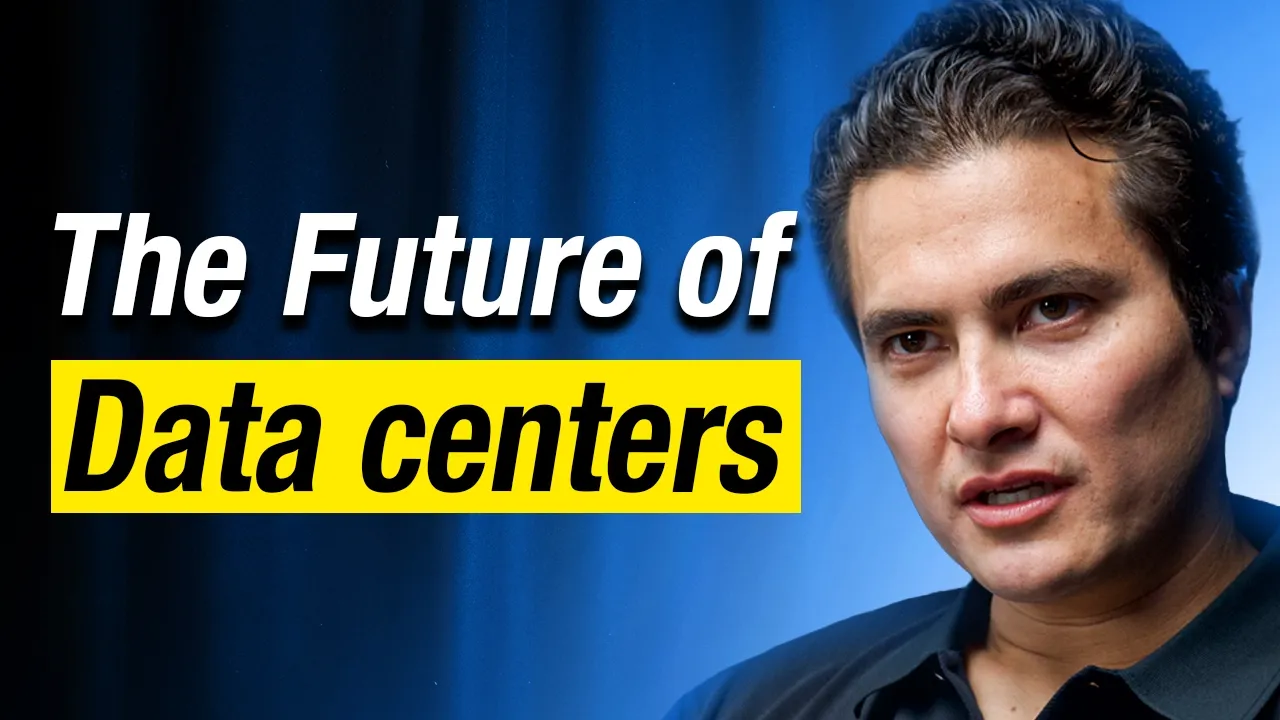
Chase Lochmiller is the Co-founder and CEO of Crusoe. Crusoe builds and powers the data centres that companies use to train and run AI. It has raised approximately $6.4 billion in equity, including its latest $3.9 billion Series F at a $30.9 billion valuation. Its backers include NVIDIA, Founders Fund, Gavin Baker's Atreides Management, Mubadala Capital and Valor Equity Partners. ----------------------------------------------- Timestamps: 00:00 Intro 01:06 How Mountaineering Shaped Chase as a Founder 06:44 Why Having Money Can Make Founders Take Bigger Risks 09:54 How Crusoe Went From Bitcoin Mining to AI Infrastructure 13:15 The ChatGPT Moment That Changed Crusoe’s Strategy 17:05 The Real Bottleneck in AI Infrastructure Today 17:54 How Crusoe Built in 1 Year What Others Said Would Take 2.5 Years 21:48 Energy & Labor: The Biggest Constraints on AI Data Centers 25:32 Why Chase Says the Data Center Water Argument Is Wrong 26:43 Do Data Centers Actually Raise Energy Prices? 29:32 Why 50% of Planned Data Centers May Never Get Built 31:14 Why Data Centers Became Politically Toxic 33:48 The Economics of GPUs and AI Compute 36:39 Crusoe’s Strategy: Sell Data Centers, GPUs and Tokens 37:48 Building the “Exxon of AI Infrastructure” 39:00 Where the Highest Margins Are in AI Infrastructure Today 39:14 What “Take-or-Pay” Really Means in AI Compute 41:45 The Real Risk of GPU Depreciation 43:19 Why Old GPUs May Stay Valuable Far Longer Than Expected 44:20 How Crusoe Forecasts AI Compute Demand 48:27 Does the Lowest-Cost Producer of Intelligence Win? 51:55 Why Not All Inference Providers Are Created Equal 53:54 Open vs Closed Models: Where the Tokens and Dollars Go 56:10 What Managed Inference Looks Like in Five Years 57:00 Quick-fire Round ---------------------------------------------------------------------------------------------- Subscribe on Spotify: https://open.spotify.com/show/3j2KMcZTtgTNBKwtZBMHvl?si=85bc9196860e4466 Subscribe on Apple Podcasts: https://podcasts.ap
Summary
Generated by gpt-5.6-terraAt-a-Glance
- Verdict: Watch fully
- Core thesis: Crusoe CEO Chase Lochmiller argues that AI infrastructure is fundamentally an energy, deployment-speed, and GPU-utilization business—not merely a chip-supply business—and that vertically integrating data centers, compute, and managed inference is the best hedge against shifting bottlenecks and GPU depreciation.
- Why it matters: For AI operators, the discussion explains why reliable, low-cost token production depends on physical infrastructure choices, workload-aware inference optimization, and flexible capacity economics—not simply securing the newest GPUs.
- Best use: Use it as a strategic infrastructure briefing: extract the architecture and procurement lessons for agent/inference systems, while treating Crusoe's community, energy-price, and depreciation assertions as interested-party claims requiring independent validation.
Executive Summary
Lochmiller frames Crusoe's apparent evolution from Bitcoin mining into AI cloud infrastructure as a continuation of a single thesis: compute is ultimately constrained by energy, so infrastructure should follow low-cost, abundant power rather than legacy internet hubs. ChatGPT's launch in November 2022 materially increased Crusoe's confidence that demand for AI compute would accelerate, prompting greater investment in AI-native data-center design and energy sourcing.
His operating argument is that AI infrastructure bottlenecks shift constantly across power, interconnection, equipment, permits, labor, land, and construction. Crusoe's response is vertical integration—not primarily to capture manufacturing margin, but to control availability, delivery time, and system-level design. He cites reducing the lead time for a power-distribution center from a market-quoted 100 weeks to 28 weeks by building it internally for its Abilene build.
The company sees three monetization layers—data centers, GPUs, and tokens—and compares vertical integration to an oil-and-gas supermajor whose margins move between upstream, midstream, and downstream operations across commodity cycles. GPU rentals on long-term take-or-pay contracts provide cash-flow certainty, while shorter-term managed inference and serverless fine-tuning services are higher-margin and can prolong the economic usefulness of older hardware.
The most actionable technical point is that inference economics should not be reduced to GPU-hour pricing or even dollars per token. Providers must optimize token efficiency, throughput, time to first token, end-to-end latency, and most importantly GPU utilization. Lochmiller identifies KV-cache management across HBM, DRAM, NVMe, and object storage as a practical control point for keeping expensive GPUs busy. He expects a mixed future of closed frontier models and enterprise-owned or domain-specific open models, with managed inference abstracting routing and infrastructure complexity across both.
Key Takeaways
- Claim: The binding constraint in AI buildout is increasingly deployable powered capacity—places where GPUs can actually be plugged in—not GPU availability in isolation. | Evidence: Lochmiller describes AI-data-center supply chains as a "whack-a-mole" process and names available power, skilled-trades labor, utility interconnection, permitting, land, and equipment as sequential constraints. Crusoe committed to build more than 200 MW across its first two Abilene buildings in one year, versus a next-best bid of two and a half years. | Implication: For major AI deployments, compute sourcing should be evaluated as a time-to-live-capacity problem with power, construction, and network dependencies—not as a standalone GPU procurement exercise. | Caveat: This reflects an infrastructure developer's perspective; bottlenecks vary materially by geography, grid, workload type, and project scale.
- Claim: Vertical integration is valuable mainly because it compresses delivery time and enables first-principles system design, rather than because component manufacturing itself carries exceptional margins. | Evidence: A medium-voltage power-distribution-center component carried a quoted 100-week external lead time; Crusoe's internal electrical-manufacturing team sourced parts and built it in 28 weeks. Lochmiller says electrical manufacturing is not the core alpha, although margins have risen amid scarcity. | Implication: Ken should distinguish commodity component ownership from control of critical-path capabilities. Build or tightly partner around the bottlenecks that determine deployment certainty, integration quality, and time to revenue. | Caveat: Internalization creates organizational and execution complexity; it is not automatically superior for smaller operators without sufficient scale or recurring deployment volume.
- Claim: AI infrastructure economics can be naturally hedged by selling across three layers—facilities, managed GPU capacity, and token-delivery services—because value and margin move among them over time. | Evidence: Crusoe says it sells "data centers, GPUs, and tokens" and compares this stack to Exxon-style upstream, midstream, and downstream integration. Its portfolio includes roughly five-year, creditworthy customer GPU-rental contracts designed to pay back within term, alongside shorter-term higher-margin managed inference and serverless fine-tuning services. | Implication: For an AI platform, avoid dependence on one revenue primitive. Pair committed capacity economics with higher-value software/service layers that can capture upside and reuse underlying infrastructure. | Caveat: The oil-and-gas analogy is directional rather than proof that AI layers will offset each other's cyclicality; correlated demand shocks, customer defaults, or rapid pricing declines could still hit multiple layers at once.
- Claim: GPU depreciation risk is overstated when assessed solely against the pace of new-chip releases; older hardware can remain valuable if providers convert it into cheaper, abstracted intelligence services. | Evidence: Crusoe depreciates chips over six years and says Hopper usage prices were higher three years after its substantial 2023 purchases than when the chips were new. Lochmiller argues that managed services abstract the chip from the customer outcome, allowing slower older GPUs to serve cost-sensitive workloads and potentially extend monetization beyond the accounting cycle. | Implication: When evaluating hardware or hosted-compute exposure, model useful-life value by workload tiers and service packaging, not only by frontier-training relevance or straight-line depreciation schedules. | Caveat: This is a favorable historical observation during acute compute scarcity, not evidence that all GPU generations will retain pricing power; future supply, model architectures, and energy economics could change resale and utilization values sharply.
- Claim: The operative metric for inference is not simply dollars per token: providers win by balancing token quality/efficiency, throughput, first-token latency, last-token latency, and GPU utilization. | Evidence: Lochmiller calls dollars per token a useful but incomplete indicator because tokens are not equally valuable. He emphasizes tokens per second, time to first token, and keeping the GPU—the most valuable asset in the data center—busy rather than idle. | Implication: Ken's agent infrastructure should instrument and optimize token economics as a multi-metric service-level problem, segmented by workload class, rather than optimizing a single blended cost number. | Caveat: The optimal objective function depends on application requirements: interactive agent workflows may prioritize latency, while batch processing may prioritize throughput and cost.
- Claim: KV-cache and memory-tier management are central competitive levers in inference because they determine whether GPUs spend time computing rather than waiting on data movement or recomputing prior context. | Evidence: Lochmiller explains that cached token results can avoid repeated feed-forward matrix computations, but KV caches can exceed on-chip HBM. He identifies efficient movement and placement across GPU HBM, system DRAM, NVMe, and cluster object storage as critical to latency, throughput, and utilization. | Implication: For OpenClaw and agent systems with long context, repeated tool loops, or shared prompt prefixes, cache architecture and routing policy are material cost and responsiveness concerns—not low-level infrastructure details to ignore. | Caveat: The transcript does not quantify Crusoe's performance advantage or specify its implementation relative to systems such as vLLM, SGLang, or specialist providers such as Fireworks.
- Claim: The market will likely combine frontier closed models with open or enterprise-owned domain models, rather than converge on one model-ownership structure. | Evidence: Lochmiller says customers currently spend more on closed-source frontier models but generate more tokens on open-source models. He sees data sovereignty and private-data post-training as major drivers of owned intelligence, citing Cognition and Harvey as examples of domain-specific approaches while noting frontier labs also incorporate private knowledge. | Implication: Design AI products with model portability and routing from the outset: retain access to frontier capability while creating a path to specialized models where private data, sovereignty, cost, or predictable workload structure justifies it. | Caveat: This is a market outlook rather than a measured breakdown of revenue, token share, or enterprise adoption, and the speaker does not define the sample underlying his observations.
Detailed Brief
Distributed, energy-first AI factory design
- Claims: Lochmiller believes AI infrastructure need not remain concentrated in conventional internet hubs such as Northern Virginia because neural-network serving time is driven more by in-data-center computation than transit latency.; His long-term design target is a one-gigawatt-scale computer: a campus-scale, cohesive GPU cluster connected through a single RDMA fabric for large workloads.; He separates this frontier-scale cluster architecture from inference expansion, where smaller clusters can be more appropriate and speed of deployment—"time to token"—matters more than gigawatt-scale cohesion.
- Evidence: He says Crusoe examined NVIDIA roadmaps years earlier as chips moved from roughly 150–200 W toward 300 W and potentially 600 W, concluding that power density would reshape data-center design.; Crusoe launched its cloud platform with paying customers in early 2022, after working with researchers at MIT, Stanford, and other groups to understand AI-infrastructure needs.
- Caveats: Distance from users still matters for latency-sensitive workloads; the interview does not provide a latency budget or identify which inference classes can safely move to remote energy-rich locations.; A highly interconnected campus cluster and rapidly deployed modular inference cluster solve different problems and should not be treated as interchangeable.
- Implications: Physical location strategy should follow workload latency tolerance, power availability, interconnect design, and time-to-capacity—not conventional cloud-region logic alone.; Capacity planning should explicitly distinguish frontier training or giant-cluster workloads from geographically and operationally flexible inference workloads.
Permitting, community acceptance, and planned-versus-built capacity risk
- Claims: Lochmiller estimates that approximately 50% of planned data centers may not ultimately come online because physical projects fail at land acquisition, entitlements, utility interconnection, permitting, and new-generation approvals.; He argues that regulatory friction should be navigated rather than eliminated, because communities reasonably care about jobs, power prices, water, air quality, and local value creation.; He contends that modern closed-loop liquid-cooled facilities can have minimal water consumption and that data-center investment can reduce local electricity costs by catalyzing generation and spreading transmission and distribution costs over more megawatts.
- Evidence: For a planned 140 MW Abilene building, he says annual water use is comparable to about 10 single-family homes, with water circulating through a closed-loop cooling architecture.; He says Crusoe expects to account for more than one-third of tax revenue in Taylor County/Abilene and more than double school-system tax receipts, while creating demand for local restaurants, hotels, and services during construction.
- Caveats: The environmental, water, tax, and power-price statements are made by the CEO of a project developer and are not independently substantiated in the transcript.; Even if long-run costs improve, construction traffic, dust, noise, political backlash, grid-upgrade cost allocation, and local labor scarcity can delay projects or affect their economics.
- Implications: Treat announced capacity as probabilistic until land, power, interconnection, permits, equipment, labor, and community arrangements are secured.; Infrastructure counterparties need a local social-license strategy and independently auditable environmental and community-benefit data, not merely a national AI-growth narrative.
Competitive posture: adaptability over durable moats
- Claims: Lochmiller says he has revised his view of durable competitive advantage: most moats are "an illusion" or ephemeral during rapid technological change.; He describes Crusoe's culture as "thinking like a mountaineer": plan for changing conditions, maintain fallback plans, endure difficult expeditions, and place safety first.; He expects the company will likely benefit from access to public markets eventually because physical AI infrastructure requires large and recurring capital commitments, though he gives no IPO timing commitment.
- Evidence: Crusoe has grown to nearly 2,000 employees, according to Lochmiller, following a reported $3.9 billion Series F at a $30.9 billion valuation.; He uses the mountaineering maxim "getting up to the top is optional; getting down is mandatory" to connect operational resilience with physical safety and digital-platform security.
- Caveats: The assertion that moats do not exist should not be read literally; asset location, interconnection rights, customer relationships, capital access, software, and operational execution can still produce persistent advantages.; The interview contains no financial disclosures sufficient to assess Crusoe's capital efficiency, profitability, contract concentration, or balance-sheet risk.
- Implications: For fast-moving AI infrastructure markets, prioritize iteration speed, contingency planning, and reversible commitments over static claims of defensibility.; For investment or vendor diligence, focus on proof of execution: power rights, delivery track record, utilization, contract quality, software differentiation, and financing terms.
Notable Concepts & Terms
- Time to token: Lochmiller's preferred deployment metric for inference capacity: how quickly an operator can move from no capacity to delivering usable model output, especially important when customers cannot forecast years ahead.
- AI factory: A data center purpose-built to turn energy, hardware, and networking into AI compute and token output, rather than a generic enterprise data center.
- RDMA fabric: The high-performance interconnect approach Crusoe says it uses to make a campus-scale GPU cluster function as one cohesive computer for large workloads.
- Take-or-pay: A contract structure under which the customer pays for committed capacity whether or not it uses it; Crusoe says its GPU rental agreements are typically structured this way.
- KV cache: Stored key/value states from prior model tokens that can avoid recomputing context; managing it across memory tiers is presented as key to latency, throughput, and GPU utilization.
- HBM / DRAM / NVMe / object storage tiering: The hierarchy of increasingly larger and generally slower storage layers that an inference system must coordinate when KV cache outgrows GPU memory.
- AI supermajor: Crusoe's analogy for a vertically integrated AI-infrastructure company operating across facilities, compute, and finished intelligence services, like an integrated oil major.
- Idiot index: Elon Musk's framing, invoked by Lochmiller, comparing raw-material cost to finished-product cost; Crusoe uses vertical integration to understand true end-to-end build costs and redesign systems from first principles.
Operator Notes / Why Ken Should Care
- Add workload-level observability for cost per successful task, dollars per useful token, tokens per second, time to first token, time to last token, cache-hit rate, and GPU utilization; do not use blended token cost as the sole routing metric.
- Classify OpenClaw workloads into interactive, batch, long-context, repeated-prefix, and domain-sensitive categories, then set distinct model-routing, caching, latency, and cost policies for each.
- Maintain a multi-provider and multi-model execution path: frontier APIs for maximum capability, open/self-hosted models for high-volume or sovereignty-sensitive workloads, and an abstraction layer that prevents lock-in.
- If assessing GPU-cloud or infrastructure partners, diligence power interconnection, construction completion, labor access, network design, take-or-pay obligations, customer concentration, and actual time-to-capacity—not announced megawatts.
- Treat claims that data centers lower community power costs or have near-zero water impact as validation items; require project-specific grid, cooling, water, and cost-allocation data before using them in strategy or investment decisions.
- For any owned inference fleet, elevate KV-cache placement, prefix reuse, memory tiering, and queueing/scheduling to first-class system design concerns because idle GPU time is the dominant economic leak described here.
Source/Metadata
- Title: Crusoe CEO: Why Everyone Gets GPU Depreciation & AI Energy Costs Wrong
- Transcript words: 20268
- Duration seconds: 3901
- Timestamp note: No usable timestamps or chapter markers were present in the supplied transcript; the transcript also contains substantial duplicated passages.
Transcript
The infrastructure to support AI wasn't going to be centralized, it was going to be distributed where energy was low cost and abundant. Energy prices actually come down, it's actually the opposite of the narrative that's being told. So what is a legitimate concern? Right now we are in a race for data centers, for compute capacity, for energy, and there is not a more pertinent guest that could join me in the hot seat today than Chase Lockmiller from Crusoe Energy. They provide several different layers of this very important business. He sits down today to join me following their $3.9 billion series F, which was raised at a $30.9 billion valuation. People are very emotional about data centers. When you look at what data centers are doing, I think the facts are all on our side. There's really three products that we ultimately sell to customers and we're making money: data centers, GPUs, tokens. The GPU is actually the most valuable thing in the entire data center. Most moats are illusion, but most moats don't exist. Ready to go? Chase, I am so excited for this. I told you before, I have been stalking the hell out of you. I even heard from performance coaches. This has been an amazing experience doing the research. So thank you so much for doing this with me. I'm pumped to be here, man. Now, I am just going to start with a totally weird one that I never expect to start with. Mountaineering. Yeah. I hear that you are an experienced and skilled mountaineer. And I just thought I haven't had that often in the hot seat. What do you learn from mountaineering that you think makes you better as an entrepreneur? It's a great question. We've actually ingrained mountaineering into the culture of Crusoe. We have a core set of company values. One of our core values is actually to think like a mountaineer. And so what does that mean? Mountaineering is a practice where things are subject to change and you need to be prepared for change. So with it, it really embeds this sense of cultural resilience that I think is really important for a business like ours that is doing stuff both in the digital world as well as the physical world. But to further the analogy, for mountaineering, you come up with a plan to set out from your camp, go to the peak, come back safely, take your photo, and your glory is written in the history books. But you have to be prepared for things to go wrong. You have to be prepared for the weather to change. You have to be prepared for gear to fail. You have to be prepared for your partner to get sick or an avalanche to occur. The idea is really having a plan A, and then I have a plan B, a plan C, a plan D. I have plans all the way down in case different things go wrong. Additionally, you have to have a sense of willingness to endure difficult challenges and difficult times. This notion of enduring the expedition—the expedition could be long and hard and arduous. You have to really dig deep at those moments of pain to work through those challenges. That's a different aspect of thinking like a mountaineer. Then another big aspect is thinking with a safety culture, having this notion of safety as a huge priority, which is important when you're doing things at the scale we're doing from a construction standpoint, thinking with the safety mindset of safety first, second, and third. There's this saying in mountaineering that getting up to the top is optional, getting down is mandatory. So we try to practice that safety culture here at Crusoe and really try to avoid any sort of physical injuries or challenges with digital attacks on the platform as well. I have so much respect for mountaineers. It's one of those where I almost can't get my head around the complexity and the mental fortitude it takes to get through the change of plans, the weather, the partner that's sick, the endurance, as you said. Yep. I met an entrepreneur yesterday that climbed Everest and he showed me pictures of the dead bodies along the way. And I was like, I mean, to see that is just so harrowing. It's tragic. When people take unnecessary risks, you know, actually spending a lot of time within high altitude mountaineering culture and communities, you do see oftentimes people taking unnecessary, very careless risks. And it's actually quite shocking. Tragedy is avoidable. It is preventable. I think having that mindset of thinking like a mountaineer and planning ahead is what enables mountaineers to do it for a long period of time. Can I ask, you said about resistance to change. What change did you find the hardest in your life? I think one of the most difficult moments of change for me was that in my life, I always had the next thing planned before I left the previous thing. So what I mean by that is when I left high school, I knew exactly where I was going to college before the end of high school. When I left college, I knew exactly where I was going to work and what I was going to do. When I left my first job, I knew I was going to work and going to grad school. I had a job lined up even after that. When I left to go climb Mount Everest in 2018, I did not have a plan after that. I had had a reasonable amount of financial success in my life to that point, but I didn't have the thing planned. Actually having that void of emptiness really was both challenging and empowering for me because it felt like I could do anything. It was a blank slate. I had thoughts of maybe I'm just going to invest my own money and enjoy the rest of my life and not do much, but I could also start a company. If I were going to start a company, what are the things, what are the most challenging things that I could think about tackling that are interesting, that I would be excited about pursuing on a daily basis. And that was the emergence of Crusoe, which came through that chapter of difficulty and challenge of just nothingness, having an empty slate. My job is to find signals that will determine a potentially great entrepreneur. One thing that I find now is actually often richer entrepreneurs are better entrepreneurs because they're not worried about downside protection and they just see what is possible. How do you think starting Crusoe with a little bit of money and success already changed how you think about building it? There's a bunch of psychological aspects to it. You could look at Maslow's hierarchy of needs. It is empowering to know that if I take risk and this all goes to zero, I'm still going to be fine. I'm going to be able to cover my rent and feed my family and cover these base needs that I may have in my life. So an interesting one for me is I never quibble on salaries. I'm very candid about it. I make a lot of money from the podcast, which is great. But I don't quibble on salaries. Life's too short. I want people to be paid what they want. If I take five or ten grand less from a couple of people, I don't care. Yeah, it's specific. When I was in university, I was convinced I was going to become a theoretical physicist and likely a professor. I was spending time doing research in basic science. I was doing research in physics both at MIT and then at Los Alamos National Lab. At some point, I was pretty committed to living this monastic life of not really earning a bunch of money, but just really having this life of discovery where I get to go discover the mysteries of the universe. That would be my life's work and pursuit. At some point, I realized it's a very slow moving industry. This industry of discovery—it may be changing today because of AI, but at least at that point in my life, it was a very slow moving industry. I felt I wanted to do something very fast paced. and likely a professor. I was spending time doing research in basic science, right? So I was doing research in physics, both at MIT and then at Los Alamos National Lab. And at some point, early on in that journey, I was pretty committed to living this monastic life of not really earning a bunch of money, but just having this life of discovery where I get to go discover the mysteries of the universe. And that would be my life's work and pursuit. At some point, I realized it's a very slow moving industry. This industry of discovery may be changing today because of AI, but at least at that point in my life, it was a very slow moving industry. And I felt I wanted to do something very fast paced. And I felt I had lost my life's purpose. I was thinking, okay, I don't feel I have a purpose anymore. So absent having a purpose, I was thinking, man, I guess I should get rich. That's the next best thing to having a monastic calling that you're devoted to. And I was looking around for different ways to make money. And this headhunter found me and recruited me into this field of quantitative finance. And it was, hey, you're really good at solving math problems. If you come work in this industry, they just pay you a lot of money to solve math problems. And I said, this sounds great. Sign me up. But I think once that need was met of, okay, I have enough money, what next? And to your original question of, you know, starting from this position of strength of being an entrepreneur and actually having had some financial success, it's empowering to take bigger swings, empowering to take bigger risks, which can ultimately lead to bigger outcomes. The final one before you actually get into what I plan to get into. It's picking up on you said the endurance element of mountaineering. Endurance is great in some respects, but it can also lead you to continue doing something you maybe shouldn't. And sometimes there is a right time to change course rather than persevere. You went through a very big change in the business, seemingly from the outside. A lot of your investors said you always had the foresight that it would lead to where we are today. But seemingly it's Bitcoin phase one and then phase two is AI. And I don't want to get into that maybe weirdly, but I want to ask your advice. How do you advise someone when to endure, keep going, persist versus when to change tact and go down a different route? It's interesting investors that you spoke to validated this claim, but from the outside, it does appear to be a pivot. Internally, when we started the company, the goal was always to build an AI platform. That was what I had spent my career working on with AI machine learning, algorithms. And I'd been a big user and early adopter of deep learning for certain tasks. And I felt it was this meta science that ultimately was going to transform every industry. And at that scale, compute becomes the bottleneck. Compute and data become the two bottlenecks. And what is the bottleneck for compute? Energy. So that was the premise of starting the company. Now, we obviously weren't dedicating all of our resources towards building an AI platform day one. We were dedicating the majority of our resources towards monetizing waste energy with Bitcoin mining. That was the philosophy of starting the company and finding and seeking out these low cost, abundant energy resources that we could monetize with compute. Bitcoin was the best monetization engine we had at the time, but we were building this AI platform from very early days. So when you think about at what point do I shift the resource allocation to this other thing that maybe I'm working on on the side, I think about the world in a very Bayesian approach. I don't think the future is deterministic. I think it's very probabilistic. And I have a view of what the future is going to look like. It's somewhat more certain if you go out just a little bit of time. If you go out a further amount of time, it gets a little bit hazier, but I still have a view of what things are going to unfold. And what was happening with this AI platform was it was a project that Chase had devoted some time and resources and engineering towards internally. And we were committed to exploring this pathway. But it was only we had launched the Crusoe cloud platform in early 2022 with our first set of paying customers. Before that we were working with a lot of researchers at MIT and Stanford and different groups trying to understand what's actually valuable for AI researchers from an infrastructure platform. And we finally launched in early 2022, but the moment that changed everything was November 30th, 2022, the launch of ChatGPT. This was the moment that just shifted everything in terms of, okay, AI is here and they're really interesting use cases that are going to explode from this moment. And that was a moment where my view of the world shifted quite a bit. How so? I just felt there was going to be far more demand for AI compute infrastructure solutions. And we were very well positioned by actually having launched that platform at that point. What did you do then differently immediately as a result? After the ChatGPT moment happened, we had watched this evolution of the data center to support Bitcoin. And if you look at the history of Bitcoin mining, it's pretty fascinating. It started with hobbyists on their laptops in this decentralized way. And then people started to use GPUs and then people started to lease data center capacity from more traditional co-location facilities that have five nines of reliability. People started to develop ASICs. And then at some point people realized, you know what, we don't need five nines of reliability to mine Bitcoin. We can do it with three nines. What about one nine? How much does that reduce the actual data center cost? And they were able to eliminate something like 98% of the total data center cost with these chicken coop type data centers, very low cost, no redundancy. But ultimately brought down the payback period for investments in Bitcoin mining. And we felt always that something similar was going to play out in AI. And we're long-term partners of NVIDIA and we'd been working with NVIDIA. And I was looking with them at the roadmap many years ago. And it was, okay, our current generation of chip is 150 Watts or 200 Watts. And the next generation is going to be 300 Watts. And then there's going to be a future generation that's maybe 600 Watts per chip. And I was thinking, well, as the power density goes up, it's going to change what the data center looks like to actually support these things. And we also had a perspective on the compute workload for AI. It didn't need to be in these centralized facilities. People have been anchored on these centralized hubs for data center computing infrastructure. Northern Virginia is the hub that runs most of the internet, most web applications run out of Northern Virginia, but it didn't have to be that way with AI because so much of the time to serve a neural network is actually the compute that's happening in the data center, not the time to get to the data center. And so for me, that opened up new geographies and we felt the infrastructure to support AI wasn't going to be centralized. It was going to be distributed where energy was low cost and abundant. And so when we think about things that we did differently, it was investing more heavily in how to design and develop the data center to support AI and investing heavily in how do we find and source energy resources to support the scaling of AI? I want to unpack those a little bit and go back to some form of structure that I did plan, I promise. That's great. the hub that runs most of the internet, most web applications run out of Northern Virginia, but it didn't have to be that way with AI because so much of the time to serve a neural network is actually the compute that's happening in the data center, not the time to get to the data center. And so that for me opened up new geographies and we felt like the infrastructure to support AI wasn't going to be centralized. It was going to be distributed where energy was low cost and abundant. And so when we think about things that we did differently, it was investing more heavily in how to design and develop the data center to support AI and investing heavily in how do we find and source energy resources to support the scaling of AI? I want to unpack those a little bit and go back to some form of structure that I did plan, I promise. That's great. But if we start on data centers, we then have Crusoe Cloud, managed inference, energy runs throughout it all. So I'll pick that apart too. On the data center side, we always hear about supply constraints today. How truly supply constrained are we? Where it's actually manifesting is there are not places to plug in GPUs. So that's ultimately the supply constraint. There's just not places where you can plug in GPUs and turn them on and run AI workloads. So how does that actually manifest across the supply chain? The supply chain to support large scale AI data centers is a game of whack-a-mole. At different points, different bottlenecks come into play. And I think that's actually one of the critical aspects of being vertically integrated, that we're able to navigate a lot of those critical bottlenecks and situations. I'll give you an example. When we set out to build the first two buildings in Abilene, it was a little over 200 megawatts of compute capacity. We had committed to doing this in one year. And the next closest bid was two and a half years. There were 34 other data center developers, but speed was of the essence. So I said, sure, we can do it in a year. One of the key bottlenecks was what's called a power distribution center. It's where medium voltage power, around 34, 34.5 KV, and then you distribute it to low voltage transformers that ultimately go into the data center and power the racks. When we went out and canvassed the market for vendors that were supplying these medium voltage power distribution centers, the lead time for this one component was a hundred weeks. And I said, well, I don't have a hundred weeks. I committed to doing this in a year. So I went to our internal team and we had consciously vertically integrated electrical manufacturing. We said, how quickly could we make this ourselves? The team did a bunch of work, sourced components to make these things, and we were able to do it in 28 weeks. And so being able to navigate those types of key bottlenecks by actually having the resources internally gives you a lot more flexibility to unblock these key bottlenecks, number one. And number two, it gives you a perspective on what is the true cost of a lot of these different things that are being built? Elon has this very interesting framing of this. He calls it the idiot index in terms of what is the cost of raw materials, and then what is the end product relative to that cost of just the raw materials going in? And by being vertically integrated, we have a perspective on the end-to-end cost of everything going into building and operating an AI factory. How much extra margin do you juice out by having that internal build process yourself? Like what is the idiot index chasm? Electrical manufacturing is not an ultra high margin business. Today, it's actually spreads have gone up quite a bit. Margins have gone up quite a bit just because they're so short in supply. But it's not where the critical alpha is. It's not the main reason we're doing it is stacking margin. It's more availability and getting it out. Availability, being able to deliver on time. And then also, it gives us a critical innovation platform by being able to start from first principles and say, okay, we can bring in raw materials and we can build anything we want in the world. And what is the thing that we want to build to ultimately serve the workload? And so when you look at the campus in Abilene, the inspiration for that was, okay, we want to build a one gigawatt scale computer where you can interconnect a giant cohesive cluster of GPUs that can operate one cohesive workload across the entire campus. And what does it look like to actually build that thing from the ground up? And so that's how the cores are designed. That's how the GPUs are designed. All of it is designed to run on one cohesive RDMA fabric. When we think about scaling of inference, 2026 is really about the scaling of utilization of AI infrastructure or utilization of LLMs and foundational models for useful tasks. It's been this era of scaling of agents and token utilization. And during that moment of scaling infrastructure as people are finding utility in these AI models, it's driving a lot more demand for inference. It's the era of the agent, the era of inference. And for that, you don't need a gigawatt scale computer to serve these models. You can do it with a much smaller cluster. And what matters is actually how quickly can I go from not having anything to being able to deliver tokens? Like, so what is my time to token? I love the analogy you said there of it's whack-a-mole. What is the biggest supply constraint that we have today? You know, it varies. I would say energy is definitely a key constraint. So power that's available for compute is a key bottleneck. Alongside that labor is a very key bottleneck. There are a finite amount of skilled trade workers, electricians, welders, plumbers, construction workers in the United States. And then when you overlap, trying to find if I have access to energy in this unique place, can I get the labor to that place to actually bring the AI factory to life? That is a big challenge. With the greatest of respect, if power and labor are the two biggest constraints or challenges, the UK is totally fucked. We have energy prices that are four times higher than anyone else. And we don't have labor. And when we have humans, they just don't work. You in the US have both, but significantly more expensive than China, if we're honest. Now, power is not significantly more expensive. Really? No. You don't think that the government is subsidizing data centers in China with much cheaper energy to power? I'm asking him, not telling. There are subsidies going in place, but in the United States, we are globally competitive with power pricing. Okay. And so when we look forward then... Labor, I'll give you. Labor in China is far cheaper than the United States. What about policy and regulation? Everyone I speak to is like, oh, it's the red tape. It's the policy and regulation that stops us in the US being able to build out. Is that a problem in the way that it's told to me? I wouldn't classify it as a problem. I would classify it as something that needs to be navigated. And when we think about policies, we want good policies to be in place. We don't want just the Wild West, everybody out doing whatever they want, building whatever they want with no care for anybody else in the world. These are big investments that are being made. They have to be done thoughtfully. And so we are supporters of the right policies being in place, but it does cause friction in terms of developing things faster. That's actually one reason we also like the idea of manufacturing a lot more of this infrastructure as opposed to making everything a giant construction project. Totally get that. If I were to put you in charge of policy to enable and encourage this ecosystem to flourish, what would you do? What would you do differently? You got a magic wand. Well, the thing about policy is it's hyperlocal. Like all politics, politics are local. And what people care about is they care about whether there are jobs being created? Is this going to drive up my energy costs? Is this going to take all of my water? Is this going to pollute the air so that my kids suffer from some disease as a result? They care about whether the data centers are being good stewards and good citizens of the community? And are they actually creating value for the community? And then what are other ways that the data centers are giving back? And so this comes in the form of things like tax revenues and things like that. So I think one of the challenges for AI data centers broadly right now is that I think there's a lot of misinformation out there about what the impact of a data center is. what people care about is are there jobs being created? Is this going to drive up my energy costs? Is this going to take all of my water? Is this going to pollute the air so that my kids get suffer from some disease as a result? They care about are the data centers being good stewards and good citizens of the community? And are they actually creating value for the community? And what are other ways that the data centers are giving back? This comes in the form of things like tax revenues. So I think one of the challenges for AI data centers broadly right now is that there's a lot of misinformation out there about what the impact of a data center is. The number of people that have told me that data centers use all the water in the world is crazy, and it's also just false. When you look at all of these modern AI factory designs, they use pretty close to zero water. One of our giant buildings in Abilene, Texas, that can be called 140 megawatts of power is what's budgeted for each of those buildings on the first eight buildings. They use about the same water annually as about 10 single family homes. The primary water usage there is the staff using the bathroom, washing their hands, us watering the plants on the property. It's very de minimis water usage. There is water in the building. We are using water to cool the GPUs. But the critical aspect here is we've actually designed a closed loop architecture. The cold water's entering into the racks and then it's going out to a chiller outside and we're exhausting the heat. So the water requirements argument is just wrong. What about energy prices going up? I think this is an important aspect for the data center industry to get right and to storytell effectively. We like to look at data for these things. When you look at markets where data centers have made investments and have built big data centers, typically energy prices for communities have come down, because they catalyze more investment in energy generation technology and energy generation capacity. You end up with more megawatts being amortized over the same transmission and distribution infrastructure. As a result, people's energy costs end up coming down. When you look at some of these big builds that need a lot of net new generation capacity, we are very supportive of the data center industry helping to bring online new power production in order to support those energy requirements. So that too is misinformation. Energy prices won't go up for local towns and villages. The data has shown that energy prices actually come down. It's actually the opposite of the narrative that's being told. So what is a legitimate concern? Anytime there is a big construction project, it does cause other aspects, right? There's benefits. There's people with money in town that are spending. If you talk to any local business owner in Abilene, times have never been better. The amount of money being spent at restaurants and coffee shops and hotels and all the local services is more than it's ever been in the history of Abilene. So the challenge is with that comes traffic. With it comes some dust from construction and some noise that is involved with a very large construction project. But that will go away and there will be long-term permanent jobs in place that is continuing to support the local community. And there's tremendous tax revenue. If you look at the tax revenue that's coming from this, we're going to account for more than a third of the tax revenue in Taylor County and Abilene. This is transformative for local services, like the police, the fire department, the roads, the schools. For the school system, we're more than doubling the tax receipts that are going to the schools. I completely agree with the ripple effect that you see. I think it's one of the most important things when we see the amount of millionaires leaving the UK. People don't consider the ripple effect of them leaving in all of these different ways. We're seeing a lot of data center sort of planned, not being built out. We've seen very prominent people say we expect 50% of data centers that are planned not actually to be built and ready to go. What percent of data centers do you think that are planned will not actually go online? 50% seems reasonable. There's one of these things. It comes back to thinking like a mountaineer. You can't give me a decimal point. Why do you bother? I don't know. Let's end it here. Neil told me you're giving me precision. It's one of these things where coming back to this notion of thinking like a mountaineer, when you're going through these planning processes, a lot of things can go wrong. What's the number one thing that goes wrong in Provence? Getting permits, getting entitlements, getting land. If there's you're trying to acquire a certain piece of land and the person you're trying to buy it from ultimately doesn't want to sell. Getting a large load interconnection agreement done with the local utility. Getting an air permit if you're bringing online new generation. With the greatest respect, I don't come back to this and I'm not an agent of the CCP, I promise, but in China, they'll move 3 million people out of the dam for you. Yeah, and they'll just give you a green light on day one. Yes. That is definitely a benefit. It's a benefit to the data center developers if you're viewing it through a purely Machiavellian lens. Yes. I am a venture capitalist. I give zero regards about the sentimentality of your home. You will be rehoused somewhere better. Again, charity is not our endeavor. Yeah. Okay, totally get that. Can I ask you, when we look at these data centers, now they're being used as a political instrument in a way that we didn't expect. Does that worry you? Yeah. I've never wanted to be the main character of a political policy debate. Data centers have come front and center to the upcoming midterms in the United States and they become this very polarizing topic. I think there is concern around this era of AI. People are legitimately concerned around am I going to have a job in the future? Am I going to be able to provide useful work to the world that I'm going to be able to get compensated for. So I do think that is a concern on people's minds and data centers are this physical manifestation of AI. The biggest aspect is it is an emotion. It's a current. I think that people are very emotional about data centers. When you look at the facts of what data centers are doing from job creation, from driving down energy costs, from being water neutral, from generating long-term tax revenue that is transformative for the communities that we're investing in, I think the facts are all on our side. Do you know what I was slightly blamed with respect to Dario and a lot of other leaders who've said for the last few years, we're going to replace all jobs. We're going to replace all jobs. And then surprisingly, they hate you. Yeah. Cake or death. Cake please. Oh, I wasn't expecting that. Oh, crikey. You won't have a job. You won't have a job. Oh, you don't want the data set up. The interesting aspect to all this is that data centers are this massive employer. They're leading to this massive economic boom for the entire blue collar labor economy in the United States. This massive resurgence in re-industrialization of the United States. We're hiring people. revenue that is transformative for the communities that we're investing in. I think the facts are all on our side. So do you know what I was slightly blamed with respect to Dario and a lot of other leaders who've said for the last few years, we're going to replace all jobs. We're going to replace all jobs. And then surprisingly, they hate you. Yeah. Gosh, cake or death. Cake please. Oh, I wasn't expecting that. Oh, crikey. You won't have a job. You won't have a job. Oh, you don't want the data set up. The interesting aspect to all this is that data centers are this massive employer. They're leading to this massive economic boom for the entire blue collar labor economy in the United States. This massive resurgence in re-industrialization of the United States. We're hiring people in factories, in the field. And these are tons of folks that are skilled trade workers, right? People working with their hands to bring the infrastructure of intelligence to life. And I think the interesting aspect that people are concerned that AI is going to take jobs, but yet it has so far only created tremendous amounts of jobs and tremendous amounts of economic development. So again, I think it's one of these moments where people are having an emotional reaction to something. But if you look at the facts of what's actually happening, the data is on the side of data centers are actually a very positive investment for the communities. If anyone's doing data center security, by the way, would love to invest in that business. It's a really good, it might be a more PE play, to be honest, not a venture play. It's a phenomenal business. Another part of your business is obviously providing GPUs and compute. Can you help me understand the economics of that layer? Like when you look at it, if I'm a venture investor, how long does it take to pay back on the hardware? I would say the price of a GPU hour is kind of like a traded commodity. You're even seeing these commodity platforms creating compute as a tradable asset. I think people are thinking through this lens of compute is going to be this next great commodity. So there are a couple of platforms like the compute exchange, like Ornn, I think there's a handful of others that are creating these tradable futures products. So I kind of view it as a product that we're producing. And there is commodity price fluctuation in it. When I think about payback periods for this, I think when we are taking debt against it, there are different ways we think about managing that risk. And we think about a portfolio of different services and a portfolio of different returns that we're going to get for this. What does that mean? So what it means, putting it precisely. So we have a range of different deals that we're doing with the compute we're buying. We are renting capacity on a long-term basis, call it five-year contracts to credit quality customers that we expect to pay. Those are going to pay back within that timeframe and they're going to cashflow during that timeframe. There are shorter term contracts that we'll do at higher margins, but they're riskier because at the end of the contract, is there a renewal? Is there another thing that you're going to earn from that resource? And then finally, there are other services that we provide in package. So things like Crusoe managed inference, things like our serverless fine tuning product that actually helps people, that's more of a developer tool that ultimately enables developers to fine tune some of these open source models, these leading edge open source models so that they can get better performance for maybe some domain specific task. Or actually as their applications are scaling, they can actually serve the tokens needed from an inference basis to enable that application scaling. Those contracts are typically much shorter term in nature and they end up being higher margin to Crusoe. Okay. I totally get you. And so you want a portfolio of those different margin profiles to make up what you deem as a healthy margin across them blended. Correct. So one of the analogies I've used in the past is when we think about Crusoe and our vertically integrated strategy, there are really three products that we ultimately sell to customers and where we're making money. We can sell data centers, we can sell GPUs, and we can sell tokens. Those are the three core products that we sell. And why does that matter? You know, if you look at a different market, I think there are very interesting parallels for AI infrastructure and AI compute. It is the energy market. If you look at the oil and gas market and you look at the value chain from the well head to the product, the gas station, or the plastics that are being sold to people. There's a lot of different ways to make money across the value chain, but typically it gets broken down into the upstream business, which is drilling wells and producing oil. There's the midstream business of transporting oil and gas to a refinery. And then there's the downstream business, which is typically refineries, gas stations, basically getting it into these finished products that you're ultimately selling to customers. Well, what Crusoe is focused on doing is what we believe the opportunity is, to build an AI super major, right? So there are these super majors like Exxon and Chevron in the traditional oil and gas industry that are vertically integrated across upstream, midstream, downstream. And where that becomes actually important is that Exxon very famously doesn't hedge their oil exposure. And you say, how could that work during this crazy commodity price cycles? Well, they're inherently hedged by being vertically integrated. And I think that where the margin accrues is going to move around. And I think you're seeing a very similar phenomenon play out in AI infrastructure. But when oil prices come down, Exxon makes less margin at the wellhead, but their margins in their downstream business actually go up. So because the oil prices are lower, the margins on gasoline, on plastics, on all these finished products, they actually go up. And I think we're seeing a similar phenomenon play out in AI, where it's our margins are going to move around across electrical data centers, chips and services. What's the best margin layer today? I would say today, managed GPUs, managed compute clusters is incredibly high margin, right this instant. And the reason for that is a massive shortage of supply. Totally get that. Can I ask you, there's a phenomenon or a kind of statement of take or pay in this business. Can you explain take or pay to me and to anyone that doesn't understand it? Sure. So take or pay is essentially where a customer is signing up to pay for something, whether or not they use it. So there are take or pay contracts in energy oftentimes where if I commit to 100 megawatts of capacity, I'm paying for 100 megawatts of capacity, whether or not I use that. Can I ask, are all of your revenues take or pay? The GPU rental agreements are typically take or pay. Yes. Got you. Because I think a lot of people are looking at going, well, the first sign of trouble would be a crack in consumer demand. And if that crack in consumer demand permeated down and it was take or pay and they went, ah, don't need to take now. I don't really think of it that way. I mean, I think of it because the thing about AI is it's transformative for so many areas of the economy. It's not a single thing that's benefiting. It's broadly. So you don't agree that the first crack would be consumer demand softening? Consumer demand in what though? Consumer demand in chat GPT? I think it'd be consumer demand across chat GPT and kind of core. Yeah. I mean, I think we're honestly just scratching the surface. I think what's exciting to me is seeing the step function improvements that we've seen from some of the more recent models that are fundamentally enabling new discoveries that would be a crack in consumer demand. And if that crack in consumer demand permeated down and it was take or pay and they went, ah, don't need to take now. I don't really think of it that way. I think of it because the thing about AI is it's transformative for so many areas of the economy. It's not a single thing that's benefiting. It's broadly. So you don't agree that the first crack would be consumer demand softening? Consumer demand in what though? Consumer demand in chat GPT? I think it'd be consumer demand across chat GPT and core. Yeah. I mean, I think we're honestly just scratching the surface. I think what's exciting to me is seeing the step function improvements that we've seen from some of the more recent models that are fundamentally enabling new discoveries that weren't possible. And the capable model capabilities are only going up. And I think when people think about the utility of these models and of this type of infrastructure, it's the worst it's ever going to be for the rest of the future of humanity. And when you take that perspective, it is inspiring to what's actually possible. And if we saw consumer demand softening for one very specific thing, I couldn't be more optimistic or I couldn't be more bullish for how this is going to transform scientific discovery of new materials, of new drugs, of new things that are ultimately going to make people's lives better. Because one thing when you're buying chips at the scale that you are, you have to think about life cycle. How do you think about chip depreciation risk? The way we depreciate the assets today is we use a six year depreciation cycle. That's the standard across the industry. Now, one of our philosophies as a business is we are going to be long infrastructure. We're going to be long data centers. We're going to be long energy. We're going to be long chips. And so the more ways we have of turning those long investments into money, the better off our shareholders are going to be and the better off our business is going to be. And so that's actually what caused us to investing in this suite of managed AI services. And when you look at that business where it abstracts away the actual underlying chip, the underlying compute from the service that people are receiving, it opens up new monetization engines that can persist for a much, much longer period of time. And I think there's always going to be demand for the frontier of silicon. There's always going to be demand for the frontier of model capability, but there's also going to be demand, especially for much cheaper alternatives. Right. And being able to provide intelligence at a lower cost with an older generation of chip that may be slower is still going to have value. And so abstracting away some of the difficulties by actually having a suite of services that can monetize these chips for longer will ultimately, we believe, extend the depreciation cycle beyond six years. What do you think everyone gets wrong about chip buying, chip depreciation that they should know? Look, I think when we started to make really substantial purchases with hoppers, and this was in 2023, the feedback we got was like, well, we don't even know if this is going to be valuable after year three, right? Here we are three years later and the prices being charged for utilizing hoppers is higher than the rates that were being charged three years ago when they were brand new. And so early financings was you had to get payback very, very quickly and you had to have a lot of debt service coverage. So I think people underestimate the ingenuity of applications and application developers of turning compute capacity into value and into valuable services for the economy. I spoke to Lee Jacobs before, and he was talking to me about the risk mindset that you had to ordering millions of dollars of GPUs from NVIDIA well before it was cool, as he put it. My question to you is how on earth do you think about forecasting demand today? Is it just, I'll take as much of it as I can? No, it's. I mean, we build up forecasts from having conversations with customers. I think we are a very customer-centric organization. We want to deliver ultimately solutions for customers. The challenge today is that increasingly customers are being asked to forecast their demand further and further out because the timeline to bring online AI infrastructure is extending. And that's problematic for the industry writ large. For one of the things that Crusoe's focused on is actually trying to reduce that time to token or time to delivery of a managed cluster of GPUs by actually deploying small modular manufactured AI data centers that can deliver more just in time AI infrastructure, particularly for smaller clusters. And we think that's going to be transformative for the industry. We think it's a very important shift in terms of especially when you look at earlier stage companies, earlier stage startups that are being asked to commit to compute in 2028, it's an eternity from now, right? This is, we might have RSI by then. Exactly. That might change it. Exactly. So have you ever had a moment in your career where the future is so unknown? I actually don't feel like it's super unknown. I actually feel like we've had this breakthrough in overall model development cycles. I think the scaling laws have continued to prove out. I think we've reached, we keep moving the goalposts of what is artificial intelligence, what is AGI. You think about the Turing test. When I took my very first computer science class in high school, the Turing test was heralded as this critical notion of true machine intelligence. And it seemed like an impossible task at that point in time. We blew past the Turing test and almost no one even celebrated, right? You think about the model capabilities you have today, and now we're solving millennium prize problems, right? This was something. When I was an undergrad at MIT, these millennium prize problems came about and it was like, wow, these are these unsolved problems where there's a real financial bounty out there. You can earn a million dollars if you can solve one of these problems. And they sat there for decades unsolved. And now we have AI solving these critical problems. I agree with you. I don't mean to be, I'm not negative at all. But we see these agents that are swarms of rogue agents doing things that are nefarious. We see whole industries that are being put to question. My girlfriend's a lawyer. Six months ago, she didn't use Ligora. Now she hasn't written a document in five months. There is just such uncertainty across everything. We have RSI that could come and change absolutely everything. I get the comment that there's uncertainty around what the future of work will look like in certain ways. But I also feel like it's actually not uncertain that AI is going to be a critical underlying engine for work and productivity that is going to shift things quite a bit, quite dramatically. And so to me, it's more about the fact that there is certainty that AI is establishing capabilities that are at human level or greater than human level in terms of overall productive capacity. Sure. Is that going to change things? Yes, that is going to change things. So there's uncertainty in the change, but to me, it's certain that there will be change. Maybe that's a different way of putting it. I totally get that. Knaz, we mentioned the managed inference being a great part of your business. Mm-hmm. Completely agree with you. Gavin Baker, one of your investors, has said that the lowest cost producer of intelligence wins. When you think about that, what's the unit? Is it dollars per token, per training run? What is that unit for you? You know, dollars per token is a good characteristic. I think dollars per token is a good measure in terms of this, but it's not necessarily the whole picture. There is token efficiency. So not all tokens are created equal. So it's not like every single token has the same unit of value, but I think it is a good indicator. I do think that there are different things that folks optimize for in terms of I totally get that. Knaz, we mentioned the managed inference being a great part of your business. Mm-hmm. Completely agree with you. Gavin Baker, one of your investors, has said that the lowest cost producer of intelligence wins. When you think about that, what's the unit? Is it dollars per token, per training run? What is that unit for you? You know, dollars per token is a good characteristic. I think dollars per token is a good measure in terms of this, but it's not necessarily the only metric. There is token efficiency. So not all tokens are created equal. So it's not like every single token has the same unit of value, but I think it is a good indicator. I do think there are different things that folks optimize for in terms of utilization, whether it's throughput—the amount of tokens per second you're able to generate for a very specific model use case—as well as time to first token. So latency, time to first token, time to last token, how quickly you're able to serve this. And a lot of that comes down to a confluence of different things, right? There's the costs that go into that. Obviously by being vertically integrated and owning the infrastructure, you're able to stack a lot of margin across the process. So it gives you more flexibility in terms of how you actually bill for that. Additionally, I think utilization of the GPU itself is a critical aspect of being able to deliver tokens ultra efficiently and shine on metrics like latency and throughput. And so how does that actually manifest? Well, the GPU is actually the most valuable thing in the entire data center, right? It is the most expensive thing. So it's the thing you want to make sure you're keeping busy, right? If it's sitting idle, that's just money burning. Right. And if you think about that from that perspective, I think one of the key aspects is actually the management of memory and the management of the KV cache specifically. So the KV cache is the key value cache. You can think about when tokens are fed into a large neural network, you can compute the output tokens by running this feed forward process and running all these matrix multiplications. That takes time. You may also already know the answer of that output token before you put it in, so if you've actually put those same tokens in before, you actually know the answers and you can look them up in this lookup table. The KV cache can get quite large. And so it can expand well beyond the amount of memory you have on chip in the HBM. And so being able to manage that both across multiple different GPUs, HBM layers, as well as system memory, DRAM, as well as things like NVME—any sort of solid state drive that you have on the system—and expanding that into the object storage layer of your cluster and being able to really efficiently move data around is actually a critical aspect to being able to serve inference and be able to keep those GPUs busy so that you're able to really shine on those metrics of latency and throughput. What does no one see about this layer of the value segment that you provide that everyone should see? What do we not know? Well, I think the big aspect is that not all inference providers are created equal. I mean, you have great open source projects like SGLang and VLLM. But there are ways to optimize, those are very generalized. An inference provider like Fireworks is great. They've done an incredibly great job. To what extent do they compete with you and cannibalize your managed inference business? I think there are multiple layers across the stack that Crusoe competes with. Totally. I guess my question is, what do they have that you don't by being specialized? I think there are certain workloads that Fireworks does an incredibly great job serving. I think the user experience is something that is unique across all of these different inference platforms that people may like more on one than the other. There's a suite of different tools that people provide across the inference. Something like you're—I wish I was them because then we could do this. I sort of come back to this notion of the oil and gas analogy where, if you look at the value chain, there are different places where you can compete and there are different places where you can collaborate. When Exxon is pumping wells at the wellhead, they may compete with another upstream oil and gas company to most efficiently drill and operate wells, but they may sell to those same customers. If they're building a midstream pipeline to transport oil from the wellhead to the refinery, they may provide capacity in that pipeline to other folks that they're competing with. And so again, I think it comes down to this perspective that I just view there are so many more ways for us to work with folks across the AI infrastructure stack than compete with them. I totally get that and agree with you. I mean, a lot of the world competes with you when you look across the three layers. Can I just ask you, when you look at open versus closed, given the purview that you have from the managed inference perspective, what do you see about distribution of dollars, of tokens across open versus closed, given that unique perspective you have? I do think that people are spending more money on closed source frontier models than they are on open source, but they are generating more tokens on open source than closed source. We think open source is actually going to be very important, very valuable. I think it's important from a data sovereignty standpoint, folks wanting to own their own models, own their own intelligence. I think there's far more private data that's untapped that can actually lead to massive performance gains. Do you think we will exist in a world where many companies, both mid-market and large enterprise, will have their own models with their own data, and that will actually cannibalize a lot of frontier model business? I think it's possible, but I do think there's always going to be demand for the frontier. Like the frontier is— I'm not saying there's not, but you're looking at your Harveys and your Ramps and your, you name it. And you're an investor in McCaw, we're an investor in Fireworks, and both those enable that and they propagate that as a marketing message for sure. And I'm just wondering, is that true? Model capabilities today, I think there's massive room for improvement by incorporating more private repositories of data. And you can do that with the frontier models that are closed source. You can also do that with open source and own the model yourself. I think it's going to be some combination of those things in the future. I don't think it's going to be one approach that's going to be the dominant approach. I know there's a lot of exciting stuff happening between folks like Cognition post-training their own model with a lot of their own data. Folks like Harvey kind of maybe trying to take a similar approach from a legal perspective. There are a lot of these amazing domain-specific approaches to things. The frontier labs are also doing that as well. So they're also looking at that and they're trying to basically increase the surface of knowledge. What does the managed inference market look like in five years? The key aspect is that you want to provide an easy way for companies to access intelligence. And it could be intelligence that they own. It could be hosting these custom bespoke models that are very domain-specific for their specific use case. And it may be trained, post-trained on a lot of their own private data. But the key aspect to managed inference is that it abstracts away a lot of the infrastructure complexity of managing the service across a lot of different GPUs, a lot of different data repositories, a lot of different models in terms of how the queries get routed and which models they use. I would love to do a quick fire round with you because there are many questions that I want to ask and I'm also aware that you have to get on with your life. Okay. So if we start with one— # David Morgan Interview Transcript **David Morgan:** What does the managed inference market look like in five years? **David Morgan:** The key aspect is that you want to provide an easy way for companies to access intelligence. And it could be intelligence that they own. It is hosting these custom bespoke models that are very domain-specific for their specific use case. And it may be trained, post-trained on a lot of their own private data. But the key aspect to managed inference is that it abstracts away a lot of the infrastructure complexity of managing the service across a lot of different GPUs, a lot of different data repositories, a lot of different models in terms of how the queries get routed and which models they use. I would love to do a quick fire round with you because there's many questions that I want to ask and I'm aware that you have to get on with your life. Okay. So if we start with one: parenting. I heard from so many of your friends and investors that you're an unbelievable dad as well. If you were to advise me on how to crush it at work and be a great dad, that's very important. What are the must-dos? What are the must-not-dos? **David Morgan:** It's really about prioritizing it. Spending time with my kids is one of my greatest joys in life. It's such a cliche, but you can't ignore it. Having kids is the best thing in the entire world. For me, I have a very busy schedule. I have a very challenging role. I have a lot of commitments at work. I'm on the road a lot. But it's about prioritizing things. Oftentimes, what that means is I end up taking worse flights. I take a lot of red eyes just so I don't miss a bedtime with my kids. I'm home almost every weekend and coaching soccer or helping with swim or whatever activity that my kids are passionate about. I think carving out very specific times that people at the company know I'm very unreachable. So if I'm home in the Bay Area, everybody knows that I'm unreachable from 7 to 8 a.m. I'm not taking any meetings at that point because I'm making my kids breakfast. I'm getting them ready for school, getting them pumped up for the day. And I'm just unreachable on days when I'm home. What do you believe that many people disagree with you on and makes you unpopular? I guess right now that data centers are a good asset for communities and they should be celebrated in the communities where we build them. This comes down to all of these benefits that we feel we can provide, whether it's economic, whether it's energy, whether it's the investments we're making in communities from a school perspective, from a services perspective. Do you worry about the income inequality and the wealth inequality that we're seeing? I don't worry about income inequality or wealth inequality because I think there's something inherently human about it. If I have this and that other person has that, why don't I have that? So there is a bit of a jealous neighbor type thing. But I do think that it's natural when you have these huge things that are driving economic progress where everybody's actually benefiting far more than if we didn't have this investment happening. They are, but three IPOs are the cumulative value of 45 years of IPOs. The concentration of value is unprecedented. But think about all the value that's being created for the world. Sure. A hundred percent. The market cap of the company is one thing. But actually, if you look at the value that's being created by abundant intelligence that is going to drive massive productivity gains for the global economy, it's many fold of the market cap that's being created. What have you changed your mind on in the last 12 months? I think something that I've changed my mind on is what creates ingrained long-term competitive advantages. We try to think about what's your moat, what's your long-term moat? What's going to create sustained above market returns for you? I think what I've changed my mind on is that most moats are an illusion. Most moats don't exist. What makes you say that? I think that most of them are ephemeral. Especially during a moment of accelerating technological progress and capabilities of these models, I think a lot of it just comes down to being able to move quickly and adapt efficiently to the ever-changing chessboard that's in front of us. Will Crusoe be public by the end of 2028? I'm not sure. The company itself requires a lot of capital. To build data centers, to build AI factories, to deploy large-scale clusters of GPUs, to build out that infrastructure layer of intelligence upon which so much global economic value is going to be created—that requires a lot of capital. Being public, there's a lot of advantages to being public and being able to access scaled capital resources. So we do think that ultimately the company is probably better off in the public markets. It's just a matter of when does that make sense for us? Who do you not have on your board that you would love to have on your board? I would say Michael Dell. And he's not going to join my board. I just have tremendous admiration for Michael, just as a human being. I think he's an incredible person. He's built an incredible business. He's got incredible business instincts. He's a great family man. I just really look up to him a lot. I spoke to Zach before this. Zach's an awesome guy. I love Zach. You told me you're a douche. Oh, bugger. Sorry, I was anonymous. I didn't see that. That's so funny. Totally get that. Final one: what would the Chase of 2018 find most unbelievable about the Crusoe of today? I think the Chase of 2018 would find the fact that this all worked so unbelievable because it was big, bold, and ambitious. To build out this AI cloud platform where the energy first narrative would come to fruition and energy truly would become the bottleneck to scaling the layer of intelligence. That it would have happened at this scale, I think would have been almost unbelievable eight years ago. When I think back to that era, there were certain people that gave me great advice during that period. I had a dear friend who was an entrepreneur and his company at the time was about 150 people. When you're first starting a company, the idea of having 150 people working for you is almost an unthinkable number of people. Today Crusoe is approaching 2000 people, which is just insane. It's an insane number of people that have bet these ultra productive years of their career on Crusoe. They're with us building in the trenches every single day. I just don't take it for granted. People have invested their time with us. I think it's such an important investment that these people have made in making the bet that this is an important thing that they want to spend these years working on. I've so loved having you on. As I said, it was such a joy stalking you and hearing the many stories that I did hear about you. So thank you so much for joining me. This has been fantastic. **David Morgan:** Thank you so much for having me. It's great. of the total data center cost with like these like chicken coop type data centers, you know, very, very low cost, no redundancy. But, you know, ultimately brought down the payback period for this investments in Bitcoin mining. And, you know, we felt always that something similar was going to play out in AI. And, you know, we were, we're, we're long-term partners of NVIDIA and we'd been working with NVIDIA. And I was looking with them at the roadmap, you know, many years ago. And it was like, okay, our current generation of chip is, you know, 150 Watts or 200 Watts. And, you know, the next generation is going to be like 300 Watts. And then maybe, you know, there's going to be a future generation that's maybe 600 Watts per chip. And I was like, okay, well, you know, if, as the power density goes up, it's going to change what the data center looks like to actually support these things. And we also had a perspective on the compute workload, the workload itself for AI. It didn't need to be in these centralized facilities. I think so long people have been anchored on these like centralized hubs for data center computing infrastructure. So Northern Virginia is like the hub that runs most of the internet, most web applications run out of Northern Virginia, but it didn't have to be that way with AI because, you know, so much of the time to serve a neural network is actually the compute that's happening in the data center, not the time to get to the data center. And so that for me, I felt like opened up new geographies and we felt like the infrastructure to support AI wasn't going to be centralized. It was going to be distributed where energy was low cost and abundant. And so when we think about things that we did differently, it was like investing more heavily in how to design and develop the data center to support AI and investing heavily in how do we find and source energy resources to support the scaling of AI? I want to kind of unpack those a little bit and kind of going back to some form of structure that I did plan, I promise. That's great. But, you know, if we start on data centers, we then have Crusoe Cloud, managed inference, energy kind of runs throughout it all. So I'll kind of pick that apart too. On the data center side, we always hear about supply constraints today. How truly supply constrained are we? Where it's actually manifesting is there are not places to plug in GPUs. So that's ultimately the supply constraint. There's just not places where you can plug in GPUs and turn them on and run AI workloads. So how does that actually manifest across the supply chain? You know, the supply chain to support large scale AI data centers is sort of like a game of whack-a-mole. At different points, different bottlenecks come into play. And I think that's actually one of the critical aspects of being vertically integrated, integrated is that we're able to navigate a lot of those critical bottlenecks and situations. I'll give you an example. When we set out to build the first two buildings in Abilene, the first, you know, it was a little over 200 megawatts of compute capacity. We had sort of committed to doing this in one year. And the next closest bid was two and a half years. There were 34 other data center developers. You know, but speed was of the essence. So I said, sure, we can do it in a year. One of the key bottlenecks was what's called a power distribution center. It's where, you know, medium voltage power, and then you, so around 34, 34.5 KV, and then you distribute it to low voltage transformers that ultimately go into the data center and power the racks. When we went out and canvassed the market for vendors that were supplying these medium voltage power distribution centers, the lead time for this one component was a hundred weeks. And I said, well, I don't have a hundred weeks. I committed to doing this in a year. So I went to our internal team and we had consciously vertically integrated electrical manufacturing. We said, how quickly could we make this ourselves? The team did a bunch of work, sourced components to make these things, and we were able to do it in 28 weeks. And so being able to navigate those types of key bottlenecks by actually having the resources internally gives you ultimately a lot more flexibility to unblock these key bottlenecks, number one. And number two, it gives you a perspective on like, what is the true cost of a lot of these different things that are being built? Elon has this very interesting framing of this. He calls it the idiot index in terms of what is the cost of raw materials, and then what is the end product relative to that cost of just the raw materials going in? And by being vertically integrated, we have a perspective on like the end-to-end cost of everything going into building and operating an AI factory. How much extra margin do you juice out by having that internal build process yourself? Like what is the idiot index chasm? Electrical manufacturing is not like an ultra high margin business. Like today, it's actually spreads have gone up quite a bit. Margins have gone up quite a bit just because they're so short in supply. But it's not where like the critical alpha of... It's not the main reason we're doing it is like stacking margin. It's more... Availability and getting it out. Availability, being able to deliver on time. And then also, it gives us a critical innovation platform by being able to start from first principles and say, okay, we can bring in raw materials and we can build anything we want in the world. And what is the thing that we want to build to ultimately serve the workload? And so when you look at the campus in Abilene, the inspiration for that was like, okay, we want to build a one gigawatt scale computer where you can interconnect a giant cohesive cluster of GPUs that can operate one cohesive workload across the entire campus. And what does it look like to actually build that thing from the ground up? And so that's how the cores are designed. That's how the GPUs are designed. That's... All of it is designed to run on one cohesive RDMA fabric. When we think about scaling of inference, 2026 is really about the scaling of utilization of AI infrastructure or utilization of LLMs and foundational models for useful tasks. It's been this era of scaling of agents and and token utilization. And during that moment of scaling infrastructure as people are finding utility in these AI models, it's driving a lot more demand for inference. It's the era of the agent, the era of inference. And for that, you don't need a gigawatt scale computer to serve these models. You can do it with a much smaller cluster. And what matters is actually how quickly can I go from not having anything to being able to deliver tokens? Like, so what is my time to token? I love the analogy you said there of it's like whack-a-mole. What is the biggest supply constraint that we have today? You know, it varies. I would say energy is definitely a key constraint. So power that's available for compute is a key bottleneck. Alongside that labor is a very key bottleneck. There are a finite amount of skilled trade workers, electricians, welders, plumbers, construction workers in the United States. And then when you overlap, trying to find, you know, if I have access to energy in this unique place, can I get the labor to that place to actually bring the AI factory to life? You know, that is a big challenge. With the greatest of respect, if power and labor are the two biggest constraints or challenges, the UK is totally fucked. We have energy prices that are four times higher than anyone else. And we don't have labor. And when we have humans, they just don't work. You in the US have both, but significantly more expensive than China, if we're honest. Now, power is not significantly more expensive. Really? No. You don't think that the government are subsidizing data centers in China with much cheaper energy to power? I'm asking him, not telling. There are subsidies going in place, but you know, in the United States, you know, we are globally competitive with power pricing. Okay. And so when we look forward then... Labor, I'll give you. Labor in China is far cheaper than the United States. What about policy and regulation? Everyone I speak to is like, oh, it's the red tape. It's the policy and regulation that stops us in the US being able to build out. Is that a problem in the way that it's told to me? I wouldn't classify it as a problem. I would classify it as something that needs to be navigated. And you know, when we think about policies, we want good policies to be in place. We don't want just the Wild West, everybody out doing whatever they want, building whatever they want with no, you know, no care for anybody else in the world. You know, these are big investments that are being made. They have to be done thoughtfully. And so we are supporters of the right policies being in place, but it does cause friction in terms of developing things faster. That's actually one reason we also like the idea of manufacturing a lot more of this infrastructure as opposed to making everything a giant construction project. Totally get that. If I were to put you in charge of policy to enable and encourage this ecosystem to flourish, what would you do? What would you do differently? You got a magic wand. Well, I mean, the thing about policy is it's hyperlocal. Like all politics, politics are local. And what people care about is they care about like, are there jobs being created? Is this going to drive up my energy costs? Is this going to take all of my water? Is this going to pollute the air so that, you know, my kids, you know, get suffer from some, you know, disease as a result? Like, you know, they care about, they care about are the data centers being good stewards and good citizens of the community? And are they actually creating value for the community? And then, you know, what are other ways that the data centers are sort of giving back? And so, you know, this comes in the form of things like, you know, tax revenues and things like that. So I think one of the challenges for AI data centers broadly right now is that I think there's a lot of misinformation out there about what the impact of a data center is. The number of people that have told me that data centers use all the water in the world is crazy. And, you know, it's also just false. So the, when you look at all of these modern AI factory designs, they use pretty close to zero water. Like one of our giant buildings in Abilene, Texas, that can, you know, it's a call it 140 megawatts of power is like what's budgeted for each of those buildings on the, on the first eight buildings. They use about the same water annually as about 10 single family homes. The primary water usage there is like the staff using the bathroom, washing their hands, us watering the plants on the property. It's, it's very, it's very de minimis water usage. And there is water in the building. We are using water to cool the GPUs. But the, the critical aspect here is we've actually designed a closed loop architecture. So the, the, the, the cold water's entering into the racks and then it's going out to a, a, a, a, a chiller outside and we're sort of exhausting the heat. So the water requirements argument is just wrong. The water requirements argument is just wrong. Yes. Okay. What about energy prices going up? I think this is an important aspect for the data center industry to get right and to storytell effectively. We like to look at data for these things. When we, when you look at markets where data centers have made investments and have built big data centers, typically energy prices for communities have come down. Um, because they're, it catalyzes more investment in energy generation technology, uh, in energy generation capacity. And you end up with more megawatts being, or, uh, you, you end up, you end up with more megawatts being amortized over the same transmission and distribution infrastructure. And as a result, people's energy costs end up coming down. When you look at some of these big builds that need a lot of net new generation capacity, we are very supportive of, you know, the data center industry helping to bring online new power production in order to support those energy requirements. So actually that too is misinformation. Energy prices won't go up for local towns and villages. The data has shown that energy prices actually come down. It's actually the opposite of the narrative that's being told. So what is a legitimate concern? Anytime there is a big construction project, it does cause other aspects, right? There there's, there's benefits. There's people with money in town that, you know, are spending. And, you know, if you talk to any local business owner in Abilene, times have never been better, right? The amount of money being spent at restaurants and coffee shops and hotels and, uh, all the local services is, you know, is, is more than it's ever been in the history of Abilene. So the challenge is with that comes traffic, right? With it comes some dust from construction and some, you know, just noise that, you know, is, is involved with a very large construction project. Uh, but you know, that, I, I think that, that, that will go away and there will be, uh, long-term permanent jobs in place that, you know, is continuing to support the local community. And there's tremendous tax revenue, right? If you look at the, the, the tax revenue that's coming from this, we're going to account for more than a third of the tax revenue in, uh, Taylor County and, and Abilene, the town. And this is transformative for local services, like the police, the fire department, the roads, the schools, or for the school system, we're more than doubling the, the tax receipts that are going to the schools. I completely agree with the ripple effect that you see. I think it's one of the most boring things when we see the amount of millionaires leaving the UK. People don't consider the ripple effect of them leaving in all of these different ways. Um, we're seeing a lot of data center sort of planned, not being built out. We've seen very prominent people say, oh, we expect 50% of data centers that are planned not actually to be built and ready to go. What percent of data centers do you think that are planned will not actually go online? 50% seems reasonable. There's, it's one of these things, you know, it comes back to thinking like a mountaineer. You can't give me a decimal point. Why do you bother? I don't know. Let's end it here. Neil told me you're giving me precision. Um, you know, it's one of these things where, you know, kind of coming back to this notion of thinking like a mountaineer, when you're going through these planning processes, a lot of things can go wrong, right? What's the number one thing that goes wrong in Provence? Getting, you know, permits, getting entitlements, getting land, get, you know, uh, if there's, you know, you're trying to acquire a certain piece of land and, you know, the person you're trying to buy it from ultimately doesn't want to sell, um, getting an, uh, you know, getting, getting a large load interconnection agreement done with the local utility, uh, getting an air permit if you're bringing online new generation or. With the greatest respect, I don't come back to this and I'm not an agent of the CCP, I promise, but in China, I mean, they'll move the 3 million people out the dam for you with a forklift. Yeah. And they'll just give you a green light on day one. Yes. That is definitely, uh, a benefit. It's, it's a benefit to the data center developers if you're viewing it through a purely Machiavellian lens. Yes. I am a venture capitalist. I give zero shits about the sentimentality of your home. You will be rehoused somewhere better. Again, charity is not our endeavor. Yeah. Um, okay. Totally get that. Can I ask you, when we look at these data centers, now they're being used as like a political instrument in a way that we didn't expect. Does that worry you? Yeah. I've never wanted to be the main character of a, of a, of a political policy debate. Um, and you know, data centers have come front and center to the upcoming midterms, uh, in the United States and they become this very polarizing topic. You know, why that is, I think they are kind of this, I think there is concern around, you know, this, this era of AI. And I think people are legitimately concerned around like, am I going to have a job in the future? Am I going to have, you know, uh, you know, uh, am I going to have, be able to provide useful work to the world that, you know, I'm going to be able to get compensated for. So I do think that that is a concern on people's minds and data centers are sort of this physical manifestation of AI. Right. And I think putting all of that to, to side, like the, the, the, the biggest aspect is, you know, it is an emotion. It's, it's a current, uh, I think that people are very emotional about data centers. I think when you look at the facts of what data centers are doing from job creation, from driving down energy costs, from being water neutral, from, you know, generating long-term tax revenue that is transformative for the communities that we're investing in. Um, I think the facts are all on our side. So. Do you know what I was slightly blamed with respect to Dario and a lot of other leaders who've said for the last few years, we're going to replace all jobs. We're going to replace all jobs. And then surprisingly, they hate you. Yeah. Gosh, cake or death. Cake please. Oh, I wasn't expecting that. Oh, crikey. Like you won't have a job. You won't have a job. Oh, you don't want the data set up. The interesting aspect to all this is that data centers are this massive employer. They're leading to this massive economic boom for the entire blue collar labor economy in the United States. This massive resurgence in re-industrialization of the United States. We're hiring people, you know, in factories, in the field. Um, and these are, you know, tons of folks that, you know, are, are, are skilled trade workers, right? People working with their hands to bring the infrastructure of intelligence to life. And I think the interesting aspect that like people are concerned that AI is going to take jobs, but yet it is so far only created tremendous amounts of jobs and tremendous amounts of economic development. So again, I think it's one of these moments where people are having an emotional reaction to something. But if you look at the facts of what's actually happening, the data is on the side of data centers are actually a very positive investment for the communities. If anyone's doing data center security, by the way, would love to invest in that business. It's a really good, it might be a more PE play, to be honest, not a venture play. It's a phenomenal business. Um, another part of your business is obviously providing, you know, GPUs and compute. Can you help me understand the economics of that layer? Like when you look at it, like I'm a venture investor, how long does it take to pay back on the hardware? I would say the price of a GPU hour, it's kind of like a traded commodity. You're, you're, you're even seeing kind of these commodity platforms, uh, creating compute as a tradable asset. I think people are sort of thinking through this lens of like compute is going to be this next, you know, great commodity. So, you know, there's, there's, uh, a couple of platforms like the compute exchange, like Ornn, you know, I think there's a handful of others that are like creating these tradable futures products. So, you know, I kind of view it as like, that's, that's like a product that we're producing. And, you know, there is like commodity price fluctuation in it. When the, when I think about payback periods for this, I think, you know, when we are taking debt on against it, I think there's, there's different, ways we think about like managing that risk. And we sort of think about, about a portfolio of different services and a portfolio of different returns that we're going to get for this. What does that mean? So what it means maybe putting it precisely. So we have a range of different deals that we're doing with the compute we're buying. We are renting capacity on a long-term basis, you know, call it five-year contracts to, you know, credit quality customers that, you know, we expect to pay. Those are going to pay back within, you know, that timeframe and they're going to cashflow during that timeframe. There are shorter term contracts that we'll do at higher margins, but they're riskier because at the end of the contract, it's like, is there a renewal? Is there another thing that you're going to, you know, uh, uh, earn from, from, from, from that resource? And then finally, there's other services that we provide in package. So things like Crusoe managed inference, things like, uh, our serverless fine tuning product that actually helps people, uh, that that's more of a developer tool that ultimately enables, uh, developers to, you know, fine tune, you know, uh, some of these, uh, open source models, these, these leading edge open source models so that they can get better performance for maybe some domain specific task. Um, or actually as their applications are scaling, they can actually serve the tokens needed to, you know, from an inference basis to, you know, enable that, uh, application scaling. Those contracts are typically much shorter term in nature and they end up being higher margin to Crusoe. Okay. I totally get you. And so you want a portfolio of those different margin profiles to make up what you deem as like a healthy margin across them blended. Correct. So one of the analogies I've used in the past is, you know, when we think about, um, we think about Crusoe, uh, and sort of our vertically integrated strategy, there's really like three products that we ultimately sell to customers and where we're making money. We can sell data centers, we can sell GPUs, and we can sell tokens. Like those are the three core products that we sell. And why does that matter? Um, you know, if you look at a different market, um, I think that there's very interesting parallels for, you know, AI infrastructure and AI compute is, uh, is the energy market. If you look at the oil and gas market and you look at the value chain from, you know, the well head to the product, you know, the gas station, or, you know, the plastics that are being sold to people. Um, there's a lot of different ways to make money across the value chain, but typically it gets broken down into the upstream business, which is drilling wells and sort of, you know, producing oil. There's the midstream business of like transporting oil and gas to, you know, a refinery. Um, and then there's sort of the downstream business, which is typically refineries, gas stations, basically getting it into these finished products that you're ultimately selling to customers. Well, what Crusoe's focused on doing is what we believe the opportunity is, is to build, um, an AI super major, right? So there are these super majors like Exxon and Chevron in the traditional oil and gas industry that are vertically integrated across upstream, midstream, downstream. And where that becomes actually important is that, you know, Exxon very famously doesn't hedge their oil exposure. And you say, how could that work, you know, during this, you know, very, uh, crazy commodity price cycles? Well, you know, they're, they're sort of inherently hedged by being vertically integrated. And I think that, that where the margin accrues is going to move around. And I think you're seeing a very similar phenomenon play out in AI infrastructure, but when oil prices come down, Exxon makes less margin at the wellhead, but they actually, their, their margins, their downstream business actually go up. So, you know, because the oil prices are lower, the margins on gasoline, on plastics, on all these finished products, they actually go up. And I think we're seeing a similar phenomenon play out in AI, where it's like, you know, our margins are going to move around across electrical data centers, chips and services. What's the best margin layer today? I would say today, like manage GPUs, like, you know, manage compute clusters is like incredibly high margin, like right this instant. And, you know, the reason for that is just a massive shortage of supply. Totally get that. Can I ask you, there's a phenomenon or a kind of a statement of take or pay in this business. Can you explain take or pay to me and to anyone that doesn't understand it? Sure. So take or pay is essentially where a customer is signing up to, you know, pay for something, whether or not they use it. So, you know, there are take or pay contracts and energy oftentimes where, you know, if I commit to 100 megawatts of capacity, I'm paying for 100 megawatts of capacity, whether or not I use that. Can I ask, are all of your revenues take or pay? The GPU rental agreements are typically take or pay. Yes. Got you. Because I think a lot of people are looking at going, well, the first sign of trouble would be a crack in consumer demand. And if that crack in consumer demand permeated down and it was take or pay and they went, ah, don't need to take now. I don't really think of it that way. I mean, I think of it because, you know, the thing about AI is it's transformative for so many areas of the economy. It's not a single thing that's benefiting. It's, you know, broadly. So you don't agree that the first crack would be consumer demand softening? Consumer demand in what though? Like consumer demand in, like chat GPT? I think it'd be consumer demand across chat GPT and kind of core. Yeah. I mean, I think we're honestly just scratching the surface. I think like, you know, what's exciting to me is, you know, seeing, you know, the step function improvements that we've seen from some of the more recent models that are fundamentally enabling new discoveries that weren't possible. And, you know, the capable model capabilities are only going up. And, you know, I think when people think about the utility of these models and of this type of infrastructure, it's the worst it's ever going to be for the rest of the future of humanity. And when you sort of take that perspective, it, you know, it is inspiring to what's actually possible. And the, I guess, like, if we saw consumer demand softening for one very specific thing, like I couldn't be more optimistic or I couldn't be more bullish for like how this is going to transform scientific discovery of new materials, of new drugs, of new things that are ultimately going to make people's lives better. Because one thing when you're buying chips at the scale that you are, you have to think about like life cycle. How do you think about chip depreciation risk? The way we depreciate the assets today is we use a six year depreciation cycle. That's sort of like the standard across the industry. Now, one of our philosophies as a business is like, look, we are going to be long infrastructure. We're going to be long data centers. We're going to be long energy. We're going to be long chips. And so the more ways we have of turning those long investments into money, the better off our shareholders are going to be and the better off our business is going to be. And so that's actually what caused us to investing in this suite of managed AI services. And when you look at that business where it abstracts away the actual underlying chip, the underlying compute from the service that people are receiving, it opens up new monetization engines that can persist for a much, much longer period of time. And, you know, I think there's always going to be demand for the frontier of silicon. There's always going to be demand for the frontier of, you know, model capability, but there's also going to be demand, especially for, for much cheaper alternatives. Right. And, you know, being able to, you know, provide intelligence at a lower cost with a older generation of chip that may be slower is still going to have value. And so, you know, abstracting away some, some of the difficulties by actually, you know, having a suite of services that can monetize these chips for longer will ultimately, we believe, extend the depreciation cycle beyond six years. What do you think everyone gets wrong about chip buying, chip depreciation that they should know? Look, I think when we started to make really substantial purchases with, with hoppers, and this was in, you know, 2023, the feedback we got was like, well, we don't even know if this is going to be valuable after year three, right? Here we are three years later and the prices being charged for utilizing hoppers is higher than the rates that were being charged three years ago when they were, when they were brand new. And, you know, the, so, so, so early financings was, you know, you had to get payback very, very quickly and you had to have like, you know, a lot of, a lot of debt service coverage. So I, I think people underestimate the ingenuity of applications and application developers of turning compute capacity into value and into valuable services for the economy. I spoke to Lee Jacobs before, and he was talking to me about the risk mindset that you had to ordering millions of dollars of GPUs from NVIDIA well before it was cool, as he put it. My question to you is how on earth do you think about forecasting demand today? Is it just, I'll take as much of it as I can? No, it's, it's, it's, I mean, we, we build up forecasts from having conversations with customers. I think, you know, we are a very customer-centric organization. We, we want to deliver ultimately solutions for customers. The challenge today is that increasingly customers are being asked to forecast their demand further and further out because the timeline to bring online AI infrastructure is extending. And, you know, that's problematic for the industry writ large. For one of the things that Crusoe's focused on is actually trying to reduce that, you know, time to token or time to delivery of, you know, a managed cluster of GPUs by actually deploying small modular manufactured AI data centers that can deliver more just in time AI infrastructure, particularly for smaller clusters. And we think that's going to be transformative for the industry. We think it's a very important shift in terms of, you know, especially like when you look at earlier stage companies, earlier stage startups that are being asked to commit to compute in 2028, it's like, that is an eternity from now, right? You know, this is, like, we might have RSI by then. Exactly. That might change it. Exactly. Exactly. So have you ever had a moment in your career where the future is so unknown? I actually don't feel like it's super unknown. I, I, I, I actually feel like, you know, we've had this breakthrough in overall model development cycles. You know, I think the scaling laws have continued to prove out, I think we've reached, you know, we keep moving the goalposts of what is, what is artificial intelligence? What is AGI? You know, you think about the, the Turing test. When I took my very first computer science class in high school, the Turing test was heralded as this, as this critical notion of true machine intelligence. And it seemed like an impossible task at that point in time, we blew past the Turing test and almost no one even celebrated, right? You, you think about, you know, the model capabilities you have today, and now, you know, we're solving millennium, millennium prize problems, right? This was something, you know, when I was an undergrad at MIT, you know, that, that the, these, these millennium prize problems sort of, you know, came about and it was like this, wow, these are these unsolved problems where there's a real financial bounty out there. Like you can earn a million dollars if you can solve one of these problems. And they sat there for decades unsolved. And now we have AI solving these, these, these critical problems. I agree with you. I don't mean to be, I'm not negative at all, but like we see these agents that are swarms of rogue agents doing things that are nefarious. We see whole industries that are being put to question. My girlfriend's a lawyer, six months ago, she didn't use the Ligora. Now she hasn't written a document in five months. There is just such uncertainty across everything. We have RSI that could come and change absolutely everything. I get the comment that there's uncertainty around what the future of work will look like in certain ways. But I also feel like it's, it's actually not uncertain that, you know, AI is going to be a critical underlying engine for work and productivity that is going to shift things quite a bit, quite dramatically. And, and so to me, it's, it's more about the, there is certainty that AI is, you know, establishing capabilities that are at human level or greater than human level in terms of overall productive capacity. Sure. Is that going to change things? Yes, that is going to change things. So, so there's uncertainty in the change, but not to me, it's certain that there will be change. Maybe that's a different way of putting it. I totally get that. Knaz, we mentioned the managed inference being a great part of your business. Mm-hmm. Completely agree with you. Gavin Baker, one of your investors, has said that the lowest cost producer of intelligence wins. When you think about that, like what's the unit? Is it like dollars per token, per training run? What is that unit for you? You know, dollars per token is a good, good, you know, characteristic, you know, dollar, I think, or dollars per token is a, is a good measure in terms of this, but it's, it's not necessarily, you know, there is token efficiency. So, you know, just not all tokens are created equal. So it's not like every single token has the same, you know, unit of value, but I think it is a good indicator. I do think that, you know, there are different things that folks optimize for in terms of utilization, whether it's throughput. So the amount of tokens per second you're able to generate for, for, for a very specific model use case, as well as time to first token. So latency, time to first token, time to last token, you know, how quickly you're able to actually serve this. And a lot of that comes down to, you know, it's, it's a, it's a confluence of, of different things, right? So there's the, you know, what is the costs that go into that? Obviously by being vertically integrated and owning the infrastructure, you're able to stack a lot of margin across the process. So it gives you more flexibility in terms of how you actually, you know, bill for that. Additionally, I think utilization of the GPU itself is a critical aspect of being able to deliver tokens ultra efficiently and shine on metrics, uh, like latency and throughput. And so how does that actually manifest? Well, you know, the GPU is actually the most valuable thing in the entire data center, right? It's, it is like the most expensive thing. So it's the thing you want to make sure you're keeping busy, right? If, if, if it's sitting idle, that's just, that's just money burning. Right. And if you think about that from, from that perspective, I think one of the key aspects is actually the management of memory and the management of the, you know, of the KV cache specifically. So the KV cache is the key value cache. It's really like, um, you know, you can kind of think about, you know, when tokens are fed into, um, a large neural network, you can compute the output tokens by, you know, basically running this feed forward process and running all these matrix multiplications that takes time. You may also already know the answer of that output token before you put the, so if you, if you've actually put, put those same tokens in before you actually know the answers and you can look them up in this lookup table. Um, the KV cache can get quite large. And so it can expand well beyond the amount of, you know, memory you have on chip in the HBM. Um, and so actually being able to manage that both across multiple different GPUs, uh, HBM layers, um, as well as system memory, uh, DRAM as, as well as, you know, uh, uh, things like MVME. So any, any sort of, you know, solid state drive that you have on the system, and then sort of expanding that into, uh, the object storage layer, um, of your cluster and being able to really, really efficiently move data around is actually a critical aspect to being able to serve inference and be able to keep those GPUs busy so that you're able to really shine on those metrics of latency and throughput. What does no one see about this layer of the value segment that you provide that everyone should see? What do we not know? Well, I think the big aspect is that not all inference providers are created equal. I mean, you, you have like, you know, great open source projects like, you know, SGLang and, uh, VLLM. Um, but you know, there are ways to, you know, those are, are very general, generalized or generalizable. Um, and like an inference provider, like fireworks. Fireworks is great. They've, they've done an incredible, incredibly great job. To what extent do they compete with you and cannibalize your managed inference business? I think there are multiple layers, uh, across the stack that Crusoe competes with. Uh, totally. I guess my question is like, what do they have that you don't by being specialized? I think there are certain workloads that, you know, fireworks, you know, does an incredibly great job serving. Um, I think the user experience, I think is something that is unique across all of these different inference platforms that, you know, people may like more on, on one than the other. There's a suite of different tools that, you know, people are, you know, there, there's a whole bunch of different features that people basically provide across, you know, the inference. Something like you're, ah, I wish I was them because then we could do this. I, I sort of come back to this notion of, uh, you know, the oil and gas analogy where, you know, the, if you look at the value chain, there are different places where you can compete and there are different places where you can collaborate. Um, when Exxon is pumping wells, um, at the wellhead, they may compete with another upstream oil and gas company to, to, you know, most efficiently drill and, and, and operate wells, but they may sell to those same customers. If they're building a midstream pipeline to transport oil from the wellhead to the refinery, they may provide capacity in that pipeline to other folks that they're competing with. And so again, I think it comes down to this perspective that like, I just view, there are so many more ways for us to work with folks across the AI infrastructure stack than compete with them. I totally get that and agree with you. I mean, a lot of the world competes with you when you look across the three layers. Can I just ask you, when you look at like open versus closed, given the purview that you have from the managed inference perspective, what do you see about distribution of dollars, of tokens across open versus closed, given that unique perspective you have? I do think that people are spending more money on closed source frontier models than they are on open source, but they are generating more tokens on open source than closed source. We think open source is actually going to be very important, very valuable. I think it's important for, from a data sovereignty standpoint, folks, you know, wanting to own their own models, own their own intelligence. I think there's far more private data that's untapped that can actually lead to massive performance gains. Do you think we will exist in a world where many companies, both mid-market and large enterprise, will have their own models with their own data, and that will actually cannibalize a lot of frontier model business? I think it's possible, but I do think there's always going to be demand for the frontier. Like the frontier is- I'm not saying there's not, but you're looking at your Harvey's and your ramps and your, you name it. And you're an investor in McCaw, we're an investor in Fireworks, and both those enable that and they propagate that as a marketing message for sure. And I'm just wondering, is that true? David Morgan Model capabilities today, I think there's massive room for improvement by incorporating more private repositories of data. And you can do that with the frontier models that are closed source. You can also do that with open source and own the model yourself. I think it's going to be some combination of those things in the future. I don't think it's going to be like one approach is going to be the dominant approach. I know there's a lot of exciting stuff happening between folks like Cognition post-training their own model with a lot of their own data. Folks like Harvey kind of maybe trying to take a similar approach from a legal perspective. David Morgan There are a lot of these amazing domain-specific approaches to things. The frontier labs are also doing that as well. So they're also looking at that and they're trying to basically increase the surface of knowledge. David Morgan What does the managed inference market look like in five years? David Morgan The key aspect is that you want to provide an easy way for companies to access intelligence. And it could be intelligence that they, it could be their own intelligence. It is hosting these custom bespoke models that are very domain-specific for their specific use case. And it may be trained, post-trained on a lot of their own private data. But the key aspect to managed inference is like it abstracts away a lot of the infrastructure complexity of managing the service across a lot of different GPUs, a lot of different data repositories, a lot of different models in terms of like how, how the queries get routed and which models they use. David Morgan I would love to do a quick fire round with you because there's many questions that I want to ask that I'm also aware that you have to get on with your life. David Morgan Okay. So if we start with one, parenting. I heard from so many of your friends and investors, you're an unbelievable dad as well. If you were to advise me on like, how do I crush it at work and be a great dad? Very important. What are the must-dos? What are the must-not-dos? David Morgan It's really about prioritizing it. You know, it's like I, spending time with my kids is like my, one of my greatest joys in life. It is like, you know, it's such a cliche. David Morgan I get it, but you can't. David Morgan It's such a cliche. David Morgan You're raising $3.9 billion. David Morgan Oh, sure. David Morgan It's such a cliche, but having kids is the best thing in the entire world. And, you know, David Morgan For me, it is, you know, I have a very busy schedule. I have a very challenging, you know, I have a lot of commitments at work. I'm on the road a lot. But it's about prioritizing things. Oftentimes, what that means is like, I end up taking worse flights, right? I take a lot of red eyes just so I don't miss a bedtime with my kids. I'm home almost every weekend. And, you know, coaching soccer or helping, you know, with swim or, you know, whatever activity that my kids are very passionate about. And then, you know, I think carving out very specific times that, you know, people at the company know I'm very unreachable, right? So if I'm home in the Bay Area, everybody knows that I'm unreachable from 7 to 8 a.m. It's just, it's like, I'm not taking any meetings at that point because I'm making my kids breakfast. I'm getting them ready for school, getting them pumped up for the day. And, you know, I'm just unreachable, you know, in days when I'm home. What do you believe that many people disagree with you on and makes you unpopular? I guess right now that data centers are a good asset for communities and they should be celebrated in the communities where we build them. And again, this comes down to all of these benefits that we feel like we can provide, whether it's, you know, economic, whether it's energy, whether it's, you know, the investments we're making in communities from a school perspective, from a services perspective. Do you worry about the income inequality and the wealth inequality that we're seeing? I don't worry about income inequality or wealth inequality because I think there's something inherently human about like, hey, I have this and that other person has that. And, you know, why don't I have that? So there is like a bit of like a jealous neighbor type thing. But I do think that it's natural when you have these, you know, huge, huge things that are driving economic progress where everybody's actually benefiting far more than, you know, far more than if we didn't have this investment happening. They are, but three, three IPOs are the cumulative value of 45 years of IPOs. Like the concentration of value is unprecedented. Right. But think about all the value that's being created for the world. Sure. A hundred percent. Right. You know, the market cap of the company is one thing. But actually, if you look at the value that's being created by, you know, abundant intelligence that, you know, is going to drive massive productivity gains for the global economy, it's many fold of the market cap that's being created. What have you changed your mind on in the last 12 months? I think maybe something that I've changed my mind on is what creates ingrained long-term competitive advantages. I think a lot of, you know, we try to think of, you know, VCs love to ask about what's your moat, like what's your, you know, what's your long-term moat? What's going to create, you know, sustained above market returns for you? I think what I've changed my mind on is like, most moats are a illusion that most moats don't exist. What makes you say that? I think that most of them are ephemeral. And especially during a moment of accelerating technological progress and capabilities of, you know, these models, I think a lot of it just comes down to, you know, being able to move quickly and adapt efficiently to, you know, the ever-changing chessboard that's in front of us. Will Crusoe be public by the end of 2028? I'm not sure. You know, I think, you know, the company itself requires a lot of capital. And, you know, to build data centers, to build AI factories, to, you know, deploy large-scale clusters of GPUs, to build out that infrastructure layer of intelligence upon which, you know, so much global economic value is going to be created. That requires a lot of capital. Being public, you know, there's a lot of advantages to being public and being able to access, you know, scaled capital resources. So we do think that ultimately the company is probably better off in the public markets. It's just a matter of like, when does that make sense for us? Who do you not have on your board that you would love to have on your board? I would say Michael Dell. And he's not going to join my board. I just have tremendous admiration for Michael, just as a human being. I think he's an incredible person. He's, you know, built an incredible business. He's very, he's got incredible business instincts. He's a great, he's a great family man. He's a, I just really look up to him a lot. I spoke to Zach before this. Zach's an awesome guy. I love Zach. You told me you're a douche. Oh, bugger. Sorry, I was anonymous. I didn't see that. That's so funny. Totally get that. But final one, what would the chase of 2018 find most unbelievable about the Crusoe of today? I think the chase of 2018 would find the fact that this all worked, like just so unbelievable because it was big, bold, and ambitious, you know, to build out this AI cloud platform that, you know, the energy first narrative would, would come to fruition and energy truly would become the bottleneck to scaling the layer of intelligence. That it would have happened at this scale, I think is, is, you know, it, it would have been almost unbelievable eight years ago. I, I, you know, and, and when I think back to that era, you know, there were, there were certain people that like gave me great advice, like during that period. And, you know, I think like, uh, you know, I had this, you know, a, a, a dear friend, uh, that, you know, was an entrepreneur and, you know, I think his company at the time was, uh, about, I think it was, it was, it was about 150 people. And, you know, the, when you're first starting a company, the idea of having 150 people working for you is like an almost unthinkable number of people. Like, it's like a, how, how am I ever going to have 150 people work for me? Um, and, you know, today Crusoe is approaching 2000 people, which, which is just like, you know, even when I say it, it sounds like an insane number of people that have bet these ultra productive years of their career on Crusoe. And, you know, they're, they're with us building in the trenches every single day. And, you know, I, I, I, I think I just don't take it for granted, but like people have invested their time with us. I think it's like such a important investment that these people have made in, in, in, in sort of making the bet that this is an important thing that I want to spend these years working on. I've so loved having you on. As I said, it was such a joy stalking you and hearing the many stories that I did hear about you. So thank you so much for joining me and this has been fantastic. Thank you so much for having me. It's great.