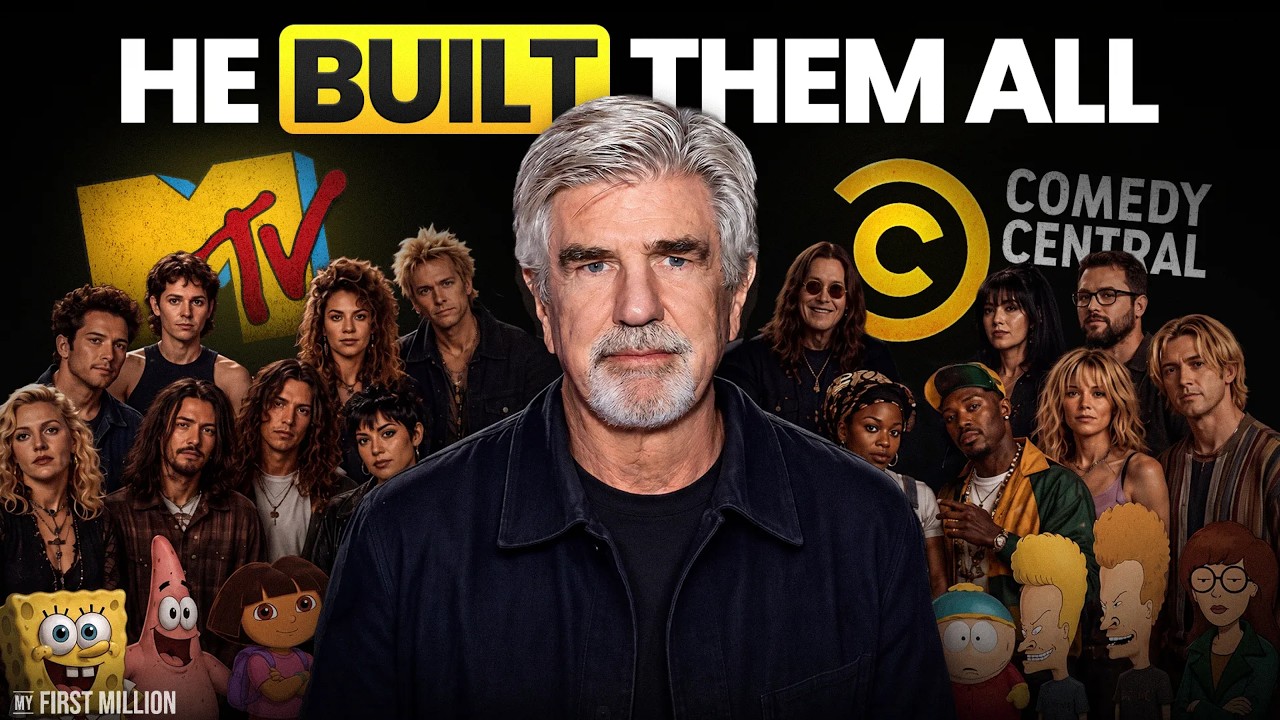
The guy behind South Park, MTV and SpongeBob reveals his secret for spotting winning ideas
Description
*Sam & Shaan's hard-won CEO lessons in one guide:* https://clickhubspot.com/xmle Episode 829: Sam Parr ( https://x.com/theSamParr ) sits down with Tom Freston to talk about the insane story of starting MTV and shaping America in the 80s and 90s. — Show Notes: (0:00) Intro (4:04) Millionaire by 26, broke by 33 (8:49) The first days of MTV (no frontal nudity) (14:14) Music Videos (19:03) How to spot culture-changing talent (27:12) Making your employees party together (31:56) Nickelodeon, SpongeBob, and Building Legacy IP (35:21) Programming for a Specific Audience (37:33) The Facebook Acquisition That Almost Happened (41:25) Founders Who Refuse to Sell (43:29) Rupert Murdoch vs. Sumner Redstone (45:23) MySpace, Big Bets, and Getting Fired (47:55) Inside the writers room (51:33) Oprah Calling (54:00) The End of Monoculture and the Creator Economy — Links: Unplugged - https://a.co/d/0ef6YVu2 — Check Out Sam's Stuff: • Hampton (joinhampton.com): My community for founders. Average member does $25m/year. Many of the guests are members. Get after it...apply: http://joinhampton.com/mfm — Check Out Shaan's Stuff: • Shaan's weekly email - https://www.shaanpuri.com • Visit https://www.somewhere.com/mfm to hire worldwide talent like Shaan and get $500 off for being an MFM listener. Hire developers, assistants, marketing pros, sales teams and more for 80% less than US equivalents. • Mercury - Need a bank for your company? Go check out Mercury (mercury.com). Shaan uses it for all of his companies! Mercury is a financial technology company, not an FDIC-insured bank. Banking services provided by Choice Financial Group, Column, N.A., and Evolve Bank & Trust, Members FDIC • I run all my newsletters on Beehiiv and you should too + we're giving away $10k to our favorite newsletter, check it out: beehiiv.com/mfm-challenge My First Million is a HubSpot Original Podcast // Brought to you by HubSpot Media // Production by Arie Desormeaux // Editing by Ezra Bakker Trupiano /
Summary
Generated by claude-sonnet-4-530-second take
Tom Freston, co-founder of MTV and CEO of MTV Networks (which owned MTV, VH1, Comedy Central, Nickelodeon), explains how he built a $8-9 billion high-margin media empire from 1980-2006 by championing eccentric creators, hiring "aberrant people," and focusing relentlessly on narrow audiences (22-24 year-olds for MTV). His playbook: green-light offbeat ideas in minutes (South Park's "anal probe" pilot, Beavis and Butthead's "Frog Baseball"), never pad for toyability, and let creative people be pains in the ass. He was fired for not buying MySpace when Murdoch did (even though MySpace flopped), nearly bought Facebook for $1.7B, and emphasizes that the cable monoculture's high margins are gone—today's creator economy demands you own distribution (newsletters, Substack) or get buried in infinite competition.
Key takes
- Green-lighting speed as strategy: Freston approved South Park and Beavis and Butthead in literal minutes after seeing rough shorts. The filter wasn't "will this sell toys?" but "is this the most original thing we've seen? Will it get attention?" Waiting for consensus or polish kills momentum.
- "Aberrant people" doctrine: Judy McGrath's rule—hire troublemakers who don't respect the system and sit in the back of the class. Freston built a "talent magnet" culture where creatives wanted to work because the company revered risk-takers, not financials. He almost never discussed quarterly results in town halls—only creative wins.
- Reality TV born from budget constraint: The Real World (1992) emerged when Freston told producers he couldn't afford writers for a soap opera. They stuck eight people in a loft with hidden cameras and edited in post. This accidentally invented modern reality TV—proof that constraints force innovation.
- Monoculture advantage vs. today's chaos: Cable gave Freston a built-in audience and high margins (three revenue streams: subscribers, ads, consumer products). Today's creator economy has no gatekeepers, so you compete with everyone. His advice: own your distribution (newsletters, Patreon) or die on rented land (social platforms).
- Zuckerberg's gall at 21: Facebook turned down $1.7B ($800-900M cash + earnout) in 2005 when revenue was $8M/year. Freston notes that true builders (Jobs, Gates, Knight, Zuckerberg) never started companies to sell them—they wanted to "grow a tree to the sky." Sellers check out early and miss generational wealth.
- MySpace blunder and firing: Freston was axed by Sumner Redstone for not buying MySpace before Murdoch scooped it for $560M (no due diligence, weekend deal). Irony: MySpace later sold to Justin Timberlake for $35M. Redstone cared more about optics (losing to Murdoch) than outcomes.
- Nickelodeon's IP goldmine: SpongeBob, Rugrats, and Nicktoons were chosen for creative love, not "toyability." Consumer products became the biggest margin driver, but only because creators weren't thinking about toys—they had crystallized character ideas. Forcing toyability kills the magic.
Useful details
- MTV's origin: Started in 1980 as a joint venture between American Express and Warner Communications with $25M seed funding. Freston was 33, the oldest on the dev team. Initial salary: $35K/year (everyone else got $30K). No stock options until 1995.
- Cable model: Three revenue streams—subscribers (10 cents/month per household for MTV), advertising, and consumer products. MTV Networks peaked at $8-9B revenue with high margins until digital disrupted the model in early 2000s.
- Music video backstory: Videos were invented in Europe because radio wasn't deregulated—bands made them for shows like Top of the Pops or record stores. MTV launched with only 160 videos (mostly UK indie acts). Madonna and ZZ Top saw they could sell records and jumped in.
- Hiring talent scouts: Freston hired "aberrant" employees in their 20s who lived in the culture. Example: Yo MTV Raps came from two interns/PAs in downtown NYC who were part of the original hip-hop scene.
- South Park origin: Brian Graydon commissioned a Christmas card (six-minute foul-mouthed kids short) for 3,000 people. Freston saw it, said "green light" in a minute. Made six episodes. First: "Cartman Gets an Anal Probe." It worked because it was the most original thing they'd seen in years.
- Beavis and Butthead discovery: Abby Triculli found Mike Judge at an Austin animation festival showing "Frog Baseball"—two characters throwing a frog and hitting it with a bat. Freston's reaction: "Hilarious, get him inside the tent." They had them rate music videos on a couch.
- Real World creation: Boone and Murray developed a soap opera with a big writers' line item. Freston said no budget for writers. They came back with "let's stick 7-8 people in a loft on Broadway and Prince Street with hidden cameras." Born: reality TV (1992). First season cast had no idea they'd be reality stars—concept didn't exist yet.
- The Osbournes pitch: Sharon Osbourne told Brian Graydon in a car, "If a crew followed me around, it'd be an amazing reality show." Graydon said "done." That became the first celebrity reality show.
- Facebook near-miss: Kevin Wall introduced Zuckerberg (21, hoodie, flip-flops, February) to Freston in 2005. Facebook's revenue: $7-8M/year, still college-only. They debated expanding to high school. Freston offered $1.7B ($800-900M cash + earnout). Zuckerberg flew on MTV's plane to Thanksgiving at Dobbs Ferry, parents picked him up. Deal died. Microsoft, Yahoo, others bid higher.
- Steve Jobs meeting: Freston's digital guy Jason Hirshhorn pitched Jobs on music streaming (pre-iTunes). Jobs: "No, we're doing the iTunes model." Jobs gave them a Pixar tour. Freston calls him a "pilgrim from India" with a non-business mindset.
- Rupert Murdoch vs. Sumner Redstone: Murdoch flew endlessly on his 727, knew operations cold, would call editors to tweak headlines. Redstone obsessed over people screwing him (antitrust lawyer background) and stock price. Murdoch's credibility with underlings came from real expertise.
- Dress code: "No frontal nudity." That's it. Worst-dressed Manhattan office building. Parties were wild—girls in short pants with bandoliers of shot glasses and tequila holsters. Non-plus-one parties so salespeople mingled with animators.
- Age and sleeping around: Average employee age: 20s. People slept in offices 24/7. Freston's advice to coworkers: "This only ends well if it ends in marriage." He wanted it to feel like the center of their social life.
- Filters for shows: Nickelodeon—nonviolence, pro-kid, fun, funny, irreverent, modern presentation (cooler than Disney). MTV—appeal to 22-24 year-olds (never show teenagers on-air or older viewers bail). Pass content through these filters, not market research.
- Oprah hired him post-firing: Freston was in Burma (no cell phones, military dictatorship) after Viacom axed him. Message at hotel: "Oprah Winfrey called." She invited him to Montecito for breakfast. He consulted on OWN (Discovery joint venture).
Caveats / counterpoints
- Survivorship bias: Freston focuses on South Park, SpongeBob, Real World—doesn't detail the flops or near-misses. His "green-light in a minute" rule likely produced many duds, but he doesn't quantify the hit rate or cost of failures.
- Monoculture nostalgia: He laments the end of cable's gatekeeper era but acknowledges it was anti-competitive (cable operators were monopolists). The "good old days" were great for him, bad for entrants and consumers.
- MySpace excuse: He was fired for not buying MySpace, which turned out to be worthless. But his Facebook miss ($1.7B offer rejected) was arguably a bigger strategic error—he doesn't explain why they didn't pivot to investing or retaining optionality.
- Stock options timing: Employees had no stock options until 1995 (15 years post-launch). Freston made his first million on paper in India at 26-27, but lost it all to bankruptcy. MTV wealth came late, and no one became a millionaire/billionaire from the 1995 options—today's startup culture would've made early employees rich.
- Culture tactics dated: Wild tequila parties, "no frontal nudity" dress code, and encouraging office romances worked in the 1980s-2000s but wouldn't fly in 2025 (he admits "you couldn't do a lot of this stuff these days").
- No playbook for today: His advice for 25-year-olds is vague—"master social media, work for enterprises that power creators, own your distribution." He doesn't offer specifics on how to break through infinite competition beyond "have an intrinsic quality."
- Nickelodeon IP luck: He credits "love for characters" over toyability, but SpongeBob/Rugrats' toy success was partly luck—not every character-first show (Angry Beavers) became a consumer products goldmine.
Ken relevance
- Agent systems GTM: Freston's "hire talent scouts, not creators" maps to Ken's agent ops—build systems that find/power talent (agents), not just deploy them. MTV's "talent magnet" culture = your ideal agent marketplace flywheel.
- Green-lighting speed: South Park approved in minutes = anti-consensus, anti-committee. Ken's agent experiments should prioritize "is this the most original thing we've seen?" over "will this scale?" Speed kills paralysis.
- Reality TV constraint: Real World born from "no budget for writers" = LLM constraints (cost, latency) force innovation. Ken's best agent use cases might emerge from what you can't afford to do manually, not what's technically possible.
- Ownership doctrine: Freston's newsletter/Substack advice = own your distribution. Ken's agent platform should be the "newsletter" of AI—users own their agent, not rent from OpenAI/Anthropic. Avoid rented land (API dependence).
- Creator economy parallels: Patreon/Substack fund creators; Ken could fund agent builders. Freston's Pilot Group (Daily Candy, Thrillist) = early-stage bets on formats, not just tech. Ken's advantage: spot agent-native businesses before they're obvious.
- Monoculture → chaos: Freston thrived in cable's gatekeeper era; Ken faces AI's infinite-creator chaos. Differentiation = "aberrant people" (unique agent use cases) + filters (what problems do you solve better than GPT-4?). Standing out requires intrinsic quality, not just tech.
- Hiring weirdos: "Aberrant people" = Ken should seek agent builders who don't respect conventional AI wisdom (e.g., ignore "agents need 100% accuracy" dogma). Trouble-makers ship.
- Investing angle: Freston's Facebook regret = Ken should consider equity stakes in agent-native startups, not just building in-house. Optionality > ownership when market's uncertain.
Watch verdict
Watch fully. Freston's "green-light in a minute" and "hire aberrant people" doctrines are rare operator wisdom, not generic startup advice. His MySpace/Facebook/Jobs stories are folklore, but his real value is how he built a creative culture at scale (spotting South Park, Real World, SpongeBob). Ken can steal the "filters over consensus" playbook for agent experiments and the "own distribution" thesis for platform strategy. The cable-to-chaos arc mirrors AI's gatekeeper-to-infinite-agents shift.
Transcript
My MTV hit list. MTV. MTV. MTV. MTV. MTV. You grew the company from zero to billions in revenue. Yeah, we were a high margin money machine. It was the height of the cable TV revolution, which began to deteriorate in the early 2000s with the digital revolution. [SPEAKER_01] You helped create South Park, Chappelle Show, Stephen Colbert. We had Jimmy Kimmel on. He got his start there. [SPEAKER_00] Bill Maher got his TV start on Comedy Central. You're recruited by Steve Jobs. Same with Geffen, who is one of the most successful media business guys there ever is. [SPEAKER_01] You, I think, made an offer to buy Facebook. Is that right? Yeah, we were the first people. We went back and forth, and we put a bid on the table, and they turned us down. [SPEAKER_01] How big? What was it? [SPEAKER_00] It was 1.7 million. Billion, excuse me. When you were trying to spot winning people or creatives, was there a common theme? [SPEAKER_00] Yeah, well... I was trying to think of the way that I could introduce you. Tom helped found MTV, which was one of the most important networks when I was raised. Going home and watching TRL at 3:30 was the greatest thing ever. But then you also owned VH1, Comedy Central, which meant you helped create South Park, Chappelle Show, Jon Stewart's... [SPEAKER_00] Daily Show. [SPEAKER_00] The Daily Show. [SPEAKER_01] Stephen Colbert. [SPEAKER_01] Stephen Colbert. We had Jimmy Kimmel on. He got his start there. Bill Maher got his TV start on Comedy Central. [SPEAKER_01] Yeah, it goes on and on and on. And then also, this is a business podcast, you grew the company from zero to billions in revenue. [SPEAKER_00] Yeah. [SPEAKER_00] How big did you... Billions. We got up to $8 or $9 billion. That includes consumer products, which became a big thing for us, because we would own the IP of all the Nicktoon Spongebob. Yeah, you owned Nickelodeon, so SpongeBob. [SPEAKER_00] That actually was the biggest business, wasn't it? Nickelodeon was? [SPEAKER_01] Yeah, by far. I want to talk about that business, but I just wanted to show the traction, not only from a cultural impact on culture, but also the business side, which those two aren't always correlated. [SPEAKER_00] Yeah, it was a wonderful business. We were a high-margin money machine. It was the height of the cable TV revolution, which began to deteriorate in the early 2000s with the digital revolution. So, yeah, we had an amazing business model. We had three revenue streams. We had subscribers, which is one-third to 40% from cable operators or satellite operators, advertising, and then consumer products, movies, and other things that we would do. How old were you when you started it? [SPEAKER_00] I was the oldest guy when we started MTV. The development team was seven or eight people, and I was 33, and I had run a business in India and Afghanistan. We used to design and make clothes and sell them to better stores here in Canada and a couple of other countries, and I knew nothing about that business, but I wanted to live in India. Were you a hippie, and you just went over there? [SPEAKER_00] I wasn't a hippie. I was just... I had been working in an ad agency in New York, and they assigned me to Charmin toilet paper, and that was the last straw for me, a line I couldn't cross. And a girlfriend, ex-girlfriend, called me from Paris, said, oh, man, you can't sell toilet paper. I'm going across the Sahara Desert. Why don't you... You should just come with me. Quit your job. Don't do this. I was on a plane 10 days later. Which is weird, because I think I read that you graduated number one in your class from getting your MBA at NYU. [SPEAKER_00] I did that, yes. I went to business school, primarily, originally, to stay out of the draft, because the Vietnam War was raging. And then in business school, I encountered people like Peter Drucker and professors. I was really entranced and turned on by business. And then when I got out of there, I basically decided I'd do menial jobs and bartend my way around for a year and take what people would call now a gap year. So I worked in Aspen and the Caribbean. It was a well-rounded experience I'd recommend for anybody to do. I was the king of the road kind of phase for me. Then I came back and got a job in an ad agency, which was interesting on another level, working in a big organization, a creative organization, at its heart. And then I quit and went traveling across the Sahara Desert. We split up. I kept going. I ended up in India and Afghanistan. And I... Because I had met another woman in Greece, she said, phase for me. Then I came back [SPEAKER_00] and got a job in an ad agency, [SPEAKER_00] which was interesting on another level, working in a big organization, a creative organization, [SPEAKER_00] at its heart. [SPEAKER_00] And then I quit [SPEAKER_00] and went traveling across the Sahara Desert. We split up. I kept going. I ended up in Indian Afghanistan. And I... Because I had met another woman in Greece, [SPEAKER_00] she said, oh, you should go to India. That's the Holy Grail. [SPEAKER_00] It's the greatest show on earth. [SPEAKER_00] In the 70s, [SPEAKER_00] it was 60% of people [SPEAKER_00] were under the poverty line. [SPEAKER_00] It was really way before [SPEAKER_00] the 90 economic reforms in India that really transformed the place. So I decided I wanted to live there. Then I said, well, what am I going to do? How can I support myself? Because he couldn't get a job there in those days. And she had told me, this woman in Greece, she had lived in Kathmandu [SPEAKER_00] and she would make and design her own clothes. She was a former clothing designer who dropped out from New York City. And she would live in Kathmandu like a queen. She would make and design these clothes and then take them overland [SPEAKER_00] and sell them [SPEAKER_00] on beach resorts in the Mediterranean in the summertime. She had her own vertically integrated conglomerate. And I said, well, what if I scale that up and I could do better stuff than the commodity imports and find partners and build businesses and factories? And our peak revenue at the time was probably $8 million. But that was then. [SPEAKER_01] What year was that? [SPEAKER_00] This was 1972. So that could be $40 million today, right? [SPEAKER_00] It was good. I mean, I had my first million in my 20s. [SPEAKER_01] How old were you? 25, 27. I was probably, no, 26, 27. [SPEAKER_01] Did you make a million? Were you able to take home anything? Well, yeah, I made it. But you probably know it was on paper. [SPEAKER_01] Oh, yeah. It was on paper because it was all tied up in inventory. It was tied up in receivables. You know, you felt I had to pay for goods in advance. It was fun. [SPEAKER_01] When you wound it down, [SPEAKER_01] I think you were, what, 30? 33. I wound it down. I mean, I really got yanked out of the business because in Afghanistan there had been a communist coup that drove me out of there. And then I doubled down on my business in India. And then of all people, having endured strikes and blackouts and dust storms and all these delays and having to pay hustle. Jimmy Carter put us out of business because he put an embargo, not a tariff, but an embargo on clothing imports from India. [SPEAKER_01] So did you walk away [SPEAKER_01] with anything? No. I ended up smuggling three tons of clothes over the St. Lawrence River to meet a delivery date at Bloomingdale's. We were doing a big, they called it, India, that was called it, Fantasy India. And I shipped clothes to Canada and then brought them in, to try and put a dent in my debts. But I ended up broke, bankrupt, and deep in debt. You know, just had my whole business yanked out from under me. It was the hardest work I'd ever done or would ever do. [SPEAKER_01] Hey everyone, [SPEAKER_01] really quick, [SPEAKER_01] if you're enjoying this episode [SPEAKER_01] on CEO stuff, [SPEAKER_01] delegating, [SPEAKER_01] having hard conversations [SPEAKER_01] with your team, [SPEAKER_01] hiring, [SPEAKER_01] then I've got something for you. [SPEAKER_01] So the team at HubSpot, [SPEAKER_01] they actually went [SPEAKER_01] and put together [SPEAKER_01] a bunch of best practices [SPEAKER_01] that Sean and I use [SPEAKER_01] in our own companies. [SPEAKER_01] And they put it together [SPEAKER_01] in something that's really [SPEAKER_01] easy to read and understand. [SPEAKER_01] And so if you want to [SPEAKER_01] save yourself 10 years [SPEAKER_01] of headache and heartache, [SPEAKER_01] then you should check it out. I wish we had this [SPEAKER_01] a long time ago. It would have helped me a lot. But there should be a QR code [SPEAKER_01] on your screen [SPEAKER_01] that you can scan [SPEAKER_01] or a link in the description. [SPEAKER_01] So check it out. [SPEAKER_01] It's totally free [SPEAKER_01] and totally awesome. You're 33 and broke. Yeah, broke. And I'm coming back to New York and all my friends who they've grown up, [SPEAKER_00] they've gotten married, [SPEAKER_01] I wish we had this a long time ago. It would have helped me a lot. But there should be a QR code on your screen that you can scan or a link in the description. So check it out. It's totally free and totally awesome. You're 33 and broke. Yeah, broke. And I'm coming back to New York and all my friends who they've grown up, they've gotten married, they have mortgages or whatever. So I said, I got to change careers. I need a new line of business. [SPEAKER_01] Well, I heard that you read a book. Yes, I bought a book. The only self-help book I ever bought. It's called—and it was the first edition—What Color Is Your Parachute? [SPEAKER_01] You're the second successful person I've talked to in the last month that said that book changed their life. That book so changed my life. And it is a simple premise. You have a series of skills that come out of your personality and you've built them and they're transferable from one industry to another. You can change careers. You can do different things. But at the heart of it, there's a few things you used to think about. You want to do something that you love and you're attracted to. That's a no-brainer. It would be great to get a business where you can go to work in a business that's not only that you love, but it's ascendant. So it looks like there's some forces that are making this business rise. And then they gave you all these exercises to determine what skills you have and how you match them up. So I sat around my kitchen and did them all and I said, voila, I want to go in the music business. Now, my brother was in the music business. I used to watch him. I'd say, well, I could do that. But I had an encyclopedic knowledge of rock and roll music. I got hired at the company that would become MTV and MTV Networks in March of 1980. When they started the company, when you guys all started the company, it was eight of you trying to figure it out. I think I read that you got like 35 grand a year. That was their first year's salary. [SPEAKER_00] That was—I got more than anybody. Everyone else was getting 30. [SPEAKER_01] What did you get? I got 35. What was the seed money to start it? We had—when I finally got approved, we were the child of American Express and Warner Communications. It was a joint venture. [SPEAKER_01] Why would American Express want to be in the TV business? Good question. They got into Warner Cable in the 70s that developed this interactive thing called Qube. It was going to be interactive television, if you can imagine such a thing. Q-U-B-E. And it was a test they had in Columbus, Ohio. And American Express thought this would be a great way for them to get into the interactive television business, which is the first iteration of it. So they formed a company and they said, we're going to bid on and get franchises in big metropolitan areas because no one had cable. It only really existed in rural areas. So then they said, well, we're going to have to feed this system. We need to feed it with some channels of programming. So they started a second, smaller company, Warner Amex Satellite Entertainment Company, or it's a mouthful, Wasac. And they started the movie channel, which was 24 hours of movies, just movies. [SPEAKER_01] Was it HBO? Is that the precursor of HBO? No, HBO had been around since 74. It was doing uncut movies and that was a big innovation. And it was using a satellite, which was our other innovation. We would not use broadcast towers, but we would bounce off a geosynchronous satellite 23,000 miles up there. This would sound like outer space stuff. And this little satellite company, we had Nickelodeon and then we were going to launch— uncut movies and that was a big innovation. And it was using a satellite, which was our other innovation. We would not use broadcast towers, but we would bounce off a geosynchronous satellite 23,000 miles up there. This would sound like outer space stuff. And this little satellite company, we had Nickelodeon and then we were going to launch a whole portfolio of channels. MTV was one of them. It was called, we're going to do a music channel of some kind. And it would be, instead of being a broadcast network, these things would be what we called then narrowcast. We're only going to program one genre and we're going to do it to one segment of an audience. [SPEAKER_01] Because before it was like ABC, there's only like four channels and it was we got to do everything for everyone. Yeah, and so no one... It's like we're [SPEAKER_01] going to be a niche network. We're going to be a niche network, do one thing all the time, do it really well, build up a relationship with our viewers. So we were existing on the side of the highway. And that was a wonderful place to be because the major networks would live or die on their shows. People knew the shows. They weren't really that conscious of whether it was NBC or ABC or whatever. We were going to be places, not shows. So you're going to watch MTV. You're going to watch Nickelodeon. [SPEAKER_01] Was that a new idea? Yeah. The people who ran this company came out of the radio business. The media business had been so boring and unchanged for so long. The big innovation in the 70s was FM radio that would take over the AM dial and they would have, instead of these general interest stations, they would be like, they would have genres like soft rock or freeform rock and roll music. So they gradually sliced away the big AM radio stations. And that was the model they saw happening in television too. Niche programming. [SPEAKER_01] What was your seed funding? $25 million. That's a shitload. Yeah, it was a shitload of money. But then again, we almost ran down to zero before we really had a business. [SPEAKER_01] What did you spend? Okay, so it was eight, eight of you all making 35 grand, so nothing. But you have $25 million. Well, it was eight people who developed it and when we launched, by the time we launched it, we had hired other people because we had to run a network. We were running a 24-hour network seven days a week. Which was insane [SPEAKER_01] because one of my heroes, Ted Turner, he had the idea of CNN and that must have been a little bit before. [SPEAKER_00] Well, a few months before. So CNN, ESPN, us, USA Network, we were all starting at the same time. It was really the beginning of the modern cable network business. We were kind of pals. [SPEAKER_00] Yeah, yeah. We were all trying to break down the broadcast monopoly that had like a 90%, 95% market share. [SPEAKER_01] Who all thought we were idiots? Which is funny because you've been around long enough that I'm going to ask you about it later. You've seen cycles of like the innovator then gets disrupted and et cetera. It becomes the main guy and gets disrupted. I think I read that by year five or year seven, you were doing like 70 million in revenue. Is that right? Yes. [SPEAKER_01] So that's a pretty fast ramp up. I mean, 25 million is a lot for startup. Well, 25 million was the cost. The 25 million was how much we had to... [SPEAKER_01] by year five or year seven, you were doing 70 million in revenue. Is that right? [SPEAKER_01] Yes. [SPEAKER_01] So that's a pretty fast ramp up. 25 million is a lot for a startup. Well, 25 million was the cost. We started with no, the 25 million was how much we had to invest in this company before we went broke. So show me your business. We're going to give you a pot of 70, 25 million dollars. Let's see if you can get your business plan, which I think originally was four years to break even. Let's see what you can do. And we were stalled and we had to figure out a Hail Mary pass to save us because the cable operators who really had to carry us, and they were monopolists at the time, they didn't want to pay 10 cents a month for MTV. [SPEAKER_01] What was the business model? The business model was multiple revenue streams. We're going to have this narrowcast kind of programming strategy, and we're going to get into all these cable systems. But what really had to happen was the cable guy had to come and wire America. And so we were also waiting for what we thought was the inevitability of cable TV coming to every household in America. [SPEAKER_01] And you'd get 10 cents per session. We would get, for MTV, we would ask 10 cents a month, so $1.20 a year. And then that was only to be one-third of the revenue. The rest was to come from advertisers. [SPEAKER_01] And how many subscribers did you have? We had a year three or four when we were running out of money, we had only two and a half million subs. We were really behind schedule. [SPEAKER_01] So only, that'd be three or four million dollars a year in subscriber revenue. Did you have any other revenue? We barely had any. We had some advertiser revenue, but we didn't really have big enough numbers to attract advertisers of any significance. So we were running low, and the roadblock we had was that the cable operators were going, no way. We don't, by the way, we don't even like this music. This is something from the devil. This is rock and roll, and these guys were more Elvis Presley fans or Bible thumpers. The guys who controlled the cable industry way back then. [SPEAKER_01] Which is funny, because they experienced the same thing with Elvis. Yeah, exactly. But then, so we needed an ad campaign. We said we have to really go for broke. I knew, because I was the marketing guy, I would go to these towns like Tulsa, which actually had MTV from day one and 100,000 homes. So you had a little microcosm where you could see what would happen if MTV was in a community, and people went crazy for it. [SPEAKER_01] What did they like about it? They just liked it, that it was 24 hours of music videos. People had never seen music videos before, so this is a network where the hell did this come from? We just, one day it showed up on their TV set, and there was all these groups they'd never heard of, with all this fast cutting, this whole new visual style, and it was funny and irreverent and looked like some underground thing, and here it was on my cable TV. I didn't have to order it or anything, so if you were a music fan, you're going, wow, this is fantastic. [SPEAKER_01] Which is interesting, because MTV doesn't do music videos anymore, but I watch music videos all day on YouTube, so the music videos are still relevant, I think. They make more music videos now than ever. That's what I thought. What about that behavior? The idea of a music video, I guess if you pitched it to me in the late 70s, I would react in the same way that I would react if, when TikTok, so you're telling me I'm just going to watch people dance on the internet? [SPEAKER_01] The music videos are still relevant, I think. They make more music videos now than ever. That's what I thought. What about that behavior? The idea of a music video—I guess if you pitched it to me in the late 70s, I would react in the same way that I would react if, when TikTok came around, someone said, "So you're telling me I'm just going to watch people dance on the internet, or I'm going to watch people play video games on the internet?" That sounds silly, but then I actually find myself doing it all the time. Was there a conversation where it was like, someone's just going to pretend that they're singing and play music and that's what we're going to be into? Well, the birth of the music video was in Europe. Television had not been deregulated, or radio, so the radio stations didn't even play music. If you can remember or you read history, there were these pirate radio stations that existed on boats off the UK that could play radio, like American style radio, where they would be playing records all day. So they said, since we can't get on the radio because there's no radios playing music, we need to get on one of these television shows. Like in the UK, there was a show called Top of the Pops. And people would make music videos to use on that show, or why not put them in record stores? That's where I saw them. I was living in Berlin and I used to go to this record store and they had a little tiny TV and I'd see music videos for the first time. And it was playful and low key and lo-fi and it was another way to reach the consumer to promote the sales of LPs. The CDs hadn't even arrived yet. So this new business came out of a need just to figure out how do we find some exposure for our product, which was the album. So then, America didn't really have any exposure to music videos because we had radio stations that played music all day long and they didn't have such a need here. So when we started MTV, we only had 160 videos and they were largely from the UK or Europe, largely from the UK from independent acts. And then when people saw these could really help sell records, we could sell a lot of records, and gradually the Bruce Springsteens and the ZZ Tops started making them. And new artists like Madonna would come on the scene who found video to be a really great imagery for themselves and they could use it very effectively and smartly. And gradually this business developed, making these things which still exist today even though MTV, for a whole bunch of reasons, just gave up on them, which I think was a mistake, obviously a mistake. [SPEAKER_01] You were able to find and employ all these amazing creative people. So Steve—I forget Steve's last name—the guy who started SpongeBob SquarePants. Steve Hillenburg. And then Mike Judge who did King of the Hill, Daria, Beavis and Butthead, and then most recently Silicon Valley, the TV show. And then Matt and Trey from South Park. Like all these amazing people. When you're talking to a young, unaccomplished person—I think Steve, the SpongeBob SquarePants guy, I think he was a marine biologist—when you were trying to spot winning people, not even ideas, was there a common theme? Yeah. Well, first of all, I really consciously wanted to make the company like it was an eccentric place. We were not a traditional media company. We were this eccentric place that would thrive on offbeat, leading edge talent, whether that be musical or comedians or whatnot, and we would try and gradually bring them— [SPEAKER_01] not even ideas, was there a common theme? Yeah. Well, first of all, I really consciously wanted to make the company an eccentric place. We were not a traditional media company. We were this eccentric place that we would thrive on offbeat, leading edge talent, whether that be musical or comedians or whatnot, and we would try and gradually bring them into the mainstream. So we kept our pop culture moves up from the street. So I wanted to have a really young employee base that was pretty loose and casual. I think I read that your dress code was no frontal nudity. [SPEAKER_00] That was it. Yes. We had the worst dressed group of people going in and out of any Manhattan office building, which would be a tie for today because no one seems to have a dress code. But in those days, everyone had to wear suits and ties and it was really straight laced. But I wanted it to be a fun place and I wanted all the employees to know that our main aptitude was creativity and taking risks. So I would put creative people in charge of these networks and I wanted to send a signal to the employees that creativity and finding people and nurturing them and having these relationships was absolutely core to our business because people wouldn't stay there a long time. People would come and work a few years and leave, but I wanted there always to be a long line of creative people who wanted to get a job at our company. We were a talent magnet in a way and very good at spotting things. We would look for people who were immersed and lived on the popular culture of the day. It wouldn't be unlike record companies that have A&R people who go out and try and spot young bands and they would hire those bands and hopefully have some hits with them. But we would have people who, when we started, for example, Yo MTV Raps, we really put hip-hop on the stage for America. We were the first people to really do it. It came from two interns. Well, there was an intern and a production assistant who lived downtown New York who were part of the original hip-hop scene as fans and they would be champions for that within the company and they would bring this cast of characters that they knew to us. But did you get it? Like, when you saw someone rap for the first time and you were like, "Oh, I get how this could be big" or was it like, "I'm good at hiring people and just letting them do whatever"? [SPEAKER_00] I was good at hiring people who were good at attracting people and had good instincts and good taste. You need someone who was well-versed in the popular culture, who had good instincts, who had diplomatic skills, was able to spot talent and build relationships with these people. It wasn't like everybody we hired or got behind was a success. But we would find people like Mike Judge at animation festivals. He would go to places where a lot of this young talent who had ideas in their head and they were animators, but they didn't want to go to Hollywood and get immersed in the factory animation scene. I didn't meet him. The first thing I saw was a short called Frog Baseball, Beavis and Butthead. It wasn't even called Beavis and Butthead yet. And it was maybe a five-minute thing that this guy who worked with us named Abby Triculli, who was an animation freak, would go to all the festivals. He saw this in Austin, Texas. And it was Beavis and Butthead and they would have a frog and they would, Beavis would throw a frog and Butthead would hit it with a bat, which sounds kind of grim. [SPEAKER_00] And it was maybe a five-minute thing that this guy who worked with us named Abby Triculli, who was an animation freak, he would go to all the festivals. He saw this in Austin, Texas. And it was Beavis and Butthead and they would have a frog and they would, Beavis would throw a frog and Butthead would hit it with a bat, which sounds grim and gruesome, but just their attitude and sensibility and the way they laughed and the way they were dressed. So the whole green lighting process, if you will, was a minute. Well, that's hilarious, these guys. How do we get this guy, Mike Judge, inside the tent and how can we make it easy for him to develop a series with this that we, well, how do we do that? So we made a deal with Mike Judge and we started cranking out, how, well, they can sit on a couch and rate music videos and talk about music videos, which is how we imagine some people in our audience would be doing and make it funny. Matt and Trey, when they came to us with South Park, the head of programming at MTV at the time, Brian Graydon, he had commissioned a Christmas card to send to 3,000 people and it was a six-minute thing with these foul-mouthed kids who became the South Park guys. Wasn't it, and I think even at the time, wasn't there a talking turd? Like, was it? [SPEAKER_00] And that was, again, that was a case of green light that we needed to hit desperately on Comedy Central. That took a minute. Okay, let's do that. Were you like, these guys are going to be special or were you like, they're just one of many? [SPEAKER_00] No, these guys are going to be special. By the way, this is the most original thing we have seen for a while. It's offbeat. There's nothing else like it. It pushes the edge. It's funny. It's irreverent and it's going to get attention. We made six episodes with them. First one was Cartman getting an alien up his ass. He's an anal probe, I think, right? [SPEAKER_00] Something like that. They like the anal probes, yeah. [SPEAKER_00] I know, it's funny because this last season where they really go to town on the Trump people has been their most successful in terms of ratings and buzz and everything. I mean, they're really, they're great guys. I'm friends with Matt, to this day. And their success has been just great to watch. I mean, then they did the Book of Mormon on top of that. They're talented guys. Yeah, they're generative. So, I hire creatives and I'm trying to get, I hire content people and the best ones are oftentimes the biggest pains in the asses. And also, I love it. So, it's a love-hate thing. But I'm always looking for ways to increase my batting average of finding young, talented people and giving them a shot and increase the likelihood of a hit rate from, I don't know what your hit rate was, but let's say it's 30%, try to get to 60%. [SPEAKER_00] Yeah. Well, it's exactly the same challenge we would have because they are a pain in the ass. I mean, that's the beauty about them. They're difficult. They really had a point of view and it was hard to move them from it or they had no point of view and they didn't want to do something and they didn't want to be told they wanted, they follow their own North Stars. And we would generally hire people who, if they were going to be on the air, they basically had a project under their belt when they came to us. It was, they were selling something. People would come, we were, they want to sell because they'd want to get [SPEAKER_00] they wanted, they follow their own North Stars. And we would generally hire people who, if they were going to be on the air, they had a project under their belt when they came to us. It was, they were selling something. People would come, we were, they want to sell because they'd want to get on one of our networks. But finding the employees who would be the talent pickers or people who have to work with talent, that was a whole other skill. These were people who didn't necessarily make things, but they would power creators. I would hire someone who would be the talent picker, if you want, if you get what I mean. Because I realized at some point I don't have necessarily the instincts to do it myself because I was a little bit older and away from the action, which always seemed to focus on what's going on with 20-year-olds. What did 20-year-olds want? So the best thing is how can you best connect with those people? I wasn't an idiot, but I would find a woman like Judy McGrath. And she would always say, what we have to do is hire aberrant people because it's going to be aberrant people who are a pain in the ass, but they're going to bring us the most success. What's that word mean? I've never heard that. [SPEAKER_00] They are trouble. And they're not mainstream people. They were people may be sitting in the back of the class when they were going to school and they don't have a lot of respect for the system. They're on an individual agenda. There's small things that companies do in their culture that have big shifts and shape the culture. For example, one of my favorite companies to read about is this company called Rakuten. It's like eBay or Amazon of Japan. And they don't have cleaners in their offices, even though it's a 10,000 person company or whatever. Because every day at 4 p.m., the employees are expected to spend 30 minutes cleaning their area and tidying their area. And then they have assigned jobs, like this person takes out the trash, whatever. And the idea being is we want to sweat the details. Was there anything that you did that you found other companies should implement in order to get their people to do more things that could get them fired at another company, but at your company could give you a 10x outcome? [SPEAKER_00] We would have parties that were, I wanted the place to have a bit of a wild vibe to it. Yeah, I heard at one of your parties, I think it was Jon Stewart. He was maybe thinking about signing with you guys to host The Daily Show or he had just signed and he goes to the holiday party and he sees you on the ground in the street because you were on someone's shoulders chicken fighting and you fell over or something like that. And he was like, these guys are drunken idiots. I'm in the perfect place. [SPEAKER_00] We had a lot of that. We used to have these girls, he couldn't do a lot of this stuff these days, but we used to have these girls in short pants with bandoliers filled with shot glasses and holsters that had tequila bottles in them. And so we would have what basically were wild parties and get togethers and social things. At my company, we don't do that many because I've got kids and so I go home. But I do think that intentionally hosting parties, it sounds so obvious and silly, but I actually do think that shifts culture a little bit. [SPEAKER_00] Yeah, and if you have a party, it's not a plus one party. I mean, people aren't bringing [SPEAKER_00] and social things. At my company, we don't do that many because I've got kids and so I go home. But I do think that intentionally hosting parties, it sounds so obvious and silly, but I actually do think that shifts culture a little bit. [SPEAKER_00] Yeah, and if you have a party, it's not a plus one party. I mean, people aren't bringing their husbands or wives or boyfriends or girlfriends. It's the people who work together. So try and build a bond up with them. So I want the salespeople to get to know some of the people in the animation department. You're a salesperson and you're also, we got to sell, we have to sell this creatively because we are just small guys still and we're up against these big networks. So how do we take this creative ethos we think really powers our business and apply it to accounting and sales and other things like that? And let's have these people socialize together and become friends. People love working there. You say when we had the pandemic and the office culture disappeared for a few years and isn't fully back yet. We used to have people who slept in their offices. They would be there 24-7. They couldn't wait to come in. It was like the center of their social life. What was the average age you think? [SPEAKER_00] 20s. Were a lot of people sleeping around with each other? Yes. Was that good or bad? [SPEAKER_00] Well, a lot of them are married and they're still married. What I would tell my coworkers, this only ends well if it ends in marriage. [SPEAKER_00] Yeah, there was that problem. But, you know, you have a lot of young people. They're working really hard. They're 16, 18 hours a day. They're consumed with their work or 12 hours a day. I mean, the only place they're meeting people is at work. So, you know, people start having relationships. We would also show people what we're making and what we're doing. And when I would speak to the employees, we would have these town halls where they could ask me anything they want. I would always lead with all the creative successes that we have and talk about the risks that we've taken and which risks have paid off and maybe which risks haven't and then show programming and talk about who is behind it and have some of the creators come out and how we revered, say, John Stewart or Stephen Colbert or John Oliver and the stable of talent we were able to grow there to have be there some interaction with that and the staff rather than focusing on our financial results. When I would speak to the company as a whole, I almost never spoke about our financial results. I never spoke about our relationship to Viacom which was our parent company which in many cases was a sin because the parent company always wanted synergy between the various divisions. The other divisions might have been, you know, Simon & Schuster or whatever and but we're, no one came to work there to work for, you know, Viacom. Viacom was this abstract public company. We don't even know what it does. They came to work at MTV or Nickelodeon and then I had to knit together how do people at Nickelodeon who were largely better dressed and maybe came from a school teacher sensibility, good for kids, more socially conscious than the MTV or VH1 people, how do they all fit together and think they're on the same team? [SPEAKER_01] Can you talk to me about the Nickelodeon business? You said that was the biggest business. I lived on the street from Sesame Street. You call it, you lived on the street? Sesame Street is 63rd. Yeah, my in-laws live on Sesame Street because that's where... It's run now by, it's been run for a long time with Nickelodeon alumni. [SPEAKER_01] I've always been interested in that business because I think they're independent still, right? The Jim Henson Company? [SPEAKER_01] from Sesame Street. [SPEAKER_01] You call it, you lived on the street? [SPEAKER_01] Sesame Street is 63rd. [SPEAKER_01] Yeah, my in-laws live on Sesame Street because that's where... It's run now by, it's been run for a long time with Nickelodeon alumni. [SPEAKER_01] I've always been interested in that business because I think they're independent still, right? The Jim Henson Company? Yes, there's the Jim Henson Company and then the Sesame Street Workshop and I'm not sure the exact, Jim Henson Company is separate from Sesame Street Workshop. [SPEAKER_01] But it's still a multi-billion dollar independent company. [SPEAKER_00] Yeah, and it runs on public broadcasting. They license the public broadcasting. What does it take to create a show or a piece of content that becomes legacy and do you think it can last for two or three decades? Well, you never know in advance. You're always hoping you're going to do that. That's the home run. So not that it only lasts for decades, but you're able to also spin it off into consumer products. That's where the real money is or motion pictures. That's what we would do, and historically these characters would be chosen by in the factory world, the commodity children's space, but they would try and pick something and say, does it have, the word they had was toyability. [SPEAKER_01] Toyability, that means like just can the character become a toy? What can't become a toy? You know, we had a show called Angry Beavers. I mean, you know. I watched that when I was a kid, yeah. There wasn't anything there, but our criteria for green lighting a show and going in and producing it had nothing to do with toyability. It was, were we in love with these characters and did we think it could be a good show and get good numbers and resonate with the audience in spite of the fact that maybe it isn't going to be a consumer products bonanza? So we were really thinking because it goes back to the creator, the creator who had these characters in his head probably wasn't thinking about toyability either. He had a more crystallized, simple idea as to what could happen here rather than what would be the eventual spinoffs and maybe he didn't want to interfere with that. He wasn't that interested in toys. So we would do things that we were in love with and a lot of them turned out to have with SpongeBob and Rugrats and so many, there was a lot of consumer products that we could crank out and feature films because when we got linked up with Paramount, we set up film labels there on the lot for MTV and VH1 and Comedy Central and Nickelodeon to develop films that would use the IP that we had generated and made famous on the television network. [SPEAKER_01] I have this feeling that a podcast must have one of the following three things in order to be good. You need to have a unique perspective. So for example, that could be LeBron James talking about basketball. It doesn't matter if he talks on the worst microphone ever. People are going to love that because LeBron James is one of one. The second thing is really high-end or unique production. For example, if you get the best voice actors and it has the best sound effects, you're like, okay, I like this because it's like a total immersive experience. Or the third one is world-class delivery, meaning a comedian. A lot of comedians that I listen to on podcasts, they can talk about anything, but they're so funny and good at delivering it that I'm into it. And so when I think of podcasting, I'm like, okay, those are like three attributes. Can I lean in on one of them? Did you think of attributes [SPEAKER_01] because it's a total immersive experience. [SPEAKER_01] Or the third one is world-class delivery, meaning a comedian. A lot of comedians that I listen to on podcasts, they can talk about anything, but they're so funny and good at delivering it that I'm into it. And so when I think of podcasting, I'm okay, those are three attributes. Can I lean in on one of them? Did you think of attributes for some of your shows where if it hits one or more of these attributes, this is a winner? Yeah, we used to have this thing we called filters, which is like that. Does it pass through these filters that we would have? The Nickelodeon people were very conscious about having some kind of pro-social appeal. Off the top of my head, we used to think we have basic values like nonviolence, pro-kid, things kids liked, it was fun, it was funny, it was irreverent. And also, does it have a modern presentation? We were trying to position ourselves as the hipper children's network, the cooler children's network versus Disney, which was the powerhouse children's operation. We wanted to be the modern version of the Disney thing. So those would be some of the filters we draw through. I can't have to go back and remember what they might have been for MTV or VH1. It usually had a lot to do with its appeal to the very specific core audience we were going after. Did you have a name for that person? The ultimate person was a 24-year-old. That's who we would program to, 22 to 24-year-olds. And teenagers, we would never talk about anyone younger than that or have them appear on the air because the minute people 24 or older saw a teenager, they were going to say goodbye. They didn't want to be part of some teeny bopper network, even though teenagers were maybe one-third of our audience. They were never showcased on the air. But we would also get people who were older watching. But the core audience on MTV was 18 to 24-year-olds. Then we would really move it to 22 to 24-year-olds. [SPEAKER_01] I was reading about you and I think when you said in the book you were fired because you didn't buy MySpace and Rupert Murdoch bought it. [SPEAKER_01] And you were fired by Sumner Redstone? [SPEAKER_01] Yes, Sumner Redstone, who was a mogul. [SPEAKER_01] It seemed like a real jackass, though. [SPEAKER_01] And then you were recruited immediately, I think, by Rupert Murdoch and a few other people to join whatever they had going on. [SPEAKER_01] But I don't think you took it. [SPEAKER_01] I think you were recruited by Bono. [SPEAKER_01] I also think you were recruited by Steve Jobs. [SPEAKER_01] And you had some affiliation with him. [SPEAKER_01] Same with Geffen, who is one of the most successful media business guys there ever is. [SPEAKER_01] You knew Bowie, Jagger, all these guys. [SPEAKER_01] You said you bought Andy Warhol's old house. [SPEAKER_01] You, I think, made an offer to buy Facebook. [SPEAKER_01] Is that right? Yeah, we were the first people. We offered $800 million cash with a $900 million earn out, if you can imagine. Tell me the Mark Zuckerberg story. Well, this guy called me up one day, Kevin Wall, who I knew from the music business, said, hey, I got this guy. We were aware social media was coming on. We were aware this is a big paradigm shift. What year? This would have been 2005. Facebook was still only programming to college kids, two, three years old, and their revenue was like $7 or $8 million a year. And Mark Zuckerberg Hey, I got this guy. We were aware social media was coming on. We were aware this is a big paradigm shift. What year? This would have been 2005. Facebook was still only programming to college kids, two, three years old, and their revenue was $7 or $8 million a year. And Mark Zuckerberg had just moved to California. And the business thing they were wrestling with, he came in to see us in Times Square, and I always remember he was wearing a hoodie and flip-flops. It was February. And I had him meet us at the MTV offices because I figured it'd be younger and it'd be interesting. [SPEAKER_01] He wanted to see what that was like. And he's only 21? Yeah, and their big challenge was, do we want to expand this to high school kids? Because it's just college kids that could really be on Facebook. Could we, is it going to be a mistake to expand our target audience to high school kids? The revenue was $8 million a year, I remember this. But we saw that social media was going to be a big force in the business and was going to grow because people now could connect directly to each other. The gatekeeper era was going to begin to fade, but we didn't have the capabilities or skill set to really create our own social network. So maybe we buy somebody else's and bring it in-house. So he came to see us, but he must have felt something good because discussions ensued with his team. There was a fellow named Ova Van Atta, who I believe was the first CFO. And we went back and forth and we put a bid on the table and they turned us down. [SPEAKER_01] How big? What was it? It was 1.7 billion, excuse me. [SPEAKER_01] 1.7, how much cash? 800 or 900 million. I'm trying, it was 800, 900 million in cash. The rest was an earn out. [SPEAKER_01] Okay, so Zuckerberg... [SPEAKER_00] He did not want MTV. Eventually we got turned down because the negotiations happened at a lower level than me. But I do remember at one point he was going back to Dobbs Ferry, New York for Thanksgiving and this guy, Michael Wolff, who was heading the negotiations from MTV Networks, he said, I could offer Mark Zuckerberg a ride on the plane and he'd be a captive audience for five hours or so. And maybe we can make some headway in the negotiation. Obviously it didn't work out. He got on the plane though? [SPEAKER_00] He got on the plane, his parents picked him up at the airport. Yeah. So this is really way back in folklore. Why didn't you invest in it? [SPEAKER_00] That's a good question. We weren't thinking of that. We were thinking of buying and owning something. We had been a company that grew organically and we had never bought anything. And we weren't really a venture. We weren't really set up as a venture firm. And our company was always, the parent company was always operating on a shoestring in terms of how much money we can really invest in our own businesses or buy other ones. I don't think we were thinking of doing an investment. That might have been a clever way to go. But they turned us down and everybody else showed up at the door. It was Microsoft, Yahoo. Everybody wanted to buy Facebook at higher and higher amounts. I think about that all the time to be 21 or 22 and being offered to be a billionaire and just the gall that he had. And I find that to be fascinating. [SPEAKER_00] And it's refreshing. People would start a company and their purpose wasn't, well, one day I'm going to sell this company to Google or Facebook or somebody else. They wanted to start a company and have it work and grow to the tree to the sky. It was the same thing with Steve Jobs. to be 21 or 22 [SPEAKER_01] and being offered [SPEAKER_01] to be a billionaire [SPEAKER_01] and just the gall that he had. [SPEAKER_01] And I find that to be fascinating. [SPEAKER_00] And it's refreshing. [SPEAKER_00] People would start a company [SPEAKER_00] and their purpose wasn't, well, one day I'm going to sell this company to Google or Facebook or somebody else. They wanted to start a company and have it work and grow to the tree to the sky. [SPEAKER_00] It was the same thing [SPEAKER_00] with Steve Jobs [SPEAKER_00] and Bill Gates and Paul Allen and Phil Knight. They all started companies because they thought that was interesting fun. They saw something in the culture where they thought they could slide in with an innovation and make a business. But those people [SPEAKER_01] always end up richer. [SPEAKER_01] Yes. [SPEAKER_01] Not always. They're owners. They didn't check out. That's not to say you can't sell your business and do something else or sell your business and maybe stay with it. But these guys were true believers. Did you know Steve Jobs? Well, we went up once to see him at, this is before the, we went up to see him and we wanted to talk about maybe doing a joint venture with MTV and Apple. This is before iTunes. There's this guy who worked with me who had a digital name, Jason Hirshhorn, and he made the case to Steve Jobs that iTunes wasn't the way to go. The way to go was to put together a music streaming service, which would have been [SPEAKER_00] like Spotify. [SPEAKER_00] And Steve Jobs [SPEAKER_00] was adamant about, [SPEAKER_00] no, that's not the way [SPEAKER_00] we're going to do it. [SPEAKER_00] We're going to do [SPEAKER_00] the iTunes model. [SPEAKER_00] And he gave us a nice tour [SPEAKER_00] of the Pixar studios and we had a fine, fine relationship, but he was someone we, of course, really idolized as an icon for us, a guy who could lead creatively. He was also, by the way, a pilgrim from India. [SPEAKER_01] Oh, yeah, yeah, yeah. Not to compare myself to him, but he didn't have a straight ahead business mindset. [SPEAKER_01] Yeah, he made fun [SPEAKER_01] of Steve Jobs. [SPEAKER_01] Bill Gates, [SPEAKER_01] he was like, [SPEAKER_01] Bill, you need [SPEAKER_01] to do some acid. [SPEAKER_01] Right. [SPEAKER_01] Which other icons [SPEAKER_01] did you, [SPEAKER_01] I read a ton [SPEAKER_01] of biographies [SPEAKER_01] and I'm always [SPEAKER_01] trying to find [SPEAKER_01] who I can [SPEAKER_01] learn something from. [SPEAKER_01] Which icons [SPEAKER_01] did you meet [SPEAKER_01] that you were like, [SPEAKER_01] this person needs [SPEAKER_01] to be studied? [SPEAKER_01] Well, there's Rupert. [SPEAKER_01] What do you think [SPEAKER_01] about him? Well, he's a bold, buccaneer, old school, classic media mogul. [SPEAKER_00] I can't say I agree [SPEAKER_00] with the results [SPEAKER_00] of some of his [SPEAKER_00] political programming, [SPEAKER_00] but you've got [SPEAKER_00] to give him credit [SPEAKER_00] for a guy who takes big risks. What was he like? Well, I got to know him a fair amount [SPEAKER_00] because his wife, [SPEAKER_00] Wendy Dang, was good friends with my wife, Kathy. So we would go on trips together and so forth. But he's quite, he could be fun. Was he a workaholic? I think so, yeah. I mean, he'd travel, the difference between him and my boss, who was Sumner Redstone, they were about the same in terms of age. Rupert was a little younger, but they were both big moguls who took bets. Sumner was always focused almost entirely on people who might be screwing him so he could sue from an antitrust perspective. He was a former [SPEAKER_00] antitrust lawyer or the stock price. Whereas Rupert Murdoch would fly around the world endlessly in his 727 and he would really understand the machinations of how the operations all worked. [SPEAKER_01] There's not very many [SPEAKER_01] good biographies on Rupert, [SPEAKER_01] so I've been able [SPEAKER_01] to piece together a few, [SPEAKER_01] but there's a cool documentary [SPEAKER_01] about him [SPEAKER_01] on HBO right now. [SPEAKER_01] And there's stories [SPEAKER_01] about him being, [SPEAKER_01] the company being huge, [SPEAKER_01] billions in revenue, [SPEAKER_01] and he was still [SPEAKER_01] calling editors [SPEAKER_01] for certain headlines [SPEAKER_01] and being like, [SPEAKER_01] you should change it of how the operations all worked. [SPEAKER_01] There's not very many good biographies on Rupert, so I've been able to piece together a few, but there's a cool documentary about him on HBO right now. And there's stories about him being, the company being huge, billions in revenue, and he was still calling editors for certain headlines and being like, you should change it to this, this, and this, and people will buy more magazines or newspapers because of that. He knew the business. He really knew how the business worked because something like that he could make a contribution to and they'd say, oh, it's the boss he wants to do this. It's not just the boss who wants to do this, but he may well have a point. He had credibility with his underlings. [SPEAKER_01] I heard he made huge bets just over one little conversation. Like, I think it was, they bought MySpace, right? He bought it on a weekend. Yeah, I heard he bought it. [SPEAKER_00] With no due diligence. How much did he pay for it? $560 million. [SPEAKER_01] And it obviously was shit. It was the wrong bet. At the time, that was, in 2005, we had the Time Warner AOL merger that was a disaster. That was the real first linking of a new media and an old media legacy media company. And that kind of blew up. So everyone was paranoid about making big bets on digital media after that. So now it's five years later. He just lays out on a weekend with no due diligence buying this social media site that we have been looking at and we're aware of in Santa Monica. Just bought it over the weekend. And he became, because of that purchase, he became the new media savant. He's this old dude. But he also gets this because he's buying this hot up-and-coming media company, which of course, or new media company, which of course didn't work out. But this really aggravated my boss, Sumner Redstone, who really had never heard of MySpace until he heard that Rupert bought it. And he fired you just because? Well, I think there might have been other reasons, but a primary reason, he told Charlie Rose, was that I had the prize and I let it go and I let it go to Murdoch. And MySpace was the prize? Yeah, which ended up dissolving and being sold to Justin Timberlake for $35 million years later. So it wasn't much of a prize. [SPEAKER_01] Were you able to make money on this as you went? Personally? Yes. We had, when we started, everyone's making $30,000, $35,000 a year. There was no stock options. People wouldn't even know what stock options were in 1980. It wasn't part of the normal nomenclature. We just can't believe we have a job here. We're on a crusade. This is the greatest thing. It's going to be the greatest thing. We're going to sweep the nation with this thing. So they were crusaders. But then we decided, in 1995, Warner made one third of the company public. And everybody got stock options. So we started seeing that we were this hot company where MTV Networks, MTV was the first name. It was a really hot commodity. So everybody had a little taste. And then we got bought when we were sold. So all those stock options vested and paid out. But, in today's, no one was becoming a billionaire or even a millionaire. [SPEAKER_01] I want to ask about writing rooms. I was listening to you and Jon Stewart talk about that. And the idea of a writing room is foreign to me because A, when I'm creative, I'm by myself. I prefer to, my old company. I used to have to write a bunch of articles a week. And I was like, I just need to go into a room by myself. [SPEAKER_01] I want to ask about writing rooms. I was listening to you and Jon Stewart talk about that. And the idea of a writing room is foreign to me because A, when I'm creative, I'm by myself. I prefer to my old company. I used to have to write a bunch of articles a week. And I was I just need to go into a room by myself and not talk to anyone. What did a writer's room look like? And what do you think made a writer's room successful in order to get the best outcome from a group of people? [SPEAKER_01] Well, I get into this in my book in a bit. We didn't really have writers for a lot of what we did. At MTV, there was stuff was really written individually. We didn't have a writer's room per se. At one point, Rupert Murdoch and Barry Diller launched the Fox Network, which was going to be not just a broadcast network like the others, but it was going to focus on younger people. And they were putting on soap operas like Melrose Place and Beverly Hills 90210. So I said, our creative people are always trying to do something a little more ambitious. Why don't we do a soap opera? So we developed one. And it was developed with this company in Boone and Murray, really successful folks, great people. They were young at the time. And it came to me and it had a budget. [SPEAKER_00] And in that budget was a big line item for writers. [SPEAKER_00] And I said, we don't really have that kind of money to hire writers. [SPEAKER_00] We're probably going to make stuff for $100,000 an episode or something like that. [SPEAKER_00] But we wanted to do it regularly. [SPEAKER_00] And we had a lot of other financial needs for the money. [SPEAKER_00] So they went back and came back to me with, okay, we're eliminating the writers. What we're going to do is find seven or eight people and stick them in a loft down on Broadway and Prince Street. We found this loft. And we're going to put hidden cameras in and we're going to tape them. And then we're going to use what our real skill set was at the time was in post-production and editing. We will edit all this action from these kids and all this interchange into these episodes. And that became the Real World, which really launched the modern version of reality television. That was 1992. That was the birth of the Real World. And then for the first season, the people who were in it, they had no idea they'd become reality stars because such a thing hadn't existed yet. Now when they cast people to be in these various reality shows, which are everywhere, everybody knows they have to have an outsized personality and be controversial and whatnot. But the success of the Real World exploded because we found out young people wanted to see other young people on television. They wanted to see, they get a lot of social cues and whatnot. The Real World, we were doing a thing with Ozzy Osbourne and Sharon Osbourne and Sharon Osbourne was driving around in the back of a car with our head of programming, Brian Graydon. And she says, this day is crazy. [SPEAKER_00] If there was a crew following me around, it would be an amazing reality show. [SPEAKER_00] So Brian, done. [SPEAKER_00] That was it. [SPEAKER_00] That became the Osbournes, which was the first celebrity reality show. [SPEAKER_00] Now there's like 50 categories of reality shows. [SPEAKER_00] There's a whole industry around them. What was the conversation like where you said, we're not doing this writer stuff? Was there a unanimous agreement in the room? [SPEAKER_00] Yes. [SPEAKER_00] Everybody said, everyone wanted to do, let's do something. [SPEAKER_00] We got to get this show on the air and let's, this is a good idea. [SPEAKER_00] We could actually make this better than ever, make it real. Whose idea was it? [SPEAKER_00] Boone and Murray had the idea. [SPEAKER_00] There was a fellow who was a champion Agreement in the room? [SPEAKER_00] Yes, yes. Everybody said, everyone wanted to do, let's do something. We got to get this show on the air and let's, this is a good idea. We could actually make this better than ever, make it real. Whose idea was it? [SPEAKER_00] Well, Boone and Murray had the idea. There was a fellow who was a champion for it internally named Doug Herzog who eventually would go on and become the head of Comedy Central and I'm sure there's some other people's names involved that I'm forgetting right now. Did you, were you on the board of OWN? Oprah's, is it OWN? [SPEAKER_00] I wasn't on the board but I was hired by Oprah to be a consultant. When I got fired from Viacom, I went to Burma which I had known from my travels in Asia which was the crazy uncle of Southeast Asia run by a military dictatorship. There's no media there. I just wanted to disappear with my wife and rethink and see if I could get some epiphany about what I was going to do next. And I got back to this place we were up in the jungle and I got back to the hotel on a boat. You had to go everywhere by boat and there's a message for you in the office. They didn't have cell phones there, nothing. Oprah Winfrey called. Were you starstruck? [SPEAKER_00] Yeah. I go, what, Oprah Winfrey? I don't even know Oprah Winfrey. Why is she calling me? So I got back in New York and I called her and she said, yeah, I called you. I saw that you left and I saw you got a big cheer which I write about in the book. When I left the company there was all these people in the lobby to send me off and says, I'd love to meet with you and talk with you and why don't you come up to Montecito and I'll make you breakfast, which I did and we become good friends. She helped me promote my book recently. I did an interview with her and I loved Oprah. There's no easier person in the world to speak to. She's curious. She knows a little bit about everything and she knows how to talk to people, nobody's business. So that's what she does for a living, right? She's always done that. So she's been able to carve out and set up this whole modern media business. She was one of the first people in the creator economy, which people would use that word today. I mean, here you have a creator who's at the center of a media enterprise, her ethos and her thing. Does she still own, is that still its own company? [SPEAKER_00] OWN is owned by Discovery. It was originally called the Discovery Health Network. And so, she did a joint venture with Discovery, David Zasloff, much in the news. He called Oprah and he said, look, we'd like to change this Discovery Health Network, which is just laying there. And what if you came in and made it the Oprah Winfrey Network and we could have something really original and noteworthy. And so, she hired me as a consultant and I did that for a couple of years. Man, it's just so crazy. I wonder if this stuff still exists. The way that I've been, I've studied Ted Turner, that's my hero. The way that it seems is because cable was the pipes, if you get in the pipes, the likelihood that you're going to be somebody [SPEAKER_00] and I did that for a couple of years. [SPEAKER_00] Man, [SPEAKER_01] it's just so crazy. I wonder if this stuff still exists. The way that I've been, I've studied Ted Turner, that's my hero. The way that it seems is because cable was the pipes, if you get in the pipes, the likelihood that you're going to be a somebody was a lot higher than what it is now. That was the era of the monoculture in a way. There was a where things were controlled by editors and there was a barrier to get in. Now anybody can. Which is pros and cons. [SPEAKER_01] Con being, if you were one of the, if you were Oprah, it was awesome. Yeah, because you had a built-in audience. You had a head start over everybody. Here you are, you're scrambling, you've built a business on your own wits, your personality, but you're competing with an infinite amount. Yeah. Everybody's their own broadcaster. [SPEAKER_01] Well, do you have any advice to that? You've been on top of the game for three generations now. Where do you think things are going to go? I know that I've heard you talk about where you seem a little frustrated with the rise of digital because that made MTV less relevant because it messed with the business model, messed with the margins, which made it all possible. Do you have any predictions on where it's going to go or tips on how to succeed right now? Well, you see things emerging to me. I really don't look at everything, but I look at stuff in the so-called creator economy and you can see there's stuff, there's things now like Patreon or Substack or everything where I always... Patreon. Yeah, Patreon rather. What I would do if I was 25 years old, because I think of, well, the same things, how could I align the things I like and care about and say, if I could work for some type of enterprise and learn the business and enterprise that's really about powering creative people and getting them more famous and more relevant and how do you do it? I mean, you have to be a master of social media these days and you have to have an intrinsic quality that will allow you to stand above everybody else, which is truly everybody else. [SPEAKER_01] Well, what's funny is my company, The Hustle, it was a daily newsletter, which at the time people laughed at it, but I was thinking, I think this can get to a couple hundred million in revenue if we do it right and we sold before we got there, but my competitors and where the company that I sold now is like hundreds of millions in revenue was possible, that was right, but I was inspired by Ted Turner, I read his biography, he's my hero and I knew all, so I studied cable, so I read about cable cowboys and Liberty Media, I studied crazy, I've studied you crazy and at the time in 2014, right around when I was starting the company, BuzzFeed was popular and Vice was popular, but what was going on was their business models were going down because Facebook was pulling back reach so they would get less clicks and I was thinking, well, where's the last bit of real estate that I could fully own and not rent and it was newsletter, newsletters and you know who I got that idea from? Bob Pittman. [SPEAKER_01] BuzzFeed was popular [SPEAKER_01] and Vice was popular, [SPEAKER_01] but what was going on [SPEAKER_01] was their business [SPEAKER_01] models were going down [SPEAKER_01] because Facebook [SPEAKER_01] was pulling back reach [SPEAKER_01] so they would get [SPEAKER_01] less clicks [SPEAKER_01] and I was thinking, [SPEAKER_01] where's the last [SPEAKER_01] bit of real estate [SPEAKER_01] that I could fully own [SPEAKER_01] and not rent? [SPEAKER_01] And it was newsletter, [SPEAKER_01] newsletters. [SPEAKER_01] And do you know [SPEAKER_01] who I got that idea from? [SPEAKER_01] Bob Pittman. [SPEAKER_01] Oh, really? [SPEAKER_01] Bob Pittman had this thing [SPEAKER_01] called the Pilot Group. [SPEAKER_01] I know, I had dinner with Bob Pittman last night, strange as it may seem, this is a synchronicity and- [SPEAKER_01] One of your co-founders. He's a co-founder. [SPEAKER_01] And he had this thing [SPEAKER_01] called the Pilot Group [SPEAKER_01] where he would fund [SPEAKER_01] newsletter companies, [SPEAKER_01] one of them being [SPEAKER_01] Daily Candy, [SPEAKER_01] which sold for $100 million. [SPEAKER_01] I heard about that story [SPEAKER_01] and I was thinking, [SPEAKER_01] I'm just going to copy that [SPEAKER_01] and do it with business news. [SPEAKER_01] And so that's how [SPEAKER_01] I started my first company [SPEAKER_01] which we ended up selling four years in. They also involved Ben Lair, I'm trying to remember the name of the newsletter. He's the other guy I copied. [SPEAKER_01] Yeah, Ben, [SPEAKER_01] for Thrillist. [SPEAKER_01] Yeah, I was just- [SPEAKER_01] Thrillist, yes. [SPEAKER_01] Yeah, I was thinking, [SPEAKER_00] I'm just going to do [SPEAKER_00] what those guys did. It was good. The newsletters had an era, digital media had an era. [SPEAKER_01] Well, they still do [SPEAKER_01] because Substack [SPEAKER_01] and Patreon, [SPEAKER_01] which you're talking about, they created their company because they saw what I was doing and they're thinking, yeah, that's cool, but what if we just created [SPEAKER_01] the technology for it, [SPEAKER_01] which obviously is far more lucrative? [SPEAKER_01] Do you regret selling that company? [SPEAKER_01] No, because I was broke. [SPEAKER_01] I didn't pay myself much money. [SPEAKER_01] The business, [SPEAKER_01] the year I sold it, [SPEAKER_01] we sold it in February, [SPEAKER_01] the trailing year, [SPEAKER_01] we had done 12 million in revenue, [SPEAKER_01] that moving forward year, [SPEAKER_01] that forward year, [SPEAKER_01] we were going to do 18. [SPEAKER_01] So it was growing rapidly. [SPEAKER_01] It was doing great. [SPEAKER_01] But I paid myself [SPEAKER_01] the first two years, [SPEAKER_01] two grand a month. [SPEAKER_01] And so I was broke. [SPEAKER_01] The last couple of years, [SPEAKER_01] I started paying myself [SPEAKER_01] a little bit more money, [SPEAKER_01] but a few things happened. [SPEAKER_01] I sold in February of 21. [SPEAKER_01] So the Black Lives Matter [SPEAKER_01] protests were happening. COVID was happening and I felt the world was going to end. [SPEAKER_01] And so the second [SPEAKER_01] that I had an opportunity [SPEAKER_01] to cash out [SPEAKER_01] and have financial security [SPEAKER_01] for forever, [SPEAKER_01] I was thinking, [SPEAKER_01] I will do that in a heartbeat. [SPEAKER_01] So I don't regret it, [SPEAKER_01] but I regret being [SPEAKER_01] in the position to sell it, [SPEAKER_01] meaning I wish [SPEAKER_01] I could have owned it forever [SPEAKER_01] and still had both outcomes. [SPEAKER_01] Obviously, that's not possible. There's a different form of the innovator's dilemma. What is that? The brokenness [SPEAKER_00] of scrambling with no money when you have a life to support. [SPEAKER_01] Well, my biggest takeaway [SPEAKER_01] from that era [SPEAKER_01] is I should have paid myself [SPEAKER_01] more money. [SPEAKER_01] But thank you for doing this. [SPEAKER_01] I've enjoyed it. I've enjoyed the conversation very much. [SPEAKER_01] Yeah, I could talk to you all day. [SPEAKER_01] You were the man [SPEAKER_01] behind the scenes [SPEAKER_01] of the content [SPEAKER_01] that shaped my childhood. Well, it's been great. And I've summarized it all in this book, which was a lot of fun to put together, Unplugged. And it's out there and doing well. [SPEAKER_01] It was good. [SPEAKER_01] I read it this past weekend. [SPEAKER_01] It was awesome. [SPEAKER_01] We didn't even get to it [SPEAKER_01] because I've seen you talk about it [SPEAKER_01] in some other podcasts, [SPEAKER_01] but you got busted for having hundreds of pounds of pot on you. [SPEAKER_00] And what they used to say, [SPEAKER_00] advice, [SPEAKER_00] they said, [SPEAKER_00] what are you doing? [SPEAKER_00] Well, we're doing a lot of stuff [SPEAKER_00] that's really smart [SPEAKER_00] and a lot of stuff [SPEAKER_00] that's really stupid, [SPEAKER_00] which is another version [SPEAKER_00] of the high and low. That's awesome. [SPEAKER_00] I'm still on that. Yeah. Well, thank you. [SPEAKER_00] All right. [SPEAKER_00] We're off. [SPEAKER_00] Thank you. if, when TikTok, like, so you're telling me I'm just going to watch people dance on the internet, or I'm going to watch people play video games on the internet? That sounds silly, but then I actually find myself doing it all the time. Was there like a conversation where it was like, someone's just going to like pretend that they're singing and play music and that's what we're going to be into? Well, the birth of the music video was basically in Europe, television had not been deregulated, so there was, or radio, so the radio stations didn't even play music. If you can remember or you read history, there were these pirate radio stations that existed on boats off the UK that would, that could play like radio, like American style radio where they would be playing records all day, so they said, since we can't get on the radio because there's no radios playing music, we need to get on one of these television shows. Like in the UK, there was a show called Top of the Pops. Yeah. And people would make music videos to use on that show or, hey, why not put them in record stores? That's where I saw them. I was living in Berlin and I used to go to this record store and they had a little tiny TV and I'd see music videos for the first time. And it was kind of like playful and low key and lo-fi and it was another way to reach the consumer to promote the sales of LPs. The CDs hadn't even arrived yet. So this new business came out of a need just to, how do we find some exposure for our product, which was the album. So then, you know, but America didn't really have any exposure to the music videos because we had radio stations that played music all day long and they didn't have such a need here. So when we started MTV, we only had 160 videos and they were largely from the UK or Europe, largely from the UK from independent acts and then when people saw these could really help sell records, we could sell a lot of records and, you know, gradually the Bruce Springsteens and the ZZ Topps started making them and new artists like Madonna would come on the scene who found video to be a really great imager for themselves and they could use it very effectively and smartly and gradually this business developed making these things which, you know, still exist today even though MTV, you know, for a whole bunch of reasons just sort of gave up on them which, you know, I think was a mistake, obviously a mistake. You were able to like find and employ all these amazing creative people so like Steve, I forget Steve's last name, the guy who started SpongeBob SquarePants. Steve Hilburn. No. And then Mike Judge who did King of the Hill, Daria, Beavis at Butthead and then most recently Silicon Valley, the TV show and then Matt and Trey from South Park, like all these amazing people. When you're talking to a young unaccomplished person because I think Steve, the SpongeBob SquarePants guy, I think he was a marine biologist. When you were like trying to spot winning people, not even ideas, was there like a common theme? Yeah. Well, first of all, I really consciously wanted to make the company like it was an eccentric, we were not a traditional media company. We were like this eccentric place that we would thrive on sort of offbeat, leading edge talent, whether that be musical or comedians or whatnot and we would try and gradually bring them into the mainstream. So we kept our, you know, pop culture kind of moves up from the street so I wanted to have a really young employee base that was pretty loose and, you know, casual. I think I said that you're, I think I read that your dress code was no frontal nudity. That was it. Yes. We had the worst dress group of people going in and out of any Manhattan office building, which would be a tie for today because no one seems to have a dress code. But in those days, everyone had to wear suits and ties and it was really kind of straight laced. But I wanted it to be a fun place and I wanted all the employees to know that our main aptitude was creativity and taking risks. So I would put creative people in charge of these networks and I wanted to send a signal to the employees that creativity and finding people and nurturing them and having these relationships was absolutely core to our business because I, and people wouldn't stay in there a long time. People would come and work a few years and leave, but I wanted there always to be like a long line of creative people who wanted to get a job at our company. We were like a talent magnet in a way and very good at spotting things. We would look for people who were sort of immersed and lived on the popular culture of the day. It wouldn't be unlike, say, record companies have A&R people who go out and try and spot young bands and they would, you know, hire those bands and, you know, hopefully have some hits with them. But we would have people who, you know, when we started, for example, Yo MTV Raps, we really put hip-hop on the stage for America. We were the first people to really, it came from two interns. Well, there was an intern and a production assistant who lived downtown New York who were part of the original hip-hop scene in a way as fans and they would be champions for that within the company and they would bring this cast of characters that they knew to us. But did you get it? Like, when you saw someone rap for the first time and you were like, oh, I get how this could be big or was it like, I'm good at hiring people and just letting them do whatever? I was good at, I guess, hiring people who were good at attracting people and had good instincts and good taste. I was, you know, you need someone who was well-versed in the popular culture, who had good instincts, who had diplomatic skills, was able to spot talent and build relationships with these people. It wasn't like everybody we hired or got behind was a success. But we were, you know, we would find people like Mike Judge at animation festivals. He would go to places then where a lot of this young talent who had ideas in their head and they were animators, but they didn't want to go to Hollywood and get immersed in the factory animation scene. I didn't meet him. The first thing I saw was a short called Frog Baseball, Beavis and Butthead. It wasn't even called Beavis and Butthead. It was Beavis and Butthead. And it was like maybe a five-minute thing that this guy who worked with us named Abby Triculli, who was an animation freak, I mean, he would go to all the festivals. He saw this in Austin, Texas. And it was Beavis and Butthead and they would have a frog and they would, Beavis would throw a frog and Butthead would hit it with a bat, you know, which sounds kind of grim and gruesome, but just their attitude and sensibility and the way they laughed and the way they were dressed. So the whole green lighting process, if you will, was like, you know, a minute. Well, that's hilarious, these guys. How do we get this guy, Mike Judge, inside the tent and how can we make it easy for him to kind of develop a series with this that we, well, how do we do that? So we made a deal with Mike Judge and we started cranking out, you know, how, well, they can sit on a couch and rate music videos and talk about music videos, which is like, like how we imagine some people in our audience would be doing and make it funny. Matt and Trey, when they came to us with South Park, the head of programming at MTV at the time, Brian Graydon, he had commissioned a Christmas card to send to like 3,000 people and it was a six-minute thing with these foul-mouthed kids who became the South Park guys. Wasn't it, and I think even at the time, wasn't there like still a talking turd? Like, was it? And that was, again, that was a case of green light that we needed to hit desperately on Comedy Central. That took like a minute. Okay, let's do that. Were you like, these guys are going to be special or were you like, they're just one of many? No, these guys are going to be special. By the way, this is the most original thing we have seen for a while. It's offbeat. There's nothing else like it. It pushes the edge. It's funny. It's irreverent and it's going to get attention. We made six episodes with them. First one was Cartman getting an alien up his ass. He's like an anal probe, I think, right? Something like that. They like the anal probes, yeah. I know, it's funny because this last season where they really go to town on the Trump people has been their most successful in terms of ratings and buzz and everything. I mean, they're really, they're great guys. I'm friends with Matt, you know, to this day. And, you know, their success has been just great to watch. I mean, then they did the Book of Mormon on top of that. They're talented guys. Yeah, they're generative. So, I hire creatives and I'm trying to get, basically, like, I hire content people and the best ones are oftentimes the biggest pains in the asses. And also, I love it. So, it's kind of like a love-hate thing. But I'm always looking for ways to increase my batting average of, like, finding young, talented people and giving them a shot and increase the likelihood of a hit rate from, I don't know what your hit rate was, but, like, let's say it's like 30%, try to get to 60%. Yeah. Well, it's exactly the same challenge we would have because they are a pain in the ass. I mean, that's the beauty about them. They're difficult. They really had a point of view and it was hard to move them from it or they had no point of view and they didn't want to do something and they didn't want to be told they wanted, you know, they kind of follow their own North Stars. And, we would generally hire people who, if they were going to be on the air, they basically had a project under their belt when they came to us. It was, they were selling something. People would come, you know, we were, they want to sell because they'd want to get on one of our networks. But, finding the employees who would basically be the talent pickers or people who have to work with talent, that was a whole other skill. You know, these were people who didn't necessarily, you know, make things, but they would power creators. I would hire someone who would be basically the talent picker, if you want, if you get what I mean. Because I realized at some point I don't have necessarily the instincts to do it myself because I was a little bit older and away from the action, which always seemed to focus on what's going on with 20-year-olds. What did 20-year-olds want? So, the best thing is how can you best connect with those people? I mean, I wasn't like an idiot, but I would find like a woman like Judy McGrath. And she would always say, what we have to do is hire aberrant people because it's going to be aberrant people who are a pain in the ass, but they're going to bring us the most success. What's that word mean? I've never heard that. They are trouble. And they're like, they're not mainstream people. They were, people may be sitting in the back of the class when they were going to school and they don't have a lot of respect for the system. They're on an individual agenda, you know. There's small things that companies do in their culture that have big, big shifts and shape the culture. For example, one of my favorite companies to read about is this company called Rakuten. It's like eBay or Amazon of Japan. And they don't have cleaners in their offices, even though it's like a, you know, a 10,000 person company or whatever. Because every day at 4 p.m., the employees are expected to spend 30 minutes cleaning their area and tidying their area. And then like, they have like assigned jobs, like this person takes out the trash, whatever. And like the idea being is like, we want to sweat the details. Was there anything that you did that you found other companies should implement in order to get their people to do more things that could get them fired at another company, but at your company could give you like a 10x outcome? We would have parties that were kind of, you know, I wanted the place to have a bit of a wild vibe to it. Yeah, I heard at one of your parties, I think it was Jon Stewart. He was like, maybe he was thinking about signing with you guys to host The Daily Show or he had just signed and he goes to the holiday party and he sees you on the ground in the street because you were on someone's shoulders chicken fighting and you like fell over or something like that. And he was like, these guys are drunken idiots. I'm in the perfect place. We had a lot of that. We have, you know, we used to have these girls, he couldn't do a lot of this stuff these days, but we used to have these girls in like, you know, short pants with bandoliers filled with shot glasses and holsters that had tequila bottles in them. And so we would have what basically were like wild parties and get togethers and social things. At my company, we don't do like that many because I've got kids and so like I go home. But like, I do think that like intentionally hosting parties, it sounds so obvious and silly, but I actually do think that like shifts culture a little bit. Yeah, and if you have a party, it's not a plus one party. I mean, people aren't bringing their husbands or wives or boyfriends or girlfriends. It's the people who work together. So try and build a bond up with them. So I want the salespeople to get to know some of the people in the animation department. You're a salesperson and you're also, you know, we got to sell, we have to sell this creatively because we are just small guys still and we're up against these big networks. So how do we take this creative ethos we think really powers our business and apply it to accounting and sales and other things like that? And let's have these people socialize together and become friends. People love working there. You say when we had the pandemic and the office culture disappeared for a few years and isn't fully back yet. We used to have people who slept in their offices. They would be there 24-7. They couldn't wait to come in. It was like the center of their social life. What was the average age you think? 20s. Were a lot of people sleeping around with each other? Yes. Was that good or bad? Well, you know, a lot of them are married and they're still married. What I would tell my coworkers, I'm like, this only ends well if it ends in marriage. Yeah, there was that problem. But, you know, you have a lot of young people. They're working really hard. They're, you know, 16, 18 hours a day. They're consumed with their work or 12 hours a day. I mean, the only place they're meeting people is at work. So, you know, people start having relationships. We would also, you know, show people what we're making and what we're doing. And when I would speak to the employees, we would have like these town halls where they could ask me anything they want. I would always lead with all the creative successes that we have and talk about the risks that we've taken and which risks have paid off and maybe which risks haven't and then show programming and talk about who is behind it and have some of the creators come out and how we revered, say, John Stewart or Stephen Colbert or John Oliver and the stable of talent we were able to grow there to have be there some interaction with that and the staff rather than focusing on our financial results. When I would speak to the company as a whole, I almost never spoke about our financial results. I never spoke about our relationship to Viacom which was our parent company which in many cases was a sin because the parent company always wanted synergy between the various divisions. The other divisions might have been, you know, Simon & Schuster or whatever and but we're, no one came to work there to work for, you know, Viacom. Viacom was this abstract public company. We don't even know what it does. They came to work at MTV or Nickelodeon and then I had to knit together how do people at Nickelodeon who were largely better dressed and maybe came from a school teacher sensibility, good for kids, more socially conscious than the MTV or VH1 people, how do they all kind of fit together and think they're on the same team? Can you talk to me about the Nickelodeon business? You said that was the biggest business. I lived on the street from Sesame Street. You call it, you lived on the street? Sesame Street is 63rd. Yeah, my in-laws live on Sesame Street because that's where... It's run now by, it's been run for a long time with Nickelodeon alumni. I've always been interested in that business because I think they're independent still, right? The Jim Henson Company? Yes, there's the Jim Henson Company and then the Sesame Street Workshop and I'm not sure the exact, Jim Henson Company is kind of separate from Sesame Street Workshop. But it's still a multi-billion dollar independent company. Yeah, and it runs on public broadcasting. They license the public broadcasting. What does it take to create a show or a piece of content that becomes legacy and do you think can last for two or three decades? Well, you never know in advance. You're always hoping you're going to do that. That's the home run. So not that it only lasts for decades, but you're able to also spin it off into, you know, consumer products. That's where the real money is or motion pictures. That's what we would do, you know, and historically these characters would be chosen by, in sort of the factory world, the commodity children's space, but they would try and pick something and say, does it have, the word they had was toyability. Toyability, that means like just can the character become a toy? What can't become a toy? You know, we had a show called Angry Beavers. I mean, you know. I watched that when I was a kid, yeah. There wasn't anything there, but our criteria for green lighting a show and going in and producing it had nothing to do with toyability. It was, were we in love with these characters and did we think it could be a good show and get good numbers and resonate with the audience in spite of the fact that maybe it isn't going to be a consumer products bonanza? So we were really thinking because it goes back to the creator, the creator who had these characters in his head probably wasn't thinking about toyability either. He had a more crystallized, simple idea as to what could happen here rather than what would be the eventual spinoffs and maybe he didn't want to interfere with that. He wasn't that interested in toys. So we would do things that we were in love with and a lot of them turned out to have, you know, with SpongeBob and Rugrats and so many, there was a lot of consumer products that we could crank out and feature films because when we got linked up with Paramount, we set up film labels there on the lot, you know, for MTV and VH1 and Comedy Central and Nickelodeon to develop films that would use the IP that we had generated and made famous on the television network. I have this feeling that a podcast must have one of the following three things in order to be good. You need to have a unique perspective. So for example, that could be LeBron James talking about basketball. It doesn't matter if he talks on the worst microphone ever. People are going to love that because LeBron James is one of one. The second thing is really high-end or unique production. For example, if you get the best voice actors and it has the best sound effects, you're like, okay, I like this because it's like a total immersive experience. Or the third one is world-class delivery, meaning a comedian. A lot of comedians that I listen to on podcasts, they can talk about anything, but they're so funny and good at delivering it that I'm into it. And so when I think of podcasting, I'm like, okay, those are like three attributes. Can I lean in on one of them? Did you think of attributes for some of your shows where like if it hits one or more of these attributes, this is a winner? Yeah, we used to have this thing we called filters, which is sort of like that. Does it pass through these filters that we would have? The Nickelodeon people were very conscious about having some kind of pro-social appeal. Off the top of my head, I mean, we used to think, I mean, we have basic values like nonviolence, pro-kid, things kids liked, it was fun, it was funny, it was irreverent. And also, does it have sort of a modern presentation? We were trying to position ourselves as the sort of, I hate to use this word, but sort of the hipper children's network, the cooler children's network versus Disney, which was the powerhouse children's operation. generation. We wanted to be sort of the modern version of the Disney thing. So, those would be some of the filters we draw through. I can't have to go back and remember what they might have been for MTV or VH1. It usually had a lot to do with, like, its appeal to the very specific core audience we were going after. Did you have a name for that person? The ultimate person was a 24-year-old. That's who we would program to, 22 to 24-year-olds. And that, teenagers, we would never talk about anyone younger than that or have them appear on the air because the minute people 24 or older saw a teenager, they were going to say goodbye. They didn't want to be part of some teeny bopper network, even though teenagers were maybe one-third of our audience. They were never showcased on the air. But we would also get, you know, people who were older watching. But the core audience on MTV was 18 to 24-year-olds. Then we would really move it to, like, 22 to 24-year-olds. I was reading about you and I think when, I think that you said in the book you were fired because you didn't buy MySpace and Rupert Murdoch bought it. And you were fired by... Sumner Redstone? Yes, Sumner Redstone, who was a mogul. It seemed like a real jackass, though. And then you were recruited immediately, I think, by Rupert Murdoch and a few other people to join, you know, whatever they had going on. But I don't think you took it. I think you were recruited by Bono. I also think you were recruited by Steve Jobs. And you had some affiliation with him. Same with Geffen, who is one of the most successful media business guys there ever is. You knew Bowie, Jagger, all these guys. You said you bought Andy Warhol's old house. You, I think, made an offer to buy Facebook. Is that right? Yeah, we were the first people. We offered, like, $800 million cash with, like, a $900 million earn out, if you can imagine. Tell me the Mark Zuckerberg story. Well, this guy called me up one day, Kevin Wall, who I knew from the music business, said, hey, I got this guy. You know, we were aware of social media was coming on. We were aware this is a big paradigm shift. What year? This would have been 19, this is 2005. Facebook was still only programming to college kids, two, three years old, and their revenue was like $7 or $8 million a year. And Mark Zuckerberg had just moved to California. And the business thing they were wrestling with, he came in to see us in Times Square, and I always remember he was, like, wearing a hoodie and flip-flops. It was February. And I had him meet us at the MTV offices because I figured it'd be younger and it'd be interesting. He wanted to see what that was like. And he's only 21? Yeah, and their big, their big challenge was, do we want to expand this to high school kids? Because it's just college kids that could really be on Facebook, the Facebook. Could we, is it going to be a mistake to expand our target audience to high school kids? The revenue was $8 million a year, I remember this. But we saw that, you know, social media was going to be a big force in the business and was going to grow because people now could, you know, they could connect directly to each other. The gatekeeper era was going to begin to fade, but we didn't have the capabilities or skill set to really create our own social network. So maybe we buy somebody else's and bring it in-house. So he came to see us, but he must have felt something good because discussions ensued with his team. There was a fellow named Ova Van Atta, who I believe was the first CFO. And we went back and forth and we put a bid on the table and they turned us down. How big? What was it? It was like 1.7 million, billion, excuse me. 1.7, how much cash? 800 or 900 million. I'm trying, it was 800, 900 million in cash. The rest was an earn out. Okay, so Zuckerberg... He did not want his MTV. Eventually we got turned down because the negotiations happened at a lower level than me. But I do remember at one point he was going back to Dobbs Ferry, New York for Thanksgiving and this guy, Michael Wolff, who was kind of heading the negotiations from MTV networks, he said, you know, I could offer Mark Zuckerberg a ride on the plane and he'd basically be like a captive audience for five hours or so. And, you know, maybe we can make some headway in the negotiation. Obviously it didn't work out. He got on the plane though? He got on the plane, his parents picked him up at the airport. Yeah. So this is really way back in folklore. Why didn't you invest in it? That's a good question. We weren't thinking of that. We were thinking of like buying and owning something. We had been a company that sort of grew organically and we had never bought anything. And we weren't really like a venture. We weren't really set up as a venture firm. And our company was always, the parent company was always sort of operating on a shoestring in terms of how much money we can really invest in our own businesses or buy other ones. I don't think we were thinking of doing an investment. That might have been a clever way to go. But they turned us down and everybody else showed up at the door. You know, it was Microsoft, Yahoo. Everybody wanted to buy Facebook at higher and higher amounts. I think about that all the time to be 21 or 22 and being offered to be a billionaire and just the gall that he had. And I find that to be fascinating. And it's refreshing. You know, people would start a company and their purpose wasn't, well, one day I'm going to sell this company to Google or Facebook or somebody else. They wanted to start a company and have it work, you know, and grow to the tree to the sky. It was the same thing with Steve Jobs and Bill Gates and Paul Allen and Phil Knight. They all started companies because they thought that was interesting fun. They saw something in the culture where they thought they could slide in with an innovation and make a business. But those people always end up richer. Yes. Not always. They're owners. They didn't check out. That's not to say you can't sell your business and do something else or sell your business and maybe stay with it. But these guys were true believers. Did you know Steve Jobs? Well, we went up once to see him at, this is before the, we went up to see him and we wanted to talk about maybe doing a joint venture with MTV and Apple. This is before iTunes. There's this guy who worked with me who had a digital name, Jason Hirshhorn, and he made the case to Steve Jobs that iTunes wasn't the way to go. The way to go was to put together basically a music streaming service, which would have been like Spotify. And Steve Jobs was adamant about, no, that's not the way we're going to do it. We're going to do, we had the iTunes model. And, you know, he gave us a nice tour of the Pixar studios and, you know, we had a fine, fine relationship, but he was someone we, of course, really idolized as an icon for us, a guy who could lead creatively. He was also, by the way, a pilgrim from India. Oh, yeah, yeah, yeah. Not to compare myself to him, but I mean, he had, he didn't have a straight ahead business mindset. Yeah, he made fun of Steve Jobs. Bill Gates, he was like, Bill, you need, you need to do some acid. Right. Which other icons did you, I read a ton of biographies and I'm always like trying to find like who I can learn something from. Which icons did you meet that you were like, this person needs to be studied? Well, there's Rupert. What do you think about him? Well, you know, he's a bold, buccaneer, kind of old school, classic media mogul. I can't say I agree with the results of some of his political programming, but you've got to give him credit for a guy who takes big risks. What was he like? Well, he, I got to know him a fair amount because his wife, Wendy Dang, was good friends with my wife, Kathy. So we would go on trips together and so forth. But, you know, he's quite, you know, he could be fun. Was he a workaholic? I think so, yeah. I mean, but he'd travel, the difference between him and my boss, who was Sumner Redstone, they were about the same in terms of age. Rupert was a little younger, but they were both big moguls who took bets. Sumner was always focused almost entirely on people who might be screwing him so he could sue from an antitrust perspective. He was a former antitrust lawyer or the stock price. Whereas Rupert Murdoch would fly around the world endlessly in his 727 and he would really understand the machinations of how the operations all worked. There's not very many good biographies on Rupert, so I've been able to piece together a few, but there's a cool documentary about him a little bit on HBO right now. And there's stories about him being, the company being huge, billions in revenue, and he was still calling editors for certain headlines and being like, you should change it to this, this, and this, and people will buy more magazines or newspapers because of that. He knew the business. Whereas, I mean, he really knew how the business worked because something like that he could make a contribution to and they'd say, oh, you know, it's the boss he wants to do this. It's not just the boss who wants to do this, but he may well have a point. He had credibility with his underlings. I heard he made huge bets just over one little conversation. Like, I think it was, they bought MySpace, right? He bought it on a weekend. Yeah, I heard he bought it. With no due diligence. How much did he pay for it? $560 million. And it obviously was shit. It was the wrong bet. At the time, that was, you know, you gotta remember, in 2000, we had the Time Warner AOL merger that was a disaster. That was the real first linking of a new media and an old media legendary or legacy media company. And that kind of blew up. So everyone was paranoid about making big bet on digital media after that. So now it's like five years later. He just lays out on a weekend with no due diligence buying this social media site that we have been looking at and we're aware of in Santa Monica. Just bought it over the weekend. And he became, because of that purchase, he became like, oh, he's the new media savant. He's like this old dude. But he also gets this because he's buying this hot up-and-coming media company, which of course, or new media company, which of course didn't work out. But this really aggravated my boss, Sumner Redstone, who really had never heard of MySpace until he heard that Rupert bought it. And he fired you just because? Well, I think there might have been other reasons, but a primary reason, like he told Charlie Rose, was that, you know, I had the prize and I let it go and I let it go to Murdoch. And MySpace was the prize? Yeah, which ended up dissolving and being sold to Justin Timberlake for $35 million years later. So it wasn't much of a prize. Were you able to make money on this as you went? Personally? Yeah. Yes, we had, you know, when we started, like I told you, everyone's making $30,000, $35,000 a year. There was no stock options. People wouldn't even know when the stock option was in 1980. It wasn't like part of the normal nomenclature. You know, we just can't believe we have a job here. We're on a crusade. This is the greatest thing. It's going to be the greatest thing. We're going to sweep the nation with this thing. So they were like crusaders. But then we decided we, in 1995, Warner Amics needed money and they made one third of the company public. And everybody got like a little bit of stock options. So we started seeing that the one, we were this hot company where MTV Networks, MTV was the first name. It was a really hot commodity. So you get a, you know, everybody had a little taste. And then we got bought when we were sold. So all those stock options vested and paid out. But, you know, in today's, no one was becoming a billionaire or even a millionaire. I want to ask about writing rooms. I was listening to you and Jon Stewart talk about that. And the idea of a writing room is foreign to me because A, when I'm creative, I'm by myself. I prefer just to like, you know, my old company. I used to have to write a bunch of articles a week. And I was like, I just need to go into a room by myself and not talk to anyone. What did a writer's room look like? And what do you think made a writer's room successful in order to get the best outcome from a group of people? Well, I get into this in my book in a bit. We didn't really have writers for a lot of what we did. At MTV, there was, stuff was really written individually. We didn't have a writer's room per se. At one point, Rupert Murdoch and Barry Diller launched the Fox Network, which was going to be not just a broadcast network like the others, but it was going to focus on younger people. And they were putting on soap operas like Melrose Place and Beverly Hills 90210. So I said, well, our creative people are always trying to do something a little more ambitious. Why don't we do a soap opera? So we developed one. And it was developed with this company in Boone and Murray, a really successful folks, great people. They were young at the time. And it came to me and it had a budget. And in that budget was a big line item for writers. And I said, you know, we don't really have that kind of money to hire writers. We're probably going to make stuff for $100,000 an episode or something like that. But we wanted to do it regularly. And we had a lot of other financial needs for the money. So they went back and came back to me with, okay, we're eliminating the writers. What we're going to do is find seven or eight people and stick them in a loft down on Broadway and Prince Street. We found this loft. And we're going to put hidden cameras in and we're going to tape them. And then we're going to use what our real skill set was at the time was in post-production and editing. We will edit all this action from these kids and all this interchange into these episodes. And that became the real world, which really launched the modern version of reality television. That was 1992. But, you know, that was the birth of the real world. And then, you know, for the first season, the people who were in it, they had no idea they'd become reality stars because such a thing hadn't existed yet. Now when they cast people to be in these various reality shows, which are everywhere, everybody knows they have to have sort of an outsized personality and, you know, be controversial and whatnot. But the success of the real world was just exploded because we found out young people wanted to see other young people on television. They wanted to see, they get a lot of social cues and whatnot. The real world, we were doing a thing with Ozzy Osbourne and Sharon Osbourne and Sharon Osbourne was driving around in the back of a car with our head of programming, Brian Graydon. And she says, oh, you know, this day is crazy. If there was a crew following me around, you know, it would be an amazing reality show. So Brian, done. That was it. That became the Osbournes, which was the first celebrity reality show. Now there's like 50 categories of reality shows. There's a whole industry around them. What was the conversation like where you said, we're not doing this writer stuff? Was there a unanimous agreement in the room? Yes, yes. Everybody said, everyone wanted to do, let's do something. You know, we got to get this show on the air and let's, this is a good idea. We could actually make this better than ever, make it real. Whose idea was it? Well, Boone and Murray had the idea. There was a fellow who was a champion for it internally named Doug Herzog who eventually would go on and become the head of Comedy Central and I'm sure there's some other people's names involved that I'm forgetting right now. Did you, were you on the board of OWN? Oprah's, is it OWN? I wasn't on the board but I was hired by Oprah to be a consultant. When I got fired from Viacom, I went to Burma which I had known from my travels in Asia which was like the crazy uncle of Southeast Asia run by a military dictatorship. There's no media there. I just wanted to disappear with my wife and just kind of rethink and see if I could get some epiphany about what I was going to do next. And I got back to this place we were up in the jungle and I got back to the hotel on a boat. You had to go everywhere by boat and there's a message and there's a message for you in the office. They didn't have cell phones there, nothing. Oprah Winfrey called. Were you starstruck? Yeah. I go, what, Oprah Winfrey? I don't even know Oprah Winfrey. Why is she calling me? So I got back in New York and I called her and she said, yeah, I called you. I saw that you left and I saw you got a big cheer which I write about in the book. When I left the company there was like all these people in the lobby to send me off and says, I'd love to meet with you and talk with you and why don't you come up to Montecito and I'll make you breakfast, which I did and we become good friends. She helped me promote my book recently. I did an interview with her and I loved Oprah. I mean, there's no easier person in the world to speak to. She's curious. She knows a little bit about everything and she knows how to talk to people like, you know, nobody's business. So, I mean, that's what she does for a living, right? She's always done that. So, she's been able to carve out and set up this whole like modern media business. She was one of the first people like in the creator economy, which people would use that word today. I mean, here you have a creator who's, she's at the center of a media enterprise, you know, her ethos and her thing, you know. Does she still own, is that still its own company? Own is owned by Discovery. It was originally called the Discovery Health Network. And so, she did a joint venture with Discovery, David Zasloff, much in the news. He called Oprah and he said, look, we'd like to change this Discovery Health Network, which is just sort of laying there. And what if you came in and made it the Oprah Winfrey Network and we could have something really original and noteworthy. and so, she hired me as a consultant and I did that for a couple of years. Man, it's just so crazy. I wonder if, if this stuff still exists. Like, the way that I've been, you know, I've studied Ted Turner, that's my hero. The way that it seems is like because, because cable was like the pipes, if you get in the pipes, the likelihood that you're going to be a somebody was a lot higher than, a little bit than what it is now. That was the era of the monoculture in a way. You know, there was a, where things were controlled by editors and there was a barrier to get in. Now anybody can. Which is pros and cons. Yes. Con being, if you were one of the, if you were Oprah, like it was, it was awesome. Yeah, because you had a built-in audience. You had a head start over everybody. You know, here you are, you're scrambling, you've built a business basically on your own wits, your personality, but you're competing with, like, an infinite amount. Yeah. Everybody's their own broadcaster. Well, do you have any advice to that? Like, you've been on top of the game for like three generations now. Where do you think things are going to go? I know that I've heard you talk like where you're, you seem a little frustrated with the rise of digital because that kind of made MTV less relevant because it kind of messed with the business model, messed with the margins, which made it all possible. Do you have any predictions on where it's going to go or tips on how to succeed right now? Well, you know, you see things emerging to me. I mean, I really don't look at everything, but I look at stuff like in the so-called creator economy and you can see there's stuff, there's things now like Patron or Substack or everything where I always... Patreon. Yeah, Patreon rather. What I would do if I was 25 years old, you know, because I think of, well, the same things, how could I align the things I like and care about and say, you know, if I could work for some type of enterprise and learn the business and enterprise that's really about powering creative people and getting them more famous and more relevant and how do you do it? I mean, you have to sort of be a master of social media these days and you have to have an intrinsic quality that will allow you to stand above everybody else, which is truly everybody else. Well, you know, what's funny is my company, The Hustle, it was a daily newsletter, which at the time was people kind of laughed at it, but I was like, I think this can get to a couple hundred million in revenue if we do it right and we sold before we got there, but my competitors and like where the company that I sold now is like 200, hundreds of millions in revenue was possible, that was right, but I was inspired by Ted Turner, I read his biography, he's my hero and I knew all, so I studied cable, so I read about cable cowboys and Liberty Media, like I studied like crazy, I've studied you like crazy and at the time in 2014, right around when I was starting the company, BuzzFeed was popular and Vice was popular, but what was going on was their business models were going down because Facebook was pulling back reach so they would get less clicks and I was like, well, where's like the last bit of real estate that I could fully own and not rent and it was newsletter, newsletters and you know who I got that idea from? Bob Pittman. Oh, really? Bob Pittman had this thing called the Pilot Group. I know, I had dinner with Bob Pittman last night, strange as it may seem, I mean, this is a synchronicity and- One of your co-founders. He's a co-founder. And he had this thing called the Pilot Group where he would fund newsletter companies, one of them being Daily Candy, which sold for $100 million. I heard about that story and I was like, I'm just going to copy that and do it with business news. And so that's how I started my first company which we ended up selling four years in. They also involved Ben Lair, I'm trying to remember the name of the newsletter. He's the other guy I copied. Yeah, Ben, for Thrillist. Yeah, I was just like- Thrillist, yes. Yeah, I was like, I'm just going to do what those guys did. It was good. I mean, the newsletters had an era, digital media had an era. Well, they still do because Substack and Patreon, which you're talking about, they created their company because they saw what I was doing and they're like, yeah, that's cool, but what if we just created the technology for it, which obviously is far more lucrative? Do you regret selling that company? No, because I was broke. I didn't pay myself much money. The business, the year I sold it, we sold it in February, the trailing year, we had done 12 million in revenue, that moving forward year, that forward year, we were going to do like 18. So it was growing like a weed. It was doing great. But I paid myself like the first two years, like two grand a month. And so I was broke. The last couple of years, I started paying myself a little bit more money, but a few things happened. I sold in February of 21. So the Black Lives Matter protests were happening. COVID was happening and I felt the world was like going to end. And so the second that I had an opportunity to kind of cash out and have financial security for forever, I was like, I will do that in a heartbeat. So I don't regret it, but I regret being in the position to sell it, meaning I wish I could have owned it forever and still like had both outcomes. Obviously, that's not possible. There's a different form of the innovator's dilemma. What is that? The brokenness of scrambling with no money when you have a life to support. Well, my biggest takeaway from that era is I should have paid myself more money. But dude, thank you for doing this. I've enjoyed it. I've enjoyed the conversation very much. Yeah, I could talk to you all day. You were the man behind the scenes of the content that shaped my childhood. Well, it's been great. And it's been, you know, I've summarized it all in this book, which was a lot of fun to put together Unplugged. And it's out there and doing well. It was good. I read it this past weekend. It was awesome. We didn't even get to it because I've seen you talk to it in some other podcasts, but like you got busted for having hundreds of pounds of pot on you. And what they used to say, advice, they said, what are you doing? Well, we're doing a lot of stuff that's really smart and a lot of stuff that's really stupid, which is sort of another version of the high and low. That's awesome. I'm still on that. Yeah. Well, thank you. All right. We're off. Thank you.