The Art of Yapping (full guide to talking on video)
Description
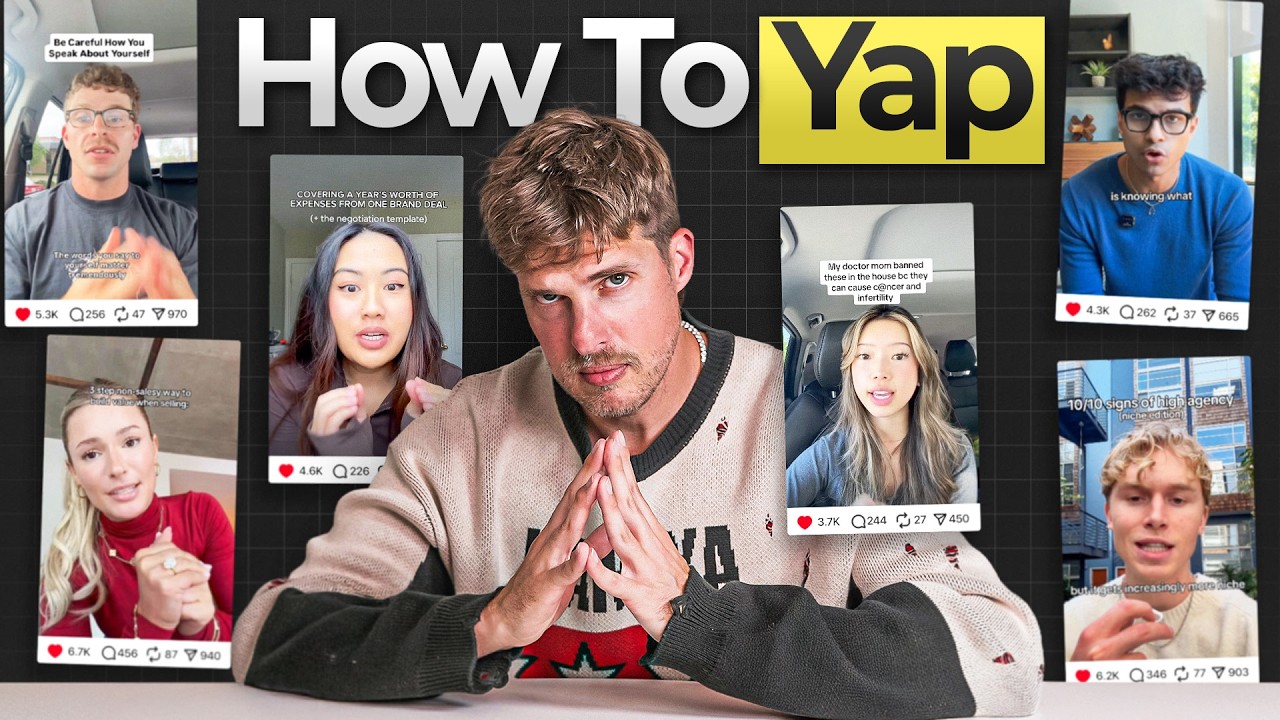
Get the "10x your LinkedIn Starter Pack" from Hubspot: https://clickhubspot.com/da6b5a In this video Oren talks about the rise of "yapping" and how to make content for social media, TikTok and Instagram with exact tactics for recordings, editing, scripting and more as a direct guide to get you started. Join the June 10th Speedrun to learn creative direction for personal brands in a 1 week spring: https://orenmeetsworld.com/june Join the next Cut30 short form bootcamp May 6th: http://cut30.co The yapping cheat sheet with all the links will be out in HYPER 5/5: https://www.hyperstudios.us/ About Me: https://orenjohn.com/ For Brand Partnerships: oren@delucamediagroup.com
Summary
Generated by gpt-5.6-terraAt-a-Glance
- Verdict: Skim
- Core thesis: Simple, opinionated phone-to-camera videos can build communication skill, generate career-relevant attention, and become a repeatable personal-brand distribution system when built around strong takes, relatable observations, stories, and lightweight editing.
- Why it matters: For an operator, the useful lesson is not influencer aspiration but a low-friction method for converting daily work, market observations, and customer questions into credible short-form distribution.
- Best use: Use this as a practical template for founder/operator video content and delegate the editing conventions to a content operator; the core frameworks are sufficient without watching the repeated portions.
Executive Summary
The speaker frames “yapping” as deliberately low-production, direct-to-camera short-form video: an iPhone, a simple mic, a point of view, and minimal editing. His central argument is that publishing this way has benefits beyond audience growth: it forces clearer thinking, improves sales and marketing communication, and turns ordinary conversations and observations into a compounding repository of ideas.
The content strategy is built on narrative and conviction rather than generic listicles. The speaker argues that most viable videos can begin with a strong take, a strong take that pivots into education, a small relatable epiphany, humor, or a personal story. The purpose of the opening is to start a conversation, but the video must subsequently deliver useful reasoning rather than remain clickbait.
The operational system is straightforward: keep a running “yap map” of three to five candidate ideas per day from work questions, meetings, personal interactions, media consumed, and offline reflection. For each idea, decide whether the usable angle is an opinion, story, or relatable observation; then apply a simple script such as hook-story-two points, hook-objection-rebuttal, or a set of four to five observations.
Production advice is intentionally lightweight. Start with a stationary, walking, or car format; add captions and, when helpful, visual overlays roughly every two seconds to sustain attention. The speaker recommends recording in segments with intentional silent pauses, removing silence in an editor, and re-recording the opening after the main take—when delivery is more natural. The video is practical but repetitive and offers limited evidence that its prescriptions generalize across audiences or platforms.
Key Takeaways
- Claim: Short-form, direct-to-camera publishing is a communication-training system as much as a content tactic. | Evidence: The speaker says beginning content creation at age 37 made him better at identifying a message, earning attention, addressing audience objections, constructing a story, selling, marketing, and articulating ideas in consequential settings. | Implication: Treat a recurring video practice as executive communication rehearsal: it can sharpen how Ken explains product theses, market shifts, and decisions even if individual posts receive modest reach. | Caveat: This is personal testimony rather than comparative evidence that content publishing is the best way to develop those skills.
- Claim: The highest-leverage content inputs are specific opinions and narrative arcs, not generic informational formats. | Evidence: The speaker identifies strong takes, take-to-education pivots, small epiphanies, humor, and story time as the foundation for roughly 90% of content, explicitly contrasting them with generic “top three” lists and motivational speeches. | Implication: For operator content, lead with a falsifiable or contrarian point of view, then explain the underlying operating logic, rather than merely summarizing tools, trends, or news. | Caveat: Strong takes can create attention but can also overstate uncertain conclusions or invite unproductive controversy if not supported by substantive reasoning.
- Claim: A provocative hook is acceptable when it opens into genuine education and resolves the apparent contradiction. | Evidence: His Coachella example opens with “there are way too many Coachella influencers” and then pivots to explain content supply and demand, arguing that demand is high and distinguishing evergreen from current content. | Implication: Ken can use a sharp opening claim—such as an apparent AI-operations misconception—as an entry point, provided the rest of the post supplies mechanisms, tradeoffs, and a defensible conclusion. | Caveat: The speaker warns against being clickbaity on the back end; the hook must be paid off with actual value.
- Claim: A daily idea-capture habit converts normal operating life into a durable content pipeline. | Evidence: The “yap map” is a note, whiteboard, or phone document populated from work questions, meetings, lunch conversations, media reactions, personal interactions, and shower/workout thoughts; the recommendation is to collect three to five ideas per day, resulting in hundreds of options over time. | Implication: Create a lightweight capture channel for questions from customers, team debates, model/tool observations, and investment or product theses; content production then becomes selection and framing rather than searching for ideas on demand.
- Claim: Simple scripting structures reduce rambling while preserving a conversational feel. | Evidence: The speaker offers three templates: hook → story → two supporting points; hook → anticipated opposing argument → rebuttal and rationale (the “8 Mile” format); and four or five discrete observations, each functioning as a mini-video. | Implication: Standardize short video briefs around one of these structures so a team can produce coherent founder-led clips without fully scripted, unnatural delivery.
- Claim: Visual novelty and editing should support attention, but low production friction is more important than polish. | Evidence: Recommended starting formats are stationary, walking, and car videos using an iPhone and basic tripod or MagSafe mount. For graphic yaps, he suggests overlays or images at roughly one every two seconds, with captions, using CapCut or Edits. | Implication: Build a minimal editing spec—accurate captions, clear title, occasional screenshots/diagrams/product visuals—rather than waiting for studio production; reserve heavy visual treatment for topics that truly need proof artifacts. | Caveat: A two-second overlay cadence is a heuristic from the speaker's creator program, not a demonstrated universal retention benchmark.
- Claim: Recording can be made easier by separating thinking from delivery instead of demanding a flawless one-take performance. | Evidence: The “recut method” has the creator pause silently while retaining eye contact whenever he needs to think or consult notes, then remove silence with Recut or an editing app. He also recommends redoing the intro at the end because delivery improves after several minutes of speaking. | Implication: For executive video, allow bullet-point-led recording with pauses and post-production cleanup; this lowers the barrier to consistent publishing without sacrificing clarity. | Caveat: Heavy silence removal can make delivery feel overly compressed if transitions and cadence are not reviewed.
Detailed Brief
Format ladder and visual composition
- Claims: The base format is deliberately candid: stationary phone-to-camera, walking while talking, or a car-based conversation.; Graphic yaps are the next level: overlays provide evidence or visual variation while the creator continues speaking.; More structured graphic yaps reserve screen space above the speaker for vertical graphics, captions, and readable head placement.
- Evidence: The speaker cites creators Brandon, Christian, Tom/“bonus footage,” and unnamed Cut30 participants as examples of basic, walking, car, chaotic-overlay, and deliberately framed graphic styles.; For a planned 60-second video, he suggests gathering approximately 30 images, implying one visual refresh about every two seconds.; He uses Canva to create full-screen 9:16 images and places them over his talking-head footage.
- Caveats: The cited examples are creator-style references, not evidence that a given format will work for a B2B, technical, or executive audience.; More frequent visuals can increase edit time and may distract from nuanced explanations if graphics do not add proof or comprehension.
- Implications: Choose format based on the message: candid formats for a live reaction or personal observation; overlays for product screenshots, charts, source excerpts, or technical diagrams.; A repeatable visual template can let a content team turn one recording into multiple platform-native variants without changing the underlying argument.
Distribution and audience framing
- Claims: The speaker views LinkedIn as underused because a small number of views from professionals, prospective clients, or hiring decision-makers can have greater career value than much larger but lower-intent reach.; He argues creators need not be recognized experts: audiences often want to hear from people at their own stage or one level ahead.
- Evidence: The LinkedIn discussion is sponsored by HubSpot and promotes its “10x Your LinkedIn Game Starter Pack,” including Adam Biddlecombe's claimed path from zero to 100,000 followers in under a year and a profile/content playbook.; The speaker positions personal branding as consistency across photo, headline, summary, and posted content.
- Caveats: The LinkedIn segment is promotional and does not supply independent data on conversion quality, attribution, or platform-specific content performance.; Publishing while still learning is credible only when claims clearly distinguish firsthand experience, observed evidence, and speculation.
- Implications: Optimize for the value of the right viewers rather than vanity reach, particularly for enterprise relationships, recruiting, partnerships, and category education.; Use a consistent positioning system so individual videos reinforce a recognizable domain rather than fragmenting attention across unrelated topics.
Notable Concepts & Terms
- Yap: A low-friction, direct-to-camera short-form video, usually recorded on a phone with minimal production requirements.
- Graphic yap: A talking-head video supplemented with image, screenshot, text, or full-screen overlays to provide evidence and reset visual attention.
- Strong take into education: A provocative opinion used as a hook that transitions into explanatory analysis rather than ending at outrage or assertion.
- Small epiphany: A recognizable everyday pattern or shared behavior framed as a fresh observation that creates affinity with viewers.
- Yap map: A daily idea inventory built from work, life, media, and offline thought, with each item converted into an opinion, story, or relatable angle.
- 8 Mile framework: A structure that states the hook, surfaces the audience's likely counterargument, addresses it directly, and then presents the speaker's reasoning.
- Recut method: Record with intentional silent thinking pauses, then automatically remove silence in editing rather than attempting a perfect continuous take.
- Redo the start at the end: Re-record the opening after finishing the body, when the speaker is more relaxed and fluent; use the later take as the final hook.
Operator Notes / Why Ken Should Care
- Establish a shared idea-capture queue fed by customer questions, internal debates, product launches, demos, market observations, and investor/partner conversations; require one clear take or story angle per entry.
- Pilot a two-week executive-video cadence using a fixed brief: one-sentence hook, supporting anecdote or proof, two points, and a single intended audience response.
- Create an editorial guardrail for contrarian hooks: factual claims require source support, uncertainty must be stated, and every provocative premise must resolve into useful analysis.
- Have an editor produce a reusable vertical template with burned-in captions, title treatment, safe zones, and slots for product screenshots or diagrams; measure qualified inbound, recruiting, and partner conversations rather than views alone.
- Use post-recording intro retakes and pause-based editing to reduce executive time cost; do not require teleprompter-perfect delivery before publishing.
Source/Metadata
- Title: The Art of Yapping (full guide to talking on video)
- Transcript words: 7363
- Duration seconds: 1074
- Timestamp note: No timestamps or chapters were provided. The transcript contains substantial duplicated passages in its latter portion.
Transcript
Today we are going to talk about the art of yapping, how to talk on the internet, why it's so powerful, exact frameworks on what to say, how to write, where to edit, all the different styles of yaps, a complete playbook for talking into your phone to change your life. And thank you to HubSpot for sponsoring this video. I just got back with the fam from Coachella, and you'll notice if you look at my content, I was doing a lot of yapping there. Just talking on the iPhone, minimal graphics about what I saw, why it matters for brand strategy, in pretty long two- or three-minute videos. And I thought it'd be a great time to tap into this strategy and explain how to use it. Let's walk in. So the other week, my boy JT dropped this video called I Really Think You Should Become an Influencer. And in the video, he details that even though you see all this content about the end of the influencer age or AI replacing creators, in reality, everyone we know that's done it has gotten this massive, outsized value. And it's not just about, hey, I'm going to make all this money or I'm going to get this huge following. Talking on the internet and yapping is the simplest version of that, right? Yapping is just putting a camera on, an iPhone camera, not caring about anything else, and just talking. The easiest, most straightforward way. But I think it's important to understand the repercussions, how this impacts all the other things in your life, right? So the primary method of business and personal communications now is short-form video. We see it in all the feeds: Instagram, TikTok, LinkedIn. Netflix is introducing vertical video. X wants more original video creation. And when you go online, you're being shared with your friends, in your group chat, with your wife or your husband. You are sharing reels and TikToks. This is an innate part of our culture, and it's the same thing in business. In Slack groups and team groups, people are sharing content. And so if you ever work in marketing or as a creative and you want to make a good ad, even if that's on TV, even if it's a text design, it comes down to understanding video and this attention complex. And if you ever want to market your business or build your career, having the ability to do that yourself or manage others becomes really important. And what was interesting to me is the number one value I got as someone who started making content at 37 was becoming a better communicator. So I'd always been quieter, more introverted, and in the right scenario I could spit out a lot of quality information really quickly to give people context. But my mind always worked faster than what I would say. And so it would just be this stream of consciousness. But when I started making content, it allowed me to think in a more compelling way. I'd think, what message am I trying to get across? How do I get this person's attention about it? How do I dispel the limiting beliefs they have around what I'm saying? And how do I present a story they're going to pay attention to that's going to get them from their perspective to the finish line of whatever I'm explaining? And now I think of all conversations like that. It's made me a better salesperson. It's made me a better marketer. It's made me better at articulating ideas in important scenarios and just more personable overall. And that's such a huge impact from simply talking on the internet. And the last impact is the ideas it's facilitated in my life, right? So if you watch a lot of my short-form content about ideas, I am fascinated with putting out original concepts. And so I'm constantly workshopping those bits with the people around me. I have one right now about how your zip code over-indexes as a factor in where you go in life. I have another one about how people don't really need McMansions and these big homes, and the ideal home size for almost everybody is 1,700 square feet. And I have all these ideas that I'm workshopping. And I have these conversations with people where I bring it up. They know I make content. We talk about this idea. They share their opinions. We facilitate more interesting, valuable combos because I'm able to think through so many of these by articulating ideas. It's just led to a more thoughtful life. Speaking of yapping, if you want that content to do even more for you, LinkedIn is an extremely slept-on platform. What I love about LinkedIn is it doesn't matter about the views. The quality of the views is so high that because you're reaching actual professionals, potential clients, and those who might hire you at a job, even if you get a handful of views and likes, it's going to be people that can make a real career difference. That's exactly why HubSpot put together this free starter pack. It's called the 10x Your LinkedIn Game Starter Pack. Inside, you get Adam Biddlecombe's growth guide, the exact playbook that he used to go from zero to 100k on LinkedIn in under a year, which is also what led to a HubSpot acquisition. So it clearly worked. You get Mindstream's one-page cheat sheet, just the kind of thing you can print out and keep next to your monitor to remind you to be attacking LinkedIn each week. And you get a LinkedIn profile playbook that covers the fundamentals, how to optimize your profile and build content that performs there. My favorite part is the personal brand section. It's about building a consistent perception of what you're known for across your photo, headline, summary, and the content you post. If you've been yapping anywhere else and neglecting LinkedIn, this is your sign to start. And especially if you're making brand content, do not sleep on LinkedIn. The link to HubSpot's 10x Your LinkedIn Game Starter Pack is in the description. It's free. Grab it. And thank you to HubSpot for sponsoring this video. If you want to start, let's tap into types of yaps. And I'm going to go into how you actually write and make the takes. And so this is all important for vernacular. You want to have the right terminology to talk about and explain it, the right examples. So this is an example from Brandon, who's great on TikTok. He is just talking. He doesn't even have captions. This is a standard yap. He turned his iPhone on. He's added a graphic at one point in here, but he is literally just talking to camera. Same thing with this. She's going through the best chicken Caesar wrap in Orange County. Simple enough content, but she is literally just on camera and talking. That is the most basic yap. You do not need anything else. Now, I highly recommend for almost everybody that you put the actual captions of what you're saying on it, but this is a standard yap. Nothing else required. Now, slightly more advanced is the walking yap. This is my friend Christian. He's a yap king. We'll talk about some of his techniques later here. But this is when you are literally just in motion, talking to the camera versus just sitting there, which I don't recommend to start out. As you have a good understanding of what content moves, it's too many variables. But it's a common technique people will do. You're able to stay in motion. You're talking. It seems more like a FaceTime with a friend. This is Tom, noted Cut 30 grad. His handle is bonus footage. He's doing a car yap. That's when you're in the car. He's not even looking at the camera a bunch. He's going back and forth with that very candid environment of just sitting down as a part of your day and talking. And those are the base yaps. So before you even get into graphics, before you get into overlays, any of that, if you just want to start talking on the internet, you pick one of these: standard yap, where you're sitting down; walking yap; car yap. It was just worth having inside your purview. And why these matter is it's about the candid setting. It's about the easy scenario, the ease of recording, about not making yourself have to worry about, I need a set. I need this. I need that. All of these are just a simple tripod. Mine is literally right here. It's in the bottom. Bluetooth remote. It was like 50 bucks, or one of those little dash cameras that connects to the MagSafe on your iPhone. Then you get to the next level of yaps, what we call graphic yaps. These are yaps where you're actually placing stuff over your video to make it more compelling to watch because you'll notice if you just talk, you need to be pretty compelling to get your value prop across, but it's still great practice and great to do. But graphic yaps help keep attention by just providing examples of what you do there. Another Cut 30 grad, she's doing what we call basically a chaotic graphic yap, where you don't care about the production at all. You just put the graphics over, and she is using the overlay function in Edits or CapCut. Literally, you just put stuff in your camera roll, you just hit overlay, you can put it over, and you can adjust the length of the clip to do roughly a bottom. Bluetooth remote. It was 50 bucks or one of those little dash cameras that connects to the MagSafe on your iPhone. Then you get to the next level of yaps, what we call graphic yaps. These are yaps where you're actually placing stuff over your video to make it more compelling to watch because you'll notice if you just talk, you need to be pretty compelling to get your value prop across, but still great practice and great to do. But graphic yaps help keep attention by just providing examples of what you do there. Another Cut 30 grad, she's doing what we call a chaotic graphic yap where you don't care about the production at all. You just put the graphics over and she is using the overlay function in Edits or CapCut. Literally, you just put stuff on your camera roll, you just hit overlay, you can put it over, and you can adjust the length of the clip to do roughly a clip every two seconds, which is what we recommend for people in Cut 30. And all this does is it makes it that her story is more compelling because you always have something to look at. And this video ripped for her. And a great thing to do is, if you're planning a video and you think it's going to be about 60 seconds, get 30 images. And it takes way less time than you think. So if you want to think out your framing slightly more, another Cut 30 grad, he sets it up really well where he frames himself on camera and knows he's always going to have a graphic above him. And he gives himself space to do that. Note his head placement, the caption placement, and the graphic placement. This is if you are the kind of person who, the chaotic one gave you a little bit of, didn't feel great about it. This is an awesome one where you can really copy his framing. Always make sure your graphics are vertical or easy to overlay. And it's easy to both look at him, read what he's saying, and look at the graphics roughly at the same time, which is how you keep a really compelling yap going. Now I do a full-screen overlay a lot because visually I like it visually. So you'll see I am talking. This is a slightly more professional camera, but I'm putting full-screen nine-by-16 images that I edit in Canva that go over the screen while I talk. And again, I am shooting for that, one for every roughly two seconds that the video is going. And you will see a lot of the more design-focused creators, people who get really into it, do these really cool setups where they'll bring graphics in and out of video, and you can get as advanced as you want, but it does not matter. The key to the yap is you just do it. The whole thing is set up to make you want it to be easy. So now that we know what those formats are, what do you actually talk about? I'm going to give you five frameworks to use for your yaps. The first one is a strong take. So Christian, whose videos I showed, he's the king of this. He can make a strong take about anything. He will be in Orlando and he'll be like, Orlando is the best sports city in North America. He will be in Philadelphia and he will be like, Champions is the best sports bar on the East Coast. Blank pizza is the best in wherever. Basically, you have a strong take. You say something is the best or you say something is the worst, and then you defend it. And this is a really easy way to get your yaps going because it forces you to have a really strong opinion. And then people are going to respond to that opinion positively or negatively. And conversation is what drives videos. So if you feel passionate about something, you can put it inside that. It's something worth talking about. And to put this in perspective of anything you can yap about, we'll talk about the things in your life, etc., later. Every beauty product: this is the absolute best concealer for people with X skin. This is the superior energy drink versus that one. This is the best choice for your influencer marketing software, whatever it is. But forcing yourself into a strong take means you have to have conviction and you have to make something interesting, and it's going to generate conversation. Now, a second, a variation of this that I do all the time is strong take into education, where you say something, but you're just using it as a hook, as a setup. So I did this with Coachella, where I was like, there are way too many Coachella influencers. The brands can't possibly be getting value out of this. That's a strong take. But then I immediately go, well, let's actually break down content supply and demand. So I immediately pivot to education where then I'm talking about, well, it's not actually too many influencers because the demand for the content is so high and the content outperforms it typically. And I break down the difference between evergreen and current content. So that hook is literally just leading me into something educational. That's a great way to think about your content, whatever you use to get people's attention. As long as you're providing value and not being super clickbaity on the back end, it's about starting the conversation. The third style is a small epiphany. It's a relatable thing that you see all the time. Do you notice how husbands always do this? Do you notice how East Coast people are always doing that? Notice how we just go into the things that happen every day and find something funny and relatable. It's an awesome way to look at this. What are the things you always see yourself doing, or unexpected or funny or shared experiences that you can talk about? Because people feel some kinship with that. They either go, I've never noticed this, or they go, Oh my God, that's so funny. I hadn't thought of that. They're like, Oh yeah, I do that too. And it builds camaraderie in the content. Then we have humor yaps, just saying something funny or a funny scenario that happened or making fun of something. Like there's a yapper who goes around critiquing all these different places in LA that are overrated. And then we have story time, where you're actually going to tell a narrative of something that happened in your life. Hey, this thing happened. I just got rear-ended at blank and blank, and I can't believe that Z happened. Strong takes, small epiphanies, and story time are the foundation for 90% of the content you can make. You notice what I didn't say. I didn't say my top three favorite whatever. I didn't say three ways on an e-comm or this is my motivational speech. None of that. These are all narrative arcs or strong opinions. If you're thinking outside of that box and it's generic, it's not going to work. So how do you actually come up with the ideas to do this? What I call a yap map. So how do you start a yap map? A yap map is, let's say, a whiteboard or a piece of paper or a note app in your phone where you're writing down stuff. And usually what I recommend is you take some time out of your day, it's a commute time, you would normally be scrolling, and you just map out things that happened to you. And so first is the touch points of your day. What happened at work? What happened in the morning? What kind of food did you get? Any conversations that came up, any meetings that happened? What are the little things that happened? And so this was the constant source of my content. It's more business-content-focused, is a question that came up that I had to explain. Why do people do influencer marketing at Coachella? Should we be doing that as an accounting brand? You answer it. You're like, you know what? This is actually a good content topic for a video. Oh, I'm at lunch with somebody and they're talking about how they're depreciating their G-Wagon through their business. Jokes that came up, movies that people saw, whatever it is, you'll be surprised how small it is. And people are all talking about watching the same TV show. Do you have an opinion or perspective on that based on your background? Same thing with your personal life. What are those interpersonal things happening? Dating is an awesome source of, maybe notice guys are always doing this. Why is it so hard to find a trad wife in Minneapolis? Whatever it ends up being. Then the media you ingest. If you're reading tweets, if you're watching stuff on Instagram, is there stuff happening that you can respond to? I don't like this trend. This news thing is crazy. Another big one is your shower workout thoughts. A lot of people will be processing things in the background. It's one of the few times in the day they're not on their phones. And you'll start to notice, oh, there are these little things that are coming up that I'm thinking about. Would that be a good video topic? And so with all of those, your goal is just to get three or five ideas down a day. That's always what I'm trying to do. And I have hundreds and hundreds and hundreds now. And then on top of that, once you have an idea, doing this. Why is it so hard to find a trad wife in Minneapolis? Whatever it ends up being. Then the media you ingest. If you're reading tweets, if you're watching stuff on Instagram, is there stuff happening that you can respond to? I don't like this trend. This news thing is crazy. Another big one is your shower workout thoughts. A lot of people will be processing things in the background. It's one of the few times in the day they're not on their phones. And you'll start to notice, oh, there's these little things that are coming up that I'm thinking about. Would that be a good video topic? And so with all of those, your goal is just to get three or five ideas down a day. That's always what I'm trying to do. And I have hundreds and hundreds and hundreds now. And then, on top of that, once you have an idea, you need a take. What is my take? Do I have a strong opinion about this one way or the other? Do I have a story I can tell about this? Or do I have a relatable thing I can break down? And that is literally a map of content that you're going to be able to make. I recommend just doing that every day. You'll be surprised. Even if you put one down and three down the next day, you're going to start having a big list of topics. So then, how do you script it? How do you script it? Yeah. So, a couple of frameworks for this. I'm just going to give you a few, and you can start experimenting with your own. But the first is hook, story, point one, point two. So how does this work? Hook: you say the thing that you're going to talk in the video about. Kit Coffee is the best coffee shop in Newport Beach. Then you tell a story. So I was getting a latte the other day with two friends of mine who are realtors. They wanted to go to this shop. I wanted to go to this shop. X happened. Y happened. And it begins to wrap the narrative of why you think this is the best coffee shop. But do you have an anecdote from your actual life, or do you have a story of somebody else? When Steve Jobs was 19, he did X and Y. My friend has blank happened. So you hook them, you tell a story that keeps them retained, and then you get into your two points. This is the best because of this, and this is the best because of that. Awesome framework for the next one, which I like to call the eight mile, is you do your hook, and you call out the opposite argument, and then you make your point. So, for instance, if you are taking a strong position about something and you want to talk about a great piece of software, why companies shouldn't do X or Y, you say it, and you say, now people might say this or that. You explain all the things that people would argue against you and disprove them, and then get into why I say this because of that. And so then you're getting rid of all the objections people have right up front. And it keeps people retained because they're probably thinking these things, and you're explaining them. And then you get to your reasoning. And this all works exactly the same if you're doing a personal anecdote. Hook it, you tell the story. Hook it, you talk a bit about the scenario, then get into your points. Another version that I like to use all the time is the last one I'll mention here for frameworks, is the four things or the five things. So I'll say something like, hey, here's observations I made at Coachella as a brand strategist. And I'll basically make four mini videos. I'll say I saw this thing, and I'll have a strong take about it. I think Nike's falling off because I didn't see any Nikes on feet. I think Gap is doing a great job because the lines were out the door and everyone was buying X or Y. I'll do three or four of those. And people will stay through to the next one. That's all you need. All you need to get started doing this is to take those frameworks, take that style of YAP, any of the ones I call out, write down some of those ideas, and fill in these. And that's how content works, how everyone makes content. And then I want to remind you, you are there to light people up. You're there to get people excited, to make them laugh, to have them be thrilled. So be excited, be passionate, care, have fun with it. Because that really comes through in the phone. One of the advice I give a lot of my friends to try to make content, they just look like they're not having fun. And if that's the case, it's probably not going to do very well. People are going to feel that. So, quick notes on recording, a few things there, just to get tactical on this. iPhone with a mic. I use a Rode plug-in USB-C mic for the phone. You don't need anything more than that. You should get a mic to do it. You can also use the Apple EarPods. AirPods do not work. A couple of ways to do it. One is just record and talk, and talk slowly enough that you can just keep it going. The other is what I do, which is called the recut method. So I will talk. I will take a breath whenever I need to think of something or look at a note. I will just stay quiet. I'll make sure I maintain eye contact with the camera while I'm quiet. I'll take as long as I need to think about my next thought. And then I'll look back at the camera, make sure I'm looking at it, and then speak again. And then you can use, I use an app called recut. It's like 20 bucks or something. You can do it inside a lot of the editing software, but you can just basically kill all the silences in between and edit down your video. And it's a really effective way to do it. You might end up with a six- or seven-minute clip because you're taking a bunch of pauses, but it allows you to think and get your bearings before saying the next thing. And the last piece of advice I'll give you in recording is that redo the start at the end is always a crucial one. Because usually when you start and you begin your recording, it's the most important part of the video, but you're the most awkward, especially when you're new. But by the time you're done talking for three minutes, you're in a much better mood or a much better flow. And I would just redo that intro a time or two, and you have a really easy time editing it. When you do this, you can do this directly in the TikTok app, but I would recommend doing it in CapCut or edits. And you can bring it into any of those, and you can add the captions that you have and then add a title. These are really important to do. I'm not going to get too deep into them, but I will have a cheat sheet down below that you can grab on this. And I will remind you, no matter what your age is, your expertise is, if you haven't seen any of my videos about this before, people want to hear from people that are at their level or a level right above them. It doesn't matter how experienced you are or not, it's about sharing that journey. And also, on the opposite end, there is nobody who is too old or in too weird a niche to do this. It's just about getting through it. We have this month's community call coming up in the first few days of May. I have a sign-up down there below. If you want to workshop any of this, any questions you have, I do live Q&A in all of these after we do some training. And it's a great time to connect with myself and with anyone else in the communities dealing with the same stuff. A lot of people meet in the chats. That community call's below. The next Cut30, if you want to do this with a group, I would recommend just go and get started with what I have here. But if you want to do this with 30 days of accountability, the next Cut30 starts early May as well. And we do them roughly every six weeks. So you have 30 days of doing this with a team and coaches and curriculum. But overall, I cannot overstate what I said in the beginning, what JT said in his video, that I really highly recommend that you become a creator, even just to learn the skill set, to learn the communication, begin thinking about the things around you, to understand how the modern world works. And then, on the high end, to significantly change your career trajectory, be able to make money on the side, if that's something you're into, and to participate in this new economy that we have a once-in-a-lifetime opportunity of getting free attention on the internet from. Thanks for watching. perspective of anything you can yap about, we'll talk about the things in your life, etc. later, every beauty product. This is the absolute best concealer for people with X skin. This is the superior energy drink versus that one. This is the best choice for your influencer marketing software, whatever it is. But forcing yourself into a strong take means you have to have conviction and you basically have to make something interesting and it's going to generate conversation. Now, a second, a variation of this that I do all the time is strong take into education, where you say something, but you're just using it as a hook, as a setup. So I did this with Coachella, where I was like, there are way too many Coachella influencers. The brands can't possibly be getting value out of this as a strong take. But then I immediately go, well, let's actually break down content supply and demand. So I immediately pivot to education where then I'm talking about, well, it's not actually too many influencers because the demand for the content is so high and the content outperforms it typically. And I break down the difference between evergreen and current content. So that hook is literally just leading me into something educational. That's a great way to think about your content is whatever you use to get people's attention. As long as you're providing value and not being super clickbaity on the back end, it's about starting the conversation. The third style is a small epiphany. It's like a relatable thing that you see all the time. Do you notice how husbands always do this? Do you notice how East Coast people are always doing that? Notice how we like just basically going into the things that happen every day and finding something funny and relatable is an awesome way to look at this. What are the things you always see yourself doing or unexpected or funny or shared experiences that you can talk about? Because people peel some kinship with that. They either go, I've never noticed this or they go, Oh my God, that's so funny. I hadn't thought of that. They're like, Oh yeah, I do that too. And it builds camaraderie in the content. Then we have humor yaps, just saying something funny or a funny scenario that happened or making fun of something. Like there's a yapper who goes around critiquing all these different places in LA that are like overrated. And then we have story time where you're actually going to tell a narrative of something that happened in your life. Hey, this thing happened. I just got rear-ended at blank and blank. And I can't believe that Z happened. Strong cakes, small epiphanies and story time is like the foundation for 90% of the content you can make. You notice what I didn't say. I didn't say my top three favorite, whatever. I didn't say three ways on an e-comm or this is my motivational speech. None of that. These are all narrative arcs or strong opinions. If you're thinking outside of that box and it's generic, it's not going to work. So how do you actually come up with the ideas to do this? What I call a yap map. So how do you start a yap map? A yap map is basically, let's say it's a whiteboard or a piece of paper or a note app in your phone where you're writing down stuff. And usually what I recommend is you take some time out of your day. It's a commute time. You would normally be scrolling and you just map out things that happened to you. And so first is the touch points of your day. What happened at work? What happened in the morning? So did you, what kind of food did you get? Any conversations that came up, any meetings that happened? What are the little things that happened? And so this was the constant source of my content. It's more business content focused is a question that came up that I had to explain. Why do people do influencer marketing at Coachella? Should we be doing that as an accounting brand? You answer it. You're like, you know what? This is actually a good content topic for a video. Oh, I'm at lunch with somebody and they're talking about how they're depreciating their G-Wagon through their business. Jokes that came up, movies that people saw, whatever it is, you'll be surprised how small it is. And people are all talking about watching the same TV show. Do you have an opinion or perspective on that based on your background? Same thing with your personal life. What are those interpersonal things happening? Dating is an awesome source of like, maybe notice guys are always doing this. Why is it so hard to find a trad wife in Minneapolis? Whatever it ends up being. Then the media you ingest. If you're reading tweets, if you're watching stuff on Instagram, is there stuff happening that you can respond to? I don't like this trend. This news thing is crazy. Another big one is your shower workout thoughts. A lot of people will be like processing things in the background. It's one of the few times in the day they're not on their phones. And you'll start to notice, oh, there's like these little things that are coming up that I'm thinking about. Would that be a good video topic? And so with all of those, your goal is just to get three or five ideas down a day. That's always what I'm trying to do. And I have hundreds and hundreds and hundreds now. And then on top of that, once you have an idea, you need a take. What is my take? Do I have a strong opinion about this one way or the other? Do I have a story I can tell about this? Or do I have a relatable thing I can break down? And that is literally a map of content that you're going to be able to make. I recommend just doing that every day. You'll be surprised even if you put one down and three down the next day, you're going to start having a big list of topics. So then how do you script it? How do you script it? Yeah. So a couple of frameworks for this. I'm just going to give you a few and you can start experimenting with your own. But the first is hook story point one point two. So how does this work? Hook, you say the thing that you're going to talk in the video about. Kit Coffee is the best coffee shop in Newport Beach. Then you tell a story. So I was getting a latte the other day with two friends of mine who are realtors. They wanted to go to this shop. I wanted to go to this shop. X happened. Y happened. And it begins to wrap the narrative of why you think this is the best coffee shop. But do you have an anecdote from your actual life or do you have a story of somebody else? When Steve Jobs was 19, he did X and Y. My friend has blank happened. So basically you hook them. You tell a story that keeps them retained. And then you get into your two points. This is the best because of this. And this is the best because of that. Awesome framework for a the next one, which I like to call the eight mile is you do your hook and you call out the opposite argument and then you make your point. So for instance, if you are taking a strong position about something and you want to talk about a great piece of software, why companies shouldn't do X or Y, you say it and you say now people might say this or that. You basically explain all the things that people would argue against you and disprove them and then get into why I say this because of that. And so then you're basically getting rid of all the objections people have like right up front. And it keeps people retained because they're probably thinking these things and you're explaining them. And then you get to your reasoning. And this all works exactly the same. If you're doing like a personal anecdote, hook it, you tell the story, hook it, you talk a bit about the scenario, then get into your points. Another version that I like to use all the time is the last one I'll mention here for frameworks is the four things or the five things. So I'll say something like, hey, here's observations I made at Coachella as a brand strategist. And I'll basically make four mini videos. I'll say I saw this thing and I'll have a strong take about it. I think Nike's falling off because I didn't see any Nikes on feet. I think Gap is doing a great job because the lines were out the door and everyone was buying X or Y. I'll do like three or four of those. And people will stay through to the next one. That's all you need. All you need to get started doing this is to take those frameworks, take that style of YAP, any of the ones I call out, write down some of those ideas and fill in these. And that's how content works, how everyone makes content. And then I want to remind you, you are there to light people up. You're there to get people excited, to make them laugh, to have them be thrilled. So be excited, be passionate, care, have fun with it. Because that really comes through in the phone. One of the advice I give a lot of my friends to try to make content, they just look like they're not having fun. And if that's the case, it's probably not going to do very well. People are going to feel that. So quick notes on recording, a few things there, just to get tactical on this. iPhone with a mic, I use a Rode plug-in USB-C mic for the phone. You don't need anything more than that. You should get a mic to do it. You can also use the Apple EarPods. AirPods do not work. A couple of ways to do it. One is just record and talk and talk slowly enough that you can just keep it going. The other is what I do, which is called the recut method. So I will talk. I will take a breath whenever I need to think of something or look at a note. I will just stay quiet. I'll make sure I maintain eye contact with the camera until I'm quiet. I'll take as long as I need to think about my next thought. And then I'll go look back at the camera, make sure I'm looking at it and then speak again. And then you can use, I use an app called recut. It's like 20 bucks or something. You can do it inside a lot of the editing software, but you can just basically kill all the silences in between and edit down your video. And it's a really effective way to do it. You might end up with a six or seven minute clip because you're taking a bunch of pauses, but it allows you to think and get your bearings before saying the next thing. And the last piece of advice I'll give you in recording is that redo the start at the end is always a crucial one. Because usually when you start and you begin your recording, it's the most important part of the video, but you're the most awkward, especially when you're new. But by the time you're done talking for three minutes, you're in a much better mood or a much better flow. And I would just redo that intro a time or two and you have a really easy time editing it. When you do this, you can do this directly in the TikTok app, but I would recommend doing it in CapCut or edits. And you can bring it into any of those and you can add the captions that you have and then add a title. These are really important to do. I'm going to get too deep into them, but I will have a cheat sheet down below that you can grab on this. And I will remind you, no matter what your age is, your expertise is, if you haven't seen any of my videos about this before, people want to hear from people that are at their level or a level right above them. It doesn't matter how experienced you are or not, it's about sharing that journey. And also on the opposite end, there is nobody who is too old or in too weird a niche to do this. It's just about getting through it. We have this month's community call coming up in the first few days of May. I have to sign up down there below. If you want to workshop any of this, any questions you have, I do live Q&A in all of these after we do some training. And it's a great time to connect with myself and with anyone else like in the communities dealing with the same stuff. A lot of people meet in the chats, that community calls below. The next Cut30, if you want to do this with a group, I would recommend just go and get started with what I have here. But if you want to do this with 30 days of accountability, the next Cut30 starts early May as well. And we do them roughly every six weeks. So you have 30 days of doing this with a team and coaches and curriculum. But overall, I cannot overstate what I said in the beginning, what JT said in his video, that I really highly recommend that you become a creator, even just to learn the skill set, to learn the communication, begin thinking about the things around you to understand how the modern world works. And then on the high end, to significantly change your career trajectory, be able to make money on the side, if that's something you're into, and to participate in this new economy that we have a once in a lifetime opportunity of getting free attention on the internet from. Thanks for watching.