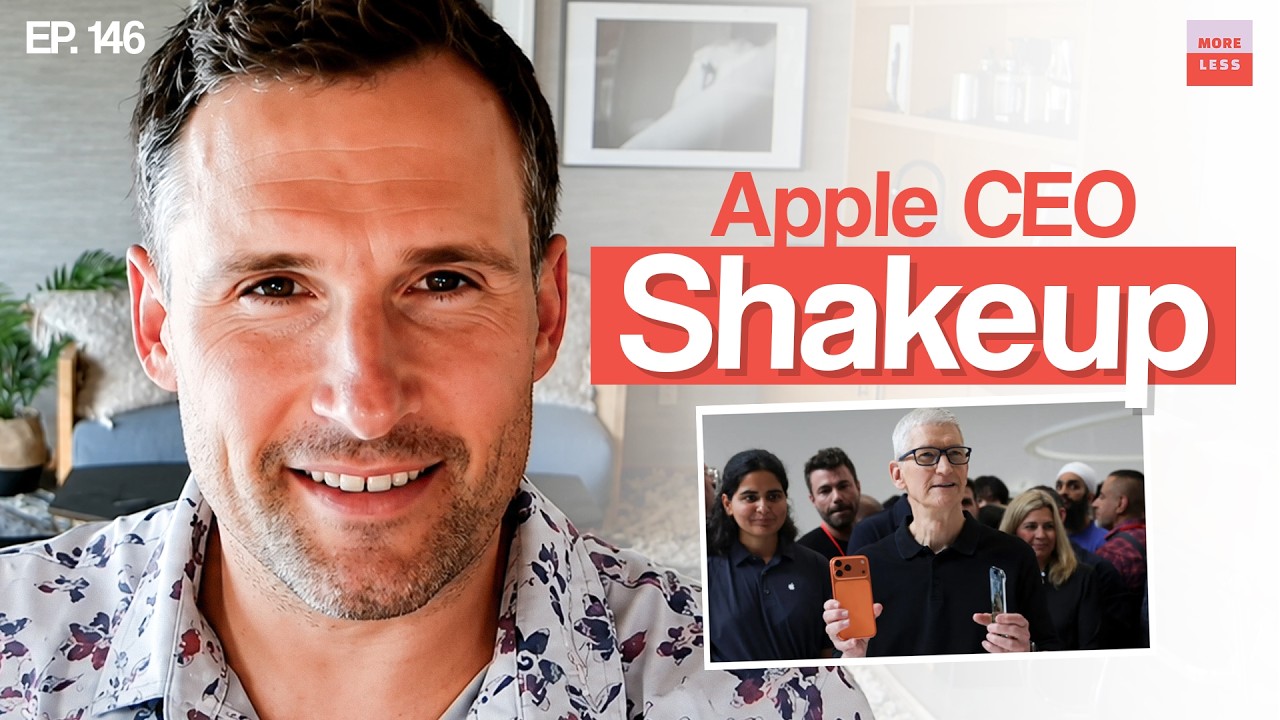
What Tim Cook’s “Executive Chairman” Move Really Means | Musk vs OpenAI, xAI and Cursor Rumors
Description
The full quad is back and we're getting right into the tech drama: AI backlash (from Reese Witherspoon to everyday skepticism), breakthrough science like CRISPR entering its “it actually works” era, and major power shifts across tech — from Apple succession chatter to Jensen Huang’s leadership moments and the brewing battle between OpenAI and Elon Musk. They squad digs into SpaceX IPO dynamics, the rise of “traces” data as the next AI battleground, and what happens when AI gives more people the power to build. Chapters: 0:17 — Welcome Back: Full Quad Edition 1:07 — Creatine, AI Stuffies, and the Opening Chaos 4:37 — Breakthrough Prize & CRISPR Finally Working 5:47 — One-of-One Gene Therapy Becomes Real 7:07 — The AI Backlash Is Real 8:47 — UBI vs. Meaning: The Real Debate 10:57 — Jensen’s “I Didn’t Wake Up a Loser Today” Moment 12:47 — Apple Succession: Tim Cook → John Ternus 16:17 — Asset Prices vs. Reality 21:17 — Elon vs. OpenAI: The Trial 27:07 — SpaceX IPO: Biggest in History? 29:27 — xAI, Cursor, and the $60B Bet 36:07 — Traces Data: The Next AI Battleground 40:07 — Workplace Surveillance & Employee Data 48:27 — Who Gets to Build? (6B Users vs. 50M Builders) 51:07 — AI: Equalizer or Concentrator? We’re also on ↓ X: https://twitter.com/moreorlesspod Instagram: https://instagram.com/moreorless Spotify: https://podcasters.spotify.com/pod/show/moreorlesspod Connect with us here: 1) Sam Lessin: https://x.com/lessin 2) Dave Morin: https://x.com/davemorin 3) Jessica Lessin: https://x.com/Jessicalessin 4) Brit Morin: https://x.com/brit
Summary
Generated by claude-haiku-4-5-20251001Summary: What Tim Cook's "Executive Chairman" Move Really Means | Musk vs OpenAI, xAI and Cursor Rumors
Main Topics
- Apple's Leadership Transition - Tim Cook stepping into Executive Chairman role; John Ternus becoming CEO
- AI Backlash and Branding - Public perception challenges facing AI adoption and industry messaging
- OpenAI vs. Elon Musk Trial - Legal battle over OpenAI's nonprofit-to-for-profit conversion
- xAI/Cursor Partnership - Elon Musk's experimental deal structure with Cursor
- Data Collection & Employee Surveillance - Meta's tracking of employee activity for AI training
- AI and Human Meaning - Debate over AI's impact on employment, agency, and societal distribution
Key Points
Apple Leadership Shift
- Tim Cook's "Step Up": Framed not as stepping down but strategically positioning himself; retains influence while passing operational responsibility
- Alphabet Model: Apple adopting a structure similar to Alphabet/Meta, separating capital allocation from day-to-day operations
- John Ternus Advantage: Hardware engineering background makes him ideal for competitive hardware cycles; software-focused executives lack the same timeline pressures
- Executive Chairman as Backup: Cook remains available if things go wrong—"a not-full transition"
- Critical Issues: Ternus will inherit U.S.-China tech war management and manufacturing decisions
AI Perception Crisis
- Public Sentiment: Widespread negative views—"takes jobs," "uses water," "answers are bad"
- Bait-and-Switch Narrative: OpenAI positioned itself as research nonprofit, then converted to for-profit without transparent communication
- The Real Problem: Messaging issue stems from industry's own "dangerous AI" marketing to justify funding demands
- Not Just Branding: Requires addressing structural concerns about job displacement and worker compensation
Elon Musk vs. OpenAI Trial
- Central Question: Did OpenAI have right to convert from nonprofit to for-profit?
- Settlement Likelihood: High probability of pre-Monday settlement or postponement due to OpenAI's inability to afford distraction
- Narrative Battle: Not about actual money—Musk pledges damages to OpenAI Foundation; it's about power dynamics
- "WWE Theory": Everything is priced on narrative; winning/losing affects perceived power and stock valuations
- Double Compensation: Elon's Tesla and SpaceX comp plans may allow him to hit both valuations through merger strategy
xAI/Cursor Deal Structure
- Experimental Partnership: Success-based pricing ($60B if model works; $10B consulting fee if not)
- Why It Matters: Cursor's developer "traces" data (prompts and responses) is extremely valuable for training coding models
- For Elon: Brilliant risk-free optionality; can decide later with potentially cheaper currency (X stock)
- For Cursor: Better than the alternative (potential insolvency); security in data asset value
- Broader Context: Only foundation model companies with adequate data and compute can win in coding AI
Data Collection & Surveillance
- Meta's Employee Tracking: Monitoring keystroke activity, DOM clickstream, full video of employees
- Historical Precedent: Sam's company Finn pioneered this 10 years ago for operations automation
- Ethical Gap: Companies already conduct this activity; the issue is transparency and consent
- Legal Argument: Tech workers should arguably be paid hourly for their work-generating data, not salaried
- Model Training Need: Computer use models are only 40% effective; capturing human data is the only path forward
AI and Human Meaning
- Agency Over Income: Real problem isn't jobs/income but lack of agency and meaning
- Empowerment Narrative: AI could unlock 100+ million creators (currently only 50M software developers globally)
- Distribution Question: Is the benefit concentrated (1% get richer tools) or distributed (mass enablement)?
- Personal Computer Analogy: Mac cost $6,000 in 1980s; took 30 years to democratize; same trajectory likely for AI tools
- Risk: Current tools are hard to use; widespread access still requires significant technical barrier reduction
Notable Quotes
Tim Cook's Strategic Move:
> "He's like, I did really well. I could have $4 trillion market value. I'm going to kick myself up. Good luck with the AI problem. If it goes badly, I'm back. And if you do it great, then wonderful."
AI Perception Crisis:
> "This is one of the greatest tricks the devil ever pulled, right? It's basically the bait and switch of saying we're just doing research, don't worry, and then flipping that into for-profit."
On the Real Stakes:
> "Everything's priced on narrative. If Elon shows once again that Elon is bulletproof and what he says happens, then he can price Tesla at $1.75 trillion."
Data as the Real Battleground:
> "The traces really matter. Like, the whole battleground is the traces right now. This is a thing nobody's talking about."
The Meaning Problem:
> "You can't just pay people and make them happy. They'll just be sadder. The problem is meaning."
On Meta's Tracking:
> "It's a vanishingly small difference between paying people to do a job and capturing the data exhaust while they're at it."
AI Enablement Vision:
> "AI is going to unlock tens of millions of more people, if not hundreds of millions of more people to create software that the 6 billion people use."
Takeaways
- Apple's transition is structural, not temporary - Cook maintaining executive chairman role signals serious corporate restructuring, not just succession planning
- AI's image problem requires honesty, not marketing fixes - The industry must be transparent about capabilities and displacement risks rather than using "beneficial research" framing
- Power dynamics trump cash in mega-company disputes - Narrative control matters more than actual settlements for companies operating at scale
- Data and compute are the real AI moats - The Cursor deal demonstrates that training data (especially human traces) is the scarcest resource, not technology
- Transparency needed on worker data usage - Companies must explicitly negotiate data rights with employees rather than capturing value from activity done under old expectations
- AI democratization is key to resolving meaning crisis - The distribution of AI tools to the masses could create meaning through agency, but requires solving accessibility and affordability
- Technology always arrives with unintended consequences - Law and ethics lag behind capabilities; proactive regulation needed rather than reactive
- Personal computer parallel offers hope and warning - Mass adoption took decades and required deliberate price/complexity reduction; same will be required for AI to be truly democratizing
Transcript
Everybody was writing these articles that Tim Cook stepped down. When my framing for this is Tim Cook stepped up. That's exactly what Apple wants you to think. He's like, I did really well. I could have fortunately knowledge of value. I'm going to kick myself up. Good luck with the AI problem. If it goes badly, I'm back. And if you do it great, then wonderful. [SPEAKER_00] More or less. Is it no or is it yes? We'll debate the text that's best when we get more or less. Dave and Britt plus Sam and Jess. Put it all right to the test. More or less. [SPEAKER_01] Why, hello, friends. Welcome to More or Less Full Quad Edition. [SPEAKER_03] Good to be back. [SPEAKER_01] Sam, are you going to tap out on us this week midway? Are you here for the whole time? Sam, when does your next meeting start? No one, who cares? He's eating something. [SPEAKER_01] So we know we've got the real Sam back. We've got the real Sam back. [SPEAKER_04] Creatine shoes. I've got Diet Cokes. I've got the breakfast of champions. [SPEAKER_01] You said the creatine shoes didn't work. You told me not to eat them. [SPEAKER_04] No, no. These are, no, these aren't. Well, they're not chews. They're the chalky ones. If you put the gummies are the ones that destroy the creatine. But they're these are very good. These are the momentous ones. [SPEAKER_01] They're pellets, creatine pellets. [SPEAKER_04] They're very good. The lemon lime ones, you just snack on them all day long at your desk. It's a lot of creatine. Are you keeping track of how much creatine you're ingesting? That's a lot of creatine. Britt, you have a furry friend next to you. What is this? What's happening? [SPEAKER_02] I'm announcing I've become a furry. Just kidding. This is a prototype. Well, that'll get people to tune in. This is a prototype that I'm only turning on for one second because Dave doesn't like it when I turn it on. It's an AI enabled stuffed animal that is a baby deer. And when you hold its hand and you say, hello, Winter, how are you right now? Then it will actually listen to it. [SPEAKER_02] Hello, Winter. I'm good. Really good right now, especially since you're here. How are you doing, Link? [SPEAKER_03] It's Sam's vision come to reality. [SPEAKER_04] Well, this is like Eric Antoneau built this with my parrot a year ago. Remember I had my parrot that went on your arm and had a little Bluetooth speaker in it with Chat GPT? [SPEAKER_03] This is the end of this is not a thing. I don't know, man. [SPEAKER_02] Well, I took it home. Obviously I got a pitch. I'm not going to tell you what I thought about the pitch, but I took it home because I was thinking my kids would want to see this. This is cool. And I was right. They thought it was amazing. My three-year-old specifically was all about it. Wanted to sleep with it. Talk to it for an hour. And then Dave was panicking. He's like, we don't need AI friends and stuffies in our house on our networks. This is crazy. [SPEAKER_03] This is the best cybersecurity attack ever. It's great. [SPEAKER_04] Like our three-year-old. It's like, take this home to your kid. Loved the little stuffy we had with a mic with the thing stuffed in it last time. It was very funny. It was like, tell a pirate joke, whatever. It's just like one, no, I don't want them having that. And then two, I don't know. I just think, you know what, it's Dave, do you remember back when we used to work at places like Facebook and other big tech companies. There were these plushes that some engineers would carry around for safety. [SPEAKER_02] I don't remember this. Like their emotional support. [SPEAKER_02] Emotional support. Fluffies. Stuffies. And they'd walk around in meetings with it. And you're like, what the fuck are you doing? Really? [SPEAKER_02] Because that's what kids do. That's what stuffies are. [SPEAKER_04] That was not what it was like when I was at Facebook. There was this whole thing where people needed their emotional support thing to code. And you're just like, oh man. First of all, that's going to be the real Chinese thing. And you get a bunch of engineers to be like, you need this stuffy at your desk when you program all the time. This emotional. [SPEAKER_01] This, did you guys have Teddy Ruxpins? Is that a tie of me coming? I invested in Slow at Toybot. [SPEAKER_02] What was the company called? [SPEAKER_03] Toy Talk. A generation ago. That was a different story. [SPEAKER_02] That was an AI project. I don't know. This is an AI project, Dave. Well, and Toy Talk didn't work. It was the right vision. [SPEAKER_02] Well, you invested in it. Clearly you thought it was a good idea. Well, I don't know. I didn't write that check. Although I do quite the CEO. By the way, that was the CEO. That guy, he's awesome. Ex-Pixar. [SPEAKER_02] Was he Pixar? Yeah, yeah, yeah. [SPEAKER_03] He's the CTO of Roblox now. [SPEAKER_02] I don't know. [SPEAKER_02] This is an AI project, Dave. [SPEAKER_04] Well, and Toy Talk didn't work. [SPEAKER_04] It was the right vision. [SPEAKER_02] Well, you invested in it. [SPEAKER_02] Clearly you thought it was a good idea. [SPEAKER_04] Well, I don't know. [SPEAKER_04] I didn't write that check. [SPEAKER_04] Although I do quite like the CEO. [SPEAKER_04] By the way, that was the CEO. [SPEAKER_04] That guy, he's awesome. [SPEAKER_04] Ex-Pixar. Was he at Pixar? Yeah, yeah, yeah. [SPEAKER_03] He's the CTO of Roblox now. [SPEAKER_04] Yeah, great guy. An Oscar award-winning team that's making this company. I think all the... [SPEAKER_04] Oscar award-winning teams generally win at technology products. [SPEAKER_04] So good luck with that. [SPEAKER_01] Always. [SPEAKER_01] Speaking of the Oscars, Sam and I went to the Science Oscars called the Breakthrough Prize [SPEAKER_01] this last weekend. [SPEAKER_02] Who won? [SPEAKER_02] What new innovations? [SPEAKER_01] I got to tell you guys, gene therapies like CRISPR, it's going to be streamed next week [SPEAKER_01] on YouTube. [SPEAKER_01] The gene therapy world is really working. [SPEAKER_01] So there were amazing scientists. [SPEAKER_03] I thought the CRISPR people already won the Breakthrough Prize. [SPEAKER_03] They did, but it was 10 years of this is going to be awesome. [SPEAKER_01] But now the applications, yeah. [SPEAKER_04] And now it's like, this works. [SPEAKER_04] It's in, it actually, my analogy is it feels exactly like Waymo, where for 10 years, [SPEAKER_04] people have been like, CRISPR is awesome. [SPEAKER_04] You're like, it is awesome. [SPEAKER_04] It's very, very cool. [SPEAKER_04] But now it's like, oh shit, it works. So what are we going to be able to do now? What kind of gene therapies? [SPEAKER_02] Are we curing diseases or what? [SPEAKER_04] It's you actually will be able to turn yourself into a furry. [SPEAKER_02] Yes. [SPEAKER_02] I can grow hair in weird places. [SPEAKER_01] We're curing blindness. [SPEAKER_01] The basic thing is to be able to target really rare things. [SPEAKER_01] And you guys, Baby KJ was there. [SPEAKER_01] This is a case that got... Everyone loves Baby KJ. [SPEAKER_01] Who's Baby KJ? [SPEAKER_01] Baby KJ was a baby who had, I think it was a liver disorder or at [SPEAKER_01] birth was identified with something that really was a horrible prognosis. [SPEAKER_01] And two scientists fast tracked with the FDA a one-of-one drug. [SPEAKER_01] So a drug that was totally targeted to KJ's condition and basically cured it. [SPEAKER_01] And it's an amazing story too, because the FDA did the approval in six weeks [SPEAKER_01] or something incredible. [SPEAKER_01] But I think it's one of the first uses of CRISPR in that context. [SPEAKER_01] And then there was a similar case though. It's the one-of-one drug. [SPEAKER_01] The one-of-one drug. [SPEAKER_04] Yeah. Where you just edit one base pair and you're like, boom, game on. [SPEAKER_01] And also this, a similar use to cure essentially a young woman of blindness who was also there. [SPEAKER_01] So that was my big takeaway. [SPEAKER_01] Science is working. [SPEAKER_01] Science is cool. [SPEAKER_01] There wasn't a ton of AI-ness, I'm tracking. [SPEAKER_01] AI is being elsewhere. [SPEAKER_01] The AI backlash, keep the AI at a simmer to not simmer up the protesting I felt was [SPEAKER_01] in the air. [SPEAKER_02] We got to get over this branding problem. [SPEAKER_02] What do you think is the answer to the branding problem of AI? This is not a brand, this is a deep existential society problem. I think honestly, I don't think branding is going to solve this. [SPEAKER_04] Well, no, there's two. [SPEAKER_04] So two things. [SPEAKER_04] One is you say, whose brand fault is this? [SPEAKER_04] And it's actually the entire marketing strategy, right? [SPEAKER_04] When you think about it, the idea of the whole thing is everyone's like, everyone [SPEAKER_04] hates that. [SPEAKER_04] It's your money raising strategy has been to run around, including Washington and be like, this is so dangerous. [SPEAKER_04] This is so dangerous and we're going to win it. So you have to do whatever we say. [SPEAKER_01] And I need a trillion dollars. [SPEAKER_04] And so when you do that, obviously you leaned into it. You literally took the [SPEAKER_04] knife and stabbed yourself immediately. And so of course you were branding. The same thing is, it is quite deep. I got a colonoscopy last week. [SPEAKER_01] Congratulations. [SPEAKER_01] I've got, Sam will bring up any opportunity to mention this fact. [SPEAKER_01] It was very deep, Dave. [SPEAKER_04] I was about to go under and the male nurse is there checking me in. [SPEAKER_04] And he's like, what do you do? [SPEAKER_04] And I'm like, I do technology stuff. And he's like, do you do AI? [SPEAKER_04] And I'm like, honestly, no, not really. [SPEAKER_04] He's like, good. He's like, AI is bad. And I'm like, why do you feel that way? [SPEAKER_04] He's like, it's taking the jobs. [SPEAKER_04] It's taking the water and its answers are bad. [SPEAKER_04] And I'm like, well, that's a very complete list. That's what everyone thinks. It's crazy. [SPEAKER_02] Reese Witherspoon put this thing on Instagram this week, which is just like, wow, I'm interested [SPEAKER_02] in what's happening with AI and women are pretty far behind on the learning [SPEAKER_02] curve here. [SPEAKER_02] And I'm curious to help them. [SPEAKER_02] And she got so much backlash. [SPEAKER_02] And I'm like, so she responded well, I think, which was sort of like, what was the backlash? [SPEAKER_02] Same thing. [SPEAKER_02] All forms. [SPEAKER_02] It's taking jobs. [SPEAKER_02] You're behind all these companies. [SPEAKER_02] You're just speaking your own book. [SPEAKER_02] AI is ruining the world. The call to us, we got it. [SPEAKER_04] It was resigned. [SPEAKER_04] It was going to happen anyway, though. And I'm curious to help them. [SPEAKER_02] And she got so much backlash. [SPEAKER_02] It was intense. And I'm so she responded well, I think, which was what was the backlash? Same thing. [SPEAKER_02] All forms. [SPEAKER_02] It's taking jobs. [SPEAKER_02] You're behind all these companies. [SPEAKER_02] You're just speaking your own book. [SPEAKER_02] AI is ruining the world. [SPEAKER_02] Blah, blah, blah. [SPEAKER_04] The call to us, we got it. [SPEAKER_04] It was resigned. [SPEAKER_04] It was going to happen anyway, though. [SPEAKER_04] So there was that. [SPEAKER_02] That's the thing. [SPEAKER_02] It is. [SPEAKER_02] And also, I think it is problematic for women, right? [SPEAKER_02] And men. [SPEAKER_02] But a lot of women who Reese is just trying to inform of what's happening are like, no, I'm not learning. [SPEAKER_02] I'm against it. [SPEAKER_02] And I think just having an open mind right now is the only way to be. And experimenting, building your own stuff. Yeah. Yeah. Well, everyone knows where we stand on this question. Hello. But no, it's an important theme. We probably, I don't think it will be published by the time this airs. But we have a very well-known figure in the tech industry who's writing an op-ed for us, laying out an entirely new tax regime, aiming to address this very issue, right? Aiming to compensate people displaced by tokens, essentially. [SPEAKER_01] So I haven't read it in full yet. [SPEAKER_01] And I think it's going to be complicated. But the fact you're seeing people now try and put these proposals into the ether. [SPEAKER_04] It's UBI type stuff. [SPEAKER_01] Yeah. [SPEAKER_01] It's a little UBI. [SPEAKER_01] It's not that UBI, but it's a little bit UBI. This has been the answer for 20 years. It's the jobs will go away because of technology and UBI is the solution. And I just don't buy it. I think it fundamentally misunderstands how people operate, right? And what people care about. The problem is meaning. As I've said a lot online, the problem is not basic income. [SPEAKER_04] The problem is meaning, right? You can't just pay people and make them happy. They'll just be sadder. [SPEAKER_01] On that note, we have a lot of news. [SPEAKER_01] So I'm going to shift to the news. [SPEAKER_01] But I would say congratulations to Yuri Milner and the whole Breakthrough Prize team. It is a rare event where you can watch Jensen and Elon sitting next to each other, just talking while Sam Smith is belting it out. [SPEAKER_04] Well, my favorite is Elon and Jensen next to each other, both with their phones up recording the act. [SPEAKER_04] I always find that funny. Really? [SPEAKER_02] You have to record this? [SPEAKER_02] Why? [SPEAKER_02] There's someone that can record it for you. [SPEAKER_03] Everyone's human. [SPEAKER_01] You got to give credit to Jensen for managing to create a prize in honor of the Vera Rubin, which is his latest technology. [SPEAKER_03] Great marketer. [SPEAKER_01] He's a great marketer. [SPEAKER_01] Also, she was an amazing woman. [SPEAKER_01] But he got, I mean, the information also had ads in the Breakthrough Prize because we are proud supporters and run media from the event. [SPEAKER_01] But Jensen also got an ad in creating his Vera Rubin Award. [SPEAKER_04] So can I ask one question on this before we move on? [SPEAKER_04] My news, one of my news systems that picked up this Jensen losing his moment. [SPEAKER_04] What was that? [SPEAKER_04] What happened? [SPEAKER_04] It was a podcast interview. [SPEAKER_04] Yeah, it was a podcast interview. [SPEAKER_04] And he completely lost it because that's always fun. [SPEAKER_01] I don't know if he lost it, but if you want to. [SPEAKER_01] Well, he was. [SPEAKER_01] What made him angry? [SPEAKER_03] He gave an interview. [SPEAKER_03] I didn't watch the whole thing. [SPEAKER_03] Dwarkesh. [SPEAKER_03] I don't even know what the question was that Dwarkesh asked. [SPEAKER_01] The question was about whether he felt about arming China with more chips. [SPEAKER_01] Right. [SPEAKER_01] So it was a national security kind of argument. [SPEAKER_01] And Jensen responded with how he always does, saying something like, well, they already have 60 percent of the chips or something like that. [SPEAKER_01] Trying to say that there's nothing new about selling into China. [SPEAKER_01] And Dwarkesh, who's a very smart person, pointed out they don't have that percentage of the flops. [SPEAKER_01] So it's the chips doesn't matter. [SPEAKER_01] The power of the chips, the computing is what matters. [SPEAKER_01] And he got frustrated. [SPEAKER_01] I didn't actually listen to it, so I don't know if that was the exact moment he got frustrated, but this is what people are talking about. [SPEAKER_01] And they're talking about the fact, which is fair, that how many times have people asked Jensen this very question? [SPEAKER_01] And if you're not technical enough to push back on his answer, you don't get to the truth. [SPEAKER_01] And so it was held up as a very great example of how these interviewers need to be as informed as possible. [SPEAKER_01] And again, you'll have people who are technical experts. [SPEAKER_01] You have people who aren't. But Jensen wasn't used to getting that pushback. [SPEAKER_03] The thing that Sam's bot picked up, though, was this other thing where he said, I didn't wake up a loser today. [SPEAKER_03] Yeah. [SPEAKER_03] What was that? That wasn't quite a line. Sorry, sorry. I'm out of touch here. What is that for? [SPEAKER_03] I don't know what the question was, but Jensen just said, I didn't wake up a loser today. [SPEAKER_03] I'm not a loser. [SPEAKER_03] It was pretty intense. These folks are intense. [SPEAKER_01] And it's a tense time. It's an exuberant time. It's a tense time. So let's turn our attention to Apple. [SPEAKER_01] Because as expected, as reported in the information and Bloomberg, give credit where credit is due. [SPEAKER_03] What was that? [SPEAKER_01] That wasn't quite a line. [SPEAKER_01] Sorry, sorry. [SPEAKER_01] I'm out of touch here. [SPEAKER_01] What is that for? [SPEAKER_03] I don't know what the question was, but Jensen just said, I didn't wake up a loser today. [SPEAKER_03] I'm not a loser. [SPEAKER_03] It was pretty intense. [SPEAKER_01] These folks are intense. And it's a tense time. It's an exuberant time. It's a tense time. So let's turn our attention to Apple. Because as expected, as reported in the Information and Bloomberg, give credit where credit is due. [SPEAKER_03] Did you break it? [SPEAKER_01] We didn't break. [SPEAKER_03] This has been going on for a long time. [SPEAKER_01] Let's just say the Information and Bloomberg both did what you call a slightly cover your ass at the end of last year reporting thing where you know it's going to happen, but you write stories that hedge up the wazoo. [SPEAKER_01] So no, we didn't. [SPEAKER_01] No one broke the news on the actual day. [SPEAKER_01] But we and Bloomberg had been reporting that this transition was transpiring likely in this time frame. [SPEAKER_01] Although lately, for what it's worth, there was some sense maybe the time frame was different. But the second Tim Cook went on, I believe, Good Morning America, and said, Apple will always be a part of my heart or something to that effect. I'm like, oh, he's got a week or two left because there's no reason to do that. [SPEAKER_01] That was just a misspeak. No, no, it's no, it's exactly what he wants. Because. Or a tell. No, it's all part of the plan. Because this is a transition plan with John Ternus, who we should talk about, taking over as CEO. [SPEAKER_01] And Tim Cook staying on as executive chairman and Tim taking on some of the going to the White House diplomatic roles. [SPEAKER_01] And so I think it's exactly, you know, you never want to look like your CEO's jumping ship, particularly as you face new challenges in the business ecosystem. [SPEAKER_01] So I think it was all part of this continuity of don't worry, guys, Tim's upstairs. [SPEAKER_01] Tim's in the house. [SPEAKER_03] I'm glad you said that. [SPEAKER_03] David, I have a bigger picture. [SPEAKER_02] We talked about it at date night last night. [SPEAKER_02] Okay. I want to hear it. We're like the Apple people, right? I'm giving you the microphone. Well, I think that it was interesting that everybody was writing these articles that Tim Cook stepped down when my framing for this is Tim Cook stepped up. [SPEAKER_01] That's exactly what Apple wants you to think. Well, but it's true, right? [SPEAKER_01] Dave, an exec chairman is nowhere close. [SPEAKER_01] An exec chairman is someone who's going to play a lot more golf, but is going to show up, a couple times a year for what's needed and is going to mentor the CEO in process. That's what executive chairman is. [SPEAKER_03] Yeah, but exec chairman and chairman are very different titles. [SPEAKER_03] And there was no exec chairman above Tim Cook. [SPEAKER_03] So I think that it's really important to look at this differently that the CEO job that John Ternus is inheriting is not the CEO job that Tim Cook inherited. [SPEAKER_03] Like this is more of an Alphabet moment. [SPEAKER_03] I think for Apple, this is a $3 trillion, $4 trillion company that has an enormously important capital allocation function at the very top. [SPEAKER_03] I view this as a bigger structural move for Apple than people are writing about it. [SPEAKER_03] I think you're right. [SPEAKER_03] People are just taking the exact line and message that Apple wants them to say. [SPEAKER_03] But this to me looks much more like what happened with Alphabet, what happened with Meta, etc. [SPEAKER_03] And that Apple is actually shifting into the scale that it actually has always been, but is going to do it more seriously now. [SPEAKER_03] And Tim would otherwise take the chairman title. [SPEAKER_03] And instead, he's taking the executive chairman title, which implies... Do you think it's a function of Ternus not being ready? [SPEAKER_03] No. [SPEAKER_04] Well, it's also just a way if they get it wrong, then they can undo it, right? [SPEAKER_04] Yeah. [SPEAKER_04] It's a big move. [SPEAKER_04] I mean, to me, it's more that I would buy, Dave, is he wants to be done. [SPEAKER_04] But to your point, it is a big transition. [SPEAKER_04] There haven't been that many in the history of these companies. [SPEAKER_04] And if you're executive chairman, then if things go wrong, you can step back in. Yeah, it's not a full transition. I think that's what's interesting. Yeah. So Ternus has to perform. [SPEAKER_03] It's very different. [SPEAKER_03] Absolutely. [SPEAKER_04] He's like, I did really well. [SPEAKER_04] I could have $4 trillion market value. [SPEAKER_04] I'm going to kick myself up. [SPEAKER_04] Good luck with the AI problem. [SPEAKER_04] If it goes badly, I'm back. [SPEAKER_04] And if you do it great, then wonderful. [SPEAKER_02] That's what I was going to say. [SPEAKER_02] I'm like, it went from $350 billion when he started to $4 trillion now. [SPEAKER_02] And the silicon stuff, the wearables. [SPEAKER_02] And by the way, I think... [SPEAKER_02] And inflation. [SPEAKER_02] The services. [SPEAKER_02] Apple TV Plus is really underrated, you guys. [SPEAKER_02] I think that was one of Tim's best. [SPEAKER_04] I mean, that's at least a trillion dollars right there. [SPEAKER_02] You know how much money Apple TV Plus loses, Brett? [SPEAKER_02] I don't care. [SPEAKER_02] It brings me happiness. [SPEAKER_02] And it is a money pit to end all money pits. [SPEAKER_02] And it doesn't matter because they're selling so much of other stuff. [SPEAKER_02] It's like so much of Google's money pits. [SPEAKER_02] But they run ads. [SPEAKER_02] Everybody gets to have loss leaders. [SPEAKER_03] Like... [SPEAKER_02] Yeah. [SPEAKER_02] I'm just saying the quality of what he created is actually quite high. [SPEAKER_04] I think that the real story on all this is we're just living in a totally post any sort of financial model reality, right? [SPEAKER_04] The markets and the economy are so fundamentally disconnected at this point. [SPEAKER_04] People are looking to stuff money in things and they have theories on that. [SPEAKER_04] And it's wild. [SPEAKER_04] So the through line of Apple being a $4 trillion dollar company was good. [SPEAKER_04] It's an incredible company. [SPEAKER_04] Is it 10x better than it was? [SPEAKER_02] Everybody gets to have loss leaders. [SPEAKER_03] Yeah... [SPEAKER_02] Yeah. [SPEAKER_02] I'm just saying the quality of what he created is actually quite high. [SPEAKER_04] I think that the real story on all this is we're just living in a totally post any sort of financial model reality, right? [SPEAKER_04] The markets and the economy are so fundamentally disconnected at this point. [SPEAKER_04] People are looking to stuff money into things and they have theories on that. [SPEAKER_04] And it's just wild. [SPEAKER_04] So the through line of Apple being a 4 trillion dollar company was good. [SPEAKER_04] It's an incredible company. [SPEAKER_04] Is it 10x better than it was? [SPEAKER_04] That's the question, right? [SPEAKER_04] That versus how do you think about Tesla, which just reported on any of these things. [SPEAKER_04] It's just wild to me how disconnected stores of value are, right? [SPEAKER_04] Where you stuff the money versus the economy right now, right? [SPEAKER_03] So... [SPEAKER_03] But Sam, Apple sells a lot of computers. Yeah, it's a great company. It's a great company. I'm not... [SPEAKER_04] I mean, I'm surrounded by $100,000 of Apple products in my office. [SPEAKER_04] I get it. [SPEAKER_04] But my only point is that when you look at what's happened in the last decade of asset prices, yes, a lot of these companies got bigger and more successful and the world's a really big place. [SPEAKER_04] But there's also just this unbelievable asset tailwind completely disconnected from any sort of reality in the markets. [SPEAKER_04] And I'm sorry, in the economy. [SPEAKER_01] Also, a couple of thoughts about Ternus. [SPEAKER_01] So he has been VP for hardware engineering. [SPEAKER_01] He's been getting more and more responsibilities, including taking over the transitions of key chips and architectures and that kind of stuff. [SPEAKER_01] He's known as being way more calm than some of the other bombastic types like Schiller. Bombastic. [SPEAKER_01] I like that word. [SPEAKER_01] I mean, Apple's got a lot of hotheads under the surface. [SPEAKER_01] But also the reason I don't think—you know, the sense, and believe me, we talked to a lot of people over two or three years about this—is also that there was no one else. [SPEAKER_01] I mean, the other... [SPEAKER_01] Not that Ternus isn't great and was clearly anointed and put on this path. [SPEAKER_01] You could see him... [SPEAKER_03] And he's a Marin boy. [SPEAKER_01] You could see him doing more speaking engagements, all of that kind of stuff. [SPEAKER_01] But also Craig Federici would have been the other guy, has been much more overseeing on the software and AI, and has his detractors too. [SPEAKER_01] So I don't think Apple has a lot of option value here. [SPEAKER_01] They're not going to run a search and hire a CEO from another company to run Apple unless they're covering their butts. [SPEAKER_04] I don't know. [SPEAKER_04] There's always Brett Taylor. [SPEAKER_01] And their fiduciary duty. [SPEAKER_01] There's always Brett Taylor. [SPEAKER_01] Okay. [SPEAKER_01] That was a stretch comment. [SPEAKER_01] But yeah. [SPEAKER_01] So anyway, I think they're well set up. [SPEAKER_01] The other side of this is Tim had been telling everyone he knows how tired he is for years and how he doesn't want the job anymore and how exhausting it is. [SPEAKER_01] Many CEOs are prone to do the same thing. [SPEAKER_01] That hardly makes him unique. [SPEAKER_01] You know, this is... [SPEAKER_01] I think this is both a passing of the reins while keeping some adult supervision around. [SPEAKER_01] And I think that is specifically for continuity on some of these issues that are going to be mega issues. [SPEAKER_01] Relationship with the U.S. government, relationship with the Chinese government. [SPEAKER_01] These are high, high, high stakes issues. [SPEAKER_01] I mean, Ternus, if he's CEO of Apple for a decade, a decade plus, is going to oversee the growing U.S.-China tech war. [SPEAKER_01] We talk about NVIDIA being in the middle of that. [SPEAKER_01] Apple is in the middle of that. [SPEAKER_01] So that's actually my biggest question. [SPEAKER_01] Not what does he think about AI? [SPEAKER_01] Yeah, maybe he'll decide to build an in-house model. [SPEAKER_01] Probably not. [SPEAKER_01] I think they've set their course there. [SPEAKER_01] But I'm very keen and I think it will still be very much a Cook call. [SPEAKER_01] How they're deciding what are they doing with their manufacturing? [SPEAKER_01] What are they doing with their China business and how they tow a shrinking tightrope there? [SPEAKER_01] But big transition, big transition. Yeah. [SPEAKER_03] I mean, Apple is a technology—well, Apple is a hardware company and competitiveness in hardware is extremely difficult. [SPEAKER_04] I thought it was a TV company. Point taken. [SPEAKER_02] I didn't say it was a TV company. [SPEAKER_02] I said I enjoy the TV part of it. [SPEAKER_02] I just want to give Tim credit. [SPEAKER_02] That's all. [SPEAKER_02] Margot's money problems started it. [SPEAKER_01] It's good. [SPEAKER_02] By the way, does Sam watch? [SPEAKER_02] Because OnlyFans is the center of this thing. [SPEAKER_02] It is all about OnlyFans. [SPEAKER_01] Sam has not. [SPEAKER_01] I've only watched one episode. [SPEAKER_01] Oh, wait till episode two. [SPEAKER_01] There are too many women in it for Sam. [SPEAKER_02] There are too many women. [SPEAKER_02] Oh, but he'll start liking it. [SPEAKER_02] There are boobs. I do love boobs. It's amazing how central OnlyFans is to culture right now and in six TV shows. [SPEAKER_03] Euphoria is all about it. [SPEAKER_03] The whole thing. [SPEAKER_03] Industry. [SPEAKER_03] They're all about OnlyFans. [SPEAKER_01] It's not my culture. [SPEAKER_01] Not my culture. Sorry, I diverted us. [SPEAKER_02] Back to hardware. [SPEAKER_03] Hardware. [SPEAKER_03] Well, I was just saying that Apple, the hardware cycles are insanely competitive. [SPEAKER_03] You have to stay on an extremely serious timeline in order to stay at the frontier of hardware and silicon. [SPEAKER_03] And so I think that in that way, this choice is extremely obvious. [SPEAKER_03] You can't choose the software people. [SPEAKER_03] They are not under the same timelines and same pressure that drive the fundamental business of Apple on a global basis. [SPEAKER_03] And so you have a very narrow set of internal choices that you can choose from. [SPEAKER_03] And I think people don't often do analysis from the outside. Sorry, I diverted us. [SPEAKER_02] Back to hardware. [SPEAKER_03] Hardware. [SPEAKER_03] Well, I was just saying that Apple, the hardware cycles are insanely competitive. You have to stay on an extremely serious timeline in order to stay at the frontier of hardware and in Silicon. [SPEAKER_03] And so I think that in that way, this choice is extremely obvious. [SPEAKER_03] You can't choose the software people. [SPEAKER_03] They are not under the same timelines and same pressure that drive the fundamental business of Apple on a global basis. [SPEAKER_03] And so you have a very narrow set of internal choices that you can choose from. [SPEAKER_03] And I think people doing analysis from the outside don't think about this. [SPEAKER_03] They think, oh, the software guys could do it too. [SPEAKER_03] And it's no, actually, the software guys are on a completely different schedule. [SPEAKER_03] They make updates every few years. [SPEAKER_03] They do a release once a year, but they have a totally different set of competitive problems than the hardware guys do. [SPEAKER_03] And the negotiation of the supply chain and the manufacturing facilities and the entire global thing that makes the billion iPhones show up in people's pockets all over the world is a pretty wildly competitive and insanely difficult thing to be good at. [SPEAKER_03] And so I think you have a pretty narrow, if not obvious choice that you have to make here if you're going to do this internally. Yeah, I think the bigger point is an excellent point, Dan. And I think the writing was really in the card when Dan Riccio, who had run hardware, got pushed out, stepped aside after multiple ins and outs a couple of years ago from a succession standpoint. So that is well said. Well, we will be watching. We will be commenting. John, you're welcome on the pod anytime. [SPEAKER_03] I just love that he's a Marin guy. [SPEAKER_03] And I think it's pretty awesome that a local Marin guy became CEO of Apple. That's pretty neat. That's quite a commute. If I were CEO of Apple, I'd not commute from Marin to Cupertino. He's not, I don't think he lives here, but he grew up here. Okay. Got it. That was cool. They'll claim him. We're going to start to have Muir Woods operating systems or something. I don't know. Yeah. He was definitely inspired by the Redwoods. Let's hope so. Okay. I want to talk about this trial. We—if you've been under a rock, or there has been a lot of news, you may have forgotten that this upcoming Monday is scheduled to be the start of the Elon Musk versus OpenAI trial. The central question of which is, did OpenAI have the right to convert from a nonprofit to a for-profit? And what should Elon be compensated, as well, having been one of the backers of the nonprofit? [SPEAKER_04] So from the first principles perspective, I'm totally with Elon on this for what it's worth. [SPEAKER_01] Yeah, but the law is it. [SPEAKER_01] Okay. [SPEAKER_01] Say more, Sam. Well, this is one of the greatest tricks the devil ever pulled, right? It's basically, and it's less about the money and more about the whole stance of the industry, which is opening this conversion of being, oh, we're just doing a research project. [SPEAKER_04] Don't worry. [SPEAKER_04] We're scraping the entire internet, but it's just for good. [SPEAKER_04] It's just for a research project. [SPEAKER_04] And then flipping that into, oh no, actually it isn't. [SPEAKER_04] I just think it was an unbelievable bait and switch, right? [SPEAKER_04] And I think it's less about the money, candidly, and more about the fact that I think almost every rights holder, right, would have said no way if it had been transparent what they were going to do. [SPEAKER_04] And they were going to become a for-profit, whereas everyone was just like, okay, and look the other way. [SPEAKER_04] It's the same thing with a lot of the talent. [SPEAKER_04] I mean, I think, look, it's all worked out, but the pitch of OpenAI early to all these researchers was, don't work at Google or Meta. [SPEAKER_04] Those are dirty for-profit companies. [SPEAKER_04] Come here and work on research and we'll support your research. [SPEAKER_04] This is very open-ended, good for the world thing. [SPEAKER_04] And that was a big part of the pitch. [SPEAKER_04] And then switching it, I think was very disingenuous. And the donate, it was, what, 130 or 50 million that they raised? [SPEAKER_04] That's less, I mean, that is how this manifests. But I'm just saying, I think there's a question of what's legal and what they did. And then there's a question of, I'm less—I think the money is less important. [SPEAKER_04] I think it's more the structural bait and switch and the data promise made. [SPEAKER_01] So some stuff has come out already in discovery. [SPEAKER_01] And OpenAI basically argues, look, we were multiple times, you know, A, there was more optionality explored and even discussed with Elon back in the day, including making this part of Tesla and other things. [SPEAKER_01] So they are trying to establish that this was not a bait and switch and that they sort of always posited that there would be different potential corporate structures as they needed more capital, which is ultimately what happened. I mean, none of us are lawyers, but I can tell you both sides are definitely positing that they have bulletproof cases here still. And this is a dangerous thing to say because we're taping sort of midweek ahead of Monday. But I think there is a greater than not chance that they settle before then or that they postpone. [SPEAKER_03] Is this thing even going to get to trial? [SPEAKER_01] I mean, I don't know. [SPEAKER_01] This is not a reporting. [SPEAKER_01] This is purely a hunch. [SPEAKER_01] But I think that OpenAI can't afford the distraction. [SPEAKER_01] They can't. Does it really just come down to money? [SPEAKER_01] So what has happened through many twists and turns and pieces have been thrown out is that Musk has said he will donate the damages owed to him to basically—it wouldn't technically be a donation, but to the OpenAI Foundation. [SPEAKER_01] So he is not asking to be left with a piece of this operating company or cash in this bank account. [SPEAKER_01] I don't know. This is not a reporting. This is just purely a hunch. But I think that OpenAI can't afford the distraction. They can't. Does it really just come down to money? [SPEAKER_01] So what has happened through many twists and turns and pieces have been thrown out and so and so is that Musk has said he will donate the damages owed to him to the OpenAI Foundation. So he is not asking to be left with a piece of this operating company or cash in this bank account. He's saying this is now a dispute over what percentage of the foundation. [SPEAKER_04] It's power. And look, these guys are all rich enough. They don't care. [SPEAKER_01] And look, he just wants it—it's power gears in the sand of OpenAI. [SPEAKER_04] So it's the MMA theory or the WWE theory of Silicon Valley. This has nothing to do. Elon, if Elon were to take money from this, it's a bad look. [SPEAKER_04] I think I've heard of that theory. [SPEAKER_04] Oh, yeah. The what? The W? That's half your theory. Are you kidding? [SPEAKER_02] It's a joke. [SPEAKER_04] It's characters playing a game. And here's the reality. The irony is, let's pretend that Elon got a $20 billion or even $100 billion settlement. Elon's shtick is that he's so rich, he doesn't care. Right? And so to accept the settlement— [SPEAKER_04] It's not just a shtick, Sam. [SPEAKER_04] But that's my point. The image has to be that I am so rich and powerful that I couldn't possibly care about this pittance from OpenAI personally. So is it a moral point? [SPEAKER_02] I think it's just competitive. [SPEAKER_02] Yeah. It's just taking their time and attention. [SPEAKER_03] But the money goes to the other side of the OpenAI balance sheet, the OpenAI foundation number goes up. [SPEAKER_04] All it is, it's ego. And it's people wanting to look more powerful and less powerful. It's if Elon loses, the gamble for Elon is just do you look less powerful? Right? The gamble for Sam and OpenAI is the same, right? [SPEAKER_04] But why does it even matter? [SPEAKER_03] Why does it matter? Just gamesmanship? [SPEAKER_04] Because everything's priced on narrative, right? Like, if Elon shows once again that Elon is bulletproof and what he says happens, right? Then he can price Tesla at $1.75 trillion. And he's the bulletproof man. It has nothing to do with money. It has to do with narrative. [SPEAKER_04] It's interesting. There's risk in that. And I think on the OpenAI side, it's the same thing, which is they set themselves up as the far and away leader in AI that no one can touch. And that's why Anthropic touching them and passing them potentially if they haven't already on revenue is such a big deal. It's not because OpenAI—that doesn't matter. The story is not, oh, someone passed you. The story is we've been telling the story that we're untouchable and we're touchable, right? And once you've been touched once, you can be touched again, right? And so everything is, I just think we have to embrace the reality, which is this tectonic tech level, the highest end. The game doesn't even have to do with cashflow. It doesn't have to do with traditional business metrics. It is literally warring city states that thrive on narrative, right? And storytelling. [SPEAKER_04] Yeah. [SPEAKER_01] So I think Elon has to be able to declare a victory here in some way, shape or form. [SPEAKER_04] That's similar to Trump and Iran. [SPEAKER_02] And what happens if he doesn't get the victory? But let's say it goes to OpenAI. He needs to find a way to claim it. And I think he'll be able to, because I think it'll be in OpenAI's interest to give him something. You don't want all these people taking the stand, although it's funny to think of Elon taking the stand, to be honest. [SPEAKER_04] It's very similar to the Iran situation. You get people who like brinkmanship them way into a really tough place, right? And it's that, you know, Iran can only end with a framework where Donald Trump can take a win. It just can't end otherwise. Right? And it'll be the same with this. Yeah. Well, the other, and I think related to that is remember, Elon is about to pull off potentially the biggest IPO in history. The Information reported this week, not only unsurprisingly, is he getting super voting shares in the SpaceX IPO, but he now has a really aggressive comp plan as well that will give him tens of millions of shares. If the market cap goes to $6.6 trillion, I'm not exactly sure. [SPEAKER_04] Can I ask a question? So because Elon also has this plan with Tesla, when they combine them, does he just get the double count? This is the great question. No, he probably will. This is probably the biggest proof that he'll combine them. But we'll have to read the fine print. [SPEAKER_04] Unless someone wrote into the contract, oh, you can't combine them. Don't you get to hit both numbers by just merging them? I think you do. I think I mean, I think. [SPEAKER_04] I 100% think you do. And like, what a play where you're down to contract details matter. [SPEAKER_04] Double count? This is the great question. No, he probably will. This is probably the biggest proof that he'll combine them. But we'll have to read the fine print. [SPEAKER_04] Unless someone wrote into the contract being like, oh, you can't combine them. [SPEAKER_04] Don't you get to hit both numbers by just merging them? I think you do. I think I think. [SPEAKER_04] I 100% think you do. [SPEAKER_04] And what a play where you're like, oh, you get down to the contract details matter. Yeah, yeah, I need the market cap to hit this. [SPEAKER_04] I didn't say I couldn't get it. By merging them together. Well, this was all in the confidential S1 that the information reported on, and we will continue to. [SPEAKER_01] But also, you have the news this week that XAI has bought the right to acquire Cursor for up to 60 billion or to do a partnership with them. [SPEAKER_01] Have we ever seen a company in the weaker position on the receiving side? [SPEAKER_01] I mean, what would, you guys are the dealmakers here. [SPEAKER_01] But I'm like, you can't even sell yourself? [SPEAKER_03] Wait, who? [SPEAKER_01] Cursor. [SPEAKER_01] This seems like weak sauce. [SPEAKER_01] I think it's a win-win. [SPEAKER_01] Okay, hold on. [SPEAKER_01] Why isn't it a win-win? [SPEAKER_01] Okay, tell me. [SPEAKER_01] I think it's weak sauce. [SPEAKER_01] This is a big experiment. [SPEAKER_01] If you have to experiment when you're Cursor and we're going to be the next gazillion dollar company, that's not good. [SPEAKER_03] No. [SPEAKER_03] Look, Elon and XAI have an extremely large data center. [SPEAKER_03] You know, I can't remember what they call it. [SPEAKER_01] Colossus. [SPEAKER_01] It's called Colossus. [SPEAKER_03] Colossus, right? [SPEAKER_03] So this thing's a really high density cluster of H100s that are extremely rare. [SPEAKER_03] Nobody has these things, especially at this size. [SPEAKER_03] And the biggest question in AI right now is, can you train models which are good at both code and computer use that are competitive with the other models that are out there, i.e. the stuff that Claude's been doing, codecs, etc. [SPEAKER_03] And what Cursor has that nobody else has is an extremely large traces data set. [SPEAKER_03] Like they've got an enormous amount of developers using their software and a huge amount of traces from all of that, all that engineering. [SPEAKER_03] And so this experiment is the way I understand it, that if they are able to create a coding model which is competitive using Cursor's data set on the Colossus infrastructure, then they will pay 60 billion. [SPEAKER_03] If they cannot, then they will just pay them 10 billion in consulting. [SPEAKER_03] You know, we did an experiment together. [SPEAKER_03] Didn't work out. [SPEAKER_03] Thanks for letting us use your data. [SPEAKER_03] But if it does work, then the whole thing comes together. [SPEAKER_03] And, you know, to me, it's like that's what's actually going on here. Elon gets to choose. [SPEAKER_03] Yeah. Okay. So why wouldn't he just raid the talent, raid the data and then not buy it? [SPEAKER_04] Because he can't get the data because there's probably some protections around it. But it's going through the data centers. I mean, I don't know. Like we've been in this talent. [SPEAKER_03] The traces really matter. Like it's the whole battleground is the traces right now. [SPEAKER_03] Like, this is a thing nobody's talking about. [SPEAKER_04] The part is, you don't, Elon doesn't know. [SPEAKER_04] He has a year for, you know, SpaceX stock or X to rocket. [SPEAKER_04] And then he has a cheaper currency to buy it with. [SPEAKER_04] I mean, you don't. [SPEAKER_01] It's brilliant for him. It's brilliant for him. [SPEAKER_04] I think it's a great deal for him. [SPEAKER_04] It's a master deal for him. [SPEAKER_04] It's a shitty deal for Cursor. [SPEAKER_04] Cursor might be going to zero. [SPEAKER_04] It's a great deal for Cursor. [SPEAKER_02] Yeah, I don't think it's a shitty deal for Cursor. [SPEAKER_02] Cursor was totally on the way out. [SPEAKER_02] And what was their last valuation? [SPEAKER_02] Nine, 10, something like that? No, I think it was like 20. [SPEAKER_02] Well, it was way overvalued for what it was bringing in. [SPEAKER_01] What if they turned down all that venture capital in their latest round instead? [SPEAKER_01] And then Elon's like, no, I'm good. [SPEAKER_02] It doesn't matter. [SPEAKER_02] They've just raised 10 billion new dollars. [SPEAKER_02] Like if they raised 10 on 100 billion, that'd be the same amount of a round. There's no scenario where Cursor is worth $60 billion. I agree. It's in the opposite direction. And so here's the irony. [SPEAKER_04] Also, the flip side, do you think that in a year, if Elon comes back and says, yeah, okay. I'll give you 30 for it, right? You think they still take that? [SPEAKER_02] They're gonna, no one's gonna touch it. [SPEAKER_02] Well, no one's gonna touch it, but they would still take it. [SPEAKER_02] They would take 30, not 60 is what I'm saying. Elon has all the leverage. It's perfect for Elon because Elon's not gonna pay. He doesn't have 30 to 60. [SPEAKER_02] It's also kind of perfect for Cursor because this is a great deal for them no matter what, I think. [SPEAKER_01] This is not a great deal for them. [SPEAKER_01] You guys forget, Cursor was on... It's a crazy great deal for them. [SPEAKER_02] The three VCs versus the journalist. [SPEAKER_03] Cursor might be worth zero, right? [SPEAKER_03] It very likely might be worth zero. [SPEAKER_03] And Cursor does not have Colossus. They do not have access to this level of compute. [SPEAKER_02] I was counting Cursor out as of two weeks ago. [SPEAKER_01] No, but this is, we're saying the same thing. [SPEAKER_01] As of the situation they are in, this is the best they could expect. [SPEAKER_01] And the fact that a company that was the darling of Silicon Valley but six months ago was named as one of the only AI native companies besides the big ones that had a shot is now in a position where the most powerful, enigmatic, toughest negotiator on the planet gets to decide [SPEAKER_03] Cursor might be worth zero, right? [SPEAKER_03] It very likely might be worth zero. [SPEAKER_03] And Cursor does not have Colossus. [SPEAKER_03] They do not have access to this level of compute. [SPEAKER_02] I was counting Cursor out as of two weeks ago. [SPEAKER_01] No, but this is, we're saying the same thing. [SPEAKER_01] As of the situation they are in, this is the best they could expect. [SPEAKER_01] And the fact that a company that was the darling of Silicon Valley six months ago was named as one of the only AI native companies besides the big ones that had a shot is now in a position where the most powerful, enigmatic, toughest negotiator on the planet gets to decide if he wants to buy them, I don't think is a great outcome. [SPEAKER_01] It may be the best outcome of this moment, but I think the arc of them, and if you only have to go back six months to seeing how they were the only company uttered in the breath of this coding disruption, how far they have fallen. [SPEAKER_01] But that's what shifted. [SPEAKER_01] Yes, that's what shifted. Two things they made. One is for the early, I only care about the early stage investors and God bless the Neo fund. Ali's crushing it, right? So whoever, I love the person who picked up 200K of SBF stock. Do you see this whole thing? Yeah. Someone bought the SBF 200K from the original seed and it's worth like $3 billion now. Once again, great investor SBF. The early stage guys are fine. Look, my whole theme on the AI stuff forever has been that it's impossible to invest in because you're always two seconds from getting swiped and the incumbents are going to win anyway. So forget everything. If you told me they got swiped from whatever narrative they're on six months ago, which is, as will Harvey and everyone else in the same story, right? But if you're just, look, I think all of this is why you can't invest in this stuff. There will be winners, but it'll be random. So you said, hey, you have an average company. It's four years old. You basically just locked in 10 billion in cash, which is kind of the Facebook deal with scale, by the way. They're like, we'll give you about 10 billion in cash, right? [SPEAKER_01] It's a big number. [SPEAKER_01] You're right. [SPEAKER_01] That's a big number. It's half of WhatsApp, right? [SPEAKER_04] That's the low end. And then the high end is who knows? [SPEAKER_04] We get to say a headline number, but Elon will pick the price later. [SPEAKER_04] You're, I don't know. [SPEAKER_04] I think it's fine. [SPEAKER_04] I think that's a great outcome for a company that could be worth zero in six months. Do you think there's a scenario where Elon says no thank you? They get the 10 billion and then Amazon's, oh, just kidding. [SPEAKER_01] We'll pay you 60 or 70. No, but maybe they'll pay two. They'll pay two. [SPEAKER_01] Yeah. [SPEAKER_01] So, but that's not good. [SPEAKER_01] Well, anyway, time will tell. [SPEAKER_01] They get $12 billion in outcome. [SPEAKER_03] The company's not worth zero. [SPEAKER_03] So the thing is, the company's not worth zero because the data is extremely valuable. No one's arguing it's worth zero. But the fact that we're saying, the fact that your optimism is based on the fact it's not worth zero is not exactly a ringing endorsement. [SPEAKER_03] But it's also, Dave, this is, it's worth, it's not, the problem is how many people is it worth anything to, right? [SPEAKER_04] It's a very small number of people. It's a very small set of people for whom it's worth anything. [SPEAKER_03] But it's worth a lot to this narrow set of people. [SPEAKER_03] I think you would have seen OpenAI or Anthropic buy it as well. [SPEAKER_02] But they don't need it now because people are switching. [SPEAKER_02] A lot of the people are switching. Let's hear from Dave one more time. What, because the conventional wisdom is that people are switching and it doesn't have much that's unique, but you feel differently. So what is it that they have that can't be replicated? [SPEAKER_03] You've got big foundation model companies out there buying the Slack instances of failed startups to get more data. [SPEAKER_03] For not very much, but yes. [SPEAKER_03] For not very much, right? [SPEAKER_03] But the reality is every single model company is out of data and they need more human generated data in order to make and improve their models. [SPEAKER_03] And specifically we have seen Anthropic specifically in the last six months, you know, their revenue numbers have gone through the roof and this is based on models that can write code and can use tools that code knows how to use, right? [SPEAKER_03] Unix, bash, being able to generate software using the Unix operating system is the whole thing driving the most value. [SPEAKER_03] It's the reason why I get a call every other day from somebody begging me to get into Anthropic, invest in Anthropic. [SPEAKER_03] That is what is driving that and they too still need more data to improve the models' ability to write code. [SPEAKER_03] The only place you can get that is from being in the work stream of software engineers. [SPEAKER_03] And specifically now it is in what we call traces in the industry, which is the actual, what the software engineer used as their prompt, what the response of the model was. [SPEAKER_03] There is a sort of private set of data that is extremely valuable to the model companies right now for improving the coding models. [SPEAKER_03] And cursor has a huge one. [SPEAKER_04] So yes, for now, but the question is, when you're selling companies for their data sets, you're selling them for scrap, right? [SPEAKER_04] That's what it comes down to. [SPEAKER_03] And you can do it. [SPEAKER_03] But not in this category, Sam, this specific category has extreme value. [SPEAKER_04] If you have a category that's evergreen where people are using it more and more. [SPEAKER_04] So you have a compounding data asset that's always going to be refreshed. [SPEAKER_04] If cursor has zero users in six months, they still have a data asset that they can sell a few times. [SPEAKER_04] It's just not that, it's worth a hell of a lot less than actually having a scaling thing. [SPEAKER_04] The argument used. [SPEAKER_04] Well, it's worth $10 billion. [SPEAKER_04] We actually have a price. [SPEAKER_04] To Elon. [SPEAKER_03] But not in this category, Sam, this specific category has extreme value. [SPEAKER_04] If you have a category that's evergreen where people are using it more and more. [SPEAKER_04] So you have a compounding data asset that's always going to be refreshed. [SPEAKER_04] If cursor has zero users in six months, they still have a data asset that they can sell a few times. [SPEAKER_04] It's not that, it's not worth zero, but it's worth a hell of a lot less than actually having a scaling thing. [SPEAKER_04] The argument used. [SPEAKER_04] Well, it's worth $10 billion. [SPEAKER_04] We actually have a price. [SPEAKER_04] To Elon. [SPEAKER_04] At it with an unknown currency. [SPEAKER_04] But yes, yes. [SPEAKER_04] If you're going to, if you can, the way I would frame it is it's worth whatever the division is of 10 billion over 2 trillion. [SPEAKER_04] Right. [SPEAKER_04] Which is an infinitesimally small number, but I don't want to do it in my head. [SPEAKER_04] Right. [SPEAKER_04] That's what it really is. [SPEAKER_04] Because it's all made up numbers. [SPEAKER_01] Can I share something? [SPEAKER_01] I just wanted to check that my memory of Anthropic's revenue being at 30 billion is correct. [SPEAKER_01] So I just typed into Google and first it funnily says, did you mean Anthropic's revenue 30 million? [SPEAKER_01] Google cannot believe that billion is accurate. Why do you go to Google first? Well, but that's because LLMs are bad at numbers, Jess. [SPEAKER_01] But the next, the first three entries are TITV videos. [SPEAKER_01] So way to go team on SEO. It might be just because it's your computer. [SPEAKER_02] Google has learned you and what you like in the algorithm. [SPEAKER_01] Well, it's still pretty good. [SPEAKER_01] It's still pretty good. And the next one is just the Anthropic webpage. [SPEAKER_01] So it also is a sign that Google likes video. [SPEAKER_02] And the nature of companies needing more data. [SPEAKER_02] Meta now tracking everything its employees do and all the keystrokes that they do on their computers. No, it's fine. [SPEAKER_04] For what it's worth, I got to say, can I do a traditional Sam rant on this? [SPEAKER_04] Oh my God, fine. [SPEAKER_03] Sam's going to bring us the Finn rant. I've heard this rant. [SPEAKER_04] You know what we want? [SPEAKER_04] We were doing this like 10 plus years ago. This is literally what we did at Finn. We basically built this human loop system with a queue. And then we tracked exactly what we're doing with full video as well as the full DOM clickstream on everything. And we were using it. The irony, Dave, of data sets being valuable is candidly, if you unrolled the Finn data set from 10 years ago of operations agents clicking all this stuff, doing real human tasks for years for real people, that probably was worth a shitload of money. [SPEAKER_04] Right? [SPEAKER_04] So. But the answer is, obviously, this is where you go. This is a total. And by the way, people were upset. [SPEAKER_02] Is every company going to do this now? [SPEAKER_02] Is Meta setting a precedent? [SPEAKER_03] Well, no. [SPEAKER_03] Companies that need to train computer use models. I know. Well, I mean, those. [SPEAKER_02] But that's everyone. [SPEAKER_04] Companies already do this in rudimentary stupid ways. [SPEAKER_04] They do this where they do the thing where you move your mouse to see if someone is at their desk. [SPEAKER_04] The upper version of this, which is tracking the DOM, using the web, videoing them. [SPEAKER_04] We did that at Finn for our own teams. [SPEAKER_04] We did that for third parties like Airbnb and a bunch of other people and operations teams to start automating and streamlining work. [SPEAKER_04] This is an old playbook. It's just so funny because the traditional standard is, we actually did have this right. We were just 10 years early. [SPEAKER_03] It's still not great, though. [SPEAKER_03] It feels panopticon to me. [SPEAKER_02] I want to know how the employees feel about it. [SPEAKER_03] Do you want to work under that? [SPEAKER_03] They do not feel good. I mean, I've read articles saying that some are not too happy about it. And they're doing all these layoffs at the same time. It's a big blow up. What they're doing, what people already are doing. They're creating these sims and having people make investment banking models and then watch them. Right. [SPEAKER_04] This is literally what you mean, Sam. [SPEAKER_03] What's that? [SPEAKER_03] Explain this to the listener. [SPEAKER_03] I'm not sure I understand. [SPEAKER_03] I mean, this is a huge business. [SPEAKER_04] This is what Garrett's company does. [SPEAKER_04] Right. [SPEAKER_04] They build up a similar, they build up a workspace for people. With Garrett's company, Handshake. Handshake. [SPEAKER_04] And this is what scale did or whatever. [SPEAKER_04] You build up an environment. [SPEAKER_04] I need to figure out how investment bankers work. [SPEAKER_04] So I'm going to hire a bunch of investment bankers. [SPEAKER_04] And I'm going to have them do their job. [SPEAKER_04] I'm going to say build models. [SPEAKER_04] Right. [SPEAKER_04] And I'm going to watch them. [SPEAKER_04] I'm going to do the click stream, understand what they're doing. [SPEAKER_04] And that's how I create the data set to then automate the shit out of it. [SPEAKER_04] And then they just pay the people to do it. [SPEAKER_04] All this is, is the logical extension, which is, I'm already paying people all day long to do these things. Why will we not capture the data exhaust while we're at it to do the same thing? Right. It's a vanishingly small difference. [SPEAKER_02] I feel like the employees should get a cut of the ultimate value of the data. But this is the problem with all this stuff is it's the same thing with someone who's if you go to an investment banker, right. And you're like, Hey, I'm going to give you an environment. I'd like you to build some models for me, investment banker. And I'm going to watch you. That guy's like, cool. I'll do it for a hundred bucks. By definition, they're giving away the secrets of what they do and putting all their [SPEAKER_02] I feel like the employees should get a cut of the ultimate value of the data. But this is the problem with all this stuff. It's the same thing with someone who, if you go to an investment banker, right. And you're like, hey, I'm going to give you an environment. I'd like you to build some models for me, investment banker. And I'm going to watch you. That guy's like, cool. I'll do it for a hundred bucks. By definition, they're giving away the secrets of what they do and putting all their friends out of a job. [SPEAKER_02] But the problem is these employees were already hired at Meta and they weren't told when they were being hired. And by the way, at some point, we're going to start tracking literally everything you do on your computer. But it's fundamentally the company's paying for their time. I mean, here's an interesting argument. You know, there's this big argument in Silicon Valley for ages about whether most tech workers really should be paid by the hour versus salary. Right. And the argument is that if you are not a manager by the strict letter of the law, you're supposed to be paid for your work by the hour. Right. In most legal frameworks. And so the argument has always been, well, individual engineers or people doing stuff, their salary, their stock options, but really you should just be paying by the hour legally. This might push in that direction. We're like, yeah. Literally these people are just training systems for you by the hour. So you should just pay them by the hour for their work so that you're scraping it and building models off of it, which is what you're doing for the investment bankers anyway. [SPEAKER_02] I'm just saying it feels weird. [SPEAKER_03] I mean, the data is going to have to come from somewhere. Computer use models are less than 40% effective right now. And the coding models use the terminal. They use bash and they're extremely effective. But all of the computer use models are truly bad right now. So the only way we're going to get there is with something like this. [SPEAKER_01] So let's recap. We're going to be telling people that AI—what did your colonoscopy attendant say about AI? It's not going to be very good. It's going to take your job. It's going to increase your energy prices. It's going to spy on you. We have a problem. Houston, we have a problem. This is what we signed up for. By the way, the OpenAI story, I would argue this goes back to where we started, which is the nonprofit thing. Hey, if you told everyone on the internet, right, you publish all this content, you put stuff out there. And a group came and said, hey, we're going to take it all and remake a model so that we don't need to use any of your images ever again. We can just create images on the fly and we don't need to ever use your writing anymore because we can just make it all ourselves. They'd be like, absolutely not. The bait and switch was they went out and said, well, we're just doing research. So don't worry about it. This is for the good of humanity. And they flipped it around. And I think it's exactly the same thing. If you said to computer workers, don't worry, we promise we're not going to replace you. We're just doing research that's good for everyone. You'd be like, oh, well, maybe it's okay to watch me. If you're like, hey, actually, let's be honest. I'm going to watch your clickstream and then back you out of the equation in eight months. People are going to be super pissed, right? So there's a level of honesty, I think, that you just got to confront about this stuff. [SPEAKER_01] Yeah. The flip side would be that business, all businesses evolve and you can't like, is it breaking the law to—now this is a big pivot. I'm just arguing, but I'm arguing that side for the sake of it. Not because I believe one of these others. I think the problem is a lot of stuff might not be technically breaking the law. It's just that the law cannot keep up with reality. The law did not anticipate this, right? [SPEAKER_01] And that's the issue. The law did not anticipate this. [SPEAKER_01] The law should have known. No, the law never knows. And that's the whole thing. And it's probably going to know less and less if we're on the current state and course of artificial intelligence. Friends, what's cooking before we wrap? What should we leave the people with this weekend? [SPEAKER_04] I gotta say, I had a great time with AI. [SPEAKER_03] Yeah, I mean, that's the thing that Jess, you heard me give a speech last week. Oh, I forgot to say how exceptional it was. Guys, Dave, I'm so glad you brought this up, Dave. You know, it takes a lot. Most times I step on stage, I'm interviewing someone or I'm being interviewed. Dave at a very prominent event just stepped up to the microphone and told the amazing story of where Klaue is today and some of the origins. I was very proud of you, Dave. And you really commanded that room. And I think you should really, I know it's not easy for anyone to do that. And Britt, I imagine you helped with some of the writing because it was also very good. But it was great. And I think it takes, and I presume you weren't even given a format. So you had a blank slate and you created a great narrative and I felt so proud. So well done. [SPEAKER_03] Thank you. That was so long ago now. Yeah. But you know, I guess one of the things that I've been thinking about along the lines of all of this and Sam, I read your essay about meaning. [SPEAKER_01] And I think you should really, I know, it's not easy for anyone to do that. [SPEAKER_01] And Britt, I imagine you helped with some of the writing because it was also very good. [SPEAKER_01] But it was great. [SPEAKER_01] And I think it takes, and I presume you weren't even given a format. [SPEAKER_01] So you had a blank slate and you created a great narrative and I felt so proud. [SPEAKER_01] So well done. [SPEAKER_03] Thank you. That was so long ago now. [SPEAKER_03] Yeah. [SPEAKER_03] But I guess one of the things that I've been thinking about along the lines of all of this and Sam, I read your essay about meaning. [SPEAKER_03] And I think that there's a counter narrative that needs to emerge, which is that the thing that gives people meaning is agency, their ability to create what they want to create. [SPEAKER_03] And if you look at the sheer number of people that use software in the world right now, it's around 6 billion, right? [SPEAKER_03] People are using software. [SPEAKER_03] There's only 50 million people that write software in the world. [SPEAKER_03] And the idea that AI is going to unlock tens of millions of more people, if not hundreds of millions of more people to create software that the 6 billion people use to me is an incredibly powerful story. And Sam, I know you've done some events recently to teach people that don't know how to use software and how to make things with AI. We had 3000 students show up last week at the University of Michigan on Thursday night for when the University of Michigan is launching an Institute for agentic computing. [SPEAKER_03] And 3000 students that feel deeply empowered by this new software called OpenClaw that enables you to build any software that you want for any reason. [SPEAKER_03] To me, that's really inspiring. And I'm hearing stories now every day of people that have built a small business, stuff that's really basic. [SPEAKER_03] We've got this guy in Switzerland that used OpenClaw to brew beer. And it built him a website and it's set up Stripe. And now he's got a lobster lager that he's selling on the internet. [SPEAKER_03] And he doesn't care. [SPEAKER_03] He's 70. [SPEAKER_03] He doesn't care that any of this was written by code that he doesn't understand. [SPEAKER_03] He's just really psyched that he gets to have a relationship with the customers that are drinking his beer. [SPEAKER_03] And I think that's really inspiring. And the idea that this stuff, the hard work of using all the computers that people have done in these big tech companies kind of starts to go away might actually be a really good thing. And that people can create what they want to create. I guess I'm just far more optimistic that we may actually be at a local maximum right now that the inequality that we see in the Magnificent Seven and in the software stocks in the market is so concentrated into this priesthood of 50 million people that can write software today. The distribution of more people being able to write software is actually going to be a huge bonus for meaning in the world. And yes, we might lose some jobs that were otherwise moving data around in spreadsheets. But I'm much more optimistic about this. [SPEAKER_04] Look, I'm very optimistic about the creators that we work with. [SPEAKER_04] I mean, that was one of the most fun I've had in a long time was sitting with 30 of them for two days and teaching them how to set up their own infrastructure and do the last mile so they can actually enable themselves and create massively useful values. [SPEAKER_04] I'm all in on that. [SPEAKER_04] For me, the problem is how consolidated or distributed is the meaning, right? And it is the purpose. Dave, if you give people more agency. [SPEAKER_04] The question is how many and who? The question is the distribution of it, not whether the 1% is going to be fine, right? And 1% of 8 billion people, still a lot of people. [SPEAKER_04] The question is, is it enough? [SPEAKER_04] It's a very different model than a model of having a robust middle class that feels invested in the projects, right? The world of people. But they haven't. [SPEAKER_03] I guess that's the thing is they haven't felt that you had to be able to speak this very esoteric computer language in order to be invested for the last 30 years. You get to be on the marketing team, right? You get to be on all these other things. It's not just, I agree that I love software. It's so fun. And it's never, I'm having a blast. I'm literally, I spent six hours on a flight flying back to California today, coding the entire way, coding in quotes. And I worked on six things and I got six things done that are all awesome that I wanted, right? So I'm all in about the leverage on the tools. It is so fun. But I just think the problem is when you scope out, you do have this fundamental problem, which is the fact that I can do so much more on my own and you can do so much more on your own just means we don't need to include as many people. We don't have to play nicely with others as much. Right. [SPEAKER_03] The speech that I gave was that when I was seven, my grandfather put a Macintosh computer on my desk and that computer costs $6,000, in today's dollars in the mid-80s. [SPEAKER_03] And it took a very long time to get those computers to everyone, right? [SPEAKER_03] It took the next 30 years to lower the price and make them more usable, more accessible. [SPEAKER_03] I guess my belief is that we're sitting here. [SPEAKER_03] These AI tools are still really complicated, very hard to use. [SPEAKER_03] You've got to put a room together to teach people how to use this stuff, right? You're right. [SPEAKER_03] Not very many people are going to know how to do that. [SPEAKER_03] But the march forward is how do we make this cheaper? How do we make it actually easy to use for people? [SPEAKER_03] And enable the most people to get access to it. [SPEAKER_03] And to me, that's what the personal computer was all about. [SPEAKER_03] I guess my belief is that we're sitting here. These AI tools are still really complicated, very hard to use. You've got to put a room together to teach people how to use this stuff. Right. You're right. Not very many people are going to know how to do that. But the march forward is how do we make this cheaper? How do we make it actually easy to use for people and enable the most people to get access to it. And to me, that's what the personal computer was all about. Guys, I am going to put a pin in this. I'm going to put a pin in it because it's been a long and great episode. And this topic requires even more revisitation. I don't know if that's the word. [SPEAKER_04] By the way, while we're talking, I'm building my health. [SPEAKER_02] Stop talking is what Jess is telling you. Guys, we have to end the podcast when we have to end the podcast. [SPEAKER_01] But with that, I think we covered some excellent ground. We hit the highlights. We added some new flair. I hope that everyone enjoyed listening to this as much as we clearly enjoyed making it. And we will see you back here next week for another episode of More or Less. Bye. [SPEAKER_03] Thanks, everyone. Bye. No, it's fine. For what it's worth, again, I got to say, can I do a traditional Sam rant on this? Oh my God, fine. Sam's going to bring us the Finn rant. Like I've heard this rant. You know what we want? Like we were doing this like 10 plus years ago. This is like literally what we did at Finn is we basically built this human loop system with a queue. And then we tracked exactly what we're doing with full video as well as the full DOM clickstream on everything. And we were using it. The irony, Dave, of data sets being valuable is candidly, if you unrolled the Finn data set from 10 years ago of operations agents clicking all this shit, doing real human tasks for years for real people, that probably was worth a shitload of money. Right? Like so. But the answer is like, obviously, this is where you go. Like this is like a total. And by the way, people were upset. Is every company going to do this now? Like is Meta setting a precedent? Well, no. Companies that need to train computer use models. I know. Well, I mean, those. But that's everyone. Like the companies, first of all, companies already do this in like rudimentary stupid ways. Like they do this in like where they do the thing where like you move your mouse to like is someone at their desk. The upper version of this, which is like in your tracking the DOM, using the web, you're videoing them. We did that at Finn for our own teams. We did that for a third parties like Airbnb and a bunch of other people and operations teams to start automating and streamlining work. This is an old playbook. It's just so funny because the traditional standard is, man, we actually did have this right. We were just 10 years early. It's still not great, though. Like it doesn't feel it feels panopticon to me. I want to know how the employees feel about it. Do you want to work under that? They do not feel good. I mean, I've read articles saying that some are not too happy about it. And they're doing all these layoffs in the same time. It's sort of like a big, a big blow up. What they're doing, like what people already are doing. We know this is like they're creating these sims and having people like make investment banking models and then watch them. Right. Like this is like literally what you mean, Sam. What's that? I think explain this to the listener. I'm not sure I understand. I mean, this is a huge business. Like this is what Garrett's company does. Right. Is they like they build up a similar, like they build up a workspace for people. With Garrett's company, Handshake. Handshake. And like this is what scale did or whatever. Is you build up like an environment. You're like, I need to figure out how investment bankers work. So I'm going to hire a bunch of investment bankers. And I'm going to have them do their job. I'm going to say build models. Right. And I'm going to watch them. I'm going to like do the click stream, understand what they're doing. And that's how I create the data set to then automate the shit out of it. And then they just pay the people to do it. All this is, is the logical extension, which is, wait a minute. I'm already paying people all day long to do these things. Why will we not capture the data exhaust while we're at it to do the same thing? Right. Like, so it's, it's, it's, it's a vanishingly small difference. I feel like the employees should get a cut of the ultimate value of the data. But this is the problem with all this stuff is like, it's the same thing with someone who's like, if you go to an investment banker, right. And you're like, Hey, I'm going to give you an environment. I'd like you to build some models for me, investment banker. And I'm going to watch you. That guy's like, cool. I'll do it for a hundred bucks. By definition, they're like giving away the secrets of what they do and putting all their friends out of a job. But the problem is these employees were already hired at Meta and they didn't, they weren't told when the time they were being hired. And by the way, at some point, we're going to start tracking to literally everything you do on your computer. But it's like fundamentally the company's paying for their time. I mean, I, here's an interesting argument. You know, there's this big argument in Silicon Valley for ages about whether most tech workers really should be paid by the hour versus salary. Right. And the argument is that if you are not a manager by like the letter of the strict law, you're supposed to be paid for your work by the hour. Right. In like most legal frameworks. And so the argument has always been, well, individual engineers or people doing stuff like it's, you know, their salary, their stock options, but really you should just be paying by the hour legally. This might push in that direction. We're like, yeah, yeah. Like literally these people are just like training systems for you by the hour. So like you should just pay them by the hour for their work so that you're scraping it and building models off of it, which is what you're doing for the investment bankers anyway. I'm just saying it feels weird. I mean, the data is going to have to come from somewhere. Like computer use models are less than 40% effective right now. And the coding models use the terminal. They use bash and they're extremely effective. But it's like all of the computer use models are truly bad right now. So the only way we're going to get there is with some kind of something like this. So let's recap. We're going to be telling people that AI, what did your colonoscopy attendant say about AI? It's not going to be very good. It's going to take your job. It's going to take the job. It's going to increase your energy prices. It's going to spy on you. We have a problem. Houston, we have a problem. This is what we signed up for. By the way, the open AI story, I would argue this goes back to where we started, which is the nonprofit thing, which is like, hey, if you told everyone on the internet, right, you publish all this content, you put stuff out there. And a group came and said, hey, we're going to take it all and remake a model so that we don't need to use any of your images ever again. We can just create images on the fly and we don't need to ever use your writing anymore because we can just make it all ourselves. They'd be like, absolutely not. The bait and switch was they went out and said, well, we're just doing research. So don't worry about it. This is for the good of humanity. And they flipped it around. And I think it's exactly the same thing. If you said, if you said they have computer workers, don't worry, we promise we're not going to replace you. We're just doing research that's good for everyone. You'd be like, oh, well, maybe it's okay to watch me. If you're like, hey, actually, let's be honest. I'm like just going to watch your clickstream and then back you out of the equation in eight months. People are going to be super pissed, right? So there's just like a level of honesty, I think, right? That you just got to confront about this stuff. Yeah. The flip side would be that business, all businesses evolve and you can't like, is it breaking the law to, now this is a big pivot. I'm just arguing, but I'm arguing that side for the sake of it. Not because I believe one of these others. I think the problem is, is like a lot of stuff might not be technically breaking the law. It's just not like the law cannot keep up with reality. The law did not anticipate this, right? Like, and that's kind of the issue. The law did not anticipate this. The law should have known, but. No, the law never knows. And that's kind of the whole thing. And it's probably going to know less and less if we're on the current state and course of artificial intelligence. Friends, what's cooking before we wrap? What should we leave the people with this weekend? I gotta say, I had a great time with AI. Yeah, I mean, I guess that's like the thing that Jess, you heard me give a speech last week. Oh, I forgot to say how exceptional it was. Guys, Dave, I'm so glad you brought this up, Dave. You know, it takes a lot. Most times I step on stage, I'm interviewing someone or I'm being interviewed. Dave at a very prominent event just stepped up to the microphone and told the amazing story of where Klaue is today and some of the origins. I was very proud of you, Dave. And you really commanded that room. And I think you should really, I know, like, it's not easy for anyone to do that. And Britt, I imagine you helped with some of the writing because it was also very good. But it was great. And I think it takes, and I presume you weren't even given a format. So you had a blank slate and you created a great narrative and I felt so proud. So well done. Thank you. That was so long ago now. Yeah. But, you know, I guess like one of the things that I've been thinking about along the lines of all of this and Sam, I read your essay about meaning. And I think that there's a counter narrative that needs to emerge, which is that the thing that gives people meaning is agency, like their ability to create what they want to create. And if you look at the sheer, like the number of people that use software in the world right now, it's around whatever, 6 billion, right? People are using software. There's only 50 million people that write software in the world. And the idea that AI is going to unlock tens of millions of more people, if not hundreds of millions of more people to create software that the 6 billion people use to me is like an incredibly powerful story. Like, and Sam, I know you've done some events recently to teach people that don't know how to, you know, use software and how to, how to make things with AI. You know, we had 3000 students show up last week and at the University of Michigan on Thursday night for clock on the University of Michigan is launching an Institute for agentic computing. And, you know, 3000 students that feel deeply empowered by this new software called OpenClaw that enables you to build any software that you want for any reason. Like to me, that's like really, really inspiring. And, you know, I'm, I'm hearing stories now every day of people that have built a small business, stuff that's like really basic. Like we've got this guy in Switzerland that used OpenClaw to brew beer. And then the, it built him a website and it's set up Stripe. And now he's got a lobster lager that he's selling on, you know, on the internet. And he doesn't care. He's I think 70. He doesn't care that any of this was written by code that he doesn't understand. He's just really psyched that he gets to have a relationship with the customers that are drinking his beer. And like, I think that's like really pretty inspiring. And like the idea that this stuff, they're like hard work of like using all the computers that people have done in these like big tech companies kind of starts to go away might actually be a really good thing. And that people can create what they want to create. And I don't know, like, I guess I'm just like, I'm far more optimistic that like we may actually be at a local maximum right now that the inequality that we see in the mag seven and in the stock software stocks in the market is so concentrated into this like priesthood of 50 million people that can write software today. The distribution of more people being able to write software is actually going to be a huge bonus for meaning in the world. And yes, we might lose some jobs that were otherwise moving data around in spreadsheets. But like, I don't know, like I'm like much more optimistic about this. Look, I'm very optimistic about the creators that we work with. I mean, like that was one of the most fun I've had in a long time was sitting with 30 of them for two days and teaching them how to like set up their own infrastructure and kind of do the last mile so they can actually enable themselves and massively useful and values. I'm all in on that. For me, the problem is like how consolidated or distributed is the meaning, right? And it is kind of the purpose. I don't like Dave, if you have eight. If we give people more agency. The question is how many and who? The question is the distribution of it, not like whether the 1% is going to be fine, right? And by the way, 1% of 8 billion people, still a lot of people. The question is, is it enough? It's a very different model than a model of like having a robust middle class that feels dealt in the projects, right? Like the world of like people. But they haven't. I guess that's the thing is like they haven't felt like you had to be able to speak this very esoteric computer language in order to be dealt in for the last 30 years. You get to be on the marketing team, right? You get to be on all these other things. It's not just like I agree that I love software. It's so fun. And like it's never like I'm having a blast. I'm literally I spent six hours on a flight flying back to California today, coding the entire way, coding in quotes. And I worked on like six things and I got like six things done that are all awesome that I wanted it, right? So like I'm all in about the leverage on the tools. It is so fun. But I just I think the problem is when you scope out, you do just have this fundamental problem, which is the fact that I can do so much more on my own and you can do so much more on your own just means we don't need to include as many people. We don't have to play nicely with others as much. Right. I don't know. Like the the speech that I gave was that like when I was seven, my grandfather put a Macintosh computer on my desk and that computer costs $6,000, you know, in today's dollars in the mid 80s. And it took a very long time to get those computers to everyone, right? Like it took the next 30 years to lower the price and make them more usable, more accessible. I guess my belief is that we're sitting here. These AI tools are still really complicated, very hard to use. Like you've got to put a room together to teach people how to use this stuff. Right. You're right. Like not very many people are going to know how to do that. But the march forward is like, how do we make this cheaper? How do we make it actually easy to use for people? And, you know, enable the most people to get access to it. And it's just like, to me, it's like, that's what the personal computer was all about. Guys, I am going to put a pin in this. I'm going to put a pin in it because it's been a long and great episode. And this topic requires even more revisitation. I don't know if that's the word. By the way, while we're talking, I'm building, I'm building my health. Stop talking is what Jess is telling you, but you guys. Guys, we have to end the podcast when we have to end the podcast. But with that, I think we covered some excellent ground. We hit the highlights. We added some new flair. I hope that everyone enjoyed listening to this as much as we clearly enjoyed making it. And we will see you back here next week for another episode of More or Less. Bye. Thanks, everyone. Bye.