Knowledge Systems: The New GTM Stack — Jeffrey Wang, Exa
Description
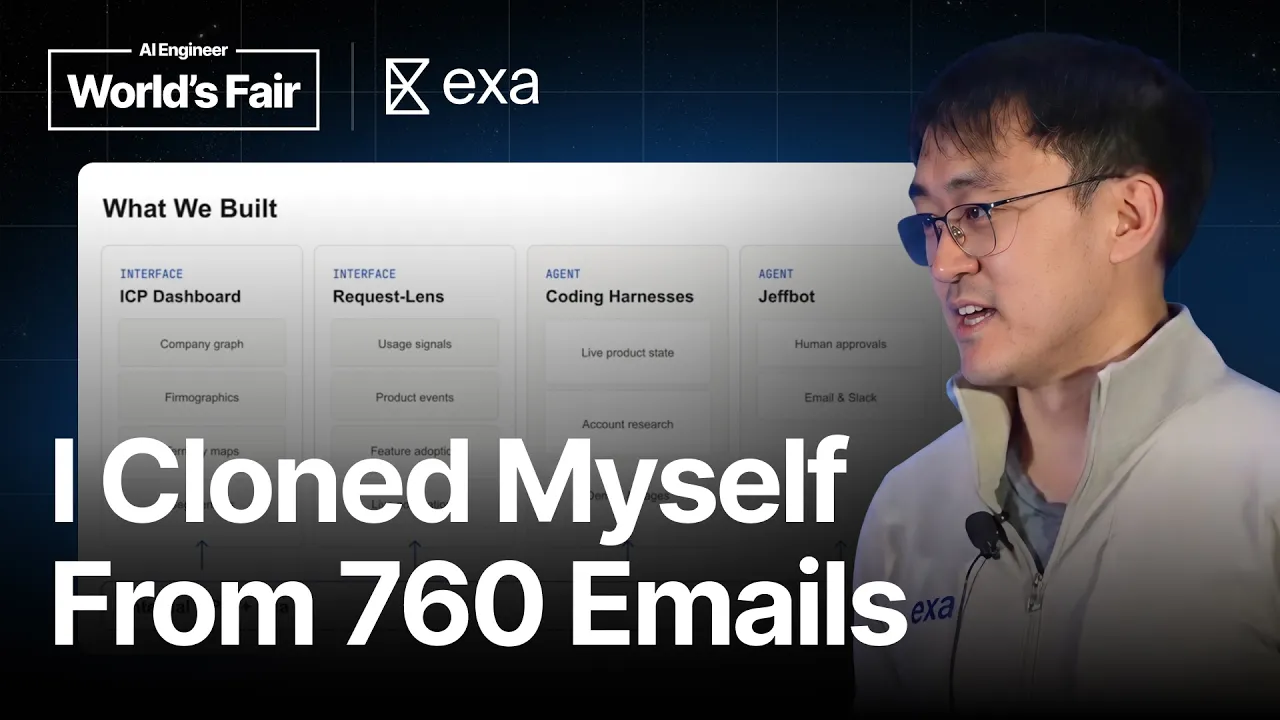
Over a week off, Jeffrey Wang built an AI clone of himself. He analyzed 760 of his own emails to derive his voice, down to averaging 18 words and signing off with best rather than sincerely, then turned hundreds of past decisions into evals to calibrate the agent's judgment against his own. Anyone at Exa can now ask Jeffbot to draft a Slack message. Wang cofounded Exa, a search engine for agents, and his framing is that go to market is now an AI engineering problem. The product versus distribution argument he treats as settled: you need both. Underneath, go to market is a data problem, which means keeping a live model of your world agents can act on. Two interfaces and two agents make it concrete. An ICP dashboard classifies effectively every company in the addressable market, with anticipated spend attached, built by running Exa's embeddings over the web. Request Lens fires when something meaningful happens to a customer: a signup, a surge in searches, a sudden stop. The go to market team runs about a dozen agents in Slack against internal data. Wang closes on three principles: agent first requires API first, since agents cannot reach data without a programmatic interface; not everything should be a chatbot, because a consistent UI you learn once still beats a generated one; and buy versus build is a false dichotomy where what matters is whether the system is arbitrarily customizable. In the Q&A: Jeffbot reads and writes only when Wang calls it, and can only draft for anyone else. Speaker info: - https://x.com/jeffzwang - https://www.linkedin.com/in/wangzjeff/ Timestamps: 0:00 - Exa, and why engineers should care about go to market 2:56 - Go to market is a data problem 3:58 - A live model of your world that agents can act on 5:18 - The ICP dashboard: classifying your whole market 6:59 - Request Lens: alerts when something matters 7:41 - A dozen agents in Slack, and the go to market spend 8:22 - Jeffbot: cloning yourself from 760 emails 10:19 - Agent first means
Summary
Generated by gpt-5.6-terraAt-a-Glance
- Verdict: Watch fully
- Core thesis: Exa treats go-to-market as an AI engineering and data-systems problem: build a live model of customers and product signals, expose it through programmatic interfaces, and let agents plus purpose-built UIs drive account research, outreach, demos, and decisions.
- Why it matters: This is a concrete operating model for turning internal and external data into an agent-accessible GTM control plane, including API/MCP architecture, event-triggered workflows, role design, and permission boundaries.
- Best use: Use it as a design reference for an agent-native revenue system—especially the combination of ICP intelligence, behavioral signals, Slack-based agents, configurable SaaS systems, and FDE ownership.
Executive Summary
Jeffrey Wang argues that product quality and distribution are not substitutes: a company needs both. His central reframing is that modern GTM is fundamentally a data problem. The job is to maintain a current model of the company’s market—accounts, people, use cases, product usage, and changing external events—on which agents can act.
At Exa, that model is operationalized through two recurring interfaces. An internal ICP dashboard classifies companies across Exa’s addressable market and attaches account-level attributes such as anticipated annual spend and company metadata. A separate Request Lens system notifies the team when meaningful customer events occur, including signup, heavy usage, usage decline, or activity from strategically important accounts.
Agents sit on top of these systems rather than replacing them. Exa’s GTM staff use a Slack-based ecosystem of roughly a dozen agents with broad internal-data access for account research, custom demos, and other deal work. Wang’s example, JeffBot, is a calibrated executive proxy trained on his emails and prior Slack/email decisions; it produces draft responses and decisions for staff, but with materially reduced permissions when invoked by others.
The operating principles are pragmatic: agent-first requires API-first access to internal and external systems; stable GUIs remain valuable alongside flexible chat agents; and the key buy-versus-build criterion is not ownership but whether a system is arbitrarily customizable and agent-accessible. Exa uses Salesforce as its database and exposes it to agents through MCP rather than replacing it.
Key Takeaways
- Claim: GTM should be engineered as a live data system rather than managed as a collection of isolated sales and marketing tasks. | Evidence: Wang frames customer research, target discovery, contact identification, POC creation, and account monitoring as one unifying data problem spanning internal company data and a world of more than 60 million companies, billions of people, LinkedIn data, and continuously changing news. | Implication: Build a continuously updated account and signal layer before optimizing individual agent prompts or outbound sequences; otherwise agents lack the world model needed to make useful GTM decisions.
- Claim: A durable ICP system should classify the whole relevant market and support account-level investigation, not merely store a hand-curated lead list. | Evidence: Exa’s internal ICP dashboard categorizes companies in its TAM into segments such as model providers, AI coding platforms, and GTM intelligence tools; each company can then be inspected for expected annual spend and other metadata. Wang describes Exa technically as embeddings over the internet, used for semantic filtering and market segmentation. | Implication: For agentic account selection, prioritize a semantic company universe with explicit segment definitions and enriched account records, then treat scoring outputs as hypotheses to validate rather than ground truth. | Caveat: The presentation does not describe validation methods for predicted spend, classification accuracy, data freshness, or how the system handles ambiguous companies.
- Claim: GTM agents become operationally valuable when they are triggered by meaningful product and account signals, not just used on demand for generic research. | Evidence: Exa’s Request Lens alerts the team when someone signs up, conducts many searches, stops using searches, or when a high-priority person appears. These events are presented as signals the team can immediately act on. | Implication: Define a small set of high-intent and churn-risk events, attach an owner and next-step workflow to each, and avoid building a notification feed that lacks decision rights or follow-through. | Caveat: The speaker does not provide alert thresholds, routing logic, false-positive rates, or measured conversion impact.
- Claim: The most effective near-term model is a hybrid of persistent task-specific interfaces and flexible conversational agents. | Evidence: Wang rejects the idea that every AI experience should be a chatbot. He argues that stable, repeatable use cases benefit from a consistent UI users can learn, while chat agents provide arbitrary flexibility; Exa uses both dashboards and Slack-based agents. | Implication: Use structured dashboards for repeatable workflows such as ICP review and signal triage, while reserving agent chat for investigation, synthesis, drafting, and ad hoc workflow creation.
- Claim: Executive-proxy agents can accelerate decisions and communications if they are built from behavioral artifacts and evaluated against real historical decisions. | Evidence: Wang built JeffBot during a week using Opus 4.5 by analyzing 760 emails for stylistic patterns, reviewing hundreds of decisions from Slack and email, creating a decision-making framework, and constructing evals to calibrate behavior. Employees use it to draft Slack messages, decisions, and emails. | Implication: If building an executive agent, separate style imitation from decision-policy evaluation, source examples from real decision artifacts, and keep outputs in draft/recommendation mode unless the action class is tightly bounded. | Caveat: A clone trained on historical communications can reproduce past judgment patterns but cannot by itself guarantee sound decisions under new strategy, changed market conditions, or sensitive circumstances.
- Claim: Agent-first architecture depends on programmatic system access, while authorization must be scoped by caller and action rather than granting every agent universal authority. | Evidence: Wang says all relevant internal and external data need a good API—whether API, MCP, CLI, or another programmatic interface. In the security discussion, JeffBot has broad read/write access when Wang invokes it, but other employees can only use it to draft messages and are denied access to all MCPs and tools. | Implication: Design agent permissions around identity, caller context, tool-level scopes, and allowed action classes; never infer that a founder-level agent should expose founder-level access to every user. | Caveat: The transcript describes permission differentiation at a high level but does not cover auditing, approval gates, data classification, prompt-injection defenses, or revocation procedures.
- Claim: Forward Deployed Engineers can combine revenue support with rapid GTM tooling development, compressing work that historically sat across solutions engineering and separate internal-tool teams. | Evidence: Exa’s GTM organization includes AEs, SDRs, and an FDE function. Non-FDE GTM employees are trained to use AI tools, while FDEs maintain and add features to the AI systems while also supporting and running deals. Exa had about eight or nine FDEs at roughly 115 employees. | Implication: For an early or mid-stage AI-native GTM organization, give technically strong revenue operators ownership of both deal execution and workflow tooling, then plan to split responsibilities when maintenance and specialization become bottlenecks. | Caveat: Wang explicitly says this all-in-one FDE model may not scale indefinitely as the team grows.
Detailed Brief
Buy versus build: optimize for agent-accessible customizability
- Claims: Wang considers the conventional choice between buying SaaS and building proprietary GTM software a false dichotomy.; The higher-order criterion is whether a system can be customized on demand and made to work on the organization’s behalf.
- Evidence: Exa uses Salesforce rather than replacing it because it provides a mature sales database and embeds accumulated product choices about how sales operations should work.; Salesforce is exposed through MCP, allowing Exa’s agents to access it as part of daily work.
- Caveats: “Arbitrary customizability” still requires reliable APIs, adequate data models, governance, and engineering capacity; MCP exposure alone does not make a rigid workflow operationally flexible.
- Implications: Retain mature systems of record when they offer strong primitives, then build the agent and workflow layer around them instead of reflexively rebuilding their UI and data model.
Human adoption model and organizational enablement
- Claims: Exa does not require every GTM employee to become a software builder.; The company’s operating model emphasizes AI literacy and tool use across AEs and SDRs, with deeper system-building concentrated in FDE.
- Evidence: Wang says most non-FDE GTM staff are not generally vibe-coding the interfaces, although there are exceptions.; The company runs training sessions to ensure employees understand how to use the tools effectively.
- Caveats: The transcript offers no adoption metrics, quality controls for agent-generated outputs, or evidence that training alone produces durable behavior change.
- Implications: Separate broad operator enablement from platform ownership: train all revenue staff on agent workflows, but assign accountable technical owners for reliability, maintenance, and iteration.
Notable Concepts & Terms
- Live model of the world: Wang’s term for a continuously useful representation of relevant companies, contacts, customer data, product behavior, and external events that agents can query and act on.
- ICP dashboard: Exa’s internal market-intelligence interface for classifying its addressable company universe and exploring enriched account records.
- Request Lens: An event-driven notification system that surfaces account activity such as signup, high usage, declining usage, and activity from priority people.
- JeffBot: A founder proxy agent built from Wang’s communication style, historical decisions, evaluation set, and connected company systems, with different privileges depending on the caller.
- API-first / MCP: The architectural prerequisite for agents to access systems and data programmatically; Wang treats the exact interface type as less important than dependable machine access.
- Crystallized UI: A stable, repeatable user interface for recurring tasks, contrasted with an open-ended chatbot or dynamically generated UI.
- Forward Deployed Engineering (FDE): A technical revenue role that both supports customer deals and builds or maintains the internal AI systems that improve GTM execution.
- Arbitrary customizability: Wang’s decision criterion for GTM software: a purchased or home-built system is valuable if it can be adapted quickly to changing needs and used by agents.
Operator Notes / Why Ken Should Care
- Audit the current GTM data plane: identify the systems of record, external enrichment sources, and product events that agents need, then expose the highest-value sources through scoped APIs or MCP tools.
- Select three event classes—high-intent activation, expansion signal, and churn-risk behavior—and attach explicit owner, SLA, and recommended agent workflow before rolling out alerts.
- Prototype an executive-drafting agent using a constrained corpus of past decisions and communications; require evaluation against held-out decisions and restrict it to draft mode for general users.
- Establish a caller-aware authorization model for every agent: separate read, draft, recommend, and execute permissions; log tool calls and require approval for consequential writes.
- Consider an FDE-style pod for revenue tooling, with a mandate to convert recurring deal friction into reusable workflows while maintaining a clear boundary between experimental tools and systems of record.
- Do not replace Salesforce or another mature CRM solely to become “AI-native”; first test whether an agent layer over its APIs/MCP can deliver the needed flexibility.
Source/Metadata
- Title: Knowledge Systems: The New GTM Stack — Jeffrey Wang, Exa
- Transcript words: 4617
- Duration seconds: 1129
- Timestamp note: No usable timestamps or chapters were present in the supplied transcript; the Q&A portion is duplicated and ends with extraction noise.
Transcript
. Hey everybody, I'm Jeff. I guess I was introduced, but I'm the co-founder of Exa, and today I'm going to give a talk on turning go-to-market into an AI engineering problem in the spirit of this AI engineering affair. And just a quick show of hands to understand the audience: raise your hand if you're technical. Okay, great. Okay. So I oriented this talk around go-to-market as presented to engineers. So I'm happy that I did that. Cool. So first, just to ground what Exa is, because it's relevant inside of this presentation, Exa is a search engine for agents. Think: agents are really smart, but they don't have access to the web. We're this web MCP, web tool that agents can access. We power Cursor, we power Cognition, we power a lot of the AI ecosystem at this point. And before we start, I also just want to talk about, especially as a technical audience, why should you even care? Why should you care about go-to-market? I guess this audience cares about go-to-market because you chose to go to this go-to-market talk. But I think there's this funny narrative right now, which is people are like, oh, product is the only thing that matters, or distribution is the only thing that matters. And there's all sorts of Twitter flame wars, like, oh, is Cluelly going to succeed because they're really good at distribution, but what the heck is their product? And then other people are like, oh, the product needs to be super good because agents shop for the product, so they'll shop for the best product. And so my view and my experience in the last few years is that you just have to do both. I think you have to get product right and you have to get go-to-market right. You've got to build the thing, it's got to be good, and then you've got to get it into people's hands. If you don't do both things, then you don't have a company. So that's my view on the matter. And I would say a really funny thing also is, as a technical person, when you start a company or you start some sort of project, very much so the bias is, hey, I'm going to just build the thing. I'm going to make it really, really freaking good, right? That's the bias you have as an engineer. That's the bias we had when we started EXO, and we were honestly pretty bad at go-to-market. We were not doing enough marketing, we were not doing enough sales. But I think the cool thing about go-to-market, particularly in 2026, is you can treat go-to-market like an engineering problem, and particularly an AI engineering problem. And so I think that's a super exciting thing. It's more fun for engineers than ever to do go-to-market, because you can automate things, you can do so much as one person, et cetera. Also, I want to make this interactive. If anybody has questions at any point, please ask, because I'm aware there's a lot of talks, and I don't want to bore you. Cool. So the hypothesis I have is if you're an engineer, or if you're anyone, you can treat go-to-market like an engineering problem. So first, what do go-to-market teams do? I have a laundry list of things here, of things that go-to-market teams do, but here are a few. One is you've got to research your customer, right? You've got to research your targets. You have to find out information about targets. You have to find the right people at particular companies. You have to build POCs. There's a ton of stuff you have to do, right? So I'm not going to list everything here, but what is the grand unifying theme? Well, go-to-market is a data problem, right? So you have this entire world of what your product does, and then this entire world of all your potential customers, and you're just trying to learn and figure out what your world looks like. And so this is my proposal. It's a data problem, and we have to solve it from a data perspective. Cool. So what is the data that is relevant? I propose that you need a live model of your world that agents can act on. And so what does that mean? Okay. Well, one is you have a ton of internal data, right? There's all this information that you know about your customers, about people that are at your company, data about how people use the product. That's internal data that you know. And then there's all sorts of external data, right? There's over 60 million companies in the world, and there's billions of people, over a billion that are on LinkedIn, for example, and all sorts of stuff is happening every day, right? There's all this news. And so when you're building this data go-to-market system, it's important to keep in mind all the different sources that exist and are available to your agents. And cool. So I'm going to go through, hopefully pretty fast, all the different components of what we've built at Exa. And just for context, I've been really passionate about this for a long time. So Exa was launched in the middle of 2023, and so we were post-GPT4, and GPT4 was really incredible because it could actually, even then, even though it's way worse than Fable or whatever, actually just automate entire parts of go-to-market. And so from the beginning, I've been thinking about our go-to-market from a very, very AI agent-first perspective. And so we're going to go over two interfaces that we have that help us, and then two agents. Cool. Cool. Okay, the first is what we call our ICP dashboard. And the ICP dashboard is a product that we have internally that answers the question: what is our world? What is the world of customers and use cases that we care about? And what we actually do is we go ahead and use Exa, and again, Exa is this arbitrarily powerful search engine for AIs, essentially, and we just classify every possible company that is inside of our total addressable market. And I blurred out some of the details on how much money we make from each category and stuff like that. But yeah, we have categories like model providers, AI coding platforms like, say, Cursor, go-to-market intelligence tools. And this makes up our TAM, and we have an understanding of almost every company within those segments. And then for each of those companies, we can deep dive, right? So here's the example of SpaceX. We can see how much annual spend we could anticipate them to have, then all this metadata about the company. So we have a list of all the companies and then a ton of data about each company. How do we do this? Again, we're able to do this because Exa is this search engine. We take the Internet, we crawl it, we train embeddings to do web search really well. And so basically, from a technical perspective, you could think about Exa as embeddings over the Internet. And when you have embeddings over the Internet, you have this arbitrarily powerful semantic filtering and slicing and dicing of any type of data that you want. And so we use that to generate this gigantic list of potential ICPs. Cool. Next, we have a tool we call Request Lens. Request Lens, what is Request Lens? Well, it's basically a system where any time something significant happens with any of our customers, we're alerted. Someone signed up. Someone used a ton of searches. Someone stopped using searches. Someone showed up that we really, really care about. All these things are signals that we are notified about and that our team can act on. Cool. So those are the two interfaces that we have. And then I'll go over two types of agents that we have. So one is coding agents. So our go-to-market team is crazy, crazy, crazy deep on agents. Our engineering team uses a lot of agents, but our go-to-market team is, you could look at some of their dev spend and other agent spend, it's really freaking high. And that's because everybody on our go-to-market team is constantly asking agents about our customers. We have account executives that build demos for our customers. It's a system where any time something significant happens with any of our customers, we're alerted. Someone signed up. Someone used a ton of searches. Someone stopped using searches. Someone showed up that we really, really care about. All these things are signals that we are notified about and that our team can act on. Cool. So those are the two interfaces that we have. And then I'll go over two types of agents that we have. So one is coding agents. Our go-to-market team is crazy, crazy, crazy deep on agents. Our engineering team uses a lot of agents, but our go-to-market team is, you could look at some of their dev spend and other agent spend. It's really freaking high. And that's because everybody on our go-to-market team is constantly asking agents about our customers. We have account executives that build demos for our customers. It's just this crazy ecosystem where we have maybe a dozen different agents inside of our Slack, and anybody can use any of them. They all have access to tons and tons of our internal data. And, yeah, any time we want to dig deeper on an account, any time we want to make a demo, et cetera, we depend heavily on agents. Cool. And then I want to talk about another really cool agent that I'm pretty proud of. We call it JeffBot. Or I call it JeffBot. JeffBot is an AI clone of myself as much as possible. So what is it? This winter break, I'm sure a lot of you spent that break playing with Opus 4.5, and I was no different. So I was in Puerto Rico. No, I was in Mexico. I was in Mexico, and I had a week off. And so my goal with that week and with Opus 4.5 was to just try to make a digital clone of myself. And so I did things like analyze 760 of my emails to figure out what my email voice is. Like, oh, I use 18 words on average per email. And I like to end emails with best and not sincerely. All that type of stuff, right? So I made a voice for myself. And then I also made a decision-making framework. So I made a decision-making framework where I analyzed hundreds of decisions I've made in the past. And I analyzed them, and I created evals. So I actually created evals from those decisions and calibrated this agent system to behave like myself. And then finally I gave it read and write access to all the data that I am. And I personally have. And there's a cool advantage to this because I basically have access to every single system at the company. Because I'm in the nice seat of having that. And so, yeah, this thing has access to everything. And basically what happens is anybody at the company can use JeffBot to create drafts of Slack messages that are basically answers or decisions that are made. And this is a huge, great thing. Our go-to-market team uses it to draft emails, for example. Cool. All right. So those are the systems that we have at Exa. It works pretty well. Our go-to-market team is very lean but very productive. And so, yeah. I just want to cover, lastly, just a few principles. Principles I have around what it means to be an agent-first company. So, firstly, to be agent-first, you must be API-first, right? All these systems that we built, whether it was those agents or whether it was those GUIs that we have, if there did not exist really good APIs on top of any internal and external data, we'd be out of luck, right? You need to create really good APIs. If you don't have really good APIs, your agents are not going to be able to have data access. So you can think about this as MCP, CLI, whatever, right? It doesn't really matter. You just need some interface that's programmatic. Secondly, I think there's still this mistake in the agent world that's made. Hey, does everything need to be a chatbot? I think the answer is no. I think both GUIs and chatbots are both super useful and have their own benefits. I don't know how many people in the room have thought about dynamic user interfaces, but yes, dynamic user interfaces are amazing. Yes, technically AI can just produce a new UI for any use case that you have. Just to answer a question, it could produce an HTML markdown file, right? But I think there is something really nice about being able to visit the same consistent UX for the same use cases over time so that you can learn how to use some tool. So, yeah, I think having crystallized UIs and then also arbitrarily powerful, flexible chat agents are both important components of being agent first. And then finally, there's this question, hey, should you shop for Salesforce or should you build your own CRM or something, right? I actually think this is a false dichotomy. It's not a choice. We don't live in a world where the choice is between purchasing SaaS and building things yourself. The way I like to think about it is you should just be using something that is arbitrarily customizable, right? Obviously, if you build something yourself, then it's arbitrarily customizable because you can vibe code and make it better at any given point. But also if you procure SaaS, if you can make that SaaS work on your behalf and be arbitrarily customizable, then that works too, right? You don't need to build this GUI and have a proactive roadmap as to what features make really great sense inside of some system. If you can arbitrarily customize the system, even if it's a system you've purchased, then you're pretty good, right? So, for example, we use Salesforce. We use Salesforce at Exa, and it's great because it's a really good database. It's made a lot of amazing choices around what sales should look like, choices that we don't want to make ourselves, and then it's exposed as MCP. So all of our agents have access to Salesforce MCP. It works really well. Our team uses it every day. And so, yeah, I think infinite customizability is really the highest-order bit. Cool. That's all I had. Yeah, does anybody have any questions? We have time for questions. Okay, coming. Hey, so you said you took all your past decisions. Can you elaborate a bit about that? What artifacts are those? Usually people don't save their decisions. Is it Slack? Is it email? Is it other artifacts? Yeah, good question. I looked at decisions I made within Slack and email. A surprisingly large amount of everything that goes on in a company is on Slack, right? So if you just read a ton of Slack history, you can definitely find hundreds of decisions that you've made in the past. Awesome. Quick question over here. So your go-to-market team, what's the split between, are they just all AI-cracked? Or do they also have the domain expertise too? What's the split between technical and non-technical? Because obviously you need them to know how to do marketing, sales, et cetera. But are they also upskilling in terms of using AI systems? Are you handing them tools or are they building their own? That's a very good question. So our go-to-market team is comprised of account executives, which run the deals. There are sales SDRs that help with demand generation. And then there are separately a FDE org, so Forward Deployed Engineering Organization. And what I'll say is that everyone that's not in FDE has learned how to use AI really well. So the answer is they're not vibe coding. They're not generally, with some exceptions, vibe coding these interfaces that we have. But they are using the tools really, really well. And we make sure that we have training sessions and just make sure that people really understand how to use these tools. And then we have this funny thing, which is that our Forward Deployed Engineering Organization is actually the one that does a lot of the maintenance and feature building of these AI systems. And so they're both running deals and supporting deals, but then also making everything smoother by doing sales, but then also building the sales system. It's kind of a funky thing we have going on. Yeah. So, the answer is they're not vibe coding. They're not generally, with some exceptions. They're not generally vibe coding these interfaces that we have. But they are using the tools really, really well. And we make sure that we have training sessions and just make sure that people really understand how to use these tools. And then this funny, we have this funny thing, which is our Forward Deployed Engineering Organization is actually the one that does a lot of the maintenance and feature building of these AI systems. And so they're both running deals and supporting deals, but then also making everything smoother by doing sales, but then also building the sales system. It's a funky thing we have going on. Yeah. How do you think about different security boundaries within your enterprise? What you said suggested that you've got Jeffbot, which runs with all of your full privileges, and then it's available to everybody, which suggests that there's one security level and everyone can see everything all the time. Is that what you're going with, or is there some other guardrails in place? Yeah, that's a good question. We pay pretty careful attention to guardrails. So, for example, in the case of Jeffbot, when I use Jeffbot and I call Jeffbot, it has access to a ton of systems and it can, for example, do reads and writes. However, when anybody else calls Jeffbot, all it can do is draft messages, and also I don't give Jeffbot permissions to all of our MCPs and tools in the case of what other people call it. And so, in short, it's pretty well defined, or we do pay some care to the security. Okay, last question. Can you share the origin story of the FDE team? Did that just happen organically or did you intentionally do it? I'm just really curious how that came to exist. Yeah, for sure. My hypothesis on this is once upon a time the FDE role didn't really exist. Palantir started calling some people FDEs, but that was really it. And what tech companies had was solutions and sales engineers and then account executives. I was a solution. Got it. Yeah, yeah. The thing that I think has changed is that because of AI, as a technical person that is supporting revenue generation, you can actually not only support their revenue generation but then very easily build the tooling to smooth everything over. And make your own life easier. Make the lives of AEs easier. Because of AI, this is just possible now. That's two, before that was two jobs and now it's one job. In theory. Now when our team grows, right now it's about eight or nine FDEs. Will it scale such that everyone does everything? Probably not. But at least right now that's what we have, and I think that's a really good working model to get pretty far. Eight out of how many? Oh, eight of, how big is our go to market org? You have eight FDEs and the size of the company right now. Oh, we're about 115 people. Okay. That's yay yay yay yay yay yay yay yay yay yay yay yay yay yay yay yay yay yay yay yay yay yay yay yay yay yay yay yay yay yay yay yay yay yay yay yay yay yay yay yay yay yay yay yay yay yay yay yay yay yay yay yay yay yay yay yay yay yay yay yay yay yay yay yay yay yay yay yay yay yay yay yay yay yay yay yay yay yay yay yay yay yay yay yay yay yay yay yay yay yay yay yay yay yay yay yay yay yay yay yay yay yay yay yay yay yay yay yay yay yay yay yay yay yay yay yay yay yay yay yay yay yay yay yay yay yay yay yay yay yay yay yay yay yay yay yay yay yay yay yay yay yay yay yay yay yay yay yay yay yay yay yay yay yay yay yay yay yay yay yay yay yay yay yay yay yay yay yay yay yay yay yay yay yay yay yay yay yay yay yay yay yay yay yay yay yay yay yay yay yay yay yay yay yay yay yay yay yay yay yay yay yay yay yay yay yay yay yay yay yay yay yay yay yay yay yay yay yay yay yay yay you I mean, a surprisingly large amount of everything that goes on a company is on Slack, right? So, like, if you just read, like, a ton of Slack history, like, you can definitely find hundreds of decisions that you've made in the past. Awesome. Quick question over here. So your go-to-market team, what's the split between, are they just all, like, AI cracked? Or do they also have, like, the domain expertise, too? What's the split between technical and non-technical? Because obviously you need them to, like, know how to do marketing, sales, et cetera. But then do they also, are they also upskilling in terms of using AI systems? Are you handing them tools or are they building their own? That's a very good question. So our go-to-market team is comprised of, like, there's account executives which, like, run the deals. There are, like, sales, like, SDRs that help with demand generation. And then there are separately, like, a FDE org, so Forward Deployed Engineering Organization. And what I'll say is that, like, everyone that's, okay, everyone that's not in FDE is, like, has learned how to use AI really well. So, like, the answer is, like, they're not vibe coding. They're not generally with, you know, there's some exceptions. They're not generally vibe coding these interfaces that we have. But they are using the tools really, really well. And, like, we make sure that we have training sessions and, like, just make sure that people really understand how to use these tools. And then this funny, we have this funny thing, which is, like, our Forward Deployed Engineering Organization is actually the one that, like, does a lot of the maintenance and feature building of these AI systems. And so they're both running deals and, like, supporting deals, but then also making everything smoother by, like, doing sales, but then also building the sales system. Like, it's kind of a funky thing we have going on. Yeah. How do you think about different security? How do you think about different security boundaries within your enterprise? What you said suggested that you've got Jeffbot, which runs with all of your full privileges and then it's available to everybody, which suggests that there's one security level and everyone can see everything all the time. Is that what you're going with or is there some other guardrails in place? Yeah, that's a good question. We pay pretty special, we pay pretty careful attention to guardrails. So, for example, in the case of Jeffbot, when I use Jeffbot and I call Jeffbot, it has access to a ton of systems and it can, for example, do reads and writes. However, when anybody else calls Jeffbot, all it can do is draft messages and also I don't give Jeffbot permissions to all of our MCPs and tools in the case of what other people call it. And so, in short, it's pretty well defined or we do pay some care to the security. Okay, last question. Can you share the origin story of the FDE team? Did that just happen organically or did you intentionally do it? I'm just really curious like how that came to exist. Yeah, for sure. I mean, my hypothesis on this is like once upon a time the FDE role didn't really exist. Like Palantir started calling some people FDEs but that was really it. And what tech companies had was like solutions and sales engineers and then like account executives. I was a solution. Got it. Yeah, yeah. The thing that I think has changed is that because of AI, as like a technical person that is supporting revenue generation, you can actually not only support their revenue generation but then very easily build the tooling to smooth everything over. And make your own life easier. Make the lives of AEs easier. Like because of AI, this is just possible now. Like that's like two, before that was like two jobs and now it's like one job. In theory. Like now when our team grows, like right now it's about eight or nine FDEs. Like will it scale such that everyone does everything? Probably not. But at least right now that's what we have and I think that's a really good working model to get pretty far. Eight out of how many? Oh eight of like how big is our go to market org? You have eight FDEs and the size of the company right now. Oh, we're about 115 people. Okay. That's yay yay yay yay yay yay yay yay yay yay yay yay yay yay yay yay yay yay yay yay yay yay yay yay yay yay yay yay yay yay yay yay yay yay yay yay yay yay yay yay yay yay yay yay yay yay yay yay yay yay yay yay yay yay yay yay yay yay yay yay yay yay yay yay yay yay yay yay yay yay yay yay yay yay yay yay yay yay yay yay yay yay yay yay yay yay yay yay yay yay yay yay yay yay yay yay yay yay yay yay yay yay yay yay yay yay yay yay yay yay yay yay yay yay yay yay yay yay yay yay yay yay yay yay yay yay yay yay yay yay yay yay yay yay yay yay yay yay yay yay yay yay yay yay yay yay yay yay yay yay yay yay yay yay yay yay yay yay yay yay yay yay yay yay yay yay yay yay yay yay yay yay yay yay yay yay yay yay yay yay yay yay yay yay yay yay yay yay yay yay yay yay yay yay yay yay yay yay yay yay yay yay yay yay yay yay yay yay yay yay yay yay yay yay yay yay yay yay yay you