Why a One-Line Change Can Break Your Whole Stack - Cole Gannaway, Qodo
Description
Code generation is moving faster than ever, and the bottleneck has moved to review. Cole Gannaway, a solutions engineer at Qodo, shows how a one-line data model change that passes every test can quietly break web, mobile, CLI and MCP clients, and how a software graph of your repos reveals that blast radius. He covers turning tribal knowledge and PR comments into custom rules, bringing review context in before code is written, why the agent that wrote the code shouldn't grade it, and checking PRs against the original ticket. Chapters: 0:00 Intro 0:59 Review is the new bottleneck 2:03 A one-line change that passes every check 3:35 The hidden blast radius 4:15 Building a software graph 4:56 Custom rules and tribal knowledge 5:47 Context before code is written 6:29 Don't let the writer grade its own code 8:20 Turning PR comments into rules 10:06 Q&A: catching the wrong intent 13:55 Wrap-up Cole Gannaway https://www.qodo.ai Join us in SF for the second annual AIE CODE summit: https://aie.codes our last flagship summit of 2026. Applications live now!
Summary
Generated by gpt-5.6-terraAt-a-Glance
- Verdict: Skim
- Core thesis: As AI accelerates code generation, the limiting control point in a software factory becomes context-rich, independent code review that can detect cross-repository blast radius, validate intent, and turn review feedback into reusable rules.
- Why it matters: Ken’s agent systems need a verification and governance layer separate from implementation agents; passing builds and tests are insufficient evidence that an AI-generated change is safe across a connected system.
- Best use: Use this as a concise vendor-led reference for designing a review/control-plane layer around coding agents, particularly software graphs, independent reviewers, staged checks, and learned organizational rules.
Executive Summary
Cole Gannaway positions Qodo as one component of an AI-native “software factory,” focused specifically on the pull-request and review bottleneck. His central argument is that code generation is improving rapidly, while review, trust, and verification remain constrained because neither humans nor generic CI checks can reliably understand all dependencies and implications of a change.
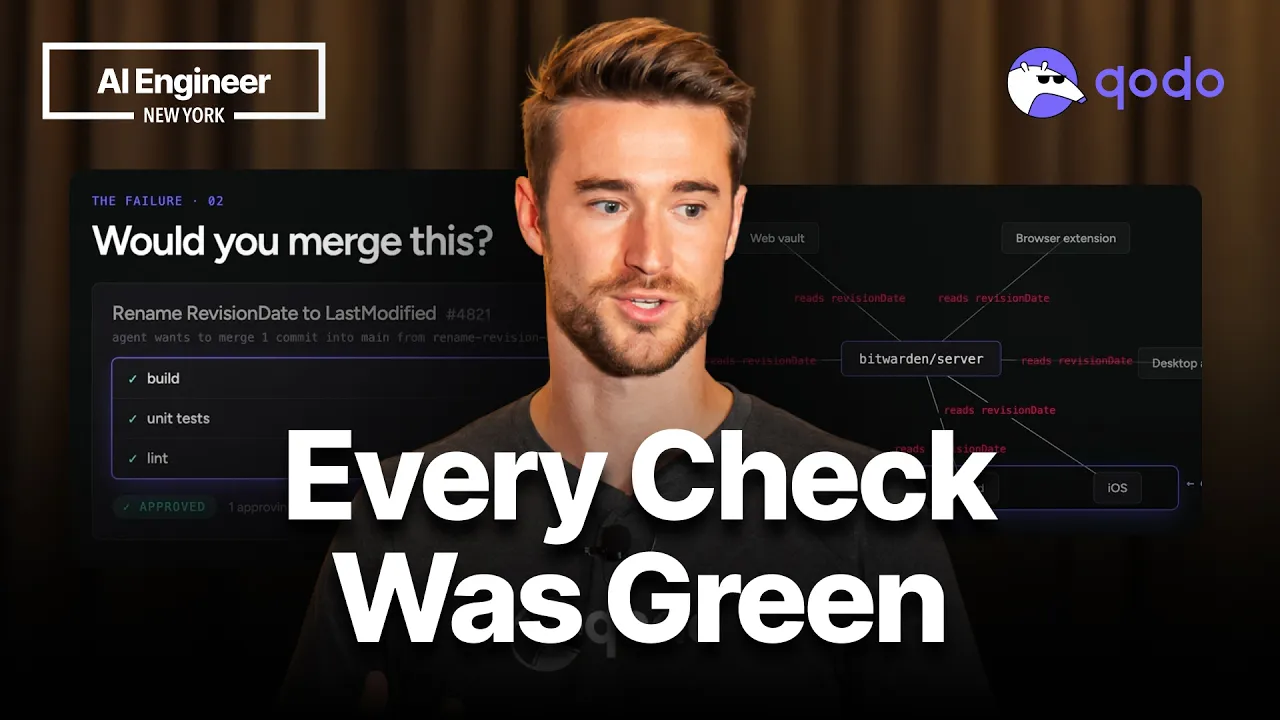
The core illustrative case is a one-line data-model rename in Bitwarden. A reviewer could reasonably approve it after a passing build, unit tests, and linting, yet the modification may affect a backend service, web and mobile clients, MCP servers, and CLI consumers. The relevant issue is not merely repository-level dependency detection, but identifying the precise integration surface and exposing the resulting blast radius before production.
Gannaway’s proposed operating model is to construct a software graph, retrieve task-specific context from tickets and codebase knowledge, apply custom organizational rules, and run an independent review agent before and during implementation rather than only after a PR is opened. He recommends periodic reviews at roughly 25%, 50%, and 75% of a coding task to keep the implementation aligned with its intent and prevent agents from drifting into over-engineering or solving the wrong problem.
The talk also makes a sound agent-design case: the agent that writes code should not grade its own work. Independent reviewers can use different models and harnesses, potentially adversarially, to reduce correlated bias. Review comments and postmortem lessons should then be converted into enforceable rules, so human reviewer judgment becomes persistent organizational knowledge rather than a recurring manual bottleneck.
Key Takeaways
- Claim: The PR/review stage is becoming the critical bottleneck in AI-assisted software delivery, because generation velocity now exceeds the capacity to establish whether changes are trustworthy. | Evidence: Gannaway says customers are enthusiastic about ticket-to-production workflows but repeatedly struggle at pull request and review; he frames review as the “trust and verification layer.” | Implication: Treat review as a first-class control plane in coding-agent workflows rather than as a final passive CI gate. | Caveat: He does not claim code generation is solved; the point is that it is advancing at an unprecedented rate relative to verification.
- Claim: Passing builds, unit tests, and linters cannot establish the safety of a code change when its semantic blast radius crosses repositories and client surfaces. | Evidence: The Bitwarden example uses a seemingly innocuous one-line data-model change that could affect the backend server, web client, Android/iOS clients, MCP servers, and CLI. | Implication: Risk assessment for agent-generated changes should account for downstream consumers and integration contracts, not just local repository health. | Caveat: Bitwarden is explicitly presented as an illustrative example, not a documented production incident attributed to that project.
- Claim: A useful review system needs a granular software graph: it must connect repositories and identify the actual components and interfaces affected by a change. | Evidence: Qodo’s stated approach is to automatically build a graph of team repositories plus their integration surface; Gannaway distinguishes this from merely knowing that two repositories are connected. | Implication: For multi-repo systems such as an OpenClaw ecosystem, prioritize dependency and contract intelligence that can be retrieved into an agent’s decision context.
- Claim: Review context should be available before code is written and repeatedly during implementation, not only once a PR is ready. | Evidence: The talk proposes supplying MCP-accessible codebase wisdom and custom rules to coding agents pre-PR, then running review checkpoints at approximately 25%, 50%, and 75% completion. | Implication: Build agent workflows with intermediate intent and design checks, especially for long-running tasks where context can become diluted and implementation can drift. | Caveat: Earlier feedback improves the odds of a correct first attempt but does not eliminate mistakes or remove the need to verify consequential changes.
- Claim: Ticket and acceptance-criteria context can detect implementation-intent failures, including agents over-engineering a request or addressing the wrong problem. | Evidence: In response to an audience question, Gannaway describes Jira and Linear integrations that inject ticket content into PR review and flag requirements gaps against the ticket’s acceptance criteria. | Implication: Connect task specifications to implementation reviews, but add a mechanism for agents or reviewers to challenge unclear requirements rather than treating tickets as ground truth. | Caveat: This only works to the extent that tickets capture the true intent; the audience question correctly identifies ambiguous or incorrect upstream intent as a separate failure mode.
- Claim: The implementation agent should not be the sole evaluator of its own code; independent models and harnesses can reduce self-confirming errors. | Evidence: Gannaway argues that implementation agents are already occupied with exploration, debugging, and coding, while a dedicated reviewer has focused context; he suggests varying the underlying LLMs, harnesses, and using adversarial reviewers. | Implication: Separate generation from verification in agent architecture, and diversify review paths for high-impact changes instead of relying on one model and one toolchain. | Caveat: Agreement across reviewers is described as higher signal, not proof of correctness; divergent reviewer conclusions require investigation rather than an automatic decision.
- Claim: Human review comments and code-level postmortem lessons should become reusable, automated policy rather than remain ephemeral tribal knowledge. | Evidence: Qodo is shown suggesting a future rule from a PR comment; one example rule requires a deprecation flag or heightened review when public APIs change. | Implication: Create a governed pipeline from reviewer feedback to versioned rules, while keeping process and organizational lessons in separate operating mechanisms. | Caveat: Not every postmortem finding is codifiable: Gannaway notes that many lessons concern organizational or process changes rather than code-level rules.
Detailed Brief
Toward selective human-free merges
- Claims: The next decision layer is not simply whether automation can merge code, but which changes can safely bypass human inspection.; Blast-radius information is proposed as an input to that merge-policy decision.
- Evidence: Gannaway says organizations are already merging some PRs without a human looking at them and frames the product direction as determining which PRs should and should not receive that treatment.
- Caveats: The presentation offers no concrete thresholds, false-positive rates, policy examples, or evidence that a software graph alone is sufficient to authorize autonomous merges.
- Implications: Autonomous merge permissions should be tiered by impact and reversibility, with blast radius as one signal among test quality, authorization boundaries, contract changes, and rollback readiness.
What Qodo is and is not claiming to solve
- Claims: Qodo is positioned as a specialized review and code-intelligence layer within a broader software factory, rather than an end-to-end autonomous delivery system.; Its proposed context sources extend beyond source code to ticketing systems, custom rules, MCP servers, and accumulated codebase knowledge.
- Evidence: Gannaway repeatedly says Qodo is “a critical part” rather than the complete software-factory picture and cites Jira and Linear as available integrations.
- Caveats: The session is a vendor presentation and provides architecture claims and product demonstrations, but no independent benchmarks, customer outcomes, deployment constraints, or pricing/security detail.
- Implications: Evaluate the design pattern independently of the vendor: determine whether an existing code-search, dependency-analysis, CI, and agent framework stack can supply the same control-plane primitives.
Notable Concepts & Terms
- Software factory: The envisioned ticket-to-production system of humans, coding agents, review agents, CI, and organizational knowledge; Qodo focuses on its review/verification segment.
- Software graph: A machine-usable map of repositories, components, dependencies, and integration surfaces used to determine the impact of a proposed change.
- Blast radius: The downstream systems, interfaces, clients, or repositories that may break or require coordinated changes after a local modification.
- Codebase wisdom: Codified tribal knowledge, review history, conventions, and learned rules supplied to agents as operational context.
- Independent review agent: A specialized verifier separate from the coding agent, intended to have focused context and avoid an agent self-approving its own output.
- Adversarial reviewers: Multiple reviewer configurations, models, or harnesses examining the same change to expose correlated blind spots and disagreements.
- Requirements-gap review: Comparing a change against linked ticket acceptance criteria to identify missing requirements, unintended scope, or implementation drift.
- MCP: Model Context Protocol is presented as a mechanism for exposing codebase knowledge and review context to coding agents before PR creation.
Operator Notes / Why Ken Should Care
- Define a merge-risk policy that explicitly classifies cross-repo contract changes, public API changes, auth/security changes, and broad dependency changes as mandatory independent-review cases.
- Instrument coding-agent runs with staged verification checkpoints; test 25%/50%/75% review gates on longer tasks and require remediation or explicit continuation decisions after material findings.
- Maintain a versioned rule-creation workflow: convert recurring PR comments and incident findings into scoped, testable agent-review rules, with ownership and expiry/review dates.
- Run an architecture evaluation for an independent reviewer path using a different model and, where feasible, a different harness from the implementation agent; measure agreement, disagreement, and false-positive burden.
- Assess whether current repository metadata can produce a component-level dependency graph and integration-contract map before evaluating a dedicated vendor solution.
Source/Metadata
- Title: Why a One-Line Change Can Break Your Whole Stack - Cole Gannaway, Qodo
- Transcript words: 4653
- Duration seconds: 890
- Timestamp note: No timestamps or chapters were present in the supplied transcript; substantial portions of the talk appear duplicated.
Transcript
Well, thanks so much for showing up to this discussion here. I'll probably actually ask for a little audience participation as well. We'd love to get to know how you guys are thinking about things. The goal of today is to talk about CODO, which is the organization I'm representing, as well as how software factories have evolved. This is what we're seeing in the industry, where a lot of AI native or AI first companies are starting to head. I think everyone has a grand vision of where these factories can go, and we believe CODO is a critical part of that, not the complete picture of that. So there's an element of what we do, where we specialize, and then areas that are outside, and we'll make sure to be clear on some of that. I'll hop into the first one that's worth walking through. I'm what's called a solutions engineer, so I spend time with organizations talking through how our product or other products might fit into their workflows and teaching about CODO as a platform. What I often hear from customers is that they're super excited about going from ticket all the way to production, from somebody generating code or somebody coming up with a ticket and being able to push that all the way through. And what they're finding is at the pull request level or at the review stage, they're struggling. This has become a huge bottleneck. Code generation, I wouldn't say is solved, but it's definitely moving at a rate that we've never seen before. And so this has been a big bottleneck. This is also where it's critical that we provide the human or the coding agent or the review agent with as much context as we can to make sure that we're making the right decisions. This is really the trust and verification layer. All the other components are still valuable, but just worth noting that's where we'll focus a lot today is on that review section here. I want to give a practical example. As I mentioned, code generation is not necessarily solved, but when we're looking at code and when we're creating features and when we're trying to generate new code, new features, we can often miss things that we're not trying to. So this is an example where we have just a one line change. This is on Bitwarden, which is an open source password manager. And you'll notice that we have just one line change to our data model. If I was a developer and I saw this, it seems good to me, right? I'm going to say this seems like the right change. I want it to rename it. I would probably merge it. I would probably look and see that the build passed, that unit test passed, maybe even my linters passed. It seems like this is a change that we needed. This is a feature that we wanted. Let's approve it. So I'm curious, maybe just from a show of hands, but how are you guys when you're talking about code review or review changes? I would imagine you have a bunch of tools. When they all give you green checks, does that mean it's good to go? Or what does that look like for you guys? Maybe a show of hands, how many have merged a PR that they were like, seems good to me, not 100% sure. I didn't look at all the lines of code. Maybe just a raise of hands. Yeah. Right. So everyone here, I think just about everyone here is, we can't look at all the lines of codes that have changed. So we rely on these tools. There's a bunch of great tools out there worth noting, not all tools are built the same and not all context is built the same. And this example that we would have just merged, we would have missed the blast radius or the effect that this can happen. This one line of code change can affect multiple repos. And this example, again, I'm using Bitwarden as an illustrative example. We have a back-end server that could be connected to web clients that could be connected to mobile or iOS devices. It could be connected to MCP servers or CLI. And you'll notice that all of these components are affected on that one line of change. So this is typically found in production, right? Maybe a bug or a user story or the web app crashes. And so we'd love to be able to catch this as early as possible. Context is king here. One of the things that Codo will do, and I think is really important, is build out a software graph of the repositories that your team is working on today. This will build it out automatically. And it'll also build out an integration surface. So not just you'd be disappointed or it wouldn't be as valuable if we said just Bitwarden server was connected to Bitwarden Android, but not what the actual components are that are connected. And so this is a huge area of if we're building this software factory, if we're not looking at every line of code, how do we get this to my agent, to my review agent, to be able to take this into account. Another thing that's worth calling out is not everything is purely functional. Some are going to be a bit more senior level reviewers, custom rules, maybe a bit of taste that's involved. And how are we learning from some of our past mistakes? So when we go back to the software factory, for example, here, we have a human that reviews it. But is there a way that we can bring that human reviewer back into the code intelligence, back into the review layer, rather than it just being every time that's the bottleneck, if that makes sense. So in this example here, we have a custom rule that we can add, which says, hey, if we're going to change anything about public APIs, we want to make sure that we add either a deprecation flag, or we review this a bit more. Additionally, we'd love to have this information pre-PR, pre-code generation. So is there an opportunity for us to bring this information in before we've ever generated a line of code, knowing that we have potential downstream effects if we make some of these changes? These are some of the areas you can see that in this example, we've got an MCP server, we've got code-based wisdom, we're getting those custom rules or tribal knowledge that might exist, bring all that into our coding agent long before we're pushing it up. That doesn't guarantee that it's not going to make mistakes, right? I think anybody would say that we want to double check, but this gives us a much better opportunity and a much better shot at making it right on the first try. Worth calling out here, I think many organizations are thinking, should I just use Claude Code or my implementation agent to just do the review? This review stage has some information, but some of this is actually valuable in the actual generation stage. It's also worth noting that an implementation agent has a bunch of other things that it's doing that are not related to review. And context windows are getting bigger, but that doesn't mean that things don't get buried, that doesn't mean things don't get hallucinated. And so there's debugging, there's implementation, there's exploring the code base versus a review agent has a specific set of context that we want to use. And you'll notice here on the right, we potentially have some room to focus on other things as well. So not just the code base wisdom that we saw or the graph, we can even bring in more information that might be custom to this specific run or this specific review that we have potentially some room for as well. So this goes into the agent that wrote the code. We don't need him grading the code. One, we have more context window available. The other is we want to make sure that these are independent. So that can be things like the LLM that's being used under the hood, whether it's Anthropic, whether it's OpenAI, whether it's open weight models. Can we leverage multiple models to try to get rid of some of that bias? Another is the harness. If the harnesses are the same, we can have some bias there. We would love to be able to swap out all of these or even make adversarial reviewers that have the ability to look at the same code and see if there's differences in what we're finding. If we find the same thing, probably high signal that that's true. If we find completely different things, that might be worth further investigation. And then lastly, how do we take this information from this specific example and make sure that it doesn't happen again? I know a lot of organizations that I work with will do post-mortem reviews and these are valuable. We learn from it. Often we learn things that don't have anything to do with code but have to do with organizational changes or process changes that we need to do. But for the code level changes, how do we bring that back in and make that actual tribal knowledge organizational knowledge that everyone can use in an automated fashion? And this is a huge area as well. You can see in this example here, Codo, for example, is suggesting a rule based on a comment on a PR. So that way we can go back and now apply that rule to every PR in the future. You'll also see that because we have that software graph information, we can see the blast radius of that one line of code change was large. We can flag that to the reviewer, whether that's a human or another agent, to make sure that we're looking at this a bit closer. So I wanted to show this at least from a high level view of what we're talking through. There's a bunch of things involved in each software factory. Context is going to be king. So can we get the right data, the right information? Can we apply those rules or standards that we may already have or ones that we want to learn from? And then can we check this pre-PR using MCP, CLI? There's great things to catch at the PR level. However, if we could have caught it earlier, then maybe we could have caught it at the code gen stage or have ability to remediate and go from there. I'll show a little bit of this live, but I just wanted to at least show some of what we're thinking, how we've seen customers building out their software factories. Curious if there's any questions so far, I'm happy to pause. But what does this look like for you guys? Were you raising your hand? Yeah, go for it. So during the PR stage, we go for a review. Or I go for a review with the agent. And I tell the agent, hey, I want to change X, Y, Z. I want to load some questions about the code base for this. And then I go in and I fill in some documentation, basically what you're saying, where it will get applied on the next run of the factory. Yes. So you're doing all that, right? Yep. Yeah, we're able to bring in. So I'm showing just some examples of what we do. And I'm focusing on the software graph and the custom rules. We can bring in a bunch of other things like ticketing systems, things like that as well. Do you find that most of your clients have problems with intent before the code gets even written? Yeah. So if we go back to this section here on the ticket right here, right? Maybe the ticket isn't written super well. Is that kind of what you're describing? Maybe. Whatever context is produced to generate the implementation aspect. The linkage between those two, it's missing the real intent. And so it's implementing the wrong thing. Guiding it, guiding it. So you're saying the agent can then start going, I think one that maybe a lot of people have experienced is the over-engineering of some of these agents where I asked it to do one thing and it's now recreating everything from scratch. Is that kind of what you're describing there? And maybe even... We're approaching the problem incorrectly. Just could be totally incorrect. So not even over-engineering, just wrong. Yeah. So Codo, I can maybe even show a little bit of this live here. If I go in, we've got integrations with things like Jira tickets or linear tickets. And then these will go into every PR review. So if I go to this one, for example, you can see here, we'll link in tickets directly into it. When you go from dark mode to light mode, you really get blasted there. You can see there's acceptance criteria in here. And then if I go back to the review, so if I go back here, you'll see that we actually will highlight requirements gaps based on that ticket that we just saw. So this is, when we're talking Codo, we're not looking at just those things, but we're looking at, are we completing the ticket? So are we actually going down that rabbit hole? And because we can do this review PR, pre-PR, we can actually guide the agent. So typically what we'll do when we work with clients is we'll say, run a review periodically. So we'll often put a skill in there, which says, as we're generating code, at your 25%, your 50%, your 75% mark, go ahead and run a review, make sure we're on the right path. As I mentioned, that context window earlier starts to shrink. And so this is one of those things where a, if I go to this one, this specialized review agent can act as almost a manager agent in this way of guiding the agent from doing the wrong thing or over engineering it or things like that. So, did that help answer that question? And it may be further that we need to talk through it. Okay, cool. Any other questions, comments? Just curious. Okay. Awesome. We'll be at the booth downstairs, the Codo booth. I'm happy to talk through it with you guys further. I think a lot of our clients are getting towards this, how do we make this software factory run? And the critical section that at least our platform is solving for is that review stage. How do we give the human as much information? How do we bring this context layer, this code intelligence and wisdom layer into the review agent to make it as accurate, as trustworthy? And so then I'd say the next layer of where we're going is what ones can be merged without a human looking at it. I think today people are already doing that. We'd love to know which ones that we should, which ones that we should not. And so that blast radius information is available there. Or what does that look like for you guys? Maybe a show of hands, like how many have merged a PR that they were like, seems good to me, not 100% sure. I didn't look at all the lines of code. Maybe just a raise of hands. Yeah. Right. So everyone here, I think just about everyone here is like, we can't look at all the lines of codes that have changed. So we rely on these tools. There's a bunch of great tools out there worth noting, not all tools are built the same and not all context is built the same. And this example that we would have just merged, we would have missed the blast radius or the effect that this can happen. This one line of code change can affect multiple repos. And this example, again, I'm using Bitwarden as a sort of an illustrative example. We have a back-end server that could be connected to web clients that could be connected to mobile or iOS devices. It could be connected to MCP servers or CLI. And you'll notice that all of these components are affected on that one line of change. So this is typically found in production, right? Maybe a bug or a user story or the web app crashes. And so we'd love to be able to catch this as early as possible. Context is king here. One of the things that Codo will do, and I think is really important, is build out a software graph of the repositories that your team is working on today. This will build it out automatically. And it'll also build out an integration surface. So not just you'd be disappointed or it wouldn't be as valuable if we said just Bitwarden server was connected to Bitwarden Android, but not what the actual components are that are connected. And so this is a huge area of if we're building this software factor, if we're not looking at every line of code, how do we get this to my agent, to my review agent, to be able to take this into account. Another thing that's worth calling out is like not everything is purely functional. Some are going to be a bit more senior level reviewers, custom rules, maybe a bit of taste that's involved. And how are we learning from some of our past mistakes? So when we go back to like the software factory, for example, here, we have a human that reviews it. But is there a way that we can bring that human reviewer back into the code intelligence, back into the review layer, rather than it just being every time that's the bottleneck, if that makes sense. So in this example here, we have a custom rule that we can add, which says, hey, if we're going to change anything about public APIs, we want to make sure that we add either a deprecation flag, or we review this a bit more. Additionally, we'd love to have this information pre-PR, pre-code generation. So is there an opportunity for us to bring this information in before we've ever generated a line of code, knowing that we have potential downstream effects, if we make some of these changes? These are some of the areas you can see that in this example, we've got an MCP server, we've got code-based wisdom, we're getting those custom rules or tribal knowledge that might exist, bring all that into our coding agent long before we're pushing it up. That doesn't guarantee that it's not going to make mistakes, right? I think anybody would say that we want to double check, but this gives us a much better opportunity and a much better shot at making it right on the first try. Worth calling out here, I think many organizations are thinking, should I just use Claude Code or my implementation agent to just do the review? This review stage has some information, but some of this is actually valuable in the actual generation stage. It's also worth noting that an implementation agent has a bunch of other things that it's doing that are not related to review. And context windows are getting bigger, but that doesn't mean that things don't get buried, that doesn't mean things don't get hallucinated. And so there's debugging, there's implementation, there's exploring the code base versus a review agent has a specific set of context that we want to use. And you'll notice here on the right, we potentially have some room to focus on other things as well. So not just the code base wisdom that we saw or the graph, we can even bring in more information that might be custom to this specific run or this specific review that we have potentially some room for as well. So this kind of goes into the agent that wrote the code. We don't need him grading the code. One, we have more context window available. The other is we want to make sure that these are independent. So that can be things like the LLM that's being used under the hood, whether it's Anthropic, whether it's OpenAI, whether it's Openweight models. Can we leverage multiple models to try to get rid of some of that bias? Another is the harness. If the harnesses are the same, we can have some bias there. We would love to be able to swap out all of these or even make adversarial reviewers that have the ability to look at the same code and see if there's differences in what we're finding. If we find the same thing, probably high signal that that's true. If we find completely different things, that might be worth further investigation. Awesome. And then lastly, how do we take this information from this specific example and make sure that it doesn't happen again? I know a lot of organizations that I work with will do post-mortem reviews and these are valuable. We learn from it. Often we learn things that don't have anything to do with code but have to do with organizational changes or process changes that we need to do. But for the code level changes, how do we bring that back in and make that actual tribal knowledge a organizational knowledge that everyone can use goes in an automated fashion? And this is a huge area as well. You can see in this example here, Codo, for example, is suggesting a rule based on a comment on a PR. So that way we can go back and now apply that rule to every PR in the future. You'll also see that because we have that software graph information, we can see the blast radius of that one line of code change was large. We can flag that to the reviewer, whether that's a human or another agent, to make sure that we're looking at this a bit closer. So I wanted to show this at least from a high level view of what we're talking through. There's a bunch of things involved in each software factory. Context is going to be king. So can we get the right data, the right information? Can we apply those rules or standards that we may already have or ones that we want to learn from? And then can we check this pre-PR using MCP, CLI? Like there's great things to catch at the PR level. However, if we could have caught it earlier, then maybe we could have caught it at the code gen stage or have ability to remediate and go from there. I'll show a little bit of this live, but I just wanted to at least show some of what we're thinking, how we've seen customers building out their software factories. Curious if there's any questions so far, I'm happy to pause. But what does this look like for you guys? Were you raising your hand? Yeah, go for it. So during the PR stage, we go for a review. Or I go for a review with the agent. And I tell the agent, hey, I want to change X, Y, T. I want to load some questions about the code base for this. And then I go in and I fill in some documentation, basically what you're saying, where it will get applied on the next run of the factory. Yes. So you're doing all that, right? Yep. Yeah, we're able to bring in. So I'm showing just some examples of what we do. And I'm kind of focusing on the software graph and the custom rules. We can bring in a bunch of other things like ticketing systems, things like that as well. Do you find that most of your clients have problems with intent before the code gets even written? Yeah. So if we go back to this section here on the ticket right here, right? Maybe the ticket isn't written super well. Is that kind of what you're describing? Maybe. Okay. Whatever context is produced to generate the implementation aspect. The linkage between those two, it's missing the real intent. And so it's implementing the wrong thing. Guiding it, guiding it. So you're saying like the agent can then start going, like, I think one that maybe a lot of people have experienced is the over-engineering of some of these agents where I asked it to do one thing and it's now like recreating everything from scratch. Is that kind of what you're describing there? And maybe even... We're approaching the problem incorrectly. Just could be totally incorrect. So not even over-engineering, just wrong. Yeah. So Codo, I can maybe even show a little bit of this live here. If I go in, we've got integrations with things like Jira tickets or linear tickets. And then these will go into every PR review. So if I go to like this one, for example, you can see here, we'll link in tickets directly into it. Wow. When you go from dark mode to light mode, you really get blasted there. You can see there's acceptance criteria in here. And then if I go back to the review, so if I go back here, you'll see that we actually will highlight requirements gaps based on that ticket that we just saw. So this is, when we're talking Codo, we're not looking at just those things, but we're looking at, are we completing the ticket? So are we actually going down that rabbit hole? And because we can do this review PR, pre-PR, we can actually guide the agent. So typically what we'll do when we work with clients is we'll say, run a review periodically. So we'll often put a skill in there, which says, as we're generating code, about at your 25%, your 50%, your 75% mark, go ahead and run a review, make sure we're on the right path. As I mentioned, that context window earlier starts to shrink. And so like, this is one of those things where a, if I go to this one, this specialized review agent can act as almost a manager agent in this way of guiding the agent from doing the wrong thing or over engineering it or things like that. So, did that help answer that question? And it may be, it may be further that we need to talk through it. Okay, cool. Any other questions, comments? Just curious. Okay. Awesome. We'll be at the booth downstairs, the Codo booth. I'm happy to talk through it with you guys further. I think a lot of our our clients are getting towards this, how do we make this software factory run? And the critical section that at least our platform is solving for is that review stage. How do we give the human as much information? How do we bring this context layer, this code intelligence and wisdom layer into the review agent to make it as accurate, as trustworthy? And so then I'd say the next layer of where we're going is what ones can be merged without a human looking at it. I think today people are already doing that. We'd love to know which ones that we should, which ones that we should not. And so that that blast radius information is available there.