An Agent That Fixes Its Own Mistakes - Saloni Gandhi & Ziwei Guo, LinkedIn
Description
At LinkedIn, AI agents pull together profiles, preferences, career goals and activity into an evolving picture of each member's career. Saloni Gandhi and Ziwei Guo show the closed loop that keeps that agent improving: it evaluates its own outputs, finds failure patterns, reflects on root causes, and proposes targeted fixes, using GEPA to refine its instructions. They also share where they're taking it next, beyond prompts to improving the whole agent harness. Saloni Gandhi, LinkedIn: https://x.com/sal_gandhi | https://www.linkedin.com Ziwei Guo, LinkedIn: https://www.linkedin.com
Summary
Generated by gpt-5.6-terraAt-a-Glance
- Verdict: Watch fully
- Core thesis: LinkedIn's recursive self-improvement (RSI) system can safely improve an agent through production-trace evaluation, root-cause reflection, candidate edits, and holdout validation—but evaluator and diagnosis quality, not prompt generation, are the governing constraints.
- Why it matters: It offers a concrete enterprise pattern for turning agent observability into a controlled continuous-improvement loop, while showing with real human-alignment data why unreliable LLM judges can cause an optimizer to make the wrong changes.
- Best use: Use it as a design reference for an agent improvement control plane: build calibrated evaluation and independent diagnosis before automating prompt, workflow, or harness changes.
Executive Summary
LinkedIn describes an RSI pipeline built around a user-understanding agent that infers member preferences—such as preferred job titles—from profile, search, location, and behavioral data. The system captures agent traces, scores outputs with an L1 LLM judge against product rubrics, clusters failures, uses an L2 reflection agent to diagnose root causes, proposes prompt edits, validates candidate changes, and promotes only holdout-validated improvements to a new production baseline.
The central operational lesson is that self-improvement is only as trustworthy as its evaluation layer. LinkedIn's human-review analysis found its L1 judge aligned much better on strong outputs than on weak ones: roughly 80% alignment for score-3 outputs, versus 55% and 57% for scores 1 and 2. The judge was often overly harsh, especially at score 1, and its agreement varied materially by output dimension. These failures were frequently specification and rubric defects rather than merely model defects.
After clarifying rubric rules around harmless formatting, title normalization, partial credit, concurrent employment, seniority, and geographic inference, human alignment improved from 57% to 64% and mean error fell from 0.96 to 0.74. The team also found L2 root-cause attribution harder than failure detection: when the taxonomy lacked an explicit "L1 judge is wrong" category, L2 incorrectly blamed rubrics, and it sometimes repeated L1 rationales rather than independently assessing the underlying output.
The deployed system is currently conservative: its first RSI-generated prompt change went to production only after human review and quantitative measurement. LinkedIn is automating the loop on weekly, biweekly, or monthly cadences, but keeps humans in the release path while improving judge reliability. Its scale thesis is that reusable evaluation, trace collection, reflection, validation, and self-service infrastructure should be shared across agent teams rather than rebuilt per agent.
Key Takeaways
- Claim: RSI should optimize the agent harness before attempting to optimize the underlying base model. | Evidence: LinkedIn defines optimizable harness components as planning and orchestration logic, context and memory, tool interfaces, artifact storage, and evaluation logic; its current project scope is prompt optimization rather than base-model optimization. | Implication: For an agent platform, start with controllable, reversible system-layer changes and establish a reliable promotion loop before pursuing model-level adaptation. | Caveat: Their live implementation is concentrated on prompt changes, while workflow, harness-code, and optimizer-code optimization are presented as progressively harder future levels.
- Claim: A production-grade RSI loop needs explicit separation between evaluation, diagnosis, edit generation, validation, and final holdout confirmation. | Evidence: LinkedIn's seven-step loop is: generate agent traces; run L1 evaluation; reflect/root-cause failures; propose edits; validate candidates with the same evaluation framework; apply the winning edit; then rerun evaluation on a holdout set before adopting it as the new baseline. | Implication: Treat automated edits as experiments with gated promotion, not as direct consequences of a critic's recommendation. | Caveat: Using the same judge for candidate validation is only safe to the degree that the judge itself is calibrated to human judgment and resistant to variance.
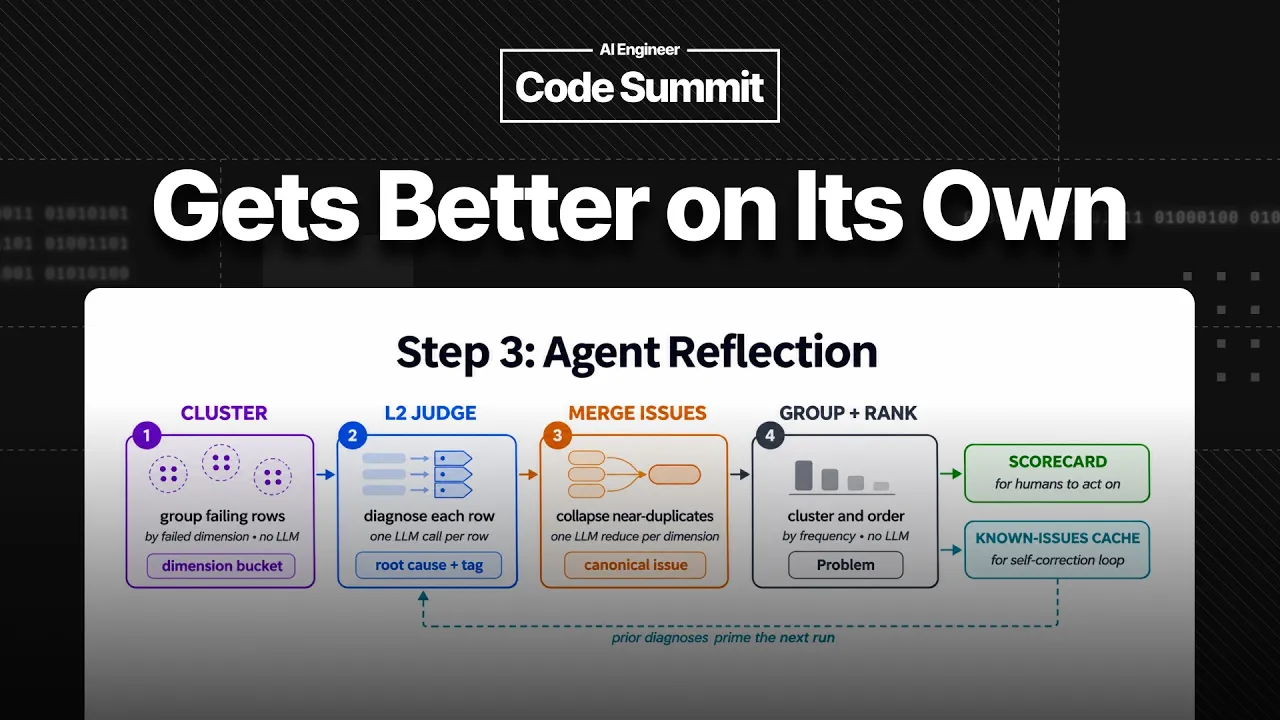
- Claim: Failure aggregation should convert noisy row-level LLM diagnoses into a ranked, reusable issue backlog. | Evidence: For each failing trace, LinkedIn clusters by failed dimension, has L2 assign root-cause tags, deduplicates semantically similar free-text diagnoses into canonical issues, ranks those issues by frequency, and saves prior diagnoses to prime subsequent L2 runs. | Implication: Build an issue store that links traces, judge evidence, canonical failure labels, frequency, and proposed remediation; this becomes the bridge from observability to engineering work. | Caveat: Similar-sounding diagnoses may conceal distinct causes, so canonicalization is useful for prioritization but should not replace sample-level inspection for high-impact issues.
- Claim: Judge calibration is the primary bottleneck in self-improving agents because a plausible but miscalibrated evaluator systematically drives bad optimization. | Evidence: Across approximately 180-200 human reviews, L1 alignment was about 55% for score 1, 57% for score 2, and 80% for score 3. Dimension-level agreement was particularly weak for preferred titles and was about 47% for domains/expertise and 50% for work type. | Implication: Before trusting an LLM-as-judge to steer automated changes, measure agreement by score bucket and output dimension—not merely one aggregate accuracy metric. | Caveat: These measurements apply to LinkedIn's specific user-understanding task and 1-to-3 scoring rubric, rather than proving identical rates for other agent types.
- Claim: Many apparent LLM-evaluation errors are actually underspecified policy decisions that need to be encoded into rubrics. | Evidence: The judge rewarded plausible job titles while missing omitted intent signals; it blurred domain, role/function, and skill; lacked partial-credit rules; penalized capitalization and formatting differences; and made inconsistent inferences from employment data. Of 37 overly harsh judgments, 31 were score-1 assignments. | Implication: Use human–judge disagreement reviews to improve the definition of correctness and evidence policy, not just to tune prompts or swap models. | Caveat: More detailed rubrics can introduce maintenance burden and may overfit current annotation disputes if not tested on held-out examples.
- Claim: Root-cause reflection requires independent reasoning and an explicit option for evaluator error; otherwise it can produce persuasive but harmful explanations. | Evidence: LinkedIn found L2 attribution substantially harder than detecting a failure. Its original taxonomy could not explicitly label an incorrect L1 judgment, leading L2 to blame the rubric; L2 also sometimes reused L1's rationale without independently checking it against the agent output. | Implication: Design diagnosis as a separate audited component: require it to inspect original evidence, permit 'evaluator wrong/insufficient evidence' outcomes, and prevent direct edit generation from unverified diagnoses. | Caveat: Majority voting and holdout evaluation can reduce individual LLM-judge variance, but they do not by themselves eliminate shared rubric or taxonomy errors.
- Claim: The success metric for RSI is faster reliable improvement in agent quality, not the volume of autonomous edits. | Evidence: LinkedIn's first RSI-optimized prompt change was deployed only after human review and quantitative measurement. It proposes tracking the percentage of prompt changes reliably generated and validated by RSI, downstream response quality, and engineering productivity, while retaining human-in-the-loop production updates initially. | Implication: Set adoption thresholds around validated outcome improvement and rollback confidence; do not optimize a program for edit throughput or automation percentage alone. | Caveat: The talk reports one initial production PR and evaluation-quality gains, but does not quantify downstream end-user quality lift, productivity lift, or the autonomous adoption rate.
Detailed Brief
The target agent and evaluation object
- Claims: The target is a user-understanding agent used in LinkedIn's career context, not a generic chat agent.; Its output is structured member understanding rather than only free-form text, making field-specific evaluation and citation quality important.
- Evidence: The agent takes a member ID and accesses profile data, search history, location, and preference data.; For fields such as preferred job titles, it emits inferred values, confidence, citations supporting the inference, and reasoning.; The L1 judge evaluates more than 15 task dimensions using product-defined rubrics on a 1-to-3 scale, where 1 is poor, 2 fair, and 3 strong.
- Caveats: The transcript does not provide full rubric definitions, exact task list, or a causal measure connecting field-level judge improvements to member-facing outcomes.
- Implications: Structured agents benefit from evaluating each output field against its evidence trail rather than relying solely on an overall response-quality score.; Citations and intermediate traces are not just observability artifacts; they provide the evidence substrate needed for evaluation and diagnosis.
Enterprise scaling model
- Claims: LinkedIn views RSI as a reusable organizational capability with a dependency stack: base agent, continuous evaluation, systematic reflection, and then closed-loop optimization.; Shared infrastructure is preferable to each team building bespoke judges, trace analysis, and promotion logic.
- Evidence: The proposed five investment areas are standardized human-calibrated evaluation frameworks and metrics; automated trace and feedback collection; repeatable automated optimization; holdout and regression validation; and self-service components for team adoption.; The workflow can run on weekly, biweekly, or monthly cadences depending on product needs.
- Caveats: The presentation is an architecture and early-results talk, not a demonstrated fully autonomous enterprise deployment.
- Implications: The highest-leverage platform investment is a common evaluation-and-promotion substrate, because it allows future agents to inherit trust mechanisms rather than merely reuse prompts or orchestration code.
Notable Concepts & Terms
- Recursive self-improvement (RSI): A controlled loop in which agent traces are evaluated, failures are diagnosed, system edits are proposed and validated, and approved changes become the next baseline.
- L1 judge: The first-level LLM evaluator that scores agent outputs against product rubrics; its human alignment determines whether RSI feedback is credible.
- L2 reflection: A second-level diagnostic process that explains why an L1-evaluated failure occurred and attributes it to the agent, prompt, tools, context, rubric, or evaluator.
- Canonical issue: A deduplicated root-cause label created by merging similar free-text diagnoses, enabling frequency-based prioritization of systemic failures.
- Optimization ladder: LinkedIn's increasing-complexity path from prompt and structural-context changes to automatic workflow design, harness-code changes, and eventually optimizer-code changes.
- Holdout validation: A final evaluation on data withheld from candidate selection, used to verify that an RSI-generated change genuinely improves the agent before baseline promotion.
- JEPA/JPA proposal method: The transcript names this as the method used to identify root causes and generate prompt-update proposals; the exact expansion is not specified.
Operator Notes / Why Ken Should Care
- Create a release gate for any self-modifying agent: candidate diff, linked failure cluster, independent validation result, holdout result, confidence/variance measure, approver, and rollback path.
- Run a human calibration study for each judge before allowing it to prioritize engineering work; segment agreement by score bucket, task dimension, and error direction such as overly harsh versus overly lenient.
- Add explicit diagnosis labels for evaluator error, rubric ambiguity, insufficient evidence, tool/data failure, prompt failure, orchestration failure, and model limitation; require the diagnostic agent to cite primary trace evidence.
- Maintain a canonical failure registry with deduplication, frequency, impact, affected-agent version, evidence samples, and remediation status; feed approved labels back into future diagnosis prompts cautiously.
- Separate selection and confirmation datasets, and monitor regression across previously fixed clusters so a local prompt improvement cannot silently degrade adjacent behaviors.
- Prioritize a shared eval/reflection/validation platform over per-agent autonomous-edit systems; the former is the prerequisite for trustworthy reuse.
Source/Metadata
- Title: An Agent That Fixes Its Own Mistakes - Saloni Gandhi & Ziwei Guo, LinkedIn
- Transcript words: 8069
- Duration seconds: 2330
- Timestamp note: No usable timestamps or chapter markers were present in the supplied transcript; the latter portion includes substantial repeated transcript material.
Transcript
Hello, everyone. My name is Zuwei and today, together with Salony, we are going to present the recursive self-improvement project that we are doing at LinkedIn. For this RSI work, we focus on the user understanding. We are excited to share the RSI work we did at LinkedIn. First, just a high level overview on what is a recursive self-improvement. The recursive self-improvement is built around some AI system. The purpose of doing this is we want to get a system that self-improves, so it can learn from issues in production traces and that work. The AI system can be some agent at LinkedIn. One example is our career agent to help our LinkedIn users, members to achieve their career goals. From the agent, there are many daily development work that we discover the issues we want to address. Also, we will get the production traces and we can log the issues we found during the production traffic. Once we have this information, we will have some evaluation engine, for example, the AI-judging judge, to check our traces and to identify the issues and give us feedback. Based on the feedbacks, we will use those feedback to keep continuously iterating our system. So we build this kind of loop to improve our AI system. One key thing we want to call out is during this recursive self-improvement process, the evaluation is very critical and it must be objective and well aligned with the user feedback because this is the key to identify where the bottleneck is and guide the next step for the AI system improvement. Next, we want to show which component of the AI system we can optimize. So here, take the harness as an example or as an orchestrator. So there are different components we can use, we can optimize by using the RSI. So for example, the first is planning and logics, which is used to orchestrate execution and make a decision path. Second is the context and the memory, where we preserve and manage the session state. And the third one is a tool interface that interacts with external and internal APIs and the datasets. The last but not least is artifact storage that we are working with those outputs and the generation logs. And on top of those, we have some evaluation logic to help us to evaluate each component and help us to improve the AI system. Another thing to keep in mind is that all those harnesses are powered by the base model, but for the RSI, currently the optimize of this base model itself is not in scope, but we focus on the harnesses optimization first. Here we want to show the ladders that we can climb to optimize the AI system by using the RSI. At the beginning, this typically starts from simple process. At the beginning, we can focus on the prompts updates because this is the easiest and most straightforward way to keep iterating our AI system. And after that, we can continue to optimize the structural context of the AI system. And this is the L1 ladder. And for the L2 ladder, which is after the structural context optimization, we can expand our scope to design the workflow automatically. And this is a meta information design. And after that, we can optimize the harness code itself. And at the end, we can optimize the optimizer code itself. So this is the different optimization ladders with increasing complexity. For our project, currently, our active focus is prompt optimization, but moving forward, we are extending our scope to more complicated optimization in future. Here, we want to show our RSI strategy. So we break down our RSI process into seven steps. The first step is to run the agent and generate some samples. So for our career agent that we are optimizing for, given a query, we are generating some output and we are logging those processes. This is the agent trajectories and the traces that we can use to optimize. Once we got those information, the next step, step two, is we run through the evaluation engine, for example, the arm judge, to get some judge output to tell us where we are good at and where we are not good at for the future iteration. Once we get the judge output, then we go into the RSI components. Starting from step three, this is inside the RSI loop. The first step is we will do the agent reflection. Sometimes we also call it root cause analysis. Based on the judge output, we want to understand what is the root cause that we don't have a good output. For example, if this is an agent issue, a model issue, a prompt issue, a tool issue, or some other issues. Sometimes it can even be a judge issue or rubric issue. Once we identify the root cause, the next step is to generate some edits proposal. So currently the edits proposal are just prompt. But as we are climbing the ladder for the RSI loop, in future, this edits can also be a new design of the workflow, the harness code or even the optimizer code. The next step is to validate our edits, because some edits can be good, some can be bad. So we will use the same evaluation engine, for example, the same judge with the same rubrics to evaluate our edit validation. Once we find some good candidates, the next step is to evolve our prompt to adapt the proposed edits we have. Once the prompt is updated, the very last step, which is step seven here, is we run the evaluation again on a holdout set to confirm our new system indeed performs better than the old system after the RSI optimization. After this holdout validation, we will make the prompt updates, and this will become our new baseline. And then in future, we will continue to do this RSI iteration to keep improving our system with some cadence. Next, we can dig deeper into each step so we can understand more details on what we are doing here. For example, what is the agent we are optimizing, and what are the detail steps in each these high level steps to help you understand more of our RSI work here. The first step I want to show is the first step where we generate agent output and generate the trace. First of all, I want to help you understand the agent we are optimizing here. This is a user understanding agent at LinkedIn. You can see in this slide, we are showing the input and output of this agent. The input is simply a member ID, also a user ID. By giving user ID, we can fetch some information of this user. For example, this user's search history, profile data, and location data and the preference data. And we have this user understand agent to take those users' history or behavior data, profile data as an input, and do a lot of agentic synthesized steps and we generate the output. So for this output, we call it member understanding or user understanding output. Here is a high level structure of this output. So given a member, we will generate some fields to describe this member based on our agent understanding. For example, what is the preferred job title of this member? This is one field of this user understanding output. So for this one, this is an example of preferred job titles. So it can be something like a network manager, account manager, those kinds of things. And we will give confidence on how confident this agent thinks this is indeed the preferred job titles for this user. And also we will generate some citation data. This is why the agent thinks those titles is preferred job title for this particular member. For example, the reason could be like user's saved search history, the job titles appears very frequently. So the agent thinks, this is a strong evidence to support that the preferred job title is a network manager for this user. And finally, this agent can also output the reasoning on why the agent thinks those are preferred job titles. For example, the state of preference anchors, the primary titles, they would search and support the agent, adjacent ones, those kinds of things. So this is one example of the user understanding agent that we are optimizing. Step two is once we got this agent's trace and we are running the IOM judge to get a quality reading of this agent output. For example, the reason could be user's saved search history, like those job titles appear very frequently. So the agent thinks, oh, this is strong evidence to support that the preferred job title is a network manager for this user. And finally, this agent can also output the reasoning on why they like it. It's just reasoning like why the agent thinks those are preferred job titles. For example, the state of preference anchors, the primary titles they would search and support the agent, adjacent ones, those kinds of things. So this is one example of the user understanding agent that we are optimizing. Step two is once we get this agent's trace and we are running the IOM judge to get quality readings of this agent output. For this particular user understanding agent, the score is over 15 tasks with dimensions by IOM judge, whereas product defender rubrics. So here is one example of the judge output. For a particular member, the user, we will generate the IOM judge score, which is 2.31. It will also tell which score this is for and the breakdowns of each dimensions score. For example, the goal summary dimensions. We also have some other dimension for the preferred job title dimensions. For each dimension, we will give a detailed score for each dimension and also the notes. The notes is the rationale and the IOM vertex, like why we give this score to this particular dimension. For this particular judge and the agent, the judge score is 1, 2, 3 skill. The score 1 means the quality is not good. The 2 is a fair quality. And the 3 means this is a very good quality. That's our IOM judge. After we got the judge score for each dimension of our user understanding agent, the next step is we will run this agent reflection process. As we mentioned earlier, there are four mini steps for the agent reflection. The first step is clustering. We will group the failing rows. In a production trace, we have a lot of examples, a lot of users, and we will group those users and traces by the failing dimension. This is just a pure clustering without any cost. Once we get the clustering, the next step is what we call L2 judge. Within each clustering, we will run the IOM to diagnose each row, and then for each row we will assign a root cause and a tag. This is where we can rely on the IOM to let us know if this dimension has a low score due to the prompt issue, agent issue, harness issue, code issue, or even the judge issue or rubric issue. These will be covered by the root cause and tag here. Once we get the per row level root cause and tag, the next step is to merge the issues. The root cause is more like free text, but some root causes, even if the tags are not exactly the same, may describe a very similar thing. That's why we want to do this kind of deduplication. We merge the issues if we think the root cause is near duplicates. For example, for one row with one member, the root cause can be the members profile data is missing. For another row, the IOM can say the profile data is not showing the full picture of this user's browsing history or whatever. They are both describing the same thing—the profile data is not supporting this agent output—but they just use different text. That's why we need this deduplication step to merge similar issues. We can get some canonical issue, the root cause labels. Once we finish step three, the next step is based on the canonical issues we found. We group and rank them by frequency. This step requires no IOM. This is to help us understand what are the major issues and bottlenecks in our AI system. Once we do the grouping and ranking, we generate a scorecard for humans to act on to continue iterating our AI system. We basically cache or save those root causes somewhere. We will continue to use this for the self-question loop. There's an arrow here that goes back to the L2 judge. It will guide us on what is a prior diagnosis prime on the next turn. This is easier for the L2 judge to identify the issues in future runs. That's what we do for the agent reflection. The next step is general edits proposal. From step three, we already know what the root cause is, why the agent fails. So the next step is naturally, given those root causes and issues we want to fix, what can we do? What new edits do we want to propose? We have what we call the proposal lifecycle. Based on the judge evidence and the reflection artifact, we will propose the input. We will run some methodology. For this project, we are using the JPA to identify the root cause and propose new prompt changes. Given a trace sample, we do it in a mini batch fashion and generate the new prompt updates proposal. Once we generate the prompt updates proposal, we select the winner prompts and do validation on the validation set. Once we found good prompt candidates and run the validation set and think it is a good prompt updates, we will update our prompt in our system. This will go into production and become our new canonical baseline. We will continue with future RSI iterations. That's the entire lifecycle of this RSI iteration. Next, this slide shows our primary focus for this RSI work. We currently have three major focuses: quality, automation, and production updates. Quality: We are focused on different things for quality. We did many iterations to improve the quality of our agent, judge, and this RSI loop. For example, we did extensive human annotations so we can improve both the L1 judge and L2 judge quality. We did many studies and analysis to assess the agent judge variance so we can mitigate the impact from the non-deterministic nature of the L1. The third is we push the quality updates to both agent judge and RSI reflection based on our annotation and the variance analysis. Automation: As we mentioned, there are seven steps in the RSI iteration. We built a workflow so we can kick off this workflow with some cadence, weekly or biweekly or monthly based on the needs, so it can automatically run and keep suggesting prompt updates with some cadence. Production updates: We want to build a useful RSI system that can help continuously improve our product. The third focus for our RSI work is to make updates to the career agent in production with human in the loop for now to ensure production quality is there. But later, once we think the quality is good enough, we will gradually reduce the human effort and hopefully achieve a higher automation state. And so that's why, here, I think we build a workflow so that we can kick off this workflow with some cadence for a weekly or biweekly or monthly based on the needs so that it can automatically run it and keep suggesting prompt updates with some cadence. And the third focus is production updates. So definitely, we want to build a useful RSI system that can help continuously improve our product. So that's why the third focus for our RSI work is to make updates to the career agent in production with human in the loop for now to ensure the production quality is there. But later, once we think the quality is good enough, we will gradually reduce the human effort and hopefully we can achieve a higher automation state. Cool. Yeah. Next, I'll hand over to Saloni to share more details about the outcomes and learnings of our RSI work. I'll share my screen. Sure. Yeah. Can you see my screen? Yeah. Yeah. So, yeah. Hi, I'm Saloni. And so far, we described how the RSI system is designed. But one of the most interesting aspects of this work has been understanding what happens when we actually try to make this process reliable. And in particular, we learned that the quality of the evaluator is just as important as the quality of the optimization system. So let's walk through some of those findings. So there are two major outcomes we want to highlight. So the first is that we successfully deployed our initial RSI improvements into production, which was landing a first PR, which was optimized by JEPA through the loop, which we just described. So these changes went through human review and quantitative measurement before deployment. And it was an important milestone in moving RSI beyond just an experimental workflow. The second major improvement was around evaluation quality, where we invested substantial effort in human annotations for the user understanding judge as well as analyzing where its judgment disagreed with human reviewers. And this process revealed several recurring weaknesses in both our evaluation rubrics as well as our reflection system. And by investigating those disagreements, we were able to make targeted improvements, which further strengthen the reliability as well as reduce the evaluation friction we have. And before we could trust a system to improve an agent automatically, we had to understand whether the feedback driving those improvements was also itself trustworthy. And this was a major area of our engineering work. So to understand the quality of our L1, which is our evaluation judge, we analyzed about 180 to 200 human reviews. We were particularly interested in how the judge agreed with human reviewers both across different score categories and across the individual evaluation dimensions. Starting with the chart on the left, we see that for outputs, we assigned a score of one, full judgment alignment was approximately 55% and for score two, it was around 57%. But for score three, the alignment increased to approximately 80%, which indicates an interesting pattern: the judge was considerably better at recognizing stronger outputs than it was at distinguishing between different weaker outputs. And we found that many of its lowest scores were overly harsh. And now looking at the chart on the right, agreement also varied significantly across different dimensions, where higher preferred dimensions like titles had the weakest observed alignment as well as domains or the expertise or area of work was around 47%. And work type was around 50%, which told us the evaluation quality was not uniform across all the tasks which we cared about. And certain dimensions required clearer definitions, better evidence handling rules as well as more explicit scoring guidance. So when we look more closely at the human annotation, several recurring patterns emerge. The first involved using job titles. We found cases where the judge would accept a return title because it was plausible, but would miss the fact that the agent had omitted unexpected signal or ignored an important intent signal. So in other words, sometimes the judge was evaluating the plausibility rather than the completeness of the facts which were stated. The second issue was primarily around the fields of expertise. The distinction between a domain function and the skill wasn't always clear where a domain could be software engineering and a function or a role could be, for example, a machine learning engineer while skill being machine learning. The rubric also lacked consistent partial credit rules for output containing a mixture of correct and incorrect information. And another issue involved formatting and inference. So in some cases, the judge penalized harmless formatting differences. In other words, it made inconsistent assumptions about what could be inferred from a member's existing employment information. We also examined the distribution of overly harsh judgements. Out of the 37 judgements identified as too harsh, 31 of them involved outputs that had been assigned a score of 1, which suggests that the boundaries between our scores needed to be recalibrated. Another record source of disagreement was whether an informed member's reference should be considered valid when the evidence wasn't explicitly stated. And the broader lesson here was that many evaluation disagreements were not simply model failures. They were reflecting ambiguities in the rubric as well as the underlying evaluation policy. Based on these findings, we introduced several targeted improvements to our evaluation rubrics. One was fixing harmless formatting differences. Previously, a value such as full-time could receive an incorrect score because of capitalization or incorrect formatting. We updated the rubrics so that these differences would not be treated as semantic failures. Similarly, we introduced normalization guidance for titles. We also clarified how the judge should handle concurrent employment, inferring seniority as well as inferring geographic references of the user, and more broadly, we recalibrated the rules separating low scores from partially correct outputs. And these changes resulted in measurable improvements where human alignment increased from 57 to 64, and at the same time the mean error decreased from 0.96 to 0.74. What we're trying to achieve here is to get our system as highly aligning to humans as much as possible. And what we find particularly interesting here is that we didn't achieve these improvements by only handling the model, but we also improved specifications of what correct evaluation should look like—that is, rubric design as well as evidence which our evaluator is spitting out. Moving forward, we perform a similar human review analysis for our reflection agent which was described earlier in our pipeline. We should recall that our L2 takes an evaluation failure and then it tries to identify the cause. For example, it identifies what problem was caused by the agent itself, by the evaluation rubric, or by some other issue with the available context. What we discovered was that root cause attribution was substantially harder than simply identifying a failure. Human reviewers agreed more often when L2 attributed a problem to the underlying model, but agreement was much lower for other causes, particularly rubric-related issues. One important issue was that our original reflection taxonomy didn't include a way to explicitly say that the L1 judge could have been wrong. As a result, sometimes the reflection agent fell back to blaming the rubric even when the real problem was an incorrect L1 judgment. And another issue was that the reflection sometimes used the L1 judge's rationale without independently evaluating it against the agent's output. And we exposed an important risk here: a reflection system can produce convincing explanations while still misidentifying the underlying problem. And if we use those explanations to generate prompt changes, we could end up modifying the wrong component of the system. So improving the L2 reflection charge became our next priority. So to talk about some of the quality improvements, these findings led us to focus on improving both layers of evaluation. At L1, the goal was to make sure that the scoring was more accurate and better aligned with human judgment. And at L2, the goal was to improve the reliability of the root cause diagnosis. And this slide basically summarizes some of the changes we made to the system and the impact that we observed. We introduced several targeted changes to address the reflection failures identified through human review. The root cause diagnosis, as we mentioned earlier. So we also use majority voting and held out evaluations to help mitigate variance from individual LLM judgments. And together, these improvements support a more reliable optimization process. Importantly, one of the observed improvements here was about the required adoption threshold and the reported confidence interval as well. The second level of impact is where we want to measure RSI adoption grows. This includes the percentage of agent prompt changes that can reliably be generated and validated through recursive self-improvements and downstream response quality, and also productivity gains for engineers maintaining these systems. Those broader metrics are a part of how we want to think about evaluating these systems at scale, because the ultimate goal isn't to maximize the number of automated prompt edits. It's to produce measurable improvements in agent quality while maintaining confidence that those changes are genuinely beneficial. This brings us to the final part of our talk, which is how do we scale these capabilities, which is through an acceleration plan. So far, we focused on one implementation of RSI for user understanding, but the broader opportunity is much larger. If we are able to standardize evaluation, reflection, and optimization, we could potentially reuse this loop for many other agent teams. And moving forward, to understand the end-to-end evals, the current status, this diagram shows progression of capabilities that we believe are necessary to support RSI at scale. At the foundation, we obviously have the base agent, where most teams already have agents that perform useful tasks, whether that's question answering, summarizing, chat agents, or completing workflows. The next layer is agent-like evaluation, and this is where we begin to see gaps, because some teams have built their own bespoke evaluation workflows. Others rely on one-off analysis or manually inspecting outputs. But only a few of them have relatively standardized, reliable evaluation processes that can be continuously reused. And above evaluation, we have agent-like reflection, which means being able to systematically investigate or do root cause diagnosis. And finally, at the top, we have the RSI loop itself, which connects evaluation and reflection to optimization and validation. The important observation here is that these layers depend on one another, and you can't build a trustworthy loop without reliable diagnosis. That's why we see leveling up evaluation infrastructure as a prerequisite to scaling RSI. And rather than asking every team to independently build all these components, there's an opportunity to provide shared infrastructure. So what would it take to make RSI a reusable capability across an enterprise? We've identified five strong areas. First is standardizing evaluation infrastructure. So we need reusable evaluation frameworks, metrics, judges which can be calibrated with human feedback. And the second is automating feedback loops. So we want systems that can continuously collect execution traces, detect recurring failures, and perform root cause analysis. We need to scale automated optimization. That includes prompt optimization, agent-like reflection. So instead of making ad hoc changes, we want improvement processes where candidate updates can be generated and tested in a more repeatable way. The fourth area is validation and trust. So any automated improvement needs evidence that it actually works, which means having robust holdout evaluations and progression testing. And finally, we want to democratize RSI across teams, where the goal is to develop reusable components and self-service info so that teams can adopt these capabilities without having to build an entire RSI pipeline themselves, which is what our broader vision is. And I think that this is an important shift in how we approach the engineering of AI systems. So in recursive self-improvement, just to summarize, we have two key components, which is the improvement engine and the target agent. The target agent in the AI system is something we are trying to make better, while the improvement engine is responsible for driving that change by evaluating performance, identifying failures, root causes, and proposing improvements. But the objective of the RSI system isn't simply to improve the agent's performance at a given point in time. It's to accelerate how quickly the agent gets better. And if we think of the agent performance as a function of time, we are interested in increasing its first derivative, essentially making the performance improvement curve steeper. And in our case, the target agent is our user understanding agent, while the improvement engine is the RSI pipeline, which brings together evaluation, reflection, and prompt optimization. Before I close, we want to acknowledge the people who helped make this work possible. This has been a collaborative effort across the core team, our evaluation team, and our engineering partners and leadership. We would particularly like to thank all the team members and collaborators with CIDEO for their contributions. A lot of the work we have described for evaluation quality, the reflection and production required collaborations across these different areas of expertise, and we are grateful for the support and feedback we have received. Thank you. And I guess we just want to conclude by saying that the most important part of improvement processes is being able to trust the changes we are making to make the system better. So that's some of the directions we are exploring with recursive self-improvement here. So thank you so much for listening. So that's, we are like, that's why we need this, kind of, deduplication step to merge the similar issues. So we can get some canonical issue, I'll say the root cause labels. And once we finish the step three, so the next step is to, based on the canonical issues, we found that we are group and rank them by the frequency. And this step, there's no IOM required. So this is just to help us to understand what is the major issues bottlenecks in our AI system. And once we do the group and ranking, and we are generated a scorecard for the human to get, to be just, get the human to act on, to continue, iterate our AI system. And also we are, like, basically just cache, or save those root cause somewhere. And we will continue to use this for the self-question loop. So that's why, so you can see, like, there's an arrow here, like, a go back to the L2 judge. So be like, it will guide us on, like, what is, like, a prior diagnosis prime on the next turn. So that is easier for the, like, L2 judge to identify the issues in future runs. So that's, like, what we do for the agent reflection. So the next step is a general edits proposal. Because from the step three, the previous slide, we know, we already know, okay, so what is the root cause, right? Why, like, the agent fails? So the next step is, naturally, like, given those root cause, those issues we want to fix. So what can we do, right? What is the new edits we want to propose? And here, like, we have, again, like, this kind of, we call it the proposal lifecycle. So based on the judge evidence and the reflection artifact, we will propose the input. And we will run some methodology. So for this project, we are using the JPA to, you know, the root cause and to propose a new prompt change. And this will be like, given a trace sample, we'll do it in a mini batch fashion and generate the new prompt updates proposal. And once we generate the prompt updates proposal, we'll select the winner prompts and do the validation. validation set. And once we found a good prompt candidates and we run the, you know, the validation set and we think it is become, it is a good prompt updates. And we will update our prompt in our system. So this will be into the production and this will become our new canonical baseline. And we will continue to do the, like, the future RSI iterations. So, yeah, that's kind of the, and, yeah, that's kind of like the entire lifecycle of this RSI iteration. And next, this slide, we want to show our primary focus for this RSI work. So we, so currently we have three major focuses. So the first is the quality, second is the automation, and the third is the production updates. So quality, like, so be like, we are focused on the different things on the quality. So, and the way, did many iterations to try to improve the quality of our agent, judge and this RSI loop. For example, we did extensive human annotations so that we can improve the L1, both the L1 judge and the L2 judge quality. And we did many studies and analysis on assess the agent judge variance so that we can make sure we can kind of mitigate the impact from the non-deterministic nature of the L1. And the third one is that we push the quality updates to both agent judge and RSI reflection based on our annotation and the variance analysis mentioned above. So that's on the quality side. And the second focus is automation. Because as we mentioned, so there are seven steps in the RSI iteration. And so that's why, like, here, like, I think we build a, this kind of, like, workflow so that we can kick off this workflow with some cadence for a weekly or biweekly or monthly based on the needs so that it can automatically run it and keep suggesting the, like, prompt updates with some cadence. And the third focus is production updates. So definitely, like, we want to build a useful RSI system that can help keep continuously improve our, you know, product. So that's why, like, we, the third focus for our RSI work is to make updates to the career agent in production with human in the loop, like, for now to ensure, like, the production quality is there. But later, like, once we think the quality is good enough, like, we will gradually, like, reduce the human effort and hopefully we can achieve a higher automation kind of state. Cool. Yeah. Next, I'll hand over to Saloni to share more details about the outcomes and learnings of our RSI work. I'll share my screen. Sure. Yeah. Can you see my screen? Yeah. Yeah. So, yeah. Hi, I'm Saloni. And so far, we described how the RSI system is designed. But one of the most interesting aspects of this work has been understanding what happens when we actually try to make this process reliable. And in particular, we learned that the quality of the evaluator is just as important as the quality of the optimization system. So let's walk through some of those findings. So there are two major outcomes we want to highlight. So the first is that we successfully deployed our initial RSI improvements into production, which was like landing a first VR, which was optimized by JEPA through the loop, which we just described. So these changes went through human review and quantitative measurement before deployment. And it was an important milestone in moving RSI like beyond just an experimental workflow. The second major improvement was around like evaluation quality, where we invested substantial effort and like human annotations for the user understanding judge and as well as like analyzing where its judgment sort of like disagreed with like human reviewers. And this process revealed several recurring weaknesses in both our evaluation rubrics as well as our reflection system. And by investigating those disagreements, we were able to make targeted improvements, which further strengthen the reliability as well as reduce the evaluation readings which we have. And before we could trust a system to improve an agent automatically, we had to understand whether the feedback driving those improvements was also itself trustworthy. And this was like a major area of our engineering work. So to understand the quality of our like L1, which is our evaluation judge, we analyzed about 180 to 200 human reviews. We were particularly interested in how the judge agreed with human reviewers both across different score categories and across the individual evaluation dimensions. Starting with the chart on the left, we see basically that for outputs, we assigned a score of like one full judgment alignment was approximately 55% and for score two, it was around 57%. But for score three, the alignment increased to approximately like 80%, which indicates an interesting pattern, which was that the judge was considerably better recognizing stronger outputs than it was at like distinguishing between different sort of like weaker outputs. And we found that the scores. And we found that many of its lowest scores were like also overly harsh. And now looking at the chart on right, agreement also varied significantly across like different dimensions, where higher preferred dimensions like titles had like the weakest observed alignment as well as like domains or like the expertise or area of work was around like 47%. And the sort of like work type was around 50%, which told us like the evaluation quality was uniform across all the tasks which we cared about. And certain dimensions required more clearer definitions, better evidence handling rules as well as like more explicit scoring guidance. So when we look more closely at the human annotation, several recurring patterns emerge. The first involved like using job titles, we found cases where the judge would accept like a return title because it was plausible, but would miss the fact that the agent had omitted unexpected signal or like an ignored and basically ignored an important intent signal. So in other words, sometimes the judge was sometimes evaluating the plausibility rather than the completeness of the facts which was stated. The second issue was primarily around the primarily around the fields of expertise here. The distinction between like a domain function and the skill wasn't like always clear where a domain could be like, say, software engineering and a function or a role could be like, for example, a machine learning engineer while skill being machine learning. The rubric also like lack consistent partial credit rules for output containing like a mixture of correct and incorrect information. And another issue was involving around formatting and inference. So in some cases, the judge penalized harmless formatting differences. In other words, it made it inconsistent assumptions about what could be inferred from like a member's existing employment information. data that was also working to be working to. We also examined like the distribution of overly harsh judgements. Out of like the 37 judgements identified as too harsh, 31 of them involved. Outputs that have been assigned a score of 1 which suggests that the boundaries between our scores needed to be like recalibrated. Another record source of disagreement was whether an informed member's reference should be considered valid when the evidence wasn't like explicitly stated. and the broader lesson here was that many evaluation disagreements were not simply like model failures they were reflecting ambiguities in the rubric as well as the underlying evaluation policy based on these findings we introduced several targeted improvements to our evaluation rubrics one was like basically fixing harmless formatting differences um previously like a value such as like you know full-time could receive an incorrect score because of like capitalization or incorrect formatting we updated the rubrics so that these differences would not be treated as like semantic failures similarly we introduced normalization guidance for like titles um we also clarified how the judge should handle concurrent employment like you know sort of inferring seniority as well as like inferring geographic references of the user and more broadly we recalibrated the rules uh separating low scores from like partially correct outputs and these changes resulted in like resulted in like measurable improvements uh where human alignment increased from like 57 to like 64 and at the same time the mean error decreased from like 0.96 to 0.74 what we're trying to achieve here is to get our system as high or like as highly aligning to humans as much as possible and what we find particularly interesting here is that we didn't achieve these improvements by only like handling the model but we also improved specifications of what like correct evaluation should look like that is like rubric design as well as like um evidences which our evaluator is like spitting out um moving forward uh we perform like a similar human review analysis for our reflection agent which was described earlier in our pipeline we should recall that our l2 takes an evaluation failure and then it tries to identify certain cause for example it basically identifies what's the problem caused by the agent itself by the evaluation rubric or by some other issue with the available context what we discovered was that root cause attribution was substantially harder than like simply identifying a failure human reviewers agreed more often when l2 attributed a problem to like the underlying model but agreement was much lower for other causes particularly like rubric related issues um one important issue was that our original reflection taxonomy didn't include a way to explicitly say that or elven judge could have been wrong um as a result sometimes the reflection agent fell back to blaming the rubric even when the real problem was like an incorrect um elven judgment um and like another issue was like the uh reflection even sometimes used the elven judge's rationale without like independently evaluating or independently thinking over it against the agent's output and um we exposed an important risk here which was like a reflection system can produce convincing explanations while still like identifying misidentifying like the underlying problem and if we use those explanations to generate prompt changes we could like end up modifying like the wrong component of the system so improving the l2 uh like reflection charge like became our next priority um so to talk about some of the quality improvements um these findings led us to focus on improving both layers of evaluation at l1 the goal was to make sure that the scoring was more accurate and more better aligned with human judgment and at l2 the goal was to improve the reliability of the root cause diagnosis and the next this slide basically summarizes some of the changes we made to the system and the impact that we observed we introduced like several targeted changes to address the um the reflection failures um identified through like imiimiimiimiimiimiimiimiimiimiimiimiimiimiimiimiimiimiimiimiimiimiimiimiimiimiimiimiimiimiimiimiimiimiimiimiimiimiimiimiimiimiimiimiimiimiimiimiimiimiimiimiimiimiimiimiimiimiimiimiimiimiimiimiimiimiimiimiimiimiimiimiimiimiimiimiimiimiimiimiimiimiimiimiimiimiimiimiimiimiimiimiimiimiimiimiimiimiimiimiimiimiimiimiimiimiimiimiimiimiimiimiimiimiimiimiimiimiimiimiimiimiimiimiimiimiimiimiimiimiimiimiimiimiimiimiimiimiimiimiimiimiimiimiimiimiimiimiimiimiimiimiimiimiimiimiimiimiimiimiimiimiimiimiimiimiimiimiimiimiimiimiimiimiimiimiimiimiimiimiimiimiimiimiimiimiimiimiimiimiimiimiimiimiimiimiimiimiimiimiimiimiimiimiimiimiimiimiimiimiimiimiimiimiimiimiimiimiimiimiimi the root cause diagnosis, as we mentioned earlier. So we also use majority voting and held out evaluations to help mitigate variance from individual LLM judgments. And together, these improvements support a more reliable optimization process. Importantly, one of the observed improvements here was about the required adoption threshold and the reported confidence interval as well. The second level of impact is where we want to measure the RSI adoption grows. This includes the percentage of agent prompt changes that can reliably be generated and validated through recursive self-improvements and downstream response quality, and also productivity gains for engineers maintaining these systems. Those broader metrics are a part of how we want to basically think about evaluating these systems at scale, because the ultimate goal isn't to maximize the number of automated prompt edits. It's to produce measurable improvements in agent quality while maintaining some sort of a confidence that those changes are genuinely beneficial. This brings us to the final part of our talk, which is how do we scale these capabilities, which is through an acceleration plan. So far, we focused on one implementation of RSI for user understanding, but the broader opportunity is much larger. If we are able to standardize evaluation, reflection, and optimization, we could potentially reuse this loop or the cycle for many other agent teams. And moving forward, to understand the end-to-end evals, the current status, this diagram basically shows progression of capabilities that we believe are necessary to support RSI at scale. At the foundation, we obviously have the base agent, where most teams already have agents that perform useful tasks, whether that's question answering, summarizing, chat agents, or just completing workflows as such. The next layer is agent-like evaluation, and this is where we begin to see gaps, because some teams have built their own bespoke evaluation workflows. Others rely on one-off analysis or manually inspecting outputs. But only a few of them have relatively standardized, reliable evaluation processes that can be continuously reused. And above evaluation, we have agent-like reflection, which means being able to systematically investigate or do some sort of root cause diagnosis. And finally, at the top, we have the RSI loop itself, which connects evaluation and reflection to optimization and validation. The important observation here is that these layers depend on one another, and you can't build a trustworthy loop without reliable diagnosis. That's why we see leveling up evaluation infrastructure as a prerequisite to scaling RSI. And rather than asking every team to independently build all these components, there's an opportunity over here to provide some sort of shared infrastructure. So what would it basically take to make RSI a reusable capability across an enterprise? We've identified five strong areas. First is sanitizing evaluation infrastructure. So we need reusable evaluation frameworks, metrics, judges which can be calibrated with human feedback. And the second is automating feedback loops. So we want systems that can continuously collect execution traces, detect recurring failures, and perform some sort of root case analysis. So we need to scale automated optimization. That includes prompt optimization, agent-like reflection. So instead of making ad hoc changes, we want improvement processes where candidate updates can be generated and tested in a more repeatable way. The fourth area is validation and trust. So any automated improvement needs evidence that it actually works, which means having robust holdout evaluations and some sort of progression testing. And finally, we want to obviously democratize RSI across teams, where the goal is to develop reusable components and self-service info so that teams can adopt these capabilities without having to build an entire RSI pipeline themselves, which is what our broader vision is. And I think that this is an important shift in how we approach the engineering of AI systems. So in recursive self-improvement, we basically, just to summarize, we have two key components, which is the improvement engine and the target agent. The target agent in the AI system is something we are trying to make better, while the improvement engine is responsible for driving that change by evaluating performance, identifying failures, root causes, and proposing improvements. But the objective of the RSI system isn't simply to improve the agent's performance at a given point in time. It's to accelerate how quickly the agent gets better. And if we think of the agent performance as a function of time, we are interested in increasing its first derivative, if we think about it, essentially making the performance improvement curve steeper. And in our case, the target agent is our user understanding agent, while the improvement engine is the RSI pipeline, which brings together evaluation, reflection, and prompt optimization. Before I close, we want to acknowledge the people who helped make this work possible. This has been a collaborative effort across the core team, our evaluation team, and our engineering partners and leadership. We would particularly like to thank all the team members and collaborators with CIDEO for their contributions. A lot of the work we have described for evaluation quality, the reflection and production required collaborations across these different areas of expertise, and we are grateful for the support and feedback we have received. Thank you. So thank you. And I guess we just want to conclude by saying that the most important part of improvement processes is being able to trust the changes we are making to make the system better. So that's some of the directions we are exploring with recursive self-improvement here. So thank you so much for listening. And thank you. And thank you. And thank you. And thank you. And thank you. And thank you.