Your AI Pilots Won't Move the P&L. Here's What Will - Adam Nahari, Apollo
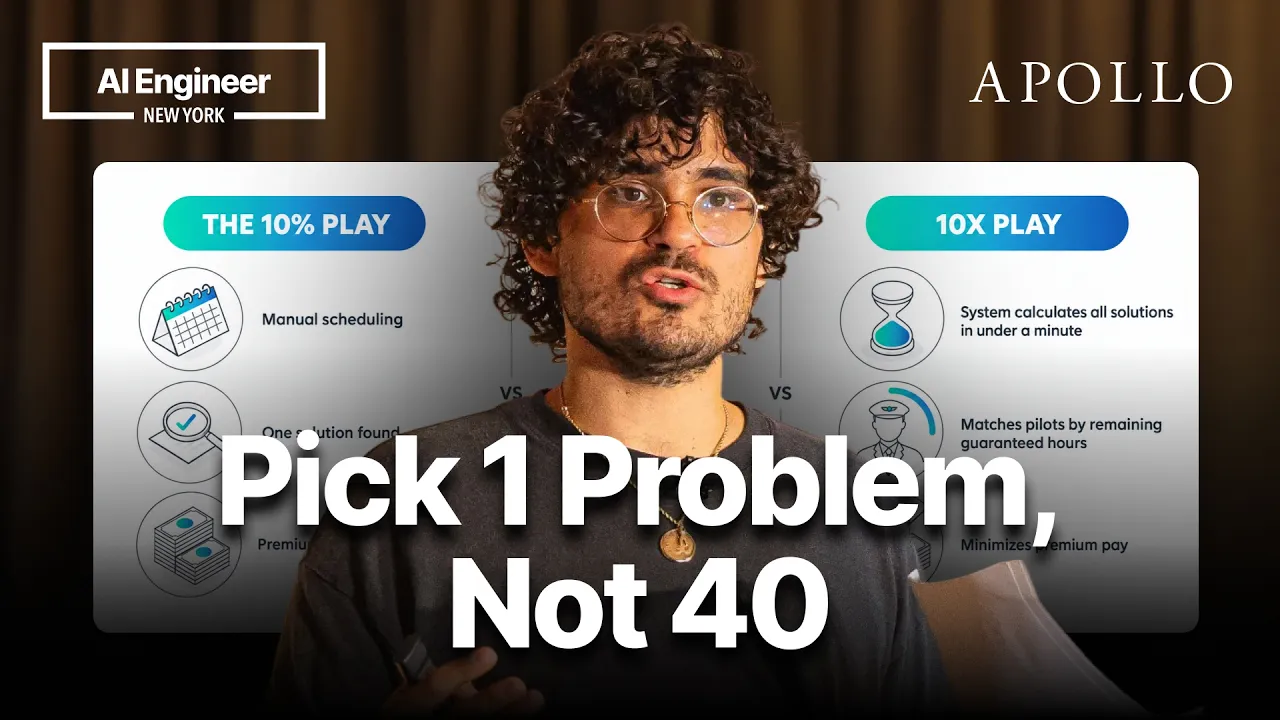
Description
Most companies use AI, but very few see it show up in their margins. Adam Nahari of Apollo Global Management explains why engineering is the smaller part of an AI transformation. He walks through the six moves that turned an airline's crew-scheduling desk into a 10x win: start from the P&L, pick one or two problems, get a real owner, put the tools in everyone's hands, and set kill metrics before you start. 0:00 Intro: the airline crew scheduling desk 1:22 AI adoption vs. real EBIT impact 2:42 Why engineering is the smaller part 3:42 The three layers of AI value 5:45 Start from the P&L 7:21 The 10% play vs. the 10x play 9:02 Getting it used: owners and alignment 11:42 Put the tools in everyone's hands 12:40 Set kill metrics first 14:07 Recap: the six moves Adam Nahari, Apollo Global Management: https://www.apollo.com Join us in SF for the second annual AIE CODE summit: https://aie.codes our last flagship summit of 2026. Applications live now!
Summary
Generated by gpt-5.6-terraAt-a-Glance
- Verdict: Skim
- Core thesis: AI creates material EBIT impact only when companies redesign a high-value core workflow around it, with CEO sponsorship, business ownership, adoption discipline, and CFO-enforced economics—not when they merely deploy broad copilots.
- Why it matters: The talk provides a practical operating model for distinguishing AI activity and reported time savings from AI initiatives that can credibly improve margin and survive scaling economics.
- Best use: Use it as a concise checklist for selecting and governing a small number of operational AI programs, especially agentic workflow redesigns tied directly to P&L lines.
Executive Summary
Adam Nahari argues that the gap between widespread AI adoption and limited EBIT impact is primarily an organizational problem rather than a model or engineering problem. Although nearly 90% of businesses report AI use and people report real time savings, only 6% report significant EBIT impact. His working heuristic is that successful AI transformation requires roughly five units of change management for every one unit of engineering, with engineering becoming relatively less important as models improve.
He separates AI into three value layers: general productivity tools, domain-specific copilots and enterprise retrieval, and core operational AI embedded in the workflows that define a business. General tools are useful but their gains tend to be competed away; durable margin gains come from proprietary operational systems that redesign an end-to-end process. He says firms reporting material EBIT impact are three times more likely to redesign a full workflow rather than simply add a tool.
The airline crew-scheduling example is the central proof point. A manual scheduler facing an aircraft disruption has 15 minutes to find a legal crew solution under rest, qualification, location, maintenance, and cost constraints—often resorting to premium pay when no solution is found. The proposed redesign consolidated operational data, used an optimization engine to generate and cost-rank all feasible solutions in under a minute, and delivered those recommendations through a scheduler decision-support application.
Nahari’s six moves are to select only one or two CFO-recognized opportunities, redesign the process rather than automate its current form, secure active CEO prioritization, co-build with business operators, make AI use widespread enough to create informed demand, and define time, performance, adoption, and scale-economics kill criteria before launch. The content is high-signal but delivered as a short, repetitive executive framework rather than a detailed implementation guide.
Key Takeaways
- Claim: Broad AI adoption and productivity gains do not automatically translate into P&L improvement; the bottleneck is transformation execution. | Evidence: Nahari cites over 55% of U.S. adults using generative AI within three years, nearly 90% of businesses using AI in at least one function, and roughly 2% of U.S. working hours represented by reported time savings, versus only 6% of businesses reporting significant EBIT impact. | Implication: Do not use seat adoption, prompt volume, or claimed hours saved as the success measure for an AI program; require a causal path to a financial line item. | Caveat: The cited figures are presented as talk-level benchmarks without source methodology in the transcript, so they are directional context rather than a basis for independent forecasting.
- Claim: The highest-margin AI opportunity is core operational AI that changes a proprietary business workflow, not general-purpose copilots. | Evidence: Nahari’s three-layer model distinguishes general productivity tools, domain-specific tools such as business-function copilots and retrieval over company documents, and core operational systems such as airline crew scheduling. He says general-tool benefits tend to be competed away while operational AI gains are more likely to remain in margin. | Implication: Prioritize agent and automation investments where unique operating data and decision logic can create a defensible cost, service, or throughput advantage. | Caveat: Core operational AI is harder to purchase or deploy off the shelf because it depends on company-specific data, constraints, workflows, and change management.
- Claim: Choose one or two initiatives by working backward from a CFO-recognized P&L driver, rather than running dozens of disconnected pilots. | Evidence: For the airline, Nahari starts with EBITDA and maps routes, aircraft ('tails'), maintenance constraints, and crew costs; crew is selected because it is the second-largest cost after fuel. His five use-case criteria are a recognized financial line, an agreed baseline, ready infrastructure and owned data, a named business champion, and top-five CEO priority. | Implication: Build an AI opportunity portfolio around a very small number of measurable economic constraints or cost pools, with explicit disqualification criteria for everything else. | Caveat: A technically attractive workflow without an agreed baseline, data ownership, or a single accountable user should not qualify as a transformation priority under this framework.
- Claim: Incremental automation of an existing workflow produces incremental results; material value requires redesigning the full decision process. | Evidence: The airline’s '10% play' was making schedulers somewhat faster in their existing process. Its '10x play' consolidated flight, crew, and maintenance data; created an optimization engine that enumerated and cost-ranked feasible solutions; and redesigned the scheduler workflow around a decision-support application. The system reportedly moved from 15 minutes to find one answer to under one minute. | Implication: For agent systems, assess whether the product merely assists a single task or changes data assembly, option generation, ranking, approval, and handoff across the whole operating loop. | Caveat: Nahari labels the 10% and 10x figures as illustrative, not measured outcome claims.
- Claim: Visible CEO commitment and a business co-owner are prerequisites for sustained cross-functional AI execution. | Evidence: Nahari says he will not fund an initiative unless the CEO has publicly committed to it as a company priority. In the airline case, the VP of crew scheduling co-sponsored the work, while schedulers served as AI champions: meeting engineering every other day, co-designing the interface, participating in A/B tests, and driving peer adoption. | Implication: Before committing build capital, identify the CEO-level mandate, P&L owner, operational champion, CFO partner, and technical resource commitment—not just an interested department. | Caveat: Executive sponsorship must be renewed over time because priorities and resource alignment decay; an initial announcement alone is insufficient.
- Claim: Every AI pilot should have precommitted kill gates and be evaluated on scaled unit economics, not prototype novelty. | Evidence: The airline initiative used a 90-day time gate for each stage, A/B testing against an agreed baseline, and an adoption gate of more than 50% scheduler usage. The CFO also tested whether scaled costs—including compute, tokens, and personnel—were significantly lower than the expected impact; Nahari says many pilots fail here. | Implication: Require a written continuation/termination memo before launch that specifies the baseline, observation window, adoption threshold, and all-in cost-to-impact model at production scale. | Caveat: A pilot can show local task value yet still fail at scale if ongoing model, compute, integration, and operating costs exceed the financial benefit.
Detailed Brief
Change-management burden and workforce readiness
- Claims: Nahari’s operating heuristic is that AI transformation requires five units of change management for every one unit of engineering.; As foundation models improve, he expects the engineering fraction of the work to shrink further while problem selection, adoption, alignment, and measurement remain the limiting factors.; Leaders cannot reliably identify AI-enabled workflow opportunities if they have never personally used AI tools.
- Evidence: At an executive AI workshop of roughly 30 people, Nahari says three out of four participants had not used an AI tool before that week.; He argues that hands-on experimentation creates the intuition needed to recognize where AI can alter workflows and decisions.
- Caveats: The five-to-one ratio is explicitly Nahari’s mental model from personal experience, not a universal benchmark or causal study.
- Implications: Treat practical AI fluency among leaders and operators as transformation infrastructure, not as a separate training or innovation exercise.; Budget organizational design, adoption support, measurement, and operator involvement as the main workstream rather than as overhead around the build.
Notable Concepts & Terms
- Three layers of business AI: A value hierarchy separating general productivity tools, domain-specific copilots/retrieval, and proprietary core operational AI; the speaker locates durable margin impact primarily in the third layer.
- Core operational AI: Vertical AI embedded in the process that makes a business operate, such as crew scheduling; it combines company data, constraints, decision logic, and workflow redesign.
- Five-to-one change-management ratio: Nahari’s heuristic that transformation success demands about five times as much organizational change work as engineering work.
- 10% play versus 10x play: The contrast between speeding up an existing task with a tool and rebuilding the end-to-end workflow around AI-driven optimization and decision support.
- Named user champion: A specific individual who wants the solution and can sponsor adoption; Nahari emphasizes choosing a person rather than assigning ownership to a department.
- Kill metrics: Predefined thresholds that stop or continue an AI pilot, including time-to-value, measured performance against baseline, adoption, and scaled economics.
- Absorptive capacity for AI: The organization’s ability to operationalize increasingly available models through workflow change, data readiness, leadership alignment, and adoption; Nahari frames it as a competitive differentiator.
Operator Notes / Why Ken Should Care
- Create an AI investment intake template that rejects proposals lacking a CFO-linked line item, pre-agreed baseline, owned/available data, named operational champion, and explicit executive priority.
- For each existing pilot, classify it as general productivity, domain-specific assistance, or core operational AI; decide whether its expected benefit can persist as margin or will likely diffuse into price and parity.
- Require an end-to-end workflow map for any agent proposal: data sources, constraints, option generation, decision ranking, human approval, exception handling, and downstream system updates.
- Establish a production-scale economics model that includes model/token spend, infrastructure, integration, human review, support, and change-management costs before approving expansion.
- Adopt a 90-day stage-gate cadence with precommitted performance and adoption thresholds; designate the CFO or finance partner as the independent benefits scorekeeper.
- Identify operator champions early and put them into recurring design and test sessions, rather than handing a completed agent workflow to users for post-build adoption.
Source/Metadata
- Title: Your AI Pilots Won't Move the P&L. Here's What Will - Adam Nahari, Apollo
- Transcript words: 3319
- Duration seconds: 951
- Timestamp note: No timestamps or chapter markers were present. The transcript substantially repeats the talk's latter portion.
Transcript
ADAM NAHARI Hi, everybody. Good morning. My name is Adam Nahari. I'm going to share a few thoughts today on driving a successful AI transformation. And I want to start somewhere specific: a scheduling desk for a large cargo airline. An aircraft experiences a failure. The scheduler has 15 minutes to re-crew the flight. The process is entirely manual. And the scheduler has to consider rest rules, qualifications, where each pilot is. They identify one legal solution. And it's not necessarily the cheapest one. Often, they identify no legal solutions, in which case the release valve is premium pay—paying more to make the problem go away. This happens every day across the entire network. And crew is the second largest cost after fuel. Remember the scheduler? I'm going to come back to him. Let's zoom out. AI tools work. Everybody in this room knows that they work. Over 55% of US adults have used generative AI within the last three years. At the same point in the curve, the PC was at 20%, and the internet was at 30%. Almost 90% of businesses report using AI in at least one business function. And yet, only 6% report significant EBIT impact. Time savings is real. People report it. If you add it up, it amounts to about 2% of total US working hours. And yet, almost none of that shows up in the P&L. Robert Solow famously said, you can see the computer age everywhere but in the productivity statistics. He said that in 1987. We are seeing the same thing happen again today, only on a larger scale and at faster speeds. Why is that? And what do the 6% that see material EBIT impact do differently? Here's my answer. For every AI transformation that I've led or watched up close, engineering was the smaller part. For every five units of change management, there's only one unit of engineering. That's my mental model. And this ratio is moving. As models get better and better, the engineering share is only shrinking. Picking the right problem, creating buy-in, driving adoption, measuring impact—that's where the real time and effort goes. And that's where failures tend to happen. So for the rest of this talk, I'm going to focus on those five units of change management. So why doesn't the P&L move even though the tools work? I like to think of AI in businesses in these three layers. The first layer is general productivity—the copilots and chatbots that we all use. Because everyone has access to them, gains tend to show up in price, but not in margin. They get competed away. The second layer is domain-specific AI. You can think of these as business function-specific copilots or retrieval over your business documents. These tools allow for faster retrieval and better and deeper use of your enterprise knowledge. And finally, the third layer: core operational AI. These are the vertical systems embedded in the business processes that make your business what it is. Crew scheduling for airlines is a great example of this. And because you can't buy these tools or this change management off the shelf, these gains tend to remain in margin. Most businesses are investing in layer one. But the businesses that see material EBIT impact are three times as likely to redesign an entire workflow end-to-end rather than just adopting a new tool. They're investing in layer three in addition to investing in layer one. So I'd like to go through the six moves that, in my mind, are key to driving a successful AI transformation and moving the P&L. Move number one: Pick one or two problems, not 40. Let's start with the P&L and work our way backwards. So for an airline, that North Star metric might be EBITDA. The four drivers of that metric are routes, which is demand; tails, which is supply; maintenance, which dictates constraints; and crew, which is the cost driver. It's such a significant cost driver that we decided to start and focus there. As I mentioned, it's the second highest cost driver after fuel. We did not work on 40 pilots at this company. We chose this one initiative that, if we got right, would be truly needle-moving. So on the right, you can see the five things that I look for in a good use case or problem. The first is it moves a line the CFO recognizes. It's measurable with a baseline agreed up front, not in retrospect. The tech and data infrastructure is ready for the transformation and the company owns the data. A named user wants it and can champion the initiative—a person, not a department. And this is one of the CEO's top five priorities. Move number two: Reimagine the process end to end. These are illustrative numbers. But the idea is that when you take an existing process and just try to automate it, the gains are incremental. So in airlines, the 10% play would be taking that existing scheduling process and giving the scheduler a tool to make them somewhat faster. On the other hand, the 10x play was building an optimization agent engine that took all of these constraints into account, produced the entire list of possible solutions, and ranked them by cost. And this system was able to do all of that in under a minute. In addition to building that system, we also redesigned the process—the workflow that the scheduler went through. This took consolidating all of the company data, including flights, crew, maintenance, building this optimization engine that I described to you, and building a decision support app for the schedulers. Move number three: Start with the CEO. Before I put any money at risk, the one question I ask is: where is the CEO? Have they committed publicly that this initiative is a priority to the company? If they haven't, I don't fund the initiative. The correlation with success is that strong. Without it, the company doesn't necessarily have to say no, but you experience scheduling conflict after scheduling conflict. Data requests take weeks and weeks. Pilots get rescheduled and delayed. Everybody takes their cue from the CEO. The P&L owner staffs it. The CFO who needs to fund and track it. The CTO who needs to prioritize engineering and technical resources for it. And this alignment wears off over time. So we need to keep renewing it. Move number four: Building with the business. Significant transformation requires the P&L owner to drive change. In the airline, the VP of crew scheduling was the co-sponsor of this transformation. We also identified AI champions—crew schedulers—that were embedded in the solution design from day one. They met with the engineering team every other day. They designed the interface together with the engineering team. They were part of A-B testing. And they drove this change to their peers. So they adopted it because they had a hand in building it. And likewise, for talent, we recruited new leadership to build the platform and the AI at the point of decision-making. We hired a chief information officer, a VP of data and AI, and a senior director of data science. These folks had both the technical expertise and the domain expertise in airlines. So they understood how schedulers worked and could work with them to design a tool that fit their needs. The takeaway here is that the organizational investment exceeded the technology investment. Move five: Put the tools in everyone's hands. I was in an AI workshop with 30 or so other executives. And we were asked to think how we might redesign our business with AI. But three out of four people in that room had never used any AI tool until that week. It's impossible to redesign a workflow with AI if you've never used AI. The intuition on where value lies and which use cases can be enabled with AI only comes if you're using the tools. Experimentation with the tools is the absolute minimum requirement to drive this type of transformation. Move number six: Set the kill metrics first and let the CFO keep score. The goal is to think about the kill metrics. Before we start a pilot, we write down what are the kill metrics that will determine if a pilot continues or stops. Three types of gates that we used in this initiative: The first is a time gate. We gave each stage 90 days. And if we didn't see value in those 90 days, we would stop the initiative. The second is a metric gate—A-B testing at each stage relative to a baseline that we decided on in advance. And the third is an adoption gate: Were the crew schedulers using this tool at over 50%? The other important test that we put in place, working hand in hand with the CFO, was that the CFO was calculating whether the cost of this initiative at scale, including compute and token and the individuals involved with this work, was significantly lower than the impact that the initiative would generate. Many pilots die at this stage because they don't pass this test. So let's recap the six moves that I just described. First, you want to be thoughtful about choosing your problem. You want to pick one or two things to tackle, not 40. And you want to reimagine the entire process end to end, rather than building on processes that may already be obsolete. Second, you want to choose the owners starting with the CEO and building with the business. Third, you want to make it stick. Make sure that relevant stakeholders are experimenting with the tools. Set kill metrics in advance before starting a pilot. And work with the CFO on the unit economic scalability of your projects. While the tools are available to everybody and models are available to all of us, the ability to absorb these models is a competitive differentiator. And the businesses that are able to do that and truly take advantage of the models as they continue getting better and better are going to thrive. So before it took 15 minutes to find one answer. Now it takes less than a minute to find the answer. Thank you. Time savings is real. People report it. If you add it up, it amounts to about 2% of total US working hours. And yet, almost none of that shows up in the P&L. Now, Robert Zalo famously said, you can see the computer age everywhere, but in the productivity statistics. He said that in 1987. We are seeing the same thing happen again today, only in larger scale and faster speeds. Why is that? And what do the 6% that see material EBIT impact do differently? Here's my answer. For every AI transformation that I've led or watched up close, engineering was the smaller part. For every five units of change management, there's only one unit of engineering. That's my mental model. And this ratio is moving. As models get better and better, the engineering share is only shrinking. Picking the right problem, creating buy-in, driving adoption, measuring impact. That's where the real time and effort goes. And that's where failures tend to happen. So for the rest of this talk, I'm going to focus on those five units of change management. So why doesn't the P&L move even though the tools work? I like to think of AI in businesses in these three layers. The first layer is general productivity, the copilots and chatbots that we all use. Because everyone has access to them, gains tend to show up in price, but not in margin. They get competed away. The second layer is domain-specific AI. You can think of these as business function-specific copilots or retrieval over your business documents. These tools allow for faster retrieval and better and deeper use of your enterprise knowledge. And finally, the third layer, core operational AI. These are the vertical systems embedded in the business processes that make your business what it is. So crew scheduling for airlines is a great example of this. And because you can't buy these tools, this change management off the shelf, these gains tend to remain in margin. Most businesses are investing in layer one. But the businesses that see material EBIT impact are three times as likely to redesign an entire workflow end-to-end rather than just adopting a new tool. They're investing in layer three in addition to investing in layer one. So I'd like to go through the six moves that, in my mind, are key to driving a successful AI transformation and moving the P&L. Move number one. Pick one or two problems, not 40. Let's start with the P&L and work our way backwards. So for an airline, that North Star metric might be EBITDA. The four drivers of that metric are routes, which is demand, tails, which is supply, maintenance, which dictate constraints, and crew, which is the cost driver. It's such a significant cost driver that we decided to start and focus there. As I mentioned, it's the second highest cost driver after fuel. We did not work on 40 pilots at this company. We chose this one initiative that, if we got right, would be truly needle moving. So on the right, you can see the five things that I look for in a good use case or problem. The first is, it moves a line the CFO recognizes. It's measurable with a baseline agreed up front, not in retrospect. The tech and data infrastructure is ready for the transformation and the company owns the data. A named user wants it and can champion the initiative, a person, not a department. And this is one of the CEO's top five priorities. So that's a good idea. Okay, move number two. Okay, move number two. Reimagine the process end to end. These are illustrative numbers. But the idea is that when you take an existing process and just try to automate it, the gains are incremental. So in airlines, the 10% play would be taking that existing process, scheduling process that I described to you and giving the scheduler a tool to make them somewhat faster. On the other hand, the 10x play was building an optimization agent engine that took all of these constraints into account, produced the entire list of possible solutions, and ranked them by cost. And this system was able to do all of that in under a minute. In addition to building that system, we also redesigned the process, the workflow that the scheduler went through. This took consolidating all of the company data, including flights, crew, maintenance, building this optimization engine that I described to you, and building a decision support app for the schedulers. All of this engineering work was still the smaller part of this project. The bigger job was getting it used. All of this engineering work was still the bigger part of this project. Move number three, start with the CEO. Before I put any money at risk, the one question I ask is, where is the CEO? Have they committed publicly that this initiative is a priority to the company? If they haven't, I don't fund the initiative. The correlation with success is that strong. Without it, the company doesn't necessarily have to say no, but you experience scheduling conflict after scheduling conflict. Data requests take weeks and weeks. Pilots get rescheduled and delayed. Everybody takes their cue from the CEO. The P&L owner staffs it. The CFO who needs to fund and track it. The CTO who needs to prioritize engineering and technical resources for it. And this alignment wears off over time. So we need to keep renewing it. Move number four, building with the business. Significant transformation requires the P&L owner to drive change. In the airline, the VP of crew scheduling was the co-sponsor of this transformation. We also identified AI champions, crew schedulers, that were embedded in the solution design from day one. They met with the engineering team every other day. They designed the interface together with the engineering team. They were part of A-B testing. And they drove this change to their peers. So they adopted it because they had a hand in building it. And likewise, talent, we recruited new leadership to build the platform and the AI at the point of decision making. We hired a chief information officer, a VP of data and AI, and a senior director of data science. These folks had both the technical expertise and the domain expertise in airlines. So they understood how schedulers worked and could work with them to design a tool that fit their needs. So the takeaway here is that the organizational investment exceeded the technology investment. Move five, put the tools in everyone's hands. I was in an AI workshop with 30 or so other executives. And we were asked to think how we might redesign our business with AI. But three out of four people in that room had never used any AI tool until that week. It's impossible to redesign a workflow with AI if you've never used AI. The intuition on where value lies and which use cases can be enabled with AI only comes if you're using the tools. Experimentation with the tools is the absolute minimum requirement to drive this type of transformation. And move number six, set the kill metrics first and let the CFO keep score. So the goal is to think about the kill metrics. Before we start a pilot, we write down what are the kill metrics that will determine if a pilot continues or stops. Three types of gates that we used in this initiative. The first is a time gate. We gave each stage 90 days. And if we didn't see value in those 90 days, we would stop the initiative. The second is a metric gate. A-B testing at each stage relative to a baseline that we decided on in advance. And the third is an adoption gate. Were the crew schedulers using this tool at over 50%? Over 50% of crew schedulers. The other important test that we put in place, working hand in hand with the CFO, CFO was calculating whether the cost of this initiative at scale, including compute and token and the individuals involved with this work, was significantly lower than the impact that the initiative would generate. Many pilots die at this stage because they don't pass this test. So let's recap the six moves that I just described. First, you want to be thoughtful about choosing your problem. You want to pick one or two things to tackle, not 40. And you want to reimagine the entire process end to end, rather than building on processes that may already be obsolete. Second, you want to choose the owners starting with the CEO and building with the business. Third, you want to make it stick. Make sure that relevant stakeholders are experimenting with the tools. Set kill metrics in advance before starting a pilot. And work with the CFO on the unit economic scalability of your projects. While the tools are available to everybody, models are available to all of us. The ability to absorb these models is a competitive differentiator. And the businesses that are able to do that and truly take advantage of the models as they continue getting better and better are going to thrive. So, before it took 15 minutes to find one answer. Now, it takes less than a minute to find the answer. Thank you. Thank you.