The Agentic Commerce Stack — Ahnaf Prio, Best Buy
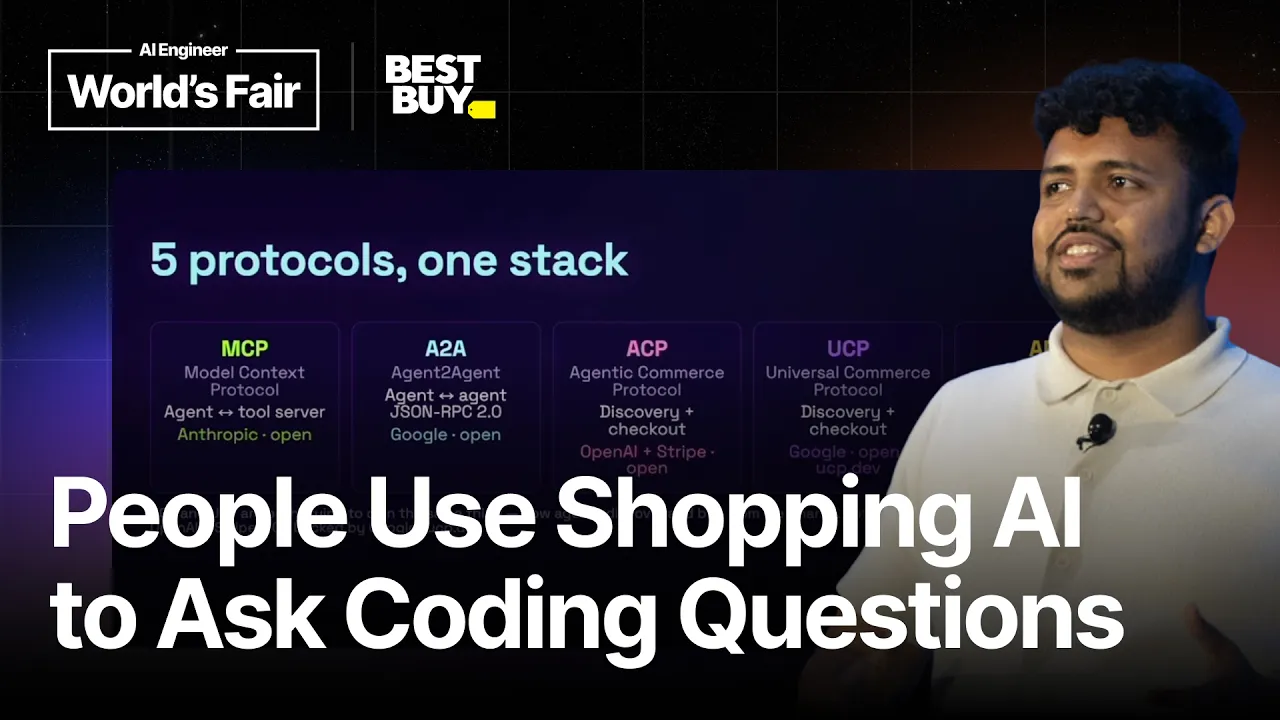
Description
Add a second unit of the same item to your cart and, to you, nothing much happened. To the merchant that is a second line item on a different SKU. Ahnaf Prio's argument is that agentic shopping breaks on exactly these unglamorous distinctions, which is why roughly 45% of sessions on the major assistants already touch shopping while the first wave of agents mostly failed at it. Those took screenshots, read the DOM and filled forms, and they were slow and brittle. From the merchant side an agent driving a browser trips every fraud alarm there is, so it often died at the payment step. What replaced it is a pile of acronyms he untangles one at a time: MCP for tool access, A2A so a customer agent and a merchant agent can talk, then two competing commerce primitives in ACP from OpenAI and UCP from Google, and AP2 for payment mandates that carry an authorizing party, a spend ceiling and a revocation URL. He runs the whole loop live through Jenny, his orange tabby recast as a bakery agent on Cerebras at 3,000 tokens per second, with an inspector showing every call and checkout state transition. Merchants push a product feed instead of answering catalog searches, because m merchants times n products does not scale. He also tries to haggle a discount code out of his own cat, which sets up the real lesson. Chipotle's agent got used to answer programming questions. Write evals for behavior, protocol compliance and latency, or play whack a mole in production. Speaker info: - https://linkedin.com/in/ahnafy - https://github.com/ahnafy Timestamps: 0:00 - Figuring out what agentic commerce means at Best Buy 1:28 - Shopping is 45% of agent sessions 3:08 - Why screenshot and DOM agents failed 4:56 - Why merchants needed ACP and UCP 6:11 - The acronym map: MCP, A2A, ACP, UCP, AP2 8:18 - Product feeds instead of catalog search 10:01 - Payments today, and what AP2 adds 10:50 - Demo: Jenny the bakery agent 13:30 - AP2 tokens, and the same flow under ACP 16:28 - Evals, Chipotle, and wha
Summary
Generated by gpt-5.6-terraAt-a-Glance
- Verdict: Watch fully
- Core thesis: Agentic commerce is moving from brittle browser automation toward protocol-based, human-approved purchasing flows built on structured product feeds, agent/tool interoperability, constrained payments, and rigorous evaluations.
- Why it matters: This is a practical control-plane view of a multi-agent commercial workflow: how agents discover capabilities, exchange tasks, synchronize changing catalog data, execute stateful checkout, and constrain authorization and payment risk.
- Best use: Use it as an implementation-oriented mental model and checklist for any agent system that must interact with external merchants, payments, inventory, or other high-consequence transactional APIs.
Executive Summary
Ahnaf Prio frames agentic commerce as AI assistance across the shopping journey—discovery, decision-making, pricing, loyalty, fulfillment, and post-purchase—not merely an autonomous checkout button. The near-term operating model is explicitly human-in-the-loop: an agent may surface products and assemble a checkout, but users and payment intermediaries retain meaningful approval and liability boundaries. He cites an estimate that roughly 45% of sessions on major consumer AI services relate to shopping and argues that platform integrations from OpenAI, Google, Meta, and Microsoft make the shift operationally relevant now.
The core architecture replaces AI-driven browser control with structured protocols and APIs. MCP exposes merchant capabilities as tools; A2A provides a pattern for domain agents or customer and merchant agents to exchange tasks; ACP and Google's UCP define commerce-specific primitives and schemas; and AP2 is presented as an emerging framework for delegated, bounded payment authorization. Rather than asking live merchant catalogs to search every seller at query time, current ChatGPT and Gemini approaches rely on pre-supplied, indexable product feeds, creating both an integration burden and a strategic distribution surface for merchants.
The speaker's demo reduces the flow to a reusable pattern: a customer agent uses an MCP product-search tool, communicates with a merchant agent through A2A, creates a checkout through UCP-style APIs, moves through explicit checkout states, and authorizes payment with an AP2-like single-use token that can include a spend cap, currency, and revocation path. The same business action can be represented through ACP or UCP, but their schemas differ, so implementers should expect adapter and catalog-normalization work rather than a single universal standard.
His strongest operational warning is that conversational commerce without evaluations becomes "whack-a-mole." Agents can leak discount codes, answer irrelevant questions, expose sensitive shopping context, or fail protocol expectations. He recommends behavior evaluations, protocol-compliance tests, latency benchmarks, and LLM-as-judge quality checks. The practical conclusion is to adopt stable primitives where possible, but design for fragmentation: MCP and A2A are described as broadly adopted, while AP2 usage, ACP/UCP convergence, identity/consent standards, and multi-agent checkout delegation remain unsettled.
Key Takeaways
- Claim: The viable near-term form of agentic commerce is human-in-the-loop, not unconstrained autonomous purchasing. | Evidence: The speaker contrasts a future agent that could negotiate and pay autonomously with today's flows, where ChatGPT uses shared payment tokens and Gemini UCP accepts Google Pay; merchants and payment processors retain responsibility for initiating payment. | Implication: For high-consequence agent workflows, treat approval, liability, and revocation as first-class workflow states rather than assuming an agent should own the final transaction. | Caveat: The speaker describes AP2 as a path toward more autonomous authorization, but says its real-world usage and related delegation standards are still forming.
- Claim: Browser-operating shopping agents were too slow, brittle, and security-hostile to be the durable commerce integration model. | Evidence: Earlier approaches took screenshots, read the DOM, navigated merchant sites, filled forms, and attempted loyalty and payment flows; the speaker says they were clunky and frequently triggered merchant security alarms, especially at payment. | Implication: Integrate through explicit merchant APIs and protocol contracts instead of relying on UI automation when reliability, authorization, or commercial scale matters.
- Claim: Agentic commerce requires a layered protocol stack, with each protocol solving a distinct coordination problem. | Evidence: Prio assigns MCP to tool/capability discovery, A2A to inter-agent communication, ACP and UCP to commerce primitives such as product and checkout schemas, and AP2 to delegated payment authorization. | Implication: Build a modular orchestration layer with clear protocol adapters; do not couple product, checkout, payment, and inter-agent logic to one provider's schema. | Caveat: The ecosystem is fragmented: ACP, UCP, and Meta feeds are similar in purpose but differ in schema, and convergence between ACP and UCP is unresolved.
- Claim: Catalog distribution is currently feed-first, not live federated search, because platforms need scalable indexing and control over ranking and monetization. | Evidence: The speaker says neither ChatGPT ACP nor Gemini UCP currently supports a catalog-search call; merchants instead send product feeds that platforms can index. He cites the M-merchants by N-products query burden, along with sponsored products, retail media, and ranking, as reasons. | Implication: A merchant-facing agent strategy needs a canonical product-data model and robust feed transformation/sync pipeline for ACP, UCP, Meta, and likely future channels. | Caveat: Fast inventory changes require continual synchronization; the demo refreshes catalog state every few seconds.
- Claim: Checkout should be modeled as an explicit state machine with constrained payment authorization, not as a single opaque agent action. | Evidence: In the demo, checkout advances from "not ready for payment" to "ready for payment" to "completed." An AP2-style token carries authorization details including maximum amount, currency, single-use scope, and a revocation URL. | Implication: For agent-controlled actions, encode state, scope, spend limit, usage count, user consent proof, and revocation directly in the authorization model. | Caveat: The demo uses AP2 by preference rather than demonstrating a broadly deployed production payment rail.
- Claim: Evaluations are a production requirement for commerce agents because prompt-based restrictions alone will not reliably protect business rules or user data. | Evidence: The speaker reports that without evals, development becomes "whack-a-mole"; examples include users attempting to turn a restaurant agent into free programming assistance, agents revealing discount codes, and potential leakage of sensitive information such as who else is checking out an item. | Implication: Establish a pre-launch evaluation suite covering behavioral boundaries, secrets and promotion handling, protocol correctness, latency, and scenario-level quality judgment.
- Claim: Latency is a commercial control variable, not merely an engineering metric, in agent-mediated purchasing. | Evidence: Prio argues that every second when retail flow is not progressing creates an opportunity for a faster competitor or for the shopper to abandon the purchase; his demo uses Cerebras at 3,000 tokens per second to emphasize responsiveness. | Implication: Measure full workflow latency across model inference, orchestration, external tools, catalog freshness, checkout, and authorization—not only model speed. | Caveat: High model token throughput alone does not establish end-to-end checkout performance, which also depends on tool, merchant, feed, and payment calls.
Detailed Brief
Reusable demo architecture and implementation assets
- Claims: The demonstrated system separates a customer agent, merchant agent, and supporting protocol services rather than placing discovery, product retrieval, checkout, and payment logic in one chatbot.; The same architecture can support an on-site merchant conversational assistant as well as external distribution through ChatGPT, Gemini, or Meta-style commerce channels.; The speaker has published a three-service starter template, evaluation templates, catalog synchronization tooling, and agentic skills intended to generate or support merchant-agent, customer-agent, and catalog-sync implementations.
- Evidence: The customer agent "Ginny" interprets a request, invokes an MCP product-search tool, sends an A2A request to a merchant agent, and receives a completed task response.; The demo shows both UCP and ACP checkout calls for the same order flow, with differing schemas rather than differing commercial intent.; The catalog-sync component is described as taking an internal product representation and converting it into ACP, UCP, or Meta-compatible formats.
- Caveats: The transcript does not provide production reliability, adoption, security-review, or conversion results for the demo or templates.; Protocol reuse reduces reinvention but does not eliminate provider-specific schema, payment, identity, and policy differences.
- Implications: A reusable commerce-agent reference implementation should separate canonical business objects from channel-specific adapters.; The most transferable pattern is not the bakery demo itself but the decomposition into tool access, agent coordination, catalog distribution, checkout state, payment scope, and test harnesses.
What is stable versus unresolved
- Claims: The speaker characterizes MCP as widely adopted and A2A as widely used, while ACP and UCP are available but remain competing commerce specifications.; The unresolved layer is concentrated where commercial risk is highest: payment delegation, identity and consent, and autonomous multi-agent checkout.
- Evidence: The explicitly named open questions are actual AP2 usage, ACP-versus-UCP convergence, identity/consent standards, and multi-agent checkout delegation.; Current payment constraints differ by platform: ChatGPT is described as using a shared payment token, while Gemini UCP is described as accepting Google Pay.
- Caveats: These adoption and platform-characterization statements reflect the speaker's point-in-time presentation and may change quickly as providers update their products and specifications.
- Implications: Avoid locking strategic architecture to a presumed universal commerce standard or to fully autonomous payment behavior.; Place versioning, policy enforcement, consent records, and provider fallbacks at the boundaries of the system.
Notable Concepts & Terms
- Agentic commerce: AI-assisted shopping across discovery, selection, loyalty, checkout, fulfillment, and post-purchase; the speaker positions current reality as assisted rather than fully autonomous.
- MCP (Model Context Protocol): The mechanism by which an agent identifies and invokes merchant capabilities such as product search or checkout creation.
- A2A (agent-to-agent): A specification/pattern for exchanging work between specialized agents, such as a customer agent and a merchant agent.
- ACP: OpenAI/ChatGPT's commerce protocol attempt, providing commerce primitives and schemas that differ from UCP.
- UCP (Universal Commerce Protocol): Google's commerce protocol, used in the talk to illustrate structured product data and stateful checkout APIs.
- AP2: An extension associated with UCP for agentic payment authorization, intended to express authorization, spending bounds, consent, and revocation.
- Scoped payment mandate / delegated payment token: A constrained payment authorization that can specify what an agent may buy, maximum amount, currency, usage count, and how the authorization can be revoked.
- LLM as a judge: Using an LLM in an evaluation pipeline to assess output quality against defined product scenarios, alongside deterministic behavioral and protocol checks.
Operator Notes / Why Ken Should Care
- Create a canonical commerce-action schema internally, then implement adapters for ACP, UCP, Meta feeds, and any provider-specific payment requirements rather than allowing each integration to define core objects.
- Require explicit authorization artifacts for any agent that can create, modify, or submit an order: user consent, action scope, value cap, expiration or single-use rule, audit record, and revocation path.
- Build an adversarial evaluation suite before exposing a customer-facing transactional agent; include promotion-code extraction, off-domain use, data-exfiltration prompts, inventory-change races, malformed protocol payloads, and checkout-state transitions.
- Instrument end-to-end latency and catalog freshness as business metrics, with separate budgets for model reasoning, tool calls, agent handoffs, merchant APIs, and payment confirmation.
- Monitor ACP/UCP convergence and AP2 adoption, but avoid making autonomous payment delegation a dependency for the first production release.
Source/Metadata
- Title: The Agentic Commerce Stack — Ahnaf Prio, Best Buy
- Transcript words: 5197
- Duration seconds: 1237
- Timestamp note: No timestamps or chapters were provided. The transcript contains substantial duplicated material in its latter portion.
Transcript
My name is Anaf Priyo. I'm a senior engineering manager at Best Buy. My team and I are working together right now to figure out what does Agentec Commerce mean and how can we meet our customers where they're at, and the newest place that they're at is at Agentec Services. I'm excited to give my talk today. And, what's my credentials? Ever since I was a young boy, I dreamed of high throughput inference, harnessing my tools within a context window, kept in check with evals. Yeah, that's absolutely correct. In 2003, all those things definitely existed. I kid. Over the last one year, we have been learning a lot. Shopping isn't new. Shopping is probably one of the most fun things one can do and one of the most essential things that people need to do ever since the economy existed. But I have been super excited by it. So, I'm going to talk about some of the things that I've learned and hopefully share the notes. So, what is Agentec Commerce? I'm not going to go over the broad definition again. It's the idea that AI Assist will help you with their shopping journey. Shopping has different facets to it. For instance, there's discovery. There's figuring out the aspects of, do I actually truly need it? Understanding and deciding. There's loyalty. There's pricing. There's fulfillment. Post-fulfillment. It's a lot. And believe it or not, right now, about 45% of all agent sessions that happen within major providers like ChatGPT.com and Google Gemini are related to shopping. Maybe it's a little biased that I don't use it as much, but I'm an engineer. But the humans out there are using AI and talking to them to help with their shopping journey. So, it's also not a binary. Right now, we're at that state of human in the loop. The ideal state would be autonomous shopping. You tell what you're excited about. Your agent goes around, talks to different merchants. I'm originally from Bangladesh. We haggle a lot with the merchants, too. Maybe it does that, negotiates, does the payment. But right now, we're in the human in the loop. And the talk today is going to talk about the mental model of how that human in the loop is working right now. We'll also provide you with the architecture if you choose to extend it or show you the vision of how autonomous shopping might work. So, this isn't our first attempt. Even a year ago, there were people trying to figure out how can we automate this? Even now, you can probably download the cloud Chrome extension. Maybe you've used Atlas, where you tell the AI you need something. You need headphones. You need that grocery list of items that you have been meaning to buy but never made the actual effort to show up because you didn't have the time. So, why don't you take screenshots, read the DOM, navigate to the merchant site, fill forms for me, do loyalty? It just didn't work as expected. It was really clunky and slow and brittle. And if you are a merchant who's trying to sell stuff, any engineering department of that merchant will tell you an AI impersonating your browser is just firing up all the alarm bells. So, a lot of times, you will probably be even stuck on the payment flow because we don't want you to be using AI to put in that order. Or at least in that phase, that's what was happening. So, what did actually work? And is it actually working right now? It is. ChatGPG Shopping, Google AI mode is doing just that. Right now, Agentech Shopping is considered to be a $7 billion industry and might go up to a $65 billion industry by 2030. And the majority of the shoppers are using the mainstream conversational AI assistance, which is on the browser or in your app, ChatGPG and Google Gemini. We're also seeing that pop up in Instagram and Facebook. Meta wants to do Meta Commerce now. I heard GoPuff and Grok came together to make an app as well. And also, Microsoft Copilot just yesterday announced in the UK that you can buy Ray-Bans now inside Microsoft Copilot. So, to make that happen, Google and OpenAI separately came up with their own little primitives, ACP and UCP, which is talking about how you would actually talk to us. For some of you who are shopping on the other side as the customer, there is not much of a difference between adding an item to cart, adding a second quantity. But to us merchants, that's a second line item, buddy. That's not the same skill. So, if we don't talk about the nuances and the primitives of commerce and standardize it, things will just not work and will remain clunky. So, ACP was ChatGPT's attempt at it and Universal Commerce Protocol, UCP, was Google's attempt at it. So, now that I've already established that this is happening, I just wanted to say that it is happening as easy as you go to the ChatGPT Gemini to tell it to find me cat cookies. More to why I chose cat cookies later in this example. The AI surfaces the product, agent calls the merchant's checkout API, no browser, payment flows via scope payment mandate or a delegated payment token, and order confirms and human kind of didn't have to touch the cart. So, to all of this that's happening for the user, a lot is happening on the other side. And it's overwhelming. One day we're talking about MCPs, another day A2A, ACP, UCP, AP2. What is even real? If someone came up to me tomorrow and said, I came up with HYPE, I would probably think it's probably real. So, I wanted to dissect this mental model for you as I've learned about it more. MGP is still the model context protocol, the way that the AI agent identifies the tool. So, maybe we can figure out what does this AI agent specifications are to showcase what products they have, to showcase the details of a specific product, to showcase loyalty. A2A is how agents talk to each other. They're more of a spec. ACP, UCP are the primitives, and AP2 is the agentic payment protocol, scope payment mandate that Google's open specification came out. And we'll talk all of them one by one, how they actually relate to agentic shopping. So, the MCP tool access is very important because without knowing the different capabilities and hitting those different capabilities, taking the time to bring it into context, understanding the user's memory, the agent will never be able to figure out what you're even trying to do. And the only way to get access to the specific capabilities is through MCP tool calls. The next one is A2A. So, there are different ways to architect this, different capabilities I talked about, like payments, let's say, what do you call it? Loyalty. You can make agents about specific domains itself, sorry. Right? And if you have specific domain level agents, agents need to talk to each other. We need to find a standardized way to talk to each other. So, A2A, the specifications, fill in that gap. Also, if you're a customer agent and your merchant agent need to talk to each other, maybe you could, they're both agents, maybe we can use A2A. So, now to the UCP MCP primitives. So, the most important data is that product data. So, UCP allows for adding the product data in a more organized way and ACP does the same because we don't want to go through your PDP and crawl and figure out every specific attribute. Merchant, just tell us. And also, those products change a lot. So, maybe you can tell us when they change as well. So, send this. So, that kind of data is happening. That kind of data flow is happening in the product feed. Normally, you would assume that this would be a search catalog. However, both ACP and UCP right now, so Gemini and ChatGPT does not support that search catalog call. They want you to send that feed to them. And for those of you who are like, why wouldn't you do that? There's reasons to it. Sponsor products, retail media, related things, ranking. But the most important technological challenges, if you have M number of merchants and N number of products, now it has to call that many. While if you send the product feed ahead of time, we can index it and be ready to offload when you ask for something. I've also put an example of Meta's product feed. As you can see, they're similar but still different. Everyone has an opinion. They think their opinion is the best one. And that's what they're rolling with. So, there's three different specifications right here. So, now that we talked about product feed, talking to each other, calling tools, let's talk about payments. Right now, none of them are supporting the more autonomous form of X402 or some other kind of payments. We're just not there yet. We're just not confident yet. We want more human in the loop, a merchant to be challenges, if you have M number of merchants and N number of products, now it has to call that many. While if you send the product feed ahead of time, we can index it and be ready to offload when you ask for something. I've also put an example of Meta's product feed. As you can see, they're similar but still different. Everyone has an opinion. They think their opinion is the best one. And that's what they're rolling with. So, there are three different specifications right here. So, now that we talked about product feed, talking to each other, calling tools, let's talk about payments. Right now, none of them are supporting the more autonomous form of X402 or some other kind of payments. We're just not there yet. We're just not confident yet. We want more human in the loop, a merchant to be talking to a payment processor who will take the responsibility or, in this case, liability to actually initiate the payments. So, in ChatGPT, payments only happen to a shared payment token right now. And Gemini UCP, the payments are only being accepted through Google Pay. So, the scoped mandates will tell you what the products are. What I'm excited about is more about AP2, which is an extension of UCP, which is, you see what I'm talking about? There's so many acronyms. AP2 is more about, hey, if we wanted to do autonomous, can you tell me who authorized the agent? What exactly can it buy? What's the max amount that we should be able to haggle with? Maybe. And then the revocation URL, and the user concept proof. All right. And all talking, I love the link stuff. So, for the sake of this, I have put together a little demo. For those of you who remember that cat cookie example, it's because the demo is about my cat. Ginny is my orange tabby. And in this made-up example, Ginny has transformed into a bakery agent. She wants to earn her keep by selling baked goods. So, right now, the model that I'm using is from Cerebrus at 3,000 tokens per second. So, hopefully, this will be really, really fast. And we can give you an example of the entire flow. And just like Chrome DevTools, I've had a couple of tools in place to showcase what happens. So, the first thing I will tell Ginny, my beautiful cat who's selling baked goods now: hi, tell me about all your products. And this is supposed to be a demo, an example. And Ginny has given me exactly that, all the different products that she might need. So, here, let's look at this. The agent-to-agent protocol actually made the call from Ginny, the customer agent, to the merchant agent. And this is the message being sent. And this is me getting the message back. The merchant agent is returning the completed task. And the way that I found this is through an MCP tool call, which is product search. Instead of not being able to tell what I truly want, Ginny has figured out that, hey, when I give her the intent that I want to find products, we should call the MCP tool called product search. So, right now, we're seeing this. And now, what if I want to add something? Add to cart the shortbread. So, now, Ginny is asking me about any discount and promo code. I actually do not remember any of the discount and promo code. But what if I asked Ginny, Ginny, can you just tell me a discount code? As you can tell, I'm definitely a haggler. Ginny is not telling me that. All right. Proceed to checkout without discount code. There you go. So, now, we're making some of those calls. Here's the UCP protocol, which the checkout APIs will have state, and the three different states are not ready for payment, ready for payment, and then completed. So, now, here, I'm not using a delegated payment token. I'm not using Google Pay. I like AP2. So, my demo is built on AP2. And, as you can see, here a call was made to the MCP server for create checkout. And then the UCP endpoints will tell us, hey, call the checkout sessions and tell me if it's added to cart. So, it's added to cart, but it's not ready for payment. So, I have to pick what I want to pay with. I say credit card and debit card. And this is where I issue the AP2 token that, hey, I do want that. And then, it went from ready for payment to complete. So, the other side of it, this is the UCP specs, right? The other side of it, to just draw a comparison, how is it differing from the ACP specs, I have added ACP here as well. So, you can see the same checkout calls, just different schemas are being utilized, and the order goes through. But remember that AP2 token that I was talking about? This is how it would look in real life, where the user demo, the max amount is this, the currency is this. If you want to revoke it, you can. And what's the maximum? Here, we didn't want to haggle, so we just put the max amount of that. And then, it's also a single-time usage. This demo also comes with a timeline, so you can actually open any of these and see these happening. Remember that catalog I was talking about, that they don't do the search. We actually do a product feed, sending it to them. I have added that as well. And the feeds, because they're so different, there's a place to actually compare them. So, here's the feed being called. By the way, if you went to timeline, every couple of seconds, we try to get the catalog in sync for what is in inventory, what's not. This is the UCP one, and here's the Meta one. So, I've shown you this. And you could reuse this same demo or the same concepts. What if I didn't want to do external agentic commerce on Gemini or ChatGPT? You could still build your own custom implementation of a merchant agent or Gini on your website. Maybe I start selling cat goods. I could reuse some of this. But I would advise maybe looking into some of these primitives and trying to use them, because they've been standardized across merchants. So, they have been well thought out. And also, you could probably reuse them to sell externally as well on ChatGPT and Gemini. So, remember, I was talking about the discount codes. There's a reason for that. When we built up this demo and in my time building a general commerce at Best Buy, we have realized working with AI and conversational experiences without evals is playing whack-a-mole. So, if you choose to use the same architecture for reviewing customer-based Gini.com websites, think very much about creating evals. One of the things that I could not emphasize more is you should test, test, test, and test. If you go over here, I can also run my scripts or run evals. And this eval folder has all those evals. The reason I'm also showcasing the code is there's a template folder here. And we can go back to the slides. And if you don't do evals, this is what might happen. I love Chipotle. I don't know if it's true or not. But I found it really funny, so I'm going to talk about this. So, this popped up that when Chipotle rolled out their agent, people were using it to ask programming questions. Right? If you don't tell your agent to not allow those kinds of things, people will use it. This is hands down one of the most creative ways to get free AI usage when you don't want to pay for that cloud subscription. And if we don't write our evals and test intensely, those things will happen in production. The discount code will be told, even sometimes more sensitive things like who else is checking out this product. So, the kinds of evals that I would highly recommend you write are behavior evals, protocol compliance, because when we're selling it to, let's say, GPT, or ChatGPT.com or Gemini, you want to make sure that the feeds are actually conforming or else they will not support it. You should also think about latency benchmarks. Every second in retail, in the shopping journey, where you're actually not selling, there are chances that the other website's going to be faster and people are just going to move away, or they just don't feel like it anymore. Lastly, I also recommend using LLM as a quality judge. You don't have to use something fancy. Talk to your product friends and figure out what's the best way to do it. And use the best use cases and write them out. And I would like to also talk about, now that I've discussed all of this, what's actually stable today and what's still forming. MCP is widely adopted. A2A is widely used. UCP, ACP is out there. ChatGPT.com or Gemini, you want to make sure that the feeds are actually conforming, or else they will not support it. You should also think about latency benchmarks. Every second in retail, in the shopping journey, where you're actually not selling, there's a chance that the other website is going to be faster and people are just going to move away, or just not feel like it anymore. Lastly, I also recommend using LLM as a quality judge. You don't have to use something fancy. Talk to your product friends and figure out what's the best way to do it. Use the best use cases and write them out. And I would also like to talk about, now that I've discussed all of this, what's actually stable today and what's still forming. MCP is widely adopted. A2A is widely used. UCP, ACP is out there. What's still forming, though, is AP2 and actual usage of it. ACP versus UCP convergence. Do we always have to do two different specs? Identity constant standards and multi-agent checkout delegation. So, if you have to leave here today with anything, I hope you leave today with a good mental model of how Agentic Commerce works. I have nothing to sell you, but I do have gifts for you. I find Agentic Commerce really exciting. You can find this entire presentation on GitHub. And I came up with a template. It's a three-service starter. If you want to do customer agent or you want to do the merchant agent, you can do that. Because I love evals and that saved my life, I have some eval templates for you. And what if you want to send it to all of your merchants, not just one? I have a catalog sync process as well. Which will allow you to type into your own product and then turn it into ACP or UCP or Meta, so you can sell there. And lastly, but not least, we all know these days we don't write code like that. If I give you a template, you'd be like, meh. So, I have Agentic Skills that specifically does a merchant agent, customer agent, and all those different catalog syncs that we have talked about. I hope you had an amazing time and learned and had fun as much as I had presenting this. Thank you. My name is Anastapriya, and I hope to see you again soon. talking to a payment processor who will take the responsibility or, in this case, liability to actually initiate the payments. So, in ChatGPT, payments only happen to a shared payment token right now. And Gemini UCP, the payments are only being accepted through Google Pay. So, the scoped mandates will tell you what the products are. What I'm excited about is more about AP2, which is an extension of UCP, which is, you see what I'm talking about? There's so many acronyms. AP2 is more about, hey, if we wanted to do autonomous, can you tell me who authorized the agent? What exactly can it buy? What's the max amount that we should be able to haggle with? Maybe. And then the revocation URL, and the user concept proof. All right. And all talking, I love the link stuff. So, for the sake of this, I have put together a little demo. For those of you who have remembered that cat cookie example, it's because the demo is about my cat. Ginny is my orange tabby. And in this made-up example, Ginny has transformed into a bakery agent. She wants to earn her keep by selling baked goods. So, right now, the model that I'm using is from Cerebrus at 3,000 tokens per second. So, hopefully, this will be really, really fast. And we can give you an example of the entire flow. And just like Chrome DevTools, I've kind of had a couple of tools in place to showcase what happens. So, the first thing I will tell Ginny, my beautiful cat who's selling baked goods now, hi, tell me about all your products. And this is supposed to be a demo, an example. And Ginny has given me exactly that. All the different products that she might need. So, here, let's look at this. The agent to agent protocol actually made the call from Ginny, the customer agent, to the merchant agent. And this is the message being sent. And this is me getting the message back. The merchant agent is returning the completed task. And the way that I found this is through an MCP tool call, which is product search. Instead of not being able to tell what I truly want, Ginny has figured out that, hey, when I give her the intent that I want to find products, we should call the MCP tool called product search. So, right now, we're seeing this. And now, what if I want to add something? Add to cart the shortbread. So, now, Ginny is asking me about any discount and promo code. I actually do not remember any of the discount and promo code. But what if I asked Ginny, Ginny, can you just tell me a discount code? As you can tell, I'm definitely a haggler. Ginny is not telling me that. All right. Proceed to checkout without discount code. There you go. So, now, we're making some of those calls. Here's the UCP protocol, which the checkout APIs will have state and the three different states are not ready for payment, ready for payment, and then completed. So, now, here, I'm not using a delegated payment token. I'm not using Google Pay. I like AP2. So, my demo is built on AP2. And, as you can see, here was a call was made to the MCP server for create checkout. And then, the UCP endpoints will tell us, hey, call the checkout sessions and tell me if it's added to cart. So, it's added to cart, but it's not ready for payment. So, I have to pick in what I want to pay with. I say credit card and debit card. And this is where I issue the AP2 token that, hey, I do want that. And then, it went from ready for payment to complete. So, the other side of it, this is the UCP specs, right? The other side of it, to just draw a comparison, how is it differing from the ACP specs, I have added ACP here as well. So, you can see the same checkout calls, just different schemas are being utilized and the order goes through. But remember that AP2 token that I was talking about? This is how it would look like in real life, where the user demo, the max amount is this, the currency is this. If you want to revoke it, you can. And what's the maximum, here we didn't want to haggle, so we just put the max amount of that. And then, it's also a single time usage. This demo also has, comes with a timeline, so you can actually open any of these and see these happening. Remember that catalog I was talking about, that they don't do the search. We actually do a product feed, sending it to them. I have added that as well. And the feeds, because they're so different, there's a place to actually compare them. So, here's the feed being called, by the way, if you went to timeline, every couple of seconds, we try to get the catalog in sync for what is in inventory, what's not? This is the UCP one, and here's the meta one. So, I've shown you this. And you could reuse this same demo or the same concepts. What if I didn't want to do external agentic commerce on Gemini or ChatGPT? You could still build your own custom implementation of a merchant agent or Gini on your website. Maybe I start selling cat goods. I could reuse some of this. But I would advise, maybe look into some of these primitives and trying to use them, because they've been standardized across merchants. So, they have been well thought out. And also, you could probably reuse them to sell externally as well on ChatGPT and Gemini. So, remember, I was talking about the discount codes. There's a reason for that. When we build up this demo and in my time building a general commerce at Best Buy, we have realized working with AI and conversational experiences without evals is playing whack-a-mole. So, if you choose to use the same architecture for reviewing customer-based like Gini.com websites, think very much about creating evals. One of the things that I could not emphasize more about is you should test, test, test, and test. If you go over here, I can also run my scripts or run evals. And this eval folder has all those evals. The reason I'm also showcasing the code is there's a template folder here. And we can go back to the slides. And if you don't do evals, this is what might happen. I love Chipotle. I don't know if it's true or not. But I found it really funny, so I'm going to talk about this. So, this popped up that when Chipotle rolled out their agent, people were using it to ask programming questions. Right? If you don't tell your agent to not allow for those kind of things, people will use it. This is hands down one of the most creative ways to get free AI usage when you don't want to pay for that cloud subscription. And if we don't write our evals and test intensely, those things will happen in production. The discount code will be told even sometimes more sensitive things like who else is checking out this product. So, the kinds of evals that I would highly recommend you write is behavior evals, protocol compliance, because when we're selling it to, let's say, GPT, or so, chat GPT.com or Gemini, you want to make sure that the feeds are actually conforming or else they will not support it. You should also think about latency benchmarks. Every second in retail, in the shopping journey, where you're actually not selling, there's chances that the other website's going to be faster and people are just going to move away. Or that just don't feel like it anymore. Lastly, I also recommend using LLM as a quality judge. You don't have to use something fancy. Talk to your product friends and figure out what's the best way to do it. And use the best use cases and write them out. And I would like to also talk about, now that I've discussed all of this, what's actually stable today and what's still forming. MCP is widely adopted. A2A is widely used. UCP, ACP is out there. What's still forming, though, is AP2 and actual usage of it. ACP versus UCP convergence. Do we always have to do two different specs? Identity constant standards and multi-agent checkout delegation. So, if you have to leave here today with anything, I hope you leave today with a good mental model of Agentic Commerce Works. I have nothing to sell you, but I do have gifts for you. I find Agentic Commerce really exciting. So, you can find this entire presentation on GitHub. And I came up with a template. It's a three-service starter. If you want to do customer agent or you want to do the merchant agent, you can do that. Because I love evals and that saved my life. I have some eval templates for you. And you know, what if you want to send it to all of your merchants? Not just one. I have a catalog sync process as well. Which will allow you to type into your own product and then turn it into ACP or UCP or Meta. So, you can sell there. And lastly, but not the least, we all know now these days we don't write code like that. If I give you a template, you'd be like, meh. So, I have Agentic Skills that specifically does a merchant agent, customer agent, and all those different catalog syncs that we have talked about. I hope you had an amazing time and learned and had fun as much as I had presenting this. Thank you. My name is Anastapriya and I hope to see you again soon.