How to scale intent, quality, and artistry with Al | Katie Dill (Stripe)
Description
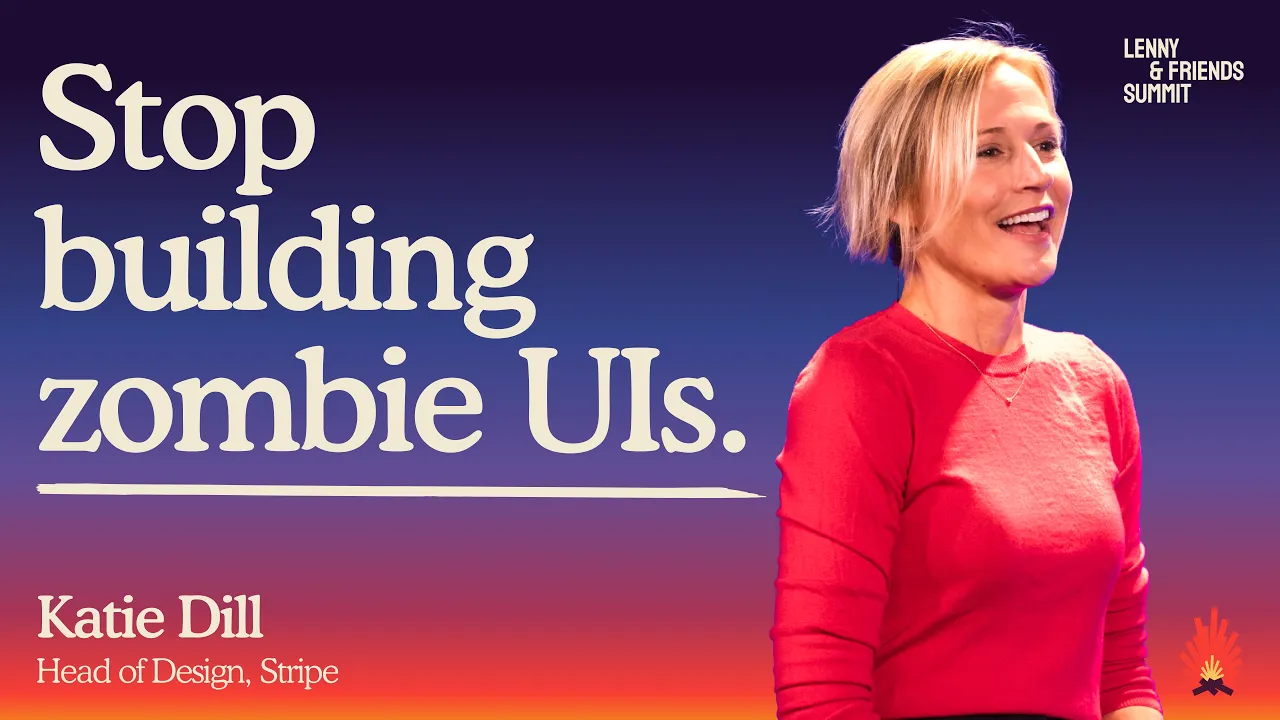
As AI makes it easier to build, how do we keep products from becoming generic “zombie UI”? At the Lenny and Friends Summit, Stripe’s Katie Dill explains why great design still depends on a clear point of view, an understanding of users, and care in the details. She shares how to build those standards into AI tools, edit beyond the first draft, and use AI to create more original products. Recorded live at Lenny and Friends Summit on September 10, 2026, in San Francisco.
Summary
Generated by gpt-5.6-terraAt-a-Glance
- Verdict: Watch fully
- Core thesis: AI should not merely accelerate production of familiar interfaces; teams must encode a clear point of view and quality bar into their systems, then apply human editorial judgment and creative ambition to produce differentiated products.
- Why it matters: Stripe offers a concrete pattern for agentic building: replace loose documentation retrieval with an opinionated design-system harness containing templates and flows, while explicitly restoring quality control after rapid generation.
- Best use: Use this as a leadership and product-design operating model for building AI-enabled product teams, especially when defining standards, agent constraints, review loops, and creative culture.
Executive Summary
Katie Dill frames the current AI wave as a building boom with a historical warning: postwar modernism's intentional principles were eventually copied into generic, context-free buildings. LLMs create a comparable risk because they optimize toward probable and familiar outputs, make premature completion feel satisfying, and encourage teams to treat cheap-to-generate work as disposable. The result is "zombie UI": polished-looking but generic software that lacks user understanding, brand character, and durable ownership.
Her response is to make a product team's point of view operational. Teams should define what their brand stands for, what users need, and what quality means independent of whether AI or people made the output. At Stripe, this standard is expressed through details across product and brand work; an AI-generated ad review still yielded 17 concrete refinements. The aim is not abstract perfection, but going one level deeper than users consciously notice so that care is felt in the final experience.
The most reusable implementation lesson is that design systems must evolve from component libraries that scale consistency into systems that scale intent. Stripe found an MCP over design documentation too underspecified: the same prompt led different people to different results. It moved to a CLI built on the design system, designed to deliver the relevant guidance where builders work and to include complete templates and flows, not only atomic components. This provides a more opinionated harness for AI-generated production work.
Rapid AI creation removes the old scarcity-based filter that limited what teams could build before shipping. Dill argues organizations therefore need an editor accountable for the end-to-end user experience: not just approving or rejecting generated artifacts, but determining whether they are coherent, solve the real problem, and are fully formed. AI expands the creative search space, but humans must iterate, scrutinize, and take responsibility for choices that models treat as interchangeable.
Her final argument is cultural rather than technical: use AI's lower production cost to explore stranger, more responsive, and more original interfaces—not only to make existing patterns faster. Give models richer brand-specific inputs, stress-test outputs with adversarial agents, and protect experimentation. The competitive goal is to raise the ceiling of product quality and artistry, rather than merely raise the floor of baseline execution.
Key Takeaways
- Claim: Unchecked AI-assisted building tends toward generic, context-insensitive "zombie UI" because LLMs are optimized to return probable patterns rather than a product's specific point of view. | Evidence: Dill contrasts intentional early modernism with postwar copies that became indistinguishable "zombie buildings," and uses a generic-looking website for a Korean barbecue business as the digital analogue. | Implication: Treat default generated UI and copy as a starting hypothesis, not production-ready design; differentiation must be deliberately specified upstream. | Caveat: The claim is not that AI inherently produces poor work; its failure mode is strongest when teams supply little brand, user, or contextual direction.
- Claim: A team's quality standard should be based on the user-visible output, not whether the work was generated by AI. | Evidence: In a Stripe critique of an AI-assisted advertisement, a cross-functional partner asked what quality bar should apply to something made with AI; the team concluded the user only cares whether it is good, then identified 17 refinements such as softer edges, adjusted bubbles, and more meticulous visual treatment. | Implication: Do not create a lower review standard or separate acceptance path for AI-generated artifacts; hold them to the same product, brand, and usability criteria.
- Claim: For agentic construction, the object of design shifts from individual screens to an opinionated system that can make distributed decisions while preserving intent. | Evidence: Stripe initially used an MCP that understood its design documentation, but it was insufficiently specific and yielded divergent results for the same prompt. Stripe evolved to a CLI built on the design system that provides a more obedient AI harness and surfaces documentation at the point of building to reduce "context rot." | Implication: For Ken's agent systems, retrieval over guidelines alone is unlikely to ensure coherent output; encode executable constraints, defaults, and context directly into the developer/agent workflow. | Caveat: Dill says Stripe has encountered snags and is still working the approach out; this is an emerging operating pattern rather than a proven finished blueprint.
- Claim: A modern AI-ready design system needs complete templates and behavioral flows, not just components and atomic design tokens. | Evidence: Dill says Stripe's newer system teaches how the product should behave and how pieces come together through full templates and flows. She compares the desired system to Gutenberg's 290-character typesetting system, designed to remain both extensible and sufficiently opinionated to avoid ugly spacing in the finished page. | Implication: Define workflow-level patterns, interaction behavior, exception handling, and compositional rules for agents—not merely reusable UI primitives—then retain room for deliberate craft beyond compliance. | Caveat: Even a rules-compliant system can still feel lifeless, as Dill notes through Christopher Alexander's observation that a system can satisfy every rule and still be dead.
- Claim: AI shifts product filtering from pre-build scarcity to post-build editorial judgment, making a named end-to-end editor function essential. | Evidence: Previously, teams might choose one staffed idea from 20 and prune throughout development; now they can build 20 ideas in a week. Dill argues the filter consequently moves after generation, where it is harder to say no, and asks who in an organization evaluates whether the product is a coherent whole. | Implication: Build explicit post-generation review gates and assign accountable owners who test full user journeys, rather than relying on isolated artifact reviews or assuming deployment-ready code equals a finished product. | Caveat: The editor's role is not simply vetoing work; it must diagnose whether an experience is fully formed and how to push it to completion from the user's perspective.
- Claim: AI's best creative value is expanding the possibility space, provided humans iterate deeply rather than accepting the first plausible output. | Evidence: For the event opening animation, Stripe started with a 3D scene and used AI for animation, then iterated 56 times to reach a subtler and more realistic result. Dill argues the team may not have attempted such a complex scene or so many viewpoints without AI. Stripe similarly paired a human marbler's work for its Built to Grow cover with AI fine-tuning of colors and lines. | Implication: Use AI to generate alternatives and accelerate iteration, but budget human judgment for selection, refinement, and accountability; measure success by better user problem-solving and meaningful details, not generation speed. | Caveat: Fast first-pass output creates the "burrito dilemma": the speed and apparent polish can tempt teams to accept flawed work prematurely.
Detailed Brief
Practical creative-partner tactics
- Claims: Prompt quality should include a product's beliefs, brand character, definition of good, and distinctive source material rather than only a generic task request.; Generated work should be actively stressed rather than passively accepted.; Adversarial agents can assist critique, but they do not replace the human responsibility to keep pushing for a better result.
- Evidence: Dill contrasts asking for a generic Korean-barbecue website with specifying what the business believes, cares about, and considers good.; She recommends supplying source material that helps the model think in different directions and using adversarial agents to "bang up" outputs.
- Caveats: These are tactics, not substitutes for culture: the harder challenge is making it safe and expected for teams to depart from cookie-cutter patterns.
- Implications: Create reusable prompt/context packs containing brand principles, strong reference artifacts, user-context constraints, and anti-patterns.; Add automated critique roles to generation workflows, while preserving a final human escalation path for taste, coherence, and strategic differentiation.
Leadership model: protect exploratory work
- Claims: AI lowers the cost of creation, so leaders should reinvest some of the saved time and capacity into exploration rather than extracting it entirely as efficiency.; New interaction and aesthetic conventions remain open territory; current defaults such as chats, charts, and CLIs should not be mistaken for the endpoint of AI interfaces.; The target outcome is a product that anticipates needs and conveys intentional care, not a technical demo proving an animation or interface was generated quickly.
- Evidence: Dill invokes multi-touch and synthesizers as technologies that enabled new interaction and creative forms rather than simply speeding up old ones.; She advises leaders to give teams room to explore and to "protect the strange."; Her closing contrast is Gothic architecture, where distinct crafted details revealed the maker's hand, versus interchangeable postwar buildings.
- Caveats: Differentiation is harder and culturally riskier than following established patterns, even when AI makes implementation cheap.
- Implications: Separate exploratory interface work from immediate delivery commitments so teams can pursue higher-upside interaction ideas without being forced into default patterns.; Evaluate creative AI work by user relevance, anticipation of edge cases, and brand coherence—not by tool novelty or time-to-generate.
Notable Concepts & Terms
- Zombie UI: Dill's term for monotonous, generic, and uncared-for interfaces produced when patterns are copied without attention to user context, brand, or long-term responsibility.
- Raise the ceiling, not just the floor: Use AI not only to make acceptable baseline output faster, but to enable work that would otherwise be too complex, varied, or ambitious to pursue.
- Scale intent: The new purpose of a design system: carry a team's judgment, behavioral expectations, and point of view into distributed human and agentic production.
- Context rot: The degradation in model outcomes when design guidance is not delivered in the right context and moment of work; Stripe's CLI is intended to mitigate this.
- Point of view: An explicit definition of what a brand is for, who it wants to be to users, and what users care about; without it, AI supplies generic assumptions.
- The burrito dilemma: The tendency to overlook serious flaws because AI produces an apparently finished artifact so quickly, analogous to accepting a quickly microwaved but poor meal.
- Editor: The accountable role that assesses an AI-accelerated product as a complete user journey, restores post-build filtering, and develops work beyond superficial completion.
- Protect the strange: A leadership mandate to preserve room for unconventional experiments and differentiation instead of defaulting to safe, familiar AI-generated patterns.
Operator Notes / Why Ken Should Care
- Audit the current agent/UI generation stack for whether it retrieves passive documentation only; prioritize an executable harness that injects behavioral flows, templates, constraints, and product-specific context at generation time.
- Assign a specific owner or review forum to evaluate generated experiences end-to-end as users, with authority to require further iteration after a feature is technically complete.
- Create a quality rubric that is tool-agnostic: problem resolution, user-context anticipation, cross-flow coherence, brand fit, and deliberate details should be required regardless of whether output is human- or AI-produced.
- Run a small adversarial-review agent experiment that critiques brand fit, journey coherence, and likely user confusion, then compare its findings against human editorial review.
- Reserve explicit capacity from AI-driven productivity gains for interface exploration and differentiated prototypes rather than converting all gains into throughput targets.
Source/Metadata
- Title: Raise the ceiling: how to scale intent, quality, and artistry with Al | Katie Dill (Stripe)
- Transcript words: 5524
- Duration seconds: 1308
- Timestamp note: No usable timestamps or chapters were present in the supplied transcript; substantial portions of the transcript are duplicated.
Transcript
Rebekah Kelley Reviewer Good morning. Right after World War II, there was a massive building boom, the largest in history. In the U.S., people were coming home from war, there were new technologies, new construction methods, and buildings were going up like gangbusters. The builders of that day drew on the style of modernism from the 1920s. That's really simple geometries, clean, bare surfaces, monochromatic color palettes, and no adornment. Now, say what you will about modernism, but the founders behind the movement had intentionality. There was a point of view behind the Villa Savoie. There were principles behind the Bauhaus. But after World War II, with urgency to build and new construction methods, the style was essentially copied, again and again, without intentionality. The thinking got thinner and thinner, and all that was left were generic patterns ill-suited to the context at hand. For example, we used to have banks that looked like this, signaling trust, reliability, and security. And then we got this. You're all too familiar with this reality because it carried on for decades until this day. Zombie buildings all over the place. Nothing differentiates them. Nothing says, this is intentional. This is fit to purpose. They essentially show no care for the user and the inhabitants around it, no care for context or the brand. I think about this a lot. One, we're surrounded by them. And two, we're in another building boom now. The AI building boom. Everybody and their mother can build now. Teams of three can do what teams of 30 used to be needed for. But there's echoes of the post-war building boom, similarities that are actually watchpoints for us. I want to tell you about these watchpoints, and then we'll talk about how we can navigate them together. First, LLMs are really good at telling you the most probable answer, which essentially means that they're able to tell you what has been or is popular now, what has worked, what was in style. They're less good at telling you what's original or specific to you, your brand, and your user's context. I'll give you an example. Can you guess what this brand sells? Software? No, Korean barbecue. Now, this is, I'm sure, a very fine website, but it has no character, no context for the user or the context of the use. Which brings me to my second point, the temptation of done. AI makes things feel finished really, really fast, all too often prematurely. I'll give you an example that I probably shouldn't admit. I have a microwave burrito for lunch all too often. I take the cold hard rock out of the freezer, plop it on the plate, put it in the microwave, and in 90 seconds, I go from hungry to lunch. I'm willing to overlook some pretty serious flaws. It's nearly inedible, but I'm so enamored by the speed of execution. The same happens with AI. You type in a sentence, and boom, you have an interface. There's some nice little corners and maybe some drop shadows, and it's good to be done. But an apparently polished state can often be misleading. Does it really solve the problem? Does it really differentiate? All the questions Clairvue brought up earlier apply here. And the third watchpoint. This work is so easy to do, so quick, that it often feels disposable. And worst, is treated that way. We sometimes let the responsibility of our decisions fall by the wayside and don't really think about the long term. Like, who's maintaining this anyways? All three of these watchpoints can come together to a world that looks a little like this. An actual place in Turkey. If we're not careful, our building boom could end up a little too much like the post-war building boom. The proliferation of patterns ill-suited to the context at hand. Essentially, zombie UI. Zombie UI that's monotonous, vacant, or uncared for. We spend half our waking lives looking at screens. We want software that feels actually cared for. And that means has a little personality, something as simple as the GrokBot and the little animation and life that it brings. Or even these tiny details like actually having the date in the tab on the calendar. You've probably clicked by this all day long. But that shows the builder cared about you. Or the understanding of context, like the Link Agent Wallet. It anticipates the issues that the agent could have while buying online. And has the troubleshooting built in. Because they anticipate the context of the user, even when it's an agent. These examples show builders that care about their users and bring that care into the work. It shows the character of the brand. And it has soul. We can do this with AI, even though it can sometimes be the culprit. And I have four recommendations on how we can use AI to build products with care and soul. First one. You have to have a point of view. If you don't, AI will give it for you. And as we've already talked about, that's very likely to be generic and looking at the past. You need to define your brand. What is it for you? What is it for your users? Who do you want to be to them? And what do they care about? This forms the basis of your standards. And I'd say this in any era, but it's all the more important right now. When building is distributed, ownership is diffuse, we're all contributing to the products in more ways than we've been in the past. It's too easy to abdicate to AI. So for example, at Stripe, we care a lot about optimism. So we put that into all the details, big and small. The colors we choose, the way we write, what we write about, and the products that we ship to try to support entrepreneurs. Now, these details are so important to be aligned on because everybody is contributing and so much is changing. And I'll give you an example of where that friction can show up if there isn't alignment. We were recently in a design crit looking at an advertisement. So this is an ad we were working on that shows our brand, the parallelogram, with our users' visuals. And as we were looking at this, we were like, all right, cool, you kind of get what's happening, but some things are off. And in the room was a cross-functional partner that was looking to move fast and get something shipped. I'm sure you can't relate. And we had a discussion because they brought up a really interesting question. What's the quality standard for something made with AI? What a curious question. Why should that matter how it was made? It doesn't matter to the users how it was made. It matters to them if it's good or not. And so that is the basis of our standards. It's the output at the end of the day that matters. And they care if it's good and so should we. So through that discussion, we got alignment on what really matters here and what we're striving for, and then walked away with 17 bullet points of improvements to be made. The frost a little bit here and there, softer edges, a bit smaller bubbles. And now we use this term as a verb to mean meticulous craft around the office called Pepsi bubbling. Now, we're not shooting for perfection. We're shooting to go one level deeper than what your customer could see. That meticulous craft will show up for them. And this point of view really drives the standards and drives the work, especially when there's agents involved. And so much more is happening on a daily basis. So how do you develop it? Frankly, it's all about getting really good at noticing. Notice what your users need and what they want, not just what they say. Notice what the world around you signals good and great and meh. Really take note of these things in the products that you use, but also in analogous situations so you can be inspired by art, science, and a broader point of view in the work that you create. Building your sense of taste and your understanding of the world around you and what's good and great can really improve your own standards that you will then need to scale. Which brings me to my second recommendation, which is encode your standards into the machine. It would be a wonderful world if every human had the shared understandings and could make the same decision. But the reality is, humans are not going to be a part of all of these decisions going forward. We are seeing interfaces built without a designer in the room. We're seeing agents finding problems and fixing them while we sleep. And we're certainly seeing generative UI built in real time for users. This is why design systems are having a moment again. And the system of yesterday is different than the system of today. In the past, you didn't have to write everything down because there was always a designer in the room to fill in the blanks. Now we must enable distributed building and agentic construction and the decisions need to be easier to define. So the object of design is no longer the screen. It is the system itself. Now everybody knows Gutenberg created the first printing press. The lesser known part of the story is the system he built around it. He didn't create just 26 lowercase and 26 uppercase letters. He created 290 unique characters, different widths, abbreviations, ligatures. And the reason that he did this is because when he typeset it We are seeing interfaces built without a designer in the room. We're seeing agents finding problems and fixing them while we sleep. And we're certainly seeing generative UI built in real time for users. This is why design systems are having a moment again. And the system of yesterday is different than the system of today. In the past, you didn't have to write everything down because there was always a designer in the room to fill in the blanks. Now we must enable distributed building and agentic construction and the decisions need to be easier to define. So the object of design is no longer the screen. It is the system itself. Now everybody knows Gutenberg created the first printing press. The lesser known part of the story is the system he built around it. He didn't create just 26 lowercase and 26 uppercase letters. He created 290 unique characters, different widths, abbreviations, ligatures. And the reason that he did this is because when he typeset it and wanted it to be fully justified, he wanted to make sure that there wouldn't be the weird rivers and lakes of white space that erode the beauty of the final product. Essentially, he was making it both extensible and opinionated enough that it could feel as good as handmade, although it was machine-made. This is what we should be aiming for as well. Now, the old system scaled consistency, but the new system needs to scale intent. We've been working on this at Stripe and have hit a few snags along the way, and so we're figuring it out. But one of the things we want to do is we want to empower builders to go from prompt to production nearly instantaneously. Many started with an MCP that understood our design documentation, but the results were not great. It wasn't specific enough, and it wasn't driving the right outcomes. Three different people could put in the same prompt and get three different results. So since then, we've evolved, and now we have created a CLI built on our design system. It makes a harness that makes the AI far more obedient. Now, it's where the builders are building, and it consumes the documentation at the right time and place to avoid context rot. Now, importantly, the big difference between this version and a previous design system is it's not just components and atomic parts, but it's actually full templates and flows. So the system actually knows what our product is supposed to behave like and how it all comes together. Essentially, it's far more opinionated than it's been in the past. We embed these standards into the means of production, which enables a more coherent product. But this is just the baseline. Christopher Alexander said, a system can satisfy every rule and still be dead. And this brings me to my third recommendation. Refuse to confuse done with good. The filter is gone. It used to be the quality filter was essentially built into every stage of the product development process, even before a project started. We've got 20 ideas, and we can only staff one. And then we poked and we prodded and we pruned along the way, and products grew somewhat methodically. Well, now we can build 20 ideas in a week. This is awesome in many ways, and we can finally skip theoretical meetings talking about hypothetical products, and react to the real thing in our hands. But the filtering that used to be throughout the process now needs to happen post-build, when it is a lot harder to say no. This is where the role of an editor comes in, and it is ultra-important in this day and age. Who is doing this in your organization? Who's looking at the end-to-end and understanding whether or not we're actually building a whole? It's a new behavior. We have to unlearn that built means done, and that done means good. The most important thing I can say to anybody working on their editing skills is you have to experience it as a user would. Does it actually solve the problem? Is it actually attuned to the way the user thinks about things? Is it actually coherent? A lot of things look good in isolation, but then when you pull it all together into the user journey, it feels a little disconnected. And it's not just about saying yes or no, this is good or it shouldn't go. It's actually about, is it even fully formed? How can we push this to completion? We don't want done to be the enemy of good. A very insightful article by Nabil Qureshi talks about what makes art great. And he says it's about the unexpected details, those little surprising things you're like, wow, I can't believe they thought of that. And then the deeper meaning that sits behind the surface or the continuous themes that tie it all together to a whole. These are the things that AI is not great at. But knowing what the gaps are in AI help us better navigate that and fill these gaps in. As Nabil says, one of the things that so offends us about AI's slop is the sense that the details don't matter. The cup is green, but may as well have been blue. An editor takes accountability for every decision, which is in many ways, every pixel. I'll give you an example from this event. So my team had the pleasure of designing the event. Stefan worked on this fabulous opening animation. He and the team started with a 3D model of the scene, and then they brought it into AI to help with the different animations. Now here's the first version. It's cool. It's fun to see the different little parts of it, and that's nice the way it moves. But if you scrutinize it pixel by pixel, something feels off, right? That's not quite the way it should move. It's a little jerky. You kind of want to get more of the scene, right? So he did it again. And again. And again! 56 times! 56 iterations later, he got to something truly beautiful. Now, it's got more realism, it's got a little bit of life, and it's subtle differences, but you can sense the care. Now, one of the things that so impresses me about this is that if he didn't use AI, he may not have built such a complex scene, or he may not have tried so many different viewpoints. And while it wasn't one and done, and certainly took a lot of wherewithal and scrutiny, AI opened the possibility space. Now, this brings me to my last, and definitely my favorite, fourth recommendation. Unleash creativity and artistry. Yes, AI can help us manufacture monotony. But it is also the greatest creative catalyst we've ever had. This matters more now, because when everybody and their mother is building something, it is going to be harder and more important to differentiate. And the interfaces of today, chats, charts, CLIs, no way is that the epitome of great interactions in the modern era. There is so much more we can do, and so much more we should do, to make things feel generative, alive, responsive, dynamic. We can literally talk to the computers. So let's branch out. It is time to invent new interfaces. It is time to invent new aesthetics. The best practices have not been written yet. We get to do that. And now we have the tools to do it. It's just like when multi-touch made it possible to do wholly new interactions, or the synthesizer allowed us to create totally new sounds. AI is allowing all sorts of new creativity, and we're seeing so much of this online. We're even seeing folks showing up the Stripe design team with way more interesting data viz. And we're seeing websites for restaurants with character and personality, and people using AI to paint and create art themselves. It is a really interesting time. And at Stripe, we're using AI to essentially amplify the abilities of the creative team. Our most recent cover for Built to Grow, it was created by a human marbler who worked on these stunning iterations. And then we used AI to fine tune the details ever further to ensure we had the colors and the lines in all the right places. It was basically taking the good judgment of the humans and helping us scale it to make something truly stunning. Now, to make AI a stronger creative partner, there's a couple of things I recommend. One, improve your inputs. You want more specificity going in the direction of your brand, your unique interests. So put specific prompts. Don't just say, hey, I need a website for my Korean barbecue, but this is what I believe in. This is what good is. This is what we care about. Add your source material that you're using to build your own standards with. Help make it think in different ways. And then stress your outputs. Don't get tempted by the burrito dilemma. Always push a step further. And then, of course, use adversarial agents to help you critique it and bang it up a little bit. But you yourself should always be pushing for better. Now, these are just tactics. The much harder thing is definitely cultural. It is easy to follow cookie-cutter patterns. It's safe and cozy. But it is much more impressive and much harder to find something unique that improves the status quo. So if you're leading a team, don't just tell them to use AI, but give them room to explore. Protect the strange. AI lowers the cost to create. Let's spend some of that savings on making something truly special. but this is what I believe in. This is what good is. This is what we care about. Add your source material that you're using to build your own standards with. Help make it think in different ways. And then stress your outputs. Don't get tempted by the burrito dilemma. Always push a step further. And then, of course, use adversarial agents to help you critique it and bang it up a little bit. But you yourself should always be pushing for better. Now, these are just tactics. The much harder thing is definitely cultural. It is easy to follow cookie-cutter patterns. It's safe and cozy. But it is much more impressive and much harder to find something unique that improves the status quo. So if you're leading a team, don't just tell them to use AI, but give them room to explore. Protect the strange. AI lowers the cost to create. Let's spend some of that savings on making something truly special. If we only use AI to make the things that we already make just faster, then we are definitely missing out on the most interesting part. AI can help us raise the ceiling, not just the floor. The most important thing is to be very intentional. It's your point of view. It's your system. It's your quality bar. And your ambition. That you will want to bring to life with AI. In total contrast to the post-war building boom and modernism design, it was Gothic architecture. In 1850, John Ruskin wrote a lot about quality and craft and highlighted Gothic architecture as the epitome of great. He noticed that no Gothic building was alike. Frankly, not even one column was alike the other. Each detail was uniquely crafted and showed the unique hand and mind of the maker behind it. It felt truly cared for. This is what our users want. They're not impressed if we animated something with 3.js and Blender in 30 minutes. They are impressed by us solving their problems and clever touches in the details that show we anticipated their needs and that our brand has some character behind it. We have the choice in this building boom to not make the digital equivalent of zombie buildings. We can make this a creative renaissance. So let's make some products that are more powerful and show the hand and care of the maker. Thanks, everybody. Thank you. Thank you. because there was always a designer in the room to fill in the blanks. Now we must enable distributed building and agentic construction and the decisions need to be easier to define. So the object of design is no longer the screen. It is the system itself. Now everybody knows Gutenberg created the first printing press. The lesser known part of the story is the system he built around it. He didn't create just 26 lowercase and 26 uppercase letters. He created 290 unique characters, different widths, abbreviations, ligatures. And the reason that he did this is because when he typeset it and wanted it to be fully justified, he wanted to make sure that there wouldn't be the weird rivers and lakes of white space that erode the beauty of the final product. Essentially, he was making it both extensible and opinionated enough that it could feel as good as handmade, although it was machine-made. This is what we should be aiming for as well. Now, the old system scaled consistency, but the new system needs to scale intent. We've been working on this at Stripe and, you know, have hit a few snags along the way, and so we're figuring it out. But one of the things we want to do is we want to empower builders to go from prompt to production nearly instantaneously. Like many, we started with an MCP that understood our design documentation, but the results were not great. It wasn't specific enough, and it wasn't driving the right outcomes. Three different people could put in the same prompt and get three different results. So since then, we've evolved, and now we have created a CLI built on our design system. It makes a harness that makes the AI far more obedient. Now, it's where the builders are building, and it consumes the documentation at the right time and place to avoid context rot. Now, importantly, the big difference between this version and a previous design system is it's not just components and atomic parts, but it's actually full templates and flows. So the system actually knows what our product is supposed to behave like and how it all comes together. Essentially, it's far more opinionated than it's been in the past. We embed these standards into the means of production, which enables a more coherent product. But this is just the baseline. Christopher Alexander said, a system can satisfy every rule and still be dead. And this brings me to my third recommendation. Refuse to confuse done with good. The filter is gone. It used to be. The quality filter was essentially built into every stage of the product development process, even before a project started. We've got 20 ideas, and we can only staff one. And then we poked and we prodded and we pruned along the way, and products grew somewhat methodically. Well, now we can build 20 ideas in a week. This is awesome in many ways, and we can finally skip theoretical meetings, talking about hypothetical products, and react to the real thing in our hands. But the filtering that used to be throughout the process now needs to happen post-build, when it is a lot harder to say no. This is where the role of an editor comes in, and it is ultra-important in this day and age. Who is doing this in your organization? Who's looking at the end-to-end and understanding whether or not we're actually building a whole? It's a new behavior. We have to unlearn that built means done, and that done means good. The most important thing I can say to anybody working on their editing skills is you have to experience it like a user would. Does it actually solve the problem? Is it actually attuned to the way the user thinks about things? Is it actually coherent? A lot of things look good in isolation, but then when you pull it all together into the user journey, it feels a little disconnected. And it's not just about saying yes or no, this is good or it shouldn't go. It's actually about, is it even fully formed? How can we push this to completion? We don't want done to be the enemy of good. A very insightful article by Nabil Qureshi talks about what makes art great. And he says it's about the unexpected details, those little surprising things you're like, wow, I can't believe they thought of that. And then the deeper meaning that sits behind the surface or the continuous themes that tie it all together to a whole. These are the things that AI is not great at. But knowing what the gaps are in AI help us better navigate that and fill these gaps in. As Nabil says, one of the things that so offends us about AI's slop is the sense that the details don't matter. The cup is green, but may as well have been blue. An editor takes accountability for every decision, which is in many ways, every pixel. I'll give you an example from this event. So my team had the pleasure of designing the event. Stefan worked on this fabulous opening animation. He and the team started with a 3D model of the scene, and then they brought it into AI to help with the different animations. Now here's the first version. It's cool. It's, you know, fun to see the different little parts of it, and that's nice the way it moves. But if you scrutinize it pixel by pixel, something feels off, right? That's not quite the way it should move. It's a little jilted. You kind of want to get more of the scene, right? So he did it again. And again. And again! 56 times! 56 iterations later, he got to something truly beautiful. Now, it's got more realism, it's got a little bit of life, and it's subtle differences, but you can sense the care. Now, one of the things that so impresses me about this is that if he didn't use AI, he may not have built such a complex scene, or he may not have tried so many different viewpoints. And while it wasn't one and done, and certainly took a lot of wherewithal and scrutiny, AI opened the possibility space. Now, this brings me to my last, and definitely my favorite, fourth recommendation. Unleash creativity and artistry. Yes, AI can help us manufacture monotony. But it is also the greatest creative catalyst we've ever had. This matters more now, because when everybody and their mother is building something, it is going to be harder and more important to differentiate. And the interfaces of today, chats, charts, CLIs, no way is that the epitome of great interactions in the modern era. There is so much more we can do, and so much more we should do, to make things feel generative, alive, responsive, dynamic. We can literally talk to the computers. So let's branch out. It is time to invent new interfaces. It is time to invent new aesthetics. The best practices have not been written yet. We get to do that. And now we have the tools to do it. It's just like when multi-touch made it possible to do wholly new interactions, or the synthesizer allowed us to create totally new sounds. AI is allowing all sorts of new creativity, and we're seeing so much of this online. We're even seeing folks showing up the Stripe design team with way more interesting data viz. And we're seeing websites for restaurants with character and personality, and people using AI to paint and create art themselves. It is a really interesting time. And at Stripe, we're using AI to essentially amplify the abilities of the creative team. Our most recent cover for Built to Grow, it was created by a human marbler who worked on these stunning iterations. And then we used AI to fine tune the details ever further to ensure we had the colors and the lines in all the right places. It was basically taking the good judgment of the humans and helping us scale it to make something truly stunning. Now, to make AI a stronger creative partner, there's a couple of things I recommend. One, improve your inputs. You want more specificity going in the direction of your brand, your unique interests. So put specific prompts. Don't just say, hey, I need a website for my Korean barbecue, but this is what I believe in. This is what good is. This is what we care about. Add your source material that you're using to build your own standards with. Help make it think in different ways. And then stress your outputs. Don't get tempted by the burrito dilemma. Always push a step further. And then, of course, use adversarial agents to help you critique it and bang it up a little bit. But you yourself should always be pushing for better. Now, these are just tactics. The much harder thing is definitely cultural. It is easy to follow cookie-cutter patterns. It's safe and cozy. But it is much more impressive and much harder to find something unique that improves the status quo. So if you're leading a team, don't just tell them to use AI, but give them room to explore. Protect the strange. AI lowers the cost to create. Let's spend some of that savings on making something truly special. If we only use AI to make the things that we already make just faster, then we are definitely missing out on the most interesting part. AI can help us raise the ceiling, not just the floor. The most important thing is to be very intentional. It's your point of view. It's your system. It's your quality bar. And your ambition. That you will want to bring to life with AI. In total contrast to the post-war building boom and modernism design, it was Gothic architecture. In 1850, John Ruskin wrote a lot about quality and craft and highlighted Gothic architecture as the epitome of great. He noticed that no Gothic building was alike. Frankly, not even one column was alike the other. Each detail was uniquely crafted and showed the unique hand and mind of the maker behind it. It felt truly cared for. This is what our users want. They're not impressed if we animated something with 3.js and Blender in 30 minutes. They are impressed by us solving their problems and clever touches in the details that show we anticipated their needs and that our brand has some character behind it. We have the choice in this building boom to not make the digital equivalent of zombie buildings. We can make this a creative renaissance. So let's make some products that are more powerful and show the hand and care of the maker. Thanks, everybody. Thank you. Thank you.