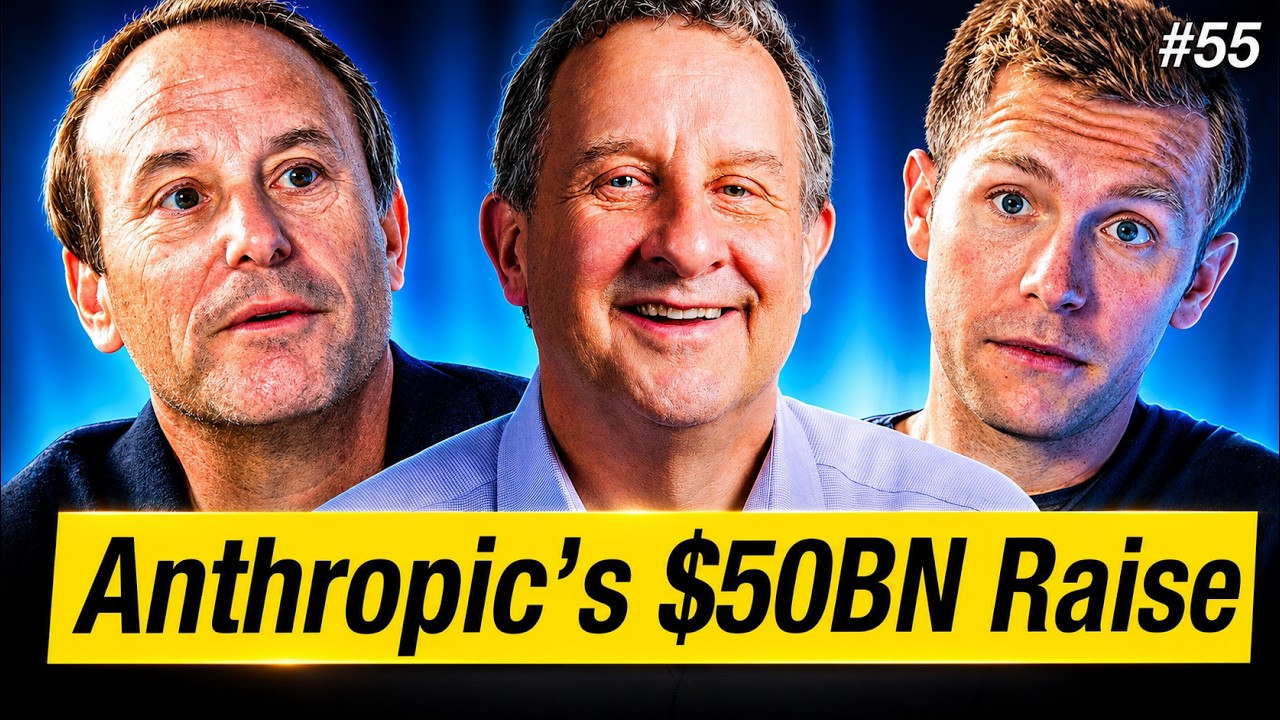
Anthropic's Raise & What It Means for Potential IPO? Mag7: Google & Amazon Up, Meta & Microsoft Down
Description
Jason Lemkin is one of the leading SaaS investors of the last decade with a portfolio including the likes of Algolia, Talkdesk, Owner, RevenueCat, Saleloft and more. Rory O’Driscoll is a General Partner @ Scale where he has led investments in category leaders such as Bill.com (BILL), Box (BOX), DocuSign (DOCU), and WalkMe (WKME), among others. ----------------------------------------------- Timestamps: 00:00 Intro 01:06 Mag7 Earnings: The "Super Bowl" of Tech Results 04:59 Google's Cloud Explosion & The AI Search "Disruption" That Never Came 14:46 Microsoft's $190B Bet: Is AI the Only Thing Keeping Growth Flat? 21:24 Meta's $150B Future Bet vs Wall Street's Need for Spreadsheets 28:14 Palantir's Home Run: Why Big Companies Spend Big Money on AI 39:42 Apple's Quiet Consistency & The Stealth Inflation of Memory Chips 42:37 The SaaS Apocalypse Over? Atlassian and Twilio Lead the Re-acceleration 01:04:17 Anthropic's $50B Raise & The Math Behind Token vs. Salary Spend 01:10:57 Sierra's $15B Valuation: Replacing the $400B Customer Service Labor Market 01:19:30 Musk vs Altman Trial 01:23:49 The End of Managers? Brian Armstrong & The Rise of the "Individual Contributor" ---------------------------------------------------------------------------------------------- Subscribe on Spotify: https://open.spotify.com/show/3j2KMcZ... Subscribe on Apple Podcasts: https://podcasts.apple.com/us/podcast... Follow Harry Stebbings on X: https://x.com/harrystebbings Follow Jason Lemkin on X: https://x.com/jasonlk Follow Rory O’Driscoll on X: https://x.com/rodriscoll Follow 20VC on Instagram: https://www.instagram.com/20vchq Follow 20VC on TikTok: https://www.tiktok.com/@20vc_tok Visit our Website: https://www.20vc.com Subscribe to our Newsletter: https://www.thetwentyminutevc.com/con... ----------------------------------------------- Legal Disclaimer: The content of this podcast is for informational and entertainment purposes only and does not constitute financial or i
Summary
Generated by claude-haiku-4-5-20251001Video Summary: MAG 7 Earnings & AI Market Dynamics
Main Topics
- MAG 7 Earnings Season - Major tech earnings results and their implications for AI investment
- AI Model Dominance - Anthropic and OpenAI's market positioning vs. competitors
- CapEx Aggression - Record capital expenditure by hyperscalers and its sustainability
- Private Market Activity - Anthropic's $50B raise and Sierra's $15.8B valuation
- SaaS Recovery - Signs of reacceleration in traditional software companies
- Workplace Transformation - AI's impact on corporate structure and employment
Key Points
MAG 7 Earnings Winners & Losers
- Google (Winner): Cloud backlog nearly doubled to $462B; search economics remain strong despite LLM competition; dominant token growth
- Amazon (Winner): $181B revenue; AWS at $37B with fastest growth in 15 quarters
- Meta (Loser): Strong earnings crushed on CapEx raise ($125B to $145B); unclear ROI justification
- Microsoft (Loser): Excluding AI initiatives, core revenue is "flat to slightly down"
The "Most Aggressive Quarter in American Capitalism"
- Top 5-6 companies growing 20-40% while doubling down on CapEx
- CapEx consuming most free cash flow (50-60% growth in some cases)
- Hyperscalers essentially working as infrastructure providers for LLM companies (Anthropic, OpenAI)
Token Production & Model Competition
- Gemini: Token production grew from 10B to 16B tokens/minute (Q4 to Q1)
- Anthropic: Grew tokens ~10x in same period
- Developer mindshare: Anthropic and OpenAI dominating; Google lagging in coding despite overall AI relevance
Meta vs. Google CapEx Justification
- Google: Clear attribution ($60B revenue growing 80% YoY, cash flow positive path)
- Meta: Vague "next-generation experiences" narrative; $150B bet with unclear monetization path
- Market demands transparent ROI linkage for CapEx investments
Notable Quotes
> "The most aggressive quarter in American capitalism... This is the top of the distribution pulling away."
> "Without the AI initiative, Microsoft, the corporation, is flat revenue."
> "When you are doing 10 billion dollars in revenue or run rate, you are actually making CapEx predictions that might be 10 times that amount... times $3 per dollar of revenue, you are committing 30 billion in CapEx for every 1 billion in revenue."
> "A CMO today should be able to run their own campaigns... You don't need a team; you and the agent should do it."
> "If you don't develop the skills people want, you deserve your fate... but there's real demand for that skill."
> "Anyone on LinkedIn that talks about their team, fire them... Lead from the front with AI."
Takeaways
Market Structure
- Hyperscalers are primary beneficiaries through infrastructure and distribution, not IP ownership
- LLM companies control the valuable "sliver" but infrastructure providers are capturing most revenue today
- Winner determination depends on long-term token spend as % of salary (estimated 5-25%)
Corporate Implications
- AI is spark that ignites board-level urgency; every CEO must address it
- Palantir positioned to capitalize on enterprise transformation needs (can move $10-100M deals)
- Expertise gap massive: no one has in-house AI capabilities; creates consulting boom
SaaS Situation (Not "Apocalypse")
- Recovery underway for companies capturing two prongs: monetizing base + attracting new customers
- Examples: Atlassian (monetization only), Twilio (both prongs), Cloudflare, Mongo, Datadog
- Trade at ~6x revenue if growing 30% cash-flow positive (vs. pre-COVID benchmarks)
Token Economics Reality
- Marketing/customer success automation costs ~$250/month for two full-time equivalent AI agents
- Engineering tokenization appears lower than 20% assumption
- Tokens getting cheaper 10x every 18 months; inefficiency now may be rational
Anthropic IPO Timing
- $50B raise at $900B removes urgency for 2024 public offering
- Can raise capital in 48 hours without drama; IPO is optional now
- CapEx demands unprecedented (5-10x revenue for meeting capacity needs)
Management Philosophy Shift
- "Build or go" becoming dominant mandate
- Managers who don't code/execute are liabilities
- Need hands-on leadership in AI, not delegation (post-2008 financial crisis lesson)
Work Dynamics
- In-office days critical for collaboration and coordination (Monday/Friday precedent)
- Remote work becoming signal for lower commitment
- Bifurcation: contributors vs. paycheck collectors will accelerate
Transcript
The most aggressive quarter in capitalism. This is leaning in like you've never seen leaning in before. This is the top of the distribution pulling away. This week, it was the Super Bowl of earnings, MAG 7 earnings. So what happened? Meta lost, Microsoft, Amazon thumbs up, and Google home run. Next, is the SaaSpocalypse over? Atlassian 29% up, Twilio 20% up, 5.9 23% up. And then in private markets, Sierra raising $950 million at a $15 billion valuation. And then finally, Sam Altman versus Elon Musk. [SPEAKER_00] Week one of the trial begins. [SPEAKER_00] When the music stops, who has a chair with a trillion dollars on it? [SPEAKER_00] Without the AI initiative, Microsoft is flat revenue. [SPEAKER_02] Anyone on LinkedIn that talks about their team, fire them. [SPEAKER_02] My team this. [SPEAKER_02] They're all so precious about their team. [SPEAKER_02] Lead from the front with AI. A CMO today should be able to run their own campaigns. Ready to go? [SPEAKER_01] Guys, there's a lot for us to report on this week. [SPEAKER_01] We had a big week of earnings. [SPEAKER_01] MAG 7 Super Bowl was the title that I had down. [SPEAKER_01] 540 billion in combined revenue, 700 billion in AI capex. I thought we'd start with the clear winner, which seemingly was Alphabet. Alphabet cloud backlog nearly doubled to 462 billion. Now it's Alphabet's entire 2025 revenue. Do you agree Alphabet was the runaway winner from this mega earnings season? I mean, Jesus, it's jaw dropping at that scale, right? [SPEAKER_02] I think the meta, the theme of this episode, I think we can tie it into Twilio and Atlassian and Palantir is just this jaw dropping acceleration, right? [SPEAKER_02] And even since we've been doing this show, it's obvious the capex boom has been happening. [SPEAKER_02] Rory's been great on this, right? [SPEAKER_02] But to see Google accelerate at this scale, 60 some odd percent, I think. [SPEAKER_02] It's just, it once again makes you wonder why you invest in anything else. [SPEAKER_02] Why you invest in the amount, the sheer force of spend. And as a side note, as a personal note, everything's clicking at Google. When we started this show, folks were wondering would search die, right? Because everything would go to the LLMs. Clearly, it hasn't happened economically. It hasn't happened in advertising. And honestly, I was checking even our own little SEO at Saster. It's up 60% this year, the highest ever, the highest ever. So Google's cash, everyone, a lot of folks are struggling to protect their cash cow versus the investment in the future, right? Should Uber invest in autonomous driving, which it needs to, or should invest in Uber Eats, which is on fire. There's so many trade-offs here, but Google has no trade-offs. Everything, the only trade-off it has is where do I put my chips? Because I need it. I need all the TPUs for myself and for my customers and my partners. And I need it for Replit, who hosts every website on it. They just have to figure out who's getting this massive backlog. [SPEAKER_00] So first of all, I agree on the framing. [SPEAKER_00] And I actually, I'm going to quote a blogger I read, a sub-stacker I read, Evan Armstrong, who described this quarter. [SPEAKER_00] And I thought it was a great description. [SPEAKER_00] He writes something called, I think it's not the leverage or something. [SPEAKER_00] The most aggressive quarter, sorry, the most aggressive quarter in capitalism, right? [SPEAKER_00] And I'd actually amend it to saying the most aggressive quarter in American capitalism, because it is a uniquely American thing. [SPEAKER_00] This was an astonishingly aggressive quarter. [SPEAKER_00] And I love the wording, because there's two things going on. [SPEAKER_00] One, the largest five or six companies on the planet are accelerating at scale and doing plus or minus 20% growth overall, 30%, 40% growth in some of their sub-sectors. [SPEAKER_00] So that's wildly aggressive growth. [SPEAKER_00] And then even more aggressive CapEx, right? [SPEAKER_00] These same companies are doubling down on CapEx, letting it grow 50%, 60%, such that CapEx is now eating most of their free cash flow. [SPEAKER_00] So this is leaning in like you've never seen leaning in before. [SPEAKER_00] And he wrote a really nice piece that says, normally it's the new guys, the up-and-comers being aggressive and the incumbents moving a bit slowly and defending their turf. [SPEAKER_00] These are five of the seven largest market cap companies on the planet saying, hell no, we're not going to get pushed around. [SPEAKER_00] In fact, six, if you include NVIDIA, which didn't report this week, we're just going to make the bet too, right? [SPEAKER_00] So that's the first zoom out comment. [SPEAKER_00] This is the top of the distribution pulling away, which is a sobering thing if you start thinking about all sorts of inequality, all sorts of those kinds of issues. [SPEAKER_00] But just from a wow perspective, these are amazingly great companies doubling down. [SPEAKER_00] So that's the first big picture framing here. [SPEAKER_00] You just can't take it for granted. [SPEAKER_00] Second comment would probably be, yeah, you're right. Of the companies, Google did quote unquote the best. Right. In that it's existing. Jason, you found it right. The existing business where you could have made a disruption story around search hasn't happened. And the cloud business has accelerated. But I'm going to make a point. I actually think controversial take for all of these companies, I wouldn't say it's disappointing, but this is only the starter. It's not the main event. Yeah, you're right. Of the companies, Google did quote unquote the best. Right. In that it's existing. Jason, you found it right. The existing business where you could have made a disruption story around search hasn't happened. And the cloud business has accelerated. But I'm going to make a point. I actually think this is a controversial take for all of these companies, I wouldn't say it's disappointing, but this is only the starter. It's not the main event. All these companies are fundamentally across all of the companies that have been successful out of here. And it's obviously Google. It's not Meta, which we'll talk to in a second. It is Microsoft. It is Amazon. If you analyze what they're boasting about, and if you go one level deeper, it's two things. One, we sold a lot of compute to the LLM companies to make their tokens. And then second thing they're boasting about, oh, and by the way, we bought some of those tokens and sold them to our customers because we have distribution too. Right? And both of those statements are true. And both of those statements made the revenue line go up. But if you zoom out a million miles, what you say is, oh, let me get this straight. You, the five largest market cap companies on the planet, are effectively working for these two privately held companies and doing their distribution and doing their CapEx investment while ultimately, they own the IP. [SPEAKER_01] Hmm. Just an interesting phenomenon. And that's the second big picture comment here, which is, this is all a bunch of people. Yeah, this is a bunch of the largest companies growing quickly by servicing these other companies. It's super interesting. And then the last, which is going back to Google. I thought everything was really good, but it was interesting. Yeah. Let's talk about Gemini. You see all these evals of Gemini and it's nearly as good. It's nearly as good for coding. Right? And then they cited a number and I wrote it down and I apologize. I couldn't find it in front of me. The month on month token growth, Q1 was pretty good. It was 60, 70%, XT billion tokens per second or some vanity metric like that. But the truth is Anthropic probably grew tokens 15X in Q1. Right? So the interesting thing is I go back to think every other business is ancillary to the business of making tokens as an LLM. And the only guys who are even in the game there are Google because they actually have their own model and their token growth, their Gemini growth for coding and related things significantly underperformed the other two guys. So my, where I'm going with this, the last sentence is the most aggressive quarter in American capitalism is an underperforming quarter relative to the privates. [SPEAKER_02] No, no, no. [SPEAKER_02] I actually, I just want to, I don't want to go, I don't want to connect it to another section too quickly, but the point is super interesting. [SPEAKER_02] Of course, they're at the mercy of these two privately held companies, right? [SPEAKER_02] They're the hyperscalers. [SPEAKER_02] On the other hand, Palantir blew out the quarter growing. [SPEAKER_02] I should have it at hand, 80 something percent. 82%. Astonishing. [SPEAKER_02] Six point something billion in revenue. [SPEAKER_02] And I watched, I never do this because I just read it, but I watched Alex Karp's analyst discussion is great. [SPEAKER_02] He's so entertaining. [SPEAKER_02] And he has a t-shirt just like Harry's today. [SPEAKER_02] And he's with his team. [SPEAKER_02] Really interesting. [SPEAKER_02] And he made the point and obviously he's talking his book to use Rory's point, but he was really insistent that there is no value at the LLM level to Palantir because at Palantir scale, this is not a simple B2B app, right? [SPEAKER_02] This is high-end AI. [SPEAKER_02] He's like, there's no difference between the LLMs. [SPEAKER_02] So it is interesting that where the value is at the three layers, right? [SPEAKER_02] Right from application to LLM to infrastructure or hyperscaler. [SPEAKER_02] If nothing else, it's a challenge that it's fluid. [SPEAKER_02] It's just going to be fluid the rest of the next 12. [SPEAKER_02] It's hard to predict. [SPEAKER_02] I'm not, I know you're not challenging me. [SPEAKER_02] I just, when Alex said that, I don't buy it today, but I don't not buy it, right? It's so fluid. Totally. But if I'm honest, what I agree with that, I think he's living [SPEAKER_02] If nothing else, it's a challenge that it's fluid. It's just going to be fluid the rest of the next 12. It's hard to predict. I'm not, I know you're not challenging me. I just, when Alex said that, I don't buy it today, but I don't not buy it, right? It's so fluid. Totally. But if I'm honest, what I agree with that, I think he's living on a different play. Look, I think, and let's play it back to hyperscalers. And let's compare it to Microsoft who went down after their results. Palantir have an exciting enough enterprise product line that despite the whole LLMs are going to eat everything story, they can make that statement and make it credible. And I believe it's credible for them and we can talk about why later, right? I don't think Microsoft can make that statement. Hey, our co-pilot is so cool that we don't care which LLM we use and enterprises are just ripping it off the shelves, right? So, I agree. I think that you're correct for Palantir. That same level of, there's an insatiable enterprise demand for Palantir. The only insatiable enterprise demand that Amazon, Google, or Microsoft are experiencing are the insatiable enterprise demand for sell-through of the LLM products that they now host and can sell using their large distribution channel. And it's a great business, don't get me wrong. It's they get revenue, right now, they probably get more revenue from the LLMs than the LLMs are getting because they get the revenue going in on the hosting. In Google's case, they get the revenue going in on the chips, they get the revenue going in on the hosting, and they get the revenue on the distribution side from selling, right? And only a small sliver accrues to the LLM. But my instinct is that over time, that's the attractive sliver vis-a-vis those guys, not vis-a-vis Palantir, to your point, Jason. I think Palantir, because this is all about, there's clearly a wall of money out here and everyone's trying to figure out who gets to keep it when the music stops, who has a chair with a trillion dollars on it, right? And that's what we're all trying to figure out here. [SPEAKER_02] The only one thing I might add is, there still remains, probably in that sub-stack you quoted and others, there remains a lot of skepticism that's investment ties. It's consuming all of their free cash flow. Are they really capturing, yeah, Microsoft owns some of OpenAI's IP, but are they really capturing enough value? And we went from free cash flow engines to no free cash flow, right? The only thing I would say I know this is Captain Obvious, but it's certainly clear to me when I worked at a Fortune 500 tech company, it's clear today, if there's one thing these companies are good at, it's financial engineering. Day in and day out. Now, we can challenge them, but they've worked through 27 sensitivity analyses and gone through this, and maybe they're making the wrong bet. Maybe they will regret having squandered their free cash flow on a bunch of chips sitting in depreciating servers, but they know exactly what they're doing. They know exactly where they can offload risk to core weave. They know what Nibia should take. They know where to, and they may be making the wrong bets, but it probably doesn't matter because they'll scale them back, right? But I do believe that it is very thoughtful financially. And when that OpenAI blew up and they fired Sam, Sacha kept saying that this is not such a huge bet for us back then. Remember, he kept saying things like, this is not the end of, this is important, but this is a week of, I mean, it's gone up. This is not going to ruin Microsoft. So my only rambling point is I think they may be wrong, but I think they know exactly what they're doing to the last decimal point. I don't know. Well, maybe a better statement than this is. It was a really good phrase because I saw a dialogue on Twitter, this is what, [SPEAKER_02] This is important, but this is a week of it's gone up. This is not going to ruin Microsoft. So my only point is I think they may be wrong, but I think they know exactly what they're doing to the last decimal point. I don't know. Well, maybe a better statement than this is. It was a really good phrase because I saw a dialogue on Twitter, this is what, six months back, where someone said effectively that, who are you to second guess these folks? These are the smartest people on the planet making bets. And the response back, which really struck with me, was look, no one at the height of the CapEx boom thinks, I'm just doing dumb shit here because they wouldn't do it, right? Everybody, when they're spending a trillion dollars, thinks this is a great idea. It's going to come back. And then just sometimes you're right and sometimes you're wrong, right? I think, look, they are making informed bets. And right now, one of the things they're wrestling with is, for example, Microsoft was a little conservative a year ago and now they're wrestling with that. It turns out that being aggressive is the winning strategy. And one of the definitions of a crazy bull market is when the most, it's typically, that's when the most aggressive person makes the most money, right? So we're in that stage now, right? And, but you are right about one thing, which is, is that if they overinvest, the great thing is all, and this is where it is different than 1999 is that if they are overinvesting, if they, and they throttle back, they still have their existing businesses, is your point? I think it's low risk, lower risk than the sub-stax claim it is, right? I agree. It is. I agree. That's why I actually have come up with this distinction between overinvestment, which may be happening, so far it's not, even overinvestment, you can't improve overinvestment, and a bubble. I don't use the bubble words because the bubble words are, to your point, Jason, they're making a financial and valuation statement, right? I don't think you have to make that here. You're just simply saying, right now the compute's all finding a good home. Will it over the next five years? Who knows? But to your point, it's interesting. I want to go back to your comment on Satya that it doesn't matter that much to us. I'm going to say bullshit, right? One of the most interesting statistics about Microsoft is in this quarter, it's taking out their quote-unquote AI businesses, and to some extent, they do this reallocation bullshit. All the good stuff is reallocated, right? But if you take out Copilot growth and Azure growth, the rest of the business is flat to slightly down. In other words, if you didn't have an AI business, you'd be another SaaS company trading at three times revenues. Welcome to our world, right? So it does matter. I mean, right now, three years ago, that might have been true. But right now, if the AI bet is wrong, all these valuations are wrong, despite the fact that they're not outrageously valued on a PE basis, all the growth is coming from these initiatives. And as I say, it was stunning to me. Let me repeat, without the AI initiative, Microsoft, the corporation, is flat revenue. Yeah, so good bet. [SPEAKER_01] Their AI ARR is 37 billion. Their CapEx spend will be 190 billion. Does that concern you to hear? The most aggressive quarter in American capitalism, baby. That's right. You know, yeah, no, look, if they're wrong, they just throttle back the future, live off the cash flows, and they, you know, they just have a great, big digestion period where the stock looks overvalued and goes down. So it's not as terrifying as, let's just say, you had the same bet and you financed it with 150 billion of debt. That would be beyond terrifying. But yeah, no, it is, it's an aggressive investment, well in advance of revenues. and they have a great big digestion period where the stock looks overvalued and goes down. So it's not as terrifying as, let's just say, you had the same bet and you financed it with 150 billion of debt. That would be beyond terrifying. But yeah, no, it is, it's an aggressive investment, well in advance of revenues. So by definition. [SPEAKER_02] I have just a slightly different take for what it's worth. It's just, and we know this, but you especially see it when you work on the other side at an extremely profitable public company with massive margins, your cash is so trapped. You cannot spend it. Your EPS goes down. Your dividends might be impacted. But there are moments in time when the public market lets you spend it and don't take a hit for it, right? And some of this is financial engineering where it sits on the balance sheet, et cetera. That's important, right? But one of the reasons like Salesforce Ventures and Google, Google owns so much of SpaceX and everybody is you could do something with the cash. You're allowed to make investments. It hurt Shopify this quarter. But when you have these windows and you don't have to be like Jeff Bezos in the day convincing Wall Street to let you spend when Wall Street lets you spend and doesn't punish your stock, you should spend every dollar on the balance sheet that lets you because you'll build it back up. But it's trapped when growth slows. When growth slows, it is, you're literally at the mercy of getting another half cent into your EPS. It's a terrible place to live. Like when you're at the mercy of not being able to spend, it is, oh, we have six billion on your balance sheet, but if you can't spend it, who cares? Like literally, who cares? You can't grow if you can't spend it. I understand what you're saying and you're not incorrect about the wider constraints, but those wider, how the Wall Street and perception impacts your ability to invest aggressively. But the result you articulate, it raises the risk of bad capital allocation because if you're grabbing the moment, not because the ROI is there, but because the permission is there, right? What you're basically saying is your decision to invest isn't to some part predicated on the street's willingness to give you that permission and now they're giving you permission. And I think you're correct. Everyone's allowed to lean in right now a little, but it does just, it heightens the risk of groupthink and the fact that you end up allocating badly. Now, having said that, I just got to say it again. Right now, the allocation's been great and the more you allocate it, the smarter you look. Like six, nine months ago, there was this, oh, I don't want to buy from OpenAI because they mightn't have the money. Now, you know, Corwee's killing it. OpenAI looks like a good credit and every, and the more compute you have, the smarter you look. So I don't want to sound like Debbie Downer here talking about capital misallocation when right now it's working. But yeah. [SPEAKER_02] Yeah, but let me just give you one example. Sorry, I was talking with the CEO of a $20 billion plus public company, software company that where growth is modest today, right? But revenues are very impressive. And we were talking about AI and agents, which is what people want to talk to me about. And he was talking about how they were saving like 100 basis points on their LOM costs. And I'm like, you're dead. You're dead because you don't have permission from Wall Street to do the opposite. You don't have permission to spend 10% to decrease your gross margins, 5%, 10% so you have the best agent in your category. You are you're trapped in a death spiral. And he's so focused. I mean, the margins of this company are very impressive, right? But he's so focused on driving them up to keep away, to keep Wall Street happy and to keep the Carl Icons happy. The rooms of maneuver is so effing narrow at a $20 billion market cap. And when these guys, [SPEAKER_02] in your category. [SPEAKER_02] You're trapped in a death spiral. [SPEAKER_02] And he's so focused. [SPEAKER_02] The margins of this company are very impressive, right? [SPEAKER_02] But he's so focused on driving them up to keep away, to keep Wall Street happy and to keep the Carl Icons happy. [SPEAKER_02] The rooms of maneuver is so narrow at a $20 billion market cap. [SPEAKER_02] And when these guys, when Satya and Google can spend, if I were running one of these companies, I would be like, I would force you to force rank it, of course, but spend it all if we're allowed to. [SPEAKER_02] Spend it all, boys, because the day will come when we can't spend nothing. Again, I always recall from the vehemence of the direction, but I think you're right in the sense if you're trying, if your number one priority right now is to optimize your LL spend, LLM spend dollars, you're missing the point. Over the medium term, you'd probably want to optimize, but if there's positive ROI on LLM spend in terms of age and functionality, yes, you should be doing it. So as usual with you, Jason, I agree with the broad trust. You're exactly right. If you think you're going to make money by saving money right now, that's not the case. You do want to, I think, be a little more circumspect than some of the investment you're seeing, but err on the side of aggression. And so maybe it's a good time to talk. By the way, when I did find that number for the Gemini token production, they boasted about the fact that the Gemini token production went from 10 billion per minute in Q4 to 16 billion per minute in Q1. All I'll say is Anthropic 10x in that period of time and tokens probably went up by more than that. What's your takeaway from that then? My takeaway from that is every time you look at the evaluations, it says you've got the big two, obviously Anthropic and OpenAI, and then, oh, close behind, you've got Gemini, you've got Grok, and then you've got the open source guys six, 12 months behind. And when you look at what's actually going on, the big two guys are getting all the money. Gemini, for some reason, doesn't appear to be able to do a great job of developing code love and just getting that kind of traction because coding is where it's all happening. Grok is obviously nowhere until it gets cursor done. And even the open source, when you, I mean, you do see people using them and you do see the Palantir perspective, which is you can get something done with the open source. But, and this really matters because it, you know, there's one view of the world, the Palantir view of the world, they're five years from now, these are all API calls, they're all commodities. And if you look at the benchmarks, you could convince yourself of that story. But if you look what's actually happening, you know, there are millions of developers who have that same choice every day and they are choosing over and over again because of the model or because of the harness to go with the big two. Right? So, you know, I think Google has outperformed everyone in terms of being AI relevant. They are by far the best of the five people who reported this week. And as yet, in terms of mindshare of coding, taking that as the kind of mother load and the epicenter of the revolution, they're nowhere compared to the other two guys. Help me out. [SPEAKER_01] We have Meta crushing earnings. [SPEAKER_01] Revenue 56 billion EPS 10.44 versus 6.67 expected. [SPEAKER_01] Insane beat there. [SPEAKER_01] And they got crushed because of CapEx raise again from 125 to 145. [SPEAKER_01] So why did Meta get crushed on CapEx increases where Google get plaudits? Two people of the revolution, they're nowhere compared to the other two guys. Help me out. [SPEAKER_01] We have Meta crushing earnings. Revenue 56 billion, EPS 10.44 versus 6.67 expected. Insane beat there. And they got crushed because of CapEx raise again from 125 to 145. So why did Meta get crushed on CapEx increases where Google gets plaudits? Two people are spending 100 to 200 billion dollars and one of them has a revenue coming in that's clear and attributable and that's Google and one of them doesn't and that's Meta. So that's the big picture coming. Let's dive down one level. Why is Meta doing this? And you can imagine three scenarios and I think there's only two of them. One is are they going to be yet another third party hyperscaler provider? It doesn't look like that's happening. They're not competing with Google to provide compute to Entropic nor should they. So the two reasons they use. One is the reason they started to use a little bit over the last couple of calls is oh my gosh we're optimizing our ad performance a whole ton using these models and it's making the numbers better. Right? And so let's dive into that a little. Is that there's no doubt the numbers are amazing. They are using and so yeah they are getting if you do the math they're saying they're getting 10-15% lift in the last couple of quarters the performance is better but it's super hard unless you see an A-B test and this is always the case with lift analysis right? You need to see the A-B test you need to see half of the ads optimized using let's call it the Meta-Llama 5 or whatever the new model is called I can't remember whatever and then half not. Are you really getting lift? Right? And you probably are getting some lift right? Is that worth 10 billion a year? Maybe 15? But they're spending 150 right? So my point is they've been using this justification for the LLM spend as being it'll optimize our existing business and I've always felt that's wrong because if it takes 150 billion in CapEx to give a 10% lift on a 200 billion dollar business it's probably a mistake especially when some of that technology might be available third party so it was noticeable in this call there was a little bit more of the we're just going to build next generation experiences kind of qualitative comments on you know simply put if people go from talking to other humans and looking at news to talking to chatbots I Facebook want to be there when that happens and I think that's the justification so the market is looking at and going I got it this is not a business this is a I want to show up if something happens so it's it's 150 billion dollar bet on the future that's not quite articulated so you just put a slightly higher discount on that right? That's all that's happening here. It's like don't know why they're spending and he's going to do it he doesn't have to ask any permission and maybe he'll be right like he was on Instagram or WhatsApp or maybe he'll be wrong like he was on Meta but it's not like Google where you can go oh I get it they're spending 150 but they're getting 60 billion back and it's growing 80% year on year in two years it'll be cash flow positive it's just a different thing. [SPEAKER_02] I do think that Wall Street is also to Rory's point Wall Street is all building these spreadsheets GPU depreciation CapEx where it's going the Meta model doesn't support that agreed. but they're getting 60 billion back and it's growing 80% year on year. In two years it'll be cash flow positive. It's just a different thing. [SPEAKER_02] I do think that Wall Street is also, to Rory's point, Wall Street is all building these spreadsheets—GPU depreciation, CapEx, where it's going—the Meta model doesn't support that. Agreed, it just, it's indirect, right, and it just doesn't support it. And well put, nor does the math tie, but it's too, it's too confusing. They're all running spreadsheets and arguing over the inputs and the outputs of these capital investments to the outputs, and they just debate it. I like that Jason, because effectively what you didn't say but it's true is, and Mark isn't running those spreadsheets and doesn't give a shit about those spreadsheets. Like thank you very much guys, knock yourselves out. I'm going to spend to be relevant. Their little heads are hurting when they run the spreadsheets because they can't touch it, and they can do it for the other guys, and they can't do it here. I think you're exactly right. He didn't make 200 billion dollars by running a spreadsheet at Harvard. He just built the product and got the traction, so it ain't going to change now. [SPEAKER_01] Of the four—Alphabet, Amazon, Meta, and Microsoft—you can buy one and sell one. What do you buy, what do you sell? You buy Amazon and you sell Microsoft. But these are weekly held. I haven't, you know. [SPEAKER_01] Why do you buy Amazon? It's the one we didn't touch on. And for everyone listening, Amazon: 181 billion revenue, AWS 37 billion, fastest growth in 15 quarters. You know, I mean look, it's weekly held in the sense of, look there's two net sellers, two net buyers. Google and Amazon are doing well, Meta and Microsoft not so clear. So you obviously pick on one each side, and I picked on Microsoft because I just, that sentence that they're flat excluding AI just made me really pause. Was Meta, even though what they're doing is crazy. They can always stop and they'll still be the best ad network business on the planet. So that's on the sell, and on the buy, you know, honestly, it's too boring to buy Google at this point. It was great a year ago when we were saying it's great. Now it's up, you know, it's the highest, slightly the highest, valued on a PE basis of those four. So it was, to some extent, it was a, on the fly, contrarian bet in that Amazon just has now access to the Anthropic models and going to get that lift. They have the AWS distribution. They now have the Amazon Anthropic models. So they're more aligned there. [SPEAKER_02] One thing we talk constantly about how AI impacts the top line and to a lesser extent the bottom line. There's a secondary, there's a derivative effect that benefits everyone and does not benefit Meta at all, which is we're not just using AI to make applications better. We are building many many more applications. There is an application boom. This is the greatest boom in application building in the history of our lives. The amount has exploded right now. You make even more money selling tokens than you do selling basic AWS or GCP services. But there's a double boom going on here. So I got to put Meta last because they're not benefiting from the application boom either. They're not benefiting from it, and there may even be a crossover where the AI gets a little mature, which I do not remotely see happening. [SPEAKER_02] or GCP services. But there's a double boom going on here, so I got to put Meta last because they're not benefiting from the application boom either. They're not benefiting from it, and there may even be a crossover where the AI gets a little mature, which I do not remotely see happening. Okay, but even if it did, the application boom has just begun—the thousand flowers of applications. Maybe this was the quarter SaaS bounce back from the SaaS apocalypse, but I think in a couple years we'll look back and we'll laugh at the SaaS apocalypse and say my god, the explosion of B2B applications were like nothing we've seen before. There were just old guys that learned a new dance and didn't die. But who cares? We'll look back in a couple years and we won't care because of this app explosion everyone's building. That could lead to a renaissance for Amazon beyond what we've seen, right, because of its traditional strength. It benefits Microsoft and the enterprise, but not below that, right? And GCP is in Gemini or this weird thing where it's very cost effective and developer friendly. I can't predict, but I know Meta loses in the app explosion. [SPEAKER_01] Before we move to the SaaS apocalypse, which you mentioned there, Palantir obviously very recently we added it last minute. Home run in terms of performance. RPO is up 134% at 4.45 billion. Rule of 40, they're at 145%. Jason, I'm borrowing from your tweet here. Cops Latter was blunt. This number has only been matched by AI infra companies—Nvidia, Micron, and SK Hynix. I mean, guys, I don't know what to say other than these numbers are really good. [SPEAKER_02] He also said, and it just didn't quite tie to the forward guidance, but he also said that they were doubling, so they're accelerating from there. He was clear. Now I couldn't quite get that to tie to the Wall Street guidance, so it happens when you shoot from the hip, but he was very clear that they're doubling so they are accelerating. I just think he was shooting from the hip in terms of the timing of when the RPO would land. He was clear, and Harry, he was very clear that Europe's just started. It's so far behind—not at the startup level but at the buying level—that that's just started on the commercial side. I was thinking about it. They're just in a very enviable position, right, because [SPEAKER_02] Behind, not at the startup level but at the buying level that just started on the commercial side. I was thinking about it. They're in a very enviable position right because if you're a large corporation, I always think that whenever you're selling application software you want to be one of the top two initiatives for the most senior person you're selling to. That's how you make money, right? And right now they're selling to the CEO and the most senior initiatives, the top two initiatives for every CEO in corporate America is do something in AI, right? So that's what your board is telling you. So what are you going to do, right? If you think about it, you don't have a large number of choices. Yeah, you can sign up something when. You can buy Copilot or you can buy Coworker. You can buy Claude for every one of your employees and that gets individuals using AI but doesn't move the needle, right? What you really want to do is some corporate-wide initiative that's big, right? And all the AI apps companies that we all fund, they tend to be a fairly point solution, right? Because they've been founded in the last two or three years, right? And they're really good at saying we'll deal with your customer support, and that's probably the most valuable company in AI land, in new AI land. In other words, Brett Taylor can call higher than anyone else. Most of these 25-year-old founders can. So that's as high as they can call, right? So you can spend $2 million with Sierra. You can— Else, most of these 25-year-old founders can. So that's as high as they can call, right? So you can spend $2 million with Sierra, you can spend $200 grand with whatever, right, and that's an issue if you're running Corporate America. If your number one task is to do AI, you don't spend $200 grand because that doesn't solve the problem, right. And then there's this one company that's been selling to the US government for 20 years that can move in $20 and $100 million dollar chunks. They can literally say, "Yeah, you want to redo your entire go-to-market infrastructure? You want to redo your entire business intelligence with AI? We can do that. We did it for the US government. We did it for the DHS. We done it for JP Morgan." They are credibly moving in $10 million dollar chunks. So now this corporate CEO can say, "I have two initiatives this year: launch that new product and make this company AI first. I just signed Palantir for $10 million. They're going to bring in people. They're going to make shit happen. Initiative done. Tick it off. Report to board. It's June 30th and I'm on track for the year, right?" And it sounds stupid, but big companies have to spend big money to do big things, and there are very few software companies that are situated. It's why IBM has existed for 30 years longer than it should, right, because they can do those big deals, those big initiatives. It's why EDS made a lot of money as an AI initiative that has measurable, demonstrable results that is about enterprise-wide transformation. We can Big initiatives. It's why EDS made a lot of money as an AI initiative that has measurable, demonstrable results that is about enterprise-wide transformation. We can deliver you that, right? The alternative to them is Accenture with a bunch of cloud licenses. Whoop-dee-doo, right? I'd go with the guys who are winning the war. [SPEAKER_01] Palantir is a general catalyst for AI transformation. You need to move $100 million, you probably won't get fired. Cool, absolutely. [SPEAKER_00] And it has more clearly demonstrated value. I know that sounds really simplistic, but you think it from the perspective of the CEO. You can't have your top three initiatives be a $200,000 spend with any of these AI. It's just that's a bit of a weenie bet, right? Yeah, you come back in and you say we hired the guys that have been doing this for all of corporate America and for the government. You are done. To add on to just maybe two things. One, I'm not the numbers have obviously gone up because I'm dating myself. When I was a VP at Adobe, there were only two or three big initiatives at a time. To Rory's point, that's it. But they, those were the big projects. They took five years to deploy. Now Palantir can deploy in less than a year, which is magical. But the other thing I would add, it was funny having been doing B2B for a while, Alex Karp on the earnings call, he talked about the defense business and he talked about how important it is to support our country and the only thing more important this is different than in my entire year, the last year he how important it is to support our country and the only thing more important this is different than in my entire year. The last year he said my entire year in the commercial side I get brought in by a stakeholder marketing revenue someone and then I got to sell to another even a pounder I got to sell to another stakeholder and another stakeholder and it takes a couple years. He in the last year every stakeholder shows up to the meeting everyone is there so not only are we a top two or three drive to Harry's point drive the corporate change the CEO and the CFO importantly are saying now everyone come to the table now and if Palantir is the answer or at least the bet we're not going to evaluate for two years we have to do this now and Alex was so aggro in his somewhat charismatic weird goofy way on today because we never saw folks on the commercial side they did deals this big like Adobe but instead of everyone's there everyone shows up to the meeting. [SPEAKER_00] AI sparks the imagination in the way that digital transformation or databases or client server or SaaS just doesn't. It's got that spark of oh my god is it live is it sentient. Corporate American now believes it is the way to transform their company and you're right Jason every board is telling every company to get on top of this. Every company who's going to be the C-level executive says no I don't want to join the meeting on the most important court of initiative I don't. [SPEAKER_00] This every company who's going to be the C-level executive says no, I don't want to join the meeting on the most important court of initiative. I don't think it's going to work. Right? By the way, what it means now, the naysayer voice has gone to zero. [SPEAKER_01] 9 billion market cap though, is it priced to perfection or is that— [SPEAKER_00] Of course it's priced to perfection. It's priced to more than perfect. And I will admit I exhaled when I saw this quarter because when you pushed me, and again a few weeks ago, to name stocks I'm proud that I named Atlassian. We'll talk about that in a second. But on the expensive side, I said Palantir is the best situated. And yes, it's wildly expensive. You really have to grow for two or three years to get into this valuation. But if the boom has legs, they're the most likely to grow into it. It's still a terrifying value. I woke up the night after I did that podcast. I'm like, that's a risky one, right? Atlassian, it's a value play, it's a no-brainer. But this one, wow, you're leaning in. But this quarter justified that because you do the math and two years of doubling and it looks cheap. But Alex predicted a year of doubling, so there's an argument. If you think that's cheap, I haven't fully thought it through. If you think it's cheap, it's not the craziest place to get to, right? Because 100 percent the CEO said corporations work in Palantir. It's just every conversation I have is a reminder that no one has this expertise in— The CEO said corporations work in Palantir. It's just every conversation I have is a reminder that no one has this expertise in house. No one. Agreed. It's the worst gap between in-house and external expertise in our lifetimes. So for years, this is going to benefit Palantir. It's going to mean even if we were head scratching why Anthropic and OpenAI are setting up these consulting entities, which seem goofy, right, they're not because the dollars are going to go up, the initiative is going to go up. But the inability to have anyone in-house that can remotely execute, there'll be folks down some HubSpot agencies, they will figure this out. Some Shopify dev shops that do are going to have infinite demand because whether it's enterprise or SMB, no one has this expertise. It's embarrassing how few people have this expertise, right. It's just even Coinbase today. I'm laying off 15%. I don't have managers managing managers. I don't need them. I need folks that will actually do the work in AI, right. If Brian doesn't have the people, what hope is there for the rest of the world? [SPEAKER_00] When you say it in one sense, it sounds almost derogatory: no one has the expertise. But the real truth is this. I'm donning my microeconomics hat here, right. Logically, what you want is someone to take the time, six months to develop the expertise and then sell it to me, and I can only have to pay them for a week of my time and their time. It totally makes sense. [SPEAKER_00] It came to me and I can only have to pay them for a week of my time and their time. It totally makes sense. I even think about how I learn AI. A good portion of it is doing it myself, but when I get stuck, I just ring out chief data scientist and say, "Look, I could spend a whole day or two slogging through this point, but just tell me the answer so I can keep moving here, right?" That in a microcosm is what you need for every consultant and frankly anyone looking for a job too. Which gets to the undergraduate unemployment discussion. If you don't develop the skills you have, you deserve your fit. Yeah, that you need, you deserve your. I truly believe if you develop the skills that people want and focus on the things they actually want, there's a real demand for that skill. $50,000 year SDRs, but there's almost no need for a $60,000 SDR with six months of junior college research that can't—they can't spell 11 Labs. You just don't need that person anymore. You needed them three years ago. You don't need them today. But you can spend $250 for someone that's as productive as 20 human SDRs. Those are the skills you have to have. [SPEAKER_00] Before we move on to the SaaS apocalypse next, but it's so funny. We are about to do something incredibly funny. We're about to skip the one line item in the agenda just to point out Apple. Apple beat across the board. Tim punches out on a high. Stunning results. [SPEAKER_00] About skipping the one line item in the agenda just to point out Apple beat across the board. Tim punches out on a high, stunning results, great quarter, no real AI story yet. Thank you everyone else for getting caught in hysteria. Meanwhile, we're just building the largest, one of the two largest companies on the planet and doing really well here, not wasting our money on CapEx, continuing to do buybacks, just working for the stockholders. I just felt the need to call that out in passing. [SPEAKER_01] I thought the memory chip supply constraints were interesting. [SPEAKER_00] That is interesting, and it's not just for Apple, but just one interesting statistic I saw: everyone is talking about how the CapEx budgets have all been raised this quarter 10, 20, 30 percent, a significant slug of that CapEx raise is for the same physical amount of CapEx just at a higher price because the memory portion of anything you're doing has exploded in cost, right? So I do agree and I think that you're going to see some impact of that right down to the price of the iPhone you can't afford transported to the US on a plane that can't have jet fuel from the far east, but yeah, there you go. Much pain to come, but yes, I think memory prices and obviously thus memory stocks is a factor, not just for Apple, but across the whole CapEx story. Well, I believe maybe it's the 16 meg versus the 8. I forget what the difference is, but it's not $200 even at current prices, so all this stealth inflation—it's off topic, but you know. [SPEAKER_02] versus the 8. I forget what the difference is, but it's not $200 even at current prices. So all this stealth inflation, it's off topic, but it will lead to a lot of socioeconomic stress when folks don't care whether there's a $799 or $599 Mac Mini and the average individual is hurt. It's the rental market to live in San Francisco now. You can't rent anything. They don't even exist. [SPEAKER_01] No one's going to leave. I see buy prices like 3 million higher than the 5 million I just saw. Made 30 million on my Anthropic vesting. My partner wants a house. What am I going to do, argue that it's not worth 5 million? And it's been 6 months. I'm just going to buy it. I don't really care. I don't really care. [SPEAKER_01] Right. Last week we were in a bit of doldrums and we wanted more positive news. The SaaS-pocalypse could be over. Atlassian up 29%. Twilio up 20%. 5.9 up 23%. Boys, is the sunshine coming out? Is the SaaS-pocalypse over, or is this the case of three good performing companies pulling away? Well, let me—I think Rory categorized these companies the last few times. Let me just break it up. First of all, Five Nine. I'm not interested in reaccelerating to 9 percent. I don't care. I'm not saying that they're not benefiting, but I don't think that deserved to be with the friends. I would really distinguish. First of all, it is heartening to see Atlassian and Twilio reaccelerate. These are older companies, to reaccelerate. So two great stories. And if nothing else. Really distinct. First of all, it is heartening to see Atlassian and Twilio reaccelerate. These are older companies to reaccelerate. So two great stories. And if nothing else, they support the idea that for folks that are benefiting from AI, we're past the bottom. For folks that are benefiting, we're going to see some more quarters come out that maybe aren't as good right before the next show. But I do just want to note this is my bias and my perspective. That Wall Street misses a subtlety that I think you guys will agree with. Wall Street saw Atlassian got really good at, and this we've talked about, monetizing its AI product, Rovo AI. It sold the heck out of it last quarter and people were happy to pay for it, okay? Its net new customer accounts are still slowing. Its net new customer account, Twilio did the opposite. This company was dead when we started because of AI and other startups and other companies. Now the ACV per customer hasn't gone up quite as much, right? But there is an explosion. Eleven Labs uses Twilio. All these AI folks use Twilio. So Twilio won on two points, right? Folks use it for AI and they had net new customer growth. Atlassian monetized its base with AI, thumbs up, right? Pass the test. But it's not clear it's attracting new customers. And so you might be deferring bad news ultimately. If your AI story gets more revenue from your base but does not expand it, right? To be proven. To be proven, you're right? [SPEAKER_00] You're right on the facts. So going back to what you said, is the SaaS But does not expand it right to be proven to be proven you [SPEAKER_00] You're right on the facts. So going back to the you said is the SaaS apocalypse over? No, I would say it's not over in a sense I didn't think. Look, three: if you just avoid going from guardrail to guardrail, the big picture is when people price these stocks like it's all going to zero, you've got this potential for a 20 or 30 percent bounce and you saw that right now, right? Taking it last, for example, I don't think it's not going to 10x from here, right? It's not and it's never going to be an AI first 5x 10x growth company. What it is going to be a really well run company that as you say Jason, if you can't add new customers, maybe you steady state growth is 20 or 30 percent. If you can add new customers on top, maybe you can go higher, but these are going to be cash flow positive companies growing 30 percent. They're going to deal with the SaaS issue saying it's all going to shit and they trade it three times, but the company fundamentals are decent. You can buy and get a 2x and when people start believing all the hype and they're still pretty lofty like ServiceNow was before the last announcement. When you're trading at seven times revenues, you're very vulnerable to a correction, right? Because I think you've got a bounded and you're right, the low and I'm not surprised at the lack of new customers because I always felt these stocks would slow down independent of AI. [SPEAKER_00] Bounded and you're right, the low and I'm not surprised at the lack of new customers because I always felt these stocks would slow down independent of AI because these markets are fairly well served. Atlassian has done a great job over 15 years of meeting the need for this product and now additional customer growth either as new company formation or takeaways from someone else. So it's not surprising it's a bounded, well executed company. So I were asked as I often say here, things are proving out to be exactly what they should be, which is these are solid, high growth, cash low generating companies. Probably work closer to six times if they're going north to 30%, maybe even a little higher, right? Which is what they traded at for a decade and a half before COVID and there you go. So yeah, but so but of course you're right. But to me, Twilio is more interesting because it's also benefiting from net new customer growth. When Jeff Lawson was on the show, Twilio was in the doghouse, right? This looked dead, a dated product. And Jeff and Harry asked Jeff about this and Jeff like, well, I haven't been in the game for a little while. I'm working on nuclear fusion and harnessing the sun's energy, but if I had to think about it, Twilio is going to be a beneficiary because APIs are what AIs and the agents need. We have the dominant service and as these agentic products scale, they will. [SPEAKER_00] Value for new products to existing. Because APIs are what AIs and the agents need, we have the dominant service, and as these agentic products scale, they will [SPEAKER_00] Value for new products to existing customers. And are you getting new customers? And when you do the latter, yeah, that's good because I think why would anyone in AI, why would Lovable or Rep bother rebuilding this stack? It's especially if you can buy it on an API basis, just call it a day. The risk would be if at the infra layer, there someone had built a better Twilio that was better, you might switch, right? But Cisco's $15 billion deal, Run on, Run on Twilio, right? There's a lot of. I'm not a total expert, but obviously there's reliability, right? There's infrastructure under the infrastructure. And so my learning is for a lot of folks, nobody built Twilio, nobody beat Twilio. It's not just software they could. It's possible, right? But now they're a beneficiary because this infrastructure was good enough. Apple in, I mean, it's a little attenuated, but there's something. It's good enough to benefit from all the trends happening. It's good enough. Who are the [SPEAKER_01] Other traditional SaaS companies in SaaS jail that should be released in the same way that hopefully Atlassian and Twilio are being released? Well, here's where here's where Rory and I diverge. I, that's why I'm worried Atlassian isn't a two-pronged AI beneficiary. To be a two-pronged AI beneficiary, you have to be able to monetize your AI, and you have to attract new customers. There's two prongs. And the ones that have done it so far are close to infra, right? Cloudflare, Twilio, Mongo, Datadog, and even DigitalOcean, which proves anybody can do it, right? If you're the 11th cloud provider and you can grow 352% stock price, anyone that has a can do it. But the one I'll tell you, the one I'm waiting to see, so HubSpot. Right. Cloudflare, Twilio, Mongo, Datadog, and even DigitalOcean, which proves anybody can do it, right? If you're the 11th cloud provider and you can grow 352% stock price, anyone that has a can do it. But the one I'll tell you, the one I'm waiting to see—so HubSpot this week announced that HubSpot will put agents on parity with humans in their coming release. It'll be their platform will be completely open to agents and they'll make sure that the agentic version of HubSpot is at least at parity with the human version. That's the right vision. Now are they going to overcharge for it? I'm not even sure anymore it matters outside of SMBs. But I want to see if it's a little late. But it's not too late. It's a little late, it's not too late. I want to see if that works. I want to see if it works. In a way, it's Mark Benioff's headless vision that he talked about, right? But let's see if HubSpot can become the hub for agents in all of its categories for SMBs, for GTM. It should re-accelerate dramatically. Let's see, let's see if it works. If it doesn't work there, I think we can ride all the rest off, all of its peers. It should work. But HubSpot is such a broad customer base, it's relatively more tech-centric than Monday, right? So I think this headless thing—I'm not saying it should lead HubSpot to double, right? It's not mathematically possible. I believe over the next 12 months this strategy, if it's real, should lead to genuine re-acceleration at HubSpot. Otherwise there's no hope for this classic categories because they're going to make it completely open to all agents. [SPEAKER_00] I think to your point Jason, far more of them are going to fall into the not re-accelerating. Re-acceleration will be exception, not the rule, right? And then for the others, it's a question of, is it a slowly evaporating ice cube or a long, or a, you know, a quick evaporating ice cube? The underlying issues in the SaaSocalypse haven't changed, right? For the drama to reduce around it, we need a few more folks to be in that category I think. And I'm not sure at last thing gets both prongs. But I'm here for it because it lifts all the tides, right? If we get up three or four of these, then we could move on and talk about other things. The underlying issues are there, but we could move on and talk about other things. [SPEAKER_00] Just to push a little bit on the positive on Atlassian again, because I actually I think you're changing to go because I thought your other rule was not new customers, but the, which obviously is the best of all, but I don't think it's realistic any more than I think Zoom will ever get a new customer again. Everyone who needs a Zoom account has one. But the other test you applied, which I thought was a good one, was can they sell new products to their customers? And Atlassian's daily active users, their AI revenues, did take a jump. So I do think there's some lift there that you can get. You're right, it would be great if 10 or 15 of the companies start doing that, then you have a sense of what you know, good looks like for SaaS companies. Because I think that's what people are struggling with because there's no universe in which any of these companies become, you know, obviously not an LLM or a Sierra or a Harvey or anything like that, that's just not going to happen. You can't get there from here. The question is, can you return to 30% growth with free cash flow positive and stock-based comp under control? [SPEAKER_00] That's what people are struggling with because there's no universe in which any of these companies become obviously not an LLM or a Sierra or a Harvey or anything like that. That's just not going to happen. You can't get there from here. The question is: can you return to 30% growth with free cash flow positive and stock based comp under control and a gross net retention such that no one's terrified that you have a zero terminal value? If you can do those things and demonstrate relevance, then the advantages you bring to the table in terms of scale, in terms of a couple of billion dollars in revenue, can all come to the fore, right? And you're right, a couple of these guys have done it. If more of them do it, then we'll know what winning looks like. And to your point Jason, then it'll become painfully clear what not winning looks like. And let's be frank, what we saw in Medallia was an investor walking away saying this thing isn't winning. I just can't get that from here, right? Even though it had positive EBITDA that was five or six times coverage. Just like, there's just nothing here, right? So I want to in many respects, seeing what Twilio and Atlassian have done will be a positive for the people who are on that journey and will be the nail in the coffin for the people who aren't because it'll be like, oh that's what it takes to win. And you're not doing it, mister fill in the blank. Okay. [SPEAKER_01] Okay, on to private company land. Anthropic at 44 billion dollars. I thought Jason's question here, which he put in, was exactly the right one: are there enough developers for this level of revenue growth to continue? And you can immediately say yes when you look at the TAM of the service value of developers. But when you look at this, it's 100 million per day. How did you guys react to this? [SPEAKER_00] I think it's the right question. I think that if I was to pick one number that I'd like to know which would give me an informed opinion on this, we're trying to figure it out. We're doing some work in the portfolio. What is the steady state token spend as a percentage of salary dollars per engineer in a fully mature AI first organization, right? Because I actually just was looking at this, doing the bottoms up knowledge work TAM, and I think in anything other than pure AGI, which is too arm wavy for me, most of the other jobs have a task automation potential in my view that's sub 10%. You can do some of marketing, some of sales, some of accounting, but not all of it, whereas for coding you can do a shit ton today, and we don't argue the former yet Harry. The point is, coding it's pretty clear that it can be done, that there's a huge amount of automation that can be done. So now in a way that it's not as clear yet for the other areas, let's just go with that for now, right? Therefore, coding is the tip of the spear. Coding is pick your cliche, it's the canary in the coal mine. So therefore, if you know what the long-term steady state automation as token as a percentage of salary is, you know how big this can be. And at 20% or 30%, Anthropic can grow into that multi-hundred billion dollar revenue category, right? Maybe even half a trillion dollars, right? At 5%, it gets a lot harder, right? So to me, that's the question. [SPEAKER_01] When you look at Andre Kapathy saying right, he used to use it for 20%. [SPEAKER_00] and at 20% or 30%, Entropic can grow into that multi-hundred billion dollar revenue category right, maybe even half a trillion dollars right. At 5%, it gets a lot harder right. So to me, that's the question. [SPEAKER_01] When you look at Andre Kapathi saying right, he used to use it for 20% and now he helps it with the final 20%, but how much would you have to pay a month to get Andre Kapathi to code for you? [SPEAKER_00] I can tell you, it ain't 250 grand a year, probably about a billion a month. That's my point. I'm 20k an hour, just for me. That's what I quoted this morning. I love it. Someone wanted to, I got one of those requests to help them look at this vibe code. It has a 20,000 hour. I got a yes. I don't know if it'll really happen though. I just do it for fun right. That's my price. It's one thing that David Sachs and Marc Andreessen and others were pointing out, that the number of recs out there, job specs for developers and engineers, is up right. Are there just enough developer dollars and everything? It's just interesting that that 20% doesn't sound high to the scale analysis, but it's not going to come from net headcount cut in developers and engineers that are AI-pilled. It's not coming from loss of humans right. [SPEAKER_00] I totally agree. Because to be very clear, and this is where I don't know why people struggle with this, I think words I never thought I'd say, David Sachs and people are entirely right on this thing right. And Aaron says it really well. If automation, if 20% spend on tokens 3x's the effectiveness of your developer, then the ROI in developers goes up, so the number of developers will go up. Yeah, that's the point people are missing. If the ROI is higher, then if you can attract them, the number will, you'll hire more. [SPEAKER_00] Yeah. Now you have all sorts of second order, yeah. It's what your point says. There'll be lots more competition. There'll be lots more bundling. I think software companies will have to cover a wider surface area because there's going to be more competition. Products are easy to make, but there's no doubt that if 20% token spend, this is hypothetically, if you have a 200 grand engineer, if 40 grand on tokens doubles that person's productivity and you had 10 engineers, my guess is you'll have 15 because you're like, shit, these engineers are really good. Now you might spend less in sales and marketing because your product will be better, so you might spend more in gross. You might have more in cost of goods because your token spend will go up, but your efficiency should go up. Can I share maybe one slight bull case on it that I didn't even realize until this week? So definitely, people are missing the point. If you can find the engineers that are AI-pilled and capable, you'll hire more and more of them because they're infinitely more productive of course you will. If you're growing, if you're shrinking, the calculation's different. Like actually, if you're hyper-growing, you'll hire unlimited engineers if you can find folks above the line with AI right. So, but a funny thing is so we built this AI-VP of Marketing and AI-VP of Customer Success at Sastra. They're pretty good now. It took a while to get them pretty good, and I gotta tell you, I'm too busy. I never looked to see what they cost each month in tokens and others. unlimited engineers if you can find folks above the line with AI right. So but a funny thing is we built this AI-VP of Marketing and AI-VP of Customer Success at Sastra. They're pretty good now. It took a while to get them pretty good. And I gotta tell you, I'm too busy. I never looked to see what they cost each month in tokens and others. I never looked until I looked literally this week for the first time. I think Sunday. And what you hear, what do you think it costs to run an AI, a full-time semi-autonomous AI VP of Marketing, customer success, what's your guess it costs per month to run those in tokens and everything. These are autonomous now. They're doing everything. They replaced many people. [SPEAKER_00] 2,800 a month. Jason did not run a single efficiency maximizer there. So I'm going to give you four or five. I'm going to give you three grand. I don't know. So six grand total for two full-time agents. You're right. There's no attempt to. [SPEAKER_01] Who are you? Percy following me. 2,800. Oh I'll give you 3,000. It's the Price is Right games, isn't it? [SPEAKER_00] Absolutely. I did admit I did think that. Yes. There's a bit of gamesmanship in that answer here. Two of them full-time. Two full-time human equivalents. $254 a month. [SPEAKER_00] Oh wow. Interesting. $250. I sent this to Amelia on our team. And she's in Slack. And I said no, that's the whole month. So it may be this ties to Notion saying that open source LLMs are fine. It may be that not only is engineering the first and best use of LLMs, okay, for all the reasons we've tested, it may be that the next wave are great. They're just as good, but man, we don't need as many tokens as we thought to replace Jason on the marketing team. We only need $254 a month for both of them running full-time, right. It's going to be a little higher this month because of Sastra annual, but not much. Man, not much. That's deflationary and weird at the same time. We thought, I mean, Amelia literally thought that was per day. $254 a month to run two highly valuable autonomous AI agents for marketing and customer success. Pretty crazy. I would have guessed you'd be sloppier than that. [SPEAKER_00] I am sloppy. You get it. I don't have time. I don't care. I don't know what to make of that information. It's odd because it would have been my prior, right. When we did some of the survey results on the engineering spend, it's you know, 2%. We found one at 15%. So it's not anywhere close to the 20%. Yes, right. And so you know, that implies that someone's spending you know, even in engineering, you know, hundreds of dollars a month, not thousands, right. So I'm trying to disaggregate that from you know. I mean, the captain obvious thing is you don't have to refactor a massive codebase eight times a day to run a lot of agentic workflows, even very, very, very high quality ones, right. And to be clear, it's kind of crazy this AI-VP marketing we built. [SPEAKER_00] From— The captain obvious thing is you don't have to refactor a massive codebase eight times a day to run a lot of agentic workflows, even very, very, very high quality ones, right? And to be clear, this AIVP marketing we built now, every morning it comes up with three great ideas which are better than any humans are going to come up with. It's exhausting. It's so many ideas, right? And it could do all of that for $94.27 in tokens last month. It beats any human in ideas, not in execution. This beats any ideas that humans have for 94 bucks a month. That's just an argument that at some point as we get into these other categories, they're just not as attractive as an engineering for token consumption, right? [SPEAKER_00] And that's why I had said, yeah, I think it's 20% and 5%. But what you're saying is even that might be high, which is interesting because it's funny. I'm frustrated myself now because that would have been my gut. And I will admit, because I've done the data and I've looked, for example, some of our companies where they're selling a software product that's LLM enabled, and I said what's the token intensity there. And it's sub 10% and that's on the COGS line, not the employee line, right? And I looked, I talked to our internal guy, and what would look for the stuff we're doing, I'm like, oh, that feels relatively small. So my prior would have been around there. But if that's the case, I really struggle then to figure out how they're doing 44 billion, right? Because we— [SPEAKER_02] If I had the question, will it—it's clearly true. It's just I need someone smarter than me to tick and tie all the maps. Right. What it means is that there must be small numbers of engineers literally doing half their salary to get to that kind of number, right? And then the second order question is, are they the tip of the spear and this is the way the world is going and therefore— Number right. And then the second order question is: are they the tip of the spear and this is the way the world is going and therefore the 20% overall number will happen, or are they token maxing for performative reasons? And all of this, some of this is overdone and you could get the same, the Jason, I never thought that a more efficient use of tokens is possible right? In which case, obviously at 44 billion is not as much of a run rate as you thought right? So that's why I go back to my, I don't know the answer, as evidenced by the fact that my guess was wrong and influenced by Twitter, but I do know enough to know it's the right fucking question right? If you know the relationship between human spend and token spend for coding as the mother load job, you probably have a handle on what's going on right? And that's why we're serving our customers as we speak, our companies as we speak. [SPEAKER_02] 25 seems like a good framework for today. It just, we'll see where the rest of the year takes us right? We'll see where the rest of the year takes us. There's so many... Because remember, the one thing you always have to remind yourself is tokens get cheaper by the year. Every turn of the crank on GPU gives you a 3x. Every turn of the crank on LLM optimization gives you another 3x. You're looking at 10x price falling every 18 months. So in a weird kind of way, it might pay you to be inefficient now to get good at doing it. At 10x price falling every 18 months, so in a weird way it might pay you to be inefficient now to get good at doing it and [SPEAKER_01] At what price? Roughly $900 billion valuation, Roy, according to the latest. I've had 7 LPs ping me being like, "Harry, you know, everyone—how do we get in? How do we get in? How do we get in?" Anthropic eyes $50 billion round at $900 billion. And I'm going to admit, here's one where I was—I keep track. Here's one where I was. I thought they wouldn't have to do it. They should go straight to the IPO. But that was stupid, old world thinking because the truth is you shouldn't do it if a) you have to spend a whole bunch of time doing a raise and b) those raises give you rights around an IPO block or anything like that. But we live in a world where they can send out an email and people respond in 48 hours and it's no drama and they take the terms they get. So yes, they should grab the $50 billion. I didn't, and good on them because you [SPEAKER_02] Have two—you had 48 hours to decide. Nothing that is better than any IPO on planet earth. You're right, Jason. And you know, we talk about public versus private. As long as you can raise cap it like that in the private markets without [SPEAKER_01] Price of this supposed Q4 IPO it Might do nothing to either of them. But what it does do, if you're the Anthropic CFO, is it allows you to exhale, right? It means that you can get Nothing to either of them, but what it does do—if you're the entropic CFO—is it allows you to exhale, right? It means that you can get this. You always hate to have to do something that you have to do, right? Because there's no doubt, had they not done this, they would really want to get public in the back half of this year, and you could see a scenario where that's not possible through circumstances beyond your control, right? So I think what it does—I don't think there's a mild anchoring effect on pricing, I'm sure. There's no blocks on IPOs, so to a rounding error, we should assume these shares are powerless and have no votes and no knowledge. But there might be a mild anchoring effect to the high end. But the real point is it just gives you that degrees of freedom. You don't have to do it, right? And one of the math I did—I tweeted it—because you guys helped me think through it—is this is going to be really obvious, but if you have a company, every dollar of revenue that Anthropic does means someone, either Anthropic or its one year out, right? You are guessing—not your revenue today, but your capex a year from now, right? So when you are doing 10 billion dollars in revenue or run rate, you are actually making capex predictions that might be 10 times that amount. Times $3 per dollar of revenue, you are committing 30 billion in capex for every 1 billion in revenue you have. It is amazing, right? You now a lot of that you lay— Of your revenue, you are committing 30 billion in capex for every 1 billion in revenue you have. It is amazing, right? You now, a lot of that you lay off that risk to the hyperscalers, but when you zoom out, there is no—my big aha is, and that's why I was wrong two weeks ago, there is no such thing as too much cash on your balance sheet. There is no such thing. Dario is entirely right. This is the riskiest game of financial guesswork I've ever seen. You're betting somewhere between 5 and 10 times your revenue at any point in time to meet the capex demand when you're out. It's huge. There's never been a bet like this before, and the only thing you can do is risk the bet, raise capital, but I do think it somewhat decreases the odds of an IPO this year. [SPEAKER_02] And I think there's two facts. Just mathematically, if you can raise 50 billion literally in 48 taken control of my life. I changed my allegiances to some extent, but if OpenAI said today they thought about spitting out their hardware business they just bought for 6 billion and the slight drama with aligning Sam and Sarah Fryer, if OpenAI pushes out its IPO timeline and Anthropic is well funded, they may be in less of a rush to deal with the headaches of being IPO. So if they really feel like OpenAI is a second half 2027 IPO, this may—it's just for the sport of it. I think the combination of the two decreases the odds of the IPO this year. We'd have to check Polymarket, do we. [SPEAKER_01] [SPEAKER_02] It's just for the sport of it. I think the combination of the two decreases the odds the IPO this year. We'd have to check Polymarket. [SPEAKER_01] Do we think that we've all said all along that both will go out this year? Do we think this is actually the first sign that this is true slippage and both will actually go out in 27? I think the truth is now they don't have to. OpenAI, remember how quickly we forget, raised 120 billion dollars six weeks ago. And so I think you have to go public this year. I'm with Jason. I think Jason described it well. You still will in a favorable wind if things are organized, if you feel you're predictable you won't, if you're not. And now you don't have to. So in the right circumstances they'd be crazy not to go, but you can't control the circumstance. First of all, you have another IPO pricing in advance of you that has way more risk and story risk in it in terms of SpaceX. So you can imagine the world getting a little disrupted because of that. There was a war on as a reminder. Lots of shit can go wrong, right? So I think the bigger high if you're the CFO of Anthropic you go home after you raised 50 billion dollars after two days work and you say to your spouse, "Good week at the office, hon. We got it done." [SPEAKER_01] I didn't logistically know how they do it with the amount of tens and twenties and thirties and just the logistical challenge of collecting 50 billion. I [SPEAKER_01] didn't logistically know how they do it with the amount of tens and twenties and thirties and the logistical challenge of collecting 50 billion dollars from every family office institution under the sun. [SPEAKER_02] The key is having a Brex and a ramp account. You got to split it up between the two right? That's the insider trick, right? And you get the credit card points. Look, that's why you end up with these minimum check sizes that are huge. That's why you end up with people doing bundling and SPV so it looks like a single check size. You just end up with those structures to make it happen, right? And the point is when you have unlimited demand you just tell people what they have to do because look, sometimes in a deal you have a minimum close. I'm not going to close unless you raise a minimum of 10. That's not going to happen here. So they can truly look everyone in the eye and say let me tell you how we're going to accept the money. The first person in the door with the money and the completed paperwork gets the full allocation and it goes down from there. And then people will just make it happen. I bet you there's an account somewhere in the Fed that's just seeing a wall of money keep coming in. [SPEAKER_01] I remember speaking to one of the leading GPs of one of the leading firms. I said how much does it cost to take a meeting with you to get one as an LP? 250 million bucks. That was the entry. [SPEAKER_01] Leading firms. I said, "How much does it cost to take a meeting with you to get one as an LP?" $250 million bucks. That was the entry price. I was thrilled that you're on the show. That's awesome. Speaking of OpenAI chairman Brett Taylor, he's out in market raising $950 million at a $15.8 billion price for Sierra. They're at $150 million in ARR. They've got some amazing enterprises as customers. It's 105x revenue multiple. On the negative side, it's a $400 billion customer service market. On the positive side, how did we read this race? [SPEAKER_02] I'm starting to get worried, and what I mean is on the legal side, we clearly have, if nothing else, proven I think the TAM is a little larger than when we thought in agentic. I'm not just 100% convinced the CX market, as big as it is—$400 billion, whatever you want to call it—I'm not convinced it's grown 10x because of AI. I believe it's grown a bit. I believe it might have CX and Enterprise. I'm not saying it's not true and that you're not replacing all these humans that we saw early, and I'm not saying I'm even right. But I'm worried that the overall TAM is being flattered by the desire to just reduce headcount. It seems to flatter the TAM expansion. I just think it's TBD at this valuation if there's a $100 billion company here for sure or not. I don't know. Broadly agreed, because just for my guess is the customer support software market which exists today is probably 20 or 30 billion, and the customer support labor spend is 400. Because just for my guess is the customer support software market which exists today is probably 20 or 30 billion and the customer support labor spend is 400 billion so you're exactly right. If you're selling a story that says we're going to replace the old customer support software with new, you're going to replace Service Cloud, which is the Salesforce product, which Brett Taylor obviously knows really well, with Sierra, that's not a great business because you're going to be grinding out replacement for the next couple of decades, right? You have to buy into some level of there's time expansion from labor replacement. [SPEAKER_01] Not only that, but actually expansion into sales and upsell massively. In the abstract you have time expansion from labor replacement, but once you have three or four customers competing for the same thing, then your competition is not labor, your competition is three other companies, all of whom are using LLMs for the same thing. So I think there's a fair amount of leaning in here at 100 times revenue in a world where you can buy Anthropic for 30 times revenue, 20 times revenue, right? Just to state the obvious. Now I think the fun thing about it is that when you have this whole dialogue "software is dead," right? Because if you think about it, there's two sub-dialogues of "software is dead." There is "all software is dead," which is the SaaS apocalypse, and then there's the more terrifying version: all software is dead because the LLMs are going to eat everything, right? And what I like about this is this is the guy who's chairman of what's still the biggest LLM company, OpenAI, software. Are you going to eat everything right? And what I like about this is this is the guy who's chairman of what's still the biggest LLM company, OpenAI, software to build a large independent company. When people are giving me is software dead, are the LLMs going to eat everything story, people are voting with the dollars that say it's not right with companies like Sierra, and I believe them to be correct. And one rule of thumb going back to my failed math earlier, but now trying to get it right. I, one thing I look at LLMs spend is sub 10% of revenues. In other words, LLMs are not the dominant portion of the value they deliver. It's the LLM plus the software plus the whole thing plus all the domain-specific knowledge. So I think the fact that they can raise this kind of money, it speaks to the belief in the next generation software companies. The multiple you can definitely look. Anytime you're paying, I hope they're right. [SPEAKER_02] Rory makes such an important point here. The SaaS apocalypse assumed that no one was going to buy software. Sierra is a counter-narrative to that. If nothing else, we want to buy as is Palantir from this week, right? So it's meta good news, but maybe not for a lot of our portfolio, but at a meta level it's great news. [SPEAKER_01] Are we really running out of with no more dilution? You're doing a 5.5X. [SPEAKER_02] Yeah, but we want Tiger to be back. That's good for everybody, Harry. So let's distinguish between GV and Tiger, okay? We want Tiger to be deploying lots of capital. [SPEAKER_02] We want Tiger to be back. That's good for everybody, Harry. So let's distinguish between GV and Tiger, okay. We want Tiger to be deploying lots of capital into our portfolio companies, so let's cheer them on, okay. We need Tiger to be strong again. No, it doesn't. I think, Harry, we're all Pavlovian investors. Investors are the most Pavlovian. Key assets at absurd prices has been by far and away the best strategy for the last three years, right. So you're just going to do more and you're just going to keep doing until you overshoot. Is this the moment they've overshot? I don't know. I would have guessed 380 billion front. That feels a bit lofty, right. The point is the point is, also on the flip side, Open AI. We suggested this a while back, and when I suggested, I was also saying it shouldn't be necessary because really all we need is for someone to tell the team at Open AI: come on, just stick to your knitting. Do two or three things, do them well, get rid of the external noise. And to be fair to them, you've seen some progress in that direction, right. So you don't need to have quote unquote Brent Taylor run this company. I think whatever is working, Mr. Altman has decided to focus a little bit, reduce the extraneous noise, and they seem to be getting better performance. I'm kind of to Jason's point, being a little bit back on team Open AI, not from a bandwagon perspective, but from an all you have to do is just do the ordinary things well and you'll do great. [SPEAKER_01] Which has more upside if you Bandwagon perspective, but from a all you have to do is just do the ordinary things well and you'll do great. [SPEAKER_01] Which has more upside if you were to put a dollar to work, Sierra or Anthropic? Not even subject for a second. Not even subject for a second. Wow. [SPEAKER_01] You're saying it's more likely than that Anthropic is worth 6 trillion than Sierra is worth 100 billion? Yes. I think the likelihood of both of those happening are low, but yes. [SPEAKER_02] I think that there's I'm not good at the VC gossip. Harry, you're much better at this than me, but my sense is they're just different bets because Anthropic is a bet that there's boundless upside and Byron Dieter was on CNBC or whatever this week saying by far this is the best round to invest in right and a little bit he's talking in this book, but we all know Byron. I believe he deal and people were snippy when they did the round at 10 billion and I don't know gossip, but I was at a big event and people are like, well, they did that round because they wanted access to bread. I to be like that in your portfolio, but there's some comfort in having downside protection even if it's pretend, but it's part of venture investing. We downside protection is real. We just overstate it, right, and the number of potential acquirers is real. We actually overstate that too. Well, worst case Claude tells me this the other day. I was talking about my portfolio. He's like, worst case, this one will exit for one. [SPEAKER_02] Well, worst case, Claude tells me this the other day. I was talking about my portfolio. He's like, "Worst case, this one will exit for one and a half to two billion to one of these three folks." I'm like, "Thanks Claude, I feel better." Let me explain. Yes, that's because the training data doesn't include the decades that I remember. Well, let me tell you, worst case is a one and a half billion exit for your investments. [SPEAKER_01] In other news, Musk versus Altman trial, week one. Rory, going back to this that you mentioned earlier, Musk admits XAI distilled OpenAI models, partly. Importantly, that he said partly. Also, Greg Brockman claims that his stake is now worth 30 billion dollars. Another revelation that came out, boys. What's the analysis on week one of Musk versus Altman? First of all, thank God for this gift, for the tech version of TMZ. It's going to be the gift that keeps on giving. It's a little bit of rubber necking on a car accident because it's just going to be impossible to tear your eyes away from it, right? And yes, Evan's going to come out and it's just going to be, yeah, people aren't going to look great. Which is different than actually we should talk in a second about the actual legal issues here, which are much distinct. But yes, I mean, so in no particular order, yeah, the distillation comment wasn't a good look for Elon. Being asked under oath to rank the models and having to rank OpenAI and Anthropic above him probably hurt deep in his soul, right? Being asked under OAT to rank the models and having to rank Open AI and Anthropic above him probably hurt deep in his soul, right? And it just shows whenever you get to this type of lawsuit, it's always embarrassing for both sides. I feel for Greg Brockman when you have this private diary where you write your inner thoughts and suddenly you get a document retention request and now your private personal diary is out there forever and to sneer at you. It's bullshit, right? So on the 30 billion thing, people have been discussing it. Of course, someone on Twitter treats that he owns 30 billion. He didn't. It would be surprising if he was worth less than 10 or 20 billion dollars. The most surprising thing is Sam Altman's worth zero on this, right? Which I still think is weird and a mistake. It would be easy to throw criticism at both sides, but it actually doesn't matter to the legal issues. The legal issues I think are going to be that no one talks about—super interesting—is one. And the earlier you see threads from Elon about hey, this might be something I want, the earlier it says you should have known then and you should have sued then. This, he may lose on statute of limitations. The judge may just decide, dude, you have to bring a case within three years, five years have passed, so I'm not going to rule on the merits. It's been fun listening to you guys for two weeks, but I'm ruling it out on that, right? Then another one that's super obscure, but the It's been fun listening to you guys for two weeks, but I'm ruling it out on that. Right, then another one that's super obscure. But the minute you hear, you go get it. A lot of the money came through his donor advised fund. And anyone who uses a DAF, it's super efficient. You distribute stock into it, and then you advise the fund how to spend the money. But it turns out that DAF is an Open AI, so Elon may not have standing in the case. These are the legal issues that are going on underneath the surface. So what's going to happen here is, and sometimes, especially in a pure jury trial, if someone looks like a jerk on the stand, it can impact them. And both sides are going to look like jerks on the stand, possibly, because at times they are jerks. But it doesn't matter because the jury—it's a weird thing. The jury is advisory in this case. In other words, they have the right to give advice on some of the truth, but in terms of the merits of the case, Elon probably went backwards just because of these technical issues. It's hilarious, but I will admit I say all that and I give this virtual speech about we shouldn't be looking at the car crash, and then I'm looking over at the car crash. [SPEAKER_01] There. Choices, dude. You can choose any of the remainders. There's a lot in the venture and private markets from Founders Fund's new $6 billion fund. Coinbase cutting 14%. Vanta, 63% growth at $300 million ARR. ROGO raises at $2 billion. [SPEAKER_02] I'm going to give a quick shout out to [SPEAKER_01] New 6 billion fund. Coinbase cutting 14%. Vanta 63% growth at 300 million ARR. ROGO raises at 2 billion. [SPEAKER_02] I'm going to give a quick shout out to Vanta. We don't have to spend the time on it. Another story of reacceleration of growth. It's not just Palantir. We had Rippling last week, 70% at a billion. Vanta 60%. I think every week we got to have a shout out. So shout out to Vanta, our good news story, which is Brian saying that I just don't need anybody at Coinbase that isn't also an individual contributor anymore. I just don't want anybody here, is what he said this morning when we record this. So a day delay, but we do not need managers and managers. We do not need managers if you can't ship and manage, if you can't deliver a campaign and be the head of that's how all founders have felt. And then we give up at a certain point. We give it's always true of the first 50, right? And then we start to give up. And then around 500, I've learned in the old days you would just capitulate. And then you have managers and managers. And then you start not meeting people as CEO before they leave! I remember I was at Aaron Levy's office when they crossed 500 and he said this was a learning moment for me. He didn't mean managers of managers, but we capitulated to this. And Brian saying no more. With AI, we will even have teams of one that are self-managers, right? And I'm living that today. And I know every founder. [SPEAKER_02] Brian saying no more with AI we will even have teams of one that are self managers, right, and I'm living that today. And I know every founder, every founder wants this world to exist where there is no one anymore working in my company that isn't shipping, that isn't committing, that isn't building. And I think if this really hits, it will just he's putting into words what many of us have struggled to say: we don't want managers anymore. You got to build or you got to go. Interesting. Build or go. Everyone wants this. Every founder wants it. It's not the layoffs. Build or go. Build or leave. [SPEAKER_01] What percent of managers can also build? Five percent? [SPEAKER_02] They all gotta go. They build kanban cards and talk about their team. Anyone on LinkedIn that talks about their team, fire them. My team, this, they're also precious about their team. My team, my team did this. That means they did nothing. Lead from the front with AI. AI, no, but it also AI lets you lead from the front. And this is who we want to work with. This is who we want to invest. This is who we want our teams. We want folks that lead from the front. Managers of managers lead from the rear. They lead from HQ, from their comfy office and their mug, and we're done with it. I'm done with it. So anyone that talks about how great their team is, get your four months of severance and two weeks. Coinbase and Armstead, because a while back we talked about this and I did a tweet on it. [SPEAKER_02] of severance and two weeks for Coinbase and Armstead. Because a while back we talked about this and I did a tweet on it. Got a lot of pickup on all the performative lying reasons why people are blaming AI for terminations, either because they've overhired or because the growth has slowed or because they just spent all the money on capex, or as you pointed out, they need different people. I'm now mentally guilty until proven innocent. You're lying. But this is the big but. I gotta give Ron Armstrong credit. He's demonstrated clarity of thought in how he thinks about hiring, firing, and company culture. I that to work anymore. You remember that manifesto he did and said I'll pay you, I'll give you severance if you want to go? A lot of backlash at the time, a lot of backlash. And in retrospect, an excellent call. An excellent call, not only because it wasn't just a political call, it wasn't taking the other side. It was taking no side, which has turned out to be entirely the average CEO blaming AI for the thing, right? That's the first comment. And then to your situation, you want to believe that managers should manage. And at some point, Alfred Sloan, managing the guy who built GM, managing the modern corporation. But there's a part of it that agrees with you, Jason. I think if you're not hands-on, you just don't have a feel for it. The best CEO at every level, you can't be an individual contributor all day, because Jamie Dimon is not out there making loans, right? But you have The best CEO at every level—you can't be an individual contributor all day because Jamie Diamond is not out there making loans, right. But you have to do enough to know what's happening on the front line with the new stuff. You can't be so dissociated from it that you don't understand, because then you're in the grip of the experts, right? And today that thing is AI. If you look at what happened to those financial companies that went bust, it was CDO, CLO. My 25-year-old kids are doing this, my quants are doing this, and I don't understand. So I'm going to accept—I'm going to be, as Jason says, a manager of managers, and I'm going to accept that they did their work correctly and it will be fine. And they all went bankrupt. I think the same thing, Jason is right. Today, if you're not using the technology yourself at least 10% of your time, then you're in the business of listening to other people tell you things you don't know if it's true or not. I always run my own models for our companies. I just want to see the numbers: where does the cash go? Makes me a little old school, but I think there's a disconnect. So I think it's more— [SPEAKER_02] I think that was true last year. I think Brian wants more. Yeah, let me give you an example. So last night we had our AI VP of customer success reach out to 120 sponsors for Saster annual asking them exactly what their issues were, telling me everything they had to do to get it done. You don't— [SPEAKER_02] Reach out to 120 sponsors for Easter annual, asking them exactly what their issues were, telling me everything they had to do and get it done. You don't want a chief customer officer that has to tell three people to do that today. You want a chief customer officer that actually understands why is that possible, how did that happen, why is that better than any humans done on my team, and that they can then talk to cloud code or Repler level, whatever, and make it better tomorrow. That's what you want on your team. It's not just that they dabble. It's not they want because pre-AI, a chief customer officer could not reach out to 150 customers at 12:32 last night in the morning. Now with AI, our chief AI officer reached out to 232, 100 and something customers at 12 something. You want that person or move them out. Promote the director that knows how to do that. It's a waste of time having that, that, that, that, that overfed person talk to the VP, tell the director, and tell someone else that takes three weeks to do this when we did it at 12:32 in the morning last night to 100 and some odd sponsors, the 10 million of revenue. [SPEAKER_01] They wouldn't ask for feedback. They'd ask for a meeting to give the feedback, which would take two weeks to get the feedback, and then they'd do a— [SPEAKER_02] For sure. That's what's always frustrating. But now we know that the best executives let me make an even simpler version. A CMO today and I know this is really triggering to 90% of CMOs, but you know— [SPEAKER_02] The best executives let me make an even simpler version. A CMO today, and I know this is really triggering to 90% of CMOs, but it's true. A CMO today should be able to run their own campaigns. This is why I'm not saying you have to spin up Marketo or HubSpot. I'm saying you should be able to tell your agent, and our agent, our AI VP marketing, started running its own campaigns the last two weeks and it's better. So you don't even need to know exactly how that works, but the CMO should be able to interact with the agent and say let's talk about the three best campaigns we should run to support scale, whatever, and run it themselves now. Because you don't need a team. You and the agent should do it. And you should want to do that. And you should be passionate about it. And you should get rid of the executives in your organization that are resisting that. Get rid of them. Jason, again, I love it. What percent of CMOs can do that? 2%? 1%? Maybe you just need a Director or VP that cares and you don't need a CMO. But the interesting question on that economics is Darwinian. Over time that 10 will become 20, will become 40, because the people who can't do it will be forced out, right? I think what you're saying, Jason, is what it takes to compete is changing. And if the people who have it succeed, capitalism works. It excludes the people who can't do it. Yeah, we might be better off without them. And that's why all the CX executives show... It succeeds. Capitalism works. It excludes the people who can't do it. Yeah, we might be better off without them. And that's why all the CX executives show up to the Palantir meeting because they know Jason's on the board and he's going to put them against the wall if they don't know how to do this. It's a genuine comment. If there's that level of imperative to do this, then anyone with an ounce of survival gene in them will make sure they're in the room when those decisions are happening. [SPEAKER_01] And people think they're rage bait and it's not. It's genuinely how I think and you can tell me if I'm an idiot or I'm not. Work from home Fridays is BS and it's an excuse for a three day weekend. Real or rage bait? Well, you always rage bait, but our work from office days on Monday and Friday always have been. And my logic was we had our two partner meetings every Monday and every Friday in the old world pre-COVID. And why should we change just because that's happened? Once in a while we allow people if you're on the road or if you want to make a longer thing, you can use five chits a year and work from home on a Friday. But 90% of the people are in the office every Monday and every Friday because those are— [SPEAKER_01] Everyone said to me you're full of it. That's not true. When you have four days a week in office and Fridays work from home, it's an excuse for a three day weekend. [SPEAKER_02] And the people, the 90% of folks that don't— [SPEAKER_01] A week in office and Fridays work from home. It's a fucking excuse for a three-day weekend, right? [SPEAKER_02] And the people—the 90% of folks that don't want to work hard and 5% of the remaining 10% that do want to work hard, but it's so hard they think you're toxic. And Brian will—and at Coinbase, you've got an email to your personal email this morning. Sorry, your Coinbase accounts no longer work. We had to do that to protect our customers. They send the email: your email no longer works. So that's what's going to happen to those people criticizing you. They're not wrong in terms of quality of life and the way they want to live. They are right. [SPEAKER_02] If you want to contribute to this world rather than just collect a paycheck, and we are going to more and more bifurcate to folks that just want to collect a paycheck so the agent doesn't displace them to folks that want to change the world, and that's fine. Let's not conflate the two the way we did in 2021. [SPEAKER_01] I love it. I like that rage, but real is a new win. that over time, that's the attractive sliver vis-a-vis those guys, not vis-a-vis Palantir, to your point, Jason. I think Palantir, because this is all about, there's clearly a wall of money out here and everyone's trying to figure out who gets to keep it when the music stops, who has a chair with a trillion dollars on it, right? And that's what we're all trying to figure out here. The only one thing I might add is, you know, there still remains, probably in that sub-stack you quoted and others, there remains a lot of skepticism that's investment ties. It's consuming all of their free cash flow. Are they really capturing, yeah, Microsoft owns some of OpenAI's IP, but are they really capturing enough value? And we went from free cash flow engines to no free cash flow, right? The only thing I would say I know this is Captain Obvious, but it's certainly clear to me when I worked at a fortune 500 tech company, it's clear today, if there's one thing these companies are good at, it's financial engineering. Day in and day out. Now, we can challenge them, but they've worked through 27 sensitivity analyses and gone through this, and maybe they're making the wrong bet. Maybe they will regret having squandered their free cash flow on a bunch of chips sitting in depreciating servers, but they know exactly what they're doing. They know exactly where they can offload risk to core weave. They know what Nibia should take. They know where to, and they may be making the wrong bets, but it probably doesn't matter because they'll scale them back, right? But I do believe that it is very thoughtful financially. And when that OpenAI blew up and they fired Sam, Sacha kept saying that this is not such a huge bet for us back then. Remember, he kept saying things like, this is not the end of, like, this is important, but this is a week of, I mean, it's gone up. This is not going to ruin Microsoft. So my only rambling point is I think they may be wrong, but I think they know exactly what they're doing to the last decimal point. I don't know. Well, maybe a better statement than this is. It was a really good phrase because I saw a kind of dialogue on Twitter, this is what, six months back, where, you know, someone said effectively that, who are you to second guess these folks? These are the smartest people on the planet making bets. And the response back, which really struck with me, was look, no one at the height of the CapEx boom thinks, I'm just doing dumb shit here because they wouldn't do it, right? Everybody, when they're spending a trillion dollars, thinks this is a great idea. It's going to come back. And then just sometimes you're right and sometimes you're wrong, right? I think, look, they are making informed bets. And right now, I mean, one of the things they're wrestling with is, for example, Microsoft was a little conservative a year ago and now they're wrestling with that. It turns out that being aggressive is the winning strategy. And, you know, one of the definitions of a crazy bull market is when the most, it's typically, that's when the most aggressive person makes the most money, right? So we're in that stage now, right? And, but you are right about one thing, which is, is that if they overinvest, I mean, the great thing is all, and this is where it is different than 99 is that if they are overinvesting, if they, and they throttle back, they still have their existing businesses, is your point? I think it's low risk, lower risk than the sub-stax claim it is, right? I agree. It is. I agree. That's why I actually have come up with this distinction between overinvestment, which may be happening, so far it's not, even overinvestment, you can't improve overinvestment, and a bubble. I don't use the bubble words because the bubble words are, to your point, Jason, they're making a financial and valuation statement, right? I don't think you have to make that here. You're just simply saying, you know, right now the compute's all finding a good home. Will it over the next five years? Who knows? But to your point, it's interesting. I want to go back to your comment on Satya that it doesn't matter that much to us. I'm going to say bullshit, right? One of the most interesting statistics about Microsoft is in this quarter, it's taking out their quote-unquote AI businesses, and to some extent, they do this reallocation bullshit. All the good stuff is reallocated, right? But if you take out Copilot growth and Azure growth, the rest of the business is flat to slightly down. In other words, if you didn't have an AI business, you'd be another SaaS company trading at three times revenues. Welcome to our world, right? So it does matter. I mean, right now, three years ago, that might have been true. But right now, if the AI bet is wrong, all these valuations are wrong, despite the fact that they're not outrageously valued on a PE basis, all the growth is coming from these initiatives. And as I say, it was stunning to me. Let me repeat, without the AI initiative, Microsoft, the corporation, is flat revenue. Yeah, so good bet. Their AI, ARR, is 37 billion. Their CapEx spend will be 190 billion. Does that concern you to hear? The most aggressive quarter in American capitalism, baby. That's right. You know, I mean, and I, yeah, no, look, if they're wrong, they just throttle back the future, live off the cash flows, and they, you know, they just have a great, big digestion period where the stock looks overvalued and goes down. So it's not as terrifying as, let's just say, you had the same bet and you financed it with 150 billion of debt. That would be beyond terrifying. But yeah, no, it is, it's an aggressive investment, well in advance of revenues. So by definition. I have just a slightly different take for what it's worth. It's just, and we know this, but you especially see it when you work on the other side at an extremely profitable public company with massive margins, your cash is so trapped. You cannot spend it. Your EPS goes down. Your dividends might be impacted. But there are moments in time when the public market lets you spend it and don't take a hit for it, right? And some of this is financial engineering where it sits on the balance sheet, et cetera. That's important, right? But, you know, one of the reasons like Salesforce Ventures and Google, Google owns so much of SpaceX and everybody is you could do something with the cash. You're allowed to make investments. It hurt Shopify this quarter. But when you have these windows and you don't have to be like Jeff Bezos in the day convincing Wall Street to let you spend when Wall Street lets you spend and doesn't punish your stock, you should spend every dollar on the balance sheet that lets you because you'll build it back up. But it's trapped when growth slows. When growth slows, it is, you're literally at the mercy of getting another half cent into your EPS. It's a terrible place to live. Like when you're at the mercy of not being able to spend, it is, oh, we have six billion on your balance sheet, but if you can't spend it, who cares? Like literally, who cares? You can't grow if you can't spend it. I understand what you're saying and you're not incorrect about the wider constraints, but those wider, how the Wall Street and perception impacts your ability to invest aggressively. but the result you articulate, it raises the risk of bad capital allocation because if you're grabbing the moment, not because the ROI is there, but because the permission is there, right? What you're basically saying is your decision to invest isn't to some part predicated on the street's willingness to give you that permission and now they're giving you permission. And I think you're correct. Everyone's allowed to lean in right now a little, but it does just, it heightens the risk of groupthink and the fact that you end up allocating badly. Now, having said that, I just got to say it again. Right now, the allocation's been great and the more you allocate it, the smarter you look. Like six, nine months ago, there was this, oh, I don't want to buy from OpenAI because they mightn't have the money. Now, you know, Corwee's killing it. OpenAI looks like a good credit and every, and the more compute you have, the smarter you look. So I don't want to sound like Debbie Downer here talking about capital misallocation when right now it's working. But yeah. Yeah, but let me just give you one example. Sorry, I was talking with the CEO of a $20 billion plus public company, software company that where growth is modest today, right? But revenues are very impressive. And we were talking about AI and agents, which is what people want to talk to me about. And he was talking about how they were saving like 100 basis points on their LOM costs. And I'm like, you're dead. You're dead because you don't have permission from Wall Street to do the opposite. You don't have permission to spend 10% to decrease your gross margins, 5%, 10% so you have the best agent in your category. You are you're trapped in a death spiral. And he's so focused. I mean, the margins of this company are very impressive, right? But he's so focused on driving them up to keep away, to keep Wall Street happy and to keep the Carl Icons happy. The rooms of maneuver is so effing narrow at a $20 billion market cap. And when these guys, when Satya and Google can spend, if I were running one of these companies, I would be like, I would force you to force rank it, of course, but spend it all if we're allowed to. Spend it all, boys, because the day will come when we can't spend nothing. Again, I always recall from the vehemence of the direction, but I think you're right in the sense if you're trying, if your number one priority right now is to optimize your LL spend, LLM spend dollars, you're missing the point. Over the medium term, you'd probably want to optimize, but if there's positive ROI on LLM spend in terms of age and functionality, yes, you should be doing it. So as usual with you, Jason, I agree with the broad trust. You're exactly right. If you're a dick, if you think you're going to make money by saving money right now, you know, that's not the case. You do want to, I think, be a little more circumspect than some of the investment you're seeing, but err on the side of aggression. And so maybe it's a good time to talk. By the way, when I did find that number for the Gemini token production, they boasted about the fact that the Gemini token production went from 10 billion per minute in Q4 to 16 billion per minute in Q1. All I'll say is Antropic 10x in that period of time and tokens probably went up by more than that. What's your takeaway from that then? My takeaway from that is every time you look at the evaluations, it says, you know, you've got the big two, obviously Antropic and OpenAI, and then, oh, close behind, you've got Gemini, you've got Grok, and then you've got the open source guys six, 12 months behind. And when you look at what's actually going on, the big two guys are getting all the money. Gemini, for some reason, doesn't appear to be able to do a great job of developing Codo love and just getting that kind of traction because coding is where it's all happening. Grok is obviously nowhere until it gets cursor done. And even the open source, when you, I mean, you do see people using them and you do see the Palantir perspective, which is you can get something done with the open source. But, and this really matters because it, you know, there's one view of the world, the Palantir view of the world, they're five years from now, these are all API calls, they're all commodities. And if you look at the benchmarks, you could convince yourself of that story. But if you look what's actually happening, you know, there are millions of developers who have that same choice every day and they are choosing over and over again because of the model or because of the harness to go with the big two. Right? So it's, you know, I think Google has outperformed everyone in terms of being AI relevant. They are by far the best of the five people who reported this week. And as yet, in terms of mindshare of coding, taking that as the kind of mother load and the epicenter of the revolution, they're nowhere compared to the other two guys. Help me out. We have Meta crushing earnings. Revenue 56 billion EPS 10.44 versus 6.67 expected. Like insane beat there. And they got crushed because of CapEx raise again from 125 to 145. So why did Meta get crushed on CapEx increases where Google get plaudits? Two people are spending 100 to 200 billion dollars and one of them has a revenue coming in that's clear and attributable and that's Google and one of them doesn't and that's Meta. So that's the big picture coming. Let's kind of dive down one level. Why is Meta doing this? And you can imagine three scenarios and I think there's only two of them. One is are they going to be yet another third party hyperscaler provider? It doesn't look like that's happening. They're not competing with Google to provide compute to Entropic nor should they. So the two reasons they use. One is the reason they started to use a little bit over the last couple of calls is oh my gosh we're optimizing our ad performance a whole ton using these models and it's making the numbers better. Right? And you know so let's dive into that a little is that there's no doubt the numbers are amazing. They are using and so yeah they are getting if you do the math they're saying they're getting 10-15% lift in the last couple of quarters the performance is better but it's super hard unless you see an A-B test and this is always the case with lift analysis right? You need to see the A-B test you need to see half of the ads optimized using let's call it the meta-Lama 5 or whatever the new model is called I can't remember whatever and then half not. Are you really getting lift? Right? And you probably are getting some lift right? Is that worth 10 billion a year? Maybe 15? But they're spending 150 right? So my point is they've been using this justification for the LLM spend as being it'll optimize our existing business and I've always felt that's bullshit because if it takes 150 billion in CapEx to give a 10% lift on a 200 billion dollar business it's probably a mistake especially when some of that technology might be available third party so it was noticeable in this call there was a little bit more of the we're just going to build next generation experiences kind of qualitative comments on you know simply put if people go from talking to other humans and looking at news to talking to chatbots I Facebook want to be there when that happens and I think that's the justification so the market is looking at and going I got it this is not a business this is a I want to show up if something happens so it's it's 150 billion dollar bet on the future that's not quite articulated so you just put a slightly higher discount on that right? That's all that's happening here it's like don't know why they're spending and he's going to do it he doesn't have to ask any permission and maybe he'll be right like he was on Instagram or WhatsApp or maybe he'll be wrong like he was on Meta but it's not like Google where you can go oh I get it they're spending 150 but they're getting 60 billion back and it's growing 80% year on year in two years it'll be cash flow positive it's just a different thing I do think that Wall Street is also to Rory's point Wall Street is all building these spreadsheets GPU depreciation CapEx where it's going the Meta model doesn't support that agreed it just it's indirect right and it just doesn't support it and well put nor does the math tie but it's too it's too confusing they're all running spreadsheets and arguing over the inputs and the outputs of these capital investments to the outputs and they just debate it I like that Jason because effectively what you didn't say but it's true is and Mark isn't running those spreadsheets and doesn't give a shit about those spreadsheets like thank you very much guys knock yourselves out I'm going to spend to be relevant their little heads are hurting when they run the spreadsheets because they can't touch it and they can do it for the other guys and they can't do it here I think you're exactly right he didn't he didn't make 200 billion dollars by running a spreadsheet at Harvard he just built the product and got the traction so it ain't going to change now of the four Alphabet Amazon Meta and Microsoft you can buy one and sell one what do you buy what do you sell you buy Amazon and you sell Microsoft but these are weekly held I haven't you know why do you buy Amazon it's the one we didn't touch on and for everyone listening Amazon 181 billion revenue AWS 37 billion fastest growth in 15 quarters you know I mean look it's weekly held in the sense of look there's two net sellers two net buyers Google and Amazon are doing well Meta and Microsoft not so clear so you obviously pick on one each side and I picked on Microsoft because I just that sentence that they're flat excluding AI just made me really pause was Meta even though what they're doing is crazy they can always stop and they'll still be the best ad network business on the planet so that's on the sell and on the buy you know honestly it's too boring to buy Google at this point it was great a year ago when we were saying it's great now it's up you know it's the highest slightly the highest valued on a PE basis of those four so it was to some extent it was a on the fly contrarian bet in that Amazon just has now access to the entropic models and going to get that lift they have the AWS distribution they now have the Amazon entropic models so they're more aligned there one thing we talk constantly about how AI impacts the the top line and to a lesser extent the bottom line there's a secondary there's a derivative effect that benefits everyone and does not benefit Meta at all which is we're not just using AI to make applications better we are building many many more applications there is an application boom this is the greatest boom in application building in the history of our lives the amount has exploded right now you make even more money selling tokens than you do selling basic AWS or GCP services but there's a double boom going on here so I got to put Meta last because they're not benefiting from the application boom either they're not benefiting from it and there may even be a crossover where the AI gets a little mature which I do not remotely see happening okay but even if it did the application boom has just begun the thousand flowers of applications and you know maybe maybe this was the quarter SaaS bounce back from the SaaS apocalypse but I think in a couple years we'll look back and we'll laugh at the SaaS apocalypse and say my god the explosion of b2b applications were like nothing we've seen before there were just old guys old guys that learned a new dance and didn't die but who care we'll look back in a couple years we won't care because of this app explosion everyone's building and so like that could lead to a renaissance for Amazon beyond what we've seen right because of its traditional strength it benefits Microsoft and the enterprise but not below that right and GCP is in Gemini or this weird thing where it's very cost effective it's developer friendly I can't predict but I know meta loses in the app explosion before we move to the SaaS apocalypse which you mentioned there Palantir obviously very very recently we added it last minute home run in terms of performance RPO is up 134% at 4.45 billion rule of 40 they're at 145% Jason I'm borrowing from your tweet here cops latter was blunt this number has only been matched by AI infra companies Nvidia Micron and SK Hynix I mean guys I don't know what to say other than holy fuck these numbers are really fucking good he also said and it just didn't quite tie to the forward guidance but he also said that they were they were doubling so they're accelerating from there he was clear now I couldn't quite get that to tie to the Wall Street guidance so it happens when you shoot from the hip but he was very clear that they're doubling so they are accelerating I don't I just think he was shooting from the hip in terms of the timing of when the RPO would land he was clear and Harry he was very clear that Europe's just started it's so far behind not at the startup level but at the buying level that that's just started on the commercial side the way I was thinking about it they're just in a very enviable position right because if you're a large corporation right you know I always think that whenever you're selling application software you want to be one of the top two initiatives for the most senior person you're selling to that's how you make money right and right now they're selling to the CEO and the most senior initiative the top two initiatives for every CEO in corporate America is do something in AI right so you know that's what your board is telling you so what are you going to do right if you think about it you don't have a large number of choices yeah you can sign up something when in you can buy copilot or you can buy coworker you can buy claude for every one of your employees and that kind of get individuals using AI but doesn't move the needle right what you really want to do is some corporate wide initiative that's big right and all the AI apps companies that we all fund they tend to be a fairly point solution right because they've come from that they've been founded in the last two or three years right and they're really good at saying we'll deal with your customer support and that's probably the most call high company in AI land in new AI land in other words Brett Taylor can call higher than anyone else most of these 25 year old founders can so that's as high as they can call right so you can spend $2 million with Sierra you can spend 200 grand with whatever right and that's an issue if you're running corporate America if your number one task is to do AI you don't spend 200 grand because that doesn't solve the problem right and then there's this one company that's been selling to the US government for 20 years that can move in 20 and 100 million dollar chunks they can literally say yeah you want to redo your entire go-to-market infrastructure you want to redo entire your business intelligence with AI we can do that we did it for the US government we did it for the DHS we done it for JP Morgan they are credibly moving in 10 million dollar chunks so now this corporate CEO can say I have two initiatives this year launch that new product and make this company AI first I just signed Palantir for $10 million they're going to bring in people they're going to make shit happen initiative done tick it off report to board it's June 30 and I'm on track for the year right and it sounds stupid but big companies have to spend big money to do big things and there are very few software companies that are situated it's why IBM has existed for 30 years longer than it should right because they can do those big deals that big initiatives it's why EDS made a lot of money as an with an AI initiative that has measurable demonstrable results that is about enterprise wide transformation we can deliver you that right the alternative to them is Accenture with a bunch of cloud licenses whoop-dee-doo right I'd go with the guys who are winning the war Palantir is like general catalyst for AI transformation you need to move $100 million you probably won't get fired cool absolutely and it has more clearly demonstrated value I know that sounds really simplistic but you think it from the perspective of the CEO you can't have your top three initiative be a $200,000 spend with any of these AI it's just like that's a bit of a weenie bet right yeah you come back in and you say we hired the guys that have been doing this for all corporate America and for the government you are done to add on to just maybe two things one I'm not the numbers have obviously gone up because I'm dating myself when I was a VP at Adobe there were only two or three big initiatives at a time to Rory's point that's it but they 24 those were the big projects they took five years to deploy now Palantir can deploy in less than a year which is magical but the other thing I would add it was funny having been doing B2B for a while Alex Karp on the earnings call he talked about the defense business and he talked about how important it is to support our country and like the ! only thing more important this is different than in my entire year the last year he said my entire year in the commercial side I get brought in by a stakeholder marketing revenue someone and then I got to sell to another even a pounder I got to sell to another stakeholder and another stakeholder and it takes a couple years he like in the last year every stakeholder shows up to the meeting everyone is there so not only are we a top two or three drive to Harry's point drive the corporate change the CEO and the CFO importantly are saying now everyone come to the table now and if Palantir is the answer or at least the bet we're not going to evaluate for two years we have to do this now and Alex was like so aggro in his somewhat charismatic weird goofy way on today because we never saw folks on the commercial side they did deals this big like Adobe but instead of everyone's there like everyone shows up to the meeting look AI is it sparks the imagination in the way that digital transformation or databases or client server or SaaS just doesn't you know it's just it's got that spark of oh my god is it live is it sentient corporate American now believes it is the way to transform their company and you're right Jason every board is telling every company to get on top of this every company who's going to be the C-level executive says no I don't want to join the meeting on the most important court of initiative I don't think it's going to work right by the way what it means now the naysayer voice has gone to zero so 9 billion market cap though is it priced to perfection or is that of course it's priced to perfection it's priced to more than perfect and I will admit I exhaled when I saw this quarter because when you pushed me and again a few weeks ago to name stocks I'm proud that I named Atlassian we'll talk about that in a second but on the expensive side I said Palantir is the best situated and yes it's wildly expensive you really have to grow for two or three years to get into this valuation but if the boom has legs they're the most likely to grow into it it's still a terrifying value I woke up the night after I did that podcast I'm like that's a risky one right Atlassian it's a value play it's a no brainer but this one wow you're leaning in but this quarter kind of justified that because you know you do the math and two years of doubling and it looks cheap but Alex predicted basically a year of doubling so there's an argument if you think that's cheap I haven't fully thought if you think it's cheap it's not the craziest place to get to right because 100 100 the CO said said he corporations work in Palantir it's just every conversation I have is a reminder that no one has this expertise in house no one agreed it's so it's the worst gap between in-house and external expertise in our lifetimes and so for years this is going to benefit Palantir it's going to mean like even if we were head scratching why Anthropic and open AR setting up these consulting entities which seem goofy right they're not because the dollars are going to go up the initiative is going to go up but the inability to have anyone in-house that can remotely execute remotely execute if it's and there'll be folks down some HubSpot agencies will figure this out some Shopify dev shops that do are going to have infinite demand because whether it's enterprise or SMB no one has this expertise it's almost embarrassing how few people have this expertise right it's just even Coinbase today I'm laying off 15% I don't I have managers managing managers I don't need them I need folks that will actually do the work in AI right if Brian doesn't have the people what hope is there for the rest of the world and when you say it in one sense it sounds almost derogatory no one has the expertise but the real truth is this I'm donning my micro icon hat here right logically what you want is someone to take the time six months to develop the expertise and then sell it to me and I can only have to pay them for a week of my time and their time it totally makes sense like I even think about how I learn AI a good slug of it is doing it myself but when I get stuck I just ring out chief data scientist and say look I could spend a whole day or two slogging through this point but just tell me the answer so I can keep moving here right that in a microcosm is what you need for every consultant and frankly anyone looking for a job too which kind of gets to the you know the undergraduate unemployment discussion if you don't develop the skills you have you deserve your fit yeah that you need you deserve your I truly believe if you develop the skills that people want and focus like a laser on the things they actually want you know there's a real demand for that skill in $50,000 year SDRs but there's almost no need for a $60,000 SDR with six months of junior college research that can't they can't spell 11 labs you just don't need that person anymore you needed them three years ago you don't need them today but you can spend 250 for someone that's as as productive as 20 human SDRs those are the skills you have to have or before we we're going to move on to the SaaS apocalypse next but it's so funny we are about to do something incredibly funny we're about to skip the one line item in the agenda just to point out Apple Apple beat across the board Tim punches out on a high stunning results great quarter no real AI story yet thank you everyone else for getting caught in hysteria meanwhile we're just building the largest you know one of the two largest companies on the planet and doing really well here not wasting our money on you know CapEx continuing to do buybacks just working for the stockholders I just felt the need to call that out in passing I thought the memory chip supply constraints were interesting that is interesting and it's not just for Apple but just one interesting statistic I saw everyone is talk about how the CapEx budgets have all been raised this quarter 10 or 20 30 percent a significant slug of that CapEx raise is for the same physical amount of CapEx just at a higher price because the memory portion of anything you're doing has exploded in cost right so I do agree and I think that you're going to see some impact of that right down to the price of the iPhone you can't afford transported to the US on a plane that can't have jet fuel from the far east but yeah there you go much pain to come but yes I think memory prices and obviously thus memory stocks is a factor not just for Apple but across the whole CapEx story well I believe maybe it's the 16 meg versus the 8 I forget what the difference is but it's not $200 even at current prices so all this stealth inflation it's off topic but you know it will it's going to lead to a lot of socioeconomic stress when folks don't care whether there's a $799 or $599 Mac Mini and the average individual is hurt it's like you know the rental market to live in San Francisco now now you can't rent anything they don't even exist no one's going to leave I see buy prices like 3 million higher than the 5 million I just made 30 million on my anthropic vesting my partner wants a house what am I going to do argue that it's not worth 5 million I mean and it's been 6 months I just gonna buy it I don't really care I don't really care right last week we were in a bit of doldrums and we wanted more positive news the sasspocalypse could be over Atlassian up 29% Twilio up 20% 5.9 up 23% boys is the sunshine coming out is the sasspocalypse over or is this the case of three good performing companies pulling away well let me I think Rory categorized these companies the last few times let me just break it up first of all five nine I'm not interested in reaccelerating to nine percent I don't care okay I'm not saying that they're not benefiting but like I don't think that deserved the to be with the friends I would really distinct first of all it is heartening to see Atlassian and Twilio reaccelerate these are older to reaccelerate so two great stories and if nothing else they support the idea that for folks that are benefiting from AI we're past the bottom for for folks that are benefiting we're going to see some more quarters come out that maybe aren't as good right before the next show but I do just want to this is my bias and my perspective that Wall street a subtlety that I think you guys will agree with the Wall Street and see Atlassian got really good at and this we've talked about this monetizing its AI product it's rovo AI it's sold the F out of it last quarter and people were happy to pay for it okay it's net new customer account is still slowing it's net new customer account Twilio did the opposite this company was dead when we started because of AI and other startups and other companies now the ACV per customer hasn't gone up quite as much right but there is an explosion 11 labs uses Twilio all these AI folks use Twilio so Twilio won on two points right folks use it sort of for AI and and they had net new customer growth Atlassian monetized its base with AI thumbs up right pass the test but it's not clear it's attracting new customers and so you might be deferring bad news ultimately if your AI story gets more revenue from your base but does not expand it right to be proven to be proven you you're right on the facts I mean so going back to the you said is the SaaS apocalypse over no I would say it's not over in a sense I didn't think look three if you just avoid going from guardrail to guardrail the big picture is when people price these stocks like it's all going to zero you've got this potential for a 20 or 30 percent bounce and you saw that right now right taking it last for example I don't think it's like it's not going to 10x from here right it's not it's not and it's never going to be a AI first 5x 10x growth company what it is going to be a really well run company that as you say Jason if you can't add new customers maybe you steady state growth is 20 or 30 percent if you can add new customers on top maybe you can go higher but these are going to be cash low positive companies growing 30 percent they're going to deal with the SPC issue saying it's all going to shit and they trade it three times but the company fundamentals are decent you can buy and get a 2x and when people start believing all the bullshit and they're still pretty lofty like ServiceNow was before the last announcement when you're trading at seven times revenues you're very vulnerable to a correction right because I think you've got a bounded and you're right the low and I'm not surprised at the lack of new customers because I always felt these stocks would slow down independent of AI because these markets are fairly well served Atlassian has done a great job over 15 years of meeting the need for this product and now additional customer growth either as new company formation or takeaways from someone else so it's not surprising it's a bounded well executed company so I'm were asked as I often say here things are proving out to be exactly what they should be which is these are solid high growth cash low generating companies probably work closer to six times if they're going north to 30% maybe even a little higher right which is what they traded at for a decade and a half before COVID and there you go so yeah but but so but of course you're right but but you know but to me Twilio is more interesting because it's also benefiting from net new customer growth when Jeff Lawson was on the show Twilio was in the I mean it wasn't even that long ago it was in the dog house right this was uh it looked dead a dated product and Jeff and and Harry asked Jeff about this and Jeff like well I haven't been in the game for a little while I'm working on nuclear fusion and harnessing the sun's energy but if I had to think about it Twilio is going to be a beneficiary because APIs are what AIs and the agents need we have the dominant service and as these agentic products scale they will value for new products to existing customers and are you getting new customers and when you do the latter yeah that's good because I think why would anyone in AI why would lovable or rep bother rebuilding this stack it's like especially if you can buy it on an API basis just call it a day well the risk would be if at the infralayer there someone had built a better Twilio that was better you might switch right but Sierra 15 billion deal run on run on Twilio right there's a lot of I'm not a total expert but obviously there's reliability right there's infrastructure under the infrastructure and so my learning is for a lot of folks nobody built Twilio nobody beat Twilio it's not just software they could like it's possible right but now they're a beneficiary because this infrastructure was good enough like Apple in in in I mean it's a little attenuated but there's something it's good enough to benefit from all the trend happening it's good enough who are the other traditional SaaS companies in SaaS jail that should be released in the same way that hopefully Atlassian and Twilio are being released well here's where here's where Rory and I diverge I that's why I'm worried Atlassian isn't a two-pronged AI beneficiary to be a two-pronged AI beneficiary you have to be able to monetize your AI and you have to attract new customers there's two prongs and the ones that have done it so far are close to infra right Cloudflare Twilio Mongo Datadog and even DigitalOcean which proves anybody can do it right if you're the 11th cloud provider and you can grow 352% stock price anyone that has a can do it but and the one I'll tell you the one I'm waiting to see so HubSpot this this week announced that HubSpot will put agents on parity with humans in their in their coming release it'll be their platform will be completely open to agents and they'll make sure that the agentic version of HubSpot is at least at parity with the human version that's the right vision now are they going to overcharge for it I mean I'm not even sure anymore it matters outside of SMBs but but I want to see if it's a little late but it's not too late it's a little late it's not too late I want to see if that works I want to see if it works in a way it's Mark Benioff's headless vision that he talked about right but let's see if HubSpot can become the hub for agents in all of its categories for SMBs for GTM it should re-accelerate dramatically let's see let's see if it works if it doesn't work there I think we can ride all the rest off all of its peers I mean it should work but HubSpot is such a broad customer base it's relatively more tech-centric than Monday right so I think this headless thing I'm not saying it should lead HubSpot to double right it's not mathematically possible I believe over the next 12 months this strategy if it's real should lead to genuine re-acceleration at HubSpot otherwise there's no hope for this classic categories because they're going to make it completely open to all agents I think to your point Jason far more of them are going to fall into the not re-accelerating re-acceleration will be exception not the rule right and then for the others it's a question of is it a slowly evaporating ice cube or a long or a you know a quick evaporating ice cube the underlying issues in the saspocalypse haven't changed right for the drama to reduce around it we need a few more folks to be in that category I think and I'm not sure at last thing gets both prongs but I'm here for it because it lifts it lifts all the tides right if we get up three or four of these then we could kind of like the underlying issues are there but we could move on and talk about other things just to push a little bit on the positive on Atlassian again because I actually I think you're changing to go because I thought your other rule was not new customers but the which obviously is the best of all but I don't think it's realistic any more than I think Zoom will ever get a new customer again everyone who needs a Zoom account has one but the other test you applied which I thought was a good one was can they sell new products to their customers and Atlassian's daily active users their AI revenues did take a jump so I do think there's some lift there that you can get that you're right it would be great if 10 or 15 of the companies start doing that then you have a sense of what you know good looks like for SaaS companies because I think that's what people are struggling with because there's no universe in which any of these companies become you know obviously not an LLM or a Sierra or a Harvey or anything like that that's just not going to happen you can't get there from here the question is can you return to 30% growth with free cash flow positive and stock based comp under control and a gross net retention such that no one's terrified that you have a zero terminal value if you can do those things and demonstrate relevance then the advantages you bring to the table in terms of scale in terms of you know a couple of billion dollars in revenue can all come to the fore right and you're right a couple of these guys have done it if more of them do it then we'll know what winning looks like and to your point Jason then it'll become painfully clear what not winning looks like and you know let's be frank what we saw in Medallia was an investor walking away saying this thing isn't winning I just can't get that from here right even though it had positive EBITDA that was you know five or six times coverage just like there's just nothing here right so I want to in many respects seeing what seeing what Twilio and Atlassian have done will be a positive for the people who are on that journey and will be the nail in the coffin for the people who aren't because it'll be like oh that's what that's what it takes to win and you're not doing it mister fill in the blank okay okay on to the onwards to private company land Anthropic at 44 billion dollars I thought Jason's question here which he put in was exactly the right one are there enough developers for this level of revenue growth to continue and you can immediately say yes when you look at the TAM of like the service value of developers but when you look at this it's 100 million per day how did you guys react to this I think it's the right question I think that if I was to pick one number that I'd like to know which would give me an informed opinion on this we're trying to figure it out we're doing some work in the portfolio what is the steady state token spend as a percentage of salary dollars per engineer in for a fully mature AI first organization right because I actually did I just was looking at this doing the bottoms up knowledge work TAM and I think in anything other than pure AGI which is too arm wavy for me most of the other most of the other jobs have a task automation potential in my view that's sub 10% you know you can do some of marketing some of sales some of accounting but not all of it whereas for coding you can do a shit ton today and we don't argue the former yet Harry the point is coding it's pretty clear that it can be done that there's a huge amount of automation that can be done so now in a way that it's not as clear yet for the other areas let's just go with that for now right therefore coding is the tip of the spear coding is pick your cliche it's the canary in the coal mine so therefore if you know what the long-term steady state automation as you know token as a percentage of salary is you know how big this can be and at 20% or 30% Entropic can grow into that you know multi-hundred billion dollar revenue category right maybe even half a trillion dollars right at 5% it gets a lot harder right so to me that's the question when you look at Andre Kapathi saying right he used to use it for 20% and now he helps it with the final 20% but how much would you have to pay a month to get Andre Kapathi to code for you I can tell you it ain't 250 grand a year probably about a billion a month that's my point I'm 20k an hour just for me that's what I quoted this morning I love it someone wanted to I got one of those requests to help them look at this vibe code it has a 20,000 hour I got a yes I don't know if it'll really happen though I just do it for fun right that's my price it's one thing that you know David Sachs and Marc Andreessen and others were pointing out that the number of recs out there job specs for developers and engineers is up right are there just enough developer dollars and everything it's just interesting that that 20% doesn't sound high to the scale analysis but it's not going to come from net headcount cut in developers and engineers that are AI pilled it's not coming from loss of humans right I totally agree because to be very clear and this is where I don't know why people struggle with this I think words I never thought I'd say David Sachs and people are entirely right on this thing right and Aaron says it really well if automation if 20% spend on tokens 3x's the effectiveness of your developer then the ROI in developers goes up so the number of developers will go up yeah that's the point people are missing if the ROI is higher then if you can attract them the number will you'll hire more yeah now you have all sorts of second order yeah it's what your point says there'll be lots more competition there'll be lots more bundling I think software companies will have to cover a wider surface area because there's going to be more competition products are easy to make but there's no doubt that if 20% token spend this is hypothetically if you have a 200 grand engineer if 40 grand on tokens doubles that person's productivity and you had 10 engineers my guess is you'll have 15 because you're like shit these engineers are really good now you might spend less in sales and marketing because your product will be better so you might spend more in gross you might have more in cost of goods because your token spend will go up but your efficiency should go up so can I share maybe one slight bull case on it that I didn't even realize until this week so definitely people are missing the point if you can find the engineers that are AI-pilled and AR-cable you'll hire more and more of them because they're infinitely more productive of course you will if you're growing if you're shrinking the calculation's different like actually if you're hyper-growing you'll hire unlimited engineers if you can find folks above the line with AI right so but a funny thing is so we built this AI-VP of Marketing and AI-VP of Customer Success at Sastra they're pretty good now it took a while to get them pretty good and I gotta tell you I'm too busy I never looked to see what they cost each month in tokens and others I never looked until I looked literally this week for the first time I think Sunday and what you hear what do you think it costs to run an AI a full-time semi-autonomous APA VP of Marketing customer success what's your guess it costs per month to run those in tokens and everything these are autonomous now they're doing everything they replaced many people 2,800 a month Jason did not run a single efficiency maximizer there so I'm going to give you four or five I'm going to give you three grand I don't know so six grand total for two full-time agents you're right there's no attempt to who are you Percy following me 2,800 oh I'll give you 3,000 it's like price is right games isn't it absolutely I did admit I did think that I mean is Jason going to yes there's a bit of gamesmanship in that answer here two of them full-time two full-time human equivalents $254 a month oh wow interesting $250 I sent this to Amelia on our team and she's like per day in Slack and I said no that's that's the whole month so it just may be this kind of ties to Notion saying that you know that open source LLMs are fine it may be that not only are is engineering the first and best use of LLMs okay for all the reasons we've tested it may be that the next wave are great like they're just as good but man we don't need as many tokens as we thought to replace Jason on the marketing team we only need $254 a month for both of them running full-time right it's gonna be a little higher this month because of Saster annual but not much man not much that's deflationary and weird at the same time we thought I mean Amelia literally thought that was per day $254 a month to run two highly valuable autonomous AI agents for marketing and customer success pretty crazy I would have guessed you'd be sloppier than that I am sloppy you get it I don't have time I don't care I don't know what to make of that information it's odd because it would have been my prior right when we did some of the survey results on the engineering spend it's you know 2% we found one at 15% so it's not anywhere close to the 20% yes right and so you know that implies that someone's spending you know even in engineering you know hundreds of dollars a month not thousands right so I'm trying to disaggregate that from you know I mean the captain obvious thing is you don't have to refactor a massive codebase eight times a day to run a lot of agentic workflows even very very very high quality ones right and to be clear it's kind of crazy this AIVP marketing we built now every damn morning it comes up with three great ideas which are better than any humans going to come up with it's exhausting it's so many ideas right and it could do all of that for $94.27 in tokens last month 90 it beats any human in ideas not in execution this beats any like ideas that humans have for 94 bucks a month that's just an argument that at some point as we get into these other categories they're just not as attractive as an engineering for token consumption right and that's why I had said yeah I think it's 20% and 5% but what you're saying is even that might be high which is just interesting because it's funny I'm frustrated myself now because that would have been my gut and I will admit because I've done the data and I've looked for example some of our companies you know where they're selling a software product that's LLM enabled and I said what's the token intensity there and it's sub 10% and that's on the COGS line not the employee line right and I looked I talked to our internal guy and what would look for the stuff we're doing I'm like oh that feels relatively small so my prior would have been around there but if that's the case I really struggle then to figure out how they're doing 44 billion right because we you know if I had the question will it it's clearly true it's just I need someone smarter than me to tick and tie all the map right what it means is that there must be small numbers of engineers literally doing half their salary to get to that kind of number right and then the second order question is are they the tip of the spear and this is the way the world is going and therefore the 20% overall number will happen or are they token maxing for performative reasons and all of this and some of this is overdone and you could get the same you know the Jason I never thought it that a more efficient use of tokens is possible right in which case obviously at 44 billion is not as much of a run rate as you thought right so that's why I go back to my I don't know the answer as evidenced by the fact that my guess was wrong and influenced by Twitter but I do know enough to know it's the right fucking question right if you know the relationship between human spend and token spend for coding as the mother load job you probably have a handle on what's going on right and that's why we're serving our customers as we speak our companies as we speak 25 seems like a good framework for today it just we'll see where the rest of the year takes us right we'll see where the rest of the year takes us there's so many I because remember the one thing you always have to remind yourself is tokens get cheaper by the year every turn of the crank on GPU gives you a 3x every turn of the crank on LLM optimization gives you another 3x you're looking at 10x price falling every 18 months so in a weird kind of way it might pay you to be inefficient now to get good at doing it and at what price roughly $900 billion valuation Roy according to the latest and I've had like 7 LPs ping me being like Harry you know everyone how do we get in how do we get in how do we get in Anthropic Eyes $50 billion round at $900 billion and I'm going to admit here's one where I was I keep track here's one where I was ! I thought they wouldn't have to do it they should go straight to the IPO but that was stupid old world thinking because the truth is you shouldn't do it if a you have to spend a whole bunch of time doing a raise and b those raise give you rights around an IPO block or anything like that but we live in a world where they can send out a email and people respond in 48 hours and it's no drama and they take the terms they get so yes they should grab the 50 billion I didn't and good good on them because you have two you had 48 hours to decide no nothing that is better than any IPO on planet earth you're right Jason and you know we talk about public versus private as long as you can raise cap it like that in the private markets without price of this supposed Q4 IPO it might do nothing to either of them but what it does do if you're the entropic CFO is it allows you to exhale right it means that you can get this you always hate to have to do something that you have to do right you know like because there's no doubt had they not done this they would really want to get public in the back half of this year and you could see a scenario where that's not possible through circumstances beyond your control right so I think what it does I don't think I mean there's a mild anchoring effect on pricing I'm sure there's no blocks on IPOs so to a rounding error we should assume these shares are powerless and have no votes and no knowledge but there might be a mild anchoring effect to the high end but the real point is it just gives you that degrees of freedom you don't have to do it right and one of the math I did I tweeted it because you guys helped me think through it is this is going to be really obvious but if you have a company every dollar of revenue that Antropic does means someone either Antropic or its one year out right you are guessing not your revenue today but your capex a year from now right so when you are doing 10 billion dollars in revenue or run rate you are actually making capex predictions that might be 10 times that amount times $3 per dollar of revenue you are committing 30 billion in capex for every 1 billion in revenue you have it it is amazing right you now a lot of that you lay off that risk to the hyperscalers but when you zoom out there is no my big aha is and that's why I was wrong two weeks ago there is no such thing as too much cash on your balance sheet there is no such thing Dario is entirely right this is the riskiest game of financial guesswork I've ever seen you're betting somewhere between 5 and 10 times your revenue at any point in time to meet the capex demand when you're out it's huge there's never been a bet like this before and the only thing you can do is do risk the bet raise capital but I do think it somewhat decreases the odds of an IPO this year yes and I think there's two facts just mathematically if you can raise 50 billion literally in 48 taken control of my life I I changed my allegiances to some extent but if OpenAI said today they thought about spitting out their hardware business they just bought for 6 billion and the slight drama with aligning Sam and Sarah Fryer if OpenAI pushes out its IPO timeline and Anthropic is well funded they may be in less of a rush to deal with the headaches of being IPO so if they if they really feel like OpenAI is a second half 2027 IPO this may it's just for the sport of it I think the combination of the two decreases the odds the IPO this year we'd have to check Polymarket do we think that we've all said all along that both will go out this year do we think this is actually the first sign that this is true slippage and both will actually go out in 27 I think the truth is now they don't have to I mean OpenAI remember how quickly we forget raised 120 billion dollars like six weeks ago and so I think you have to go public this year I'm with Jason I think Jason described it well you still will in a favorable wind if things are organized if you feel you're predictable you won't if you're not and now you don't have to so in the right circumstances they'd be crazy not to go but you can't control the circumstance you know first of all you have another IPO pricing in advance of you that has way more risk and story risk in it in terms of SpaceX so you can imagine the world getting a little disrupted because of that there was a war on as a reminder lots of shit can go wrong right so I think the bigger high if you're the CFO of Antropic you go home after you raised you know 50 billion dollars after two days work and you say to your spouse good week at the office hon we got it done you know I didn't logistically know how they do it with the amount of tens and twenties and thirties and just like the logistical challenge of collecting 50 billion dollars from every family office institution under the sun well the key is having a Brex and a ramp account you got to split it up between the two right that's the insider trick right and you get the credit card points look that's why you end up with these minimum check sizes that are huge that's why you end up with people doing bundling and SPV so it looks like a single check size you just end up with those structures to make it happen right and the point is when you have unlimited demand you just tell people what they have to do because look it's not like I mean sometimes in a deal you have a minimum close I'm not going to close unless you raise a minimum of 10 that's not going to happen here so they can truly look everyone in the eye and say let me tell you how we're going to accept the money the first person in the door with the money and the completed paperwork gets the full allocation and it goes down from there and then people will just make it happen I bet you there's an account somewhere in the Fed that's just seeing a wall of money keep coming in it's like you know I remember speaking to one of the leading GPs of one of the leading firms I said how much does it cost to take a meeting with you to get one as an LP 250 million bucks that was the entry price I was like wow I'm really thrilled that you're on the show that's awesome speaking of OpenAI chairman Brett Taylor is out in market raising $950 million at a $15.8 billion price for Sierra they're at $150 million in ARR they've got some amazing enterprises as customers it's 105x revenue multiple on the negative side it's a $400 billion customer service market on the positive side how did we read this race I'm starting to get worried and what I mean is on the legal side we clearly have if nothing else proven I think the TAM is a little larger than when we thought in agentic I'm not just 100% convinced the CX market as big as it is 400 billion whatever you want to call it I'm not convinced it's grown 10x because of AI I believe it's grown a bit I believe it might have CX and Enterprise I'm not saying it's not true and that you're not replacing all these humans that we saw early and I'm not saying I'm even right but I'm worried that the overall TAM is being flattered by the desire to just reduce headcount it seems to flatter the TAM expansion I just think it's TBD at this valuation if there's a $100 billion company here for sure or not I don't know broadly agreed because just for my guess is the customer support software market which exists today is probably 20 or 30 billion and the customer support labor spend is 400 billion so you're exactly right if you're selling a story that says we're going to replace the old customer support software with new you're going to replace Service Cloud which is the Salesforce product which Brett Taylor obviously knows really well with Sierra that's not a great business because you're going to be grinding out replacement for the next couple of decades right you have to buy into some level of there's time expansion from labor replacement not only that but actually expansion into sales and upsell massively in the abstract you have time expansion from labor replacement but once you have three or ! four customers competing for the same thing then your competition is not labor your competition is three other companies all of whom are using LLMs for the same thing so I think there's a fair amount of leaning in here at 100 times revenue in a world where you can buy Antropic for 30 times revenue 20 times revenue right just to state the obvious now I think the fun thing about it is that when you have this whole dialogue software is dead right because if you think about there's two sub dialogues of software is dead there is all software is dead which is the SaaS apocalypse and then there's the more terrifying version all software is dead because the LLMs are going to eat everything right and what I like about this is this is the guy who's chairman of what's still the biggest LLM company OpenAI software to build a large independent company when people are giving me is software dead are the LLMs going to eat everything story people are voting with the dollars that say it's not right with companies like Sierra and I believe them to be correct and one rule of thumb going back to my failed math earlier but now trying to get it right it it I one thing I look at LLMs spend is sub 10% of revenues in other words LLMs are not the dominant portion of the value they deliver it's the LLM plus the software plus the whole thing plus all the domain specific knowledge so I think the fact that they can raise this kind of money it it speaks to the belief in the next generation software companies the multiple you can definitely look anytime you're paying I hope they're right Rory makes such an important point here the SaaS apocalypse assumed that no one was going to buy software Sierra is a counter narrative to that if nothing else we want to buy as is Palantir from this week right so it's meta good news but maybe not for a lot of our portfolio but at a meta level it's great news are we really running out of with no more dilution you're doing a 5.5 X yeah but we want Tiger to be back that's good for everybody Harry so let's distinguish between GV and Tiger okay we want Tiger to be deploying lots of capital into our portfolio companies so let's cheer them on okay we need Tiger to be strong again no it doesn't I think Harry we're all Pavlovian investors are the most Pavlovian key assets at absurd prices has been by far and away the best strategy for the last three years right so you're just going to do more and you're just going to keep doing until you overshoot is this the moment they've overshot I don't know I would have guessed 380 billion front that feels a bit lofty right the point is the point is also on the flip side Open AI we suggested this a while back and when I suggested I was also saying it shouldn't be necessary because really all we need is for someone to tell the team at Open AI come on just stick to your knitting do two or three things do them well get rid of the external noise and to be fair to them you've seen some progress in that direction right so you don't need to have quote unquote Brent Taylor run this company I think whatever is working Mr. Altman has decided to focus a little bit reduce the extraneous noise and they seem to be getting better performance I'm kind of to Jason's point being a little bit back on team Open AI not from a bandwagon perspective but from a all you have to do is just do the ! ordinary things well and you'll do great which has more upside if you were to put a dollar to work Sierra or Anthropic not even subject for a second not even subject for a second wow I mean yeah you're saying it's more likely than that Anthropic is worth 6 trillion than Sierra is worth 100 billion yes I think the likelihood of both of those happening are low but yes ! I think that there's ! I'm not good at the VC gossip Harry you're much better at this than me but my sense is they're just different bets because Anthropic is a bet that there's boundless upside and Byron Dieter was on CNBC or whatever this week saying by far this is the best round to invest in right and a little bit he's talking in this book but we all know Byron I believe he deal and people were kind of snippy when they did the round at 10 billion and I don't know gossip but I was at a big event and people are like well they did that round because they wanted access to bread I to be like that in your portfolio but there's some comfort in having downside protection even if it's pretend but it's part of venture investing is we you know we downside protection is real we just overstate it right and the number of potential acquires is real we actually overstate that too well worst case Claude tells me this the other day I was talking about my ! portfolio he's like worst case this one will exit for one and a half to two billion to one of these three folks I'm like thanks Claude I feel better let me explain yes that's because the training data doesn't include the decades that I remember well let me tell you worst case Jason worst case is a one and a half billion exit for your investments worst case okay in other news Musk versus Altman trial week one Rory going back to this that you mentioned earlier Musk admits XAI distilled open AI models partly importantly that he said partly also Greg Brockman claims that his stake is now worth 30 billion dollars another revelation that came out boys what's the analysis on week one of Musk versus Altman first of all thank you God for this gift for the tech version of TMZ it's going to be the gift that keeps on giving it's kind of it's a little bit you know kind of rubber necking on a car accident because it's just going to be impossible to tear your eyes away from it right and yeah Evan's going to come out and it's just going to yeah people aren't going to look great which is different than actually we should talk in a second about the actual legal issues here which are much distinct but yes I mean so in no particular order yeah the distillation comment wasn't a good look for Elon the being asked under OAT to rank the models and having to rank open AI and anthropic above him probably hurt deep in his soul right and it just show whenever you get to this kind of law it's always embarrassing for both sides I mean I feel for Greg Brock when you have this private diary where you write your inner thoughts and suddenly you get a document retention request and now your private personal diary is out there forever and to sneer at you it's kind of bullshit right so on the 30 billion thing people have been not well of course someone that the Twitter treats oh he owns ! 30 billion he didn't it would be surprising if he was worth less than 10 or 20 billion dollars the most surprising thing is Sam Altman's worth zero on this right which I still think is weird and a mistake it would be easy to throw shit at both sides but it actually doesn't matter to the legal issues the legal issues I think are going to be that no one talks about super interesting is one and the earlier you see threads from Elon about hey this might be something I want the earlier it says you should have known then and you should have soon then this he may lose on statute of limitations the judge may just decide dude you have to bring a case within three years five years have passed so I'm not going to rule on the merits it's been fun listening to you guys for two weeks but I'm ruling it out on that right then another one that's kind of super obscure but the minute you hear you go get it is a lot of the money came through his donor advised fund and anyone uses a DAF it's super efficient you distribute stock into it and then you advise the fund how to spend the money but it turns out that DAF is a open AI so Elon may not have standing in the case these are the legal issues that are going on underneath the surface so what's going to happen here is and sometimes especially in a pure jury trial if someone looks like a jerk on the stand it can impact them and both sides are going to look like jerks on the stand possibly because at times they are jerks but it doesn't matter because the jury it's a weird thing the jury is advisory in this case in other words they have the right to give advice on some of the truth but in terms of the merits of the case Elon probably went backwards just because of these kind of technical issues it's hilarious but I will admit I say all that and I give this virtual speech about we shouldn't be looking at the car crash and then I'm looking over at the car there choices dude you can choose any of the remainders there's a lot in the venture and private markets from founders funds new 6 billion fund coinbase cutting 14% Vanta 63% growth at 300 million ARR ROGO raises at 2 billion I'm going to give a quick shout out to Vanta we don't have to spend the time on it another story of reacceleration of growth it's not just Palantir it's not we had rippling last week 70% at a billion Vanta 60 I think every week we got to have a shout out so shout out to Vanta our good news story of which is Brian saying that I just don't need anybody at Coinbase that isn't also an individual contributor anymore I just don't want anybody here is what he said this morning when we record this so you know a day delay but we do not need managers and managers and we do not need managers if you can't ship and manage if you can't deliver a campaign and be the head of that's how all founders have felt and then we give up at a certain point we give like it's always true of the first 50 right and then we start to give up and then around 500 I've learned in the old days you would just capitulate and then you have managers and managers and then you start not meeting people as CEO before they leave ! I remember I was at Aaron Levy's office when they crossed 500 and he said this was a learning moment for me he didn't mean managers of managers but we capitulated to this and Brian saying no more with AI we will even have teams of one that are self managers right and I'm living that today and I know every founder every founder wants this world to exist where there is no one anymore working in my company that isn't shipping that isn't committing that not isn't building and I think if this really hits it will just he's putting into words what many of us have struggled to say is we don't want managers anymore you got to build or you got to go interesting build or go everyone wants this every founder want it's not the layoffs build or go build or leave what percent of managers can also build five percent they all gotta go they build kanban cards and talk about their team anyone on LinkedIn that talks about their team fire them my team this they're also precious about their team my team my team did this that means they did nothing lead from the f front with AI AI no but it also AI lets you lead from the front and this is who we want to work with this is who we want to invest this is who we want our teams we want folks that lead from the front managers of managers lead from the rear they lead from HQ from their comfy office and their mug and we're done with it I'm done with it so anyone that talks about how great their team is get your four months of severance and two weeks for kind of Coinbase and Armstead I mean because you know a while back we talked about this and I did a tweet on it got a lot of pick up on all the performative lying reasons why people are blaming AI for terminations either because they've overhired or because the growth has slowed or because they just spent all the money on capex or as you pointed ! out they need different people I'm now mentally guilty until proven innocent you're lying but and this is the big but I gotta give Ron Armstrong credit he's demonstrated clarity of thought in how he thinks about hiring firing and company culture I that to work anymore you remember that manifesto he did and basically said I'll pay you I'll give you severance if you want to go to a lot of backlash at the time a lot of backlash and in retrospect an excellent call I mean an excellent not only because it wasn't just a political call it wasn't taking the other side it was taking no side which has turned out to be entirely the average CEO blaming AI for the thing right that's the first comment and then to your situation you want to believe that managers should manage and at some point Alfred Sloan managing the guy who built GN managing the modern corporation but there's a part of it agrees with you Jason is that I think if you're not hands on you just don't have a feel for it the best CEO at every level you can't be an individual contributor all day because Jamie Diamond is not out there making loans right but you have to do enough to know what's happening on the front line with the new stuff you can't be so dissociated from it that you don't understand because then you're in the grip of the experts right and today that thing is AI I mean if you kind of what happened those companies that went the financial companies that went bust it was like CDO CLO my 25 year old kids are doing this my quants are doing this and I don't understand so I'm going to accept I'm going to be as Jason says a manager of managers and I'm going to accept that they did their work correctly and it will be fine and they all went bankrupt I think the same thing Jason is right today if you're not using the technology yourself at least 10% of your time then you're in the business of listening to other people tell you things you don't know if it's true or not I always run my own models for our companies I just want to see the numbers where does the cash go makes me a little old school but I think there's disconnected so I think it's more I think that was true last year I think Brian wants more yeah let me give you an example so last night we had our AI VP of customer success reach out to 120 sponsors for Saster annual asking them exactly what their issues were telling me everything they had to do and get it done you don't want a chief customer officer that has to tell three people to do that today you want a chief customer officer that actually understands why is that possible how did that happen why is that better than any humans done on my team and that they can then talk to cloud code or repler level whatever and make it better tomorrow that's what you want on your team it's not just that they dabble it's not they want because pre AI a chief customer officer could not reach out to 150 customers at 1232 last night in the morning like we did now with AI our chief AI officer reached out to 232 100 and something customers at 12 something you want that person or move them out promote the director that knows how to do that it's a waste of time having that that that that that overfed person talk to the VP tell the director and tell someone else that takes three weeks to do this when we did it at 1232 in the morning last night to 100 and some odd sponsors the 10 million of revenue they wouldn't ask for feedback they'd ask for a meeting to give the feedback which would take two weeks to get the feedback and then they'd do a for sure that's what's always frustrating but now we know that the best executives let me make an even simpler version a CMO today and I know this is really triggering to 90% of CMOs but you know it's true a CMO today should be able to run their own campaigns and this is why I'm not saying you have to spin up Marketo or HubSpot I'm saying you should be able ! tell your agent and and our agent our AI VP marketing started running its own campaigns the last two weeks and it's better and so you don't even need to know exactly how that works but the CMO should be able to interact with the agent and say let's talk about the three best campaigns we should run to support scale whatever and run it themselves now because you don't need a team ! you and the agent should do it and you should want to do that and you should be passionate about it and you should get rid of the executives in your organization that are resisting that get rid of them Jason again I love it what percent of CMOs can do that 2% 1% maybe you just need a director or VP that cares and you don't need a CMO but the interesting question on that economics is Darwinian and over time that 10 will become 20 will become 40 because the people who can't do it will forced out right I think what you're saying Jason is what it takes to compete is changing and if the people who have it succeed capitalism works it excludes the people who can't do it yeah we might be better off without them and that's why all the CX executives show up to the Palantir meeting because they know Jason's on the board and he's going to put him against the wall if they don't know how to do this shit it's a genuine comment if there's that level of imperative to do shit then anyone with an ounce of survival gene in them make sure they're in the room when those decisions are happening and wants to be and people think they're rage bait and it's not it's just genuinely how I think and you can tell me if I'm an idiot or I'm not work from home Fridays is BS and it's an excuse for a three day weekend real or rage bait well you always rage bait but our work from office days on Monday and Friday always have been and my logic was we had our two partner meetings every Monday and every Friday in the old world pre COVID and why should we change just because that's happened now once in a while we allow people if you're on the road if you want to make a longer thing you can use five chits a year and work from home on a Friday but 90% of the people are in the office every Monday and every Friday because those are everyone said to me you're full of that's not true when you have four days a week in office and Fridays work from home it's a fucking excuse for a three day weekend right and the people the 90% of folks that don't want to work hard and 5% of the remaining 10% that do want to work hard but it's so hard they think you're toxic and Brian will and at Coinbase you've got an email to your personal email this morning sorry your Coinbase accounts no longer work we had to do that to protect our customers they send the email your email no longer works so that's what's going to happen to those people criticizing you they're not wrong in terms of quality of life and the way they want to live they are right if you want to contribute to this world rather than just collect a paycheck and we are going to more and more bifurcate to folks that just want to collect a paycheck so the agent doesn't displace them to folks that want to change the world and that's fine let's not conflate the two like we did in 2021 I love it I like that rage but real is a new win win win win win win win win win win !