The AI Company Simulating the Entire Economy | Simile Co-founder & CEO, Joon Sung Park
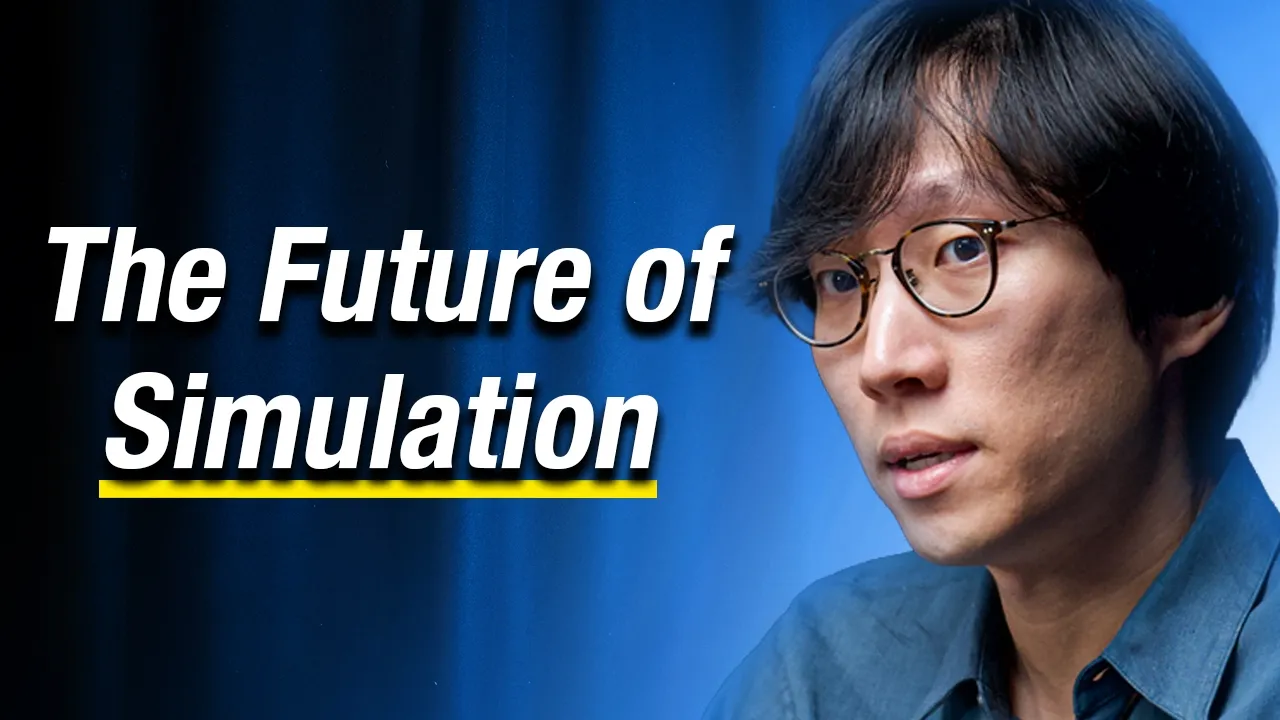
Description
Joon Sung Park is the Founder and CEO of Simile, the AI simulation company building foundation models of human behaviour; allowing companies to test how real people may think, decide and act before making a decision in the real world. Simile has now raised $300 million in total, including a $200 million Series B announced last week at a $2 billion valuation, led by Greenoaks and Index Ventures. ----------------------------------------------- Timestamps: 00:00 Intro 01:26 The Valentine's Day Simulation That Put Joon on the Map 03:56 How Agents Got Memory, Planning & Reflection — The Origin Story 07:07 Simile vs. Frontier Models 07:59 Say vs Do: Why Behaviour Data Beats Survey Data 09:33 Prediction Is Overrated 12:31 Is Simile Just a Fancy Qualtrics? The TAM Question 15:48 How Many People Do You Need for Accurate Simulations? 16:56 The Data Flywheel: How the World Becomes the Ground Truth 19:59 Can Simile Simulate Elections, Democracies & Wicked Problems? 21:43 Who Should and Shouldn't Have Access to Simulation Technology? 33:07 How to Build a World-Class Research Team That Doesn't Quit 35:59 The Two Contradictory Superpowers That Make Great Founders 39:10 Competing for Research Talent in the Tens of Millions 43:28 From Researcher to CEO: What Joon Looks for in Academic Founders 44:33 Raising $300M in Six Months: How the Round Came Together 58:01 Is Simile the Future of Love and Matchmaking? 1:00:45 Quick Fire Round ---------------------------------------------------------------------------------------------- Subscribe on Spotify: https://open.spotify.com/show/3j2KMcZTtgTNBKwtZBMHvl?si=85bc9196860e4466 Subscribe on Apple Podcasts: https://podcasts.apple.com/us/podcast/the-twenty-minute-vc-20vc-venture-capital-startup/id958230465 Follow Harry Stebbings on X: https://twitter.com/HarryStebbings Follow Joon Sung Park on X: https://twitter.com/joon_s_pk Follow 20VC on Instagram: https://www.instagram.com/20vchq Follow 20VC on TikTok: https://www.tiktok.com/@20vc_t
Summary
Generated by gpt-5.6-terraAt-a-Glance
- Verdict: Watch fully
- Core thesis: Simile is building a foundation model of human behavior whose defensibility comes from representative behavioral and experimental data, enabling enterprises to run counterfactual simulations that guide interventions rather than merely forecast outcomes.
- Why it matters: This is a concrete blueprint for a potentially important AI category: proprietary data acquisition, causal feedback loops, and multi-agent simulation may create durable moats beyond access to frontier LLMs.
- Best use: Use this as a strategic case study on data-moat design, grounding and evaluation loops for agentic systems, and the commercialization of research-heavy AI.
Executive Summary
Joon Sung Park frames Simile not as a better survey platform or a generic prediction engine, but as a behavioral foundation-model company. Its intended primitive is: specify a population, model its perspectives and likely behavior, then simulate how that population responds under alternative actions. The company’s claimed differentiation from OpenAI or Anthropic is explicit: frontier labs optimize for rational intelligence, coding, and science; Simile wants models that retain human preferences, biases, mistakes, and heterogeneity.
The central technical-commercial argument is that observational data supports correlations and forecasts, while enterprises ultimately need counterfactual guidance: what should we change to prevent a negative outcome or create a better one? Simile therefore emphasizes collection of transaction and observational data, partnerships, representative participant sourcing, and especially randomized experiments/A-B tests that expose how behavior changes under different treatments. It proposes a feedback loop in which the real world resolves large numbers of generated hypotheses over time.
The interview is especially useful on the operating model for research companies. Park argues that research and GTM can reinforce each other only where model progress directly improves the product users buy. Simile found an initial wedge in enterprise market research and claims customers can validate expensive consulting-style studies in minutes rather than months; he says large enterprises closed pilots in roughly three months because slow, costly experimentation is an acute pain point.
The longer-term vision is high-variance but consequential: large, validated multi-agent simulations representing populations at scale, potentially used for product launches, markets, policy, and other collective-action problems. Park is candid that the major gap is not making a compelling proof of concept—the Smallville-style multi-agent town was one—but demonstrating reliable, scalable, production-grade evaluation. The discussion also offers strong hiring and investment heuristics: seek researchers motivated by impact rather than attachment to an elegant problem, and seek teams with both technical rigor and commercial complementarity.
Key Takeaways
- Claim: A defensible AI company needs a proprietary and difficult-to-replicate data-acquisition strategy, not merely access to the same base models as competitors. | Evidence: Park says Simile collects behavioral, transaction, and observational data; partners with customers and vendors; recruits everyday people rather than expert labelers; and asks deep biographical questions such as "tell us the story of your life" to model preferences and life context. | Implication: For agent and AI-ops products, proprietary workflow traces, intervention outcomes, and hard-to-source user behavior may be more strategically valuable than generic prompt/response logs. | Caveat: The transcript does not provide independent evidence that Simile’s data rights, representativeness, or collection economics are durable at population scale.
- Claim: Prediction alone is not the enterprise value proposition; the higher-value product is causal, counterfactual decision support. | Evidence: Park uses Starbucks as the example: knowing Frappuccino sales will decline is insufficient unless the system can explain what actions may prevent it. He says Simile trains on randomized controlled trials and A-B tests showing what happens when people experience treatment A versus B. | Implication: Position decision systems around controllable levers, alternative scenarios, and intervention selection—not dashboards that merely forecast outcomes. | Caveat: Counterfactual claims require strong experimental design and careful external validation; simulation outputs should not be treated as causal proof simply because they are generated by a model.
- Claim: Memory, planning, and reflection are foundational architecture components for believable long-horizon agents, and reflection compresses raw events into higher-level identity and intent. | Evidence: In the 2023 Smallville project, 25 GPT-3.5-based NPCs maintained memories, planned their days, and reflected on accumulated events. Park describes initial memory as Markdown files, then introduces periodic "shower thought" reflections that infer patterns such as why an agent repeatedly visited a library or bought omelets. | Implication: Ken should separate event storage from reflective synthesis in agent architectures: retaining every interaction is insufficient unless the system periodically derives durable beliefs, goals, preferences, and summaries. | Caveat: The conversation presents the architecture as an early agent milestone, but does not establish that this specific memory approach remains state of the art for production systems.
- Claim: Simulation has a potentially powerful learning loop because the real world can serve as a continuous reward signal. | Evidence: Park compares coding agents’ accept/reject signals with simulation: Simile can generate tens of thousands of hypotheses daily, map each to observable end states, then later score which predictions were correct as events unfold. He says production inference cost has fallen by roughly 100x after finding more efficient modeling approaches. | Implication: A practical evaluation strategy for forecasting or simulation agents is to log explicit predictions prospectively, define resolution criteria in advance, and continuously backtest against later ground truth. | Caveat: Many important outcomes are delayed, ambiguous, confounded, or unobservable; real-world outcome matching is not automatically a clean reward function.
- Claim: Enterprise adoption can be much faster than conventional enterprise-sales assumptions when the product removes an immediate experimentation bottleneck. | Evidence: Park says Simile expected the market to need one to two years to warm up, but reports that some large enterprises closed within three months. In early sales calls, customers reportedly tested Simile against findings from large consulting engagements, with the system reproducing outcomes of studies that took three to six months in about two minutes. | Implication: For novel AI infrastructure, identify a painful, budgeted workflow with an existing expensive substitute; live benchmark comparisons against the customer’s prior research can create unusually strong proof of value. | Caveat: These are founder-reported results without customer-level methodology, sample sizes, or independent benchmarks.
- Claim: The commercial value of high-cost inference rises with decision stakes, creating a plausible market for very expensive simulation runs. | Evidence: Park says broad segmentation or multi-step downstream-impact simulations cost more to run but can yield higher ROI because they inform costly decisions. He predicts that within two to three years a single session could cost $10-20 million to run while being worth $100 million to a very large enterprise or government. | Implication: Do not optimize solely for lowest per-query cost: route computational effort according to the cost of being wrong, and price decision systems against avoided downside or strategic upside rather than token usage alone. | Caveat: The $100 million scenario is explicitly a forward-looking vision, not current pricing or demonstrated market behavior.
- Claim: Research-led companies become viable businesses when founders are committed to impact and can pair technical ambition with commercial leadership. | Evidence: Park credits the cofounding structure: researchers Joon Sung Park, Michael Bernstein, and Percy Liang paired with Laney Allen on product/GTM. His investor heuristic is whether academics are "married to impact" rather than attached to a research problem; his hiring heuristic favors people who were the recurring "common denominator" behind prior successes and who combine normally contradictory strengths. | Implication: When assessing research-spinout investments or technical hires, test for customer pull, a credible path from research metric to user value, complementary commercial ownership, and evidence that candidates repeatedly drive outcomes across contexts. | Caveat: This is a founder’s qualitative selection framework rather than a validated predictor of company outcomes.
Detailed Brief
Simulation as representation at scale, not just synthetic market research
- Claims: Park sees synthetic panels as likely to exceed the current human-panel market because they raise the number and scope of questions organizations can test.; He argues that organizations currently investigate only about 5% of the hypotheses they could pursue; the rest are excluded by time, budget, or inability to run emergent-scale experiments.; The long-term ambition is simulations of interacting populations and ecosystems, not isolated respondents answering survey prompts.
- Evidence: The Smallville demonstration populated a game town with 25 agents that formed relationships, remembered interactions, planned activities, and self-organized a Valentine’s Day party.; Park describes possible applications ranging from product launches and market response to collective-action problems such as climate coordination and conditions under which democracies fail.; He characterizes current frontier LLMs as a "CPU of intelligence"—one highly capable rational model—and behavioral simulation as a prospective "GPU of intelligence," where many diverse, human-like models generate emergent collective behavior.
- Caveats: The most consequential applications—politics, public policy, financial markets, and individual digital twins—raise material misuse, privacy, governance, and representational-bias risks that the interview acknowledges conceptually but does not operationalize.; Park identifies production-grade evaluation as the main unresolved chasm: a multi-agent proof of concept does not establish that users should rely on its outputs for high-stakes decisions.
- Implications: The strategic unit of competition may shift from a single best reasoning model toward orchestration of many calibrated, diverse models plus credible evaluation infrastructure.; Any system claiming to represent a population should make sampling coverage, subgroup error, intervention validation, and governance first-class product surfaces rather than hidden model assumptions.
Capital, talent, and company-building lessons
- Claims: Simile raised $100 million and was then preemptively financed with a further $200 million, bringing total funding to $300 million over roughly six months, because it believed added data and compute could accelerate research inputs even though research outcomes cannot be guaranteed.; Park believes the AI market has frothy areas, particularly new labs without a clear path to real-world impact, but says company fundamentals should still be assessable through model-progress trajectories and demand.; Research talent can command compensation in the tens of millions, so startups cannot reliably win by matching cash compensation.
- Evidence: Park says researchers are attracted by an ambitious vision, societal impact, interesting work, and a platform where they can express their distinctive strengths; he points to a core group that stayed together through multiple research projects before joining Simile.; His leadership archetype is short-term paranoia paired with long-term conviction: urgency prevents complacency, while belief sustains company-building through uncertainty.; He says experienced investors were more useful than expected as operating mentors and connectors, including helping introduce a key cofounder.
- Caveats: The financing discussion is self-reported and reflects a favorable market environment; large capital raises do not validate technical feasibility or long-term unit economics.; The thesis that vision and impact offset compensation is most applicable to mission-driven frontier researchers, not necessarily to all scarce engineering talent.
- Implications: For capital-intensive AI work, fundraise when additional capital has a specific, credible conversion path into more experiments, more proprietary data, or faster model iteration—not simply because financing is available.; Retention systems for elite technical teams should center on trust, ownership, intellectual scope, and visible connection between individual work and the company’s mission.
Notable Concepts & Terms
- Smallville: A 2023 multi-agent simulation in a game-town setting with 25 NPCs; it demonstrated memory, planning, reflection, social interaction, and emergent coordination.
- Behavioral foundation model: Simile’s proposed model category: a model optimized to reproduce human values, preferences, biases, mistakes, and behavior rather than maximize abstract rational intelligence.
- Synthetic panels: AI-simulated populations used to answer market-research and behavioral questions at far greater speed and potential scale than conventional human panels.
- Counterfactual simulation: Modeling what a population would do under different choices or interventions; the proposed source of business value beyond simple forecasting.
- Reflection: A periodic agent process that synthesizes many low-level memories into higher-level beliefs, motivations, preferences, and self-understanding.
- Representation at scale: Park’s normative vision that simulations could capture diverse stakeholder perspectives more granularly than current surveys, institutions, or representative mechanisms.
- World as ground truth: The proposed simulation-evaluation loop in which forecasted hypotheses are scored later against observable real-world outcomes.
- Married to impact: Park’s diligence heuristic for research founders: favor people motivated to create real-world and commercial outcomes rather than those attached primarily to an intellectually interesting problem.
Operator Notes / Why Ken Should Care
- Add prospective hypothesis logging and delayed outcome scoring to any agentic prediction or recommendation workflow; require a predefined resolution event and calibration review before trusting aggregate performance.
- For agent memory design, implement a distinct reflection/synthesis layer that promotes recurring events into durable user or agent state; do not rely on raw transcript retrieval alone.
- When evaluating AI companies, diligence the exclusive data rights, representativeness, intervention labels, and feedback-loop latency—not just model benchmarks or claimed access to proprietary data.
- Explore whether a simulation-style counterfactual layer could improve high-stakes GTM, pricing, routing, or workflow decisions, but start with a narrowly measurable intervention rather than population-scale claims.
- For research-led opportunities, screen explicitly for a product/GTM counterpart and evidence that research advancement maps directly to a customer metric; avoid teams whose roadmap remains an open-ended science project.
- Treat synthetic-population outputs as decision support requiring uncertainty reporting and external validation, especially for sensitive demographic, political, financial, or policy use cases.
Source/Metadata
- Title: The Best AI Companies Have Unique Data Acquisition Strategies | Simile Co-founder & CEO
- Transcript words: 19866
- Duration seconds: 3902
- Timestamp note: No usable timestamps or chapter markers were present in the supplied transcript; substantial portions of the latter interview appear duplicated.
Transcript
I think there is a world in which, in about two or three years, we're running a single simulation session that people will pay $100 million for. This is Joon Sung Park, founder and CEO at Simile. They predict the future. They're a simulation market that tries to predict future human behavior. It is incredible. My fundamental thesis here is, for AI companies of this generation, you need to have an interesting data strategy that's going to be defensible. This was one of the best AI technical conversations we've had in a long time. And it was incredible to have Joon on the show. People live through different stages in their life, and they have different careers, different jobs. At each stage of their life, were they the reason why that thing was successful? If you squint, were they the common denominator? Ready to go? Joon, I'm so excited for this, dude. When Shardul told me that I had to meet you, I'm going to be honest, Shardul does not tell me often that I have to meet someone. So I was like, wow, I feel honored. Thank you, Shardul. And then we met when I was on holiday with my family. And I remember my grandparents were asleep upstairs, so I was whispering to you. And I remember being so excited by what you were building, but then also having to be incredibly respectful of the sleeping elderly people next door. But thank you so much for joining me, dude. Thank you for having me. Excited to be here. Now, when I spoke to a lot of your investors and friends before, they all said that I had to start on the very unique background you have, of specifically becoming very well known for a particular project. And it centers around Valentine's Day and a simulation that happened as a result. Can you explain what happened and how that potentially led to the early days of Simile? For sure. So this was 2023. We had this idea that large language models are often used for simple tasks like classification, simple generation. But we thought that these models actually had a latent potential. One of the early observations that we made was that these models are trained on so much human behavior data, sentiment data, that were expressed on the web. So if you poke at them at the right angle, you could actually extract a lot of realistic human behaviors out of them. I thought that was really interesting. And it was also particularly interesting in that it was domain agnostic. So if you look at the literature in computer science, for many decades, we've always had the vision of creating agents that are meant to be generalizable, that are meant to really be able to act like humans in any environment. And my mind went to, well, maybe we have that opportunity here. So what we ended up doing was, if we were to fast forward many years into doing this, what would be the most ambitious vision that we might have? And that was creating the entire lived experience of a town. So the idea here was we would make a game town and we would populate it with 25 NPCs, so non-player characters, except these characters would actually wake up in the morning, do their routines, go to work, have relationships, and do all that. They would actually remember their interactions. They would actually plan their days. And some of the surprising things you end up seeing was the simulation itself was set the day before Valentine's Day. And you actually see these agents come together, have parties, self-organize. So they would actually plan parties, they would decorate the cafe, and so forth. We thought that was really interesting. Now, two fundamental contributions from that work. One was it was one of the earliest examples of creating agents. So this particular set of agents were paired with, back in the day, GPT-3.5, text-davinci. So we didn't quite have ChatGPT back then. And then it was paired with memory, planning, and reflection. Really the first times that those concepts came out to be an explicit part of the architecture in, quote unquote, agentic workflows. The reason why we actually got that inspiration was, if you had more than one agent side by side, you want them to remember each other. Back in the day, language models didn't really have the concept of memory. So I thought, okay, you have to give them the memory so that they don't say, hey, nice meeting you, every time they meet their roommate. So we had them have this concept of memory and planning and reflection to make sense of a very long-term landscape. How do you solve that memory problem? Because everyone says, oh, we have a memory problem today. How do you solve the memory problem of agents to prevent that from happening? So back in the day, the initial idea was fairly simple, which was that these language models are actually quite good at parsing natural language. So we put everything in Markdown text files. That was it. That worked. Now, the issue there, however, is because the language models have a context window, and even today, even if the context window is getting larger, the kind of experiences that these agents can have in the small game town is immense. And imagine now, if we were to bring this to real life in a world like the one we live in, the amount of memory that we accumulate is huge. So the problem becomes, how do you make sense of this large quantity of memory? So imagine you went to get omelets five times a day. You want to make sense of that aside from, oh, I went to get omelets five times throughout the week, or something like that. So we had this concept of reflection, which basically was every certain interval, it's like a shower thought. So you ask the agent explicitly to get a bunch of their memory pieces and basically make sense of them. Why did you get omelets so often this week? Were you busy? Do you like omelets? Why are you studying for this test so hard? You are in the library every single day. Does this matter to you? And they will actually start formulating ideas that are more high-level than what happens on the ground truth. So gradually they start to realize, oh, this particular research topic, I'm actually quite invested in it. This might actually have something to do with my childhood or my fundamental memory. This actually shapes who they are as a person. So that ends up becoming a very useful function in creating these agents that have personality, that actually have a point of view in the world, that can actually make sense of a lot of this data. So that's how we did it back in the day. And so when we think about a simulation model today, for those that don't know, a simulation model is essentially that. It's the creation of agents that then produce a set of activities or actions that then will show us what a simulated future world might look like. Is that correct? That's right. Got you. Okay. When we think about then building a simulation model company, would you say Simile is a simulation model company? Yeah. We are a company that is creating a foundation model of human behavior that can then be used to create simulations of individuals, simulations of subpopulations, and, down the line, the simulation of the entire ecosystem and even the market. Do you sit on top of core foundation models? How do you think about the relationship, for those listening, between an OpenAI, Anthropic, frontier model provider and you? Yeah. So this is a great question. So the way we see it is, if you look at large language model companies today, fundamentally the task they have at hand is to create super-rational, intelligent machines that are good at coding, that are good at natural sciences and mathematics. Simile doesn't really care about any of those. What we care about is, if we have a person make a mistake in this context, we want our models to make the same kind of mistake. We want our models to be biased in the same way humans are. In a way, we want to be a representation of people's values, preferences, and taste, their subjective half of their brain. That's what we care about. I love that. And a lot of what people say is different to a lot of what people do. How do you think about the chasm of what people say and what people do and how that impacts your models? For sure. So, to give us real, if you look at the web data, it is fundamentally data of what people have said, not what they have done. And obviously, large language models today are trained preliminarily, mainly on this web data. For us, we actually do collect a lot of behavior data. We collect transaction data. We collect observational data. We also partner with our customers, our vendors, to collect some of this data. But my personal hot take here is a lot of observational behavior data and what they're amazing at is actually helping you create a correlation of the observation and what could happen in the future. Good for prediction tasks. But my take here, after interacting with so many of our customers and also being in research, is that no one really cares about prediction. No one really cares about what's going to happen in the future unless you're trying to predict the stock market. What people actually care about is they want to shape the future. They want to know, imagine you're a Starbucks. It doesn't really help them to know that your Frappuccino sales are going to tank in two quarters. And obviously, large language models today are trained preliminarily, mainly on this web data. For us, we actually do collect a lot of behavior data. We collect transaction data. We collect observational data. We also partner with our customers, our vendors, to collect some of this data. But my personal hot take here is a lot of observational behavior data. And what they're amazing at is actually helping you create a correlation of the observation and what could happen in the future. Good for prediction tasks. But my take here, after interacting with so many of our customers and also being in research, no one really cares about prediction. No one really cares about what's going to happen in the future unless you're trying to predict the stock market. What people actually care about is they want to shape the future. They want to know, imagine you're a Starbucks. It doesn't really help them to know that your Frappuccino sales are going to tank in two quarters. They'll hear that and they'll be like, what do we do about that? That's terrible. What they want to know is how can we prevent it? What do we need to do now to change the future? And there, what you really need is causal mechanism. You need a model that can actually reason about causal mechanisms and counterfactuals. So the kind of data that we care deeply about is a lot of randomized control trials. We actually run a lot of A-B testing. We show the models. Imagine people have done this versus that. This is how their behaviors will actually change. And that becomes a core part of our training asset. So this is actually the data collection that goes beyond observation or data that Simile collects. Is data collection acquisition the hardest element of building simulation models for you? If we think about the kind of core pillars for traditional models, it might be compute, algorithms, and data. Is data the biggest challenge for you? Data is an important piece of Simile, for sure. My fundamental thesis here is for AI companies of this generation, you need to have an interesting data strategy that's going to be defensible. And for us, really the data collection challenge comes from two angles. One is actually sourcing people. Sourcing people here is a little bit different than what other language model companies might consider to be their people or their population. We don't go after these expert programmers or expert scientists. We go after people like us, everyday people living their everyday life. But what we care about is are they representative? Do we actually have the same representation of people as we do in the world that we live in? And then actually asking the right questions to these people. What are the experiments? What are the questions that actually get at the fundamental core nature of who they are? Some of the questions we actually ask at the start of our data collection at times are actually saying something like, tell us the story of your life. Where did you grow up? What did you experience? What were some of the hardest problems that you had to tackle or decisions you had to make? Tell us a lot about these people. And that's what we try to do. In terms of people don't want to predict the future, just so we can drill down on that. I thought they do. Like Starbucks, if they can predict that Frappuccino sales will be down in two quarters, they can amend, bluntly, their buying cycle. They can change how much they purchase. Isn't that valuable? And what am I missing? But that's the thing. The reason why they want to know is so they can change their strategy. So certainly talking about how much resources they actually need to actually serve this market, that is a kind of changing in behavior. But fundamentally, it is about counterfactuals. So we have this market that we want to serve. We want to maximize our value as a company. What do we need to do to make sure that we react to this dip in the market, whatever it may be? Now, fundamentally, the work that we do is about people. We try to assimilate people and represent people's perspectives. So the value that we provide is counterfactual in terms of what your consumers, what your population, would do. When you look at what can be done for some of the biggest brands, you mentioned a CVS there, incredibly valuable for surveys, for customer feedback, for determining what customers really want moving forwards. I don't know how to say this. Do you want to just be a next-generation Qualtrics? And how do you prevent that being the end goal? Yeah. So the way we see it is, again, fundamentally, the core primitive of what we're trying to build is very straightforward. You tell us what population you're interested in, and we'll go model them. And really, so far, the layer of innovation has lived in the more tooling layer. How can we create better survey tool? How can we create a better interview tool? Simulation is fundamentally about something different, which is how can you create the most generalizable model of people so that we can represent people's viewpoints at scale? And that goes beyond simply running surveys or interviews. Down the line, I actually see simulation as a field moving into context where, hey, can we actually create simulations of many people interacting with each other so that you can understand all the downstream implications of your decision-making? Or if, imagine you have a new product you're about to launch, can you actually simulate the entire launch and how the audience might actually react, how the market might shift? And this also goes into the scientist part of me also getting quite excited by the vision where simulation, I do think, can also be a cure for many of what we call, quote unquote, wicked problems. A good example here might be things like climate change requires collective action across many stakeholders who have different incentives. One of the reasons why such problems are so difficult is actually finding the right equilibrium state where all different parties come together to make decisions for global good is very difficult. Can we actually simulate those decision-making processes? Can we actually simulate even things like in what conditions does a democracy fail? Can we actually predict that? These are the kinds of questions that simulation ultimately can answer. Can I ask you, thinking about that democracy is failing elections for a government has been an incredibly useful tool. How do you think about who you can and should work with versus who you shouldn't? Can you imagine, and possibly can possibly possibly possibly possibly possibly possibly possibly possibly possibly possibly possibly possibly possibly possibly possibly possibly possibly possibly possibly possibly possibly possibly possibly possibly possibly possibly possibly possibly possibly possibly possibly possibly possibly possibly possibly possibly possibly possibly possibly possibly possibly possibly possibly possibly possibly possibly possibly possibly possibly possibly possibly possibly possibly possibly possibly possibly possibly possibly possibly possibly possibly possibly possibly possibly possibly possibly possibly possibly possibly possibly possibly possibly possibly possibly possibly possibly possibly possibly possibly possibly possibly possibly possibly possibly possibly possibly possibly possibly possibly possibly possibly possibly possibly possibly possibly possibly possibly possibly possibly possibly possibly possibly possibly possibly possibly possibly possibly possibly possibly possibly possibly possibly possibly possibly possibly possibly possibly possibly possibly possibly possibly possibly possibly possibly possibly possibly possibly possibly possibly possibly possibly possibly possibly possibly possibly possibly possibly possibly possibly possibly possibly possibly possibly possibly possibly possibly possibly possibly possibly possibly possibly possibly possibly possibly possibly possibly possibly possibly possibly possibly possibly possibly possibly possibly possibly possibly possibly possibly possibly possibly possibly possibly possibly possibly possibly possibly possibly possibly possibly possibly possibly possibly possibly possibly possibly possibly possibly possibly possibly possibly possibly possibly possibly possibly possibly possibly possibly possibly possibly possibly possibly possibly possibly possibly possibly possibly possibly see it, simulation as a piece of technology is one of the twin pillars of technology. I'm a fan of science fiction. You read any advanced science fiction, there's always two pillars. One is some form of AGI that always shows up. The other is simulation. And with any powerful technology, the misuse, the potential for misuse, is quite real. And the way we see it, simulation at its best ought to be representation at scale. People have different viewpoints, different perspectives, different tastes. Many of their viewpoints are not considered in rooms where important decisions for them are made. We want to always say we listen to our people, we listen to our customers, we listen to our stakeholders. In practice, very difficult. This is a way for us to ensure that in every decision- making, we actually listen to people at scale. That's the North Star. How much data do you need to feel confident in an accurate prediction outcome to be displayed? Is it 100 people? Is it 1,000 people? Is it a million people? You want to have more people represented so that you can segment down to specifics of population. If you look at any social scientific literature, if you have a very narrow population of interest, you would usually get statistical significance in the study that you want to run by the time you have 1,000 people. However, oftentimes, the kind of ways that people query our system is they want to come in and say, hey, filter down to x, y, z population. Those filters are often created on the fly. For us to then be able to simulate people's responses across all those filters, and those mean we want to represent the entire population. So that's the journey that we're on. Is it self-fulfilling? Do you get better and better at predicting over time? I think that certainly is the case because, right, there is the data flywheel. There is the learning that occurs as we get more and more simulated results and see what happens in the ground truth. That, absolutely, yes. And this is obviously one of the core value proposition for our narrow population of interest, you would usually get statistical significance in the study that you want to run by the time you have 1,000 people. However, oftentimes, the kind of ways that people query our system is they want to come in and say, hey, filter down to x, y, z population. Those filters are often created on the fly. For us to then be able to simulate people's responses across all those filters, that means we want to represent the entire population. So that's the journey that we're on. Is it self-fulfilling? Do you get better and better at predicting over time? I think that certainly is the case because, right, there is the data flywheel. There is the learning that occurs as we get more and more simulated results and see what happens in the ground truth. That, absolutely, yes. And this is obviously one of the core value propositions for our early partners because they know, in their business context, it is similarly getting better and better and better. And do they have that compounding advantage? It's like AlphaGo. They just beat the shit out of the model and played it 1,000 times every day. Activities and outcomes in the world are another game of AlphaGo where you can correct the model on what was wrong and what you missed and what didn't happen. And 10,000 days in, you should almost be better than the model at the model. Do you know what I mean? So this is actually quite interesting. You might think of, let's actually think about a different example. So how does a data flywheel work in simulation, and why would it work? If I were to take a brief detour and talk about coding, the reason why coding agents have had such massive improvement over the years was because their learning, their reward function, was extremely clear. If you make a suggestion and your user says, accept, fantastic. If they say reject, also very useful. You very quickly know what is good and what is bad. And that actually was one of the core learning mechanisms for these models. And it might be easy to look at simulation as a field and say, well, where are you going to get the reward? Because fundamentally, all the things that you're trying to predict are happening in the future. It's going to be hard to validate. It is true. At the same time, I actually think simulation has an even better mechanism, which is the world is our ground truth. We live in the ground truth world. So what we can do is every single day, we can be generating tens of thousands of hypotheses. Each hypothesis is mapped onto an end statement. If this happens, we know whether we can validate the simulation to be right or wrong. And we're basically watching the world every day, seeing which of those hypotheses are answerable at what time. And we can basically say, a month goes by, we generated a million hypotheses, x percentage of them came true. This is the best way to learn about the world. Does it take a huge amount of compute to run these simulated environments at scale and well? Compute is an important piece of simulation. Of course, a lot of the work that we do is to make our simulation more efficient. So a lot of our compute initially actually goes in to create the initial breakthroughs in technology. So it is actually exploring different ways to train, exploring different kinds of data sets. Once we have a point of view, we can very quickly make it efficient. So some of the things that I've seen within Simile as we built this company over the year is, right now, we have a model that's been in production. This model used to cost about 100 times more to run than it does now. And some of it does happen because we actually found different ways to model, but with the same reward model, with the same philosophy, just in a way that's much more efficient at inference time. So there are these kinds of tricks that we can play and these kinds of scientific advancements we can make to make things cheaper. A lot of the investment, however, does go to find that initial point of view. Can I ask you, when you look at serviceable market or total addressable market, TAM in venture speak, you obviously have your CVSs and your huge enterprises who would absolutely want to work with you. It can also be consumers, regular consumers wanting to see what happens if and running their own environments. Is this a play for everyone? Is this a play for the biggest companies in the world? How do you think about the TAM for something like Simile? So the start of my career really came from research, obviously. And the job of a researcher is to serve humanity. Then we do our research, obviously, for our own enjoyment as well. We love the process of finding new things in the world. But fundamentally, it is a service. It is a belief that if we are able to make scientific breakthroughs, this is going to, down the line, serve everyone in our society. That is how I see simulation as a field as well. So right now we do serve enterprise customers for a couple of reasons. One, obviously, I'll be frank, there is the budget. There is a clear product-market fit that we see today. And that does excite us. And at the same time, it is an amazing way to validate the technology. It is very important to us that we get the feedback loop to be as tight as possible, so we know when our simulation is right, when our simulation is wrong, and we're improving it every single day. And obviously, there's this side part here that's just as important, which is, I have a colleague when I was at Stanford. My office next to mine was Pat Hanrahan, who was one of the founders of Tableau. He's a graphics professor. Also, he won Turing Awards, a very well-known person in this landscape. An advice he actually gave me and some of my colleagues was, the best way to get feedback is to actually ask people to pay you. That was their core philosophy at Tableau. And I also see this here. So getting the best kind of feedback matters a lot. So enterprise market, market research right now is a wedge that we found that actually has significant budget, that has immediate product-market fit. But down the line, I do want this technology to be used by the rest of our society because, fundamentally, what we are trying to serve is help people make better decisions. Before we move on to expansions that it could be used for, when did you know you had product-market fit? You said you felt that pull. When were you like, ah, we got product-market fit here? Many of the Fortune 500 board members and their C-suites reached out. In part, they do come to Stanford to see some of the demos that are happening in the lab. And they all saw the Smallville demo after it got released. And everyone thought, oh my god, if we can simulate a market like this, this is going to change the way we operate. So you could immediately sense the product-market fit. And really, this was the forcing function for us to then say, okay, this is actually quite interesting. We're actually going to show and validate that our simulation cannot just be an interesting demo, but it's going to be accurate. So we spent about a year actually demonstrating that we can create models of people that are actually amazing and validated at predicting people's behaviors across surveys, behavior experiments, real environment. And we showed that we can actually predict people's behaviors and attitudes 85% as accurately as people replicate their own. We put that work out at the end of 2024. And that's really what started the field around synthetic panels simulations. And that's the market that we're seeing today. Will synthetic panels be larger than human panels in three years' time? The way I see it, synthetic panels will be larger than what we know to be the current human panel market. In part, because this can really raise the ceiling of the kind of questions we can answer. What I see today in the market is actually quite broken. We have so many questions we want to ask about our market. If we were to release this product, if we were to have this particular strategy, this particular policy, you're a scientist, then you want to run this study, or you want to try these macro-scale experiments, you are looking at maybe 5% of those ideas get answered. The rest of the 95%, we never bother experimenting with, because we either don't have the ability to do them, especially if it's something at the emergent scale, like we literally don't have a way to run those emergent-scale experiments. At the same time, we don't have the budget and time for it. So a lot of the decisions that we make as a society, we base on our gut instinct. Sometimes they're good, but sometimes they're very biased, based on our own narrow experience. So what simulation will do is unlock that limitation, and us to actually test every single hypothesis that we have about the world before we have to launch into the world. How do you balance the pursuit of the next dollar and serving customers who pay a lot of money, I'm sure, versus research prioritization, and maybe focusing dollars there over building out a customer success team and an FDE team? How do you balance profit maximization with research purity? have the ability to do them, especially if it's something at the emergent scale. We literally don't have a way to run those emergent scale experiments. At the same time, we don't have the budget and time for it. So a lot of the decisions that we make as a society, we base on our gut instinct. Sometimes they're good, but sometimes they're very biased, based on our own narrow experience. So what simulation will do is unlock that limitation and allow us to actually test every single hypothesis that we have about the world before we have to launch into the world. How do you balance the pursuit of the next dollar and serving customers who pay a lot of money, I'm sure, versus research prioritization, and maybe focusing dollars there over building out a customer success team and an FDE team? How do you balance profit maximization with research purity? Simile is interesting as a company. Simile is a company that has a real product and engineering team, but at the same time, we are a research company. The co-founders, the three co-founders, are researchers. We have, as co-founders, myself, Michael Bernstein, Percy Leung, Laney Allen. Myself, Michael, and Percy were all researchers at Stanford. I led research around agents, simulations. Michael was one of the co-authors of ImageNet that really kickstarted the AI revolution, and he's been a leader in human-centered AI. Percy was the person who literally coined the term foundation model. And the vision for this particular area is the vision that we can actually create the next paradigm shift in AI and in the way we view technology and the impact of the technology in the form of simulation. The reason why we are able to, however, operate as a research lab but also have an amazing product and engineering function and go-to-market function that's led by my counterpart, Laney, is the alignment between what the technology can do and the promise of technology is so close to what our market actually requires. The better the model gets in representing people, the better simulation we can create. It immediately means a better experience for our users because they'll have much more grounded, much more accurate simulation. It is very difficult to maintain both a lab and a product company if there is not that alignment. But when there is, it can be quite magical, and that's what we're seeing at Simile. Can I ask you, when we think about the pursuit of some of the largest companies on earth, we mentioned, I'm not sure which customers you're able to say versus not to say, but you mentioned CVS. People always think it's multi-year, incredibly long sales cycles. Was that something that you experienced, or was it a different experience for you getting and working with some of the biggest companies on the planet? What's been fascinating to me coming into the field of simulation, especially in this market, was last year when I started the company and when I left Stanford in June of 2025, so it's been exactly one year. I actually thought our field, the market, would take about a year or two before they warm up to the idea of simulation. So we'll build the right foundation for this company and for this market, and we'll go aggressive maybe towards the end of 2026, was what I had in mind. And that's not what we experienced. What we experienced was our customers were moving extremely fast, also in ways that truly made me change my perspective on corporate America. Our leaders that we work with, for instance, CVS, I've been working with this particular leader, Shree, who is their VP of Insights, extremely forward-looking, extremely ambitious, extremely hardworking, and an amazing counterpart to Simile. But what I've also found was the pain they were feeling in their day-to-day work was so real. It was way more acute than I could have imagined. When they realized that there is, or there could be, an answer in this market for addressing some of those pains of very slow experimentation, budget, and so forth, they are ready to drop everything and try us out. So we actually saw some of the largest customers in the world move at lightning speed for enterprise, where we saw them close deals within three months. Three months. Wow. Okay. That's very different from what people traditionally think. What matters more to them: speed of output, in other words, being able to get results very quickly on their simulations, or accuracy of simulations? Yeah. It is both. There are so many questions that they are truly relying on their gut decision on today. If they can get some form of evidence to at least directionally guide them on the right path, then they're ready to try it. And then they very quickly realized that, oh, this is actually an amazing way to interact with a lot of data. This is an amazing way to gain evidence that is actually quite accurate. One of the ways we actually got some of our first customers was in the first call, they actually had a finding from large consulting companies. And they queried our system: hey, if we were to rerun this, what would the system say? And we predicted the outcome of studies that took three to six months, but just within two minutes. That's very powerful. It must be so compelling in a customer conversation to be able to say, you did this campaign. If you had done this campaign, it would have been 12% more effective. Do you want to buy our product? It is such a good sell. As a seller, to be able to have that data is unbelievable. How do you think about value extraction efficiently? And what I mean by that is that if you work with a CVS, or any of your big companies that you work with, these massive companies where, if you're able to do your job efficiently, you can move the needle to the tune of hundreds of millions for them, in some cases billions of revenues. Charging a million bucks feels like a large chasm between value generated and value extracted. How do you think about closing that chasm to be more fair? Yeah, that's a great question. And I see the market moving in this direction. One of the core premises and one of the ways that our customers are actually finding value in Simile is actually avoiding really damaging decisions that could have cost them hundreds of millions of dollars. So it's prevention, not optimization. It's both. But certainly prevention is a huge, obvious value case, right? That, oh wow, that could have been a total disaster. Had we run that, that would have cost us half a billion dollars. We ran simulation, and that prevented it. That's a no-brainer. This is a true painkiller in their case. If you do your job efficiently, can Kalshi, Polymarket still exist for a lot of their markets? So it's an interesting question. I do certainly think there is an overlap here in that we are companies that are fundamentally interested in the future and helping people at least get a glimpse of what the future might be. Where I see Simile come in is we are a company that is not just interested in what's going to happen, but more in how it's going to happen and why. So in that way, and this is also the value proposition that our customers are most inspired by, it's one thing to simply predict, but can we actually show here all the steps that your ecosystem is going to take to get to that particular outcome? And this is the way you can prevent that, or you can encourage that. And that is ultimately the power. When it comes to team building, you said about the craft of team building, and I think it's really interesting because it's an ongoing challenge, building the best team. What have been your biggest lessons coming out of research in what it takes to build an all-star team at Simile? So a couple of things. One is the team has to be balanced. There are certain powers that I can bring to the team, but there's also a lot of things that I don't know. I was a researcher. I was not an enterprise seller. I needed Lainey to be my co-founder to lead that part of the game. So balancing the team and being able to see where your team is lacking, especially as we scale, there are new gaps that are emerging. Actually seeing that ahead of time and making sure that we fill those gaps, I do think, is a core fundamental of building a great team. At the same time, I also do think it's important that the team remains consistent in their values and in their rigor. This is more of a painter's analogy. So when I was a painter, I was a figure painter. So I worked a lot with human subjects, portraits, figure studies. There's this untold secret among figure artists, which is it doesn't matter who you paint. Your subject sort of looks like the painter themselves in some ways, or at least they share a similar vibe. I think building a team is actually a lot like that. In the best team, in the team that you care deeply about, you really should see yourself in the team. And for me, a couple of things matter the most. One is, and this is the same standard I try to uphold for myself, are we the common denominator of success? People live through different stages in their life, and they have different careers, different jobs. At each stage of their life, were they the reason why that thing was successful? If you squint, So when I was a painter, I was a figure painter. So I worked a lot with human subjects, portraits, figure studies. There's this untold secret amongst figure artists, which is it doesn't matter who you paint. Your subject looks like the painters themselves in some ways, or at least they share a similar vibe. I think building a team is actually a lot like that. In the best team, in the team that you care deeply about, you really should see yourself in the team. And for me, a couple of things matter the most. One is, and this is the same standard I try to uphold for myself, are we the common denominator of success? People live through different stages in their life, and they have different careers, different jobs. At each stage of their life, were they the reason why that thing was successful? If you squint, were they the common denominator? If the answer is yes, then what that suggests is a couple of things: that they have an extreme degree of ownership, that they are the kind of people who come in and say, it doesn't matter how everything else goes, I will personally make this successful. So it also shows the ability to reinvent themselves. So one of my co-founders, Michael Bernstein, has had a very interesting career as a researcher, where during his PhD 10 years ago, he started his field in crowdsourcing collective intelligence. Then very quickly, during his early years as a faculty member at Stanford, he went into different areas of AI, and then now into generative AI agents and simulations. And at each step of the way, you could see in the work he's done that this is very Michael. You could see that this is the person who led a lot of the success. That's an amazing signal. And another piece, the second piece for me, is this is a little bit more niche to myself, but I found this to be very true, at least to the way I look at the world. Do my leaders and my team have two superpowers that are not supposed to coexist in one person? Any expert will usually come in with one superpower, or even sometimes multiple superpowers, but they're all correlated. You're an amazing programmer who happens to be amazing in mathematics, very common. Where I found things to be particularly compelling is if people have two superpowers that's really contradictory. The most common one here is actually the greatest CMOs, which there are very few, I count on one single hand, are unbelievably data-rigorous, oriented, scientific in their approach. And then you blend that with this creative artistry, imagination. And they are two relatively opposing mental approaches, I think. Yes. And it's very rare to have that in a CMO. But when you have that, that is the world-class CMO. And that's magical. That particular description I actually sometimes have used for my board members for Duel. Deeply analytical, but he's very intuitive. And I think that's how he makes investment that happens to be very successful. So hopefully, similarly, we'll continue on the success. But in my team, the kind of things that I also see as an archetype is, and I also categorize myself as one of these kind of people. On a day-to-day basis, for instance, Lainey, one of my co-founders, she's paranoid. She's somebody who will come to the table and say, unless we put everything on the table today and do everything possible, we'll lose, we'll fall behind, everything will fail. But long-term, she's religious. This is somebody who fundamentally believes the world is stacked for her. That no matter how this goes, we will make this successful. Actually balancing those two at the same time is quite difficult because if you are short-term paranoid, then you're likely going to be very pessimistic about your future. And you might be amazing at shorting stocks, but not great as a company builder. If you're religious, you have the opposite problem, which is you're complacent. And then you feel like, ah, we don't have to put everything on the table today. Things will be okay. Balancing those two needs somebody who is broken in some ways. That somehow they found a way to be deeply paranoid, but at the same time, ignore all the paranoia of today to believe that the world is going to be amazing. I think that's exactly me. And I think it's actually that you believe the paranoia that you hold today helps that future state be amazing. I so often interview the world's most successful founders, and they all say, I say, what do you wish you'd known when you started? And they always say, oh, I wish I'd known that it would all work out. And I wish I hadn't been so worried. And I think it's the worst answer you could give me because the fact that you were so worried, and so you did the prep, you put the work in, you stayed up late to do that presentation, that led to the success. Without the paranoia, Laney didn't hit the quarter. Laney didn't set the urgency in the sales team. Laney didn't hire those extra people because you didn't know the excess demand would be there. The paranoia drives the success. It's a really interesting one. Can I ask you, Brandon at McCall was on the show recently, and he was like, honestly, researchers, they're in the tens of millions of dollars. It is so expensive. Do you find that to be true? And how do you find this intense war for research talent in the Bay? Absolutely. So the research talent is very sought after today. And I have my closest colleagues and friends whose total comp does range in tens of millions. Now, when they join, similarly, I'm fairly upfront with them. It is not possible. It doesn't matter how many hundreds of millions that you raised. Meeting them at their base salary is tricky. However, the researchers fundamentally care about a couple of things. They care about a vision. If this idea truly comes to fruition, these are people who have literally seen OpenAI being the laughingstock in Silicon Valley to becoming a nearly trillion dollar business. And these are people who have seen Anthropik go to that same state within the past five years. So these are people who are fundamentally aware that a deep, ambitious vision can actually come to fruition. So they care deeply about the vision. They also care deeply about the impact. What is the societal impact of the technology that they'll be working on? And is it actually interesting to them? Do you worry about the retention problem in the Valley today? You see so many researchers move with such promiscuity, if you can use that word. Do you worry about the retention problem today? Consistently. And in fact, I actually do view the role of leadership to be that of obviously hiring amazing people, but also providing a platform where individual members can express their superpower to their maximum degree. And I do think this part genuinely does matter. And retention can be challenging, but it can be done. And one of the core, I have a small sense of pride in the way my career has panned out over the past six years or so as a researcher, where PhD students often go from one project to the next and their entire co-authorship would change, maybe except for your advisor. I've had an interesting career where in the past six years, all my core team members never left. That we all move from one project to the next, to the next together. And now when I said, hey, I want to do this thing and build a simile, I was able to somehow convince Michael and Percy who were actually my doctoral advisors to actually come join me. And I think a part of it is we worked so closely together that there is a genuine sense of trust. But at the same time, and I am somebody who fundamentally believes that, one, it is my job to communicate the degree of confidence and trust to the team that they feel like this will work out. Can I ask you a really important question for me, which is I see a lot of amazing people in research and academia who are considering or starting a company in the same way that you did. And I always worry that I'm going to finance a science project because science projects, although great and although interesting and intellectually satiating, don't always make great companies. You've been able to do that incredibly well in the last year to 18 months. If you were an investor analyzing a group coming out of academia, what would you look for that would give you confidence that they would be able to make the leap from research to starting a company? The thing I actually would look for is, are they married to a problem or are they married to impact? Sometimes researchers are very much focused on a problem, and something about that problem fascinates them. But oftentimes it's just not a good company or it's not a thesis that can really be formed into a company for various reasons. But there are researchers who are fundamentally driven by impact that they can have in the world. And for them, it means finding a problem that can actually reach people, finding problems that can actually generate revenue. And that's what drives them. You want to find researchers who are in that category. great companies. You've been able to do that incredibly well in the last year to 18 months. If you were an investor analyzing a group coming out of academia, what would you look for that would give you confidence that they would be able to make the leap from research to starting a company? The thing I actually would look for is, are they married to a problem or are they married to impact? Sometimes researchers are very much focused on a problem, and something about that problem fascinates them. But oftentimes it's just not a good company, or it's not a thesis that can really be formed into a company for various reasons. But there are researchers who are fundamentally driven by impact that they can have in the world. And for them, it means finding a problem that can actually reach people, finding problems that can actually generate revenue. And that's what drives them. You want to find researchers who are in that category. So talk to me. It was Shah Doole that introduced us. Huge thanks to Shah Doole for that. But there's a new funding round that's come to be in the last month or so. Can you talk to me about the funding round, how it came to be, and how you think about it? For sure. So we raised our $100 million round about five months ago. Soon after, we were preempted fairly recently by insiders. So Shrodo, that Index led our previous round, and including Shrodo and some of the other insiders, were looking at the market. Shrodo has this comment that he every once in a while makes, where he's seen some of the fastest-growing market, and his track record does show that he truly has seen different markets. He has quite never seen this kind of traction in this kind of pool. When that is paired with the technological progress that has been made, and also the amount of compute that we can also leverage to even further accelerate our progress, that prompted our insiders to go, can we actually put in more money now than later? So that's how the initial round conversation came to be. We were not planning on raising at that particular moment. But there are a couple of teams that I particularly respected in the Valley that, if we were to be raising, I wanted to talk to. And I found out that the team that I had in mind as my top of the list actually was Neil Meadows' team at Green Oaks. And it turns out his team actually has been looking deeply into this market and all the players, how the market is going, and were actually prepared to make the investment. And they were looking for the right time to do so. So I reached out and said, hey, this is going to be the round. We're not running a process. So if you'd be interested in joining, we have a few days to make that happen. And they were excited. So the round came together. So we raised $200 million. It brings our total funding to be $300 million raised over the past six months or so. It gives us very meaningful capital to go after this really ambitious modeling challenge and building up this team. It also brings in a lot of really exciting people to the team. Shrodo has been a fantastic partner. We actually have a lot of Index connection at Simile. Our seed actually was led by Mike Volpe, who runs now his own firm, and Shrodo, along with Neil and Green Oaks' team, along with Patrick, who is their partner. You didn't need the money, I take it. You raised $100 million six months ago. So was there a consideration of, we don't need the money, why would we take $200 million now? There was certainly that consideration. Where we netted out was the modeling does take compute. And this is one of those areas where you can actually, here's a fundamentally interesting part about research. With research, you really cannot control the outcome necessarily. But what you can control is the input and the process. And we were at this moment where, yes, we can actually significantly raise the input, both in terms of data and compute spend, to actually meaningfully accelerate this progress. That's when we thought it actually makes sense. Totally get that. What did you not know about fundraising, coming from a world of academia research, that you now know, having been through three rounds? Well, one actually here was coming in, I was actually fairly skeptical what the roles of VCs actually were. What do they actually do? We all are. What do they actually do? How do they help? And I will be honest, I still can't quite put my finger on it and say, this is no way they help. However, if you bring in the right set of people, what I have realized was they can be some of the greatest partners, and they can also be a really strong set of mentors. Because I never ran a company, certainly not one like this. This is my first real experience building a company. And I have a lot of technical experience of doing research, but so much of what I need to do on a day-to-day basis is new. If there's someone I can trust, then that's an amazing boost. Initially, I started to work with Mike Volpe, and we also had other firm, A-Star, who also helped lead our seed. And these funds and Mike's team, and we also work with Ishani very closely there, they really became core mentors as I operated in the field. And they also were the, Mike actually introduced me to Lainey, who ended up becoming instrumental as I thought about the business. And I found a great partner and friend in her, which also has been an amazing part of this experience. So certainly one is the VCs can actually help in some magical ways. And they have seen enough that, if you're an experienced VC, they can actually provide the advice that the founders might not have coming in. And that is one. Another one here is things always happen a little bit sooner than you would expect. Obviously, coming in, I had, in my mental model, okay, well, if we raise seed now, that means we might raise our A in about a year and maybe B in the year after, or something like that. All that happened within a year. We raised seed, and I think our series A was very soon after. And our next round also came very soon after. So I think the market is always moving perhaps one step ahead of where you are in terms of their interest in investing in you. And it is useful to be prepared for those moments. That's what I've learned. Do you worry that the market is so frothy that it can get ahead of itself? When you announce this fundraise with the people that you have and with the press that you'll get, you'll get more interest for the next round. And it's an ongoing cycle, and the hubris is very high right now. Do you think about that? I do think there are parts of the market that are actually quite frothy. Yeah, for sure. There's a lot of capital going in. There's a lot of excitement. I actually do care a lot about the fundamentals. Well, for your customers, who do you actually work with? What's the market pool that you actually see? And what's the technology? One of the most interesting things about how OpenAI and ThropTex, these companies grew, was there were very strong fundamentals they could actually map out. They could actually see, oh, the models are getting better at this rate. Oh, and there's this kind of demand. Some of those they could actually foresee. And some of those we can actually see at Simile as well. Does the unit economics vary for you on a per-simulation basis? And what I mean by that is, if you look at, say, for Anthropoc and OpenAI and model routing, some tasks require frontier models, which are much more expensive, much more token-heavy, versus others, which are much easier and can have a degraded or older model and a much cheaper model. Is that the same for simulations? Do different simulations cost different amounts in terms of compute token usage associated? They do. Usually when you have simulation that is trying to answer something that's much more complex, or something that's, let's say you want to actually understand all the downstream implication of your decision, or you want to do market segmentation study across all of the US, much more expensive. What I also have seen, however, is it is in those simulations where we actually get higher ROI for our users, because those decisions are some of the most costly decisions if they fail to make the right one. So this is actually interesting for simulation as a field. So we've all seen as a community the inference cost going up and up and up. And we now have these thinking models that are thinking for half an hour a day and actually start spending token maxing and spending a lot of money on just running this process. I actually do think simulation could actually be the next frontier of that, where, in my vision, I think there's a world in which in about two, three years, we're running a single simulation session, and that's going to take 10, 20 million dollars to run a single session. But it's going to be so valuable that people will pay 100 million dollars for it. So that's where I see it go. And that would be for the world's largest enterprises. That'd be for a most costly decisions if they fail to make the right one. So this is actually interesting for simulation as a field. So we've all seen, as a community, the inference cost going up and up and up. And we now have these thinking models that are thinking for half an hour a day and actually start spending token maxing and spending a lot of money on just running this process. I actually do think simulation could be the next frontier of that, where, in my vision, I think there's a world in which, in about two, three years, we're running a single simulation session. And that's going to take 10, 20 million dollars to run a single session. But it's going to be so valuable that people will pay 100 million dollars for it. So that's where I see it go. And that would be for the world's largest enterprises, that'd be for a government or whatever that may be. Especially on the high end of the spectrum, that's what it would be. What cannot be simulated today that you think will be possible in three years? So for me, it's actually a little bit less about what cannot be simulated, because I actually do think everything that we want to simulate, we can actually create the initial proof of concept. However, as we all know, one of the core challenges of AI is actually bridging the proof of concept with real value, productionizable technology. So that's actually the chasm that I see. So the interesting thing here is I see the world of simulation going into this world where we are creating this very complex multi-agent simulation, or we're running a very long study with many different steps of simulations along the way. But we actually started the field from multi-agent simulation when we created this small game town. That was fundamentally that vision. And it also makes sense because we did that because myself, Michael, and Percy sometimes sit together and do this exercise called time machine game. If we were to write a time machine, go 10 years into the future, what's going to be the craziest thing we're going to see? And can we do that now? And that was the motivation for running the Smallville experiment. So this can be done. But the question is, can we evaluate the efficacy of these simulations? Can we actually propose this as a scalable, productionizable system that people can actually rely on for making their decision? And that's the chasm. And that's the thing that we see getting bridged every day. A huge part of it also is getting models to be better, creating bigger simulation, making the system more scalable. All that becomes a part of this. Can we play a time machine game with me and you? Let's do it. In 10 years' time, what is the craziest thing that you can see happening? A lot of things. But one thing I will actually say is I am someone who is fascinated by history of technology and analogies that we can draw from it. What I see today that's prominent in AI space is what I consider to be the CPU of intelligence unit. You have this one language model that's really large, that's very smart, that can do very complex reasoning tasks. And that's like CPU. What I see coming, and what I think simulation as a field can offer, is the GPU of intelligence unit. As I mentioned before, Simile does not care about creating really smart, super-intelligent machines. What we care about is creating models that are as smart as we are. I've felt a lot of things. I want to make sure that the model that represents me can fail the same way. But the beautiful part about people is, individually, we have so much diversity, so many different takes in our world that make individuals so interesting. But also, when they come together as a large collective, the emerging phenomena that we're able to draw out are some of the most wonderful things that we can see in our world. Creating a society, creating an amazing process that actually allows us to make all these achievements. Can we actually replicate that in simulation? I think it's going to be quite inspiring. What's the crazy prediction then, that every single person will have a replicable twin that acts and behaves like them in a simulated world? I think that's the vision. The vision here is, again, representation at scale. We as a society have found over the years many different ways to represent our members. Sometimes it's a form of government. Sometimes it's actually companies. Company, we are, as a society, allocating capital to make sure that they serve society and the needs of people. But if we can actually create an artifact that, in a much more scalable and granular way, represents all the individuals, what are the new kinds of policies, new kinds of companies, that can be created on the basis of it? I actually do think it's quite interesting. If I'm a hedge fund, is this not the most obvious buy in the world? If I'm looking for alpha and edge on everyday activity, fuck, sign a million dollar contract with you and get unbelievable insight? Yeah. Maybe Simile will actually own a small hedge fund down the line. That's a cool idea. Would you be down to do that? Well, it turns out we actually do have quants in our firm. So some of the members who have joined actually do have more quant background. And I think right now they're joining not because they actually want to start a quant firm at Simile. They actually join because they actually see the vision of Simile very much aligned with their passion and interest, which is to model the world. But down the line, I think it's actually an interesting idea. Is there a world, again, I'm just in crazy time machine world, is there a world where you are so efficient and so good that actually stock markets become uninvestable because the world is skewed to Simile's hedge fund or similar providers, and actually it is not a fair marketplace? I think especially with, obviously, if we were to assume that we're going to have some form of AGI, and if we were to assume some form of perfect simulator, I think a lot of the world, a lot of the things that we assume to be true about our world, I think will change. Certainly one of these could actually be the stock market. What else do you think we assume to be true today that you think won't be in five years' time? What I think we generally assume to be true about the world that we live in is that it is fundamentally impossible to get everyone's perspective. Therefore, we need representatives of these people to approximate their perspectives. So far, it has worked in some ways, it has failed in other ways. I actually don't think this is a limitation we have to suffer through in the future. I think there's a world in which we can truly create a layer that becomes a representational layer of our society and of our collective intelligence. Is the future of love not also similarly? And what I mean by that is, if you were able to create effective simulations of yourself, dating itself could be much more efficient. I've got a girlfriend, and she's watching, but if you could date 100 people at the same time for the first date, of course, not onwards. You're in a lot of trouble for that, June. But if you could, it would be much more effective at finding the one for you who could pass through to the next stage. Do you know what I mean? I get that. Well, look, I think love comes in different forms. And I think just as we discussed today, people have such a degree of diversity. Personally, I am a bit of a romantic, I'll be honest. And this actually goes to the point that I mentioned about long-term religious. I actually do believe that love is a find, at least in my life, find its way in a more organic way. I actually do think the way I meet the person I personally do care a lot about, and the fact that we have shared a journey, I personally care a lot about. I think that piece of humanity will, I don't think, ever change. Actually, it is experiencing things together. Having that shared memory, I actually do think, is fundamental to the way we form trust. This is also, we talked about process a lot. This is actually a part of it. For your users using your simulation, can you actually bring them along in this process? I think finding love is a little bit like you're co-founding your life with this person. So can you actually find a process that actually would bring them along in this process of living? I actually do think it does matter. Oh, you're so romantic. Unfortunately. Do you know what I'm thinking of? Dude, I'm a content person. I'm a content person and investor. Weird mindset, actually, in both ways. There's a show called Married at First Sight. You might not know it. It's where you marry someone on first sight. But I'm just thinking it'd be the most phenomenal advert for Simile if you could do the perfect marriage at first sight because of simulations that have been run before. But, you know, I'm just leaving you with pearls of wisdom that I think would be great. We're going to do a quick-fire answer. I say a short statement. Well, who's the most underrated AI researcher today? There's so many, but I actually bit like you're co-founding your life with this person. So can you actually find a process that actually would bring them along in this process of living? I actually do think it does matter. Oh, you're so romantic. Unfortunately. Do you know what I'm thinking of? Dude, I'm a content person. I'm a content person and investor. Weird mindset, actually, in both ways. There's a show called Married at First Sight. You might not know it. It's where you marry someone at first sight. But I'm just thinking it'd be the most phenomenal advert for simile if you could do the perfect marriage at first sight because of simulations that have been run before. But I'm just leaving you with pearls of wisdom that I think would be great. We're going to do a quick-fire answer. I say a short statement. Well, who's the most underrated AI researcher today? There's so many, but I actually do really think there are some incredible people who are working at these larger labs whose names are not known because they work at larger labs and they don't publish. But I think there are some really incredible people in there. What area of AI do you think is particularly overheated today? I do think Neo Labs, without a clear vision for how they're going to impact the world, I do genuinely think there is some risk that they will turn out to be an interesting research project, but not a viable company. If you were investing in my seat today, what part of the AI landscape would you say is underinvested and most exciting? You can't say simulation. I fundamentally believe that for AI companies in the future, you have to have an interesting data strategy. Do you have access to data that no one else has access to? Do you know how to collect data that is very hard to collect? When you see those opportunities, I would invest. Right now, aside from simulation, robotics is an obvious place where this has become the case. Obviously, robotics, there's a lot of money already going in. I wouldn't say it's underinvested, but I also do think it is quite an interesting area. I also do think, aside from the core robotics or AI space, the inference layer, but also chip layer, the hardware, I do actually think it's quite interesting. And it's a very hard area for people to crack into. But there are a couple of teams that have done, I think, an exceptional job in recent months or years. I think they're quite interesting. Who do you think those are? The recently edged came out of their stealth. Quite a political team. I think they're going to be exciting. So that's one. Final one for you. What's the kindest thing that anyone's ever done for you? I think it's a nice note. I'm somebody who actually needed a lot of help throughout my career. I didn't come in knowing everything. Well, certainly, I don't know everything now. But I also didn't come in as someone who was an obvious candidate. The one person I quickly called out was, when I graduated from college, I moved to Palo Alto, living in Sam Altman's garage. I didn't have a job because I was trying to run a startup that didn't really go anywhere. But that was a moment where I really felt lost. I could sense in the air that the AI wave was coming. And I realized that if you want to be a surfer, you need a wave that you can surf. And I want to make sure that when the AI wave is here, I want to be there to ride it. And I want to help create the wave in the first place to ensure my seat in it. But I had no research background. I had done no research during my undergrad, which is quite rare. I would reject, if you're a PhD student applicant and have no research experience during your undergrad, unfortunately, it's very hard. So I actually messaged a bunch of people. And there's this one professor at Stanford, Mary Waters. She's a theory professor. And I happened to graduate from the same college as her. And she replied. And I still don't know why. I think it was truly out of kindness and the fact that we're from the same school. And she thought, well, okay, here's a student who is seeking advice. I'll at least spend half an hour with the student. She very graciously spent a full morning with me, just talking me through how I should think about AI space or how I should think about research. And she actually connected me with an initial set of people that I started to work with and learn from. So that initial set of people who came together to help give me advice and actually let me have a foot into this area of research, it really was not an obvious choice for them. I really didn't think I deserved it. But that was the bet that they took, I think, truly, purely for their own kindness. And I'm very grateful that they did. Never forget the first believer. June, from quant funds to simulated worlds to love, this has taken many different twists and turns. But thank you so much for joining me. Thank you for having me. forcing function for us to then say, okay, this is actually quite interesting. We're actually going to show and validate that our simulation cannot just be an interesting demo, but it's going to be accurate. So we spent about a year actually demonstrating that we can create models of people that are actually amazing and validated at predicting people's behaviors across surveys, behavior experiments, real environment. And we showed that we can actually predict people's behaviors and attitudes 85% as accurately as people replicate their own. We put that work out at the end of 2024. And that's really what started the field around synthetic panels simulations. And that's the market that we're seeing today. Will synthetic panels be larger than human panels in three years time? Will synthetic panels in three years time? The way I see it, synthetic panels will be larger than our what we know to be the current human panel market. In part, because this can really raise the ceiling of the kind of questions we can answer. Well, what I see today in the market is actually quite broken. We have so many questions we want to ask about our market. If we were to release this product, if we were to have this particular strategy, this particular policy, you're a scientist, then you want to run this study, or you want to try like this macro scale experiments, you are looking at maybe 5% of those ideas, get answered. The rest of the 95%, we never bother experimenting with, because we either don't have the ability to do them, especially if it's something at the emergent scale, like we literally don't have a way to run those emergent scale experiments. At the same time, we don't have the budget and time for it. So a lot of the decisions that we make as a society, we base on our gut instinct. Sometimes they're good, but sometimes they're very biased, based on our own narrow experience. So what simulation will do is unlock that limitation, and us to actually test every single hypothesis that we have about the world, before we have to launch into the world. How do you balance the pursuit of the next dollar and serving customers who pay a lot of money, I'm sure, versus research prioritization, and maybe focusing dollars there over building out a customer success team and an FDE team? How do you balance the profit maximization with the research purity? Simile is interesting as a company. Simile is a company that has a real product and engineering team, but at the same time, we are a research company. The co-founders, the four of the three co-founders, are researchers. We have, as co-founders, myself, Michael Bernstein, Percy Leung, Laney Allen. Myself and Michael Percy were all researchers at Stanford. I led research around agents, simulations. Michael was one of the co-authors of the ImageNet that really kickstarted the AI revolution, and he's been a leader in human-centered AI. Percy was the person who literally coined the term foundation model. And the vision for this particular area is the vision that we can actually create the next paradigm shift in AI and in the way we view technology and the impact of the technology in the form of simulation. The reason why we are able to, however, operate as a research lab, but also have an amazing product and engineering function and go-to-market function that's led by my counterpart, Laney, is the alignment between what the technology can do, the promise of technology, is so close to what our market actually requires. The better the model gets in representing people, the better simulation we can create. It immediately means better experience for our users because they'll have much more grounded, much more accurate simulation. It is very difficult to maintain both a lab and a product company if there is not that alignment. But when there is, it can be quite magical, and that's what we're seeing as similarly. Can I ask you, when we think about the pursuit of some of the largest companies on earth, we mentioned, I'm not sure which customers are able to say versus not to say, but you mentioned CVS. People always think it's like multi-year, incredibly long sales cycles. Was that something that you experienced or was it a different experience for you getting and working with some of the biggest companies on the planet? What's been fascinating to me coming into the field of simulation, especially in this market, was last year when I started the company, and when I left Stanford in June of 2025, so it's been exactly one year. I actually thought our field will actually, the market will take about a year or two before they warm up to the idea of simulation. So we'll basically find, build the right foundation for this company and for this market, and we'll go aggressive, maybe towards the end of 2026, was what I had in mind. And that's not what we experienced. What we experienced was our customers were moving extremely fast, also in ways that truly made me change my perspective on corporate America. Our leaders that we work with, for instance, CVS, I've been working with this particular leader, Shree, who is their VP of Insights, extremely forward-looking, extremely ambitious, extremely hardworking, and amazing counterpart, two vision-like simile. But what I've also found was the pain they were feeling in their day-to-day work was so real. It was way more acute than I could have imagined. That when they realized that there is, or there could be an answer in this market for addressing some of those pains of very slow experimentation, budget, and so forth, they are ready to drop everything and try us out. So we actually saw some of the largest customers in the world move at lightning speed for enterprise, where we saw them close deals within three months. Three months. Wow. Okay. That's very different to what people traditionally think. What matters more to them? Speed of output, in other words, being able to get results very quickly on their simulations, or accuracy of simulations? Yeah. It is both. There are so many questions that they are truly relying on their gut decision today. That if they can get some form of evidence to at least directionally guide them in the right path, then they're ready to try it. And then they very quickly realized that, oh, this is actually an amazing way to interact with a lot of data. This is amazing way to gain evidence that is actually quite accurate. And they actually, one of the ways we actually got some of our first customers was in the first call, they actually had a finding from large consulting companies. And they basically queried our system, hey, if we were to rerun this, what would the system say? And we predicted the outcome of studies that took three to six months, but just within two minutes. That's very powerful. It must be so compelling in a customer conversation to be able to say, like, you did this campaign. If you had done this campaign, it would have been 12% more effective. Do you want to buy our product? It is such a good sell. I'm a seller to be able to have that data is unbelievable. How do you think about value extraction efficiently? And what I mean by that is that if you work with like a CVS or you name any of your big companies that you work with, these massive companies where if you're able to do your job efficiently, you can move the needle to the tune of hundreds of millions for them, in some cases, billions of revenues. Charging like a million bucks feels like a large chasm between value generated and value extracted. How do you think about closing that chasm to be more fair? Yeah, that's a great question. And I see the market moving in this direction. One of the core premise and one of the ways that our customers are actually finding value and similarly is actually avoiding really damaging decisions that could have costed them hundreds of millions of dollars. So it's prevention, not optimization. It's both. But certainly prevention is a huge, it's an obvious value case, right? That, oh, wow, that could have been a total disaster. Had we run that, that would have costed us half a billion dollars. We ran simulation and that prevented it. That's no brainer. This is a true painkiller in their case. If you do your job efficiently, can calcium poly markets still exist for a lot of their markets? So it's an interesting question. I do certainly think there is an overlap here in that we are companies that are fundamentally interested in the future and helping people at least get a glimpse of what the future might be. Where I see similarly come in is we are a company that is not just interested in what's going to happen, but more on how it's going to happen and why. So in that way, and this is also the value proposition that our customers are most inspired by, it's one thing to simply predict, but can we actually show here all the steps that your ecosystem is going to take to get to that particular outcome. And this is the way you can prevent that or you can encourage that. And that is ultimately the power. When it comes to team building, you said about the craft of team building. And I think it's really interesting because it's an ongoing challenge building the best team. What have been your biggest lessons coming out of research in what it takes to build an all-star team similarly? So a couple of things. One is the team has to be balanced. There are certain power that I can bring to the team, but there's also a lot of things that I don't know. I was a researcher. I was not an enterprise seller. I needed Lainey to be my co-founder to lead that part of the game. So balancing the team and being able to see where your team is lacking, especially as we scale, there are new gaps that are emerging. Actually seeing that ahead of time and making sure that we fill those gaps, I do think is a core fundamentals of building a great team. At the same time, I also do think it's important that the team remains consistent in their values and in their rigor. This is more of a painter's analogy. So when I was a painter, I was a figure painter. So I worked a lot with human subjects, portraits, figure studies. There's sort of this untold secret amongst figure artists, which is it doesn't matter who you paint. Your subject sort of looks like the painters themselves in some ways, or at least they share the similar vibe. I think building a team is actually a lot like that. In the best team, in the team that you care deeply about, you really should see yourself in the team. And for me, a couple of things matters the most. One is, and this is the same standard I try to uphold for myself, but one is, are we the common denominator of success? People live through different stages in their life and they have different careers, different jobs. At each stage of their life, were they the reason why that thing was successful? If you squint, were they the common denominator? If the answer is yes, then what that suggests is a couple of things. That they have extreme degree of ownership, that they are the kind of people who come in and say, it doesn't matter how everything else goes, I will personally make this successful. So, it also shows the ability to reinvent themselves. So, one of my co-founder, Michael Bernstein, he has had a very interesting career as a researcher, where during his PhD 10 years ago, he started his field in crowdsourcing collective intelligence. Then very quickly, during his early years as a faculty member at Stanford, he went into different areas of AI, and then now into generative AI agents and simulations. And at each step of the way, you could sort of see in the work he's done that this is very Michael. You could see that this is the person who led a lot of the success. That's an amazing signal. And another piece, the second piece for me is, this is a little bit more niche to myself, but I found this to be very true, at least to the way I look at the world. Do my leaders and my team have two superpowers that's not supposed to coexist in one person. Any expert will usually come in with one superpower, or even sometimes multiple superpowers, but they're all correlated. You're an amazing programmer who happens to be amazing in mathematics, very common. Where I found things to be particularly compelling is if people have two superpowers, that's really contradictory. The most common one here is actually the greatest CMOs, which there are very few, I count on one single hand, are unbelievably data, rigorous, oriented, scientific in their approach. And then you blend that with this creative artistry, imagination. And they are two relatively opposing kind of mental approaches, I think. Yes. And it's very rare to have that in a CMO. But when you have that, that is the world-class CMO. And that's magical. That particular description I actually sometimes have used for my board members for Duel. Deeply analytical, but he's very intuitive. And I think that's how he makes investment. That happens to be very successful. So hopefully, similarly, we'll continue on the success. But in my team, the kind of things that I also see as an archetype is, and I also categorize myself as one of the kind of things that I have, these kind of people. On a day-to-day basis, for instance, Lainey, one of my co-founders, she's paranoid. She's somebody who will come to the table and say, unless we put everything on our table today and do everything possible, we'll lose, we'll fall behind, that everything will fail. But long-term, she's religious. This is somebody who fundamentally believes the world is stacked for her. Then no matter how this goes, we will make this successful. Actually balancing those two at the same time is quite difficult because if you are short-term paranoid, then you're likely going to be very pessimistic about your future. And you might be amazing at shorting stocks, but not great as a company builder. If you're religious, you have the opposite problem, which is you're complacent. And then you sort of feel like, ah, we don't have to put everything on the table today. Things will be okay. Balancing those two needs somebody who is broken in some ways. That somehow they found a way to be deeply paranoid, but at the same time, ignore all the paranoia of today to believe that the world is going to be amazing. I think it's actually, that's exactly me. And I think it's actually, you believe that the paranoia that you hold today helps that future state be amazing. You know, I so often interview the world's most successful founders and they all say, I say, what do you wish you'd known when you started? And they always say, oh, I wish I'd known that it would all work out. And I wish I hadn't been so worried. And I think it's the worst answer you could give me because the fact that you were so worried, and so you did the prep, you put the work in, you stayed up late to do that presentation. That led to the success. Without the paranoia, Laney didn't hit the quarter. Laney didn't set the urgency in the sales team. Laney didn't hire those extra people because you didn't know the excess demand would be there. The paranoia drives the success. It's a really interesting one. Can I ask you, Brandon at McCall was on the show recently and he was like, honestly, researchers, they're in the tens of millions of dollars. It is so expensive. Do you find that to be true? And how do you find this intense war for research talent in the Bay? Absolutely. So the research talent is very sought after today. And I have my closest colleagues and friends whose total com does range in tens of millions. Now, when they join, similarly, I'm fairly upfront with them. It is not possible. It doesn't matter how many hundreds of millions that you raised. Meeting them at their base salary is tricky. However, the researchers fundamentally care about a couple of things. They care about a vision. If this idea truly come to fruition, like these are people who have literally seen OpenAI being the laughingstock in Silicon Valley to becoming a nearly trillion dollar business. And these are people who have seen Anthropik go to that same state within the past five years. So these are people who are fundamentally aware that deep, ambitious vision can actually come to fruition. So they care deeply about the vision. They also care deeply about the impact. What are the societal impact of the technology that they'll be working on? And is it actually interesting to them? Do you worry about the retention problem in the Valley today? You see so many researchers move with such promiscuity, if you can use that word. Do you worry about the retention problem today? Consistently. And in fact, I actually do view the role of leadership to be and that of obviously hiring amazing people, but also providing a platform where individual members can express their superpower to their maximum degree. And I do think this actually part genuinely does matter. And retention can be challenging, but it can be done. And one of the core sort of a, I have a small sense of pride in the way my career has panned out over the past six years or so as a researcher, where PhD students often go from one project to the next and their entire co-authorship would change, maybe except for your advisor. I've had sort of an interesting career where in the past six years, all my core team members never left. That we all move from one project to the next, to the next together. And now when I said, hey, I want to do this thing and build a simile, I was able to somehow convince Michael and Percy who were, they were actually my doctoral advisors, to actually come join me. And I think a part of it is, you know, we worked so closely together that there is genuine sense of trust. But at the same time, and I am somebody who fundamentally believes that one, it is my job to communicate the degree of confidence and trust to the team that they feel like this will work out. Can I ask you a really important question for me, which is I see a lot of amazing people in research and academia who are considering or starting a company in the same way that you did. And I always worry that I'm going to finance a science project because science projects, although great and although interesting and intellectually satiating, don't always make great companies. You've been able to do that incredibly well in the last year to 18 months. If you were an investor analyzing a group coming out of academia, what would you look for that would give you confidence that they would be able to make the leap from research to starting a company? The thing I actually would look for is, are they married to a problem or are they married to impact? Sometimes researchers are very much focused on a problem and something about that problem fascinates them. But oftentimes it's just not a good company or it's not a thesis that can really be formed into a company for various reasons. But there are researchers who are fundamentally driven by impact that they can have in the world. And for them, it means finding a problem that can actually reach people, finding problems that can actually generate revenue. And that's what drives them. You want to find researchers who are in that category. So talk to me. It was Shah Doole that introduced us. Huge thanks to Shah Doole for that. But there's a new funding round that's come to be in the last month or so. Can you talk to me about the funding round, how it came to be and how you think about it? For sure. So we raised our $100 million round about five months ago. And soon after, we were preempted fairly recently by insiders. So Shrodo, that index led our previous round, and including Shrodo and some of the other insiders were looking at the market. And Shrodo has sort of this comment that he every once in a while makes, where he's seen some of the fastest growing market, and his track record does show that he truly has seen different markets. He has quite never seen this kind of traction in this kind of pool. When that is paired with the technological progress that has been made, and also the amount of compute that we can also leverage to even further accelerate our progress, that sort of prompted our insiders to go, can we actually put in more money now than later? So that's how the initial round conversation came to be. And we were now planning on raising at that particular moment. But there are a couple of teams that I particularly respected in the Valley, that if we were to be raising, I wanted to talk to. And I found out that the team that I had in mind as my top of the list actually was Neil Meadows' team at Green Oaks. And it turns out his team actually has been looking deeply into this market and all the players, how the market is going, and we're actually prepared to make the investment. And they're looking for sort of the right time to do so. So I reached out and said, hey, this is going to be the round. We're not running a process. So if you'd be interested in joining, we have a few days to make that happen. And they were excited. So the round came together. So we raised $200 million. So it brings our total funding to be $300 million raised over the past six months or so. It gives us a very meaningful capital to go after this really ambitious modeling challenge and building up this team. It also brings in a lot of really exciting people to the team. Shrodo has been a fantastic partner. We actually have a lot of index connection at Simile. Our seed actually was led by Mike Volpe, who runs now his own firm, and Shrodo, and along with Neil and Green Oaks' team, along with Patrick, who is their partner. You didn't need the money, I take it. You raised $100 million six months ago. So was there a consideration of, we don't need the money, why would we take $200 million now? There was certainly that consideration. Where we netted out was the modeling does take compute. And this is one of those areas where you can actually, here's a fundamentally interesting part about research. With research, you really cannot control the outcome necessarily. But what you can control is the input and the process. And we were sort of at this moment where, yes, we can actually significantly raise the input, both in terms of data, compute spend, to actually meaningfully accelerate this progress. That's when we thought it actually makes sense. Totally get that. What did you not know about fundraising coming from a world of academia research research to you now know having been through three rounds? Well, one actually here was coming in, I was actually fairly skeptical what the roles of VCs actually were. What do they actually do? We all are. What do they actually do? How do they help? And I will be honest, I can't still quite put my finger on it and say, this is no way they help. However, if you bring in the right set of people, what I have realized was they can be some of the greatest partner and they can also be really strong set of mentors. Because I never ran a company, certainly not one like this. This is my first real experience building a company. And I have a lot of technical experience of doing research, but so much of what I need to do on a day-to-day basis is new. If there's someone I can trust, then that's an amazing boost. Initially, I started to work with Mike Volpe and we also had other firm, A-Star, who also helped lead our seed. And these funds and Mike's team, and we also work with Ishani very closely there, they really became sort of core mentor as I operated in the field. And they also were the, Mike actually introduced me to Lainey, who ended up becoming instrumental as I thought about the business. And I found a great partner and friend in her, which also has been an amazing part of this experience. So certainly one is the VCs can actually help in some magical ways. And they have seen enough that if you're an experienced VC, they can actually provide the advice that the founders might not have coming in. And that is one. Another one here is things always happen a little bit sooner than you would expect. Obviously, coming in, I had sort of a, you know, in my mental model, okay, well, if we raise seed now, that means we might raise our A in about a year and maybe B in the year after or something like that. All that happened within a year. We raised seed and I think our series A was very soon after. And our next round also came very soon after. So I think the market is always moving perhaps one step ahead of where you are in terms of their interest in investing in you. And it is useful to be prepared for those moments. That's what I've learned. Do you worry that the market is so frothy that it can get ahead of itself? Like when you announce this fundraise with the people that you have and with the press that you'll get, you'll get more interest for the next round. And it's an ongoing cycle and the hubris is very high right now. Do you think about that? I do think there's parts of market that is actually quite frothy. Yeah, for sure. There's a lot of capital going in. There's a lot of excitement. I actually do care a lot about the fundamentals. Well, for your customers, who do you actually work with? What's the market pool that you actually see? And what's the technology? One of the most interesting thing about how OpenAI and ThropTex, these companies grew, was there were very strong fundamentals they could actually map out. They could actually see, oh, the models are getting better at this rate. Oh, and there's this kind of demand. Some of those they could actually foresee. And some of those we can actually see at Simile as well. Does the unit economics vary for you on a per simulation basis? And what I mean by that is like, you know, if you look at say for Anthropoc and OpenAI and model routing, some tasks require frontier models, which are much more expensive, much more token heavy versus others, which are much easier and can have a degraded or older model and a much cheaper model. Is that the same for simulations? Do different simulations cost different amounts in terms of compute token usage associated? They do. Usually when you have simulation that is trying to answer something that's much more complex or something that's, let's say you want to actually understand all the downstream implication of your decision, or you want to do market segmentation study across all of the US, much more expensive. What I also have seen, however, is in it is in those simulations where we actually get higher ROI for our users, because those decisions are some of the most costly decisions if they fail to make the right one. So this is actually interesting for simulation as a field. So we've all seen as a community, the inference cost going up and up and up. And we now have these thinking models that are thinking for like half an hour a day and actually start spending like token maxing and spending a lot of money on just running this process. I actually do think simulation could actually be the next frontier of that. Where in my vision, I think there's a world in which in about two, three years, we're running a single simulation session. And that's going to take 10, 20 million dollars to run a single session. But it's going to be so valuable that people will pay 100 million dollars for it. So that's where I see it go. And that would be for the world's largest enterprises, that'd be for a government or whatever that may be. Especially on the sort of the high end of the spectrum, that's what it would be. What cannot be simulated today that you think will be possible in three years? So for me, it's actually a little bit less about what cannot be simulated, because I actually do think everything that we want to simulate, we can actually create the initial proof of concept. However, as we all know, one of the core challenges of AI is actually bridging the proof of concept with real value productionizable technology. So that's actually the chasm that I see. So interesting thing here is I see the world of simulation going into this world where we are creating this very complex multi-agent simulation, or we're running a very long study with many different steps of simulations along the way. But we actually started the field from multi-agent simulation when we created this small game town. That was fundamentally that vision. And it sort of also makes sense because we did that because we, myself, Michael and Percy, we sometimes sit together and do this exercise called time machine game. If we were to write a time machine, go to 10 years into the future, what's going to be the craziest thing we're going to see? And can we do that now? And that was the motivation for running the Smallville experiment. So this can be done. But the question is, can we evaluate the efficacy of these simulations? Can we actually propose this as a scalable productionizable system that people can actually rely on for making their decision? And that's the chasm. And that's the thing that we see getting bridged every day. A huge part of it also is getting models to be better, creating bigger simulation, making the system more scalable. All that becomes a part of this. Can we play a time machine game with me and you? Let's do it. In 10 years time, what is the craziest thing that you can see happening? A lot of things. But one thing I will actually say is I am someone who is fascinated by history of technology and analogies that we can draw from it. What I see today that's prominent in AI space is what I consider to be the CPU of intelligence unit. You have this one language model that's really large, that's very smart, that can do very complex reasoning tasks. And that's like CPU. What I see coming and what I think simulation as a field can offer is the GPU of intelligence unit. As I mentioned before, Simile does not care about creating really smart, super intelligent machines. What we care about is creating models that are as smart as we are. I've fed a lot of things. I want to make sure that the model that represents me and fail is the same way. But the beautiful part about people is individually, we have so much diversity, so much different takes in our world that makes individuals so interesting. But also when they come together as a large collective, the emerging phenomena that we're able to draw out is some of the most wonderful things that we can see in our world. Creating a society, creating an amazing process that actually allows us to make all these achievements. Can we actually replicate that in simulation? I think it's going to be quite inspiring. What's the crazy prediction then that every single person will have a replicable twin that acts and behaves like them in a simulated world? I think that's the vision. The vision here is again, representation at scale. We as a society have found over the years many different ways to represent our members. Sometimes it's a form of government. Sometimes it's actually companies. Company, we are as a society allocating capital to make sure that they serve the society and the needs of people. But if we can actually create an artifact that in a much more scalable and granular way represents all the individuals, what are the new kind of policies, new kind of companies that can be created on the basis of it? I actually do think it's quite interesting. If I'm a hedge fund, is this not the most obvious buy in the world? If I'm looking for alpha and edge on everyday activity, I'm looking for alpha and edge on the world. Fuck, sign a million dollar contract with you and get unbelievable insight? Yeah. Maybe Simile will actually own a small hedge fund down the line. That's a cool idea. Would you be down to do that? Well, it turns out we actually do have quants in our firm. So some of the members who have joined actually do have more quant background. And I think right now they're joining that because they actually want to start a quant firm at Simile. They actually join because they actually see the vision of Simile very much well aligned with their passion and interest, which is to model the world. But down the line, I think it's actually an interesting idea. Is there a world, again, I'm just in crazy time machine world, is there a world where you are so efficient and so good that actually stock markets become uninvestable because the world is skewed to Simile's hedge fund or similar providers, and actually it is not a fair marketplace? I think especially with, obviously, if we were to assume that we're going to have some form of AGI, and if we were to assume some form of perfect simulator, I think a lot of the world, a lot of the things that we assume to be true about our world, I think will change. Certainly one of this could actually be the stock market. What else do you think we assume to be true today that you think won't be in five years' time? What I think we generally assume to be true about the world that we live in is that it is fundamentally impossible to get everyone's perspective. Therefore, we need representatives of these people to approximate their perspectives. So far, it has worked in some ways, it has failed in other ways. I actually don't think this is a limitation we have to suffer through in the future. I think there's a world in which we can truly create a layer that becomes a representational layer of our society, and of our collective intelligence. Is the future of love not also similarly? And what I mean by that is, if you were able to create effective simulations of yourself, dating itself could be much more efficient. I've got a girlfriend, and she's watching, but if you could date 100 people at the same time for the first date, of course, not onwards. You're in a lot of trouble for that, June. But if you could, it would be much more effective at finding the one for you who could pass through to the next stage. Do you know what I mean? I get that. Well, look, I think love comes in different forms. And I think just like as we discussed today, people have such degree of diversity. Personally, I am a bit of a romantic, I'll be honest. And this actually goes to the point that I mentioned about long-term religious. I actually do believe that love is sort of a find, at least in my life, you know, find its way in a more organic way. I actually do think the way I meet the person I personally do care a lot about, and the fact that we sort of have shared a journey I personally care a lot about, I think that piece of humanity will, I don't think, ever change. Actually, it is experiencing things together. Having that shared memory, I actually do think is fundamental to the way we form trust. This is also, we talked about process a lot. This is actually a part of it. For your users using your simulation, can you actually bring them along in this process? I think finding love is, it's a little bit like you're co-founding your life with this person. So can you actually find a process that actually would bring them along in this process of living? I actually do think it does matter. Oh, you're so romantic. Unfortunately. Do you know what I'm thinking of? Dude, I'm a content person. I'm a content person and investor. Weird mindset, actually, in both ways. There's a show called Married at First Sight. You might not know it. It's where you marry someone on first sight. But I'm just thinking it'd be the most phenomenal advert for simile if you could do the perfect marriage at first sight because of simulations that have been run before. But, you know, I'm just leaving you with pearls of wisdom that I think would be great. We're going to do a quick fire answer. I say a short statement. Well, who's the most underrated AI researcher today? There's so many, but I actually do really think there are some incredible people who are working at these larger labs whose names are not known because they work at larger labs and they don't publish. But I think there are some really incredible people in there. What area of AI do you think is particularly overheated today? I do think Neo labs, without a clear vision for how they're going to impact the world, I do genuinely think there is some risk that they will turn out to be interesting research project, but not a viable company. If you were investing in my seat today, what part of the AI landscape would you say is under invested and most exciting? You can't say simulation. I fundamentally believe that for AI companies in the future, you have to have interesting data strategy. Do you have access to data that no one else has access to? Do you know how to collect data that is very hard to collect? When you see those opportunities, I would invest. Right now, aside from simulation, robotics is sort of an obvious place where this has become the case. Obviously, robotics, there's a lot of money already going in. I wouldn't say it's under invested, but I also do think it is a quite interesting area. I also do think, aside from the core sort of robotics or AI space, the inference layer, but also chip layer, the hardware, I do actually think it's quite interesting. And it's a very hard area for people to crack into. But there are a couple of teams that have done, I think, an exceptional job in the recent months or years. I think they're quite interesting. Who do you think those are? The recently edged came out of their stealth. Quite a political team. I think they're going to be exciting. So that's one. Final one for you. What's the kindest thing that anyone's ever done for you? I think it's a nice note. I'm somebody who actually needed a lot of help throughout my career. I didn't come in knowing everything. Well, certainly, I don't know everything now. But I also didn't come in as someone who was an obvious candidate. The one person I quickly called out was, when I graduated from college, I moved to Palo Alto living in Sambaray's garage. I didn't have a job because I was trying to run a startup that didn't really go anywhere. But that was a moment where I really felt lost. I could sense in the air that AI wave was coming. And I realized that if you want to be a surfer, you need a wave that you can surf. And I want to make sure that when the AI wave is here, I want to be there to ride it. And I want to help create the wave in the first place to ensure my seat in it. But I had no research background. I had done no research during my undergrad, which is quite rare. I would reject, you know, if you're a PhD student, applicant, and have no research experience during your undergrad, unfortunately, it's very hard. So I actually messaged a bunch of people. And there's this one professor at Stanford, Mary Waters. She's a theory professor. And I happened to graduate from the same college as me. And she replied. And I still don't know why. I think it was truly out of kindness and the fact that we're from the same school. And she thought, well, okay, here's a student who is seeking advice. I'll at least spend half an hour with the student. She very graciously spent a full morning with me and just talking me through how I should think about AI space or how I should think about research. And she actually connected me with an initial set of people that I started to work with and learn from. So that initial set of people who came together to help give me advice and actually let me have a foot into this area of research, it really was not an obvious choice for them. I really didn't think I deserved it. But that was the bet that they took, I think, truly for, you know, purely for their own kindness. And I'm very grateful that they did. Never forget the first believer. June, from quant funds to simulated worlds to love, this has taken many different twists and turns. But thank you so much for joining me. Thank you for having me.