From Scratch to SOTA: Training a 3B State-Space Vision Model — Krishna Prasad Srinivasan, Sarvam
Description
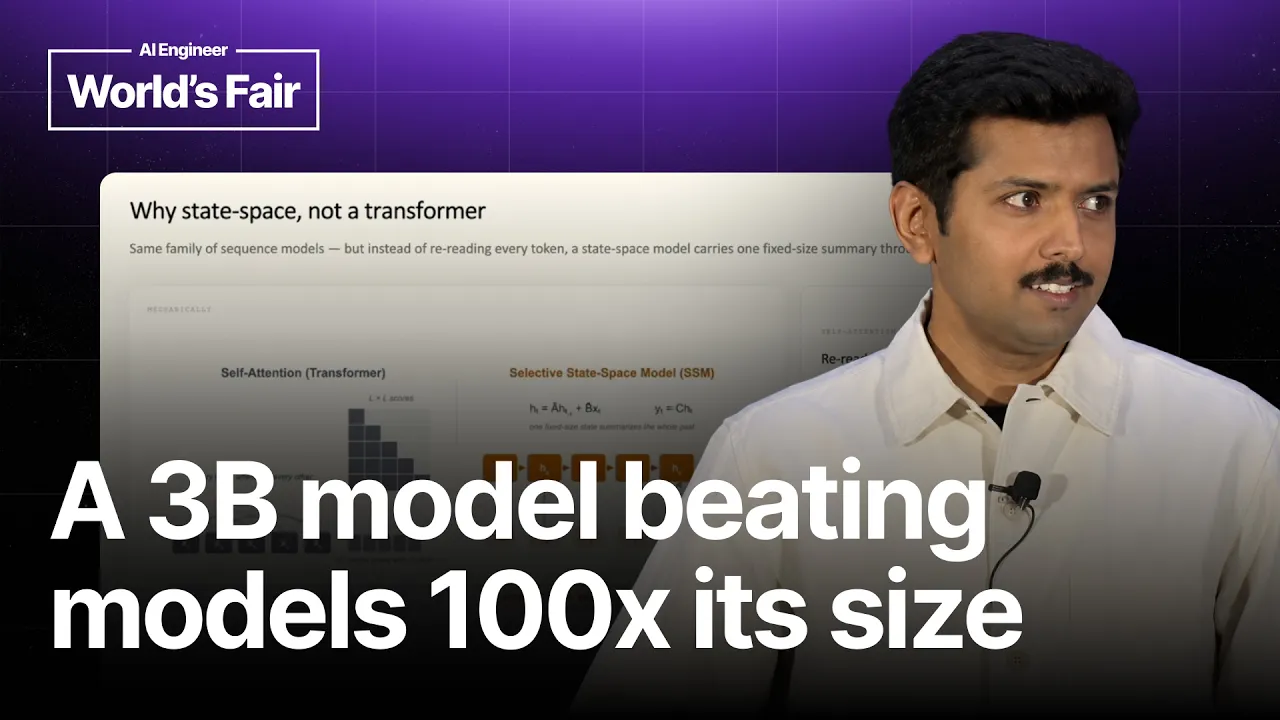
Well under one percent of the Common Crawl corpus that frontier models train on is in an Indian language, even as frontier labs call India a fast growing market. Krishna Prasad Srinivasan says the knowledge exists but was never digitized, and Sarvam's answer is a three billion parameter vision language model, small enough for one GPU, that he says beats document AI models a hundred times larger. The model is unusual twice over. Its backbone is a state space model rather than a transformer, because a page can run to ten thousand visual tokens and quadratic attention gets expensive, while an SSM keeps constant memory. And in late 2025, when most OCR models were monolithic page level VLMs, the team bet on block level OCR wrapped in a layout harness and a reading order harness, which many 2026 releases have since converged on. Training runs as a four stage curriculum: thirteen trillion text tokens across English, 22 Indian languages, math, and code before the model sees a pixel, so a language prior can resolve a smudged word; continual pretraining on three hundred million image text pairs; supervised fine tuning on a hundred million OCR samples; then reinforcement learning. OCR correctness is machine checkable, so rewards are unit tests on character error rate, table structure, or grammar, which makes verifiable reward RL scalable here. The moat is underneath: a data engine for languages with no labeled data, and evals built for real usefulness. Four months after launch the model is digitizing 35 million pages for insurers, banks, and governments, with a public Indic benchmark from the 1800s to today promised soon. Questions cover low resource transfer, synthetic data, and sovereignty. Speaker info: - https://x.com/fewshotlearner - https://www.linkedin.com/in/krishnapsrinivasan/ Timestamps: 0:00 - A 3B model that beats models 100 times larger on document AI 1:14 - Sarvam, and why India is missing from the machine readable world 2:37 - Why Indic document intelligence
Summary
Generated by gpt-5.6-terraAt-a-Glance
- Verdict: Watch fully
- Core thesis: Sarvam argues that a purpose-built 3B state-space vision-language model, wrapped in document-specific layout and reading components and trained with a strong data/eval/RL loop, can outperform far larger general VLMs for multilingual OCR at materially lower inference cost.
- Why it matters: It is a concrete example of winning a vertical AI workload through system design—model architecture, decomposition, deterministic verification, proprietary data pipelines, and deployable sovereignty—not merely scaling parameters.
- Best use: Use it as a reference architecture for document-intelligence agents and for identifying workloads where a small specialist model plus deterministic evaluation can beat a frontier generalist.
Executive Summary
Krishna Prasad Srinivasan presents Sarvam Vision as a 3B-parameter, India-built document VLM for English and 22 official Indian languages. The strategic premise is that India is poorly represented in standard web-scale training corpora not because relevant knowledge is absent, but because much of it remains undigitized. The product target is therefore knowledge extraction from difficult, multilingual documents rather than generic image understanding or plain text transcription.
The principal technical bet is to reject page-level monolithic transformer VLMs for OCR. Sarvam splits the task into layout and reading “harness” modules around a state-space-model (SSM) VLM that performs block-level OCR. The claimed advantage is computational: documents can create 5,000–10,000 visual tokens per page, making transformer attention expensive due to quadratic sequence interactions, whereas the SSM processes sequentially with linear compute and constant state memory. The acknowledged trade-off is potentially lossier recall, accepted in exchange for lower-cost long-document inference.
Training follows a four-stage curriculum: 13T text tokens to build the language backbone; 300M image-text pairs for general vision alignment; 100M OCR examples for supervised specialization across languages, tables, equations, handwriting, and document types; then reinforcement learning using machine-verifiable OCR rewards. Srinivasan frames the durable moat not as the standard recipe itself but as the continuously improving data engine and evaluation suite required for low-resource languages.
The most reusable operational point is that OCR admits deterministic or semi-deterministic checking: character correctness, table structure, equations, grammar, and other output properties can be turned into unit-test-like rewards. Sarvam reports launch scores of 84.3 on olmOCR-Bench and 93.2 on OmniDocBench, claims an unbeaten lead across its 22-language Indic setting, and says deployments have digitized more than 35M pages. The commercial wrapper, Akshar, adds confidence scoring, block-level grounding, human review, agentic proofreading, API access, and on-prem deployment for regulated or sovereign customers.
Key Takeaways
- Claim: For long-document OCR, a small state-space model paired with document-specific decomposition can be a better production architecture than a large monolithic transformer VLM. | Evidence: Sarvam uses a 3B SSM VLM for block-level OCR, surrounded by separate layout and reading harnesses. The speaker says a page may contain 5,000–10,000 visual tokens; transformer attention creates L×L interactions, while the SSM updates a single state token-by-token with linear compute and constant state memory. | Implication: For high-volume document pipelines, first consider task decomposition and sequence-cost structure before defaulting to a frontier multimodal model; a specialist inference path can offer a substantially better cost/latency envelope. | Caveat: The speaker explicitly characterizes block-level SSM OCR as accepting “somewhat of a lossy recall” relative to a more globally attentive approach; this must be measured on document classes where cross-block context is critical.
- Claim: A capable multilingual language prior should be trained before visual OCR specialization, because it helps resolve ambiguous pixels using linguistic context. | Evidence: Stage one trains the 3B language backbone on 13T tokens spanning English, Indian-language text, math, and code before it sees images. Srinivasan compares the effect to a human inferring a partially blurred word from surrounding context; he later says the mix is 40% Indic, with the remainder English, math, and code. | Implication: Document systems need an explicit fidelity policy: use language priors to disambiguate images, but retain grounding and verification so the model does not silently normalize or hallucinate source text. | Caveat: This linguistic prior can also create a transcription risk: OCR requires faithful extraction of visible mistakes rather than plausible correction. Sarvam explicitly distinguishes OCR from translation or transliteration for this reason.
- Claim: The baseline training recipe is conventional; the defensible advantage lies in proprietary low-resource data generation, evaluation coverage, and feedback-driven iteration. | Evidence: Sarvam’s curriculum moves from 13T text tokens to 300M image-text pairs, 100M supervised OCR samples, and RL. For languages with little labeled data, it built pipelines combining synthetic and real documents, then continuously changes training data based on evaluation performance. | Implication: In low-resource verticals, the asset to build is not only a trained model but a closed-loop data/eval factory that can turn deployment failures into targeted new training and test material. | Caveat: The presentation does not provide per-language data volumes, error breakdowns, or a controlled ablation showing how much each data source and training phase contributes.
- Claim: OCR is especially well suited to scalable reinforcement learning because much of output quality can be scored automatically rather than judged subjectively. | Evidence: Sarvam describes sampling groups of outputs, scoring them with unit tests, reinforcing outputs above an average baseline, and repeating. It cites rewards based on character error/correctness, table structure, mathematical equations, language-specific properties, and grammar; the speaker says substantial gains come from this RL stage. | Implication: Ken should prioritize RL or optimization loops first in workflows with executable checks—structured extraction, reconciliation, schema compliance, grounded citations, and tool-result validation—rather than in open-ended subjective tasks. | Caveat: Machine-verifiable rewards are strongest for deterministic extraction properties and may miss semantically correct but structurally unusual outputs, or reward shortcuts unless the test suite is broad.
- Claim: The production product is an agentic, reviewable document workflow rather than a standalone OCR endpoint. | Evidence: Akshar provides human-in-the-loop digitization, extraction and downstream ingestion, along with confidence scores, block-level grounding, and agentic proofreading. Sarvam offers the model through API, on-prem deployment, and the agentic platform. | Implication: A deployable document agent should expose evidence at the block/field level and confidence-based escalation, allowing operators to audit and correct outputs rather than forcing them to trust raw model text. | Caveat: No operational metrics are given for review-rate reduction, end-to-end field accuracy, throughput, latency, or the relative contribution of agents versus the base model.
- Claim: Sovereign deployment and Indic-language performance form a commercial wedge that larger global providers may not satisfy despite broad general capabilities. | Evidence: Sarvam claims an unbeaten lead for its 22 Indic languages relative to Gemini, ChatGPT, and Opus, reports launch scores of 84.3 on olmOCR-Bench and 93.2 on OmniDocBench, and says insurance, banking, government, and historical-preservation customers have digitized more than 35M pages in roughly four months. It identifies on-prem control over where transcription data goes and how it is used as crucial for government buyers. | Implication: For regulated, regional-language, or data-residency-sensitive deployments, deployment control and localized evaluation may be more decisive buying criteria than generic frontier-model ranking. | Caveat: The benchmark claims are speaker-reported, and he notes that newer releases have already moved global benchmark scores; independent evaluation and current leaderboard verification are needed before using the performance claims in a vendor decision.
Detailed Brief
Indic OCR evaluation and data-quality requirements
- Claims: Sarvam plans to release a public Indic benchmark spanning 22 languages, historical material from the 1800s through modern documents, and heterogeneous formats.; For OCR, the desired behavior is high-fidelity reproduction of the source, including visible source errors, rather than translation, transliteration, or stylistic correction.; Deployments across different Indian states are intended to become a feedback source for future training.
- Evidence: The proposed benchmark includes prose, poetry, literature, tables, finance documents, and varied layouts.; The speaker says transliterated data is increasingly appearing in OCR training, but says its quality and utility remain unsettled.; Current production use includes regional-language, English, and mixed-language document digitization.
- Caveats: A multilingual benchmark can still fail to reflect real enterprise distributions, degraded scans, handwriting styles, and regional formatting unless its test splits and provenance are disclosed.; Using production feedback for training requires careful data-governance, customer-consent, and contamination controls, none of which are specified in the talk.
- Implications: Separate transcription fidelity metrics from language-model plausibility metrics in any evaluation stack.; Treat public benchmark release, provenance documentation, and per-language error analysis as material diligence milestones for Sarvam.
Strategic market narrative
- Claims: Sarvam positions document digitization as foundational infrastructure: extracting currently inaccessible material creates the corpus needed for later localized AI applications and personalized agents.; The company’s near-term focus remains document vision, while it signals future general-purpose VLM and agent-vision releases.
- Evidence: Srinivasan argues that much Indian knowledge is absent from machine-readable training corpora because it has not been digitized, despite India being an important market for frontier labs.; He describes sovereignty, model capability, and data creation as the three drivers of adoption.
- Caveats: The claimed progression from digitization to broadly capable localized agents is strategic rather than demonstrated in this presentation.
- Implications: The strongest strategic framing is a data-flywheel business: secure document processing creates localized data assets, which can improve specialized models and unlock adjacent workflows.
Notable Concepts & Terms
- State-space model (SSM): The sequence architecture used instead of transformer attention; Sarvam’s argument is that its linear compute and constant state memory suit long visual-token sequences in OCR.
- Block-level OCR: OCR performed on document regions rather than treating an entire page as one monolithic VLM input; it is the key decomposition that reduces cost and supports grounding.
- Layout and reading harnesses: Two document-specific modules that surround the base VLM, respectively organizing page structure and handling reading/extraction; they embody the system-level specialization thesis.
- RL-VR: Reinforcement learning with verifiable rewards. In this case, OCR outputs are scored through executable checks such as character accuracy, table structure, and equation correctness.
- Data engine: Sarvam’s pipeline for generating synthetic documents, incorporating real documents, and feeding evaluation failures back into subsequent training—presented as a core moat for low-resource languages.
- Akshar: Sarvam’s agentic document-intelligence workbench that adds human review, confidence scoring, block-level grounding, proofreading, and ingestion workflows around Sarvam Vision.
- Sovereign AI: The ability to control model deployment and transcription-data handling, including on-prem operation; positioned as essential for government and regulated enterprise customers.
Operator Notes / Why Ken Should Care
- Benchmark any document-agent stack as a composed system: page segmentation/layout, block extraction, field-level grounding, confidence calibration, and human escalation—not just raw OCR text accuracy.
- Identify current workflows with machine-checkable output contracts and test whether RL-VR can optimize them using validators for schemas, reconciliations, totals, citations, tables, or tool outcomes.
- For any India, public-sector, financial-services, or regional-language document opportunity, add data residency, on-prem availability, auditability, and per-language evaluation to vendor-selection gates.
- Request Sarvam’s released Indic benchmark, per-language and per-document-type results, real-world error analysis, pricing, latency, and evidence that the reported 35M-page deployment figure reflects sustained production quality.
- Avoid using language-model correction as a substitute for OCR fidelity; require source-linked evidence and preserve ambiguous or erroneous source content for downstream review.
Source/Metadata
- Title: From Scratch to SOTA: Training a 3B State-Space Vision Model — Krishna Prasad Srinivasan, Sarvam
- Transcript words: 4272
- Duration seconds: 1269
- Timestamp note: No usable timestamps or chapter markers were provided. The transcript contains a substantial repeated segment.
Transcript
Hi everyone, Graph Noon. I'm Krishna and I'm a general manager at Servon. Today I'm going to tell you how a 3 billion parameter model, small enough to run on a single GPU, gets state-of-the-art in document AI and beats models 100 times larger in size. It is also a slightly unusual model in two ways. Firstly, the language model used is not a standard transformer and the entire model building from data to training to compute was done end-to-end in India. For English and for 22 official Indian languages, which I think are personally one of the hardest document intelligence problems in the world right now. This is how we went from scratch to SOTA. Who are we? We are Servon, a sovereign foundation model company in India. We work across different modalities, voice, text, and vision. In voice, we have speech-to-text and text-to-speech models. In text, we have a 30 billion and 100 billion parameter models. In vision, we have a document intelligence model, which is what we are going to talk about today. India is largely missing from the machine-readable world. According to a published language distribution study, well under 1% of the common corpus on which frontier models are trained have Indian language representation. Now, in several forums, you may have heard Frontier Labs say that India is one of their larger and fastly growing markets. To that end, India is still missing in terms of data from frontier models that are being trained every day here. Now, why is that? Primarily not because there is a lack of data or the knowledge does not exist. It is because the data has never been digitized. We are solving that problem at Servon. Why is Indic document intelligence hard? Firstly, the goal is that of knowledge extraction, not just purely text extraction. Extracting pure text without logical coherence is meaningless. And secondly, in Indic scripts, the shape of the words and the language you see are very different from what a machine sees. That is, Indian languages have a complex set of unicodes fused together. To get right, the language model needs to be strong at all 22 languages. Third, majority of Indian languages can be considered low resource due to which there is a lot of lack in data today to train these models. Our answer to this is Servon Vision, India's first sovereign vision language model, built from scratch, a 3 billion parameter model with state space architecture. Data, compute, and training, all of which done in India. When we started the initial work in late 2025, most VLMs in the OCR space were monolith VLMs. They performed page level OCR. And we, at the time, took a contrarian bet to focus on block level OCR instead, adding a document hardness around the model. A lot of models since then, released recently in 2026, have converged onto the same hardness plus small model paradigm for OCR, which shows a lot of value in the direction we set off. Servon Vision, in particular, has two hardness modules, one for layout and one for reading hardness. And a state space model, a VLM, for block level OCR. Again, today, why do we use state space and not a transformer? Most OCR models today, like general VLMs, open source VLMs like Quen, Gemma, et cetera, are all transformers based. We took an alternate approach using an SSM. Why? Both are fundamentally sequenced models, transformers and SSMs, but with very different underlying mechanics. A transformer has every token look at every other token, where the compute grows with square of the sequence length. That is the L cross L interactions. And the memory goes as the sequence grows as well. Now, on the other hand, SSMs have a single state. They maintain a single state through the sequence, updating it token by token. Now, as compute grows only linearly, the memory stays constant for SSMs. Now, why is this the right architecture for OCR? It really depends on the trade-offs here. For long documents in particular, which can lead up to 5,000 to 10,000 visual tokens per page, and quadratic complexity of compute and memory becomes very expensive for inference. On the other hand, doing block level OCR with somewhat of a lossy recall using SSMs can be justified to avoid high compute costs imposed by transformers. So, how do you actually train this? We built a staged curriculum, four stages. Each building on the last. Stage one is text-only pre-training, 13 trillion tokens across English, Indian language text, math, and code. This builds the 3 billion parameters language backbone. And a strong language prior is what lets the model resolve a smudged or an ambiguous text from the image. The same way you can read a half-blurred word because you know which word is supposed to be at the right place. So, we focused on building the competence of the language model first before the model ever even sees a pixel. Stage two is where we perform continual pre-training on 300 million image text pairs. This teaches the language model general vision capabilities and teaches how to see, how to interpret pixels, and so on. Then comes stage three where we performed supervised fine-tuning on 100 million OCR samples. Now, stage three is primarily focused on letting a general VLM model become strong at OCR. What that includes is having diverse data across all 22 languages and English and also incorporating all kinds of document components such as tables and equations and handwritten documents and so forth. Now, stage four is reinforcement learning which helps push past the ceiling of whatever supervised fine-tuning is able to achieve. So, here you will see this is a standard recipe. However, the moat here is two things underneath, the data layer and the eval layer. The first is the data engine. For most of the 22 languages, there is no label data available readily. When label data does not exist, building the data engine becomes hard, and that is something we have done extensively. We've built pipelines to create synthetic data and data from real documents and also help build the pipeline for continuously improving the data that goes into training based on the eval performance and so on. So, we are currently actively looking at the paradigm of our relamps as we explore the agent vision capabilities for our models in the upcoming releases. The second moat is the evals. You cannot reach state of the art if you cannot measure how well your model performs. We have curated extensive evals to ensure what we are measuring is truly SOTA and also truly meaningful in terms of usefulness for end users. So, I want to take just a minute to dwell on our RL pipeline. Stage four, because a lot of gain comes from RL essentially. In OCR, correctness is a machine-readable problem. A lot of tests can be set up to reward and score the models against these samples that you create. In the world of deterministic OCR, these are all machine verifiable. Hence, RL gives us a major boost. Sample a group, score with unit tests, reinforce what the average value to beat is, and then repeat the process. This makes RL-VR for OCR very, very scalable. Now, after all the from scratch training we've done and the data effort we've made, we were able to establish SOTA in two of the global English benchmarks. One is Ulmo OCR Bench, and the other is Omnidoc Bench. At launch, we were at 84.3 on Ulmo OCR and then 93.2 on Omnidoc Bench. The models that have released since have moved the needle quite a bit, and we'll soon have a stronger model in the global leaderboard as well. Secondly, and more importantly, on 22 Indian languages, we have an unbeaten lead even compared to all the frontier models such as Gemini and ChatGPT and Opus and so on. This is where we've extended the lead significantly, and we remain strong compared to all of these newer models that have come in. Now, Servon Vision powers our agentic document intelligence workbench called Akshar, where we enable human-in-the-loop agentic digitizations and extractions and then ingestions for various downstream document intelligence problems. We provide confidence scores, and we have block level grounding, and then also the ability to do agentic proofreading, et cetera. Now, benchmarks and SOTA are one thing. They have their place. Today, some of the largest enterprises in the world, from insurance to banking to governments to historical preservation organizations, are using Servon Vision to digitize more than 35 million pages across English and 22 Indian languages. The model is available as API and on-prem and then the agentic platform. So, in conclusion, until four months ago, there was no sovereign model from India. Today, we have Servon Vision, which was trained from scratch and has established SOTA at a price point that is extremely competitive with all the other solutions, including open and closed source. First, we've started by solving some of the hardest problems for Indian language document intelligence. Soon, we will be releasing general-purpose VLMs, which are capable of much more vision capabilities, and look forward to all of you trying out our models. Thank you. Happy to answer any questions. Yes, absolutely. In general, the language capability of the 22 languages enhances English language by quite a margin. This is applicable to any low-resource language, not just Indian low-resource languages. Right. We don't quite go in that direction with this model because this is a vision-focused model, wherein we are focused on extracting information or knowledge from documents. But, yes, there could be some parallels to helping models use general languages to speed up coding as well. But, that's not the periphery of this work. Right. So, there are two things. We create artificial documents, synthetic documents, as they are called, for general post-training. That includes SFT and RL. However, coming to your specific question on RL, you can generate synthetic documents there as well. However, the best thing to do is to take real-world documents, complex enough, that help you set up unit tests or different kinds of rewards. Like, a reward based on character rate or a reward based on table structure or a math equation or something that is pertinent to a language or grammar rewards and so on, and then help the model iteratively improve based on rule-outs that the model is able to produce at different settings. So, did you say big fan of Chandra? All right. That's from a different lab. I'm also a big fan of the lab that produced Chandra. But, yes, to your question on Indic Benchmark, yes, we will release the Servon Indic Benchmark that we have created for 22 languages. And it spans a huge time period, starting from 1800s until modern day. And also, different kinds of layouts, different kinds of documents. In Indian languages, you can imagine documents with prose, poetry, literature, tables, finance, and all of those things. We'll soon release that benchmark in public as well. So, translation is again, transliteration is again, not directly involved here because in OCR, what we care about is high fidelity extraction. You want, even if there is a mistake in an image, you want that mistake to be extracted correctly and not the model making changes at whim. Hence, that is not directly applicable. But, yes, what we see is a lot of data that is coming through transliteration for even OCR training now. And the jury is out on what is the quality of that data and how useful it is, et cetera. It is an up and coming country and still being digitized as we speak. It's important that representation or ability to digitize the country exists to begin with. Secondly, on the training side, what we have done in particular is to create data that can be added to a lot of training downstream. So we are at a very early stage in terms of AI becoming a regular part of our lives and we need the data to start to be able to eventually get to a place where we can have personalized agents in the language you prefer and language I prefer and however I want in some way. So to do all of that, we need to start somewhere and the data needs to be created. If the data is of good quality, then that helps the model become SOTA. And if a model is SOTA then from insurance agencies to government organizations, to others who care about sovereignty in AI. As a government body, I cannot have a model deployed elsewhere. I don't know where the data is going for the transcriptions. So I need to be able to control where the data is sent and when it is used, how much it is used, et cetera. So sovereignty becomes very crucial and hence this model really is now, it's been what, four months since we launched and already we are digitizing 35 million pages. So that shows that the market was waiting for something sovereign in this space that can really kickstart the AI digitization wave in India. So yeah, primarily three aspects. One on sovereignty, the other is the model capability itself, and the third is data that is required to train these models. Yeah, it is 40% Indic and then the rest is English and comprises of math and code, et cetera. Yes. Currently, the deployments we've made with this model are in different states, trying to digitize regional languages, along with all the English and mixed language documents. And hence, we'll soon be able to train with the feedback we get from the current deployment. So yeah, we have started that pipeline as well. monolith VLMs. They performed page level OCR. And we, at the time, took a contrarian bet to focus on block level OCR instead, adding a document hardness around the model. A lot of models since then, released recently in 2026, have converged onto the same hardness plus small model paradigm for OCR, which shows a lot of value in the direction we set off. Servon Vision, in particular, has two hardness modules, one for layout and one for reading hardness. And a state space model, a VLM, for block level OCR. Again, today, why do we use state space and not a transformer? Most OCR models today, like general VLMs, open source VLMs like Quen, Gemma, et cetera, are all transformers based. We took an alternate approach using an SSM. Why? Both are fundamentally sequenced models, transformers and SSMs, but with very different underlying mechanics. A transformer has every token look at every other token, where the compute grows with square of the sequence length. That is the L cross L interactions. And the memory goes as the sequence grows as well. Now, on the other hand, SSMs have a single state. They maintain a single state through the sequence, updating it token by token. Now, as compute grows only linearly, the memory stays constant for SSMs. Now, why is this the right architecture for OCR? It really depends on the trade-offs here. For long documents in particular, which can lead up to 5,000 to 10,000 visual tokens per page, and quadratic complexity of compute and memory becomes very expensive for inference. On the other hand, doing block level OCR with somewhat of a lossy recall using SSMs can be justified to avoid high compute costs imposed by transformers. So, how do you actually train this? We built a staged curriculum, four stages. Each building on the last stage one is text-only pre-training, 13 trillion tokens across English, Indian language text, math, and code. This builds the 3 billion parameters language backbone. And a strong language prior is what lets the model resolve a smudged or an ambiguous text from the image. The same way you can read a half-blurred word because you know which word is supposed to be at the right place. So, we focused on building the competence of the language model first before the model ever even sees a pixel. Stage two is where we perform continual pre-training on 300 million image text pairs. This teaches the language model general vision capabilities and teaches how to see, how to interpret pixels, and so on. Then comes stage three where we performed supervised fine-tuning on 100 million OCR samples. Now, stage three is primarily focused on letting a general VLM model become strong at OCR. What that includes is having diverse data across all 22 languages and English and also incorporating all kinds of document components such as tables and equations and handwritten documents and so forth. Now, stage four is reinforcement learning which helps push past the ceiling of whatever supervised fine-tuning is able to achieve. So, here you will see this is a standard recipe. However, the moat here is the two things underneath, the data layer and the eval layer. The first is the data engine. For most of the 22 languages, there is no label data available readily. When label data does not exist, building the data engine becomes hard, and that is something we have done extensively. We've built pipelines to create synthetic data and data from real documents and also help build the pipeline for continuously improving the data that goes into training based on the eval performance and so on. So, we are currently actively looking at the paradigm of our relamps as we explore the agent vision capabilities for our models in the upcoming releases. The second moat is the evals. You cannot reach state of the art if you cannot measure how well your model performs. We have curated extensive evals to ensure what we are measuring is truly SOTA and also truly meaningful in terms of usefulness for end users. So, I want to take just a minute to dwell on our RL pipeline. Stage four, because a lot of gain comes from RL essentially. In OCR, correctness is a machine-readable problem. A lot of tests can be set up to reward and score the models against these samples that you create. In the world of deterministic OCR, these are all machine verifiable. Hence, RL gives us a major boost. Sample a group, score with unit tests, reinforce what the average value to beat is, and then repeat the process. This makes RL-VR for OCR very, very scalable. Now, after all the from scratch training we've done and the data effort we've made, we were able to establish SOTA in two of the global English benchmarks. One is Ulmo OCR Bench, and the other is Omnidoc Bench. At launch, we were at 84.3 on Ulmo OCR and then 93.2 on Omnidoc Bench. The models that have released since have moved the needle quite a bit, and we'll soon have a stronger model in the global leaderboard as well. Secondly, and more importantly, on 22 Indian languages, we have an unbeaten lead even compared to all the frontier models such as Gemini and ChatGPT and Opus and so on. This is where we've extended the lead significantly, and we remain strong compared to all of these newer models that have come in. Now, Servum Vision powers our agentic document intelligence workbench called Akshar, where we enable human-in-the-loop agentic digitizations and extractions and then ingestions for various downstream document intelligence problems. We provide confidence scores, and we have block level grounding, and then also the ability to do agentic proofreading, etc. Now, benchmarks and SOTA are one thing. They have their place. Today, some of the largest enterprises in the world, from insurance to banking to governments to historical preservation organizations, are using Servum Vision to digitize more than 35 million pages across English and 22 Indian languages. The model is available as API and on-prem and then the agentic platform. So, in conclusion, until four months ago, there was no sovereign model from India. Today, we have Servum Vision, which was trained from scratch and has established SOTA at a price point that is extremely competitive with all the other solutions, including open and closed source. First, we've started by solving some of the hardest problems for Indian language document intelligence. Soon, we will be releasing general-purpose VLMs, which are capable of much more vision capabilities, and look forward to all of you trying out our models. Thank you. Happy to answer any questions. Yeah. Yes. Yes, absolutely. In general, the language capability of the 22 languages enhances English language by quite a margin. This is applicable to any low-resource language, not just Indian low-resource languages. Yeah. Yes. Right. We don't quite go in that direction with this model because this is a vision-focused model, wherein we are focused on extracting information or knowledge from documents. But, yes, there could be some parallels to helping models use general languages to speed up coding as well. But, yeah, that's not the periphery of this work. Yeah. Right. So, there are two things. We create artificial documents, synthetic documents, as they are called, for general post-training. That includes SFD and RL. However, coming to your specific question on RL, we don't – you can generate synthetic documents there as well. However, the best thing to do is to take real-world documents, complex enough, that help you set up unit tests or different kinds of rewards, right? Like, say, a reward based on character rate or a reward based on table structure or a math equation or something that is pertinent to a language or, like, grammar rewards or so on, and then help the model iteratively improve based on rule-outs that the model is able to produce at different settings. Yeah. Yes. So, did you say big fan of Chandra? All right. That's from a different lab. I'm also a big fan of the lab that produced Chandra. But, yes, to your question on Indic Benchmark, yes, we will release the Servam Indic Benchmark that we have created for 22 languages. And it spans a huge time period, starting from 1800s until modern day. And also, different kinds of layouts, different kinds of documents. In Indian languages, you can imagine documents with prose, poetry, literature, tables, finance, and all of those things. We'll soon release that benchmark in public as well. So, translation is, again, transliteration is, again, not directly involved here because in OCR, what we care about is high fidelity extraction. Right? You want, even if there is a mistake in an image, you want that mistake to be extracted correctly and not the model making changes at whim. Hence, that is not directly applicable. But, yes, what we see is a lot of data that is coming through transliteration for even OCR training now. And the jury is out on what is the quality of that data and how useful it is, et cetera. Yeah. Yes. . . . . . . . . . . . . . . . . . . . It is up and coming country and still being digitized as we speak. It's important that representation or ability to digitize the country exists to begin with. Secondly, on the training side, what we have done in particular is to create data that can be added to a lot of training downstream. So we are at a very early stage in terms of AI becoming a regular part of our lives and we need the data to start to be able to eventually get to a place where we can have personalized agents in the language you prefer and language I prefer and however I want in some. So to do all of that, we need to start somewhere and the data needs to be created. If the data is of good quality, then that helps the model become SOTA. And if a model is SOTA then from insurance agencies to government organizations, to others who care about sovereignty in AI. As a government body, I cannot have a model deployed elsewhere. I don't know where the data is going for the transcriptions. So I need to be able to control where the data is sent and when it is used, how much it is used, etc. So sovereignty becomes very crucial and hence this model really is now, like it's been what, four months since we launched and already we are digitizing 35 million pages. So that shows that the market was waiting for something sovereign in this space that can really kickstart the AI digitization wave in India. So yeah, primarily like three aspects, one on sovereignty, the other is the model capability itself, and the third is data that is required to train these models. Yeah, it is 40% Indic and then the rest is English and comprises of math and code, etc. So that's a little bit. All right. Yes. Just a few questions. Are we using the . Currently, the deployments we've made with this model are in different states, trying to digitize regional languages, along with all the English and mixed language documents. And hence, we'll soon be able to train with the feedback we get from the current deployment. So yeah, we have started that pipeline as well. . . . . . . . . . . . . . . . . .