1,000 Claude Agents Formalized Fermat's Last Theorem — Lance Martin, Anthropic
Description
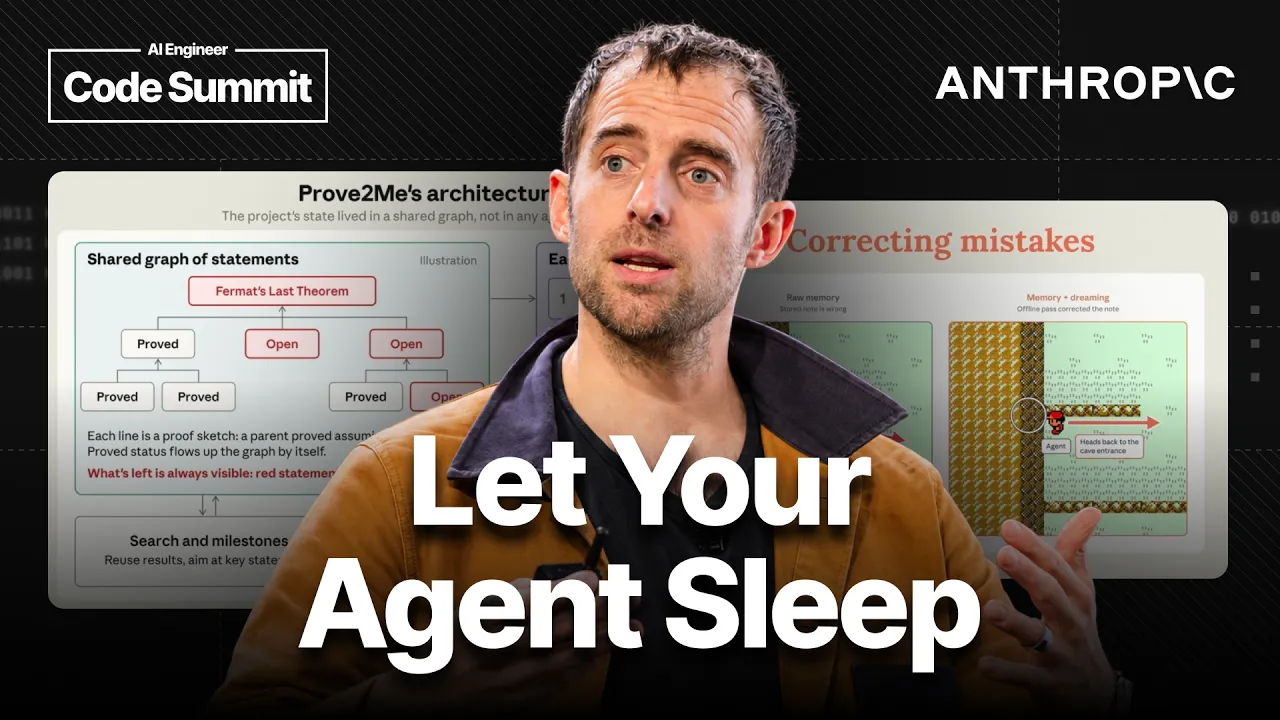
A team of 1,000 Claude agents formalized Fermat's Last Theorem in Lean over about 30 hours, using nothing but Git and a database, with no domain-specific harness and no human steering on the solution. Lance Martin shows how the lead agent built its own coordination tables and how the team reassigned itself as the work progressed. Then he turns to memory: why stronger models know what to write down, how Claude's Pokemon memory got tighter from Sonnet 3.7 to Fable 5, and how "dreaming" over transcripts fixes poisoned memories and builds better wikis. Speaker info: - https://x.com/RLanceMartin - https://www.anthropic.com Timestamps: 0:00 - Fermat's Last Theorem 0:57 - Formalizing the proof in Lean 2:27 - 1,000 agents, no domain harness 3:57 - The lead agent builds its own tables 5:27 - Agents reassign themselves over 30 hours 7:01 - Memory: understood backwards, lived forwards 8:31 - Daily memory vs long-term knowledge 9:16 - Stronger models use memory better 10:46 - Pokemon memory: Sonnet 3.7 vs Fable 5 12:16 - Dreaming over transcripts and notes 13:46 - Dreaming fixes a poisoned memory 15:16 - Building a company wiki 17:35 - Dreaming fills the gaps
Summary
Generated by gpt-6.1-terraAt-a-Glance
- Verdict: Watch fully
- Core thesis: Anthropic reports that agents can coordinate a large, verifiable task using simple shared primitives, while durable agent memory improves when separate reflection processes consolidate and correct what agents record during work.
- Why it matters: The talk offers concrete patterns for agent orchestration, sandboxing, persistent state, memory evaluation, and recovery from corrupted knowledge—directly relevant to Ken’s agent systems and control-plane design.
- Best use: Use the talk as a design and evaluation input for a bounded multi-agent pilot and a separate memory-consolidation experiment, not as proof that 1,000 agents are economically optimal.
Executive Summary
Lance Martin describes an Anthropic experiment in which one lead and 999 helper agents formalized an existing Fermat’s Last Theorem proof in Lean over roughly 30 hours. The agents had isolated sandboxes, Git, and a SQL database; the lead created coordination tables, assigned work, and adjusted allocation as the proof progressed. Unlike an earlier effort, the reported run used no domain-specific orchestration harness or human steering of the solution, although substantial security monitoring remained.
The second half argues that agent memory has two distinct jobs: recording potentially useful information during a task and later consolidating it into coherent, reusable knowledge. In Martin’s account, stronger models were better at deciding what to record and retrieve, while an offline reflection process he calls “dreaming” corrected a poisoned game memory and improved generated knowledge representations.
The results suggest a practical architecture: retain source traces, allow task-level notes, and periodically use additional compute to verify, repair, index, or synthesize durable memory. The reported evidence is promising but narrow: the talk does not establish multi-agent cost efficiency, generalize the formalization result to unverifiable work, or give complete memory benchmark results.
Key Takeaways
- Claim: A large agent team reportedly formalized an existing proof with a generic coordination substrate rather than a mathematics-specific orchestration harness. | Evidence: Martin reports one lead and 999 helpers working for approximately 30 hours across 60 proof statements, with Git and SQL as shared primitives and Lean checking proof steps. An earlier effort used roughly a dozen agents, the Proof to Me platform, and substantial researcher support. | Implication: Test simple shared-state coordination on tasks with strong automated verification before investing in elaborate domain-specific orchestration. | Caveat: This was formalization of an existing human proof, not a new proof of Fermat’s Last Theorem. Lean supplies a powerful domain-specific verification environment, and the transcript gives no cost, success-rate, or smaller-team comparison.
- Claim: The lead agent built its own operational coordination structures and dynamically redistributed work. | Evidence: About five minutes into the run, the lead created tables for announcements and assignments, notes, subtasks, and landed work; agents used them to communicate, track dependencies, and reassign effort as the proof advanced. | Implication: A control plane can expose flexible shared primitives and observe the protocol agents create, rather than hard-coding every collaboration rule upfront. | Caveat: The outcome is reported by Anthropic and illustrated through a run; the transcript does not establish how reliably the same behavior emerges across tasks or repeated trials.
- Claim: Minimal task-specific orchestration did not mean minimal security infrastructure. | Evidence: Each agent had its own sandbox with restricted network access; real-time monitoring inspected tool calls for escapes, and offline monitoring reviewed agent runs every 10 minutes. | Implication: Separate the question of how much task scaffolding agents need from the non-negotiable isolation and observability needed to run them safely. | Caveat: The talk does not specify the sandbox implementation, monitoring coverage, or whether any security incidents occurred.
- Claim: A memory directory alone does not ensure useful persistent memory; model capability and prompting conditions matter. | Evidence: In a CLBench setup with 40 database questions and a fresh session between questions, Martin says Sonnet 4.6 gained little from an optional memory directory, while stronger models more effectively decided when to write and read. In Pokémon, the weaker model accumulated many indiscriminate notes while the stronger model kept more strategic memory and progressed further. | Implication: Evaluate memory write quality, retrieval behavior, and downstream task performance separately for each model and prompt configuration. | Caveat: The CLBench setup gave only a minimal instruction that memory was available; it does not show that explicit memory policies or tooling could not improve a weaker model. The transcript contains inconsistent model names, so exact cross-model comparisons should be checked against the source.
- Claim: Offline reflection can repair persistent memory errors that otherwise trap an agent in repeated failure. | Evidence: In Pokémon, an incorrect landmark location in memory caused Claude to repeatedly mislocalize itself and fall through a trap door; Martin reports that dreaming corrected the memory and enabled progress to the next level. | Implication: Treat memory as mutable, fallible state and build a repair path rather than assuming stored notes are authoritative. | Caveat: This is a single illustrated game failure, not evidence that reflection reliably detects every false or adversarial memory.
- Claim: Agent-generated knowledge representations can complement search, and additional consolidation compute improved the reported wiki results. | Evidence: Using an anonymized Stainless corpus and 25 company-specific questions, Martin reports 53% for semantic search alone; a Claude-generated wiki improved as dreaming tokens increased, and combining wiki and search performed better than search alone. | Implication: Benchmark synthesized organizational knowledge alongside retrieval, including the cost and accuracy of keeping the representation current. | Caveat: The transcript does not provide the final wiki or combined scores, token costs, or enough evaluation detail to establish statistical robustness.
Detailed Brief
Memory representations and consolidation
- Claims: Martin frames the central memory problem as local versus global: an agent records what seems important during a session, but future sessions need a coherent, nonredundant knowledge base.; Dreaming can process both transcripts and session notes, producing new representations or promoting selected information into context automatically loaded in future sessions.
- Evidence: In a separate wiki example, reflection filled missing pages that had existed only as placeholders and created an index.
- Caveats: Automatically injecting a synthesized memory into every session can amplify an error if promotion is not controlled; the talk does not describe a validation procedure for promotion.
- Implications: The memory layer is not merely storage: it is a transformation and publication pipeline whose outputs have different scopes of influence.
Notable Concepts & Terms
- Lean: Proof assistant used to computationally check formal proof steps; its verification capability is central to interpreting the multi-agent result.
- Proof to Me: Mathematics-proof orchestration platform used in Anthropic’s earlier formalization effort but reportedly omitted from the 1,000-agent run.
- Shared Git and SQL primitives: The common repository and database through which agents coordinated work, recorded state, and landed proof code.
- CLBench: Open-source continued-learning benchmark used here to test whether agents carry useful information between fresh sessions.
- Dreaming: Martin’s term for applying offline agent compute to transcripts and memory notes to consolidate, correct, index, or synthesize knowledge.
- Poisoned memory: An incorrect stored belief that can repeatedly misdirect an agent, illustrated by the erroneous Pokémon landmark.
- Injected context: Selected memory loaded proactively into future sessions; useful for high-value knowledge but consequential if that knowledge is wrong.
Operator Notes / Why Ken Should Care
- Prototype a small lead-and-worker system with shared task, announcement, and artifact records; compare it with a fixed workflow on completion rate, spend, latency, and failure recovery.
- Require sandbox isolation, network restrictions, tool-call logging, and explicit escalation procedures before increasing agent concurrency.
- Build a memory evaluation set with known facts, changed facts, and deliberately corrupted notes; measure retrieval, correction, and downstream task outcomes.
- Gate promotion into always-injected context with provenance, review or verification, versioning, and rollback.
- Check the underlying Anthropic reports for exact model identities, proof dependencies, run costs, success rates, and complete benchmark scores before using the claims in an investment or architecture decision.
Source/Metadata
- Title: 1,000 Claude Agents Formalized Fermat's Last Theorem — Lance Martin, Anthropic
- Transcript words: 6170
- Duration seconds: 1123
- Timestamp note: No timestamps or chapters were provided. The supplied transcript contains duplicated passages and inconsistent model-name transcriptions.
Transcript
I'm Lance from Anthropic. I know we've had some issues with the prior keynotes, so we're set to go. I'm going to tell two stories about getting the most out of Claude and exploring Claude's frontier capabilities. So the first is multi-agent. This is a blog I wrote with the Fable 5.2 launch. And I want to tell the story of what happened here. So Fermat's Last Theorem is one of the more famous claims in mathematics. It's stood and proven for around 350 years. And it's actually a very simple statement: A to the end, B to the end, C to the end has no solution for any positive whole numbers greater than 2. Now, this deceptively simple statement has proven to be quite difficult to actually prove. In the mid-'90s, Sir Andrew Wiles did prove it. He put out a proof, and it took him seven years of work. It was extremely painstaking. And since that time, a major effort and interest in mathematics has been formalizing that proof for computationally checking every step. So proofs are chains of logic. And you actually can computationally check proofs using different systems, which I'll talk about, for example, using Lean. This is just a visual explaining the effort that he went through—an extremely painstaking process to establish this proof. And in September, we published that we use Claude to formalize it. This is a first very important result that we shared along these lines. And we used Lean to do it. So Lean allows you to computationally verify every step in a proof. Now, doing this is extremely painstaking. We started with a team of around a dozen agents. And this is just showing a schematic of that team. Very early on, that team didn't work very effectively. We had to give it something called Proof to Me. Now, this is a platform for orchestrating mathematics proofs. And it helped the agents significantly manage the state of the project. Lean you can think about as a harness. So basically, it provides the agents with a graph that they can query. So it's basically lots of scaffolding around this problem statement. You can think of it as a very domain-specific harness. Now, this is all setting up what we actually did. We reported this back in September. The formalization. Now, what I wanted to do for 5.2 is show: can we have a much larger team of agents, going from around a dozen to 1,000, do this formalization with no domain-specific harness, so without Proof to Me, and with no human steering with respect to the solution? So the report we talked about in September had both this domain-specific harness, Proof to Me, and a lot of support from a researcher. This is testing whether a large team of Fable 2 agents can autonomously develop this formalization themselves. So this is just giving you a sense for the harness. It looks complicated, but it's actually pretty simple. Each of the 1,000 agents has its own sandbox with restricted network access. Most of this is directed on safety and security. So we have 1,000 agents. Each have their own sandbox. They can connect to two different things: a Git and a SQL database. That's it. Those are the core primitives that we give this team. And we have real-time monitoring, looking at every tool call for things like escapes. We also have offline monitoring, looking at runs of all the agents every 10 minutes. This is the setup: 1,000 agent team, very simple primitives, just Git and a database. The prompting is pretty simple. It establishes one lead agent, 999 helper agents. It gives them awareness of Git and the database, and the problem statement. That's really it. We want to see if this team could then do this formalization. What's interesting is this is the story of what the team did. The lead, very early on, five minutes into the run, basically created these database tables. So agents now are sufficiently advanced that they can actually build primitives that they need to solve hard problems. We didn't tell them to create these tables. These are the tables that the agent actually just built: A table where the lead can announce things and assign roles to workers. Everyone can post notes. A subtask table, a table that indicates whether or not things are landed. So the lead just creates these tables to orchestrate this team. And this is a visualization showing how the agents wrote to and read from these tables over the course of this run. Now, red on the top is showing writes to the tables. Green is showing reads. What's really interesting is you can see occasionally the lead write into the announce table. This announces major global announcements about the problem. It also assigns workers, these helpers, different statements in this theorem as they proceed. Notes are where they communicate and share progress. Land is where they actually write the Lean code as part of the proof. And so the agents all autonomously, without specific prompting, use the database in this way to coordinate their work on this extremely hard, long horizon task. This ran for around 30 hours. And for particularly challenging parts of this proof, they actually developed their own abstractions. This is actually a task tree for this Lagrange tunnel. This is one of the harder statements in the proof. And this is showing the different dependencies of the tasks within this tree. And this is showing over time how the progress goes from in progress to done in red. So the point of all this is to highlight: agents can solve very long horizon problems without much scaffolding. This is showing the overall allocation of the agents across these different tasks over the course of this run. And this shows how the lead and the agents themselves reallocate themselves and reassign themselves to different parts of the problem as it progresses. And as these statements—there are 60 statements in this proof—are all solved. So the agents using simple primitives, Git and the database, can coordinate themselves across this very hard problem to solve it progressively over time. That's really the key point. And you can see time progressing here. This is from one of our runs. This is one of the notes that the agents left, basically saying: total freeze of the origin, effective now, magnificent work, all 999 of you. So basically, what is really interesting about this is we were able to show this formalization, which was expected to take many, many years. Back in September, we showed initially we could do it with a dozen agents with a lot of scaffolding, this Proof to Me harness and a lot of support from a researcher. This new result is showing we provide a lot of structure in terms of safety and monitoring, but the agent team was able to accomplish this task with very simple primitives, without a domain-specific harness in this particular case. And agents are getting increasingly good at orchestrating themselves and knowing how to coordinate using these simple primitives for very challenging long horizon tasks. That's really the key observation, which is very interesting from this work. Now, I want to shift gears and talk about memory, which is entirely different. But it's highlighting another area where we're seeing Claude gain significant capabilities. So previously, we talked about Claude's ability to orchestrate large teams to solve very long horizon problems. Memory is a different capability. It's showing that Claude is increasingly capable of organizing this context to help solve long horizon problems. So I published an Eng blog on this fairly recently. And this is actually the lead line of the blog. I think this actually encapsulates the idea of the blog. And one of the central ideas around memory, I think, is very interesting. And this is from the philosopher Kierkegaard: So life can only be understood backwards, but it must be lived forwards. This is a fundamental paradox of agent memory, because agents write to memory typically as they go about a task. They encounter something weird or interesting. They write to memory. But memory needs to be a coherent map of an agent's knowledge that agents can look back on and reflect on. So when they're writing to memory, they're writing myopically. They're looking greedily within a session, saying, ah, this seems important for this task at hand. But memory needs to be something that's globally coherent and not redundant. So this is a very tricky paradox of memory. And frankly, we as humans have the same challenge. We go about our day, we write to short-term memories. It's believed that the hippocampus is the place that is orchestrated. At night, it's believed that the hippocampus replays to the neocortex, which is where long-term knowledge is stored. So it's believed that this dreaming process for humans helps consolidate the fragments, or the most important aspects of our daily experience, into long-term knowledge. So there's this decomposition between daily memory and long-term knowledge. And we found agents can benefit from the same decomposition. That's really the key point of the post. Now, here are some results telling the story. So this is actually an open source continued learning benchmark called CLBench. But memory needs to be something that's globally coherent and not redundant. So this is a very tricky paradox of memory. And frankly, we as humans have the same kind of challenge. We go about our day, we write to short-term memories, believe that the hippocampus is the place that that's orchestrated. At night, it's believed that the hippocampus replays to the neocortex, which is where long-term knowledge is stored. So it's believed that this dreaming process for humans helps consolidate the fragments, or the most important aspects of our daily experience, into long-term knowledge. So there's this decomposition between daily memory and long-term knowledge. And we found agents can benefit from the same decomposition. That's really the key point of the post. Now, here are some results telling the story. So this is an open source continued learning benchmark called CLBench. And this is showing that different models, as you go from Sonnet up to Opus 5.5, get increasingly good at using memory. Now, this task is a very simple setup. It asks Claude to solve 40 questions about a database. In between each question, it's a fresh session. And Claude can write to notes, a memory directory, between each session. So it's a set of sequential questions. And Claude can write memories to help with future questions. So what happens is the dark bars are showing when you give Claude the memory store. And then the hash is without memory. Now, what's interesting is with Sonnet 4.6, giving Sonnet memory you can see in the dark blue, has very little benefit. Claude can't really use memory. And we looked into the results and we found Sonnet doesn't reliably know when to write to memory. It also doesn't really naturally read from memory. It's also worth noting that these experiments are done with no specific memory prompting. It just tells the agent the directory is available. Use memory if you want. That's really it. So Sonnet 4.6 doesn't natively use memory effectively. Sonnet 5 does better. Opus and so on. And basically, the models get better and better with the same simple instruction at using memory. And really, the key idea here is that with stronger models, they know intrinsically when to write to memory. And they know intrinsically when to read from memory to retrieve information. Their memories are also better. They're highly verified statements or predictions about the state of the database or what may happen next. Versus earlier models tend to write lower quality memories. And I'll show you a very fun example of this from a different game. This is from Pokemon. So this is showing Claude's memory directory from Pokemon with Sonnet versus Claude with Opus. Here is the key point. The size of each box indicates the number of memory files in each of these directories. So when we give Claude a memory directory, just like I did in that prior benchmark, Claude can write whatever it wants in that directory while it plays the game. What's really interesting is Sonnet, we see it writes a huge amount to memory. And when you look at the memories, it's indiscriminate. It's basically writing down all sorts of experience. It creates this huge, unwieldy memory directory of things that are not really relevant or strategic for gameplay. And it proceeds much worse in the game than Opus. Opus's memory directory is much tighter. It's really strategic insights, tactical knowledge, things you can't just get from game state very easily. So what we see is better models have much better instincts for salience and what to write to memory. And you can see this reflected in the size of the memory directories. It's much tighter. It's much more strategic. And gameplay, indeed, with Opus gets much further than Sonnet. So it gives another intuition around the fact that Claude is much better at writing to memory, knowing what to write in salience and what's salient. And also using and reading from memory. So models are getting more and more effective at knowing salience, knowing what to write, and also reading. Now, both of these represent what I would consider writing to memory during experience. So basically, in both of these tasks, we let Claude write to memory while it plays this game. We let Claude write to memory while it does the CLBench benchmark. But as I mentioned, there's also the dreaming side of memories. This is allowing Claude to reflect over memories to fix things. And I'll show some interesting examples of that. This is a framing of dreaming. And you can think about memory in terms of transcripts. Transcripts you can think about as the foundation of memory. So imagine a memory system could very simply be just transcript search. Claude writes a transcript as it goes about a task. Future sessions can read from the transcript. Of course, transcripts are large. It's very unwieldy. We talk a lot about in the blog post the fact that transcripts often contain information where a very small amount of information in transcripts is actually salient and matters. So we also allow Claude to do things like writing memory notes. That's what I just talked about. As it goes, it can write notes to memory. But dreaming lets you do more. Dreaming lets you reflect over transcripts and these written notes and re-represent them. Build memory representations like wikis, as an example. Actually promote certain memories to injected context and load it preemptively into every future session. So memory is this, dreaming is this mechanism where you can process existing transcripts or existing memory notes and build new things from them, including representations, injected contexts, and more. So some fun examples of this. This is from Pokemon gameplay. Dreaming is an effective way to correct mistakes in memory. So as I talked about, when Claude's going about a task, it can write incorrect notes to memory. It makes a mistake. This happened in this particular game. Claude incorrectly wrote the location of a particular landmark in the game. Now what happened is, with this incorrectly written memory, Claude got trapped in a loop, where basically it would mislocalize itself at this particular point in the game, fall down this trap door, and it would basically send it back to the prior level. That's the high level intuition. The details aren't that interesting or important. The key idea is a poison memory was injected and it's stuck there. Dreaming can rescue that. That's really the intuition on why dreaming is extremely powerful for reflecting over memories and correcting them. So this is showing some trajectories of the game. Where orange is memory and dreaming, up is good. So basically, up represents game progress, and down represents game regression. And what's interesting is raw memory, basically without dreaming, we can see crashes out. An incorrect memory is planted, and Claude continues to basically regress or fall in the game when it hits that particular point. Where dreaming it rescues that mistake, Claude proceeds to the next level. That's really the key observation. And this is a very general principle. Claude can use dreaming to correct mistakes in memory that are otherwise stuck there. It's a very important way you can correct from errors. Now, this is another fun example of building representations in memory. So there's been a lot of interest in wikis as general ways that Claude can organize knowledge. This is a really fun example from when we acquired a company, Stainless, back in May. And we had access to the company corpus, all its documents and Slack messages and so forth. And we anonymized things. And we built a data set from it, which allowed us to test dreaming. So what we did was we created an email set of 25 questions about the company that can only be answered from this corpus. We allow Claude to build a wiki from this information to help it answer questions. What you see is we compare a raw search tool. That's just semantic search over this documentation. We compare that as a baseline, which does reasonably well. You can see it's 53% for search. We also test letting Claude build a wiki over this knowledge. You can see as you push, you add more and more dreaming tokens, the wiki gets better and better, allowing Claude to answer questions. So Claude natively can build up over time a representation of this corpus of knowledge through a wiki. And as you add more dreaming, the wiki gets more and more useful. We think there's a really nice mental model to think about how agents can build knowledge over time. They can be given access to raw corpuses of texts, of transcripts. And they can build these representations that allow them to search those contexts much more easily, to answer questions and to connect their knowledge in effective ways. We also find that adding the wiki and the search tool together actually bumps further beyond just raw search. So it's another intuition that Claude can also build representations like wikis in its memory in order to help it solve problems. And a final example, this is from a different benchmark. But this is showing two different wikis that Claude built. So this is prior to dreaming and after dreaming. So Claude natively can build up over time a representation of this kind of corpus of knowledge through a wiki. And as you add more dreaming, the wiki gets more and more useful. We think there's a really nice mental model to think about how agents can build knowledge over time. They can be given access to raw corpuses of texts, of transcripts. And they can build these representations that allow them to search those contexts much more easily, to answer questions and to connect their knowledge in effective ways. We also find that adding the wiki and the search tool together actually bumps further beyond just raw search. So it's another intuition that Claude can also build representations like wikis in its memory in order to help it solve problems. And a final example, this is from a different benchmark. But this is showing two different wikis that Claude built. So this is prior to dreaming and after dreaming. What we saw is when Claude was building wikis in this particular case, there were some gaps. And for example, this initial wiki had a bunch of placeholders for pages that didn't exist. This can happen when Claude is building different memory representations. And without dreaming compute, there may not be opportunities to rescue or fix those errors. What we saw is when we ran dreaming, dreaming can look over Claude's existing representation, like for example, wiki, and can fill in mistakes. So in this case, it fills in all the missing gaps. It creates an index. And so again, dreaming is a way that Claude can reflect and apply compute across its memory to improve it by correcting mistakes like I talked about, by filling in gaps in its knowledge like we see here, or for example, by creating new representations like wikis. So with that, I thank you all for listening. And I'll be at the Anthropic booth. So please come see me and I'm happy to talk about any of this. Thank you. Thank you. Thank you. Thank you. That's really it. We want to see if this team could then do this formalization. What's interesting is this is kind of the story of what the team did. The lead, very early on, five minutes into the run, basically created these database tables. So agents now are sufficiently advanced that they can actually build primitives that they need to solve hard problems. We didn't tell them to these tables. These are the tables that the agent actually just kind of built. A table where the lead can announce things, assign roles to workers. Everyone can, you know, agents can post notes. A subtask table, a table that indicates whether or not things are landed. So the lead just creates these tables to orchestrate this team. And this is a visualization showing how the agents wrote to and read from these tables over the course of this run. Now, red on the top is showing writes to the tables. Green is showing reads. What's really interesting is you can see occasionally the lead right into the announce table. This kind of announces major global, like kind of announcements about the problem. It also signs workers, these helpers, different statements in this theorem as they proceed. Notes are where they communicate and share kind of progress. Land is where they kind of actually write the lean code as part of the proof. And so the agents all autonomously, without specific prompting, use the database in this way to coordinate their work on this extremely hard, long horizon task. This ran for around 30 hours. And for particularly challenging parts of this proof, they actually developed their own abstractions. This is actually a task tree for this Lagrange tunnel. This is one of the harder statements in the proof. And this is actually showing the different dependencies of the task within this tree. And this is actually showing over time how the progress from like, in progress to done in red. So the point of all this is really just to kind of highlight, agents can solve very long horizon problems without much scaffolding. This is showing kind of the overall kind of allocation of the agents across these different tasks over the course of this run. And this kind of shows how the lead and the agents themselves kind of reallocate themselves and kind of reassign themselves to different parts of the problem as it progresses. And as these statements, there are 60 statements in this proof, are all solved. So the agents using simple primitives, Git, and the database, can coordinate themselves across this very hard problem to solve it progressively over time. That's really the key point. And you can see time progressing here. This, from one of our runs, this is one of the notes that the agents left, basically saying total freeze of the origin, effective now, magnificent work, all 999 of you. So basically, what is really interesting about this is we were able to show this formalization, which was expected to take many, many years. Back in September, we showed initially we could do it with like a dozen agents with a lot of scaffolding. This proved to be a harness and a lot of poking and support from a researcher. This new result is showing we provide a lot of structure in terms of safety and monitoring, but the agent team was able to accomplish this task with very simple primitives, without a domain civic harness in this particular case. And agents are getting increasingly good at orchestrating themselves and knowing how to coordinate using these simple primitives for very challenging long horizon tasks. That's really the key kind of observation, which is very interesting from this work. Now, I want to shift gears and talk about memory, which is entirely different when I talk about it in terms of multi-agent. But it's highlighting in another area where we're seeing Claude gain significant capabilities. So previously, we talked kind of about Claude's ability to orchestrate large teams to solve very long horizon problems. Memory is a different capability. It's showing that Claude is increasingly capable to organize this context to help solve long horizon problems. So I published an Eng blog on this fairly recently. And this is actually the lead line of the blog. I think this actually encapsulates the idea of the blog. And one of the central ideas around memory, I think, is very interesting. And this is from the philosopher Kierkegaard. So life can only be understood backwards, but it must be lived forwards. This is a fundamental paradox of agent memory, because agents write to memory typically as they go about a task. They encounter something weird or interesting. They write to memory. But memory needs to be a coherent map of an agent's knowledge that agents can look back on and reflect on. So when they're writing to memory, they're writing kind of myopically. They're looking greedily within a session, saying, ah, this seems important for this task at hand. But memory needs to be something that's globally coherent and not redundant. So this is like a very tricky paradox of memory. And frankly, we as humans have the same kind of challenge. We go about our day, we write to short-term memories, believe that the hippocampus kind of is the place that that's orchestrated. At night, it's believed that the hippocampus replays to the neocortex, which is where long-term knowledge is stored. So it's believed that actually this dreaming process for humans helped consolidate the fragments, or like the most important aspects of our daily experience, into long-term knowledge. So there's this decomposition between daily memory and kind of long-term knowledge. And we found agents can benefit from the same decomposition. That's really the key point of the post. Now, here's some results kind of telling the story. So this is actually an open source continued learning benchmark called CLBench. And this is showing that different models, as you go from like Sonnet up to like Opus 5.5, get increasingly good at using memory. Now, this task is a very simple setup. It asks Claude to solve 40 questions about a database. In between each question, it's a fresh session. And Claude can write to notes, like a memory directory, between each session. So it's kind of like a set of sequential questions. And Claude can write memories to help with future questions, right? So what happens is the dark bars are showing when you give Claude the memory store. And then the hash is like without memory, OK? Now, what's interesting is with Sonnet 4.6, giving Sonnet memory you can see in the dark blue, has very little benefit. Can't really use memory. And we looked into the results and we found Sonnet doesn't reliably know when to write to memory. It also doesn't really naturally read from memory, OK? It's also worth noting that these experiments are done with no specific memory prompting. It just tells the agent the directory is available. Use memory if you want. That's really it. So Sonnet 4.6 doesn't natively use memory effectively. Sonnet 5 does indeed better. Opus and so on. And so basically, the models get better and better with the same simple instruction at using memory. And really, the key idea here is that what happens is with stronger models, they know intrinsically when to write to memory. And they kind of know intrinsically when to read from memory to retrieve information. Their memories are also better. They're highly verified statements or predictions about kind of the state of the database or what may happen next. Versus earlier models tend to write lower quality memories. And I'll show you a very fun example of this from a different game. This is from Pokemon. So this is showing you Claude37's memory directory from Pokemon versus Fable5. Here is the key point. The size of each box indicates the number of memory files in each of these directories, OK? So when we have ClaudePay Pokemon, we give Claude a memory directory, just like I did in that prior benchmark, right? Claude can write whatever it wants in that directory while it plays the game. What's really interesting is, Sonnet37, we see it writes a huge amount to memory. And when you look at the memories, it's indiscriminate. It's basically writing down all sorts of experience. It creates this huge, unwieldy, just disgusting memory directory of things that are not really relevant or strategic for gameplay. And it proceeds much worse in the game than Fable5. Fable5's memory directory is much tighter. It's really strategic insights, tactical knowledge, things you can't just get from game state very easily. So what we see is better models have much better instincts for salience and what to write to memory. And you can see this reflected in the size of the memory directories. It's much tighter. It's much more strategic. And gameplay, indeed, with Fable5 gets much further than Sonnet37. So it gives another intuition around the fact that Claude is much better at writing to memory, knowing what to write in salience and what's salient. And also kind of using and reading from memory. So models are getting more and more kind of effective at knowing salience, knowing what to write, and also reading. Now, both of these represent what I would consider in my initial framing of like writing to memory during experience. So basically, in both of these tasks, we let Claude write to memory while it plays this game. We let Claude write to memory while it does the CLBench benchmark. But as I mentioned, there's also the dreaming side of memories. This is allowing Claude to reflect over memories to fix things. And I'll show some interesting examples of that. This is kind of a framing of dreaming. And so you can think about memory in terms of there are transcripts. Transcripts you can think about as kind of the foundation of memory. So imagine a memory system could very simply be just transcript search. Claude writes for a transcript as it goes about a task. Future sessions can read from the transcript. Of course, transcripts are large. It's very unwieldy. We talk a lot about in the blog post the fact that transcripts often contain information that, you know, a very, very small amount of information in transcripts is actually salient and matters. So we also allow Claude to do things like writing memory notes. That's what I just talked about. As it goes, it can write notes to memory. But dreaming lets you do more. Dreaming lets you reflect over transcripts and these written notes and re-represent them. Build memory representations like wikis, as an example. Actually promote certain memories to injected context and load it preemptively into every future session. So memory is this, dreaming is this mechanism where you can kind of process existing transcripts or existing memory notes and build new things from them, including representations, injected contexts, and more. So some fun examples of this. This is from Pokemon Gameplay. Dreaming is an effective way to correct mistakes in memory. So as I talked about, when Claude's going about a task, it can write incorrect notes to memory. Just, it makes a mistake. This happened, this is in this particular game. Claude wrote, incorrectly wrote the location of a particular landmark in the game. Now what happened is, with this incorrectly written memory, Claude got trapped in a loop, where basically it would mislocalize itself at this particular point in the game, fall down this trap door, and it would basically send it back to the prior level. That's like the high level intuition. The details aren't that interesting or important. The key idea is, a poison memory was injected and it's stuck there. Dreaming can rescue that. That's really the intuition on why dreaming is extremely powerful for reflecting over memories and correcting them. So this is showing some trajectories of the game. Where orange is memory and dreaming, up is good. So basically, up represents game progress, and down represents game regression. And what's interesting is, raw memory, basically, without dreaming, we can see crashes out. A incorrect memory is planted, and Claude continues to basically regress or fall in the game when it hits that particular point. Where dreaming it rescues that mistake, Claude proceeds to the next level. That's really the key observation. And this is a very general principle. That Claude can use dreaming to correct mistakes in memory that are otherwise stuck there. It's a very important way you can kind of correct from errors. Now, this is another fun example of building representations in memory. So there's been a lot of interest in wikis as kind of general kind of ways that Claude can organize knowledge. This is a really fun example from we acquired a company, Stainless, back in May. And we had access to the company corpus, all its documents and Slack messages and so forth. And we anonymized things. And we built kind of a data set from it, which allowed us to test dreaming. So what we did was, we created kind of an email set of 25 questions about the company that can only be answered from this corpus. We allow Claude to build a wiki from this information to help it answer questions. What you see is, we compare a raw search tool. That's just like some kind of semantic search over this documentation. We compare that as a baseline, which does reasonably well. You can see it's like 53% just for search. We also test letting Claude build a wiki over this knowledge. You can see as you push, you add more and more dreaming tokens, the wiki gets better and better and better allowing Claude to answer questions. So Claude natively can kind of build up over time a representation of this kind of corpus of knowledge through a wiki. And as you add more dreaming, the wiki gets more and more useful. We think there's a really nice mental model to think about how agents can kind of build knowledge over time. They can be given access to kind of raw corpuses of texts, of transcripts. And they can kind of build these representations that allow them to search those contexts much more easily, to answer questions and to connect their knowledge in effective ways. We also find that adding the wiki and the search tool together actually bumps further beyond just raw search. So it's kind of another intuition that basically Claude can also build representations like wikis in its kind of memory in order to help it solve problems. And a final example, this is from a different benchmark. But this is showing two different wikis that Claude built. So this is prior to dreaming and after dreaming. What we saw is when Claude was building wikis in this particular case, there were some gaps. And for example, this initial wiki had a bunch of placeholders for pages that didn't exist. This can happen when Claude's kind of building different memory representations. And without dreaming compute, there may not be opportunities to rescue or fix those errors. What we saw is when we ran dreaming, dreaming can look over Claude's existing representation, like for example, wiki, and can fill in mistakes. So in this case, it fills in all the missing gaps. It creates an index. And so again, dreaming is a way that Claude can reflect and kind of apply compute across its memory to improve it by correcting mistakes like I talked about, by filling in gaps in its knowledge like we see here, or for example, by creating new representations like wikis. So with that, I thank you all for listening. And I'll be at the Anthropic booth. So please come see me and happy to talk about any of this. Thank you. Thank you. Thank you. Thank you.