SpaceX Hit $2.5 Trillion. Now Watch What Elon Buys Next.
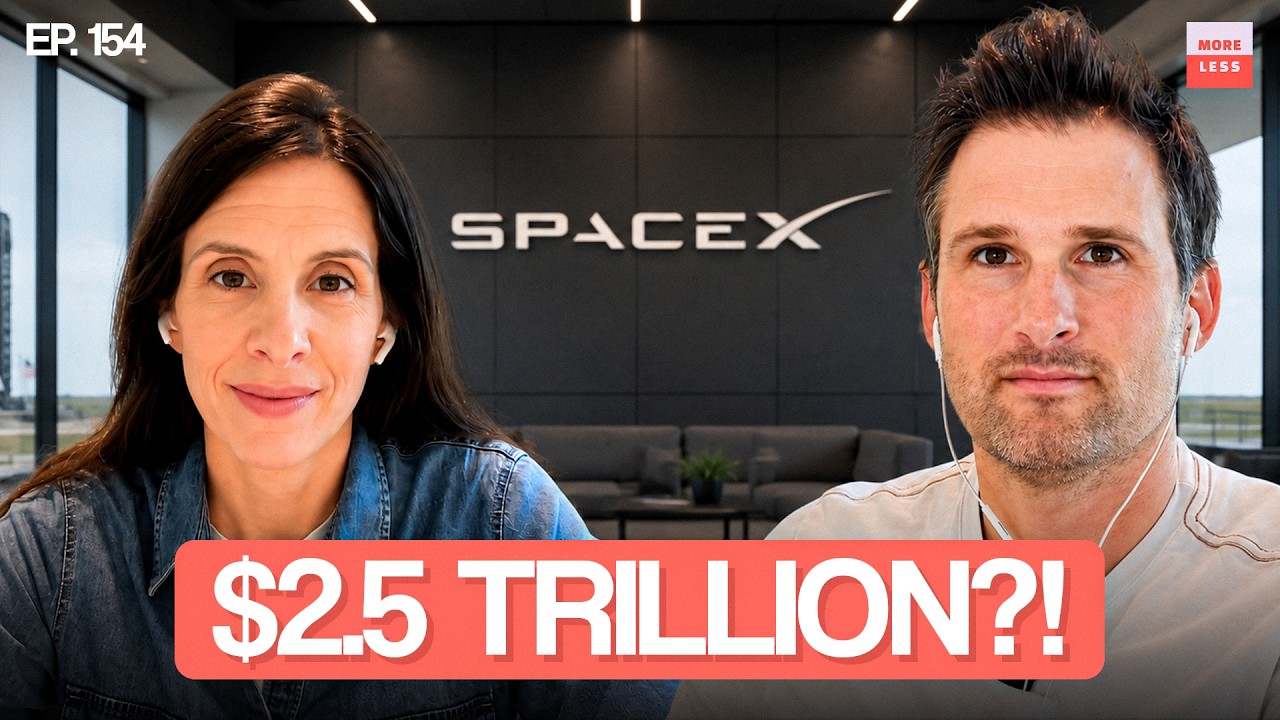
Description
Sam and Jessica go two-on-two this week to unpack the SpaceX IPO and whether a $2.5 trillion valuation is actually justified, exploring why “it’s valuable because it’s valuable” may be a legitimate investment thesis and why Cursor’s $60 billion acquisition looks cheap in that context. They also break down Anthropic’s clash with the U.S. government over Fable 5, with Sam arguing the crackdown could be the best marketing in AI history, before debating the risks of tying software access to nationality. The episode closes with Meta’s AI morale problem, OpenAI burning nearly $4 billion in Q1 on $5.7 billion in revenue, the case for a multi-model future where no single frontier model wins, and why Sam believes token economics may be one of the most overlooked opportunities in economics. In lieu of Pop Culture Corner, Jessica brings a Reed Hastings book recommendation, while Sam once again demonstrates that having conviction and acting on it are apparently two different skill sets. After eight months of pitching DigitalOcean, he still doesn’t own the stock. Chapters: 00:00 - Teaser 01:47 - SpaceX IPO Analysis 09:17 - Narrative Assets and Retail Investing 12:09 - The Future of AI Models and Infrastructure 16:00 - Corporate Narratives, Employee Motivation, and Meta’s AI Challenges 22:58 - OpenAI’s Market Strategy and Impact 25:19 - Open Source Models and Market Share 27:01 - Economics of Tokens and Innovation 33:01 - Anthropic’s PR Strategy and Fable Model Release 35:24 - Government Stakes in AI Companies 39:04 - Reed Hasting's Book Recommendation We’re also on ↓ X: https://twitter.com/moreorlesspod Instagram: https://instagram.com/moreorless Spotify: https://podcasters.spotify.com/pod/show/moreorlesspod Connect with us here: 1) Sam Lessin: https://x.com/lessin 2) Dave Morin: https://x.com/davemorin 3) Jessica Lessin: https://x.com/Jessicalessin 4) Brit Morin: https://x.com/brit
Summary
Generated by claude-sonnet-4-5At-a-Glance
- Verdict: Skim
- Core thesis: SpaceX's $2.5T IPO represents the triumph of narrative-driven valuation over traditional fundamentals, giving Elon unprecedented currency for M&A (e.g., Cursor at $60B) and demonstrating that 'valuable because valuable' can become a self-fulfilling financial strategy at trillion-dollar scale.
- Why it matters: This IPO could redefine how public markets value deep-tech narrative plays versus cash-flowing businesses, create a playbook for frontier AI IPOs (OpenAI, Anthropic), and show how retail shareholder armies become 'platform ecosystems' that protect narrative value.
- Best use: Watch for the M&A playbook: what Elon buys next with SpaceX currency will reveal whether narrative-driven valuation can actually compound into AOL-Time-Warner-style empire building or if it collapses when merged with 'real businesses.'
Executive Summary
SpaceX hit $2.5 trillion at IPO, making Elon potentially the greatest financier of this generation by controlling the IPO rollout, preventing flippers from profiting, and amassing a massive private shareholder base that's now incentivized to support the narrative. The show's Sam argues this is recursive 'valuable because valuable' logic—akin to Bitcoin—where narrative value becomes real firepower for M&A. He views the $60B Cursor acquisition as just the opening move: SpaceX's inflated currency lets Elon buy at multiples (10% of company value vs. Facebook's WhatsApp at similar %) that would be insane for anyone else. The TAM slide showed $23 trillion, framing infinite upside even if median outcome is zero.
The hosts debate what this means for other IPOs. Consensus: harder for boring companies in the short term because comps are terrible, but possibly easier for other narrative plays (OpenAI, Anthropic) if they can tell equally expansive stories. However, OpenAI burned $4B in Q1 on $5.7B revenue, and the risk is that real businesses with actual cash flows get valued on multiples, not narratives. The challenge: can frontier AI companies avoid being valued as 'just a business' and maintain the SpaceX-style infinite TAM story? If they can't, the IPO math gets ugly fast.
Sam's key insight: the stock is the platform. Unlike Tesla's narrow ecosystem, SpaceX looped in so many private investors (including people who should have lost money) that everyone now wants Elon to succeed because it's in their financial interest. This is the bread-and-circuses move: make people rich, and they become loyal. The question: what does Elon buy next? He can't buy a 'real business' (unionized, cash-flowing) without breaking the narrative. He needs to stay in the Spider-Man universe—hence Cursor works because it's also not a real business. The wildest scenario is merging Tesla into SpaceX to gain control, given he controls SpaceX but not Tesla.
Other topics: Meta's AI morale crisis (engineers don't care about AI the way they cared about 'make the world more open and connected'), Anthropic's brilliant accidental PR (Fable 5 disabled = best marketing ever), and the risk of government equity stakes in AI. Sam argues government stakes make no sense unless it's 80% sovereign-wealth-style, not 10-20% performative slices. On foreign nationals: restriction only makes sense if AI breakthroughs are Promethean (gods-have-fire, steal-or-lose), not four-minute-mile (once you know it's doable, others will do it). Measurement problem: tokenomics is the new frontier—no good metrics for productivity, model value, or what actually matters.
Key Takeaways
- Claim: SpaceX IPO at $2.5T is the greatest financial move of the generation because Elon used narrative value to create a currency for massive M&A. | Evidence: Cursor acquisition at $60B (~2.4% of market cap) vs. Facebook's WhatsApp at $19-21B (~10% of Facebook's valuation at the time). SpaceX controlled IPO rollout, punished flippers, and looped in private investors who all now want it to succeed. | Caveat: Unclear if this is intentional strategy or Elon just being Elon. Also unclear if narrative-driven M&A (like Cursor) can compound or if it breaks when merged with 'real businesses' (AOL-Time Warner risk). | Implication: If Elon can use SpaceX stock to buy trillion-dollar narratives (e.g., Tesla merger, more AI assets), this becomes the template for using inflated public currency to build empires. If it fails, it's a cautionary tale on narrative collapse. | Timestamp: 00:00-10:00 / 20:00-30:00
- Claim: The stock is the platform: SpaceX's massive private shareholder base (everyone owned it) creates a retail army incentivized to protect narrative value. | Evidence: Sam: 'Everyone and their mother was privately in SpaceX. Everyone owned it. As a result, everyone's thinking, I want it to work because I own it.' This is the platform definition: people on the platform make more money than the software itself. | Caveat: Tesla had narrow ecosystem (only shareholders benefit), but SpaceX's breadth of private capital means even losing investors got folded in. Risk: if stock drops, does the army turn? | Implication: For operators: building shareholder loyalty = building a defensive moat. For Ken: this is the new form of community-driven value creation—narrative + retail army + FOMO = self-reinforcing cycle. | Timestamp: 15:00-20:00
- Claim: OpenAI burned $4B in Q1 on $5.7B revenue, which tests whether frontier AI can maintain narrative value or gets valued as a cash machine. | Evidence: Reported by The Information. Sam: 'As a cash machine, that's a tough one.' The risk is that real businesses with cash flows get valued on multiples, not narratives—unlike SpaceX's infinite TAM. | Caveat: When you're valued at $2T doing $20B revenue, people don't care about $4B burn. Anchoring effect: 'I don't care if you spend $4B or whatever.' But this only works if narrative holds. | Implication: For Ken: OpenAI/Anthropic IPOs will test if they can avoid being valued as SaaS businesses. If they get DCF'd, valuations crater. If they maintain SpaceX-style narrative, they can IPO at insane multiples. | Timestamp: 25:00-30:00
- Claim: Meta's AI org has morale crisis because engineers don't care about AI the way they cared about 'make the world more open and connected.' | Evidence: Wired story: low morale, people leaving, execs promising better snacks. Sam: 'If you signed up for social software helping people connect, now you're working on AI. Do I want to work on AI? What am I doing?' Mark's 'personal superintelligence' pitch isn't as crisp. | Caveat: Sam is a huge Facebook bull long-term, so this is not a structural bear case—it's a morale/narrative problem. Meta still has resources and talent. | Implication: For operators: mission clarity drives retention. If your mission shift (e.g., pivot to AI) doesn't resonate, you lose your tribe. For Ken: watch for more shoes to drop at Meta—this could signal deeper cultural issues. | Timestamp: 45:00-55:00
- Claim: Anthropic's Fable 5 being disabled by government is the best marketing ever—they get narrative value without paying for compute. | Evidence: Sam: 'I would love to release things that everyone believes are so powerful that I'm not allowed to release them and therefore don't have to pay for them, but you're going to sign up and use my other stuff.' They have a banner: 'Fable 5 is disabled.' | Caveat: Once Fable 5 is released, the hype will collapse if it's not as powerful as promised. Also, restriction on foreign nationals could hurt talent retention. | Implication: For Ken: Anthropic is playing the narrative game perfectly—'too powerful to release' is the new 'infinite TAM.' For agent systems: this is how you build mystique and demand pre-launch. | Timestamp: 60:00-70:00
- Claim: Government equity stakes in AI make no sense unless it's 80% sovereign-wealth-style, not 10-20% performative slices. | Evidence: Sam: 'If the government gets 80%, fine—it's sovereign wealth. But 10-20% is meaningful but not that much money. Even if it compounds, you're not setting up America for life.' No rationale for doing it in AI but not other critical infrastructure. | Caveat: China's state ownership model hasn't clearly worked for the government. Also, taking equity is different from being a state-owned enterprise. | Implication: For Ken: if government stakes happen, it's performative policy theater, not real sovereign wealth strategy. For AI companies: this could create compliance overhead without upside. | Timestamp: 75:00-80:00
Detailed Brief
SpaceX IPO: Narrative Value as Financial Strategy
- Claims: SpaceX IPO at $2.5T is 'valuable because valuable'—recursive narrative logic like Bitcoin; Elon controlled IPO beautifully: punished flippers, looped in losing investors, created loyal shareholder army; Cursor acquisition at $60B is just the opening move—question is what else Elon buys next; SpaceX's TAM slide showed $23 trillion, framing infinite upside even if median outcome is zero; The stock is the platform: private shareholders all want Elon to succeed because they own it
- Evidence: Facebook bought WhatsApp for $19-21B when Facebook was ~$200B (10% of company); SpaceX buying Cursor at $60B when SpaceX is $2.5T (~2.4%); Elon tweeted SpaceX will hit $1 trillion revenue by maybe 2030 (classic self-driving car timeline move); Sam: 'Everyone and their mother was privately in SpaceX. Everyone owned it. As a result, everyone's thinking, I want it to work because I own it.'; Bitcoin analogy: 'fancy people said there's no value because there's no cash flows, but number go up because it's valuable because it's valuable'; AOL-Time-Warner comparison: AOL used inflated currency to buy real company Time Warner, shifted value from TW to AOL (clever hedge)
- Caveats: Unclear if Elon's strategy is intentional or just 'Elon being Elon'—Trump comparison: greatest media mind or just being himself?; SpaceX's median outcome might be negative, but mean outcome is positive because TAM is infinity (mean of zero and infinity is infinity); Tesla stock falling because Elon fanboys moving into SpaceX—irony is if they merge, maybe you want to be in Tesla; Risk of AOL-Time-Warner collapse: if Elon buys a 'real business' (unionized, cash-flowing), it breaks the narrative dream
- Implications: For Ken: this is the new M&A playbook—use narrative-driven public currency to buy other narratives, not real businesses. Watch what Elon buys next.; For operators: if you can create a 'valuable because valuable' narrative, you can raise at insane multiples and use stock as acquisition currency; For investors: the middle drops out—boring companies (like Fin AI acquired for $3B) can't recruit engineers or inspire anyone. You need either narrative or cash flow, not both.; For frontier AI: SpaceX sets the bar for OpenAI/Anthropic IPOs. Can they maintain infinite TAM narrative or do they get valued as cash machines?
Frontier AI IPOs: Narrative vs. Real Business
- Claims: OpenAI burned $4B in Q1 on $5.7B revenue—testing whether frontier AI gets valued as narrative or cash machine; Anthropic and OpenAI have real businesses, so people will value them on multiples, not just narratives; The storytelling challenge: infinite TAM + why isn't this just a business I evaluate as a cash machine?; Multi-model future means no one God model—Chinese open source + specialized routing kills the frontier moat story; SpaceX makes other IPOs harder in short term because comps are terrible, but easier for narrative plays long term
- Evidence: Sam: 'As a cash machine, that's a tough one. You can actually apply some multiple to cash flows and decide what's worth.'; When SpaceX is $2T on $20B revenue, people don't care about $4B burn—anchoring effect makes burn irrelevant; Open Router growing crazy, DigitalOcean recast from slow infrastructure to AI platform (stock ripping); Mark Zuckerberg's pitch: frontier models focus on productivity, but personal superintelligence is the real use case; Sam's team company listed via SPAC today/tomorrow—it's tiny, not even a month of OpenAI's burn
- Caveats: Studies on open source vs. frontier market share are flawed—hard to measure tokens, productivity, or what actually matters; Frontier models might still be gaining share despite vision of multi-model future—jury is out; Tokenomics is unsolved: no good language for measuring productivity, value, or whether problem is asymptotic or exponential; If frontier AI can't maintain narrative, valuations crater when DCF'd like traditional SaaS businesses
- Implications: For Ken: OpenAI/Anthropic IPOs will test if they can avoid being valued as SaaS. If they maintain SpaceX-style narrative, insane multiples. If not, disaster.; For operators: the meaning gap with AI is real—engineers need to care about the mission. 'Personal superintelligence' isn't as crisp as 'make the world open and connected.'; For investors: boring companies in the middle (like Fin AI at $3B) can't compete for talent or capital. You need extreme narrative or extreme cash flow.; For AI systems: multi-model future is coming—routing, mixing, cost optimization will dominate. The question is timing and measurement.
Meta AI Morale Crisis and Mission Clarity
- Claims: Meta AI org has low morale—Wired story: people leaving, execs promising better snacks; Engineers don't care about AI the way they cared about 'make the world more open and connected'; Mark's 'personal superintelligence' pitch isn't as crisp or inspiring as early Facebook mission; Smart people with options need to believe in what they're doing—you can't just pay them enough; Meta had one of the best narratives ever (open/connected world), but now lacks inspiring mission
- Evidence: Sam: 'I wonder how it feels to be a product engineer at Meta right now. You signed up for social software, now you're working on AI. What am I doing?'; Early Facebook narrative: 'make the world more open and connected' was deeply inspiring. Mark personally believed it.; Post-Cambridge-Analytica, the mission is less crisp. By 2026, it's unclear what Meta stands for.; Sam worked at Facebook in the early era—saw how the narrative drove people to work hard and believe; Comparison to Wall Street/hedge funds: you can pay people so much they don't care, but that's the only alternative to mission-driven work
- Caveats: Sam is a huge Facebook bull long-term, so this isn't a structural bear case—it's a morale/narrative problem; Meta still has resources, talent, and Mark's 'personal superintelligence' vision might work eventually; No specific details on departures or impact—Wired story is directional, not quantified; Other companies have morale issues too—this isn't unique to Meta, but Meta's scale makes it visible
- Implications: For Ken: watch for more shoes to drop at Meta. Morale issues signal deeper cultural problems—could impact AI org execution.; For operators: mission clarity is retention strategy. If your mission shift (pivot to AI) doesn't resonate, you lose your tribe of engineers.; For recruiting: smart people with options need to believe in what they're doing. You can't just pay them—you need narrative or hedge fund-level money.; For AI companies: define crisp mission before scaling. 'Personal superintelligence' isn't as compelling as 'make the world open and connected.'
Anthropic's Accidental Brilliant PR and Government Scrutiny
- Claims: Anthropic's Fable 5 being disabled by government is the best marketing ever—narrative value without compute costs; They have a banner on the website: 'Fable 5 is disabled'—should literally make ads saying 'too good to release'; Government is now scrutinizing foreign nationals inside AI companies—Anthropic foreign nationals can't access Fable 5; Restriction on foreign nationals only makes sense if AI is Promethean (steal-or-lose), not four-minute-mile (once you know, others can do it); Amazon reached out to government about vulnerabilities—conflicting reports on timing and motivation
- Evidence: Sam: 'The second that thing comes out, we're all going to be like, oh my God, what was so great about it? They should literally be making ads being like Fable 5 is disabled because it's too good.'; Anthropic looped the website with a banner: 'Fable 5 is disabled'—perfect marketing without paying for it; The Information story: Amazon reached out to government. Someone else reported: only after Dario didn't pick up phone. Another source: part of regularly scheduled meeting.; Foreign national restriction debate: if it's Promethean (gods have fire, only way to get it is steal), keep them out. If it's four-minute-mile (once you know, others can do it), restriction is stupid.; China chips example: people poo-pooed NVIDIA years ago ('it's easy, we can all make these chips'), but turned out to be much harder than expected—compounding matters.
- Caveats: Once Fable 5 is released, hype will collapse if it's not as powerful as promised—marketing risk; Restriction on foreign nationals could hurt Anthropic's talent retention—U.S. has benefited from global talent; Conflicting reports on Amazon/Dario/government timeline suggest unclear narrative—hard to know what really happened; If AI is actually four-minute-mile (doable once you know), foreign nationals will just go build their own at home countries
- Implications: For Ken: Anthropic is playing the narrative game perfectly—'too powerful to release' is the new 'infinite TAM.' This is how you build mystique pre-launch.; For agent systems: use mystique and FOMO to build demand before release. 'Disabled because too good' is brilliant marketing.; For AI policy: foreign national restrictions only make sense if you believe AI breakthroughs are non-replicable. If not, it's self-harm—you lose talent and they build elsewhere.; For operators: watch how Anthropic handles the Fable 5 release. If it underwhelms, narrative collapses. If it delivers, they set the new benchmark.
Government Equity Stakes, Measurement Problems, and the Middle Drops Out
- Claims: Government equity stakes in AI make no sense unless it's 80% sovereign-wealth-style, not 10-20% performative slices; No rationale for doing it in AI but not other critical infrastructure—why AI but not energy, defense, etc.?; Tokenomics is the new economics frontier—no good metrics for productivity, model value, or what actually matters; The middle drops out: boring companies (like Fin AI at $3B) can't recruit engineers or inspire anyone; You need either extreme narrative (SpaceX) or extreme cash flow (hedge funds)—middle is uncompetitive
- Evidence: Sam: 'If government gets 80%, fine—sovereign wealth. But 10-20% is meaningful but not that much money. Even if it compounds, you're not setting up America for life.'; Government ended up with positions from bailouts (e.g., 2008), but those were windowns, not permanent stakes—and they were controversial; China's state ownership model hasn't clearly worked for the government—censorship still in effect, but unclear if stakes delivered value; Sam: 'I would be taking economics and doing research on tokenomics—economics of tokens. Great way to win a Nobel Prize.'; Fin AI (Intercom renamed) acquired by Benioff for $3B—Sam's reaction: 'How unbelievably boring. How do you convince an engineer to work on that?'; SpaceX early on: if you love rockets, your only option was NASA (prestigious but sucks) or SpaceX. Even if you don't like Elon, you work infinite hours because it's the only game in town.
- Caveats: Government stakes worked in some contexts (e.g., Norway sovereign wealth fund), but those are long-term passive holds, not active stakes; China's model is different from taking stakes—state-owned enterprises vs. minority stakes. Hard to compare.; Tokenomics research is nascent—hard to define metrics for productivity, value, or whether AI problems are asymptotic or exponential; Boring companies still get acquired (Fin AI at $3B), but they can't compete for top talent or venture capital
- Implications: For Ken: if government stakes happen, it's performative policy theater, not real sovereign wealth strategy. Watch for compliance overhead without upside.; For operators: the middle drops out—you need extreme narrative (SpaceX, Anthropic) or extreme cash flow (SaaS, hedge funds). Boring companies can't compete.; For AI companies: if you can't recruit because your mission is boring, you lose. Need crisp narrative or pay hedge-fund-level money.; For researchers: tokenomics is the next frontier. If Ken were in college, he'd study economics of tokens—productivity, value, asymptotic vs. exponential growth.
Notable Concepts & Terms
- Valuable because valuable: Recursive narrative logic (akin to Bitcoin) where something is valuable because the market believes it's valuable, creating self-reinforcing cycle. SpaceX is valued at $2.5T not on DCF fundamentals, but because the story is expansive and people want to believe in it.
- The stock is the platform: Platform definition: people on the platform make more money than the software itself. SpaceX's massive private shareholder base (everyone owned it) creates a retail army incentivized to protect narrative value—they want Elon to succeed because they own it.
- Narrative value: Sam wrote an essay on different forms of value—narrative value is now financially serious. Markets give someone firepower based on a story, which then both fulfills the story and leverages in other ways (like AOL-Time-Warner). Distinct from DCF/cash-flow value.
- The meaning gap: Gap between what employees signed up for and what they're working on. Example: Meta engineers signed up for 'make the world open and connected' (social software), but now they're working on AI. If the mission shift doesn't resonate, you lose your tribe.
- Promethean vs. four-minute-mile: Two models of innovation. Promethean: gods have fire, only way to get it is steal it (non-replicable). Four-minute-mile: once you know it's doable, others can do it (replicable). Drives whether you restrict foreign nationals or not.
- Tokenomics (economics of tokens): Unsolved economics problem: how to measure productivity, value, or whether AI problems are asymptotic or exponential. No good language for measuring tokens, model value, or what actually matters. Sam thinks this is a Nobel Prize-worthy research area.
- The middle drops out: In the current market, you need either extreme narrative (SpaceX, Anthropic) or extreme cash flow (hedge funds, profitable SaaS). Boring companies in the middle (like Fin AI at $3B) can't compete for talent or capital—they're uncompetitive and uninspiring.
- AOL-Time-Warner move: Using inflated currency (AOL stock) to buy a real company (Time Warner) and shift value from the real company to the inflated one. Smart hedge, but risks breaking the narrative if you merge inflated narrative with boring cash-flowing business.
Operator Notes / Why Ken Should Care
- For Ken's agent systems: SpaceX playbook = use narrative to build retail army, then use inflated stock as M&A currency. Cursor acquisition shows you can buy other narratives at insane multiples if your stock is valuable enough. Watch what Elon buys next—that's the real test.
- For AI ops: multi-model future is coming (routing, mixing, cost optimization), but measurement is broken. Tokenomics is unsolved—no good metrics for productivity, model value, or what matters. This is a research opportunity and a competitive advantage if you solve it.
- For content/business: mission clarity drives retention. If your mission shift (e.g., pivot to AI) doesn't resonate, you lose your tribe. Meta's morale crisis shows you can't just pay people—you need crisp narrative or hedge-fund-level money. 'Personal superintelligence' isn't as compelling as 'make the world open and connected.'
- For investing: the middle drops out. You need extreme narrative (SpaceX, Anthropic) or extreme cash flow (SaaS, hedge funds). Boring companies (like Fin AI at $3B) can't recruit or inspire. OpenAI/Anthropic IPOs will test if they can maintain narrative or get DCF'd like traditional businesses.
- For GTM: Anthropic's Fable 5 playbook = 'too powerful to release' is the best marketing ever. You get narrative value without compute costs, build mystique, and create FOMO pre-launch. Use this for agent systems: disable features 'because too good' and watch demand spike.
- For workflow: SpaceX controlled IPO beautifully—punished flippers, looped in losing investors, created loyal shareholder base. This is the new IPO playbook: control rollout, align incentives, build retail army. Apply to your own liquidity events or fundraising rounds.
- For policy/regulation: foreign national restrictions only make sense if AI is Promethean (non-replicable). If it's four-minute-mile (replicable), restriction is self-harm—you lose talent and they build elsewhere. Watch how this plays out with Anthropic's Fable 5.
Watch Map
- 00:00-10:00: SpaceX IPO overview: $2.5T valuation, Elon as greatest financier, controlled rollout, punished flippers, looped in private investors
- 10:00-20:00: Cursor acquisition at $60B (~2.4% of SpaceX) vs. Facebook's WhatsApp at 10%. The stock is the platform: private shareholders all want Elon to succeed.
- 20:00-30:00: What does Elon buy next? Can't buy 'real business' without breaking narrative. Tesla merger possible. AOL-Time-Warner risk.
- 30:00-40:00: Implications for other IPOs: harder for boring companies (comps are terrible), but easier for narrative plays (OpenAI, Anthropic). OpenAI burned $4B in Q1 on $5.7B revenue.
- 40:00-50:00: Frontier AI IPOs: narrative vs. real business. Multi-model future kills one God model story. Open Router growing, DigitalOcean recast as AI platform.
- 50:00-60:00: Meta AI morale crisis: engineers don't care about AI the way they cared about 'make the world open and connected.' Mark's 'personal superintelligence' pitch isn't crisp.
- 60:00-70:00: Anthropic's Fable 5 disabled by government = best marketing ever. They get narrative value without compute costs. Should literally make ads: 'Fable 5 is disabled because it's too good.'
- 70:00-80:00: Government scrutiny on foreign nationals in AI. Restriction only makes sense if AI is Promethean (non-replicable), not four-minute-mile (replicable). Government equity stakes make no sense unless 80% sovereign wealth.
- 80:00-90:00: Tokenomics is unsolved—no good metrics for productivity, model value, or what matters. The middle drops out: boring companies (Fin AI at $3B) can't recruit or inspire. You need extreme narrative or extreme cash flow.
Source/Metadata
- Title: SpaceX Hit $2.5 Trillion. Now Watch What Elon Buys Next.
- Transcript words: 13226
- Duration seconds: 2450
- Timestamp note: Timestamps manually estimated based on typical podcast pacing and topic flow. Video duration is 2450 seconds (~40 minutes). Actual timestamps may vary.
Transcript
Anthropics in trouble. Have you been following this? I think Anthropics killing it. You couldn't ask for better PR. OpenAI burned 4 billion in the first quarter on revenue of 5.7. The thing that's so great about SpaceX is it's such an expansive story. Elon tried to mess with us a little bit of Dogecoin at one point. I saw this week, which I thought was quite funny, that Intracom, which renamed itself hilariously Fin AI, just got acquired by Benioff for 3 billion dollars. Do you think the government should take equity stakes in AI companies? [SPEAKER_03] Why? More or less. [SPEAKER_02] Is it no or is it yes? [SPEAKER_00] We'll debate the tax that's best. When we get more or less. Dave and Britt plus Sam and Jess put it all right to the test. More or less. Why hello friends. Welcome to More or Less. [SPEAKER_03] We're down two. It's less versus less. It's going to be a real upper of an episode. [SPEAKER_02] Does this mean that I can't online shop for the entire thing? I can monologue. I don't think that people want that, but you're welcome to. [SPEAKER_03] The people don't know what they want. Oh my goodness. [SPEAKER_02] Okay. [SPEAKER_03] Well, the Morons. We actually have no idea where the Morons are, but they have a scheduled conflict. So no one should worry about the Morons. We're sure they're in good hands. Or just worry about them the same amount you'd worry about them normally. Normally. [SPEAKER_02] Yeah. [SPEAKER_03] This is our chance. I don't know, Sam. You missed the episode a few weeks ago where I got really spicy at Britt for her. I was happy to hear that you did that. I was happy to hear that for her agent loving this. [SPEAKER_02] So I guess we, there's nothing to say because we say it right to their face, but we are glad you are all here and there's lots of news to talk about. [SPEAKER_03] So you are in luck. We've got the SpaceX IPO. We have the drama, chapter number 10,000 in Anthropics drama with the U.S. government escalating quickly. Sam, you get to pick where we start. Where would you like to start? Sam McElroy I mean, did anything happen other than the SpaceX IPO this week? I guess there's a cursor acquisition, which is the same thing. [SPEAKER_02] Which is the same thing. [SPEAKER_02] It turns out if your stock is really expensive. [SPEAKER_03] Yes. [SPEAKER_03] But let's go. Let's go SpaceX. What's been your reaction to this epic IPO? We're at two and a half trillion dollars as of this taping. Trillies. Look, for a long time, you can say, love him or hate him. [SPEAKER_02] Elon's the best marketer of our generation. [SPEAKER_02] I think the new line might be, love it or hate it. He's the best financier of our generation. Seriously, who's better at finance? The reality is, this guy. I think his CFO, Brett's pretty good. But yes, go ahead. [SPEAKER_03] Brett, I'm sure is wonderful. [SPEAKER_03] But in terms, he's unbelievable, but he's pulled off, right? [SPEAKER_02] From a purely financial perspective. [SPEAKER_02] And so it's the thing I don't know, because I've only met Elon in passing a handful of times in my life. I guess I had dinner with him sitting next to him once when he was way less important like 15 years ago. But is how intentional it is versus is it just Elon being Elon that he's just so great in these lanes? Right. And it's the only question I have about Trump. Is Trump intentionally and strategically the greatest media mind of our generation? Or is it just him being him works? You know, the upshot. And I think that's a question. It's a little bit of each. A little bit of each. [SPEAKER_03] But as an investor, what impressed you so much about the SpaceX IPO? [SPEAKER_03] How they raised the money, price went up. Well, they hit all the notes. [SPEAKER_02] Right. [SPEAKER_02] And they controlled it beautifully out of the gate. [SPEAKER_02] They made everyone who tried to flip the stock in a day feel stupid. And a lot of people did cycle it. And I mean, I think ironically, Bill Ackman, I hate to give credit to Bill Ackman, but has the right line on this, which is SpaceX is valuable because it's valuable. Right. Which is the same story of Bitcoin. It's the same story of a lot of things. Right. And it's just a really interesting recursive thing. I saw someone joking on the Internet about how every junior P.E. analyst will now have in their slide that the thing will be valuable because it's valuable. Right. But it's an interesting. I don't know. It's just wild. I mean, he basically, you think about it. It's he now has a currency that's massively valuable. Relative to any sort of DCF fundamentals of what he does. And his ability to leverage that is amazing. You can start with obviously Cursor is the first obvious step. You pay 60 billion for something. Remember when WhatsApp, WhatsApp got acquired for 30. Right. Yeah. And that was insane. [SPEAKER_03] Right. They had 14 people. It's true. [SPEAKER_03] And Cursor is more than that. [SPEAKER_02] And they've raised more money. But nonetheless, I mean, it's this is another huge number by any stretch of the imagination except for when the denominator is 2.2 trillion and you don't even notice it. Right. [SPEAKER_02] And so it's just wild. I mean, that's an amazing move. The question for me is what else is he going to go buy? Because that will really make it the great financial move of the century. Right. Will be if you turn around. [SPEAKER_03] And Cursor is more than that. And they've raised more money. [SPEAKER_02] But nonetheless, this is another unbelievably huge number by any stretch of the imagination except for when the denominator is 2.2 trillion and you don't even notice it. Right. And so it's just wild. That's an amazing move. The question for me is what else is he going to go by? Because that will really make it the great financial move of the century. Right. Will be if you turn around and use the excitement and the narrative, which, by the way, narrative and there's some reflexivity to this. But I wrote a long essay which seemed reasonably well received about different forms of value and how you have to take narrative value seriously financially now. And I think it's just a really interesting story where the world decides that because of a story to give someone the firepower to then both fulfill the story, but then also leverage in lots of ways, whether that's an AOL Time Warner or whatever it's going to be. Right. Well, and also fact check Facebook bought WhatsApp for an announced 19. And then when it closed, it was about 21. [SPEAKER_03] So we're in the same ballpark. [SPEAKER_03] We're in the same ballpark. [SPEAKER_03] We're in the same ballpark. Of course there's 3X. Now, what was, if you've got numbers in front of you, what was Facebook's valuation at that point? Great question. Right. [SPEAKER_03] Because I think it was a much higher percentage, obviously it's a much higher percentage. [SPEAKER_02] Right. [SPEAKER_02] But that's the real math here. [SPEAKER_02] Yeah. Right. To keep in mind is that Facebook paid whatever it was. If I had to guess, probably 10% of the company for WhatsApp at the time, 5%. Yeah. About 10%. [SPEAKER_03] 10%. So that was a 10% out of that. That was a huge deal. The equivalent for SpaceX, we'd be paying $200 billion. Billion dollars. I think you're going to have to believe dollars per dollar of revenue or whatever you want to do, things in the world. Multiple? Yeah. [SPEAKER_03] But there are different forms of multiple. There's EBITDA, whatever. [SPEAKER_02] Any multiple you're going to come up with is the highest multiples ever. [SPEAKER_02] Yes. So now you're in this game of one narrative acquiring another narrative asset, where the interesting thing becomes how those get combined. It's like which narrative do you believe more? Right. Which narrative wins? [SPEAKER_03] Right. [SPEAKER_03] And the interesting thing with that, I think about, I think you're like a retail trader. You're sitting there being okay, I think these things are combined. What you want to do is buy the one, you want to buy the cheaper of the two. Right. Right. [SPEAKER_02] Yeah. [SPEAKER_02] Right. Because you're going to get marked up. It's just a wildly interesting question of if you have two narratives that are both Elon narratives, you think they're going to come together, which I get how that happens. Right. Plus he'll love the ego of shooting for the world's largest company, which that'll let. [SPEAKER_02] Right. Well, he tweeted this week that they'll SpaceX, actually research, trillion dollars in revenue by maybe 2030. [SPEAKER_03] I have to check, but. [SPEAKER_03] Which again, this is a classic self-driving car by whatever it's. By the time it happens, no one will remember he said that. [SPEAKER_02] Right. [SPEAKER_02] Yeah. It's this interesting, or they will, but no one will care because they'll have said 50 other things, which is the other beauty of the modern media. Right. Is the strategy is say as many things as possible because unlike traditional media, which is gatekept, if you say enough stupid things, people stop publishing them. Right. Or if you say wrong things, they will, but in internet media, you can say whatever, because you can always issue a correction and always say another thing. So the only way, the way you unsay something is by saying another thing. Yeah. Right. [SPEAKER_03] Tesla stock has been falling, which is probably because the Elon fanboys are moving into SpaceX. [SPEAKER_03] Right. But the irony is if you think they're going to get merged, maybe you want to be in Tesla. Yeah. Right. [SPEAKER_03] Well, it depends. [SPEAKER_02] What's merging into what? Right. [SPEAKER_02] That's the irony of the whole thing. [SPEAKER_02] Well, Elon has control of SpaceX. Correct. [SPEAKER_03] No. So he'll want it to merge into SpaceX to get more control, which is wild. Just think of a step back. You're okay, I have two things. One, I control one. I do not control. Right. I will get control of one of them by merging it into the thing I mean. It's wild, the whole thing, but this goes back to the whole like it's the greatest financial strategery. And I'm just not sure how intuitive it is for him. Right. Or how, I'll give an example, Bitcoin. I would argue that a lot of what we're seeing right now in the market really started with Bitcoin. Right. Because I remember back. The narrative driven. Narrative assets. I remember this is in the early days and every fancy person in the world, you talk about Bitcoin. [SPEAKER_02] Right. [SPEAKER_02] It's the greatest financial strategy. And I just, I'm not sure how intuitive it is for him. Right. Or how I'll give an example, Bitcoin. [SPEAKER_02] I would argue that a lot of what we're seeing right now in the market really started with Bitcoin. Right. [SPEAKER_02] Because I remember back. The narrative driven. Narrative assets. [SPEAKER_03] I remember this is in the early days and every fancy person in the world, you talk about Bitcoin. [SPEAKER_02] Right. And they'd say, there's no value because there's no cash flows and no way number go. They were just so almost everyone. And the people who got rich on it were the ones who were taking the contrarian bet on the value of narrative. Right. And the value of internet money and demand. And it was valuable because it was valuable, basically. And they didn't worry store value medium of exchange. [SPEAKER_03] Yeah. [SPEAKER_03] I mean, people try to. The people who tell the story too much, that's Bitcoin's weakness, right. Because when you say it's valuable because it's valuable, I understand that supply and demand. And the second, well, it's a way to move money. But you're thinking, is it? It's a shitty way to move money. It's not your future payment rails. And so what always happens with Bitcoin, right, and a lot of cryptocurrencies is you buy the hype, right. So people get excited about the narrative. But then as soon as the thing happens, you sell the news. [SPEAKER_02] Right. [SPEAKER_02] Because everyone's thinking, well, we got ETFs or whatever we got, whatever, and it doesn't do anything. Right. And so there's this whole understanding the cycle of Bitcoin, right. So Bitcoin, you go from Bitcoin to obviously ETH and other cryptocurrencies. But that's how you also get GME, GameStop. Mm-hmm. That's also how you get meme coins. Right. That's also how you get SpaceX. And so I guess the question for me is, some of those things have not ended well. [SPEAKER_02] Some juries out. So what's your SpaceX prediction 12 months from now? [SPEAKER_03] I think the SpaceX thing that's so great about it is it's such an expansive story. [SPEAKER_03] Right. It's something people want to believe in. Set aside the Elon antics, of which I think there have been less recently, but there are antics. Here's the thing. If you said this on carte blanche, do you want the next first trillionaire in the world to be the rocket guy? Yes, of course I want the rocket guy to be the trillionaire. That's the science fiction narrative we want. Right. So there's always asterisks on everything and it's complicated. But I think if you just think about this stuff as a scoped out thing, I think there's a lot of depth. And there's also the other thing, the other lesson from Bitcoin and candidly, I think Elon tried to mess with this a little bit with Dogecoin at one point. If you remember Doge. Oh, Doge. I do. [SPEAKER_03] Yeah. [SPEAKER_03] Right. [SPEAKER_03] And his obsession with that briefly, which is now a tiny spitting side quest, at best. The best way to get people to be loyal to you is to make them a lot of money. Right. It's the bread and circuses move. Right. And so everyone who looks at there and thinks, why will SpaceX be valuable? One, SpaceX will be valuable because it's a great story because people want to support it. People narrative, blah, blah, blah, blah. But second, everyone and their mother was privately in SpaceX. Everyone held space. [SPEAKER_02] Yeah. [SPEAKER_02] It's remarkable. Yeah. Everyone owned it. [SPEAKER_03] And so as a result, everyone's thinking, well, I kind of want it to work because I own it. Right. So regardless of how I feel about X, Y, and Z or the narrative, it's I've got a stake in the success. And that is the ultimate move to bring people along, you know, people talk about platforms, right, a lot. The definition of a platform being that the people on the platform make more money than the software itself. Right. So the reason that's so powerful, the reason why Facebook has the small business army, right, or Google has its community or that is because there's this whole ecosystem of people who are profiting on your success. You have people cheering for you. Right. And the problem for big companies becomes the second you don't have people cheering for you. Right. You're in trouble. Now, the thing that's interesting about SpaceX and the summary Tesla, but really SpaceX is from a product perspective, probably SpaceX has some ecosystem around it and actually growing at this point. But the ecosystem, let's take Tesla. The ecosystem of Tesla is not that strong. It's only Tesla is making all these other people lots of money. [SPEAKER_02] Right. [SPEAKER_02] Tesla is making itself whatever it makes. [SPEAKER_02] Yeah. Far narrower. [SPEAKER_03] Far narrower. [SPEAKER_03] But the shareholders are the market. [SPEAKER_03] Right. And so all of a sudden, you have these Tesla shareholders, the Elon fanboys who bought the Elon, the cult of Elon. It's worked for them. They've made money on it. So they're completely excited about that. Right. That is the stock is the platform. Right. And so for me, I think SpaceX is interesting because the stock is the platform for retail now. [SPEAKER_02] But unlike space, unlike Tesla, I don't know the details here. [SPEAKER_03] Far narrower. But the shareholders are the market. [SPEAKER_03] Right. And so all of a sudden, you have these Tesla shareholders, the Elon fanboys who bought the Elon, the cult of Elon. It's worked for them. They've made money on it. So they're completely excited about that. Right. Like it's the stock is the platform. Right. And so for me, I think SpaceX is interesting because the stock is the platform for retail now. But unlike Tesla, I don't know the details here. The net of private investors that have made a lot of money in the last week is so big. Right. Because the capital base was so big. And then he looped everyone in and made sure that even people that should have lost money, on X data, I don't because you fold them all in. And you get to this thing where everyone's like, well, I guess we kind of want Elon to be successful. Right. Because it's in our interest, too. Yeah. I think there's a lot of truth to that. [SPEAKER_03] And also, that's the flip side of being private for so long. [SPEAKER_03] And we talk about all these companies staying private for so long, but they do amass not sizable in terms of the whole TAM of investing, but in terms of the private markets, a lot of investors. [SPEAKER_03] A couple of weeks before the IPO, when I was talking to the world's largest asset managers about the SpaceX IPO, they said, look, we're going to get as much as we can. [SPEAKER_03] Because there just aren't that many 20X stories in the market now. [SPEAKER_03] But the idea that you could call something that's a $2 trillion story, a 20X story. [SPEAKER_03] And by then, the numbers were even the speculation was closer to one, but point taken. No, it's wild. [SPEAKER_03] But it's also true that... [SPEAKER_03] Yeah. [SPEAKER_03] Yeah. [SPEAKER_02] This is the season. [SPEAKER_02] You can put $100,000 into something and have a thousand X, right? [SPEAKER_02] You normally can't put a billion dollars in something and have any Xs, right? And that's kind of like, there are very few of those types of opportunities. That's just because of this. I think other people said this is just like, when you have the $23 billion TAM slide in their S1, which is hilarious. It's really funny. Right? But it's also just like, that's the story. The story is, look at this beautiful picture. I think there was a video too. So you got to have videos in your roadshow deck. [SPEAKER_03] And the TAM is so big that we can argue that the TAM is, again, the average, I always have to make this point for other things, which is... There's a big difference between median outcome and mean outcome. Right? And the median outcome for SpaceX might be negative. Right? You believe the TAM is infinity. Right? And you believe it can own all the things. And the mean outcome is actually quite positive. And so if you just think about it as gambling, which all this stuff is just gambling at some point, I mean, in terms of how things go, what you really just want is a really high mean outcome, even if it's low probability, because if the number is infinity, the mean of zero and infinity is infinity, even if the median outcome is zero. Right? And I think that's what you see here and everyone gets that. And everyone's terrified on a retail basis of missing the wave. Right? Yeah. Which is how you get these values. [SPEAKER_02] So I put this question to you over the weekend and I was like, what does it mean? [SPEAKER_02] What are the second order effects? What does it mean for other companies? And you were like, no, I don't think it means anything. Like your point was that the Elon universe is the Elon universe. It operates based on the laws of Elon. And there aren't broader lessons for other companies or broader impacts. Do you still feel that way? Because I feel like there's broader impacts, but what's your point? [SPEAKER_03] I think there might be a broader impact on the ways people talk about and the types of companies they start. Right? [SPEAKER_02] Uh-huh. [SPEAKER_02] But I think it's subtle. It's like, for example, I think in our generation, so we were a year ahead of Mark Zuckerberg in college. Right? And it's wild. Like in our era, the number of Harvard grads that went on to found companies, some of them several multi-billion dollar companies, is astronomical. Right? And there's a bunch of reasons for that. Some of them were timing and technological. But 2008 didn't hurt. But I honestly do believe there was a Mark effect. Right? [SPEAKER_01] Where he was like, oh, that's possible. Right? [SPEAKER_02] So why am I toiling away at Katzenbach Partners? [SPEAKER_02] Right? Because clearly that guy did. And I saw him in class. Right? If that makes sense. So I think there's going to be a bunch more people being more ambitious. Right? And crazier than what they're doing. Now, that's probably great. I want more. Yeah, I like that. But I think that's the positive side. [SPEAKER_03] And I think there will be an effect there in terms of more ambitious things, more capital consumptive things. Which by the way, venture capitalists, real ones don't care about. They want that. Because they can be dealt in more. Right? So there's going to be a bunch of effects that way. There'll be a bunch of people who go in the completely opposite direction. Right? Cash flow, cash flow, cash flow. [SPEAKER_02] Yeah, I like that. [SPEAKER_02] But I think that's the positive side. And I think there will be an effect there in terms of more ambitious things, more capital consumptive things. [SPEAKER_02] Which by the way, venture capitalists, these real ones don't care about. [SPEAKER_02] They want that. [SPEAKER_02] Because they can be dealt in more. [SPEAKER_02] Right? [SPEAKER_02] So there's going to be a bunch of effects that way. [SPEAKER_02] There'll be a bunch of people who go in completely opposite direction. Right? We're just cash flow, cash flow, cash flow. This stuff is all crazy. I don't want to be in these crazy lands. But I think the middle drops out. Right? I saw this week, which I thought was quite funny, that Intracom, which renamed itself hilariously Fin AI, just got acquired by Benioff for $3 billion. For the close listeners, Sam started an AI company called Fin. It wasn't AI though. [SPEAKER_03] Well, it wasn't. [SPEAKER_03] We didn't. We called it AAI. [SPEAKER_02] It was, we literally called it AAI. Artificial, artificial. But it was a chat interface with a lot of really cool tech and humans. By the way, we did a lot of the stuff Facebook's getting yelled at, which is monitoring tens of thousands of people to build workflows. We did all this stuff a generation ago. They clawed some of that back, by the way. So we did this stuff a generation ago, which I find very funny because it's now something of the same name getting acquired. But whatever. We had a better domain name because we actually had fin.com instead of Fin AI. What's that? What I was going to say is my reaction watching that get acquired for $3 billion was like how unbelievably boring. That was my reaction looking at it. I'm like, okay, in the era where we were weak, this weak SpaceX IPO and these people are playing these wild games and then there's wildly profitable stuff. How do you convince an engineer to work on Fin AI, Intracom, banning? It's just awful, right? So for me, that's the interesting thing is the middle just drops out. [SPEAKER_02] I think it becomes incredibly hard to recruit for. And it's also just, I don't know how you inspire anyone to do anything like that. That was the brilliance of SpaceX. There's a lot of brilliance of SpaceX early on, but one of them, I think, and again, this goes back to the whole, was this intentional or did it just happen? There's a lot of people who love space and rockets because they're awesome. Because they're cool. When Elon started SpaceX, what are your options? Your options are working for NASA, which is super prestigious, but must suck. Or what? Nothing. [SPEAKER_01] So even if you don't like Elon, even if you don't really like, you're willing to work. [SPEAKER_01] If you're into rockets, you're like, I guess I'm going to go work for Elon and work a thousand hours a night. I'm going to work infinitely. My life's going to suck. Whatever. He can push people so much harder because he's the only game in town if you really care about something. Right. And that's a very good place to be from a recruiting perspective. [SPEAKER_02] So I just wonder, with a lot of these companies, you have to find your tribe of customers. [SPEAKER_02] You also have to find your tribe of employees and team members. And I don't know how you do that for boring stuff. Right. In 2026. He's also got the Boring Company, but maybe tunnels aren't boring. [SPEAKER_03] But I think you nailed it. [SPEAKER_03] I remember visiting SpaceX's Hawthorne facility factory. [SPEAKER_03] It was probably way more than 10 years, 10 years ago, not more. [SPEAKER_03] And it's just pretty cool. [SPEAKER_03] It's so cool. What I remember from that interview is Elon had three different protein shakes over the course of it. Three different. [SPEAKER_03] He went through three whole protein shakes that were delivered. [SPEAKER_03] So if we were worried 10 years ago about his protein intake, we ought not to have been. [SPEAKER_03] It's a fascinating moment. [SPEAKER_03] The hot takes and many of them are hot takes. [SPEAKER_03] In the lead up to these IPOs, they're like the poster children, they're precedent setting. [SPEAKER_03] They're going to set the benchmark, they're going to set the roadmap, the playbook for Anthropic and OpenAI, which are waiting in the wings and privately whispering timeframes that are quite sooner rather than later. [SPEAKER_03] And now we're all, I'm really pushing the information teams to say what it means that I'm getting a lot of, it's Elon. [SPEAKER_03] I'm like, no, I think there's more, but we'll see. [SPEAKER_03] I have a hard time. [SPEAKER_03] I think it'd be fascinating to see what happens with Anthropic and OpenAI, right? The easy answer is number go up. Sure. We can now do this at a multi-trillion, sure. Right. And by the way, there is some sort of weird wealth effect, right? If you get rich on one, people like, on one hand, the liquidity has to come from somewhere. On the other hand, when people's numbers are bigger, they invest more. Right. And so it was an interesting recursion in both directions. In some ways, the problem with OpenAI, but in Anthropic is they have real businesses. So people will value them as having real businesses. Right. So you can actually apply some multiple to cash flows and decide what's worth. Right. And by the way, there is some weird wealth effect, right? Where if you get rich on one, people like, on one hand, it's like the liquidity has to come from somewhere. On the other hand, when people's numbers are bigger, they invest more. Right. And so it was an interesting recursion in both directions. In some ways, the problem with OpenAI, but Anthropic is they have real businesses. So people will value them as having real businesses. Right. So you can actually apply some multiple to cash flows and decide what's worth. [SPEAKER_03] Yeah. You like, whereas the, and that's, I think a lot of the fear mongering of early OpenAI that's kind of become Anthropic and whoever's ahead in 2026 will have this infinite flywheel over there. That is the storytelling you have to add, right? To infinite TAM and to why isn't this just a business I evaluate as a cash machine, right? Effectively. And you're, ooh, as a cash machine, that's a tough one. That becomes the real question. We reported by the way last night that OpenAI burned 4 billion in the first quarter on revenue of 5.7. [SPEAKER_03] So it will be a test. It will be a test. But it's funny because even that, people anchor on numbers and when you're, oh, well something's worth $2 trillion that does 20 billion in revenue. You're, I don't care if you spend $4 billion or whatever. You know what I mean? I think that becomes, there's a very, maybe troglodyte is not the right word, but there's a very, I don't know, retard max version of all of this. Whatever. Enjoy, spend a bunch of money. There'll be more. I did ask in our back channel if the SpaceX IPO makes it harder, easier for other startups to go public. [SPEAKER_03] And I don't know what I was expecting, but several people chimed in harder in the short term because the comps are kind of not great. My company TeamShare is listed today or maybe tomorrow. How'd it go? [SPEAKER_02] They have listed or they haven't listed? [SPEAKER_03] You know, it's a SPAC transaction, so I don't really understand how it works, but the ticker hasn't updated, but I think the merger is complete, but it's traded up. It's fine. It's tiny compared to, it's not even a month of OpenAI's burn. Yeah. There you go. [SPEAKER_03] I just think there's two very different stories. There's a cash flow. There's a real business story and there's a narrative story. And right now we're open for narratives. Okay. Open for narratives. [SPEAKER_03] I think you're right too. I think looking at Tesla as an acquisition makes sense, but another question is what else? Yeah. And I was, the question for me is, you have to protect the narrative, right? So you can't buy something that breaks the ambition and becomes a real company. If that makes sense. You have to only, I think this is part of the challenge of narratives. You can't AOL Time Warner it, right? AOL Time Warner was you have a massively inflated currency in AOL and they buy a super real company Time Warner and merge them and basically shift all the value from Time Warner to AOL. That's a very clever hedge, right? Effectively where you hedge out your inflated currency into real assets. That would break the dream. He can't just buy a unionized whatever, right? It's a cash flowing way. It has to be something that fits into the Spider-Man universe, right? That makes it, that's why Cursor works because Cursor fits into the universe of things effectively in a productive way where it's not a real business either, you know? [SPEAKER_03] Well, I'm actually, I think one open question is what is his owned and operated frontier AI strategy versus data center strategy? Like is he going to stay in the game of trying to make Grok a competitor to? Does it even matter? I mean, this is the question. What actually matters? We're moving beyond the game where anyone thinks that one model will rule them all. The future is multi-model. You mix them together. You think about routing to the right model in the right circumstance. There's no one God model. That's clearly where we're going, right? The Chinese open source models will be able to do 90% of the heavy lifting. Maybe you'll have some specialized models or Anthropic slightly better at X, Y, and Z, but be a hundred times more expensive and still route to it. So it's not, the question on narrative rotation is, are we at a point where it doesn't matter, the story of, can I build the best, biggest model? Does it even matter anymore? Or is it, you want to own the machines that do matrix multiplication because it's infrastructure. There's value to having the capacity to multiply large numbers. You want to use all the models kind of done, you know? So I kind of get that at the same point, I don't really see this erosion of open source and other models into the market share of the frontier models yet. And I feel it's coming because the cost of the frontier is so high and that vision of the world makes a lot of sense to me. But I think you can look at the last several months and see the opposite pattern, which is that the frontier is actually gaining share. [SPEAKER_03] I don't know that that's true. I think these studies are quite flawed, right? That's my sense. I would love to get to the ground truth of what the dynamics are that are happening, but here's what I can tell you. Are you seeing companies swap in open sources? Is everyone talking about it? My sense is I know, but they doing it. Because the cost of the frontier is so high and that vision of the world makes a lot of sense to me. But I think you can look at the last several months and see the opposite pattern, which is that the frontier is actually gaining share. I don't know that that's true. I think all these studies are quite flawed, right? That's my sense. I would love to get to the ground truth of what the dynamics are that are happening, but here's what I can tell you. Are you seeing companies swap in open sources? Is that everyone's talking about it? And my sense is that I know they're doing it. I think so. But not in, I think it's hard to measure is the honest answer. I will say that open router, which is probably the poster child for this, is growing crazy and the valuation's way up and is looking good. There's companies like DigitalOcean. I'm so bad at trading stocks. It's wild how bad I am at trading stocks. You haven't talked about DigitalOcean for eight months and how it's the core engine I use and whatever else. [SPEAKER_03] Yeah, you set me up on it. Look at the stock price. Probably should have bought some. Well, we can analyze your trading habits because people, just in the last month, they came out with great guidance and they basically got recast from being a slow growing infrastructure provider to an AI platform, which I could have told you because I was using it that way the entire time. And the stock is ripping and now I'm behind the ball on it. But you just have to believe in yourself, Sam. Just believe. Yeah, I know. Who knew that my problem is a lack of belief in my own self? Yeah, who knew? But what I was going to say about them is they just opened up a whole new set of endpoints, which are just mixing models, right? Where, yeah, just let us front them. The physics of it makes sense, right? Of course, if you just think about the physics of all this, you're multiplying big numbers, the open source is catching up. There's no cost to shipping it like energy. There's no regulatory capture. Of course, you're going to mix them for the lowest possible cost, you know? [SPEAKER_03] Yeah, I agree. I'm just curious why it hasn't happened yet. And maybe it is happening or... [SPEAKER_02] Or maybe it is, but the measurement, I think the measurement is really suspect on what's happening on a lot of this stuff. So what's the right measurement? Tokens generated? [SPEAKER_02] No, because not all tokens are the same, right? So it's very hard to baseline. I mean, this is really the economics problem of the entire thing, right? Which is we don't have the right language for measuring it. We don't have the right language for talking about productivity. We don't have the right language for actually doing, what type of problem is this? Is it an asymptotic problem? Or is it an exponential problem? What's the value being right versus wrong? I wrote a little mini essay about this, but I really believe if I were in college, one, I'd be taking economics. And two, I would be doing a ton of research and trying to write papers and get involved in the question of tokenomics, not like true tokenomics, the economics of tokens, because I think that is going to be an enormous area of financial breakthrough, but also it's a great way to win a Nobel Prize. [SPEAKER_02] Good topic to study. Two quick other AI topics. Should we discuss what's going on in Meta? I think we need to discuss it. What's happening in Meta? Seems like tough times over there. Wired had a great story that morale is low in AI, people are leaving, a lot of all hands where executives are promising to improve morale and better snacks. What is this? Put this in the cycle for us. [SPEAKER_02] Well, I don't really know any details. And as you know, I'm a huge Facebook bull long term. But I had to say, here's what I think is probably happening. I wonder how it feels to be a product engineer at Meta right now. Right? If you think about narratives, remember Meta had Facebook at the time, had probably one of the best possible narratives. Remember, make the world more open and connected? [SPEAKER_02] I do. That was awesome, right? If you think about it, I worked at Meta at Facebook in that era. I also remember the era of increasing empathy in the world. Do you remember that? [SPEAKER_03] Yeah, that was but that was less compelling. I mean, if you think about narratives, companies that are old go through several of them. But if you think about it, the early Facebook, which was so inspiring, everyone worked so hard and really believed in it, right? Was this mantra, like, what are we doing? It's like, we're making the world more open and connected. And that was deeply inspiring in that era. [SPEAKER_02] Yeah, definitely. Who worked really hard and really cared about that narrative. And I do wonder, if the problem, when you think about morale, you can make people work really hard and do really shitty things if they believe in what they're doing. Like, if they're like, I'm here and I signed up for this, this would be the Elon playbook. This is the play. Well, this is the funny thing. This was the Mark play. I mean, Mark, make the world open and connected, which I believe was him personally, great, right? And when you have that narrative, you just have such tailwinds on everything, right? And the problem with people, or smart people who have options, right? Is you're like, okay, I'm at Meta. I signed up in some form 20 years in because I believed in social software, helping people connect, or helping people, whatever brought you, which was not as crisp in 2026 as it was in 2010, right? Post Cambridge Analytica, whatever other scandals. But if you think about that, you're like, okay, now we're working on AI. And you're like, but do I want to work on AI? Did I not sign up to work on social software? What am I doing? Right? And I think that's the thing. I mean, I've talked about this before, the meaning gap with AI. But I just think people need to do things they really, really care about. This is the thing I always talk about with startups, too. Is when people come and pitch baby companies, sometimes they sound like business school cases. Really, that's a good business. But why on earth do you [SPEAKER_02] you're okay, now we're working on AI. And you're like, but do I want to work on AI? Do I believe? Didn't I come here to work on social software? What am I doing? Right? And I think that's the thing. I've talked about this before, like the meaning gap with AI. But I just think people need to do things they really, really care about. This is the thing I always talk about with startups, too. When people come and pitch baby companies, sometimes they sound like business school cases, really, that's a good business. But why on earth do you care about this? Like, who cares, right? You really need that level of passion [SPEAKER_02] to keep an organization happy and successful and make it win. And I mean, you have that with the information. It's like, you can, lots of people have different opinions. But ultimately, like, the reporters who work on the information, like, deeply believe in what you do, which is why they do it. Yeah. And why they work for you. Right? That's like, I think the big differentiator is you just have to have, you either have to pay people so much money, they don't care, right? They believe in getting rich. Like, that's the Wall Street or the hedge fund answer, right? Or, you know, [SPEAKER_02] my favorite example is if you find founders who are working on online gaming, right? It's fine as long as they're in it. And they're like, I'm here to make maximum money. And if they're honest about that, right? Like, they're like, oh, yeah, that's what I care about. I'm here for money. And then you get a certain type of people to do a certain set of things based on that belief. Right? But if you're not doing that, your job is to filter to the people who actually give a shit about your mission, understanding that most people don't, right? Yeah. Okay. That little watch Meta. I feel like there are going to be more shoes to drop there without knowing anything. It just seems like a tough time. They just need to find what that crisp mission is and then resort their human capital to people who are like, I'm in. You know, there's my side. Well, the mission around AI that Mark used to successfully recruit a lot of top talent a year ago was this idea of a personal super intelligence. Like he really, and he talks publicly about this all the time that so many of the frontier AI models are focused on productivity maxing, but he thinks that humans are going to find far more use cases and gravitate to more use cases of AI. Look, and I said this as a huge, enormous fan of his and believer in him and the whole thing. I just, it's not as crisp as make the world more open and connected. Yeah, I agree. I agree. Anthropic in trouble. Have you been following this? Are they, or are they doing incredible at marketing? Yeah, we're talking about it. Again, and again, and again, and again. I think Anthropic killing it. They've successfully released a model. Like you couldn't ask for better PR. Well, they haven't released the model. Even better. They don't have to pay for it. No, we can't use it. We can't use Fable. But isn't that even better? Their servers aren't burning right now. That would be the equivalent of Elon getting to say, oh, I definitely can go to Mars, but I'm not going to because someone told me I'm not allowed to. Oh yeah. That's pretty. It's the best possible marketing. It's pretty funny. I would love to release things that everyone believes are so powerful that I'm not allowed to release them and therefore don't have to pay for them, but you're going to sign up and use my other stuff. And you're right. The second that thing comes out, we're all going to be like, oh my God, what was so great about it? They literally have little things on there. I saw this because I happened to log in to the actual website, Anthropic recently. And they have a little thing being like Fable 5 is disabled. I'm like, that's the greatest marketing I've ever seen. Like they should literally be making ads being like Fable 5 is disabled because it's too good. [SPEAKER_02] Right. Yeah. And you're like, I don't know, what more do you want? I think people are much smarter than the public gives them credit for. Right. A lot of times I think people over read into things and think that there's some great strategy when there isn't. In this case, it's like, I mean, this is perfect and I'm sure they're doing it 100% on purpose. [SPEAKER_02] Yeah. Well, it's fascinating. We had a story over the weekend that Amazon had reached out to the government finding some vulnerabilities. And then someone else reported they only reached out to the government after Dario didn't pick up the phone call, which makes no sense. And then someone else reported it was part of their regularly scheduled meeting with the government. But now you have Anthropic's own partners that are involved in kind of talking about this model, although they weren't necessarily talking about the power of it. And I think one of the most interesting things to come of this latest round with Anthropic in DC is the growing scrutiny on [SPEAKER_02] foreign nationals inside AI companies and what they can have access to. The government's now said that foreign nationals inside Anthropic can't have access to it. I kind of worry about that. I think we're in a very bad place if all of a sudden the software you have access to working on is dependent on your nationality when you're employed by a U.S. company. That seems bad. It's probably bad for the U.S. companies, right? Probably, right? I think that's the only one that's bad. Yeah, we've benefited from talent around the world. Yeah. It really just depends, like, if you actually think these things are uniquely powerful or not, right? If you're like, ooh, we've invented dark matter and it's impossible for someone else to invent it unless they steal it. If it's, oh God, what's the, God, why am I blanking on this? Who stole fire from the gods? No, I don't know. Oh, come on. This is one of the most important Greek myths. Sorry, I don't have all the myths. Prometheus. Prometheus, thank you. It's like, if this is a Promethean thing where the gods have fire and your only job is to make sure that Prometheus doesn't steal it, then sure, keep the foreign nationals out. Reasonable. But I don't think it's much more likely that it's kind of the four-minute mile, right? Which is, once you know it's doable, other people can do it and they will do it. In which case, like, [SPEAKER_02] One of the most important Greek myths. Sorry, I don't have all the Prometheus. Prometheus, thank you. [SPEAKER_02] It's if this is a Promethean thing where the gods have fire and your only job is to make sure that Prometheus doesn't steal it, then sure, keep the foreign nationals out. Reasonable. But I don't think it's much more likely that it's the four-minute mile, right? Which is once you know it's doable, other people can do it and they will do it. In which case, that's a stupid strategy, right? Because they'll just make their own fire. Yeah, well, that's what's happening in chips in China. And this is, look, if you go back, I remember before NVIDIA, several years ago, people really poo-pooed NVIDIA because they're happy. It's easy. We can all make these chips, right? And it turns out, and everyone's like, whatever. It doesn't matter, they'll be fine. It's a 12-month trade and it's not going to sustain. And that actually abstractly might eventually be true, right? But it's turned out to be not true on a several-year basis. It's turned out to be much harder, right? And there's more compounding people realize. I think this is the big balance in a lot of these. I mean, the same thing with rockets. I mean, you go back to Elon. It's Elon week. It's the last few have been. It's are the rockets a moat, right? It's on one hand, they shouldn't be, right? But on the other hand, it's Bezos' shit keeps blowing up, right? And so maybe they are a moat, you know? And that becomes the question of what actually is competitive and defensible and what isn't? And your belief system around that is highly then drives your activities around do you keep foreign nationals out? Do you let them in? What do you do? All these things are downstream of that. Do you think the government should take equity stakes in AI companies? No, because I don't. Why is the upshot, you know? It's not I don't understand the rationale for doing it in them and not in other things, if that makes sense. There's lots of critical infrastructure. Yeah, well, they've ended up with positions from bailouts and that kind of thing. But then they get rid of them. They wind them out. And that was a big no-no at the time. That was a huge deal. I guess Intel would be. I don't know. I think to me it's what's the, okay, if you told me from a sovereign wealth perspective, if you said, okay, the government's going to get 80% of the company or something. Full on China style. And it's not going to mess up the company. Actually, the company will just keep going. It doesn't need, you can have, give it 20% and give the government 80% and God bless, it goes to $10, $100 trillion valuation because that's the future we live in and the timeline and the narrative. Fine. That's not going to happen. Maybe it's 10, 20% slice max or something, right? At which point, it's meaningful, but it's not that much money. And even if it compounds, it's what, you're not setting up America for life. There's no sovereign wealth angle. Buy shares in the companies if you want to. You can, you know, it's a difficult thing. It just seems like a weird bridge to cross, right? Yeah. I don't understand how it makes any logical sense given what we do as a society, you know? I mean, I spent the beginning of my reporting career very heavy on China tech coverage and those were not the models that the U.S. was aspiring to in terms of ownership. And obviously, taking a stake is different from being a state-owned enterprise, but... Well, has that even worked for the government in China? It's not even clear... Well, you know, that censorship thing is still in effect over there. I just think it's a red herring to some degree, this whole thing. Okay, Sam, I've asked all the questions. Give us our last topic. I'm going to go work out. I don't really have anything more. You've got nothing else? What are you excited about? Well, you're reading some book you like. I am. I'm reading Culpability, which is a good book for the tech-minded, recommended to me by Reed Hastings. Fancy. And some parts are a little on the nose and very much AI. Sometimes it feels a little bit close to my day job, but I'm really enjoying it. And I don't want to give too much away, but anyone who wants to discuss either Culpability or Yesteryear, which turned really dark. You didn't like the ending. Did not like the ending of Yesteryear, but I'm really happy to talk about either of those. They're very different. Okay. I'm going to go work out. Okay. Well, great. This is when Sam does the ghost goodbye when there are three other people, it's not as awkward. But I will say thank you to the listeners for sticking around, and I hope that you enjoyed this conversation, and we promise the Morrins will be back and more very soon. Have a good one. Bye-bye. Bye. If you enjoyed this show, please leave us a virtual high five by rating it and reviewing it on Apple Podcasts, Spotify, YouTube, or wherever you get your podcasts. Find more information about each episode in the show notes, and follow us on social media by searching for @moreorlss, @davemorin, @lesson, @jlesson, and as for me, I'm @brit. See you guys next time. Right. And by the way, there is some sort of weird wealth effect, right? Where like, if you get rich on one, people like, on one hand, it's like the liquidity has to come from somewhere. On the other hand, when people's numbers are bigger, they invest more. Right. And so it was like an interesting recursion in both directions. In some ways, the problem with like open AI, but in anthropic is they have real businesses. So people will value them as having real businesses. Right. So you can actually apply some multiple to cash flows and decide what's worth. Yeah. You like, whereas the, you know, and that's, I think a lot of the fear mongering of early open AI that's kind of become anthropic and the, oh, whoever's ahead in 2026 will have this infinite flywheel over there. That is the storytelling you have to add, right? To infinite TAM and to why isn't this just a business I evaluate as a cash machine, right? Effectively. And like, you're like, ooh, as a cash machine, that's a tough one. You know, that's like becomes the real question. We reported by the way last night that open AI burned 4 billion in the first quarter on revenue of 5.7. So it will be a test. It will be a test. But it's like, it's funny because like even that, like people anchor on numbers and when you're like, oh, well something's worth $2 trillion that does 20 billion in revenue. You're like, I don't care if you spend $4 billion or whatever. You know what I mean? Like, I think that becomes like, there's like a very like troglodyte, maybe troglodyte is not the right word, but there's like a very like, I don't know, like, like, retard max version of all of this. We were just like, whatever. Like, enjoy, spend a bunch of money. Like, there'll be more. I did ask in our back channel, like if the SpaceX IPO makes it harder, easier for other startups to go public. And I don't know what I was expecting, but several people chimed in harder in the short term because the comps are kind of like not great. I mean, my company team share is just listed today or maybe tomorrow. How'd it go? They have listed or they haven't listed? You know, it's a SPAC transaction, so I don't really understand how it works, but like, it's like the ticker hasn't updated, but I think the merger is complete, but it's traded up. It's fine. It's tiny compared to, it's not even a month of, uh, of open AI's burn. Yeah. There you go. I just think there's like two very different stories. There's like a cash flow. There's like a real business story and there's a narrative story. And right now we're open for narratives. Okay. Open for narratives. I think you're right too. I think looking at Tesla as an acquisition makes sense, but I think the other, another question is what else? Yeah. And I was, I mean, the question for me is like, again, you have to protect the narrative, right? So you can't buy something that breaks the ambition and becomes a real company. If that makes sense. Like you have to buy, you have to only, you can't, I think this is part of the challenge of narratives. Like you can't, you can't AOL Time Warner it, right? Like AOL Time Warner was you have like a massively inflated currency in AOL and they buy a super real company Time Warner and merge them and basically shift all the value from Time Warner to AOL. That's a very clever hedge, right? Like effectively where you hedge out your inflated currency into real assets. That would break the dream. He can't just buy a unionized whatever, right? It's like a cash flowing way. It has to be something that fits into the Spidey universe, right? That makes it, that's why cursor works because cursor, like it fits into the universe of things effectively in a productive way where it's not a real business either, you know? Yeah. Well, I'm actually, I think one open question is what is his like owned and operated frontier AI strategy versus data center strategy? Like is he going to stay in the game of trying to make Grok a competitor to? Does it even matter? I mean, this is the question like, I got to ask like what, what actually matters? Like we're so obviously moving beyond the game where anyone thinks that like one model will rule them all. The future is multi-model. You mix them together. You think about routing to the right model in the right circumstance. Like there's no one God model. Like that's clearly where we're going, right? Like the Chinese open source models will be able to do 90% of the heavy lifting. Maybe you'll have some specialized models or Anthoppy slightly better at X, Y, and Z, but be a hundred times more expensive and still route to it. And like, so it's just not, the question on narrative rotation is like, are we at a point where like, it just doesn't like the story of, can I build the best, biggest model? Like, does it even matter anymore? Or is it like, yeah, you want to own like the machines that do matrix multiplication because it's infrastructure. There's value to like having the capacity to multiply large numbers. You want to use all the models kind of done, you know? So I kind of get that at the same point, like, I don't really see this like erosion of open source and other models into the market share of the frontier models yet. And I feel like it's coming because the cost of the frontier is so high and that vision of the world like makes a lot of sense to me. But I think you can look at the last several months and see the opposite pattern, which is that the frontier is actually gaining share. I don't know that that's true. I think these, all these studies are like quite flawed, right? Like, is my sense. I don't, I would love to get to the ground truth of what the dynamics are that are happening, but here's what I can tell you. Are you seeing companies swap in open sources? Is that everyone's talking about it? And my sense is that I know, but they doing it. I think so. But like, not in like, I think it's hard to measure is the honest. I will say that like open router, which is probably the poster child for this is growing like crazy and the valuation's way up and is looking good. There's companies like DigitalOcean talk about others. I'm so bad at trading stocks. It's like wild how bad I am at trading stocks. You haven't talked about DigitalOcean for like eight months and how like it's the core engine I use and whatever else. Yeah. You helped set, you set me up on it. Look at the stock price. Probably should have bought some. Okay. Well, we can analyze your trading habits because people just in the last like month, they came out with great guidance and they re they basically got recast from being a slow growing infrastructure provider to like an AI platform, which I could have told you because I was using it that way the entire time. And the stock is like ripping and now I'm behind the ball on it. But like, you just have to believe in yourself, Sam. Just believe. Yeah, I know. Who knew that my problem is a lack of belief in my own self? Yeah. Who knew? But like what I was going to say about them is like, they just opened up a whole new set of endpoints, which are just like mixing models, right? Where like, yeah, just like let us front them into the physics of it makes sense, right? Like, of course, if you just think about the physics of all this, like you're multiplying big numbers, the open source is catching up. There's no cost to shipping it like energy. There's no regulatory capture. Like, of course, you're going to mix them for the lowest possible cost, you know? Yeah, I agree. I'm just curious why it hasn't happened yet. And maybe it is happening or... Or maybe it is, but the measurement, I think the measurement is really suspect on what's happening on a lot of this stuff. So what's the right measurement? Like tokens generate like... No, because the top is not all tokens are the same, right? So it's like very hard to like baseline. I mean, this is really the economics problem of the entire thing, right? Which is, we don't have the right language for top measuring it. We don't have the right measure language for talking about productivity. Even we don't have the right language for actually doing like, what type of problem is this? Is it like an asymptotic problem? Or is it an exponential problem? What's the value being right versus wrong? Like, I wrote a little mini essay about this, but I really believe like, if I were in college, one, I'd be taking economics. And two, I would be doing a ton of research and trying to like, you know, write papers and get involved in the question of like, tokenomics, not like, like true tokenomics, the economics of tokens, because I think that is going to be like an enormous area of financial breakthrough, but also like, it's a great way to win a Nobel Prize. Yeah. Amen. Good topic to study. Two quick other AI topics. Should we discuss what's going on in Meta? I think we need to discuss it. What's happening in Meta? Seems like tough times over there. Wired had a great story that kind of morale is low in AI, people are leaving, a lot of all hands where executives are promising to improve morale and better snacks. Like, what is this? Put this in the cycle for us. Well, I don't really know any details. And like, as you know, I will like, I'm a huge Facebook bull long term. But I had to really go say, like, here's what I think is probably happening is like, I wonder how it feels to be like a product engineer at Meta right now. Right? Like, if you think about like, I'd actually argue in terms of narratives, remember, Meta had Facebook at the time, had probably one of like, the best possible narratives. Remember, make the world more open and connected? I do. That was awesome. Right? Like, if you think about like, like, I worked at Meta at Facebook in that era. I also remember the era of increasing empathy in the world. Do you remember that? Yeah, that was but that was less compelling. I mean, that like, if you think about like, narratives, like companies that are old, go through several of them. But like, if you think about it, the early Facebook, which was so inspiring, everyone worked so hard, and really believed in it, right? Was this like, mantra, like, what are we doing? It's like, we're making the world more open and connected. And that was not inspiring to everyone. But that was deeply inspiring in that era. Yeah, definitely. Who worked really hard, and really cared about that narrative. And I do wonder, like, if the problem, when you think about morale, like, you can make people work really hard and do really shitty things, if they believe in what they're doing. Like, if they're like, I'm here, and I signed up for this, this would be the Elon playbook. This is the play. Well, this is the funny thing. This was the Mark clear. I mean, Mark, make the world open and connected, which I believe was him personally, like, great, right? And like, when you have that narrative, like, you just have such tailwinds on everything, right? And the problem with people, right? Or like, smart people who have options, right? Is you're like, okay, like, I'm at Meta. I signed up in some form 20 years in, because I believed in social software, helping people connect, or helping people, you know, whatever, whatever it was that brought you, which was not as crisp in 2026 as it was in 2010, right? Post Cambridge Analytica, whatever other scandals. But like, if you think about that, like, you're like, okay, now we're working on AI. And you're like, but do I want to work on AI? Like, do I believe? Didn't I not here to work on social software? Like, what am I doing? Right? And I think that's like, kind of the thing. I mean, I've talked about this before, like the meaning gap with AI. But like, I just think people need to do things they really, really care about. This is the thing I always talk about the startups, too, is I'm like, you know, when people come and pitch baby companies, sometimes they sound like business school cases, really, that's a good business. But why on earth do you care about this? You know, like, what? Like, who cares, right? You really need that level of passion to keep an organization happy and successful and make it win. And like, I mean, you have that with the information. It's like, you can, lots of people have different opinions. But ultimately, like, the reporters who work on the information, like, deeply believe in what you do, which is why they do it. Yeah. And why they work for you. Right? That's like, I think the big differentiator is you just have to have, you either have to pay people so much money, they don't care, right? They believe in getting rich. Like, that's the Wall Street or the hedge fund answer, right? Or, you know, my favorite example is if you find founders who are working on like, online gaming, right? It's fine as long as they're in it. And they're like, I'm here to make maximum money. And if they're honest about that, right? Like, they're like, Oh, yeah, that's what I care about. I'm here for money. And then you get a certain type of people to do a certain set of things based on that belief. Right? But if you're not doing that, your job is to filter to the people who like, actually give a shit about your mission, understanding that most people don't, right? Yeah. Okay. That little watch meta. I feel like there are gonna be more shoes to drop there without knowing anything. It just seems like a tough time. They just need to find what that crisp mission is and then like, resort their human capital to people who are like, I'm in. You know, there's my side. Well, the mission around AI that Mark used to successfully recruit a lot of top talent a year ago was this idea of like a personal super intelligence. Like he really, and he talks publicly about this all the time that, you know, so many of the frontier AI models are focused on like productivity maxing, but he thinks that humans are gonna find far more use cases and gravitate to more use cases of AI. Look, and I said this as a huge, enormous fan of his and believer in him and like the whole thing. I just, it's not as crisp as make the world more open and connected. Yeah, I agree. I agree. Anthropics in trouble. Have you been following this? Are they, or are they doing incredible at marketing? Yeah, we're talking about him. Again, and again, and again, and again. I think Anthropics killing it. They've successfully released a model. Like you couldn't ask for better PR. Well, they haven't released the model. Even better. They don't have to pay for it. No, we can't use it. We can't use Fable. But isn't that even better? Their servers aren't burning right now. That would be the equivalent of like Elon getting to say, oh, I definitely can go to Mars, but I'm not going to because someone told me I'm not allowed to. Oh yeah. That's pretty. It's like the best possible marketing. Like it's like, it's pretty funny. I would love to release things that everyone believes are so powerful that I'm not allowed to release them and therefore don't have to pay for them, but you're going to sign up and use my other stuff. And you're right. The second that thing comes out, we're all going to be like, oh my God, what was so great about it? They literally have little things on there. I saw this because I happened to log in to the actual website, Anthropic recently. And like, they have a little thing being like Fable 5 is disabled. I'm like, that's the greatest marketing I've ever seen. Like they should literally be making ads being like Fable 5 is disabled because it's too good. Right. Yeah. And you're like, I don't know, what more do you want? Like, I think people, that people are much smarter than like the public gives them credit for. Right. Like a lot of times I think people like over read into things and think that like there's some great strategy when there isn't. In this case, it's like, I mean, this is perfect and I'm sure they're doing it 100% on purpose. Yeah. Well, it's fascinating. We had a story over the weekend that Amazon had reached out to the government finding some vulnerabilities. And then someone else reported they only reached out to the government after Dario didn't pick up the phone call, which makes no sense. And then someone else reported it was part of their regularly scheduled meeting with the government. But now you have Anthropic's own partners that are involved in kind of talking about, you know, this model, although they weren't necessarily talking about the power of it. And I think one of the most interesting things to come of this latest round with Anthropic in DC is the growing scrutiny on foreign nationals inside AI companies and what they can have access to. The government's now said that foreign nationals inside Anthropic can't have access to it. I kind of worry about that. I think we're being a very bad place if all of a sudden the software you have access to working on is dependent on your nationality when you're employed by a U.S. company. That seems bad. It's probably bad for the U.S. companies, right? Probably, right? Like, I think that's the only one that's bad. Yeah, we've benefited from talent around the world. Yeah. It really just depends, like, if you actually think these things are, like, uniquely powerful or not, right? If you're like, ooh, we've invented dark matter and, like, it's impossible for someone else to invent it unless they steal it. If it's, if it's, um, oh, God, what's the, um, God, why am I blanking on this? Who stole fire from the gods? No, I don't know. Oh, come on. This is, like, one of the most important Greek myths. Um, sorry, I don't have all the Prometheus. Prometheus, thank you. It's like, if this is, like, a Promethean thing where, like, the gods have fire and your only job is to make sure that Prometheus doesn't steal it, then sure, keep the foreign nationals out. Reasonable. But, like, I don't, I think it's much more likely that it's kind of, like, the four-minute mile, right? Which is, like, once you know it's doable, other people can do it and they will do it. In which case, like, that's a stupid strategy, right? Because, like, they'll just make their own fire. Yeah, well, that's what's happening in chips in China. And this is, like, look, if you go back, like, I remember before NVIDIA, like, several years ago, people really poo-pooed NVIDIA because they're, like, ah, yeah, they're happy. It's easy. Like, we can all make these chips, right? And, like, it turns out, like, and, like, everyone's like, ah, whatever. It doesn't, you know, they'll be fine. Like, it's a 12-month trade and, like, it's not going to sustain. And, like, that actually abstractly might eventually be true, right? But it's turned out to be not true on a several-year basis. Like, it's turned out to be much harder, right? And, like, there's more compounding people realize. I think this is, like, this is the big balance in, like, a lot of these. I mean, the same thing with rockets. I mean, like, you know, you go back to Elon. It's, like, Elon week. It's the last few have been. It's, like, are the rockets a moat, right? It's, like, on one hand, they shouldn't be, right? But on the other hand, it's, like, Bezos' shit keeps blowing up, right? And so, like, maybe they are a moat, you know? Like, and that becomes the question of, like, what actually is competitive and defensible and what isn't? And, like, your belief system around that is, like, highly then drives your activities around, like, do you keep foreign nationals out? Do you, like, let them in? Like, what do you do? Like, all these things are downstream of that. Do you think the government should take equity stakes in AI companies? No, because I don't, like, why is, like, kind of the upshot, you know? It's, like, it's not, like, I don't understand the rationale for doing it in them and not in other things, if that makes sense. There's lots of critical infrastructure. Yeah, well, they've ended up with positions from bailouts and that kind of thing. But then they get rid of them. Like, they don't, like, they wind them out. And that was, like, a big no-no at the time. That was, like, a huge deal. I guess intel would be. I don't know. I think, to me, it's, like, what's the, like, okay, if you told me, from a sovereign wealth perspective, if you said, okay, the government's going to get 80% of the company or something. Full on China style. And it's not going to fuck up the company. Actually, the company will just keep going. It doesn't need, you can have, give it 20% and give the government 80% and, like, God bless, it goes to $10, $100 trillion valuation because that's the future we live in and the timeline and the narrative. Fine. That's not going to happen. Like, maybe it's, like, 10, 20% slice max or something, right? At which point, like, it's meaningful, but it's not that much money. And even if it compounds, it's, like, what, you're not, like, setting up America for life. There's no, like, sovereign wealth angle. Buy shares in the companies if you want to, like, you can, you know, it's a difficult thing. It just seems like a weird bridge to cross, right? Yeah. I don't understand how it makes any, like, logical sense given, like, what we do as a society, you know? Like, I mean, I spent the beginning of my reporting career very heavy on China tech coverage and, like, you know, those were not the models that the U.S. was aspiring to in terms of ownership. And obviously, taking a stake is different from being a state-owned enterprise, but... Well, has that even worked for the government in China? Like, it's not even clear... Well, you know, that censorship thing is still kind of in effect over there. I just think it's kind of like a red herring to some degree, this whole, like, you know, thing. Okay, Sam, I've asked all the questions. Give us our last topic. I mean, I'm going to go work out. I don't really have anything more. You've got no other... What are you excited about? Well, you're reading some book you like. I am. I'm reading Culpability, which is a good book for the tech-minded, recommended to me by Reed Hastings. Ooh, fancy. And some parts are a little, like, on the nose and, like, very much AI. Like, sometimes it feels like a little bit close to my day job, but I'm really enjoying it. And I don't want to give too much away, but anyone who wants to discuss either Culpability or Yesteryear, which turned really dark. You didn't like the ending. Did not like the ending of Yesteryear, but I'm really happy to talk about either of those. They're very different. Okay. I'm gonna go work out. Okay. Well, great. This is, you know, when Sam does the ghost goodbye when there are three other people, it's not as awkward. But I will say thank you to the listeners for sticking around, and I hope that you enjoyed this conversation, and we promise the Morrins will be back and more very soon. Have a good one. Bye-bye. Bye. If you enjoyed this show, please leave us a virtual high five by rating it and reviewing it on Apple Podcasts, Spotify, YouTube, or wherever you get your podcasts. Find more information about each episode in the show notes, and follow us on social media by searching for at more or less, at Dave Morin, at lesson, at jlesson, and as for me, I'm at Brit. See you guys next time.