Hard truths about building in the AI era | Keith Rabois (Khosla Ventures)
Description
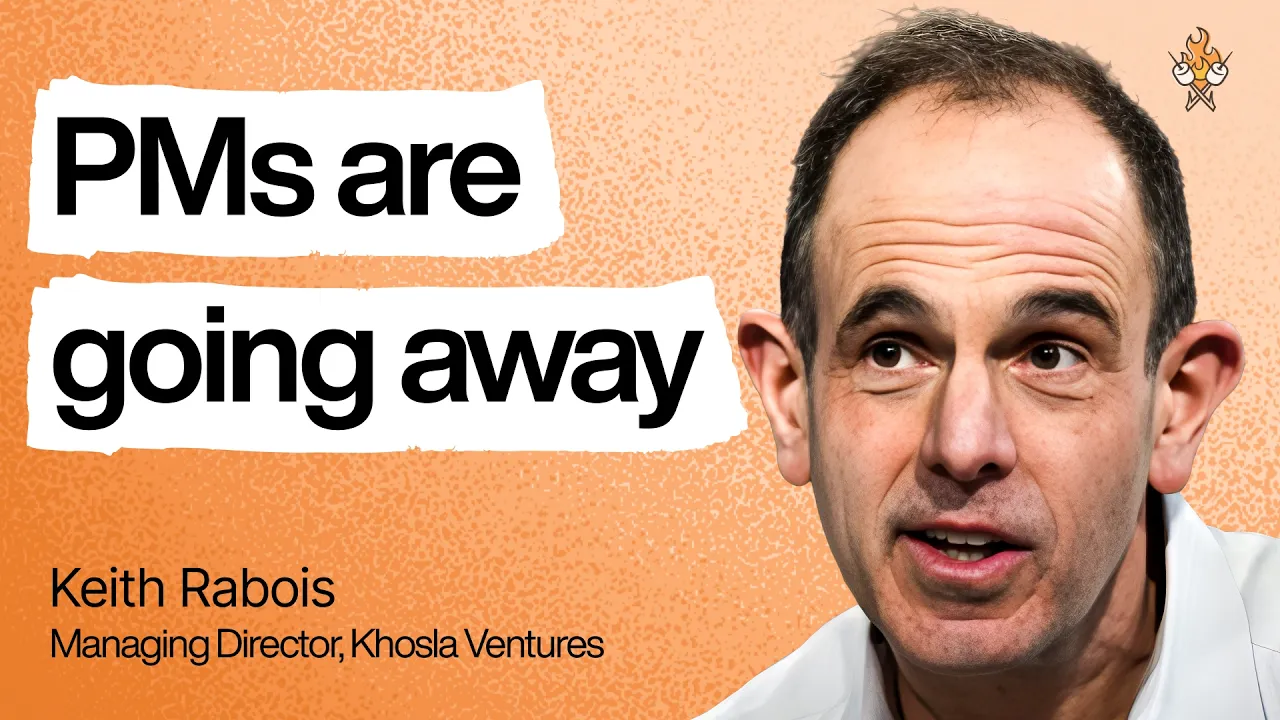
Keith Rabois was an early executive at PayPal (part of the famous PayPal Mafia), COO at Square, VP of Corporate Development at LinkedIn, and an early investor in Stripe, DoorDash, Airbnb, YouTube, Ramp, and Palantir. Currently he’s managing director at Khosla Ventures. Also, he hasn’t touched a computer since September 2010 (he does everything from an iPad). *In our in-depth conversation, Keith shares:* 1. The barrels vs. ammunition hiring framework (and how to spot barrels) 2. Why talking to customers is actively harmful for consumer products 3. How to identify undiscovered talent 4. Why the PM role is dying 5. The three traits of the best-performing companies right now 6. The specific interview question he asks every senior candidate 7. Why CMOs (not engineers) are becoming the #1 consumer of tokens *Brought to you by:* WorkOS—Modern identity platform for B2B SaaS, free up to 1 million MAUs: https://workos.com/lenny Vanta—automate compliance, manage risk, and accelerate trust with AI: https://vanta.com/lenny *Episode transcript:* https://www.lennysnewsletter.com/p/hard-truths-about-building-in-the-ai-era *Archive of all Lenny's Podcast transcripts:* https://www.dropbox.com/scl/fo/yxi4s2w998p1gvtpu4193/AMdNPR8AOw0lMklwtnC0TrQ?rlkey=j06x0nipoti519e0xgm23zsn9&st=ahz0fj11&dl=0 *Where to find Keith Rabois:* • X: https://x.com/rabois • LinkedIn: linkedin.com/in/keith • Website: https://www.khoslaventures.com *Where to find Lenny:* • Newsletter: https://www.lennysnewsletter.com • X: https://twitter.com/lennysan • LinkedIn: https://www.linkedin.com/in/lennyrachitsky/ *In this episode, we cover:* (00:00) Introduction to Keith Rabois (01:59) Why Keith hasn’t used a computer since 2010 (04:52) The team you build is the company you build (07:40) How Keith learned to identify talent at PayPal (10:05) Tactics for getting better at hiring (15:31) The barrels vs. ammunition framework (18:52) What makes someone a barrel (22:36) How to attract the best talent (26:18) Building
Summary
Generated by claude-haiku-4-5-20251001Hard Truths About Building in the AI Era | Keith Rabois Summary
Main Topics
- Talent Identification and Hiring: The foundational skill for building successful companies
- "Barrels and Ammunition" Framework: Understanding organizational capacity for parallel initiatives
- AI's Impact on Roles: How foundation models are reshaping product, engineering, and design roles
- Operating Tempo: Speed and execution as markers of successful companies
- Contrarian Business Insights: Customer feedback, psychological safety, and public criticism
- Career Navigation in the AI Era: Intellectual curiosity as the key to future-proofing skills
Key Points
Talent & Hiring
The Core Principle: "The team you build is the company you build" — the single most important factor in startup success.
- Assessing Talent: Keith's key insight is that he could accurately identify talent within organizations but struggled with strangers. The lesson: develop expertise at evaluation through deliberate practice and feedback loops.
- 30-Day Feedback Loop: Asking "Would I make the same hire decision?" 30 days after hiring is as predictive as measuring at 1-2 years.
- Reference Checking: Ruthless referencing (e.g., Tony Xu at DoorDash does 20 references per senior hire) beats interviews. Key is asking the right questions:
- "Is Max a good employee?" (wrong question) vs. "Is Max capable of being a world-class entrepreneur?" (right question)
- "What would lead to success?" and "What would cause failure?"
Finding Undiscovered Talent:
- Don't compete for the same people everyone else wants
- Understand why large organizations won't correctly evaluate certain candidates
- Younger people often have "less data," making them invisible to homogenous evaluation systems
- Look for what others miss
Barrels vs. Ammunition
A company's limiting factor isn't money or headcount—it's the number of "barrels" (people who can independently drive initiatives from inception to success).
- PayPal had ~254 people but only 12-17 barrels
- Most good companies have 2-15 barrels
- Hiring "ammunition" (support staff) without expanding barrels creates coordination tax and drag
- The Smoothie Test Example: An intern named Taylor Francis solved an unsolvable problem (delivering cold smoothies at 9 PM) by owning it end-to-end—demonstrating barrel-level agency
What Makes a Barrel:
- Takes ownership and delivers outcomes
- Motivates, accumulates resources, measures progress
- Comes back proactively with diagnosis and solutions before escalating
Pushing for Excellence (The "Bar Raiser" Concept)
- Relentless application of force: The CEO's job is offsetting organizational complacency
- Counterintuitive insight: When companies are struggling, be supportive; when thriving, be critical
- Talented people want to be pushed; they get unhappy coasting
- "You get to a certain threshold, momentum gets you a valuation... but you've got to start your record 0-0 again next year"
AI's Impact on Traditional Roles
PMs are becoming CEOs of their initiative:
- Traditional PM role (roadmap + customer feedback) doesn't work when capabilities change weekly
- The future role: understanding business equations, noticing what's newly possible, shipping immediately
- Skill needed: business acumen, not process management
Engineers with Commercial Instincts: The ultimate unicorn in the AI era—they ship code themselves while leading teams, leveraging AI as a "second team."
Design: Merging with code; alpha is in storytelling and cutting through clutter, not tools.
Contrarian Takes on Customer Feedback
"I hate talking to customers" (for consumer/SMB products)
- Customers can't articulate subconscious decisions (why you buy a Porsche isn't the real reason)
- Feedback becomes "locked in your brain" and biases future decisions
- Works for enterprise with specific decision-makers; fails for mass market
Better Approach: Trust foundational insights
- Brian Chesky didn't ask customers if they wanted Airbnb; he noticed 30 Craigslist listings for bedroom rentals
- Andrew Mason's insight: phones need two buttons—"I'm bored" and "I'm hungry"
Speed as a Differentiator
- Successful companies identify problems and ship solutions between board meetings
- Ramp shipped cards in 3 months (typically 9-12 months) — creating unfair advantage
- Shopify: PMs can't give PowerPoint presentations; everything must be a working demo
- "Days Ramp": Tracking days since launch as metric #1 in every board meeting
Hiring Philosophy
- Value Creation vs. Value Preservation: Hire for experience if you need stability; skip it for explosive growth
- Promote from within: Transform chief-of-staff roles into talent factories
- Example: One CEO's last 2 hires (CMO and Head of Product) were previous chief-of-staff and current chief-of-staff
- Build organizational "factories" to develop ambitious talent
Public Criticism vs. Private Feedback
- Giving negative feedback privately optimizes for the individual, not the system
- Public criticism signals to the whole organization that issues are being addressed
- Allows others to help; builds collaboration
- High-performance machines don't have psychological safety; they're about winning (references Michael Jordan, last Dance)
AI & Career Anxiety
- AI will "radically reorient" careers
- Key to thriving: Intellectual curiosity, not just working harder
- CMOs are the #1 token consumers in top companies—they're experimenting with AI tools to bypass dependencies
- Learn and leverage new tools before they commoditize
Notable Quotes
- "The team you build is the company you build."
- "If a founder shows the ability early in his career to assess talent ruthlessly and accurately, he or she can go very far with no other abilities whatsoever."
- "High-performance machines don't have psychological safety. They're about winning."
- "The single role for the CEO is offsetting that complacency."
- "The better you're doing, the more the CEO should push."
- "I think the skill is more like being a CEO now, which is: what are we building and why?"
- "You want to build a company on undiscovered talent. You don't want to compete for people everybody else wants."
- "An isolated fake experiment doesn't give you actionable insights and often is directly wrong."
- "No days off." (His personal mantra)
- "Everything important you need to learn about humans was written by Shakespeare."
Takeaways
- Master Talent Evaluation: It's a learnable, improvable skill with feedback loops. Use ruthless referencing and ask the right questions.
- Organize Around "Barrels": Don't just hire more people. Identify and develop high-agency team members who can drive initiatives independently.
- Embrace the Push Culture: The best talent thrives under pressure. Complacency is the enemy.
- Rethink Traditional Roles in the AI Era:
- PMs become business strategists/mini-CEOs
- Engineers who understand business are rare and valuable
- Design is about storytelling and differentiation, not craft
- Distrust Customer Feedback for Consumer Products: Build on foundational insights and your own understanding of human behavior instead.
- Speed is a Competitive Advantage: Organize teams and decision-making to iterate and ship weekly, not quarterly.
- Future-Proof Your Career: Be intellectually curious about new tools and capabilities; don't just work harder.
- Develop Internal Talent: Chief-of-staff roles and internal promotion create compounding advantage and loyalty.
- Be Context-Dependent: Supportive when struggling, critical when thriving. Different moments require different leadership.
- Optimize for Winning, Not Comfort: Psychological safety is less important than drive, excellence, and clear expectations.
Transcript
The idea of a PM makes no sense in the future. The skill is more like being a CEO now, which is what are we building and why? [SPEAKER_00] There's a lot of anxiety in the job market. [SPEAKER_01] AI is going to radically reorient lots of people's careers, and maybe including mine. What I've noticed in some of the best organizations is the number one consumer of tokens is the CMO. They don't need to rely upon deputies and deputies and deputies to get actual work product. [SPEAKER_00] I want to hit on some contrarian takes that you have. [SPEAKER_00] Your advice, you don't actually want to be talking to customers. [SPEAKER_00] I hate talking to customers. [SPEAKER_00] I refuse to allow colleagues of mine to talk to customers. You have this idea of criticizing in public versus in private. High-performance machines don't have psychological safety. They're about winning. You're uniquely great at helping companies build world-class teams. [SPEAKER_01] If a founder shows the ability early in his or her career to assess talent ruthlessly and accurately, he or she can go very far with no other abilities whatsoever. It feels like it's never been harder to attract the best talent. Really talented people. [SPEAKER_01] When things are going well, they're not happy. [SPEAKER_01] The morale actually does go down when people are skating. The single role for the CEO is offsetting that complacency. The better you're doing, the more the CEO should push. [SPEAKER_00] Today, my guest is Keith Raboi. Keith's resume, both as an operator and investor, is absurd. He was an early investor in Stripe, Palantir, Airbnb, YouTube, DoorDash, Ramp, and dozens of other companies. [SPEAKER_00] He's part of the famous PayPal Mafia, where he was executive vice president of business development and policy. [SPEAKER_00] He's also been chief operating officer at Square, VP of corporate development at LinkedIn. [SPEAKER_00] He's also co-founded two companies, and he's currently managing director at Kostla Ventures. [SPEAKER_00] It's safe to say that Keith is in the 99.9th percentile at identifying talent, building teams, and operating world-class companies. Before we get into it, don't forget to check out LennysProductPass.com for an incredible set of deals available exclusively to Lenny's newsletter subscribers. With that, I bring you Keith Raboi. Keith, thank you so much for being here, and welcome to the podcast. [SPEAKER_01] It's a pleasure to be with you. Okay, so when we were starting this recording, you told me you're doing this from an iPad, which I've never had, and you shared a crazy fact that you haven't used a computer in years. Talk about what's going on there. [SPEAKER_01] Yeah, so when I started working at Square, Jack Dorsey was running the company off an iPad, and so I immediately converted in September 2010, and have since then. [SPEAKER_01] I haven't touched a computer since September 2010. [SPEAKER_01] Everything I do in my life is either done from my phone, my watch, or my iPad. What's so interesting about this, as you were talking, is just there's this trend of engineers starting to code from their phone, like Boris Cherneon and Simon Willison, these two engineers that are 10X engineers, and they're just coding from their phone, talking to AI, and I feel like you've been preparing for this for a long time. [SPEAKER_01] Yeah, trying to be ahead of the curve. [SPEAKER_01] Jack's very good at being ahead of the curve. [SPEAKER_01] If you just watch what Jack's doing and follow, he's in pretty good shape with technology. And just to understand the benefit, is it just avoid distractions? [SPEAKER_01] Yeah, partially distractions, partially just the flexibility, taking an iPad with you anywhere is super easy. [SPEAKER_01] Some laptops have improved since then, but the screen flexibility, angles, just the weight. I carry my iPad with me everywhere, so there's no reason. [SPEAKER_01] There's nothing you can't perform, unless maybe if you're doing heavy-duty engineering, which obviously has not been my forte in life, although I may have to start. [SPEAKER_01] There's no reason to use a more powerful, heavier weight, less flexible machine. iPad maxing. Keith Raboi. [SPEAKER_01] See if you got my Apple. As long as it's an Apple product that works. [SPEAKER_00] I look so appropriate. [SPEAKER_00] This episode is brought to you by our season's presenting sponsor, WorkOS. [SPEAKER_00] What do OpenAI, Anthropic, Cursor, Vercel, Replit, Sierra, Clay, and hundreds of other winning companies all have in common? [SPEAKER_00] They are all powered by WorkOS. [SPEAKER_00] If you're building a product for the enterprise, you've felt the pain of integrating single sign-on, SCIM, RBAC, audit logs, and other features required by large companies. [SPEAKER_00] WorkOS turns those deal blockers into drop-in APIs with a modern developer platform built specifically for B2B SaaS. Literally every startup that I'm an investor in that starts to expand upmarket ends up working with WorkOS. And that's because they are the best. Whether you are a seed-stage startup trying to land your first enterprise customer or a unicorn expanding globally, WorkOS is the fastest path to becoming enterprise-ready and unblocking growth. It's essentially Stripe for enterprise features. Visit workos.com to get started or just hit up their Slack where they have actual engineers waiting to answer your questions. WorkOS allows you to build faster with delightful APIs, comprehensive docs, and a smooth developer experience. [SPEAKER_00] Go to workos.com to make your app enterprise-ready today. [SPEAKER_00] As I was preparing for this, Keith, there's so many directions we could have gone with this. [SPEAKER_00] You are so smart at so many things. [SPEAKER_00] I want to focus on something that I think you're uniquely great at, which is helping companies build world-class teams. And I want to start in particular with attracting the best talent. [SPEAKER_00] And what's really interesting these days from what I can tell is there's a lot of people [SPEAKER_00] and a smooth developer experience. [SPEAKER_00] Go to workos.com to make your app enterprise-ready today. [SPEAKER_00] As I was preparing for this, Chad, there's so many directions we could have gone with this. You are so smart at so many things. I want to focus on something that I think you're uniquely great at, which is helping companies build world-class teams. And I want to start in particular with attracting the best talent. And what's really interesting these days from what I can tell is there's a lot of people that are struggling to find a job. It's taking a lot longer to find a job. There's all these layoffs. On the other hand, it feels like it's never been harder to attract the best talent. There are so many amazing companies doing amazing things, so much money flying around, these $100 million offers and things. And so from the companies that you are closest to that you see are best at attracting the best talent, what have they figured out? What are they doing differently? What are some creative things they do? Well, let's start with first principles. The most important lesson I learned when I was working at Square from my board was Vinod Khosla was on my board. And he said, the team you build is the company you build. And that adage is the most important thing when you're creating a startup. People get distracted with the market, with customers, with the product, with technology. Ultimately, it's a team. If you have the right people, everything else will be easy. And if you have the wrong people, everything else is going to be difficult. So I actually learned this. Vinod distilled it, but I actually learned this back in my PayPal days. So in the early 2000s, why was PayPal so successful? Why were there such a general, subsequent generations of successful, interesting companies for 25 years now? It's because Peter Thiel and Max Levchin marshaled an incredible density of talent. So it allowed PayPal to succeed where possibly we wouldn't have. And these people went on with interesting ideas, ambition, and talent to build epic companies in all kinds of verticals. So from day one, I've always been focused on the importance of critical density talent, how do you identify, retain, and promote people with that talent? Back in the PayPal days, when I first started in my career in technology, I actually was not very good at this. Fortunately, Peter and Max were. So Max basically hired all the technical talent in the organization. Peter pretty much hired everybody else. They used their network primarily. So it was very difficult to get a job at PayPal unless you had a first degree or second degree connection to the engineering team or to Peter through Stanford, which is a different type of recruiting model. It works really well if you have a strong network. I wouldn't recommend it for everybody, but if you have a network that has unique talent, there's no substitute. Interviews are not a great substitute in regard to how strong you are at interviewing. But when I started my career, I was mediocre at hiring people. Probably 50-50. Some good people, some mediocre people. That doesn't allow you to scale a team with an unfair advantage. But what I learned to do is steal people from other people's organizations within PayPal very successfully. So I got feedback from David Sachs, who was the COO at the time, that I wasn't going to get promoted again until I could demonstrate leverage, leadership leverage, which had an equation for one plus one has to equal three or more. So for every incremental person you hire, you have to show that you produce disproportionate returns, nonlinear returns. And because I wasn't hiring that well, I wasn't really succeeding at that leverage. So when I went around and took the feedback into account, I said, okay, I really want to get promoted. What do I do? So I found people within the organization that I felt had talent, that were not being leveraged to the highest potential and ambition. And I recruited them to my team. And that was very successful. hiring that well, I wasn't really succeeding at that leverage. So when I went around, took the feedback into account, I said, hmm, okay, I really want to get promoted. What do I do? So I found people within the organization that I felt had talent, that were not being leveraged to the highest potential and ambition. And I recruited them to my team. And that was very successful. And then I did get promoted actually fairly quickly because the people actually went up to speed. They were able to run really fast. And we produced a lot of really important results for the company. The lesson, though, that I took away was, well, that's great because what it showed to me is I actually could identify talent. I just couldn't identify strangers with talent. So people that were in the building that I'd have lunch with or dinner with or go for a run around the PayPal campus with, I was accurate at diagnosing their abilities. I just couldn't do it in a 20-minute, 30-minute, 45-minute interview. So the first thing is just double down on people I know. That doesn't scale perfectly, but learn to be excellent at, if I had context, assessing people's abilities, superpowers, and weaknesses. Then over the next X years, tried to identify ability, a different technique for identifying, assessing random people because ultimately if you're going to build an organization, ultimately if you're going to be a VC, you can't just invest in people you already know. So that took some years and requires some training. Anyway, I think you can teach some of this to a founder, but one advantage a founder has that's going to thrive is if a founder shows the ability early in his or her career to assess talent ruthlessly and accurately. He or she can go very far with no other abilities whatsoever. Hiring is a muscle. You need to exercise it. You need to try, learn what worked, what didn't, what could you have known, what did you miss, why, and riff on that and try to get better at it. There are tactics you can learn. I think the tactics work pretty well within the middle of a bell curve distribution of moving yourself 10, 20 degrees within that bell curve. I don't think the tactics can really teach you how to identify, call it the top 10 basis points, top 50 basis points. There you have to deviate from the norm. And I think that's actually true of most lessons in life. If you're going to be extraordinary in any skill, you can't follow a playbook. Otherwise, by definition, lots of other people would be the top 10 basis points. But you can get a lot better by learning techniques. So, for example, let me share a couple. One thing I think you can learn to do is be excellent at references. It doesn't work for hiring people right out of college or something because the reference context is going to be a little off. But I think without getting better at interviewing and assessing, if you just learn to extract the right information from ruthless referencing. So, for example, ruthless referencing to me means Tony at DoorDash does 20 references on every single senior hire. 20. Wow. I bet he's pretty good. I bet he's been pretty accurate too. So, I think you can learn that. That's a skill that's teachable, that being absolutely incredibly dedicated to your craft, you can just get better at. Back in the day, there was an investor at Greylock who was on my board at LinkedIn, David Z. Very successful investor, notable for both LinkedIn and Facebook investments. He used to teach at Greylock you couldn't stop referencing a founder until you hit a negative reference. So, you would know you had exhausted the reference when you finally hit a negative reference. And so, I think there are tactics there in muscle building. How do you get the right information from the right people? How do you frame the questions, et cetera? at Greylock you couldn't stop referencing a founder until you hit a negative reference. So, you would know you had exhausted the reference when you finally hit a negative reference. And so, I think there are tactics there in muscle building. How do you get the right information from the right people? How do you frame the questions, et cetera? That will lead you in the right direction. Now, you have to be careful. Let's say I'll give you an example where these can go wrong. I've been a long-time investor from the seed round of a company called FAIR founded by two of my colleagues at Square. Max Rhodes and Jeff Kaldeson worked for me at Square and then the two other co-founders also worked at Square. When people were reference-checking Max, often most VCs asked the wrong question, which was, was Max a good employee? The answer to that is very mixed. And so, some venture capitalists, including some very good ones, were nervous about investing in FAIR. If they framed the question slightly differently, which is, is Max capable of being a world-class entrepreneur? The answer was yes. So, again, it's a tactic. You have to understand what exactly am I trying to extract? Same person, wrong question, wrong result. And many people passed on FAIR and they regret it. And these are actually quite talented investors. They just didn't frame the question correctly when they were calling someone like Jack Dorsey out for the reference. [SPEAKER_00] Any other questions you find really helpful in extracting the right information? When I interview candidates for senior people in leadership positions, I always ask them, look at whatever company they're at and say, if you were CEO, what would you have done differently? And you get a feel for the strategic mindset of can they drive value creation? Because almost by definition, they've come from a company that's had some traction and success. So, can they edit? So, for your case, I would have asked you, if you were CEO of Airbnb, what would you have done differently? And you learn a lot from that question. On references specifically, I think a general arc that's pretty good is asking the person, what would lead to this person being most successful? And if something were not to work out, what would be the primary root cause that you can identify if something's going wrong? I think generally probing on those two arcs leads to a lot of insight. [SPEAKER_00] And that first question is for the candidate or is that in the record? Yeah, for the candidate. That's not the candidate specifically. Got it. Because I don't want them to criticize Airbnb. I don't think that's that productive. But you can tell how much of the current business model have they absorbed, how much they understand trade-offs, and then can they create an unfair advantage because they have insights into afterburners. And then I have a follow-up question, which is usually gold, which is, let's say I ask you this question about Airbnb and you give me this great answer. I'm like, well, why weren't you able to persuade Brian to do it? [SPEAKER_00] So you made this interesting point that there's tactics that can help you get better at finding and identifying talent. A lot of this is just the feedback loop of doing it a bunch, it sounds like. I find the feedback loop is so hard to actually do. Most people interview, hire, and then don't really learn much from how it ends up going. There's this gut thing that happens, but they're not really thinking about it. Do you have any advice for just how to make the most out of the lesson of seeing how something went? So I've read some research on the topic. And if you ask yourself 30 days after any hire, would you make the same decision? That 30 day loop is pretty useful. And it, from how it ends up going. There's this gut thing that happens, but they're not really thinking about it. Do you have any advice for just how to make the most out of the lesson of seeing how something went? [SPEAKER_01] So I've read some research on the topic. And if you ask yourself 30 days after any hire, would you make the same decision? That 30 day loop is pretty useful. And it's as accurate as measuring it a year or two years out. So you've got a pretty tight feedback loop and you can ask the entire hiring team. So I think that is a technique that every company should use. [SPEAKER_00] I want to talk about this framework that you have, barrels and ammunition, because this is really mind expanding and helping people understand who to even hire. So look, most companies raise money. They have some traction. They get launched, get some traction. Then they raise a lot of money, whether it's a series A or a series B. And then they hire a lot of people infallibly or at least historically. And then the CEO, almost without exception, gets frustrated because they've hired a lot of people. The burn rate has increased a lot and they don't feel that more is getting accomplished per unit of time, per day, per week, per month, per quarter. And they get frustrated. And so then they sit around at a dinner with other CEOs or people like me or one-on-one conversation with me and are incredibly unhappy and disappointed that I'm spending all this money on all these people, but we're getting less done or the same done. Why, why, why, why? After years of sitting through these conversations at dinner with other CEOs or COOs, I realized that the fundamental driver of this is that the number of people that can independently drive an initiative from inception to success is very limited within any company. And if you hire more people without expanding the number of what I call barrels that can drive from inception to success, all you're doing is stacking people behind the same initiatives. And so you're wasting time, energy, and increasing your collaboration tax, your coordination tax. And so that's what causes the drag coefficient. So for example, at PayPal, we had about 254 people in Mountain View when we were acquired. Of those people, depending on how strict you really want to be, it is considered one of the best talent-rich networks of all time in technology. There is between 12 to 17 barrels in the organization. That's an infinite number. I once asked Jack Altman on a podcast at Lattice, which is a pretty good company, how many barrels of a company. The answer was two. That's a more common answer for a very good company. So you have between two and let's say 15 barrels at a company. That defines the unique number of things you can do in parallel versus sequentially. And just hiring more people is not going to change that. And if anything, it's just going to cause a collaboration or coordination tax and you're going to have a drag provision and you're going to do less. So the key is if you want to do more or need to do more, your market requires you to do more, your business model requires you to do more, VCs require you to do more, you need to have more barrels. Now, the question is how and when and there's a lot of details there, but fundamentally the ratio of barrels to ammunition is what dictates the number of important initiatives that can be pursued simultaneously. And you're not saying you don't want ammunition. It's valuable to make an impact. You need ammunition in addition to the barrel. [SPEAKER_01] Yeah, you definitely need ammunition and it depends on what kind of project. There are types of projects where an individual barrel may be able to succeed with very limited or no ammunition. Sometimes it may be [SPEAKER_01] that can be pursued [SPEAKER_01] simultaneously. And you're not saying you don't want ammunition. It's valuable to make an impact. You need ammunition in addition to the barrel. [SPEAKER_01] Yeah, you definitely [SPEAKER_01] need ammunition [SPEAKER_01] and it depends [SPEAKER_01] on what kind of project. [SPEAKER_01] There are types [SPEAKER_01] of projects [SPEAKER_01] where an individual barrel [SPEAKER_01] may be able to succeed [SPEAKER_01] with very limited [SPEAKER_01] or no ammunition. [SPEAKER_01] Sometimes it may be [SPEAKER_01] a designer, [SPEAKER_01] an engineering team, [SPEAKER_01] a PM, [SPEAKER_01] a data analysis, [SPEAKER_01] et cetera. [SPEAKER_01] It depends on [SPEAKER_01] what the project is, [SPEAKER_01] what the problem [SPEAKER_01] you're trying to solve is, [SPEAKER_01] what's the proper [SPEAKER_01] amount of ammunition. [SPEAKER_01] But once you think [SPEAKER_01] about the ratios [SPEAKER_01] of ammunition [SPEAKER_01] to the problem, [SPEAKER_01] you can be [SPEAKER_01] much more constructive [SPEAKER_01] and deliberate [SPEAKER_01] and intentional [SPEAKER_01] about the team [SPEAKER_01] construction. Most people hearing this assume they are barrels. What helps you understand if someone is truly a barrel? [SPEAKER_01] Can they take an idea [SPEAKER_01] and make it happen? [SPEAKER_01] We're going up that hill over there. [SPEAKER_01] That's the hill. [SPEAKER_01] Get us over that hill. [SPEAKER_01] And one way [SPEAKER_01] or the other, [SPEAKER_01] they will motivate [SPEAKER_01] people if they need to. [SPEAKER_01] They will accumulate resources if they need to. They will measure what they need to. And they're going to get your company across that hill. That's a barrel. Anything less than that is not a barrel. [SPEAKER_00] And so this is skills [SPEAKER_00] like internal [SPEAKER_00] org stuff, [SPEAKER_00] resource, [SPEAKER_00] strategy. [SPEAKER_00] It's the collection [SPEAKER_00] of all the things to get something done. Collection of all those things. There's an outcome. CEO wants, CEO founder wants an outcome. And come hell or high water, this person is going to deliver that outcome. Now, the outcome can be fairly narrow and not that difficult in the beginning. And then you expand the scope, the complexity, the difficulty that you entrust to your barrels. And sometimes they have no line of sight of how to solve it when you start. Sometimes you have a preliminary idea. So it ranges, but ultimately it's that skill of I'm going to take this off your plate. You can fire and forget, and this is going to happen. And if it's not going to happen, I'm going to come back to you proactively with the issues I'm confronting, what I've already tried, the diagnosis of the root causes and ask for your help with sufficient time for you to intervene and try to brainstorm [SPEAKER_00] with me [SPEAKER_00] to get us [SPEAKER_00] to the right answer. [SPEAKER_00] Agency is the word [SPEAKER_00] that comes to mind [SPEAKER_00] when you talk [SPEAKER_00] about this role. Yeah, I think agency is accurate. The problem I have with terms like agency is it's a little strategy because in one ear, a lot of people went out the other and they don't really process the meaning. [SPEAKER_00] Yeah. [SPEAKER_00] Who are some examples [SPEAKER_00] of barrels that make [SPEAKER_00] this real [SPEAKER_00] so people can understand [SPEAKER_00] what you're talking about? I talked to my YC lecture in 2014 about how to operate. They can be as simple as the now somewhat famous in technology smoothie test, which is, we used to have engineers work pretty hard at the Square and pretty late. And I always wanted them to have food so they wouldn't be distracted and I didn't really want them to eat junk food because I actually think junk food is bad for you, bad for your brain, et cetera. So I settled on delivery and really wanted to provide at 9 p.m. cold smoothies. And we had, at that time, a pretty substantial team at Square, office team, EAs. This was not a lean, mean organization. And so I tried through the office team, EAs, and nothing. We never got healthy, delicious, cold smoothies delivered at 9 p.m. Just kept at it. I like cold smoothies. And we had at that time a pretty substantial team at Square, office team, EAs. This was not a lean, mean organization. And so I tried through the office team, EAs, and nothing. We never got healthy, delicious, and cold smoothies delivered at 9 p.m. Just kept that one. It was getting frustrated because if you, at the end, if the smoothies aren't cold then no one's going to eat them. They don't arrive at 9 and no one can really bake on the refreshment. Everything went wrong. And then I had this intern named Taylor Francis and I was explaining just my frustration. It was like a second day at work. And he's like, I'll solve it. And I was like, okay, kid, good luck with that. I was like, sure, keep trying, try. Anyway, day goes by, now my clock arrives and lo and behold, smoothies show up at 9 p.m., delivered on the standing desk table where the engineers would congregate. I sampled them. They're cold, they taste great. And I'm like, oh my God, I found a barrel. And I later gave him almost everything to do. [SPEAKER_00] I want to go back to actually the first question we did. You shared some amazing advice for how to identify great talent, but I'm still curious when you find that barrel, for example, when like everyone's throwing money at them, there's all these amazing teams to join. What are some things that companies do to attract and convince them to join their team? [SPEAKER_00] The standard stuff is still true. Mission. Selling the vision of mission is indispensable. Most people have proven talent anyway, at least in the current world, are going to attract offers for multiple opportunities. And so you've got to convince them that your opportunity is very special. I think one way to do that that's a little bit more nuanced is convince them that their particular skill overlaps with the critical blockers to the current company, meaning they're betting on themselves. So for example, if they are superb at marketing, if the biggest blocker of the company in the company's current success is not technology, not the product, but we believe it's marketing, it's really easy to go to a world-class marketing person and say, not only is this great company building something really cool and interesting that you'll be proud of, but your particular ability is very unique and differentiated and you can solve this. This is actually how I wound up at Square. Back in 2010, I was actually just been aqua hired into Google and was planning on being a VC actually next after I was vesting whenever Google is going to compensate us. And then the investors in Square called me up and they said, hey, we've been looking for almost a year now for someone who knows something about financial services yet is still entrepreneurial. And they're like, hey, there's only three of these at the time. I was like, there's only really two or three of you in the world, so would you be interested? And I said, well, maybe. But that was the argument to me that made me leave Google early, after two weeks and infuriate everybody, and bypass venture for another three years, which had been my plan, was because they made the argument that, hey, I was one of three people in the world that could actually do But that was the argument to me that made me leave Google early, after two weeks and infuriate everybody. And bypass venture for another three years, which had been my plan, was because they made the argument that, hey, I was one of three people in the world that could actually do this job. [SPEAKER_00] So there's a, I don't know if it's ego, but it's also just impact. [SPEAKER_00] Yep. Well, exactly. Impact. You have talents, you want to use them and you want to feel that you're challenged every day and that what you're doing really, really matters. So that, I think that can be extremely helpful. My more important arc in this is, I think you have to build a company on undiscovered talent. I don't think you really want to compete for the people that everybody else wants. Right. And I learned this at PayPal. Peter taught me this literally the first day, the first week of my job at PayPal, that the way to build a company—we were jogging around the Stanford campuses. You've got to find these undiscovered talent. That's the only way to scale organization against these large incumbents with infinite money, et cetera. And I've been on that crusade for 25 years. For those who are interested, you can link to it. I gave a speech at Ramp about how to hire, but talks in detail. I also recommend Eric, CEO of Ramp speech, which is fairly similar. Both videos are online. [SPEAKER_00] That's such interesting advice and it makes so much sense. You're not going to be able to afford the people that have done the thing at top companies and also they're just probably not the people to join at early. They're also not maybe the people you want, so there's adverse selection. But it's like a salary cap. Most sports these days have salary caps. And when you're a startup, not only do you have a salary cap, you probably have one-tenth the salary cap of the people you're competing with. So you've got to figure out how to leverage less assets to more success. [SPEAKER_00] What's just one tip when you're looking for and discover talent that's a sign of, okay, this person is really special? I know you have a lot to talk about here, but just what's one tip? I think it's isolating why other people aren't going to process them correctly. Most recruiting at large organizations becomes a homogenous function. And so if you understand why this person is going to get thrown into this black box kind of thing and not get processed accurately, it's pretty easy. So I always think about, let's say this person was interviewing at Meta or Google or Block these days or Coinbase. What are they going to miss? And then why? And then that leads to, oh, perfect. So sometimes it's just lack of information. One of the reasons why, sometimes it's controversial to say this, but one of the reasons why the net impact of my higher undiscovered talent is you wind up skewing younger. It's not because you need young people. It's that younger people have by definition less data. It's, you know, we use credit scoring, Sometimes it's controversial to say this, but one of the reasons why the net impact of my higher undiscovered talent is you wind up skewing younger. It's not because you need young people. It's that younger people have by definition less data. It's like we use credit scoring, FICA scores. It's the same thing for employment. By the time you're over 30-some, lot of things, there's so many data points about you that this black box machine is usually going to process you like many other people. If there's no data points, it's very hard for a black box machine that does homogenous evaluation to evaluate you. So there is alpha, so to speak, by definition for people who have no data points. [SPEAKER_00] It's interesting how this is the same skill as being an investor, picking startups to invest in. Yeah, absolutely. [SPEAKER_00] Okay, I want to talk about something else. I asked a few people that know you well that work with you at various companies what to talk to you about. And one person said that when I asked him what to talk about, he said, my immediate reaction is that he is a bar raiser. No matter what kind of numbers we put up, he pushes us to do more. In fact, often it seems like the better we do, the harder he pushes. Does that resonate? Yeah, I think that's true. I mean, I think, look, ultimately, I'll channel someone else's feedback, but it's the same thing. So a friend of mine who's a CEO once asked Mike Moritz, what's the most common denominator of the best CEOs ever? And he said it's the relentless application of force. I think that's the job of the CEO. People eventually get comfortable, complacent. The more success you have, the more complacent the organization tends to get. And the single role for the CEO is offsetting that complacency. So, to the point, the more success you have, the better you're doing, the more complacency naturally kicks in. And unless you've erected a network effect, you do not want to get complacent. And even then, you can debate whether you should. But fundamentally, most businesses are not network-effect businesses. They are not going to run on their own for a long time. So, I think that's one insight is the better you're doing, the more the CEO should push. Secondly, it's a little bit like sports when you're growing up. People, when they're winning, take advantage of feedback better than when they're losing, usually. So, for example, now what I do is mostly VC, mostly a board member, mostly a consigliere, a founder. And when the company's struggling, maybe what's less intuitive, and you may have picked up on this in your research and interviews of people who know me. When a company's struggling, I'm actually usually very non-critical and more like a coach and supporter. Because the company, the founder knows they're struggling. Being critical doesn't really help them solve the problems. That's when being supportive can actually somewhat counterintuitively be more important. But when the company's thriving, it's really important to be critical and isolating things that will eventually be problems while everybody in the company is really happy and borderline complacent. So you kind of want to be the doesn't really help them solve the problems. That's when being supportive can actually somewhat counterintuitively be more important. But when the company's thriving, it's really important to be critical and isolating things that will eventually be problems while everybody in the company is really happy and borderline complacent. So you want to be the opposite as a default. And that's a really good sports coach. When you're winning is when to polish everything and really master the details. When you're losing, you definitely also have to be exciting people and embracing the future and selling the future. [SPEAKER_00] So is the advice, say, someone's listening, a founder or product leader. The advice here is just keep pushing harder, set the bar higher as things, even if you're doing great. Yeah, if you're doing great. Well, also you have to remember, I remember giving a speech once at Square, you get to a certain threshold, crazy inflection. Momentum gets you a certain valuation and all these attributes. But it's of like winning a Super Bowl. You get, the last year was great. Last four quarters were wonderful. It's winning the Super Bowl. You got to come back next year and start your record zero, zero again. And you got to remember that. Actually, adventures like that, I'm only as good as my last investment. I've had 13 years or whatever of pretty good investments. But truth I have to wake up every day and find some undiscovered founder that's going to change the world. And if I don't do that, it doesn't matter what I've done the last 13 years. But a company is of like that. The company can skate on autopilot for a while. Venture, you really can't ever skate. [SPEAKER_00] I definitely saw this with Brian Chesky. He just felt things were going great and we just shipped amazing products and growth is up and he's just always pedal to the metal no matter what. Just, come on, when are we going to take a little break? And it's interesting because when we did have little breaks here and there, morale actually went down because people were, what am I working on? I don't know. It's not that exciting. Brian and I are usually in sync a lot. There's a really good interview where I interviewed him also at the same conference of how to hire when he talks mostly about founder mode. But I generally subscribe to virtually all of Brian's views. He even taught me some of these things himself. But the more important point I think you identified, which is very subtle, is really talented people are superb athletes. And when things are going well and people are really coasting, they're not happy. They have an internal clock tempo. They just want to create things and create value and drive, drive. And the morale actually does go down for the best people in the world when people are skating. [SPEAKER_00] Okay. So actually along those lines, there's a lot of anxiety in the market, in the job market about the future of careers. Am I going to have a job? Am I going to, where are things going? And it just feels people are working very, very hard. They're just putting in a lot of hours, especially the most AI people. It just feels they're working harder than ever. I don't know if you saw this thing Tyler Cohen put out of just work harder. Now is the time to work harder because AI is eating away at your value. You know, you [SPEAKER_00] And it just feels like people are working very, very hard. They're just putting in a lot of hours, especially the most AI pill people. It just feels like they're working harder than ever. I don't know if you saw this thing Tyler Cohen put out of just work harder. Now is the time to work harder because AI is eating away at your value. You probably talk to a lot of people looking for career advice of just like, this feels scary and I feel like I'm working too hard. What should I do? I don't know. Do you have any advice for folks? Well, I do think AI is going to radically reorient lots of people's careers, maybe including mine. So I think that's actually true. And I think the way to thrive in a rapidly emerging technology world is to be intellectually curious. So for example, I'm a business person historically. I did actually code when I was really young, but professionally just a business person. What I've noticed in some of the best organizations is the number one consumer of tokens is the CMO. People are intellectually curious. And so they're like, wow, there's all these cool things I can do now with my hands. Either I had to rely on other teams or never got access the way I wanted and blah, blah, blah, or lag. And they just do it. This is actually true at Opendoor. It's true in another great company that I'm on the board of. That's incredible. And so I think you can be intellectually curious and future-proof yourself more than just yes, you can work harder and a big subscriber to no days off and working all the time and all that stuff. But fundamentally, the intellectual curiosity is able to learn new things. And that is how you embrace the future. [SPEAKER_00] And you said CMO is who's using the most. Both of these two companies, both massive, awesome companies with lots of engineers. And I think that's very encouraging. You know, for the executive particularly, but it was definitely the most executive in the company. [SPEAKER_00] And what are they building? Is it landing pages and paid tests? Well, sometimes it's more what we would have thought of as analytics. Sometimes it's actually campaigns, actual campaigns. It's just they don't need to rely upon deputies and deputies and deputies to get actual work product. And so they're just shipping things and shipping, you know, drafts of things or giving the CEO insights into things themselves. [SPEAKER_00] I want to get your take on the future of specifically the product triad. You work with a lot of product people, engineers, designers. Everyone's always wondering what the hell is going to happen in my career. Thoughts on the future of those three specific roles. Well, I saw this podcast or listening to this podcast that Peter Fenton did and he convinced me that the idea of a PM makes no sense in the future. If you think about decomposing the logic is what does PM usually do? They take these inputs from customers. They create this sequential roadmap that's well organized over the next year, blah, blah, blah, blah. That world is ridiculous. Right now, the capabilities of foundation models or companies like Lovable and things like that are improving at such a rapid rate that it makes no sense to have a year-long roadmap. And they're just incoherent. There are things that were impossible to do in November that are actually pretty easy to do right now in March. And so I think you need to build an organization that's incredibly adept at people say nimble and all that stuff, but incredibly adept at changing the roadmap almost on the fly. And I think intermediaries like conventional PMs don't make a lot of sense versus being prepared intellectually, embracing and exploiting, noticing. that are actually pretty easy to do right now in March. And so I think you need to build an organization that's incredibly adept at people say nimble and all that stuff, but incredibly adept at changing the roadmap almost on the fly. And I think intermediaries like conventional PMs don't make a lot of sense versus being prepared intellectually, embracing and exploiting, noticing. So someone needs to notice that, oh, wow, we can actually do this, but then exploiting it this week is the future of a very, a high-growth, stellar startup. We'll notice that something's now possible this week and create new features and new value for customers next week. [SPEAKER_00] That's such an interesting area of discussion. A lot of people are saying things as RPM. So I want to try to defend that role just to see if you, see if I can convince you otherwise. And by the way, I will say Mark Andreessen had this really good visual of just what's happening here is like every, all those three functions, it's like the standoff where they're all like, I'm going to take you, the future is my role. The future is design. That's engineering is the future. So the way I see it is as AI makes it easier to build and eats the middle of the software development process. Just anyone can build each old AI, here's what I want. The hard part, the gap, at least for now, is figuring out what to build and then aligning everyone around what to build. I agree with that. I actually think whether you talk about someone who used to be a PM or someone who used to be a designer or called an engineer, the skill is more like being a CEO now, which is what are we building and why? Exactly. And to be a successful engineer, that trait's critical, to be a successful designer because the tools and the ability to actually create the thing, an object, is going to be easier and easier. But the art is knowing what to build. Another competitor of mine, Alfred Lynn at Skoya, likes to talk about being a chef. When you're a chef at a prime restaurant, you're not actually cooking the dish. You're sampling your colleagues and editing their work a little bit. But fundamentally, it's half a commercial role. Being a chef in a famous restaurant is what's our value proposition? How do we differentiate ourselves? How do we brand ourselves? What's our segment? What's our pricing? Et cetera. What's our location even? That's what makes a famous chef. It's not they're literally cooking the dish all the time. [SPEAKER_00] Okay. I 100% agree. Interestingly enough, PMs are called mini COs often. And I think the important thing is it's not like, what do you call this person? I think the question is, what skill will be most, where are human brains still going to be necessary? Business acumen. It's basically business acumen. Right. Like what will help this company grow and succeed? Exactly. I understand the company's business equation, where we're trying to go and what the inputs and connection outputs are. And I can on my own, create things that move the needle or potentially move the needle. It's very exciting because you can actually drive impact much more easily now as an individual. [SPEAKER_00] My conclusion, based on what you just shared is of the three roles, which role is best at that? And historically, it'd be PMs. Obviously, I think the important thing here is it's like the best, you know, it's like great PMs or great engineers, designers will do well. But I think, interestingly, what you're describing to me is what it sounds like what a great PM would be really good at, basically. If they were exceptional, I think that's right. But I think the best, [SPEAKER_00] It'd be PMs. [SPEAKER_00] Obviously, I think the important thing here is it's the best. It's great PMs or great engineers, designers will do well. But I think, interestingly, what you're describing to me is what it sounds like what a great PM would be really good at. If they were exceptional, I think that's right. But I think the best, a lot of the best engineers I've worked with have commercial instincts like Max Levchin has this on steroids. Jeremy Stoppelman, he's worked with me very closely at PayPal before he started Yelp and got promoted to be engineering director and vice president of PayPal. Has commercial instincts, back when he was an individual contributor. So I think there are great engineers who are technically proficient that have always understood the business building. [SPEAKER_00] Yeah. I think that's the ultimate unicorn is an engineer that is also very business minded. It's going to put a premium. I think this would at the age of AI will put an incredible premium on that because they're not going to need a large team. You're not going to be marshalling the forces. Another example is a good friend of mine is director of engineering at RANF. He ships as much code personally. So he has a team of about 20 people. He personally ships as much code as he used to as an individual contributor while he's managing a team of 20 because the tools are so great and he's become a leading pioneer in the usage of AI. And he's using AI as a second team. He's basically like, okay, you're the team manager. You do this, you do this, you do this, stitch this together, check this out. And I think that is definitely in the future. [SPEAKER_00] I 100% agree. Engineers that are very good at that are just extra valuable. What's your take on design in the future of design, the value of design? Well, it's interesting. Design and code are merging and it's not clear to me who triumphs, is it code becomes design or design just translates automatically into code. I've made some investments that bet on both in some ways, but I think they're merging in a way where they're not separate fiefdoms anymore. [SPEAKER_00] I am so excited to tell you about this season's supporting sponsor, Vanta. Vanta helps over 15,000 companies like Cursor, Ramp, Duolingo, Snowflake, and Atlassian earn and prove trust with their customers. Teams are building and shipping products faster than ever thanks to AI. But as a result, the amount of risk being introduced into your product and your business is higher than it's ever been. Every security leader that I talk to is feeling the increasing weight of protecting their organization, their business, and not to mention their customer data. Because things are moving so fast, they are constantly reacting, having to guess at priorities, and having to make do with outdated solutions. Vanta automates compliance and risk management with over 35 security and privacy frameworks, including SOC 2, ISO 27001, and HIPAA. This helps companies get compliant fast and stay compliant. More than ever before, trust has the power to make or break your business. Learn more at vanta.com slash Lenny. And as a listener of this podcast, you get $1,000 off Vanta. That's vanta.com slash Lenny. [SPEAKER_00] What I'm seeing is something really interesting happening with design. On the one hand, I just did some analysis on the job market for design, and it's basically plateaued in terms of the number of open design roles over the past three years. It just hasn't gone anywhere. It's flat. We had the head of Claude design, Jenny Nguyen, on the podcast, and she had this insight that the design process, there's no time for the design, the traditional design process. There's engineers are shipping 17 things a day. There's no time to sit there and help mock and prototype and all these things. [SPEAKER_00] of open design roles over the past three years. It just hasn't gone anywhere. It's flat. We had the head of Claude design, Jenny Nguyen, on the podcast, and she had this insight that the design process—there's no time for the traditional design process. There are engineers shipping 17 things a day. There's no time to sit there and help mock and prototype and all these things. Let me give you a couple of concrete examples. So at Shopify, the way they develop—they've been doing this for over two years now. So this may seem normal, but they have not let PMs provide PowerPoint or Keynote presentations on product for two years. Every presentation on product has to be a workable demo. And they just expect the PMs to create the products. And the execs just refuse to look at static presentations. No, I want everything working. This is for two years. So I think everything's just merging together. [SPEAKER_00] That's so interesting. You would think though, because there are so many products launching every single day, like there's just endless things to pay attention to. You would think design would be a differentiator more and more. I do agree with that. I do agree with that. Actually, I think the alpha is in design, just like in marketing. It's not the tools. It's not the channels, not the metrics. It's the storytelling. It's how do you cut through the clutter in the snappiest, most compelling possible way. There's an NP problem. There's so many different words you can use to express the same concept. But the person who can say, this is the way to frame it—that proverbial thousand songs in your pocket is worth all the tools in the world. [SPEAKER_00] Yeah. So that's the other part of my insight recently. As AI makes it easier to build, it's expanding from the middle out. And what remains is figuring out what to build and iterating on the idea. And then at the other end of the spectrum is distribution. Getting anyone to pay attention to what you've done. Because there's so much happening every single day. Yeah, cutting through the clutter. I mean, that's always been critical. I mean, one of the times when people are pitching me as an investor, it's one of the things I'm dialing into immediately—how the hell is this going to cut through the clutter? It's one of the reasons why I don't like to take customer feedback into account because by definition, when you put something in front of a customer, that's not a proxy for the real world. In the real world, you have to cut through the clutter while they're going to their Barry's bootcamp, while they're doing their job, while they're raising their kids, while they're walking, while they're on the subway. An isolated fake experiment doesn't give you actionable insights and often is directly wrong. [SPEAKER_00] Interestingly, on that line, there's a few companies that are launching. Simile is one that is simulating humans. I don't know if you heard about this company. They basically are building AI models of actual people so that you can simulate your marketing launch and your product experience with people before you launch. I don't know if I've seen that specific company. I have seen one or two pitches. My general question as a refrain on those type of companies is what are they training on? Because if they're not training on the right data, it's dangerous to say you're simulating humans. [SPEAKER_00] Yeah. That is the question. What a weird world. Along these lines, actually, you have this—I don't know if you call it a hot take—that AI content is going to surpass human content and that's just the future. Oh, that's inevitable. [SPEAKER_00] Someone was talking to me and she was saying in the Chinese TikTok app, it's just all AI videos now and it's very good. [SPEAKER_00] That is the question. [SPEAKER_00] Oh, man. [SPEAKER_00] What a weird world. [SPEAKER_00] Along these lines, actually, you have this—I don't know if you call it a hot take—that AI content is going to surpass human content and that's just the future. [SPEAKER_00] Oh, that's inevitable. [SPEAKER_00] Someone was talking to someone and she was saying in the Chinese TikTok app, it's just all AI videos now and it's very good. She actually enjoys watching these videos and these stories. [SPEAKER_00] I think there'll be a binary sort of maybe. I could see products and content thriving that is clearly still human generated and that there's some desire for authenticity. Just like, for example, this piece of art is a Warhol. Anybody could create this now, high fidelity. But there's still an appreciation for this was created by Andy Warhol. I think there's going to be a curated experience with a premium of provenance, that you know is human created. And then there's just going to be a sort of a rank filtering of what's the best content and whether it's AI generated or not. It's a little bit like the Ben Thompson strategy thing of curation versus algorithm. There's going to be two poles and the curation maybe for human created stuff. And then there's going to be the algorithm which is just what's the best. [SPEAKER_00] I 100% believe that. That makes so much sense. [SPEAKER_00] I was just thinking the other day, it's so interesting that AI is getting very good at video. Videos are actually fun to watch that are AI generated and then images are getting really good. But writing is still really bad that is AI generated and it's ironic that it's called a large language model. It's all context, text trained and it's just that's the thing it's least good at which is really weird. Well, I think part of it is the economic decision of token rationing by the LLMs. They basically are when you prompt, they're trying to make their economics work within a bell curve distribution. So, for example, I'd use a prompt in LLM to write something that's very short. The quality is significantly better than if it's a page, paragraph—I mean page to chapter to book. I think it's token rationing versus actual quality. [SPEAKER_00] You would think though, you know, like I don't know if it was Hemingway or just if I had more time I would have made it shorter. It takes more work. I think the writing right now what works best is short, many short examples and then the humans picking, editing, reprompting. It's a little bit like when I used to be a litigator 25 plus years ago, the hardest part of writing a brief or all the art and all the magic was the first paragraph. If I could write that first paragraph really well, the chance I would win the case and convince the judge would go through the roof. So what I would actually do is I might have three weeks to write a brief. I might spend the first week or more walking around the office thinking through how am I going to nail the first three sentences. Once I figured out how I wanted to frame those first three sentences, I could write 30 pages in two days, but getting that right could take a week or two. Sometimes it would occur to me in the shower or literally, you know, in the middle of a run. It's like, oh my god, here's how I distill it. Then I could just sit down and power through the rest of the brief. I think it's a little bit like that—the power through the rest of the brief works well. You still need the first three sentences. [SPEAKER_00] Is there a story from that time in your life that would be interesting to share? I didn't even know about that. So yeah, not everybody knows, you know, I spent the first four and a half years of my professional career as a law clerk. and I think it's a little bit like that. The power through the rest of the brief works well. You still need the first three sentences. [SPEAKER_00] Is there a story from that time in your life that would be interesting to share? I didn't even know about that. So yeah, not everybody knows. I spent the first four and a half years of my professional career as a law clerk and then litigator, which occasionally comes in handy truthfully. Sometimes trading off business risk against legal risk is a valuable thing to do. Sometimes it's not accidental that many of my best investments are in financial services in heavily regulated areas because I think I can do the legal risk assessment in my own brain. This was definitely true back in the day when I invested in YouTube, but I think most things that lawyers learn are very inconsistent with being an entrepreneur. So when you're graded as a lawyer, you learn every exam in law school virtually is issue spotting. So you get credit for identifying there's fact patterns, identify all the issues, and then resolve them. So you learn to identify everything that can go wrong, moderately useful, but very not useful as an entrepreneur. I mean, sure, you can identify all the reasons a company could fail, not that difficult to do. The art is solving those. So not the best training. And then you also measure your productivity by hours worked. You literally build per hour. It took me two years, maybe a year and a half, after converting to technology to stop tracking all my time. I used to literally write down in my notebook a half hour of this meeting, 20 minutes on this, blah blah blah. I just couldn't get that out of my brain. [SPEAKER_00] That is so funny. And David Sachs was a lawyer too. It's interesting that's true. Peter, Peter was a lawyer. Peter was smart enough to quit after five months and four days, I think. David never practiced. He'd be even smarter than both of us. [SPEAKER_00] Okay, I'm going to hit on some hot takes, contrarian takes that you have. You have a number of these. I heard you share on a podcast recently. They asked you why don't you have as many contrarian takes these days, and you're like, well they've just all been proven right. And that's the problem. You know, if you have good ideas, eventually you want them to be adopted. It's a little bit like when you're an investor, you want to be contrarian. So Airbnb, you start with a contrarian take, but eventually if the company's going to succeed, it has to become consensus. Like everybody in the world has to use it and believe in it and trust it. So you want that inflection. Like you don't want to just have contrarian takes and then nobody believe it. So you do need a refresh rate. And then the question is how do you have, how do you find new ideas, but you want to actually exhaust them. [SPEAKER_00] Okay so one that I think people still would disagree with is that your advice is for unless you're building an enterprise company, you don't actually want to be talking to customers. Yeah, I hate talking to customers. I refuse to allow colleagues of mine to talk to customers. You know, there's the famous stuff with Steve Jobs, the horses and the faster horses and all the stuff, but I think it's more important. It's often directionally wrong. Customers don't know what they want, and they're very bad at it because it's a subconscious decision, especially for consumers. What I purchase, what I wear is not a conscious decision. And when you're consciously trying to answer a subconscious decision, you actually give misleading information, even when you're trying. You know, the proverbial example I like to use, but it's instructive, is ask anybody who drives a super fancy car, like a Porsche or a Lamborghini, why they bought the car. Ninety-nine percent of the time, they will tell you decision and when you're consciously trying to answer a subconscious decision you actually give misleading information even when you're trying. The proverbial example I like to use, but it's instructive, is ask anybody who drives a super fancy car like a Porsche or a Lamborghini why they bought the car. 99% of the time they will tell you every reason except the real reason. That once you realize that you're like, I'm never asking customers anything now. It's hardcore enterprise customer development that does work because there is a decision maker and the decision maker is mostly making utilitarian decision. And yes there's political forces within the organization and they may or may not be able to tap into those but fundamentally extracting that information is valuable. But a consumer S&B micro merchant product, unmitigated disaster. [SPEAKER_00] And so the implication here is you need to rely on your instincts and gut and experience. Humans are humans. I have this other line I like which is everything important you need to learn about humans was written by Shakespeare. Just read Shakespeare. That's better than all the customer research. Now you are producing a movie and ultimately this movie doesn't just need to be critically acclaimed. You have to sell tickets. So if you're not selling tickets you have to question: okay, is the trailer wrong? Is our distribution, where we're trying to meet people to let them know about the movie, is that wrong? Fortunately, unlike a movie you can go back and say, have I casted this somewhat incorrectly? Is the script slightly off? But the goal is selling tickets and that's what you want to optimize for. But if you don't sell tickets successfully, economically, efficiently, you definitely want to go back in a loop and try to reorient things so that you are selling tickets. [SPEAKER_00] So it's catcaltv stuff is what I'm hearing here. And so your insight here is it's not only, it's not going to help you. You're saying more so it's actually harmful. It's harmful. And then people will say yeah, I've signed so many meetings and this would infuriate me, but where people will be like I talked to eight customers blah blah blah and I know that this isn't statistically represented but then they pontificate for an hour and then they're like oh I know this is not blah blah blah but once you hear this stuff it's they can't take this out of your brain and then every other subsequent meeting is like this stuff that's just locked in the customer's brain. So yes, in the enterprise when you have, I work with a company in AI that has 30 must-win accounts. That's the goal for the company over the next two years: make sure all 30 and we're doing really well get all 30 using our problem. Great. We actually can talk to all 30 customers and we can actually meet the decision maker all 30 customers and we can influence the CEO, right, all 30 customers. Make sure all 30, and we're doing really well. Get all 30 using our problem. Great, we actually can talk to all 30 customers and we can actually meet the decision maker—all 30 customers—and we can influence the CEO. Right, all 30 customers. That is a useful exercise if you're targeting a billion people on the planet. You are not getting a representative. [SPEAKER_00] A contrarian take. Many people would not believe this is good advice. Do you have a story, maybe an example of just wow, this—someone talking to a customer and going in the wrong direction for a while? All the time. Called companies. There's a reason why there's a Darwinistic efficiency to this too, which is just like, hey, there are things you can—that—is it feasible to do X, Y, or Z? So let's get DoorDash. I don't think customers told us that we want a button on our phone to deliver food, but you could talk to restaurants and say, hey, would you put this placard here so that people walking into your store know in the future they can get delivered? Okay, yeah, maybe then could you run an experiment of how many deliveries per hour would you? There are ways to improve the odds that you can make the business work, but I don't think launching the company saying, hey, we found 10 people in Palo Alto, do you want this button on your phone? So when Tony and Evan walked into my office originally, the epiphany I had was well, they had a stat which is 93% of restaurants in the United States don't deliver. I was like, okay, seems like it should be a higher percentage than 7% convinced. And then when they were describing what they wanted to create, Andrew Mason of Groupon fame had famously said these phones. be a higher percentage than seven convinced and then when they were describing what they wanted to create Andrew Mason of Groupon fame had famously said these phones these devices should have two buttons I'm bored and I'm hungry and I was oh my god you're the I'm hungry button and then it just clicked in my brain and then it was okay now we need to make it economically possible to scalably do this good luck guys [SPEAKER_00] and this advice is not just consumer you're also talking door dash has SMB ish yeah square and things like that square [SPEAKER_00] yeah square is a good example anything sub mid market I think is it's directionally dangerous [SPEAKER_00] and the advice here is trust your insights you need to have the insight yourself you can't find it I think typically the best companies yeah there's foundational insight and people don't necessarily want to hear that but there's logic you can acid test to pressure test the logic to some extent when Brian first pitched me on Airbnb there was some interesting evidence he already had this was going to be successful the number one that stuck with me at the time was he gave me the exact number of Craigslist listings that said I want to rent someone's bedroom and it was actually a reasonable number it was like 30 in the Bay Area but given that you had to literally type it in and you know have the epiphany yourself I was that's a lot actually that's probably a real market there and I was already as soon as he said that I [SPEAKER_00] yeah Have the epiphany yourself. I was like, that's a lot, actually. That's probably a real market there, and I was already as soon as he said that, I— [SPEAKER_00] Yeah, and I think Airbnb was a good example where he was solving his own problem, saw an opportunity. He wasn't talking to people, "Hey, would you do this thing?" And people would have said if you'd sampled them, people definitely would have got feedback that was like no, very, very high risk. That's a good example where you had sample 10 random people, good chance that 9 plus percent would say no, I don't do that. [SPEAKER_00] You know what's really interesting? I was just watching Taylor Swift's acceptance speech at this award show, iHeartMedia something or other, and she gave this really powerful speech that when she was starting out, she was just at home working on songs, learning piano, just in a room on her own and had thousands of hours to just iterate and learn and get better. Versus today, if you were to do this, you'd be posting it, sharing it, people giving you feedback constantly. And her advice is just like, find ways to just not expose yourself to people for a long time. So I have a couple of friends who are artists in the music industry, and I think what she's saying is one of the reasons why it's sometimes difficult for artists to have success. It was like I'm creating this and it's resonating, then because they have an audience, someone—either they or their manager or whoever, the label—wants them to get feedback, and it creates derivative works. Not strictly legally, but derivative works. Someone, either they or their manager or whoever the label wants them to get feedback. And it creates derivative works, not strictly legally, but derivative works that are less inspired. There's a podcast that Jack Altman did with my friend Alex from The Chain Smokers. He actually talks about this at length. They created a song that actually didn't resonate with their normal audience but actually resonated with a different audience, which is interesting. So I think you can get trapped with success if you're not careful. It's a good illustration actually. [SPEAKER_00] There's also this concept of the ugly baby in Creativity Inc. I don't know if you read that book by Ed Catmull about how every great idea at Pixar starts as this ugly baby that no one wants to help and pay attention to and just get out of here. That is actually the start. I use this prism as an investor. When I make a seed investment or a Series A investment, I want half of my friends who are VCs to laugh at me. I literally want them to laugh because I know most of the people I compete with pretty well. [SPEAKER_00] That's so interesting you say that. I did some research recently on what are signs. We interviewed this. Me and Terrence Rohan—I don't know if you know him, VC—we interviewed early employees of people that have joined early generational companies many times. They opened OpenAI early before anyone knew about it, Palantir really early, Stripe. And so we asked them what did you look for? And there's three patterns, and one of them is people. My parents used to laugh at almost all my jobs in tech. [SPEAKER_00] We asked them what did you look for and there's three patterns and one of people. Yeah, my parents used to laugh at almost all my jobs in tech. It used to be very funny. They thought I was going to be homeless because most of it did not make sense to them. [SPEAKER_00] Classic parents. No idea what the hell people do in tech. They did appreciate Stripe though. My mom always appreciated Stripe and always tried to lobby me to invest and I finally— [SPEAKER_00] iPad was dying. [SPEAKER_00] Classic. That's maybe the downside of the iPad is I use it too much. I want to follow up on this discussion we're having about just finding great companies. A lot of people are starting AI companies now. There's so many launching. As an investor, I'm just curious what's a sign that this is a worthwhile idea considering the endless number of startups launching and maybe what are some flags, maybe don't work on that idea? Well, the existential question everybody talks about these days is are the foundation labs just going to be so proficient that there's no oxygen? Because if you're building a successful startup you need to build for 8 to 20 years into the future, whether you just discount a capital analysis or some other prism, it doesn't matter ultimately. Does start creating questions about the sustainability of even companies that look like they're thriving in the short term. So that's one question. The second question I'd ask is very typical. I've always asked this question for 25 years, which is what are the accumulating advantages of this startup? You do want to believe that over time you create an unfair advantage and there— Asked this question for 25 years: what are the accumulating advantages of this startup? You do want to believe that over time you create an unfair advantage, and there are different species of accumulating advantages. One set of options is network effects, but you want something that over time makes the business better and better and better, arguably easier and easier. At some point, do you see those sorts of things at the beginning, like when you're seeing a seed stage startup? [SPEAKER_00] Yeah, it's a great question because I think people can conflate two things. There's a difference between seeing it and understanding the potential. So what I'm looking for when I need a founder is: can they articulate where the accumulating advantages can be in theory, conceptually? They don't have to have demonstrated it. Yes, there's an occasional example—once every five years you might find one where early on you can actually point your finger on it empirically. But that's way too strict a bar for an early stage investor. But I personally want where they can build accumulating advantages and maybe even sequentially identify when they would start either taking advantage of them, leveraging them, or measuring them. [SPEAKER_00] So when you're evaluating startups these days—I know this is a very hard question to answer—but is there anything in particular you're looking for that you get really excited about? I'm a founder-driven investor, so the only thing I really care about is: does this founder have a non-zero chance of changing an industry of the world? And if they do, for a seed or Series A investment, I'm in. Period. Don't ask any other questions. non-zero chance of changing an industry of the world and if they do for a seed or series A investment I'm in period don't ask any other questions that's all I need to identify. Not every investor who's been successful has the same algorithm they're running. There are technology driven investors like I would say Mark Andreessen is probably someone like that, but Node is a market driven investors. My colleague David why didn't I say is that I think Alfred Lynn and Sequoia is mostly that. So you can have different approaches, mental models, paradigms, but for me it is: is this founder extraordinary? Do I have reason to believe that this founder is the next Brian Chesky? [SPEAKER_00] You mentioned that you're an investor in all these companies you listed are doing incredibly. Is there something they are doing, the way they operate that is different from companies that are not as successful? I think the subtle signal, let's say very early, is speed. And it's one of those things that's easy to say, but let me try to be more concrete. There's a tempo, an operating tempo, that a successful company develops that develops very early in a company's trajectory and is incredibly impressive. I remember when Roloff Bote was on my board at Square. He led the series B so he joined our board and six months in, two board meetings, and he said to me, he's like, I haven't seen this kind of tempo since our PayPal days. And he'd been a VC at that point for nine years. And I was curious, I said, you know what are of Tempo. Since our PayPal days, he'd been a VC at that point for nine years. I was curious. I said, what are you noticing? He's like, at board meeting X, you guys identify an opportunity or problem, and by the next board meeting, you've shipped solutions, addressed it, and featured it constantly, consistently. I think that's right. So the time between the seed and Series A affair was pretty tight. I remember at the time my chief of staff was Delian Asparov. Delian said to me after the second fair board meeting that he shadowed me at—he said, if there's one company in Silicon Valley that would cause me to leave being a VC, it'd be Fair. I was like, interesting, why? It's like the pace of execution. His answer was exactly the same as Rawls. He's like, there is something slightly off, and by the next morning meeting, not only have they identified the root causes, but that's just one trait. But you see it. It did lead me to, for example, preempt the Series A of Ramp. So I led the seed in May of 2019 and gave a term sheet to preempt the A in September. So pretty quick. One of the two signals was how fast Ramp was able to be on the precipice of shipping the cards. I'd been working in financial services for a long time, 19 years or so, and there's just a lot of moving pieces to ship a card. You need these program managers. You need the sponsoring bank, and you need this and this and this. Usually takes 9-12 months, best case. To ship a card, you need these program managers, you need the sponsoring bank, and you need this and this and this. Usually, it takes 9-12 months best case, 9 months. Ramp was on the precipice in three months, and I was creating an unfair advantage. The team was X when you invested in it. Wow, this team is getting better, deeper, better, etc. So that's another signal. The third thing that I've noticed is I think they have a different hiring philosophy. Ultimately, maybe there are exceptions to this, but most of the companies I work with that are thriving have skipped hiring mostly internally grind talent, and I think that model has worked really well. It's definitely true of Ramp, definitely true of Trade Republic. It seems to be a mostly common ingredient, but there are probably exceptions. [SPEAKER_00] Wow, that is an incredible answer. Instead of traits, just to be clear, what you're saying in that third piece—so it's not hire fancy VPs from other successful companies and instead develop people internally as a trade internally? Almost turned it into a competitive advantage, meaning a strategy like we're just not even going to interview people, we're not going to try, we're just going to promote from within. And I think in some roles it's not like you're hiring a GC typically right out of law school, but although we have done that once and it worked out pretty well, believe it or not. But I wouldn't recommend that. I have this blog post—well, Delian wrote this blog post of lessons he learned from Keith, and one talks about hiring senior people and the I have this blog post. Well, Delian wrote this blog post of lessons he learned from Keith, and one talks about hiring senior people. The rough prism is: are you hiring for value creation or value preservation? If you're hiring for value preservation, typically some experience is useful. On the value creation side, it's probably not. [SPEAKER_00] It's interesting how much of this comes down to helping people develop and grow into the role versus finding someone already there. And obviously speed trickles down from just who you're hiring. Yeah, I've watched people use chief of staff roles to grow talent. One company board meeting I was at this week that is phenomenal on any metric—the last two hires: his head CMO, who's fantastic, is performing miraculously. He was his last chief of staff. And his new head of product probably is his current chief of staff. He's just created this institution, this factory, where he can absorb ambitious, talented people and over one or two years through osmosis train them to be senior, successful leaders. [SPEAKER_00] When you talk about speed, I think about ramp for sure. When Jeff was on the podcast, their CPO, he just said our title was "velocity, velocity, velocity." And I know they have Days. If you go to days.ramp.com, it's the number of days since they launched, and they're just always looking at that number. [SPEAKER_00] How long is— Every board meeting starts with that. The first slide: day, day 1184. [SPEAKER_00] And they're like, what are they worth? Like 100 billion? [SPEAKER_00] Not quite. Probably not quite that much, but a reasonable fraction. That's the first slide. Day 1184. [SPEAKER_00] They're asking, what are they worth? Like 100 billion? Not quite. Probably not quite that much, but a reasonable fraction of that. Okay, that was incredibly valuable. Okay, one last hot take that I know you have, that I want to make sure we share, is this idea of criticizing in public versus in private. Talk about that. Yeah, so this is a lesson I actually absorbed from one of the great founders. It's so obviously true, but almost no one does this, and very few people talk about it, even if they do it. So if you think about it, when you give people negative feedback individually, you're optimizing for the atomic unit, not the system. The reason why to do it in public is it's more important for all the colleagues to understand that there's an issue, it's being addressed, versus when you give feedback to the individual, they don't know that you're addressing this, that you're on top of it. Now it's a collaborative, and then also it lets other people raise their hand and say, "You know what, I can help with that," and so it becomes a team-building exercise in some way, versus, "Oh, you have this deficiency, go fix it yourself," and then the rest of the company is nervous about why this problem is persisting. [SPEAKER_00] When people hear this, they may feel like, oh wait, isn't it aggressive to criticize everyone in public? Call out any advice for how do you not make [SPEAKER_00] May feel oh wait, I'm just, it feels aggressive to be criticize everyone public call about any advice for just how do you not make it this scary environment or is that part of it? Well, there's probably an art to this. I would say some of the best coaches in sports probably do a bit of both. There's things they will say in front of the team and then there's things that probably you know, channeled to the individual player so probably a mix. You know, could be very effective too. [SPEAKER_00] It feels you're not a focus on psychological safety as a core? No, I don't believe in that at all. High performance machines don't have psychological safety. They're about winning. For those who want to, a good book that's off central casting for you is read Jordan Rules or watch The Last Dance. If you want to, but fundamentally, read Jordan Rules if you want to be Michael Jordan, you gotta act like Michael Jordan. [SPEAKER_00] Do you feel that's negatively correlated to this idea of psychological safety with success for the most part? Yeah, interesting. I'm going to take us to Failure Corner. Okay, so Failure Corner. You know, you talk about all these things you've done that are incredibly well, these companies you invested in, all these businesses you build, PayPal, all these things. People don't realize there's also a lot of failures along the way. I alluded to one by accident. I talked about being acquihired or whatever into Google and being stuck there, so clearly not successful. That was. [SPEAKER_00] failures along the way I alluded to one by accident. I talked about being acquihired into Google and being stuck there, so clearly not successful. That was a slide. So we did sell for 187 million, but nowhere near the ambition. We didn't really achieve any of our goals, product-wise or company-wise. Investing teaches you mostly about failures. If you're a world-class investor in the '80s and golden, by definition that's 50 to 60, 70 percent failing. There's a little bit like those old Nike commercials where there's the Michael Jordan one where it's like you missed 109 game-winning shots in my career, or there's the tennis one. I think it's Federer. That's like I win 60 percent of my points. I just think I'm the best. Have failures all day long. I think one of the arts is not getting too caught up in failure. Actually, I gave this feedback in a board meeting recently, which is someone well-meaning, one or two board members, like "Well, let's do retros on our failures," and the company is doing really well. So I was like, "You know what, honestly, I'm not sure." And people think they're going to get criticized. This is where psychological safety maybe has some validity, which is be ambitious, be bold, don't worry about the failing part unless there's things you miss that could have been factored in. But you want people to take risk and you want people to be excited about raising their hands for very You miss that could have been factored in, but you want people to take risk and you want people to be excited about raising their hands for very difficult problems and challenges because that's how you create value. And so I was no, let's really not do these retros, let's [SPEAKER_00] just focus on winning contrarian takes all around. Keith, is there anything else you wanted to share? Anything else you want to leave listeners with before we get to our very exciting lightning round? I'm excited for your lightning round. This is usually one of the best parts of your podcast. [SPEAKER_00] Okay, first question: what are two or three books that you find yourself recommending most to other people? So the number one one is called "The Upside of Stress" by Kelly McGonigal, professor at Stanford, and it argues in an incredibly compelling way that if you want to be happy, healthy, or wealthy, you need more stress in your life, not less. So it's magic. The evidence she marshals is effectively uncritiquable at the outcome level, at the biochemical level. It is transformative to people to read this book, so highly recommend it. [SPEAKER_00] Favorite recent movie or TV show you've enjoyed? TV, I actually just watched "Nuremberg Trial." Highly recommend "Nuremberg Trial." There's a lot of lessons there that are applicable to the modern world. So I won't spoil it all, but even I'm a student of history and politics, and watching the movie I probably learned five or ten things that I never knew before. So highly, it's extreme. I mean, obviously not an exciting, thrilling movie, but it's extremely well produced movie and incredibly useful to understand some of the travesties of history and how to prevent them in the future. Where do you find this? Exciting, thrilling movie, but it's extremely well-produced movie and incredibly useful to understand some of the travesties of history and how to prevent them in the future. [SPEAKER_00] Where do you find this? It's on one of the streaming services. It's either on Netflix or iTunes or both. [SPEAKER_00] Sweet. Okay, is there a product that you've recently discovered that you really love? Rarely. I do find products that I'm addicted to. I doubt this per se, but about eight sleep, which is another one of my conventions. You must sleep eight hours a day. You must prioritize sleep even when you're very busy. I am an investor in some, somewhat biased in eight sleep, but it transforms people's lives. So I'm still addicted to that one. I don't know if there's a new product that— [SPEAKER_00] It counts. Do you have a life motto that you find yourself coming back to in work or in life? No days off. Hashtag no days off. I don't believe in taking days off from work period. Derivation for those who are interested is when Bill Belichick won the Super Bowl for like whatever, billions time with the Patriots back-to-back Super Bowl wins. I think he started the championship celebration parade with this chant of no days off. So that's my mantra. [SPEAKER_00] When you say no days off, are you saying work every day, work the weekend, or what do you— That too. But like, so some of— [SPEAKER_00] Every day? All right, and more than once typically. More than once a day. [SPEAKER_00] And you told me you had a Barry's class this morning. You have another one later today? I do. And a lift. [SPEAKER_00] Okay. Final question. So you were famously part of the PayPal mafia. [SPEAKER_00] told me you—we started recording. You had a Barry's class this morning. You have another one later today. [SPEAKER_00] I do. [SPEAKER_00] And a lift. [SPEAKER_00] Okay. Final question. So you were famously part of the PayPal mafia. I'm curious if there was someone there that's over-performed, someone that you worked with that you never thought would be that good. Honestly, no. A lot of investing in most of the derivative companies and stuff. And so I think I had a good Spidey sense of which people had at least founder level ambition and could potentially build something. Sorry. I wish I could give you a better answer. [SPEAKER_00] They would have been mad at you anyway. So this is the safer answer. Well, it's Penns. If they've been super successful, they might not care. That's true. Peter Thiel. No, just kidding. [SPEAKER_00] Yeah. Elon Musk. Keith, thank you so much for doing this. I learned so much. That's going to help a lot of founders, a lot of people building stuff. Two final questions. Where can folks find you online if they want to reach out? And how can listeners be useful to you? Yeah. So x.com. I tweet prolifically. You mentioned my pinned tweet. So that's probably the easiest way. [SPEAKER_00] Sweet. Keith, thank you so much for being here. Pleasure to be with you. Thanks for the invitation. [SPEAKER_00] Thanks for accepting it. Bye everyone. Thank you so much for listening. If you found this valuable, you can subscribe to the show on Apple Podcasts, Spotify, or your favorite podcast app. Also, please consider giving us a rating or leaving a review, as that really helps other listeners find the podcast. You can find all past episodes or learn more about the show at Lenny's podcast.com. See you in the next episode. How do you frame the questions, et cetera? That will lead you in the right direction. Now, you have to be careful. Like, let's say, I'll give you an example where these can go wrong. I've been a long-time investor from the seed round of a company called FAIR founded by two of my colleagues at Square. Max Rhodes and Jeff Kaldeson worked for me at Square and then the two other co-founders also worked at Square. When people were reference-checking Max, often most VCs asked the wrong question, which was, was Max a good employee? The answer to that is very mixed. And so, some venture capitalists, including some very good ones, were nervous about investing in FAIR. If they framed the question slightly differently, which is, is Max capable of being a world-class entrepreneur? The answer was yes. So, again, it's like a tactic. You have to understand, like, what exactly am I trying to extract? Same person, wrong question, wrong result. And many people passed on FAIR and they regret it. And these are actually quite talented investors. They just didn't frame the question correctly when they were calling someone like Jack Dorsey out for the reference. Any other questions you find really helpful in extracting the right information? When I interview candidates for senior people in leadership positions, I always ask them, you know, look at whatever company they're at and say, if you were CEO, what would you have done differently? And you get a feel for the strategic mindset of, you know, can they drive value creation? Because almost by definition, they've come from a company that's had some traction and success. So, can they edit? So, for your case, I would have asked you, you know, if you were CEO of Airbnb, what would you have done differently? And you learn a lot from that question. On references specifically, I think a general arc that's pretty good is asking the person, what would lead to this person being most successful? And if something were not to work out, what would be the primary root cause that you can identify if something's going wrong? I think generally probing on those two arcs leads to a lot of insight. And that first question is for the candidate or is that in the record? Yeah, for the candidate. That's not the candidate specifically. Got it. Because it's not, I don't want them to criticize Airbnb. I don't think that's that productive. But you can tell how much of the current business model have they absorbed, how much they understand trade-offs, and then can they create an unfair advantage, you know, because they have insights into afterburners. And then I have a follow-up question, which is usually gold, which is, let's say I ask you this question about Airbnb and you give me this great answer. I'm like, well, why weren't you able to persuade Brian to do it? So you made this interesting point that there's like tactics that can help you get better at finding and identifying talent. A lot of this is just the feedback loop of doing it a bunch, it sounds like. I find the feedback loop is so like, it's hard to actually like, like most people interview, hire, and then don't really learn much from how it ends up going. Like there's this gut thing that happens, but they're not like really thinking about it. Do you have any advice for just how to make the most out of the lesson of seeing how something went? So I've read some research on the topic. And if you ask yourself 30 days after any hire, would you make the same decision? That 30 day loop is pretty, pretty useful. And it, it basically, it's as accurate as measuring it a year or two years out. So you've got a pretty tight feedback loop and you can ask the entire hiring team. So I think that is just a technique that every company should use. I want to talk about this framework that you have, barrels and ammunition, because this is really mind expanding and helping people understand who to even hire. So look, most companies raise money. They have some traction. They, you know, just see Brown. They get launched, get some traction. Then they raise a lot of money, whether it's a series A or a series B. And then they hire a lot of people infallibly or at least historically. And then the CEO, almost without exception, gets frustrated because they've hired a lot of people. The burn rate has increased a lot and they don't feel like that's more, more is getting accomplished per unit of time, per day, per week, per month, per quarter. And they get frustrated. And so then they sit around at a dinner with other CEOs or people like me or one-on-one conversation with me and are incredibly unhappy and disappointed that I'm spending all this money on all these people, but we're getting less done or the same done. Why, why, why, why? After years of sitting through these conversations at dinner with other CEOs or COOs, I realized that the fundamental driver of this is that the number of people that can independently drive an initiative from beginning, from inception to success is very limited within any company. And if you hire more people without expanding the number of what I call barrels that can drive from inception to success, all you're doing is stacking people behind the same initiatives. And so you're wasting time, energy, and increasing your collaboration tax, your coordination tax. And so that's what causes the drag coefficient. So for example, at PayPal, we had about 254 people in Mountain View when we were acquired. Of those people, depending on how strict you really want to be, it is considered one of the best talent-rich networks of all time in technology. There is between 12 to 17 barrels in the organization. That's like an infinite number. I once asked Jack Altman on a podcast at Lattice, which is a pretty damn good company, how many barrels of a company. The answer was two. That's a more common answer for a very good company. So you have between two and let's say 15 barrels at a company. That defines the unique number of things you can do in parallel versus sequentially. And just hiring more people is not going to change that. And if anything, it's just going to cause a collaboration or coordination tax and you're going to have a drag provision and you're going to do less. So the key is to me is if you want to do more or need to do more, your market requires you to do more, your business model requires you to do more, VCs require you to do more, you need to have more barrels. Now, the question is how and when and, you know, there's a lot of details there, but fundamentally the ratio of barrels to ammunition is what dictates the number of important initiatives that can be pursued simultaneously. And you're not saying you don't want ammunition. Like it's valuable to make an impact. You need ammunition in addition to the barrel. Yeah, you definitely need ammunition and it depends on what kind of project. There are types of projects where an individual barrel may be able to succeed with very limited or no, you know, ammunition. Sometimes it may be a designer, an engineering team, a PM, a data analysis, blah, blah, blah. It depends on what the project is, what the problem you're trying to solve is, what's the proper amount of ammunition. But once you think about the ratios of ammunition to the problem, you can be much more constructive and deliberate and intentional about the team construction. Most people hearing this assume they are barrels. What helps you understand if someone is truly a barrel? Can they take an idea and make it happen? Basically, we're going up that, there's a hill over there. That's the hill. Get us over that hill. And one way or the other, they will motivate people if they need to. They will accumulate resources if they need to. They will measure what they need to. And they're going to get your company across that hill. That's a barrel. Anything less than that is not a barrel. And so this is skills like internal org stuff, resource, like strategy. It's kind of the collection of all the things to get something done. Collection of all those things. Basically, there's an outcome. CEO wants, CEO founder wants an outcome. And come hell or high water, this person is going to deliver that outcome. Now, the outcome can be, you know, fairly narrow and not that difficult in the beginning. And then you expand the scope, you know, the complexity, the difficulty that you basically entrust to your barrels. And sometimes they have no line of sight of how to solve it when you start. Sometimes you have a preliminary idea. So it ranges, but ultimately it's that skill of I'm going to take this off your plate. You can fire and forget, and this is going to happen. And if it's not going to happen, I'm going to come back to you proactively with the issues I'm confronting, what I've already tried, the diagnosis of the root causes and ask for your help with sufficient time for you to intervene and try to brainstorm with me to get us to the right answer. Agency is the word that comes to mind when you talk about this role. Yeah, I think agency is accurate. The problem I have with terms like agency is it's a little bit like strategy because in one ear, a lot of people went out the other and they don't really process the meaning. Yeah. Who are some examples of barrels that make this real so people can understand what you're talking about? You know, I talked to my YC lecture in 2014 about how to operate. They can be as simple as the now somewhat famous in technology smoothie test, which is, you know, we used to have engineers work pretty hard at the square and pretty late. and I always wanted them to have like food so they wouldn't be famous, they wouldn't be distracted and I didn't really want them to eat like junk food because I actually think junk food is bad for you, bad for your brain, et cetera. So settled on delivery and really wanted to provide like at 9 p.m. like cold smoothies. And we had a, at that time, a pretty substantial team at Square, office team, EAs, you know, this was not a lean, mean organization. And so I tried through the office team, EAs, and nothing, we never got healthy, delicious, and cold smoothies delivered at 9 p.m. Just kept that one. It was getting frustrated because if you, at the end, if the smoothies aren't cold then no one's going to eat them. They don't arrive at 9 and no one can really bake on, you know, the refreshment, everything went wrong. And then I had this intern named Taylor Francis and I was explaining just my frustration. I mean, it was like a second day at work. And he's like, I'll solve it. And I was like, okay, kid, good luck with that. Like, I was like, sure, keep trying, try. Anyway, day goes by, now my clock arrives and lo and behold, smoothies show up at 9 p.m. Deliver it on the standing desk table where the engineers would congregate. I sampled them they're cold, they taste great. And I'm like, oh my God, I found a barrel. And I later gave him almost everything to do. I want to go back to actually the first question we did. You shared some amazing advice for how to identify great talent, but I'm still curious when you find that barrel, for example, when like everyone's throwing money at them, there's all these amazing teams to join. What are some things that companies do to attract and convince them to join their team? The standard stuff is still true. Mission, selling the vision of mission is indispensable. Most people have proven talent anyway, at least in the current world, are going to attract offers for multiple opportunities. And so you've got to convince them that your opportunity is very special. I think one way to do that that's a little bit more nuanced is convince them that their particular skill overlaps with the critical blockers to the current company, meaning they're betting on themselves. So for example, if they are superb at, let's say, marketing, if the biggest blocker of the company in the company's current success is not technology, not the product, but we believe it's marketing, it's really easy to go to a world-class marketing person and say, not only is this great company building something really cool and interesting that you'll be proud of, but your particular ability is very unique and differentiated and you can solve this. This is actually how I wound up at Square. Back in 2010, I was actually, I'd just been aqua hired into Google and was planning on being a VC actually next after I was kind of like vesting whenever Google is going to compensate us. And then, the investors in Square called me up and they said, hey, we've been looking for almost a year now for someone who knows something about financial services yet is still entrepreneurial. And they're like, hey, there's only three of these at the time. I was like, there's only really two or three of you in the world, you know, so would you be interested? And I said, well, maybe. But that was the argument to me that made me leave Google early, like after two weeks and infuriate everybody. And bypass, you know, venture for another three years, which had been my plan, was because they made the argument that, hey, I was one of three people in the world that could actually do this job. So there's like a, I don't know if it's ego, but it's also just like impact. Yep. Well, exactly. Impact. Like you have, you have talents, you want to use them and you want to feel that you're challenged every day and that what you're doing really, really matters. So that, I think that can be extremely helpful. You know, my more important arc in this is, I think you have to build a company on undiscovered talent. Like I don't think you really want to compete for the people that everybody else wants. Right. And, you know, I learned this at PayPal. Peter taught me this literally the first day, the first week of my job at PayPal, that the way to build a company we were jogging around the Stanford campuses. You've got to find these undiscovered talent. That's the only way to scale organization against these large incumbents with infinite money, et cetera. And, you know, I've been on that crusade for 25 years. For those who are interested, you can link to it. I gave a speech at ramp, you know, how to hire, but talks in detail. I also recommend Eric, CEO of ramp speech, which is fairly similar. Both videos are online. That's such interesting advice and it makes so much sense. You're not going to be able to afford the people that have done the thing at top companies and also they're just probably not the people to join at early. they're also not maybe the people you want, so there's adverse selection, but, you know, it's like a salary cap. Most sports these days have salary caps. And when you're a startup, not only do you have a salary cap, you probably have one-tenth the salary cap of the people you're competing with. So you've got to figure out how to leverage, you know, less assets to more success. What's just one tip when you're looking for and discover talent that's a sign of, okay, this person is really special. I know you have a lot to talk about here, but just like what's one tip? I think it's basically isolating why other people aren't going to process them correctly. Like most recruiting at large organizations becomes sort of a homogenous function. And so if you understand why this person is going to get thrown into this block box kind of thing and not get processed accurately, it's pretty easy. So I always think about, you know, let's say this person was interviewing at Meta or Google or Block these days or Coinbase. What are they going to miss? And then why? And then that leads to, oh, perfect. So sometimes it's just lack of information. Like one of the reasons why, you know, sometimes it's controversial to say this, but one of the reasons why the net impact of my higher undiscovered talent is you wind up skewing younger. It's not because you need young people. It's that younger people have by definition less data. It's like, you know, we use credit scoring, FICA scores. It's the same thing for employment. By the time you're over 30-some lot of things, there's so many data points about you that this block box machine is usually going to process you like many other people. If there's no data points, it's very hard for a block box machine that does homogenous evaluation to evaluate you. So there is alpha, so to speak, by definition for people who have like no data points. It's interesting how this is the same skill as being an investor, picking startups to invest in. Yeah, absolutely. Okay, I want to talk about something else. I asked a few people that know you well that work with you at various companies what to talk to you about. And one person said that when I asked him what to talk about, he said, my immediate reaction is that he is a bar raiser. No matter what kind of numbers we put up, he pushes us to do more. In fact, often it seems like the better we do, the harder he pushes. Does that resonate? Yeah, I think that's true. I mean, I think, look, ultimately, I'll channel someone else's feedback, but it's the same thing. So a friend of mine who's a CEO once asked Mike Moritz, like, what's the most common denominator of the best CEOs ever? And he said it's the relentless application of force. Quote, I think that's the job of the CEO. People eventually get comfortable, complacent. The more success you have, the more complacent the organization tends to get. And the single role for the CEO is offsetting that complacency. So, to the point, the more success you have, the better you're doing, the more complacency naturally kicks in. And unless you've erected a network effect, you do not want to get complacent. And even then, you can debate whether you should. But, like, fundamentally, most businesses are not network-affect businesses. They are not going to run on, you know, on their own for a long time. So, I think that's one insight is the better you're doing, the more the CEO should push. Secondly, it's a little bit like sports when you're growing up. People, when they're winning, take advantage of feedback better than when they're losing, usually. Like, so, for example, now what I do is mostly, mostly VC, mostly a board member, mostly a consigliere, a founder. And when the company's struggling, maybe what's less intuitive, and you may have picked up on this in your research and, you know, interviews of people who know me. When a company's struggling, I'm actually usually very non-critical and more like a coach and supporter. Because the company, the founder knows they're struggling. Being critical doesn't really help them solve the problems. That's when being supportive can actually somewhat counterintuitively be more important. But when the company's thriving, it's really important to be critical and isolating things that will eventually be problems while everybody in the company is really happy and borderline complacent. So you kind of want to be the opposite as a default. And that's like a really good sports coach. When you're winning is when to polish everything and really master the details. When you're losing, you definitely also have to be exciting people and embracing the future and selling the future. So is the advice, say, someone's listening, a founder or product leader. The advice here is just keep pushing harder, set the bar higher as things, even if you're doing great. Yeah, if you're doing great. Well, also you have to remember, like, I remember giving a speech once at Square is like, you get to a certain threshold, crazy inflection. Momentum gets you a certain, you know, valuation and all these like attributes. But it's kind of like winning a Super Bowl. You get, the last year was great. Last four quarters were wonderful. It's like winning the Super Bowl. You got to come back next year and start your record zero, zero again. And you got to remember that. Actually, adventures like that, you know, I'm only as good as my last investment. I've had like 13 years or whatever of pretty damn good investments. But like, truth I have to wake up every day and find some undiscovered founder that's going to change the world. And if I don't do that, it doesn't matter what I've done the last 13 years. But a company is kind of like that. The company can skate on autopilot for a while. Venture, you really can't ever skate. I definitely saw this with Brian Chesky. He just felt like things were going great and we just shipped amazing products and growth is up and he's just always like pedal to the metal no matter what. Just like, come on, when are we going to take a little break? And it's interesting because when we did have little breaks here and there, morale actually went down because people were like, what am I working on? I don't know. It's not that exciting. Brian and I are usually in sync a lot. There's a really good interview where I interviewed him also at the same conference of how to hire when he talks mostly about founder mode. But I generally subscribe to virtually all of Brian's views. He even taught me some of these things himself. But the more important point I think you identified, which is very subtle, is really talented people are like superb athletes. And when things are going well and people are really kind of coasting, they're not happy. they have an internal clock tempo. They just want to create things and create value and drive, drive. And like, you know, the morale actually does go down for the best people in the world when people are skating. Okay. So actually along those lines, there's a lot of anxiety in the market, in the job market about the future of careers. Am I going to have a job? Am I going to, like, where are things going? And it just feels like people are working very, very hard. They're just putting in a lot of hours, especially the most AI pill people. It just feels like they're working harder than ever. I don't know if you saw this thing Tyler Cohen put out of just like work harder. Now is the time to work harder because AI is eating away at your value. You know, you probably talk to a lot of people looking for career advice of just like, this feels scary and I feel like I'm working too hard. What should I do? I don't know. Do you have any just like advice for folks? Well, I do think AI is going to radically reorient, you know, lots of people's careers, maybe including mine. So I think that's actually true. And I think the way to thrive in a rapidly emerging technology world is to be intellectually curious. So for example, you know, I'm a business person historically, you know, I did actually could when I was really young, but like basically professionally just a business person. What I've noticed in some of the best organizations is the number one consumer of tokens is the CMO. people are intellectually curious. And so they're like, wow, there's all these cool things I can do now with my hands. Either I had to rely on other teams or never got access the way I wanted and blah, blah, blah, or lag. And they just do it. This is actually true at Opendoor. It's true in another great company that I'm on the board of. That's incredible. And so I think you can be intellectually curious and future-proof yourself more than just, yes, you can work harder and a big subscriber to like no days off and working all the time and all that stuff. But fundamentally, the intellectual curiosity is able to learn new things. And that is how you embrace the future. And you said CMO is who's using the most. Both of these two companies, both massive, you know, awesome companies with lots of engineers. And I think that's, that's very encouraging. Um, you know, for the executive particularly, but it was definitely like the most executive in the company. And what are they building? Is it like landing pages and paid tests? Well, sometimes it's like more like what we would have thought of analytics. Sometimes it's actually campaigns, like actual campaigns. It's just like, they don't need to rely upon deputies and deputies and deputies to get actual work product. Um, and so they're just like shipping things and like, or shipping, you know, drafts of things or giving the CEO insights into things themselves. I want to get your take on the future of specifically the product triad. Uh, you work with a lot of product people, engineers, designers. Uh, everyone's always wondering what the hell is going to happen in my career. Thoughts on just the future of those three specific roles. Well, I saw this podcast or listening to this podcast that Peter Fenton did and he convinced me that the idea of a PM makes no sense basically in the future. If you think about decomposing the logic is what does PM usually do? They take these inputs from customers. They create this sequential roadmap that's well organized over the next year, blah, blah, blah, blah. That world is like ridiculous. Like right now, the capabilities of foundation models or companies like Lovable and, you know, things like that are just so improving such a rapid rate that it makes no sense to have a year-long roadmap. And they, they just like incoherent. There are things that were impossible to do in November that are actually pretty easy to do right now in March. And so I think you need to build an organization that's incredibly adept at, you know, people say nimble and all that stuff, but incredibly adept at changing the roadmap almost on the fly. And I think intermediaries like conventional PMs don't make a lot of sense versus being prepared intellectually, embracing and exploiting, noticing. So someone needs to notice that, oh, wow, we can actually do this, but then exploiting it this week is the future of a very, a high-growth, stellar startup. We'll notice that something's now possible this week and create new features and new value for customers next week. That's such an interesting area of discussion. A lot of people are saying things as RPM. So I want to try to defend that role just to see if you, see if I can convince you otherwise. And by the way, I will say Mark Andreessen had this really good visual of just what's happening here is like every, all those three functions, it's like the standoff where they're all like, I'm going to take you, the future is my role. The future is design. That's engineering is the future. So the way I see it is as AI makes it easier to build and kind of eats the middle of the software development process. Just anyone can build each old AI, here's what I want. The hard part, the gap, at least for now, is figuring out what to build and then aligning everyone around what to build. I agree with that. I actually think like whether you talk about someone who used to be a PM or someone who used to be a designer or called an engineer, the skill is more like being a CEO now, which is what are we building and why? Exactly. And to be a successful engineer, that trait's critical, to be a successful designer because the tools and the ability to actually create the thing, an object, is going to be easier and easier. But the art is knowing what to build. You know, another competitor of mine, Alfred Lynn at Skoya, likes to talk about being a chef. When you're a chef at like a prime restaurant, you're not actually cooking the dish. You're sampling, you know, your colleagues and editing their work a little bit. But fundamentally, it's half a commercial role. Being a chef in a famous restaurant is what's our value proposition? How do we differentiate ourselves? How do we brand ourselves? What's our segment? What's our pricing? You know, et cetera. What's our location even? That's what makes, you know, a famous chef. It's not, they're literally cooking the dish all the time. Okay. I 100% agree. Interestingly enough, PMs are called mini COs often. And I think the important thing is it's not like, what do you call this person? I think the question is, what skill will be most, like where are human brains still going to be necessary? Business acumen. It's basically business acumen. Right. Like what will help this company grow and succeed? Exactly. I understand the company's business equation, where we're trying to go and what the inputs and connection outputs are. And I can, on my own, create things that move the needle or potentially move the needle. It's very exciting because, you know, you can actually drive impact like much more easily now as an individual. My conclusion, based on what you just shared is of the three roles, which role is best at that? And historically, it'd be PMs. Obviously, I think the important thing here is it's like the best, you know, it's like great PMs or great engineers, designers will do well. But I think, interestingly, what you're describing to me is what it sounds like what a great PM would be really good at, basically. If they were exceptional, I think that's right. But I think the best, a lot of the best engineers I've worked with have commercial instincts like Max Levchin has this on steroids. Jeremy Stoppelman, you know, he's worked with me very closely at PayPal before he started Yelp and got promoted to be engineering director and vice president of PayPal. Has commercial instincts, you know, back when he was an individual contributor. So I think there are great engineers who are technically proficient that have always understood the business building. Yeah. I think that's like the ultimate unicorn is an engineer that is also very business minded. It's going to put a premium. I think this would at the age of AI will put an incredible premium on that because they're not going to need a large team. You're not going to be marshalling the forces. Like, you know, another example is a good friend of mine is director of engineering at RANF. He ships as much code personally. So he has a team of about 20 people. He personally ships as much code. He has used to as an individual contributor while he's managing a team of 20 because the tools are so great and he's become a leading pioneer in the usage of AI. And he's basically using AI as a second team. He's basically like, okay, you're the team manager. You do this, you do this, you do this, stitch this together, check this out, blah, blah, blah. And I think that is definitely in the future. I 100% agree. Engineers that are very good at that are just extra valuable. What's your take on design in the future of design, the value of design? Well, you know, it's interesting. Design and code are merging and it's not clear to me who triumphs of like, is it code becomes design or design just translate automatically into code. I've made some investments that bet on both in some ways, but I think they're merging in a way where they're not separate, you know, fiefdoms anymore. I am so excited to tell you about this season's supporting sponsor, Vanta. Vanta helps over 15,000 companies like Cursor, Ramp, Duolingo, Snowflake, and Atlassian earn and prove trust with their customers. Teams are building and shipping products faster than ever thanks to AI. But as a result, the amount of risk being introduced into your product and your business is higher than it's ever been. Every security leader that I talk to is feeling the increasing weight of protecting their organization, their business, and not to mention their customer data. Because things are moving so fast, they are constantly reacting, having to guess at priorities, and having to make do with outdated solutions. Vanta automates compliance and risk management with over 35 security and privacy frameworks, including SOC 2, ISO 27001, and HIPAA. This helps companies get compliant fast and stay compliant. More than ever before, trust has the power to make or break your business. Learn more at vanta.com slash Lenny. And as a listener of this podcast, you get $1,000 off Vanta. That's vanta.com slash Lenny. What I'm seeing is something really interesting happening with design. On the one hand, I just did some analysis on the job market for design, and it's basically plateaued in terms of the number of open design roles over the past three years. It just hasn't gone anywhere. It's flat. We had the head of Claude design, Jenny Nguyen, on the podcast, and she had this kind of insight that the design process, there's no time for the design, the traditional design process. There's like engineers are shipping 17 things a day. There's no time to sit there and help mock and prototype and all these things. Well, let me give you a couple of concrete examples. So at Shopify, the way they develop, they've developed, they've been doing this for over two years now. So this may seem normal, but they have not let PMs provide like PowerPoint or keynote presentations on product for like two years. Every presentation on product has to be a workable demo. And they just expect the PMs to create the products. And the execs just refuse to look at static, you know, we're going to have this feature. No, I want everything working. This is for two years. So I think that, you know, again, like everything's just merging together. That's so interesting. You would think though, because there are so many products launching every single day, like there's just endless things to pay attention to. You would think design would be a differentiator more and more. I do agree with that. I do agree with that. Actually, I think the alpha is in design, just like in marketing. It's not the tools. It's not the channels, not the metrics. It's the storytelling. It's how do you cut through the clutter in the snappiest, most compelling possible way. There's kind of an NP problem. There's so many different words you can use to express the same concept. But the person who can say, this is the way to frame it, you know, that proverbial thousand songs in your market is worth like all the tools in the world. Yeah. So that's the other part of my insight recently is just as AI makes it easier to build, it's kind of expanding from the middle out. And what remains is figuring out what to build and making it, iterating on the idea. And then it's at the other end of the spectrum, which is distribution. Getting anyone to pay any attention to what the heck you've done. Because again, there's so much happening every single day. Yeah, cutting through the clutter. I mean, that's always been critical. I mean, one of the times when people are pitching me as an investor, it's one of the things I'm dialing into, you know, immediately is how the hell is this going to cut through the clutter? It's one of the reasons why I don't like to take like customer feedback into account because by definition, when you put something in front of a customer, that's not a proxy for the real world. In the real world, you have to cut through the clutter while they're going to their Barry's bootcamp, while they're doing their job, while they're raising their kids, you know, et cetera, et cetera. And while they're walking, while they're on the subway, like that, like, you know, an isolated fake experiment doesn't give you actionable insights and often is directly wrong. Interestingly, on that line, there's a few companies that are launching, Simile is one that is simulating humans. I don't know if you heard about this company. They basically are building AI models of actual people so that you can simulate your marketing launch and your product experience with people before you launch. I don't know if I've seen that specific company. I have seen one or two sort of pitches. My general question as a refrain on those type of companies is what are they training on? Because like, again, if they're not training on the right data, it's dangerous to say you're simulating humans. Yeah. Yeah. That is the question. Oh, man. What a weird world. Along these lines, actually, you have this, I don't know if you call it a hot take that AI content is going to surpass human content and that's just the future. Oh, that's inevitable. Someone was, I was talking to someone and she was saying in like the Chinese TikTok app, it's just like all AI videos now and it's like very good. She like actually enjoys watching these videos and these stories. I think there'll be like a binary sort maybe. I could see products and content thriving that is clearly still human generated and that there's some desire for authenticity. Just like, for example, you know, this piece of art is a Warhol. Anybody could create this now? High fidelity. But there's still an appreciation for this was created by Andy Warhol. I think there's going to be a curated experience with a premium of provenance, you know, that you know is human created. And then there's just going to be a sort of a rank filtering of what's the best content and whether it's AI generated or not. It's a little bit like the Ben Thompson strategy thing of curation, you know, versus algorithm. There's going to be two poles and the curation maybe for human created stuff. And then there's going to be the algorithm which is just what's the best. I 100% believe that. That makes so much sense. I was just thinking the other day, it's so interesting that AI is getting very good at video. Like videos are actually fun to watch that are AI generated and then like images are getting really good. But writing is still really bad that is AI generated and it's ironic that it's called a large language model. It's all context, text, text trained and it's just like that's the thing it's least good at which is really weird. Well, I think part of it is the economic decision of token rationing by the LLMs. Like they basically are when you prompt they're kind of trying to make their economics work within a bell curve distribution. And so, for example, I'd use a prompt in LLM to write something that's very short. The quality is significantly better than if it's a page, paragraph, I mean page to chapter to book. I think it's token rationing ratioing versus actual quality. You would think though, you know, like I don't know if it was Hemingway of just like if I had more time I would have made it shorter. Like it takes more work. But then you have I think the writing right now what works best is short many short examples and then the humans picking, editing, reprompting. It's a little bit like when I used to be a litigator 25 plus years ago the hardest part of writing a brief or all the art and all the magic was the first paragraph. If I could write that first paragraph really well the chance I would win the case and convince the judge would go through the roof. So what I would actually do is I might have three weeks to write a brief. I might spend the first week or more walking around the office thinking through how am I going to nail the first three sentences. Once I figured out how I wanted to frame those first three sentences I could write 30 pages in like two days but getting that right could take a week or two. Sometimes it would occur to me in the shower or literally the you know shower or in the middle of a run it's like oh my god here's how I distill it. Then I could just sit down and power through the rest of the brief and I think it's a little bit like that the power through the rest of the brief works well you still need the first three sentences. Is there a story from that time in your life that would be interesting to share? I didn't even know about that. So yeah not everybody knows you know I spent the first four and a half years of my professional career as a law clerk and then litigator which occasionally comes in handy truthfully like sometimes trading off business risk against legal risk is a valuable thing to do. Sometimes it's not accidental that many of my best investments are in financial services in heavily regulated areas because I think I can sort of do the legal risk assessment in my own brain. This was definitely true back in the day when I invested in YouTube but I think most things that lawyers learn are very inconsistent with being entrepreneur so when you're graded as a lawyer you learn every exam in law school virtually is issue spotting so you get credit for identifying there's like fact patterns identify all the issues and then resolve them so you learn to identify everything that can go wrong moderately useful but very not useful as an entrepreneur I mean sure you can identify all the reasons a company could fail not that difficult to do the art is you know solving those so you know not the best training and then you also measure your productivity by hours worked you know literally you build per hour it took me two years maybe a year and a half after converting to technology to stop tracking all my time I used to literally write down in my notebook a half hour of this meeting 20 minutes on this you know blah blah blah I just couldn't get that out of my brain that is so funny and David Sachs was a lawyer too it's like interesting that's true Peter Peter was a lawyer Peter was smart enough to quit after five months and four days I think David never practiced he'd be even smarter than both of us okay I'm gonna hit on some hot takes contrarian takes that you have you have a number of these I heard you share on a podcast recently they asked you why don't you have as many contrarian takes these days and you're like well they've just all been proven right and that's the problem is you know if you have good ideas eventually you want them to be adopted it's a little bit like you know when you're an investor you want to be contrarian so Airbnb you start with a contrarian take but eventually if the company's gonna succeed it has to become consensus like everybody in the world has to use it and believe in it and trust it so you want that inflection like you don't want to just have contrarian takes and then nobody believe it so you do need a refresh rate and then the question is how do you have you know how do you find new ideas but you want to actually exhaust them okay so one that I think people still would disagree with is that your advice is for unless you're building an enterprise company you don't actually want to be talking to customers yeah I hate talking to customers I refuse to allow colleagues of mine to talk to customers you know there's the famous you know you can talk about the famous stuff and the Steve Jobs you know the horses and the oil faster horses and all the stuff but I think it's more important is it's often directionally wrong customers don't know what they want and they're very bad because it's a subconscious decision especially for consumers like what I purchase what I wear is not a conscious decision and when you're consciously trying to answer a subconscious decision you actually give misleading information even when you're trying you know the proverbial example I like to use but it's instructive is ask anybody who drives a super fancy car like a Porsche or a Lamborghini like why they bought the car 99% of the time they will tell you every reason except the real reason that once you realize that you're like I'm never asking customers anything now it's hardcore enterprise customer development does work because there is a there is a decision maker and the decision maker is mostly making utilitarian decision and yes there's political forces within the organization and they may you may or may not be able to tap into those but fundamentally extracting that information is valuable but a consumer S&B micro merchant product unmitigated disaster and so the implication here is you need to rely on your instincts and gut and experience yeah I mean humans are humans I have this other line I like which is everything important you need to learn about humans was written by Shakespeare just read Shakespeare like that's better than all the customer research now you are producing a movie and ultimately this movie doesn't just need to be critically acclaimed you have to sell tickets so if you're not selling tickets you have to question okay is the trailer wrong is our distribution you know where we're trying to meet people to let them know about the movie is that wrong fortunately unlike a movie you can go back and say have I casted this somewhat incorrectly is the script slightly off you know etc but the goal is selling tickets and that's what you want to optimize for but if you don't sell tickets successfully economically efficiently you definitely want to go back in a loop and try to reorient things so that you are selling tickets so it's like catcaltv kind of stuff is what I'm hearing here and so your insight here is just like it's not only like it's like it's not going to help you you're saying more so it's actually harmful it's harmful and then people will say yeah like I've signed so many meetings and this would infuriate me but where people will be like I talked to eight customers blah blah blah and I know that this isn't statistically represented but then they pontificate for an hour and then then they're like oh I know this is not blah blah blah but once you hear this stuff it's like you can't take this out of your brain and then every other subsequent meeting is like this stuff that's just locked in the customer's brain so yes in the enterprise when you have like I work with a company in AI that has 30 must win accounts that's like the goal for the company over the next two years make sure all 30 and we're doing really well get all 30 using our problem great we actually can talk to all 30 customers and we can actually meet the decision maker all 30 customers and we can influence the CEO right all 30 customers that is a useful exercise if you're targeting a billion people on the planet you are not getting a representative being a contrarian take many people would not believe this is good advice do you have a story maybe an example of just like wow this like someone talking to a customer and going in the wrong direction for a while all the time they're called companies you know there's a reason why there's a darwinistic efficiency to this too which is just like hey there are things you can that like is it feasible to do X Y or Z so let's get like door dash I don't I don't I don't think customers told us that we want a button on our phone to deliver food but you could talk to restaurants and say hey would you put this placard here so that people walking into your store know in the future they can get delivered okay yeah maybe then could you run an experiment of how many deliveries per hour would you there are ways to improve the odds that you can make the business work but I don't think launching the company saying hey we found 10 people in Palo Alto do you want this button on your phone so when Tony and Evan walked into my office originally the epiphany I had was well they had a stat which is 93% of restaurants the United States don't deliver I was like okay seems like it should be a higher percentage than seven convinced and then when they were describing what they wanted to create Andrew Mason of Groupon fame had famously said these phones these devices should have two buttons I'm bored and I'm hungry and I was like oh my god you're the I'm hungry button and then it just clicked in my brain and then it was like okay now we need to make it economically possible to scalably do this good luck guys and this advice is not just consumer you're also talking like door dash has like SMB ish yeah like square and things like that square yeah square is a good example like anything sub mid market I think is it's directionally dangerous and the advice here is basically trust your insights like you need to have the insight yourself you can't find it I think typically the best companies yeah there's foundational insight and you know people don't necessarily want to hear that but like there's logic you can acid test to pressure test the logic like you know to some extent like when Brian first pitched me on Airbnb there was some interesting evidence he already had this was going to be successful the number one that stuck with me at the time was he gave me the exact number of Craigslist listings that said I want to rent someone's bedroom and it was actually a reasonable number it was like 30 in the Bay area but given that you had to literally type it in and you know sort of have the epiphany yourself I was like that's a lot actually that's like probably a real market there and I was already like as soon as he said that I yeah and I think Airbnb was a good example where he was solving his own problem saw an opportunity he wasn't like talking to people hey would you do this sort of thing and people would have said you know if you'd sampled them on people definitely would have got feedback that was like no like very very high risk like that's a good example where you had sample 10 random people good chance that 9 plus percent would say no I don't do that you know what's really interesting I was just watching Taylor Swift's acceptance speech at this award show iHeartMedia something or other and she gave this really powerful speech that when she was starting out she was just kind of at home working on songs learning piano just in a room on her own and had thousands of hours to just iterate and learn and get better versus today if you were to do this you'd be posting it sharing it people giving you feedback constantly and her advice is just like find ways to just not expose yourself to people for a long time so I have a couple of friends who are like in artists in the music industry and I think what she's saying is one of the reasons why it's sometimes difficult for artists to had success to it was like I'm creating this and it's resonating then because they have an audience someone either they or their manager or whoever the label wants them to get feedback and it creates derivative sort of works not strictly legally but derivative works that are less inspired there's a podcast that Jack Altman did with my friend Alex from the chain smokers he actually talks about this at some length that they created song that actually didn't resonate with their normal audience but actually resonated with a different audience which is interesting so I think you can get trapped with success if you it's a good illustration actually there's also this concept of the ugly baby in creativity inc I don't know if you read that book at catmull about every idea at Pixar like every great idea starts as this ugly baby that no one wants to help and pay attention to and just get this out of here I mean that is actually the start of like I use this prism as an investor which is when I make a seed investment or share a investment let's say I want half of my friends who are VCs to laugh at me like literally laugh because I know most of people I compete with pretty well and so that's so interesting you say that I did some research recently on what are signs we interviewed this me and Terrence Rohan I don't know if you know him VC we interviewed early employee people that have joined early generational companies many times and like they open open AI early before anyone knew about it Palantir really early Stripe and so we asked them what did you look for and there's three patterns and one of people yeah my parents used to laugh at almost all my jobs in tech it used to be very funny they thought I was going to be homeless because most of it did not make sense to them classic parents no idea what the hell people do in tech they did they did appreciate Stripe though my mom always appreciated Stripe and always tried to lobby me to invest and I finally ! iPad was dying classic that's maybe the downside of the iPad is I use it too much I want to follow up on this discussion we're having about just finding great companies a lot of people are starting AI companies now there's so many launching as an investor I'm just curious what's a sign that this is a worthwhile idea considering the endless number of startups launching and maybe what are some flags maybe don't work on that idea well the existential question everybody talks about these days is you know are the foundation labs just going to be so proficient that there's no oxygen because if you're building a successful startup you need to build for like 8 to 20 years into the future like whether you just discount a capital analysis or some other prism it doesn't matter ultimately does start creating questions about the sustainability of even companies that look like they're thriving in the short term so that's one question the second question I'd ask is very typical I've always asked this question for 25 years which are what are the accumulating advantages of this startup you do want to believe that over time you create an unfair advantage and there are different species of accumulating ! advantages of a set of options is network effects but you want something that over time makes the business better and better and better arguably easier and easier at some point do you see those sorts of things at the beginning like when you're seeing a seed stage startup yeah it's a great question because I think people can conflate two things there's a difference between seeing it and understanding the potential so what I'm looking for when I need a founder is can they articulate where the accumulating advantages can be in theory conceptually they don't have to have demonstrated it yes there's an occasional example once every five years you might find one where early you can see you can actually point your finger on it empirically but that that's way too strict a bar for an early stage investor but I personally want where they can build accumulating advantages and maybe even sequentially identify when they would start either taking advantage of them leveraging them or measuring them so when you're evaluating startups these days I know this is a very hard question to answer but is there anything in particular you're looking for that you get really excited about I'm a founder driven investor so the only thing I really care about is does this founder have a non-zero chance of changing an industry of the world and if they do for a seed or series A investment I'm in period don't ask any other questions that's all I need to identify not every investor who's been successful has the same algorithm they're running there are technology driven investors like I would say Mark Andreessen is probably like someone like that but Node is a market driven investors my colleague David why didn't I say is that I think Alfred Lynn and Sequoia is mostly that so you can have different sort of approaches mental models paradigms but for me it's is this founder extraordinary do I have reason to believe that this founder is the next Brian Chesky you mentioned that you're an investor in all these all these companies you listed are doing incredibly is there just something they are doing the way they operate that is different from companies that are not as successful I think the subtle signal let's say very early is speed and you know it's one of those things that's easy to say but let me try to be more concrete there's a tempo an operating tempo that a successful company develops that is that develops very early in a company's trajectory and is incredibly impressive I remember when Roloff Bote was on my board at Square he led the series B so he joined our board and six months in two board meetings and he said to me he's like I haven't seen this kind of tempo since our PayPal days and he'd been a VC at that point for nine years and I was curious I said like you know what are you noticing and he's like at board meeting X you guys identify an opportunity or problem and by the next board meeting you've shipped solutions addressed it featured constantly consistently and I think that's right like so the time between the seed and series A affair was pretty tight and I remember at the time my chief of staff was Delian Asparov and Delian said to me after the second fair board meeting that he shadowed me at he said if there's one company in Silicon Valley that would cause me to leave being a VC it'd be fair and I was like interesting why it's like the pace of execution and his answer was exactly the same as Rawls he's like there is something slightly off and by the next morning meeting not only have they identified the root causes but that's just one trait but you see it did lead me to for example preempt the series A of ramp so I led the seed in May of 2019 and gave a term sheet to preempt the A in September so pretty quick one of the two signals was how fast ramp was able to be on the precipice of shipping the cards I'd been working in financial services for a long time 19 years or so and there's just a lot of moving pieces to ship a card you need these program managers you need the sponsoring bank and you need this and this and this usually takes 9-12 months best case 9 ramp was on the precipice in like three months and I creating creating an unfair advantage the team was X when you invested in it wow this team is getting better you know deeper better etc so that that's another signal the third thing that I've noticed though you know is I think they have a different hiring philosophy ultimately and maybe there's exceptions to this but most of the companies I work with that are thriving have basically skipped mostly internally grid talent and I think that model has worked really well it's definitely true of ramp definitely true of trade republic it seems to be a mostly common ingredient but there's probably exceptions wow that is an incredible answer instead of traits just to be clear what you're saying in that third piece so it's not hire like fancy VPs from other successful companies and instead develop people internally as a trade internally and almost turned it into a competitive advantage meaning a strategy like we're just not even going to interview people we're not going to try we're just going to promote from within and I think in some roles it's not like you're hiring a GC typically right out of law school but although we have done that once and it worked out pretty well believe it or not but I wouldn't recommend that you know I have this blog post well Delian wrote this blog post of lessons he learned from Keith and one talks about hiring senior people and the rough prism is are you hiring for value creation or value preservation if you're hiring for value preservation typically some experience is useful on the value creation side it's probably not it's interesting how much of this comes three is helping people develop and be you know into the role versus finding someone and then obviously speed all trickles down from just who you're hiring yeah I mean I've watched people use like even chief of staff roles to grow talent um one company board meeting I was at this week that is phenomenal on any metric and the last two his head his CMO who's who's fantastic is performing miraculously um was his last chief of staff and his new head of product probably is his current chief of staff and just like created this institution of factory where he can absorb ambitious talented people and over one or two years in osmosis train them to be senior successful leaders when you talk about speed I think about ramp for sure when Jeff was on the podcast their CPO he just like our title was velocity velocity velocity and I know they have like days if you go to days ramp com it's like the number of days since they launched and they're just always looking at that number how long is oh yeah every board meeting starts with that the first slide day day 1184 and they're like what are they worth like 100 billion not quite probably not quite that much but a reasonable fraction of that okay that was incredibly valuable okay one last hot take that I know you have that I want to make sure we share is this idea of criticizing in public versus in private talk about that yeah so this is a lesson I actually absorbed from one of the great founders I it's so obviously true but almost no one does this and very few people talk about it even if they do it so if you think about it when you give people feedback negative individually you're optimizing for the atomic unit not the system the reason why to do it in public is it's more important for all the colleagues to understand that there's an issue it's being addressed versus like they usually feedback to the individual they don't know that you're addressing this that you're on top of you're where you're addressing it now it's a collaborative and then also it lets other people kind of raise their hand and say you know what I can kind of help with that or you know et cetera and so it becomes like a team building exercise in some way versus like oh you have this deficiency go fix it yourself and then the rest of the company you know is nervous about why this problem is persisting when people hear this they may it may feel like oh wait I'm just it's like it feels aggressive to be criticize everyone public call about any advice for just like how do you not make it this like I don't know scary environment or is that part of it Well there's probably an art to this like I would say you know some of the best coaches in sports probably do a bit of both like there's things they will say in front of the team and then there's things that probably you know channeled to the individual player so probably a mix you know could be very effective too it feels like you're not a focus on psychological safety as a core no no I don't believe in that at all like high performance machines don't have psychological safety they're about winning like for those who want to you know a good book that's off central casting for you is read Jordan rules or watch the last dance if you like but like fundamentally read Jordan rules if you want to be Michael Jordan you gotta act like Michael Jordan Do you feel like that's negatively correlated to this idea of psychological safety with success for the most part yeah interesting I'm going to take us to failure corner okay so failure corner so that you know you talk about all these things you've done that are incredibly well these companies you invested in all these businesses you build PayPal all these things people don't realize there's also a lot of failures along the way I alluded to one by accident I talked about being acquihired or whatever into Google and being stuck there so clearly not successful that was slide so you know we did sell for like 187 million but not nowhere near the ambition you know didn't really achieve any of our goals product wise or company wise investing teaches you mostly about failures you know if you're a world world class investor in the 80 and golden by definition that's like 50 to 60 you know 70 percent failing there's a little bit like those old Nike commercials where there's the Michael Jordan one where it's like you know missed 109 game winning shots in my career or there's the tennis one I think it's Federer that's like you know I something like I win 60 percent of my points I just think I'm the best have failures all day long I think one of the arts is like not getting too caught up in failure actually I think over I actually gave this feedback in the board meeting recently which is someone well mentioned well meaning one or two board members like well let's do retros on our failures and the company is doing really well so I was like you know what honestly I'm not sure I and you know really people think they're going to get criticized this is where psychological safety maybe has some validity which is be ambitious be bold don't worry about the failing part unless there's things you miss that could have been factored in but you want people to take risk and you want people to be excited about raising their hands for very difficult problems and challenges because that's how you create value and so I was like no let's let's really not do these retros let's just focus on winning contrarian takes all around Keith is there anything else you wanted to share anything else you want to leave listeners with before we get to our very exciting lightning round I'm excited for your lightning round this is usually like one of the best parts your podcast okay first question what are two or three books that you find yourself recommending most other people so the number one one is called the upside of stress by Kelly McDougall professor at Stanford and basically it argues in an incredibly compelling way that if you want to be happy healthy or wealthy you need more stress in your life not less so it's magic the evidence she marshals is effectively uncritiquable at the outcome level at the biochemical level it is transformative to people to read this book so highly recommend it favorite recent movie or tv show you've enjoyed TV I actually just watched Nuremberg trial highly recommend Nuremberg there's a lot of lessons there that are applicable to the modern world so I won't spoil it all but even I'm kind of a student of history and politics and watching the movie I probably learned five or ten things that I never knew before so highly it's extreme I mean obviously not an exciting thrilling movie but it's extremely well produced movie and incredibly useful to understand you know some of the travesties of history and how to prevent them in the future where do you find this is on one of the streaming services it's either on Netflix or iTunes or both sweet okay is there a product that you've recently discovered that you really love rarely you know I do find I do find products that I'm addicted to like you know I doubt this per se about eight sleep which is another one of my conventions is you know you must sleep eight hours a day you must prioritize sleep even when you're very busy I am an investor in some somewhat biased in eight sleep but it transforms people's lives so I'm still addicted to that one I don't know if there's like a new product that it counts do you have a life motto that you find yourself coming back to in work or in life no days off hashtag no days off I don't believe in taking days off from work period derivation for those who are interested is when Bill Belichick won the Super Bowl for like whatever billions time with the page pants as back to back Super Bowl wins I think he started the championship celebration parade with this chant of no days off so that's that's kind of my mantra and when you say no days off are you saying like work every day like you know like work the weekend sort of thing or or what do you that too but like so some of and like like like like actually every day all right and more than once typically more than once a day but and you told me you we started recording you had a Barry's class this morning you have another one later today I do I do. And a lift. Okay. Final question. So you were famously part of the PayPal mafia. I'm curious if there was someone there that's like over-performed, someone that you worked with that you never thought would be that good. Honestly, no. A lot of investing in, you know, most of the derivative companies and stuff. And so I think I had a good Spidey sense of which people, you know, had at least founder level ambition. And could potentially build something. Sorry. I wish I could give you a better answer. They would have been mad at you anyway. So this is the safer answer. Well, it's Penns. If they've been super successful, they might not care. That's true. Peter Thiel. No, just kidding. Yeah. Elon Musk. Keith, thank you so much for doing this. I learned so much. That's going to help a lot of founders, a lot of people building stuff. Two final questions. Where can folks find you online if they want to reach out? And how can listeners be useful to you? Yeah. So x.com. I tweet prolifically. You mentioned my pinned tweet. So that's probably the easiest way. Sweet. Keith, thank you so much for being here. Pleasure to be with you. Thanks for the invitation. Thanks for accepting it. Bye everyone. Thank you so much for listening. Thank you so much for listening. If you found this valuable, you can subscribe to the show on Apple Podcasts, Spotify, or your favorite podcast app. Also, please consider giving us a rating or leaving a review, as that really helps other listeners find the podcast. You can find all past episodes or learn more about the show at Lenny's podcast.com. See you in the next episode. So how do you think the tools and tools and tools and tools and tools and tools and tools