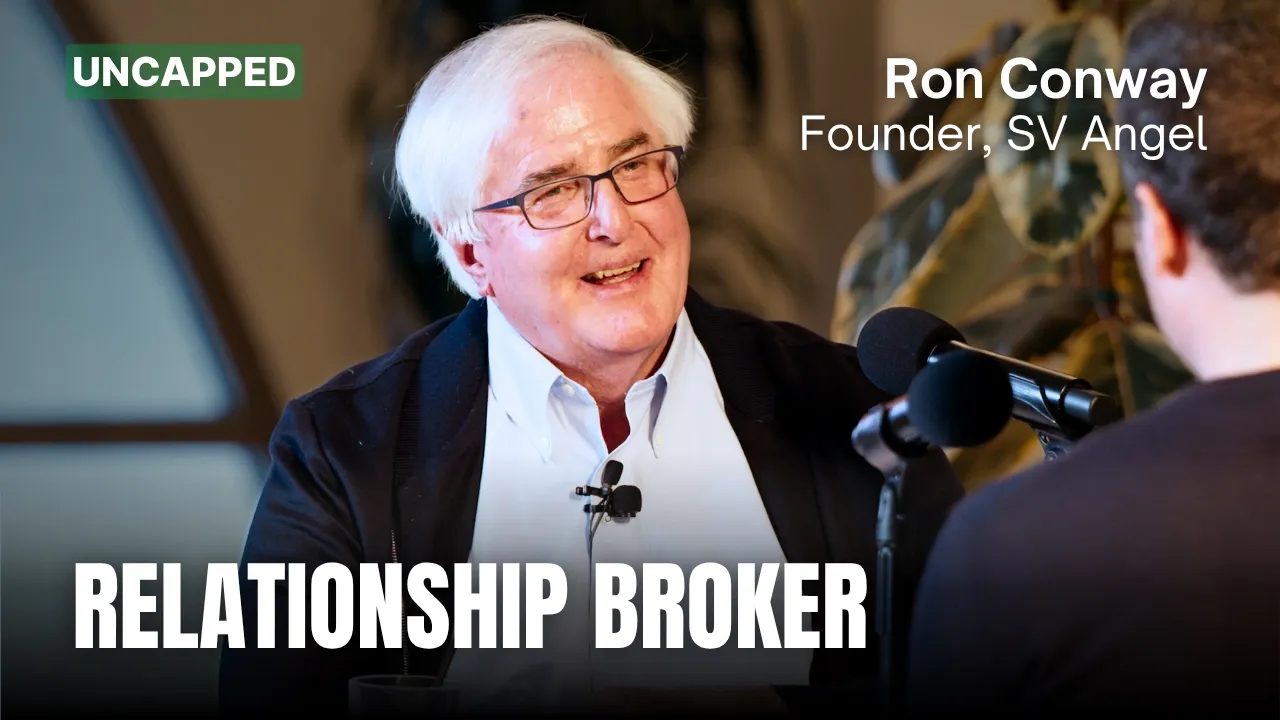
SV Angel’s Ron Conway: Silicon Valley’s Relationship Broker | Ep. 45
Description
Ron Conway is the Founder and a Managing Partner of SV Angel. He has been an active angel investor since the mid-90s and has received wide recognition for his role in the tech ecosystem. He has been included on Vanity Fair’s 100 most influential people in the Information Age, awarded Best Angel at the TechCrunch Crunchies Awards, and has been named on Forbes Magazine's Midas list of top “deal-makers” since 2011. Prior to founding SV Angel, Ron was with National Semiconductor Corporation in marketing positions (1973-1979), Altos Computer Systems as a co-founder, President, and CEO (1979-1990), taking the company public on Nasdaq in 1982. Ron reflects on decades of investing, from semiconductors to AI, and what it really means to be an “all in” partner to founders. He shares how relationships compound into an unfair advantage, why the best investors show up at inflection points, and how being willing to fight, whether in boardrooms or Washington, can change outcomes. Timestamps: (0:00) Intro (1:50) From semiconductors to AI (8:39) Two investments that changed everything (11:46) Nonpassive angel investing (14:57) Becoming a relationship broker (18:00) Building authentic relationships (24:48) Going deep with OpenAI and Airbnb (29:19) Fighting for founders (31:39) Remarkable returns at seed (33:20) The state wealth tax (37:17) Tech and politics Links: https://x.com/RonConway https://x.com/jaltma https://svangel.com/ https://uncappedpod.com/ friends@uncappedpod.com
Summary
Generated by claude-haiku-4-5-20251001SV Angel's Ron Conway: Silicon Valley's Relationship Broker
Main Topics
- Career Evolution: Conway's journey through semiconductor, computer, software, internet, and AI eras
- Angel Investing Philosophy: The power of relationship-building and active founder support
- Building Networks: How Conway developed a world-class relationship infrastructure
- Inflection Points: SV Angel's strategy of deep involvement during critical moments
- Civic Engagement: Tech industry's responsibility in politics and policy-making
- Portfolio Strategy: Thematic investing approach across different technology cycles
Key Points
Career Arc & Philosophy
- Conway has lived through every major technology cycle since semiconductors, starting at National Semiconductor
- Core lesson: "If you don't disrupt yourself, you will be disrupted"
- Went from running Altos Computer (IPO 1986, sold to Acer) to becoming an angel investor through Don Valentine's mentorship
- Has invested in defining companies: Google, Facebook, LinkedIn, Stripe, Airbnb, Pinterest, PayPal
Angel Investing Approach
- SV Angel's model: "All in or don't bother" — advocates for founders across all dimensions
- Helps with non-traditional problems: founder health crises, family issues, regulatory challenges
- Established relationships with UCSF medical departments to help founders navigating health issues
- Focuses on solving "unusual stumbling blocks" that go beyond traditional business problems
Relationship Building & Brokering
- Key insight: Relationships are SV Angel's most valuable asset
- Personality trait requirement: Must genuinely enjoy meeting people and connecting them
- Mark Andreessen calls him "the human router"
- Built network organically over 40 years through career progression:
- Started at National Semiconductor → led to Apple connections (Mike Markula, Mike Scott)
- Software executives → Internet company founders
- Board positions at major companies → extensive executive relationships
- Keeps track of "big" introductions; memorable recent example: Eric Yuan (Zoom founder) accosted him in parking lot thanking him for early advice
- Mindset: Constantly thinking about who to connect without expecting immediate returns
Deep Engagement Strategy
- Inflection Point Model: SV Angel doesn't micromanage but provides intensive support during life-or-death situations
- Example - Airbnb during COVID:
- Board told Brian Chesky the company was done
- Conway convinced him otherwise and mobilized to raise capital
- Raised "a couple hundred million" in 10 days when founders were told raising was impossible
- Used unconventional instruments (Silver Lake financing)
Fearlessness & Fighting
- Core principle: "Fearless for founders"
- Examples of aggressive advocacy:
- Silicon Valley Bank Crisis (2023): Didn't sleep for three days; pressured FDIC and Congress to guarantee deposits before Tokyo market opening
- OpenAI coup: Fought to ensure Sam Altman was reinstated; "took no prisoners"
- Napster/Soapapipa era: Literally stood on soapbox at City Hall to fight music industry regulations
- Willing to make enemies and endure media criticism
- Has conviction and knows "how to wiggle into solving problems"
Thematic Investing
- SV Angel maintains a list of ~6 themes at any given time
- Any company fitting those themes gets considered; companies outside themes are quickly rejected
- Examples of themes:
- Search (Yahoo, Ask Jeeves, Lycos era)
- B2B
- AI (current dominant theme)
- Early AI: First angel investment ever was Natural Language Inc. (1980s) — way too early
- Current approach within AI requires being thematic about which AI applications to pursue
Portfolio Construction
- Invests in many companies; hits some mega-winners (Google, Facebook, Stripe, etc.)
- Diversified approach with concentrated winners driving returns
- Must have thematic conviction about what will "explode"
- Competitive nature and dislike of losing drives rigorous selection
Civic Engagement & Politics
- SV Angel founders encouraged to be civically engaged, meet local politicians before crises occur
- Tech industry should emphasize job creation to lawmakers
- Currently fighting California wealth tax proposal:
- 5% tax on all assets (house, art, cars, everything)
- Worse provision: taxes based on voting control, not ownership percentage
- Example: Larry & Sergey taxed on 80% of Google market cap even though they own ~10%
- This forced them to leave California
- Strategy: Negotiate with Governor Newsom to keep it off ballot via counter-initiatives
- Only one healthcare union behind it (self-appointed leader)
- Has built relationships with key politicians (Nancy Pelosi, Schumer, state senators, governors)
- Relationship approach: Non-transactional long-term cultivation, not one-time asks
Family Legacy
- Three sons involved in venture:
- Topher: Works at SV Angel
- Ronnie: Runs A Capital
- Danny: Runs Symphony
- Didn't push them; they naturally gravitated to the business
- All work from same office; shares values of loving founders
Notable Quotes
> "If you don't disrupt yourself, you will be disrupted."
> "You got to recognize the problem, want to solve it and have conviction and want to win. And off you go."
> "No VC comes close to [our] relationship network."
> "I can call people up now and say, you want to do it the hard way or the easy way?"
> "Fearless for founders. That's what we're about."
> "We are always on for founders. We're advocates for founders. We're always on."
> "My wife hates meeting new people. I happen to love meeting new people. If you don't have that trait, it's going to be harder for you."
> "I love connecting people because something good is going to happen."
> "Some companies go out of business because they shouldn't [because of bad advice or lack of support]."
> "If I had a gravestone, just 'fearless for founders.' That's what we're about. Because founders do get abused."
Takeaways
For Seed Investors
- Build Authentic Relationships First: Don't approach relationships transactionally; cultivate over decades so you're available when founders need you
- Develop a Network with Intention: Start in one sector, move deliberately through industries, maintain relationships across all of them
- Add Value Beyond Capital: Be an advocate across all dimensions—personal, professional, regulatory, medical, emotional
- Practice Active Engagement at Critical Moments: Don't micromanage, but when founders hit inflection points, go all-in
- Be Thematic: Have conviction about what will explode; quickly reject companies outside your themes
- Know Your Competitive Edge: Conway's edge is relationships; know yours and lean into it
- Be Willing to Fight: Defend founders fiercely; be prepared to be disliked; have conviction
For Founders
- Choose investors who are "always on" and willing to go deep during crises
- Make sure your angel investors have genuine relationships with potential partners/customers/acquirers
- During crises, find advisors willing to make aggressive moves (like Conway's 10-day fundraising during COVID)
For the Tech Ecosystem
- Civic engagement isn't optional—founders and investors should build political relationships before they need them
- Tech industry must advocate for itself in policy debates based on job creation
- Investors should help founders navigate non-business crises (health, family, regulatory)
- Relationship-brokering creates network effects that benefit the entire ecosystem
Core Life Lesson
Conway embodies a philosophy of relentless service to founders combined with aggressive defense of their interests. Success comes from:
- Genuine enjoyment of people and connection
- Playing the long game
- Having conviction and fearlessness
- Recognizing problems and committing fully to solving them
Transcript
You got to recognize the problem, want to solve it and have conviction and want to win. And off you go. I can call people up now and say, you want to do it the hard way or the easy way? [SPEAKER_00] God, I would hate to get that call from you. Thanks. Cool. All right. Well, this is my first go at a live podcast. So I don't know what's going to happen, but we both have a sufficient number of microphones on that this will be good. Yeah, yeah. And I feel rude not facing the audience, but because it's a podcast. The audience is out there. [SPEAKER_01] And my camera is there. If you're back there, don't think I'm rude. That's right. I'm doing what we do on podcast. And I'm going to leave the second we're done. The second we're done. Because I have Nancy and Paul Pelosi sitting with Gail and I on the floor of the Warrior Game tonight. And if you know Nancy Pelosi, she is always prompt and has told me to be prompt. We will not be late. And we're going to get to that type of thing as one of your superpowers. So everybody knows who you are. But as I was thinking about this conversation and this audience, we have a bunch of seed investors here in various forms of the job and various stages in their career. And you are the person who is the archetype of angel investing. You've been almost embarrassingly successful investing in Stripe and LinkedIn and Facebook and Google and PayPal and Airbnb and Pinterest and almost more than it's reasonable to name. And so what I wanted to do was try to open up how you've made that happen and have you look back over the decades of your investing and try to glean what an investor in 2026 can learn from you and your success and try to take for themselves. I think the place I wanted to start was if you could try to give your own narrative of your own career, starting from when you first got into investing and what played out over time just to ground us in what your professional life has been all about. [SPEAKER_01] Well, I think it all starts with age and seniority. And speaking of age and seniority, your mom is here and I want to recognize her. My mom's young. What? My mom is young. There's no age and seniority. [SPEAKER_01] Hey, I view myself as young too, but I want to recognize that mom is here. And we had a good time at Sam's 40th. And this is why I bring up age. Because I've been through every technology cycle, starting with semiconductors, which is where I started my career. I did not like school. I couldn't wait to get out of school. So I left San Jose State. And the next Monday, I started work at National Semiconductor in the Santa Clara Valley when most of Santa Clara Valley was fruit orchards and an occasional semiconductor factory. So I went through the semiconductor phase, which gave way to the computer phase. It gave way to the software phase. And then into the 90s with the internet boom. And then today, the AI boom. The AI boom is bigger than all of those combined, I swear to God. It's hard to fathom. It's hard to keep up with. But I think we all have that problem because there's so much change happening at once. Even in the internet boom, you could keep track of things. Netscape was mission central. Netscape's the one that allowed you access to all of this corpus of information on the web. And from that, we got the internet boom. So I was fortunate to go work at National Semiconductor. A few people at National went off and started a company called Altos Computer. They asked me to join. This is when the microcomputers were disrupting DEC, Data General, Prime, Wang. Does anybody remember these names? But this little Altos computer was upending them. So technology is all about disrupting. So we were disrupting the many computer companies. And I love it because I interviewed sitting on the floor. There are no desks, nothing. I was the head of sales on Walsh Road in Santa Clara, literally five blocks from National Semiconductor. And because I was the sales guy and justifiably so, technology companies are engineer driven. And our engineering CEO, Dave Jackson, who had more charisma, you know, this Brit just eeked charisma and helped me close anything that was hard to sell. You're the sales guy. You sit next to the copy machine next to the factory, which is just fine with me because I was traveling a lot anyway. So we built Altos. Altos went public. We had a very successful IPO. And what year was this? I want to say '86. [SPEAKER_00] Mid-80s, yeah. But our stock went public at $21. We had our closing dinner at Club 21 in New York. I told my wife when I left, this is not a normal business trip. We're going public. At the end of this week, we're going to be what we call wealthy. And she said, you are so full of shit. And she happened to go to the bank the day we went public. And I sold some stock. And the guy goes, this is like the biggest deposit we've ever had. And she called me up in New York and said, what in the hell is going on? You've done something bad. I said, no, no, we just went public. She's like, you need more IPOs. What? She's like, you need more IPOs? Yeah. Yeah. So I ran Altos, but we ran into bumpy water because along came, you know, if you don't disrupt yourself, you will be disrupted. That's one of my benchmark sayings. If you don't disrupt yourself, you will be disrupted. And we were complacent. We had a great IPO, King of the Hill, you know, we thought we were King of the Hill. And along came this little thing called the PC connected to the Ethernet, which replaced these multi-user systems. So we had to sell the company to Acer. The value of our real estate. Don't disrupt yourself, you will be disrupted. That's one of my benchmark sayings for my new company. If you don't disrupt yourself, you will be disrupted. And we were complacent. We had a great IPO, we thought we were King of the Hill. And along came this little thing called the PC connected to the Ethernet, which replaced these multi-user systems. So we had to sell the company to Acer. [SPEAKER_01] The value of our real estate. [SPEAKER_01] And I told the Stace when I was selling them, this real estate is worth a hundred million. [SPEAKER_01] So it doesn't really matter what you pay for anything else. [SPEAKER_01] And it's on Trimble road. [SPEAKER_01] That real estate's now probably worth a half a billion. [SPEAKER_01] So then I was out of a job and Don Valentine was our lead board member. [SPEAKER_01] Everyone knows Don Valentine, the founder of Sequoia Capital. [SPEAKER_01] He came on the board very soon, was the only investor, came on the road show with us. And Don, he has two sons and a daughter, and any father, I'm going to see where that daughter goes. He picked Altos out of his whole portfolio because he liked our culture. [SPEAKER_01] And another thing that a founder has to do is build the culture. [SPEAKER_01] Some companies have bad culture. [SPEAKER_01] They allow philandering, et cetera, et cetera. [SPEAKER_01] That's not a good culture. Those people are not role models. I'm just not going to name them. [SPEAKER_00] We can name a couple if you want, but think of it. But culture's important. And he knew that we built a great culture and we had all these young kids. Dave Jackson's kids worked there. It was a really cool place. And our motto was play hard, work hard. There was alcohol, but it was on Friday night. And then Monday, everyone back to work. So Don says to me, what the hell are you going to do? And I said, let me tell you, I don't like managing people. I found that out because of close to a thousand people. And you just become an HR director, in my opinion. Some people like managing and God bless those people. We need managers. And Don said, well, if you don't like managing people, why don't you come hang out with me, come to board meetings and watch me give founders advice. You've already been a founder, so you know what it's like. And why don't you become an angel investor? So I went to board meetings with Don. And in the middle of the first board meeting, I was spellbound because he was giving this founder advice that I knew I could give to the founder. So I just started investing in startups on my own. And that led to becoming institutional, et cetera, et cetera. [SPEAKER_00] Was there a moment in your early angel investing journey where something important happened? [SPEAKER_00] Like, was there a seminal investment that changed everything for you? [SPEAKER_00] Was it a slow build? [SPEAKER_00] How did you go from just sitting in that first board meeting to getting the traction that you got? We made a bunch of investments and a lot of them failed. The very first angel investment I ever made was a company called Natural Language Incorporated, Berkeley, California. [SPEAKER_00] Natural language. Sounds like AI. AI, my first investment ever. I'm not exaggerating. Now, I dredged this up after the AI who would care five years ago. But it was run by two guys, John Manfredelli and Ginsburg. I forget his first name. My synapses aren't working right now. Way too early for AI. So guess what we did? Like all good founders, let's go find a home for ourselves. [SPEAKER_01] We went up to Microsoft and Bill Gates already was all over AI and he wanted the team. So we brought the team up. I didn't tell him, but we were out of payroll. And he goes, I'm going to buy the company. I said, we've got to buy it today. And he goes, I'm going to buy the company. I said, no, we're going to do it today because otherwise I'll go sell to somebody else. He got really furious. And down came the guy who now owns the Giants, who is the general counsel. Because I said, you can't leave until we sign the deal. And he goes, well, how about it became a game. How about if I bring down my general counsel and he doesn't leave until the deal's done so I can go run my company? I said, no, that's good. Manfredelli still works at Microsoft. [SPEAKER_01] But the investment that kind of got the clock ticking and things going was Ask Jeeves. [SPEAKER_01] Ben Rosen and I, Ben Rosen was a Morgan Stanley star analyst who loved and covered Altos Computer. [SPEAKER_01] Morgan Stanley, Altos was always a buy. [SPEAKER_01] We all loved each other. [SPEAKER_01] He went and started Rosen Partners. Compaq and Lotus were his wins. He retired from there when I was getting started. And he said, Ron, let's go do this together. Just investing our own money together. Nothing formal. But Ben sourced Ask Jeeves, not me. The guy on the East Coast sourced Ask Jeeves in Berkeley. And him and LJ7, they each had a private plane. This is years ago, but they each had a private plane. I would pick them up at the airport. And we'd go. We wouldn't have a board meeting. We'd have a build the company meeting. And the three of us, with the founders of Ask Jeeves, built that company together. And it was so much fun. The funnest part was in the car. Me, much younger than the two of them, chauffeuring these two who were pretty old at the time. And the things that they would say and the stories they would tell. And it was all about, we're going to make Ask Jeeves a huge company. [SPEAKER_00] It's interesting hearing you talk about this because you've used the language around building companies a lot. [SPEAKER_00] And I know also in a lot of the companies you've been involved with later, like Airbnb and OpenAI, I know you really get in there. And the three of us, with the founders of Ask Jeeves, built that company together. And it was so much fun. The funnest part was in the car. Me, much younger than the two of them, chauffeuring these two who were pretty old at the time. And the shit that they would say and the stories they would tell. [SPEAKER_01] And it was all about, we're going to make Ask Jeeves a huge company. [SPEAKER_00] It's interesting hearing you talk about this because you've used the language around building companies a lot. [SPEAKER_00] And I know also in a lot of the companies you've been involved with later, like Airbnb and OpenAI, I know you really get in there. [SPEAKER_00] I think there's a reputation a lot of people associate with angel investors that is extremely passive. [SPEAKER_00] And I don't think you think of it that way. [SPEAKER_00] Have you, what is your experience of what angel investing looks like when it's done well? [SPEAKER_00] Is it passive or should it be active? [SPEAKER_00] What's the boundary? Well, with SV Angel, you're all in or don't bother. And we've always taken the approach that if SV Angel had a moniker, it would be advocates for founders. But how we approach investing is a holistic approach. We want to help the whole founder. We want to help them advance their career because when they start, they have no experience whatsoever. We want to help them build their team. But along the way, they're going to run into all kinds of stumbling blocks. And we are afraid of no stumbling block. But these are unusual stumbling blocks. I get the call. My mom just got diagnosed with stage four breast cancer. How am I supposed to run this company and help my mom? And off we go. We have formed a very close partnership with UCSF in San Francisco. One of the best medical centers west of the Mississippi. [SPEAKER_01] We know every department head. [SPEAKER_01] They make us go through procedures. [SPEAKER_01] Occasionally, I violate those and go directly to the head of neurology, the way I did last summer for a luminary in this valley. [SPEAKER_01] And I wanted, I'm digressing here, but his name's Andy Josephson. [SPEAKER_01] I was in Venice. I got a call in the middle of the night from your brother. Hint, hint what company it was. And I went to work. [SPEAKER_01] And before morning, Andy got the hint. Because I said, I want to know what doctor you're going to assign. And he said, he gave me a bunch of names. And I said, well, give me a name. Give me a name. He goes, how about if I am the attending? The head of all neurology of UCSF. I said, Andy, took you a while, but you got it right. Okay. He's in the car now coming to see you. I don't want anyone less than. So what we do brings some comfort to the founder and the family. [SPEAKER_00] You're talking about the ability to do that. [SPEAKER_00] And, right after this, you are going to go see Nancy Pelosi. [SPEAKER_00] And part of my experience with you when you invested in my company, Lattice, was somehow, and I knew you were involved in a lot of companies, but if I called, you answered. [SPEAKER_00] And you connected me to Mark Benioff. [SPEAKER_00] And then you took it. [SPEAKER_00] And so. [SPEAKER_00] Don't ask me to do that now. [SPEAKER_00] I won't do it one time. It was a one-time ask. We don't have troops and I don't talk to Benioff. [SPEAKER_00] Well, we'll. [SPEAKER_00] Politics comes in 20 minutes. [SPEAKER_00] But part of, I think, what allows you to do what you've done must be having the ability to be a power broker. [SPEAKER_00] And to have these connections. [SPEAKER_00] And I feel that in some ways, there's firms now who have built a brand around that. [SPEAKER_00] Andreessen comes to mind. [SPEAKER_00] But you obviously have done that on your own. [SPEAKER_00] And you've been able to be in touch with the right regulators so that you can help a marketplace that is running into issues with the city or things with the hospital or CEOs of big companies. [SPEAKER_00] What did it take to get to a place that let you have those relationships where you could help companies in a real way with a small amount of your time? [SPEAKER_00] Because I think that's the only way that this works. At SV Angel first. Everyone in the firm has an attitude of. We are always on for founders. We're advocates for founders. We're always on. If they have a problem at two in the morning and I'm in Venice, I'm picking up the phone. But instead of the word power, I would swap in the word relationship. SV Angel has built a relationship network. No VC comes close to. Andreessen Horowitz has tried and succeeded. Mark and Ben take tiny salaries and they have a huge service org. But some of it is organic. For me, it's because I started my career at National Semiconductor. Guess what Steve Jobs did when he started his, first it was semis and then the PCs. When Jobs started the PC, the only place he had to go to find executives was the semiconductor companies. So he went and got Mike Markle, let him be the chairman. And he got Mike Scott, who was the head of hybrid semiconductors at National Semiconductor, to be the president of Apple. [SPEAKER_01] I'm sitting in Mike Scott's office one day and he goes, I'm going to Apple. [SPEAKER_01] And I said, what the hell is Apple? [SPEAKER_01] And he goes, well, it's this microcomputer thing and I'm sick of building semiconductors. [SPEAKER_01] And then Jobs came back to get Floyd Kwame to be the first VP of marketing of Apple. [SPEAKER_01] So based on National Semiconductor, I had two relationships at Apple Computer. [SPEAKER_01] And then just imagine that flywheel going for 40 years. [SPEAKER_01] Because then I went into software. I got to know every single software executive. A bunch of them peeled off and went to Internet companies. So when our founders need help, I have this Rolodex. Some of them are getting old. But I have this Rolodex of any company. And what was fortunate is we ended up investing in some of the defining companies like Google, Twitter, Meta. Which creates more relationships. A lot of our founders need distribution deals from. Yeah. So then based on National Semiconductor, I had two relationships at Apple Computer. And then just imagine that flywheel going for 40 years. Because then I went into software. I got to know every single software executive. A bunch of them peeled off and went to Internet companies. So when our founders need help, I have this Rolodex. Some of them are getting old. But I have this Rolodex of any company. And what was fortunate is we ended up investing in some of the defining companies like Google, Twitter, Meta. Which creates more relationships. That a lot of our founders need distribution deals from. Yeah. And we built the management teams of those companies. Those are very easy calls to call Chris Cox and say, hey, I'm sending somebody over. [SPEAKER_00] I assume you think that being a relationship broker is very important to being a good seed investor. It's our most valuable asset. [SPEAKER_00] What do you do to nurture it? [SPEAKER_00] Because obviously, it couldn't have happened without some of those early relationships. [SPEAKER_00] But there's a lot of other people who have early relationships like that that don't turn into a relationship broker the way you have. [SPEAKER_00] So I'm curious if you can talk about some of the things that you've done to authentically build those. [SPEAKER_00] I've watched you at an event where you're thinking about making... you pull two people together at a party and say, you guys should talk. [SPEAKER_00] You're like, I'm not going to get anything immediate out of this. [SPEAKER_00] But I see you constantly brokering these relationships. [SPEAKER_00] So what's going through your head as you navigate the world to cultivate this? Well, first of all, you have to have a personality where you enjoy meeting new people. I love meeting new people. [SPEAKER_01] My wife hates meeting new people. [SPEAKER_01] I would imagine 40% of the population hates meeting new people. [SPEAKER_01] They're shy. [SPEAKER_01] They're not interested. [SPEAKER_01] There's various reasons. [SPEAKER_01] I happen to love meeting new people. [SPEAKER_01] So I love gathering people. [SPEAKER_01] If you don't have that trait, it's going to be harder for you. [SPEAKER_01] And then I love connecting people. Mark Andreessen calls me the human router. That's a compliment. [SPEAKER_01] I love connecting people because something good is going to happen. I mean, if I made a list of all of them, it'd be a long list. So you're obviously not keeping track, though. You're, of course, just doing this and who knows what will happen. What's the mindset? [SPEAKER_01] I keep track of the big one. Actually, you do. I keep track of the big one. I keep track of the big one. So tell me about that. [SPEAKER_00] You keep track of the big one. You know, very key intros. Yeah. Yes. It was just somebody yesterday was telling me. I wish I could remember. But they were bragging about this thing. And I said, who do you think did the original intro? And they kept talking. And I said, I did that intro. And then they looked at me like I was nuts. And then I just described it exactly. And they go, oh, yeah, you obviously put that deal together. I said, yeah. But then I moved to the next one. We have a lot of founders. [SPEAKER_00] And there's a lot going on. [SPEAKER_00] So is it a constant background function for you as you're meeting people of who could I be connecting? [SPEAKER_00] Oh, hell yes. [SPEAKER_00] And we love helping all founders. Yeah. Oh, now the synapses are going to fire. Cloudflare. Yeah. Cloudflare. That company had all kinds of problems in the early days. I helped that company because they were part of the ecosystem. If a founder stops me and has a problem I can solve, I'll solve it. Even though, here's a good one. The founder of Zoom, Eric Yuan, accosted me in a parking lot a long time ago. As I'm getting in my car, he goes, I actually alarmed you. And he said, guess what you did for me? And then he described, I got in the car, shut the door. And I only saw him after Zoom. He reached out to me and he said, well, I ran into him somewhere. [SPEAKER_01] And he goes, we got to talk about the parking lot. And I said, what parking lot? He goes, you sat in a parking lot and gave me a whole bunch of advice at the beginning of my career. [SPEAKER_01] I said, yeah, that's fun. Yeah. It's interesting because I think as a seed investor, you can be sitting around. If you wake up one morning, you're like, what should I do today? There's like the, I think the common body of work is, what are the companies I should go try to meet and get time with? And I feel like there's another orientation, which I feel like you very much have, which is just, who could I be connecting today? And what are the people I know that I could be putting in touch with each other? I think that's something that you have to have a long-term commitment to. [SPEAKER_00] You can't just do that one time. Well, it's a commitment to the ecosystem. The tech ecosystem in the Bay Area is really, really important. [SPEAKER_00] Do you go out of your way to go build relationships in other ecosystems? [SPEAKER_00] Like, for example, are you ever like, I should go meet people. [SPEAKER_00] I should go spend time with this part of the government or these people in Hollywood or whatever, because I just know that somebody in tech will need this. Very premeditated. Media, we were way too early. We were poking around Hollywood in, you know, 1988 because of Len Armato, Shaquille O'Neal's agent at the height of the Lakers. He was a tech nut. And he goes, it's all going to happen tomorrow. Streaming, audio, video. We invested in audio and video companies way too early. Now, we did not invest in YouTube, but I sat in the rat infested place in San Bruno with Chad and Steve, because that's a company I knew was exploding. [SPEAKER_01] That one, I actually drove, parked, put money in the meter, went in and said, guys, I want to be of service. [SPEAKER_01] Video is going to explode. [SPEAKER_01] But then we had all the copyright issues. [SPEAKER_01] And I feel so sorry for them. He was a tech nut. [SPEAKER_01] And he goes, it's all going to happen tomorrow. [SPEAKER_01] Streaming, audio, video. [SPEAKER_01] We invested in audio and video companies way too early. [SPEAKER_01] Now, we did not invest in YouTube, but I sat in the rat infested place in San Bruno with Chad and Steve, because that's a company I knew was exploding. [SPEAKER_01] That one, I actually drove, parked, put money in the meter, went in and said, guys, I want to be of service. Video is going to explode. But then we had all the copyright shit. And I feel so sorry for them. Chad, by the way, sits two seats down from us tonight because they knew they had to sell. Now, thank God they sold to Google and we know what happened to Google stock. And they deserve all of the benefits those two have gotten. But they knew they didn't have enough lawyers and infrastructure, et cetera. There is a right time to sell. So we tend to actually predict stuff early, look at natural language. [SPEAKER_00] But so if you're thinking about I need to go deeper with the government because I've got a lot of companies bumping into regulations and things like that, you'll go to what? Go to D.C. for a week and just spend time with people? Or what's that look like? Well, I've always felt the tech industry should be civically engaged generically. We have to vote. We have to tell legislators about all the jobs we're creating. And if we run into trouble, they should be loyal to us because of job creation. The reason I love Nancy Pelosi, you say job creation to her and she doesn't care what it is. [SPEAKER_01] If it's creating jobs, I'm going to help. [SPEAKER_01] She gets it. [SPEAKER_01] But there's a lot of lawmakers, Bernie Sanders, God help us, who don't get it, who want to demonize tech. [SPEAKER_01] And all they're doing is costing America jobs. That's not fair to anybody. So, yes, I've made it my business over the years to always know the two state senators, know the governor, know Nancy and Schumer. [SPEAKER_00] And building a relationship with them is hard. [SPEAKER_00] But it's true. [SPEAKER_00] I mean, coming to those relationships transactionally is never going to work. [SPEAKER_00] They have everybody coming to them transactionally all day. Exactly. [SPEAKER_00] And I guess you have to build. I mean, you did it naturally, but you built those kinds of relationships over the course of your career, of course. [SPEAKER_00] To be able to help the next person, you've got to have done something before. Exactly. [SPEAKER_00] Before we come back to politics, there's a couple more investing things I wanted to get your take on. [SPEAKER_00] There's a few times where I've observed you going really deep with a company that maybe you made a small investment in early and then you might have invested more. [SPEAKER_00] But you take these really deep engagements. [SPEAKER_00] I know you've worked with my brother at OpenAI. [SPEAKER_00] I think you've gone deep with Airbnb. [SPEAKER_00] How do you think about that work as it relates to the business of angel investing or seed investing? [SPEAKER_00] Is that something that you think, looking back, has doing that with a small number of companies been important? [SPEAKER_00] Was that just fun? [SPEAKER_00] Is it both? [SPEAKER_01] SVAngel always gets involved at what we call inflection points. [SPEAKER_01] And we tell founders, we're not going to bother you. [SPEAKER_01] We're not going to look over your shoulder. [SPEAKER_01] But if you're at an inflection point where it's a life and death situation, that's what we're good at. [SPEAKER_01] So you come to us when you're at an inflection point. [SPEAKER_01] COVID hits and Brian Chesky's board tells him, Jesus, have we got a company? [SPEAKER_01] And poor Brian was struck by that and calls me. [SPEAKER_01] And I said, you bet your ass we have a company. [SPEAKER_01] You're going to have to make some hard decisions. [SPEAKER_01] He already knew what they were. [SPEAKER_01] He was going to have to lay off half the company. These founders are smart. But that was a crisis where he was being told that the game was over. [SPEAKER_01] And I was, the game is not over. [SPEAKER_01] The game is just starting. [SPEAKER_01] It was so bad. [SPEAKER_01] I said, hey, this is COVID. COVID is Armageddon. When the three of you are free, Joe, Nathan, and Brian, you call me. I don't care if it's three in the morning. But I'm going to give you a little lecture about who's in charge here. You're in charge of your own destiny. I know we can go raise. We raised a couple hundred million. They were told that they could not raise anything. Zero. Do not bother to raise money. You can't raise money. There's this thing called COVID. I said, you're being given a bunch of bad advice and we're going to go raise the money. And in 10 days, we had the money. We didn't have it where I thought we were going to get it, but that didn't matter. We got it from Silver Lake in some fancy instrument. God bless Silver Lake. [SPEAKER_01] And Silver Lake's quite happy right now with that. [SPEAKER_01] So these inflection points, they're obvious. [SPEAKER_01] A founder who's really in need. [SPEAKER_01] They matter so much to a founder. And we're going to put all of our stuff to the side and go help. The Silicon Valley Bank crisis, which hit the day of our founder summit three years ago, was definitely the most consequential project I've ever worked on and probably the most consequential. And I never thought about that until just a couple of months ago because of having dinner with Wally Adeyamo, Deputy Secretary of Treasury under Janet Yellen during SVB. He said to me, do you understand what you did and how it came down and you got really nasty at the right time? Well, the government wasn't doing anything. And all they needed to do was guarantee the deposits. [SPEAKER_00] So what'd you do? Well, I didn't sleep for three days, but by Sunday morning, about six hours before the Tokyo stock market opens, we had to have this solved or there was going to be a worldwide financial crisis. And we had people in Washington, D.C. who didn't get it. So by Sunday morning, and Sherrod Brown's one of them, the head of the banking committee, hey, we can't spend too much time on this. Well, the government wasn't doing anything. [SPEAKER_01] And all they needed to do was guarantee the deposits. So what'd you do? [SPEAKER_01] Well, I didn't sleep for three days, but by Sunday morning, about six hours before the Tokyo stock market opens, we had to have this solved or there was going to be a worldwide financial crisis. [SPEAKER_01] And we had people in Washington, D.C. who just didn't get it. So by Sunday morning, Sherrod Brown's one of them, the head of the banking committee. We can't spend too much time on this. [SPEAKER_01] But the FDIC, which is the one who had to process, we're going to guarantee the deposits. [SPEAKER_01] They wouldn't budge. And I didn't realize it. [SPEAKER_01] They only report to Congress. [SPEAKER_01] It's very unusual because I'm like, who's your boss? [SPEAKER_01] I'm going to go talk to them. Nancy Pelosi, everybody. [SPEAKER_01] Their boss is Sherrod Brown and Maxine Waters. [SPEAKER_01] Sherrod in the Senate, Maxine in the House. [SPEAKER_01] So I was talking a lot to Sherrod and Maxine. [SPEAKER_01] And by Sunday morning, I got very firm with them. [SPEAKER_01] You're going to be responsible for a worldwide crisis. [SPEAKER_01] I don't know what the hell you're doing, but get off your duffs and make the announcement. It's an interesting thing about you because I feel like you love people. [SPEAKER_00] You're incredibly supportive of people. [SPEAKER_00] You're there for them in their times of need. [SPEAKER_00] But this story is an example. [SPEAKER_00] And there's a lot of other examples too, where you're also not afraid to fight and you're really willing to fight. [SPEAKER_00] Can you talk about an investor's role in those situations? [SPEAKER_00] I think there was a story recently where Neil at Green Oaks was in a real fight with government for a founder. [SPEAKER_00] And I think that's really important to do. [SPEAKER_00] You've been willing to do it. [SPEAKER_00] But it's different than the sort of, I love people, I'm going around and meeting. [SPEAKER_00] It doesn't naturally show up. [SPEAKER_00] I think from you, it's coming from a place of, I love my founders, so I'll fight for them. [SPEAKER_00] But can you talk about the mindset that lets you go fight? Well, you have to have conviction and know how to wiggle your way into solving that problem. The OpenAI coup, when Sam was asked to leave, was a good example. I had conviction that the founder had been mistreated and we were going to make that right. And we were taking no prisoners. And we did. We knew what we had to do and we went and did it. [SPEAKER_00] Do you think in general, Silicon Valley lacks the toughness needed in a lot of cases? [SPEAKER_00] Because I feel like other industries often will do this sort of tougher work at a higher rate. [SPEAKER_00] Do you feel like enough of it happens in tech? Probably not. There's a lot of companies that go out of business because they shouldn't. The other thing, this might sound trivial, but I do not like losing. I am competitive. [SPEAKER_00] You have to be okay with being disliked or having people mad at you. Well, I think if you're fighting for a founder, you have to be fearless. If I had a gravestone, just fearless for founders. That's what we're about. Because founders do get abused. What happened to Sam is unconscionable. But this does happen. And when that happens, we don't like it. [SPEAKER_00] And we get the blinders on until we fix it. [SPEAKER_00] I love it. [SPEAKER_00] One other investing topic I want to ask you about, and then I want to talk a little bit about politics. [SPEAKER_00] I want to hear about the way you think about building portfolios. [SPEAKER_00] And SV Angel has had remarkably good returns. [SPEAKER_00] You've taken a pretty diversified approach in general. [SPEAKER_00] You've made a lot of investments, then you've hit some really big companies. [SPEAKER_00] It sounds like throughout your career, you've invested in a lot of companies. [SPEAKER_00] What's your mindset when you think about what seed investing should look like in terms of concentration or exposing yourself to enough companies and all these things? Well, today it's easy because everything's AI. [SPEAKER_00] Yeah. But if you go back 40 years ago, SV Angel has always been thematic investors. I like what I do because it's interesting. And I watch founders succeed. Jack Dorsey. [SPEAKER_01] Watching Jack Dorsey go through troubles at Twitter, resurrected Square. It's the best thing that you could ever witness. We're always thematic. And we're thematic because it's interesting. So when I first started, I said, what the hell do we think is going to explode? You've got Yahoo and Ask Jeeves and Lycos. There were 10 search companies. Something must be going on in search. So search became a theme. B2B game a theme. We've always been thematic. We have this piece of paper. If I had it, we're always looking at probably six themes. Any company in that theme that comes in the door, we're going to at least take a look at. If it doesn't fit those themes, we pretty quickly turn them down. So SV Angel is very thematic oriented. Now within AI, we have to be thematic within AI because everything's AI. [SPEAKER_01] But we've always been thematic investors. I know we don't have much longer. And I really want to talk to you about politics. I know something that's important to you. You talked about how it's really important for you, think people in tech, companies in tech to be engaged. I know right now you really care about what's happening in the state. And in particular, I actually would love to start by talking about the wealth tax that is being proposed. And I know you've been fighting and you care a lot about it. Can you talk about why you think it's a bad idea? [SPEAKER_01] One more thing. SV Angel has always been civically engaged and encouraged founders to be civically engaged. [SPEAKER_01] So you know your local politicians. [SPEAKER_01] So when you have a crisis, you have a relationship. [SPEAKER_01] We're also philanthropically engaged. [SPEAKER_01] We believe founders want to give back. [SPEAKER_00] I know right now you really care about what's happening in the state. And in particular, I would love to start by talking about the wealth tax that is being proposed. And I know you've been fighting and you care a lot about it. Can you talk about why you think it's a bad idea? One more, one global SVH has always been civically engaged and encouraged founders to be civically engaged. So that your local politicians know you. So when you have a crisis, you have a relationship. We're also philanthropically engaged. We believe founders want to give back. Guess what? You have this byproduct that morale explodes when the company also has a philanthropic bent. But right now on this state wealth tax, I hate to be pessimistic and I'm not normally pessimistic, but we have a crisis where we have one SEI union that's associated with healthcare who has a ballot proposition. They need 900,000 signatures for it, which is possible. And when they get that, it will go on the ballot on top of all the other taxes we pay. It's a 5% wealth tax on every asset that you have. So if this happened, they would go through your house, appraise every piece of art, appraise your car and whatever that is, you pay 5%. What makes it worse is if you have voting control, like Larry and Sergey do. Larry and Sergey, let's say they own 10% of Google today. They have 80% voting control. Zuckerberg has the same thing. A lot of founders have this. This horrible piece of legislation says your tax is based on whatever that top number is. So even though Larry and Sergey don't own 80% of Google, they want to tax them for 80% of the market cap of the company. That is why Larry and Sergey had to leave. They didn't have a choice. There wasn't multiple choice for them. So this is one of the most onerous pieces of proposed ballot initiative. Our job is to get Gavin to negotiate this so that it doesn't get to the ballot. So maybe they don't get the signatures. [SPEAKER_00] Because you think if it gets to the ballot, it's got a good chance of going through? It could. We can't let that happen, in my opinion. And Gavin knows that, and Gavin's with us on that. So if they get the signatures, there will be—and they only have money for the signatures. They don't have money to even run a campaign. So they're not thinking that well. So at that point, there needs to be a negotiation to keep it off the ballot. That's why there are counter-ballot initiatives against this also getting signatures. We need a couple of those to get the 900K signatures as well, because that will give Gavin some bargaining chips. The other labor unions are furious at the healthcare guys. Imagine what the teachers' union thinks of this. Right. And all the other unions. This is all driven by the healthcare union. It's just one isolated healthcare union. There's even other healthcare unions. This is just one guy who is self-appointed. So the other unions, they're watching what's going on. Their blood pressure's going up. So that will be another negotiating lever that Gavin has. We must keep this off the ballot. So a whole bunch of work has to happen for that to happen. [SPEAKER_00] So obviously you're putting a lot of work in now. Were you doing this work earlier in your career as well? Or is this something that you've gotten to later in life as you've accumulated more influence? [SPEAKER_01] No, no, no, no. We started with Soapapipa when music first came to the internet. I hate to say it. Orrin Hatch and Dianne Feinstein. All the media people said, oh, they're going to take all of our music away. Also Napster. We were the first investors in Napster. And so we got involved in Soapapipa when they tried to outlaw media generated by the internet on the web. This is crazy. Topher will remember this. I said, so I was the rookie. So all these other lobbyists were telling us what to do. I said, what did we do? We've got to stop this. This is crazy. Well, you should go down to City Hall and stand on a soapbox. I said, oh, I've heard that saying all the time. And they said, no, no, no, we're not kidding. And we were in the middle of our weekly meeting. And they said, get down to City Hall. There's a whole bunch of cameras down there. You go down and you literally get on a soapbox. We'll meet you there. And you give your speech. A lot of good things are going to happen. I felt like a fool. I got on the soapbox, gave my lecture, lots of cameras. And we started to turn the tide. It's crazy. And Orrin Hatch, Sean Fanning helped a lot with that. I remember Sean Fanning happened to be with Orrin Hatch that day. And I said, Sean, whatever you're talking about, stop talking about that and tell him about this. He was the first senator to say, I'm voting against this. My pal, Sean Fanning. Yeah, I mean, it goes back to the thing I said earlier about your willingness to fight. I think a lot of people don't do this, even if they believe certain things. Because they're thinking, I'm going to have a lot of people mad at me. And if I'm running a company, a lot of things internally are going to come up. Or the media is going to say things. And I'm tired. And I've got a family. And I'm busy. And so I think a lot of people don't do it. Not because they don't care. But it takes a lot of courage and energy to do it. [SPEAKER_01] You've got to recognize the problem, want to solve it, and have conviction, and want to win. Yeah. And off you go. [SPEAKER_00] And I might, if I'm running a company, a lot of things internally are going to come up. [SPEAKER_00] Or just, the media is going to say things. And I'm tired. [SPEAKER_00] And I've got a family. [SPEAKER_00] And I'm busy. [SPEAKER_00] And so I think a lot of people don't do it. [SPEAKER_00] Not because they don't care. [SPEAKER_00] But it takes a lot of courage and energy to do it. You've got to recognize the problem, want to solve it, and have conviction, and want to win. [SPEAKER_00] Yeah. And off you go. In my later years, because I'm the one doing it and I've done enough of these, I can call people up now and say, you want to do it the hard way or the easy way? [SPEAKER_01] God, I would hate to get that call from you. [SPEAKER_01] Well, I did one today. [SPEAKER_01] That'd be tough. I did one today. That's tough. You mentioned Topher. You have three kids and work with kids over the course of your career. I think that's a beautiful thing. And I've got kids and something I thought about. [SPEAKER_00] I'm just curious what that's been like for you. [SPEAKER_00] It seems awesome. [SPEAKER_01] And it's been awesome. I did not ask my sons to get in the investing business. I thought it was interesting. But I don't tell people it's interesting. But one by one, they all left jobs in L.A. because they all went to UCLA and came up and said, hey, this looks pretty interesting. Topher left his job in L.A. and said, I just want to come find a place to work. So I'll sit in your weekly meetings and pick a company and start interviewing at a bunch of companies. And three weeks later, he goes, I don't want to interview. This is interesting just sitting here. It just seems like such a good way to have an adult ongoing relationship with your kids. [SPEAKER_00] Of course. And we all operate out of the same office. [SPEAKER_00] That's awesome. Ronnie has A Capital. Danny has Symphony. [SPEAKER_00] And we love founders. [SPEAKER_00] So good. [SPEAKER_00] Well, Ron, thank you so much for doing this. [SPEAKER_00] You're a total legend. [SPEAKER_00] I love learning from you. [SPEAKER_00] Thanks for making time for it. It's a pleasure. It's a pleasure. [SPEAKER_00] And now you'll be on time with Nancy. I know we don't have that much longer. And I really want to talk to you about politics. I know something that's important to you. You talked about how it's really important for you think people in tech, companies in tech to be engaged. I know right now you really care about what's happening in like the state. Um, and in particular, I actually would love to start by talking about the, the wealth tax that is being proposed. And I know you've been fighting and you care a lot about it. Can you talk about like why you think it's a bad idea? One more, one global SVH has always been civically engaged and encouraged founders to be civically engaged. So that, you know, your local politicians. So when you have a crisis, you have a relationship. We're also philanthropically engaged. We believe founders, you want to give back. Guess what? You have this byproduct that morale explodes when the company is also has a philanthropic bent. But right now on this state wealth tax, you know, I hate to be pessimistic and I'm not normally pessimistic, but we have a crisis where we have one SEI union. That's associated with healthcare who has, who has a ballot proposition. They need 900,000 signatures for it, which is possible. And when they get that, it will go on the ballot on top of all the other taxes we pay. It's a 5% wealth tax on every asset that you have. So if this happened, they would go through your house, appraise every piece of art, appraise your car and whatever that is, you pay 5%. What makes it worse is if you have voting control, like Larry and Sergey do. Larry and Sergey, let's say they own 10% of Google today. They have 80% voting control. Zuckerberg has the same thing. A lot of founders have this. This horrible piece of legislation says your tax is based on whatever that top number is. So even though Larry and Sergey don't own 80% of Google, they want to tax them for 80% of the market cap of the company. That is why Larry and Sergey had to leave. They didn't have it. There wasn't multiple choice for them. So this is one of the most onerous pieces of proposed ballot initiative. Our job is to get Gavin to negotiate this so that it doesn't get to the ballot. So maybe they don't get the signatures. Because you think if it gets to the ballot, it's got a good chance of going through? It could. We can't let that happen, in my opinion. And Gavin knows that, and Gavin's with us on that. So if they get the signatures, there will—and they only have money for the signatures. They don't have money to even run a campaign. So, you know, they're not thinking that well. So at that point, there needs to be a negotiation to keep it off the ballot. That's why there are counter-ballot initiatives against this also getting signatures. We need a couple of those to get the 900K signatures as well, because that will give Gavin some bargaining chips. The other labor unions are furious at the health care guys. Imagine what the teachers' union thinks of this. Right. And all the other unions. This is all driven by the health care union. It's just one isolated health care union. There's even other health care unions. This is just one guy who is self-appointed. So the other unions, you know, they're watching what's going on. Their blood pressure's going up. So that will be another negotiating lever that Gavin has. We must keep this off the ballot. So a whole bunch of work has to happen for that to happen. So obviously you're putting a lot of work in now. Were you doing this work earlier in your career as well? Or is this like something that you've gotten to like later in life as you've accumulated more influence? No, no, no, no. We started with Soapapipa when music first came to the internet. I hate to say it. Orrin Hatch and Dianne Feinstein. All the media people said, oh, they're going to take all of our music away. Also Napster. We were the first investors in Napster. And so we got involved in Soapapipa when they tried to outlaw media generated by the internet on the web. This is crazy. Topher will remember this. I said, so I was the rookie. So all these other lobbyists were telling us what the hell to do. I said, what the hell did we do? We've got to stop this. This is crazy. Well, you should go down to City Hall and stand on a soapbox. I said, oh, I've heard that saying all the time. And they said, no, no, no, we're not kidding. And we were in the middle of our weekly meeting. And they said, get down to City Hall. There's a whole bunch of cameras down there. You go down and you literally get on a soapbox. We'll meet you there. And you give your speech. A lot of good shit's going to happen. I felt like a fool. I got on the soapbox, gave my lecture, lots of cameras. And we started to turn the tide. It's crazy. And Orrin Hatch, Sean Fanning helped a lot with that. I remember Sean Fanning happened to be with Orrin Hatch that day. And I said, Sean, whatever the hell you're talking about, stop talking about that and tell him about this. He was the first senator to say, I'm voting against this. My pal, Sean Fanning. Yeah, I mean, it kind of goes back to the thing I said earlier about your willingness to fight. I think a lot of people don't do this, even if they believe certain things. Because they're like, you know, I got to go. I got to go have a lot of people mad at me. And I might, you know, if I'm running a company, a lot of, you know, things internally are going to come up. Or just, you know, the media is going to say things. And I'm tired. And I've got a family. And I'm busy. And so I think a lot of people don't do it. Not because they don't care. But it takes a lot of, like, courage and energy to do it. You've got to recognize the problem, want to solve it, and have conviction, and want to win. Yeah. And off you go. In my later years, because I'm the one doing it and I've done enough of these, I can call people up now and say, you want to do it the hard way or the easy way? God, I would hate to get that call from you. Well, I did one today. That'd be tough. I did one today. That's tough. You mentioned Topher. You have, you know, three kids and work with, you know, kids over the course of your career. I think that's, like, a beautiful thing. And I've got kids and something I thought about. I'm just curious what that's been like for you. Like, it seems awesome. And it's been awesome. I did not ask my sons to get in the investing business. I thought it was interesting. But I don't tell people it's interesting. But one by one, they all left jobs in L.A. because they all went to UCLA and came up and said, hey, this looks pretty interesting. Topher left his job in L.A. and said, I just want to come find a place to work. So I'll sit in your weekly meetings and pick a company and start interviewing at a bunch of companies. And, like, three weeks later, he goes, I don't want to interview. This is, like, it's interesting just sitting here. It just seems like such a good way to, like, have adult ongoing relationship with your kids. Of course. And we all operate out of the same office. That's awesome. Ronnie has A Capital. Danny has Symphony. And we love founders. So good. Well, Ron, thank you so much for doing this. You're a total legend. I love learning from you. Thanks for making time for it. It's a pleasure. It's a pleasure. And now you'll be on time with Nancy.