Inside Arca's Long-Horizon Agents That Run the Business - Aman Singh, Arca
Description
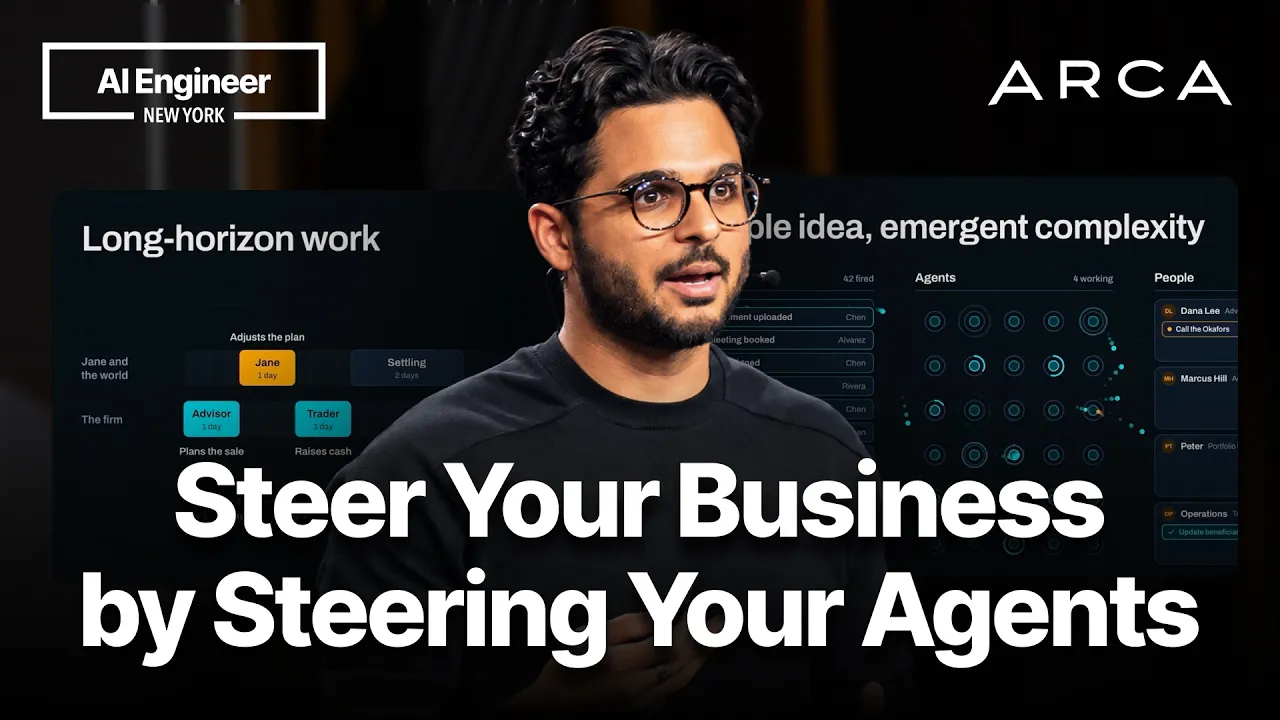
Arca is an AI-native financial services firm where agents don't assist the business, they run it. Aman Singh, who leads AI at Arca, shows how long-horizon agents own a client goal end to end across days of stop-start work: a signal system that keeps agents aware of emails, calls, custodian events and in-app actions; operational context and a harness to do the work; persistent memory; and shared spaces where agents pull in the right person at the right time. The result: agents prompt people more than people prompt agents, and the firm steers the business by steering its agents. Chapters 00:00 Intro: Arca, an AI-native services firm 01:19 Long-horizon vs long-running work 01:54 Example: raising cash for a client's tax bill 02:51 Agents own the outcome end to end 04:17 Following one signal: the journey of an email 05:28 Spaces: where agents pull in people 06:08 Agents watch the world so people don't have to 06:52 Handling a messy real world 08:24 The primitives of long-horizon work 09:00 Emergent complexity, and the last six months 10:11 Why do this? Agents run the business 11:15 Steering the business by steering agents 12:28 Using AI tools vs being AI native Aman Singh, Arca Join us in SF for the second annual AIE CODE summit: https://aie.codes our last flagship summit of 2026. Applications live now!
Summary
Generated by gpt-5.6-terraAt-a-Glance
- Verdict: Watch fully
- Core thesis: Arca defines an AI-native services firm as one in which persistent, event-driven agents own multi-day client outcomes end to end, prepare human actions, and can be redirected by changing business-level goals.
- Why it matters: This is a concrete control-plane pattern for long-horizon agent operations: agents monitor signals, retain case state, coordinate other agents and people, and escalate only the specific approvals or execution tasks that require humans.
- Best use: Use it as an architectural reference for building agents that run asynchronous operational workflows rather than chat-based copilots, especially where external events, handoffs, approvals, and durable memory matter.
Executive Summary
Aman Singh presents Arca as an applied-AI financial-services firm rather than a SaaS vendor. Its premise is that agents should not merely assist employees; they should own the progression of client outcomes across days or weeks. The representative workflow is raising cash for a client's tax bill: analyze holdings and tax consequences, respect client-specific constraints, route a trade to a human, wait for settlement, trigger an ACH, and react to client responses or other changes.
Arca's core implementation is an event- or signal-driven agent system. Background agents ingest emails, calls, documents, meetings, custodian events, market movements, and internal product activity. Agents can register interest in future events such as a client response or an ACH settlement, communicate changed state to other agents, and wake on schedules when an expected event does not arrive.
The speaker frames the necessary primitives as operational context for deciding what comes next, a harness of tools and guardrails for doing work, persistent memory for retaining state across a long horizon, and a shared workspace through which agents explain plans and pull in the right humans. Employees are meant to receive well-scoped, pre-prepared tasks after the agent has completed roughly 90% of the surrounding work.
The strategic claim is stronger than workflow automation: once agents can drive work through people, management can steer the business by setting agent goals. Arca's example is changing from reactive tax-bill handling to a January goal of proactively preparing every client's tax plan and presenting an advisor with a one-click approval email. The talk is conceptually useful and directly relevant to agent orchestration, though it provides no technical implementation details, performance metrics, or compliance/control evidence.
Key Takeaways
- Claim: Long-horizon agent work is primarily asynchronous, eventful case management rather than a single model run that reasons continuously for days. | Evidence: Arca's tax-payment example spans an advisor's analysis, a trader's liquidation, multi-day asset settlement, operations-triggered ACH, and additional waiting for client replies; Singh describes such work as a client goal spanning roughly 10 days with many actors, decisions, and handoffs. | Implication: Design agent systems around durable case state, pauses, resumption, and external dependencies—not only tool loops and token-efficient execution within one session.
- Claim: The control plane for long-horizon work is a broad signal system that makes agents continuously aware of both external events and internal workflow changes. | Evidence: Signals include inbound email, phone calls, documents, meetings, custodian events, market movements, calendar reschedules, task completions, and data entered by employees in Arca's UI. Agents can register interest in events such as a response from Jane or confirmation that an ACH has landed. | Implication: A capable operational agent platform needs subscription, routing, and scheduled-recheck primitives; polling an inbox or relying on a human to manually resume a workflow will not cover the real process.
- Claim: Persistent, client-specific operational context is what lets agents make useful progress without repeatedly asking humans to reconstruct the case. | Evidence: For the tax example, the agent combines industry operating knowledge, a financial-computation sandbox, and deep client memory—such as an instruction from a call eight months earlier never to sell Jane's Apple position. | Implication: Memory should be modeled as governed operational state and client constraints tied to a case, not merely as conversational history or generic retrieval. | Caveat: The presentation does not explain provenance, retention rules, conflict resolution, or authorization boundaries for this memory, all of which are especially consequential in financial services.
- Claim: Agents should create a shared work space and bring humans in only for bounded approvals or tasks they are qualified to execute. | Evidence: After generating a plan, Arca's agents place it in a space where multiple people can chat with the agent, approve a client email, and receive tasks; an agent routes the trade-execution step to the relevant trader. | Implication: The human interface should be a task and decision surface generated by the agent, rather than a general-purpose chatbot that requires employees to discover, prompt, and supervise every next step.
- Claim: Multi-agent coordination must accommodate changing facts, not just hand off a static plan. | Evidence: A background agent can notify another agent when a new signal changes the required tax funding amount from $100,000 to $80,000, prompting the shared plan to be updated. | Implication: Ken should treat event ordering, state reconciliation, idempotency, and auditability as first-class design concerns for any signal-driven multi-agent architecture. | Caveat: Singh acknowledges emergent complexity when hundreds of signals, agent-to-agent communications, and human tasks are active simultaneously, but offers no mechanism for race conditions, conflicting updates, or plan-version control.
- Claim: An AI-native company is distinguishable from an AI-tool-using company when managers can alter business outcomes by changing agent goals. | Evidence: Arca's reactive tax-payment email is reframed as a failure of proactivity: adding a goal to prepare every client's tax situation each January should cause agents to conduct the analysis and place one-click approval messages on employees' task lists before clients ask. | Implication: The highest-leverage application is not isolated task automation but a goal-to-work layer that translates management priorities into recurring, observable operational campaigns. | Caveat: This is a strategic aspiration rather than a demonstrated outcome; the talk supplies neither client-impact metrics nor evidence that goal changes execute safely across all edge cases.
- Claim: Operating the services business itself gives Arca a feedback advantage: it can standardize work and turn employee reasoning into evaluations. | Evidence: Singh says Arca has spent the prior six months closing context gaps, improving task-routing precision, strengthening long-horizon state, standardizing firm workflows, and collecting colleagues' reasoning as evals. | Implication: Agent quality improvement depends as much on process standardization and capture of expert judgment as on model selection; ambiguous, informal operations leave agents without reliable context to execute.
Detailed Brief
Arca's stated operating model and maturation priorities
- Claims: Arca deliberately positions itself as the financial-services operator using AI internally, not as a vendor selling an agent product to established firms.; The desired interaction pattern reverses the normal copilot model: agents prompt people with prepared work more often than people prompt agents.; The team identifies three active improvement fronts: eliminating agent context gaps, increasing precision in who receives which task and when, and reliably preserving state across long horizons.
- Evidence: The company serves both affluent technology executives planning retirement and households with their first million dollars pursuing major purchases.; Singh says employees log in to lists of tasks that agents have prepared after reading incoming material and completing approximately 90% of the work.; The speaker says Arca has been working on the system for the past six months.
- Caveats: No deployment scale, task-completion rate, accuracy, cost, latency, client adoption, or reduction in human workload is provided.; No details are given on financial regulatory controls, approval thresholds, trade authority, security boundaries, or responsibility when an agent's recommendation is wrong.
- Implications: The credible unit of product value is an operating system for a firm, combining workflow redesign, data/state infrastructure, and user behavior—not an LLM feature layered onto existing processes.; A practical evaluation program should measure whether agents surfaced the correct task, selected the correct owner, retained the correct state, and escalated at the proper decision boundary.
Notable Concepts & Terms
- Long-horizon, less-long-running work: Arca's distinction between work that lasts many calendar days because it waits on real-world events and work that continuously consumes compute for long periods.
- Signal system: The event-routing layer through which agents observe external and internal changes, subscribe to future events, and resume work.
- Agent harness: The tool, guardrail, and execution environment that lets an agent conduct operational work, including a computation sandbox in Arca's financial use case.
- Persistent memory / long-horizon state: Durable case and client context that allows an agent to resume safely after days, including client-specific constraints and prior decisions.
- Space: Arca's shared collaboration surface where agents publish plans, people inspect or chat about them, and execution tasks are assigned.
- Agents prompt people: The intended operating model in which agents detect work, prepare it, and request narrowly scoped human action rather than waiting for user prompts.
- Steering the business by steering agents: The thesis that business goals can be encoded as agent objectives, causing the system to launch and coordinate corresponding operational work.
Operator Notes / Why Ken Should Care
- Evaluate an event-subscription layer for OpenClaw-style agents: explicit event types, durable subscriptions, scheduled fallback wakeups, routing rules, and an immutable event/audit log.
- Define a durable case-state schema that separates facts, source/provenance, client or policy constraints, plan versions, pending dependencies, assigned human owners, and approval status.
- Require idempotency and reconciliation design before allowing multiple agents to update a shared case after asynchronous signals; the talk highlights the problem but does not solve it.
- Prototype the 'agent-prepared task inbox' interaction model for a single recurring workflow, with humans limited to approvals, exceptions, and accountable execution.
- Build evaluations around task-routing precision and context completeness, capturing expert corrections as structured feedback rather than relying only on final-outcome success.
- For any regulated or financially consequential deployment, separately specify authorization tiers, approval gates, memory provenance, data retention, and human accountability; these controls are absent from Arca's presentation.
Source/Metadata
- Title: Inside Arca's Long-Horizon Agents That Run the Business - Aman Singh, Arca
- Transcript words: 3782
- Duration seconds: 795
- Timestamp note: No timestamps or chapters were present in the supplied transcript. The latter portion substantially repeats the earlier presentation.
Transcript
My name is Aman. I lead AI at Arca and today I'm going to talk to you about Arca's long horizon agents that run our business. Arca is an AI native services firm. We provide our clients with financial services like financial planning, tax planning, asset management, investment advice and we serve a range of clients. Some of them are technology executives that have amassed a lot of wealth and need a real plan to retire early but also that family in New Hampshire that made their first million dollars and want to buy that house finally. I said we were AI native. There's lots of definitions of this term these days, very overused. What we mean by AI native is that agents run our business. Not that they assist the business from some co-pilot corner, they execute the decisions that shape the outcomes that our business has for our clients. Work in this industry, it's interesting to know what it looks like. In financial services, the work is more long horizon and less long running and what I mean by that is this is less agents grinding tokens for hours or days on end, right? This is more one client goal that spans 10 days. It's very stop start. There's many actors in between, many decision points, many handoffs and ultimately that goal lands 10 days later. That is the kind of work that we are working on. And so here's an example. Jane's our client, fairly wealthy, but has a big tax bill in April 15th, right? So we're going to help Jane figure out what is the most tax optimal way for this cash to be raised to pay the tax bill. There's the advisor that will do all of the statement analysis and the analysis of how to make this tax optimal. There's the trader that would actually liquidate the assets. The assets themselves will take days to settle and then the ops people will come in and trigger the ACH. That will itself take days to land. So this is the kind of work I'm talking about in this industry, which takes days to settle. And of course, if you do this at scale for several clients, the amount of time our firm takes to do this sort of work exponentiates, right? So at Arca, we took a different approach. It's helpful to know that Arca is not a SaaS company. We are not selling software to other businesses, to other firms. We are the firm. We're an applied AI company that happens to be running a services business in this industry. And so the approach we took was, all right, we're going to have agents own this whole long horizon outcome end to end. And for that, we gave them a couple of key components I'll give you a sneak peek of. We gave them signals from the external world that keeps them really aware of what is happening. That email will be read by agents. We give them all of our operational context on what to do about that email. What does this industry do with the situation of taxes? We gave them a harness that gives them all the tools and the guardrails. And more importantly, persistence of memory over the long horizon period to carry that work out. And, of course, we gave them the ability to collaborate with people. So that work with agents compresses a lot because all we did was we took humans out of the critical path of this work. Nobody has to babysit this goal over days. Agents are on it. In this talk, I'd love to describe to you how we actually do that. Let's follow the journey of this email. Jane owes $100,000 for taxes. This email, much like many other signals in our platform, will be read by background agents. There's phone calls our firm is making. There's documents that are coming in. There's meetings being had. There's events coming in from our custodian. There's market movement that's happening. These are all signals that our background agents are continuously evaluating to progress work. So this email is one of those signals. And when the signal is ingested by agents, they actually get to the work, right? We have a harness that gives them the knowledge to know what to do about the situation. They have deep client memory so they know, hey, let's never touch Jane's Apple position because she said that in a call eight months ago, right? We, of course, have a sandbox for all of the financial computation that needs to happen for this analysis. But largely, I think harnesses today are coalescing on a standard shape. So it's more interesting what happens outside of this harness. So after they've done the work, they produce this plan. This plan by itself cannot be executed without people. So in our product, we build a space. Agents build a space where they put out this plan. You can chat with the agent to know what's happening with the plan. There's multiple people that can be chatting with the agent. And more importantly, this space is where also they pull people in when they need people to execute some work. So here in this case, we would approve the plan and the email out to Jane. And then there's this whole dance of has Jane replied? What does her answer mean for the plan that we have, right? And then all of these other questions that we'll have to be answered throughout this whole long horizon work. At Arca, we were like, of course, we're not going to have people babysitting it. So we let our agents watch the world. People don't have to, right? So we give them tools to be able to register interest in anything happening in our world. They're able to say, let me know when Jane responds. Let me know when that ACH lands, right? And this is powered by our signal system in the background where agents are routing signals to agents that are interested in it. And of course, if the signal never lands, agents can wake themselves up on a schedule as well to keep track of work. But the real world is very messy, right? People are waiting for that email. But Jane never responds to that email. Say we meet her in person, and we learn some information that affects the plan. So the person goes in and they add this information into our UI. But this act of adding information or doing work in our UI is also a signal that will wake up an agent. In fact, when people work in our product, when they reschedule a calendar event, that's a signal. When they mark a task complete, that is a signal. So this system lets us be both aware of everything happening in the external world and the internal world as work is progressing so our agents can participate in work. And of course, agents are communicating with each other as well. This signal read by a background agent, we let it notify another agent about this so that it can update the space to say, hey, we just need $80,000 instead of the $100,000. So the work has changed because of these signals. And the last piece of the story is that agents are able to pull in the right people at the right time. So the agent on the left has read operational context to be like, okay, the next step here is to pull in the person that trades these assets. And so that person now gets a task and gets pulled in to participate in this long horizon work. What we've done overall, if you take a step back, is we've given our agents the primitives for driving long horizon work. What do people do at work, right? They need to stay aware of what is happening. We've built this very intense signal system for our agents to be aware. They need to know what to do next. We've given them all of this operational context. They need to do the work. It's our harness that lets them actually perform the work and keep track of it, right? It's long persistence memory systems that hold the state and bringing the right people at the right time. This is a pretty simple idea on the face of it, but there's a lot of emergent complexity. At any point, there's hundreds of these signals coming in and they are tasks being added on people's plates. They're being pulled in. Background agents are communicating with each other, right? Over the last six months, we've been working on getting this system to be really good. We've been closing all of our context gaps so that agents are fully aware. We have been working on the precision of tasks, so pulling in the right person at the right time, work through the right person. And we've been working on our ability to hold state over long horizons as well. And because we are the firm and not just a SaaS company, we've been changing and standardizing how work happens in the firm in the first place and operationalizing that context into our agent's state. And because these are our colleagues that use our product, we collect rich reasoning from them that become evals for our system to improve. So there's a question to be asked here, why do this? Right? What does this unlock? What is the takeaway here? For us, this is our whole thesis: we want our platform to be so AI native that agents drive the business. Agents run the business. They are making the decisions that shape our outcomes. And so at Arca, when people log in, right, they see a list of tasks that have been prepared for them by agents. They've already read that email. They've looked at the document that came in. They've done 90% of the work. And they're pulling you in just when it's time for you to act. So building the system lets us get to a point where, at Arca, agents prompt people more than people are prompting agents, which lets our agents drive the work that our firm does. And because agents are driving the work the firm does, agents can drive the business. Let me give you an example. Remember that email that Jane sent us? This is a bit of a failure, right? Because we should have just been proactive about this in the first place, right? So Jane should never have to send this email. Say at our AI native business, we take on this new goal. Our new goal is proactivity. Every January, prepare each client's tax situation and proactively reach out to them before anyone even asks. This is a new business goal for our business to drive. And in an AI native firm, all we have to do is make this goal part of our agent's set of goals. And because they have the primitives to be able to drive work through people for the business, they start driving this goal. And just like that, you have these analyses being done in January and these one-click approval emails with the full plan for every client showing up on our users' plates. And because they're aligned with the goal of proactivity, they can one-click approve and drive the business towards this new outcome. So this is, I think, the key difference between a company that uses AI tools versus a company that is AI native. In an AI native company, you know you've built one when you can steer your business by steering your agents. And that is our ambition at Arca and we are hiring. So please check out our website. Please reach out to me if this is something that you're interested in working on, these sorts of problems. And thank you for listening. So there's the advisor that will do all of the statement analysis and the analysis of how to make this tax optimal. There's the trader that would actually liquidate the assets. The assets themselves will take like days to settle and then the ops people will come in and kind of like trigger the ACH. That will itself take days to land. So this is kind of the work I'm talking about in this industry, which takes days to settle. And of course, if you do this at scale for several, several clients, the amount of time our firm takes to do this sort of work exponentiates, right? So at ARCA, we took a different approach. It's helpful to know that ARCA is not a SaaS company. We are not selling software to other businesses, to other firms. We are the firm. We're an applied AI company that happens to be running a services business in this industry. And so the approach we took was, all right, we're going to have agents own this whole long horizon outcome end to end. And for that, we gave them a couple of key components I'll give you a sneak peek of. We gave them signals from the external world that keeps them really aware of what is happening. So that email will be read by agents. We give them all of our operational context on what to do about that email. What does this industry do with the situation of taxes? Right? We gave them a harness that gives them all the tools and the guardrails. And more importantly, persistence of memory over the kind of long horizon period to carry that work out. And, of course, we gave them the ability to collaborate with people. So that work with agents compresses a lot because all we did was we took humans out of the critical path of this work. Nobody has to babysit this goal over days. Agents are on it. In this talk, I'd love to describe to you how we actually do that. Let's follow the journey of this email. Jane owes $100,000 for taxes. This email, much like many other signals in our platform, will be read by background agents. So there's phone calls our firm is making. There's documents that are coming in. There's meetings being had. There's events coming in from our custodian. There's market movement that's happening. These are all signals that our background agents are continuously evaluating to progress work. So this email is one of those signals. And when the signal is ingested by agents, they actually get to the work, right? We have a harness that gives them the knowledge to know what to do about the situation. They have deep client memory so they know, hey, let's never touch Jane's Apple position because she said that in a call like eight months ago, right? We, of course, have a sandbox for all of the financial computation that needs to happen for this analysis. But largely, I think harnesses today are coalescing on a standard shape. So it's more interesting what happens outside of this harness. So after they've done the work, they produce this plan. This plan by itself cannot be executed without people. So in our product, we build a space. Agents build a space where they put out this plan. And there's, you can chat with the agent to like kind of know what's happening with the plan. There's multiple people that can be chatting with the agent. And more importantly, this space is where also they pull people in when they need people to execute some work. So here in this case, we would approve the plan and the email out to Jane. And then there's this whole dance of has Jane replied? What does her answer mean for the plan that we have, right? And then all of these other questions that we'll have to be answered throughout this whole like long horizon work. At Arca, we were like, of course, we're not going to have people babysitting it. So we let our agents watch the world. So people don't have to, right? So we give them tools to be able to register interest in anything happening in our world. So they're able to say, let me know when Jane responds. Let me know when that ACH lands, right? And this is powered by by our signal system in the background where agents are routing signals to agents that are interested in it. And of course, if the signal never lands, agents can like wake themselves up on a schedule as well to keep track of work. But then of course, the real world is very messy, right? People are waiting for that email. But Jane never responds to that email. Say we meet her in person, and we learn some information that affects the plan. So the person goes in and they add this information into our UI. But this act of adding information or doing work in our UI is also a signal that will wake up an agent. In fact, when people work in our product, when they reschedule a calendar event, you know, that's a signal. When they mark a task complete, that is a signal. So this system lets us be both aware of everything happening in the external world and the internal world as work is progressing so our agents can participate in work. And of course, agents are communicating with each other as well. So this signal read by a background agent, we let it notify another agent about this so that it can update the space to say, hey, we just need $80,000 instead of the $100,000. So the work has changed because of these signals. And the last piece of the story is that agents are able to pull in the right people at the right time. So the agent on the left has read operational context to be like, okay, the next step here is to pull in the person that trades these assets. And so that person now gets a task and gets pulled in to participate in this long horizon work. What we've done overall, if you take a step back, is we've given our agents the primitives for driving long horizon work. What do people do at work, right? They need to stay aware of what is happening. So we've built this very intense, like, signal system for our agents to be aware. They need to know what to do next. So we've given them all of this operational context. They need to do the work. So it's our harness that lets them actually perform the work and keep track of it, right? It's long persistence memory systems that hold the state and bringing the right people at the right time. This is a pretty simple idea on the face of it, but there's a lot of emergent complexity. You can imagine at any point, there's hundreds of these signals coming in and they are, you know, tasks are being added on people's plates. They're being pulled in. Background agents are communicating with each other, right? So over the last six months, we've been working on getting this system to be really good. We've been closing all of our context gaps so that agents are fully aware. We have been working on the precision of tasks, so pulling in the right person at the right time, work through the right person. And so we've been working on our ability to hold state over long horizons as well. And because we are the firm and not just a SaaS company, we've been changing and standardizing how work happens in the firm in the first place and operationalizing that context into our agent's state. And because these are our colleagues that use our product, we collect rich reasoning from them that become evals for our system to improve. So I guess there's a question to be asked here, like, why do this? Right? What does this unlock? What is the takeaway here? Right? For us, this is our whole thesis, is that we want our platform to be so AI native that agents drive the business. Agents run the business. They are making the decisions that shape our outcomes. And so at ARCA, when people log in, right, they see a list of tasks that have been prepared for them by agents. They've already read that email. They've looked at the document that came in. They've done like 90% of the work. And they're pulling you in just when it's time for you to act. So building the system lets us get to a point where, at ARCA, agents prompt people more than people are prompting agents, which lets our agents drive the work that our firm does. And because agents are driving the work the firm does, agents can drive the business. Let me give you an example. Remember that email that Jane sent us? This is a bit of a failure, right? Because we should have just been proactive about this in the first place, right? So Jane should never have to send this email. So say at, you know, our AI native business, we take on this new goal. Our new goal is proactivity. Every January, prepare each client's tax situation and proactively reach out to them before anyone even asks. This is a new business goal for our business to drive. And in an AI native firm, all we have to do is make this goal part of our agent's set of goals. And because they have the primitives to be able to drive work through people for the business, they start driving this goal. And just like that, you have these analyses being done in January and these one-click approval emails with the full plan for every client showing up on our users' plates. And because they're aligned with the goal of proactivity, they can one-click approve and drive the business towards this new outcome. So this is sort of, I think, the key difference between a company that uses AI tools versus a company that is AI native. In an AI native company, you know you've built one when you can steer your business by steering your agents. And that is our ambition at ARCA and we are hiring. So please check out our website. Please reach out to me if this is something that you're interested in working on, these sorts of problems. And thank you for listening.