How people become obsessed with brands
Description
Get the 20 Highest Converting Meta Ads swipe file from HubSpot: https://clickhubspot.com/1cd283 Sign up for my weekly brand strategy newsletter: hyperstudios.us Join the next Cut30 short form bootcamp: cut30.co In this video Oren goes through the concept of the loneliness economy, identity marketing and the playbook to use it for your brand. About Me: https://orenjohn.com/ For Brand Partnerships: oren@delucamediagroup.com
Summary
Generated by gpt-5.6-solAt-a-Glance
- Verdict: Skim
- Core thesis: As traditional social spaces weaken and algorithms fragment culture, successful brands increasingly sell a recognizable identity, community, and aspirational life rather than relying on product utility alone.
- Why it matters: The framework explains how to turn customer identity into sharper segmentation, distinctive product signals, community-led distribution, and creative tests that separate a buyer's actual demographics from who they aspire to be.
- Best use: Use it as a planning framework for brand positioning and paid-social creative: define the identity motive, build recognizable signals, and test actual, perceived, and aspirational customer avatars separately.
Executive Summary
The speaker argues that brands have acquired a second job: beyond supplying products, they now serve as social connection points. The decline of informal third spaces, increased time alone, and the rise of consumption-linked gatherings such as run clubs, pop-ups, festivals, and fitness communities make products useful signals for finding people with similar tastes and identities.
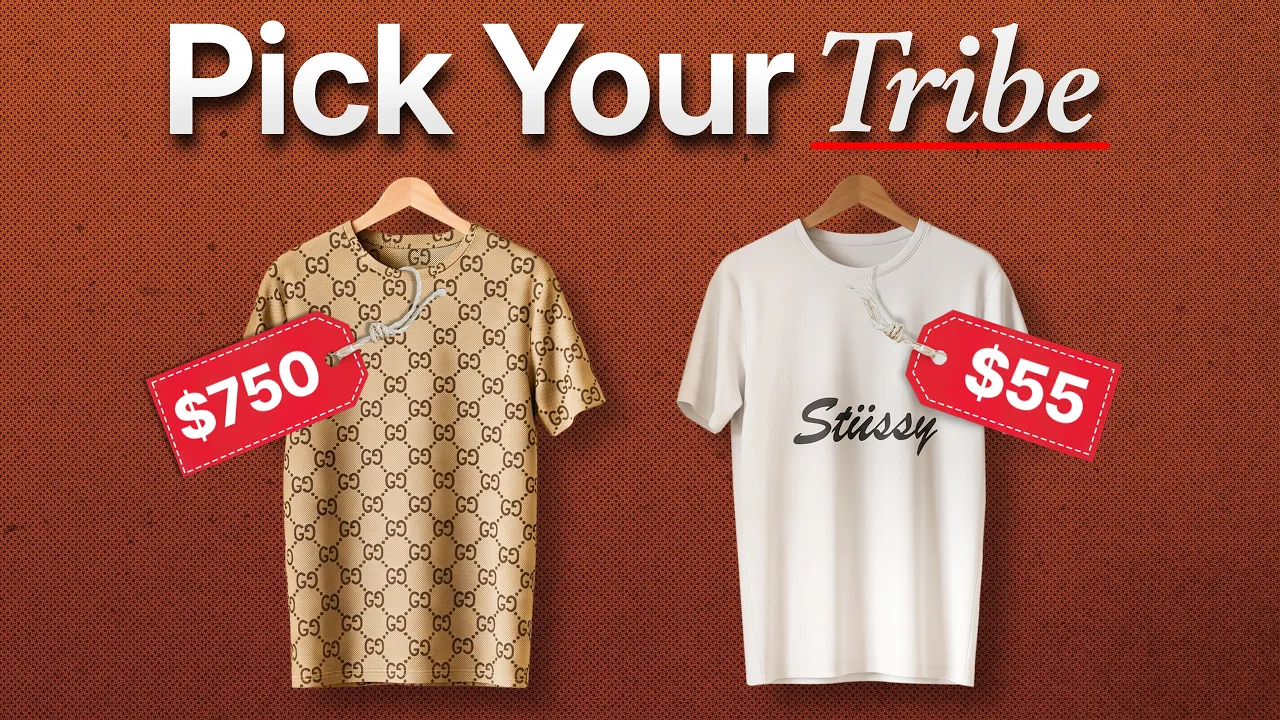
Stüssy is presented as an early, deliberate practitioner. Its tribes, city chapters, community-member lookbooks, and selection of culturally credible people turned the brand into social infrastructure rather than a conventional apparel advertiser. Modern brands extend the model by showing an entire desirable life through events, retail environments, emails, creators, packaging, and recognizable design signatures.
The practical playbook begins with customer data rather than a founder's assumed persona. Marketers should distinguish the person who buys, the person that buyer believes they are, the person they want to become, and the messenger they want to hear from. The product then needs a visible signature—color, form factor, pattern, packaging, iconography, or logo—that allows the identity to be recognized by others.
Identity appeals can target belonging, superiority or taste, rebellion, standing out, or pride in a subculture. They can also address a private identity tension rather than public affiliation. The Liftfoils example shows why this distinction matters: some older customers responded to people like themselves, while others wanted younger riders who reflected the vitality they hoped to retain, producing an approximately 50-50 creative split and requiring different landing-page experiences.
Key Takeaways
- Claim: Brands increasingly function as social connectors because conventional third spaces have weakened and many remaining gathering points are tied to consumption. | Evidence: The speaker points to solo travel, restaurants designed for single diners, brand-sponsored run clubs, festival culture, and product-based recognition through items such as Stanley or Owala bottles and recognizable workout clothing. Four of his six single male friends reportedly met recent partners through run clubs or workout-related activities. | Implication: A brand can create value and defensibility by facilitating repeat interaction among customers, but community should be designed as a useful experience rather than treated as decorative messaging. | Caveat: The argument is observational and anecdotal; the transcript does not provide research quantifying the decline of third spaces or establishing that brand-led gatherings cause stronger customer outcomes.
- Claim: Algorithmic feeds split audiences into narrower performative cultures, so one broad creative strategy may fail even when the underlying product serves multiple groups. | Evidence: The speaker argues that men increasingly perform for male audiences and women for female audiences, citing viral interviews about preferred male arm size and fitness content that allegedly pushes men toward physiques rewarded by other men rather than desired by potential partners. | Implication: Creative, spokesperson, offer framing, and distribution should be segmented around each audience's reference group and identity incentives rather than merely changing surface-level demographic cues. | Caveat: The gender framing is highly generalized and supported by cultural examples rather than rigorous audience data; it should be treated as a hypothesis to test, not a universal rule.
- Claim: The strongest identity brands construct a community system around culturally credible insiders instead of simply hiring the largest influencers. | Evidence: Stüssy built the Stüssy Tribe, established chapters in different cities, featured friends and community members in 'homie lookbooks,' and selected people from skate, surf, music, design, and creative circles who fit the brand's culture even when they were not the most famous. | Implication: Influence should be evaluated by identity fit and network credibility, not reach alone, while local chapters, events, and community-native content can provide distribution beyond one-to-one advertising. | Caveat: Stüssy is a culturally specific streetwear example; brands in low-interest or regulated categories may need different community mechanics.
- Claim: Customer identity research must separate actual buyers from the identities those buyers perceive or aspire to. | Evidence: The speaker recommends analyzing an email list with Outer Signal and gives the example of a brand that believes it serves a fashionable Gen Z woman but discovers that the buyer is an older Gen X woman who may want to identify with the younger persona. | Implication: GTM research should combine behavioral data with interviews and creative testing so campaigns do not confuse the purchaser's age or profile with the identity that makes the offer compelling. | Caveat: Third-party persona enrichment can reveal correlations but may misclassify people or create privacy and compliance concerns; it cannot independently explain motivation.
- Claim: Identity marketing becomes materially stronger when the product has a recognizable visual signature that customers can display and others can decode. | Evidence: Examples include Dior's logo-bearing cosmetic attachment, Margiela-style tags, Bad Son's raised stitching, Nerf's orange, Zuru's red, and Gelblaster's deliberate ownership of green on retail shelves. The speaker also proposed matte-green compostable packaging with an embossed or debossed logo for a luxury meal-prep company. | Implication: Distinctiveness should be engineered into the product and packaging system through color, form, texture, pattern, or iconography rather than depending exclusively on prominent logos. | Caveat: The prediction that redesigned meal packaging could quadruple customer photos is speculative and was not tied to a completed test.
- Claim: Most outward-facing identity propositions can be organized around five motives: belonging, superior taste or status, rebellion, standing out, and pride in a subculture. | Evidence: Sneakers illustrate belonging; the brand described as 'The Road' in the transcript illustrates subtle taste superiority; Liquid Death represents rebellion; the speaker's Bad Son jacket functions as deliberate visual flair; and geography, race, hobbies, or gender can anchor subcultural pride. | Implication: Every campaign should specify the identity reward it offers; otherwise creative may show a lifestyle without clarifying whether the customer is supposed to fit in, rise above, rebel, stand out, or affirm group pride. | Caveat: These are practical creative archetypes rather than a validated or exhaustive psychological taxonomy, and a brand may activate several at once.
- Claim: The most sophisticated identity marketing may resolve a private tension between a customer's current self and desired self, requiring tests of multiple avatars and messengers. | Evidence: Liftfoils' electric hydrofoil offered aging water-sports enthusiasts exhilaration and a sense of retained youth. Ads tested professional athletes including Laird Hamilton and Brian Grubb, older surfers resembling buyers, and younger riders; the response was described as roughly a 50-50 split, with different cohorts sent to different landing pages. A separate brand serving older women reportedly performed better with UGC from younger, attractive men than with customers shown people like themselves. | Implication: Creative testing should independently vary the depicted user, aspirational self, authority or messenger, and landing-page narrative instead of assuming demographic mirroring will perform best. | Caveat: No conversion rates, sample sizes, or experimental controls are disclosed, so the cases demonstrate hypotheses and segmentation logic rather than generalizable performance benchmarks.
Detailed Brief
Starting an identity system from existing brand assets
- Claims: A brand without a clear persona can begin with authentic source material already available to it, particularly founder background, company location, cultural provenance, or a place that strongly shaped the product.; Geographic specificity can create meaningful differentiation even within the same category because a Northwest outdoor brand communicates a different identity from a Southwest outdoor brand, just as British, American, Australian, and Chinese racing traditions imply different aesthetics and stories.
- Evidence: The transcript contrasts regional outdoor identities and several national racing identities as raw material for positioning.; Polo Ralph Lauren is used as a counterpoint to Stüssy: consumers and the Lo-Life movement adapted the brand into identities that extended beyond the audience and meaning originally intended by the company.
- Caveats: Borrowed geography or subculture can feel manufactured if the company lacks a credible relationship to it.; Once customers appropriate a brand, management may not retain complete control over what the identity comes to mean.
- Implications: Identity architecture should identify which elements are authentic and controllable and which meanings customers are already creating independently.
Lifestyle media and physical experiences as identity delivery
- Claims: Identity can be communicated without explicit product persuasion by depicting a coherent life that the audience already inhabits or wants to enter.; Physical activations become more powerful when attendees value the associated music, people, place, or ritual independently of the transaction.
- Evidence: The beauty brand transcribed as Rode used emails depicting a model's night out, including an espresso martini, lip gloss, and club destination, allowing recipients to consume an aspirational identity without a conventional list of purchase reasons.; Blank reportedly found that London pop-ups and house-music-related experiences became central to growth because the gatherings developed meaning beyond the clothing brand itself.
- Caveats: The transcript does not provide acquisition costs, retention data, or incremental revenue for these experiential tactics.
- Implications: Content and events can be evaluated as identity products in their own right, with success measured through participation, repeat attendance, organic creation, and network growth rather than impressions alone.
Paid-social execution details
- Claims: The speaker reduces major differences in Meta acquisition performance to three creative variables: the hook, the offer, and the structure of the copy or script.; Reference frameworks can accelerate production, but their structural logic should be adapted to the offer rather than copied verbatim.
- Evidence: The sponsored segment contrasts a $10 cost per action with a $40 cost per action and promotes HubSpot's swipe file of 20 Meta ads assembled from Ben Heath's work.; Ben Heath is credited with managing more than $300 million in ad spend and generating $1.2 billion in client revenue; the templates cover e-commerce, local businesses, lead generation, and SaaS.
- Caveats: This is sponsored material, and the transcript supplies no independent validation that the three-variable model explains the cited cost-per-action difference.
- Implications: Identity hypotheses still need disciplined direct-response construction; a culturally resonant persona does not compensate for an unclear hook, weak offer, or poor script.
Notable Concepts & Terms
- Identity marketing: Positioning a product as an expression of who the buyer is, wants to be, or wants others to recognize, rather than selling only functional utility.
- Loneliness economy: The speaker's label for products, services, and experiences designed around increased time alone while also helping people manage or escape that isolation.
- Third spaces: Informal social environments outside home and work; their perceived decline creates an opening for brands, run clubs, pop-ups, and other consumption-linked gatherings to become connection infrastructure.
- Stüssy Tribe: Stüssy's network of culturally credible friends, creatives, athletes, and musicians, organized partly through city chapters and used to embody the brand's community.
- Homie lookbook: A visual campaign featuring actual friends or community members rather than conventional models, making the brand's desired social world feel authentic and accessible.
- Visual signature: A repeatable color, shape, pattern, texture, tag, package, or icon that makes the product recognizable and usable as an identity signal.
- Actual, perceived, and aspirational persona: The distinction between who buys, who that person thinks they are, and who they want to become; the video treats this separation as essential to creative strategy.
- Identity weak point: A private gap or insecurity in a customer's self-concept that a product may help resolve, such as an aging athlete wanting to preserve a sense of vitality and mastery.
Operator Notes / Why Ken Should Care
- Add four explicit fields to customer and campaign briefs: actual buyer, self-perceived identity, aspirational identity, and preferred messenger.
- Build a creative test matrix that varies avatar age, spokesperson type, identity motive, hook, and landing-page narrative independently; do not bundle every variable into one test.
- Audit whether each product has a recognizable signature visible in thumbnails, screenshots, packaging photos, and real-world use without relying on the brand name.
- Choose one primary identity motive per campaign and reject concepts that ambiguously mix belonging, status, rebellion, flair, and subcultural pride.
- Pilot one recurring community ritual with standalone participant value, then track repeat attendance, customer-to-customer connections, user-generated content, referrals, and conversion separately.
- Validate enriched persona data through interviews and observed behavior, and review privacy and platform-policy exposure before operationalizing third-party audience profiling.
- Create ethical review criteria for identity-based campaigns so they solve or positively frame a customer tension rather than intensifying insecurity that the product cannot credibly address.
Source/Metadata
- Title: How The Biggest Brands Sell Identity, Not Product (and it's blowing them up)
- Transcript words: 8555
- Duration seconds: 1111
- Timestamp note: No timestamps or chapters were present. A substantial portion of the transcript is duplicated, including the sponsor segment and most of the core argument.
Transcript
Today we are going to talk about the Identity Marketing Playbook. Thank you to HubSpot for sponsoring this video. You may have noticed if you walk into a new environment or a new job, people gravitate together. One of the easiest ways they recognize who they might be friends with is by the products they use. Say you started a new job, you're a sneakerhead, and you recognize somebody else wearing whatever cursed pair of Travis Scotts, or perhaps someone with the Rode lip gloss phone case. It's an easy question to ask about sneakers, another one if they're going to Pilates later. In a world where our relationships are continually online, products become a signaler. We all know that brands signal identity. But growing up, brands used to use identity as one tool in their sales toolkit. Now it's become one of the primary tools, a core piece of marketing. So in this video, I'm going to go through what happened, how the modern world has got us here, and the idea of the loneliness economy, and how brands participated in it whether they plan to or not. I'm going to talk about the transition of how brands are now facilitators for experiences in life that culture is left behind. I'm going to talk about early adopters of this playbook, go a bit into Stussy and brands like that, who defined identity as part of brand on their own terms. And I'm going to go to how to think about identity in terms of any brand you represent or work for or anything you consume. We're going to talk about personas, signature designs, different archetypes of consumers, what type of identity they're playing into. Then we're going to end with identity beyond affiliation, around things that we all want to be and aspire to and how brands positively can help solve that. If you've ever been interested in the psychology of why we buy or how culture is changing and driving us apart and the role brands play in connecting us back together, this is the video for you. Let's lock in. So I am on my way to Cannes Lions, the advertising and marketing film festival where I will be all week in a villa with a bunch of other creators making a lot of content. And one of the panels that I am giving is about how advertising and organic content like you see on social media have started to become one and the same. They're more similar than ever. The Venn diagram doesn't have a small overlap in the middle. The overlap has grown a lot bigger. And in preparing that talk, it got me thinking a lot about how do we actually get here where what we consume for fun and consume for ads is basically the same. If you'll be in the South of France this week, I'll link some of the events down below. But diving into it, it started with this idea of loneliness. The modern world has made us alone and that made us justify that feeling of being alone and consume around it. So you see things like the solo trip economy. Don't wait for your friends to go travel the world. Restaurants redesigning to allow for more single person dining. Products that you can buy as a signaler to help you attract other people. Now, many people will say there's a difference between being alone and being lonely, but more people spend more time not around other people than ever in history, which is not an innate human experience. And so we subconsciously, no matter what we believe or culture has taught us to believe, will always want those experiences to bring us back to each other and will connect around the things we have. One of those big shifts is this idea of third spaces going away. The fact that people would all go hang out at a bar or a bowling alley or a night club or whatever it is used to have those places they would share with each other where they would be able to congregate and make friends and have a locality. We have less of those than we did before. And the ones we do have are all built around consumption, the line for matcha, whatever it is. And that's shifted a lot to experiences. Because we don't have those same third places, we gravitate towards everyone getting ready and going to the festival season together. The event, waiting in line in New York. The big experiences of the run club. It's funny, of my friends who are still single, and I was married young compared to a lot of my friend group, four of the six of my boys who are still single all met their recent girlfriends in run clubs or a workout related activity. That is now one of these congregations and their events, all the ones near me are put on by brands. A lot of them start just as congregations and build brands on top of that or run by influencers. This is all slightly related to commerce. And none of this is bad. It's just a shift we have. But what's gotten interesting is brands now have double duty. They serve both as products and connection points because we associate so much of our identity and what we buy, which again is not a bad thing. People can argue against that, but it's one of the consumable things we do. It's something that we as human beings, we buy things, we make decisions about it, we're proud of it, we justify it. It's part of our lives. It gives us an opportunity to reflect ourselves. And brands are dragged into this whether they want to or not. If you have a Stanley or an Oala, it says a specific thing about you. If you have the specific workout set of the moment, if you have a Represent 24/7 pair of pants or shirt with a big logo on it, the Outdoor Voices sorority dress, other people who know what that is will recognize it. We buy things, we make decisions about it, we're proud of it, we justify it. It's part of our lives. It gives us an opportunity to reflect ourselves. And brands are dragged into this whether they want to or not. If you have a Stanley or an Oala, it says a specific thing about you. If you have the specific workout set of the moment, if you have a Represent 24/7 pair of pants or shirt with a big logo on it, the Outdoor Voices sorority dress, other people who know what that is acknowledge it and represent it. And they think it's a good thing. And they like to meet other people that are into those similar things. It is a connection point established through our experiences. And this is exacerbated by algorithms. And I'll talk about the pre-algorithm version of this and Stüssy in a sec. So first, if you want to take what we're talking about, actually apply it to really tactical marketing, I would take insights, all the stuff you see in this video and any of these videos you've watched from me and take them right into your ad account in Meta. And HubSpot's put together an excellent download, the 20 highest converting Meta ads swipe file. They can help get you started. So the difference between a $10 cost per action and a $40 cost per action is usually one of three things in an ad. It's your hook, how you're reeling people in, it's the offer, what you're actually selling, and then the structure of the copy, the idea, the script. And if you don't have a reference point for what works, you're starting from scratch each time. So that's where Ben Heath comes in from Heath Media. He's managed over 300 million in ad spend, generated 1.2 billion in client revenue. And HubSpot put together a free swipe file of his 20 top performing ads. These are frameworks that are built out by business type, cover e-commerce, local, lead gen, SaaS, they have hooks, they have body copy, and CTAs you can adapt to your offer in minutes. You can take things like identity, personas, and put them into these frameworks. The part I like most is how the guide shows you how to make these your own ads. So you don't just copy willy-nilly. You learn the structural logic behind what makes it work. So if you're running Meta ads, you're briefing someone that is, this is a reference doc you want to open before you start. Link is in the description, it's free. Thank you to HubSpot for sponsoring this video. Because now algorithms are very much driven towards people performing for the same gender. We talked about this in my boy marketing versus girl marketing algorithm video. But right now, more so than ever in history, guys do things to impress guys, girls do things to impress girls. One of the big viral things that was on the internet the other week was all these street interview TikTokers asking girls what the preferred arm size of guys is. And this is a topic I talk about a lot because I work a lot in health and wellness, and you've seen a lot of videos I have around peptides and stuff like that, where guys have been trained by performance for other guys to over lift, to engineer themselves to a body type that isn't actually appealing to the opposite sex. It's been done by these performative algorithms. And the same things happen to women in completely other ways on the other side because there's less overlap than ever. And so they end up in communities and with clothes and with activities that only signal to their existing gender, begin performing in a very different way than we did before. And then the actual products shift and adapt to that. And what we talked about in that video and ended up was that brands have to have different marketing strategies, hugely different to reach those two demographics. You can't hit it with the same advertisement, even if you sell to a wide base. And I actually look at in a world where algorithms have taken over a lot of how we communicate and shown true desires in weird ways, brands serving as facilitators, as connectors, as representations of our identities, an ability to go meet somebody is a good thing. And it also gives you work in marketing the ability to understand and more nuanced, communicate your value proposition to other people. So going into identity marketing, I want to call out the early hitter here, which was Stüssy. I've done a whole video on Stüssy's art direction, but they were one of the original streetwear brands that was hyper-focused on who you are as someone they decided. You can talk about Polo Ralph Lauren as an interesting other case where they made the product for certain demographics and it was co-opted by people around the city. The low-life movement, et cetera, people began to form the brand into their own identity, whatever they wanted it to be. It grew beyond what the brand wanted, whereas Stüssy was surgical. They introduced the Stüssy tribe, people that represented them, friend groups, not necessarily famous people or always pros. It had a lot of overlap with pro athletes and musicians, but also a lot of people, designers, creatives, interesting people in the world. They put chapters in different cities. They facilitated connection between cool and interesting people. Their lookbooks were what we now call the homie lookbook, where it's your friends and members of your community versus traditional models. So them taking that idea, multiplying it by the locations and the chapters, has been adopted by a lot of people. This is why you see storefronts early. It had a lot of overlap with pro athletes and musicians, but also just a lot of people, designers, creatives, interesting people in the world. They put chapters in different cities. They facilitated connection between cool and interesting people. Their lookbooks were what we now call the homie lookbook, where it's your friends and members of your community versus traditional models. So them taking that idea, multiplying it by the locations and the chapters, has been adopted by a lot of people. This is why you see storefronts early. That location had a huge presence. When I was in the UK and I did the video about Blank, you may have seen, they were talking about how the London pop-ups were a relentlessly part of their growth. They began to realize that those experiences and house music and a few of the connection points they had there were actually bigger than just the brand itself. They were bringing people together and they're able to grow legs beyond your typical one-to-one advertising connection and there's a power in that. But then also influence draws people in, right? Yeah, it's a multiplier. And Stussy had that right too. They're picking the right influential people in skate, in surf, in music. Not necessarily the biggest, but the ones that would fit into their existing community that you would feel an identity because you knew about. And then they adapt that with lookbooks and content that shows that lifestyle visually. And you still see that today, right? Where a lot of their campaigns are shot around where I am in California. They're shot with a lot of specific cars and specific looks and with people that look and feel like your friends, not like some other models. At least for me as someone squarely in their target demographic. And this has been adapted in a million ways. Rode took that idea of the lookbook and made an aspirational identity version. They would do emails where they have a night out with one of their models. And they would show the espresso martini with the lip gloss next to it and the club that they were going to. It'd be a profile of an individual person, a woman that their consumer might aspire to be, or might just know that was in their friend group. And they got to adopt that identity even just by opening and consuming an email. It's not like a whole section, here's why you buy. It's just showing a life. So if brands show a life that you want or are in, then how do you begin to develop this for a brand? Or how do you begin to think about what a brand is trying to say to you? We'll get there in a second. All right, so how do you begin to think about personas in anything you're marketing or selling, or begin to wonder how you're being classified and sold to? So first, if you have a brand, you don't have any idea who your customer might be. You want to start with what you have. And what do I mean by that? Location is a big one. Is your brand based in a place? Is there an identity around that place? Being a Northwest outdoors brand versus a Southwest outdoors brand say significantly different things. An Americana racing company versus a British racing company versus an Australian racing company or a Chinese racing company. You can make a unique brand off any of those angles. That could come from your background as a founder. It could come from someone you're working with, background, the place where you're located, or just a place where you took intense inspiration. If you already have some of that data, what you'll start to find is over time, the customer may not be what you expected. I have a whole video about archetypes and personas, but you'll know that my go-to there is you basically take your email list, run it through Outer Signal. I'll link them down below too. And it will basically build you out personas from your email list. I love to do this exercise with brands because often they'll think they have one persona. Oh, we sell to the hip Gen Z girl. But then you pull it open and you're like, well, actually you sell to the older Gen X woman. But that perception you have of maybe that elder Gen X woman wants to be that younger Gen Z woman. You begin to start noticing these shifts of, okay, we're marketing to one person, but the customer that attracts actually has a different desire. Or our marketing isn't connecting because we're actually marketing to the wrong person. The person that actually ends up buying us isn't even discovering it through our funnel. This is how you begin to have those conversations that are important. So you start with your persona knowledge. And then you begin to think about signature designs. What you'll notice about all of the identity marketing products that we talked about, whether that's in a wall of water bottle, whether that's a rep t-shirt, whether it's the choice of your company to be a Google versus a Teams organization, all of these have visual signatures. It could be colorways. It could be form factors. When Dior had cosmetics that went viral, it's because they had basically a little Dior keychain attachment to it. It would signal that you're a Dior person, give you a luxury signaler from their logo on a low cost purchase. It's an identity play. Patterns, tags, subtle things like you see with Margiela. I did this video with Grant Owens. I got a lot of comment on my Bad Son jacket. All of these have visual signatures. It could be colorways. It could be form factors. When Dior had cosmetics that went viral, it's because they had a little Dior key chain attachment to it. It would signal that you're a Dior person, give you a luxury signaler from their logo on a low cost purchase. It's an identity play. Patterns, tags, subtle things like you see with Margiela. I did this video with Grant Owens. I got a lot of comment on my Bad Son jacket. You can immediately tell it's Bad Son because they have that particular raised stitching pattern that they do. These are all visual signatures. And they can apply to anything. So people will associate themselves with those brands. Color does this as well. When I was in the toy category, Nerf associated itself with orange. Zuru was competing with them and owned red. At Gelblaster, we hyper-focused on green. You could see it in big color blocking on the shelf. You want people to know, not get confused about which you're buying. You want to be, "Oh, I'm going to get the green one." These are little things that are associations because they want to associate themselves with whatever the marketing was. I was recently talking to a luxury grocer doing meal prep. And they were talking about packaging as a differentiator. And everyone has the same meal prep packaging. And I was telling them, I was, they should go matte green because you could still do that in the same compostable style. Silk or do an emboss or a deboss of their logo on it. And they would probably quadruple the amount of people taking pictures of it versus the plain plastic top. It would become an identity play to signal that you got that meal kit because it would look sick and sick to that demographic who's buying that kind of luxury thing. And you could also do this with iconography. Obviously, the logos tell this story. And you'll see it. White Fox, Scuffers, all the hip brands, the easiest way to play it. Nude Project. Iconography and logos tend to work in some regards, especially with younger demographics. But the more subtle ways and more different differentiation when you're working on color and pattern and things like that end up being usually bigger, more sophisticated ways to do it over time and in more categories. And then I'm going to walk you through five architects, for lack of a better term, five reasons that people will associate themselves with identity for a brand. So first is belonging. I want to fit in with people like me. This is sneakers. Sneakers only exist to find other people that will think that your sneakers are cool. And by doing that, you immediately have a friend or have someone that will think, have some respect for you. And it's completely about belonging. Every single one of those purchases is around that. And that is an excellent way to think about, especially for very lonely demographics, right? Sneakers appeal a lot to lonely people. It becomes an obsession point. Fashion in general is a larger extension of that. To be able to find people that have that same interest or that same thing becomes a very easy signaler. And then there's a second idea. There's, "Hey, I'm better than the others." That's another thing. There's a lot of people that want to prove they're better than other people even subtly. You have brands like The Road that position themselves entirely. I'm more tasteful than everyone else in my friend group. I have The Road playlist. I have a bag that not everyone would know. I have this subtle look. It's the it thing. You are proving something to others and making people aspire to what you have, but subtly. And you have The Rebel. I don't play by your rules. If you're marketing in Gen X, this is your go-to. I'm going to choose not just the more extreme angle, but the more outsider angle than anything else. Just liquid death to some regard. There's room inside, a counterculture rebel take in every product category. And you have standout. You have flair. The I'm special call it. Look, that Bad Son jacket is flair. I own that jacket because I know I can go on a podcast and it'll stand out on a feed. It is a flair piece. You only have things like that if you are trying to prove a point about standing out from something. There are plenty of brands that say something about you in a loud way. And then there's the idea of pride in a subculture. And if you know, you know. And you can base that around geography, around race, around hobbies, around gender, but saying that you're proud of your background. That yes, of course, I'm going to have this Chinese founded brand or whatever it is that tells that story to a subculture. Those are just five that you can work with. Fitting in, being better than somebody, not playing by anybody's rules, standing out, or having pride in the subculture. It's an amazing way to begin thinking about how an identity marketing playbook could work for any product. I want to end with identity beyond affiliation because identity can also be deeply personal. It doesn't have to do anything with others. I'm going to have this Chinese founded brand or whatever it is that tells that story to a subculture. Those are just five that you can work with: fitting in, being better than somebody, not playing by anybody's rules, standing out, or having pride in the subculture. It's an amazing way to just begin thinking about how an identity marketing playbook could work for any product. I want to end with identity beyond affiliation because identity can also be deeply personal. It doesn't have to do anything with others. Almost all of those have to do with a signal you're sending to others. But one of the core points to think about in marketing is if people have a weak point in their internal identity, how can you help resolve it? And a great example of this was I worked for years with Liftfoils on their marketing. They're a surf foil company, electric hydrofoils, et cetera. And we had a big advocate, a customer advocate, Drew Brees. He's a famous quarterback. He bought this product. While I was running marketing there, we had a massive gift given to us that he went on Ellen after he stopped being a quarterback. And he talked about one of his favorite things to do was ride on his e-foil. And he actually did a training with Ellen. And it was a huge sales process for us, but not just because a celebrity was showing, because of what it solved. Not to get too deep into hydrofoils, but you have classic hydrofoils that have a mast and you ride waves and there's no motors or anything on there. And it's a work of modern physical mastery to be able to pump and foil. I have 14 stitches in my forehead from a foil. So my days of any of these are gone. But then the electric hydrofoils, you're basically flying on water and you have a motor and a remote control. And it's an incredible feeling and experience. But for either of those products, but in particular the motorized one, there's a lot of guys who get to a certain age and they had the same experience as me. I got 14 stitches in my head from a hydrofoil. It was proof to me that I'm not young anymore. I can't do extreme sports anymore. It was my third injury in a row. I fell off an ATV. I had bruised a rib snowmobiling. I was like, okay, I still think I'm 22 and I'm not. Happens to a lot of guys. But you see a product and you're like, hey, I can still have that experience. I can still have that feeling of flight, of exhilaration, but I can do it in this really modern way. And that's a problem I can solve with money that's really cool that someone I respect, a pro athlete is doing. That solves a weak point in so many guys' identities who had made that water sports a core part of what they do and who could continue doing that in a way that was cool and fun. And this ties into a last strategy I'll outline here about testing that. Because what was interesting there is we tested all kinds of ads, right? I was in the same framework I talked about when I was talking about HubSpot earlier. What I did, I ran all the meta with an agency inside there. We worked on ad creative and collateral, et cetera. I worked with Vervont on that, shout out Vervont. But we were testing traditional like, hey, let's get our team on there. We had pro surfers. We had Laird Hamilton. We had Brian Grubb. We had a lot of pros we would have in the ad account. And let's test people that look like our customer avatar. Let's test older surfers. You get this wide swath of different consumer types inside these ads to see what worked or not. And we found that it's not the person that our consumer wanted to see themselves in. They didn't want to necessarily see themselves on the board. Some people did, but a lot of them wanted to see the younger avatar. They wanted to feel like they were the younger person. And it was a 50-50 split. And those would go to different landing pages, different experiences, people that bought for different reasons. And that's what I would encourage you to test when you are building ads, you're building organic concepts. Think about who is your actual demo? And who does that demo think they are? And then who do they want to be? And then who do they want to hear from? A friend of mine has a brand that sells to elder women. He actually found that young UGC from younger, good-looking guys worked a lot better for him than that demographic being shown to themselves. You might find a mix of that. But that combination of what those archetypes look like, why people buy, and who they want to buy it from adds up to sophisticated marketing. And if you're in one of these funnels and you're being advertised to, do you start thinking about what does it say? If it's actually solving an internal problem that you have that is a weak point for you, that's a good thing. You're being shown a mirror of something you may want that may actually solve something for you. Or if you're being shown something that's selling you a version that feels dirty, that you don't quite want, or feels off, that's a bad sign for a brand. And if you're in one of these funnels and you're being advertised, do you start thinking about what does it say? If it's actually solving an internal problem that you have that is a weak point for you, that's a good thing. You're being shown a mirror of something you may want that may actually solve something for you. Or if you're being shown something that's selling you a version that feels dirty, that you don't quite want, or feels off, that's a bad sign for a brand. And the more conscious we are on how we're being sold and why and why we buy, the better. So anyway, I'm excited to be cutting some videos from the French Riviera here next week with a bunch of the people that I'm inside our can house with. In the house, we have Dara Denny's there, JT Barnett's there, Sammy Cohen's there, Tatum Brandt, a bunch of creators you may or may not have heard of. We're making all kinds of interesting content. We have scheduled depending on timing, and so I'm excited to drop some of that on this channel too so you can see some more conversations over the coming weeks. I'm working on a video about actual French luxury as well. So for those who are waiting for more luxury content, that is coming soon. And as always, thank you all so much for watching. it's the offer, what you're actually selling, and then the structure of the copy, the idea, the script. And if you don't have a reference point for what works, you're basically starting from scratch each time. So that's where Ben Heath comes in from Heath Media. He's managed over 300 million in ad spend, generated 1.2 billion in client revenue. And HubSpot put together a free swipe file of his 20 top performing ads. These are frameworks that are built out by business type, cover e-commerce, local, lead gen, SaaS, they have hooks, they have body copy, and CTAs you can adapt to your offer in minutes. You can take things like identity, personas, and put them into these frameworks. The part I like most is how the guide shows you how to make these your own ads. So you don't just copy willy-nilly. You learn the structural logic behind what makes it work. So if you're running meta ads, you're briefing someone that is, this is a reference doc you wanna open before you start. Link is in the description, it's free. Thank you to HubSpot for sponsoring this video. Because now algorithms are very much driven towards people performing for the same gender. We talked about this in my boy marketing versus girl marketing algorithm video. But right now, more so than ever in history, guys do things to impress guys, girls do things to impress girls. One of the big viral things that was on the internet the other week was all these street interview TikTokers asking girls what the preferred arm size of guys is. And this is a topic I talk about a lot because I work a lot in health and wellness, and you've seen a lot of videos I have around peptides and stuff like that, where guys have been basically trained by performance for other guys to over lift, to engineer themselves to a body type that isn't actually appealing to the opposite sex. It's been done by these performative algorithms. And the same things happen to women in completely other ways on the other side because there's less overlap than ever. And so they end up in communities and with clothes and with activities that only signal to their existing gender, begin performing in a very different way than we did before. And then the actual products shift and adapt to that. And what we talked about in that video and ended up was that brands have to have different marketing strategies, hugely different to reach those two demographics. You can't hit it with the same advertisement, even if you sell to a wide base. And I actually look at in a world where algorithms have taken over a lot of how we communicate and shown true desires in weird ways, brands serving as facilitators, as connectors, as representations of our identities, an ability to go meet somebody is a good thing. And it also gives you work in marketing the ability to understand and more nuanced, communicate your value proposition to other people. So going into identity marketing, I want to call out the early hitter here, which was Stussy. I've done a whole video on Stussy's art direction, but they were one of the original streetwear brands that was hyper-focused on who you are as someone they decided. You can talk about Polo Ralph Lauren as kind of an interesting other case where they made the product for certain demographics and it was co-opted by people around the city. The whole, the low-life movement, et cetera, people began to form the brand into their own identity, whatever they wanted it to be. It grew beyond what the brand wanted, whereas Stussy was surgical. They introduced the Stussy tribe, people that represented them, friend groups, not necessarily famous people or always pros. It had a lot of overlap with pro athletes and musicians, but also just a lot of people, designers, creatives, interesting people in the world. They put chapters in different cities. They facilitated connection between cool and interesting people. Their lookbooks were what we now call the homie lookbook, where it's your friends and members of your community versus traditional models. So them taking that idea, multiplying it by the locations and the chapters, has been adopted by a lot of people. This is why you see storefronts early. That location had a huge presence. When I was in the UK and I did the video about Blank, you may have seen, they were talking about how the London pop-ups were kind of a relentlessly part of their growth. They began to realize that those experiences and house music and a few of the kind of connection points they had there were actually bigger than just the brand itself. They were bringing people together and they're able to grow legs beyond your kind of typical one-to-one advertising connection and there's a power in that. But then also influence draws people in, right? Yeah, it's a multiplier. And Stussy had that right too. They're picking the right influential people in skate, in surf, in music. Not necessarily the biggest, but the ones that would fit into their existing community that you would feel an identity because you knew about. And then they adapt that with lookbooks and content that shows that lifestyle visually. And you still see that to today, right? Where a lot of their campaigns, so they are shot around where I am in California. They're shot with a lot of specific cars and specific looks and with people that look and feel like your friends, not like some other models. At least for me as someone squarely in their target demographic. And this has been adapted in a million ways. Rode took that idea of the lookbook and basically made an aspirational identity version. They would do emails where they have a night out with one of their models. And they would show the espresso martini with the lip gloss next to it and the club that they were going to. It'd be a profile of an individual person, a woman that their consumer might aspire to be, or might just know that was in their friend group. And they've got to adopt that identity even just by opening and consuming an email. It's not like a whole section, here's why you buy. It's just showing a life. So if brands show a life that you want or are in, then how do you begin to develop this for a brand? Or how do you begin to think about what a brand is trying to say to you? We'll get there in a second. All right, so how do you begin to think about personas in anything you're marketing or selling, or begin to wonder how you're being classified and sold to? So first, if you have a brand, you don't have any idea who your customer might be. You want to start with what you have. And so what do I mean by that? Location is a big one. Is your brand based in a place? Is there an identity around that place? Being a Northwest outdoors brand versus a Southwest outdoors brand say significantly different things. An Americana racing company versus a British racing company versus an Australian racing company or a Chinese racing company. You can make a unique brand off any of those angles. That could come from your background as a founder. It could come from someone you're working with, background, the place where you're located, or just a place where you took intense inspiration. If you already have some of that data, what you'll start to find is over time, the customer may not be what you expected. I have a whole video about archetypes and personas, but you'll know that my go-to there is you basically take your email list, run it through Outer Signal. I'll link them down below too. And it will basically build you out personas from your email list. I love to do this exercise with brands because often they'll think they have one persona. Oh, well, we sell to like the hip Gen Z girl. But then you pull it open and you're like, well, actually you sell to the older Gen X woman. But that perception you have of maybe that elder Gen X woman wants to be that younger Gen Z woman. You begin to start noticing these shifts of, okay, we're marketing to one person, but the customer that attracts actually has a different desire. Or our marketing isn't connecting because we're actually marketing to the wrong person. The person that actually ends up buying us isn't even discovering it through our funnel. This is how you begin to have those conversations that are important. So you start with your persona knowledge. And then you begin to think about signature designs. What you'll notice about all of the identity marketing products that we talked about, whether that's in a wall of water bottle, whether that's a rep t-shirt, whether it's the choice of your company to be a Google versus a Teams organization, all of these have visual signatures. It could be colorways. It could be form factors. When Dior had cosmetics that went viral, it's because they had basically like a little Dior key chain attachment to it. It would signal that you're a Dior person, give you a luxury signaler from their logo on a low cost purchase. It's an identity play. Patterns, tags, like subtle things like you see with Margiela. I did this video with Grant Owens. I got a lot of comment on my Bad Son jacket. You can immediately tell it's Bad Son because they have that particular raised stitching pattern that they do. These are all visual signatures. And they can apply to basically anything. So people will associate themselves with those brands. Color does this as well. When I was in the toy category, Nerf associated itself with orange. Zuru was competing with them and owned red. At Gelblaster, we hyper-focused on green. You could see in big color blocking on the shelf. You want people to know, not get confused about which you're buying. You want to be like, oh, I'm going to get the green one. These are little things that are associations because they want to associate themselves with whatever the marketing was. I was recently talking to a luxury grocer doing meal prep. And they were talking about packaging as a differentiator. And everyone has the same meal prep packaging. And I was telling them, I was like, they should go matte green because you could still do that in the same compostable style. Silk or do like a emboss or a deboss of their logo on it. And they would probably quadruple the amount of people taking pictures of it versus of the plain plastic top. It would become an identity play to signal that you got that meal kit because it would look sick and sick to that demographic who's buying that kind of luxury thing. And you could also do this with iconography. Obviously, the logos tell this story. And you'll see it. White Fox, Scuffers, all the hip brands, the easiest way to play it. Nude Project. Iconography and logos tend to work in some regards, especially with younger demographics. But the more subtle ways and kind of more different differentiation when you're working on color and pattern and things like that end up being kind of usually bigger, more sophisticated ways to do it over time and in more categories. And then I'm going to walk you through five architects, for lack of a better term, basically five reasons that people will associate themselves with identity for a brand. So first is belonging. I want to fit in with people like me. This is sneakers. Sneakers basically only exist to find other people that will think that your sneakers are cool. And by doing that, you immediately have a friend or have someone that will think, like have some respect for you. And it's completely about belonging. Every single one of those purchases is around that. And that is an excellent way to think about, especially for very lonely demographics, right? Sneakers appeal a lot to lonely people. It becomes an obsession point. Fashion in general is a larger extension of that. To be able to find people that have that same interest or that same thing becomes a very easy signaler. And then there's a second idea. There's, hey, I'm better than the others. That's another thing. There's a lot of people that want to prove they're better than other people even subtly. You have brands like The Road that position themselves entirely. I'm more tasteful than everyone else in my friend group. I have The Road playlist. I have a bag that not everyone would know. I have this subtle look. It's the it thing. You are proving something to others and making people aspire to what you have, but subtly. And you have The Rebel. I don't play by your rules. If you're marketing in Gen X, this is like your go-to. I'm going to choose not just the more extreme angle, but the more outsider angle than anything else. Just liquid death to some regard. There's room inside, kind of like a counterculture rebel take in every product category. And you have standout. You have flair. The I'm special call it. Look, that bad sun jacket is flair. I own that jacket because I know I can go on a podcast and it'll stand out on a feed. It is a flair piece. You only have things like that if you are trying to prove a point about standing out from something. There are plenty of brands that say something about you in a loud way. And then there's the idea of pride in a subculture. And if you know, you know. And you can base that around geography, around race, around hobbies, around gender, but saying that you're proud of your background. That yes, of course, I'm going to have this Chinese founded brand or whatever it is that tells that story to a subculture. Those are just five that you can work with. Fitting in, being better than somebody, not playing by anybody's rules, standing out, or having pride in the subculture. It's an amazing way to just begin thinking about how an identity marketing playbook could work for any product. I want to end with identity beyond affiliation because identity can also be deeply personal. It doesn't have to do anything with others. Almost all of those have to do with a signal you're sending to others. But one of the core points to think about in marketing is if people have a weak point in their eternal identity, how can you help resolve it? And a great example of this was, I worked for years with Liftfoils on their marketing. They're a surf foil company, electric hydrofoils, et cetera. And we had a big advocate, a customer advocate, Drew Brees. He's a famous quarterback. He bought this product. While I was running marketing there, we had a massive gift given to us that he went on Ellen after he stopped being a quarterback. And he talked about one of his favorite things to do was ride on his e-foil. And he actually did like a training with Ellen. And it was a huge sales process for us, but not just because a celebrity was showing, because of what it solved. Not to get too deep into hydrofoils, but basically you have classic hydrofoils that have basically a mast and you ride waves and there's no motors or anything on there. And it's a work of modern physical mastery to be able to pump and foil. I have 14 stitches in my forehead from a foil. So my days of any of these are gone. But then the electric hydrofoils, you're basically flying on water and you have a motor and a remote control. And it's an incredible feeling and experience. But for either of those product, but in particular the motorized one, there's a lot of guys who get to a certain age and they had the same experience for me. I got 14 stitches in my head from a hydrofoil. It was proof to me that I'm not young anymore. I can't do extreme sports anymore. It was like my third injury in a row. I fell off an ATV. I had bruised a rib snowmobiling. I was just, I was like, okay, I still think I'm 22 and I'm not. Happens to a lot of guys. But you see a product, you're like, hey, I can still have that experience. I can still have that feeling of flight of exhilaration, but I can do it in this really modern way. And that's a problem I can solve with money that's really cool that someone I respect, a pro athlete is doing. That solves a weak point in so many guys' identities who had made that water sports a core part of what they do and who could continue doing that in a way that was cool and fun. And this ties into kind of like a last strategy I'll outline here about testing that. Because what was interesting there is we tested all kinds of ads, right? I was in the same framework I talked about when I was talking about HubSpot earlier. What I did, I ran all the meta with an agency inside there. We worked on ad creative and collateral, et cetera. I worked with Vervont on that, shout out Vervont. But we were testing traditional, like, hey, let's get our team on there. We had pro surfers. We had Laird Hamilton. We had Brian Grubb. We had a lot of pros we would have in the ad account. And let's test people that look like our customer avatar. Let's test older surfers. You get this wide swath of different consumer types like inside these ads like to see what worked or not. And we found that it's not the person that our consumer wanted to see themselves in. They didn't want to necessarily see themselves on the board. Some people did, but a lot of them wanted to see the younger avatar. They wanted to feel like they were the younger person. And it was like a 50-50 split. And those would go to different landing pages, different experiences, people that bought for different reasons. And that's what I would encourage you to test when you are inside building ads, you're building organic concepts. Think about who is your actual demo? And who does that demo think they are? And then who do they want to be? And then who do they want to hear from? A friend of mine has a brand that sells to elder women. He actually found that young UGC from like younger, good-looking guys worked a lot better for him than that demographic being shown to themselves. You might find a mix of that. But that combination of what those archetypes look like, why people buy, and who they want to buy it from adds up to sophisticated marketing. And if you're in one of these funnels and you're being advertised, do you start thinking about what does it say? If it's actually solving an internal problem that you have that is a weak point for you, that's a good thing. You're being shown a mirror of something you may want that may actually solve something for you. Or if you're being shown something that's selling you a version that feels kind of dirty, that you don't quite want, or feels off, that's a bad sign for a brand. And the more conscious we are on how we're being sold and why and why we buy, the better. So anyway, I'm excited to be cutting some videos from the French Riviera here next week with a bunch of the people that I'm inside our can house with. In the house, we have Dara Denny's there, JT Barnett's there, Sammy Cohen's there, Tatum Brandt, a bunch of creators you may or may not have heard of. We're making all kinds of interesting content. We have scheduled depending on timing, and so I'm excited to drop some of that on this channel too so you can see some more conversations over the coming weeks. I'm working on a video about actual French luxury as well. So for those who are waiting for more luxury content, that is coming soon. And as always, thank you all so much for watching.