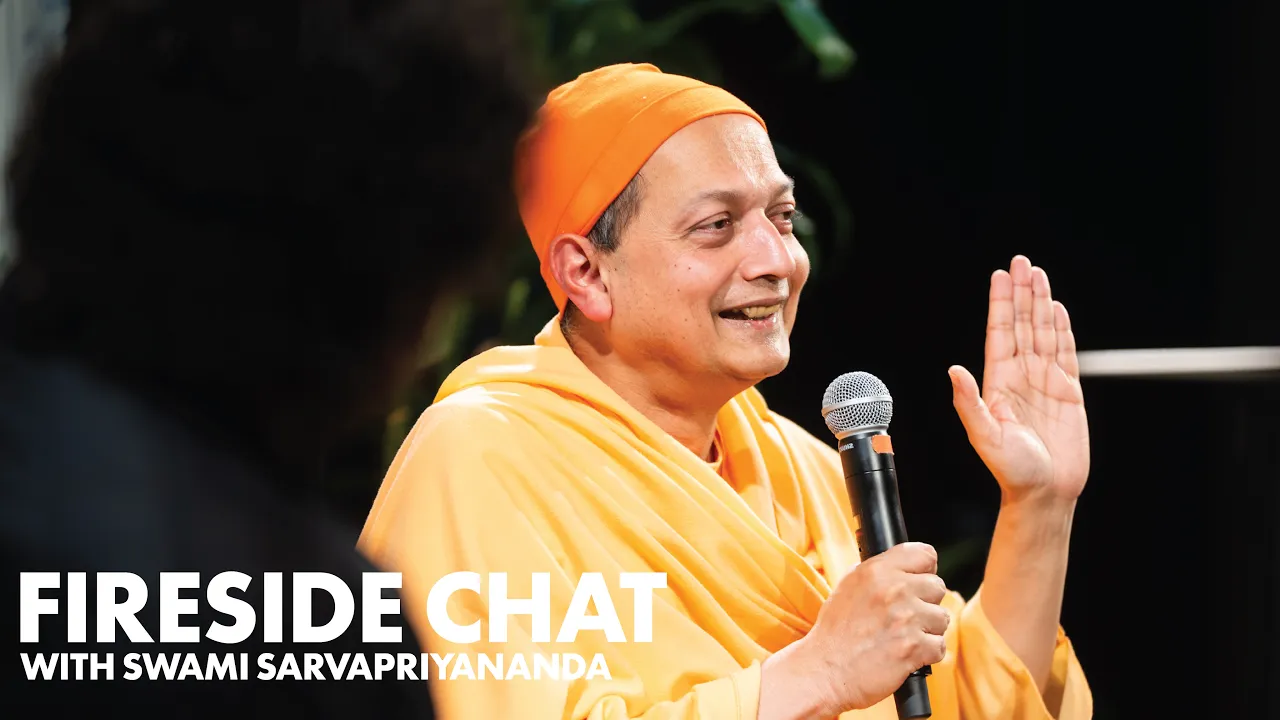
Swami Sarvapriyananda: The Equation of Consciousness & The True Self
Description
Swami Sarvapriyananda, Minister and spiritual leader of the Vedanta Society of New York, delivers a talk on the fundamental nature of consciousness at SPC. Using the simple framework of C + O = E (Consciousness + Object = Experience) he unpacks ancient insights from Advaita Vedanta. He explores how our true self is the unchanging witness to the ever-changing objects of the world—including our own bodies and minds. The core talk is followed by a Q&A session exploring the intersection of these spiritual truths with modern dilemmas, including AI, the "hard problem" of consciousness, and practical habits for finding focus and fearlessness in daily life. Apply to SPC https://www.southparkcommons.com/apply Chapters: 0:00 — The Parable of the Washerman and the Diamond 5:25 — The Equation of Experience (C + O = E) 9:08 — Insight 1: Consciousness is One 13:33 — Insight 2: Consciousness is Continuous 16:57 — Insight 3: Consciousness is Unchanging 18:43 — Insight 4: The Light of Lights 23:01 — Insight 5: Consciousness is Your True Self 26:18 — Defining Intelligence vs. Consciousness in AI 35:12 — Overcoming Fear and Seeking Security 39:03 — 4 Spiritual Practices for Modern Life
Summary
Generated by claude-haiku-4-5-20251001Swami Sarvapriyananda: The Equation of Consciousness & The True Self
Main Topics
- The Nature of Consciousness: Vedantic analysis of consciousness as the fundamental nature of reality
- The Equation C + O = E: Consciousness plus object equals experience
- Artificial Intelligence and Consciousness: Exploring the limitations of AI in replicating consciousness
- Fear and Non-Duality: How understanding consciousness dissolves fear
- Spiritual Practices: The Four Yogas as practical paths to self-realization
- The Self (Atman): The realization that consciousness is one's true nature
Key Points
The Fundamental Equation
C + O = E (Consciousness + Object = Experience)
- All experience can be deconstructed into consciousness (the witness) and objects (all that is experienced)
- Objects include: physical forms, sounds, thoughts, emotions, memories, and sensations—anything that can be experienced
- The mind and body are subtle and gross objects respectively, not the observer itself
Properties of Consciousness
- Oneness: The same consciousness illuminates all diverse experiences (visual, auditory, tactile, emotional, intellectual)
- Continuity: Consciousness persists without interruption even in sleep and anesthesia
- Unchangingness: Cannot change because any change would itself become an object of consciousness
- Non-Affectedness: Not damaged, improved, or enriched by experiences—only objects change
- The Light of Lights: Consciousness illuminates all knowledge and experience; nothing can be known without it
- Directness (Aparoksha): Consciousness requires no instrument to be experienced; it's immediate and choiceless
- Identity with the Self (Atman): Consciousness is not something you have—it is what you are
The Parable of the Diamond
The washerman who discovers a diamond but uses it to scrub laundry symbolizes:
- We already possess consciousness but don't understand its value
- Vedanta introduces us to the profound depth of what we already have
- Recognition of this "diamond" solves existential problems at the deepest level
Consciousness vs. the Mind
- The mind is an object, not the subject
- AI can replicate mind functions (creativity, problem-solving, decision-making) because the mind is an object
- AI cannot replicate consciousness because consciousness is the subject—the fundamental witness
- The failure of AI to achieve consciousness proves consciousness is fundamentally different from mental processes
Fear and Non-Duality
The Vedantic Analysis of Fear:
- Fear arises from the sense of "otherness"—the belief that something exists apart from oneself
- Desire and limitation follow from this perception of separation
- The Solution: Non-dual realization that all objects and experiences appear only in consciousness, which is one's true nature
- When you recognize you are that infinite consciousness in which all appears, there is nothing separate from you to fear
> "Nothing in this world and nobody in this world is apart from you."
The "Hard Problem of Consciousness"
- Modern science has 325+ theories of consciousness but no consensus
- The gap between objective brain processes and subjective experience (the "explanatory gap") remains
- The problem arises from assuming consciousness is produced by the brain
- Vedantic reversal: Consciousness is fundamental; matter appears to consciousness
The Problem of Physicalism
- Cannot explain how objective processes produce subjective experience
- Attempting to understand consciousness through materialism commits a "category error"
- Consciousness (the subject) cannot be reduced to objects
- Recent physics conferences unexpectedly feature consciousness as a topic—suggesting the materialist framework is inadequate
Notable Quotes
> "You are consciousness. Consciousness is you. But you can't find consciousness anywhere except in yourself."
> "Whatever you experience is not you. It's an object. Some of it is a cloud hanging around you—your body and your mind."
> "The person will never be free. But you can be free of the person."
> "I am that light in which the universe appears, plays around and disappears, giving me all these various experiences."
> "Consciousness shining, everything else shines. Everything else means mind and senses and language and the world shines for us."
> "All of the ocean is not different from water and you are the water. Not the water in one wave or one part of the ocean. You are water itself. All waves are you. The entire ocean is you."
> "One is most fearless when one is acting in the benefit of others."
> "Selflessness—when it's not my concern, I have no axe to grind, I'm here just to be helpful—I'll be fearless."
> "Consciousness is not like the mind. It's not another object. You are duplicating the attributes and activities of the mind. But that's still not consciousness."
Takeaways
Understanding Consciousness
- Recognition of What You Are: You are not the body or mind—you are the consciousness that experiences them
- Everything is Known Through Consciousness: No experience is possible without consciousness; it's the ground of all knowing
- The Unchanging Witness: Despite life's constant changes, consciousness remains constant—the stable ground of experience
Practical Implications for AI and Technology
- Mind-based activities (creativity, problem-solving, language) can be replicated by machines
- Consciousness itself remains fundamentally irreplicable because it's not a function but the fundamental subject
- This distinction is crucial for understanding the limits and nature of artificial intelligence
Overcoming Fear in Uncertain Times
- Fear stems from perceiving separation and limitation
- Four practices to transcend fear:
- Self-inquiry (Jnana Yoga): "Who am I?" recognizes the unchangeable nature of consciousness
- Meditation (Raja Yoga): Trains attention and calms the mind, revealing consciousness's steady nature
- Selfless action (Karma Yoga): Dissolves ego-identification and reveals interconnectedness
- Faith/Devotion (Bhakti Yoga): Deep faith in something higher provides resilience and meaning
The Four Yogas (Practical Paths)
- Jnana Yoga: Path of inquiry and self-knowledge
- Bhakti Yoga: Path of devotion and faith
- Raja Yoga: Path of meditation and attention training
- Karma Yoga: Path of selfless service and action
Core Spiritual Truth
> "Atman is Brahman" — The individual consciousness is the universal consciousness; non-duality is the fundamental nature of reality
For Seekers
- Spiritual seeking is not about gaining something new but recognizing what's already true
- Genuine spirituality is about living in alignment with deeper truths: selflessness, love, focus, and self-knowledge
- Data shows people with genuine spiritual practice are more resilient to mental illness and cope better with challenges
- The practices work regardless of religious tradition—the principles are universal
Additional Context
The talk bridges ancient Vedantic philosophy with modern concerns:
- Addresses consciousness studies and the hard problem of consciousness
- Explores the implications of AI development for understanding mind and consciousness
- Provides practical guidance for navigating uncertainty and fear in the AI era
- Demonstrates that philosophical inquiry and spiritual practice are relevant to contemporary challenges
The speaker emphasizes that these are not abstract intellectual concepts but direct, experiential truths accessible to anyone willing to investigate their own experience carefully.
Transcript
Namaste and good evening, everybody. Great to be here with all of you and thanks to Aditya and South Park Commons for organizing this. I'm here primarily out of curiosity, just like many of you are here. All right. So what we're going to do now is for the next 20 minutes or so, I'm going to speak, do a TED talk. I've done two TED talks and each time I promise that I won't do one more because the most difficult thing that I've done is these TED talks. It's around 20 minutes and it takes me 20 minutes to get started. But I promise to be crisp. I was told again and again, these are very smart people. You don't have to repeat yourself, you don't have to tell jokes and keep their interest. They are interested already. All right. Sri Ramakrishna used to tell this parable about the washerman and the diamond. So there's this traditional Indian washerman. Those who are from India, you've heard the term dhobi. So he collects your dirty laundry, goes to the riverbed and washes it and scrubs it dry with the rock and then cleans it and gets it back to you. And this poor washerman found a diamond. He didn't know what a diamond was. He had never seen one in his life, but he knew this was not an ordinary rock. Every facet of this story is fascinating because it's connected to our topic today of consciousness. He didn't know what it was, but he thought it was a particularly pretty rock and he used it to scrub dirty laundry. But he was still curious. So he took it to the vegetable seller, his friend, and asked him, what's this? The vegetable seller also was not all that much more educated or wise in the ways of the world. So he also didn't know what it was. But he said, it's a pretty rock. I'll give you 10 rupees for it. And luckily this washerman didn't sell it to him. You take consciousness to the physicalist who will say, yeah, consciousness, we know what it is. It's a product of the brain. Don't sell it to him. It'll shortchange you. He took it to different people. Long story short, finally, the washerman took the diamond to a diamond merchant who said, wow, this is the largest, most amazing raw diamond that I've ever seen. I'll give you a million rupees for it. And so the washerman's poverty was ended. He found out the real value of the diamond and that's the story. The idea being we all have this diamond already. Vedanta, the particular school of philosophy we're talking about today, tells us about what we already have. It just introduces us to its depth. Just like that washerman, not only do we already have consciousness, we are already using it all the time. The washerman was using it, but using it just to scrub dirty laundry. We are using consciousness too. We are using it right now. We are seeing, we are thinking, we are listening. We are conscious. But Vedanta says, and many of these schools of philosophy, Indian, Eastern schools of philosophy, they say that this is truly a diamond. And we do not know what it is, its depth, its profound nature. And if only we would know what it is, what is that we already have, our real nature, our core nature, it would really solve our problems at the deepest level, at a philosophical level, at an existential level. So what Vedanta does is like the diamond merchant. It introduces us to what we already have. It introduces us to what we already are. There's a saying in Hindi among the monks in the Himalayas, Praptasya Prakti, attainment of what is already attained. Nirittasya nivritti in Sanskrit means it removes what was never there, gives you what you already had. It sounds like a con job. The snake oil salesman of the Wild West, who was arrested and produced before the sheriff, the sheriff produced it before the judge, charged him with giving imaginary cures for real diseases and real cures for imaginary diseases. But no, this is something really, really deep and valuable. Since we're going to talk about something which is already there, consciousness, it is experiential. Just now, Abhinav was talking about it and he was talking about hard practices. He says, Swami, what you talk about sounds very intellectual, but what about hard practices? By which he means experiential. But consciousness is experiential. In fact, there's no other experience except conscious experience. And so what we're going to talk about right now for the next few minutes, I will introduce us to the key concept of Advaita Vedanta, which opens up the rest of the whole philosophy for us. And this, I would urge us to look at our own experience. Nothing of what I'm going to say now for the next 15 minutes is going to be outside anybody's experience. We all know about it. All that I'm going to do is draw attention to the diamond, draw attention to what we already have. We always had it. All right. Since mostly you're techies, a neat equation is helpful. I read somewhere Stephen Hawking said that in his book Brief History of Time, his publisher told him, each equation will half your readership. We lose readers. Half your readers will go over if we put in one equation. But here it's just the opposite. People here love equations. So here is an equation for us, which will serve us throughout this talk. Consciousness plus object is equal to experience. C plus O is equal to E. As simple as that. What is experience? All that we have. Whatever is happening is experience for us. What is this experience? It is analyzable into consciousness plus object. And if you go a little bit deeper into it, it's a very interesting claim. What would be the definition of an object? Anything that we experience is an object. So this table is an object because I see it. I can touch it. My shirt is an object. Consciousness plus object is equal to experience. C plus O is equal to E. As simple as that. What is experience? All that we have. Whatever is happening is experience for us. What is this experience? It is analyzable into consciousness plus object. And if you go a little bit deeper into it, it's a very interesting claim. What would be the definition of an object? Anything that we experience is an object. So this table is an object because I see it. I can touch it. My shirt is an object. Consciousness plus object is equal to experience. C plus O is equal to E. As simple as that. What is experience? All that we have. Whatever is happening is experience for us. What is this experience? It is analyzable into consciousness plus object. And if you go a little bit deeper into it, it's a very interesting claim. What would be the definition of an object? Anything that we experience is an object. So this table is an object because I see it. I can touch it. My shirt is an object. I can see it. Very interestingly, my body is an object too, because I can experience it. I can see it. I can touch it. I can smell it, taste it. But every sense organ operates on the body. So it's experienceable. It's an object because it is experienced. But even more interestingly, and here is where it gets really interesting, is our internal experiences, which are generally classified as subjective, as internal, as mind belonging to the realm of mind and consciousness. A thought. If you just think ABCD now, or you just think AI. By the way, AI for me is Advaitic intelligence, not artificial intelligence. That thought, by our definition, is also an object because you experienced it. Our emotions are also objects because we experience them. Just because you experience it. You see, I feel it. Depression, unhappiness, pain, joy. Yes, because you feel it, it's an object. Whatever we can experience is an object. And by this, we also get a definition of a neat definition of consciousness. Which is no small feat. Because if you look at consciousness studies today, they're struggling for definitions. They have a plethora of definitions, all of which fall short. I'll give you a neat definition which works just like that. That which experiences objects is consciousness. That which illumines, reveals, experiences is consciousness. A philosopher, Aarindam Chakravarti, he defined an object as: an object is anything that objects to your consciousness. So think of consciousness as a field. And it runs out there and it runs into forms like this. It runs into sound like my speech. It runs into thoughts. It runs into memories. It runs into desires, into sensations. Those are objects. It's the field running into something. The moment the field runs into this, I see. The moment the field runs into this sound, I hear. I think. I remember. I want. I hate. I love. All of those are experiences. And they're generated when consciousness hits an object. So this is the equation. C plus O is equal to E. Consciousness plus object is equal to experience. And we will abandon this equation at the very end. But right now it will serve our purpose. All right. Let's now do the experiential talk thing. I'm going to say some things. Notice and check in our own experience. Is it a fact? What did he say? Do I get it? Is it true? So, C plus O is equal to E. Let's look at our experiences. I see. I see so many things. And the things which I see are very different. But yet in all of them, one thing is common. I am conscious. When I see you, I am conscious. When I see them, I am conscious. When I see what was outside, I am conscious. The consciousness is constant. If you separate the consciousness analytically from the objects, the objects keep changing. And therefore the experiences keep changing. But the consciousness is constant. It is one consciousness. It is the same consciousness which sees this. And the same consciousness which sees this. Even more dramatic. Check with our own experience. I stop seeing. And I just listen. How dramatically different is listening from seeing? Seeing is a vivid experience. Shut my eyes. I just listen. That's another vivid experience. Very different experience. Yet what continues. What is common. Utterly the same. Consciousness. Consciousness. When you flush out all objects, the bare awareness, at least conceptually we can understand. It has to be the same thing which experienced objects called forms, and experienced it through the eyes, and we got the experience of visual, experience of seeing. The auditory experience of hearing. The olfactory experience. The gustatory experience. The tactile experience. They are all experiences. And they are dramatically different from each other. But here, the first takeaway, the first insight we get, is consciousness is one and the same, and common to all of them. This one common observer, observer in the sense, not a little guy sitting and watching, more like a light illumining. So that observer, that light, this is called in Vedanta the witness consciousness. Witness, not in the sense of a guy watching through binoculars or something, no. It's just like light illumining whatever comes in front of it. If you are up on your consciousness studies theories, there are many theories. One of them is global workspace theory. It treats consciousness as a stage, and whatever comes on the stage is lit up. And whatever comes on the stage and is lit up is then conveyed to the rest of the brain, which are neurological processes. It's very similar to one of the approaches in Advaita Vedanta actually. It's just like light, illumining whatever comes in front of it. If you are up on your consciousness studies theories, there are many theories. More like a light illumining. So that observer, that light, this is called in Vedanta the witness consciousness. Witness, not in the sense of a guy watching through binoculars or something. No, it's just like light illumining whatever comes in front of it. Just by the way, if you are up on your consciousness studies theories, there are many theories. One of them is global workspace theory. It treats consciousness as a stage, and whatever comes on the stage is lit up. And whatever comes on the stage and is lit up is then conveyed to the rest of the brain, which are neurological processes. It's very similar to one of the approaches in Advaita Vedanta actually. So consciousness is the first takeaway. It is one and common to all our experiences. When I see, I hear, I smell, I taste, I touch—one consciousness behind all of them. When I think internally, when I imagine, when I enjoy, when I suffer, when I remember, when I desire, when I hate, all those are dramatically different objects and dramatically different experiences. Imagine the experience of loving and the experience of hating—so different. And yet there's the claim that there's one light experiencing both. After all, do we not say I hated but now I love? The I is common. It's not that somebody else, some other entity hated, and some other entity is loving. No, the same entity claims both experiences. If experiences have changed, then the objects that were experienced have changed. Consciousness is not changed. It's the same—same consciousness in all my actions. Indeed, in all my waking and dreaming and here is a very interesting claim: in deep sleep also, the presence of all these objects is illumined by the same light of consciousness. And the absence of all the objects—if you sweep away all the objects, empty the room, empty the stage, the global workspace of consciousness—that empty space, that absence of objects, is also revealed by the same consciousness. We just call it sleep. This is the Vedantic understanding of sleep and would be analogously the Vedantic understanding of general anesthesia—just a huge area we can talk about. So the takeaway: one consciousness illumining all our experiences. Second insight into this consciousness: all of these are new insights. We're learning something here. This one consciousness is also continuous. None of the objects are continuous, none of the experiences are continuous. The very thing that we say our day is full of experiences is because they're discontinuous and they keep changing. Why do they keep changing? The answer is the objects presented to consciousness keep changing. Consciousness itself neither changes—it's one and it is continuous. So this one witness consciousness is also a continuous consciousness in contrast to the objects which change, our experiences which change. Third: not only is it continuous, but also unchanging. These are claims, but I can immediately demonstrate that they have to be true. What do I mean by continuous and unchanging? The river is continuous but it continuously changes—it's flowing. We have all heard the stream of consciousness theory in literature and in psychology. Now we understand from a Vedantic perspective such a thing is impossible. When you say stream of consciousness, you mean a stream of conscious experiences, a stream of objects floating through consciousness giving rise to a stream of experiences. So this consciousness is not only one, not only continuous without a break. Suppose you say there's a break—how do you know there's no break in consciousness? A break would be defined as a break in the presentation of objects, for example deep sleep or general anesthesia, the absence, an experience of absence, not an absence of experience. Such a thing is inconceivable. What is possible is an absence of objects presented to consciousness. Sweep away all the objects and you have something like deep sleep or what we call unconsciousness. So it is continuous but it's also unchanging. The nature of consciousness as this steady illumination does not change. You might say why not? Is there any logical reason? Yes, there is. If there is a change in consciousness itself, the question would be: is it knowable or unknowable? Is it experienceable or inexperienceable? If it is experienceable, then the change becomes an object. You see? So experience is consciousness plus object equals experience. If there is a change in consciousness, if that change you know, if you experience it, it becomes an object. Then it is not consciousness. It is something presented to consciousness. And if you say there is a change in consciousness but it cannot be known, then don't talk about it. It makes no sense. The question would be: is it knowable or unknowable? Is it experienceable or inexperienceable? If it is experienceable, then the change becomes an object. You see? So experience is consciousness plus object equals experience. If there is a change in consciousness, if that change you know, if you experience it, it becomes an object. Then it is not consciousness. It is something presented to consciousness. And if you say there is a change in consciousness but it cannot be known, then don't talk about it. It makes no sense. So consciousness, again the claim would be it is one, illumining every experience that we have external and internal, intellectual, emotional, physical, mental, all of those experiences, aesthetic, good, bad, horrible. All experiences are illumined by that one consciousness. Indeed, they are there. Experiences are there because of consciousness. Otherwise we wouldn't have experience. There would be no experience. It would be dark. Although Vedanta would say that's also an experience. Opening your eyes is an experience. Closing your eyes is also an experience. It's an experience of absence. Consciousness did not go out. So, one more: consciousness is not changed by experience. All these are new. When you look back upon it, you will say that they are pretty obvious. But till now it was not obvious. We all talk about: oh I have been traumatized by my experience. I am shattered by my experiences. If you look a little more closely, that trauma, do you experience it? Of course, that's why I am talking about it. If you are experiencing it, then the trauma must be an object. It's something that was not there earlier. It's there now. May not be, hopefully, there later on. But you were there earlier. You are there right now. And you will be there afterwards also. So, whatever happens, happens in the object. Whatever is experienced is an object. Therefore, consciousness itself is not enriched, degraded, or diminished by experience. I am making a logical argument. Show me different. I am not denying that our bodies are damaged by experience. They can be. They are. All the time. COVID can do it. Our minds are traumatized by experience. A nasty word, an unpleasant comment on your Facebook page can do it. It can traumatize your mind. But even that would be an object for you, the consciousness. Consciousness. So, consciousness by itself is, in a certain sense, safe. Always safe. Choicelessly so. It cannot be damaged by experience. It makes all experience possible, but it itself cannot be damaged by experience. Cannot be enriched either. They can be. They are. All the time. COVID can do it. Our minds are traumatized by experience. A nasty word, an unpleasant comment on your Facebook page can do it. It can traumatize your mind. But even that would be an object for you, the consciousness. Consciousness. So consciousness by itself is, in a certain sense, safe. Always safe. Choicelessly so. It cannot be damaged by experience. It makes all experience possible, but it itself cannot be damaged by experience. Cannot be enriched either. It's already what it is. Then, another thing. In Vedanta, we call consciousness the light of lights. So in Vedanta, light would be anything that reveals something. If something was in darkness, if it's revealed, that which reveals it is called a light. So the room was in darkness. Now the lights have come on. So this is a light because it revealed what was in darkness. In the same sense, the sun is a light, the moon is a light, the stars are lights. But also, language is a light. I don't have to tell you this. All AI, right now at least, in the age of LLMs, language is a light. All that it reveals. That's what AIs do. Vedanta would say yes, it's using a most powerful light, that is language. All of human experience, consciousness plus object encoded into language, fed into the AI. It's a light. Language is a powerful light. Our senses are lights. Eyes are lights which reveal forms. Ears are lights which reveal sound and so on and so forth. Because they reveal something which would be otherwise not revealed. The mind is a light, which reveals whatever the senses dump into it, the information. But ultimately, consciousness is the light of the mind also. Because finally, whatever is experienced is an object presented to consciousness. And consciousness, there's no light of consciousness. Consciousness is the light of lights. So there's a very beautiful Upanishadic verse which says: That shining, everything else shines. By its light, everything here is revealed. Consciousness shining, everything else shines. Everything else means mind and senses and language and the world shines for us. By the light of consciousness, everything here is revealed. By the light of consciousness, everything here is revealed. You shining, everything else shines after you. By your light, everything here is lit up. This is consciousness. The light of lights. One more. We could go on. And I'm saying all of these are new. They're not quite understood. Only faintly so by the modern philosophy of mind. So these are really very ancient insights. But we've been bringing it into dialogue with the modern philosophy of mind. You'll find these are, at least they should be treated as extremely important claims. Very, at least provocative claims. One more. Consciousness is what is called in Sanskrit Aparoksha, which means direct. Immediate. To see something I need eyes. There has to be a light. There have to be forms which are seeable by my eyes. My mind has to pay attention. All of these need to happen. This instrumentation has to be in place. Then I can see or hear or touch. But consciousness is direct. You don't need anything else to experience consciousness. Consciousness is the ground of all experience. It makes what makes all experience possible. It's direct. It's choiceless. You cannot not be conscious. This is in another way Descartes' famous proof of Cogito, ergo sum. I think therefore I am. There have to be forms which are seeable by my eyes. My mind has to pay attention. All of these need to happen. This instrumentation has to be in place. Then I can see or hear or touch. But consciousness is direct. You don't need anything else to experience consciousness. Consciousness is the ground of all experience. It makes what makes all experience possible. It's direct. It's choiceless. You cannot not be conscious. This is in another way Descartes' famous proof of Cogito, ergo sum. I think therefore I am. It cannot be—even if you doubt it, you're just proving it. So consciousness is choiceless. You cannot not be conscious. You cannot decide. Swami, have you heard of general anesthesia? Yes, but Vedanta would clear that that's also consciousness. There's consciousness of an absence. And this consciousness, summing up. I've run out of time. This consciousness, which is the one light of all our experiences. One. Which is continuous without interruption. Even in so-called general anesthesia or deep sleep claim. Number three. It is unchangingly continuous. There's a difference between being continuous and not changing. It's unchangingly continuous. Number four. It is not affected, degraded, improved, enriched, damaged by our experiences. Number five. It is the light of lights. All knowledge is light and this is that which lights up knowledge. There's a question there. The difference between consciousness and knowledge. Experience and knowledge. And finally, it is also direct, immediate, choiceless. And one more, most important. It is you. This is what Vedanta calls Atma, the Self. In Vedanta, the Self is not the body. We start with nobody denies that we are conscious. But we think we are bodies with consciousness. Vedanta wants to push us to the position that we are consciousness experiencing bodies and minds. So this consciousness which we are talking about now is the Self. You are consciousness. Consciousness is you. But consciousness is other things also. No, we won't go there. You can't find consciousness anywhere except in yourself. And one more, most important. It is you. This is what Vedanta calls Atma, the Self. In Vedanta, the Self is not the body. We start with nobody denies that we are conscious. But we think we are bodies with consciousness. Vedanta wants to push us to the position that we are consciousness experiencing bodies and minds. So this consciousness which we are talking about now is the Self. You are consciousness. Consciousness is you. But consciousness is other things also. No, we won't go there. You can't find consciousness anywhere except in yourself. Take a look around. Swami, they are all conscious. Are they? All you can see of them is their body. All you can hear of them is their language. All you can observe is their behavior. The way we experience consciousness within ourselves, we do not experience, we cannot. To experience consciousness elsewhere would be to make consciousness an object. Okay. All of this is just developing the idea of consciousness plus object is experience. Now, this is not even Advaita. It's still very gross dualism because you have split the world into consciousness and object. I'll just stop here. The next step in Advaita would be to ask the question, what is the relationship between consciousness and object? C and O. Are they separate? Are they in some sense one? Is one the source, the other the product? If you say object is the source and consciousness is the product, you'd get materialism. If you say consciousness is the source and object is the product, some kind of consciousness produces the material universe, you get religion, theism. God produced the universe. That's the common definition of God in every religion which believes in God. Or you say they are parallel, they are strictly separate entities. You get the ancient Sankhya philosophy which says there are two realities in this universe, a material reality, called object, and consciousness. And they are parallel realities, they interact. Where do they interact? In us? We are combination interactions of consciousness and object. Each has serious problems, each approach. Or you can say they are interdependent realities. The mind only school of Buddhism, the emptiness school of Buddhism will say consciousness and object rise and fall together. Each of them has serious problems. The view which I am recommending, which I am talking about today, the Advaita, non-dualistic view says that object is an appearance, not a product of consciousness. Object is an appearance in consciousness. So, consciousness plus object is equal to experience. But now this object is in some sense consciousness itself. Consciousness appearing to itself as object generates experience. So in one sense, all underlying the whole equation, consciousness, object and experience is consciousness itself. This is called the non-duality of consciousness. Generally, I don't give talks like this. It would be one and a half hours with jokes and stories and all. But this audience is different. So, I've reduced it to this, the bare bones, the equations. All right. Thank you. Let's talk about it. [SPEAKER_01] Thank you so much for that, Swamiji. I am actually curious, could you tell us a little bit more? I use that word, Swamiji. Could you tell us a little bit more about what that means and in your tradition? Swami just means a monk. Our husband is also called a Swami. A king would be called a Swami. But we are kings without empires. The king without kingdoms. Yes. So, a master, teacher, monk and in different traditions, not just the non-dual tradition of Vedanta. Dualistic traditions, non-dual traditions, all kinds of Hindu traditions. So, monks are called Swami in that sense. But it is an interesting question in another sense. What I talked about just now is not academic. This is another brilliant thing generally about Indian culture. This is taken very seriously. So, these monks who belong to different schools of sorts. I belong to the non-dualistic school of Vedanta. But they are practicing philosophers. So, they take it seriously and they try to live by it and realize it and reframe their life in the light of this philosophy. I do it in this philosophy. But there are other philosophies also. And there are thousands of these people. Thousands of us. So, they are specialists. You don't need to be a specialist in AI to use ChatGPT or Gemini. But you do need specialists to make and maintain and tune up and understand AI like you. So, everybody doesn't have to be like you. They can be end users of what you are producing. But there have to be some specialists. Similarly, we have monks or specialized scholars. The monks are called Swamis. Okay. So, I'm going to move to the question of intelligence. And the elephant in every Silicon Valley room these days is artificial intelligence. And I find it fascinating as someone who studied computer science and AI as it is one of the first technologies that we've made that we don't fully understand in some sense. It is, to quote Richard Feynman, what I cannot build, I do not understand. And it creates a sense of mystery and fear and why is language so powerful. [SPEAKER_01] And we've been able to do so much with it. And yet, it's so limited in so many ways. But the first thing I want to approach about AI is to level set a definition, a working definition in the room of what intelligence is, which is the best definition I've seen from the computer science world is representation and problem solving. And I find it fascinating as someone who studied computer science and AI as it is one of the first technologies that we've made that we don't fully understand in some sense. It is, to quote Richard Feynman, what I cannot build, I do not understand. And it creates a sense of mystery and fear and why is language so powerful. [SPEAKER_01] And we've been able to do so much with it. [SPEAKER_01] And yet, it's so limited in so many ways. [SPEAKER_01] But the first thing I want to approach about AI is to level set a definition, a working definition in the room of what intelligence is, which is the best definition I've seen from the computer science world is representation and problem solving. [SPEAKER_01] It is when an agent wants to change the state of its perceived reality from one state to another state, it is the ability to take the universe and its experience and represent it in a meaningful way and traverse that representation to the desired state. [SPEAKER_01] So, this will be a practical, imperfect, but practical working definition of what intelligence is. [SPEAKER_01] I'm curious actually before we get deeper, is that how you would think of intelligence? Quite similar. Let me translate what you said into Vedanta. So, you have an agent, you have representations, you have decision making, producing knowledge, that would be the side of intelligence. So, in Vedanta you have consciousness, of course, which we just talked about. But also, again in our own experience, there are two kinds of entities among objects. I said consciousness plus object is equal to experience. But if we look at the objects which we are experiencing right now, there are two kinds. One is physical, public, third-person, experienceable objects, like this table, like this microphone, like this body. Our physical bodies are entities which are public. A doctor can experience your physical body, knows more about our physical bodies than we do. But we have also another kind of, very different kind of object in our experience, which we call our minds, which are utterly different from the physical bodies. They are, to begin with, probably non-local. We don't know exactly where they are located. Maybe they inhabit a different space. And they are entirely private. We code what's going on in our minds in language and then that's what we train AIs in. But our minds are directly accessible only to us, internally, first person. Each person has a private world, an objective world. Vedanta would say that's also an objective world. See how it's different from our common discourse. Our common discourse would be, this is an objective world. That what you've got in there is a subjective world. Vedanta would say, no, no, no, both are objective. Because the definition of object, whatever is presented to you is an object. The world is presented to you, physical object. The mind is presented to us, subtle object. Now, the consciousness in the mind, it functions as an agent. In Vedanta, that would be the ego. It's part of the mind. In fact, we can all experience our egos right now as the sense of I. And that ego uses the mind and the body to make changes in its state of experience. It makes representations. That making representations is what is called in Vedanta the mind. And a part of the mind is concerned with knowledge and determination. I'm translating from the Sanskrit. That part of the mind which is concerned with knowledge and determination. That this is this. That experience which we have, I get it. Experience which we have, I don't get it. Now I get it. That changed. That happened in the intellect. So that's the higher part of the mind. There's a processing part of the mind, the representing part of the mind. And there is also the agent part of the mind. And there are all parts of the mind. The ego is a part of the mind. The intellect, intelligence is a part of the mind. The processing of sensory information, memory is part of the mind. Memory is also part of the mind. All of this is our internal objective, what we call the subject basically. But Vedanta would consider that also to be object. Because it's all lit up by consciousness. So yes. And here is the new step forward in Vedanta. Vedanta is very old. Thousands of years old. But new things can happen because of inputs from AI, from people, the work that you are doing. Vedanta would immediately say, look, this goes to prove that the mind is also an object. Because now you are able to replicate, imitate, replicate the activities and outputs of the mind. It's not the subject. Notice the one thing that, here is an elephant in the room. I use this argument and I am sure many of you here would push back vehemently against it. He did. Notice the one thing that these AIs cannot do. They can compose stories. They can take decisions. They can drive a taxi way better than us. But one thing they cannot do. They are not conscious. You may push back on that. We will argue about that later on. But they are not conscious. And I wonder why. To train an AI to be creative, to write short stories or to do your emails or write an academic assignment. It's very, very difficult. These are complex tasks, which have cost billions. [SPEAKER_00] I was telling them, you have spent billions of dollars in budgets and thousands of training hours to do that. AI, consciousness is very simple. We just defined it. All it does is give first person experience. Consciousness gives first person experience. That's all it does. Why can't you replicate that? But they are not conscious. And I wonder why. To train an AI to be creative, to write short stories or to do your emails or write an academic assignment, it's very, very difficult. These are complex tasks, which have cost you billions. I was telling them, you have spent billions of dollars in budgets and thousands of training hours to do that. AI, consciousness is very simple. We just defined it. All it does is give first person experience. Consciousness gives first person experience. That's all it does. Why can't you replicate that? And the answer from Vedanta is, it points to the utterly different nature of consciousness. Consciousness is not like the mind. It's not another object. Until now, we were able to duplicate the activities of natural objects. That's what our machines do. Now, there's a revolution. You guys, you are duplicating the attributes and activities of the subtle objects, which is the mind. But that's still not consciousness. And I think this difference, this failure of AI to approximate or to replicate consciousness, if that's the fact, it points to the correctness of this analysis, that consciousness and object, and the mind is also put in the category of the object. [SPEAKER_01] Well, to do the pushback. Yeah. Right. I don't know that my Waymo is any less conscious than I know this about the next person. I know in my heart, right? There is a feeling. There is a sense of connectedness and you can rationalize that as mirror neurons and whatnot. But I think there is something genuine you cannot just dismiss of what is. Do brains generate minds, right? What is it? And another way to put it is, I don't think most of us can experience what you're talking about, right? Which is the mind as a subtle object. I think of my mind as maybe my personality most of the time. [SPEAKER_01] We do. But it just takes one. Just point it out. The diamond merchant pointed it out to the washerman. We just, it has to be pointed out. Think a thought right now and think, am I not able to experience that thought? Isn't it a first person experience? A flash of pain, a memory, or Proust, the smell of madeleines in the morning for breakfast. It's an experience. And Vedanta just labels it an object. How is it different in principle from this object? They are both lit up by consciousness. And it's not something esoteric. That monks, after 10 years or 20 years of meditation, you begin to experience your minds as object. No, all of us, we experience our minds as objects. It's just that we don't think, we don't frame it that way. And that's why we think, I am this. This body. Not only we identify ourselves with our minds, we identify ourselves with our bodies. So I am this body, I am this mind, and the rest of it is not me. The other begins when my fingertips end. Beyond these fingertips is the other. Inside this skin and in the mind is me. Vedanta says, no, that's not logical. Vedanta says, be logical and psychological. Look at our own experience. Whatever you experience is not you. It's an object. Some of it is a cloud hanging around you. Your body and your mind, your personality. Even the word personality comes from the Greek for person, for mask. So even personality is not you. We are not persons. There is a saying which I love. However, the person will never be free. But you can be free of the person. While still putting on the mask. Even when you put on the mask, as long as we are aware it's a mask, we are free of it. To interact with this world, you cannot but have masks. You must have a body to interact with physical beings. You must have a mind to interact with thought and emotion. You must have senses to interact with forms and sounds and tastes. So all of that is good. These are powers. These are super powers which we all have. But whom do these powers belong to? To consciousness. And there is something special about it. I can go on. The latest issue of Scientific American. 29 theories of consciousness. What is consciousness? To answer that, they said 29, not theories, 29 categories of theories. Robert Lawrence Kuhn in that Closer to Truth podcast. He has categorized the landscape of consciousness. 325 theories. 325 theories. In science. The first thing he says is in science, we say we have an explanation. When we narrow it down to one acceptable peer-reviewed theory. And we say, okay, this works. It can be revised later. But right now this works. It goes to the textbooks and all. It is scientific knowledge. If I have 325 theories and I still say we need one more. The right one. Or 29 theories according to Scientific American in February. It just is another way of saying, I don't know. It's a profound mystery. We just don't know what consciousness is. If you say AI can be conscious, it runs up against what's called the hard problem of consciousness. That a series of objective processes will produce another object. It cannot produce the subject. The brain processes. The brains generate consciousness. That's the mainstream view. If I have 325 theories and I still say we need one more. The right one. Or 29 theories according to Scientific American in February. It just is another way of saying, I don't know. It's a profound mystery. We just don't know what consciousness is. If you say AI can be conscious, it runs up against what's called the hard problem of consciousness. That a series of objective processes will produce another object. It cannot produce the subject. The brain processes. The brains generate consciousness. That's the mainstream view. Brains have something to do with consciousness. Nobody can deny that. But do they generate consciousness? The philosophical problem in principle, philosophers of mind will tell you today also. Thanks to David Chalmers. They will tell you you are making a category error. The last things that we can observe are minute electrical or neurochemical activity in the brain. Thanks to modern technology. But from there to the experience of speech. Of light and sound and pain and thinking and understanding. Those experiences. And electrical, minute electrical activity which cannot be observed without the most sophisticated machines. Isn't there a gap? There is an enormous gap. This is called the explanatory gap. And there are many views on it. There's Daniel Dennett and others who were convinced that this is an illusion. That it is nothing other than if you say that there is an electrical discharge and there's lightning. They are the same thing. They are. But this is a counter example to what I'm saying. But my answer to that would be this is not a good example. Because electrical discharge and the lightning are both objects. They can be related. They can even be identical. But the object and the subject are utterly different. And the failure of AI to be conscious. The failure of science, brain science, neuroscience. The failure of modern consciousness studies to agree upon even a set of consciousness theories. That just shows that our framework with which we are trying to understand consciousness is not adequate. We're trying to understand the true subject, the real subject as another object. That's why the philosophers call it a category error. Thank you. Thank you for putting up with my skepticism. It's been understandable. I want to address another thing that's just in the air with us all. It's fear. It is an interesting time we live in on every level from intellectual to practical to economic. Things are changing. [SPEAKER_01] Very few, if any, nobody really knows how they're going to end up. And our minds just love certainty. They love patternization. They love knowing what's going on. We've talked about the underlying reasons for the fear. I'm just curious what advice would you have for us to deal with the general anxieties of the AI era and the transition we're going through? You know, actually, better than me because you're anxious and uncertain. You think somebody dressed peculiarly will have a better answer? No. Certainly not. You guys are the experts. And from you guys I've heard three kinds of answers which covers the entire spectrum. From AI utopia. I won't name names. They are at the cutting edge of AI. I was just telling you about those guys. They are at the cutting edge of some of the famous AIs operating today. AI utopia. It's all going to be major, and it's going to be great, Swami. Don't worry. It's going to be amazing. That's one end of the spectrum. The other end: it's going to be major, and it's going to be horrible. So that's another group. Yeah. And in between the spectrum: it's not going to be all that major. You're going to go into a boom now. It'll go bust, and then we'll have some residual effects. It will maybe not even be as evolutionary as the internet itself. It'll be big, but less big than that. These are the various opinions and you know all of them. And one good thing about it is also, it's not like the industrial revolution. We will see the effects of it 50 years later, or maybe in your children's time. Because AI is so fast, and the cycles are so fast now. You will see the answers to these questions in the next 5, 10, 15 years, definitely. From a Vedantic, and more largely from a spiritual perspective, the spiritual truths remain unchanged. In a world before, pre-AI, and after AI also. Selflessness is more rewarding than selfishness. That's going to continue. Love is more rewarding than desire. That's going to continue. We'll have to learn these lessons again and again, at the individual level and the societal level. Focus is more rewarding than distraction. Say, Swami, the whole of Silicon Valley is built on the model, you know that, you distract people, that pays. But for ourselves, in our own lives. Focus is more rewarding than distraction. And self-knowledge is more rewarding than knowledge of the other. Knowledge of the other is of course important. AI is an interesting thing, which has brought self-knowledge and knowledge of the other together. That's why it's so fascinating and mysterious. You're making things which are just like ourselves. Fear, let me give you the Vedantic analysis. Fear comes from the other. Fear. The Upanishads say the very existence of the other is the source of fear. You distract people, that pays. But for ourselves, in our own lives, focus is more rewarding than distraction. And self-knowledge is more rewarding than knowledge of the other. Knowledge of the other is of course important. AI is an interesting thing, which has brought self-knowledge and knowledge of the other together. That's why it's so fascinating and mysterious. You're making things which are just like ourselves. Fear, let me give you the Vedantic analysis. Fear comes from the other. The Upanishads say the very existence of the other is the source of fear. Even desire comes after fear. Desire comes from a sense of incompleteness. The very existence of the other implies one thing: that there is something that I am not. There's a limit, there's an end to myself, to my being. Because I stop where the other starts. Therefore, I am limited. This implication that I am small, there is something that I am not. There's something outside me, there's something beyond me. That is the source of fear. The French philosopher Sartre said, hell is other people. What Vedanta does is it reverses that. If consciousness plus object, Vedanta says you are everything. Atman is Brahman. If consciousness plus object is equal to experience, but the objects are also nothing but consciousness appearing to itself, then all object and all experience, which means all of life itself, is consciousness, is you. [SPEAKER_01] In some way. Nothing in this world and nobody in this world is apart from you. That's the widest sense of the self that we can get. When I say I am consciousness itself, it's not like I am a spark of consciousness in a vast material universe, separated from everything. That's alienation. But no. I am that light in which the universe appears, plays around and disappears, giving me all these various experiences. And that which appears in me, and only in me, in me means in consciousness. Show me something which is the universe, where you can experience an object apart from consciousness. You cannot. The entirety of the world, known and unknown, knowledge and experience are different. Known and unknown, appears in consciousness. All of these are utterly obvious when we consider it. But we never consider it. We never think in this way. You are the consciousness in which what we call the universe, other people, our own lives, they appear, they play around and they disappear. Therefore, all of life is not different from consciousness and you are that consciousness. Like all of the ocean is not different from water and you are the water. Not the water in one wave or one part of the ocean. You are water itself. All waves are you. The entire ocean is you. And what the beauty of Advaita Vedanta is, it's very hardheaded. What I am saying here sounds poetical. It's not poetical. It's not meant to be poetical. It's meant to be literal and argued out in painstaking detail with any question, facing any possible question. And it's not new. It's thousands of years. And it's developed in various forms. It's not just limited to Hinduism. [SPEAKER_01] Some form of non-dual understanding you find in Taoism, you find in Buddhism, you find in all the major spiritual traditions of the world. [SPEAKER_01] And that, I would be happy to claim soul possession of this amazing wisdom, but it's not true. [SPEAKER_01] And I'm glad it's not true because that makes it more probable that it's right. [SPEAKER_01] It has been known to human beings since the dawn of history, before prehistoric times, I'm convinced of that. [SPEAKER_01] This knowledge has been around in some way or the other. [SPEAKER_01] Now we are thinking about it in terms of science, consciousness studies, AI. [SPEAKER_01] This is new. [SPEAKER_01] Even quantum theory, this is new. [SPEAKER_01] I have a nice anecdote to relate. [SPEAKER_01] I'll take names. [SPEAKER_01] I met this very interesting person, Helmut. He's the head of quantum computing at Google. And he told me this thing personally. He met the physicist Roger Penrose. And he's saying, Sir Roger, ultimately all of this, the data we are talking about, even in quantum computing, it has to be grounded. It has to be stored in matter. It manipulates matter. [SPEAKER_01] So that's where it has to be grounded. So it is all, even knowledge is grounded in something material, right? And Sir Roger Penrose says, ah, but you see, I do not understand what matter is. Roger Penrose, he says, I'm uncomfortable being called a materialist because I don't understand matter. So matter is mysterious. There is a philosopher, Galen Strawson. If you look it up, he wrote this article, tongue in cheek, in the New York Times, "The Hard Problem of Matter." He says there's no hard problem of consciousness. We are conscious. That's the first fact. It's pre-fact. It's a bit like pre-boarding. Okay. So pre-fact, before all facts, we are conscious. And it's only to consciousness that facts reveal themselves. In this consciousness, to consciousness, matter reveals itself. So the question is, what is matter? We do not understand consciousness. We do not understand consciousness. If you look it up, he wrote this article, tongue in cheek, in the New York Times, "The Hard Problem of Matter." He says there's no hard problem of consciousness. We are conscious. That's the first fact. It's pre-fact. It's a bit like pre-boarding. So pre-fact, before all facts, we are conscious. And it's only to consciousness that facts reveal themselves. In this consciousness, to consciousness, matter reveals itself. So the question is, what is matter? We do not understand consciousness. We do not understand consciousness. Why do we say it's a hard problem of consciousness? Because we have made up our minds that consciousness is produced by the brain. And now we don't understand how brains can produce consciousness. Hence, hard problem of consciousness. But why not do it the other way around? Consciousness is fundamental. Matter appears to consciousness. The question should be, what is this matter which appears to me? And he says when you start investigating matter, that's physics. And that's becoming more and more mysterious. And here is the funny part of it. In the last 20 years, a science journalist said, I've been attending physics conferences here in the United States and in Europe in the last 20, 25 years. There's a new entrant, a new character in these conferences. Most unexpected character in physics conferences across the world. Consciousness. You would never expect consciousness to make an appearance in physics. This is supposed to deal with the most fundamental realities of the universe. Consciousness seems to be a higher order product of biology. Why in physics? It's coming back. This Vedantic perspective, they are not surprised. This is a sign of advancing knowledge. If consciousness plus object is experience, and the object is also somehow nothing but consciousness, when we investigate the object, somehow it will ground out in consciousness again. Of course, here we are using consciousness in a much deeper sense than our empirical consciousness. You would never expect consciousness to make an appearance in physics. This is supposed to deal with the most fundamental realities of the universe. Consciousness seems to be a higher order product of biology. Why in physics? It's coming back. This Vedantic perspective, they are not surprised. This is a sign of advancing knowledge. If consciousness plus object is experience, and the object is also somehow nothing but consciousness, when we investigate the object, somehow it will ground out in consciousness again. Of course, here we are using consciousness in a much deeper sense than our empirical consciousness. My last set of questions is going to be about practice. [SPEAKER_01] Yes. Many of the people here are what I would call spiritually curious, and they have tried, in some degree of seriousness, a lot of different practices. How would you recommend, as an individual, I go about finding the right spiritual practice for me? Spiritually curious? In Vedanta, this is called a jigyasu, an inquirer, a seeker. If you are curious in a dilettante fashion, it's a dilettante. [SPEAKER_01] But as you said, many are curious in a serious fashion. So, curious in a serious fashion is what is called a spiritual seeker. [SPEAKER_01] And in Vedanta, this seeking is turned towards what I am. What am I? [SPEAKER_01] Who am I or what am I? This is the Vedantic inquiry. And what might seem, as you said, it seems very intellectual. The implicit thing being that it's not practical, it's intellectual. No, no, no. Because we are consciousness, this intellectual inquiry into what am I is the core practice. But you are right. It's also supported by a series of other practices. So, meditation is a supporting practice here. All this spiritual query, this realization that I am consciousness, I am not the body, not the mind. This is possible when the mind is calm. If the mind is scattered, it is not possible. In fact, no great inquiry is possible if the mind is scattered. If you look at scientists, look at yourselves, many of you in the tech sector, you are workaholics. A workaholic is a person who is tremendously focused. And that means the mind is channeled towards one thing, not skipping around. I heard that many people in Silicon Valley are not fans of their own products. The social media and all of that. There was a documentary, The Social Dilemma, I think. So, focus is a spiritual practice. And there is a whole range of meditative practices whose primary theme is the training of attention. Once we had a retreat on meditation. And the philosopher I mentioned, Arundam Chakrabarty, he said, when I told him this, we are going to do this retreat on meditation, non-dual meditation, dualistic meditation, Buddhist mindfulness meditation, several kinds of practices. He said, that's good. We are going to do each one independently as the tradition demands. But then at the end, look back upon and try to see what was common to all of them. At the end of the three days retreat, we found it was quite obvious what was common to all these range of meditative practices. And that one common factor was the training of attention. The ability to attend. What are we attending to? And how much attention are we putting on it? The poet said, the mind in its own place can make a hell of heaven and a heaven of hell. One of the crucial factors of making a heaven out of hell is focus. Scattered mind, hell. It's easy, but it's hellish at the end. At first it might seem easy and pleasant. But focused mind converts hell into heaven. So that's one essential practice. Apart from the inquiry, meditation. Then third, action. Now the jargon is spiritualizing action. But let me put it in a way which will be as secular as possible. Altruistic or selfless action. [SPEAKER_01] That is very helpful for self-inquiry. Our main obstacle to self-inquiry is our identification with this body-mind. I am this thing. Vedanta wants me to say that I am limitless consciousness. To realize that. It's already true. But focused mind converts hell into heaven. So that's one essential practice. Apart from the inquiry, meditation. Then third, action. Now the jargon is spiritualizing action. But let me put it in a way which will be as secular as possible. Altruistic or selfless action. [SPEAKER_01] [SPEAKER_00] That is very helpful for self-inquiry. Our main obstacle to self-inquiry is our identification with this body-mind. I am this thing. Vedanta wants me to say that I am limitless consciousness. To realize that. It's already true. But I don't want to see it because I think I am just this thing. I am so attached to the mask. I want to ignore the reality, the very profound reality behind the mask. The extremely powerful way of relaxing, letting go of our death grip on the personality, is being selfless. Selfless action is some kind of actual service. Somebody told me the motto for MIT is mind and hand. Not only you must learn it, you must do it. You learn by doing. And sorry, I shouldn't have said MIT. That's East Coast. I should have said Stanford. Yes. So actual selfless action has a great effect in purifying the mind. Then this non-dual philosophy becomes more and more obvious. So these are some of the practices. And I must mention this. I know it's a pretty secular audience. But there is a great wisdom to the theistic traditions of the world. Belief in God. If you've got it, protect it. It's very valuable. It's becoming more and more rare. It's very valuable. The easy belief... not... see, we believe. We have the power of belief. That's the whole thing on which the advertisement industry is predicated. To convince us of all sorts of nonsense. But we... it's a powerful, powerful... it's a great power to believe in something. What we deeply believe in guides our action. So the power of belief. Even if I say I don't know that God exists. Alright. Believe that God exists. Start there. That's a great practice. Helpful for the non-dual realization also. So four practices. The inquiry itself. The who am I inquiry. Second, attention training, which is a secular way of talking about meditation. Third, altruism, which is a secular way of talking about spiritualizing action. And last but not least, there's no secular way of talking about this. There's a universal way of talking about it. Whatever our religion—Hindus, Muslims, Christians, Jews, or even Buddhists, Jains, who might not be classified under theistic religions. But there's a deep element of faith, a faith in something higher and nobler at least. That's extremely important. A lot of our problems are not intellectual; they're emotional. A lot of our sufferings are emotional. And this deep faith in a higher power helps. You talked about fear and the need for safety. Wittgenstein defined religion as a search for, a quest for ultimate security, just the opposite of fear. We want something that will take us beyond fear for sure. Notice how these four practices take us beyond fear. Each takes us beyond fear. Selfishness is connected deeply to fear. Selflessness—when it's not my concern, I have no axe to grind, I'm here just to be helpful—I'll be fearless. One is most fearless when one is acting in the benefit of others. Logically, if I'm acting for my own benefit and if I'm killed in the process or wiped out, then I don't get the benefit. But if I don't want a benefit from it, if I want to be of service to others, I'm willing to exhaust myself, my wealth, my time, my energy achieving that goal, because you will benefit from it. So fearlessness and selflessness go together. Second, the devotional practices, the faith in God. Fearlessness and the faith in a higher power go together. Not fashionable to say these days, but it's true. Psychiatrists in Washington, D.C.—the American Psychiatry Association had a meeting with faith leaders and psychiatrists to face the post-COVID spike in mental illness. And someone asked, till now you're hostile to religion, saying religion is a kind of pathology. Now are you friendly to religion all of a sudden? And they said, no, it's not that we say that God exists, that we suddenly started believing in God, that the APA started believing in God. Not at all. But you cannot argue with the data. And the data shows people who have some kind of genuine religiosity in them, spirituality in them, in whatever tradition, are more resilient to mental illness. And if they do get mental illness, they recover better or cope better with that. So fear—overcoming fear and faith in God in some form is helpful. It doesn't have to be in a particular religion, whatever our tradition, whatever you're comfortable with. And then third, a concentrated mind is fearless; a restless mind is fearful. And finally, this inquiry—who am I?—it takes you beyond fear. It shows you this consciousness which cannot be damaged by experience. What do you have to be afraid of? Nothing in this world can affect you. Krishna in the Gita says, centered in which the heaviest of sorrows cannot shake you—that's your own real nature, the diamond which we already have. [SPEAKER_00] Recognize that and you'll see it's obvious it can't affect me. [SPEAKER_00] Still, it won't be pleasant if you get sick physically. [SPEAKER_00] It won't be pleasant if people treat you unfairly. [SPEAKER_00] And then third, a concentrated mind is fearless; a restless mind is fearful. [SPEAKER_00] And finally, this inquiry—who am I?—it takes you beyond fear. [SPEAKER_00] It shows you this consciousness which cannot be damaged by experience. [SPEAKER_00] What do you have to be afraid of? [SPEAKER_00] Nothing in this world can affect you. Krishna in the Gita says, centered in which the heaviest of sorrows cannot shake you—that's your own real nature, the diamond which we already have. Recognize that and you'll see it's obvious it can't affect me. Still, it won't be pleasant if you get sick physically. It won't be pleasant if people treat you unfairly. But still, there is an eye of the storm, a calmness in the middle of the storm. Yeah. Thank you. And last question—I'm curious, what is your practice and how has it changed since you moved to America and then since you moved to New York? Oh, my practice is fixed because I'm a monk, so it's central. [SPEAKER_01] Spirituality is what I do. [SPEAKER_01] I'm a specialist in that. [SPEAKER_01] That's why you become a monk. [SPEAKER_01] But practically, if you say what is your practice, what do you do all day long? One is this self-inquiry practice, which I study and reflect on Vedanta and meditate upon it. I have a regular meditation practice morning and evening. I have a devotional practice and a service practice. So, the service used to be a school when I was in India. So, this work that I'm doing right now is part of my spiritual practice. So, I don't have two lives, a spiritual life and a secular life. It's all one life and that's very nice. So, I just have to take care that whatever I'm doing has to be part of one of these four practices—what Vivekananda called the four yogas. Jnana Yoga, the way of enquiry. Bhakti Yoga, the way of love and devotion. Raja Yoga, literally means the Royal Yoga, the Yoga of attention, meditation. And Karma Yoga, the way of service or action, spiritualizing action. That's my service. That's my spiritual practice. And in fact, it really doesn't change much. [SPEAKER_00] A little bit tweaking, so from India to United States and now in New York. Not very different. Thank you so much, Ramiji. [SPEAKER_00] Thank you. Thank you. [SPEAKER_00] It's very valuable. [SPEAKER_00] It's becoming more and more rare. [SPEAKER_00] It's very valuable. [SPEAKER_00] The easy belief... [SPEAKER_00] See, we believe. [SPEAKER_00] We have the power of belief. [SPEAKER_00] That's the whole thing on which the advertisement industry is predicated on. [SPEAKER_00] To convince us of all sorts of nonsense. [SPEAKER_00] It's a powerful, powerful... [SPEAKER_00] It's a great power to believe in something. What we deeply believe in, guides our action. So, the power of belief. Even if I say, I don't know that God exists. Alright. Believe that God exists. Start there. That's a great, great practice. Helpful for the non-dual realization also. So, four practices. The inquiry itself. The who am I inquiry. Second. Attention training. Which is a secular way of talking about meditation. Third. Altruism. Which is a secular way of talking about spiritualizing action. And last but not least. There's no secular way of talking about this. There's a universal way of talking about it. Whatever our religion. Hindus, Muslims, Christians, Jews. Even Buddhists, Jains. Who might not be classified under theistic religions. But there's a deep element of faith. A faith in something higher and nobler at least. That's extremely important. A lot of our problems are not intellectual. They're emotional. A lot of our sufferings. Emotional. And this deep faith in a higher power. It helps. You talked about fear and the need for safety. Wittgenstein defined religion as a search for, is a quest for ultimate security. Just the opposite of fear. We want something that will take us beyond fear for sure. Notice how these four practices take us, each takes us beyond fear. Selfishness is connected deeply to fear. Selflessness. When it's not my benefit, I have no axe to grind. I'm here just to be helpful. I'll be fearless. One is most fearless when one is acting in the benefit of others. Logically, if I'm acting for my own benefit. And if I'm killed in the process or wiped out. Then I don't get the benefit. But if I don't want a benefit from it. I want to be of service to others. I'm willing to exhaust myself, my wealth, my time, my energy. Achieving that goal. Because you will benefit from it. So fearlessness and selflessness, they go together. Second, the devotional practices. The faith in God. Fearlessness and the faith in a higher power. They go together. Not fashionable to say these days, but it's true. Psychologists. I'm telling you, psychiatrists. Washington, D.C. American Psychiatry Association. They had a meeting with faith leaders and psychiatrists. To face the post-COVID spike in mental illness. And they said, somebody asked, till now you're hostile to religion. Psychiatrists. Religion is a kind of pathology. Now, are you friendly to religion all of a sudden? And they said, no. They go together. Not fashionable to say these days, but it's true. Psychologists. I'm telling you, psychiatrists. Washington, D.C. American Psychiatry Association. They had a meeting with faith leaders and psychiatrists. To face the post-COVID spike in mental illness. And they said, somebody asked, Till now you're hostile to religion. Psychiatrists. Religion is a pathology. Now, are you friendly to religion all of a sudden? And they said, no. It's not that we say that God exists. We suddenly started believing in God. The APA started believing in God. Not at all. But you cannot argue with the data. And the data shows people who have some kind of genuine religiosity in them. Spirituality in them. In whatever tradition. They are more resilient to mental illness. And if they do get mental illness, they recover better or cope better with that. So, fear. Overcoming fear and faith in God in some form is helpful. It doesn't have to be in a particular religion. [SPEAKER_00] Whatever our tradition. [SPEAKER_00] Whatever you're comfortable with. [SPEAKER_00] And then third. [SPEAKER_00] Concentrated mind. [SPEAKER_00] Fearless. [SPEAKER_00] Restless mind. [SPEAKER_00] Fearful. [SPEAKER_00] And finally, this inquiry. [SPEAKER_00] Who am I? [SPEAKER_00] It takes you beyond fear. [SPEAKER_00] It shows you this consciousness which cannot be damaged by experience. [SPEAKER_00] What do you have to be afraid of? Nothing in this world can affect you. Krishna in the Gita says, Centered in which the heaviest of sorrows cannot shake you. That's your own real nature. The diamond which we already have. Recognize that and you'll see it's obvious. It can't affect me. Still, it won't be pleasant if you get sick physically. It won't be pleasant if people treat you unfairly. But still, there is an eye of the storm. A calmness in the middle of the storm. Yeah. Thank you. And last question. I'm curious. What is your practice? And how has it changed actually since you moved to America and then since you moved to New York? Oh. My practice is fixed because I'm a monk. [SPEAKER_01] So, it's central. [SPEAKER_01] Spirituality is what I do. [SPEAKER_01] I'm a specialist in that. [SPEAKER_01] That's why you become a monk. [SPEAKER_01] But practically, if you say, what is your practice? [SPEAKER_01] What do you do all day long? One is this self-inquiry practice, which I study and reflect on Vedanta and meditate upon it. I have a regular meditation practice morning and evening. I have a devotional practice and a service practice. So, the service used to be a school when I was in India. So, this work that I'm doing right now, it's part of my spiritual practice. So, I don't have two lives, like a spiritual life and a secular life. It's all one life and that's very nice. So, I just have to take care that whatever I'm doing has to be part of one of these four practices. What Vivekananda called the four yogas. Jnana Yoga, the way of enquiry. Bhakti Yoga, the way of love and devotion. Raja Yoga, literally means the Royal Yoga. The Yoga of attention, meditation. And Karma Yoga, the way of service or action, spiritualizing action. That's my service. That's my spiritual practice. And in fact, it really doesn't change much. A little tweaking, so from India to United States and now in New York. Not very different. Thank you so much, Ramiji. Thank you. Thank you. Desire comes from a sense of incompleteness. The very existence of the other implies one thing: that there is something that I am not. There's a limit, there's an end to myself, to my being. Because I stop where the other starts. Therefore, I am limited. This implication that I am small, there is something that I am not. There's something outside me, there's something beyond me. That is the source of fear. The French philosopher Sartre said, hell is other people. Fear. The Upanishads say the very existence of the other is the source of fear. Even desire comes after fear. Desire comes from a sense of incompleteness. The very existence of the other implies one thing: that there is something that I am not. There's a limit, there's an end to myself, to my being. Because I stop where the other starts. Therefore, I am limited. This implication that I am small, there is something that I am not. There's something outside me, there's something beyond me. That is the source of fear. The French philosopher Sartre said, hell is other people. What Vedanta does is it reverses that. If consciousness plus object, Vedanta says you are everything. Atman is Brahman. If consciousness plus object is equal to experience. But the objects are also nothing but consciousness appearing to itself. Then all object and all experience, which means all of life itself, is consciousness, is you. [SPEAKER_01] In some way. Nothing in this world and nobody in this world is apart from you. That's the widest sense of the self that we can get. When I say I am consciousness itself. It's not like I am a spark of consciousness in a vast material universe, separated from everything. That's alienation. But no. I am that light in which the universe appears, plays around and disappears, giving me all these various experiences. And that which appears in me. And only in me. In me means in consciousness. Show me something which is the universe, where you can experience an object apart from consciousness. You cannot. The entirety of the world, known and unknown, knowledge and experience are different. Known and unknown, appears in consciousness. All of these are utterly obvious when we consider it. But we never consider it. We never think in this way. You are the consciousness in which what we call the universe, other people, our own lives, they appear, they play around and they disappear. Therefore, all of life is not different from consciousness and you are that consciousness. Like all of the ocean is not different from water and you are the water. Not the water in one wave or one part of the ocean. You are water itself. All waves are you. The entire ocean is you. And what the beauty of Advaita Vedanta is, it's very hardheaded. What I am saying here sounds poetical. It's not poetical. It's not meant to be poetical. It's meant to be literal and argued out in painstaking detail with any question, facing any possible question. And it's not new. It's thousands of years. And it's developed in various forms. It's not just limited to Hinduism. [SPEAKER_00] Some form of non-dual understanding you find in Taoism, you find in Buddhism, you find in all the major spiritual traditions of the world. [SPEAKER_00] And that, I would be happy to claim soul possession of this amazing wisdom, but it's not true. [SPEAKER_00] And I'm glad it's not true because that makes it more probable that it's right. [SPEAKER_00] It has been known to human beings since the dawn of history, before prehistoric times, I'm convinced of that. [SPEAKER_00] This knowledge has been around in some way or the other. [SPEAKER_00] Now we are thinking about it in terms of science, consciousness studies, AI. [SPEAKER_00] This is new. [SPEAKER_00] Even quantum theory, this is new. [SPEAKER_00] I have a nice anecdote to relate. [SPEAKER_00] I'll take names. [SPEAKER_00] I met this very interesting person, Helmut. [SPEAKER_00] He's the head of quantum computing at Google. [SPEAKER_00] And he told me this thing personally. He met the physicist Roger Penrose. And he's saying, Sir Roger, ultimately all of this, the data we are talking about, even in quantum computing, it has to be grounded. It has to be stored in matter. It manipulates matter. [SPEAKER_01] So that's where it has to be grounded. So it is all, even knowledge is grounded in something material, right? And Sir Roger Penrose says, ah, but you see, I do not understand what matter is. Roger Penrose, he says, I'm uncomfortable being called a materialist because I don't understand matter. So matter is mysterious. There is a philosopher, Galen Strawson. If you look it up, he wrote this article, tongue in cheek, in the New York Times, "The Hard Problem of Matter." He says there's no hard problem of consciousness. We are conscious. That's the first fact. It's pre-fact. It's a bit like pre-boarding. Okay. So pre-fact, before all facts, we are conscious. And it's only to consciousness that facts reveal themselves. In this consciousness, to consciousness, matter reveals itself. So the question is, what is matter? We do not understand consciousness. We do not understand consciousness. Why do we say it's a hard problem of consciousness? Because we have made up our minds that consciousness is produced by the brain. And now we don't understand how brains can produce consciousness. Hence, hard problem of consciousness. But why not do it the other way around? Consciousness is fundamental. Matter appears to consciousness. The question should be, what is this matter which appears to me? And he says when you start investigating matter, that's physics. And that's becoming more and more mysterious. And here is the funny part of it. In the last 20 years, a science journalist said, I've been attending physics conferences here in the United States and in Europe in the last 20, 25 years. There's a new entrant, a new character in these conferences. Most unexpected character in physics conferences across the world. Consciousness. You would never expect consciousness to make an appearance in physics. This is supposed to deal with the most fundamental realities of the universe. Consciousness seems to be a higher order product of biology. Why in physics? It's coming back. This Vedantic perspective, they are not surprised. This is a sign of advancing knowledge. If consciousness plus object is experience, and the object is also somehow nothing but consciousness, when we investigate the object, somehow it will ground out in consciousness again. Of course, here we are using consciousness in a much deeper sense than our empirical consciousness. Okay. Consciousness. You would never expect consciousness to make an appearance in physics. This is supposed to deal with the most fundamental realities of the universe. [SPEAKER_00] Consciousness seems to be a higher order product of biology. Why in physics? It's coming back. This Vedantic perspective, they are not surprised. This is a sign of advancing knowledge. If consciousness plus object is experience, and the object is also somehow nothing but consciousness, when we investigate the object, somehow it will ground out in consciousness again. Of course, here we are using consciousness in a much deeper sense than our empirical consciousness. Okay. My last set of questions is going to be about practice. Yes. [SPEAKER_00] Many of the people here are what I would call spiritually curious, and they have tried, in some degree of seriousness, a lot of different practices. How would you recommend, as an individual, I go about finding the right spiritual practice for me? Spiritually curious? In Vedanta, this is called a jigyasu, an inquirer, a seeker. If you are curious in a dilettante fashion, it's a dilettante. [SPEAKER_01] But as you said, many are curious in a serious fashion. [SPEAKER_01] So, curious in a serious fashion is what is called a spiritual seeker. [SPEAKER_01] And in Vedanta, this seeking is turned towards what I am. [SPEAKER_01] What am I? [SPEAKER_01] Who am I or what am I? This is the Vedantic inquiry. And what might seem, as you said, it seems very intellectual. The implicit thing being that it's not practical, it's intellectual. No, no, no. Because we are consciousness, this intellectual inquiry into what am I is the core practice. But you are right. It's also supported by a series of other practices. So, meditation is a supporting practice here. All this spiritual query, this realization that I am consciousness, I am not the body, not the mind. This is possible when the mind is calm. If the mind is scattered, it is not possible. In fact, no great inquiry is possible if the mind is scattered. If you look at scientists, look at yourselves, many of you in the tech sector, you are workaholics. A workaholic is a person who is tremendously focused. And that means the mind is channeled towards one thing, not skipping around. I heard that many people in Silicon Valley are not fans of their own products. The social media and all of that. There was a documentary, The Social Dilemma, I think. So, focus is a spiritual practice. And there is a whole range of meditative practices whose primary theme is the training of attention. Once we had a retreat on meditation. And the philosopher I mentioned, Arundam Chakrabarty, he said, when I told him this, we are going to do this retreat on meditation, non-dual meditation, dualistic meditation, Buddhist mindfulness meditation, several kinds of practices. He said, that's good. We are going to do each one independently as the tradition demands. But then at the end, look back upon and try to see what was common to all of them. At the end of the three days retreat, we found it was quite obvious what was common to all these range of meditative practices. And that one common factor was the training of attention. The ability to attend. What are we attending to? And how much attention are we putting on it? The poet said, the mind in its own place can make a hell of heaven and a heaven of hell. One of the crucial factors of making a heaven out of hell is focus. Scattered mind, hell. It's easy, but it's hellish at the end. At first it might seem easy and pleasant. But focused mind converts hell into heaven. So that's one essential practice. Apart from the inquiry, meditation. Then third, action. Now the jargon is spiritualizing action. But let me put it in a way which will be as secular as possible. Altruistic or selfless action. [SPEAKER_00] That is very helpful for self-inquiry. Our main obstacle to self-inquiry is our identification with this body-mind. I am this thing. Vedanta wants me to say that I am limitless consciousness. To realize that. It's already true. But I don't want to see it because I think I am just this thing. I am so attached to the mask. I want to ignore the reality, the very profound reality behind the mask. The extremely powerful way of relaxing, letting go of our death grip on the personality, is being selfless. Selfless action is some kind of actual service. Somebody told me the motto for MIT is mind and hand. Not only you must learn it, you must do it. You learn by doing. And... Sorry, I shouldn't have said MIT. That's East Coast. I should have said Stanford. Yes. So, actual selfless action has a great effect in purifying the mind. Then this non-dual philosophy becomes more and more obvious. So, these are some of the practices. And I must mention this. I know it's a pretty secular audience. But there is a great wisdom to the theistic traditions of the world. Belief in God. If you've got it, protect it. It's very valuable. It's becoming more and more rare. It's very valuable. The easy belief... Not... See, we believe. We have the power of belief. That's the whole thing on which the advertisement industry is predicated. To convince us of all sorts of nonsense. But we... It's a powerful, powerful... It's a great power to believe in something. What we deeply believe in guides our action. So, the power of belief. Even if I say, I don't know that God exists. Alright. Believe that God exists. Start there. That's a great practice. Helpful for the non-dual realization also. So, four practices. The inquiry itself. The who am I inquiry. Second. Attention training. Which is a secular way of talking about meditation. [SPEAKER_00] Third. [SPEAKER_00] Altruism. [SPEAKER_00] What we deeply believe in guides our action. [SPEAKER_00] So, the power of belief. [SPEAKER_00] Even if I say I don't know that God exists, believe that God exists. [SPEAKER_00] Start there. That's a great practice. Helpful for the non-dual realization also. So, four practices. The inquiry itself. The who am I inquiry. Second, attention training, which is a secular way of talking about meditation. Third, altruism, which is a secular way of talking about spiritualizing action. And last but not least, there's no secular way of talking about this. There's a universal way of talking about it. Whatever our religion—Hindus, Muslims, Christians, Jews, or even Buddhists, Jains, who might not be classified under theistic religions. But there's a deep element of faith, a faith in something higher and nobler at least. That's extremely important. A lot of our problems are not intellectual; they're emotional. A lot of our sufferings are emotional. And this deep faith in a higher power helps. You talked about fear and the need for safety. Wittgenstein defined religion as a search for, a quest for ultimate security, just the opposite of fear. We want something that will take us beyond fear for sure. Notice how these four practices take us beyond fear. Each takes us beyond fear. Selfishness is connected deeply to fear. Selflessness—when it's not my concern, I have no axe to grind, I'm here just to be helpful—I'll be fearless. One is most fearless when one is acting in the benefit of others. Logically, if I'm acting for my own benefit and if I'm killed in the process or wiped out, then I don't get the benefit. But if I don't want a benefit from it, if I want to be of service to others, I'm willing to exhaust myself, my wealth, my time, my energy achieving that goal, because you will benefit from it. So fearlessness and selflessness go together. Second, the devotional practices, the faith in God. Fearlessness and the faith in a higher power go together. Not fashionable to say these days, but it's true. Psychiatrists in Washington, D.C.—the American Psychiatry Association had a meeting with faith leaders and psychiatrists to face the post-COVID spike in mental illness. And someone asked, till now you're hostile to religion, saying religion is a kind of pathology. Now, are you friendly to religion all of a sudden? And they said, no, it's not that we say that God exists, that we suddenly started believing in God, that the APA started believing in God. Not at all. But you cannot argue with the data. And the data shows people who have some kind of genuine religiosity in them, spirituality in them, in whatever tradition, are more resilient to mental illness. And if they do get mental illness, they recover better or cope better with that. So, fear—overcoming fear and faith in God in some form is helpful. It doesn't have to be in a particular religion, whatever our tradition, whatever you're comfortable with. And then third, a concentrated mind is fearless; a restless mind is fearful. And finally, this inquiry—who am I?—it takes you beyond fear. It shows you this consciousness which cannot be damaged by experience. What do you have to be afraid of? Nothing in this world can affect you. Krishna in the Gita says, centered in which the heaviest of sorrows cannot shake you—that's your own real nature, the diamond which we already have. Recognize that and you'll see it's obvious it can't affect me. Still, it won't be pleasant if you get sick physically. It won't be pleasant if people treat you unfairly. But still, there is an eye of the storm, a calmness in the middle of the storm. Yeah. Thank you. And last question—I'm curious, what is your practice and how has it changed since you moved to America and then since you moved to New York? Oh, my practice is fixed because I'm a monk, so it's central. [SPEAKER_01] Spirituality is what I do. [SPEAKER_01] I'm a specialist in that. [SPEAKER_01] That's why you become a monk. [SPEAKER_01] But practically, if you say what is your practice, what do you do all day long? One is this self-inquiry practice, which I study and reflect on Vedanta and meditate upon it. I have a regular meditation practice morning and evening. I have a devotional practice and a service practice. So, the service used to be a school when I was in India. So, this work that I'm doing right now is part of my spiritual practice. So, I don't have two lives, a spiritual life and a secular life. It's all one life and that's very nice. So, I just have to take care that whatever I'm doing has to be part of one of these four practices—what Vivekananda called the four yogas. Jnana Yoga, the way of enquiry. Bhakti Yoga, the way of love and devotion. Raja Yoga, literally means the Royal Yoga, the Yoga of attention, meditation. And Karma Yoga, the way of service or action, spiritualizing action. That's my service. That's my spiritual practice. And in fact, it really doesn't change much. It's all one life and that's very nice. So I just have to take care that whatever I'm doing has to be part of one of these four practices. What Vivekananda called the four yogas: Jnana Yoga, the way of enquiry. Bhakti Yoga, the way of love and devotion. Raja Yoga, literally means the Royal Yoga. The Yoga of attention, meditation. And Karma Yoga, the way of service or action, spiritualizing action. That's my service. That's my spiritual practice. And in fact, it really doesn't change much. A little bit tweaking, so from India to United States and now in New York. Not very different. Thank you so much, Ramiji. Thank you. Thank you. It's very valuable. It's becoming more and more rare. It's very valuable. The easy belief... Not... See, we believe. We have the power of belief. That's the whole thing on which the advertisement industry is predicated on. To convince us of all sorts of nonsense. But we... It's a powerful, powerful... It's a great power to believe in something. What we deeply believe in, guides our action. So, the power of belief. Even if I say, I don't know that God exists. Alright. Believe that God exists. Start there. That's a great, great practice. Helpful for the non-dual realization also. So, four practices. The inquiry itself. The who am I inquiry. Second. Attention training. Which is a secular way of talking about meditation. Third. Altruism. Which is a secular way of talking about spiritualizing action. And last but not least. There's no secular way of talking about this. There's a universal way of talking about it. Whatever our religion. Hindus, Muslims, Christians, Jews. If even Buddhists, Jains. Who might not be classified under theistic religions. But there's a deep element of faith. A faith in something higher and nobler at least. That's extremely important. A lot of our problems are not intellectual. They're emotional. A lot of our problems. A lot of our sufferings. Emotional. And this deep faith in a higher power. It helps. You talked about fear and the need for safety. Wittgenstein defined. Religion is a search for, is a quest for ultimate security. Just the opposite of fear. We want something that will take us beyond fear for sure. Notice how these four practices take us, each takes us beyond fear. Selfishness is connected deeply to fear. Selflessness. When it's not my, I have no axe to grind. I'm here just to be helpful. I'll be fearless. One is most fearless when one is acting in the benefit of others. Logically, if I'm acting for my own benefit. And if I'm killed in the process or wiped out. Then I don't get the benefit. But if I don't want a benefit from it. I want to be of service to others. I'm willing to exhaust myself, my wealth, my time, my energy. Achieving that goal. Because you will benefit from it. So fearlessness and selflessness, they go together. Second, the devotional practices. The faith in God. Fearlessness and the faith in a higher power. They go together. Not fashionable to say these days, but it's true. Psychologists. I'm telling you, psychiatrists. Washington, D.C. American Psychiatry Association. They had a meeting with faith leaders and psychiatrists. To face the post-COVID spike in mental illness. And they said, somebody asked, till now you're hostile to religion. Psychiatrists. Religion is a kind of pathology. Now, are you friendly to religion all of a sudden? And they said, no. It's not that we say that God exists. We suddenly started believing in God. The APA started believing in God. Not at all. But you cannot argue with the data. And the data shows people who have some kind of genuine religiosity in them. Spirituality in them. In whatever tradition. They are more resilient to mental illness. And if they do get mental illness, they recover better or cope better with that. So, fear. Overcoming fear and faith in God in some form is helpful. It doesn't have to be in a particular religion. Whatever our tradition. Whatever you're comfortable with. And then third. Concentrated mind. Fearless. Restless mind. Fearful. And finally, this inquiry. Who am I? It takes you beyond fear. It shows you this consciousness which cannot be damaged by experience. What do you have to be afraid of? Nothing in this world can affect you. Krishna in the Gita says, Centered in which the heaviest of sorrows cannot shake you. That's your own real nature. The diamond which we already have. Recognize that and you'll see it's obvious. It can't affect me. Still, it won't be pleasant if you get sick physically. It won't be pleasant if people treat you unfairly. But still, there is an eye of the storm. A calmness in the middle of the storm. Yeah. Thank you. And last question. I'm curious. What is your practice? And how has it changed actually since you moved to America and then since you moved to New York? Oh. My practice is sort of fixed because I'm a monk. So, it's sort of central. Spirituality is what I do. I mean, I'm a specialist in that. That's why you become a monk. But practically, if you say, what is your practice? What do you do all day long? One is this self-inquiry practice, which I study and reflect on Vedanta and meditate upon it. I have a regular meditation practice morning and evening. I have a devotional practice and a service practice. So, the service used to be a school when I was in India. So, this work that I'm doing right now, it's part of my spiritual practice. So, I don't have two lives, like a spiritual life and a secular life. It's all one life and that's very nice. So, I just have to take care that whatever I'm doing has to be part of one of these four practices. What Vivekananda called the four yogas. Jnana Yoga, the way of enquiry. Bhakti Yoga, the way of love and devotion. Raja Yoga, literally means the Royal Yoga. The Yoga of attention, meditation. And Karma Yoga, the way of service or action, spiritualizing action. That's my service. That's my spiritual practice. And in fact, it really doesn't change much. Little bit tweaking, so from India to United States and now in New York. Not very different. Thank you so much, Ramiji. Thank you. Thank you.