40x More Merged PRs With 2.7x the Engineers — Walden Yan, Cognition
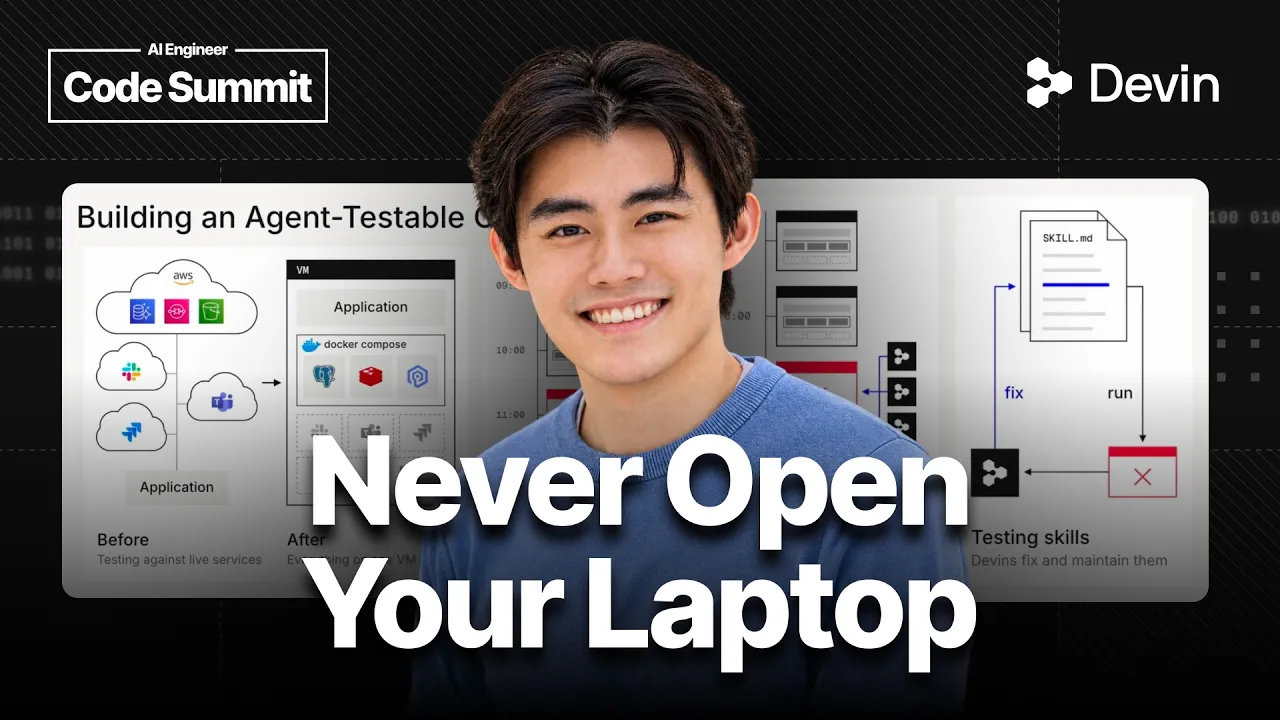
Description
Cognition's merged PRs grew 40x in a year while its engineering team grew 2.7x. Walden Yan explains what changed: self-driving PRs by default, small pods that own everything from bug reports to QA, and a workflow run almost entirely from Slack. He covers running every service locally so agents can test, VMs rebuilt every hour, and agents that optimize the factory itself. Then he shows the next step: giving agents jobs instead of tasks, from tuning inference on new GPUs to an Android app maintained by Devin over 44 days. Speaker info: - https://cognition.ai Timestamps: 0:00 - 40x merged PRs in a year 1:42 - Self-driving by default 2:31 - Small pods with vertical ownership 3:16 - Working entirely from Slack 4:46 - Every service runs locally for agents 6:20 - iPads and cloud-only security 7:05 - Agents that improve the factory 7:50 - Give agents jobs, not tasks 9:24 - Measure everything, let agents optimize 10:09 - Tuning inference on new GPUs 10:54 - An Android app in 44 days 13:13 - Be ambitious
Summary
Generated by gpt-5.6-terraAt-a-Glance
- Verdict: Watch fully
- Core thesis: Cognition claims that agent-driven engineering can deliver order-of-magnitude throughput gains only when agents are embedded in a self-driving software factory with isolated reproducible environments, measurable goals, persistent ownership, and human escalation rather than task-by-task prompting.
- Why it matters: This is a concrete operating model for turning coding agents into a control plane for engineering work: agents can implement, test, monitor, improve, and optimize systems continuously while humans own goals, architecture, and exception handling.
- Best use: Use it as a reference architecture and organizational-design prompt for building long-running software agents, especially the environment, observability, escalation, and metric-optimization loops required before delegating durable jobs.
Executive Summary
Walden Yan argues that Cognition increased merged-PR throughput 40x over roughly a year while engineering headcount grew only 2.7x, implying more than a 10x increase in output per engineer. His explanation is not simply that Cognition bought a coding agent; it rebuilt its engineering process into a "software factory" where Devons can move work from bug report through implementation, testing, merge, monitoring, and maintenance, escalating only when human judgment is needed.
The operational prerequisite is a hermetic, agent-accessible development environment. Cognition migrated services to run locally via Docker Compose, built mocks for third-party dependencies, rebuilds fresh virtual-machine snapshots from the latest code hourly, and uses agents as first responders when those builds break. This gives every agent a clean environment without live-service access and lets the agent maintain testing knowledge as the codebase evolves.
Yan's more consequential shift is from assigning agents bounded tasks to assigning them continuing jobs defined by measurable outcomes. An agent tasked with improving P99 latency should establish telemetry, alerts, a work breakdown, reports, and an ongoing optimization loop—not wait for repeated prompts. Cognition applies this to infrastructure throughput and product parity: it says an agent optimized inference performance on new NVIDIA hardware over a week, and another maintained an Android application from the iOS codebase and user-feedback streams over 44 days.
The talk is strongest as a vision plus implementation pattern rather than as independently verifiable productivity research. The reported metrics and quality claims are self-reported, and details such as review gates, rollback policy, evaluation methodology, costs, and failure rates are thin. Still, it provides unusually useful design principles for agent orchestration: isolate execution, make systems measurable, persist agent context and hooks, capture evidence, and reserve humans for approvals and consequential exceptions.
Key Takeaways
- Claim: Cognition attributes a 40x increase in merged PRs to an agent-native operating model rather than headcount growth alone. | Evidence: Yan says merged PR throughput rose 40x over about 12 months while engineering headcount rose 2.7x, which he interprets as each engineer becoming more than 10x more productive; he also claims PR quality stayed at least as high. | Implication: For Ken, the relevant unit is not an individual coding copilot but a workflow that lets a small human team supervise many autonomous workstreams with quality controls. | Caveat: These are company-reported throughput and quality assertions; the talk does not provide baselines for PR size, review standards, rework, incident rates, or costs, so merged-PR volume should not be treated as a standalone productivity measure.
- Claim: The target state is a self-driving software factory in which work can travel from incoming bug report to monitored production change with humans handling exceptions. | Evidence: A customer can send a bug video in Slack; an employee forwards it internally, tags Devon, and Devon returns both a PR and a video demonstrating the fix. Yan says this permits much of the lifecycle to happen without opening an IDE or GitHub. | Implication: Evidence artifacts—recordings, reproducible test results, and concise status updates—are central to scaling oversight; they allow operators to approve outcomes rather than inspect every implementation detail. | Caveat: Yan explicitly acknowledges that human judgment remains necessary through escalations, but does not specify the escalation policy, authority boundaries, or criteria for autonomous merging.
- Claim: Agent autonomy depends on hermetic, reproducible development and test environments rather than agents touching staging or live systems. | Evidence: Cognition moved services to local Docker Compose execution, uses mocked versions of third-party services, runs them in agent-accessible VMs, and rebuilds those VM snapshots hourly from the latest code. Agents repair broken snapshots when the rapidly changing codebase fails to build. | Implication: Before assigning agents broad engineering ownership, prioritize a one-command clean build, dependency virtualization, ephemeral execution, and automated environment-health remediation. | Caveat: Mocks and local environments can diverge from production behavior; the presentation does not explain how Cognition validates production-only dependencies, deployment safety, or fidelity of mocks.
- Claim: Engineering organization shifts from large functional teams executing tickets to small vertically accountable pods directing agent swarms. | Evidence: Cognition broke larger teams into pods of roughly two or three engineers; each pod handles customer bug reports, QA, PM work, and its own Linear board, then delegates implementation to agents. | Implication: The human role becomes problem selection, system design, acceptance judgment, and management of autonomous work—not simply ticket implementation. | Caveat: This model assumes engineers can make product and QA decisions as well as technical ones; the talk does not address coordination mechanisms for cross-pod architecture, prioritization conflicts, or regulated approval processes.
- Claim: The next agent interface is a durable job tied to an objective function, not a sequence of narrowly specified tasks. | Evidence: For a P99-latency goal, Yan expects an agent to add telemetry, establish alerts, decompose work, create Datadog monitoring, publish weekly Slack reports, and continuously report progress. He urges teams to turn engineering concerns such as click latency, layout shifts, and onboarding retention into measurable metrics that agents can optimize 24/7. | Implication: Agent jobs need explicit success metrics, baselines, operating constraints, reporting cadence, and human approval points—not merely a high-level desired outcome. | Caveat: A single metric can be gamed or optimized at the expense of reliability, cost, user experience, or security; the speaker does not discuss guardrail metrics or multi-objective optimization.
- Claim: Persistent agents can own long-running optimization and product-parity work with sparse human intervention. | Evidence: Cognition says an agent given permanent GPUs explored and tested strategies for about a week to improve inference throughput, with the preferred approaches sent to a human for final approval. Separately, it tasked an agent with maintaining Android parity with iOS, monitoring code and Slack feedback, performing live QA, and over 44 days producing a near-release Android app; Yan says it merged up to 40–50 PRs on some days. | Implication: Persistent triggers, source monitoring, feedback ingestion, QA loops, and selective escalation are what convert an agent from a session-based tool into an operational teammate. | Caveat: The transcript inconsistently names the target hardware as Hopper in one passage and Vera Rubin in its duplicated passage, and it provides no benchmark configuration, cost, or external validation for the claimed comparison against GB300 systems.
Detailed Brief
Recursive improvement of the software factory itself
- Claims: Cognition treats all agent-generated code, PRs, decisions, and execution traces as data that other agents can analyze for process improvement.; The company uses a daily Slack channel where Devon proposes operational improvements rather than waiting for developers to discover them manually.
- Evidence: Yan gives example proposals: changing a Node setup to shave one minute from CI, and changing a lint script to catch 20% more bugs before AI code review.; He frames candidate opportunities as wasted time, token spend, manual work that can become scripts, and missing tests.
- Caveats: The talk does not state whether these suggestions are automatically applied, how their benefits are measured, or how the organization prevents local CI or token optimizations from creating broader reliability costs.
- Implications: The orchestration layer should collect structured traces and outcomes from agents so improvement agents can optimize the production system of work, not just application code.; A practical maturity marker is whether the platform can surface recurring bottlenecks and recommend or execute bounded fixes with measurable before-and-after results.
Security and advanced test scenarios
- Claims: Yan argues that cloud-controlled development VMs can improve security relative to developer laptops containing scattered credentials and operational access.; He contends that isolated VMs can support richer integration tests than simple unit testing.
- Evidence: For testing Devon's ability to join Zoom voice calls, Cognition had the agent create multiple accounts, join the same call from within one VM, exchange voice memos, and verify the behavior.; The stated security rationale is that agents operate without needing to touch live services, while centralized VMs limit the unknown secrets and tools residing on individual developer devices.
- Caveats: Centralization changes rather than eliminates risk: VM identity, credential brokering, network egress, audit logs, and privilege boundaries become critical. These controls are not described in the talk.
- Implications: For agent systems, isolated reproducible sandboxes are both an autonomy enabler and a security-control surface; their access model deserves the same rigor as a production control plane.
Notable Concepts & Terms
- Software factory: Yan's model for an engineering system that defaults to autonomous execution from issue intake through testing, merge, monitoring, and maintenance, with humans engaged through escalation.
- Devon: Cognition's coding agent, presented as the worker executing implementation, testing, QA, reporting, and long-running optimization jobs.
- Agent swarms: Multiple agents operating under a small human pod's direction, allowing the pod to own a broader vertical product surface.
- Fresh VM snapshots: Hourly rebuilt virtual-machine environments containing the newest code and mocked dependencies, intended to give every agent a clean, reproducible execution context.
- Skills / self-maintained testing loops: Agent-maintained knowledge of how to test a changing codebase, reducing dependence on static runbooks that become obsolete.
- Jobs versus tasks: The shift from asking an agent for a discrete implementation to assigning it ongoing ownership of a measurable business or engineering outcome.
- Recursive self-improvement: Applying agents to the telemetry and traces produced by the engineering system itself, seeking to improve CI, testing, scripts, token efficiency, and workflow bottlenecks.
- P99 latency: A tail-latency metric used as an example of a measurable objective an agent can instrument, monitor, and optimize continuously.
Operator Notes / Why Ken Should Care
- Assess whether the current development stack can create a fully clean, agent-runnable environment from source code and mocked dependencies; treat this as a prerequisite before expanding autonomous coding permissions.
- Define a pilot "job," not a ticket queue: choose one bounded metric with a baseline, guardrails, data access, reporting cadence, rollback path, and explicit human approval boundary.
- Require agent outputs to include auditable evidence artifacts—test recordings, environment version, changed files, benchmark deltas, and rationale—so Slack or another control surface supports outcome review.
- Instrument the agent workflow itself: capture task lineage, token/cost use, build failures, test results, review outcomes, rollbacks, and incidents before attempting recursive optimization.
- Design access around ephemeral identities and least privilege for execution VMs; do not equate cloud-hosted agents with security unless credential brokering, egress controls, logging, and production-write boundaries are in place.
- Avoid using merged PR count as the north-star KPI; pair any throughput target with customer impact, defect escape, rework, reliability, security, and unit-cost measures.
Source/Metadata
- Title: 40x More Merged PRs With 2.7x the Engineers — Walden Yan, Cognition
- Transcript words: 3823
- Duration seconds: 847
- Timestamp note: No usable timestamps or chapters were present. The latter portion of the supplied transcript substantially repeats earlier material.
Transcript
Hello, everyone. It's a pleasure to be here today. Quick introduction. I'm Walden. I'm one of the co-founders and chief product officer at Cognition. We build a product called Devon. I want to spend most of my time here today, though, abstracting a bit away from that and focusing on what are we doing internally as an engineering team to move way faster. And so the backdrop I would put for all of this is this is what our merged PR throughput looks like at Cognition. The start of this is around 12 months ago. So you're looking at about a snapshot of a year. And over this last year, this blue chart here, this 40x, is a 40x in the number of merged PRs we are producing on our engineering team. Now, you might also notice there's a small black line along the bottom there. It's easy to miss. But that 2.7x, that is our engineering headcount growth in the same period. So we have been hiring engineers. But each of our engineers is now more than 10x more productive than they were before. And I would dare to say that these PRs are just as high quality, if not higher quality, than they were a year ago. And so really, the crux of what I want to talk about today is, what did we do to unlock this 40x engineering throughput? And there's a lot of things we did, from both the code base to the way we structure engineering teams, that I think are very practical steps you can take if you want to reproduce the same results. Many of you are probably familiar with the software factory. How many of you guys have heard of software factory? Let's see a raise of hands. Cool. So I'll start with the basics, and then I'll work my way up to the more advanced stuff. The basic idea of a software factory is, by default, everything should be self-driving. We have PRs that go from initial bug report to final merge and monitoring and maintenance without a single human involved. Oftentimes, human judgment is needed, though. And that's where we have escalations. But by default, our entire software development process is just run by Devon from end to end. One of the things this means is that the role of the software engineer has to change quite a bit. Around March of this year, we had this conversation with the engineering team. And we said, look, if you are right now just picking off tickets off a linear board and then sending that to an agent and implementing it, you're not going to really be set up for success in the age of AI. Because anything that is described and can be implemented will be able to send to Devon. So really, everyone has to change the way that they're developing. And the way we've enforced this is we've taken our larger teams and we've broken them up into smaller pods. And the smaller pods not only are given swarms of agents to do work for them. They are given more vertical responsibility. So instead, you might have only two or three engineers on a team at a time. But they're responsible for everything beyond the engineering as well. They're responsible for listening to customer bug reports. They're responsible for doing QA testing. They're responsible for doing the PMing and product management. And basically, every engineer manages their entire own linear board of things to do. And they send that to an agent to implement for them. So it's really a fundamental change in the way that our engineers do work. This has been one of the things that we've implemented over the last year. And we've been helping a lot of large organizations implement for themselves as well. Another thing I'd really like to highlight is we work from Slack everywhere. So this is an example of what a customer bug report might look like. They send me a video on Slack. And we just forward bug reports straight into our internal channel. And we tag Devon and say, hey, please fix this. Devon immediately comes up, shows up at PR. But then also sends back a video with the fix and proof. And this makes our lives so much easier, because I literally don't have to leave Slack for most of my work. We've abstracted away all the development to be based on evidence, videos. And I can just send the proof that the fix is ready right back to the customer without having to open an IDE or even GitHub most of the time. So this is the end goal you want to reach, which is a point where you can do your entire development lifecycle without opening up an IDE or without opening up a single coding agent. But to get to this point, there's a lot of infrastructure we had to change underneath. And so this is the hard part that really every engineering team has to do if they want to get to that point. It's not just you purchase a coding agent. You've got to go change the way you build. So before, when we test our applications, we'd be testing them against cloud deployments. We'd have a staging environment, connect to a staging database, connect to live servers. And then we'd have our engineers manually go click through and verify that the flows work end to end. We did a big migration to move every service to be able to run locally with Docker Compose. We've made it so every third party service, we have mocked versions to be able to run locally. And these can all run inside a single virtual machine that every Devon has access to. And every coding agent in our company now does not need to touch any live services at all to test their changes. In fact, these VMs, we rebuild them every hour at the company. Every hour, we pull the latest version of the code. We rebuild the entire code base from scratch, should be able to run very quickly and easily from scratch. If these builds ever fail because your code base is rapidly changing, we also have Devon be the first response there. And they're always immediately fixing these VM snapshots. So every time we spin up an agent from Slack, it goes to a fresh machine on a fresh version of the code base with the latest updates. And these agents, you need to teach them how to test your code base as well. But the benefit of using cloud coding agents is that they can self-maintain their training loops. So that last section there on testing, Devon will write its own skills for how to test our code base. The code base will change over time, so the way you test it will change. But Devon can keep on updating these skills so that it tests over and over again. So the end result of this is literally people do not need to open their laptops anymore to test any code changes. In fact, several engineers at Cognition have already moved to using iPads for the development process. iPads are also more secure. You see a lot of these hacks recently. A lot of it is because of DevOps and people leaking keys. Who knows what's on your developer machine? You might have secrets all over the place. When everything is in the cloud in these controlled VMs, you're actually in a much more secure spot. I've showed some basic versions of things you can test. We've also tested advanced multiplayer setups, which is really cool. We've often, when we were developing Devon's ability to join voice in Zoom calls, we actually had Devon, when it tests, create multiple accounts, have them join the same Zoom call, all from within their one VM, and send voice memos back and forth to make sure that the functionality is working. So you can do quite advanced setups if you really push the limits of your code base. And actually, on top of all this, you obviously want recursive self-improvement. I think people think about this from the model sense quite a lot. But actually, if you think about it, every single line of code that's being written, every single PR that's being generated, every decision, if you have a cloud agent setup, that's all tracked across your entire code base. So there's no reason why you shouldn't also be able to run agents on top of that, do the data analysis, and figure out where are we wasting time, where are we wasting tokens, what things can be turned into scripts, what tests can we be adding to improve this process. And so we have a channel where Devon every day posts ideas about, hey, if we change our node setup, we can shave a minute off of our CI. If we change this Lint script, we can catch 20% more of these bugs before they ever hit AI code review. And this has actually been a huge unlock, where you can just set up these systems, and the agents will go and optimize your software factory for you. This has been really exciting. One of the things that I don't hear people talking about a lot, but I think is really where things are going next, is moving from the world where you're giving tasks to your agents to giving jobs to your agents. And this is a bit of a paradigm shift. You really have to start treating these things like coworkers. So what does giving a job to an agent look like? Imagine I care about back-end performance. Really, this is what the development flow of the future should look like. You should send to your agent, hey, I want to improve P99 latency of my application. Instead of you telling it what to do to do that, it should say, OK, P99 latency. Let me add the telemetry to figure out where our P99 latency is today. Let me set up alerts so I can figure out where we need to be in the future. Let me go break down every single task we need to do to be able to move this latency. Let me create Datadog alerts. Let me create weekly reports in Slack. And let me send you updates on your phone every day on here's where our P99 latency is, and here's how much it's improved. This is fundamentally the type of systems that we encourage all of our engineers to be building at Cognition. We don't even want you to be prompting your agents most of the time. We want you to just be giving your agent goals that they can work toward over long durations of time. And anything in your company that you think isn't measurable, find a way to measure it. Do you care about your application performance? Go measure the latency of clicks on your application. If your application has a lot of weird layout shifts, go measure the bounding boxes and try to figure out how you can minimize layout shifts across your application. There's obviously P99 latency, but there's also things like onboarding retention. How much of what you guys do as engineers is things you can boil down to a single number or metric? And I encourage you that if you can do that, you should just set up an agent to go optimize that number 24-7. So a great example of this is inference latency. At Cognition, we're lucky to be the first receivers of NVIDIA's new class of Hopper GPUs. Kernels were not built for these GPUs when we received them. So we had to, from scratch, figure out how do we build our own inference stack on top of this new hardware that's coming out. And agents have allowed us to do this in a way that is much more efficient than before. So we just tell it, hey, we care about the throughput, our TPM of these GPUs. Go figure out how to push that to its limits. And over the course of what is about a week, the agent was able to go. We allocated it a permanent set of GPUs to work on. It was able to go find different strategies, test them. The strategies that it found worked best. It was sent to a human engineer for final approval. But basically, there's eight or nine different things that were roughly discovered via just giving these agents these high-level goals. And we were able to push the throughput on these new Hopper GPUs from what was worse than the GB300s to what is now significantly better than the previous class of GB300 GPUs. And again, this is all done by just giving an end goal to your agents. Another example that I like to share with folks, we are a fairly small engineering team. It means we do not have, oftentimes, the bandwidth to fully staff things that we might want to do, like an Android application. But the other day, one of our engineers on our team, Samuel, he had this brilliant idea. He said, OK, look, we have a team of people working on building a great iOS application. Can't we just use that as a blueprint for our Android application and tell Devon, hey, go maintain parity from our iOS application to our Android application end-to-end? And that is exactly what he did. But it wasn't just one Devon session to go do all this. He said, set up permanent hooks against our code base to monitor the iOS application. Go listen to the Slack channels for user feedback about our applications. And then go recursively improve our application. Go do live QA testing of every detail and making sure it all works. Syncing these things live has been really cool. And I think the final results here are actually quite good. So we really just gave our agent this one high-level prompt, which is, hey, go manage the entire Android application. And over the course of 44 days, we have a working application, which we'll be putting out soon. But as a time lapse, most days, there's not a single human message going to this agent working on it. And on those days, it's merging upward of like 40, 50 PRs a day. All of this is being live QA tested against the iOS application, pixel for pixel, testing whether it's escalating only the most important decisions to a human at the end of the day. And most of the time, our engineers don't even need to open Devon. They're just from Slack looking at the recordings that it sends back to them. So in the end, the human is barely doing anything in this loop. This is how many messages a human actually had to send to our agent in this entire process. And it's not a slop application. This is actually something that we will be going live with very soon. So, cool. That's actually all I had. I think the end message from all of this is if you set up the loop for your agents correctly, you can do some pretty incredible stuff. So I think really most teams are limited by the amount of ambition they have. So it's time to be ambitious. Thank you. that's being written, every single PR that's being generated, every decision, if you have a cloud agent setup, that's all tracked across your entire code base. So there's no reason why you shouldn't also be able to run agents on top of that, do the data analysis, and figure out where are we wasting time, where are we wasting tokens, what things can be turned into scripts, what tests can we be adding to improve this process. And so we have a channel where Devon every day posts ideas about, hey, if we change our node setup, we can shave a minute off of our CI. If we change this Lint script, we can catch 20% more of these bugs before they ever hit AI code review. And this has actually been a huge unlock, where you can just set up these systems, and the agents will go and optimize your software factory for you. This has been really exciting. One of the things that I don't hear people talking about a lot, but I think is really where things are going next, is moving from the world where you're giving tasks to your agents to giving jobs to your agents. And this is a bit of a paradigm shift. You really have to start treating these things like coworkers. So what does giving a job to an agent look like? Imagine I care about back-end performance. Really, this is what the development flow of the future should look like. You should send to your agent, hey, I want to improve P99 latency of my application. Instead of you telling it what to do to do that, it should say, OK, P99 latency. Let me add the telemetry to figure out where our P99 latency is today. Let me set up alerts so I can figure out where we need to be in the future. Let me go break down every single task we need to do to be able to move this latency. Let me create Datadog alerts. Let me create weekly reports in Slack. And let me send you updates on your phone every day on here's where our P99 latency is, and here's how much it's improved. This is fundamentally the type of systems that we encourage all of our engineers to be building at Cognition. We don't even want you to be prompting your agents most of the time. We want you to just be giving your agent goals that they can work toward over long durations of time. And anything in your company that you think isn't measurable, find a way to measure it. Do you care about your application performance? Go measure the latency of clicks on your application. If your application has a lot of weird layout shifts, go measure the bounding boxes and try to figure out how you can minimize layout shifts across your application. There's obviously P99 latency, but there's also things like onboarding retention. How much of what you guys do as engineers is things you can boil down to a single number or metric? And I encourage you that if you can do that, you should just set up an agent to go optimize that number 24-7. So a great example of this is inference latency. At Cognition, we're lucky to be the first receivers of NVIDIA's new class of Verorubin GPUs. Kernels were not built for these GPUs when we received them. So we had to, from scratch, figure out how do we build our own inference stack on top of this new hardware that's coming out. And agents have allowed us to do this in a way that is much more efficient than before. So we just tell it, hey, we care about the throughput, our TPM of these GPUs. Go figure out how to push that to its limits. And over the course of what is about, I guess, here, like a week, the agent was able to go. We allocated it a permanent set of GPUs to work on. It was able to go find different strategies, test them. The strategies that it found worked best. It was sent to a human engineer for final approval. But basically, there's eight or nine different things that were roughly discovered via just giving these agents these high-level goals. And we were able to push the throughput on these new and Verorubin GPUs from what was worse than the new GB300s to what is now significantly better than the previous class of GB300 GPUs. And again, this is all done by just giving a end goal to your agents. Another example that I like to share with folks, we are a fairly small engineering team. It means we do not have, oftentimes, the bandwidth to fully staff things that we might want to do, like an Android application. But the other day, one of our engineers on our team, Samuel, he had this brilliant idea. He said, OK, look, we have a team of people working on building a great iOS application. Can't we just use that as a blueprint for our Android application and tell Devin, hey, go maintain parity from our iOS application to our Android application end-to-end? And that is exactly what he did. But it wasn't just, hey, one Devin session to go do all this. He said, set up permanent hooks against our code base to monitor the iOS application. You know, go listen to the Slack channels for user feedback about our applications. And then go recursively improve our application. Go do live QA testing of every detail and making sure it all works. Syncing these things live has been really cool. And I think the final results here are actually quite sick. So we really just gave our agent this one high-level prompt, which is, hey, go manage the entire Android application. And over the course of 44 days, we have a working application, which we'll be putting out soon. But as a time lapse, most days, there's not a single human message going to this agent working on it. And on those days, you know, it's merging upward of like 40, 50 PRs a day. All of this is being live QA tested against the iOS application, pixel for pixel, testing whether, you know, escalating only the most important decisions to a human at the end of the day. And most of the time, our engineers don't even need to open Devon. They're just from Slack looking at the recordings that it sends back to them. So in the end, the human is barely doing anything in this loop. This is how many messages a human actually had to send to our agent in this entire process. Yeah. And it's not a slop application. This is actually something that we will be going live with very soon. So, cool. That's actually all I had. I think the end message from all of this is if you set up the loop for your agents correctly, you can do some pretty incredible stuff. So I think really most teams are limited by the amount of ambition they have. So it's time to be ambitious. Thank you. Amazing. Amazing. Amazing. Amazing Amazing Amazing Amazing Amazing Amazing Amazing Amazing ! Amazing Amazing Amazing Thank you.