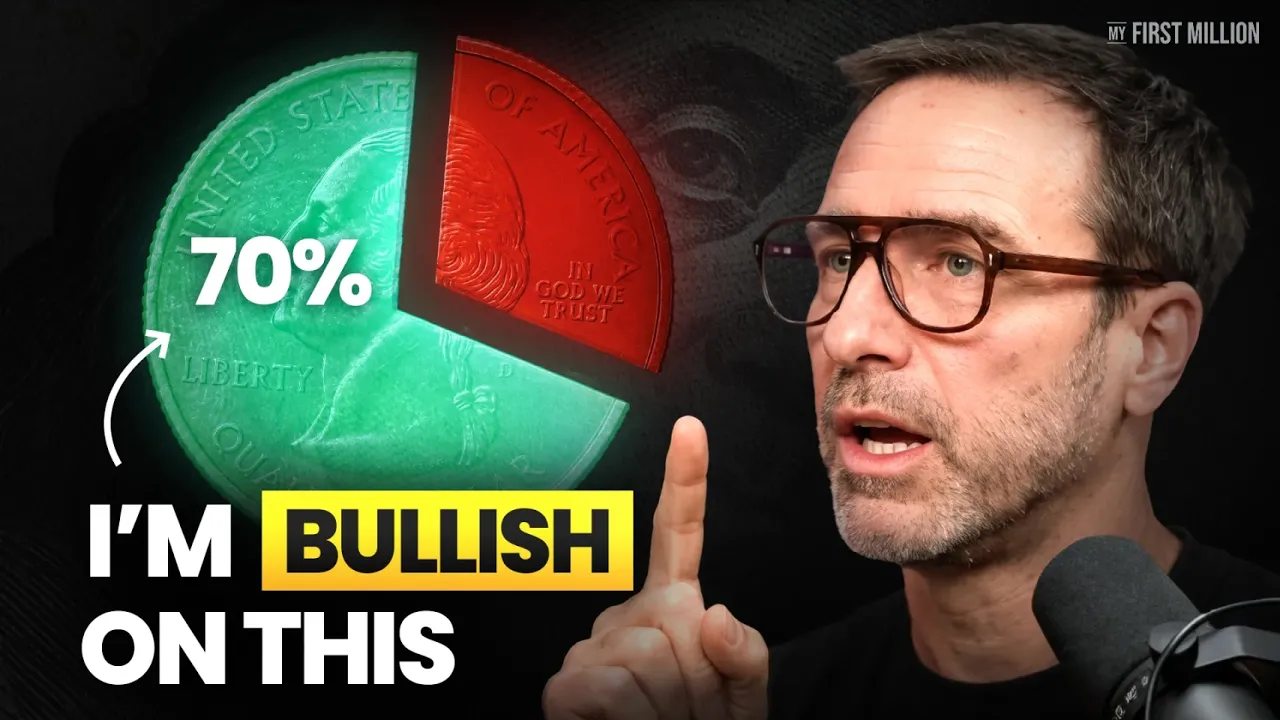
I made $80M. Now I’m putting 70% of my portfolio in ONE stock - Chris Camillo
Description
*Shaan's guide to go from $0 to $1M:* https://clickhubspot.com/tb2s Episode 846: Sam Parr ( https://x.com/theSamParr ) and Shaan Puri ( https://x.com/ShaanVP ) talk to Chris Camillo ( https://x.com/ChrisCamillo ) about the 5 trades he’s betting on in 2026. — Show Notes: (0:00) Social Arbitrage (6:29) Needohs (20:16) Nerd culture (27:06) Information asymmetry (46:30) Amazon (1:02:21) Podcasting — Links: • Dumb Money Live - https://www.youtube.com/DumbMoneyLive — Check Out Sam's Stuff: • Hampton (joinhampton.com): My community for founders. Average member does $25m/year. Many of the guests are members. Get after it...apply: http://joinhampton.com/mfm — Check Out Shaan's Stuff: • Shaan's weekly email - https://www.shaanpuri.com • Visit https://www.somewhere.com/mfm to hire worldwide talent like Shaan and get $500 off for being an MFM listener. Hire developers, assistants, marketing pros, sales teams and more for 80% less than US equivalents. • Mercury - Shaan uses Mercury across all of his companies. you can too: http://mercury.com/ Mercury is a fintech company, not an FDIC-insured bank. Banking services provided by Choice Financial Group, Column, N.A., Members FDIC • I run all my newsletters on Beehiiv and you should too + we're giving away $10k to our favorite newsletter, check it out: beehiiv.com/mfm-challenge My First Million is a HubSpot Original Podcast // Brought to you by HubSpot Media // Production by Arie Desormeaux // Editing by Ezra Bakker Trupiano /
Summary
Generated by gpt-5.6-terraAt-a-Glance
- Verdict: Skim
- Core thesis: Chris Camillo argues that ordinary investors can outperform by spotting meaningful cultural, consumer, and technological change before markets fully price it, then exiting when that information becomes broadly understood.
- Why it matters: The video offers a reusable signal-detection and thesis-validation model relevant to AI-era investing and identifies Amazon as Camillo's highly concentrated AI-infrastructure bet, while also surfacing a credible media-format opportunity.
- Best use: Use it as a framework for finding and validating non-consensus behavioral signals, not as trade advice or a substitute for portfolio construction and diligence.
Executive Summary
Camillo presents "observational investing" or "social arb" as a pure information-asymmetry strategy: observe changes in how people behave, identify public companies helped or hurt by that shift, validate the signal with alternative data and real-world checks, and buy before institutional and retail investors recognize the consequence. He says he turned an initial $20,000 portfolio into roughly $80 million over 17 years, while withdrawing substantial profits along the way, but the performance claims are self-reported in the conversation.
His core operating discipline is thesis-based rather than price-based. He enters when an important piece of information is underappreciated and exits at "information parity"—when company disclosures, analysts, financial media, and social investors have broadly incorporated the same insight. The examples range from the Sphere's Wizard of Oz experience establishing product-market fit to a small holding company exposed to viral NeeDoh toys.
The most actionable current thesis is his extreme conviction in Amazon as an AI beneficiary. He believes Amazon's AI infrastructure, AWS, custom Trainium chips, advertising business, logistics network, robotics potential, and Anthropic ownership give it unusual leverage to an AI-driven productivity wave. He says Amazon common stock is about 50% of his portfolio and related options bring effective exposure to roughly 70%, while explicitly characterizing this as outsized risk.
Outside equities, the discussion contains two secondary ideas: cultural observation can be converted into operating businesses, as illustrated by the Collect-A-Con Pokémon convention business; and podcasting is likely to become more formatted and entertainment-programmatic. Camillo is building an Austin studio to develop women creators into repeatable podcast franchises, aiming to create top-tier global shows rather than simply run conventional interview podcasts.
Key Takeaways
- Claim: Camillo's investing edge is to isolate an emerging behavioral or technological change that matters financially before the broader market recognizes it. | Evidence: He calls the approach "observational investing" or "social arb" and describes monitoring TikTok, Reddit, consumer conversations, store behavior, search trends, web traffic, and direct channel checks. He cites the Sphere's Wizard of Oz attraction as a signal that the venue had finally found a replicable, viral product format. | Implication: For Ken, the useful pattern is not social-media monitoring by itself but building a disciplined pipeline from observed behavior to affected entities, measurable economic impact, and a test for whether consensus has noticed. | Caveat: The method depends on correctly translating a social signal into a material revenue, margin, or perception change for a public company; a trend can be visible yet still be too small, transient, or already priced in.
- Claim: The exit rule is information parity, not a target stock price or whether the trade is profitable. | Evidence: Camillo says he sells once the company, analysts, financial press, and other investors begin publicly framing the same insight—for example, when the Sphere's sellouts and earnings implications from Wizard of Oz became commonly discussed. He may exit progressively as dissemination increases. | Implication: A research system using this approach needs explicit monitoring of narrative diffusion and consensus adoption, not merely entry-signal detection. | Caveat: Information diffusion is gradual and difficult to measure; a stock can continue rising after exit for unrelated reasons, which he argues should not retroactively invalidate the original trade.
- Claim: High-conviction observational trades require independent validation beyond the original narrative. | Evidence: For the NeeDoh toy thesis, he describes estimating holiday unit sales, margins, effects on the operating company's dividends, and the parent holding company's valuation; he says AI can help inspect financials and model scenario impacts. His community also conducts distributed store checks across states and challenges each thesis. | Implication: The relevant operating lesson is to pair qualitative demand signals with falsifiable supply, unit-economics, ownership-structure, and valuation checks before capital allocation. | Caveat: He characterizes the tiny public parent, Gladstone Investment (GAIN), as especially risky because small companies have many unknown variables; he treated the NeeDoh trade as medium rather than high conviction despite investing roughly $500,000 to $1 million.
- Claim: Camillo uses aggressive concentration only when he believes the information advantage and impact are unusually large. | Evidence: He says his approximately 80-85 high-conviction trades over 17 years generally involved allocating 5%-30% of the full portfolio to stock positions or 2%-15% to options; he once put 100% of his portfolio into Nintendo after seeing demand for the Wii at E3. | Implication: Separate the idea-generation framework from his sizing behavior: conviction-based concentration may explain outsized returns but is not a generally transferable risk policy. | Caveat: He acknowledges concentration and options create outsized risk, notes that his largest annual drawdown was roughly 20%-30%, and explicitly says most people should not use this approach across their entire portfolio.
- Claim: AI creates an unusually fertile environment for observational investing because it is changing costs, workflows, and competitive positions across sectors simultaneously. | Evidence: Camillo compares the scale of change to the pandemic, when altered work and consumption patterns generated trades around products such as Peloton, Amazon, home-office equipment, and at-home entertainment. He argues that AI's impact will generate distinct winners and losers rather than a uniform market outcome. | Implication: Ken should look for second-order AI effects—workflow redesign, infrastructure demand, changing unit economics, and displaced incumbents—rather than relying on generic AI exposure narratives. | Caveat: The claim rests on a broad macro thesis, and the transcript offers no systematic method for separating real AI adoption and productivity gains from hype or capital-expenditure overbuild.
- Claim: Amazon is Camillo's largest current thesis because he believes it is structurally positioned to capture AI infrastructure revenue and AI-enabled operating leverage. | Evidence: He cites Amazon's AWS position, Trainium AI chips, advertising business, global logistics footprint, potential robotics gains, and 15% Anthropic stake. He says Amazon common equity represents about 50% of his portfolio and options add exposure such that Amazon may represent roughly 70% of it. | Implication: The valuable thesis structure is Amazon's multi-layer exposure—compute, cloud, advertising, logistics, and automation—not the recommendation to replicate his concentration. | Caveat: This is an exceptionally concentrated, self-reported investment view. His claims about Trainium revenue, Amazon's AI CapEx, and a potential Anthropic IPO valuation are assertions in the interview rather than independently substantiated analysis.
- Claim: The next media opportunity is not more generic conversation podcasts but programmatic, format-driven shows built around distinctive human personalities. | Evidence: Camillo says 70% of podcasters are men and is launching an Austin studio to help women solo creators move into durable podcasts. He points to Caleb Hammer's Financial Audit as a formal recurring entertainment program and Lil Dicky and Benny Blanco's Friends Keep Secrets as evidence that creative staging, recurring bits, and integrated ads can transform the format. | Implication: For media and GTM work, invest in repeatable show mechanics, talent development, production design, and audience-specific formats rather than assuming a studio conversation alone is a defensible product. | Caveat: This is a forward-looking business thesis, not evidence that the proposed studio has identified talent, distribution advantages, or an economic model that can reliably create top-20 shows.
Detailed Brief
From cultural signal to owned operating asset: the Collect-A-Con example
- Claims: Camillo treats observational insight as useful beyond public equities: if a community is underserved, an operator can create the enabling physical or digital venue.; His thesis was that Pokémon and broader collector culture had millions of committed participants but no scaled, recurring convention equivalent to long-established sports-card shows.
- Evidence: After buying a $375,000 Pokémon box, breaking it into packs for charity, and hosting a large Las Vegas event, he met collector-network participants including Steve Aoki and Gary "King Pokémon" Haase.; He invested about $600,000 for a minority but substantial stake in a convention business that grew from one Frisco, Texas event to 20 shows and 700,000 attendees over four years before being sold to Ari Emanuel; exact sale and financial details were not disclosed.; The operators reduced costs by owning their own pipe-and-drape equipment and transporting it between cities in an 18-wheeler, illustrating that event economics depended heavily on operational frugality rather than only demand.
- Caveats: The sale economics, revenue, EBITDA, and buyer terms are under NDA, so the claimed scale and profitability cannot be assessed from the transcript.; The initial Pokémon-charity event was described as a financial loss; its value was relationship formation and validation of the community, not direct event profit.
- Implications: When a cultural niche has high participation but weak infrastructure, the better opportunity may be the ecosystem layer that lets the community gather, transact, or create—not necessarily the consumer product itself.; Community participation can function as diligence: direct involvement produced relationship access and operational insight that passive trend observation would not have supplied.
Capital, fulfillment, and the stated personal operating model
- Claims: Camillo distinguishes financial independence from unlimited consumption: he considers control of time and freedom from obligatory employment highly valuable, but believes excessive visible wealth can erode authentic relationships.; He frames his next ventures as games worth playing for the process, creativity, and charitable capacity rather than for maximizing a personal net-worth number.
- Evidence: He describes a "sweet spot" of wealth and suggests committing capital to a charitable foundation or illiquid risk assets as mechanisms to reduce excess personal liquidity and consumption.; The hosts add examples of wealth changing social dynamics, including a wealthy friend isolated by an 18,000-square-foot home and a billionaire who declined to automatically pay for a group lunch in order to avoid creating a power imbalance.
- Caveats: These are personal observations and values, not a universal prescription for philanthropy, liquidity planning, or lifestyle management.; The discussion risks minimizing the genuine financial insecurity of audiences who have not reached baseline independence; the speakers themselves acknowledge that financial freedom is materially beneficial.
- Implications: For founder/operator decision-making, define a sufficient personal liquidity threshold and explicit non-financial objectives before pursuing larger exits or consumption upgrades.; Keep relationship-preserving norms deliberate as wealth and status increase, especially around shared experiences, team dynamics, and family life.
Notable Concepts & Terms
- Observational investing: Camillo's label for identifying changes in culture, behavior, or technology and connecting them to public companies likely to benefit or be harmed.
- Social arb / social arbitrage: Using underappreciated social signals as an information advantage before the financial market incorporates their economic consequences.
- Information imbalance: The entry condition: a material fact or emerging pattern is known to the researcher but not yet sufficiently appreciated by the investing public.
- Information parity: The exit condition: the original insight is now reflected in company commentary, analyst estimates, media coverage, and broad investor narratives.
- Channel checks / store checks: Ground-level validation through customers, employees, retailers, or local observations to determine whether a perceived trend is real and scalable.
- Big-money account: Camillo's proposed separate risk bucket for high-conviction speculative investments, kept distinct from retirement, education, and essential capital.
- Programmatic podcasting: Podcasting organized around a repeatable entertainment format, segments, staging, and show mechanics rather than an unstructured studio conversation.
- Embodied intelligence: AI applied through robotics and physical automation; Camillo treats it as a future source of productivity gains for logistics-heavy companies such as Amazon.
Operator Notes / Why Ken Should Care
- Create a signal-to-thesis template for AI and agent-market research: observed behavior, affected workflow or company, economic transmission mechanism, validation sources, disconfirming evidence, and a defined information-parity exit trigger.
- Treat Amazon's AI thesis as a diligence prompt: independently verify AI CapEx, AWS and Trainium traction, Anthropic economics, advertising leverage, and whether logistics automation can meaningfully expand margins.
- For media initiatives, evaluate whether the product has a repeatable program format and talent-development pipeline; do not model success around generic interview-podcast production.
- Avoid copying the speaker's portfolio concentration or options exposure; if applying the framework to investing, separate experimental capital from operating, retirement, and required-liquidity assets.
- Explore ecosystem-layer opportunities around high-engagement communities where the audience has demand but lacks an efficient venue, workflow, marketplace, or operating infrastructure.
Source/Metadata
- Title: The simple investing strategy I used to turn $20K to $80M
- Transcript words: 18312
- Duration seconds: 5090
- Timestamp note: No usable timestamps or chapters were present in the supplied transcript; the transcript also contains substantial duplicated passages near the end.
Transcript
The world is still unsure about how this is going to play out. I'm not unsure. I'm willing to bet it all. What's up, Chris? Good to see you again. Hey, Sean. How you doing, man? I'm good. So we should start with a little intro. Sam, you weren't here last time Chris was on. Chris, can you do the simplest explanation of who you are, number one, and then number two, your unique philosophy and unique strategy that you've used to buy and sell stocks, to invest? Yeah, I'm a regular person. For most of my career, I've had a regular job. I'm not a financial analyst. I'm not a technical trader. I hate all that stuff. I hate technicals. I hate fundamentals. I'm like most regular people, right? A normal guy with a normal job that was trying to break out, try to find a future for myself, because I realized that my job was capped, like 99.9% of people in this world. And I started investing in something I call observational investing or social arb investing, which really is trying to detect change in the world, whether it's change in technological development, or change in culture, change in consumer behavior. You're trying to detect change, and you're trying to connect the dots to companies that would either benefit or be harmed by that change. And then you're investing in those companies. It's that simple. One of many ways that you personally observe is through social media comments. Yeah. Think about it. How do you observe change in the world the quickest? What do people do before they change their life? They talk about it, right? Before you can see the evidence of it, they talk about it. If you're a developer and you're changing the way that you develop software and you're adopting AI in your company, you're probably in Reddit forums with other developers speaking about it. And it's not always tech. A lot of it is just consumer behavior, right? Because I remember you had one that was around the Sphere, which most people don't even realize. That's the big dome in Vegas, the Sphere. It's a publicly traded stock. And I think you noticed, what was it, the Wizard of Oz? You were like, dude, this Wizard of Oz show. Yeah, game changer, right? They didn't quite nail product-market fit at the Sphere until that Wizard of Oz came out. And they were like, oh, take an old movie, use AI to make it more interesting in terms of visuals to put it on this insane projection screen, and then add some 4D effects like a tornado and the winds blowing and all this stuff. And all of a sudden, you created a unique human experience that would go viral on TikTok, which is exactly what happened. And now people from around the world, from Europe, are like, we're going to Vegas to go to this Sphere place to see this Wizard of Oz that we saw went viral on TikTok, right? And so, man, what a game changer. Did you buy it? Dude, yeah. So I heard him talking about it, so I started tracking it. It's up 220% in the last year. I mean, from the time we got in, which is like at 20-something bucks, it's up like 6X or something. Chris, I got to give you a little credit because anytime somebody comes on the pod and talks about investing, the goal is first to get context on, okay, before we listen and really drink the Kool-Aid on all your philosophy or your strategy, we like to understand, does it work? What are the results? And so you can talk a little bit about that, but I'll give one little point, which was last time you were on the pod, I asked you to make three picks, three predictions, three stocks to look at. You said Palantir, Bloom Energy. It was at $92. It's now at $240. So it's up 165% since the last podcast. And then NVIDIA, which is up a smaller amount. But those were your three picks. So I got to give you a little bit of credit. So here's the thing. I actually aggressively disagree with that type of performance analysis because the world's changing every minute of every day. So the day after the show, I could have found new information that would have put me on the opposite side of all three of those trades, right? And so the only way you could ever analyze any investor ever is through long-term audits over a long period of time, total portfolio. I don't care if an investor comes on, gives you five stocks, and all of them rocket. It could have been based on beta, could have been based on the market, completely luck, right? So don't give me any credit for anything from the last show. So if you don't want, I mean, you feel free if you want, but all that actually matters is what's the 10-, 15-, 20-year total portfolio track record in and out through multiple markets. Great. So what is it? What are the audited, what is it, 15-year results? It's like 68% over 15 or 16 years. What does that mean in terms of dollars? What'd you start with? I've generated about 80 million off of an initial $20,000 portfolio that I kicked off in 2007. Wow. And then do you reinvest new capital into that? The truth is that I took massive amounts of capital out every year, almost all of my profits. And so theoretically, if I kept it all in and maintained the same returns, which would have been harder because the account would have been larger, obviously, it'd be like 700 million or something like that. But the truth is it's meaningfully easier to manage an account that is seven to eight figures than an account that's nine figures, for obvious reasons, right? So you can never really compare apples to apples. You can't really compare me to a guy managing $5 billion. It's unfair to the guy that's managing $5 billion because he has restrictions. He's having to move large amounts of money. I'm able to be hyper-flexible with what I do. But I would say that the sizing of my account is still meaningfully larger than just about any other retail investor in the world. What's been the worst downswing? What year did you do the worst, or what's been the biggest dip you had? I think I had, it wasn't crazy, it was like 20% or 30% down in a year. I think the biggest up years might have been like 300% in a year. But it's been relatively consistent. So, Chris, I want to ask you a question. After you came on and you talked about this observational investing, I have to say, I'm a bit skeptical about most financial influencers on YouTube. I would just say that's a general stance I have. You should be more than skeptical. Yeah. But what you talked about, it's not like it was some insane idea. You look for changes of where you see the world going, where you think demand is going, where there might be supply constraints, and those obviously might be interesting companies. Now, the question I have for you, because one example is my kids went crazy about this thing called NeeDohs. Explain what these things are. They're basically just a pile of, it's just like a goop ball. I don't even know how you explain it. It's just a squishy toy. It's a squishy toy that is slightly firmer, slightly higher quality. Squishies have been around for 15 years, but they were able to go viral this last year. It became a thing in elementary and middle schools, like finding rare NeeDohs. You couldn't find them. So they had that sort of Pokemon card thing. This happens a lot of times with crazes, right? But is NeeDoh a public company? Yeah, so NeeDoh is a very tiny private company that's actually held by another private company that owns, I think, 27 private companies. And NeeDoh, the company that owns NeeDoh, is one of those 27 companies. What's interesting is that this is a holding company that generally doesn't move because they generate their earnings from interest payments and dividends paid by these small operating companies. To my knowledge, and the ticker is G-A-I-N, to my knowledge, they've never owned a company that has had a hyperviral product like NeeDoh before. Can you imagine that Wolf of Wall Street call to Sean? Like, listen, Sean, this is a small company in Andover, Massachusetts, that is sitting on breakthrough technology that is extra squishy yet firm at the same time. That's exactly what it is, man. That's exactly what it is, man. That's literally exactly what it is. And by the way, whenever you invest in a tiny company like this, there's all types of unknown risk involved. So it's a really dangerous game to play. But I did make the investment. What's interesting is that this is a holding company that generally doesn't move because they generate their earnings from interest payments and dividends paid by these small operating companies. To my knowledge—and the ticker is G-A-I-N—to my knowledge, they've never owned a company that has had a hyperviral product like Neato before. Can you imagine that Wolf of Wall Street call to Sean? Listen, Sean, this is a small company in Andover, Massachusetts, that is sitting on breakthrough technology that is extra squishy yet firm at the same time. That's exactly what it is, man. That's exactly what it is, man. That's literally exactly what it is. And by the way, whenever you invest in a tiny company like this, there's all types of unknown risk involved. So it's a really dangerous game to play. But I did make the investment. It's a bit of a novelty investment and a novelty product. So the thesis is that if Neato can remain on trend through the holiday season, and if the parent company is able to fully scale out supply, this is actually going to be a needle mover for the parent company. And you should see about a 30% to 40% increase in valuation at the parent company. Let's break this trade even further. There's all these cool books on Warren Buffett's first 50 deals or whatever. Let's do Chris's investment in Danito's. Could you say how much did you put into it? When did you put into it? And when you're saying there should be a 30% or 40%, what numbers did you look at to make this estimation of how much juice is on here or how much profit could be had? You're basically looking at— Hey, let's take a quick break because the team at HubSpot has put together something pretty cool. In this episode, Chris is talking about the way he knows how to make money. Identifying these trends, scouting the TikTok comments, making these big leveraged bets. That's great for him. It is amazing. Some people will like that. I personally don't know how to make money that way. I wouldn't do it. But I've talked before about the way that I know how to make money, about how to build a money-making skill, about how to leverage your time and energy. And the team at HubSpot actually went through the video where I explained all that and turned it into a free downloadable cheat sheet on my four rules of how to make money. Now, this is not get-rich-quick advice. It's just core principles, foundational principles, about building wealth. Things that I wish I knew when I was just getting started. And so, if you want to download it, it's in the description below. It's totally free. You can go get it. Thanks to the folks at HubSpot for doing the research, making this document, and making it available to all you guys. All right, back to this episode. You're basically looking at how many Neatos you think the company can sell through the holiday season based on demand and how many they're currently selling. By the way, this is a little bit of a science and a little bit of an art. And you assess what that will do to that company's bottom line, how that will increase dividends, and what that increased dividend payment to the parent company will account for relative to the total valuation of the parent company. It's a difficult exercise, and this is where AI comes in really great because AI can help you do that exercise. So we're not financial analysts, and AI does an excellent job going deep into the financials of a company like this. And then, okay, if they sell this many at this much of a profit margin, it could have this big of an impact on the parent company and on earnings come the holiday season. So again, a lot of estimates that you're making. It was enough for me to invest. I put somewhere between half a million and a million dollars into the trade. It wasn't crazy. I did it more because I loved the product, and I loved the trade, and I felt the trade's going to work, and I wanted to be part of it. So for me, on an equity trade, that's not a huge trade for me, but I like it. And by the way, if you look at the past 17 years, I've made about 80 to 85 high-conviction trades over 17 years. So the entirety of my performance is based on those 80 trades. And Nito was a high conviction? I wouldn't call Nito a high conviction. I'd call it probably a medium conviction because the company's so tiny that there are a lot of variables that could impact a minuscule company like that. But all 80 of those trades were publicly discussed, more or less, as they were happening. So I'm really public with my ideas because I want my community to provide feedback and poke holes in my thesis. There aren't that many of us social arbitrators, observational traders. So I've always said that the community at large, when we work together on ideas—sometimes I surface ideas, sometimes members of my community surface ideas—we cross-research them. We play devil's advocate with each other. We poke holes in the thesis. And I always say, as a group, we're more powerful than the biggest hedge fund because we have tens to hundreds of thousands of people now that are social arbitrators. And we come from every walk of life. So we have people from every industry sector, every profession, every demographic. So we have tons of people that have kids. When we do channel checks, when we do store checks, I'll throw it out in my community, and they will do store checks in every state. So we'll have people aggregating: hey, I went to this shop in Missouri. I went to this shop in Florida. Here's what the clerk told me, right? It's really, really fun, guys. Now, let me ask you a question about this. The specific question I have is, observing the trend, especially if you're a parent with young kids, was actually not that hard. It's pretty easy to see, holy shit, every kid in the school wants it and there's none on the shelves. Stores can't keep them in stock. People are banging on the doors. So the buy side of that kind of makes some sense to me. But all these things seem like fads. They seem like trends. I would never know when to exit a trade like this. I would never know when to sell because I don't think 20 years from now, my kids are going to care about Neato's, or the kids are necessarily going to care about Neato's. So can you explain how you think about the exit or the sell when it's something like this, where it's a trend or a wave that may not be enduring? Well, let's back up. It all is dependent upon the conviction level and the underlying thesis that you observed, right? So you have a thesis that you come up with that there is some new information that is likely to positively impact this company or this sector that the market is not aware of yet or that the market underappreciates. Now, you have to ask yourself, to what extent is this a needle mover for this company, right? Is this going to meaningfully move the revenue needle, the profit needle, their cost structure, or the perception of this company? Is it meaningful? And are there other things that are happening to this company that are more meaningful than this one piece of information that I feel is a needle mover? Okay? And then you have to ask yourself, to what extent do other investors, institutional or retail, already know about this? Because it's not a binary thing, right? Some people might know, but does the market at large fully appreciate that piece of information? Or do they only partially appreciate it? So it's additive. And you have to determine, am I highly convicted in this trade? Because this thing that's about to happen, or that already happened, is going to be massively impactful to this company. And there's nothing else that's going to impact this company over the course of the next few weeks or the next couple of months. And there are virtually no other investors, institutional or retail, that understand this yet. And to answer your question, Sean, the exit window is when other people come to terms with this information, right? When other people start to appreciate this information that you found, that you traded on. As soon as that information becomes public, like in the case of the Sphere, when other retail traders, when financial press, when the company itself and analysts started coming out with reports saying, hey, they're selling out the arena due to Wizard of Oz, this is going to be a game changer. We're starting to revise our earnings estimates based on this new template that they found with the Wizard of Oz. And by the way, they can replicate this model now with other old movies. And it's a highly profitable model. And we now feel that they've kind of cracked product-market fit at Sphere, which is a game-changing moment. When you start to hear about that in the press, when you see other investors talking about it on X, when the company itself talks about it, When other people start to appreciate this information that you found, that you traded on. As soon as that information becomes public, in the case of the Sphere, when other retail traders, when financial press, when the company itself and analysts started coming out with reports saying, hey, they're selling out the arena due to Wizard of Oz, this is going to be a game changer. We're starting to revise our earnings estimates based on this new template that they found with the Wizard of Oz. And by the way, they can replicate this model now with other old movies. And it's a highly profitable model. And we now feel that they've cracked product market fit at Sphere, which is a game-changing moment. When you start to hear about that in the press, when you see other investors talking about it on X, when the company itself talks about it, that's the point of information parity, and that's when we exit the trade. So you initiate an observational social arm trade at the point of information imbalance. When you find some information that is impactful that the world doesn't know about yet, and you exit that investment as the world starts to appreciate that information. And that's not always a binary event either. Sometimes you exit it over time as more and more investors start to appreciate the information. Now, you try to ignore stock price. The assumption is that if that piece of information is meaningfully positive to that company, as other people start to surface that information, it will positively impact the stock. But that's out of your control. The bottom line is you're trading a thesis. Your thesis revolves around one piece of information. And when that information gets widely disseminated to other investors, then you no longer have an information advantage. Therefore, you should be exiting that trade. Whether you made money in the trade or whether you lost money in the trade for some other unknown reason. Maybe the market, maybe something else happened. It's irrelevant. So, that's the entire methodology. That's everything I've been doing for 17 years. There's a lot more to it. Because when you find this narrative, right, you then need to check every other piece of information that you can or data source to validate it. Talking to store clerks, right? Maybe you're pulling web traffic stats. Maybe you're looking at Google search trends. Depending on the trade, there's a million different ways to validate the narrative thesis that you originated using alternative data or other information sources. It's a case-by-case basis. But this is everything I've been doing for 17 years. And it's very different from being a fundamental trader or being a technical trader. Has there been a time over the last 15 or 18 years that you've been doing this where you've said, I'm quitting and I'm not doing this anymore. I'm going back to just index investing or something. What was the low point? No, I love this so much, guys. This is literally part of my soul. This is what I do. I have so much fun doing this. You've got to realize, my methodology entails reading comments on TikTok videos. I get to watch the world unfold. I get to learn about culture and consumer behavior and trends and what people are buying, what they're doing. It is the funnest research any investor could ever do. I'm not studying fundamentals or charts. What I do is fun as hell. Then every five years, I have this thesis that I go all in on. So, five years ago, it was Pokemon and nerd culture. And I started this company called Collecticon. And we became the largest Pokemon trade show in the world. And we sold it to Ari Emanuel a few months ago for an insane amount of money. But we grew that from the ground up. And I take on one of those projects. The next project I'm taking on. Wait, can you tell me about this? That's a big deal. Tell the full story before you tell the new project. Oh, you want to know the story? This is actually amazing. I always tell everyone, don't do things for yourself. Just go out there and do things for other people. And it always comes back in your favor. Don't ask how or why. It just generally always does. So, I'm really big into philanthropy. I have a 501 foundation. I support pediatric charity, animal welfare, and elder care. And back during the pandemic, I know nothing about Pokemon, okay? But Logan Paul bought a $350,000 Pokemon box, which set the world record. And I was like, man, that looks really fun. And I was bored. I'm going to go do the same thing. But then I'm going to break it into the 24 packs and auction it off for charity. And then just donate it all to the foundation. And I'm going to also throw the world's biggest Pokemon party in Vegas. Because I ended up meeting all these Pokemon people. And they were the coolest, nicest people in the world. I'm telling you, I never met people so fun. And so, I met Steve Aoki, who's a big Pokemon guy. I met this guy, Gary King Pokemon, who's the number one Pokemon collector in the world. And he was the guy that I think sold Logan one of his biggest Pokemon cards. And I said, I want to do this party, guys. And they helped me put on this party in Vegas. And we agreed that a third of the proceeds would go to Steve Aoki's brain charities. A third would go to Gary King Pokemon's autism charities. And a third would go to the charities I care about. So, I bought this box for $375,000. We broke it up, threw the world's biggest Pokemon party, and donated hundreds and hundreds of thousands of dollars to charity. The party itself cost me almost $150,000 to put on. I made zero. All this was a massive loss and donation to a bunch of charities. But what came out of it? I met all these really interesting people. And about a month later, Gary King Pokemon calls me. He goes, hey, Chris, I know you believe in Pokemon now. I know you believe that this is going to be really big and get bigger every year. One of the guys at the party wants to start a Pokemon convention. And he doesn't have any money. Can I introduce you? Maybe you would invest in it. I said, yeah, sure. Let's do it. I had lunch with this guy. He lived in Texas. I said, let's just do it. This guy's been working in conventions for 20 years. He had the perfect skill set to do it. He and his two cousins were deeply passionate collectors and Pokemon collectors. I said, you guys are the perfect people to run this conference. Let's do it together. I invested, I want to say, $600,000 into the company. I took a minority but massive stake in the company. And I helped build this conference, starting with one show in a small hotel convention room in Frisco, Texas. And four years later, we were throwing 20 shows, 700,000 attendees. The biggest Pokemon trade show in the world. Massive success. And by the way, we all worked all the shows. I would travel around the country and be the guy who was ticketing people online at 7 in the morning. We'd have 3,000 people in line because we were trying to operate the show so efficiently. Because we didn't have much money. This was a huge business, too. I mean, 700,000 tickets at 400. It's got to be a nine-figure exit, right? Yeah. Massive business, guys. Massive. You wouldn't believe. I'm under NDA. I can't tell you the specifics of the sale. But massive exit. Can you say, generally speaking, these businesses, what do they sell for? Yeah, like on an EBITDA. What's an EBITDA multiple? They don't sell for big multiples because it's a physical business. It's not like a software business. But the amount of money we were generating from these shows was enormous. It was really profitable? Very profitable because we cared deeply about the shows and we ran great shows. We actually— I mean, just doing back-of-the-envelope math, 700,000 times, let's say, 60 bucks, you're getting close to $50 million in revenue, let alone vendors. I can't disclose exact numbers, but I'm going to tell you the numbers were huge. And we started from nothing. And we built this all up over four years. But it wasn't easy, guys. We were so frugal that we had our own rig. Because the most expensive part of throwing a convention is renting pipe and drape at all the conventions. So we bought our own pipe and drape, put it in an 18-wheeler, and the founder, operator of this business, Matthew, would drive the truck himself from city to city. It was crazy, okay? And then we would unload the truck with some local help. And we would set up the shows ourselves. I mean, there were points, because I have a bad back, where after the first day, I almost couldn't walk. I can't disclose exact numbers, but I'm going to tell you the numbers were huge. And we started from nothing. And we built this all up over four years. But it wasn't easy, guys. We were so frugal that we had our own rig. Because the most expensive part of throwing a convention is renting pipe and drape at all the conventions. So we bought our own pipe and drape, put it in an 18-wheeler, and the founder, operator of this business, Matthew, would drive the truck himself from city to city. It was crazy, okay? And then we would unload the truck with some local help, right? And we would set up the shows ourselves. There were points, because I have a bad back, where after the first day, I was almost—I couldn't walk. And there were some shows I'd have to go home on day two because I hurt my back so bad from leaning over, ticketing thousands of people at the show. Because we would hire contract workers to help us, but we needed every hand possible. That's pretty crazy. And so we ran it like a family business. We were deeply passionate about the attendees. We would throw a concert every Saturday, midday. We had Vanilla Ice perform. It was so fun. And meanwhile, to this day, I've never bought a Pokemon card. So I was an observer of this sector. But long story short, I had deep conviction in nerd culture and Pokemon specifically. And I think Wall Street and the business community generally don't appreciate the fact that there are millions of people that like collecting these cards. And no one had provided a fun place for them to physically go to once a year to connect with other people like them and trade these cards. We have sports card shows. We've had them forever, right? With baseball cards and whatnot. But no one had ever really established a big show for TCG, for these table card games, right? No one had ever done it before. So it just intuitively made sense to me. So I'm curious if this is something that others have been doing or there's people you look up to. So, for example, somebody who you wouldn't think is an observational trader, wouldn't call that, is Warren Buffett. But there are some great stories where he did exactly what you're talking about. There's a story of the salad oil crisis with American Express. I don't know if you guys know that story. But basically, at a given time, they were lending money to this guy who was supposed to have salad oil dressing. And then they went and they checked the barrels, and the barrels were just full of water, salt water, seawater. And there was no salad oil at all. And the stock is plummeting. And Buffett figured out what the central question was, which is, is this a temporary setback, or is this actually going to be damaging to the trust of the brand long term? And he believed in brands, right? That's why he has been on Coca-Cola and Geico and these other companies that he feels have brands that have power. It's the exact opposite of what Chris is. It's like, what won't change? Yeah, so he, well, he was, but still, the market research part of this is kind of shared, right? So the story is he goes into a store and he just watches the clerk and he watches customers with their credit card. And he's basically trying to figure out, are people going to stop taking American Express because they no longer have faith in the good standing of American Express? Or is the American Express brand going to endure this? And really, the asymmetry was the market believed that this would damage the future of American Express and the quality of the brand. And what he observed in watching people was that the stores and the customers had no problem using American Express and that there was no issue. And he did a very similar thing with Apple, where he had stayed away from technology companies for a long time. And then he realized, oh, when he talked to Apple customers, not only would they not trade their current device for a cheaper equivalent device by somebody else, you can't pay these people to switch off Apple. And it was more of a social, psychological observation, not a technical or fundamental analysis of the business, that led him to invest in those companies. So, Chris, it's a long-winded way of asking, who else has been great at this? What are the great stories that inspire you on this? Or do you feel like you're kind of the first one to popularize this? No, the concept of information asymmetry is not new to investing methodologies. The most famous person to adopt it widely would have been Peter Lynch with the Magellan Fund in the 80s. The difference is being a pure observational social arb investor is this concept that it shouldn't be part of an investing methodology, but it should be the only thing that you take into consideration, right? So Peter Lynch kind of blended this observational investing approach. He would famously walk the malls and look at what stores had the longest lines at the cash register. Seems pretty simple, right? And he would combine that with massive amounts of fundamental research. You have to ask yourself, though, if the market is relatively efficient, and we know the market's never perfectly efficient, but if it's relatively efficient in terms of taking into account all the fundamentals and all the technicals, and you have all these investors that are trying to price a company based on all the known things, then if you're able to surface something that's unknown, that is meaningful, you don't need to worry about all the other stuff. You don't need to have this robust, fundamental, technical approach that also happens to apply information asymmetry when you come across it. You can focus all of your energy and all of your research on just finding new information that the market hasn't discovered yet, and making an assumption that the particular company that you're trading is relatively efficient with all the known information, and investors haven't fully priced in this new piece of information. So all you care about is that one piece of information asymmetry. It simplifies the way that investors can approach this game, because most of us are never going to be technically proficient investors and never going to be able to compete with the absolute best, most pedigreed, Wharton-graduated fundamental investors, right, that are doing deep, deep fundamental analysis, and they've come to terms with the fact that this company should trade at a 29 PE as opposed to the 24 PE it's trading at today. I mean, I don't want to play that game. The easiest game to play, because you can invest a million different ways, so the question is, what is the best approach to investing that the largest chunk of ordinary people can actually apply efficiently to markets and regularly do that in a fruitful way? And I strongly believe it's pure observational social arb investing. Sean, I actually just Googled this, and it's funny. I'm quoted as the source on Google for this story, so it could be a little bit wrong. But in 1966, a young Warren Buffett visited a movie theater on 45th and Broadway in New York to watch Mary Poppins. He went with a briefcase in the middle of the afternoon, later joking that it almost felt like he needed to rent a kid to fit in. And this trip was his way of researching Disney to see if they had lasting brand appeal. And later that day, he bought 5% of the company at $4 million, and it was a 50% gain over the next year. And he says selling it, which he did after one year, was one of the biggest mistakes he's ever made. And by the way, if he really believed that lasting, durable brand appeal was there for Disney, right, did he also believe that the rest of the world came to that acknowledgment after a year? And if he did, then he didn't have any alpha after a year, and he was probably right to sell Disney. And Disney might have— He was only 35 when he did that, by the way. So, I mean, you could also say maybe he just made a mistake. But you have to understand something. Whether a stock goes up or down after you sell might have nothing to do with you making a mistake, because that's not your thesis. That's not why you invested. You don't have any alpha. So it could have gone up for a completely different reason. So you got to get out of the headspace of saying because a stock continued to go up after you exited, you made the mistake. That could be completely coincidental. It went up for something that you had no knowledge of, that you had no take on. How do you quantify that, though? Because, for example, Sean and I, or the average Joe, might have an opinion on one company. Their sales, we think, are going up. But that doesn't necessarily mean the stock will change. Okay, let's take a step back. So, you could also say maybe he just made a mistake. But you have to understand something. Whether a stock goes up or down after you sell might have nothing to do with you making a mistake, because that's not your thesis. That's not why you invested. You don't have any alpha. So it could have gone up for a completely different reason. So you got to get out of the headspace of saying because a stock continued to go up after you exited, you made the mistake. That could be completely coincidental. It went up for something that you had no knowledge of, that you had no take on. How do you quantify that, though? Because, for example, Sean and I or the average Joe might have an opinion on one company. Their sales, we think, are going up. But that doesn't necessarily mean the stock will change. Okay, let's take a step back. If you are correct that a company is being impacted by something meaningfully and their revenue is going to go up and the rest of the investor class is not aware of that yet, if there's nothing else impacting that company during that trade window, it is highly likely. Again, there are a lot of factors. There's the macro market. The market can come down, right? But in a vacuum, that piece of information will almost always, in a vacuum, will almost always result in the stock going up. Because when a company makes more money than the market anticipates, the stock will go up. If you're able to surface something that will impact a company's sales that the rest of the market is not aware of, when the rest of the world comes to terms with that piece of information, that will positively impact the stock price. Assuming that there's nothing else going on with that company or the market at large. But I wouldn't overthink it. Too many investors overthink this. It's not that complicated, guys. Can you give a sense of volume? So I think you said something like 80 investment decisions, 17 years. Does that mean you're making four-ish buy-sell trade decisions per year? Or did I hear that wrong? Because my hunch was that you're a little more active than that, it seems like. In a given year, how many investment decisions are you making? So I'm referring to high-conviction trades, trades where I have a lot of conviction. And I'm generally allocating 5% to 30% of my total portfolio to buying that stock. Or I'm allocating, call it 2% to 15% of my portfolio to buying options in that stock. By the way, when you say portfolio, is this like I have my trading, my fund, my fund slush fund, and then I have my boring, safe nest egg over here? No, entire portfolio. Entire portfolio, yes. I think what Sean was getting at was, do you have a safety net? No. My public equity portfolio is my public equity portfolio. It's just one portfolio. So when I have high conviction in a trade, I will allocate between, like I said, I don't know, up to a third of my portfolio might be in that single stock for that period of time that I'm in that trade. And Sean, to answer your question, in the early years, I would average one to two high-conviction trades a year. Now, as we have more social media today than we had back 13 years ago, and the world is more digitally connected today, it's actually easier than it's ever been to read into the world's conversations as they're happening. As you guys know, I spend hours a night reading comments on TikTok videos because that's where most of the world organically shares what they're doing, what they're buying, where they're going on a daily basis. I've increased the velocity of my high-conviction trades. So there have been years now where I've had six or seven high-conviction trades in a year where it used to be one or two. Right. And by the way, the more change that's happening in the world, the more opportunity to surface a high-conviction trade. So probably the biggest year I ever had was during the pandemic because, the year of the pandemic, there was a tremendous amount of change happening in the world. We all started living at home, working from home, right? We stopped going out. We started buying things that we would ordinarily never buy. We stopped spending money on those things and started spending money on these things because we're living inside of our house for a year straight. We're buying bicycles and cameras for our computers and printers because the kids are doing the homeschooling and all of these things. So we're buying Peloton because we're not going to the gym and we're working out at our house now. So we're shopping more on Amazon and Spotify. So the more change, the more opportunity for an observational investor to surface that change and connect the dots to investable opportunities. When there's not a lot of change in the world, then there's less opportunity for us. So what I've been telling people is, in the age of AI, we've never experienced this type of global change before other than the pandemic. Because AI is radically changing the way that we think about work, that we think about intelligence. Every company in the world is going to get hit positively or negatively due to the way that AI and unlimited intelligence is going to impact their sector over the next few years. So this is an amazing time to be an observational social arb investor because the world is changing so quickly. There's going to be so many winners and losers. So the game here is to figure out what's changing and the degree to which that change is good or bad for any given company at any given period of time. Does this influence you, Sean? This is your second time talking to him. Have your actions changed since December? Not necessarily because the main thing I do isn't active investing in public equities. If I did, maybe it would be a little more. But I don't know. I find it fascinating. And like you said, we talked to, on one end of the spectrum, the Charlie Munger, Buffett disciples. We've had those value investors on. We've had Howard Marks. He's dealing in debt and bonds. And you have Ray Dalio. You have all these different people. So I'm more of a, right now, in a kind of curiosity mode, not a, oh, great, let me switch up my style every time I talk to a really successful, really interesting investor, which for us on this podcast is every month. But let me ask you a question. Your audience. What do you think the average follower of this show looks like? Do you think the average follower of this show is capable of being a top 1% fundamental investor competing against literally 150? Well, I don't think that the average listener of this show could be a top 1% in any type of investing. That's completely untrue. That's ridiculous. I don't think that's ridiculous to say the average person can't be able to. That is patently false. Patently false. Where do you think I graduated in my high school class? Just guess. Percent-wise. Either 1% or the worst percent. I'm not sure where I should guess. No, no, no, no. Genuinely. I generated 80 million off a $20,000 portfolio. I am who I am. Look at the last 15 years of stuff and articles. Genuinely, objectively, where do you think I would have graduated in my high school class of a public school? Just back up. The question was, the average person of our show, are they a 1% investor? I don't think they are. Nor do I think they are. Oh, no, no, no. I'm sorry. I didn't mean that. I mean, do they have the capacity? Also, no. Okay. Well, I'm asking you. So let's talk about IQ. I had an IQ test. What do you think my IQ was? Or where do you think I graduated in my high school class? Just objectively, just throw it out there. Middle. Sean. Well, you're asking the question, which tells me it's got to be in the bottom half of your class. It's lower than that. It was the bottom 25% of my high school class. I barely graduated. And I'll just tell you this. I don't recall my exact IQ, but I will tell you this. When I was in kindergarten, okay, I was the only kid in the class that didn't know what my last name was. And they sent me to Manhattan to get an IQ test. And I still have that piece of paper. It was slightly below average in terms of IQ. Nothing crazy. They kept me in the class. I don't know why I didn't know my last name. Wait, I'm just saying, I was the only kid that didn't know my last name. Just objectively, throw it out there. Middle. Sean. Well, you're asking the question, which tells me it's got to be in the bottom half of your class. It's lower than that. It's the bottom 25% of my high school class. I barely graduated. And I'll tell you this. I don't recall my exact IQ, but I will tell you this. When I was in kindergarten, okay, I was the only kid in the class that didn't know what my last name was. And they sent me to Manhattan to get an IQ test. And I still have that piece of paper. It was slightly below average in terms of IQ. Nothing crazy. They kept me in the class. I don't know why I didn't know my last name. Wait, I'm just saying, I was the only kid that didn't know my last name. I went on to do not a lot better through my senior year of high school, obviously. I was bottom 25% of my class. But what about temperament? Because, again, we've talked to all these amazing people. A huge takeaway that I've had talking to a bunch of the investors in particular is that temperament probably matters more than IQ, more important than IQ when it comes to this game. Okay, I would say that being a top 1% observational investor, just a top 1% investor generally, is easily doable if you're willing to aggressively adopt being an observational purist investor. And the reason I say that is because what I actually do is so simple and so straightforward. And I've seen over the past seven or eight years, since I've been public about this on YouTube and I have hundreds of thousands of followers, I have people around the world writing me near daily. They are dentists. They are dentists. They are janitors. They drive trucks for UPS. They work in a parking lot checking out cars, okay? And they will DM me, hey, Chris, I've been watching you for five years. I started doing this. I was early to this company or to this company based on what I observed in the world. That one investment has changed my entire life. And I tell people if you have one or two home runs over 20 years, one or two home runs over 20 years, meaning you find something early and you put a meaningful amount of money in it, that could put you into the 1% or 2% range of all investors over that two-decade period. And that's all it takes. And a perfect example of that is Tesla, okay? I actually wasn't early into Tesla. But do you know how many terrible investors otherwise, I mean, these are people that hadn't done anything in their entire life in the investing world and probably haven't done much since, are 1% investors because they were behind the wheel of a Tesla in early days and they realized this is a game changer, and they put some meaningful, not even that meaningful, just some reasonable amount of money into Tesla stock. And that one investment made them a top 1% global investor for a 10- or 15-year period or 20-year period and changed the trajectory of their entire life. They're not hyper-intelligent. Were you successful and successful and successful and successful and successful and successful and successful and successful and successful and successful and successful and successful and successful and successful and successful and successful and successful and successful and successful and successful and successful and successful and successful and successful and successful and successful and successful and successful and successful and successful and successful and successful and successful and successful and successful and successful and successful and successful and successful and successful and successful and successful and successful and successful and successful and successful and successful and successful and successful and successful and successful and successful and successful and successful and successful and successful and successful and successful and successful and successful and successful and successful and successful and successful and successful and successful and successful and successful and successful and successful and successful and successful and successful and successful and successful and successful and successful and successful and successful and successful and successful and successful and successful and successful and successful and successful and successful and successful and successful and successful and successful and successful and successful and successful and successful and successful and successful and successful and successful and successful and successful and successful and successful and successful and successful and successful and successful and successful and successful when they came out with the Wii because I was at the E3 conference and actually saw this is a Buffett story, right? I actually saw the line of people interacting with the Nintendo Wii for the first time. I don't know if you remember that. Game-changing platform. And nobody on Wall Street believed it. Everyone on Wall Street was so hyper-focused on the Xbox coming out and the PlayStation coming out. Nobody thought the Wii was going to be a big deal. I was there. I saw it in real life. I had 100% of my portfolio invested in a Nintendo ADR, which is a tracking stock that tracks the Japanese ticker of Nintendo. And I had 100% of my portfolio, I think for a full year, in Nintendo until Wall Street finally realized how big of a deal that was. But Amazon, I just think it's the company that is best positioned in the world to benefit from the upcoming AI efficiency wave, which is, once we actually start to see meaningful productivity jumps from the AI age, there's no company in the world that's going to benefit more from that than Amazon. I also think they are the nucleus of AI infrastructure. So, sorry, what's the observation you made here? Is this not from the TikTok comments in this situation? No, this is a global cultural shift. And it's a big observation I've had for three years, which is based in part, I don't know if you guys ever read Nassim Taleb's book, Black Swan. But Black Swan theory essentially says that our minds are not capable of fully recognizing and appreciating anomalies in the market or the world that haven't happened before. I had this thesis in early-days AI that AI wouldn't just be the next internet. It's not just going to be the next mobile phone or smartphone, but that it would be meaningfully larger than anything we've experienced in our lifetime. And as a result of that, we would see the biggest trades of our lives happen as a direct result of AI. And even when the information was right in front of us, the market would not believe it until it actually shows up in the numbers because there's no precedent for what we're seeing in AI. There's nothing that has ever happened in our lifetime before AI that we can compare to AI. Now, I might regret saying this in 10 years, but I don't think so. I think the concept of intelligence becoming infinite and free to the world is going to be the biggest change we've ever seen in humanity. So the reason why Amazon went down and has not really gone up as a company meaningfully recently, right, is because they have made such an aggressive investment in AI, $200 billion. Now it's like 200. It's more than $200 billion this last year. CapEx investment in AI in a sector that nobody knows if it's going to pay off for them or not. Does that mean, for example, did your Alexa just change? Where now she talks to you, my Alexa just changed and now it talks like ChatGPT, I can ask real questions. I would say the biggest example is this. It's this simple. Amazon is betting the entire company on AI. End of story. As are some of the other big tech companies, right? They are leveraging all of their profits. They're leveraging their balance sheet. They are building out massive infrastructure unlike they ever had in the history of the company. They are making the biggest CapEx investment of any company in the world by a big margin in AI, and the world is still unsure about how this is going to play out. I'm not unsure. I'm willing to bet it all. They think that the infrastructure layer of AI, which is Amazon, okay, because Amazon, understand this, they are a chip company, right? Their Tranium chips alone, their Tranium AI chips, are generating like $50 billion of revenue this next year. They are one of the largest infrastructure data center companies in the entire world, and their AWS platform and everything that they've constructed in cloud computing over the past 15-plus years sits at the center of this architecture, infrastructure for AI, okay? On top of that, Amazon is the third-largest digital advertising company in the world, okay? So as AI makes advertising meaningfully more efficient and targeted and effective and personal and rich for consumers, Amazon is at the center of that wave. Additionally, Amazon has spent 20 years building out the world's largest logistical infrastructure for the delivery of physical product to humans, an investment that no other company has even come close to making. That investment, even moving the margin needle a few points, is a game changer for Amazon. So as we enter this new world of intelligence and automation and robotics, okay, Amazon already has the infrastructure as the world's largest e-commerce company, the largest logistics company, to benefit massively from the increases in productivity and efficiencies that infinite free intelligence and eventually what we're going to see is embodied intelligence, right, with robotics, right? This is going to result in productivity and efficiency gains unlike we've ever experienced as humans, and Amazon is the number one On top of that, Amazon is the third largest digital advertising company in the world, okay? So as AI makes advertising meaningfully more efficient and targeted and effective and personal and rich for consumers, Amazon is at the center of that wave. Additionally, Amazon has spent 20 years building out the world's largest logistical infrastructure for the delivery of physical product to humans, an investment that no other company has even come close to making. That investment, even moving the margin needle a few points, is a game changer for Amazon. So as we enter this new world of intelligence and automation and robotics, okay, Amazon already has the infrastructure as the world's largest e-commerce company, the largest logistics company, to benefit massively from the increases in productivity and efficiencies that infinite free intelligence and eventually what we're going to see is embodied intelligence, with robotics. This is going to result in productivity and efficiency gains unlike we've ever experienced as humans, and Amazon is the number one company to benefit from all of that. Sound like you're giving a sermon. You're bought in. And by the way, they own 15% of Anthropic too. They just, and that's what's so funny here. Now, if Anthropic IPOs between one and two trillion, which who knows, I think there's a reasonable chance they will next year, Amazon will make more money off that IPO than the 200 billion they spent on CapEx that everybody's so worried about, right? And so, again, we are living in an age when the market has more noise than it's ever had. The stories are changing every day. It's impossible as an investor to cut through the noise. So that's what's so difficult, is I think most new investors, they just give up because they're like, I can't keep up with all this stuff. You don't have to keep up with any of it. Just find one company that sits in a place where they stand to benefit meaningfully from something that you're seeing in the world. It could be AI with Amazon. It could be the fact one of my big trades recently, one of my big trade theses recently, is flip-flops are trending this summer, right? Because last summer there were $750 flip-flops made by a company called Rowe, and now every person in the world wants to wear flip-flops because they're on trend. You can go out at night to a club wearing flip-flops. And so, there's a Brazilian company that is one of the largest makers of flip-flops. There's so many ways to arb change in the world. When you said Amazon was your most concentrated bet in a long time, what does that mean percentage-wise for you? Amazon right now is about 50% of my portfolio value. And on top of that... Did you say 5-0 or 1-5? 5-0. On top of that, I have options in Amazon that account for another 50%. So, theoretically, I mean, yeah, if you count the amount that those options represent, it could be 70% of my portfolio is Amazon right now. That's how confident I am in that trade. So, after you make a bet like that, Ed Thorpe has this cool book, the famous investor, one of the early hedge fund guys, where a funny story is he's like, I make my trade and then I just go and hang out for six months and I just see what happens. And there's stories of him playing tennis throughout the day and they're like, shouldn't you be at work? He's like, I made the trade. Let's see what's going to happen. So, are you making that bet and then stepping away for a little while, or are you active every single day then? I love that concept, by the way. I've been saying for months, this is the summer to deep research your trade, make it, and then just walk away because 99% of the noise hitting this market on a day-to-day basis, week-to-week basis, doesn't matter at all. And there is not that much happening and changing where you need to be that concerned about the market on a day-in, day-out basis. Now, I'm not completely just going off and playing tennis for the rest of the summer. I'm keeping up with what's happening in the market, but I don't think there's going to be anything that's going to happen over the course of the next few weeks to a couple months that would meaningfully change my thesis on Amazon. Something might, but my thesis on Amazon is fairly large and it's based on something that I believe is going to unravel over the next few years as opposed to unravel over the next few months. So it's a massive concentration risk that I'm putting on this trade. But this is what I do, right? You can't generate outsized returns without taking outsized risk. You just can't do it. By the way, guys, I don't think that most people should be doing this across their entire portfolio. I always tell people, and I'm not a financial advisor, obviously, but you've got to bucket your assets for different risk categories, right? So I think everybody should have a big money account. I don't care if you start with $50 in that account, but everyone should have an account where they're willing to take big risk for big gains. And you don't have to take your kids' college savings to put in that account or your retirement money in that account. You could just start making trade-offs in your life. I don't know, mow your own lawn or make your own coffee, but every dollar that you save, put it in this big money account and then use it to actually take a big risk every once in a while in something that you believe in so that you have a chance of becoming a top 1% investor. But do it with trade-offs. Do it with other people's money, right? Get your haircut every five weeks instead of every four weeks. I don't know. Delay that big purchase six months so the big screen TV is $200 less than it was six months earlier. Take the $200 you saved, put it in your big money investment account. If that's how you fund that account, then you're not afraid to take a concentrated risk. If you're co-mingling your money altogether, it could be really hard to take a big risk on something because it's psychologically difficult for you to throw that much money into a risky investment. So you have to bucket your money. This is one of the most important lessons for investors. I'm willing to do it, right? If Amazon is the stock that takes me down as an investor and ruins my reputation, then let it be. Well, it's definitely not going to take you, it won't take you down. Well, I don't know. Well, I don't know how leveraged you are, but, I mean, it's not like it's not going away. No, you never know. It could. But here's the thing, guys. I have been so transparent about everything I've ever done in the market. I talk about everything. I talk about the good, the bad, the risk factors. And when I lose, I talk about how much money I lost. I do not advise anyone to try to mirror my trades. I just want people to see how I think. I want them to see how I think about risk, how I think about concentration, how I think about observational investing. I just share everything with the world. And by the way, you guys know this. I'm one of the only, I don't know, I'm sure there's at least a couple others, financial content creators. I've never sold anything. I don't have courses. I don't sell a thing. What's, is your community free? Dude, I don't even take sponsorships. Do you know that I haven't taken one sponsorship my entire life? I won't take $1 from an advertiser. I won't take $1 from a community member. The only thing that's ever been sold is we sell some t-shirts and hoodies at cost. I take that back. The value I get out of my community is collaboration. I get so many great ideas from our community, and they help vet my own ideas. That's probably made me more money than I could have ever made from courses and selling sponsorships and all that stuff. By the way, I have a lot of respect for that. I think, A, I trust that. My trust goes up. Like I said, I was very skeptical of finance and stock influencers and traders on YouTube. But the fact that you're not selling courses, not charging for community, not taking sponsors, and all that, that is, I think, extremely commendable and extremely rare. So I got to give you props for that. To be honest, here's the deal. We always say it, if you're so great at something, and hoodies at cost. I take that back. The value I get out of my community is collaboration. I get so many great ideas from our community, and they help vet my own ideas. That's probably made me more money than I could have ever made from courses and selling sponsorships and all that stuff. By the way, I have a lot, a lot of respect for that. I think, A, I trust that. My trust goes up. Like I said, I was very skeptical of finance and stock influencers and traders on YouTube. But the fact that you're not selling courses, not charging for community, not taking sponsors and all that, that is, I think, extremely commendable and extremely rare. So I got to give you props for that. To be honest, here's the deal. We always say it: if you're so great at something, which, come on, I've been great the last 17 years, I make an insane amount of money from my portfolio. I don't need to do any of that. The amount of money I make is public, right? So I'm very fortunate to not have to do that. And I just don't need to do that. So I don't want to do that. But I do have an overriding goal here. My goal, my mission in life, is to bring every human on earth into the investor class. And that's why I'm on YouTube. That's why I'm on X. That's why I talk. That's why I do shows like this. And I truly believe that this style of investing, it's something that you could do for fun. You could do it on the side. You don't have to quit your job. You just retrain your brain to start thinking about this stuff. And you might only get one great investment the next 10 years. But that one investment, if you have a big-money account and if and when you find it, whether it's the next Tesla or the next whatever, you're willing to throw a lot of money behind it, that could be the thing that changes your entire life. And my next big thesis is podcasters, which sounds insane because there are so many podcasters, right? You got to be kidding, Chris. Don't we have too many podcasters? Let me just say this. In the age of AI that we're about to enter into, we are going to deeply appreciate humans, I think. That's my thesis. And while we will embrace technology and AI and efficiencies and all the wonderful things it's going to bring to us, I think we will equally appreciate the most human of human voices and human personalities. And we are going to need that for connectivity, to remind us of what's real. So what's the bet? What would the product be? The bet is that we are just getting started with podcasting, and I believe the entirety of the future of media is new media, and podcasters will continue to get bigger and bigger. I think the most human of human voices will become infinitely valuable the next 10 years. I think within the podcasting sector, women are slow to become podcasters because we have so many brilliant solo creators that are women on TikTok, but women tend to be really intimidated by friction, by bridging into podcasting when you need to have camera equipment and editors and clippers, and you need to have staff, right? And you need to invest money and capital. So I believe the most talented women voices in the world are not yet podcasting. So I'm opening up a podcast incubation studio in Austin, Texas, where we are going to attempt to develop a very boutique studio, but we're going to attempt to identify the most talented women voices in the world that are currently doing content as solo creators and help them bridge into the world of durable, repeatable podcasting, which we believe is just getting started. I think if you move forward five to eight years, there will be hundreds of podcasts that are worth a hundred million dollars or more. I'm not doing this for the money. I'm doing this because I know that this could be really big, and I have so much fun working with other creative people. I love podcasters. Generally, all I do is watch podcasts, right? And sit in on podcasts. But when I look at women's podcasting, 70% of podcasters are men. So I think there's this huge opportunity the next few years as podcasting becomes more programmatic to help develop podcasts into what they will be. Because I don't think the future of podcasting is two people in a studio talking on mics. No offense. I mean, my show is three guys in a studio talking on mics. I think it will become, I think it will be that probably for financial podcasters and business podcasts. But I think for general-audience podcasts, especially for women, it will become more programmatic. When you say programmatic, what does that mean? Okay, so are you familiar with Financial Audit, Caleb Hammer's show out of Austin? He's the third biggest podcast in the world on YouTube. Okay? His show is programmatic. He has an actual program that expresses itself through a podcast format. Okay? So he has guests on the show, but he has a very formal program of entertainment. Right? And so that is the future of podcasting. So we have to get more creative with podcasting. We have to take risks. Caleb took a big risk with what he did. Have you seen Friends Keep Secrets? No. What is that? You got to check this. You're going to love this. So this is Lil Dicky, the rapper, Benny Blanco, the producer. Yeah, I'm sorry. I have seen it. It's the greatest show ever. Yes. To me, that's an example of what you're talking about. When I saw that, I was a little bit mind-blown. And I'm doing podcasting twice a week for six years, and what they came in and did, I really feel like the real creatives have arrived into podcasting because now you see Conan O'Brien's got a podcast and Hasan Minhaj's got a podcast. The real comedians have podcasts, the real creatives have podcasts, and now what they're doing to the format, because they come from a different background, is they're approaching it differently. They got a house, and they stage the cameras, and the guest shows up almost like a sitcom at the door, and then they open the door, and then they move from the kitchen to the living room, and they have these bits that they do. And the way they do their ad reads, you're like, oh God, their ad read is more entertaining than my actual content. Jesus, I need to up my game. Sean, you got it. You just nailed it. Now fortunately, again, the type of podcasting that we do is education and business and finance. I think we can afford to be very slow to change because it's just different for us. A lot of the people that watch your show, that watch my show, primarily are looking to take something away from that show in terms of education and growth and learning. I think the personality entertainment piece is 10% to 20% of the show. If we tried to make it 50%, we might lose our audience, right? But for the future of podcasting, I think it looks very different, broader based. I think it's going to be exciting. And here's the thing, guys: I've been talking about stocks for 10 years. I love it, but I'm bored by it. So I like diving into these different areas where I get to be a bit more creative with other creatives and not just talk about stock. That's why I enjoyed the Pokemon thing. I didn't collect Pokemon, but it was kind of fun being around other people that were passionate about something. And in my mind, I'm like, how do I make money off this, guys? How do I make money off of Pokemon? That's how I did it. I did it by starting the convention that the Pokemon enthusiasts would come to and enjoy, right? And you got to be the uncle and not the father, right? Somebody else ran it, and you got to pitch in where it was helpful and fun, but not necessarily the day-to-day. Is that right? I didn't have to do the full day-to-day. I got to do the day-to-day when we would have shows, but behind the scenes, I wasn't working full-time, for sure. But man, was it a lucrative journey, and damn, was it fun. It was so fun. Thanks for doing this. Now I'm like, I have all these notes, all these rabbit holes I'm going to go down. The podcast thing, the Collect-a-Con, that's crazy. You got layers. Well, here's the thing. I'm really fortunate that I have this insane network of people that I'm constantly meeting with. A lot of them And you got to be the uncle and not the father, right? Somebody else ran it, and you got to pitch in where it was helpful and fun, but not necessarily the day-to-day. Is that right? I didn't have to do the full day-to-day. I got to do the day-to-day when we would have shows, but behind the scenes, I wasn't working full-time for sure. But man, was it a lucrative journey, and damn, was it fun. It was so fun. Thanks for doing this. You're, now I'm like, I have all these notes, all these rabbit holes I'm going to go down. This podcast thing, the Collect-a-Con, that's crazy. You got layers. Well, here's the thing. I'm really fortunate that I have this insane network of people that I'm constantly meeting with. A lot of them are hyper-successful, billionaires in the back half of their career or life. And I'm at a point like, okay, if you've had success and you can do anything you want, what would it actually be? And I feel that for so many people in my network, it always comes down to having a bigger number. And I'm like, are you sure that you're making decisions driven by the right motivations? Because is that bigger number actually going to give you fulfillment in the way that you think it is? And over the last couple of years, I've come to the conclusion that a bigger number for me is going to make no difference in my level of contentment or fulfillment in life. And I like the concept of grinding and creating and building and taking risk, but not if it's to get a bigger number. So if I'm going to do something the next three to five years, whatever my next thing is, I want the journey to be as fun as the outcome. Okay, my outcome that I want is to land the top 20 global podcasts by developing two or three shows over the next few years with people I believe are unbelievably talented. I want to build a great team around them. I want to, I want to, it's the gamemanship of, can I do this? There's tens of millions of podcasts. If I landed a top 20, how wild would that be? But I want the journey in trying to figure out how to win, how to get there, to be fun. And I know I love working with creative people. Because I've been stuck in podcast world for the last seven years, I get it, right? Right? And I love it. So whether I end up winning or losing, and by the way, if I win, I'm looking at adding to my charitable foundation. My number is not for me, it's for the foundation. But the journey and how we get there will be fun regardless, because I'm going to be around creative people. I'm going to be in a sector that I love. When in history could you take a few million dollars and start a media company, which is exactly what I'm doing right now? Could you imagine 20 years ago? You couldn't do that. You just couldn't do that, right? Now, you can land the top five show globally if you execute in three years, two years. Isn't that wild, that you could do that out of one studio with 10 people, 10 or 15 people? How exciting is that, that you could play in this game and you could have a top five global media show in a couple years if you could find the right person and the right team and the right format? To me, that journey of just attempting to accomplish that is maybe the funnest thing I will ever do in my life. So I'm really looking forward to this next thing that I'm doing. Hopefully we win, but even if we don't win, damn, guys, I'm at a point where I'm going to have fun. I'm going to have fun trying, okay? And by the way, I tell this story to a guy. I had lunch with a guy, massive exit. I don't know how much he's worth, but it's a lot. And I talked to him about this story, and he said, you know what, Chris, I'm going to buy this bonsai shop that me and my daughter go to. He goes, because it's my favorite thing in the world. Me and her go there, and we just hang out there, and I'm going to buy it. This guy's going to end up spending more time with his daughter. He's going to have fun because he's going to take this little bonsai shop that's been around for 35 years and try to grow it with her, which is kind of cool. He's an AI guy, right? So he's going to actually apply artificial intelligence into the growth strategy for the bonsai shop. He's going to maybe get some content creators and influencers to try to take it global through e-com. There's all kinds of fun stuff you can do here, starting with a little bonsai store that you and your daughter love. I'm like, now that's a great way to spend the next five years of your life. There's a lot of people that have made it, that have enough money that they can do what they want. We're so set on bigger number, more happy, bigger number. No, no, no, no, no. I actually believe that there is a point when the bigger number has the opposite effect. It definitely, 100%, makes you less fulfilled and less happy. Well, you know why? Most people think that's a Mo Money Mo Problems thing, but I think underneath that is you have no excuse left. When you don't have a lot, you can always tell yourself, well, it's on the other side of this. And then once you get there, there's nothing left to blame for any lack, any internal holes, any internal anxieties or feeling of lack or dissatisfaction. And so you can't blame that anymore. You've lost the excuse. And I think that is a very tough moment for people when you no longer can say, well, it's because I don't have that. That's why I feel this way. It's like, no, no, I feel that way because that's how I am. And I think that's a pretty brutal realization. At least that's what I felt and what I've seen. That's part of it. I think a big part of it is that you become disconnected with other humans, and you can't relate anymore, and people treat you differently, and it gets harder to maintain and develop authentic, real relationships. You can't do anything about this. When you become excessively wealthy to the point where nothing matters anymore, you just don't relate to daily things the same way as the rest of your family and friends and colleagues do, and they sense that. And then also when you meet new people and you start going to certain types of vacations and certain types of dinners and you hang out and maybe you have a yacht and maybe you fly private, then it's like, well, this is what I want to do with my time, but I just want to spend time with my friends. So maybe your friends are now on your yacht and doing $5,000 dinners, or maybe you have to bring them on your private jet, and you're paying for them, and it makes things really weird because then it's like, wait a second, are these people, they don't even rip on me anymore? They don't even treat me the same anymore, maybe because they're worried that they're not going to be part of this lifestyle that I'm paying for only because they can't be here unless I pay for it. And I want to live the lifestyle, and I want my friends to be with me. There's just so many problems that organically surface when you enter that stratosphere, which used to be this many people, but in 2026, guys, there are a lot of people with excessive wealth. Let's be honest, the number of people that have excessive wealth in 2026, for a variety of reasons, okay, are enormous. The number of people that fly private, the number of people that spend $3,000, $2,000 a night on hotel rooms and resorts, the number of people that are going out to dinners at these places where they're spending just wild amounts of money on a regular basis, the wealth class is huge. And I think that ultra-high-net-worth wealth class is probably miserable because of all these factors, and it's really hard to stay grounded. It's exceptionally difficult to stay connected, and you guys know there's nothing more important in life than being deeply connected with other humans. Nothing. And this thing makes it very hard to stay deeply connected. Surface, when you enter that stratosphere, which used to be this many people, but in 2026, guys, there are a lot of people with excessive wealth. Let's be honest. The number of people that have excessive wealth in 2026, for a variety of reasons, are enormous. The number of people that fly private, the number of people that spend $3,000, $2,000 a night on hotel rooms and resorts, the number of people that are going out to dinners at these places where they're spending just wild amounts of money on a regular basis. The wealth class is huge, and I think that ultra-high-net-worth wealth class is probably miserable because of all these factors, and it's really hard to stay grounded. It's exceptionally difficult to stay connected, and you guys know there's nothing more important in life than being deeply connected with other humans. Nothing. And this thing makes it very hard to stay deeply connected. So, it's almost like a hack, not letting yourself get to that point. I know it sounds crazy. There is a sweet spot. I think there is a sweet spot for wealth, and it's different for every person, and you can sense when you get out of the range of that sweet spot because you can sense these things starting to happen, and there are a lot of ways to knock yourself back down. One of them is starting a foundation and just giving money into the foundation, right? It's not yours anymore. It's not yours. You give the foundation, it belongs to the foundation, and you get to do good things with it. Also, you can take that money and invest it in other things that put it at risk. But again, it's not yours when it's invested and illiquid and put at risk. So, now your access to liquidity and your access to money that you know is bankable becomes more reasonable, and you don't push yourself into that stratosphere of overspending on a regular basis. I agree with every word you just said. Every word you just said, I totally agree with. So, I think it's a topic that, quite honestly, not only do people not talk about, but I think most people don't even think about because your brain doesn't, my brain for some reason. Well, if you don't do it appropriately, it sounds kind of douchey if you talk about this stuff publicly. That's easy. That doesn't mean it shouldn't, it's not important. It's super helpful. It's just helpful to maybe a small group of people. There was a great blog post on this by Julie, I think Zhao was her name. She wrote a thing, to all the folks who were about to get rich. It was right before the SpaceX IPO, and she was at Facebook right before Facebook had its IPO, and she talked about what she observed and saw of the people who had been working really hard for a long time, and suddenly the shackles of liquidity were off them, and now they had the money, and what did you do? And she talked about how people play that game. And Chris, your point on disconnection is one that she made. I'll read you a little part of it. She's like, "Once money can buy you anything, you become a bit of a character. You can eat at fancy restaurants all the time. You bring a full zoo and carnival and a chocolate train to your kid's three-year-old birthday party. You become so cloaked by these fancy things, shiny things that you can buy, and that sparkling cloak can become so distracting that people can no longer see you. You become harder to connect with." And she talks about how the disconnection can lead to a great source of unhappiness. I saw this with, I have a friend who got very, very wealthy through real estate, bought a mega mansion, 18,000 square feet. He's literally, not only did he move away from his friends and family because we don't afford to live in that place, that neighborhood. That neighborhood has acres in between houses. But then even in his own house, he was disconnected from his own kids, where we're in the west wing and he's on the east wing, 10,000 feet apart. The money literally, I watched it, make him less happy because it created an immense amount of social disconnection on many, many levels. And I remember when I first moved to San Francisco, I worked for this guy. He's a billionaire. And we went out to lunch as a group of us, five of us. And at the end, he tossed his card in, but he basically was like, "Oh, should we all just put our cards in?" And I was like, man, this guy, what a cheap billionaire. This guy didn't even pick up the tab. And I realized, actually, it wasn't because he's cheap at all. He's not a cheap guy at all. He's very generous. But he didn't want to change the social dynamic between us, or it became this weird power dynamic or this weird subservient thing. And he was actually doing us all quite a big favor by not doing that. So you start to see these little moments of possible disconnection versus connection. Facts. I always wondered, why am I seeing this and none of the other people, or very few, that are in the same place seem to see it? I think it's because I've retrained my mind to be an observational investor. So I'm constantly observing life and culture and everything. I'm just being hyper-observant about it. And it kind of translated to this. And I was hyper-observant about this, the birthday, all the stuff, right? And I was like, damn, I cannot fall into that trap. I do not want to be miserable, like a lot of the people that I see. And you've seen this, right? They fall into the traps, and then it never leads to a good place. But I will say this also, because a lot of people will see shows like this and be like, "Oh, it's so easy for you guys to talk about this when you have it." Admittedly, the sweet spot is pretty sweet. Okay? So I'm just gonna say, the sweet spot of wealth is pretty sweet. So don't mischaracterize what we're talking about. Gaining financial independence is one of the most amazing things one could ever experience in life. What that buys you is actually insane. Being in full control over your time, how you spend it, who you're with, where you go, and never having to work for someone else again, that is magical. That actually is as good as you think it is. It really is. It's actually better. It's better. Okay? I remind myself, I talk to some of my friends, I'm like, "Hey, dude, just a reminder, dude, we haven't worked a real job in 15 years. It's pretty freaking nuts." And my buddies are like, "Yeah, dude, we forget how good we have it." I'm like, "Do you know how many of our friends and colleagues are still getting up every day and going to the job we had 15 years ago?" And because we became independent investors and became part of the investor class and aggressively invested money in equity markets, and now we're independently, financially free. We're podcasters, and we're investing, and we're working really hard. We're starting businesses and backing other businesses. We're probably working harder than we've ever worked in life, but it's optional. It's optional. And we're doing it because we enjoy it. And we're financially free to be at every kid's soccer game. We're financially free to be with our family and our friends whenever we want, however we want. I used to have the cubicle job for many, many years, guys. Many, many, many years I had the job in the cubicle doing sales calls, right? And so, I try to never forget how awesome it is to not be in that position. So, yeah, I don't mean to rip on getting wealthy because it's pretty damn awesome. It's just, keep it manageable because there is a point of diminishing returns, and then there's a point of deeply, deeply negative returns on every dollar you spend. Not every dollar you make, but every dollar you spend after that point. You're cool, man. Chris, this was fun. I like having, we like having you on. We like talking to you. You got to do a part three now. Dude, you guys are, you guys are the best. I'm always up for it. I love it. Well, we appreciate you so much. That's it. That's the pod. I love it. I love it. I love it. I love it. I love it. I love it. I love it. I love it. to make no difference in my level of contentment or fulfillment in life. life. And I like the concept of grinding and creating and building and taking risk, but not if it's to like get a bigger number. So like if I'm going to do something the next three to five years, wherever my next thing is, like I want the journey to be as fun as the outcome. So, okay, my outcome that I want is to land the top 20 global podcasts by developing two or three shows over the next few years with people I believe are unbelievably talented. I want to build a great team around them. I want to, like, I want to, it's the gamemanship of like, can I do this? There's tens of millions of podcasts. How can, if I landed a top 20, how wild would that be? How, but I want the journey in trying to figure out how to win, how to get there to be fun. And I know I love working with creative people. I kind of, because I've been stuck in podcast world for the last seven years, I kind of get it, right? Right? So like, and I love it. So like, whether I end up winning or losing, and by the way, if I win, I'm looking at, I'm looking at adding to my charitable foundation. That's like, my number is not for me, it's for, it's for the foundation. But the journey and how we get there will be fun regardless. Like, because I'm going to be around creative people, I'm going to be in a sector that I love. I mean, when in history could you take a few million dollars and start a media company? Which is exactly what I'm doing right now. Like, could you imagine like 20 years ago, you couldn't do that? You just couldn't do that, right? Now, you can land the top five show globally if you execute in three years, two years. Isn't that wild? That like, you could do that out of one studio with like 10 people, 10 or 15 people. Like, how exciting is that that you could play in this game and you could have a top five global media show in a couple years if you could find the right person and the right team and the right format. To me, that journey of just attempting to accomplish that is maybe the funnest thing I will ever do in my life. So, I'm really looking forward to this next thing that I'm doing. Hopefully, we win, but even if we don't win, damn, guys, I'm at a point, I'm going to have fun. I'm going to have fun trying. Okay? And by the way, like, I tell this story to a guy. I had lunch with a guy, massive exit. I don't know how much he's worth, but it's a lot. And I talked to him about this story and he said, you know what, Chris, I'm going to buy this bonsai shop that me and my daughter go to. He goes, because it's my favorite thing in the world. Me and her go there and we just hang out there and I'm going to buy it and, like, this guy's going to end up spending more time with his daughter. He's going to have fun because he's going to take this little bonsai shop that's been around for 35 years and try to grow it with her, which is kind of cool. He's going to actually, he's an AI guy, right? So, like, he's going to actually, like, apply artificial intelligence into the growth strategy for the bonsai shop. He's going to maybe get some content creators and influencers to try to, like, take it global through e-com. Like, there's all kinds of fun stuff you can do here starting with a little bonsai store that you and your daughter love. I'm like, now, that's a great way to spend the next five years of your life. There's a lot of people that have made it that have enough money that they kind of can do what they want. Like, we're so set on just, like, bigger number, more happy, bigger number. No, no, no, no, no. I actually believe that there is a point when the bigger number has the opposite effect. It definitely, 100%, makes you less fulfilled and less happy. Well, you know why? Most people think that's, like, a Mo Money Mo Problems thing, but it's, I think underneath that is you have no excuse left. You know, for, basically, when you don't have a lot, you can always tell yourself, well, it's on the other side of this. And then once you get to, once you get there, there's nothing left to blame for any lack, any internal holes, any internal anxieties or feeling of lack or just dissatisfaction. And so, you can't, you can't blame that anymore. You've lost the excuse. And I think that is a very, like, tough moment for people when you don't, you no longer can say, well, it's because I don't have that. That's why I feel this way. It's like, no, no, I feel that way because that's how I am. And that, I think that's a pretty brutal realization. At least that's what I felt and what I've seen. That's part of it. I think a big part of it is that you become disconnected with other humans and you can't relate anymore and people treat you differently and it gets harder to maintain and develop authentic, real relationships. You can't do anything about this. When you become excessively wealthy to the point where nothing matters anymore, you just don't relate to daily things the same way as the rest of your family and friends and colleagues do and they sense that. And then also when you meet new people and like you like, listen, you start going to certain types of vacations and certain types of dinners and you hang out and maybe you have a yacht and maybe you fly private and then it's like, well, this is what I want to do with my time but I just want to spend time with my friends so maybe your friends are now on your yacht and doing $5,000 dinners and your friends or maybe you have to bring them on your private jet and like you're paying for them and it makes things really weird because then it's like, wait a second, are these people, they don't even rip on me anymore? They don't even treat me the same anymore maybe because they're worried that like they're not going to be part of this lifestyle that I'm paying for only because they can't be here unless I pay for it and I don't want to, I want to live the lifestyle and I want my friends to be with me. There's just so many problems that organically surface when you enter that stratosphere which used to be like this many people but in 2026 guys, there are a lot of people with excessive wealth. Let's be honest, like the number of people that have excessive wealth in 2026 for a variety of reasons, okay, are enormous. The number of people that fly private, the number of people that spend $3,000, $2,000 a night, on hotel rooms and resorts, the number of people that are going out to dinners at these places where they're spending just wild amount of money on a regular basis. The wealth class is huge and I think that ultra high net worth wealth class is probably miserable because of all these factors and it's really hard to stay grounded. it's exceptionally difficult to like stay connected and you guys know there's nothing more important in life than being deeply connected with other humans. Nothing. And this thing makes it very hard to stay deeply connected. So, it's almost like a hack not letting yourself get to that point. I know it sounds crazy. There is a sweet spot. I think there is a sweet spot for wealth and it's different for every person and you can kind of sense when you kind of get out of the range of that sweet spot because you can kind of sense these things starting to happen and there are a lot of ways to knock yourself back down. One of them is starting a foundation and just giving money into the foundation, right? Like, it's not yours anymore. It's not yours. You give the foundation, it belongs to the foundation and you get to do good things with it. Also, you can take that money and like you can invest it in other things that puts it at risk. But again, it's not yours when it's invested and illiquid and put at risk. So, now your access to like liquidity and your access to money that you know is bankable becomes more reasonable and like you don't push yourself into that stratosphere of overspending on a regular basis. I agree with every word you just said. Every word you just said I totally agree with. So, but I think it's a topic that quite honestly not only people don't talk about but I think most people don't even think about because like your brain doesn't, my brain for some reason. Well, if you don't do it appropriately it sounds kind of douchey if you talk about this stuff publicly. I mean, that's like easy, like that doesn't mean it shouldn't, it's not an important, I mean, like it's super helpful. It's just helpful to like maybe a small group of people. There was a great blog post on this by Julie, I think Zhao was her name. She wrote a thing to all the folks who were about to get rich. It was right before the SpaceX IPO and she was at Facebook right before Facebook had its IPO and she talked about what she observed and saw of the people who, you know, had been working really hard for a long time and suddenly the sort of shackles of liquidity were off them and now they had the money and what did you do? And she talked about how people play that game and Chris, your point on disconnection is one that she made. I'll read you a little part of it. She's like, once money can buy you anything you become a bit of a character. You can eat at fancy restaurants all the time. You bring a full zoo and carnival and a chocolate train to your kid's three-year-old birthday party. You know, you become so cloaked by these fancy things, shiny things that you can buy and that sparkling cloak can become so distracting that people can no longer see you. You become harder to connect with. And she talks about like the disconnection can lead to is a great source of unhappiness. You know, I saw this with, I have a friend who got very, very wealthy through real estate, bought a mega mansion, 18,000 square feet. He's literally, not only did he move away from his friends and family because we don't afford to live in that place, that neighborhood. That neighborhood has acres in between houses. But then even in his own house, he was disconnected from his own kids where we're, you know, in the west wing and he's on the east wing, 10,000 feet apart. The money literally, I watched it, make him less happy because it created an immense amount of social disconnection on many, many levels. And I remember when I first moved to San Francisco, I worked for this guy. He's a billionaire. And we went out to lunch as a group of us, five of us. And at the end, he was like, you know, he tossed his card in, but he basically was like, oh, should we all just put our cards in? And I was like, man, this guy, what a cheap billionaire. This guy didn't even pick up the tab. And I realized like, actually, it wasn't because he's cheap at all. He's not a cheap guy at all. He's very generous. But he didn't want to change the social dynamic between us or it became this weird power dynamic or this weird, like subservient thing. And he was actually doing us all quite a big favor by not doing that. So you start to see these little moments of possible disconnection versus connection. Facts. I always wondered, like, why am I seeing this and none of the other people or very few that are in the same place seem to see it? I think it's because I've like retrained my mind to be an observational investor. So I'm constantly observing life and culture and like everything. I'm just being hyper-observant about. And it kind of translated to this. And I was hyper-observant about this, the part, the birthday, like all the stuff, right? And I was like, damn, I cannot fall into that trap. I do not want to be miserable. Like a lot of the people that I see, and you know, you've seen this, right? Like they fall into the traps and then it's like, it never leads to a good place. But I will say this also because a lot of people will see shows like this and be like, oh, it's so easy for you guys to talk about, you know, this when you have it. I will, admittedly, the sweet spot is pretty sweet. Okay? So like, so I'm just gonna say, the sweet spot of wealth is pretty sweet. So don't mischaracterize what we're talking about. Gaining financial independence is one of the most amazing things one could ever experience in life. What that buys you is actually insane. Being in full control over your time, how you spend it, who you're with, where you go, and never having to work for someone else again, that is magical. That actually is as good as you think it is. It really is. It's actually better. It's better. Okay? I remind myself, I talk to some of my friends, I'm like, hey, dude, I just feel like a reminder, dude, we hadn't worked a real job in like 15 years. Like, it's pretty freaking nuts. And my buddies are like, yeah, dude, we forget how good we have it. I'm like, I'm like, do you know, like how many of our friends and colleagues are still getting up every day and going to the job we had 15 years ago? And because we became independent investors and became part of the investor class and aggressively invested money in equity markets and now we're independently, financially free. We're podcasters and we're investing and we're working really hard. We're starting businesses and backing other businesses. We're probably working harder than we've ever worked in life, but it's optional. It's optional. And we're doing it because we enjoy it. And we're financially free to be at every kid's soccer game. We're financially free to be with our family and our friends whenever we want, however we want. Like, I used to have the cubicle job for many, many years, guys. Many, many, many years I had the job in the cubicle doing sales calls, right? And so, I try to never forget how awesome it is to like not be in that position. So, yeah, I don't mean to rip on getting wealthy because it's pretty damn awesome. It's just keep it manageable because there is a point of diminishing returns and then there's a point of deeply, deeply negative returns on every dollar you spend. Not every dollar you make, but every dollar you spend after that point. You're cool, man. Chris, this was fun. I like having, we like having you on. We like talking to you. You got to do a part three now. Dude, you guys are, you guys are the best. I'm always up for it. I love it. Well, we appreciate you so much. That's it. That's the pod. I love it. I love it. I love it. I love it. I love it. I love it. I love it. I love it.