Why AI Startups Will Disappear Without Compute Markets — Evan Conrad, San Francisco Compute
Description
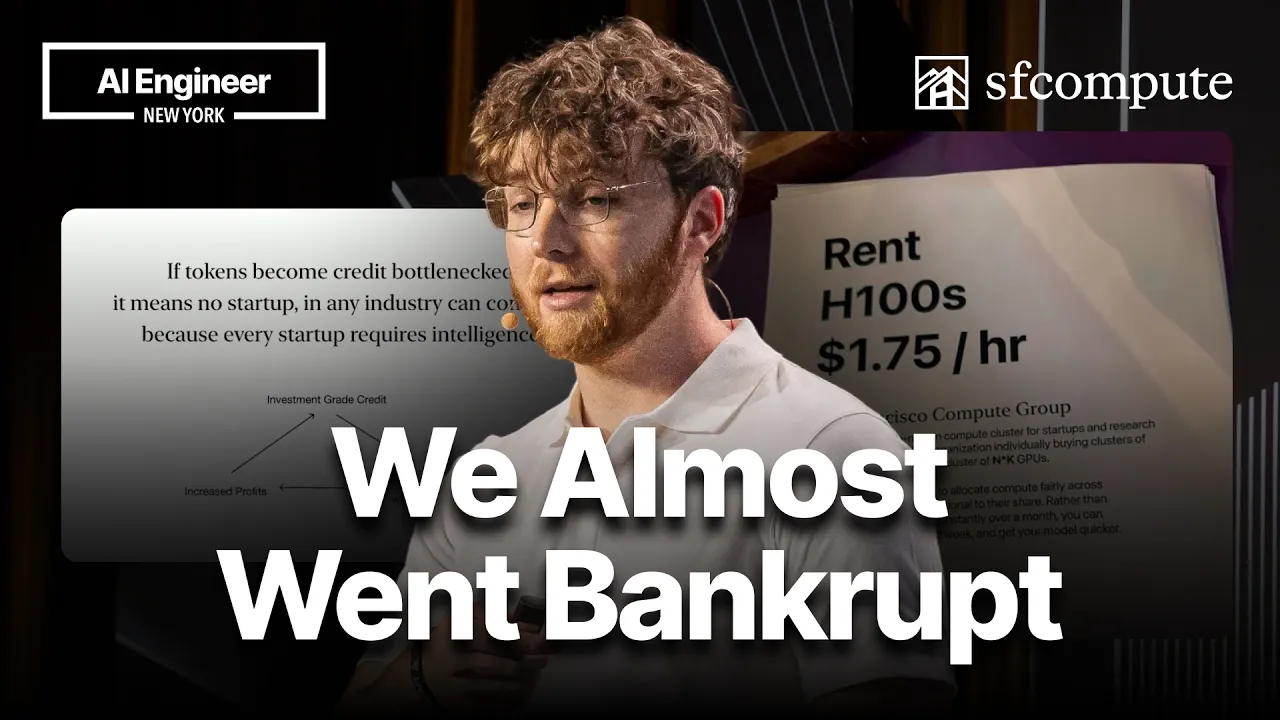
Evan Conrad explains how San Francisco Compute, which began as an AI lab that had to sublease its own GPU cluster to stay alive, ended up both operating clusters and running a market for them. He walks through the chain of problems a new lab or inference company hits: everyone is sold out, the deposit eats the bank balance, clusters arrive late and break, and demand is nearly impossible to predict. He argues these are all one risk problem, that AI companies run into credit limits before power limits, and that without a working compute market the price of entry keeps climbing until no new startups can get in. Chapters: - 00:00 Intro - 00:42 Physically settled compute - 01:35 Supercomputing as a service - 02:08 How a struggling AI lab became a GPU broker - 03:32 Two miracle problems - 04:26 Sold out, deposits and delays - 06:20 It's all one risk problem - 08:13 Credit, not power, is the bottleneck - 10:13 What a compute market has to solve - 11:37 Why you have to operate the cluster - 13:05 Why nobody does physical settlement - 13:59 From $10M to $1B deposits - 15:26 Why startups need this Evan Conrad, San Francisco Compute: https://sfcompute.com Join us in SF for the second annual AIE CODE summit: https://aie.codes our last flagship summit of 2026. Applications live now!
Summary
Generated by gpt-5.6-terraAt-a-Glance
- Verdict: Skim
- Core thesis: AI startups will increasingly be shut out of compute because GPU capacity is financed against customer credit and locked into inflexible long-term contracts; a physically settled compute market could turn cluster capacity into a liquid, financeable asset instead.
- Why it matters: The argument reframes the AI compute bottleneck as primarily a credit, liquidity, and risk-allocation problem—not simply a GPU or power shortage—and predicts that failure to solve it will concentrate AI development among clouds and well-capitalized incumbents.
- Best use: Use it as a strategic thesis on infrastructure-market design and as a checklist of why ordinary GPU brokerage, reserved-capacity contracts, and startup-owned clusters fail; skim because the latter half substantially repeats the earlier argument.
Executive Summary
Evan Conrad argues that AI compute is structurally difficult to finance because AI customers are highly price-sensitive, generally lack investment-grade credit, and cannot safely absorb long-term take-or-pay commitments. Unlike SaaS firms, whose margins can tolerate a cloud-price increase, AI companies may become unviable if underlying compute costs rise. Lenders therefore require deposits and committed customers before funding clusters, creating deployment delays and making startup cash balances the practical limit on AI capacity.
His proposed answer is a compute market with physical settlement: the market operator must also own and operate the GPU infrastructure, rather than merely broker third-party capacity. In this model, capacity can be purchased for current or future delivery through a live order book, while the operator can maintain reliability, substitute failed nodes, and manage the underlying cluster as a standardized deliverable.
The broader claim is political-economic as much as operational. If compute remains illiquid and credit-constrained, cloud providers, large model labs, and Fortune 500 buyers will become the only credible counterparties. Inference vendors may then pass their own financing burden downstream by demanding long token commitments, deposits, and creditworthy buyers—creating a compounding advantage for incumbents and excluding new startups.
The talk is also a founder narrative for San Francisco Compute. Conrad says the company began as an AI lab, JuneLark, whose own cluster costs forced it to sublease GPUs. The speaker presents its shift into compute-market infrastructure as necessary to preserve the possibility that smaller AI labs can exist, though the transcript offers little independent evidence that its market design can achieve the claimed liquidity or financing transformation.
Key Takeaways
- Claim: The central bottleneck in AI infrastructure is credit and risk allocation, which the speaker says arrives before power constraints for most new AI companies. | Evidence: GPU-cluster lenders cannot readily underwrite a new model lab or inference startup pursuing uncertain AI outcomes, so they demand large deposits, identifiable customers, and long-term offtake contracts; Conrad says startups are effectively constrained by cash in their bank accounts. | Implication: When evaluating AI infrastructure exposure, model compute access as a financing and contractual-liquidity problem, not just a unit-cost or hardware-procurement problem. | Caveat: This is the speaker's industry diagnosis, not a quantified market study; the talk provides no comparative data showing that credit is universally more binding than power, chips, networking, or data-center availability.
- Claim: Long-term reserved GPU capacity solves lender risk but creates an illiquid market that strands both excess capacity and urgent demand. | Evidence: Clusters are financed only after a customer signs a take-or-pay agreement, but a company whose product suddenly takes off cannot acquire capacity immediately if existing buyers cannot transfer or exit reservations; it instead must finance a new cluster and wait through hardware and possible data-center lead times. | Implication: Any compute procurement strategy relying solely on static reservations should include transferability, secondary-market access, or another contingency mechanism for demand shocks.
- Claim: A viable compute market must be physically settled: its operator must control the actual GPU clusters, not merely match buyers and sellers. | Evidence: San Francisco Compute describes itself as both cluster operator and market operator, offering present and future reserved capacity through a live order book. Conrad compares a brokered cluster to reselling a hotel room: the reseller cannot provide room service, fix failures, or guarantee the operating experience. | Implication: For compute exchanges, orchestration, hardware operations, node replacement, and service-level enforcement are core market infrastructure—not peripheral implementation details. | Caveat: This establishes why operational control may matter for service quality, but it does not prove that third-party supply cannot be standardized sufficiently for a brokered market.
- Claim: GPU clusters are poor assets for startups to own outright because demand forecasting errors and operational failures can be existential when AI margins are thin. | Evidence: Conrad recounts that JuneLark bought a cluster after raising $500,000 and had to sublease it to avoid bankruptcy. He says companies can overbuy and carry idle capacity or underbuy and lose momentum, while failed nodes may require RMA replacement and recreate the original lead-time problem. | Implication: Startups should distinguish between needing compute access and taking balance-sheet ownership of a fixed cluster; flexibility and replacement guarantees may be worth a premium. | Caveat: The examples of Stability AI and Character AI are invoked as cautionary outcomes, but the talk does not establish that their situations were caused primarily by compute overprovisioning.
- Claim: The compute-market operator faces a structural incentive problem: building physical settlement requires building most of a GPU cloud, after which selling traditional cloud contracts may be more profitable than supporting an open market. | Evidence: Conrad says a market operator must build the full operating capacity of a GPU cloud, while GPU clouds can sign very large deals; he characterizes the resulting temptation as simply becoming a cloud rather than maintaining market neutrality and liquidity. | Implication: A compute-market investment thesis needs a credible answer to market-maker incentives: why the operator will preserve liquidity, neutral access, and tradability instead of prioritizing high-value bilateral capacity deals.
- Claim: Without liquid compute access, credit advantages could propagate from infrastructure into the application economy and accelerate AI-industry consolidation. | Evidence: The speaker predicts inference providers could protect themselves by serving only investment-grade or Fortune 500 customers on five-year token commitments with substantial deposits. He forecasts that a new company may need roughly $100 million in tokens within three to five years to compete with incumbents already spending hundreds of millions. | Implication: For founders and investors, access to flexible compute and token supply may become a strategic moat or anti-moat: incumbents with stronger credit may gain an advantage independent of product quality. | Caveat: The $100 million token requirement and three-to-five-year forecast are speculative projections rather than demonstrated forecasts.
Detailed Brief
San Francisco Compute's proposed product model
- Claims: The company calls its offering 'supercomputing as a service' rather than conventional GPU brokerage.; It targets data-center owners seeking to become GPU clouds, venture firms seeking capacity for portfolio companies, and AI companies that want residual value from compute without operating a supercomputer.; Its stated mechanism combines operation of the full stack—from cluster design and backplane fabric through bare-metal orchestration, VMs, and services—with a market for immediately available and forward capacity.
- Evidence: Conrad says the firm runs a physically settled spot and forwards market with a live order book.; He argues that effective supercomputer operation begins with hardware bill of materials and fabric control, then extends through orchestration and higher-level services.; Dylan Page, identified as co-chair of the CNCF Infrastructure Group and formerly at Lambda, is cited as supporting the view that GPU compute is not yet sufficiently standardized or reliable to separate market operation from physical infrastructure.
- Caveats: The presentation gives no details on contract design, collateral requirements, capacity standardization, delivery guarantees, failure compensation, counterparty default handling, or how the order book reaches durable liquidity.; Because the speaker operates the company proposing this model, the talk should be read as an informed but interested thesis rather than neutral market analysis.
- Implications: The decisive diligence questions for a physical compute market are operational standardization and settlement reliability, followed by whether financial participants will trust its capacity contracts as transferable assets.
The financing loop that produces sold-out capacity and delays
- Claims: The speaker portrays the current system as circular: lenders demand customer commitments before financing equipment, but this prevents providers from having capacity ready when customers need it.; Building clusters before signing customers would reduce delivery delays and allow capacity to absorb hardware failures, but doing so requires lenders to value the cluster itself rather than primarily the customer's credit.
- Evidence: A provider waiting for a signed customer must procure and deploy only afterward, while a new cluster can require equipment lead time and sometimes new data-center construction.; If delivered nodes fail at a higher-than-expected rate, a customer without a pool of substitute nodes must pursue RMA replacements, reopening the lead-time problem.; Conrad contrasts CPU clouds serving high-margin SaaS buyers with GPU clouds serving more price-sensitive AI buyers, arguing that the latter cannot safely rely on high-margin on-demand pricing.
- Caveats: The talk does not address how residual GPU value, model-generation obsolescence, utilization volatility, or correlated hardware failures would be priced into lender underwriting.; The claim that clusters should be built before they are sold shifts, rather than eliminates, inventory and utilization risk.
- Implications: A durable solution would need risk-bearing capital willing to warehouse standardized GPU capacity and transparent pricing capable of supporting asset-based underwriting.
Notable Concepts & Terms
- Physical settlement: The market operator actually delivers and operates the underlying GPU capacity, rather than financially matching a buyer with an external provider.
- Compute forwards market: A mechanism for buying capacity scheduled for future delivery; the speaker treats it as necessary to make future compute more tradable and financeable.
- Take-or-pay contract: A long-term commitment requiring a buyer to pay for reserved capacity whether or not it uses it; lenders rely on it, but it creates rigidity for startups.
- Liquidity: The ability to transfer, sell, or acquire compute commitments as demand changes; Conrad identifies its absence as the core source of stranded capacity and delayed expansion.
- Asset underwriting: Financing based on the value and resale or service potential of the GPU cluster itself rather than the creditworthiness of a particular startup customer.
- NCP: NVIDIA Cloud Partner; Conrad uses the term for organizations that operate GPU-cloud infrastructure.
- Residual value on compute: The economic value remaining in a cluster or capacity position that an AI company may wish to retain without bearing the burden of operating the infrastructure.
- JuneLark: Conrad's earlier AI-lab effort, whose need to sublease an unprofitable cluster is presented as the origin story for San Francisco Compute.
Operator Notes / Why Ken Should Care
- Add compute-contract liquidity to vendor diligence: ask whether reserved capacity can be assigned, resold, resized, or exchanged across hardware types and dates.
- Avoid treating a startup-owned GPU cluster as a simple infrastructure purchase; stress-test it for utilization shortfalls, hardware failures, replacement lead times, and an inability to exit excess capacity.
- For any investment in a compute marketplace, require evidence on standardized deliverables, SLA enforcement, collateral/default rules, supply concentration, order-book depth, and incentives preventing conversion into a conventional GPU cloud.
- Monitor whether token vendors begin demanding large deposits, multi-year minimums, or investment-grade counterparties; that would validate the speaker's claim that compute-credit constraints are moving up the stack.
- For agent and application workloads, preserve multi-provider portability and model-routing flexibility so an abrupt compute-price change does not become an existential dependency.
Source/Metadata
- Title: Why AI Startups Will Disappear Without Compute Markets — Evan Conrad, San Francisco Compute
- Transcript words: 6527
- Duration seconds: 1069
- Timestamp note: No timestamps or chapter markers were provided. The transcript contains substantial repeated material in its latter portion.
Transcript
EVE L. So this is a talk about compute markets, but it's more of a talk about why to make a compute market. If you don't know me, I'm Evan. We run a company called San Francisco Compute. We make a physically settled order, physically settled and forwards market. So if you were here for the last talk, last talk was basically why all the operators of GPU clusters don't really work very well. When we say physically settled, we mean we're the operator. We're both the operator of the hardware in the same way that a cloud is the operator of the hardware, and then we're also the market at the same time. It's a grid for compute. So the general gist of this is that in order to run and operate a supercomputer, we think problems start right at the design of the supercomputer, right in the design of the bill of materials. It's control of the backplane fabric as well. It's also control of bare metal orchestration. It's also services on top, VMs, and so on. There's a lot of different parts of the stack that you have to do effectively. Otherwise, the folks who have a data center and would like to make more money on that data center by becoming the GPU cloud end up failing for the customer. So that's what we do. We offer what's called supercomputing as a service. We go to folks who want to become a cloud. That's folks who want to become what NVIDIA would call an NCP or venture firms that want to have clusters for their portfolio and want to be able to reallocate that capacity when a company like Instinct is taking off. Or AI companies who would like the residual value on the compute because they've realized that's really important for their financials but don't want to operate a supercomputer. So that's physical settlement. And then on top of that, we run a live order book for capacity that you can buy reserved either right now or in the future. This together is not at all what we thought we were going to be doing. Originally, we were this company called JunLark that was trying to make something like Suno or UDO, but prior to Suno or UDO. At the time, what you needed to do to realistically start an AI lab was you needed to raise a big deposit, a huge one, which was $10 million at the time. We thought that was a crazy amount of money. And so we thought, no, that's stupid. We're going to raise $500,000. And obviously, what we're going to do is we're going to rent from somebody else. Obviously, today, it's not $10 million. It's $1 billion. And nonetheless, we had raised our $500,000. We buy a big cluster. And then we're underwater on our cluster every month. And if we didn't sublease our cluster, we would have gone bankrupt. So if you've heard of GPU brokers, we were the first GPU broker because we were forced into being a GPU broker. So the first year the company was us just trying to sell our cluster. Otherwise, we would go bankrupt. So I would wander around with these actual pieces of paper at NeurIPS, which both say H100 and A100 at the same time, because that's how I made the poster so quickly. And so this talk is not really about necessarily how a compute market works. It's how a compute market gets to exist. We think about it like there's this pamphlet. And on the pamphlet, on the front side, it's like, man, starting an AI lab sucks. There's all these different financial and economic problems. On the back of the pamphlet, it says compute markets. It's not super clear how one gets to the other until you open the pamphlet. And then you're like, holy shit, there's so much stuff in this pamphlet. And it keeps going. There's so many folds. It's just a very difficult and challenging problem, because you need to solve two miracle problems to get working. You have to both make a market, which is a uniquely difficult problem, because it has a cold start problem. You also have to build a cloud. And then you have to not become a cloud, which is a whole separate challenge. But these are the problems that the labs are facing. And it's about to be the problems that everyone is about to face. So if you work at a startup, these are your problems now. Right now, everybody is sold out of compute. This is probably not going to change for a while. So that means that you're going to have to buy a new cluster, a net new one. And there's a lead time. You have no way to pay for that cluster to come online now. You're going to pay for it to come online later. There's nothing in the market that can realistically get that cluster online for you now. Meanwhile, you're going to pay your entire bank balance as a deposit. The reason you're paying your entire bank balance as a deposit is because the lender has no idea how to underwrite AGI. How in the world are you supposed to do that? You've got two-person startups in San Francisco, or maybe New York, who say, I'm going to build superintelligence. No lender knows how to underwrite superintelligence. So they have no idea what the asset is worth. Meanwhile, your cluster is very likely to be delayed. That's because the lender needed to underwrite against the credit risk of the customer. And so they need to know who is the customer first before you deploy the cluster. So right when the customer signs is the riskiest point in the entire operation. You wanted it to be the case that you built the cluster first, and then you sell it. This also helps reduce all sorts of different types of problems where clusters break. Meanwhile, most of the people who are setting up clusters are people who have the actual asset that makes the thing cheap, like you've got the data center space already. What that doesn't get is supercomputing expertise, as we saw in the last talk, if you've watched that one. Meanwhile, you're going to run into the exact same problem that JuneLark did, which is you're going to either way overbuy or you're going to way underbuy. That's because AI doesn't have margins that look like SaaS companies. And so you don't have very much margin for error. And so the chances that you either underbuy and somebody else wins because they did it correctly, or you overbuy and then you just become Stability AI, or you blow up, you end up like Character AI, are really high. So these are all the same problem. They're all different types of risk. They're technical risk. They're financial risk. They're credit risk. They're all one big bundled risk problem, which is the problem that we end up solving. And it's also the problem that we think compute markets broadly, the entire industry solves. So we'll walk through each one of these and walk how that gets to a compute market. Because if you don't understand these, it's unclear why you would want a compute market. And they almost seem like this problem that somebody thinks, oh, wow, compute markets are cool. So I'm going to go start one. We think they should be derived from the actual problems that people face, which is, first, everyone is sold out. Why are they sold out? Because the lender couldn't finance the cluster unless you had a long-term off-take agreement. In CPUs, this wasn't the case. Because CPU buyers are SaaS companies. SaaS companies have high margins. And because they have high margins, you can build a product that rewards you with high margins for your CPUs. Think about it this way. If you're a SaaS company and your underlying cloud doubles their prices, you don't go bankrupt. You hate your cloud. You're mad. But you don't go bankrupt. If you're an AI company and your underlying cloud doubles their prices, you go bankrupt, unless you go to some other underlying cloud. And what that means is that you're actually price sensitive. And because you're actually price sensitive, and there's nothing keeping you at any particular cloud, you can't sell on demand because your customers will immediately leave to whoever is cheaper. And so that means that in order to finance GPU clusters, you have to have long-term take-or-pay contracts, hopefully with someone who has investment-grade credit. However, if you don't have liquidity on those, if you're selling reserved and your customer can't get out, then that also means that some other customer who wants the capacity right now, because they're like Instinct and their product is taking off, can't pay for anything. They have to finance a new cluster, which has a lead time. Because the physical world just exists, and it's going to take a while. Sometimes you even have to build the data center. And then, because you're financing a new cluster, you're going to pay a deposit. Because almost nobody in AI has any reasonable credit. And because this is a brand new technology, all these companies are new. Meanwhile, even as you start to scale up that ladder, you're still going to run into credit issues all the way through. It's the number one bottleneck of AI at the moment. It's not power. You hit credit way before you hit power. So what that means is every inference company... If you're selling reserved and your customer can't get out, then that also means that some other customer who wants the capacity right now, because their product is taking off, can't pay for anything. They have to finance a new cluster, which has a lead time. Because the physical world just exists, and it's going to take a while. Sometimes you even have to build the data center. And then, because you're financing a new cluster, you're going to pay a deposit. Because almost nobody in AI has any reasonable credit. And because this is brand new technology. All these companies are new. Meanwhile, even as you start to scale up that ladder, you're still going to run into credit issues all the way through. It's the number one bottleneck of AI at the moment. It's not power. You hit credit way before you hit power. So what that means is every inference company, every Neolab, they're bottlenecked by how much cash do they have in the bank account. And so they go back to the venture capitalist, who says, "I'm going to fund at the model layer, the application layer, the inference layer, because I don't want to fund all of that CapEx stuff." And so the venture capitalist then funds all the CapEx stuff by giving the new Neolab or new inference company the check that they then send to the cloud, which is the deposit for the cluster. And that's how you underwrite the customer. So the clusters then are delayed, because the cloud couldn't actually deploy the cluster until they had the customer in hand. And so that was the riskiest point. So therefore, what should have happened was the cloud had bought the cluster ahead of time, and then waited until it was landed in the data center, and then sold it. And that means you have way less likelihood of delays. Meanwhile, the cluster is very likely to break when you get the cluster as the customer, because you don't have liquidity. And so if the failure rate is higher than what you expect, and you don't have the ability to transition a node in, then you don't have anywhere you can pull nodes from, which means that if you need new nodes to make up for the failed ones, you have to RMA them, which means you have to get a new node. And then that gets us back to several steps before, where you have the lead time problem again. And so everything breaks for everybody all the time. Once you have gotten through all of that as a new AI lab, your problems are that everyone was sold out. You then had to wait a lead time. You paid this big deposit. The thing was delayed, and then it broke. And finally, you got through all of that. And the likelihood that you predict your demand correctly is very low. And so you're either going to be way over-provisioned or way under-provisioned, and you have no way out. There's no way to sell your capacity to somebody else, and there's no way to buy more capacity if you need it. So, compute markets. To solve these problems, you need to solve a bunch of different problems all at once. You need to underwrite the value of the GPU cluster, rather than underwriting the credit risk of the customer. This is how it could work. It's not guaranteed to work like this. In other industries, what happened is everything just consolidated. You got one big credit-worthy customer that does the whole industry. That's what the path of AI is currently on track to do. Instead of going to be a liquid market where anybody can participate, it's going to look like TSMC. You're going to get one buyer, or a few buyers, that are the clouds. You're going to get a few model labs that are the AI labs. And then you won't get other startups. This is what we think is going to happen. And this is why three years ago, when we were doing our AI lab, we had a chance. We could have said, "No, we're not going to stick it out for several years, just trying to keep our company alive. We're just going to go do a new AI lab." But we saw this problem. And we said, "If we don't do anything about this, then we will just hit this three years from now." And here we are three years from now, hitting this problem, and where everyone's going to hit this problem. So if you watched the last talk, it's very hard to solve this problem unless you are operating both the market and the clusters at the same time. This is Dylan Page. Dylan is the co-chair of the CNCF Infrastructure Group. That's the organization that makes Kubernetes. He formerly worked at Lambda doing infrastructure there. And he joined San Francisco Compute because GPU Compute isn't sufficiently standardized, reliable, for the market operator to be divorced from the physical infrastructure. It doesn't work if you aren't the one who's buying the thing. It doesn't work if the person you're buying from isn't operating it. To give an example of why this doesn't work: I'm sure some of you are flying in from overseas or out of town, and you have a hotel room. Wouldn't it be great if you could sell that hotel room to somebody else? I go to you, and I want to buy that hotel room. And I say, "Can I get room service? Can I get my room cleaned? I've got a problem with my room. Who do I call?" If you don't operate the hotel, you can't fix any of those problems. That's why brokering clusters doesn't work. You have to operate the cluster like the hotel. You have to run the whole thing. Otherwise, you can't actually make a market. It doesn't work. You can't do physical settlement. So why does nobody do physical settlement? The problem is there is a very strong incentive to never do physical settlement. That's because if you build out physical settlement for compute, what that literally means is you're building out the entire operating capacity of a GPU cloud. And if you are building out the entire operating capacity of a GPU cloud, you should just be a GPU cloud, because it looks to be the case that you will make an ungodly amount of money. You will sign billion dollar deal after billion dollar deal. And so fuck it. Let's not make a GPU cloud. Or let's not make a compute market. Let's instead just become a GPU cloud, which is what basically everybody does, because the numbers are astronomical, and it's a very reasonable thing to do. The reason why we ended up building physical settlement was because we knew that if we didn't start this, we would then not be able to start an AI lab, which was the real thing that we wanted to do in the first place. We wanted to make a lab. We didn't get to make a lab unless this exists. So when we started, it was 10 million as the deposit that you had to pay to start a new lab. This is how you get over the credit risk problem. Then the cluster sizes got bigger. The minimum ante into the space got bigger. Then it was 100 million. Now it's a billion. We don't think it can continue. We don't think there is a world in which you can get a $10 billion round right out the bat before you have revenue or traction or your product or anything. And what that means is that if you don't solve this problem, we are currently on track to not have any startups in AI. Now one of the things that you could think could happen is maybe there can be new inference companies and new model labs. And the way that they solve the credit problem is that instead they just ship the risk to the application layer. They say, "I need to get over my credit problem. So what I'm going to do is I'm going to only sign customers who are investment grade credit, Fortune 500. I'm going to only sign customers on five-year contracts for tokens. I'm going to only sign customers for tokens that require a big deposit upfront." That is the end of everything. If you have inference layer getting bottlenecked by credit, what happens is you can't get tokens unless you have credit or you have a big deposit. And the problem of that is that tokens are used by the whole economy. There is no rule that says that startups have to exist. If every startup is suddenly bottlenecked by credit in order to access intelligence, what happens is existing firms just ship everything. They themselves get to make the product because they've got credit. And then they make the revenue from that product. And then it makes their credit better. And that's a flying wheel that makes consolidation happen throughout the entire economy. If you don't fix this bottleneck, there aren't any startups. This is why we started doing this. And because at one point, what we think is going to happen, is you're going to end up in three to five years, you're going to look out and say, "I want to start a new startup." And to get there, you need to buy so many tokens in order to compete with the existing partner or existing players. So you need to buy $100 million of tokens. We think this is what you are actually going to have to do. There is no rule that says that startups have to exist. If every startup is suddenly bottlenecked by credit in order to access intelligence, what happens is existing firms just ship everything. They themselves get to make the product because they've got credit. And then they make the revenue from that product. And then it makes their credit better. And that's a flying wheel that makes consolidation happen throughout the entire economy. If you don't fix this bottleneck, there aren't any startups. This is why we started doing this. And because at one point, or what we think is going to happen, is you're going to end up in three to five years, you're going to look out and say, I want to start a new startup. And to get there, you need to buy so many tokens in order to compete with the existing partner or existing players. So you need to buy $100 million of tokens. We think this is what you are actually going to have to do in order to start a new company because other people are spending hundreds of millions of dollars of tokens. If you just draw the line out, this is what happens. So you need a big giant deposit because you're two people who have no idea what they're doing. And so nobody trusts you. So you're going to go and raise $100 million from your venture capitalists. Meanwhile, nobody wants to work with you because you're a two-person startup. Then you're going to be asked to pay for that hundred, or you're going to be asked to pay for a five-year contract on that hundred million if you're not paying it all as a deposit. And then you just don't get new model labs. You don't get new startups. You get a consolidation in the industry. So we, at one point, were this little lab. And what we did is we lived in San Francisco. And we knew all the other people who were also just two little folks who had started a startup and wanted to be able to participate in the most important technology of our time. So I want these people to exist. I want this person to exist. And I want this person to exist. I want this startup to exist. And this startup to exist. And this startup to exist. This one. And this one. And this one. And this one. And this one. And this one. And this one. And this one. And this one. If you get these companies going, maybe they'll become big folks that build your cancer cures. Or they build something that nobody thought of. Or something that wasn't just AI slopped out. This is the problem that compute markets have to solve and if you don't solve it we don't think there's going to be any startups. And it keeps going. There's so many folds. It's just a very difficult and challenging problem, because you need to solve two miracle problems to get working. You have to both make a market, which is a uniquely difficult problem, because it has a cold start problem. You also have to build a cloud. And then you have to not become a cloud, which is a whole separate challenge. But these are the problems that the labs are facing. And it's about to be the problems that everyone is about to facing. So if you work at a startup, these are your problems now. Right now, everybody is sold out of compute. This is probably not going to change for a while. So that means that you're going to have to buy a new cluster, a net new one. And there's a lead time. You have no way to pay for that cluster to come online now. You're going to pay for it to come online later. There's nothing in the market that can realistically get that cluster online for you now. Meanwhile, you're going to pay your entire bank balance as a deposit. The reason you're paying your entire bank balance as a deposit is because the lender has no idea how to underwrite AGI. How in the world are you supposed to do that? You've got two-person startups in San Francisco, or maybe New York, who say, I'm going to build superintelligence. No lender knows how to underwrite superintelligence. So they have no idea what the asset is worth. Meanwhile, your cluster is very likely to be delayed. That's because the lender needed to underwrite against the credit risk of the customer. And so they need to know who is the customer first before you deploy the cluster. So right when the customer signs is the riskiest point in the entire operation. You wanted it to be the case that you built the cluster first, and then you sell it. This also helps reduce all sorts of different types of problems where clusters break. Meanwhile, most of the people who are setting up clusters are people who have the actual asset that makes the thing cheap, like you've got the data center space already. What that doesn't get is supercomputing expertise, as we saw in the last talk, if you've watched that one. Meanwhile, you're going to run into the exact same problem that Junelark did, which is you're going to either way overbuy or you're going to way underbuy. That's because AI doesn't have margins that look like SAS companies. And so you don't have very much margin for error. And so the chances that you either underbuy and somebody else wins because they did it correctly, or you overbuy and then you just become stability AI, or you blow up, you end up like character AI, are really high. So these are all the same problem. They're all just different types of risk. They're technical risk. They're financial risk. They're credit risk. They're all one big bundled risk problem, which is the problem that we end up solving. And it's also the problem that we think compute markets broadly the entire industry solves. So we'll walk through each one of these and walk how that gets to a compute market. Because if you don't understand these, it's kind of unclear why you would want a compute market. And they almost seem like this problem that somebody thinks, oh, wow, compute markets are cool. So I'm going to go start one. We think they should be derived from the actual problems that people face, which is, first, everyone is sold out. Why are they sold out? Because the lender couldn't finance the cluster unless you had a long-term off-take agreement. In CPUs, this wasn't the case. Because CPU buyers are SaaS companies. SaaS companies have high margins. And because they have high margins, you can build a product that rewards you with high margins for your CPUs. Think about it like this way. If you're a SaaS company and your underlying cloud doubles their prices, you don't go bankrupt. You hate your cloud. You're mad. But you don't go bankrupt. If you're an AI company and your underlying cloud doubles their prices, you go bankrupt, unless you go to some other underlying cloud. And what that means is that you're actually price sensitive. And because you're actually price sensitive, and there's nothing keeping you at any particular cloud. So you can't sell on demand because your customers will immediately leave to whoever is cheaper. And so that means that in order to finance GPU clusters, you have to have long-term take-or-pay contracts, hopefully with someone who has investment-grade credit. However, if you don't have liquidity on those, if you're selling reserved and your customer can't get out, then that also means that some other customer who wants the capacity right now, because they're like instinct and their product is taking off, can't pay for anything. They have to finance a new cluster, which has a lead time. Because the physical world just exists, and it's going to take a while. Sometimes you even have to build the damn data center. And then, because you're financing a new cluster, you're going to pay a deposit. Because almost nobody in AI has any reasonable credit. And because this is a brand new technology. All these companies are new. Meanwhile, even as you start to scale up that ladder, you're still going to run into credit issues all the way through. It's the number one bottleneck of AI at the moment. It's not power. You hit credit way before you hit AI, or way before you hit power. So what that means is every inference company, every Neolab, they're bottlenecked by how much cash do they have in the bank account. And so they go back to the venture capitalist, who says, oh, I'm going to fund at the model layer, the application layer, the inference layer, because I don't want to fund all of that CapEx stuff. And so the venture capitalist then funds all the CapEx stuff by giving the new Neolab, or new inference company, the check that they then send to the cloud, which is the deposit for the cluster. And that's how you underwrite the customer. So the clusters then are delayed, because the cloud couldn't actually deploy the cluster until they had the customer in hand. And so that was the riskiest point. So therefore, what should have happened was the cloud had bought the cluster ahead of time, and then waited until it was landed in the data center, and then sold it. And that means you have way less likelihood of delays. Meanwhile, the cluster is very likely to break when you get the cluster as the customer, because you don't have liquidity. And so if the failure rate is higher than what you expect, and you don't have the ability to transition a node in, then you don't have anywhere you can pull nodes from, which means that if you need new nodes to make up for the failed ones, you have to RMA them, which means you have to get a new node. And then that gets us back to several steps before, where you have the lead time problem again. And so everything breaks for everybody all the time. Once you have gotten through all of that as a new AI lab, your problems are, you know, nobody was sold, like everyone was sold out. You then had to wait a lead time. You paid this big deposit. The thing was delayed, and then it broke. And finally, you got through all of that. And the likelihood that you predict your demand correctly is very low. And so you're either going to be way over-provisioned or way under-provisioned, and you have no way out. There's no way to sell your capacity to somebody else, and there's no way to buy more capacity if you need it. So, compute markets. To solve these problems, you need to solve a bunch of different problems all at once. You need to underwrite the value of the GPU cluster, rather than underwriting the value, or underwriting the credit risk of the customer. This is how it could work. It's not guaranteed to work like this. In other industries, what happened is everything just consolidated. You got one big credit-worthy customer that does the whole damn industry. That's what the path of AI is currently on track to do. It's instead of going to be a liquid market where anybody can participate, it's going to look like TSMC. You're going to get one buyer, or a few buyers, that are the clouds. You're going to get a few model labs that are the AI labs. And then you won't get other startups. This is what we think is going to happen. And this is why, three years ago, when we were doing our AI lab, we had a chance. We could have said, no, we're not going to stick it out for several years, just trying to keep our company alive. We're just going to go do a new AI lab. But we saw this problem. And we said, oh shit, if we don't do anything about this, then we will just hit this three years from now. And here we are three years from now, hitting this problem, and where everyone's going to hit this problem. So if you watched the last talk, it's very hard to solve this problem unless you are operating both the market and the clusters at the same time. So this is Dylan Page. Dylan is the co-chair of the CNCF Infrastructure Group. That's the organization that makes Kubernetes. He formerly worked at Lambda doing infrastructure there. And he joined San Francisco Compute because GPU Compute isn't sufficiently standardized, reliable, for the market operator to be divorced from the physical infrastructure. It doesn't work if you aren't the one who's buying the thing. Sorry, it doesn't work if the person you're buying from isn't operating it. To give an example of why this doesn't work is I'm sure some of you are flying in from overseas or out of town, and you have a hotel room. Wouldn't it be great if you could sell that hotel room to somebody else? I go to you, and I want to buy that hotel room. And I say, can I get room service? Can I get my room cleaned? Can I get my room cleaned? I've got a problem with my room. Who do I call? If you don't operate the hotel, you can't fix any of those problems. That's why brokering clusters doesn't work. You have to operate the cluster like the hotel. You have to run the whole damn thing. Otherwise, you can't actually make a market. It doesn't work. You can't do physical settlement. So why does nobody do physical settlement? The problem is there is a very strong incentive to never do physical settlement. That's because if you build out physical settlement for compute, what that literally means is you're building out the entire operating capacity of a GPU cloud. And if you are building out the entire operating capacity of a GPU cloud, you should just be a GPU cloud, because it looks to be the case that you will make an ungodly amount of money. You will sign billion dollar deal after billion dollar deal. And so fuck it. Let's not make a GPU cloud. Or let's not make a compute market. Let's instead just become a GPU cloud, which is what basically everybody does, because the numbers are astronomical, and it's a very reasonable thing to do. The reason why we ended up building physical settlement was because we knew that if we didn't start this, we would then not be able to start an AI lab, which was the real damn thing that we wanted to do in the first place. We wanted to make a lab. We didn't get to make a lab unless this exists. So when we started, it was 10 million as the deposit that you had to pay to start a new lab. This is how you get over the credit risk problem. Then the cluster sizes got bigger. The sort of minimum ante into the space got bigger. Then it was 100 million. Now it's a billion. We don't think it can continue. We don't think there is a world in which you can get a $10 billion round right out the bat before you have revenue or traction or your product or anything. And what that means is that if you don't solve this problem, we are currently on track to not have any startups in AI. Now one of the things that you could think could happen is maybe there can be new inference companies and new model labs. And the way that they solve the credit problem is that instead they just ship the risk to the application layer. They say, look, I need to get over my credit problem. So what I'm going to do is I'm going to only sign customers who are investment grade credit, you know, Fortune 500. I'm going to only sign customers on five-year contracts for tokens. I'm going to only sign customers for tokens that require a big deposit upfront. That is the end of everything. If you have inference layer getting bottlenecked by credit, what happens is you can't get tokens unless you have credit or you have a big deposit. And the problem of that is that tokens are used by the whole damn economy. There is no rule that says that startups have to exist. If every startup is suddenly bottlenecked by credit in order to access intelligence, what happens is existing firms just ship everything. They themselves get to make the product because they've got credit. And then they make the revenue from that product. And then it makes their credit better. And that's a flying wheel that makes consolidation happen throughout the entire economy. If you don't fix this bottleneck, there aren't any startups. This is why we started doing this. And because at one point, or what we think is going to happen, is you're going to end up in like three to five years, you're going to look out and say, I want to start a new startup. And to get there, you need to buy so many tokens in order to compete with the existing partner or like existing players. So you need to buy $100 million of tokens. We think this is what you are actually going to have to do in order to start a new company because other people are spending hundreds of millions of dollars of tokens. If you just draw the line out, this is what happens. So you need a big giant deposit because you're two people who have no idea what they're doing. And so nobody trusts you. So you're going to go and raise $100 million from your venture capitalists. Meanwhile, nobody wants to work with you because you're a two-person startup. Then you're going to be asked to pay for that hundred, or you're going to be asked to pay for a five-year contract on that hundred million if you're not paying it all as a deposit. And then you just don't get new model labs. You don't get new startups. You get a consolidation in the industry. So we, at one point, were this little lab. And what we did is we lived in San Francisco. And we knew all the other people who were also just two little folks who had started a startup and wanted to be able to participate in the most important technology of our time. So I want these people to exist. I want this person to exist. And I want this person to exist. I want this startup to exist. And this startup to exist. And this startup to exist. This one. And this one. And this one. And this one. And this one. And this one. And this one. And this one. And this one. If you get these companies going, maybe they'll become big folks that build your cancer cures. Or they build something that nobody thought of. Or something that wasn't just AI slopped out. This is kind of the problem that compute markets have. solve and if you don't solve it we don't think there's gonna be any startups