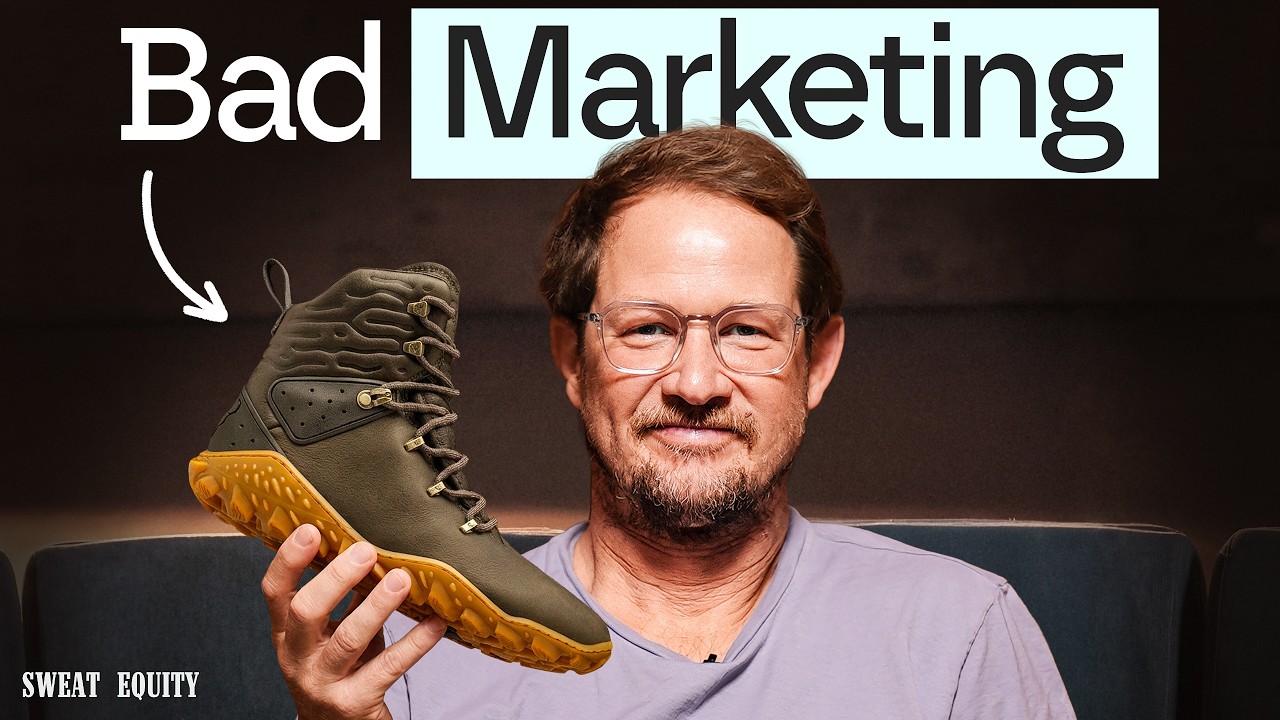
The Word of Mouth Playbook That Built Vivobarefoot to $130M/Year
Description
Every major shoe brand told him his idea would never work. He built a $130M category anyway. In this episode, Galahad Clark, co-founder of Vivobarefoot, shares how he turned a rejected idea into a global brand. From nearly going bankrupt to crowdfunding his way back and scaling without big marketing, he breaks down what it takes to lead a premium, mission-driven brand. If you want to learn how to stand behind your ideas and scale a business, this one’s for you. Enjoy the episode! :iphone:Follow Us On Social: -------------------- Instagram Alex / alexgarcia_atx Brian: / brian_blum Twitter www.twitter.com/@alexgarcia_atx www.twitter.com/@brian_blum1 -------------------- Get Moby, your AI teammate built for your business: https://www.triplewhale.com/sweat-equity -------------------- :fire:Want Free Game? Send us a picture of your Apple & Spotify reviews to podcast@marketingexamined.com and we’ll make you a playbook in a future episode. -------------------- If you’re a creator that wants to make $10k/mo https://hitmakers.biz -------------------- :chart_with_upwards_trend:Growth Playbooks, Directly To Your Inbox For growth playbooks, deep dives, and marketing case studies, get subscribed at https://www.marketingexamined.com -------------------- CHAPTERS: 00:00 - Intro 00:53 - Vivobarefoot’s Origin Story 09:41 - Why Huge Companies Rejected Barefoot Shoes 18:23 - Launching a DTC Shoe Brand in 2012: Bankruptcy & Crowdfunding 22:50 - How Accurate Data Scaled Vivobarefoot Past $50M 26:06 - Business Lessons from the Clarks Family 32:59 - Key Catalyst to Grow to $130M Without Big Marketing 37:45 - How to Earn Your Place as a Premium Brand Leader 40:12 - Big Shoe’s Crazy Argument on Kids’ Shoes 44:30 - Product Development, Elite Athletes & New Categories 48:39 - Innovating in the Footwear Industry 57:50 - Mission-Driven Brands vs. the Billion-Dollar Exit
Summary
Generated by gpt-6.1-terraAt-a-Glance
- Verdict: Skim
- Core thesis: Vivobarefoot’s founder attributes its approximately $130 million in annual revenue to a differentiated product, patient community education, and word of mouth—but says category adoption has brought lower-priced competitors and renewed pressure on profitability.
- Why it matters: The interview illustrates both the power and the limits of category creation: advocates can build demand and even rescue a company, while a successful market attracts competitors who can appropriate the category narrative.
- Best use: Use it as a founder-reported case study in category-building, operational discipline, and defending a premium position; the interview offers more strategic lessons than a repeatable word-of-mouth playbook.
Executive Summary
Galahad Clark began developing barefoot shoes around 2005 after a friend argued that conventional footwear interfered with natural movement. Attempts to partner with major footwear companies failed, so Clark went all-in on Vivobarefoot in 2012. A launch predicated on an anticipated scientific breakthrough nearly ruined the business when the research was weakened in peer review and failed to generate the expected publicity.
Clark credits the eventual turnaround to customers who valued the product, community-building, work with health professionals, and a 2016 Crowdcube raise that he says saved the company. A mentor also established weekly reviews of accurate data with the relevant decision-makers. Clark estimates revenue at about $130 million; the host says the company sold 1.2 million pairs last year.
The success created a harder market. Clark says hundreds of barefoot brands now compete, some at half Vivo’s price, and that online trading has been difficult for the past couple of years. His answer is to earn a premium through product innovation, community, physical retail, and sustainability while restoring margin discipline.
A longer-term initiative, Vivo Biome, aims to turn foot scans into locally manufactured, personalized shoes using additive manufacturing. The vision has had pilot launches, but its economics, scale, fit outcomes, and environmental benefits are not established in the interview. Clark’s broad health claims about barefoot shoes should likewise be treated as advocacy, not independently validated conclusions.
Key Takeaways
- Claim: Word of mouth worked because Vivo combined a distinctive product experience with education and a community that could explain an unfamiliar category. | Evidence: Clark credits community-building and work with health professionals rather than major campaigns, and says enthusiastic customers participated in the 2016 Crowdcube raise that saved the business. | Implication: For a novel product, treat credible user education and an engaged community as potential distribution infrastructure, but measure their contribution rather than assuming advocacy alone scales acquisition. | Caveat: He provides no referral rates, acquisition costs, campaign breakdown, or controlled evidence separating word of mouth from other growth drivers.
- Claim: Betting inventory and launch expectations on a single external validation event nearly destroyed the company. | Evidence: Before the 2012 launch, Vivo ordered substantial stock expecting Harvard research to trigger major coverage; Clark says peer review weakened the findings and the expected media attention did not materialize. He describes 2012–2016 as years repeatedly near bankruptcy. | Implication: Stage spending around verified demand and retain a downside plan when a go-to-market thesis depends on research, publicity, or another event outside the company’s control. | Caveat: The interview does not identify the paper or establish the original health-effect estimates as valid.
- Claim: A simple, recurring operating cadence materially improved execution, and abandoning it contributed to margin erosion. | Evidence: Clark’s chair brought the right people together weekly to review accurate data and make early decisions. After the chair left when the company passed roughly $50 million, Clark says reporting became less reliable and profitability and margin control deteriorated; two- or three-point losses can flip the business between profit and loss. | Implication: Protect decision cadence and data quality during leadership transitions rather than assuming practices that work at one scale have become obsolete. | Caveat: This is Clark’s retrospective account; the interview does not isolate the effect of the chair’s departure from other changes.
- Claim: Creating a category does not guarantee ownership of its economics once cheaper alternatives arrive. | Evidence: Clark says hundreds of barefoot brands have emerged since around 2021, including offers positioned at roughly half Vivo’s price; he describes the past couple of years as especially difficult online. | Implication: Assess whether a category leader has defensible differentiation beyond educating buyers, particularly when the category’s core product proposition is easy to imitate. | Caveat: Competitor counts and price comparisons are founder-reported, and no market-share or profitability data are supplied.
- Claim: Incumbent resistance can create a window for a challenger, but education must overcome the incentives of existing channel partners. | Evidence: Clark says a Clarks US barefoot range was canceled by a new CEO and an advanced Under Armour partnership was stopped by a new footwear executive. He argues specialty retailers have built expertise and commercial relationships around conventional shoe technology. | Implication: Map not only customer objections but also the financial and reputational costs that adoption would impose on distributors and established experts. | Caveat: These are Clark’s accounts of counterparties’ decisions and motivations, not independently verified explanations.
- Claim: Vivo Biome is a bet that personalized, local additive manufacturing can differentiate premium footwear and reduce reliance on conventional supply chains. | Evidence: Co-founder Asher leads the five-year effort; Vivo has conducted pioneer launches and works with Carbon. The proposed workflow converts a 3D or eventual phone foot scan into a locally manufactured shoe, with algorithms central to the process. | Implication: Treat the initiative as an early-stage manufacturing option rather than an established competitive moat or proven sustainability outcome. | Caveat: Mobile scanning and the full local, circular model are presented as goals; the interview supplies no unit economics, production volumes, comparative fit data, or lifecycle assessment.
- Claim: Clark believes a gradual transition and guidance matter when adopting barefoot footwear. | Evidence: He warns against immediately attempting an ultramarathon in barefoot shoes and says the company works with health professionals to introduce customers to the approach. | Implication: Distinguish a sensible onboarding and safety message from the founder’s much stronger medical claims when assessing the product or repeating the story. | Caveat: His broader claims that conventional shoes cause widespread pain and that barefoot shoes improve health are unverified in the interview; even the research he initially relied on was weakened in peer review.
Detailed Brief
Product development: from a failed modular shoe to a full wardrobe
- Claims: The initial engineering challenge was to change the shoe’s underlying shape, not simply remove cushioning.; Vivo expanded across use cases because Clark believed people needed barefoot options for different activities and environments.
- Evidence: Around 2005, the team developed a foot-shaped last—the form around which a shoe is constructed—and tested prototypes themselves.; An early zip-on interchangeable sole and upper proved unsuccessful; Clark compares modular shoes to products that perform neither of their combined functions well.; The ESC collection applies lessons from extreme environments, including Arctic, jungle, desert, and forest conditions, to broader outdoor products.
- Implications: A category-defining product may require changing a foundational design assumption before broadening the catalog; modularity is not valuable if it compromises the primary job.
Premium positioning has limits in sponsored sport
- Claims: Vivo is positioning some products around training rather than trying to match incumbent sponsorship spending for match-day footwear.; Clark connects the premium price to materials, factory practices, and supply-chain choices, while acknowledging that buyers have complained about cost.
- Evidence: Clark says some famous tennis players train barefoot but compete in shoes from brands paying them $5 million–$7 million contracts; he does not name them.; He wants stores in places such as New York to bring customers together and help justify the premium.
- Caveats: The athlete examples and supply-chain quality claims are not independently substantiated in the interview.
- Implications: Actual product use and public endorsement can diverge when incumbent contracts control visible moments; a challenger may need a different proof and distribution strategy.
Founder values and the sustainability constraint
- Claims: Clark frames Vivo’s mission against his account of the Clarks family business shifting from Quaker-rooted social responsibility toward externally driven financial management.; He argues that reduced sustainability commitments by large brands weaken incentives for lower-tier suppliers to invest in better materials and processes.
- Evidence: Clark recalls UK factory closures and production moving to Asia as part of the Clarks transition, while acknowledging that the managers made money.; He contrasts collaborative industry sustainability efforts around 2016–2017 with what he describes as a later retreat toward regulatory compliance.
- Caveats: Both the Clarks history and the industry-wide sustainability assessment are Clark’s interpretations; the interview provides no independent comparative data.
- Implications: Mission-led differentiation can depend on supplier capabilities and industry investment that an individual brand does not control.
Notable Concepts & Terms
- Shoe last: The form a shoe is built around; Vivo’s early shift to a foot-shaped last was foundational to its product design.
- Crowdcube: The crowdfunding platform used for the 2016 raise that Clark says rescued Vivo, illustrating how an engaged customer community can become a financing base.
- Business proprioception: Clark’s analogy between sensory feedback and accurate, timely business data: both enable better decisions.
- Category creation versus category capture: Vivo helped popularize barefoot footwear but now faces lower-priced competitors, making category growth distinct from retaining premium economics.
- Vivo Biome: Vivo’s experimental personalized-footwear platform combining foot scans, algorithms, and additive manufacturing; the proposed end-to-end model remains unproven in the interview.
- ESC collection: Vivo’s ecological survival or escape collection, developed for extreme environments and used as a source of ideas for broader outdoor footwear.
Operator Notes / Why Ken Should Care
- For any category-creation investment, request cohort-level referral, retention, and acquisition-cost data before underwriting a word-of-mouth growth claim.
- Stress-test launch plans against the failure or delay of a single research result, platform partnership, press event, or regulatory catalyst.
- Audit whether portfolio companies preserve a weekly owner-and-metric decision cadence through executive turnover and scaling.
- For premium category leaders, compare price gaps, product substitutability, repeat purchase, and channel economics before assuming early leadership is defensible.
- If investigating Vivo Biome, request pilot volumes, delivered cost per pair, scan-to-fit accuracy, return rates, manufacturing lead times, and an independent lifecycle comparison.
Source/Metadata
- Title: The Word of Mouth Playbook That Built Vivobarefoot to $130M/Year
- Transcript words: 19436
- Duration seconds: 3570
- Timestamp note: No timestamps or chapters were supplied; the transcript contains substantial duplicated passages and a repeated closing.
Transcript
There are now hundreds of other Barefoot shoe brands, which is everything we dreamed of in a way. The mission was actually too successful. I think in dollars, there's about $130 million now. That's Galahad Clark, co-founder of Vivo Barefoot, the Barefoot shoe brand that sold 1.2 million pairs last year. Famous tennis players, they have $5, $6, $7 million contracts. We know they're training in Barefoot, but on match day, putting on their expensive branded footwear. Today, he breaks down how he built a category the shoe giants rejected and how to make your customers do the marketing for you. Barefoot grew and Vivo grew, not really because we were doing amazing marketing campaigns. It was massively a word of mouth thing. And we spent a lot of time building community, working with health professionals. The truth is going to come out. This is too true for it not to come out. So how do you guys stay ahead? So what was that first thing that led to you wanting to develop such a unique product in a market like Barefoot shoes? As you know, I think I come from a long line of cobblers in England. Correct. And I was already making shoes. Yeah. My first shoe adventure was trying to make shoes with Wu-Tang Clan in New York City. Okay. Called Wu Shoes. This was a collab with Clarks or? I tried to make it a collab with Clarks. Clarks and we actually sat in the room together with— You had the Clarks brass over here and Wu-Tang Clan over here. The waspy sort of Bostonian Clarks management. Yeah. Meeting did not go well. Right. I mean, I'm happy to say that 25 years later, Clarks did finally do the Wallaby Wu-Tang collab. Nice. Okay. Anyway, needless to say, that business didn't really go anywhere and that's a whole other story. But then I had a brand called United Nude, which is the very opposite of Barefoot. But it's— My partner was a Dutch architect and we were making crazy architectural heels. Quite extraordinary products. We actually had a shop on Bond Street for a while and cool brand, still going. And then I also had a brand called Terra Plana, which was an eco-fashion brand. Right. But still making relatively conventionally shaped shoes, even if they were made in a sort of sustainable, eco-fashion way. But it was a childhood friend of mine who was into Alexander technique. And a lot of people in New York know about that because a lot of actors and musicians and people like that use Alexander technique for postural alignment therapy to make their instrument work better. Right. Yeah, it's a posture thing, right? Yeah. You can improve your overall function with hips and everything. Exactly. And this guy, Dad, was one of the leading Alexander technique guys in Europe. And he was a tennis player. He was getting injured a lot playing sport. And he was learning about the way the body worked through this principle of postural alignment. And he basically came to me and said, look, the problem is shoes. And shoes are kicking off our posture. And he got a pair of Nike Hirachis, sliced the sole off the bottom and stitched a tennis racket cover on the bottom and said, look, this is the way shoes should be made. And I instinctively loved the idea, but honestly didn't know much about it. And you'd be shocked how few people in the shoe industry really understand the anatomy of their foot, really understand biomechanics of the way the body really works. And myself included. I was in the shoe. I'd been brought up in the shoe industry, but never really been educated. Yeah. It was always a stylistic thing. It wasn't functional. And it's this whole mindset of like, this is the way it's done. This is where it's always been done. These are the—and so you learn shoemaking and you learn all these elements of the craft and you learn pattern making and all the technicalities of how to make soles and different constructions. And you learn all about shoes, but you don't learn anything about the foot. Right. It's insane when you really think about it. And there's a discussion about how to make a high heel more functional and comfortable. But it's always in the context of a heel and a toe and the way normal shoes are made. So it's a scientific insight first. You know, I believe Tim is his name. Yeah, exactly. Tim Brennan. Yeah. And so he comes to you and he's saying, look, we are walking on platforms. This doesn't make any sense for human anatomy. We've got to fix this thing. And then you are a shoemaker. You've had this background, but I guess, was it incredibly obvious at the time to make a stylish barefoot shoe or were you just thinking, we need to get it into the market? Talk about that process a little bit. So no, it wasn't. It was far from style or anything like that. It was like we—the first step was we went down to Portugal to some shoe factories and started making prototypes. And we literally—the funny thing about shoemaking is the first thing is the last. And the last is the plastic foot shape that you make a shoe around. And so all shoemaking starts with the last. And so the first thing to do was to make a foot shape last. And so if a shoe has a heel, then the last has a heel. If it's got toe spring, and if it's whatever shape it is. Yeah. So getting the last right is the first thing in footwear. So we kind of—the starting point was to reinvent the last. And a bare foot last didn't really exist in footwear. So we literally just—from our feet, almost casting our feet, then made a foot shaped last, which was very different than anything that existed in the normal shoe world at the time. And this was in 2005, six—2005. Wow. Yeah. And so obviously I was trying to do other shoe business at the time. So it was a sort of side project and we were playing around with it, making—and then so we started making shoes on the last and trying them out ourselves, basically, and walking around in them, wearing them. And we started to go into these cycles of theory and practice, right? Then we study about the anatomy and there was various scientists and various people around the world that were into this stuff. And actually a lot of the science came from a hundred years ago, because people at the turn of the 20th century were really into barefoot biomechanics. There was a guy called Morris in particular, who was like right on it. And amazingly, we found out years after we'd started Vivo Barefoot that my family business—we found an advert from the 1860s, which read like a Vivo Barefoot advert. It was unbelievable. No way. Like, it's the duty of parents to preserve the natural shape of their child's foot by wearing naturally shaped shoes. You can regain your natural shape. You can regain natural movement. They were writing copy like that in the 1860s? From the 1860s. That's insane. The advert was this juxtaposition of a stodgy Victorian mom and two kids kind of with a corset on and they're standing there really dull and straight. And then the juxtaposition of the lady in Clark's shoes kind of having fun and the kids are all dancing around. It's a vintage comparison ad. Classic. Literally with pictures of the foot showing the wide toe box versus the non—incredible. Anyway, the very first Vivo prototypes were that we were just running around in ourselves. And the initial thing was, the sole is so thin and the upper of the shoe—and the sole is what is going to change or what is going to last. So we actually sort of—the idea was you probably want to change the sole every now and again when the sole wore out, or because it was only one shoe you'd ever need is all just one barefoot shape. We put a zip around there so you could zip off the sole and you could change how you say you'd have a smart upper or a sort of sporty upper or whatever you were looking for. And you could replace what was a very, very thin sole in the beginning. It doesn't look completely different to a Vivo shoe now, but it was literally just a zip going around between the sole and the upper. That we were just running around in ourselves. The initial thing was, well, actually the sole is so thin and the upper of the shoe, and that is what is going to change or what is going to last. So we actually had the idea that you probably want to change the sole every now and again when the sole wore out, or because it was only one shoe you'd ever need, all just one barefoot shape. We put a zip around there so you could zip off the sole and you could change how you'd have a smart upper or a sporty upper or whatever you were looking for. And you could replace what was a very thin sole in the beginning. It doesn't look completely different to a Vivo shoe now, but it was literally just a zip going around between the sole and the upper. But as we found out through a long time of really painful experiments, it's a bit like shorts that turn into trousers and sofas that turn into beds. Rip away pants. They're kind of shit sofas and shit beds. And they're not very good shorts or trousers. Same with modular shoes. People have tried modular shoes in many different ways all over, and we were another one on the pile of failure of modular shoes. So how long were you in R&D? Because I believe the brand launched in 2012. Once we'd gotten over the zip thing and that hadn't really worked, we did start selling the shoes as a sub-brand of Terra Plana, which was the eco fashion brand I was making. It was Terra Plana using Vivo Barefoot technology. But it was very small. It was on the side. The initial idea was this is such a big idea and the shoe industry have gotten it so wrong that there's no way we can do this justice ourselves. We just need to go and educate the big shoe companies. So we actually went on this grand tour around all the big shoe companies, the big kids companies and said, look, here's all the evidence, here's all the science, this is the way the foot works. Clearly you've gotten it all wrong and we can all go back to happy, healthy, natural movement. To be fair, Clarks actually was one of the companies that nearly worked out. It wasn't Clarks in the UK, it was Clarks in America and they built a whole range of Clarks barefoot shoes and then the new CEO started in the UK and that was a very common response from the shoe execs of the time: the consumer isn't ready. I've decided to cancel the project. This is too weird and too different from everything we're doing and the consumer's not ready for this. So the furthest we got was with Under Armour. I remember this day, we had multiple meetings, one of the guys who was almost one of the founding members of Under Armour was really into it, was training in it. And Under Armour was obviously built on this second skin idea. They were obviously a challenger brand to Nike and Adidas and they were trying to figure out their way into footwear. So it kind of made sense that they would come in and fundamentally challenge the whole underfoot technology premise of Nike and Adidas. That probably would have been a good time for Under Armour to get into this. They were just getting started, and we were quite a long way down the road with them. Even now when I talk about it, it makes so much sense. Well, to your point, challenger brands, that would have been so mega viral at the time. And Under Armour have been making kind of—they haven't done a lot of great stuff recently. Not particularly good versions of Nike and Adidas shoes for the last 16 years. When I say Under Armour shoes, was it? Now they're a discount brand. You find them in TJ Maxx. You don't really know what it is. They're not on the same platform. It was about to happen with Under Armour and I'll never forget it. I'm not sure if I should mention his name, but there's a guy called Kevin. Kevin Plank? No, it wasn't Kevin Plank. This guy came from Nike and he was appointed head of footwear at Under Armour. He came in and it was kind of like the final meeting and he was a new guy that was put in charge of footwear and he just basically killed the whole thing. Really? Was it the same thing where he was like consumers aren't ready for this? Yeah, he didn't really—he was absolutely up to his eyeballs in all the benefits of foam and technology. It's a different time. That was kind of like, okay, if this is going to happen, we've got to do this ourselves. And at the same time, Vibram Five Fingers was already out. Correct. And the problem with Vibram Five Fingers—and I like Vibram and I like Vibram Five Fingers, so I'm not here to talk rubbish about them—they were very wedded to the Five Fingers thing and the problem with Five Fingers was the foot's actually not designed to get loads of information from between the toes and it was actually quite a specific shape. So unless you had pretty amazing feet that fitted into the— Your feet were then still being forced into an unnatural place. All feet are very different. And so we actually felt like there was a need for a product that was not a Five Finger, but a barefoot product that was not a Five Finger where the foot's really allowed to be dynamic. And if you get too much information, then the foot actually goes into tension. It's like working out. It's bothered by all the extra stuff going on around it and the Five Finger actually has quite a lot of arch shape. So the foot is never actually allowed to really relax into its barefoot function. So we felt, even Five Fingers was there and it's actually doing quite well in America around that time. Born to Run came out with around 2010 roughly. And Barefoot kind of was having a moment, but it was a little bit around running and then crazily Vibram settled a class action lawsuit from someone in California and that ass fell out of that business. So anyway, cut a long story short, all these sorts of factors happening and in 2012, we ended up—I ended up stopping everything else I was doing in shoe world. I was like, look, this is the only thing that makes sense to me from an ecological point of view, sustainable point of view, health point of view, what the world needs from footwear point of view. And we just went all in on Vivo Barefoot in 2012. I was also aware of a piece of research coming out of Harvard, which was showing that barefoot movement was 50% less injurious and 8% more efficient than shod movement. So I thought, this is perfect timing. This is the end of the modern shoe industry as we know it. I want to talk about AI for a second because everyone's doubting insane results from it. Yet I know a lot of you are frustrated with the actual experience. We all want to become AI pilled through this Q4, particularly going into 2027. So these are the ways that I'm tangibly using it to improve my brand's bottom line. Number one, analyze my ad formats and point out trends amongst underperformers, identify strong hit rates from certain angles, and also what are the best performing hooks, whether that's a visual hook, a spoken hook, or a text hook. I also use this to analyze opportunities to expand into. So sometimes there's places where we're getting a really strong click-through rate, but we're not converting well. Well, I'm going to dig into that ad and understand, did we not build enough trust before going for the sale, even though we did a really good job with hooking their attention? That allows me— For a second, because everyone's doubting insane results from it. Yet I know a lot of you are frustrated with the actual experience. We all want to become AI pilled through this Q4, particularly going into 2027. So these are the ways that I'm tangibly using it to improve my brand's bottom line. Number one, analyze my ad formats and point out trends amongst underperformers, identify strong hit rates from certain angles, and also what are the best performing hooks, whether that's a visual hook, a spoken hook, or a text hook. I also use this to analyze opportunities to expand into. So sometimes there's places where we're getting a really strong click-through rate, but we're not converting well. Well, I'm going to dig into that ad and understand what we did—did we not build enough trust before going for the sale, even though we did a really good job with hooking their attention? That allows me to optimize that ad creative and ultimately drive more conversions. The next thing that I use it for is to ask what CAC threshold can I spend into while maintaining my payback period? And what combination of ads plus emails will get me there? Maintaining a payback period is super, super simple. If you make $15 per customer and it costs you $30 to acquire a customer, then your payback period is two months, right? It takes you two months to get 15 times two. So how many emails should you be sending these cohorts of people that just converted? How many ad creatives should you be launching, which either reduce or sometimes scaling how much you're spending will actually inflate your CAC, right? So I like to use AI to actually identify what this CAC threshold is and is it something where I can afford to spend more? Can I inflate my CAC a little bit while still maintaining that payback period? Because ultimately, retained customers are going to be the profit center of your business. Number three, which landing page plus ad combo is performing the best and how can we multiply that angle into five more testing opportunities? So I love this one because if you think about it, there are little copy tweaks that in the past we were limited because of just bandwidth. Now you can scale out all these different copy tweaks across landing page and ad and see which one of those things is going to test well and perform the best. Now, if you do that with just Claude or ChatGPT, whatever, it's not going to give you anything relevant, right? It doesn't know your brand, but most importantly, it doesn't understand the underlying numbers. That's why I use Mobi. Mobi from Triplewell is basically a growth strategist that never sleeps. It uses historical Shopify data and is also fully plugged into all of your ad accounts. Mobi has the context that's needed to provide team member level insights, not just some generic response. As everyone's trying to become an AI first business going into the future, I honestly think Mobi is the most critical tool any brand can use. I'm using it currently with the three brands that I'm operating this Q4 and I really want you all to be able to test out this tool and use it. So we partnered with Triplewell to get a sick deal for Q4. Up to $200,000 in Black Friday cyber money ad credits. Go visit triplewell.com slash sweat dash equity to claim it and get that thing going. All right, let's get back to the show. How do you go to market in 2012? Because we have an audience of direct consumer entrepreneurs who are built on Meta ads, TikTok Shop, Amazon, whatever it is. And that must have just been a completely different time to launch a consumer business, right? The internet was just starting, then, and we were trying wholesale a lot, trying to launch offline as well. And we literally had distributors, we lined up a bunch of distributors and it was a classic kind of situation where this bit of research is going to drop and it's just how quickly can we make the shoes? Yeah, because the world's going to wake up and realize that padded shoes are destroying people's health and the planet. And so we were calling up 60 seconds, Panorama's the equivalent in the UK, this research coming out. It's the modern shoe industry as we know it is done. Yeah, this is just a slam dunk case. We ordered loads of product stock in the meantime, and this bloody bit of research got basically destroyed in peer review. Wow. And it did finally come out, but it got so watered down that it didn't make any of the news programs accepted it. None of the newspapers wrote about it. So just— And so you ordered a bunch of product in anticipation. So we were basically immediately bankrupt on day one. Yeah. So we had all these shoes and this kind of amazing, groundbreaking bit of research was going to blow the market open for us. And it was completely flat. So we had this absolutely classic sort of boom and bust—super naive, young entrepreneur. We've got the greatest thing since sliced bread. We're going to absolutely take over the whole of the shoe world. And we from 2012 to 2016 were brutal. Yeah. Really tough, hard years. And we were on the verge of bankruptcy every year. And we got the business working by about 2016. We went into CrowdCube, crowdfunding, right, which was quite a new thing back then. Because what was happening was there was this—people were starting to—it was a word of mouth thing that was starting to happen then, right? And people starting to use the product—people really love the product and have amazing experiences with the product. And so that community came to our rescue in 2016, saved the business. And then we had quite a serene period, I would say from 2016 up to about 2021, 2022 through COVID. COVID was pretty good for us. We were into making outdoor product. I feel like that was a huge catalyst for people to want to pursue natural health and get out there. I mean, at least my personal journey with this, you know, I was an athlete and never really heard about it except for the Five Fingers thing. And every sports team has that one guy who is a little bit out there with his practices. And I feel like for the longest time, the Five Finger was like, oh, the weird guy who's very much looking into some frontier type of training methods, get an edge. Like he's going to wear those things. And then I would say post COVID, and I mean, I'm sure you've seen knees over toes guy and a lot of these sort of biomechanic influencers. They started talking about this stuff. And what's crazy is what it all connects to, because it's not just, oh, be a better athlete, be a better performance athlete. It's relieve your hip pain. It's unlock something in your lats from walking in barefoot shoes. There is this new narrative that it's all interconnected. You know, I think you guys are obviously very well positioned for it, but what's crazy is you had been doing it for ten years to get to that position. You mentioned 2016 to 2021 being serene. What were those catalysts? Well, in retrospect, yeah, of course, of course. In the moment it was probably a little different. I had a really great chair person who was a real business mentor of mine. And he had a huge impact on me as learning to run a business and helped me really simplify the business, get the data really well organized, get the numbers right. And we talk a lot about proprioception and sensory feedback in shoes and footwear. And obviously you've got loads of nerve endings in the sole of your feet and your brain is designed to get loads of information from them. So if you cut off the sensory feedback from your feet, your brain gets bad information and makes bad movement decisions, which is why a lot of us are moving around in a clumsy, injurious way and getting sore knees, sore hips, sore backs. The numbers are insane. How many people are in some kind of struggle with that, some kind of pain. Yeah. And I would say it's mostly to do with the shoes cutting off information from the brain. And it's the same in business. And before this guy came and joined us, we were not doing a good job of connecting the data, connecting the data, basically. Yeah. And he helped us super simplify the business. And obviously you've got loads and loads of nerve endings in the sole of your feet and your brain is designed to get loads of information from. So if you cut off the sensory feedback from your feet, your brain gets bad information and makes bad movement decisions, which is why a lot of us are moving around in a clumsy, injurious way and getting sore knees, sore hips, sore backs. The numbers are insane. How many people are in some kind of struggle with that, some kind of pain? Yeah. And it's mostly to do with the shoes cutting off information from the brain. And it's the same in business. And before this guy came and joined us, we were not doing a good job of connecting the data. Yeah. And he helped us super simplify the business. We went mainly online. At the time it felt like we were fighting all the time and that raise we did in 2016 from the crowd was definitely existential. Right. And so it was definitely we were biting our fingernails and felt like we were sliding on the ridge of some pretty steep precipices with things on either side. But in retrospect, this guy was fantastic at helping me. What were some of those things that he tightened up? It's business 101, right? And we were just weak on a weekly basis, looking at the right data with the right people in the room, connected to each other and making early decisions all the time, clear decisions based on accurate data. And you just cannot underestimate how powerful that is for running an effective business or not an effective business. All the little marginal gains. And the truth is I experienced life and he ended up leaving the business because we thought we were so grand and so great. And this guy was a bit of a specialist at taking businesses from not many million up to about 50 million, let's say. And when we got past 50 million, we were like, oh, we need much, we need someone that can take us further. And so when he left and we sort of started to not get that accuracy of data and that regularity of reporting, it's very subtle, but it's amazing how quickly the business started to become less profitable, more sloppy. We lost control of the margins a little bit. That all makes a huge difference. The margins are pretty tight anyway on the best of times. You're not in the diamond business or anything like that. So you lose two or three percent here, two or three percent there and you're suddenly either in profit or in loss. And were there a lot of things, growing up in the Clarks family, seeing that business evolve—I mean, it's obviously enormous, has so many different versions of it. Were there any things that you feel like you took from that experience into Vivo? There's a number of things. I mean, Clarks started in 1825, 201 years ago, right? So I'm sixth generation and it was a Quaker business. So it was founded by people that were living in very tight sort of communities that were kind of against the mainstream. The whole thing about the Quakers is that they rejected the high church. Correct. And the high church was hoarding all the money and the power with the monarchy. Yeah. I don't know how familiar we are with the Quakers out here. The Quakers, because I feel like we have the colonial times, like the pilgrims, obviously, where I think a lot of Quakers ended up coming to America. Yeah. I didn't know they were still doing it in the 1800s. The numbers are dwindling. They're not very good at marketing. Yeah. Good business people though. Started a nice thing. Exactly. And they weren't allowed to go to university, right? Because they refused to swear any oaths. And back in those days, you had to swear an oath to the king and the church to be allowed to go to university. Really? So they rejected all that and said, no, everyone's got a direct connection to the light. And so they educated themselves and the way to survive was to build these businesses. And a lot of 19th century British business was really successful Quaker businesses. Cadbury's is another famous one, the chocolate. So anyway, for our family business, it all started to go wrong when my grandfather was the first generation that was allowed to go to university. Okay. And when he went to university, he sort of got distracted by wine, women, and song, and international ideas and all those kind of bonds and clarity started to dissipate a little bit. And my father was arguably even worse. Okay. So in the nineties, when I was at high school, I witnessed the family business kind of basically implode, or not implode is too strong a word, but the family members fell out. My father's generation all fell out with each other. Uh-huh. And the business was newly sold. There was a hostile takeover bid. And so I saw this beautiful business built on Quaker values get overtaken by outside mercenary managers coming in, shareholder capitalism. This is late eighties, nineties, all these fancy finance guys. Of course. It's like the corporate raider era. It was a corporate raider era, right? And they came in and said like you country bumpkin shoemakers, let us show you how to do it. And I remember, you know, I grew up in the little town where they'd come in their fancy suits down from the big city and everyone was kind of like, whoa, this is, these guys are badass. The stormtroopers. Yeah. Yeah. And they kind of took over the business and to some degree, they did make money. They shut down—there were 28 factories, I think in the UK—shut all the factories down, moved all the production to Asia, fired thousands of people who'd been working in those factories for generations. Was that controversial at the time? Sure. Yeah. But it was also the time that obviously brands like Nike were getting going and their competitive advantage was Asian manufacturing, all just starting around then. And so I witnessed this whole thing happening. And what was clear was a beautiful business run with a set of values was very clearly destroyed by a bunch of people that came in and started to run it with a completely different set of values. So I was definitely influenced by that juxtaposition. And that had a big influence on when I came to build my own business. And when I even went back to Clarks to say, hey, do you want to work together on this project or whatever project, whether it was Wu-Tang or Barefoot. And I was ultimately rejected by them. And so that change and what I saw happen to that business under the guise of modern, impatient capitalism was hugely influential in how the type of business I wanted to try and build with Vivo Barefoot. And I'm much more in keeping with the Quaker values of my former ancestors much more than I do with the corporate raiders that came and screwed the business in the last 20 years or so. Yeah, that's really fascinating. What are those values? Because I know Vivo is like an eco-friendly brand. Are there some other values that you think have really come through and been effective? I think Quakers lived very simply in many ways. Humble, innovated a lot. It was a lot about what is your business's value to society and basically charging a fair price and creating value, trying to make the world a better place through business. Not extractive, right. Right. And sure, create profit, but then use the profit and they really pioneered the intersection between business and social justice and they used the extra money they made to fight for the causes of the day, whether it was the abolition of slavery or the suffragette movement or even the early environmental movement, prison reform and all those kind of things. They were in it for something other than just generating money for themselves as it were. And they're doing. Are there some other values that you think have really come through and been effective? I think Quakers lived very simply in many ways. Humble, innovated a lot. It was a lot about what is your value of your business to society, and charging a fair price and creating value, trying to make the world a better place through business. Not extractive, right? And sure, create profit, but then use the profit to—and they really pioneered the intersection between business and social justice and they used the extra money they made to fight for the causes of the day, whether it was the abolition of slavery or suffragette movement or even the early environmental movement, prison reform and all those things that they were in it for something other than just generating money for themselves as it were. And they're doing business for society and they're part, they were economic actors but felt responsible to society in a good way so they ran the business and they were innovative and really doing right by the products they were offering and constantly creating more and more value and then with the profit they fought for the overall good of what was happening, whatever the social justice causes of the day were. That's awesome. Bringing it back to Vivo, so we have a business which explodes from 2016 to 2021 I would say. It grows quite a bit and you go to this new level, you're obviously we want to hire new talent at the $50 million level versus what we had at the $10 million level. What has it been like trying to continue to grow from $50 million to $100 million, I believe you said, recent disclosure, $95, somewhere in that range? Yeah, I think in dollars it's about $130 million now. My Euro conversion has never been good. I don't do math on this podcast as we know, but $130 million, right? And so, what do you think are those key catalysts that took you from $50 to $130 besides just sophistication of the business? Well, I think there's hindsight is a beautiful thing and in retrospect, we were making a product and are making a product that is a good product for people and Barefoot grew and Vivo grew not really because we were doing amazing marketing campaigns and there was this massively word of mouth thing and we spent a lot of time building community, working with health professionals and getting the knowledge out there in the same way that I went through the knowledge and was introduced to it and when you're introduced through someone taking your hand a little bit and guiding you into it, you can have an incredibly positive experience. One of the dangers of it is if you go in a bit quick and immediately try to run an ultramarathon barefoot and think, oh, barefoot's going to save me and we're all looking for silver bullets. That can be—you need to go in gently and with a little bit of awareness is a change, the whole body starts to work differently, your feet start to work differently, but just walking around in everyday life, there's very few products in the world that can have such an immediate positive impact on your health without really doing anything special, just walking around in your daily life. Very few. So we were sort of in a way blessed, no one else was really trying to do it, there were not many other brands and obviously people were discovering and discovering it and so we had this and we were making the shoes better and better, we were making plenty of mistakes along the way. We started to offer almost a full wardrobe of product so you could go hiking, trail running, go to the gym, road, lifestyle, trails to cocktails, boarding gate to boardroom, you could do it all in Vivo Barefoot, you could have kids shoes and there was this wonderful word of mouth brand build happening in what was pretty blue water and what happened, of course, was that people started, and we used to get a lot of hate mail of like, I can't wear any other shoes in Vivos, it's blah, blah, blah, but they're so expensive. Oh, right. Yeah. And the truth is we put a lot of value into the product, we use sustainable materials, sustainable practices, we work in really good factories and supply chains and they are more expensive than your average commoditized footwear. Of course. So as you know, what happened, started to happen in, I would say, probably 2021, is this just suddenly the industry woke up to like, there's a market here and there are now hundreds of other barefoot shoe brands, which is everything we dreamed of in a way. So in hindsight, when we were somewhat the only players in town, the criticism would always be like, well, if it's so good, why isn't everybody else doing it? Yeah. The mission, the mission was actually too successful. So it was, but I always said, you know, the truth is going to come out. This is too true for it not to come out. It's a bit like organic food versus pesticide laden processed food. It's healthier to eat natural food versus processed food and in the end, it's healthier for your feet to move naturally than be squashed into. So how do you guys stay ahead? How do you stay ahead of these competitors? So now we're in a whole, and to be honest, a tough, very tough couple of years online especially because suddenly you've got hundreds of new companies and brands, some of them doing a pretty good job of making nice barefoot. And I always say the fight is not within barefoot. The fight is, and so I'm happy for other people to make barefoot shoes, but we're getting a lot of, if you like those shoes, you'll love these for half the price. And that's been a story. And so we've all those people that were complaining about our shoes being too expensive now have plenty of other alternatives. They got what they want, which is great. And the free market has caught up it, in a way. So now it's like, how do we earn our place as the premium brand leader in the space? And how do we get out of barefoot and help barefoot get into the wider world and attract new people into barefoot, attract new type of consumers that are still, because big shoe, as I call it, is still pretty big. And the air soles are proliferating and obviously the biggest, sexiest new shoe brands in the world are literally air soles. And now all the big footwear is with carbon plates and getting crazy and crazy. But then the barefoot movement is happening, right? There's this movement of people, the movement of—but it's still not conventional wisdom. It's still an underground movement, although it's getting bigger and bigger. Yeah. But if you go to all the sexy shoe stores out there, there's not many barefoot shoes in them still. Right, right. And now when you talk to retailers, I mean, is that—are they aware of this? Because it kind of mirrors a lot of the stuff that I see in grocery where there's this groundswell of natural products, functional products, and it's almost swung too far where you can't go two aisles without seeing protein, collagen, and fiber and your crackers. And it seems like big shoe retailers, how do they not see this? Well, they do, and it's starting to change. But the problem is it's confusing, right? It's confusing for the consumer because there's an education component. A lot of the specialty stores and these people have gotten status and their position in society, whether it's personal or their company or their brand selling all this shoe technology over the years and being experts in pronation control and new technology, new types of technology that help you move in a certain way. And for them to suddenly go, all that stuff we've been selling you for the last 20 years— functional products, and it's almost swung like too far where you can't go two aisles without seeing protein, collagen, and fiber and your crackers. And it seems like big shoe retailers, how do they not see this? Well, they do, and it's starting to change. But the it's confusing, right? It's confusing for the consumer because there's an education component. A lot of the especially the specialty stores and these people have gotten status and their position in society, whether it's personal or their company or their brand selling all this shoe technology over the years and being experts in pronation control and new technology, new types of technology that help you move in a certain way. And for them to suddenly go, all that stuff we've been selling you for the last 20 years actually doesn't really work. And there's actually a more natural way to go. Here it is pretty tough. So there's a lot of cognitive dissonance to overcome. And the truth is that a lot of those brands are paying those people's mortgages and their businesses. And so it's still a big challenger position to big shoe. Right. I look, especially when it comes to kids, right? What and I meet quite a lot of shoe executives over the years, starting with trying to persuade them to make barefoot shoes and now agitating them whenever I'm around them. Yeah. And they all say, totally agree with your philosophy, totally agree with the science and the science for kids' shoes is black and white. To allow a child's foot to develop naturally is healthier than to squash it and squeeze it into a non-foot shaped thing that deforms and weakens their foot. Nobody can argue with that, right? The only argument for the reason you should take a child's foot and deform it and weaken it from its natural position is so when they're older, they can fit their feet into nice fashionable shoes. But if you don't allow it to be natural and wide, then when they're older they're not going to be able to fit into nice, sexy, fashionable shoes. That's so funny. Crazy argument, right? Yeah. I mean, they've created a system. You would be shocked how often I hear that argument. Really? And for me, taking a child's foot and willfully weakening it and deforming it is no better than giving children cigarettes. Yeah. Right? It's literally weakening and deforming their whole movement apparatus, right? And I do think it is a public health scandal that footwear executives know this and continue to make children's shoes that are willfully unhealthy. For me, that is a and they even though they get it, they're like, oh, the consumer's not ready, the fashion's not ready, you can't it's not commercial. That shouldn't be allowed. Now, adults, we're going to smoke and drink and make unhealthy choices, but most adults now in the educated, civilized world know when they're making unhealthy choices and they continue to do so and that's we're hedonists at heart. We're always designed, hardwired to take those easy choices as it were and those dopamine hits in whichever way they come. But I think in an ideal world, they'd know that the more time they spend barefoot, the better and then when they make the unhealthy choices and I'm not dogmatic that women shouldn't wear beautiful heels and even men can't wear whatever Cuban boots and whatever they want to wear on a Saturday night, but the more time you spend barefoot, the healthier it's going to be for whatever other things you want to put on your feet. It almost feels like that's something that footwear execs would publicly not acknowledge and then privately put their kids in Bevos, you know? It's like the tech execs not giving their kids iPads. Exactly. Right? Yeah, they know what they've created. That's a well-known thing. Yeah, they know what they've created. That's funny. So, I think something that y'all have done really effectively, which is expand into these different categories. You know, you have trail, you went trail to train to trail or whatever it is, boardroom to boardroom. Trail to cocktails. Trail to cocktails, yes. And when you guys look at new categories to launch into, is there a process that you go through where you look at, these are silhouettes that are doing really well? Like, where do you find inspiration? How do you go about product development? There's a couple of different angles here. The mindset at a certain point when everyone was rejecting making barefoot shoes, we felt like we had to make the best barefoot shoe we could make for each archetype. Best barefoot hiking shoe, best barefoot trail running shoe, training, et cetera, et cetera. For different climates. The mission of the company is to help people reconnect with nature, starting with feet. And so we also put a lot of time and energy into figuring out how to make the ultimate Arctic boot that's also barefoot, the ultimate jungle boot, the ultimate desert boot, the ultimate forest boot. So you could go and reconnect to the most extreme natures and biomes in the world. And we understood how to make the perfect footwear for more people spun out of the Vietnam War for foot problems in the jungle than they were actually being killed by the enemy. And learning how to make footwear that's appropriate to those extreme environments is something that fascinated us and I think we have now created a collection called ESC collection, it was ecological survival collection or escape. So we've understood and worked with world leading experts on how to make those products that you can go and connect in a barefoot way to anywhere in the world basically. And so that was definitely the pinnacle of and then we have takedowns of those products into the outdoor world and a lot of people have been training in barefoot. We've got a lot of court players coming to us that are training in better tennis players, basketball players, you name it, more and more elite athletes, NFL players, football players. Does that not complicate things with a basketball player training barefoot and then he puts basketball shoes on? Well, they just understand that the stronger and healthier their feet are, then when it comes to game day, whatever shoes they're wearing, they're going to be stronger and healthier. The whole body's working better. Interesting. And we've been flirting with famous tennis players and they have five, six, seven million dollar contracts, but we know they're training in barefoot, but then they're on match day putting on their expensive branded footwear. Yeah. Which is fine. And it does make it complicated for us because we're obviously not in a position to go into all the sports. We're not in a position to pick up five, six million dollar shoe contracts for one player, so we're staying a little bit at the training level, but not forgetting that our mission is to reconnect people with nature. And we're most inspired by trying to encourage people to put on barefoot shoes and go for a walk in nature. We're sitting in a golf suit. A lot of people like to play golf in barefoot shoes, even barefoot. But the healthiest thing a human being can do is go for a walk in nature and have their feet free so they can feel the nature. Everybody, you go down to the beach, you take your shoes off, everybody feels the best, right? And so the more time humans do that in this crazy world we live in, the better. Now, when you talk about innovation, what we're really inspired by for the footwear industry is the footwear industry is a disaster as we've been discussing on many levels. Not only is it a public health scandal for kids, but it is a disaster for the planet, for people in general. # Cleaned Transcript to put on barefoot shoes and go for a walk in nature. We're sitting in a golf suit. A lot of people like to play golf in barefoot shoes, even barefoot. But the healthiest thing a human being can do is go for a walk in nature and have their feet free so they can feel the nature. Everybody, you go down to the beach, you take your shoes off, everybody feels the best, right? And so the more time humans do that in this crazy world we live in, the better. Now, when you talk about innovation, what we're really inspired by for the footwear industry is the footwear industry is a disaster as we've been discussing on many levels. Not only is it a public health scandal for kids, but it is a disaster for the planet, for people in general. 25 billion pairs of shoes made every year. Nearly all of them don't fit anybody because any shoe company is only making a set number of shapes of shoe and the variety of foot shapes is such that most people, by definition, are not wearing shoes that fit them because you can't fit into only 10 shapes for a whole population. And linear supply chains out of Asia into big warehouses, commoditize, people use them for a bit, don't really like them, they frankly have a bad impact on their health, throw them in landfill, toxic materials, disaster on every front. 10,000 years ago, and ever since we left Africa 100,000 years ago, we've been making shoes to protect these very sensitive parts of our body, our feet. But we need a bit of protection from either hot ground or cold ground or puncture protection from rocks or thorns or whatever, especially when we started running hunting. But up until about 10,000 years ago, people had their shoes made from the local village cobbler. You would have stood on an animal skin and someone would have drawn around your foot and they would have made a pair of shoes exactly for you from the local animal skin. It would have been appropriate to the climate you were in. If you were up in the Arctic, it would have been a reindeer skin moccasin. If you were on the plains of New Mexico, it would have been a bison skin moccasin and so on and so forth. What did they do for soles? It was leather soles, right? Like a moccasin. Perfect barefoot shoes. Humans have been making them for 100,000 years. It's only very recently that we started making pointy heeled shoes. So you said that was 10,000 years ago? Well, 10,000 years ago, we were still making shoes like that. And up until about 1,000 years ago, it was when we started horse riding with saddles and stirrups that we started making pointy heeled shoes. And that's a whole another story. That's how we end up now in pointy heeled shoes because of horse riding and saddles and stirrups. But the point is that basic barefoot shoemaking that humans have been doing for 100,000 years worked perfectly well. It's not like we all went extinct and couldn't survive. So all our innovation effort is how do we get the shoe industry back to that type of shoemaking where it's person by person, foot by foot, and using modern additive technologies rather than subtractive supply chains. We can scan your foot through a mobile phone or a 3D scanner. And then using additive local manufacturing, we can make a shoe perfect to you in the same way that your ancestors would have done 10,000 years ago. And then it's like you get a very intimate relationship with your footwear. Really fits you. We can take it back. It's circular. You love it. You're connected to it. You're not getting shoes that hurt you. They're painful. I can't wait to get them off at the end of the night. And you guys kind of had that experience in your retail store. So that's where all our innovation is focused. We see, we hope the future of the footwear industry is this. And we call it Vivo Biome. And it's the idea that digital shoemaking can basically take us back to ancient shoemaking. Yeah, which is shoes that really fit us, personalized. You can then be part of the design process. They can get made locally. It's assess the foot in store and then 3D print somewhere? Yeah, basically. So we're working with a company called Carbon. They have a manufacturing setup in the US. And yeah, the idea is with your foot scan, and we think we're not far away from being able to get foot scans with mobile phones, we'll be able to then bespoke make a pair of shoes for you local to where you live. Wow. And you'll have a whole new relationship with footwear rather than just getting them off a shelf and going, well, these don't really fit me. You wear them for a bit and chuck them away. Yeah, that's so interesting. And is that a technological barrier right now? I guess how far are you from that being real? Well, we're five years into working on it. We've got a really crack squad of people led by my cousin, who's my co-founder, Asher of Vivo, who's been with me from the beginning. He was the creative force of Vivo from the beginning. And he's so disillusioned by the modern shoe industry and these long Asian supply chains that, and because circularity and sustainable shoemaking is so difficult in the way the world's set up. And actually, in the Obama years, going back to 2016, 17, the big shoe companies were actually trying, at least. They were engaging in quite a lot of sustainable apparel coalition type initiatives and Patagonia were working with Walmart, working with Nike, working with Adidas, and they were generating quite a lot of momentum around trying to clean up the shoe industry a little bit. Me Too happened, Black Lives Matter, COVID, Trump, more Trump, and those companies now are a shadow of the corporate citizens that they were in 2016, 17. Ten years later, they rode back on all those commitments. Woke capitalism has got a bad name and those companies have killed all those initiatives. And it has a huge impact on the whole industry, right? Because then the tier two, tier three, tier four supply chain partners think, well, the big guys are not into it anymore so we don't need to innovate. So all anyone's doing is just trying to meet the regulations. And the regulations are getting better, but no one's actively innovating into making things better. So making sustainable shoes in that system is actually harder today than it was ten years ago, which is insane, really. So you kind of have to, when the system's broken, you kind of almost need to rebuild the system from scratch. And that's what my cousin is putting his whole being into trying to figure out through this innovation platform called Vivo Biome. We have done pioneer launches of it. We're working on it. And we've got next big launches in April next year. It's all around patents of the algorithms, basically of taking the scans and how quickly you can then get the 3D additive manufacturing to work from the foot scan and be an attractive shoe and work. And there are some other 3D printing shoe companies that are starting to come through now. But obviously we think that we're going to do it on a level that is more barefoot, more healthy, more sustainable, more. I think the vision is really, you know, everyone, there's a clear consumer demand for personalized healthcare. I think you see this with Function, Superpower, Rhythm, these blood diagnostic tools where you collect your own blood and send it into a place to understand your own health, right? In the past, you would go to the doctor and they would say, here's your biomarkers, this is what you should do. Now people want to do it themselves, feed it into AI and get a personalized plan. And so it only makes sense that this would happen with feet, whatever it is. So that's really cool. Well, I mean, dude, I think this was an awesome thought. Thank you. Thank you so much for coming. It was a pleasure. Thanks for having me. As you can hear, it's day one on many levels and this crazy new world we find ourselves in with loads of barefoot shoe brands is, we've got to be the most innovative. We've got to be the most circular. We've got to build the coolest communities. We've got to open up stores in places like New York. They would say, "Here's your biomarkers, this is what you should do." Now people want to do it themselves, feed it into AI and get a personalized plan. So it only makes sense that this would happen with feed, whatever it is. So that's really cool. Well, I think this was an awesome, awesome thought. Thank you. Thank you so much for coming. It was a pleasure. Thanks for having me. As you can hear, it's day one on many levels. In this crazy new world we find ourselves in with loads of barefoot shoe brands, we've got to be the most innovative. We've got to be the most circular. We've got to build the coolest communities. We've got to open up stores in places like New York and bring people together and earn that right to charge a little bit more for our footwear than the cheap knockoffs. I think it's interesting. We live in a brand ecosystem where everyone's trying to speed run to the billion dollar exit. There are a lot of different examples of this, particularly getting that big funding round from an Elk Hatterton or whoever it is, cementing your place as an emerging brand. And what's fascinating about you guys is you're so mission driven. You don't compromise on the values. That's why you've been doing it for 20 years at this point. The world is shifting in a way where you've been right for 20 years, and now the world, the demand is certainly catching up. There's a lot of opportunities there that you're just going to continue to keep on. We've got to run a profitable business in this era now for us. A hundred percent, which is a cool new challenge. We've got to get back to those basics and do it really well, but also be cooler and more innovative and more systems thinking than ever before. Keep barefoot sexy. Never a dull day. It feels like day one for us now because we've had a challenging couple of years, and to get the business really pumping again in this new era is an exciting new time. Yeah, that's awesome. We'll link everything in the show notes. Yeah, thanks again for coming on, Galad. It was great. Thanks, man. Appreciate it. Lovely to talk to you. it's the duty of parents to preserve the natural shape of their, of their child's foot by wearing naturally shaped shoes. You can regain your natural shape. You can regain natural movement, yada, yada. They were writing a copy like that in the 1860s? From the 1860s. That's insane. The advert was like this juxtaposition of a stodgy Victorian mom and two kids kind of with a corset on and, and they're sort of standing there really dull and straight. And then the, um, you know, then the juxtaposition of the lady in Clark's shoes kind of having fun and the kids are all dancing around and. It's a vintage comparison ad. Classic. Literally with also pictures of the foot showing the, the wide toe box versus the non, incredible. Anyway, um, the, the very first Bevo prototypes were, um, that we were just running around in ourselves. And, and the initial thing was, well, actually the sole is so thin and the, and the upper of the shoe, um, and is, is what is going to change or what is going to last. So we, we actually sort of, the, the idea was you, you probably want to change the sole every now and again when the sole wore out, or because it was only one shoe you'd ever need is all just one barefoot shape. We put a zip around there so you could zip off the sole and you could change, you know, how you say you'd have a smart upper or a sort of sporty upper or whatever you were looking for. And you could replace what was a very, very thin sole in the beginning. It doesn't look completely different to a Bevo shoe now, but it was literally just a zip going around between the sole and the, Yeah, yeah, cool. But as we found out through, you know, a long time of really painful experiments and this and that, and it's a bit like shorts that turn into trousers and sofas that turn into beds. Rip away pants. They're kind of shit sofas and shit beds. Yeah. And they're not very good shorts or trousers. Right. Same with sort of modular shoes. Yeah. People have tried modular shoes in many different ways all over, you know, and we were, you know, another one on the pile of failure of modular shoes. And so how long were you in R&D? Because I believe the brand launched in 2012. And so idea to launch was a long time. Once we'd gotten over the zip thing and, and that hadn't really worked. And we, so we did start selling the shoes as a sub-brand of Terra Plana, which was the eco fashion brand I was making. And it was Terra Plana using Vivo Barefoot technology. But it was very small. It was on the side. It was, and the initial idea was, this is such a big idea and the shoe industry have gotten it so wrong that there's no way we can do this justice ourselves. We just need to go and just educate the big shoe companies. So we actually went on this kind of grand tour, basically, around all the big shoe companies, the big kids companies and said, you know, look, here's all the evidence, here's all the science, this is the way the foot works. You know, clearly, you know, you, you know, you've gotten it all wrong and we can all go back to happy, healthy, natural movement. And, and to be fair, Clark's actually was one of the companies that nearly, and it wasn't, Clark's in the UK, it was Clark's in America and they built a whole range of Clark's barefoot shoes and then the new CEO started in the UK and which was a very common response from the shoe execs of the time was, the consumer isn't ready. I've decided to cancel the project. This is, it's too weird and too different from everything we're doing and the consumer's not ready for this. So the furthest we got was with Under Armour. And I remember this day, you know, we, multiple meetings, one of the guys who was, you know, almost one of the founding members of Under Armour was really into it, was training in it. And Under Armour was obviously built on this second skin idea. They were obviously a challenger brand to Nike and Adidas and they were trying to figure out their way into footwear. And so it kind of made sense that they would come in and fundamentally challenge the whole underfoot technology premise of Nike and Adidas. Second skin, so this is 2010, something like that, That probably would have been a good time for Under Armour to get into this. Good time, right. They were, they were just, you know, and, and we were quite a long way down the road with them. Yeah. And it would have made, I mean, even now when I talk about it, it makes so much sense. Oh my gosh. Well, I mean, to your point, challenger brands, you know, like that would have been so mega viral at the time. And Under Armour, dare I say it, have been making kind of They haven't done a lot of great stuff recently. Not particularly good versions of Nike and Adidas shoes for the last 16 years. Right. Doesn't really, you know, when I say Under Armour shoes, was it? I mean, now they're a discount brand. You find them in TJ Maxx. You don't really know what it is. Yeah. They're not on the same platform. It was like about to happen with Under Armour and I'll never forget it. I'm not sure if I should mention his name, but there's a guy called Kevin. Kevin Plank. No, it wasn't Kevin Plank. Oh, okay. This guy came from Nike and he was appointed head of footwear at Under Armour. And he came in and it was kind of like the final meeting and he was a new guy that was put in charge of footwear and he just basically killed the whole bloody thing. Really? And was it the same thing where he was like, consumers aren't ready for this? Yeah, just like, he didn't really, you know, he was absolutely up to his eyeballs in all the benefits of foam and technology. Oh, yeah, yeah, yeah. It's a different time. It's a different time. That was kind of like, okay, fuck it. If this is going to happen, we've got to do this ourselves. Yeah. And, and, um, at the same time, Vibram Five Fingers was already out. Correct. And, um, and, and the problem with Vibram Five Fingers and, and I like Vibram and I like Vibram Five Fingers, so I'm, I'm not here to talk rubbish about them, but. Of course. Um, they were, they were very wedded to the Five Fingers thing and the, the problem with Five Fingers was the foot's actually not designed to get loads of information from between the toes and it was actually, it was quite a sort of specific shape. Yeah. So unless you had pretty amazing feet that fitted into the. Totally. Your, your feet were then still being forced into an unnatural place. All feet are like very different, right? All feet are different. And, and so, you know, we, we actually had a, we, we felt like there was a need for a product that was not a Five Finger, but a barefoot product that was not a Five Finger where the foot's really allowed to be dynamic. Yeah. And if you get too much information, then the foot actually goes into tension. Yeah. It's like working out. Yeah. Or just, it's, it's sort of like, um, it's bothered by the, all the extra shit going on around it and the Five Finger actually has quite a lot of arch shape. So the foot is never actually allowed to really relax into its barefoot function. So we, we felt, so even Five Fingers was there and it's actually doing quite well in America around that time. Born to Run came out with, with 2010 roughly now. And, um, Barefoot kind of was having a moment, but it was a little bit around running and, uh, and, and, and then crazily Vibram settled a class action lawsuit from someone in California and that, that, that, that ass fell out of that business. Wow. So anyway, cut a long story short, all these sort of factors happening and in 2012, we ended up, I ended up stopping everything else I was doing in, in, in shoe world. I was like, look, this is the only thing that makes sense to me from an ecological point of view, sustainable point of view, health point of view, what's the world needs from footwear point of view. Yeah. And we just went all in on Vivo Barefoot in 2012. I was also aware of a piece of research coming out of Harvard, which was good, which was showing that barefoot movement was 50% less injurious and 8% more efficient than shod movement. So I thought, this is, perfect timing. This is the end of the modern shoe industry as we know it. I want to talk about AI for a second because everyone's doubting insane results from it. Yet I know a lot of you are frustrated with the actual experience. We all want to become AI pilled through this Q4, particularly going into 2027. So these are the ways that I'm tangibly using it to improve my brand's bottom line. Number one, analyze my ad formats and point out trends amongst underperformers, identify strong hit rates from certain angles, and also what are the best performing hooks, whether that's a visual hook, a spoken hook, or a text hook. I also use this to analyze opportunities to expand into. So sometimes there's places where we're getting a really strong click-through rate, but we're not converting well. Well, I'm going to dig into that ad and understand, you know, did we not build enough trust before going for the sale, even though we did a really good job with hooking their attention? That allows me to optimize that ad creative and ultimately drive more conversions. The next thing that I use it for is to ask what CAC threshold can I spend into while maintaining my payback period? And what combination of ads plus emails will get me there? Maintaining a payback period is super, super simple. If you make $15 per customer and it costs you $30 to acquire a customer, then your payback period is two months, right? It takes you two months to get 15 times two. So how many emails should you be sending these cohorts of people that just converted? How many ad creatives should you be launching which either reduce or, you know, sometimes scaling how much you're spending will actually inflate your CAC, right? So I like to use AI to actually identify like what this CAC threshold is and is it something where I can afford to spend more? Can I inflate my CAC a little bit while still maintaining that payback period? Because ultimately, retained customers are going to be the profit center of your business. Number three, which landing page plus ad combo is performing the best and how can we multiply that angle into five more testing opportunities? So I love this one because if you think about it, like there are little copy tweaks that in the past we were limited because of just bandwidth. Now you can scale out all these different copy tweaks across landing page and ad and see which one of those things is going to test well and perform the best. Now, if you do that with just Claude or ChatGPT, whatever, it's not going to give you anything relevant, right? It doesn't know your brand, but most importantly, it doesn't understand the underlying numbers. That's why I use Mobi. Mobi from Triplewell is basically a growth strategist that never sleeps. It uses historical Shopify data and is also fully plugged into all of your ad accounts. Mobi has the context that's needed to provide team member level insights, not just some generic response. As everyone's trying to become an AI first business going into the future, I honestly think Mobi is the most critical tool any brand can use. I'm using it currently with the three brands that I'm operating this Q4 and I really want you all to be able to test up this tool and use it. So we partnered with Triplewell to get a sick deal for Q4. Up to $200,000 in Black Friday cyber money, ad credits. Go visit triplewell.com slash sweat dash equity to claim it and get that thing going. All right, let's get back to the show. How do you go to market in 2012? Because like we have an audience of, you know, direct consumer entrepreneurs who are kind of built on meta ads, you know, TikTok shop, Amazon, whatever it is. And I mean, that must have just been a completely different time to launch a consumer business, right? You know, the internet was, just sort of starting, I guess, then, and we, but we were trying wholesale a lot, trying to launch offline as well. And we literally, we had distributors, we lined up a bunch of distributors and it was a classic kind of like, this bit of research is going to drop and, you know, it's just how quickly can we make the shoes? Yeah. Because the world's going to wake up and realize that padded shoes are destroying people's health and the planet. And so, we were calling up 60 seconds, panorama's the equivalent in the UK, this research coming out, it's, you know, the modern shoe industry as we know it is done. Yeah. This is just a slam dunk case, uh, ordered loads of product stock in the, and this bloody bit of research got, uh, basically destroyed in peer review. Wow. And, and it did finally come out, but it got so kind of watered down that it didn't make, none, none, none of the news programs accepted it. None of the newspapers wrote about it. So just. And so you ordered a bunch of product in anticipation. So we were basically immediately bankrupt on day one. Yeah. So we had all these shoes and this kind of amazing, groundbreaking bit of research was going to blow the market open for us. And it was, fell completely flat. So we had this absolutely classic sort of. Boom and bust. Super naive, young entrepreneur. We've got the greatest thing since sliced bread. You know, we're going to absolutely take over the whole of shoe world. And we, from 2012 to 2016 were brutal. Yeah. Really, really tough, hard years. And we were kind of on the verge of bankruptcy every year. And, and, and we, we, I guess, you know, got the business working by about 2016. We went into crowd, cube, uh, crowdfunding. Right. Which was just quite a new thing back then. Um, cause, cause, cause what was happening was there was this, people were starting to, you know, it was a, it was a word of mouth thing that was starting to happen then. Right. And people starting to use the, people really love the product and have amazing experiences in the product. Um, and so the crowd, that community came to our rescue in 2016, save the business. And then we had quite a serene period, I would say from 2016 up to about 20, 21, 22 through COVID. COVID was pretty good for, we were into, we were making outdoor product. I feel like that was a huge catalyst for people to want to pursue natural. And health and get out there. I mean, I, I, at least my personal journey with this stuff, you know, I was an athlete and never really heard about it except for the five fingers thing. And you, you know, every, every sports team has that one guy who is a little bit out there, you know, with his practices. And I feel like for the longest time, the five finger was like, Oh, the weird guy who's like, like you said, esoteric, like very much looking into some frontier type of training methods, get an edge. Like he's going to wear those things. And then I would say, you know, post COVID. And I mean, I'm sure you've seen like knees over toes guy and like a lot of these sort of biomechanic influencers. They started talking about this stuff. And what's crazy is what it all connects to, because it's not just, you know, Oh, be a better athlete, be a better performance athlete. It's like, you know, relieve your hip pain. It's, you know, unlock something in your lats from walking on barefoot shoes. Like there is this, you know, new narrative that it's all interconnected. You know, I think you guys are obviously very well positioned for it, but what's crazy is you had been doing it for 10 years, you know, like to get to that position. Um, you mentioned 2016 to 2021 being serene. like what were those catalysts? Well, in retrospect, yeah, of course, of course, in the moment it was probably a little, I had a really great, um, chair person, um, who was a real business mentor of mine. And he, he had a huge impact on me as learning to run a business and just, and, and, and helped me really simplify the business, get the data really well organized, get the, and, you know, we talk a lot about proprioception and sensory feedback in, in shoes and footwear. And, and obviously you've got loads and loads of nerve endings in the sole of your feet and your brain is designed to get loads of information from, so if you cut off the sensory feedback from your feet, uh, your brain gets bad information and makes bad movement decisions, which why a lot of us are moving around in a clumsy, injurious way and getting sore knees, sore hips, backs is the numbers are insane. How many people are in kind of struggle with that, some kind of pain. Yeah. And it's, I would say it's mostly to do with the shoes cutting off information from the brain. And it's the same in business. And, and before this guy came and joined us, you know, we were not doing a good job of connecting the data, of connecting the data, basically. Yeah. And he, and he helped us super simplify the business. We, we went mainly online, you know, at the time it felt like we were fighting all the time and, you know, that raise we did in 2016 from the crowd was definitely existential. Right. And, you know, so it was, it was definitely, we were buying our fingernails and felt like we were sliding on the, on the, on, you know, on the, on the ridge of some pretty steep precipices and things on either side. But, you know, in retrospect, this guy was just fantastic at helping me. What were some of those things that he tightened up? It's like, you know, now I look at it, it's just business 101, right? And we were just weak on a weekly basis, looking at the right data with the right people in the room, connected to each other and, you know, making sort of early decisions all the time, clear decisions based on accurate data. And you just cannot underestimate how powerful that is for running an effective business or not effective business, all the little, marginal gains. And, and the truth is I experienced life and he ended up, uh, leaving the business because we thought we were so grand and so great. And this guy was a bit of a specialist of taking businesses from not many million up to about 50 million, let's say. And when we got past 50 million, we were like, oh, we need much, you know, we need someone that can take us to. And, and so when he left and we sort of started to not get that accuracy of data and that regularity reporting and, um, and it's very subtle, but it's, it's amazing how quickly the business started to become less profitable, less slop, you know, more sloppy. We lost control of the margins a little bit, you know, that all makes a huge difference in, from, you know, the margins are pretty tight anyway on the best of times, you know, you're not in the diamond business or anything like that. So you lose two or 3% here, two or 3% there and you're suddenly, you know, you're in profit or you're in loss. And were there a lot of things that, you know, growing up in the Clark's family, seeing that business evolve, I mean, it's obviously enormous, has so many different versions of it. Were there any things that you feel like you took from that experience into Vivo? There's a number of things. I mean, Clark's started in 1825, 201 years ago, right? So I'm sixth generation and it was a Quaker business. So it was founded by people that were living in very tight sort of communities that were kind of against the mainstream. They were, the whole thing about the Quakers is that they rejected the high church. Correct. And the high church was hoarding all the money and the power with the monarchy. Yeah. I don't know how familiar we are with the Quakers game out here. The Quakers what? Like the Quakers, like, because I feel like we have, we had like the colonial times, like the pilgrims, obviously, where I think a lot of Quakers ended up coming to America. Yeah. I didn't know they were still kind of like doing it in the 1800s. the numbers are dwindling. They're not very good at marketing. Yeah, yeah, yeah. Good business people though. Started a nice thing. Exactly. And they, well, they weren't allowed to go to university, right? Because they refused to swear any oaths. And back in those days, you had to swear an oath to the king and the church to be allowed to go to university. Really? So they rejected all that and said, no, no, no, everyone's got a direct connection to the light. And so they educated themselves and the way to survive was to build these businesses. And a lot of 19th century British business was, British businesses were really successful Quaker businesses. Cadbury's is another famous one, the chocolate. So anyway, you know, they, and the theory for our family businesses, it all started to go wrong when my grandfather was the first generation that was allowed to go to university. Okay. And he, when he went to university, he sort of got, you know, distracted by wine, women, and song, and international ideas and, you know, the whole, all those kind of bonds and clarity started to sort of dissipate a little bit. And my father was, arguably even worse. Okay. So in the, in the nineties, when I was at high school, I witnessed the family business kind of basically implode, or not implode is too, too strong a word, but the family members fell out. My father's generation all fell out with each other. Uh-huh. And the business was newly sold. There was a hostile takeover bid. And so I, I sort of saw this beautiful business built on Quaker values get overtaken by outside mercenary managers coming in, shareholder capitalism, like this is, you know, late eighties, nineties, kind of all these fancy finance guys. Of course. It's like the corporate raider era. It was a corporate raider era, right? And, uh, and they came in and like you country bumpkin shoemakers, let me, let us show you how to do it. And I'm, you know, I remember like, you know, I grew up in the little town where they'll come in their fancy suits down from the big city and everyone was kind of like, whoa, this is, these guys are badass. There's the stormtroopers. Yeah. Yeah. You know, and, and, and they kind of took over the business and, you know, and, and to some degree, they, they did make money. They shut down, there were 28 factories, I think in the UK, shut all the factories down, moved all the production to Asia, you know, fired, you know, thousands of people who've been working in those factories for generations. Was that controversial at the time? Sure. Yeah. But it was, you know, it was also the time that obviously brands like Nike were getting going and their competitive advantage was Asian manufacturing was all just starting around then. And so I witnessed this whole thing happening. And what was clear was a beautiful business run with a set of values was very clearly destroyed by a bunch of people that came in and started to run it with a completely different set of values. So I was, I was definitely influenced by that juxtaposition as it were. And that had a big influence on when I came to build my own business. And when I even went back to Clark to say, hey, do you want to work together on this project or whatever project, whether it was Wu-Tang or Barefoot. And, and I was ultimately rejected by them. And, and so that change change and what I saw happened to that business in, under the guise of sort of modern, impatient capitalism was hugely influential in how the type of business I wanted to try and build with Vivo Barefoot. And I'm much more, I feel a great kin to the Quaker values of my sort of former ancestors much more than I do to the corporate raiders that came and screwed the business in the, in the last 20 years or so. Yeah, that's, that's really fascinating. What, what are those? Cause I know Vivo is like an eco-friendly brand. Are there some other values that you think have like really come through and been effective? I think like, you know, Quakers live, they kept it very simple in many ways. Humble, innovated a lot. It was a lot about sort of what is your value of your business to society and, and, you know, basically charging a fair price and creating value, trying to make the world a better place through business. Not extractive, right. Right? And, and sure, create profit, but then use the profit to, and they really pioneered the intersection between business and social justice and they used the extra money they made to fight for the causes of the day, whether it was the abolition of slavery or suffragette movement or even the early environmental movement, prison reform and all those kind of things that they were, they were in it for something other than just generating money for themselves as it were and, and they're doing business for society and they're part, they were economic actors but felt responsible to society in a good way so they, they ran the business and they were innovative and really doing right by the products they were offering and constantly creating more and more value and then with the profit they fought for the overall good of what was happening, you know, whatever the social justice causes of the day were. That's awesome. What, bringing it back to Vivo, so we got, we have a business which kind of explodes from 2016 to 2021 I would say, I mean, you know, it's all relative. grows quite a bit and, you know, you go to this new level, you're obviously, like you said, we want to hire new talent at the $50 million level versus what we had at the $10 million level. Like, what has it been like trying to, A, you know, continue to grow from $50 million to $100 million, I believe you said, recent disclosure, $95, somewhere in that range. Yeah, I think in dollars it's about $130 million now. My Euro conversion has never been good. I don't do math on this podcast as we know, but $130 million, right? And so, what do you think are those key catalysts that took you from like $50 to $130 besides just like sophistication of the business? Well, I think there's a, and it's, hindsight is a beautiful thing and in retrospect, you know, like, we were making a product and are making a product that is a good product for people and, you know, Barefoot grew and Vivo grew not really because we were doing amazing marketing campaigns and there was sort of, it was massively a word of mouth thing and we spent a lot of time building community, working with health professionals and, and sort of just getting the, the knowledge out there basically in the same way that I went through the, the knowledge and was introduced to it and when you're introduced through someone sort of taking your hand a little bit and guiding you into it, you can have an incredibly positive experience. One of the dangers of it is if you kind of go in a bit quick and immediately try and run an ultramarathon Barefoot and think, oh, Barefoot's going to save me and, you know, we're all looking for silver bullets. That can be, you know, you need to go in gently and with a little bit of awareness is a change, the whole body starts to work differently, your feet start to work differently, but just walking around in everyday life, there's very few products in the world that can have such an immediate positive impact on your health without really doing anything special, just walking around in your daily life. Very few, so, you know, we were sort of in a way blessed, no one else was really trying to do it, there was not many other brands and obviously people were discovering and discovering and discovering it and, you know, so we had this and we were, yeah, we were making the shoes better and better, we were making plenty of mistakes along the way, we started to offer almost like a full wardrobe of product so you could go hiking, trail running, go to the gym, road, lifestyle, trails to cocktails, boarding gate to boardroom, you know, you could do it all in Vivo Baffet, you could have, you know, kids shoes and, you know, there was this wonderful sort of word of mouth brand build happening in what was pretty blue water and what happened, of course, was that people started, you know, and we used to get a lot of sort of hate mail basically of like, I can't wear any other shoes in Vivos, it's blah, blah, blah, but they're so expensive. Oh, right. Yeah. And the truth is we put a lot of value into the product, we use sustainable materials, sustainable practices, we work in really good factories and supply chains and they are more expensive than your average commoditized footwear. Of course. So, you know, as you know, what happened in, started to happen in, I would say, probably 21, is this just suddenly the industry woke up to like, there's a market here and, you know, there are now hundreds of other barefoot shoe brands, which is everything we dreamed of in a way. So, you know, in hindsight, when we somewhat, you know, were the only players in town, as it were, like a lot of the criticism would always be like, well, if it's so good, why isn't everybody else doing it? Yeah. The mission, the mission was actually too successful, you know? Yeah. So, it was, but, you know, I always said like, you know, look, the truth is going to come out. This is too true for it not to come out. It's a bit like organic food versus toxic, you know, pesticide laden processed food. It's, you know, in the end, it is healthier to eat natural food versus processed food and in the end, it's healthier for your feet to move naturally than be squashed into. So, how do you guys stay ahead? Like, how do you stay ahead of these competitors? So, so now we're in a whole, you know, and to be honest with me, a tough, very tough couple of years online especially because suddenly you've got hundreds of new companies and brands, some of them doing a pretty good job of making nice barefoot. And I always say the fight is not within barefoot. The fight is, and so I'm happy for other people to make barefoot shoes, but, you know, we're getting, you know, a lot of, if you like those shoes, you'll love these for half the price. And, and that's been a story. And so we've, you know, all those people that were complaining about our shoes being too expensive now have plenty of other alternatives. They got what they want, which is great. And the, the mark, free market is, has caught up it, I guess, in a, in a way. So now it's like, how do we earn our place as the, uh, premium brand leader in, in the space? And a little bit, how do we get out of, barefoot and help barefoot get into the wider world and attract new people into barefoot, attract new type of consumers that are still, because big shoe, as I like to call it, is still pretty big. And, as I like to say, you know, the air soles are proliferating and, you know, obviously the biggest, sexiest new shoe brands in the world are literally air soles. and, um, you know, now the, all the big footwear is with carbon plates and getting crazy and crazy. But then the barefoot movement is happening, right? There's this movement of the people, the movement of, um, but it's still not conventional wisdom. It's still a kind of, still an underground movement, although it's getting bigger and bigger and bigger. Yeah. But if you go to all the sexy shoe stores out there, there's not many barefoot shoes in them still. Right, right. And now when you talk to retailers, I mean, is that, are they aware of this? Because it kind of mirrors a lot of the stuff that I see in grocery where there's this groundswell of natural products, functional products, and it's almost swung like too far where like you can't go two aisles without seeing protein, collagen, and fiber and, you know, your crackers. And like, it seems like big shoe retailers, like, how do they not see this? Well, they do, and it's starting to, it's starting to change. Um, but, you know, the, it's confusing, right? It's confusing for the consumer because there's an education component. A lot of the, a lot of the, especially the specialty doors and these people have, um, gotten status and, uh, their position in society, whether it's personal or their company or their brand selling all this shoe technology over the years and being experts in pronation control and new technology, you know, new types of technology that help you move in a certain way. And for them to suddenly go, all that stuff we've been selling you for the last 20 years actually doesn't really work. And, you know, there's actually a more natural way to go. And, and, and here it is pretty tough. So there's a lot of cognitive dissonance to, to overcome. And the truth is that, you know, a lot of those brands are paying those people's mortgages and, and, and, and, paying their, you know, their, their businesses. And so it's, it's still a big challenger position to big shoe. Right. Um, I, look, especially when it comes to kids, right? What, what, and I meet quite a lot of shoe executives over the years, starting with trying to persuade them to make barefoot shoes and now just, you know, agitating them whenever I'm around them. Yeah. And they all say like, totally agree with your philosophy, totally agree with the science and the science for kids' shoes is black and white. To allow a child's foot to develop naturally is healthier than to squash it and squeeze it into a non-foot shaped thing that deforms and weakens their foot. Nobody can argue with that, right? The only argument for the reason you should take a child's foot and deform it and weaken it from its natural position is, so when they're older, they can, they can fit their feet into nice fashionable shoes. But if you don't, if you allow it to be natural and wide, then when they're older they're not going to be able to fit into nice, sexy, fashionable shoes. That's so funny. Crazy argument, right? Yeah. I mean, they've created a system, yeah. You wouldn't, you would be shocked how often I hear that argument. Really? And for me, like, taking a child's foot and willfully weakening it and deforming it is no better than giving children cigarettes. Yeah. Right? It's no better, right? It's literally weakening and deforming their whole movement apparatus, right? And I do think it is a public health scandal that footwear executives know this and continue to make children's shoes that are willfully unhealthy. For me, that is like a, and they, and even though they get it, they're like, oh, the consumer's not ready, the fashion's not ready, you can't, you know, it's not commercial. You know, that's, that shouldn't be allowed. Now, adults, you know, we're going to smoke and drink and make unhealthy choices, but most adults now in the educated, civilized world know when they're making unhealthy choices and they continue to do so and that's, you know, we're hedonists at heart. We're always, you know, designed, hardwired to take those easy choices as it were and those dopamine hits in whichever way they come. But, you know, I think in an ideal world, they'd know that the more time they spend barefoot, the better and then when they make the unhealthy choices and I'm not dogmatic that women shouldn't wear beautiful heels and even men can't wear whatever, Cuban boots and whatever they want to want to wear on a Saturday night, but the more time you spend barefoot, the healthier it's going to be for whatever other things you want to put on your feet. It almost feels like that's something that footwear execs would publicly not acknowledge and then privately put their kids in Bevos, you know? It's like the tech execs not giving their kids iPads. Exactly. Right? Yeah, they know what they've created. That's a well-known thing. Yeah, yeah, they know what they've created. That's funny. So, I think something that y'all have done really effectively, which is expand into these different categories. You know, you have trail, like you said, you went trail to, you know, train to trail or whatever it is, boardroom to boardroom. Trail to cocktails. Trail to cocktails, yes. And like, when you guys look at new, I guess, you know, kind of like categories to launch into, like, is there a process that you go through where you look at, okay, these are, you know, silhouettes that are doing really well? Like, where do you find inspiration? How do you kind of go about product development? There's a couple of different angles here. Like, I guess the mindset at a certain point when there were, when everyone was rejecting to make barefoot shoes, we kind of felt like we had to make the best barefoot shoe we could make for each archetype. Best barefoot hiking shoe, best barefoot trail running shoe, training, you know, et cetera, et cetera. Um, for different climates. You know, the mission of the company is to help people reconnect with nature, starting with feet. And so we were also then put a lot of time and energy into figuring out how to make the ultimate Arctic boot that's also barefoot, the ultimate jungle boot, the ultimate desert boot, the ultimate forest boot. So you could kind of go and reconnect to the most extreme natures and biomes in the world. And, and we understood how to make the perfect footwear for the, you know, more people, spun out of the Vietnam War for foot problems in the jungle than they, than actually were being sort of killed by the enemy. And, and just, you know, and so learning how to make footwear that's appropriate to those extreme environments is something that sort of fascinated us and, and we, and I think we have now created a, we've got a collection called ESC collection, it was ecological survival collection or escape. So we've understood and worked with world leading experts on how to make those products that, you know, you can go and connect in a, in a barefoot way to anywhere in the world basically. and so, so that was definitely, that's the sort of pinnacle of, and then we, we have sort of takedowns of those products into the outdoor world and, but, you know, a lot of people have been training in barefoot. Um, we've got a lot of court players coming to us that are training in better tennis players, basketball players, you know, you name it, like more and more elite athletes, NFL players, football players. Does that not complicate things with like a basketball player training barefoot and then he puts basketball shoes on? Well, well, like I said, I mean, they just, they're all now understanding that the stronger and healthier their feet are, then when it comes to game day, whatever shoes they're wearing, they're going to be, they're going to be stronger and healthier. The whole body's working better. Interesting. And, you know, we, we've been flirting with famous tennis players and, you know, they have five, six, seven million dollar contracts, but we know they're training in barefoot, but then they're on match day putting on their expensive branded footwear. Yeah. Um, which is, which is fine. And, but it does make it complicated for us because we're, we're obviously not in a position to go into all the sports. We're not in a position to pick up five, six million dollar shoe contracts for one player, you know, so we're sort of staying a little bit at the training level, but not forgetting that our mission is to reconnect people with nature. And so, you know, we're, we're most inspired by trying to encourage people to put on barefoot shoes and go for a walk in nature. Like, you know, we're sitting in a golf suit. A lot of people like to play golf in barefoot shoes, even barefoot. But the healthiest thing a human being can do is go for a walk in nature and have their feet free so they can feel the nature. Everybody, you know, you know, you go down to the beach, you take your shoes off, people don't, everybody feels the best, right? And so, you know, and so the more time humans just do that in this crazy world we live in, the better. Now, when you talk about innovation, what we're really inspired by for the footwear industry is like the footwear industry is a disaster as we've been discussing on many, many levels. Not only is a public health scandal for kids, but it is a disaster for the planet, for people in general. 25 billion pairs of shoes made every year. Nearly all of them don't fit anybody because any shoe company is only making a set number of shapes of shoe and the variety of footwear, of foot shapes is such that most people, by definition, are not wearing shoes that fit them because you can't fit into only 10 shapes for a whole population. And linear supply chains out of Asia into big warehouses, commoditize, people use them for a bit, don't really like them, they frankly have a bad impact on their health, throw them in landfill, toxic materials, disaster on every front. 10,000 years ago, and ever since we left Africa 100,000 years ago, we've been making shoes to protect these very sensitive parts of our body, our feet, but we need a bit of protection from either hot ground or cold ground or puncture protection from rocks or thorns or whatever, especially when we started doing the running hunting. But, you know, up until about 10,000 years ago, people have got their shoes made from the local village cobbler, basically. You would have stood on an animal skin and someone would have drawn around your foot and they would have made a pair of shoes exactly for you from the local animal skin. It would have been that appropriate to the climate you were in. If you were up in the Arctic, it would have been a reindeer skin moccasin. If you were on the plains of New Mexico, it would have been a bison skin moccasin and so on and so forth. What did they do for soles? It was leather soles, right? Like a moccasin. Perfect barefoot shoes. Humans have been making them for 100,000 years. It's only very recently that we started making pointy heeled shoes. So you said that was 10,000 years ago? Well, 10,000 years ago, we were still making shoes like that. And up until about 1,000 years ago, it was when we started horse riding with saddles and stirrups that we started making pointy heeled shoes. And that's a whole another story. That's how we end up now in pointy heeled shoes because of horse riding and saddles and stirrups. But the point is that basic barefoot shoemaking that humans have been doing for 100,000 years is worked perfectly well. It's not like we all went extinct and couldn't survive. So all our innovation effort is how do we get the shoe industry back to that type of shoemaking where it's person by person, foot by foot, and using modern additive technologies rather than subtractive supply chains. We can scan your foot through a mobile phone or a 3D scanner. And then using additive local manufacturing, we can make a shoe perfect to you in the same way that your ancestors would have done 10,000 years ago. And then it's like you get a very intimate relationship with your footwear really fits you. We can take it back. It's circular. You love it. You're connected to it. You're not sort of like, oh, these things hurt me. They're painful. I can't wait to get them off at the end of the night. And I can't wait to... And you guys kind of had that sort of experience in your retail store. So that's where all our... We see, we hope the future of the footwear industry is this. And we call it Vivo Biome. And it's the idea that digital shoemaking can basically take us back to ancient shoemaking. Yeah. Which is shoes that really fit us, personalized. You can then be part of the design process. They can get made locally. It's like assess the foot in store and then like 3D prints somewhere? Yeah, basically. So we're working with a company called Carbon. They have a manufacturing setup in the US. And yeah, the idea is with your foot scan, and we think we're not far away from being able to get foot scans with mobile phones, we'll be able to then bespoke make a pair of shoes for you local to where you live. Wow. And you'll have a whole new relationship with footwear rather than just getting them off a shelf and going, well, these don't really fit me. You wear them for a bit and chuck them away. Yeah, that's so interesting. And is that a technological barrier right now? I guess like how far are you from that being real? Well, we're five years into working on it. We've got a really crack squad of people led by my cousin, who's my co-founder, Asher of Vivo, who's been with me from the beginning. He was being the creative force of Vivo from the beginning. And he's kind of so disillusioned by the modern shoe industry and these long Asian supply chains that kind of, and because circularity and sustainable shoemaking is so difficult in the way the world's set up. And actually, in the Obama years, like going back to 2016, 17, the big shoe companies were actually trying, at least. They were engaging in quite a lot of sustainable apparel coalition type initiatives and Patagonia were working with Walmart, working with Nike, working with Adidas, and they were kind of generating quite a lot of momentum around trying to clean up the shoe industry a little bit. Me Too happened, Black Lives Matter, COVID, Trump, more Trump, more, you know, and those companies now are a shadow of the corporate citizens that they were in 2016, 17. Ten years later, they rode back on all those commitments. You know, woke capitalism has got a bad name and those companies have killed all those initiatives. And it has a huge impact on the whole industry, right? Because then the tier two, tier three, tier four supply chain partners think, well, the big guys are not into it anymore so we don't need to innovate. So, all anyone's doing is just trying to meet the regulations. And the regulations are getting better, but no one's sort of actively innovating into making things better. So, you know, making sustainable shoes in that system is actually harder today than it was ten years ago, which is insane, really. So, you kind of have to, when the system's broken, you kind of almost need to rebuild the system from scratch. And that's what my cousin is putting his whole being into trying to figure out through this innovation platform called Vivo Biome. We have done pioneer launches of it. We're working on it. And we've got next big launches in April next year. It's all around patents of the algorithms basically of taking the scans and how quickly you can then get the 3D, the additive manufacturing to work from the foot scan and be an attractive shoe and kind of work and yada yada. And there are some other 3D printing shoe companies that are starting to come through now. But, um, but obviously we think that we're going to do it on a level that is more barefoot, more healthy, more sustainable, more. I think the vision is really, you know, everyone, there's a clear consumer demand for personalized healthcare. I think you see this with function, superpower, rhythm, like these blood diagnostic tools where you collect your own blood and send it into a place to understand your own health, right? In the past, I mean, this was, you would go to the doctor and, they would say, you know, here's, here's your biomarkers, this is what you should do. Now people want to do it themselves, feed it into AI and get like a personalized plan. And so, I mean, it only makes sense that this would happen with, you know, feed, whether, you know, whatever it is. Um, so that's really cool. Um, well, I mean, dude, I think this was an awesome, awesome thought. Thank you. Uh, thank you so much for coming. It was a pleasure. Thanks for, thanks for having me. As you can hear, it's like day one on many levels and, you know, this crazy new world we find ourselves in with loads of barefoot shoe brands is, we've got to be the most innovative. We've got to be the most circular. We've got to build the coolest communities. We've got to open up stores in places like New York and bring people together and, you know, and earn that right to charge a little bit more for our footwear than the cheap knockoffs. I think it's interesting. We, we live in a, a brand ecosystem where everyone's trying to speed run to the billion dollar exit. I think, you know, there's a lot of different examples of this, particularly getting that big funding round from an Elk Hatterton or whoever it is, uh, you know, kind of cementing your place as like a emerging brand. And what's fascinating about you guys, you're so mission driven, you know, you don't compromise on the values like, and that's why you've been doing it for 20 years at this point. And, you know, the world is sort of shifting in a way where it's just, you've been right for 20 years, you know, and then now the world, the, the demand is like certainly catching up and, and there's a lot of opportunities there, uh, that you're just going to continue to keep on. And we've got to, you know, it's a, it's a bigger challenge to run a profitable business in this, in this era now for us. A hundred percent. Um, which is a cool new challenge and we've got to get back to those basics and do it really well, but also be cooler and more innovative and more kind of systems thinking than ever before. Keep barefoot sexy. Never a dull day. And it feels like day one kind of for us now because we've had a challenging couple of years and, you know, now to get the business really pumping again in this new era is, is, uh, is an exciting new, new time. Yeah. That's awesome. Cool. Well, we'll link everything in the show, uh, in the show notes and, yeah. Thanks again for coming on, Galad. It was great. Thanks, man. Appreciate it. Yeah. Lovely to talk to you. Lovely to talk to you. Lovely to talk to you. Lovely to talk to you. Lovely to talk to you. Lovely to talk to you. Thank you.