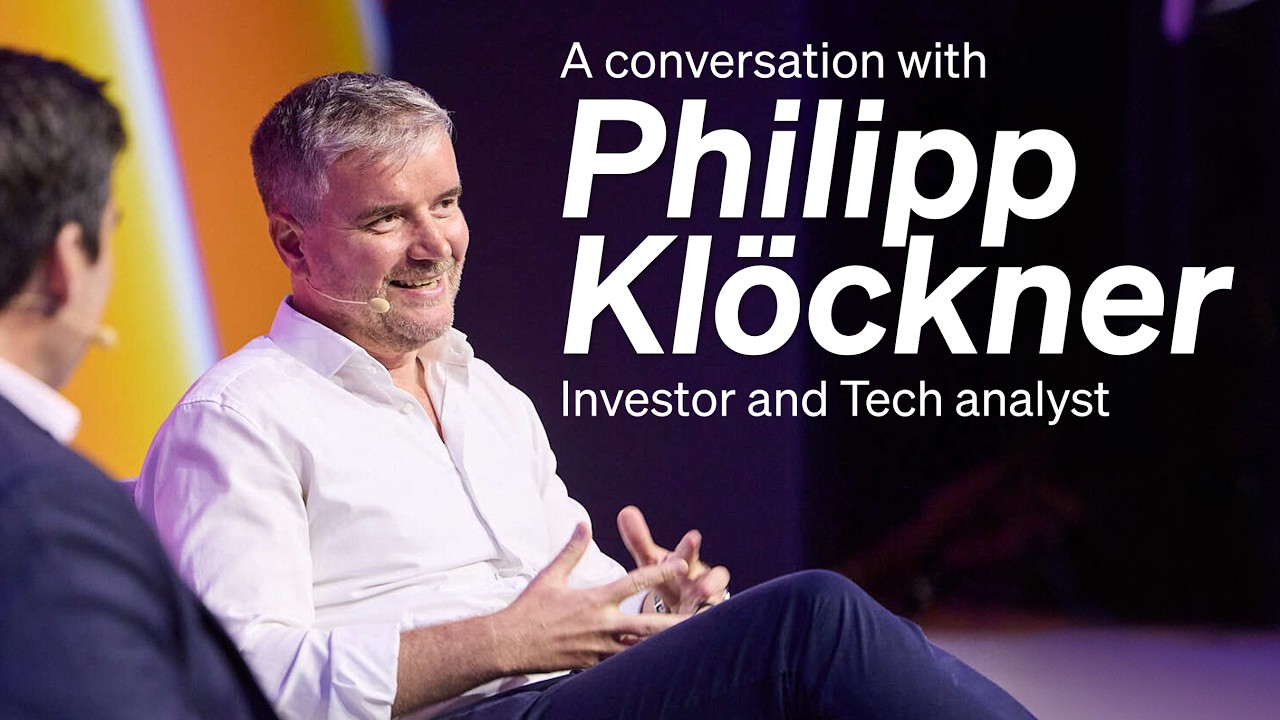
Tech analyst Philipp Klöckner in conversation with Conor McNamara
Description
Investor and tech analyst Philipp Klöckner joins Stripe EMEA CRO Conor McNamara for a fireside chat at Tour Berlin.
Summary
Generated by claude-sonnet-4-5At-a-Glance
- Verdict: Watch fully
- Core thesis: AI will transform work and economies slowly over 10+ years through inertia rather than rapid disruption, with Germany needing to build new AI-native startups in biotech/life science rather than trying to optimize existing industries, while agentic commerce remains overhyped for consumer use but promising for B2B procurement.
- Why it matters: Klöckner offers contrarian takes on AI adoption timelines (slower than hype suggests), SaaSpocalypse (buying opportunity not apocalypse), agentic commerce (B2B beats consumer), and Germany's future (biotech not manufacturing), backed by specific data points like Anthropic's 500%+ revenue expansion and observed Stripe data on AI tool adoption patterns.
- Best use: Extract his specific frameworks on AI adoption inertia, the junior-job supply-side shift in software engineering, why consumer agentic shopping won't happen (window shopping preference), and his energy/natural-resources thesis for why China/Russia will dominate robotics while Germany should bet on biotech/life science.
Executive Summary
Tech analyst Philipp Klöckner argues AI is driving a paradigm shift not through singularity but through unprecedented metrics like Anthropic's 500%+ revenue expansion (customers spending 5x year-over-year, unheard of in SaaS). He sees a long, slow transformation rather than rapid disruption—analogous to digitalization taking 20+ years—with AI adoption creating a K-shaped economy of 'AI natives' (university grads using AI for exams) versus incumbents resisting change. The so-called 'SaaSpocalypse' is overblown: software companies like Monday.com or ServiceNow remain cheaper per-seat than maintaining custom AI-built alternatives, and agents will still need APIs/software infrastructure. He views recent sell-offs (75% drops) as buying opportunities for systems-of-record SaaS, while acknowledging AI-native startups will skip entire software categories by building with 12-person teams instead of 1,200.
Klöckner is bearish on consumer agentic commerce (Alexa already failed; people want window shopping not voice ordering) but bullish on B2B agentic procurement, especially for technical spend and compliance-heavy processes. He sees job displacement happening much slower than feared due to corporate inertia and demographic gaps (Germany needs 500,000+ workers annually). Notably, he argues the narrative of companies not hiring junior developers is backwards: young people are choosing not to become software engineers (CS enrollments down from 660k to 600k in US), a supply-side shift not demand-side rejection.
On Germany's future, Klöckner is blunt: the country won't win robotics, manufacturing, or even AI foundation models (China/Russia have energy and natural resources advantages). Germany's best bet is biotech/life science/pharmaceuticals, leveraging excellent universities and historical pharmacy leadership (Bayer, BASF era) while using open-source AI models. Germany needs to build '10 more Biontechs' (immigrant-founded unicorns), mobilize pension capital into startups, ease talent immigration (months-long visa processes kill hiring), and create a true EU digital single market. The country's core problem isn't capital (investors flock to good ideas like Stripe/Revolut) but a business-administration culture trained to optimize by 5-10% rather than an engineering culture trained to rebuild from scratch. He's optimistic only if Germany builds a parallel AI-native startup economy rather than trying to transform incumbents.
Key Takeaways
- Claim: Anthropic has achieved 500%+ revenue expansion, meaning the average customer now spends 5x more than a year ago | Evidence: Klöckner predicted on his podcast that Anthropic would be the first company with 200%+ revenue expansion; actual figure turned out to be north of 500%. This is 'completely unheard of' in software—every vendor would 'kill' for such expansion. | Caveat: This applies specifically to Anthropic's customer base (likely developers/startups using Claude API heavily), not necessarily all AI companies. Revenue expansion != new customer acquisition growth. | Implication: For operators: AI tools are seeing usage intensity explode, not just user counts. For investors: revenue expansion rate (not just ARR growth) is the key metric for AI companies. For Ken's agents: API consumption models will see exponential spend per customer as use cases multiply. | Timestamp: 00:45
- Claim: The 'SaaSpocalypse' is overblown because maintaining custom AI-built software costs more than a single SaaS license | Evidence: To compete with Monday.com economically, you don't need to be cheaper than building Monday.com from scratch—you need to be cheaper than one license. AI-built custom software still requires ongoing maintenance, security, compliance adaptation, and feature development. Example: SAP's value isn't the 'ugly front end' but knowing tax regimes of 210 countries. | Caveat: AI-native startups building with 12-person teams will never need certain software categories (like SAP Success Factors for 1,200-person HR orgs). So incumbents lose future market expansion even if current customers stay. | Implication: For operators: systems-of-record SaaS (SAP, Salesforce, ServiceNow) are buying opportunities after 50-75% sell-offs. For founders: don't build 'AI replaces X' unless you can beat per-seat economics including maintenance. For Ken's content: the real shift is AI-native companies skipping whole software categories, not replacing them. | Timestamp: 08:30
- Claim: Junior software engineering jobs aren't disappearing because companies won't hire—young people are choosing not to pursue those careers | Evidence: CS university enrollments dropped from 660,000 to 600,000 in the US over two years. Klöckner argues the Brynjolfsson/Stanford data showing junior job losses has selection bias (only small/medium companies, early AI adopters). Reality: new grads using AI extensively see no future in software engineering or customer service. | Caveat: Klöckner says this is based on limited studies and early data. The long-term outcome (whether this is rational or irrational career avoidance) remains uncertain. | Implication: For hiring/GTM: talent supply shortage in software engineering may become acute, driving wages up even as productivity per-dev increases. For investors: companies solving the 'AI-augmented junior dev' problem (not replacing juniors, but making fewer of them 10x productive) have massive TAM. For Ken's agents: the 'junior dev' role will be redefined, not eliminated—someone still needs to QA and integrate AI outputs. | Timestamp: 12:15
- Claim: Consumer agentic commerce is overhyped because people fundamentally want window shopping, not voice ordering | Evidence: Alexa already enabled ordering consumer staples but failed to gain traction. To make a purchase decision, humans need to see options they don't want—the luxury they can't afford, the cheap stuff they reject—to choose what they love. Chat interfaces now rebuild comparison websites inside ChatGPT because that's how people shop. | Caveat: Klöckner acknowledges payment infrastructure improvements make it technically easier now than with Alexa, but argues human preference hasn't changed. | Implication: For operators: B2B agentic procurement (technical spend, compliance-heavy processes) is the real opportunity, not consumer shopping. For product builders: don't remove comparison/browsing from purchase flows. For Ken's content: agentic commerce thesis needs to separate B2B (procurement automation) from B2C (likely limited to pesky tasks like Deutsche Bahn claims, appointment booking). | Timestamp: 20:00
- Claim: AI adoption will mirror digitalization: 1-1.5% annual shift sustained over decades as old users die and young users enter | Evidence: Mobile vs desktop usage still shifts only 1% per year, not because individuals change behavior but because non-smartphone users die and smartphone-native youth enter the market. Digitalization took 20+ years and is still ongoing. WhatsApp is the rare exception that penetrated all age groups quickly. | Caveat: Some technologies (WhatsApp) do achieve rapid cross-generational adoption if they solve universal needs simply. AI might have pockets of rapid adoption (like software development already). | Implication: For forecasting: expect 10-15 year timelines for AI to transform industries, not 2-3 years despite hype. For incumbents: you have more time than you think, but the window is shrinking. For Ken's agents: plan for long-tail human-in-loop workflows for at least a decade, not full autonomy by 2027. | Timestamp: 19:00
- Claim: Germany's only path forward is biotech/life science/pharmaceuticals built on open-source AI models, not robotics or manufacturing | Evidence: In a world where AI and robotics dominate, the ultimate resources are energy and natural resources (iron, copper, coal). Germany has neither cheap energy nor abundant natural resources. China produces 80% of robot components and builds robots for under €10k. But Germany has excellent universities, trains leading AI/life science researchers, and was the 'pharmacy of the world' (Bayer, BASF) in late 1800s/early 1900s. Biontech (immigrant-founded) hit €100B valuation briefly. | Caveat: Google DeepMind has its own life science division competing for the same AI-pharma opportunity, so Germany faces well-capitalized US tech competition even in this domain. | Implication: For policy/founders: Germany needs to build '10 more Biontechs' with immigrant founders, mobilize pension capital into startups, and rely on open-source foundation models since it lacks a sovereign LLM player. For Ken's investing: German/EU biotech startups leveraging AI for drug discovery are the contrarian play. For Ken's content: energy/natural resources become the ultimate competitive moats in an AI/robotics economy. | Timestamp: 29:30
Detailed Brief
AI adoption dynamics and the K-shaped economy
- Claims: AI adoption creates 'AI natives' (current university grads using AI for exams) vs incumbents resisting change; Most people haven't digested implications of 3-4x software development productivity gains; AI will never be 'taken away' once adopted—Klöckner would pay €2,000/month to keep using it; Stripe data shows users hop between AI tools but never revert to non-AI tools; Workforce displacement will be much slower than expected due to corporate inertia (20+ year digitalization still ongoing)
- Evidence: Anthropic's 500%+ revenue expansion vs typical SaaS struggling for 10-20% expansion; CS enrollments down from 660k to 600k in US (young people opting out of software careers); Germany's demographic gap requires 500,000 new workers annually, which AI automation can fill at ~1%/year; Brynjolfsson Stanford study cited but dismissed as selection bias (only SMBs, early adopters)
- Caveats: Early adopter data may not reflect mainstream behavior; Job displacement data is incomplete and may miss supply-side dynamics; AI-native startups are still small fraction of total economy
- Implications: Plan for 10-15 year transformation timelines, not 2-3 years; Revenue expansion rate (not ARR) is key AI SaaS metric; Talent supply shortage in software engineering may drive wages up even as per-developer productivity increases
SaaSpocalypse reality check and AI-native company formation
- Claims: 50-75% sell-offs of Monday.com, ServiceNow are overreactions and buying opportunities; Systems-of-record SaaS (SAP, Oracle, Salesforce) are entrenched due to data lock-in and compliance complexity; AI-built custom software still requires maintenance, security, compliance adaptation—not cheaper than per-seat licenses; Switching from SAP to custom ERP is a '2-4 year project' where 'one C-level loses their job'; AI-native startups will never buy certain software because they're built with 12-person teams, not 1,200-person orgs
- Evidence: SAP's value is knowing tax regimes of 210 countries, not the 'ugly front end'; One friend automated a Monday report that only exists for her—AI-native companies won't build that process at all; Agents will still use software/APIs (Jensen Huang's billions-of-agents thesis increases software usage); All AI is software; all software will include AI—the separation is temporary
- Caveats: Future startups won't grow into SAP's addressable market, so TAM shrinks over time; AI-native companies skip entire software categories by design, not by replacement; Less startups purchasing SAP means long-term headwinds even if current customers stay
- Implications: Buy dips in systems-of-record SaaS with strong data moats; Don't build 'AI replaces SaaS X' unless economics beat per-seat pricing including maintenance; Focus on software that stores/manages data vs workflow/UI layers
Agentic commerce: B2B yes, consumer no
- Claims: Consumer agentic shopping is overhyped because Alexa already failed at ordering staples; Humans want window shopping to see options they don't want before deciding what they want; Chat interfaces rebuild comparison websites inside ChatGPT because that's how people shop; B2B procurement (technical spend, compliance-heavy) is ideal for agentic automation; Consumer claims/appointments (train delay refunds, dentist booking) are good agent use cases
- Evidence: Alexa couldn't gain traction for ordering despite existing infrastructure; High street shops have windows, not blank walls—people shop visually; Klöckner's example: if he speaks at SAP/Bosch, procurement takes 4 hours for 30 minutes on stage; Jensen Huang thesis: billions of agents will increase software/API usage
- Caveats: Payment infrastructure has improved since Alexa (acknowledged by Klöckner); Some pesky consumer tasks (claims, appointments) may work; Large purchases (travel, consumer durables) unlikely to be agent-mediated
- Implications: Build B2B agent procurement tools, not B2C shopping agents; Consumer agents should focus on high-friction low-stakes tasks (appointments, claims); Agent-to-agent transactions more viable in B2B than B2C
Germany's structural challenges and path forward
- Claims: Germany trained business administrators to optimize by 5-10%, not engineers to rebuild systems; Incentive to start companies is low when fresh grads earn €80-90k at Porsche/Mercedes/Google; Germany lacks cheap energy and natural resources (China/Russia have both); EU still has 20+ tax regimes, languages, company formation systems despite 'digital single market'; Talent immigration takes months/years vs US where founders hire within weeks; Germany isn't building many exciting companies (Revolut/Stripe are exceptions)
- Evidence: 10 richest Americans are all engineers by training; Bernard Arnault (LVMH, richest European) is also engineer; German companies (Siemens, car manufacturers) were historically built by engineers; Stripe Atlas sees large percentage of founders from outside US, big chunk from Europe, because US single market is hours not weeks; Draghi report articulates problems but not solutions
- Caveats: Claiming 'not enough capital' is partly an excuse—international investors fund good European ideas (Stripe example); Some progress on pension system reform to mobilize domestic capital
- Implications: Germany must build parallel AI-native startup economy, not transform incumbents; EU needs true digital single market (one tax regime, easy company formation across borders); Immigration reform critical: if company vouches, hire within 4 weeks; Invest as much in new company formation as in preserving incumbent industries
Biotech/life science as Germany's best strategic bet
- Claims: In AI/robotics economy, ultimate resources are energy and natural resources—Germany has neither; China produces 80% of robot components, builds robots for <€10k—Germany can't compete in robotics/manufacturing; Biotech/life science doesn't require cheap energy or abundant natural resources; Germany has excellent universities training leading AI and life science researchers; Germany was 'pharmacy of the world' in late 1800s/early 1900s (Bayer, BASF, IG Farben predecessors); Biontech (immigrant-founded) hit €100B valuation briefly—need '10 more Biontechs'
- Evidence: Lots of leading AI researchers trained in Germany (though they leave); AI researchers writing papers in US have 'all European names'—talent pipeline exists; Chemical production too energy intensive, but pharma/biotech isn't; AI accelerates pharmaceutical R&D and drug discovery
- Caveats: Google DeepMind has own life science division competing for AI-pharma; Germany lacks sovereign LLM player, must rely on open-source models; Most open-source models currently from China
- Implications: Germany should concentrate effort on biotech/life science startups leveraging AI; Open-source LLM ecosystem critical for German competitiveness; Immigration policy even more important (Biontech was immigrant-founded); Energy/natural resources become ultimate moats in AI/robotics world—Germany must compete in industries that don't require them
Notable Concepts & Terms
- Revenue expansion rate: How much more the average customer spends year-over-year. Anthropic's 500%+ (customers spending 5x more) is 'completely unheard of' and the key metric for AI SaaS success, more important than ARR growth alone.
- AI natives: People leaving university now who have done exams with AI and are fluent in AI tools from day one, analogous to digital natives or internet natives. They fundamentally build/work differently.
- SaaSpocalypse: The narrative that AI will kill traditional SaaS by enabling custom write-coded alternatives. Klöckner argues this is overblown and creates buying opportunities, especially for systems-of-record SaaS.
- K-shaped economy / AI have-nots: Divergence between those who embrace AI (startups, young people) and those who resist (incumbents, older workers, German Mittelstand). Will persist for years as with digitalization.
- Window shopping preference: Why consumer agentic commerce fails: humans need to see options they don't want (luxury they can't afford, cheap stuff they reject) to decide what they want. Voice/text ordering removes this critical comparison.
- Beharrungskräfte (inertia): German term for the persistence/inertia of large enterprises and public institutions. Why AI adoption will take 10-15+ years despite hype, as with 20-year digitalization process still ongoing.
- Systems-of-record SaaS: Software that stores/manages core business data (SAP, Oracle, Salesforce) vs workflow/UI layers. Much harder to displace due to data lock-in, compliance complexity, tax regime knowledge across 210 countries.
- Engineer vs business administrator mindset: Engineers trained to rebuild systems from scratch; business administrators (BWL in Germany) trained to optimize existing processes by 5-10%. Germany needs more of the former to compete in AI era.
- Energy and natural resources as ultimate competitive moats: In a world where AI/robotics automate most work, the only scarce inputs are energy (to run compute/robots) and materials (iron, copper, coal). China and Russia dominate both, problem for Germany.
- Open-source LLM dependency: Germany lacks sovereign foundation model players, so must rely on open-source models (currently mostly from China) to avoid US tech dependency. Critical for creating value by applying models to German industries.
Operator Notes / Why Ken Should Care
- For AI product builders: Revenue expansion rate (how much more each customer spends YoY) is more predictive than new customer acquisition for AI SaaS. Anthropic's 500%+ is the new benchmark to understand product-market fit.
- For workforce planning: Junior software engineer supply is shrinking by choice (CS enrollments down 10% in 2 years), not because companies won't hire. Plan for talent scarcity and higher wages even as per-dev productivity rises 3-4x.
- For B2B SaaS operators: Don't panic-sell on 'SaaSpocalypse' fears. Systems-of-record with data moats (SAP, Salesforce, ServiceNow) face less threat than workflow tools. Custom AI solutions still cost more than per-seat licenses when maintenance/security/compliance are factored in.
- For agentic commerce builders: Focus B2B procurement (technical spend, compliance-heavy processes) not B2C shopping. Consumer agents should target high-friction low-stakes tasks (appointments, claims) not large purchases. Humans want visual comparison shopping, not voice ordering.
- For AI-native startup formation: Build with 12-person teams doing what previously required 1,200 people. Skip entire software categories by design—don't buy Monday.com, don't build processes that only exist for human reporting. This is the actual disruption, not 'AI replaces SaaS X.'
- For EU/Germany strategy: Biotech/life science is the contrarian bet (doesn't require cheap energy or natural resources). Germany won't win robotics/manufacturing (China) or foundation models (US), but has excellent university talent pipeline and historical pharma leadership. Open-source LLM ecosystem is critical dependency.
- For forecasting/planning: Use 10-15 year timelines for AI transformation, not 2-3 years. Adoption follows digitalization curve: 1-1.5% annual shift as old users die and young users enter. Corporate inertia (Beharrungskräfte) is underestimated by hype cycles.
- For content/GTM: The narrative that 'AI takes junior jobs' is backwards—supply-side shift where young people choose not to enter those fields, not demand-side rejection by employers. This nuance matters for hiring messaging and workforce development.
- For payments/fintech operators: Agentic B2B procurement requires payment infrastructure that handles agent-to-agent transactions and compliance automation (KYC, etc.). Tectile (AI for KYC, raised €130-160M from Tiger) is the German example to watch.
- For investing: Look for (1) AI-native biotech/life science startups in Germany/EU, (2) companies solving 'AI-augmented junior dev' problem (not replacing but 10xing fewer juniors), (3) oversold systems-of-record SaaS with data moats (50-75% drawdowns are buying opportunities), (4) B2B agent procurement tools not consumer shopping agents.
Watch Map
- 00:00: Opening: Anthropic revenue expansion >500%, paradigm shift metrics, 2026 as inflection year
- 02:30: Software development transformation: 3-4x productivity gains, AI natives vs skeptics, dichotomy will persist for years
- 06:00: AI as democratizing force vs creating divergence: free access (Gemini, Meta) but value accrues to few; consumer benefit evenly distributed (therapy, coaching)
- 08:30: SaaSpocalypse debate: overblown, buying opportunity for systems-of-record SaaS, maintenance costs make custom builds uneconomical
- 12:15: Junior jobs supply-side shift: CS enrollments down 60k, young people opting out of software careers, not company rejection
- 15:00: Workforce displacement timeline: much slower than expected due to corporate inertia, Germany's 500k annual worker gap, 1% automation meets demographic need
- 19:00: AI adoption mirrors digitalization: 1-1.5% annual shift over decades as old users die and young enter, not rapid 2-3 year transformation
- 20:00: Agentic commerce: consumer overhyped (Alexa failed, window shopping preference), B2B procurement promising, pesky tasks (claims, appointments) good use cases
- 24:00: Germany's structural problems: business admin culture (optimize 5-10%) not engineering (rebuild systems), low startup incentive (€80-90k salaries), talent immigration takes months/years
- 29:30: Germany's strategic bet on biotech/life science: energy/natural resources are ultimate moats in AI/robotics world, Germany has neither, China produces 80% of robot components for <€10k
- 33:00: Biotech rationale: excellent universities, historical pharmacy leadership (Bayer/BASF era), Biontech example (immigrant-founded €100B company), need '10 more Biontechs'
- 36:00: Germany startup example: Tectile (AI for KYC, €130-160M from Tiger, likely unicorn/future decacorn in regulated financial industry)
- 38:00: 2030 vision for Germany: strong open-source LLM ecosystem, privatized pension capital, parallel AI-native startup economy, manpower exists (EU names in US AI papers), must start building
Source/Metadata
- Title: Tech analyst Philipp Klöckner in conversation with Conor McNamara
- Transcript words: 9034
- Duration seconds: 2505
- Timestamp note: Timestamps provided in transcript and used for watch_map
Transcript
Philip, welcome. My pleasure, thank you. Awesome to have you here. What do you think of that video? I would agree that it depends on how you define singularity. So is AI taking off, becoming totally independent? I don't think we're there yet, but what I do see are the hints or the bellwethers of a huge paradigm shift. If you look at new business formation, if you look especially at how AI accelerates itself, how software builds the next version of the AI and that version builds the next version and the production velocity that companies like OpenAI or Anthropic have. If you look at the revenue expansion that is unheard of of Anthropic. In our podcast I said Anthropic will be the first company who will have a revenue expansion rate from north of 200% and it turned out it's north of 500%. That means the average Anthropic customer spends five times more compared to last year with them, which is completely unheard of. Every software vendor would kill for such a revenue expansion and that's what I mean with paradigm shifts. Stuff that was true before needs completely new benchmarks and metrics. So I do see this moment in time that 2026 is a year that changes a lot of things for sure. For sure. 500% well. So on, maybe just, we could go many ways with this conversation so we'll stick to maybe software development to start with. We see it at Stripe a lot. What's your perspective on software development and the changes that have happened as a result of AI? And do you think that the world as a whole has digested the implications of the pace at which software is getting built today versus 24 months ago? [SPEAKER_00] I think most people don't. I think there are a few people, mostly working in startups or founding startups building new businesses, who are well aware of the possibilities and make maximum use of it. And then there are also people who maybe work in incumbent companies in the German Mittelstand who still try to find excuses why not to, why their piece of software couldn't be built by AI or their job couldn't be done partly by AI. And I think that will continue to exist, this dichotomy, or this you could say a world of AI have and have-nots. We're gonna stick with that for at least a few more years. So we saw the same with the digitalization and the internet. For some people, usually the younger generation, it became completely normal. They were digital natives, they were internet natives. You will have AI natives. People leaving university right now are AI native. They have done their exams with AI and then there are people who still try to find excuses not to use AI, which is stupid. [SPEAKER_01] Yeah. I think, especially with software development, probably, and that makes Anthropic such a good company, that they focused on the kind of perfect entry market from a go-to-market perspective, and software development is for sure the stuff where you will have autonomous agents building pieces of fabulous stuff. Doesn't mean it's perfect yet of course. You still need a human in the loop. You still need to check stuff, redo it, etc. But you can't deny you are three or four times more effective or efficient building software. If so, you're just doing it wrong. And I mean, just if you look at how people, you personally use AI, all the people, there are a few skeptics now that say that AI is a bubble that will burst and almost act like it's going to go away again. We have the same with the internet and digitalization of course. Don't fight gravity. Exactly. It's not going to go away. People have started using AI. I mean, a good test for what a good product is, is would you take it away from me? Would I regret it? And if you would take AI away from me again, I would be mad. I would be crazily mad. And I would be begging to pay you 2,000 euros per month to let me continue to use it. And we see that actually in our data at Stripe. So we see quite a lot of users moving from one AI tool to another. But we don't see people who start on one AI tool never go back to non-AI tools. So there's a lot of tool hopping happening but not necessarily like I'm going back to the way I used to do it two years ago. That's just not happening at all. [SPEAKER_01] Which I think reinforces your point. That's what I envy you for. That data I would obviously give my firstborn to get that kind of data. I'm very happy for the ramp data which gives us some indication about B2B usage. But obviously I would love to see who's cancelling the contract. Maybe go for a point later on and I'll tell you some more. Awesome. Just to go back to your point around, you know, this. We often talk about technology being a democratizing force in the world. I mean, I worked in cloud for ten years before joining Stripe and that was a big story. But actually, when you look at a lot of the data, in some cases, technology cannot necessarily be an economic equalizer in some ways. At least in the short term, we can create a divergence in the economy between the haves and have-nots. What's your view? Where are you on the whole stance of AI? Is it going to create further divergence in the world in terms of economic prosperity? Or do you see the future is where it's going to lift all boats? [SPEAKER_01] Excellent questions. I would say both. So I would always argue it's probably a very low barrier technology. So almost everyone potentially has access to free AI if you use Google Gemini or something or Meta, you can basically access it for free. And access to information and to knowledge was never so readily available for people at almost zero cost. So that should be a huge equalizer and at least offer chance for everyone. And then still, I think that there might be monopolies in some of the AI markets again and lots of the value will accrue at very few people potentially, unless we find ways to distribute the value more evenly. But what you can say for sure is that even if the economic value might accrue, basically the money that is earned, accrues at very few people, the kind of consumer benefit that you have is very evenly distributed. Because everyone can use it, most people will be able to use it for free, and everyone who wants to can reap enormous benefits personally from it. You basically have everyone has access to an executive coach now, to a therapist, stuff that's really hard to get, at least here in Germany, is in your pocket. Now at a decent quality by now and it's getting only better over time. And even if a few more trillion dollar companies will be minted by this, everyone of us is able to benefit from it a lot. So these things can be true at the same time, I think. Agree, agree. No, it doesn't make sense. Yes. Therapists, fitness coaches, financial coaches, who knows. [SPEAKER_01] Awesome. I want to talk to you a bit about, like, again, I think Patrick has said this before. Everyone who wants to can reap enormous benefits personally from it. You have everyone has access to executive coach now to a therapist stuff that's really hard to get at least here in Germany is in your pocket. Now at a decent quality by now and it's getting only better over time and even if a few another trillion dollar company will be minted by this everyone of us is able to [SPEAKER_01] benefit from it a lot. So these things can be true at the same time I think. Agree, agree, no it doesn't make sense. Yes, therapists, fitness coaches, financial coaches, who knows. Awesome I want to talk to you a bit about again I think Patrick has said this before he's said we the SaaSpocalypse it's a discussion where AI is software at the world now almost AI is eating software in some ways and so you see this and then Patrick has used this analogy of a pizza recently so he's saying software should work almost like a pizza you know make it once use it once and move on to the next thing. Where are you in this whole SaaSpocalypse thing? Is it overdone? Is it reality? Where are you on that? So for some pieces of software it will be reality but on average generally I think it's an exaggeration. The sell-off of software companies. I don't think certain companies are worth half or only 25% of what they have been worth before. Stuff like Monday.com or ServiceNow. I think it's always overdoing some emotional reaction if you sell off a company by 75% in a few weeks or a few months. And I think people are not aware how software purchasing in corporates actually works. Because of course I could write code my own ServiceNow or ServiceNow is a bit harder. Let's take Monday.com or Asana. You could write code that even a bit tailored to what your own needs which would be good. [SPEAKER_01] However you still need someone maintaining it. You need someone to care for the security and safety of the product. [SPEAKER_01] You need to continue to develop it. So it will still take some cost. And of course that will be with AI and write coding it will be much cheaper than it has been to build the first Monday.com. [SPEAKER_01] But you don't need to be cheaper than Monday.com. You need to be cheaper than one license of Monday.com to make it economically feasible. [SPEAKER_01] If not it doesn't make sense to build your own piece of software. So as long as one license of ServiceNow or Monday.com is cheaper than write coding it. Which it will be for a long time. Because again you have the maintenance that you need to maintain the software and continue to improve it. [SPEAKER_01] You have to adopt to tax regulation, to compliance, etc. So I don't think most companies will stick with their existing software products. [SPEAKER_01] Then there's the thing that agents, why wouldn't agents use software as well, right? [SPEAKER_01] An agent that tries to shop something needs to connect to APIs, use other services, etc. [SPEAKER_01] So Jensen Wang, that's Jensen Wang theory that as we have billions of agents they will actually increase the use of software. And that brings me to the last point which is ultimately this separation between SaaS software and AI that doesn't make sense, might make sense in the short run. But ultimately all AI is software obviously. And all software will include some kind of AI. [SPEAKER_00] So I think the so called SaaSpocalypse, I find the word in here. [SPEAKER_00] I just kind of moment through it, hopefully no more. [SPEAKER_00] So I think that's a rather buying opportunity for the good pieces of SaaS. [SPEAKER_00] For example those that basically store the data for the clients. [SPEAKER_00] The SAPs, the oracles, the sales forces, the systems of records. [SPEAKER_00] It will be really hard to get those other companies. [SPEAKER_00] If in Germany if you want to change your SAP system, you know that better than me probably. That's a two to four year project and usually one C-level person loses their job doing that. Only one? [SPEAKER_01] I want to see the companies switching from SAP to a write-coded ERP now. [SPEAKER_01] And obviously the value of SAP isn't the ugly front end but it's knowing the tax regimes of 210 countries in the world. [SPEAKER_01] You might argue that as well has become a bit easier with AI to maintain that. [SPEAKER_01] But I think especially the more complex parts of software have a good market. [SPEAKER_01] However, and that's a big difference and there we are with the half and half-nots in the K-shaped economy. [SPEAKER_01] I think there will be less startups ever purchasing in SAP or growing into that stage where they would typically use an SAP. [SPEAKER_01] And they might never need one because they will never have such a large HR. [SPEAKER_01] So SAP success factors they probably not use because their organization will be 12 people and not 1200 people. [SPEAKER_01] So these companies that are built AI first from scratch, they will need all the processes that are only built for humans to exist in these processes. [SPEAKER_01] And then you might never need an ERP. [SPEAKER_01] A friend of mine reported to me about her first AI use case and I said what did you build? [SPEAKER_01] And she automated a report that she would get every Monday to check on ad bidding or something. [SPEAKER_01] But the thing is that report only exists for her. [SPEAKER_01] So in an AI native company, no one would ever build that report or process. [SPEAKER_01] And that's what's going to be the huge advantage of companies that are being built right now. [SPEAKER_01] That they will use the technology to build companies in an entirely different way with less overhead, [SPEAKER_01] less people just doing measuring, counting, more automatization from the very beginning. [SPEAKER_01] You don't need to constantly think of the human in the loop. [SPEAKER_01] You can just build an ecosystem that works in itself. And for those companies, they might never buy certain software products. But they still need a Twilio or a Cloudflare to host the stuff. So even those will continue. Maybe just, I mean, completely gone off topic here, but that's always a sign of a good fireside, right? We go all over the place. But maybe just workforce displacement in general, right? So just on the topic of that, it sounds like you see the average size of a business, headcount wise, getting smaller over time as a result of AI. Again, we certainly see that in our data. What do you think when you look at the future of the workforce and just again, bear cases and bold cases around what AI will do for the future of work. What's your view on it? And what are going to be the emerging areas of growth for people that will require more human workforce, etc? Yeah, a few things. So first, it will workforce displacement will be much slower than expected. Because there are these young companies that would never hire certain people. However, we always underestimate the inertia, the beharrungskräfte, German word, of the large enterprises, basically, and the public enterprises. So, and again, the analog is again digitalization where you had 20 years and it's still ongoing until people were fully transformed or something. And the same will be true for AI. So, the big companies will be relatively slow in adopting AI. So the job displacement can't happen that fast unless the startups would actually take away huge parts of the markets from them. Yeah, a few things. [SPEAKER_00] So first, workforce displacement will be much slower than expected because there are these young companies that would never hire certain people. However, we always underestimate the inertia, the beharrungskräfte, German word, of the large enterprises and the public enterprises. So again, the analog is digitalization where you had 20 years and it's still ongoing until people were fully transformed. And the same will be true for AI. So the big companies will be relatively slow in adopting AI. So job displacement can't happen that fast unless the startups would actually take away huge parts of the markets from them, which then won't happen as well. The other thing is this AI and automation robotics era couldn't hit us at a nicer time because we have this strategic gap in the German job market of 500,000 people, which means we're lacking 500,000 workers more every year because of the demography of Germany. So we need 500,000 new either immigrants. If you try reproduction, that takes a few years to build workforce. So either we need to automate stuff or we need to let in a lot more immigrants. So in that regard, if AI automates 1% of jobs per year, that's perfectly fine because that's exactly the people we need to replace anyway. So I'm quite optimistic that we, at least in the beginning, won't have riots or huge displacements. And apart from a very few key industries, like I wouldn't tell my daughter to become a fashion model anymore. Probably she doesn't have the genes for it. And on the other hand, if you look at jobs for catalog models at Otto or whatever, that is down 63% already in a few years. Customer service may be the same, photographs may be the same. But especially stuff like developers, lawyers. Lawyers, Goldman Sachs said 44% of work could be automated in the short term, which makes them the second most exposed branch for AI. However, lawyer hirings are at an absolute high. And you won't find a lot of scientific data that supports job displacement right now. And the studies that you can see from Brynjolfsson from Stanford only show that this is early. You can listen to it in the podcast tomorrow, they will explain in more detail. But that was a plug for the podcast. Very subtle, very well done. No, but in short, there is this narrative that early, the job entry jobs, the junior jobs, the early career steps, those are falling away faster or they are falling away when the others, the seniors are still hired. And I think this misses several points. There's a data selection bias because it's only small and medium sized companies where the data is. And I think this is the first pull from mostly companies that embrace AI very early. And I think what actually happens is not that companies don't choose to hire young people anymore, but that young people are not choosing these jobs anymore. You can see the computer science enrollments in the US is already going down from 660,000 to 600,000 in the last two years. So I think the actual problem is not companies not wanting to hire junior people, but people coming from university using a lot of AI and deciding I will never become a software engineer or a customer service agent because that doesn't have a future. So that's what's actually happening. Interesting. Yeah. Okay. So it's on the supply side rather than the demand side. Okay. Switching gears, agentic commerce. What's your view? Agents becoming actors, trusted ecosystem on the web where people, nonhumans are purchasing on our behalf. Where are we on that curve? How bullish or bearish are you in terms of the future outlook for us? And what use cases, if any, will be the ones that will emerge first or earlier? Yeah. I think we're in the very early days and this will also move much slower than you would think. I'm the worst keynote speaker of the world because usually people try to make these paradigm shifts and tectonic shifts look like they would happen within two or three years. But if you look at data, the truth is every big shift, the mobile shift is still going on. One percent of people shift from desktop to mobile every year. And that's not because they shift their behavior, but because old people who would never use a smartphone for certain things die. And young people who use a smartphone for everything get into the market. And that's why it shifts by one percent or one and a half percent every year. Right. And this is how usage shifts happen. It's usually. And that's why I think it all will be much slower. So I'm. Change does happen, but you will find very few technologies that penetrate a whole market in a fast manner. Like WhatsApp is a good example. Our grandparents are using it. Our kids are using it. So that has really quickly penetrated lots of people. But people are not good at adoption. Distribution is much more important. Coming back to agentic commerce. I think if that would address a natural need of humans, then first Alexa would have been much more successful. Like the use cases you hear now sometimes like ordering your consumer staples, toilet paper, whatever. That was well possible with Alexa already. The new LLMs are not a game changer in terms of talking to Alexa. The payment infrastructure has become better. I admit that. But I don't. I think people just don't want to shop that way. If they want to shop that way, then our high street areas in our cities would have belts and not windows. [SPEAKER_01] People want window shopping. They don't want to talk to someone and say I want to order something. They want to window shop. They want to compare. To meet a decision what you want to buy, you need to see the options that you don't want. You want the luxury stuff that you can't afford. You want the cheap stuff that you say I'm better than that. And then you decide for the option that you love. That's why these chat interfaces right now rebuild exactly that. They basically live craft you a comparison website in ChatGPT to rebuild a price comparison, a comparison shopping website, because that's how people want to shop. [SPEAKER_01] People want window shopping. [SPEAKER_01] They don't want to talk to someone and say, I want to order something. [SPEAKER_01] They want to window shop. [SPEAKER_01] They want to compare. [SPEAKER_01] To make a decision what you want to buy, you need to see the options that you don't want. [SPEAKER_01] You want the luxury stuff that you can't afford. [SPEAKER_01] You want the cheap stuff that you say, I'm better than that. And then you decide for the option that you love. That's why these chat interfaces right now rebuild exactly that. They live craft you a comparison website in ChatGPT to rebuild a price comparison, a comparison shopping website, because that's how people want to shop. And if that has been done, people at some point might continue to then use an automatic way to not go through the shopping basket anymore, but then have an agent do the rest. [SPEAKER_00] That I believe in. [SPEAKER_00] I think the really pesky stuff like consumer claims. [SPEAKER_00] Imagine your train is delayed. [SPEAKER_00] You have a claim against the Deutsche Bahn. [SPEAKER_00] I don't want to do that myself. [SPEAKER_00] I want an agent who just automatically checks every plane and train travel that I have and gets my claims automatically. [SPEAKER_00] I'm happy to share 10% of the results just to get rid of it. But today I can handle it myself. I don't even need to share with flight ride or something. So I think consumer rights might be something where it will enter rather early. And the whole services and appointment stuff like having the table on the window with your favorite Italian restaurant, booking a treatment with a massage parlor, hairdresser, stuff like that. A dentist, doctors. That makes a lot of sense to do that in a generic way. And sometimes it involves commerce. [SPEAKER_00] So if it's treatments, there is a payment included. [SPEAKER_00] If it's doctors, maybe not. [SPEAKER_00] But we shouldn't have people sitting in the doctor's offices that are just there to answer the phone. [SPEAKER_00] So that is the stuff that I see first. [SPEAKER_00] Booking travel or doing larger purchases, I don't see that yet. [SPEAKER_00] And if so, even for a small fraction of the consumers. [SPEAKER_00] How do you think about B2B? [SPEAKER_00] So, obviously, we're very stablecoin-pilled at Stripe. [SPEAKER_00] We see stablecoins as this complementary rail to existing rails in terms of promoting economies that just weren't financially viable in traditional rails. [SPEAKER_00] And we believe that there's whole sorts of agent-to-agent transactions that will happen online in the future. [SPEAKER_00] Again, small percentage today. [SPEAKER_00] What's your view on that and the degree to which that will happen in the future? I see that as much more likely. Generally, businesses are faster in adopting new technologies. You can see that with AI. Consumer adoption is much lower compared to business adoption right now. So, technical spend, procurement, I think that makes a lot of sense. That's a cohort of processes that are made to deal with certain human limitations and compliance requirements. And that is much better done by agents. If I want to, I'm a keynote speaker. If I speak at a conference of Deutsche Bank or SAP or Robert Bosch, to be 30 minutes on stage, I have to go through a four-hour procurement process. [SPEAKER_01] That obviously doesn't make sense. Just so they can procure my solution. Yeah, but all the small stuff that a company buys, again, technical spend, but even larger stuff, I think that might well be agentic in the future. Maybe the margins will be a bit smaller there given high repeat rate and large volumes. But the total gross margin is much bigger. For sure. For sure. Okay, let's keep going. Let's talk about Germany, the German economy. I was debating, I know I'm on dangerous ground here, asking you if there's any similarities between the state of the German football team and the state of the German economy. But I wasn't sure if that's the right way to go or not. But let's go there and see. [SPEAKER_01] The only consolation I was told on mentioning the German football team was that at least the Dutch also lost. [SPEAKER_01] So that's at least something, and I speak, I'm an Irishman, so I know I'm not on higher ground here. [SPEAKER_01] We haven't been in the World Cup since 2002, I think. [SPEAKER_01] Anyway, what's your perspective on the German economy, where we are right now, the role AI can play? [SPEAKER_01] You already alluded to it a little bit when you talked about in terms of supporting what is a gap in terms of the workforce availability to support economic growth. [SPEAKER_01] But broad perspectives on where Germany is and the upside and downside case for Germany. Where to start? So there is, the example with the national team might hold up quite well. This morning my girlfriend asked me, haven't we been one of the best teams? When I was a child, we were someone. We would be playing the best teams and sometimes we would win and now we are not participating in the final rounds anymore. And the same is true for Germany. We've been leading in a few industries very early on, life science, engineering stuff, then car manufacturing and machines in general. But we haven't made the transition to the next technologies in certain industries or to new industries at all. And I think maybe it's because we are too well off. Most of us are still in a very comfortable manner. I think the incentive to build something new is really small in Germany because if you study at a good university, you did a good exam, you can get 80, 90,000 euros working for Porsche, for Mercedes-Benz, for Google. So why would you build something on your own? You can plan already when you want to build your own home after five years of working. So why take the risk? And we don't take enough risk, I think. The few people who really take enormous risks are oftentimes immigrants. You can see that much more in the US, where almost all of the pivotal companies were founded by immigrants. [SPEAKER_01] I mean, ultimately, everyone in the US is immigrant, or child of immigrant generations. [SPEAKER_01] But these are the people who changed the world. [SPEAKER_01] And we have another mindset problem in Germany, I think. [SPEAKER_01] We are trained, I studied business administration as well. [SPEAKER_01] So I'm one of these guys and I may say that. [SPEAKER_01] But if you study business administration, you are basically trained to improve some process by five to ten percent. [SPEAKER_01] And extract five to ten percent more productivity or efficiency from some process. [SPEAKER_01] But engineers are trained to build something entirely new. [SPEAKER_01] And we need more of these engineers who don't think, how can I extract ten percent more efficiency from an existing process? But yeah, these are the people who changed the world. And we have another mindset problem in Germany, I think. We are trained. I studied business administration as well. So I'm one of these guys and I may say that. But if you study BVL, business administration, you are trained to improve some process by five to ten percent. And extract five to ten percent more productivity or efficiency on some process. But engineers are trained to build something entirely new. And we need more of these engineers who don't think, how can I extract ten percent more efficiency from an existing process? But how can I rebuild this process entirely? Or how can I build a completely new business that makes this process redundant, after all? And if you look at the past in Germany, it has always been like that. All the big German companies, the car manufacturers, the Siemens, they have all been built by engineers. All the US, the ten richest people in the US are all engineers, by the way. They are not business people, but engineers by training. And the same was true for Europe. We had that before, the engineering DNA. Even Bernard Noh, the owner of LVMH, which is the richest person of Europe, is an engineer by training, not a business person. He's a very good business person, but he's an engineer by training. And I think we need to stop having business guys like me building and consulting and advising and optimizing stuff. We need people who build stuff from the ground up, who build it smarter using the newest technology. [SPEAKER_00] If we now use AI to transform companies bit by bit every year, that's not going to change the fate of Germany. I think we need to spend as much effort as we spend in preserving our incumbent car industry, etc., on new business formation, on building the next chapter or the next wave of companies that will use entirely different tech stacks, will use a different breed of people. I think that's the only way how you can reignite growth. But if you look at, and we talked about this backstage, EU Inc or the 28 regime, Draghi's report, which has been doing the rounds for a couple of years now. I was in Brussels recently as well. I see a lot of re-articulation of the problem statement, not necessarily solutioning towards the future. So when you look at, you referenced engineering talent and that DNA as being one area, but if you had to rank the most critical inhibitors to Germany getting back on track in terms of being an innovation led, founder led, DNA led country as opposed to some of the professional class, put you and I in, what needs to happen first? So I think we would benefit from a larger digital single market. The EU tries to build a digital single market, but we still have, I don't know, 20 tax regimes, languages, company formation forms, etc. So that makes it harder if we. One of the biggest advantages of the US is that they have this huge domestic market of 350, 400 million people with strong purchasing power. And if we put whole of Europe together, we had the same or even more, but we are basically still very separated. Yeah, small states, if you will. So that would be good if we have. It would be much easier if it would be easier to found a company in, I don't know, Benelux or in Switzerland or in Denmark. And you could from day one service every European country. [SPEAKER_01] That would help a lot, I think. [SPEAKER_01] Then it would help to mobilize more capital. [SPEAKER_01] However, I also think always saying we don't have enough capital in Europe is a bit of an excuse as well. [SPEAKER_01] Because if something meaningful is built in Europe, see Stripe, capital is here within milliseconds, right? [SPEAKER_01] If someone builds a really meaningful company, there are enough international investors who want to be a part of it. [SPEAKER_01] The hard truth is we are also not building a lot of exciting companies. Revolut, Stripe might be the exceptions from the rule, I'm afraid. I think getting talent into Germany needs to be much easier. That's what actually founders who I invest in tell me, that they would like it to be much easier to get someone from India or from the Philippines or from former Soviet Union into Europe to work here. So that's a process that still takes months, sometimes years. And we need the best talent, obviously. The very best people already go to the US. And if we can't even let the best people from the rest of the world in, that's a big inhibitor of growth, I think. Because we don't have all these people in Germany. We need talents from abroad and we need to make it much easier. If a company vouches for someone, they should be able to hire people within four weeks if they basically take the risk on their side. [SPEAKER_00] Yeah, no, I agree. [SPEAKER_00] Again, another Stripe Atlas, which is our incorporation service for businesses in Delaware and the US, we see a large percentage of that base of founders actually coming from outside of the US and a big chunk of them coming from Europe. [SPEAKER_00] So to your point, because they know they can get access to the single market overnight and it's a couple of hours as opposed to days or weeks here. [SPEAKER_00] If we look at which sectors of the economy, if you're in Germany, you think Germany has the best position to lead on in looking into the future. Or maybe areas of historic strengths that have since lapsed that you think, if Germany gets its act together, can return with the support of AI to being a global leader. Like, are there any particular industry segments that stand out? Yeah, maybe to lay the groundwork. So what we need to understand is that in the world, maybe in 10, 15 years times where AI has or is taking over more and more of the white collar jobs and robotics are taking over more and more of the blue collar jobs, then there are two ultimate resources, which is energy and natural resources like iron, copper, etc. Because basically robots will build themselves, AI will build itself over time. I'm not speaking of tomorrow, but 10, 15 years out maybe. So the only thing that matters is who has the cheapest energy and who has access to natural resources, iron, copper, coal, stuff like that. [SPEAKER_01] And as you might know, we're not in the best position in Germany. [SPEAKER_01] We don't have the cheapest energy prices and we don't have a lot of natural resources. [SPEAKER_01] And even worse, the two countries with the cheapest energy prices and the most access to energy and the most natural resources are China and Russia. [SPEAKER_01] So these are predestined to thrive in a world where business is mainly done by AI and robotics. [SPEAKER_01] So we have to find a way. I mean, we won't win robotics, we won't win manufacturing that for sure is going to China. [SPEAKER_01] China is already producing 80% of the stuff that is in robots. They are able to build robots for less than 10k euros or dollars. So they will win that, just like they won electric cars and software. AI will be hard as well. So we need to find something where we don't need a lot of energy and don't need natural resources. [SPEAKER_01] So, these are predestined to thrive in a world where business is mainly done by AI and robotics. [SPEAKER_01] So, we have to find a way. We won't win robotics, we won't win manufacturing. That for sure is going to China. [SPEAKER_01] China is already producing 80% of the stuff that is in robots. They are able to build robots for less than 10k euros or dollars. So, they will win that just like they won electric cars and software. AI will be hard as well. So, we need to find something where we don't need a lot of energy and don't need natural resources. And I think biotech, life science, pharmaceuticals would be a great industry because that lives mostly from great science, great human capital. We do have that. We still have excellent universities. Lots of the leading AI researchers are actually trained in Germany. Germany and the same is true for life science researchers. And Germany has been the pharmacy of the world in the end of the 19th, beginning 20th century. The times when Bayer, BASF, etc. and the predecessors of IG Farben, etc. were created. We have been doing most of the pharmaceuticals and chemical production of the world. Chemicals are too energy intensive, so we won't get that back. But pharmaceuticals, biotech, life science. We need to build the next 10 Biontechs. We had a 100 billion dollar company in Germany for a few weeks which was Biontech. And it was also built by immigrants, by the way. So we need another 10 Biontechs. And I think we can do that because there are so many new possibilities. Leveraging AI for pharmaceutical development and research. And I think that's the best chance we have. We should also diversify. We shouldn't bet everything on that one card. But I think that's the most promising industry. But it's also one that's threatened because Google DeepMind has their own life science department. And tries to build the next cancer drug as well. [SPEAKER_00] Okay, getting close to wrapping up here. [SPEAKER_00] I know drinks are waiting downstairs in the ExoPol for everyone. [SPEAKER_00] Two last questions. [SPEAKER_00] One startup in Germany that is potentially under the radar right now that you're personally excited about and that is going to set the world right, is going about it the right way. [SPEAKER_00] Under the radar is hard. [SPEAKER_00] Tectile just announced a new round led by Tiger. [SPEAKER_00] I think they raised 130, 160 million something. [SPEAKER_00] So likely a unicorn that not a lot of people know about. [SPEAKER_00] It's from the regulated financial industry. [SPEAKER_00] AI for KYC process, et cetera. [SPEAKER_00] I think that can be very impactful and could well become a billion dollar, maybe is a billion dollar company. Could become a decacorn at some point. If you continue to serve that specific industry very well. That would likely be. And I, via a friend, I did a tiny investment with them. [SPEAKER_01] Which unfortunately I sold part of in secondaries already. [SPEAKER_01] Because the previous round, before the previous round was done by Tiger as well. [SPEAKER_01] And I thought if Tiger is investing, I might cash in on a few of my shares. [SPEAKER_01] But I regretted it a lot. [SPEAKER_01] You still got some skin in the game though it sounds like. [SPEAKER_01] Awesome. Very last question. And we'll try to always leave people on a high note, right? That's what you're told in these fireside conversations. [SPEAKER_00] So if we're sitting here in Stripe Tour Berlin in a much, much, much bigger auditorium in 2030. [SPEAKER_00] With like 9,000 people in and around, something like that. What needs to be true if Germany is back at the forefront of the global economy. Both from an AI standpoint, but also from a German powerhouse traditional industry standpoint. What needs to be true? Yeah, it takes a lot to do it. But I think what will be essential is a very strong open source ecosystem. So lots of the technology we're using today is open source. Web servers, CMSs, databases, not all software is commercial. Cell phone towers are open source. Android browsers, all that is open source. And I hope AI, the LLM layer at least, the foundation model layer will become open source. Right now, most of the open source models are from China. However, I think as we don't have a sovereign German player in LLMs, we need to hope that there will be freely, publicly, openly available models that we can employ. And then we will create the value from employing open source models in our existing industry. I think that will be super important. If not, if we become more and more dependent on US companies, I'm afraid the same will repeat. History will repeat itself. And the same that happened in the digital advertising market will happen, which is not good for the tech situation in Europe, the tech and tax situation in Europe. So open source is important. [SPEAKER_01] I hope we continue to shift our pension system towards capital based, privatize it more so that people invest more in our own economy. [SPEAKER_01] That's good for people because they participate more in business formation or in capital, but also for the businesses that seek new capital. [SPEAKER_01] That would be important, especially in Germany. [SPEAKER_01] We are really terrible at that until now, but a lot has been done now to do that, which is good. [SPEAKER_01] And as I said before, I hope we invest almost as much effort in fostering a new class of startups, of companies that are just about to emerge. [SPEAKER_01] And I think that's not as much effort as we put into maintaining, preserving our existing incumbent industry. If we get that right, if we let people build the next version of this economy in parallel, because I don't believe in transforming large companies. I think you have to build a faster startup economy in parallel like it happened in the last years in the US over and over. Then we still have a chance. We still have excellent human capital. We have the smartest people. If you look at the AI papers in the US, these are all European names. Everyone in the US at some point came from here. So we have the manpower and we just have to get going and start building stuff again. Grasp the opportunity. Okay, awesome. All right, Philip, with that, thank you very much again for sharing your insights. We really appreciate it. What a great way to round out Stripe. Thank you so much. Thank you very much. Thank you. We still have excellent human capital. We have the smartest people. If you look into the AI papers in the US, these are all European names. Everyone in the US at some point came from here. So we have the manpower and we just have to get going and start building stuff again. Grasp the opportunity. All right, Philip, with that, thank you very much again for sharing your insights. We really appreciate it. What a great way to round out Stripe. [SPEAKER_00] Thank you so much. [SPEAKER_00] Thank you very much. [SPEAKER_00] Thank you. Because if something meaningful is built in Europe, see Stripe, capital is here within milliseconds, right? If someone builds a really meaningful company, there are enough international and international investors who want to be a part of it. The hard truth is we are also not building a lot of exciting companies. Revolut, Stripe might be the exemptions from the rule, I'm afraid. I think getting talent into Germany needs to be much easier. That's what actually founders who I invest in tell me, that they would like it to be much easier to get someone from India or from the Philippines or from former Soviet Union into Europe to work here. So that's a process that still takes months, sometimes years. And we need the best talent, obviously. The very best people already go to the US. And if we can't even let the best people from the rest of the world in, that's a big inhabitant of growth, I think. Because we don't have all these people in Germany. We need talents from abroad and we need to make it much more easier. If a company kind of vouches for someone, they should be able to hire people within four weeks if they basically take the risk on their side. Yeah, no, I agree. Again, another Stripe Atlas, which is our incorporation service for businesses in Delaware and the US, we see a large percentage of that base of founders actually coming from outside of the US and a big chunk of them coming from Europe. So, to your point, because they know they can get access to the single market overnight and it's a couple of hours as opposed to days or weeks here. If we look at which sectors of the economy, if you're in Germany, you think Germany has the best position to lead on in looking into the future. Or maybe areas of historic strengths that have since lapsed that you think, like if Germany gets its act together, can return with the support of AI to being a global leader. Like, are there any particular industry segments that stand out? Yeah, maybe to lay the groundwork. So, what we need to understand is that in the world, maybe in 10, 15 years times where AI has or is taking over more and more of the white collar jobs and robotics are taking over more and more of the blue collar jobs, then there are two ultimate resources, which is energy and natural resources like iron, copper, etc. Because basically robots will build themselves, AI will build itself over time. I'm not speaking of tomorrow, but 10, 15 years out maybe. So, the only thing that matters is who has the cheapest energy and who has access to natural resources, iron, copper, coal, stuff like that. And as you might know, we're not in the best position in Germany. We don't have the cheapest energy prices and we don't have a lot of natural resources. And even worse, the two countries with the most, the cheapest energy prices and or the most access to energy and the most natural resources are China and Russia. So, these are predestined basically to thrive in a world where business is mainly done by AI and robotics. So, we have to find a way basically, I mean, we won't win robotics, we won't win manufacturing that for sure is going to China. China is already producing 80% of the stuff that is in robots. They are able to build robots for less than 10k euros or dollars. So, they will win that just like they won electric cars basically and software, AI will be hard as well. So, we need to find something where we don't need a lot of energy and don't need natural resources. And I think biotech, life science, pharmaceuticals would be a great industry because that lives mostly from great science, great human capital. We do have that. We still have excellent universities. Lots of the leading AI researchers are actually trained in Germany. Germany and the same is true for life science researchers. And Germany has been the pharmacy of the world in the end of the 19th, beginning 20th century. The times when Bayer, BASF, etc. and the predecessors of IG Farben, etc. who is, etc. have been created. We have been doing most of the pharmaceuticals and chemical production of the world. Chemicals, too energy intensive, so we won't get that back. But pharmaceuticals, biotech, life science. We need to build the next 10 Biontechs. We had a 100 billion dollar company in Germany for a few weeks which was Biontech. And we need also built by immigrants, by the way. So we need another 10 Biontechs. And I think we can do that because there are so many new possibilities. Leveraging AI for pharmaceutical development and research. And I think that's the best chance we have. We should also diversify. We shouldn't bet everything on that one card. But I think that's the most promising industry. But it's also one that's threatened because Google DeepMind has their own life science department. And tries to build the next cancer drug as well. Yeah, yeah, yeah. Okay, getting close to wrapping up here. I know drinks are waiting downstairs, downstairs. In the ExoPol for everyone. Two last questions. One. One startup in Germany that is potentially under the radar right now that you're personally excited about. And that's that is setting, is going to set the world a lighter, is going about it the right way. Under the radar, under the radar is hard. Tectile just announced a new round led by Tiger. I think they raised 130, 160 million something. So likely a unicorn that not a lot of people know about. It's from the regulated financial industry. AI for KYC process, et cetera. I think that can be very impactful and could well become a billion dollar, maybe is a billion dollar company. Could become a decacorn at some point. If you continue to serve that specific industry very well. That would likely be. And I, via a friend, I did a tiny investment with them. Which unfortunately I sold part of in secondaries already. Because the previous, before the previous round was done by Tiger as well. And I thought if Tiger is investing, I might cash in on a few of my shares. But I regretted it a lot. You still got some skin in the game though it sounds like. Awesome. Okay. Very last question. And we'll try and always leave people on a high note, right? That's what you're told in these, in these, in these far side conversations. So if we're, if we're sitting here in Stripe Tour Berlin in a much, much, much, much, much bigger auditorium in 2030. With like 9,000 people in and around, something like that. What needs to be true if Germany is back at the forefront of the global economy. Both from an AI standpoint, but also just from a, you know, German powerhouse traditional industry standpoint. Like what needs to be true? Yeah, it takes a lot to do it. But I think what will be essential is, I hope for a very strong open source ecosystem. So lots of the technology we're using today is open source. Web servers, CMSs, databases, not all software is commercial use. There's the cell phone towers are open source. Android browsers, all that is open source. And I hope AI, the LLM layer at least, the foundation model layer will become open source. Right now, most of the open source models are from China. However, I think as we don't have a sovereign German player in LLMs, we need to hope that there will be freely, publicly, openly available models that we can employ. And then we will create the value basically from employing open source models in our existing industry. I think that will be super important. If not, if we become more and more dependent on US companies, I'm afraid the same will repeat. Like they say, history will repeat itself. And the same that happened in the digital advertising market will happen, which is not good for the tech situation in Europe, the tech and tax situation in Europe. So open source is important. I hope we continue to shift our pension system towards capital based, privatize it more so that people invest more to our own economy. That's good for people because they participate more in business formation or in capital, but also for the businesses that seek new capital. That would be important, especially in Germany. We are really terrible at that until now, but a lot has been done now to do that, which is good. And as I said before, like I hope we invest almost as much effort in fostering a new class of startups, of companies that are just about to emerge. And I think that's not as much effort as we put into maintaining, preserving our existing incumbent industry. If we get that right, if we let people build the next version of this economy in parallel, because I don't believe in transforming large companies. I think you have to build a faster startup economy in parallel like it happened in the last years in the US over and over. Then we still have a chance. We still have excellent human capital. We have the smartest people. If you look into the AI papers in the US, these are all European names. Everyone in the US at some point came from here. So we have the manpower and we just have to get going and start building stuff again. Grasp the opportunity. Okay, awesome. All right, Philip, with that, thank you very much again for sharing your insights. We really appreciate it. What a great way to round out Stripe. Thank you so much. Thank you very much. Thank you. Thank you.