From 36% to 100%: How Self-Improving Agents Write Their Own Skills — Rafal Wilinski, Runlayer
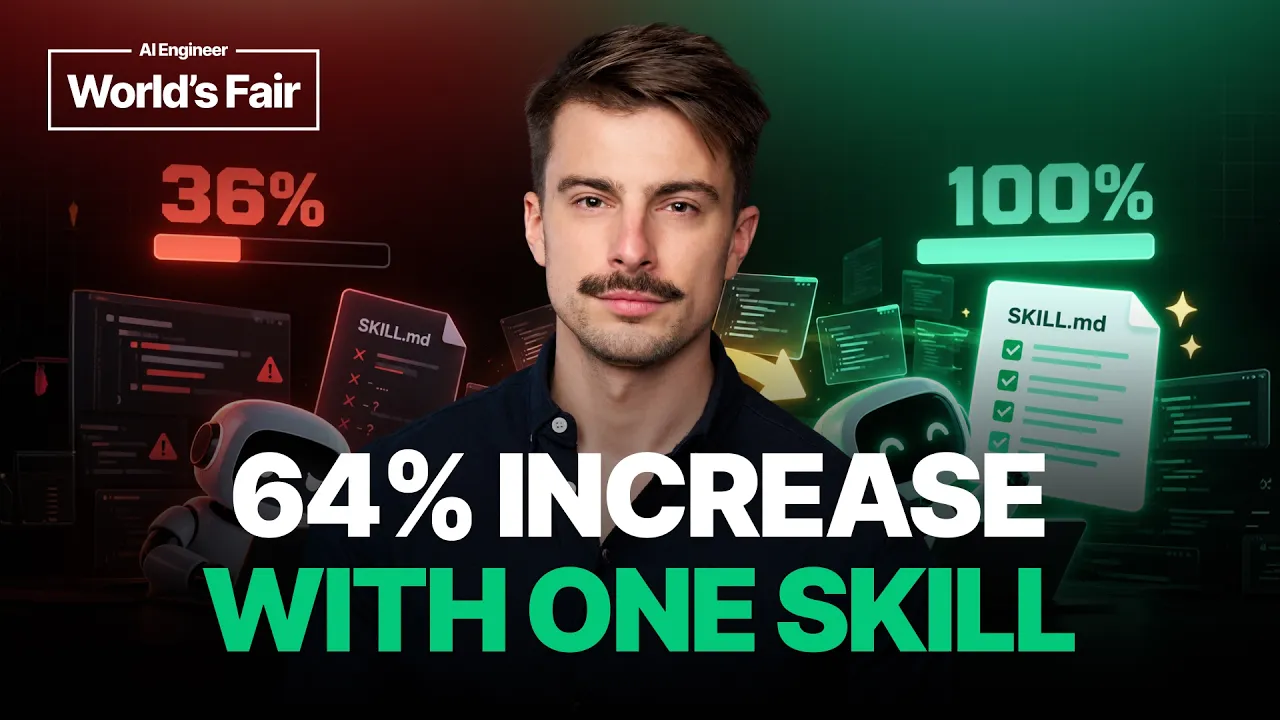
Description
When one agent finally cracks a hard problem, what if every agent in the company learned it too? Rafal Wilinski, founding engineer at Runlayer, shows how to go from one self-improving agent to a self-improving company. He explains why skills matter more as agents work longer (a bad start can send them down an hours-long rabbit hole) and the three problems holding skills back: they're built for developers, nobody has time to write them, and many clients don't support them. His fix is to deliver skills over MCP from one governed server, then let agents write their own skills by distilling successful and failed runs, an idea borrowed from the Voyager Minecraft paper. In one test, a distilled skill took a task from 36% success to 100%. Multiply that across every agent and you get an organizational flywheel that keeps your hard-won knowledge even as models change. In this talk: • What skills are, and why they matter more as agents run longer • Using MCP as the distribution layer for skills across the whole company • Distilling skills from agent traces, and why failed runs teach the most • The organizational flywheel: knowledge competitors can't copy SPEAKER Rafal Wilinski, Founding Engineer, Runlayer LinkedIn: https://www.linkedin.com/in/rafwilinski X: https://x.com/rafalwilinski Website: https://rwilinski.ai LINKS Runlayer: https://www.runlayer.com Runlayer on X: https://x.com/runlayer CHAPTERS 0:00 Intro 0:32 Every hard problem becomes a playbook 1:37 About Runlayer 2:12 What a skill is 2:51 Agents can now work for hours 3:51 Longer tasks, deeper rabbit holes 4:31 Skills nobody wants to rediscover 5:21 Three problems with skills 6:01 The risk of installing random skills 7:25 Skills vs MCP 7:55 MCP as the distribution layer 8:40 The Skills Over MCP working group 10:00 Self-improving agents 10:10 Voyager's skill library 11:34 Distilling skills from traces 11:59 Failures teach the most 12:54 Result: 36% to 100% 14:04 Frontier intelligence is rented 15:23 The organiz
Summary
Generated by gpt-5.6-terraAt-a-Glance
- Verdict: Skim
- Core thesis: Companies can create a compounding agent-performance advantage by automatically distilling successful and failed agent traces into governed reusable skills, then distributing those skills to all clients through an MCP-based control plane.
- Why it matters: This reframes agent improvement from repeatedly upgrading models or prompts into building an institutional procedural-memory layer that improves reliability, reduces token/tool-call waste, and preserves know-how when models change.
- Best use: Use this as a concise architectural argument for a centralized skill lifecycle—capture, distill, validate, govern, and distribute—rather than as an implementation tutorial.
Executive Summary
Rafal Wilinski argues that the main constraint on production agents is not only model capability but whether the agent starts with the organization’s hard-won procedures. He defines a skill as a progressively disclosed playbook: the agent initially sees a short description, then loads the full procedure only when it is relevant. This matters because stronger agents can pursue an incorrect line of reasoning for far longer, increasing tool calls, cost, and operational risk.
His proposed loop is to treat every agent run as training data for an organizational skill library. When an agent completes a meaningful multi-tool task, a separate model distills the trace into a reusable procedure. Failed runs are equally valuable because they expose missing guardrails, unsupported edge cases, or absent dependencies; those findings should make the resulting skill more robust.
RunLayer’s distribution thesis is that skills should not remain local Markdown files or developer-managed repositories. A remote MCP server can act as the centrally governed source of truth: clients search for relevant skills, receive versions appropriate to their query and role, and use MCP tools to obtain them where resource support is inconsistent. The company says it scans proposed skills for prompt injection, PII, and other issues before publishing them.
The only reported outcome is an internal Chromium-on-AWS-Lambda task where Sonnet 4.6 reportedly improved from 36% to 100% success after one successful invocation was distilled and injected into future runs. The broader strategic claim is that this library becomes a defensible, compounding asset: proprietary operating procedures encoded from real work, less dependent on any particular frontier model.
Key Takeaways
- Claim: Skills are a practical way to steer agent trajectories by supplying just-in-time procedural knowledge rather than forcing agents to rediscover company-specific workflows. | Evidence: Wilinski defines a skill as a playbook delivered through progressive disclosure: the harness first sees a summary, then injects the complete skill into context when it appears relevant. His examples include exact rollback sequences involving scripts and feature flags, and approved language for an enterprise customer at risk of churn. | Implication: For production workflows, the highest-value context may be procedural know-how and operational conventions, not a larger generic knowledge base or a different base model.
- Claim: As task horizons increase, skills become more important because capable agents can spend much more time confidently pursuing the wrong approach. | Evidence: Referencing the METR task-horizon benchmark trend, Wilinski notes that longer autonomous work also permits hundreds of tool calls and hours of reasoning in a 'deep rabbit hole' when the initial thesis is wrong. | Implication: Agent control should prioritize pre-execution routing and relevant procedural guidance, not merely post-hoc evaluation after a costly run completes. | Caveat: The talk does not provide comparative measurements showing how much skills improve trajectory quality across task types; this is a conceptual argument supported primarily by a single internal example.
- Claim: MCP should be treated as a centralized skill-distribution and governance layer, not only as a mechanism for exposing tools. | Evidence: The proposed design replaces locally installed skill files with a remote MCP server that clients query for skills; the server can enforce policy and return the appropriate skill version based on the request and the user’s role. Wilinski cites a 'Skills over MCP' working group and says RunLayer has operated this internal pattern for six months. | Implication: A company-wide skill system needs an access-controlled service layer with versioning and policy enforcement, rather than a collection of prompt files copied into individual developer environments. | Caveat: The Skills-over-MCP API is not finalized, and MCP resource support is described as inconsistent; RunLayer is currently using tools for delivery instead.
- Claim: Successful and failed agent traces can both be automatically converted into more useful skills, creating a continuous-learning loop without changing model weights. | Evidence: RunLayer takes interesting successful multi-tool traces and asks another LLM to distill a skill. It also treats failed runs as rich signals of missing guardrails, libraries, or edge cases. Wilinski grounds the pattern in the 2023 Voyager work, which stored discovered Minecraft procedures as reusable code recipes. | Implication: Instrumentation should preserve complete task traces, outcomes, and failure classifications so the organization can promote validated procedures rather than discard each run’s learning. | Caveat: Autonomous skill generation creates a quality-control problem: the talk mentions validation checks but does not specify evaluation thresholds, human review criteria, rollback procedures, or how it prevents a faulty skill from propagating.
- Claim: Distilled skills can materially raise reliability and lower execution cost by narrowing the agent’s search space. | Evidence: In RunLayer’s stated experiment, a task to run a Chromium fork in AWS Lambda using Sonnet 4.6 had a 36% success rate. After one invocation found a solution and its trace was distilled into a skill for subsequent runs, Wilinski reports a 100% success rate. He also says better skills mean fewer tool calls and explored branches. | Implication: Reliability gains may come from capturing one correct operational recipe; measure success rate, tool calls, branch count, latency, and token cost before and after skill promotion. | Caveat: This is a single vendor-reported case study with no sample size, baseline configuration, durability testing, or evidence that the 100% result generalizes beyond that task.
- Claim: A shared skill library creates an organizational network effect and can become a moat beyond access to commoditizing foundation models. | Evidence: The proposed 'self-improving organizational flywheel' groups similar runs, distills candidate skills, checks them for prompt injection and PII, publishes approved skills to a central library, and distributes them via an MCP gateway to every agent and client. The speaker characterizes the output as a collective subconscious of how the company works. | Implication: The durable asset is not the current model but a governed record of proprietary decisions, edge cases, and operating procedures that competitors cannot directly access. | Caveat: The moat depends on the quality, proprietary value, governance, and actual adoption of the skill corpus; merely collecting traces does not ensure differentiated or correct procedures.
Detailed Brief
Adoption and security constraints behind centralized distribution
- Claims: Local-first skill ecosystems are poorly suited to broad enterprise rollout because their common interfaces are Markdown, JSON, CLI commands, and Git repositories.; Nontechnical functions such as marketing, HR, legal, and finance may use general LLM clients that do not natively support local skill conventions.; Installing third-party skills directly is a supply-chain risk when a package can bundle prompts, executable scripts requiring elevated permissions, and API-key handling.
- Evidence: Wilinski calls out the popular 'npx skills' installation pattern and says RunLayer scans thousands of skills daily, finding 'really weird stuff' in them.; The suggested central repository filters candidate skills before publication for prompt injection, PII, and unspecified additional checks.
- Caveats: Centralization shifts security responsibility to the MCP gateway and skill-review pipeline; the presentation does not describe identity, authorization, provenance, signing, sandboxing, audit logging, or secret-management controls.; Client interoperability remains imperfect because resource support differs across MCP clients.
- Implications: Treat skill ingestion as untrusted-content processing, with provenance and security review separate from the decision to make a procedure available organization-wide.; Design for role-aware skill retrieval so sensitive operational procedures are not universally discoverable simply because they are useful.
Notable Concepts & Terms
- Skill: A reusable procedural playbook that tells an agent how to execute a type of task within an organization.
- Progressive disclosure: The agent sees a short skill description first and loads the complete instructions only when relevant, limiting unnecessary context consumption.
- MCP (Model Context Protocol): Presented as both a tool-access protocol and a potential centrally governed delivery channel for skills.
- Skills over MCP: An emerging working-group direction cited by the speaker; its API is not yet final, but it supports the idea of remote skill distribution.
- Voyager: A 2023 Minecraft agent paper used as the canonical example of retaining discoveries as reusable executable skill recipes instead of discarding exploration traces.
- Self-improving organizational flywheel: RunLayer’s name for capturing agent runs, distilling and validating skills, storing them centrally, and distributing them to all organizational agents.
- Frontier intelligence is rented: The claim that model capability can be deprecated, altered, or unavailable, making persistent internal procedures more durable than dependence on a particular model.
Operator Notes / Why Ken Should Care
- Run a pilot on one repeatable, high-cost workflow with meaningful historical traces; retain full tool-call traces, task outcomes, and failure reasons to support skill distillation.
- Define a promotion gate before auto-publishing a distilled skill: reproducible evaluation cases, success-rate and cost thresholds, provenance, versioning, rollback, and an owner.
- Separate knowledge delivery from tool authority: retrieve role-scoped skills through a central service, but keep credentials, destructive actions, and tool permissions under independent authorization controls.
- Add automated screening for prompt injection, PII, secrets, unsafe commands, and unauthorized external dependencies before any generated skill enters the shared library.
- Benchmark the pilot against a no-skill baseline using success rate, intervention rate, tool calls, tokens, latency, and incident/rollback outcomes; do not generalize from a single 36%-to-100% anecdote.
Source/Metadata
- Title: From 36% to 100%: How Self-Improving Agents Write Their Own Skills — Rafal Wilinski, Runlayer
- Transcript words: 4483
- Duration seconds: 1111
- Timestamp note: No timestamps or chapters were present in the supplied transcript; the latter portion substantially repeats earlier material.
Transcript
[SPEAKER_00] Hi everyone, I'm Rafal. Today I want to talk about self-improving agents but not in a single player mode where just one agent gets smarter. I want to talk about how we can apply that concept and mix it with network effects to get a self-improving company or maybe even an enterprise that self-improves while you sleep. Imagine the best engineer you ever worked with or a salesperson or a lawyer. The one that every time they cracked a genuinely hard problem they wrote down exactly how they did that and handed over the playbook to the team. So whenever they face a similar problem they don't have to figure it out from scratch. And imagine that happening for every hard problem across your whole company and that happening automatically each time. That's a dream, right? But it almost never works that way. Even when you crack a really hard problem, the knowledge, all that debugging, all that reasoning is just gone when you move on to the next task or close the session. But I want to convince you that this is actually possible and we already have all the primitives in place to make it happen. If it sounds interesting, let me introduce myself. Hi, I'm Rafal. I'm a founding engineer at RunLayer. We are making the golden path for AI at your company. Before that, I was leading Zapier agents and different AI teams. Generally speaking, my previous work was about making agents not just flashy demos, but reliable things in production. Before we go into interesting parts, I want to break down my topic into three separate pieces and start by just improving agents. There are many ways to do that. We can use better models. We can use better prompting tools, harnesses and whatnot. But I want to focus today only on skills because they are super accessible, right? To make sure that we are on the same page, a skill to me is a playbook that an agent can read when it thinks that the knowledge is relevant. From the technical perspective, the term is called progressive disclosure. It means that at the very beginning, the harness or a client sees just a summary of the skill or a short description of the skill. But when it thinks that the knowledge inside the skill can be useful, it can read the whole skill, inject it to the main context. And based on that knowledge, it can change the trajectory of the agent. Why is this so important? If you haven't been living under a rock for the past six or 12 months, your workload probably has changed a lot. And that's because the agents got so much better. Actually, the models got so much better. And it's not just vibes. It's measurable. Here you can see a chart that probably you have seen too many times already. For those who don't know, it's the meter benchmark. It measures for how long agents can work independently while still having a better job and a decent chance of completing a task. And the word chance is essential here. We are going to go back to that in a moment. But the trend is clear. The frontier capabilities, the frontier intelligence is getting better and better. They are better at multi-step deep work. There is only one caveat. If that frontier intelligence is not being taken from you. And I miss Fable probably just like you. But there is a catch. With great power or long task horizon comes great responsibility. If an agent can reason for much longer, it also means that it can dig a really deep rabbit hole. It can spend hundreds of tool calls trying to defend a wrong thesis, reason for hours. The next agent can do exactly the same thing or maybe even do something worse. So the initial trajectory matters a lot. And that's why skills are so important because they guide the agent towards the right target. Otherwise, you'll waste time. You'll waste tokens. And most importantly, you'll waste money. Valuable skills are the rituals that nobody wants rediscovered. That knowledge is often not glamorous. It's probably deeply embedded within your company. And if agents would try to rediscover that knowledge from scratch, like for instance, the sequence of scripts and feature flags in order to make a nice rollback, or what's the exact wording and language to use when dealing with that pesky enterprise customer that's about to churn. Yeah, if agents would try to figure out that from scratch, they are likely going to fail. And oftentimes that failure can be really costly. That's why I believe so many AIPOCs are failing. Because you're not giving agents the relevant context and the playbooks how to act within your company. So skills are great, but I feel like they are not problem free. There are three most important problems. And the first one is that they are local first and dev centric. What I mean by that is that when you look at the skills ecosystem, you're going to find markdown files, JSON files, CLI commands, Git repositories. And if you're a developer, that's great. But if you're a VP of AI or AI adoption lead, you need to think more empathetically about how you can roll out the AI strategy across your whole company, which includes non-technical people. And the challenge here is how non-technical people can actually create and share the skills. I love this meme. This is the junior developer or non-technical person discovering the command NPX skills, which is the most popular command to install them. That's the only command I know that installs not just a skill, but also free prompt injections, wild scripts that require root permissions, and someone else's API key. All in one run. Trust me, at RunLayer, we are scanning thousands of skills every day, and there is really weird stuff inside. Okay, second problem is that I think we all love the situation where we are facing a hard problem, and there's already a playbook on how to deal with that situation, right? But oftentimes there is no playbook because it takes time and effort and intention and energy to reflect on a problem and leave something useful for posterity behind. And the third problem is that not every LLM client supports skills. If you're in the cloud ecosystem, it's probably great. If you're a developer, you're probably going to manage, even if the skills support is weird depending on which client you're using. And once again, if you think about marketing, HR, legal, finance, those departments are probably still using ChatGPT or some other LLM client, and skills might not be supported there. And some time ago, there was this big heated debate when skills were introduced. Some people proclaimed that, thank God, MCP is finally dead because I'm not interested in dealing with OAuth. I can now hard-code a bunch of CLI commands, hard-code my API key inside a Markdown file, and call it progress, right? But I think everyone missed the point. Skills can be delivering the knowledge how to do something, and tools give us capabilities. Tools from MCPs give us capability to do those things. But MCP can also be used as a protocol to deliver the knowledge, to deliver the skills. We can use MCP as the distribution layer. So instead of installing skills locally, you can create a remote MCP server, which can become the source of truth across your whole company. Clients can connect to that. They can search for the right skills. The server can enforce policy and make sure that everyone gets the best version of the skill possible, depending on a query and, for instance, the role that they have assigned. We've been doing that internally at RunLayer for the past six months, and it's been working quite well. But it's no longer just an internal thing. We see that the broader MCP ecosystem is also going that direction. There is already a working group called Skills over MCP. And while the exact API is not final, the direction is clear. MCP can be used to deliver the skills, to deliver the knowledge across your whole company. Yeah, and while the official spec is leaning towards MCP resources, the support for resources is also mixed. So we are going with tools. Anyhow, if you remember the problems, the first problem I mentioned and the third problem I mentioned, which is the problem that they are dev-centric and the lack of support for clients, MCP as a distribution layer fixes that because it's unified and works in almost every single client, not just developer clients. So the problem of distributing skills to non-technical people is essentially solved, right? Plus, you have now a centralized API, so as a VP of AI or AI adoption, you have one place to govern and manage what's the knowledge that's getting shared and distributed across your company. Okay, so now we know how we can improve agents because we have skills. We know that we can use MCP to distribute those skills across all the clients and agents, but let's talk about something more interesting, which is how agents can improve themselves. And whenever I see a new paper or a framework speaking about this topic, I always go back to the Voyager paper. Unfortunately, you cannot see the video about its Minecraft gameplay in the background. So in 2023, right after GPT-4 was released, so ages ago, the question was for how long multiple agents or harnesses can explore Minecraft space. They dropped the agent into Minecraft with no instructions. It set its own goals. It just kept getting better without even touching the weights or model and the prompts. And in 2023, I think it was pretty groundbreaking. How did they pull it off? The key thing to notice here is the skill library. So Voyager did not just explore the Minecraft space carefully and throw the trace away. When the agent figured out something, it saved the recipe as a code that consisted of the tool calls that led the agent to the discovery. So later on, when the agent decided that, hey, I need to create a crafting table or a diamond pickaxe, it didn't have to figure it out from scratch. It could simply go to the skill library and retrieve it as a code, as a recipe that can be reused. And this is really important. This is the core idea that I want to carry forward: exploration should be turned into reusable procedural knowledge. And we started doing something very similar at RunLayer. We let the agents do the real work. And when the run succeeds and when there is something interesting in this run, there's multiple tool calls, we just take the trace and we ask a tier LLM to simply distill a skill. And while it's super simple to distill a skill from a single run, I think we humans and agents learn the most from mistakes. The real sharpening happens when the agent fails. So a run that goes sideways is actually the richest signal that you can get because it exposes the missing guardrail, the missing library, some kind of edge case that you haven't thought about upfront. And every run, pass or fail, just feeds our distiller mechanism, constantly making our skill better. The successes are making the skill more trustworthy because if the agent achieved the goal, it means that, hey, this skill works. And if it doesn't, it actually makes the skill more robust because now we know what's missing in here. And it all happens completely autonomously, asynchronously, without human in the loop. And the initial results were great. We had this task of trying to run some Chromium fork inside AWS Lambda, and we were trying to do that using Sonnet 4.6. So not the most intelligent model, but sometimes it succeeded. It's not production ready to have 36% success rate. So what we did is we flipped the flag for self-improving agents. And once in one run, one of the agent invocations cracked the code, our skill distiller created a reasonable skill. It was then included in all the future runs, and the success ratio went to 100%. So, yeah, that's great. It's like a developer with a better attitude towards documentation. The success rate is the easiest number to show, but a good skill is narrowing the search space. It makes the agent narrow the search space, and the agent stops doing tool calls and it's exploring fewer branches. It's wasting less tokens and less money. But putting savings and accuracy aside, I think there's also a deeper reason why you should be distilling skills. The problem is that frontier intelligence is rented or borrowed. It can disappear. I think, yeah, we all miss Fable. It was a great model. It can deprecate or it can get dumber. We complain every single day on Twitter, on Slack, that Opus is really dumb today. So while we have access to the best version of that intelligence, we should be using that to discover and persist those useful procedures. We should be building a catalog of how the work gets done inside our company as a collective subconscious. And how do we do it? Well, I believe we already have all the pieces of the puzzle here. We have skills as a way to retain procedures and improve agents and guide models. We have MCP as a unified distribution layer for those skills. And we also have a central repository, the knowledge base for all of those skills, which is constantly being updated and fed with new data. Yeah, we also have the continuous learning flywheel for one agent. But what's interesting is what I promised you at the very beginning: the network effect. So what happens when you multiply that by every agent and every single client in the entire company? At RunLayer, we call it self-improving organizational flywheel. We group a bunch of similar runs and try to distill a skill. It passes through our various series of checks, like whether it's not containing some kind of prompt injection or maybe PII and a bunch of other stuff. Once it's good, it's landing in our skill library. And thanks to our MCP gateway, it's being served to each and every client and agent within the company. What we end up having is a constantly evolving knowledge base, which is always up to date, continuously updated with new alpha, fed with new edge cases. So once one agent figures out a really hard problem, it's being distilled into a skill, persisted in the organizational library. So whenever someone else has the same problem in the future, they don't have to figure out the solution from scratch. They don't have to know what's the exact sequence of these magical commands that are going to restart the database or roll back production. They can simply reach out to the playbook they have. And why is this so important? Because I believe 50% of us probably already had an existential crisis thanks to the models. And the thinking goes along the lines of, okay, so models are becoming commodity. Everyone here has access to them. And the cost of software is going to zero. Everyone can be rebuilding my product, at least on the surface. In fact, so many people are walking today across the expo and they are thinking, hey, everyone's building the same thing, right? So what is my moat? And I believe the moat can be in building this flywheel and distilling the knowledge to this flywheel. Because it's like your own hardwood lessons distilled, governed how your company does things. And it's captured, compounding, raising the floor for everyone across the company, giving them access to the best knowledge available. It is also a way to be resistant against model intelligence deprecation. And it's a great way to lower your costs without changing a model. So, yeah, that's probably one thing that a competitor can't copy: your internal culture and your identity. And, yeah, that's pretty much it. Thank you for coming. If it resonated with you, I'm Rafal. I'm working at RunLayer. We are figuring out the AI golden path for you. I'm open to talk about skills, MCP agents, whatnot. And this is exactly what we are building at RunLayer. Thank you. even if the skills support is weird depending on which client you're using. And once again, if you think about marketing, HR, legal, finance, those departments are probably still using ChatGPT or some other weird LLM client, and skills might be not supported there. And some time ago, there was this big heated debate when the skills were introduced. Some people proclaimed that, thank God, MCP is finally dead because I'm not interested in dealing with OAuth. I can now hard-code a bunch of CLI commands, hard-code my API key inside Markdown file, and call it a progress, right? But I think everyone missed the point. Skills can be delivering the knowledge how to do something, and tools gives us capabilities. Tools from MCPs give us capability to do those things. But MCP can be also used as a protocol to deliver the knowledge, to deliver the skills. We can use MCP as the distribution layer. So instead of installing skills locally, you can create a remote MCP server, which can become the source of truth across your whole company. Clients can connect to that. They can search for the right skills. Server can enforce the policy and make sure that everyone gets the best version of the skill possible, depending on a query and, for instance, the role that they have assigned. We've been doing that internally at RunLayer for the past six months, and it's been working quite well. But it's no longer just an internal thing. We see that the broader MCP ecosystem is also going that direction. There is already a working group called Skills over MCP. And while the exact API is not final, the direction is clear. MCP can be used to deliver the skills, to deliver the knowledge across your whole company. Yeah, and while the official spec is leaning towards MCP resources, the support for resources is also mixed. So we are going with tools. Anyhow, if you remember the problem, the first problem I mentioned and the third problem I mentioned, which is the problem that they are dev-centric and the lack of support for clients, MCP as a distribution layer fixes that because it's unified and works in almost every single client, not just developer clients. So the problem of distributing skills to non-technical people is essentially solved, right? Plus, you have now a centralized API, so as a VP of AI or like AI adoption, you have one place to govern and manage what's the knowledge that's getting shared and distributed across your company. Okay, so now we know how we can improve agents because we have skills. We know that we can use MCP to distribute those skills across all the clients and agents, but let's talk about something more interesting, which is how agents can improve themselves. And whenever I see a new paper or a framework speaking about this topic, I always go back to Voyager paper. Unfortunately, you cannot see the video about its Minecraft gameplay in background. So in 2023, right after GPT-4 was released, so ages ago, the question was for how long multiple agents or harnesses can explore Minecraft space, right? They dropped the agent into Minecraft with no instructions. They set its own goals. They just kept getting better without even touching the weights or model and the prompts. And in 2023, I think it was pretty groundbreaking. How did they pull it off? The key thing to notice here is the skill library. So Voyager did not just explore the Minecraft space carefully and throw the trace away. When the agent figured out something, it saved the recipe as a code that consisted of the tool calls that lead the agent to the discovery. So later on, when the agent decided that, hey, I need to create a crafting table or a diamond pickaxe, I didn't have to figure it out, this whole knowledge from scratch. It could simply go to the skill library and retrieve it as a code, as a recipe that can be reused. And this is really important. This is the core idea that I want to carry forward is that exploration should be turned into reusable procedural knowledge. And we started doing something very similar at RunLayer. We let the agents do the real work. And when the run succeeds and when there is something interesting in this run, there's multiple tool calls, we just take the trace and we ask from Tier LLM to simply distill a skill, right? And while it's super simple to distill a skill from a single run, I think we humans and agents learn the most from mistakes, right? The real sharpening happens when the agent fails. So a run that goes sideways is actually the richest signal that you can get because it exposes the missing guardrail, the missing library, some kind of edge case that you haven't thought about upfront. And every run or pass or fail just feeds our distiller mechanism, constantly making our skill better. The successes are making the skill more trustworthy because if the agent achieve the goal, it means that, hey, this skill works. And if it doesn't, it actually makes skill the more robust because now we know what's missing in here. And it all happens completely autonomously, asynchronously, without human in loop. And the initial results were great. We had this task of trying to run some Chromium fork inside AWS Lambda, and we were trying to do that using Sonnet 4.6. So not the most intelligent model, but sometimes it succeeded. It was just, you know, it's not production ready to have 36% success rate. So what we did is we flipped the flag for self-improving agents. And once in one run, one of the agent invocations cracked the code, our skill distiller created a reasonable skill. It was then included in all the future runs, and the success ratio went to 100%. So, yeah, that's great. It's like a developer with better attitude towards documentation. The success rate is the easiest number to show, but good skill is narrowing the search space. It makes the agent, it narrows the search space, and the agent stops doing tool calls, and it's exploring less branches. It's wasting less tokens and less money. But putting savings and accuracy aside, I think there's also a deeper reason why you should be distilling skills. The problem is that frontier intelligence is rented or borrowed. It can disappear. I think, yeah, we all miss Fable. It was a great model, right? It can deprecate it, or it can get dumber. Like, we complain every single day on Twitter, on Slack, that Opus is really dumb today, right? So, while we have the access to the best version of that intelligence, we should be using that to discover and persist those useful procedures. We should be building a catalog of how the works gets done inside our company as a collective subconscious. And how we do it? Well, I believe we already have all the pieces of the puzzle here. We have skills as a way to retain procedures and improve agents and guide models. We have MCP as a unified distribution layer for those skills. And we also have a central repository, the knowledge base for all of those skills, which is constantly being updated and fed with new data. Yeah, we also have the continuous learning flywheel for one agent. But what's interesting is what I promised you at the very beginning, the network effect. So, what happens when you multiply that by every agent and every single client in the entire company? At RunLater, we call it self-improving organizational flywheel. We group a bunch of similar runs and try to distill a skill. It passes through our various series of checks, like whether it's not containing some kind of prompt injection or maybe PII and a bunch of other stuff. Once it's good, it's landing in our skill library. And thanks to our MCP gateway, it's being served to each and every client and agent within the company. What we end up having is a constantly evolving knowledge base, which is always up to date, continuously updated with new alpha, fed with new edge cases. So, once one agent figures out a really hard problem, it's being distilled into a skill, persistent in organizational and library. So, whenever someone else has the same problem in the future, they don't have to figure out the solution from scratch. They don't have to know what's the exact sequence of these magical commands that are going to restart the database or roll back the production. They can simply reach out to the playbook they have. And why is this so important? Because I believe 50% of us probably already had an existential crisis thanks to the models. And the thinking goes along the lines of, okay, so models are becoming commodity. Everyone here has access to them. And cost of software is going to zero. Everyone can be rebuilding my product, at least on the surface. In fact, so many people are walking today across the expo and they are thinking, hey, everyone's building the same thing, right? So, what is my moat? And I believe the moat can be in building this flywheel and distilling the knowledge to this flywheel. Because it's like your own hardwood lessons distilled, governed of how your company does things, you know? And it's captured, compounding, raising the floor for everyone across the company, giving them access to the best knowledge available. It is also a way to be resistant against model intelligence deprecation. And it's a great way to lower your costs without either changing a model. So, yeah, that's probably one thing that competitor can't copy. Your internal culture and your identity. And, yeah, that's pretty much it. Thank you for coming. If it resonated with you, I'm Rafal. I'm working at RunLayer. We are figuring out the AI golden path for you. I'm open to talk about skills, MCP agents, whatnot. And this is exactly what we are building at RunLayer. Thank you. Thank you.