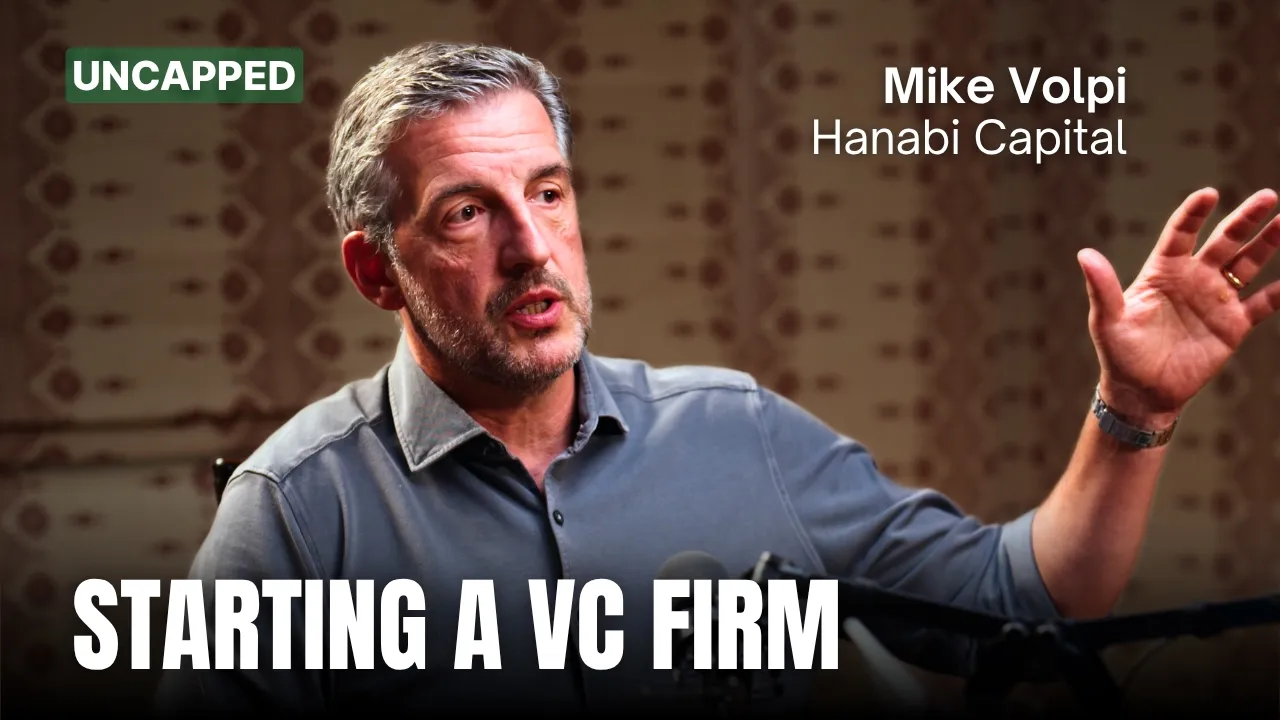
Mike Volpi on Why AI Breaks Traditional Venture Capital | Ep. 52
Description
Mike Volpi is a General Partner at Hanabi Capital, with a background that spans senior operating roles and nearly two decades of investing. Mike currently sits on the boards of several innovative companies, including Scale AI, ClickHouse, Ferrari, and Confluent, where he is known as a thoughtful sounding board and a steady presence through the highs and lows of startup life. Mike is a retired partner at Index Ventures, where he led investments in category-defining companies across AI, software, and infrastructure. Earlier in his career, he held leadership roles at Cisco, including as Chief Strategy Officer and SVP/GM of Cisco’s routing business, giving him firsthand experience in building products and teams at scale. We discussed what it takes to build a great venture firm in the AI era, why many of venture’s traditional rules are breaking down, and how AI is reshaping software, investing, and company building. We also explored the future of frontier AI labs, robotics, defense tech, and the mindset founders and investors need to adapt to a rapidly changing world. Timestamps: (0:00) Intro (0:39) Building a venture firm for AI (4:02) Designing Hanabi (5:52) Why stage matters less (9:38) Building a venture brand (13:58) The role of board seats (17:06) Attributes of enduring firms (20:44) The future of AI labs (23:14) Open-source and neolabs (32:49) The compute race (36:51) The future of software (45:49) Investing in defense (47:50) From operator to investor (50:35) Thriving founders today Links: https://x.com/mavolpi https://www.hanabi.com/ https://x.com/jaltma https://uncappedpod.com/ friends@uncappedpod.com
Summary
Generated by claude-sonnet-4-5At-a-Glance
- Verdict: Watch fully
- Core thesis: AI fundamentally breaks traditional venture capital assumptions—software creation costs plummet, capital-intensive labs dominate, stage boundaries collapse, and founders need different support—requiring VCs to abandon reinforcement learning from past success and rebuild firm design from first principles
- Why it matters: Mike Volpi articulates a complete framework for why AI invalidates traditional VC playbooks (high fixed-cost software, stage-focused funds, product > services bias, brand via marketing) and what replaces them—this is a rare explicit discussion of firm-level strategic adaptation during a platform shift
- Best use: Study for operator-relevant insights on AI business models (FDEs, services revival, data moats), VC positioning against labs, and mental models for navigating generational transitions in expertise
Executive Summary
Mike Volpi, founder of Hanabi after a long tenure at Index Ventures, argues that AI represents a discontinuity forcing VCs to discard 'reinforcement learning' from pre-AI success. The core assumption shift: software used to be expensive to build (high fixed cost, low marginal cost), justifying product-centric SaaS models and stage-based investing. AI collapses software creation costs, making the old playbook—own 15-20% at Series A, avoid services, emphasize product multiples—obsolete. Volpi built Hanabi as a compact, AI-native firm with young technical talent fluent in GPUs/compute/model architectures, flexible on stage (will invest seed to growth), and focused on data/workflow moats rather than API wrappers.
On the lab landscape, Volpi sees the winners as locked in: OpenAI, Anthropic, Google, Meta, and possibly xAI if Elon focuses. Compute access (correlates with capital: $50-100B/year spend) and the 'bitter lesson' (scale beats clever algorithms) create insurmountable moats. New labs face an order-of-magnitude disadvantage unless they secure proprietary data (e.g., Periodic Labs for chemistry via in-house experiments, robotics companies generating embodiment-specific pre-training data). Open-source models will lag 6-9 months behind the frontier, commoditizing the tail but not threatening the monetizable head. NVIDIA's dominance will erode via specialized inference chips (Cerebras, Etched, Talus) and US fab capacity (TSMC Arizona, Intel attempts).
For applications, Volpi argues only companies capturing proprietary data and business workflows in verticals the labs ignore can survive. API wrappers ('send doc to OpenAI, return formatted') have no moat. Pre-AI SaaS is split: some leaders (Dylan Field at Figma cited positively) can transition to AI-centric models; others should PE themselves (cut costs, maximize EPS). The software business model is shifting from pure product to services-adjacent: FDEs (field deployment engineers, previously dismissed as 'professional services') are now critical because deal sizes ($10M+ enterprise deployments) dwarf the cost of human customization, and customers pay for business outcomes (e.g., reduce churn 2%) not technology features. UIs will persist because human interaction with systems (Salesforce example) remains a moat, though agents will gradually take over lower-level tasks.
On firm building, Volpi emphasizes organic brand (peer references, insider knowledge, not billboards/conference sponsorships) resonates with 22-year-old founders who access transparent information online. He de-emphasizes board seats and ownership percentages: weekly 1-on-1s with founders matter more than quarterly board theater; owning 1% of Anthropic beats 20% of a mediocre company. The four core VC skills—sourcing, judgment, selling the founder, helping develop the business—require well-rounded generalists, not hyper-specialized teams stitching together 5 people per deal. Generational transition risk (legacy partners hoarding economics) is the 'quintessential failure mode' of every VC firm. Volpi's personal edge: Cisco operator experience (joined at few hundred people, left at 55,000 in 13 years) gives differentiation, but he stresses beginner's mind and treating 21-year-olds as equals to avoid the 'all-knowing grandfather' trap.
Key Takeaways
- Claim: AI breaks the foundational assumption of traditional venture capital: software is expensive to build with high fixed costs and low marginal costs, justifying product-centric SaaS models | Evidence: Volpi states most VC firms are premised on software being 'complicated, expensive, and takes a long time to build'—but AI 'takes the cost of making software way down,' invalidating assumptions about go-to-market, engineering, fundraising, customer targeting, and whether companies should be product vs. service-centric | Caveat: Volpi does not claim software has zero cost now, only that the cost structure has radically shifted—some domains (e.g., robotics, chemistry) still require expensive infrastructure and data generation | Implication: Ken should expect AI-era business models to look more like customized services (FDEs, human-in-the-loop workflows) than cookie-cutter SaaS products; operators clinging to pre-AI SaaS mental models (high-touch = bad, product-led = good) will misallocate resources | Timestamp: 02:45
- Claim: The five winning labs (OpenAI, Anthropic, Google, Meta, xAI) are determined by compute access and capital, spending $50-100B/year; new labs face insurmountable disadvantages unless they control proprietary data | Evidence: Volpi cites 'bitter lesson' dynamics: even if a new lab raises $2B for a better model architecture, it's 'an order of magnitude, if not more, at a disadvantage'—the big labs 'can just throw compute at it and blow you away'; OpenAI's smart move was buying compute early at lower cost | Caveat: Model architectures could change (Volpi acknowledges 'they may change'), temporarily leveling the field, and Jensen Huang could fund an open-source effort (Reflection example) for one generation; however, sustained competition requires continuous capital access | Implication: Ken should treat LLM infrastructure as a closed oligopoly for investment purposes; bet on specialized models with data moats (robotics embodiment data, chemistry wet-lab data) or on inference/chip layers (Cerebras, Etched) rather than on new general-purpose labs | Timestamp: 20:15
- Claim: Open-source models will remain 6-9 months behind the frontier and commoditize the tail of the monetization curve, not the profitable head where advanced model queries occur | Evidence: Latest Qwen and DeepSeek Muse models are closed, not open, because training costs are massive ('who's going to spend $50 billion to give it away?'); open-source can exist for post-training on lesser models for specific tasks, but sustained proximity to frontier requires capital most open-source projects lack | Caveat: Temporally, open-source can have 'blips' (e.g., if NVIDIA funds a project for one generation); proprietary data-focused open-source (e.g., companies post-training for corporate use) might finance closer gaps, but Volpi is skeptical this will be continuous | Implication: Ken should not expect open-source to disrupt the frontier labs' pricing power or to be a venture-backable business model on its own; instead, view open-source as a cost-reduction layer for non-critical workloads or as a distillation target for application companies | Timestamp: 24:30
- Claim: Application companies survive only by capturing proprietary data and business workflows in verticals the labs ignore; API wrappers ('send doc to OpenAI, return result') have no moat | Evidence: Volpi says 'if your basic concept is I take a document, send it to OpenAI API, it comes back and I show it to you this way—it's not enough'; labs will target the 'most interesting TAMs' and do '80% of the job,' damaging wrapper companies; construction and other niche verticals are safe because labs won't care | Caveat: Some large TAMs (legal, finance) will see direct lab competition, but execution quality and workflow integration still matter; Volpi acknowledges labs won't nail every vertical perfectly, leaving room for focused players | Implication: Ken should evaluate AI application startups by asking: (1) Is the data they use proprietary or internet-scrapable? (2) Are the workflows deeply integrated or just API calls? (3) Is the vertical large enough for OpenAI/Anthropic to care? Pass on thin wrappers; back deep vertical integrators | Timestamp: 30:15
- Claim: Pre-AI SaaS companies face two paths: PE themselves (fire staff, maximize EPS) or genuinely transition to AI-centric models; the market hasn't differentiated which leaders can execute the transition | Evidence: Volpi compares SaaS to the car business ('everybody thinks SaaS sucks') but notes some leaders—'Dylan [Field at Figma] is going to figure something out'—can transform like Elon did with Tesla; these stocks are 'oversold' because the market isn't pricing in founder capability to pivot | Caveat: Volpi admits he's 'not a very good public investor' and can't say if multiples (4-5x) are precisely correct, only that the selloff feels indiscriminate; he does not specify which SaaS companies beyond Figma have the right leadership | Implication: Ken should assess SaaS holdings/targets by management quality and AI fluency, not just current business metrics; leaders who 'get it' can re-rate dramatically, while those who don't will continue compressing; consider Figma-type situations undervalued by the market's blanket pessimism | Timestamp: 47:00
- Claim: FDEs (field deployment engineers) and services-adjacent models are no longer stigmatized because AI deal sizes ($10M+ enterprise deployments) dwarf human COGS, and customers pay for business outcomes (e.g., reduce churn 2%) not technology features | Evidence: Volpi recalls 10 years ago VCs would 'pass' on professional services models, but now 'they're called FDEs—they're really cool'; he analogizes to selling routers (24 ports vs. 16 ports) versus solving a CEO's churn problem worth 'hundreds of billions'; FDE cost is trivial relative to compute and contract value | Caveat: Volpi does not claim pure services businesses (like legacy consultancies) are the model; rather, software + customization + agents + humans is the hybrid; as agents mature, human involvement may decline, but today it's essential for context and verification | Implication: Ken should re-evaluate anti-services bias in software investing; AI-native companies with high-touch, outcome-based pricing (Palantir model) are structurally advantaged because they align with how enterprises buy AI (business value, not seat licenses); COGS fears are overblown given contract economics | Timestamp: 44:30
- Claim: Stage-centric VC (early, growth, crossover) is obsolete; firms must ignore stage and focus on opportunity magnitude because companies at $10B+ valuations can still deliver 10x+ venture returns | Evidence: Volpi invested in Anthropic at $60B, expecting '10x plus return'; he says, 'you could invest in a company at $10 billion in valuation, and three years later, it could be worth $380 billion'—emphasizes 'suite of companies we would now consider growth stage but represent venture-like return characteristics' | Caveat: Sourcing and winning allocation at growth stages is harder without reputation; Volpi acknowledges younger team members 'don't quite have the ability to go up to Dario or Sam and establish a relationship,' requiring him to 'open up that pathway' | Implication: Ken should not dismiss later-stage AI opportunities as 'growth' and therefore lower-return; the AI wave compresses timelines and amplifies outcomes such that traditional stage heuristics (early = high risk/return, late = safe/modest) are inverted; assess absolute TAM and execution, not entry price | Timestamp: 10:30
- Claim: Board seats and ownership targets (15-20% at Series A) are legacy VC rules to discard; weekly 1-on-1s with founders deliver more value than quarterly board meetings, and owning 1% of a great company beats 20% of a mediocre one | Evidence: Volpi does 'weekly, biweekly, or at least monthly check-ins' with founders and finds board meetings once companies are big to be 'useless'—'you prepare a deck, sit around, read the deck, and the three observers want to say something useless'; he says, 'would you own 20% of some schmo company or 1% of Anthropic?' | Caveat: Volpi still takes some board seats and notes small board meetings are 'a good forcing function' for early-stage companies; his approach is not anti-board but anti-formalism—he rejects making board membership 'mandatory' or a 'badge of honor' | Implication: Ken should prioritize continuous, informal founder engagement over board governance theater; for operator/builder work, this model (high-bandwidth, low-bureaucracy) is more defensible and useful than traditional board value-add narratives; agents and AI tools will further erode the value of formal oversight | Timestamp: 15:45
- Claim: Brand in venture is more important than ever (young, less-networked founders rely on it) but must be built organically via 'inside knowledge, tips, connections, network' rather than marketing, sponsorships, or billboards | Evidence: Volpi says 'classical marketing efforts sound off-key to your average 22-year-old entrepreneur' and cites a survey where Thrive (not loud, few blog posts) ranked highly with college students because 'Josh and his team built a brand on the down low'—brand as summarizing value when buyers are not expert | Caveat: Organic brand takes time and is hard to accelerate; Volpi emphasizes references and one-on-one impressions, but this doesn't scale like paid marketing; also, early-stage firms lack the track record to generate organic buzz initially | Implication: Ken should avoid traditional VC marketing (conference sponsorships, glossy content) and instead invest in founder community engagement, transparent knowledge sharing (like this podcast), and cultivating reference networks; 'feeling in on a secret' (Hermès analogy) is more valuable than visibility | Timestamp: 07:00
- Claim: Robotics models differentiate via proprietary pre-training data generated in-house around specific embodiments; purchasing data from Scale or others is 'nice but not a material differentiator' | Evidence: Volpi explains robotics needs 'a lot of pre-training data' for generalization (post-training overfits to one task), and embodiment-specific data (gripper type, dexterity) is critical; cites Mind Robotics (Rivian spinout) using 'their own factory as their data collection instrument' and Elon's advantage with Optimus via Tesla/FSD data | Caveat: Purchasing labeled robotics data is still useful ('please do, because I'm still on the board at Scale') but cannot be the sole moat; competition for purchased data is intense (Scale, Surge, Turing, others), driving margins down | Implication: Ken should evaluate robotics investments by in-house data generation capability and embodiment-specific training loops, not by partnerships with data labeling vendors; companies that build robots and deploy them (Tesla, Rivian spinout) have structural advantages over pure software plays | Timestamp: 35:00
Detailed Brief
Why AI Breaks Traditional VC and Requires Firm Redesign
- Claims: Traditional VC firms are premised on software being expensive to build (high fixed cost, low marginal cost), leading to product-centric SaaS models and stage-based fund structures; AI collapses software creation costs, invalidating assumptions about go-to-market, engineering, fundraising, customer targeting, and product vs. service centricity; Past success creates 'reinforcement learning' that VCs apply incorrectly when the world shifts—firms with more success have stronger (and more dangerous) inertia; Disrupting a market requires a macro change (AI), deadly focus on that trend, gathering people who are native to the trend, and careful avoidance of past success bias
- Evidence: Volpi: 'Most VC firms are focused on making money on software companies...based on the idea that software is complicated, expensive, and takes a long time to build...then you move into an AI era which takes the cost of making software way down. You're completely shifting the core assumptions'; Pre-AI SaaS execs 'learned a whole set of things that don't make sense anymore' because 'the whole concept of software is changing'; Firm design cascades from cost assumptions: if fixed costs are high, 'you need to sell to as many people as possible...then you move into everything from go-to-market, engineering, fundraising, which customers you target first'; Hanabi built with $175M fund, focus on AI-native technical talent, flexibility on stage (seeds to growth), weekly 1-on-1s instead of board formalism
- Caveats: Volpi does not claim all software is now free to build—domains like robotics, chemistry, and specialized infrastructure still require capital and expertise; The 'bitter lesson' (scale beats cleverness) may not hold forever; model architectures could change, though Volpi is skeptical this will happen soon or sustainably; Hanabi is a small fund ($175M), limiting ability to lead large Series A rounds ($15-30M) today, though Volpi plans to scale with future funds
- Implications: Operators and investors must discard mental models from pre-AI SaaS era (PLG, product > services, minimize COGS, stage-based ownership targets) and rebuild from first principles; Firms that succeed in AI will be lean, technically fluent, stage-agnostic, and relationship-driven; large platform firms with 600-person teams doing spreadsheets will struggle; Ken's agent systems and automation work should assume: (1) software creation is cheap, (2) value is in data/workflows, (3) customization/services are economically viable, (4) speed of iteration matters more than feature completeness
Lab Landscape: Compute, Capital, and Proprietary Data Moats
- Claims: The five winning labs—OpenAI, Anthropic, Google, Meta, xAI (if Elon focuses)—are locked in by compute access (correlates with $50-100B/year spend) and 'bitter lesson' dynamics; New labs face order-of-magnitude disadvantages; even raising $2B is trivial compared to incumbents' budgets; algorithmic improvements are unlikely to overcome scale; Open-source models lag 6-9 months behind frontier, commoditizing the tail but not the monetizable head (advanced model queries); open-source is 'not a business in AI'; Exceptions exist where proprietary data unavailable to labs creates moats: chemistry (Periodic Labs generating data via in-house experiments), robotics (embodiment-specific pre-training)
- Evidence: Volpi: 'You are talking about a group of companies that spend 50 to 100 billion conservatively a year on compute. You show up and raise 2 billion—you're about an order of magnitude, if not more, at a disadvantage'; OpenAI's advantage: 'one of the very smart things they did is they bought a lot of compute ahead of time...they probably have the lowest cost of compute of any player right now'; Open-source models (Qwen, DeepSeek Muse) are now closed: 'That's not a coincidence. They're spending a lot of money training those models. They're not just going to open them up'; Robotics data is 'not broadly available on the internet' so 'you have to generate the data that your model trains on' via tele-op or remote workers; 'people who have the right data strategy can stand out'
- Caveats: Model architectures could change, temporarily leveling the field; Volpi acknowledges 'they may change' but sees no evidence of sustained new approaches; Jensen Huang could fund an open-source lab (Reflection example) for one generation, creating a 'blip,' but it's unlikely to be continuous without ongoing capital; Labs are not 'sitting there clueless'—they're researching next-gen architectures (e.g., OpenAI's RL memo), so any new lab's algorithmic edge is likely already known to incumbents; Inference demand explosion (beyond training) increases compute load, but also increases value customers see, supporting higher prices and potentially justifying more labs if differentiated
- Implications: Ken should not invest in new general-purpose LLM labs unless they have (1) proprietary data moats in a valuable vertical, (2) capital commitments on par with big labs, or (3) a radically new architecture with proof it generalizes; Specialized models (robotics, chemistry, other physical-world domains) are venture-backable if the company generates its own data via owned infrastructure (factories, labs, deployed robots); Open-source models are useful for cost-sensitive, non-critical workloads but won't disrupt frontier pricing; Ken should assume frontier model APIs remain primary revenue drivers for labs; Compute scarcity (TSMC wafer starts) favors those who bought early and have capital; Ken should track fab capacity (TSMC Arizona, Intel, others) and specialized chips (Cerebras, Etched) as structural shifts
AI Application Layer: Data, Workflows, and the Services Revival
- Claims: Application companies survive by capturing proprietary data and business workflows in verticals the labs ignore; API wrappers have no moat; Labs will target 'most interesting TAMs' (legal, finance) and do '80% of the job,' damaging wrappers; niche verticals (construction) are safer; FDEs (field deployment engineers) are now critical because (1) AI deal sizes ($10M+) dwarf human COGS, (2) customers pay for business outcomes not features, (3) every business has unique workflows; UIs persist because human interaction with systems (Salesforce example) is a moat; systems of record retain value even as agents automate tasks underneath
- Evidence: Volpi: 'If your basic concept is I take a document, send it to OpenAI API, it comes back and I show it to you this way—it's not enough'; Labs 'will look at the most interesting TAMs and say, wait a minute, I'm going to do that...they're going to do 80% of the job...it'll do the damage'; 10 years ago, 'professional services business model—pass'; now 'they're called FDEs—they're really cool' because 'deal sizes are so gargantuan that an FDE doesn't matter for the COGS'; Volpi contrasts selling routers (24 ports vs. 16 ports) with solving 'the CEO of T-Mobile saying I need to reduce my churn by 2%—that's hundreds of billions' in value; Salesforce moat: 'every salesperson knows how to use Salesforce...the human interaction with the system is the single highest moat'
- Caveats: Some large TAMs will see direct lab competition; execution quality and workflow integration still matter, but the bar is higher; Agents will eventually automate more tasks, reducing need for human-in-the-loop FDEs; Volpi sees this as gradual ('I think that takes a while'); Customers will want 'some human to have supervision' and humans have 'sporadic contextual knowledge' that's 'surprisingly helpful,' but this is a temporary moat; Pure services businesses (like legacy consultancies) are not the model; rather, software + customization + agents + humans is the hybrid
- Implications: Ken should back AI application companies with deep vertical integration (construction, manufacturing, healthcare) and proprietary workflow capture, not thin API wrappers; Services-adjacent pricing (outcome-based, high-touch) is structurally viable in AI era because contract economics support it; COGS fears from SaaS era are obsolete; UI/UX design remains important; systems of record (where humans interact) retain moats even as AI automates back-end tasks; Ken's agent work should preserve human touchpoints strategically; Pre-AI SaaS companies should be evaluated by leadership quality (can they transition to AI-centric models?) not current metrics; Figma-type situations are undervalued, Workday-type situations are overvalued
Venture Firm Design for the AI Era: Lean, Technical, Stage-Agnostic
- Claims: VC firm success requires four skills: sourcing, judgment, selling founders, helping develop businesses—these demand well-rounded generalists, not hyper-specialized teams; AI-era firms should be lean (Hanabi has compact team vs. 600-person platform firms), technically fluent (native AI speakers), and stage-agnostic (invest seed to growth based on opportunity); Board seats and ownership targets (15-20% at Series A) are legacy rules; weekly 1-on-1s deliver more value than quarterly board theater, and 1% of a great company beats 20% of a mediocre one; Brand matters more than ever (young founders rely on it) but must be organic (peer references, insider knowledge) not marketing (billboards, conferences, content); 'feeling in on a secret' is more valuable
- Evidence: Volpi: 'You need to find opportunities, have good judgment, convince the entrepreneur, help develop their business—those four things matter. A lot of the other decorations, where you have 600 people at a firm to do spreadsheets...nobody's going to do spreadsheets anymore'; Hanabi: $175M fund, team of AI-native technical people, invest seed to growth, no ownership mandates ('own a reasonable amount, then buy more over time'); Volpi does 'weekly, biweekly, or at least monthly check-ins' with founders; board meetings once companies are big are 'useless—you prepare a deck, sit around, read the deck, and the three observers want to say something useless'; Thrive ranked highly with college students despite not being loud because 'Josh and his team built a brand on the down low'; Hermès doesn't do big ads, 'you just know it'; Volpi: 'Would you own 20% of some schmo company or 1% of Anthropic?' and 'you could invest at $10 billion in valuation, and three years later, it could be worth $380 billion'
- Caveats: Small funds (Hanabi at $175M) struggle to lead large Series A rounds ($15-30M) today; Volpi plans to scale with future funds to address this; Sourcing at growth stages requires reputation; younger team members 'don't have the ability to go up to Dario or Sam,' requiring Volpi to 'open up that pathway'; Organic brand takes time and doesn't scale like paid marketing; early-stage firms lack track record to generate references initially; Generational transition is 'the quintessential failure mode of every venture firm'—legacy partners hoarding economics kills succession; Volpi doesn't detail Hanabi's succession plan
- Implications: Ken should expect successful AI-era VC firms to be lean, technical, relationship-driven, and flexible on stage/ownership; large platform firms will struggle unless they radically simplify; For Ken's content/community work: emphasize transparent knowledge sharing, insider tips, and peer networks over traditional marketing; 'feeling in on a secret' builds brand faster; Board governance will decline in importance; operators should prioritize high-bandwidth, informal engagement (weekly syncs, on-demand help) over formal board processes; Stage-based fund structures (early, growth, crossover) will blur; Ken should assess opportunities by absolute TAM and execution, not entry price or traditional stage heuristics
Robotics, Compute, and Defense Tech as Adjacent Opportunities
- Claims: NVIDIA's compute dominance will erode via specialized inference chips (Cerebras, Etched, Talus) and US fab capacity (TSMC Arizona, Intel); Robotics models differentiate via in-house, embodiment-specific pre-training data; purchasing data from Scale/others is 'nice but not a material differentiator'; Defense tech is investable due to permanent geopolitical shifts (US/Europe defense spending up), inspiration from Anduril/Palantir unlocking capital/talent, and DoD warming to startups; Weapons deter violence (more weapons on both sides = less likely war); ethical concerns are overblown given deterrence logic
- Evidence: Volpi: 'Today, we live in a world where NVIDIA is the gatekeeper to all compute. I don't see that sustaining. I think you're going to have compute oriented towards specialized tasks'; Cerebras is 'not a particularly good training chip...but in inference, it's a godsend. It's super fast'; Etched and Talus 'baking in parts of the neural network weights into the chip itself'; Robotics: 'Companies that generate a lot of their own pre-training data, often created in-house, is a material differentiator'; Mind Robotics (Rivian spinout) uses 'their own factory as their data collection instrument'; Defense: 'Geopolitical shifts...reasonably permanent for some time'; European defense spending 'probably going to be dramatically increased'; Anduril/Palantir success 'unlocks capital and talent, but also warms up the DoD'; Trey Stevens to Volpi: 'Weapons are a system that deters violence because the more weapons one side had as the other side have it, the less likely they are to go to war'
- Caveats: NVIDIA's chip advantage is entrenched in training; specialized chips (Cerebras, Etched) are for inference or niche tasks, not general-purpose compute; US fab capacity (TSMC Arizona, Intel) is scaling but TSMC Taiwan remains dominant; geopolitical risk (Taiwan) is unresolved despite fab diversification efforts; Robotics pre-training data moats are real but execution-dependent; not every robotics company can replicate Tesla/Rivian's factory-scale data generation; Defense investing carries ethical/reputational risks; Volpi acknowledges 'this president [Trump] has disproven' deterrence logic recently, suggesting the argument is contested
- Implications: Ken should track specialized inference chips (Cerebras, Etched, Talus) as structural shifts in compute stack; NVIDIA's training dominance is safe, but inference is contestable; Robotics investments should prioritize companies with owned deployment infrastructure (factories, fleets) generating embodiment-specific data, not pure software plays or data purchasers; Defense tech is a durable tailwind; Ken should consider it for agent systems (e.g., autonomous drones, C4ISR software) and as a parallel to AI infrastructure spending dynamics; Compute scarcity and capital intensity favor those who secured capacity early; Ken should monitor fab buildouts and GPU/chip allocations as supply-side constraints on AI adoption
Operator Lessons: Beginner's Mind, Generational Cohort, and VC Differentiation
- Claims: Older VCs (Volpi is 59) must adopt 'beginner's mind' and treat 21-year-olds as equals, not as 'all-knowing grandfathers,' to win deals and stay relevant; Young founders today (20-21 years old) have 'so much knowledge compared to a generation ago' due to online content, peer communities, podcasts, and commercial information access; Operator experience (Volpi: Cisco, 300 to 55,000 people in 13 years, societal impact of internet rollout) differentiates VCs because 'everyone's smart, got a degree, got a big fund—you have to differentiate'; VCs don't need operator backgrounds (Peter Fenton, Michael Moritz examples) but need 'an angle' relevant to entrepreneurs; the key is recognizing you must differentiate
- Evidence: Volpi: 'The level of maturity that some of the younger founders have relative to even 15 years ago...you take the average 20-21 year old, and they're showing up with so much knowledge'; Founders absorbing 'content from all sorts of sources—peer groups, online, stories, podcasts' and accumulating 'commercial knowledge' early, not just technical knowledge; Volpi on Cisco: 'I joined when nobody had the internet. Because of the products we made, everybody got the internet...you participated in something reasonably momentous'; Differentiation: 'When an entrepreneur is selecting a VC, I am the product. What makes this product different?'; operator experience 'was enormously useful for me' but 'not a must'; Beginner's mind: 'Treat the person like an equal...sometimes you might have an experience to pull out, but if they don't agree, let's move on to the next topic'
- Caveats: Beginner's mind is 'very hard to do' because it 'breaks the entire structure of what gives you comfort'; Volpi admits 'not always' successful at it but 'tries hard'; Operator experience helps with senior founder relationships (Dario, Sam Altman) but doesn't guarantee young founder appeal; proximity/affinity with founders varies by age cohort; Young founders' knowledge is broad but may lack depth or context; Volpi notes humans have 'sporadic contextual knowledge' that's 'surprisingly helpful,' implying experience still matters; Not all operator backgrounds are equal; Volpi's Cisco experience (growth, recruiting, customers, relationships) is specifically relevant, unlike, say, a backend engineer role
- Implications: Ken's content and community efforts should assume young founders are highly informed and seeking peers/equals, not mentors/authorities; adopt collaborative, first-principles tone; For Ken's operator work: leverage experience as differentiation but avoid 'I've seen this before' posturing; frame advice as 'this is what I think, tell me why I'm wrong'; VCs and operators should curate 'sporadic contextual knowledge' (names, tactics, examples, edge cases) as durable edge; AI will commoditize general knowledge but not lived experience; Generational cohort matters for deal flow and trust; Ken should build relationships with AI-native founders (early 20s) now, as they'll define the next decade of outcomes
Notable Concepts & Terms
- Reinforcement learning (VC context): Past success creates feedback loops where firms apply old playbooks to new contexts incorrectly; Volpi's key metaphor for why successful firms struggle to adapt during platform shifts like AI
- Bitter lesson (AI): Scale (compute, data) beats clever algorithms; Volpi's rationale for why new labs can't compete with OpenAI/Anthropic/Google even with better architectures
- FDEs (field deployment engineers): Previously stigmatized as 'professional services,' now critical in AI era because they bridge business problems and technical solutions; deal sizes justify human COGS
- Embodiment-specific data (robotics): Pre-training data tailored to a robot's physical form (gripper type, dexterity, sensor placement); proprietary if generated in-house via deployed robots or factories
- Organic brand (VC context): Reputation built via peer references, insider knowledge, and one-on-one impressions, not traditional marketing (billboards, conference sponsorships); resonates with young founders
- Stage-centric vs. opportunity-centric: Old VC model: define firm by stage (early, growth, crossover); Volpi's model: ignore stage, focus on TAM and return potential (1% of Anthropic beats 20% of mediocre seed)
- Systems of record moat: UI/UX familiarity (e.g., Salesforce) creates defensibility because humans are trained on the system; persists even as AI automates back-end tasks
- Cohort-relevant (VC/founder fit): Matching investor age/experience to founder age/stage; easier to teach young person VC mechanics than teach 'old dog how a 25-year-old thinks'
- Beginner's mind (VC adaptation): Approach every conversation as a learner, not an authority, to avoid imposing outdated mental models; Volpi's key mindset for staying relevant at 59
- Compute scarcity (TSMC wafer starts): GPU/chip supply bottleneck at fab level; demand (training + inference) exceeds wafer starts, favoring those who bought early and have capital
- API wrapper (application moat): Application layer that simply calls OpenAI/Anthropic API and formats output; no proprietary data or workflow moat, vulnerable to lab direct competition
Operator Notes / Why Ken Should Care
- AI collapses software creation costs, making services-adjacent models (FDEs, outcome-based pricing) economically viable; Ken should design agent systems assuming customization is cheap and valuable, not a COGS burden
- Proprietary data and workflow capture are the only durable application moats; Ken's content/agent work should focus on domains where labs won't compete (niche verticals, unique workflows) or where Ken controls data generation
- Compute scarcity (TSMC wafer starts, GPU allocation) is the primary bottleneck; Ken should track specialized inference chips (Cerebras, Etched) and fab capacity as infrastructure shifts
- Young founders (early 20s) are highly informed via online content/peers; Ken's content should treat them as equals, not students, and emphasize insider knowledge over general advice
- Legacy SaaS mental models (product > services, PLG, minimize COGS) are obsolete; Ken should discard these when evaluating AI opportunities or designing go-to-market strategies
- Robotics differentiation is via in-house, embodiment-specific pre-training data; Ken should assess robotics investments by owned deployment infrastructure (factories, fleets), not purchased data partnerships
- Defense tech is a durable tailwind due to geopolitical shifts and DoD warming to startups; Ken should consider it for agent systems (autonomous drones, C4ISR) and as parallel to AI infrastructure spending
- Stage-based heuristics (early = high risk/return, late = safe/modest) are inverted in AI; Ken should assess opportunities by absolute TAM and execution, not entry price or traditional stage definitions
- Organic brand (peer references, insider knowledge) matters more than traditional marketing; Ken's content/community work should emphasize transparency and 'feeling in on a secret' over visibility
- Beginner's mind and treating founders as equals (regardless of age) is critical for staying relevant; Ken should frame operator advice as 'here's what I think, tell me why I'm wrong' to build trust
Watch Map
- 00:00: Intro: Building a new venture firm (Hanabi) after Index Ventures
- 02:45: Why AI breaks traditional VC: software cost assumptions invalidated
- 07:00: Firm design: brand via organic peer networks, not marketing
- 10:30: Stage-centric VC is obsolete; focus on opportunity magnitude (1% Anthropic > 20% mediocre seed)
- 15:45: Board seats and ownership targets are legacy rules; weekly 1-on-1s > quarterly board theater
- 20:15: Lab landscape: OpenAI, Anthropic, Google, Meta, xAI locked in by compute and capital ($50-100B/year)
- 24:30: Open-source models lag 6-9 months, commoditize tail not head; 'not a business in AI'
- 30:15: Application layer: API wrappers have no moat; proprietary data and workflows matter
- 35:00: Robotics differentiation via in-house, embodiment-specific pre-training data
- 40:00: Compute: NVIDIA dominance will erode via specialized inference chips (Cerebras, Etched)
- 44:30: FDEs and services-adjacent models are viable because deal sizes dwarf human COGS
- 47:00: Pre-AI SaaS: PE themselves or genuinely transition to AI; market hasn't differentiated which leaders can execute
- 50:00: Defense tech: durable tailwind from geopolitical shifts and DoD warming to startups
- 52:30: Operator experience differentiates VCs but not required; need 'an angle' relevant to entrepreneurs
- 55:00: Beginner's mind and treating 21-year-olds as equals is critical for older VCs to stay relevant
Source/Metadata
- Title: Mike Volpi on Why AI Breaks Traditional Venture Capital | Ep. 52
- Transcript words: 14154
- Duration seconds: 3381
- Timestamp note: Timestamps manually estimated based on content flow; transcript did not include explicit chapter markers
Transcript
The classical marketing efforts that have been done for brand building, particularly in venture, sound off-key to your average 22-year-old entrepreneur. I think what does resonate is inside knowledge, tips, connections, network, all those things which are indirect but organic ways of building brand. Yes, brand is important, but I think you want to build it organically. All right. I am really excited to be here today with Mike Volpe, who is probably one of the most successful venture capitalists of the last couple of decades and now building your own new firm. And I'm really looking forward to learning from you. So thanks for doing this with me. Are you kidding? It's a pleasure. And I've already fooled you. Well, that's one. One of the things I want to start with talking to you about, which I thought would be interesting just because I also gave my shot at it. It's just building a new venture firm. You obviously had this incredible run at a great firm at Index for a long time. And now you're building your own firm, which you've been doing for the last year and a half. Obviously, you've been really thoughtful about how you want to do it, what the tradeoffs you want to make are and what the firm design is going to be and what's the strategy. So I guess I want to start when you were thinking about creating a new firm. What did you start by thinking about? What were the key considerations that you got going? The first is somewhat obvious, but very important, which is it's very hard to disrupt a market, to break into a market unless there's something macro that's happening. That's an enormous change. Obviously, AI is that. So the first thing is to take a firm that's new and deadly focus it on whatever gigantic wave is hitting the industry right now. Because if you tend to spread the peanut butter thing, it's just never going to work. So first, A, identify that there is a massive trend and absolutely focus on it. The third thing I would say is gather people who are not only fluent, but just have grown up and live whatever this new trend is. I do think that there is a big generational shift right now between classic entrepreneurship, classic venture and this new generation of AI venture. And some people are more predisposed to it than others. The last thing I would say is you have to be very careful about your past success. This is very true for individuals, for yourself. And it's also very true for firms. And the more success a firm has had, the more, to use an AI term, reinforcement learning there is of how things were done. And if the world shifts to a place where things are done a little bit differently, that reinforcement could be applied very incorrectly. I actually think this past success reinforcement loop thing explains why a lot of, for example, execs from pre-AI SaaS find it really difficult to adapt. Because you learned a whole set of things that don't make sense anymore. Yeah. The whole concept of software is changing. Most venture capital firms are focused on making money on software companies. And that foundation is based on the idea that software is complicated, expensive, and takes a long time to build. And it costs very little to make lots of it, but it costs a lot to make the first edition of it. And so then you're in this world of, I have a high fixed cost thing, which I need to sell to as many people as possible. Every business model starts looking like that. Then you move into an AI era, which takes the cost of making software way down. You're completely shifting the core assumptions on how a business is built. And that then extends into everything from go-to-market, engineering, fundraising, which customers you target first. How do you target your customers? Should it be a product-centric company or a service center? All these assumptions blow up. So if you've had a firm as an investor that's been structured to invest in a certain type of company with a certain type of people, and that base assumption changes, the cost of making software is now super low, you blow up everything. And so if you get stuck with the old way of doing it, you're probably going to invest in the wrong companies. You obviously invested in a certain way over the last years at Index. And you had a certain ownership model, stage you like to do, all the rest of it. When you came in with Hanabi and you're like, I've got a blank canvas now, and I need to not train on what I did wrong. I want to learn from the good stuff. I want to not bring the bad stuff. What did you think about from a firm design perspective when it comes to the types of deals you were going to do, the stage, the ownership, the size checks, the dispersion of all that stuff? Well, let's start with the people. First of all, I thought AI is a relatively complex and deeply technical field. And therefore, the people that I have at the firm should be native speakers of that new dialect. The number of people that were focused on AI and machine learning pre-2018, 19, is incredibly tiny. So essentially, the volume of people that are native human beings have a professional depth of five to six years max. How big of an advantage is it if you got into AI in 2018 versus 2024, let's say? Reasonably substantial, but not massive, I would say. You can catch up. You can catch up. But you got to have a foundation. How does it work? Why does it work? [SPEAKER_01] What are the flaws? [SPEAKER_00] How quickly does it evolve? [SPEAKER_01] Do you understand compute? [SPEAKER_00] Can you talk semiconductors? What's a GPU versus CPU? Why? Memory, high bandwidth, all this stuff. Unless you are genuinely fluent in tech, these are not conversations that you're going to easily have with your counterpart, the entrepreneur. So you got to look for people that are pretty damn techie and are pretty damn young. When you build from scratch, the complexity is finding such people in this industry that want to be VCs. It's not the easiest thing in the world. But A, you look for that. The second kind of idea that's very important is in venture capital, we've talked a lot about stage centricity. We are an early stage firm. We are a mid-stage firm. We do growth. We do pre-public. We're a crossover. Everything is defined by stage. I don't think that idea applies at this point in time. Because I could invest in a company at $10 billion in valuation, and three years later, it could be worth $380 billion. It's not the easiest thing in the world. But A, you look for that. The second kind of idea that's very important is in venture capital, we've talked a lot about stage centricity. We are an early stage firm. We are a mid-stage firm. We do growth. We do pre-public. We're a crossover. Everything is defined by stage. I don't think that idea applies at this point in time. Because I could invest in a company at $10 billion in valuation, and three years later, it could be worth $380 billion. In essence, what you have is a suite of companies that we would now consider growth stage, but that represent venture-like return characteristics. It's also probably the flip side of that is there was probably a point in time when investing in something that was worth $10 billion, the downside risk was also probably very different than it is today. Yeah. But honestly, you can't sit around VC and worry about downside risk. If you're going to lose your money, you're going to lose your money. No, I'm just thinking about there were growth investors who at one point in time could get their 3Xs when it works, and get their money back when it doesn't. And now it seems like there's still venture outcomes from much later stages. Absolutely. I mean, when I got started in this industry, growth investors would be like, oh, I'd like a 3X Ligpref, and I might triple my money and whatever. [SPEAKER_01] And now I think you can genuinely go into a company at $60 billion like Anthropic, and you're going to get 10X plus return on it. So I think you have to ignore stage, observe the size of the opportunity, the magnitude of it, and so forth. And in some cases, you're finding two people in a garage, and you're helping them build the business. And in some cases, you're piling in Anthropic at $380 billion. [SPEAKER_01] And they have literally all of those have 10X plus possible outcomes. So I think you just don't pay attention to that. I want to stick with that topic for a second. I think it is an idea that is maybe still not the mainstream idea, but definitely more people are operating in this way where you can choose what boundaries you create. The stage one has gone away in favor of other things. Do you think that you're able to do that as a result of experience? Or do you think an early career investor is also equipped to traffic in pre-seed, first money investments, and also make assessments at the growth stages? Let me phrase it this way. On the assessment side, being able to effectively value very different stage companies can be done by the same person. It's not that hard. [SPEAKER_01] Looking at a spreadsheet is not rocket science for the average engineer. What is trickier? One of the things that I still think in this era and in prior eras is important is the proximity or affinity you have with the founders. If you're investing in two kids coming out of OpenAI right now and they're 22 years old and you're a young new investor, you can definitely do that. It's not likely that you'll be able to establish that relationship with Dario. [SPEAKER_00] So I think the advantage I have is that I can play that relationship game with some pretty senior folks because of my experience, but also appreciate that I need to build that relationship with a 25-year-old. Now, some of the younger people on my team don't quite have the ability to go up to Dario or Sam and establish a relationship with them, which is understandable. My job is to start to open up that pathway for them so they can. But I do think the assessment of the fact that Cerebrus is an interesting investment at the price that it was done or that OpenAI might still be interesting. Anybody can do that, just look at the math and see what it looks like and expect some level of multiples. It's not that hard to make the decision. I do think it's hard to get in at a growth stage if you don't quite have the reputation. When you thought about building this, not just creating great funds, but also building a firm, what are the other things that you've thought about? Have you thought about team and the stage and focus and things like that. Have you thought about things like brand, infrastructure, sizing of the funds over time? What are some of the other attributes when you think about building a new real venture capital firm? I still believe brand is super important. Brand is probably even more important when your purchaser, the entrepreneur, is not incredibly well informed. It's what is brand? Brand is basically a way of summarizing the value proposition that a product has to the prospective buyer because the prospective buyer is an expert. [SPEAKER_01] You know, you buy a Mercedes-Benz, why? I don't know anything about the engine or the reliability or whatever. You just know it's good. You just know it's good, right? [SPEAKER_00] That's what brand is. And if you think about entrepreneurs being younger and having less network in the world of capital, brand is very important. So I do think you have to be super conscious of brand. However, the creation of that brand has to be done very differently. Which is to say, in the old world of brand, you could use marketing. You put out super professional content and banners and you sponsor this conference and so forth. I think in this modern era, there's an enormous amount of transparency. And brand gets conveyed in a much more organic way, person by person, reference by reference. So it's less about whether I sponsored this conference or if my banner is over here. [SPEAKER_00] Yeah. And it's much more about what impression do you convey to a person that you interact with, which spreads and then people get to know you. Yes. Right. So I think the kind of classical marketing efforts that have been done for brand building, particularly in venture, sound off key to your average 22-year-old entrepreneur. It doesn't resonate. Yeah. I think what does resonate is inside knowledge, tips, connections, network, all those things that are indirect but organic ways of building brand. So yes, brand is important, but I think you want to build it organically. [SPEAKER_01] Brand billboards aren't the right thing. [SPEAKER_00] I heard somebody did a survey of college students on what VC firms. And interesting on this point, Thrive was ranked really highly and they don't do a lot of it's not loud. There's not tons of blog posts. There's not all the other stuff. [SPEAKER_00] Yeah. [SPEAKER_00] They're just, it doesn't resonate. [SPEAKER_00] Yeah. [SPEAKER_00] I think what does resonate is inside knowledge, tips, connections, network, all those things that are indirect but organic ways of building brand. So yes, brand is important, but I think you want to build it organically. [SPEAKER_01] Build tablets aren't the right thing. I heard somebody did a survey of college students and what BC firms. And interesting on this point, Thrive was ranked really highly and they don't do a lot of—it's not loud. There's not tons of blog posts. There's not all the other stuff. Yeah. I think Josh and his team over there probably built a brand on the down low versus the other way. Totally. There's also when you feel like you're in on a secret, when you know about it and you know the brand, that's worth a lot more to people. [SPEAKER_01] A hundred percent. [SPEAKER_01] But how does that get cultivated? [SPEAKER_01] I guess that's one of the questions. [SPEAKER_01] Over time success—Hermes doesn't exactly do big brand ads. [SPEAKER_01] Yeah. [SPEAKER_00] You just know it. [SPEAKER_00] I also think, I'm sure you've probably felt this over the course of your career, but probably over the long term, making good investments is probably the number one thing. And being able to sit with a founder and say, I've invested in these companies. I think that helps. [SPEAKER_01] Look, I think at least from my own experience, what I find is having made some good investments—I know what I'm doing is a good one. [SPEAKER_01] But also just people saying, look, so-and-so was very helpful in these particular moments in my company's evolution. [SPEAKER_01] When this happened, they were helpful in this way. [SPEAKER_01] When this happened, they were helpful. [SPEAKER_01] You're on the board of somebody and they say, who's your best board member? [SPEAKER_01] And if you're that person. [SPEAKER_01] Yeah. [SPEAKER_01] And the reason it's particularly tricky in VC is because people are always like, okay, tell me about your value proposition as a venture capitalist. And you're like, well, I do recruiting and we do marketing and we introduce you to customers. In that voice. Yeah. This stuff. Yeah. And that's what every single venture firm does. But the real thing that you do with entrepreneurs is whenever they get stuck, you have an answer for them. And entrepreneurs, you've been one. You get stuck in all sorts of ways. I don't get along with my co-founder anymore. [SPEAKER_00] What should I do? I've got the series B coming up. Should I do it as a two-stage series B? All this stuff. And you can't sell this though. It's one of those things that just has to come through references. Exactly. You can't be like, what's your value proposition? Oh, I'm there for you when it's hard. [SPEAKER_00] It's like, okay, sure. [SPEAKER_00] That reference in due course combined with some level of investment success becomes brand. [SPEAKER_00] And then it's highly unassailable because you can't throw banners at that. How do you think about leading in board seats then in contrast to participating and maybe having a slightly less engaged relationship? Do you do both? [SPEAKER_01] Nabi is a small fund and we manage $175 million. [SPEAKER_01] So leading a series A in this day and age, which probably ranges between 15 on the low end to 25, 30, is very hard to do with my size fund. [SPEAKER_00] So for now, we generally lead seeds, co-lead a few series A's, deploy some capital against big companies that we think are going to be even more successful. [SPEAKER_00] I do think that at some point in the future, maybe with a little more capital, we'll try to lead some things. [SPEAKER_00] But I also think that the idea of classic lead may not be as relevant in the future. [SPEAKER_00] Meaning, this is classic VC rule. [SPEAKER_00] I want to own 15% of the company or 20% of the company at series A. Okay, that's nice. First, it's probably incongruent with what the entrepreneur wants. [SPEAKER_00] But then again, would you own 20% of some schmo company or 1% of Anthropic? [SPEAKER_00] So I think there too, you sort of need to relinquish this need to lead, not lead, whatever, and deploy capital into good companies. [SPEAKER_00] If you can deploy it as a 4% owner or an 8% owner, just deploy the capital. And then these companies create such disproportionate value over time. Just pour more money in, more money, more money, more money, even at higher valuations. Just put more of it in because they're great companies. And so I think that's one of the historical VC rules that we have to let go of. I must own this much in the beginning. Own a reasonable amount. And then buy more over time. Now, what does that mean in terms of board membership, not board membership? It's a badge of honor for a VC to say, I'm on the board of that company. In my case, you know, I've done this for a while. That's not—I don't need that badge of honor anymore. But I will commit to spending a lot of time. So almost every investment that I've made as part of Hanabi, I will do weekly, biweekly, or at least monthly check-ins with founders. Go on a walk with them. Spend an hour with them. In some cases, for the younger companies, it's literally weekly. A, I find that a lot higher bandwidth than board meetings. I've done enough board meetings to last a few lifetimes at this point. And I don't find them as productive for knowledge extraction. And I think it helps the entrepreneur more with what matters to them in the moment. A lot of it is managing their execs and things like that. Yeah. There's so much stuff. [SPEAKER_00] There's all sorts of stuff. [SPEAKER_00] Everybody's got—when you're a founder, this week I got this issue. [SPEAKER_00] Next week I got a different issue. Next week I got it. [SPEAKER_00] So once a quarter you prepare a deck and you sit around and read the deck and all the three guys that are observers want to say something useless. Once they're big, they're useless. And I think it helps the entrepreneur more with what matters to them in the moment. A lot of it is managing their execs and things like that. Yeah. [SPEAKER_00] There's so much stuff. [SPEAKER_00] There's all sorts of stuff. Everybody's got, when you're a founder, okay, this week I got this issue. Next week I got a different issue. Next week I got another one. So once a quarter you prepare a deck and you sit around and read the deck and all the three guys that are observers want to say something useless. Once they're big, they're useless, I think. A small board meeting is a good forcing function to get everybody together. [SPEAKER_01] But once they're big, it becomes a different thing. I have done some board seats. [SPEAKER_01] I don't make it in any way mandatory. But I do make it mandatory to invest the regular time one-on-one or one-on-two, depending on how many founders they have. When you think about going from a good early fund, couple funds, what do you think will allow for a new firm to break through into the sort of multi-decade, this is now a truly established firm? Do you think that'll be a function of the brand ascending to a certain place? Is it a function of getting to a certain size? What do you think is the thing that leads to, all right, this is now one of the institutional firms? When you take this job of a venture capitalist and really distill it down to its barest bones attributes, I think there's four things that matter. [SPEAKER_01] You need to find opportunities. So discovery sourcing is important. You need to have good judgment to decide whether something is good or not. You need to convince the entrepreneur to take your money. So you've got to be a salesman. [SPEAKER_01] And then lastly, you've got to help them develop their business so there'll be a reference so that the other things work. Those four things matter. [SPEAKER_01] I think a lot of the other decorations that VC has become, where you have 600 people at a firm to do spreadsheets. And by the way, nobody's going to do spreadsheets anymore. That's true too. That's over. I think you can have actually very compact organizations of people that do those things very well. Doing those things very well takes actually a fairly diverse skill set. So once you start trying to over-specialize, this VC is a good sourcer, but they have bad judgment. This one's a great salesperson, but they can't source. This one's a great operating partner. Now you're trying to stitch together five people to do one deal. No. So I would say the firms of the future are probably leaner and more concentrated to groups of people that are well-rounded at that suite of four skill sets. On that point, the way you described it, the loop of the strong reference from being a great board member loops back. You can't then transfer it to somebody else doing the next deal. It almost has to be one person. No, I agree. Venture capital has gone from this sort of boutique business to the scale business of administering $20 billion. So if you want to call that venture, okay, then you have all sorts. But in terms of actually helping companies grow and develop in true startup mode, then I think it's smaller firms with that set of skills demonstrated by as many people in the firm as possible. I suppose also there's going to have to be something around the generational transition ability of the firm, that's got to be the thing that makes it last beyond the founders. [SPEAKER_01] Yeah. But I mean, that's the trickiest thing at every single venture firm. [SPEAKER_01] Yeah. [SPEAKER_01] This fact doesn't change, which is the loop in VC is very long, right? So you're a brilliant investor at Benchmark. You're making investments today. Benchmark will raise a fund the next fund you do, not because of the work you did, but because of your predecessors. So is the credit due to them or is the credit due to you? Them. And this is, well, I don't know, because you're going to generate value for the capital that you're raising now. So I think when legacy investors get greedy on the economics in a firm, things go poorly. [SPEAKER_01] That is the quintessential failure mode of every venture firm, which is legacy partners who no longer do useful investments. Yeah. Take the disproportionate portion of the promote. It seems to me it's almost like it was clearly the last generation's work that earned the next fund, but you have to give it all away anyway if you want the thing to live on. Yeah. You get a bid on the future. And you have to just say, I made enough. And now something was handed to me, I'll hand it to the next people. Yeah. [SPEAKER_00] I want to talk about AI now. Obviously, I know you're fully AI-pilled, the whole firm's around AI. So I want to talk about a few of the ideas here. [SPEAKER_00] What I want to start with is just level setting on your overall assessment of the state of play of AI. And maybe let's start with what you think is happening at the labs, at the sort of core intelligence. And I want to talk about where you think the advantages and edges are, what you think around compute and capital and scale of these things. What's your read of the state of AI at the central lab level first? The first thing I would say is my mental model of AI is a stack of things that start at the bottom with foundries and then semiconductors and then core models and the infrastructure that's associated with building those. And then there's middleware and application layer software that sit all stacked on top of each other. I think you were referring to the big labs themselves, which sit right in the middle of that pie. [SPEAKER_01] My perspective right now is that the winners are the winners and we already know. Clearly OpenAI, Anthropic, Google, I would throw Meta in the mix right now. And if Elon can get his act together at X. [SPEAKER_01] Yeah, those are the five. [SPEAKER_01] Those are the five. [SPEAKER_01] Yeah. Why those five? And that's because if you think about what are the vectors, what are the forces that make one model company better than the other one? Right now, compute and accessibility availability of compute and chips dominates. Compute is very highly correlated with capital. [SPEAKER_01] My perspective right now is that the winners are the winners and we already know. [SPEAKER_01] I think clearly OpenAI, Anthropic, Google, I would throw Meta in the mix right now. [SPEAKER_01] And if Elon can get his act together at X. Yeah, those are the five. Those are the five. Yeah. Why those five? [SPEAKER_01] And that's because if you think about what are the vectors, what are the forces that make one model company better than the other one? [SPEAKER_01] Right now, compute and accessibility availability of compute and chips dominates. [SPEAKER_01] Compute is very highly correlated with capital. And you are talking about a group of companies that spend 50 to 100 billion conservatively a year on compute. Now you show up and you're a new company X and you're like, hey, I raised 2 billion. And it's like, yeah, nicely done. You're about an order of magnitude, if not more, at a disadvantage than your competitor. So I don't see a scenario until model architectures change and they may change. It's the bitter lesson to me right now. Even if you came up with a far better model and you could argue that the way OpenAI and Anthropic do their things are a little more clunky, they can just throw compute at it and blow you away. I don't see that landscape changing. [SPEAKER_00] They are the dominant force in LLMs. Now, there are other kinds of models that could be interesting, but at least in that world, game over. Okay. So two follow-ups on that. The first is, what do you think about then open source? And so like, obviously in the wake behind the frontier, you have open source, let's call it six, whatever, nine months behind. Obviously smaller models, cheaper, served by inference companies. There's obviously a lot of utility there. Is that going to be an important part in your view of the next few years? [SPEAKER_00] Do you think that that's going to be at the edges no matter what? [SPEAKER_00] Open source is a relevant phenomenon, but not a business in AI. [SPEAKER_00] If you look at the overwhelming amount of prompting that's happening, it's against the most advanced models. And that's the most monetizable, right? So advanced models being queried over and over again is where the dollars are. And that will sustain. [SPEAKER_01] Open source can exist, in my view, in the context of somewhat far behind and somewhat reliant on various forms of distillations and techniques that the big guys have already done. [SPEAKER_01] So what that tends to do is if you think about the monetization curve, it commoditizes the tail end of the curve, but not the front end of the curve. [SPEAKER_01] And the big dollars are still in the front end of the curve. [SPEAKER_01] So I think there will be. The asterisk there is that as if you're creating an open source model that's very close to the front end, you're by definition using a lot of compute and you need to have capital. You need to have money to get that compute. And you're seeing even the most staunch open source firms not be so open source anymore. The latest Quen model is closed. MuseSpark is closed. That's not a coincidence. They're spending a lot of money training those models. They're not just going to open them up. Do you think the frontier labs will stop allowing third party to use their frontier quite as much because of the compute crunch stuff? It is likely that that will be the case. Let's say that that happens. Then what are the impacts of that? If the big labs start to say, hey, you can access our old models, but the new stuff is only first party. Well, what it'll do is it'll cause the open source stuff to be even further behind. And by the way, temporally, you can have blips. [SPEAKER_00] So Jensen can get the idea that he really wants an open source model. [SPEAKER_00] So you can go to Reflection or whatever and give them $10 billion so that one generation, they can catch up and then they'll fall behind. But it's a one-time thing. [SPEAKER_01] It's a one-time thing. Yeah, I don't think it's continuous. [SPEAKER_00] I do think that you'll have, open source will be relevant. It's relevant in one more context, which is at least in today's world, and I don't know if this will sustain, but in today's world, if you post-train a lesser model enough, it will perform a small number of tasks just as well as the big models can, right? Essentially, open source can exist as the underlying layer of companies that are post-training them for specific personalized or business or corporate use. [SPEAKER_00] That exists, and there may be a business model somewhere out there, if these post-training kinds of companies are quite successful, that they can provide financing for open source to be closer in to the big models. [SPEAKER_00] But open source out of the kindness of your heart, which was the Quen, the Deep Sea, Kimi, Llama. Doesn't make sense. [SPEAKER_00] No. [SPEAKER_00] I mean, who's going to go spend $50 billion to give it away? [SPEAKER_00] I mean, it just doesn't make sense. It made sense for a minute, or what do you think was the argument for it at the time? I don't think people forecasted how much money it would take to train these bigger models. Yeah. I don't think people expected it. I think decisions like why was Llama free? My guess is the folks at Meta looked at all these people and said, we can't exactly monetize this, but we'll try to commoditize their market by putting out something that's free. And I think that that's passed. Yeah. That's passed, clearly. Yeah. I mean, it seems like once we saw that it was tapping into labor budgets for real instead of software spend at that point, it's not really about price. [SPEAKER_01] It's about value. [SPEAKER_01] Yeah, exactly. That's the open source side. [SPEAKER_01] And then what about the Neolab side? Because that's obviously the other potential vector here. And I would argue that's probably one of, if not the hottest venture segments right now that is getting backed at huge dollar amounts, huge prices. Like what's your read on why that's happening? Yeah. Well, we largely have not invested in Neolabs because of my thesis that the big labs are going to win. of software spend at that point, it's not really about price. [SPEAKER_01] It's about value. [SPEAKER_01] Yeah, exactly. [SPEAKER_00] That's the open source side. And then what about the Neolab side? [SPEAKER_00] Because that's obviously the other potential vector here. [SPEAKER_00] And I would argue that's probably one of, if not the hottest venture segments right now that is getting backed at huge dollar amounts, huge prices. [SPEAKER_00] What's your read on why that's happening? [SPEAKER_00] Yeah. [SPEAKER_00] Well, we largely have not invested in Neolabs because of my thesis that the big labs are going to win. It is difficult to imagine that there will be an algorithmic improvement that will allow a new lab to be competitive with the capital that the big labs are throwing at it. [SPEAKER_01] Not to mention the fact that the big labs, they're not sitting there clueless, thinking there's no other algorithms here. [SPEAKER_01] They're doing their own research of what the next generation will be. [SPEAKER_01] I don't see a scenario where there's a more clever architecture to a model that outperforms dramatically the big guys. [SPEAKER_01] Now, there are a couple of areas that I find somewhat interesting, and those usually sit in pockets where there is a set of proprietary data that the model can be trained on that is not available to the big labs. So if you think about the core of the training that happens for the large models, it's the internet. The internet is largely available to everybody. If there are pockets of the internet that are not available, you can pay for it and open it up and get that stuff. Any model that bases its training on internet available data is likely to not be as competitive with the big labs. However, there are pockets where you need or have proprietary data. We're investors in Periodic Labs. Why is that interesting to us? They create their own data through their own labs, and they do training and reinforcement based off of that. We are interested in robotics. Why? Well, robotics data is not broadly available on the internet. However, you can either tele-op it or have remote workers create data, but you have to generate the data that your model trains on. So long as that data universe is reasonably private and not available to everybody else, then the people who have the right data strategy can actually stand out. So there are pockets where I think different kinds of models can be used for different kinds of orthogonal directions than the classic core models. But the Neolab that comes along and says, I'm really good at RL. And because we do RL better, we're going to beat the other guys. And I'm thinking, OpenAI got the memo on RL. [SPEAKER_00] They didn't miss that memo. [SPEAKER_00] Spend a lot of money on RL. On the robotics example, let's say, just to run with that, data is the thing that could differentiate it. [SPEAKER_00] How do you then think about investing in, let's say, scale for robotics data? [SPEAKER_00] That's going to be a data company selling to the big labs versus I'm going to invest in a new lab that is going to get that data? [SPEAKER_00] Or do you think both are workable? [SPEAKER_00] As a longtime investor in Scale, what I would say is the business of providing labeled data to large labs is a tough business to be in. At Scale, we were there early and we served the labs well. But every single time a new contract will come up, it's a dogfight. It's Scale. It's Surge. [SPEAKER_01] It's Mercore. It's Handshake. [SPEAKER_01] It's Turing. [SPEAKER_01] It's AJ. It's AJ. And what the labs want is that data provided to you at low cost. I think essentially the same will be true for robotics data that is provided to the labs. It's going to be very competitive, low barrier to entry. And it's going to be largely dependent on who bids lowest. So then what would you need to believe to back a new robotics model? One is the architecture of the post pre-training is important to understand in robotics because generally, if you do heavy doses of post-training in robotics, the robot will do one task really well, but that doesn't generalize. In order to have robots that generalize, you need a lot of pre-training data. And that pre-training data is very important on the specific embodiment of the robot. So what physical shape that robot takes is very important. So companies that generate a lot of their own pre-training data, often created in-house, is actually a material differentiator in my view. Purchase data is nice, but not a material differentiator. So if your robotics company says, I get all my data from Scale, I get all my data from wherever, not that you should buy some of that data, please do, because I'm still on the board at Scale, but I don't think that's the differentiator. Differentiator is how and what kind of data do you collect in-house and you don't share with anybody else. And you created largely around embodiments, which are explicit to your robot, your architecture, particularly since the hardest tasks in robotics right now are largely manipulation tasks or dexterity tasks. [SPEAKER_00] What kind of gripper do you have? [SPEAKER_00] Is it three fingers, four fingers? Is it a little claw? [SPEAKER_00] Those things matter a lot in the pre-training. Do you think a company that makes robots would be a good source of that data for themselves? Is that a good way to back in? If somebody's building a robot, they have them out in the wild. They're presumably collecting a lot of potentially proprietary data. Is that one of the vectors? Absolutely. [SPEAKER_00] Yeah. [SPEAKER_00] I mean, one of the advantages I'm pretty convinced that Elon will have with Optimus is that he has data collection mechanisms all over. [SPEAKER_00] I mean, look at self-driving. [SPEAKER_00] Once you're in the wild, you start getting the flywheel going. Absolutely. [SPEAKER_00] And we're investors in a company called Mind Robotics, which is the robotics spin out of Rivian. Same thing. Their own factory will be their data collection instrument and they will have a proprietary funnel, which will be materially differentiated than other people. [SPEAKER_00] Absolutely. [SPEAKER_00] Yeah. [SPEAKER_00] One of the advantages I'm pretty convinced that Elon will have with Optimus is that he has data collection mechanisms all over. Look at self-driving. It's just like once you're in the wild, you start getting the flywheel going. Absolutely. [SPEAKER_01] We're investors in a company called Mind Robotics, which is the robotics spin out of Rivian. Same thing. Their own factory will be their data collection instrument and they will have a proprietary funnel, which will be materially differentiated than other people. [SPEAKER_01] What's your read on the overall compute situation? One framing of this is that the demand for AI is just going absolutely vertical much faster than compute can get online. What do you think is the likely way this plays out? If the labs, you know, Anthropic adds 10 billion of ARR in a few more months, how do you think this ends up shaping the stack? [SPEAKER_01] We were talking about the labs, but what will the ripple effects be? How do you think about this dynamic if demand really is surging at this rate? It used to be that the demand for GPU compute was largely on training. Now with this explosion in inference, you have the twin effect of bigger models being trained and tons of inference running on the same systems. [SPEAKER_01] The load or the demand for compute is skyrocketing and it's likely that it will continue for some time. The supply side of that is basically TSMC wafer starts. [SPEAKER_01] There's only so many of those. So anybody that bought compute historically probably got it cheaper than anybody that will buy it in the future. I think one of the very smart things that OpenAI did is they bought a lot of compute ahead of time. As a result, I think Google aside, because we talk about TPUs in a second, but Google aside, they probably have the lowest cost of compute of any player in the market right now. Yeah. There's the price of it. And then there's also just the availability. It's just money doesn't get you more wafers. You just got to wait. Yeah, exactly. On the other hand, the value, particularly on the inference side, that people are seeing from the inferencing of these models is very high. You sit there and do a spreadsheet and ask Claude to do the spreadsheet for you and you go, wait a minute, I'll pay triple the amount of money that I'm paying for. So in some sense, we're getting into the fact that you'll be able to sell the output of that compute at a much higher price point in the future, given how productive and useful it is. [SPEAKER_01] Today, we live in a world where NVIDIA is the gatekeeper to all compute. Again, TPUs aside, because that's a whole interesting side conversation of what Google decides to do with TPUs. I don't see that sustaining. I do see more specialization in the kind of compute. You don't think NVIDIA's dominance will sustain? No. What do you think will happen? I think you're going to have compute that is oriented towards specialized tasks that are not necessarily dependent on NVIDIA. So for example, I'm a big fan of Cerebras. Totally. Why do I like that one? It's not a particularly good training chip, although Andrew will argue with me that that's not true. But let's leave that as where it is. In inference, it's a godsend. It's super fast. And it's made certain compromises that make it very, very good for that. I think that's one. I think we're going to see more of that style of architecture that's very good for inference, for example. There's even further evolutions, you know, back in the old days, we used to call them ASICs. But if you look at Etched or Talus, these are companies that are fundamentally baking in some parts of the neural network weights into the chip itself, which will make it even faster than Cerebras, even less flexible than Cerebras. So I think that you're seeing this evolution towards mission-specific silicon rather than general-purpose silicon. And that will happen and will take the load off of everything being NVIDIA. But I do think that we're going to do a lot of work in that bottom layer of the infrastructure to liberate ourselves as an industry from a stranglehold of chips. Yeah. I feel like the U.S. probably can't invest fast enough in this. Already, a bunch of the GPUs are being built in Arizona. I think some of the Cerebras chips are made in Arizona. I know Intel is trying to come online with their fabs to do independent silicon. I don't know that that's worked yet. But I do think we're going to see a huge amount of capacity. And then, obviously, there's a geopolitical issue of Taiwan. I can't imagine that that same situation will be true in five, six years. That would be great. Yeah. What about now flipping to the other side, the application layer. Obviously, over the last few years, there's been a bunch of amazing application companies built. Do you feel like there's durability there? And if so, what do you think the source of it is? Or what are the places that you think are risky? Not talking about pre-existing apps, but AI-native applications. I guess let's start there. In a given business, there are two things that are fundamentally proprietary. One is data, which we talked about. Every business has a bunch of data and it's their most relevant data. And the second one is business workflows. How you do and conduct business. [SPEAKER_01] I think companies that can capture the data and the workflows that exist inside of a business or in a given industry vertical that the big labs are unconcerned about or don't have access to those things can survive as application companies. Not talking about pre-assess, I'm talking about an AI-native application. I guess let's start there. In a given business, there are two things that are fundamentally proprietary. One is we talked about data. Every business has a bunch of data and it's their most relevant data. And the second one is business workflows. So how you do and conduct business. [SPEAKER_01] I think companies that can capture the data and the workflows that exist inside of a business or in a given industry vertical that the big labs are unconcerned about or don't have access to those things can survive as application companies. [SPEAKER_01] If your basic concept is I take a document, I send it over to OpenAI API or Anthropic API, it comes back and I show it to you this way. [SPEAKER_01] It's not enough. [SPEAKER_01] That's not enough. What will also happen is over time, the OpenAI's, Anthropics and Googles of the world will look at the most interesting TAMs and saying, wait a minute, I'm going to do that. [SPEAKER_00] So there's Anthropic for legal or Anthropic for finance or whatever. [SPEAKER_00] This is not their core business. [SPEAKER_00] So they're going to have varying degrees of success. [SPEAKER_00] But it'll do 80 percent of the job. [SPEAKER_00] But it'll do the damage. [SPEAKER_00] Business verticals, like if you're in construction, there's a bunch of workflows in construction that it's not likely that OpenAI or Anthropic or Google will care about. Also, I personally, I don't know, maybe this is something I need to let go of, but it would be surprising to me if people no longer wanted UIs. But we'll see if everything just became chatting. No, I'm in that camp. You know, it was interesting when you were talking to Brett, he was talking about systems of record and how systems of record are important. I actually think one of the reasons why Salesforce sustains is because every salesperson knows how to use Salesforce. [SPEAKER_01] So actually, the human interaction with the system is the single highest moat that anybody has from breaking in. That might change over when agents do the work versus humans. But as AI pilled as I am, I think that takes a while. And so that retains some of the UI does retain some level of sustainability for some period of time. [SPEAKER_01] What do you think about AI services or software fully doing the work type of things where instead of selling you accounting software to an accounting firm, we're just going to sell you completed accounting work? [SPEAKER_00] Like, do you think that's where stuff ends up? [SPEAKER_00] Are you more excited about that? Are you more excited about the software looking companies? Well, I answer the question two ways. [SPEAKER_00] One, I think it's a high bar today for AI systems today to actually offer accounting as a service. You still may not need the entry level, lower level, white collar work, but you still in today's world need a lot of contextual and other forms of knowledge that accountants have about their clients, about the systems, about how all things work. So I think we're still in an era where purely delivering a service from AI with no humans involved. [SPEAKER_01] I think we're a little early for that. [SPEAKER_01] Particularly because in some of these, you need the verification of a human stamping. [SPEAKER_01] It's actually part of the value. [SPEAKER_01] You know, I think customers obviously will want some human to have supervision over it. [SPEAKER_01] And then humans, we have some very interesting, sporadic contextual knowledge about things that's actually surprisingly helpful. To the point earlier about VCs and what makes us different than introducing you to customers and employees. There's just random little bits of knowledge here and there that we are like, whatever it's going to be. You know, it's going to be. I think that exists and persists for a while. I will say though, that SaaS business models, classic product models are going to go through a very important transformation, which is when you spent a lot of money developing a piece of software and then sold it to many, many people, you architect your business to be a product business. [SPEAKER_01] And VCs for years have looked at things and said, oh, I want a product business, not a service business. But now if the cost of software goes way down, I think you go in one of two directions. Either you're a low cost provider. You're like the Amazon of software, low margin, available to everybody, good delivery and so forth. Or what you offer is a more customized edition of the software that either has agents associated with it or is really plugged in and integrated with your system in a particular way. I think what that has done is sort of recast, you know, 10 years ago when I was doing VC and we said, oh, they have a professional services business model. You're like, oh, no, no, no. Pass. Pass. Not that one. Now they're called FDEs. Yeah. They're really cool. Palantir. They're cool. Super cool. And the interesting thing of what I think of an FDE is it is a job that is a go between, between a business problem and a technical problem. [SPEAKER_00] That's the fundamental value of an FDE. [SPEAKER_00] Now your business problem tends to be pretty specific to your business. [SPEAKER_00] Your technical problem is something that's built on a stack and structured and so forth. [SPEAKER_00] And somebody needs to say, Jack, I understand your business problem. [SPEAKER_00] This is the way how we solve it. And that's the software company of the future. In some cases, you will solve it by populating a framework or an infrastructure with agents. In some cases, you still plug in a human here and there. But that's what a software company of the future, I think, looks like. [SPEAKER_00] And one of the interesting things, just from a business model perspective there, is these deal sizes are so gargantuan that an FDE just doesn't matter for the COGS relative to the compute costs and other things. [SPEAKER_00] If you're doing a $10 million enterprise deployment, who cares? A hundred percent. But, you know, keep in mind, I started my career peddling routers and switches, right? And that's when you used to go to the network engineer on the other side. It goes like, well, my switch has 24 ports while his only has 16 ports. But that's what a software company of the future, I think, looks like. And one of the interesting things, just from a business model perspective there, is these deal sizes are so gargantuan that an FDE just doesn't matter for the COGS relative to the compute costs and other things. [SPEAKER_00] If you're doing a $10 million enterprise deployment, who cares? [SPEAKER_00] A hundred percent. [SPEAKER_00] But keep in mind, I started my career peddling routers and switches, right? [SPEAKER_00] And that's when you used to go to the network engineer on the other side. [SPEAKER_00] It goes like, well, my switch has 24 ports while his only has 16 ports. [SPEAKER_00] And therefore, for that difference, you could charge $100,000 a year. [SPEAKER_00] But when you're talking about the CEO of T-Mobile saying I need to reduce my churn by 2% and you do that for them, that's hundreds of billions. [SPEAKER_00] That's right. [SPEAKER_00] Right. And no surprise, the contract values that these people are willing to offer are huge. [SPEAKER_01] Why? [SPEAKER_01] Because you're actually solving a business problem for them. [SPEAKER_01] You're not providing them with a technology. And that's why the stuff, the FDE stuff makes so much sense. So that's a bit about the native stuff. Just quickly, I'm curious your pulse on the pre-AI SaaS. The public software companies have obviously gotten hit in the last year or so. And every time the labs release some new thing, it's the stocks get traded down further. Do you think it's oversold? Do you think it's undersold? How do you feel about it? You know, I'm not a very good public investor, so it's hard for me to say if things are over or undersold. But I do think all of those companies have one of two paths forward, right? Which is one: hang on to what you've got, grit your teeth, fire more people, just get out of the way you can, increase your EPS and do what you're doing. Make the most profit available for their duration. Fire half your staff and increase the EPS. Private equity, essentially, to yourself. [SPEAKER_01] But there's going to be a set of companies that will be able to embrace the AI thing and do a transition of their business into more of an AI-centric business model. I don't think the market has really differentiated that because if you look at the multiples, everybody's sitting at five times, four times. [SPEAKER_00] And also everyone's saying that. [SPEAKER_00] Yeah. And I mean, look, I think there's a big difference between, I don't know, Figma and Workday. Yeah. Right? I think the chances that Dylan's going to figure something out are— Much higher. A lot higher. And I think his—well, I'm an interested stakeholder, obviously—but I do think that some of those stocks have been oversold. Now, I can't tell you if they should be trading at a 12 times multiple or a six, but it just feels a bit oversold right now, given the capability of the founders. The beautiful thing about founders and leaders is that however the business looks today, it doesn't have to look like that in five years. Yeah. Right? [SPEAKER_01] If Tesla traded at car company multiples— It would look different. It would look very different. The reason it doesn't do that is because people look at Elon, even though— SpaceX will be the same, of course. Even though there are no cars that are—well, I mean, there's a handful of cars that are self-driving and there's no robots in the market. People go, he will successfully transition the company at that stage. Therefore, the company is worth more. I think SaaS is the car business right now. Everybody thinks the car business sucks. Everybody thinks SaaS sucks. Some of those leaders— Yeah. Will be able to transform their companies by hook or by crook into something like what Elon did. And I think you have to look into the management of that company and say, do they get it? [SPEAKER_01] And then I think you'll see differentiation of the good ones and the bad ones in the SaaS universe. I completely agree. And then how about outside of AI? Is there anything that you're investing in that's not AI? Right now it's 90% plus AI, but I would say defense tech is an interesting area. In defense tech too, there's a lot of AI mixed into it. But I do think that we're seeing geopolitical shifts that are reasonably permanent for some time. Take, for example, the dynamic between the US and Europe and defense spending. I don't see European defense spending being reduced. It's probably going to be dramatically increased. And so there's opportunities there. It's the right tailwinds. I do think that with companies like Anduril and to a degree Palantir being successful at breaking into the market of selling into the US defense infrastructure will be an inspiration for both sides. [SPEAKER_01] I was going to say it does both things. [SPEAKER_00] It both unlocks capital and talent, but then it also warms up the DoD to believing that these companies can work with them and take their understanding seriously and all that. [SPEAKER_00] Absolutely. And I don't think that's going back. This sort of Pandora's box has been open on that front. So I do think that that's an interesting sector. You know, it's interesting because there's always these philosophies: oh, do you invest in weapons and not invest in weapons? And when I was at Index, we didn't do defense investing at the time. And I remember looking at Anduril and thinking, this is going to be a winner. [SPEAKER_01] And I had a conversation with Trey Stevens. And I was like, hey, I don't think we can do this because we don't do weapons. [SPEAKER_01] And he was like, I don't think you get the mix here. Weapons are a system that deters violence because the more weapons one side has as the other side has, the less likely they are to go to war. [SPEAKER_00] Now, this president has disproven that. [SPEAKER_00] But leaving that aside, I think the logic was pretty strong. [SPEAKER_00] And so now I'm more of the belief that I think the right kind of defense investing is [SPEAKER_00] And I remember looking at Anduril and thinking, this is going to be a winner. And I had a conversation with Trey Stevens. [SPEAKER_00] And I was like, hey, I don't think we can do this because we don't do weapons. And he was like, I don't think you get the mix here. [SPEAKER_01] Weapons are a system that deters violence because the more weapons one side had as the other side have it, the less likely they are to go to war. Now, this president has disproven that. But leaving that aside, I think the logic was pretty strong. And so now I'm more of the belief that I think the right kind of defense investing is the right thing to do. Yeah, I think so, too. Before you joined Index, you were a founder, you're an operator. Do you feel like that mattered looking back? Was it valuable to you to have done that? Do you think you would have been an even greater investor had you just been an investor the whole time? Or do you think that if you reflect on those chapters, the net effect was that it made you a better investor than just more experience would have? First of all, I really enjoyed being an operator. It was super fun to be at a fast growth company, to see things explode and grow. I joined Cisco. We were a few hundred people. [SPEAKER_01] I left. [SPEAKER_01] We were 55,000. Oh, my God. [SPEAKER_01] In how long? [SPEAKER_01] I was there for 13 years. [SPEAKER_01] Wow. [SPEAKER_01] That's crazy. It grew to that size in about 10. [SPEAKER_00] Wow. [SPEAKER_00] And by the way, you feel somewhat like you participated in something that's reasonably momentous. I got there when nobody had the internet. And because of the products that we made, everybody got the internet. Wow. I mean, that's only a few. You can count the companies on one hand that have had that headcount growth. Yeah. Yeah. Yeah. Not just the headcount growth, but the societal impact of what was created. Yeah. Just because of the pure enjoyment of having been there, I'm happy I did it. [SPEAKER_00] How is that relevant in the context of the rest of my life? I do think that the old Steve Jobs thing applies, which is you got to connect the dots looking back. [SPEAKER_00] Now that I understand VC better. [SPEAKER_00] And by the way, I still learn every day, but I understand it a little bit better. I didn't actually realize how important having that card of having been an operator was because there's a lot of VCs. [SPEAKER_00] Everyone's smart. [SPEAKER_00] Everyone's got a degree from a good school. Everyone's got a big fund. [SPEAKER_01] You got to differentiate yourself, right? When an entrepreneur is selecting a VC, I am the product. What makes this product different than any other product in the market? And in my case, having had that experience of growth, recruiting, customers, relationships, all that was enormously useful for me. I'm not of the camp that you have to have been an operator because you look at Peter Fenton, the biggest thing he's operated was a lemonade stand. But he is one of the greatest VCs of all time. He is. And there's many other examples like that too. [SPEAKER_00] Absolutely. [SPEAKER_00] Michael Moritz was a journalist. John Doerr was a sales guy. So we all come at it from different angles. I think the important thing is to recognize that you have to have an angle and that angle has to be relevant to the entrepreneur. And so for me, having been an operator was mega. But I don't view it as a must. It's an approach that happened to help me. And most importantly, it's fun while you do it. Yeah, absolutely. When you think about what types of founders are thriving today, has it changed versus before this AI thing? [SPEAKER_01] Is it different mindsets, different types of educational backgrounds, different work experience, different age? Have there been updates that are material to you that change what kind of founders you're interested in? I think the biggest difference is the level of maturity that some of the younger founders have relative to even 15 years ago. There is so much content available, so much peer community available that you take the average 20 year old, 21 year old, and they're showing up with so much knowledge compared to a generation ago. [SPEAKER_01] I was 21, 15 years ago. [SPEAKER_01] And when I meet a 21 year old today who's a founder, I'm just like, oh, my God, I wasn't there when I was 20. [SPEAKER_01] I was 21 in the Stone Ages. [SPEAKER_01] So yeah, there you go. [SPEAKER_01] But I'm just like, it's crazy what people know now. And I think it's going to accelerate because now a 12 year old today is going to be using AI tools. By the time they're 20, they're going to be eight years into this. And it's not just book knowledge or AI knowledge. There's also a lot of just commercial knowledge. Yeah. [SPEAKER_01] What do you think that's about? [SPEAKER_01] Is that from the online content? [SPEAKER_01] Where is that from? [SPEAKER_00] Yeah. It's all of the above. [SPEAKER_01] You're absorbing content from all sorts of sources. [SPEAKER_01] It's peer groups. [SPEAKER_01] It's online. [SPEAKER_01] It's stories that we tell, podcasts that we listen to. [SPEAKER_01] Here we are. [SPEAKER_00] Especially yours. That's right. [SPEAKER_01] But I think people accumulate knowledge from all these sources at a very young age. [SPEAKER_01] It's incredible. [SPEAKER_01] It's extraordinary. [SPEAKER_01] I mean, it's absolutely extraordinary. Can I ask you an offensive question? Yeah. So all these young founders, you're not old, but you're not a young VC. [SPEAKER_01] We're absorbing content from all sorts of sources. It's peer groups. It's online. It's stories that we tell, podcasts that we listen to. Here we are. Especially yours. That's right. But I think people accumulate knowledge from all these sources at a very young age. It's incredible. It's extraordinary. It's absolutely extraordinary. [SPEAKER_00] Can I ask you an offensive question? [SPEAKER_00] Yeah. [SPEAKER_00] So all these young founders, you're not old, but you're not a young VC. Exactly. And you're doing it very successfully. What is the mindset? What do you have to do to be not a 25 year old VC? First of all, thank you for calling me old. You're not old. If you were, let's pretend. Look, I think the challenge that we old dudes run into, especially when we've had some amount of success, is that we think we know better. You've got to approach these things with a beginner's mind. [SPEAKER_01] Because every 21, 22 year old knows a whole lot of stuff that I don't know about. If you approach the relationship with, hey, I'm the all knowing grandfather. Let me tell you, kid, how this is. [SPEAKER_01] Yeah. [SPEAKER_01] It's not going to work. It's not going to work. You just have a conversation with people and you say, that's interesting. Let me give you my first principles answer to what you're saying. I think this is the right approach. But if you don't agree, tell me why. And let's have a conversation as equals. So I would say, forget your age. Treat the person like an equal. And sometimes you might have an experience that you can pull out and say, well, five years ago I saw this. It might be wrong today, but I'm just going to throw it out there for you to consider. And if they like it, great. And if they don't, let's move on to the next topic. Right. But treating people like equals is the biggest thing. And this is so hard for people to do. Because one of the things I think makes that particularly hard. By the time somebody's been working for 30 plus years, they've had successes. You don't want to relearn everything. I think it takes a certain mindset to do it. But when you look at some of the best tech executives, you look at a bunch of the best investors. I mean, I look at Jeff Bezos, take Vinod. You take a lot of people. I do think that if people are able to reset in beginner's mind all the time, it does seem like the most effective people are both extremely experienced and are able to think from the beginning again. Totally. I mean, not to get philosophical about it, but we all start as younger people. Maybe you didn't because you're a very confident man. [SPEAKER_01] But I started with a lot of lack of confidence. You know, can I do this? Will I be able to do this? And then over time, you sort of, oh, I figured this out. I figured that out. And then you get to be 59 like I am. And you're, hey, I want to feel confident on this foundation. I thought you were 49, by the way. I didn't realize. Very nice of you to say. I wish I was 49. [SPEAKER_00] But you get on this foundation of self-confidence, which is built on the fact that you think you know. At that point, being able to tear it all down and say, actually, I don't know, is a very hard thing to do. It breaks the entire structure of what gives you comfort to be the person that you are today. [SPEAKER_00] Do you feel like you've got that successfully broken down? [SPEAKER_00] Not always. But I try hard. [SPEAKER_00] I would imagine it feels good. I would imagine it feels freeing. It doesn't always feel good to people. [SPEAKER_01] It doesn't feel good to feel dumb. New. [SPEAKER_01] Yeah. [SPEAKER_01] It's very naked, right? It's a very uncomfortable feeling. But it's permission to explore and have it all be light again. I agree with you if you can get there. Yeah. But I think for a lot of people, that's a lot of breaking down of layers and layers and layers of stuff that's been built up. I do think it's the ultimate expression of self-confidence is when you can accept the fact that you don't know something. That's what I think, too. I think being able to raise your hand in a conversation with a group of people, say, what was that word you just said? Yeah. Super confident thing to be able to do that. [SPEAKER_01] People don't want to. [SPEAKER_01] No, I agree. But that's a tough thing for people to go through. Does it change for you the types of people that you want to build your firm with at Hanabi when you think about the dynamics of the market? Does it make you want a wide range of teammates' experiences and ages and backgrounds and all of that? Or do you think it's more about this mindset at the core? [SPEAKER_01] I think this mindset is absolutely the core forever, but I do think that a modern-day fund is structured with a lot of people that are cohort-relevant with the current entrepreneurs. I am not, and I try my hardest to be cohort-relevant through the things that we talked about. It's much easier to teach somebody of the current cohort a little bit about VC rather than teach an old dog how a 25-year-old thinks. Well, Mike, this was a total pleasure. I really appreciate you doing this with me. I learned a ton. Thank you. [SPEAKER_01] Super fun. [SPEAKER_00] Thank you. Have me back anytime. [SPEAKER_01] Great. It would look very different. The reason it doesn't do that is because people look at Elon, even though- SpaceX will be the same, of course. Even though there are no cars that are, well, I mean, there's a handful of cars that are self-driving and there's no robots in the market. People go like, he will successfully transition the company at that stage. Therefore, the company is worth more. I think SaaS is like the car business right now. Everybody thinks the car business sucks. Everybody thinks SaaS sucks. Some of those leaders- Yeah. Will be able to transform their companies by hook or by crook into something like what Elon did. And I think you have to look into the management of that company and say, do they get it? And then I think you'll see differentiation of the good ones and the bad ones in the SaaS universe. I completely agree. And then how about outside of AI? Is there anything that you're investing in that's not AI? Right now it's like 90% plus AI, but I would say defense tech is an interesting area. In defense tech too, there's a lot of AI mixed into it. But I do think that we're seeing geopolitical shifts that are reasonably permanent for some time. Take, for example, the dynamic between the US and Europe and defense spending. I don't see European defense spending being reduced. It's probably going to be dramatically increased. And so there's opportunities there. It's the right tailwinds. I do think that with companies like Anduril and to a degree Palantir being successful at breaking into the market of selling into the US defense infrastructure will be an inspirations for both sides. I was going to say it does both things. It both, it unlocks capital and talent, but then it also sort of warms up the DoD to believing that, you know, these companies can work with them and take their understanding seriously and all that. Absolutely. And I don't think that's going back. You know, this sort of like the, you know, Pandora's box has been open on that front. So I do think that that's an interesting sector. You know, it's interesting because there's always these philosophies like, oh, do you invest in weapons and not invest in weapons? And when I was at Index, we didn't do defense investing at the time. And I remember looking at Anduril and thinking, this is going to be a winner. And I had a conversation with Trey Stevens. And I was like, hey, I don't think we can do this because we don't do weapons. And he was like, I don't think you get the mix here. Weapons are a system that deters violence because the more weapons one side had as the other side have it, the less likely as they are to go to war. Now, this president has disproven that. But leaving that aside, I think the logic was pretty strong. And so now I'm more of the belief that I think the right kind of defense investing is the right thing to do. Yeah, I think so, too. Before you joined Index, you were like a founder, you're an operator. Do you feel like that mattered looking back? Like, was it valuable to you to have done that? Do you think, would you have been an even greater investor had you just been an investor the whole time? Or do you think that if you sort of like think back and reflect on those chapters that it like the net effect was that it made you a better investor than just more experience would have? First of all, I really enjoyed being an operator. It was super fun to be at a fast growth company, to see things explode and grow. You know, I joined Cisco. We were a few hundred people. I left. We were 55,000. Oh, my God. You know, like. In how long? I was there for 13 years. Wow. That's crazy. It grew to that size in about 10. Wow. And by the way, you feel somewhat like you participated in something that's reasonably momentous. Like, you know, I got there when nobody had the internet. And because of the products that we made, everybody got the internet. Wow. I mean, that's only of you. You count the companies on one hand that have had that headcount growth. Yeah. Yeah. Yeah. Not just the headcount growth, but the societal impact of what was created. Yeah. Just because of the pure enjoyment of having been there, I'm happy I did it. How does that, how is that relevant in the context? I do, of the rest of my life, I do think that the old Steve job things applies, which is you got to connect the dots looking back. Now that I understand VC better. And by the way, I still get, I still learn every day, but I understand it a little bit better. I didn't actually realize how important having that card of having been an operator was because there's a lot of VCs. Everyone's smart. Everyone's got a degree from a good school. Everyone's got a big fund. You got to differentiate yourself, right? Like when an entrepreneur is selecting a VC, I am the product. What makes this product different than any other product in the market? And in my case, having had that experience of growth, recruiting, customers, relationships, all that was enormously useful for me. I'm not of the camp that you have to have been an operator because, you know, you look at Peter Fenton, the biggest thing he's operated was a lemonade stand. But he is one of the greatest VCs of all time. He is. And so we all, as a venture capitalist. And there's many other examples like that too. Absolutely. I mean, Michael Moritz was a journalist. John Doerr was a sales guy. So we all come at it from different angles. I think the important thing is to recognize that you have to have an angle and that that angle has to be relevant to the entrepreneur. And so for me, having been an operator was mega. But it's I don't I don't view it as like it's a must. It's an approach that happened to help me. And it was most importantly, it's fun while you do it. Yeah, absolutely. When you think about what types of founders are thriving today, has it changed versus before this AI thing? Is it other different mindsets, different types of educational backgrounds, different work experience, different age? Like, have there been updates that are material to you that change what kind of founders you're interested in? I think the biggest difference is the level of maturity that some of the younger founders have relative to even 15 years ago. There is so much content available, so much peer community available that you take the average 20 year old, 21 year old, and they're showing up with so much knowledge compared to a generation ago. I know. I was 21, 15 years ago. And when I meet a 21 year old today who's like a founder of I'm just like, oh, my God, like I wasn't there when I was 20. I was 21 in the Stone Ages. So yeah, there you go. Two, two, two, two. But I'm just like, it's crazy what people know now. And I think it's going I think it's accelerating because I think, you know, now a 12 year old today is going to be using AI tools. By the time they're 20, they're going to be eight years into this. And it's not just like book knowledge or AI knowledge. There's also a lot of just commercial knowledge. Yeah. What do you think that's about? Is that from the online content? Where is that from? Yeah. I mean, it's all of the above. You know, we're absorbing content from all sorts of sources. It's peer groups. It's online. It's stories that we tell, podcasts that we listen to. Here we are. Especially yours. That's right. But I think people accumulate knowledge from all these sources at a very young age. It's incredible. It's extraordinary. I mean, it's absolutely extraordinary. Can I ask you an offensive question? Yeah. So all these young founders, you're not old, but you're not a young VC. Exactly. And you're doing it very successfully. What is the mindset? Like, what do you have to do to be not a 25 year old VC? First of all, thank you for calling me old. You're not old. If you were, let's pretend. Look, I think the challenge that we old dudes run into, especially when we've had some amount of success, is that we think we know better. You've got to approach these things with a beginner's mind. Because every 21, 22 year old knows a whole lot of stuff that I don't know about. If you approach the relationship with the like, hey, I'm the all knowing grandfather. Let me tell you, kid, how this is. Yeah. It's not going to work. It's not going to work. You just have a conversation with people and you say, that's interesting. Let me give you my first principles answer to what you're saying. I think this is the right approach. But if you don't agree, tell me why. And let's have a conversation as equals. So I would say, forget your age. Treat the person like an equal. And sometimes you might have an experience that you can pull out and say, well, you know, five years ago I saw this. It might be wrong today, but I'm just going to throw it out there for you to consider. And if they like it, great. And if they don't, let's move on to the next topic. Right. But it's treating people like equals is the biggest thing. And this is so hard for people to do. Because, I mean, one of the things I think makes that particularly hard. By the time somebody's, you know, been working for 30 plus years, they've had successes. You don't want to relearn everything. You know, I think it takes a certain mindset to do it. But when you look at some of like the best tech executives, you look at a bunch of the best investors. I mean, I look at like, you know, take Jeff Bezos, take Vinod. You take a lot of people. I do think that if people are able to reset in beginner's mind all the time, it does seem like the most effective people are both extremely experienced. And, you know, are able to think from the beginning again. Totally. I mean, not to get philosophical about it, but we all start as younger people. Maybe you didn't because you're a very confident man. But I started with a lot of lack of confidence. Like, you know, can I do this? Will I be able to do this? And then over time, you sort of like, oh, I figured this out. I figured that out. And then you get to be 59 like I am. And you're like, hey, I want to feel confident on this foundation. I thought you were 49, by the way. I didn't realize. Very nice of you to say. I wish I was 49. But, you know, you get on this foundation of self-confidence, which is built on the fact that you think you know. At that point, being able to tear it all down and say, actually, I don't know, is a very hard thing to do. It breaks the entire structure of what gives you comfort to be the person that you are today. Do you feel like you've got that successfully broken down? Not always. But I try hard. I would imagine it feels good. Like, I would imagine it feels kind of freeing. It doesn't always feel good to people. It doesn't feel good to feel dumb. New. Yeah. It's very naked, right? It's a very uncomfortable feeling. But it's permission to, like, explore and have it all be light again. I agree with you if you can get there. Yeah. But I think for a lot of people, that's a lot of breaking down of layers and layers and layers of stuff that's been built up. I do think it's the ultimate expression of self-confidence is when you can accept the fact that you don't know something. That's what I think, too. I think being able to, like, raise your hand in a conversation with a group of people, say, what was that word you just said? Yeah. Super confident thing to be able to do that. People don't want to. No, I agree. But that's a tough thing for people to go through. Does it change for you the types of people that you want to build your firm with at Hanabi when you think about, you know, the sort of dynamics of the market? Does it make you want, like, a wide range of teammates' experiences and ages and backgrounds and all of that? Or do you think it's more about this mindset at the core? I think this mindset is absolutely the core forever, but I do think that a modern-day fund is structured with a lot of people that are cohort-relevant with the current entrepreneurs. I am not, and I try my hardest to be cohort-relevant through the things that we talked about. It's much easier to teach somebody of the current cohort a little bit about VC rather than teach an old dog how a 25-year-old thinks. Well, Mike, this was a total pleasure. I really appreciate you doing this with me. I learned a ton. Thank you. Super fun. Thank you. Have me back anytime. Great.