78% Wanted This AI Feature. Almost Nobody Used It - Supriya Subudhi, Bumble
Description
Bumble product manager Supriya Subudhi shares five lessons from A/B testing an AI photo feedback feature in a dating app with over 20 million monthly users. 78% of surveyed users said they wanted feedback, but only 10-15% used it; the average win hid odd outputs like telling smiling people to smile more; the best model cost about 10x more; switching to a cheaper model also shrank the results; and regulation meant the feature couldn't ship outside the US. She closes with five questions to ask before you call any AI test a win. Chapters: 0:00 Intro 1:31 Bumble's AI photo feedback feature 2:38 1. Users ask for it, then ignore it 5:19 2. The average win hides the tail 7:54 3. Green dashboard, red bill 10:37 4. The win came from the model 11:49 5. There may be no global rollout 13:54 Five questions to ask Supriya Subudhi https://bumble.com Join us in SF for the second annual AIE CODE summit: https://aie.codes our last flagship summit of 2026. Applications live now!
Summary
Generated by gpt-5.6-terraAt-a-Glance
- Verdict: Watch fully
- Core thesis: For generative-AI features, a positive A/B test is only an entry point: teams must separately validate actual adoption, tail-quality failures, unit economics across models, and market-by-market deployability.
- Why it matters: Bumble's case shows how a feature with strong stated demand, positive aggregate experiment results, and real user benefit can still fail to scale because discovery, output quality, model cost, and regulation each invalidate a simplistic 'the test won, ship it' decision.
- Best use: Use this as a compact operating checklist for evaluating AI feature experiments and as a reminder to instrument adoption, output-level evals, model-cost tradeoffs, and compliance before committing to a broad rollout.
Executive Summary
Supriya Subudhi, a Bumble product manager, argues that conventional A/B-test logic is inadequate for consumer generative-AI features. At Bumble, an AI photo-feedback feature addressed a repeatedly expressed user problem—uncertainty about whether dating-profile photos were effective—and 78% of surveyed users said they wanted feedback. Yet only 10% to 15% of users exposed to the initial experiment actually used it.
The adoption gap taught Bumble that stated openness to AI is not a proxy for feature use. The team improved adoption by moving the feature from a standalone destination into moments of existing user intent: while adding photos and when users were not getting matches. The operational lesson is that an AI capability needs product-distribution design, contextual prompting, and measurable activation—not just demonstrated user interest.
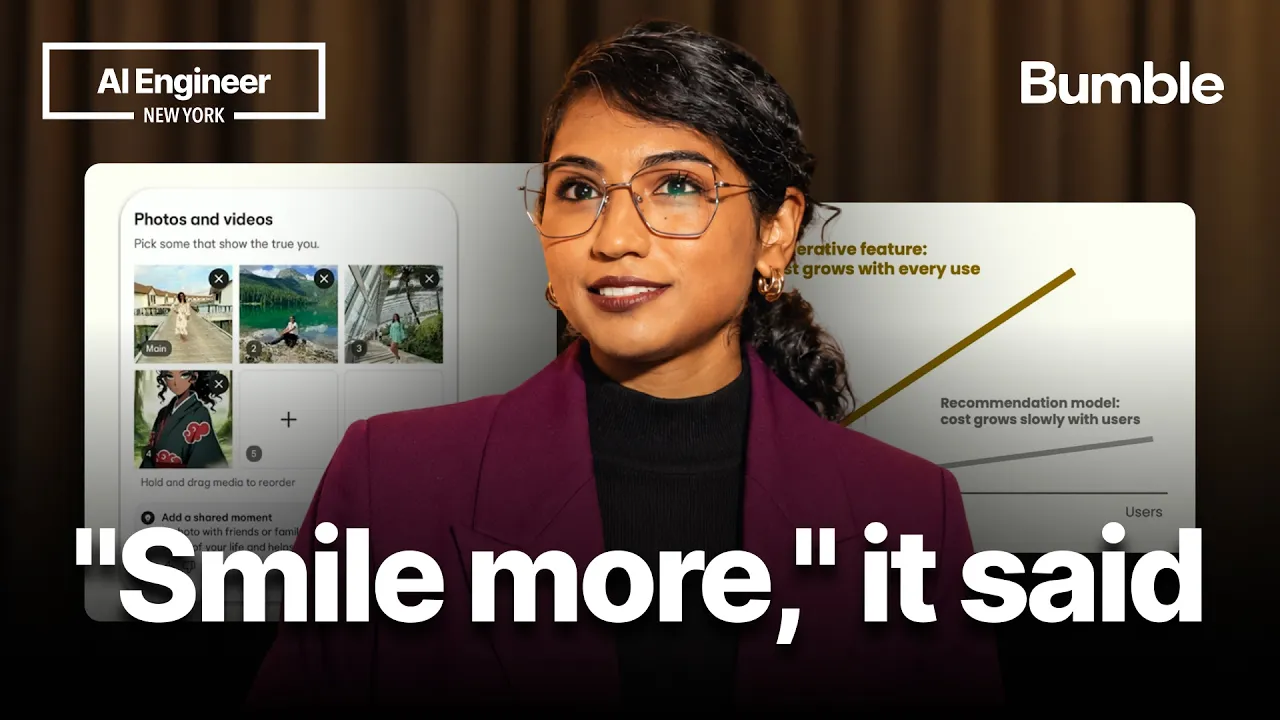
Bumble also found that favorable topline metrics concealed harmful or nonsensical individual outputs, such as telling users to smile more in photos where they were already smiling. The team shifted from aggregate experiment outcomes to guardrails, review of real outputs, and evals across the long tail of users, demographics, and languages. A positive average is insufficient when a bad output can damage trust or affect a sensitive user decision.
Finally, the feature's economics and rollout scope were inseparable from its product result. Bumble initially used a high-quality model that was roughly 10 times more expensive than a simpler approach; moving to a cheaper model initially reduced both cost and impact, revealing that the experiment's success depended on the model, not merely on the feedback concept. Through repeated model, prompt, quality, and cost testing, Bumble found a cheaper viable option. The company also launched in the US but could not deploy the same feature unchanged internationally because AI rules vary by market.
Key Takeaways
- Claim: Surveyed demand for an AI feature does not predict real-world usage; adoption depends on whether the capability appears inside the user's existing workflow at the relevant moment. | Evidence: Although 78% of Bumble research participants said they wanted AI dating-profile feedback, only 10% to 15% of users exposed to the A/B test used the feature. Bumble increased adoption by prompting for feedback while users added photos and by resurfacing it when users were not getting matches. | Implication: Treat AI-feature discovery and activation as explicit experiment metrics. Build invocation into high-intent workflow moments rather than assuming users will seek out a standalone AI tool. | Caveat: The transcript does not quantify the size of the adoption improvement after contextual placement.
- Claim: A positive aggregate A/B-test result can mask unacceptable AI-output failures in the long tail. | Evidence: Bumble saw positive topline behavior—more photo additions and more profile changes—but inspection showed the system sometimes advised users to smile more when they were already smiling. | Implication: Do not approve AI features on dashboard averages alone; require output-level quality review and define error tolerances based on the harm, reversibility, and sensitivity of the recommendation. | Caveat: Acceptable error rates depend on decision stakes: poor song suggestions in Spotify's AI DJ are more tolerable than erroneous spending guidance in a banking product.
- Claim: Guardrails and evals are product requirements, not post-launch quality enhancements, for user-facing generative AI. | Evidence: Bumble defined prohibited feedback categories, including comments on uncontrollable traits such as skin color and height, then used eval tooling and real-output review to assess whether prompts produced appropriate feedback. | Implication: Specify what the model must never say before launch, then evaluate outputs across real use cases rather than only testing whether a feature changes a behavioral metric. | Caveat: The speaker does not specify Bumble's eval methodology, sample sizes, or automated-versus-human review process.
- Claim: AI quality must be assessed across user segments and languages because a feature can have a positive average while serving groups unevenly. | Evidence: Subudhi explicitly calls for checking whether women and men receive or respond to feedback differently, and whether generated feedback behaves differently in languages such as French versus English. | Implication: Add segment and locale slices to AI release criteria, especially where language, culture, identity, or safety changes how generated advice is interpreted. | Caveat: The transcript identifies the risk but provides no reported segment-level outcome from Bumble's test.
- Claim: Generative-AI unit economics worsen with success, so an experiment win on a premium model may not be a scalable product win. | Evidence: Bumble's initial best-quality LLM was approximately 10x more expensive than a simpler approach, while generative AI incurs incremental cost as more users invoke it; this differs from many traditional ML systems with high upfront training cost but lower per-use cost. | Implication: Instrument per-invocation and per-successful-outcome costs from the beginning; make model choice part of the experiment design, not a later infrastructure optimization. | Caveat: Switching to a cheaper model initially reduced accuracy and product impact, showing that cost reduction cannot be evaluated independently of output quality.
- Claim: Teams must determine whether an AI feature is justified by short-term ROI or longer-term strategic value before setting its quality and cost budget. | Evidence: The speaker contrasts an Amazon shopping assistant as a possible short-term conversion tool with a longer-term trust and platform-retention play; Bumble ultimately used repeated evals to compare models, datasets, prompts, impact, and cost and arrived at a cheaper option that retained a good result. | Implication: State the intended value horizon upfront. Short-term features need a clear unit-economic threshold; strategic features may justify greater model spend, but only with an explicit decision to fund that option value. | Caveat: Long-term brand-equity benefits are harder to attribute than direct revenue or conversion effects.
- Claim: Global availability is a product-design decision for AI features, not merely a rollout step after the feature works. | Evidence: Bumble launched its photo-feedback project in the US but could not ship the same implementation unchanged to other countries because AI regulation differs by jurisdiction. The speaker also cites Meta's Muse AI as available only in the US and Canada. | Implication: Choose early between a market-optimized launch in the highest-value jurisdiction and the added engineering, legal, and operational cost of localized product variants. | Caveat: The talk does not identify the specific legal requirements that blocked Bumble's expansion.
Detailed Brief
A practical release gate beyond 'did treatment beat control?'
- Claims: The speaker's final framework separates five questions that are often collapsed into a single A/B-test decision: actual use, output inspection, total solution cost, affordability of the winning model, and legal availability by market.; Product, engineering, and forward-deployed roles all need to account for legal and compliance constraints earlier in the build cycle rather than handing them off after technical completion.
- Evidence: Bumble is a dating app with more than 20 million monthly active users, making even small per-use generative-AI costs relevant at scale.; The speaker frames two legitimate rollout paths: build to satisfy all intended markets from the outset, or deliberately maximize impact in the US and accept that the feature may not launch elsewhere.
- Caveats: This is a practitioner case study and framework, not a causal comparison proving that every AI feature requires the same level of evaluation or regional customization.; The transcript is duplicated in its latter portion, so it offers limited additional technical implementation detail beyond the stated framework.
- Implications: Establish a cross-functional AI launch review that jointly signs off on adoption, quality and safety, cost, and jurisdiction readiness rather than allowing an experiment dashboard to serve as the sole launch gate.; Maintain a decision record for each AI feature that states its allowable error profile, model budget, target markets, and rationale for any market exclusions.
Notable Concepts & Terms
- AI photo feedback: Bumble's case-study feature: it generated suggestions for improving dating-profile photos without performing dating decisions on the user's behalf.
- Contextual activation: Embedding an AI invocation in an existing user journey—such as photo upload—rather than placing it in a standalone destination users must discover.
- Long-tail output evaluation: Reviewing individual and segment-level outputs that aggregate A/B-test averages can conceal.
- Guardrails: Explicit constraints on categories of generated feedback, particularly for sensitive or uncontrollable user characteristics.
- Evals: The tooling and process Bumble used to inspect real outputs and rapidly compare prompts, models, datasets, quality, and cost.
- Marginal inference cost: The per-use cost characteristic of generative AI that rises with feature adoption, unlike many conventional ML systems where much of the cost is incurred upfront.
- Model-dependent experiment result: Bumble's finding that performance fell after switching to a cheaper model, demonstrating that the apparent product win was dependent on the specific model quality.
- Market-specific AI rollout: A deployment strategy shaped by jurisdictional regulation, potentially requiring regional product variants or intentional market exclusions.
Operator Notes / Why Ken Should Care
- Add an AI experiment scorecard with separate gates for exposure-to-invocation conversion, invocation-to-useful-output rate, output safety/quality failure rate, cost per successful outcome, and market eligibility.
- Require a pre-launch output policy that lists disallowed recommendation categories and maps each to eval cases, escalation ownership, and release-blocking thresholds.
- Run model-routing or model-selection tests as product experiments: compare quality, task completion, retry rate, latency, and fully loaded inference-plus-evaluation cost before claiming concept-level validation.
- Decide explicitly whether each AI capability is a US-first optimized product or a multi-market product; involve legal/compliance before architecture and data-flow choices become expensive to reverse.
- Avoid using stated AI interest in discovery research as a forecast of adoption; test contextual triggers, default placement, and recovery prompts as part of the feature itself.
Source/Metadata
- Title: 78% Wanted This AI Feature. Almost Nobody Used It - Supriya Subudhi, Bumble
- Transcript words: 4367
- Duration seconds: 884
- Timestamp note: No timestamps or chapters were present in the supplied transcript. The transcript contains a substantial repeated passage after the speaker's conclusion.
Transcript
My name is Supriya. Happy to be here today. I'm here to talk to you all about why A-B testing for AI products is weird. So, for those of you who don't know what A-B testing is, it's a method used to evaluate two versions of something with each other and see which is better. So that could be two versions of an email where you're trying to see which one's getting more clicks. It could be two versions of a feature. It could just be a feature against what's already live right now. So let me ask a quick question. Can I get a show of hands? Who thinks that if an A-B test comes back positive, that the feature should actually ship? Well, it looks like a lot of you are smart and already know that when it comes to AI, things can get a little weird. But let's talk about why. So what I found when testing with AI features, specifically Gen AI and using LLMs in consumer tech features, a positive result from an A-B test is actually just where the journey begins. It's not where it ends. And we're going to go over five reasons that I've specifically discovered that were problems that we had to overcome. I'm a product manager. I work at Bumble. Bumble is a dating app with over 20 million monthly active users. And so what does a product manager do? We represent our users. We know the problems that they face. And we try to deliver things that can solve the problems, while still being responsible for the P&L of a company. Because we don't have unlimited resources to be able to solve their problems. So in order to talk through the five reasons that I think A-B testing with AI was weird, I figured it'll be good for you all to have a visual example of what we actually shipped, so that you can try to draw parallels with things that you're working on as well. The feature that we shipped was an AI photo feedback feature. In a dating app, naturally, everyone needs a dating profile. So they would add pictures, and they wouldn't know what good looks like. So we essentially came up with the expertise that we had of what works and what doesn't work in a dating profile. We gave AI-generated suggestions of how people could improve the pictures that they were adding. So let's go into the first one: users ask for it, and then they ignore it. Now, I mentioned that a PM is supposed to know the problems of our users, right? The tools that we have to do that is research. The journey begins with discovery. What are the problems that people have, and how can we solve them? Surveys and customer interviews are great tools to find out. When we do research at Bumble, one of the almost unanimous problems that everyone always talked about was that they didn't know whether their dating profile was good enough, and they didn't get any support from us in understanding whether they were doing a good job or not. So when AI came in and there was all that potential with LLMs, we knew immediately that this was a problem that we could solve. And so we came up with different versions of how we thought AI could help people's dating journeys without actually doing dating for them. And so when we showed people examples of AI support and guidance that we could give them, the response was great. Almost 78% of the people that we spoke to came back and said they would love getting feedback from us and tell them how to do better. But when we shipped the A-B test, which means that with 50% of the people getting the feature and 50% of the people not getting the feature, we only saw 10% to 15% people actually using the feature. What that taught us was that openness to AI doesn't actually predict whether people are going to use the feature. And that's where we go back to product management 101, which is you need to really bake in the entire journey of using AI into what people are already doing in the app. Education and awareness are super critical. What we did was instead of building a standalone feature, which people could just find within the app, we went into the journeys that people were already using. So when they were adding pictures, we asked them, "Hey, do you want feedback?" When they were hitting a wall when they were trying to find someone to date and not finding any matches, we would ask them, "Hey, did you go and check the feedback in your profile? Maybe you could change something." And that drove up adoption. It's really important that we obviously measure what it is we're trying to do. That is going to form the foundation, because ultimately, if the survey is coming back with a positive result and you ship the feature, and you haven't actually looked at whether people are using it or not, you won't be able to improve that adoption in the first place. The second thing that we found was that the average win hit the tail. So when we shipped this feature, again, the top line results were great. More people were adding pictures to their profiles. The number of changes that they were making to adjust their profiles was more than the people who weren't receiving the feedback. But when we went into the details, there were weird things happening. The AI-generated tips were actually telling people to smile more when they were already smiling in their pictures. And so what that told us is that the positive average was not enough to evaluate the success anymore. We had to go into the details. Let's look at two examples before I share what we actually did. So I think Spotify has something called an AI DJ. It generates playlists for people using AI. And then let's imagine that there's your banking app, which helps you budget and decide what you should spend on and how much you should spend in a month. The scope of error is quite different in both of these things. It's okay if two out of four of the songs that are generated by AI are not good. But it's not okay if an app is telling you to spend $2,000 when you really can't. So that's where guardrails come into place. That's where we started. Setting strong guardrails of what our AI-generated feedback should and should not do was super critical. We couldn't be telling people to change things that they can't control, their skin color, their height. These are things that the AI should not touch. The next thing we had to do was reading real outputs. So this is where evals were super helpful. Now, there are way more experts here that know about evals than me. You're in the right place to learn about that. But setting up the right eval tools were super critical for us. We were able to dig in and see what real users were seeing when they were getting feedback. And that was helping us actually see whether our prompt was actually doing a good job or not. And so ultimately, the success criteria changed from looking at overall results of green versus red to what does the long tail of data have? Are we happy with the way different segments of users are receiving feedback? Are women responding the same way to our feedback as men? Are different languages responding, like people in different countries responding the same way to feedback as well? Because maybe the language generated in French is different from the language generated in English. The third thing is that the green dashboard and the red bill. So naturally, with generative AI, the success comes with a cost. When we started, we knew that this was such a big problem for our users that we wanted the best quality of feedback and the highest accuracy. So we went with the best LLM. Now, naturally, that was about 10x more expensive than a simpler approach. And then you add to that the cost of running evals on the solution that you've built. That was just too much. Now, Bumble is not a stranger to AI. I mean, the matching algorithm is also a use of AI. But when it comes to ML, the cost is different compared to Gen AI. In an algorithm, there's a lot of upfront cost of compute as well as training. But then after it's working, the incremental cost for every user to use it is not that much. With generative AI, the more successful your product, the more people that use it, and the more often they use it, the more your bill increases. And so what do you do? Maybe don't jump to using the best model from the start. And it's very important to understand why you're using AI in the first place. There are a lot of my peers that I've spoken to who have just gotten mandates from their companies to use AI in their features and their product. But you really need to understand why you're doing it. Is it for long-term benefits or is it for something short-term? Now, let's look at Amazon as an example. They have an AI assistant that can help you buy something on Amazon. Now, why would Amazon need to launch this assistant? Is it for short-term benefits that good recommendations lead to more purchases and therefore more revenue in the short-term? Or is it, but what if the recommendations aren't great? Does that mean they don't do it? Maybe not. In the long-term, having an assistant that you can rely on might make people choose Amazon over other e-commerce companies. And so the reason to launch the assistant is just for brand equity and a long-term benefit of keeping your users on your platform. And so really understanding why you're trying to use AI is going to be critical here because your budget and how much you're willing to spend is going to come from that. From a short-term benefit, yes, maybe the ROI can be a quick decision. But if it's for a long-term play, maybe it's worth getting that extra budget. So I spoke about the fact that we just jumped to using the best model. Naturally, the cost was way too high and we could not scale that. So we switched. We made the simple decision to switch to a cheaper model. But as the cost went down, so did the impact of the results because the accuracy went down as well, which basically told us that the AI feedback that we were giving was, and the results that we saw from our A-B test was due to the model that we were testing, not the concept of giving feedback itself. And so what did we do? What we learned at this point was that we really need to test a lot. And being able to be data-driven was critical. And eval setups really helped us do that, looking at being able to test how much different models can impact different data sets, the difference in the cost, and then being able to retest different versions of prompts and feedback quite quickly. That was critical. And ultimately, we resulted in the cheapest option, which helped us get the good result. And now the last one, which is sometimes there just may not be a global rollout. So Meta recently launched Muse AI. I'm not sure if you all have used it. I'm from London, so I haven't yet. And that's because Muse AI is only available in the US and Canada. And this is because AI regulation is constantly changing and is different all over the world. And there is a financial and legal risk to companies to not be compliant with that. So when we started our project, we started in the US. We shipped in the US, but then that's it. We were not able to ship the feature that was available in the US as is to other countries. And so what did we do? We realized almost immediately that whether you're a product manager or not, whether you're an aspiring product engineer, forward deployed engineer, everyone needs to start being a generalist and thinking about compliance and legal applications of products that they're building early on. It can't come later. So what that means is you can have multiple approaches. You could start with, "Oh, I definitely know I want to ship this feature all over the world. Therefore, let me understand all the restrictions and build something within all of those things." Or you could go the approach of, "Hey, I know that US is where I'm going to get my maximum impact. And therefore, I will launch the best thing possible in the US and then maybe not anywhere else." So there's going to be a spectrum of decision making that you will have to make with this new set of data. It's not just about building anymore. If you built the best thing, but you can't get it in the hands of users, it doesn't mean anything. So you could take the path of, "Okay, one country," or you could take the additional cost of making a version of the app, which works differently in different countries as well. That's the decision that now needs to be made. So to summarize, I think whenever it comes to AI features, when you all are building, ask yourself these five questions: Are people using it, or are they just saying that they will use it? Do you read real output or just look at the averages? Does it still pay off after factoring in all the costs that went into the solution? Is a win on the best model something you can afford? And are you clear legally on which markets you can ship in? Because the question is not just did the feature win the A-B test anymore? Thank you. The tools that we have to do that is research. The journey begins with discovery. What are the problems that people have, and how can we solve them? Surveys, customer interviews are great tools to find out. When we do research at Bumble, one of the almost unanimous problems that everyone always talked about was that they didn't know whether their dating profile was good enough, and they didn't get any support from us in understanding whether they were doing a good job or not. So when AI came in and there was all that potential with LLMs, we knew immediately that this was a problem that we could solve. And so we came up with different versions of how we thought AI could help people's dating journeys without actually doing dating for them. And so when we showed people examples of AI support and guidance that we could give them, the response was great. Almost 78% of the people that we spoke to came back and said they would love getting feedback from us and tell them how to do better. But when we shipped the A-B test, which means that with 50% of the people getting the feature and 50% of the people not getting the feature, we only saw 10% to 15% people actually using the feature. What that taught us was that openness to AI doesn't actually predict whether people are going to use the feature. And that's where we go back to product management 101, which is you need to really bake in the entire journey of using AI into what people are already doing in the app. Education and awareness are super critical. What we did was instead of building a standalone feature, which people could just somehow find within the app, we went into the journeys that people were already using. So when they were adding pictures, we asked them, hey, do you want feedback? When they were hitting a wall when they were trying to find someone to date and not finding any matches, we would ask them, hey, did you go and check the feedback in your profile? Maybe you could change something. And that drove up adoption. It's really important that we obviously measure what it is we're trying to do. That is going to form the foundation, because ultimately, if the survey is coming back with a positive result and you ship the feature, and you haven't actually looked at whether people are using it or not, and you won't be able to improve that adoption in the first place. The second thing that we found was that the average win hit the tail. So when we shipped this feature, again, the top line results were great. More people were adding pictures to their profiles. The number of changes that they were making to adjust their profiles was more than the people who weren't receiving the feedback. But when we went into the details, there were weird things happening. The AI generation generated tips were actually telling people to smile more when they were already smiling in their pictures. And so what that told us is that the positive average was not enough to evaluate the success anymore. We had to go into the details. Let's look at two examples before I share what we actually did. So I think Spotify has something called an AI DJ. It generates playlists for people using AI. And then let's imagine that there's your banking app, which helps you budget and decide what you should spend on and how much you should spend in a month. The scope of error is quite different in both of these things. It's okay if two out of four of the songs that are generated by AI are not good. But it's not okay if an app is telling you to spend $2,000 when you really can't. So that's where guardrails come into place. That's where we started. Setting strong guardrails of what our AI-generated feedback should and should not do was super critical. We couldn't be telling people to change things that they can't control, their skin color, their height. These are things that the AI should not touch. The next thing we had to do was reading real outputs. So this is where evals were super helpful. Now, there are way more experts here that know about evals than me. You're in the right place to learn about that. But setting up the right eval tools were super critical for us. We were able to dig in and see what real users were seeing when they were getting feedback. And that was helping us actually see whether our prompt was actually doing a good job or not. And so ultimately, the success criteria changed from looking at overall results of green versus red to what does the long tail of data have? Are we happy with the way different segments of users are receiving feedback? Are women responding the same way to our feedback as men? Are different languages responding, like people in different countries responding in the same way to feedback as well? Because maybe the language generated in French is different from the language generated in English. The third thing is that the green dashboard and the red bill. So naturally, with generative AI, the success comes with a cost. When we started, we knew that this was such a big problem for our users that we wanted the best quality of feedback and the highest accuracy. So we went with the best LLM. Now, naturally, that was about 10x more expensive than a simpler approach. And then you add to that the cost of running evals on the solution that you've built. That was just too much. Now, Bumble is not a stranger to AI. I mean, the matching algorithm is also a use of AI. But when it comes to ML, the cost is different compared to Gen AI. In an algorithm, there's a lot of upfront cost of compute as well as training. But then after it's working, the incremental cost for every user to use it is not that much. With generative AI, the more successful your product, the more people that use it, and the more often they use it, the more your bill increases. And so what do you do? Maybe don't jump to using the best model from the start. And it's very important to understand why you're using AI in the first place. There are a lot of my peers that I've spoken to who have just gotten mandates from their companies to use AI in their features and their product. But you really need to understand why you're doing it. Is it for long-term benefits or is it for something short-term? Now, let's look at Amazon as an example. They have an AI assistant that can help you buy something on Amazon. Now, why would Amazon need to launch this assistant? Is it for short-term benefits that good recommendations lead to more purchases and therefore more revenue in the short-term? Or is it, but what if the recommendations aren't great? Does that mean they don't do it? Maybe not. In the long-term, having an assistant that you can rely on might make people choose Amazon over other e-commerce companies. And so the reason to launch the assistant is just for brand equity and a long-term benefit of keeping your users on your platform. And so really understanding why you're trying to use AI is going to be critical here because your budget and how much you're willing to spend is going to come from that. From a short-term benefit, yes, maybe the ROI can be a quick decision. But if it's for a long-term play, maybe it's worth getting that extra budget. So I spoke about the fact that we just jumped to using the best model. Naturally, the cost was way too high and we could not scale that. So we switched. We made the simple decision to switch to a cheaper model. But as the cost went down, so did the impact of the results because the accuracy went down as well, which basically told us that the AI feedback that we were giving was, and the results that we saw from our AB test was due to the model that we were testing, not the concept of giving feedback itself. And so what did we do? What we learned at this point was just that we really need to test a lot. And being able to be data-driven was critical. And eval setups really helped us do that, looking at being able to test how much different models can impact different data sets, the difference in the cost, and then being able to retest different versions of prompts and feedback quite quickly. That was critical. And ultimately, we resulted in the cheapest option, which helped us get the good result. And now the last one, which is sometimes there just may not be a global rollout. So Meta recently launched Muse AI. I'm not sure if you all have used it. I'm from London, so I haven't yet. And that's because Muse AI is only available in the US and Canada. And this is because AI regulation is constantly changing and is different all over the world. And there is a financial and legal risk to companies to not be compliant with that. So when we started our project, we started in the US. We shipped in the US, but then that's it. Like, we had to stop. We were not able to ship the feature that was available in the US as is to other countries. And so what did we do? We realized almost immediately that whether you're a product manager or not, whether you're an aspiring product engineer, forward deployed engineer, everyone needs to start being a generalist and thinking about compliance and legal applications of products that they're building early on. It can't come later. So what that means is you can have multiple approaches. You could start with, oh, I definitely know I want to ship this feature all over the world. Therefore, let me understand all the restrictions and build something within all of those things. Or you could go the approach of, hey, I know that US is where I'm going to get my maximum impact. And therefore, I will launch the best thing possible in the US and then maybe not anywhere else. So there's going to be a spectrum of decision making that you will have to make with this new set of data. It's not just about building anymore. If you built the best thing, but you can't get it in the hands of users, it doesn't mean anything. So you could take the path of, okay, one country, or you could take the additional cost of making a version of the app, which works differently in different countries as well. That's the decision that now needs to be made. So to summarize, I think whenever it comes to AI features, when you all are building, ask yourself these five questions. Are people using it? Are they just saying that they will use it? Do you read real output or just look at the averages? Does it still pay off after factoring in all the costs that went into the solution? Is a win on the best model something you can afford? And are you clear legally on which markets you can ship in? Because the question is not just did the feature win the AB test anymore? Thank you.