I Spent Two Years Building the Median — Hariprasad Sudharshan
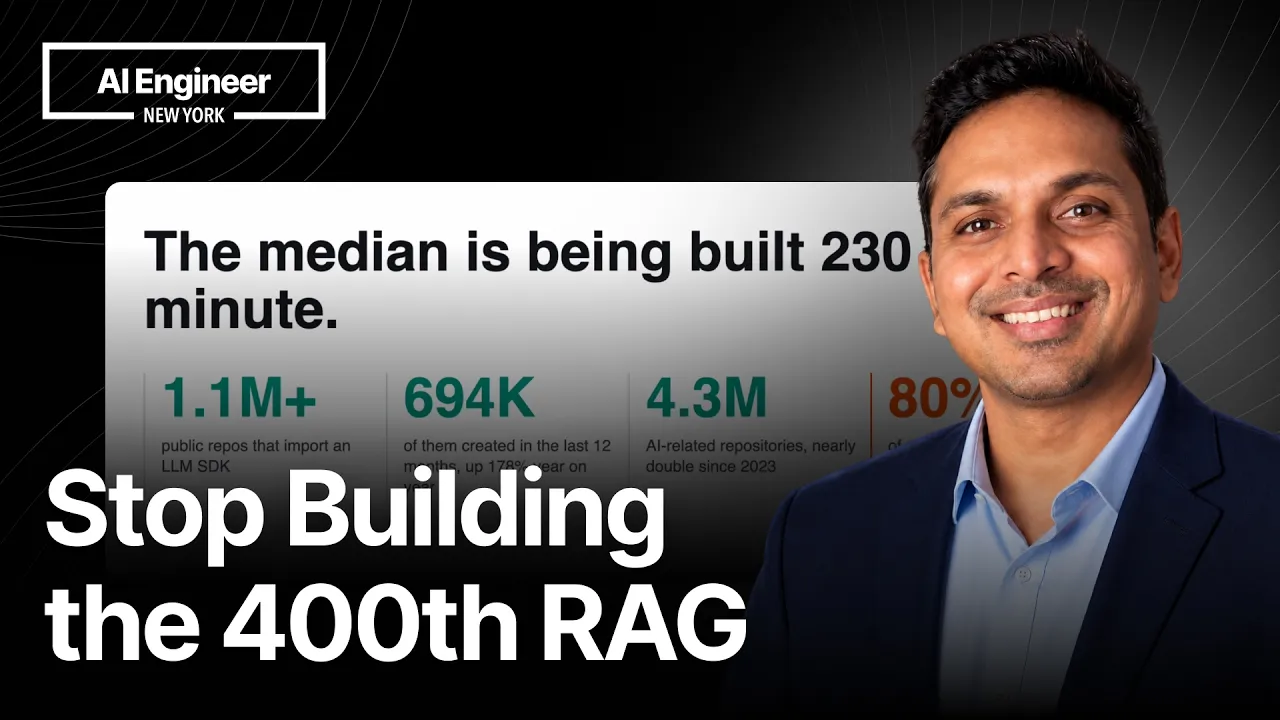
Description
After two years of intense solo building, Hariprasad Sudharshan discovers that other people have independently produced calculators much like his own. Nobody needs to have copied anyone: the same models, tools and familiar problem can lead builders toward the same solution. He calls that shared starting point the median. Faster development makes it easier to ship useful software, including internal tools and learning projects, but a functioning demo does not establish a durable product advantage. His talk is a personal reflection on that distinction, rather than a controlled study of product success or a disclosed business outcome. Sudharshan separates the model's capability from its harness and the product a customer ultimately receives. He describes a build first reflex that replaces searching for existing solutions with immediately opening a coding agent. His alternative is a novelty budget: name the one distinctive thing before starting, include it in the roadmap and review it as deliberately as other project spending. For leaders evaluating demos, he proposes three questions. Who has already solved this? What does this team have that a competitor does not? Where will the application reach users? A later calculator iteration focuses on the difference between running open model weights inside an enterprise and purchasing inference, including utilization and the infrastructure between weights and generated tokens. The practical lesson is to use the readily available starting point where it helps, then spend judgment on a specific problem, distribution and a defensible difference. Speaker info: - https://github.com/brettleehari - https://www.linkedin.com/in/haripm4ai/ Timestamps: 00:00 - The deterministic software underneath everyday life 3:54 - Rented models change how software gets built 6:41 - Athletics and moving model leaderboards 10:28 - Model, harness and product 12:09 - The median and converging solutions 14:24 - Useful software and the limits of differ
Summary
Generated by gpt-5.6-terraAt-a-Glance
- Verdict: Skim
- Core thesis: AI makes competent deterministic software cheap and fast to produce, but because models and common agent harnesses converge on similar solutions, durable product advantage must come from explicit novelty, proprietary context, opinionated choices, or distribution rather than prompting or model selection.
- Why it matters: For AI-native products and agent systems, the default output of rented frontier models is increasingly a reusable baseline rather than a moat; teams need a disciplined way to distinguish internal automation from defensible market offerings.
- Best use: Use this as a product-strategy calibration talk: adopt its novelty-screening questions for roadmap reviews, while skipping the repeated framing and treating its infrastructure claims as directional rather than a complete operating model.
Executive Summary
Hariprasad Sudharshan argues that AI does not replace the central role of deterministic software. Modern infrastructure still requires repeatable, reliable outputs; models are probabilistic inputs used to accelerate the creation of that deterministic artifact. In his framing, AI’s major five-to-ten-year value is lowering the cost of building software and making previously uneconomic or difficult software feasible.
The strategic problem is that model capability is rented and widely accessible. Small benchmark or Elo differences between labs are moving, relative measures rather than durable product advantages, and teams often confuse a model comparison with a comparison of the surrounding harness: tools, context, prompts, memory, orchestration, workflows, and MCP integrations. Given the same problem and broadly similar tools, many builders arrive at the same competent answer—the "median."
He does not dismiss AI-built software as "slop." It is often useful, finished, and especially valuable for internal applications, learning, and empowering new builders. But it has little inherent durability in an open market because competitors can generate similar products quickly; distribution can then become the effective moat. His own experience building numerous applications, including an LLM-cost calculator that resembled many others, led him to conclude that shipping speed is no longer itself differentiation.
His remedy is to assign every project a "novelty budget": before building, identify at least one specific thing the team can do that another team cannot readily reproduce. Leaders should ask who already built the solution, what unique asset or perspective the team has, and where the application will live or be distributed. His revised calculator differentiated by modeling the operational cost gap between open-weight deployment and cloud token consumption—an overlooked enterprise decision rather than another generic calculator.
Key Takeaways
- Claim: AI-assisted development will primarily use probabilistic models to produce deterministic, reliable software rather than displace deterministic software itself. | Evidence: The speaker contrasts model outputs with the dependable software required for systems such as aviation, payments, transit, elevators, and critical infrastructure; he identifies AI’s likely role as lowering development cost and enabling software that was previously too expensive, low-priority, or hard to build. | Implication: For agent and automation systems, use AI where it expands implementation capacity, but preserve deterministic control layers, validation, and reliable final workflows where the business outcome requires repeatability. | Caveat: This is a strategic forecast rather than an empirical proof, and it does not address cases where probabilistic behavior is itself the product output.
- Claim: Model leaderboard advantages are weak foundations for product strategy because they are small, relative, and rapidly changing. | Evidence: He cites a Stanford comparison with Anthropic at 1503 and Mistral at 1416, emphasizing that the 87-point gap is a relative rating within that evaluation environment, not an absolute measure of intelligence; he compares frontier-model competition to elite sprint races decided by hundredths of a second. | Implication: Avoid anchoring a roadmap or investment thesis on access to a particular frontier model unless the advantage is demonstrably durable through proprietary integration, data, economics, or workflow performance. | Caveat: He is not arguing that model evaluation is useless; the warning is against making a narrow, moving frontier gap the central roadmap advantage.
- Claim: Teams frequently compare products or coding environments when they believe they are comparing models, obscuring the actual source of performance. | Evidence: He distinguishes the model as an engine or athlete from the harness around it—tools, context, instructions, orchestration, memory, workflows, and MCP tool calls—and says comparisons such as Claude Code versus Cursor or Codex are not pure model comparisons. | Implication: Evaluate agent systems as full operating systems: separately measure base-model capability, context quality, tool reliability, orchestration, guardrails, and user-facing workflow outcomes. | Caveat: A harness can be valuable differentiation, but the speaker’s point is that increasingly commoditized models and reusable harness patterns alone are unlikely to remain defensible.
- Claim: AI makes the "median" product essentially free: competent software can be built and shipped quickly, but many independent builders will converge on the same solution. | Evidence: He says that before 2023 a baseline product required a team, time, and stack, whereas a coding agent can produce scaffolding in minutes, a working demo in hours, and potentially a supported product in about four weeks. He argues this convergence is not plagiarism but multiple people applying the same broadly available source capability to the same problem. | Implication: Treat prompt-to-production as an efficient delivery path for internal tooling and commodity features, but do not count it as a market differentiator without an additional source of advantage. | Caveat: Median products are still useful and may be successful for their creators, especially for internal use, education, or personal utility; "median" is not synonymous with low quality or AI slop.
- Claim: The main behavioral risk of coding agents is a "build-first reflex" that replaces search, buy-or-fork decisions, and explicit product judgment with rapid construction. | Evidence: His example is asking an agent to build another RAG system despite mature open-source alternatives with thousands of stars; the agent complies because it was asked to build, even though the solution is already solved. He reports repeatedly building projects and later discovering crowded categories or dozens of similar launches. | Implication: Make discovery and reuse gates mandatory before greenlighting new builds; require teams to establish why existing products, open-source projects, or forks cannot satisfy the need. | Caveat: Building remains necessary to develop intuition, and the speaker explicitly favors rapid building where the goal is learning or internal consumption.
- Claim: A project needs an explicit novelty budget—at least one substantive, named source of non-replicable value—if it is intended to compete in the market. | Evidence: He invokes PageRank as an example of a novelty that moved beyond the basic crawler-and-index search median. His three leadership questions are: who has already done this, what do we have that another team or competitor does not, and where will the application live. His operating rule is that when an AI coding agent says "done," it has supplied the median and the differentiating work begins. | Implication: Require each externally facing initiative to state and review its novelty hypothesis alongside scope, cost, and delivery milestones; if none exists, classify the effort honestly as an internal tool, learning exercise, or commodity capability. | Caveat: Novelty alone does not guarantee success; he also acknowledges that a median product may survive with a major distribution moat.
- Claim: Open-weight models do not automatically create inexpensive self-hosting because serving them requires a complex operational stack and structurally sufficient utilization. | Evidence: After finding 244 similar LLM calculators, he differentiated his own tool by estimating enterprise cost for identical model weights run internally versus cloud token consumption. He names roughly ten intervening layers, including MLOps, SRE, precision choices, KV cache management, batching, execution, parallelism, and utilization; he calls utilization structural and not something an enterprise can simply buy. | Implication: For any open-model deployment decision, model the full serving stack and sustained utilization—not just model-weight availability or per-token API price—before concluding that self-hosting is strategically or economically superior. | Caveat: The talk provides no quantitative break-even thresholds, workload assumptions, or validation of the calculator’s estimates, so it is not a substitute for a workload-specific TCO analysis.
Detailed Brief
How to interpret AI-generated similarity
- Claims: The speaker rejects the blanket label of "AI slop" for the expanding volume of AI-assisted repositories and applications.; A product’s success criterion depends on the creator’s objective: revenue is one metric, but a personal tool, portfolio artifact, or proof that a non-specialist can build an application can also be successful.; The relevant distinction is not whether the artifact was AI-generated, but whether it is intended to compete in an open market without unique value.
- Evidence: He describes personally shipping an iOS app despite previously thinking of himself as a developer in a different lane, and cites Lovable and Replit as examples of platforms enabling new builders.; He says models tend to return converged best practices rather than an individual builder’s distinctive judgment.
- Caveats: This framing is qualitative; the talk does not define measurable standards for originality, quality, retention, or commercial viability.; AI-generated similarity can still be valuable if it expands access or reduces the cost of an otherwise valuable workflow.
- Implications: Separate quality review from differentiation review: a useful artifact can pass the former while failing the latter.; Avoid dismissing low-code or agent-built work based solely on its origin; judge it against the target user outcome and competitive context.
Leadership calibration in the era of rapid demos
- Claims: Leaders who do not build with current AI tools can overvalue demonstrations because outputs that once required a quarter and a team can now be shown by one engineer quickly.; The speaker argues that firsthand building is the only reliable way to recalibrate intuition about what is easy, commodity, difficult, and novel.; Opinionated product judgment is the cheapest form of novelty because generalized models optimize toward probable, consensus-like answers.
- Evidence: He says he has shared his questions with organizational leaders and observed recurring weekly demo volume.; He characterizes coding agents as giving away the "last great design" through scaffolding, while the next platform-level building block remains the builder’s job.
- Caveats: The talk does not specify how nontechnical executives can gain this calibration without personally becoming active builders.; Being highly opinionated can also produce poor product decisions if it is not validated against users and market evidence.
- Implications: Demo review should include a commodity assessment and evidence of customer/distribution advantage, not merely an assessment of technical completion.; Reserve senior attention for capabilities that combine a concrete proprietary asset or thesis with a credible path to adoption.
Notable Concepts & Terms
- Median: The common, competent solution produced when broadly available models and standard agent tools are aimed at a familiar problem; useful to ship, but not inherently distinctive.
- Rented models: Frontier capabilities accessed through APIs or generally available providers; their accessibility levels the playing field and weakens model access as a moat.
- Harness: The deterministic system surrounding a model—context, tools, prompts, orchestration, memory, workflows, and MCP calls—which must be evaluated separately from the base model.
- Build-first reflex: The tendency to immediately ask an agent to build a solution rather than search, buy, reuse, fork, or make a deliberate product decision first.
- Novelty budget: A roadmap discipline that allocates explicit effort toward at least one named, meaningful differentiator before development begins.
- Prompt-to-production path: The rapid route from a natural-language request to a working product; the speaker considers it legitimate for internal work but usually a median path for competitive products.
- Open weights versus open inference: The distinction between freely available model parameters and the costly, operationally complex ability to serve them reliably at useful scale.
- Distribution moat: The advantage that can determine winners when product implementations converge; without it, a polished demo may be an expensive way to discover there is no route to adoption.
Operator Notes / Why Ken Should Care
- Add a mandatory pre-build checkpoint for external AI products: identify existing alternatives, the exact novelty claim, the proprietary asset supporting it, and the intended distribution channel.
- Classify AI initiatives into internal automation, learning/prototyping, commodity parity, and defensible product bets; apply different approval and success criteria to each category.
- Update agent-system evaluations to isolate model quality from harness quality, including tool success rate, context availability, orchestration reliability, error handling, and final workflow outcomes.
- Require self-hosted/open-model proposals to include workload-specific total cost of ownership: utilization assumptions, batching, caching, hardware, reliability/SRE coverage, and comparison against API token costs.
- Avoid treating faster prototype delivery or a preferred coding-agent workflow as evidence of a durable roadmap advantage; demand market, distribution, or unique-data evidence.
Source/Metadata
- Title: I Spent Two Years Building the Median — Hariprasad Sudharshan
- Transcript words: 9536
- Duration seconds: 2171
- Timestamp note: No usable timestamps or chapters were present. The supplied transcript contains substantial repeated passages, so the source is more repetitive than its stated word count suggests.
Transcript
If I tell you New York City tonight suddenly stops working, you tell me what could be possible reasons for no flights leaving JFK. The subway suddenly stops at the next station and stays there. None of your tap pay is working. The elevators you get in, they don't know which floor they are. The phones are not ringing, Wall Street, and the entire world comes to a standstill. What could be the reason? Software. Unless otherwise there is a software issue that affects the entire globe, there is nothing that can stop this modern world. This is how much the city of New York and our entire globe is actually driven by unseen software. Not the AI kind of software that we mostly talk about. It's the traditional, deterministic, rule-based, reliable software that has brought the modern world to us. It is handcrafted for over 70 years by humans. I'm Hari. I'm the product person who has built software for almost two decades now. And I have this one genuine theory. If at all there is a new industry in human history, it must be the software industry. Because you take navigation, agriculture, construction, and even astronomy. We had this in different forms and shapes earlier. Now that it may be more sophisticated, but they are nothing new to us. Today from getting to work to watching this video, from nuclear reactors to all the way to space stations, that drives the $125 trillion economy, the one common factor is software. So it would be catastrophic if for some reason software stops. It's like Y2K. And our modern world owes a lot to this kind of software. The deterministic kind, where you trust it with your pacemaker and when you fly on your 747. So if you look into the product here, on the left side, you have the engineers. The engineers are hired and they are the source of judgment for every product out there with their unique taste. And I'll go to an extent and call their belief systems and value systems reflective in the software that they shipped. The tool chain owned deterministic rules all the way. The software that runs the world and the tool chains next to it in a cross-feedback loop, where the assemblers built C, C built Unix, Unix built everything. And then we built Kafka, Zookeeper, all the way up to Kubernetes that runs the world today. The only judgment in this picture is human judgment. And we all know how varied we are. And that variance is where every product edge originates. The block here is a high-level representation of the entire software industry and the world economy. Who has the IP? Where is the continuous loop? And how that loop, where every brick on the tool chain, helps us scale new heights. Whether the software is deterministic or probabilistic. That's a question. And hold this picture. Let's watch one card change, which is, yes, in the age of AI, the engineers today are assisted, or driven, or sometimes they claim it's completely autonomous, by models that I would call rented. The good thing is that it creates a level playing field with everyone having equal access to the bleeding edge models and harnesses. Teams who cannot afford earlier access to the talent pools of Google and Meta, who handcrafted this modern software, can now afford intelligence through APIs, where it claims to have solved the software problem. Let's see whether it really solved or what's happening. If you actually pay attention and look under the hood, everything around the model, the harness, the agents, the tools, the MCP, are still the same old deterministic software. People who are building this would definitely know that these are not AI products. These are the same old deterministic software built through the models. And what did not change and stay put is what's the outcome? At the end of the day, the world requires software that's the same thing reliably every time. So the final artifact is deterministic software that drives the world economy as we know it. If that is the case, then what is the role of AI here? Its role is to, one, accelerate the development of deterministic software at the lowest cost possible. And write deterministic software that never existed before because of budget, not an interesting problem, hard problems. So those are the two use cases I see going to play out in the next five to ten years. So the bottom line is we will be using a probabilistic gear to crank out reliable deterministic software by augmenting or somebody will go to an extent say replacing human judgment. Is it possible? Where are we today? We will see in this talk. Who knows this person? I'm a big fanboy of him. He's a superhuman and he's French. Okay, now I see you will connect dots because you know the couple of men there and he's part of the elite sub-ten club. Two of them are relatively well-known, but all three are superhumans, aren't they? So in 2015, nine souls competed and the difference between them is only 27 hundredths of a second and Gatlin lost the gold by 100th of a second. Can you believe it? It's not comprehensible to human mind. The scientific measurements gave that. Okay, that is how Usain Bolt won over Gatlin that night. On another night, the order could be completely different. I still run those 100 meters and I take 13 seconds, not 10. How about you? That's the difference between us and these extraordinary athletes competing at the edge of human capability. But as a fanboy, I will argue my favorites. But I also speak to professionals in this game and in their opinion, the gap is so tiny that the previous best or who holds the world record does not matter when they get onto the field. On a given day, anybody can beat anyone. I'm going to apply the same yardstick on models to drive a couple of points. Six labs, the recent study came out from Stanford, a few dozen ELO points here and there. And the leaderboard is changing with every release cadence. And the popular question this week, which model are you using and how smarter did you feel by using that model? Isn't that the great dinner table argument these days? But I can tell you one thing, it is not necessarily a good boardroom argument. Why? Because often the emotional side of us, the fanboy moment, peeks into meeting rooms. After all, we are all humans. I am not saying don't compare models. All I am saying is don't make a small moving frontier gap into your product roadmap as an advantage. Let's live a little bit deeper here because there are some numbers to unpack. Anthropic 1500, 3, Mistral 1416, 87 points here and there. It does not mean Anthropic is 87 points smarter than Mistral. Actually, the scores, the way we should read them is relative rating derived from model comparison. It actually tells us how these models rank relative to one another in that evaluation environment. It's not an absolute intelligence scale. But here is the elephant in the room. In all these conversations across multiple teams I have seen, multiple organizations, while we think we are comparing models, what I have observed is many times we are not even comparing models. We mistakenly compare the harness or the product around models. Claude versus Cursor or Codex isn't a model comparison. It's closer to comparing Jamaica versus USA. You're comparing an athlete and the training system around the athlete. So the model is the athlete or the engine. It provides the underlying capability. The harness determines how this engine is used. The tools, context, instructions, orchestration, memory, workflows, the MCP tool callings. That's the harness around it. The product determines why anyone should care because that's the end product. Today, you and I can rent the engine and very much all the harnesses that come with engines. Some come tightly coupled, some are loosely coupled. So if everybody has the same source like we saw in the previous picture, where is the differentiation? The one that used to come which made these different companies thrive in different areas, the source or the first principles of that is from the diversity and the variance of their engineer minds. Given the model is rented, increasingly what we are seeing is that once the capability is available to everyone, then what are we staring at? The model and the harness do not care who is typing and from which part of the world or whether you are an E6, E7, or an E1 engineer. Point at the same problem, same tools, it gives the next person what it gave you. And I want to call this answer as a median. And this median keeps changing with every release cadence, as we saw in the diagram there. The previous problem solved, get into these LLMs, and then incrementally, that's what these releases come one after another, just like software cadence. I'm super simplifying here, but in a nutshell, that's what keeps the median moving up front, which is a good thing. So, at the same time, it's also a kind of trap. Because it is good enough to ship, but it is hard to tell apart that what the next person is going to ship. Because the next person or the competitor could have also shipped something similar. is typing and from which part of the world or whether you are an E6, E7, or an E1 engineer. Point at the same problem, same tools, it gives the next person what it gave you. And I want to call this answer as a median. And this median keeps changing with every release cadence, as we saw in the diagram there. The previous problem solved, get into these LLMs, and then incrementally, that's what these releases come one after another, just like software cadence. I'm super simplifying here, but in a nutshell, that's what keeps the median moving up front, which is a good thing. So, at the same time, it's also a kind of a trap. Because it is good enough to ship, but it is hard to tell apart what the next person is going to be shipped. Because the next person or the competitor could have also shipped something similar or exactly the same. This could not have happened before 2023. The median product was expensive. You needed a team, time, stack. Today, that solved problem is free. And the problem that is free is free for everyone. And you go out to the customer like how everybody goes out. And when this problem of so many products which are similar flooding the market, then the distribution becomes the mode, not your product. So, what is that mode that you can create in this new environment? I'm going to quickly go through GitHub's own number to reiterate the point that this model and harness are producing enormous amount of new software. And to me, these are really good software. But the outcomes are similar. This is not a crowd of copycats. Definitely not. It's a crowd of people who have arrived at the same answer because the source or the cookie cutter is the same. And the word that our industry chose for what they built is AI slop. The software AI slop. I want to take that word away from you and give you a new meaning to it. Let me be fair first. If you have been developing for a long time and you stumbled upon this AI-assisted development, it felt like magic, isn't it? Because we were taking a black box and pointing something to it, you would have definitely felt at some point in time, oh, it did really well. Two weeks ago, I shipped an iOS app. I've been a developer, but I've never dreamt of developing an app because remember, we had lanes. Embedded developer, app developer. AI today is making everyone a developer. To me, that's a good thing and I mean it. The word slop is negative. And they use it without any empirical analysis. Here is why I feel that those 100,000 of repos and proliferation of AI-assisted development is bringing new people into the field who have never developed. The success metrics for these new products cannot be looked at from the lens of those experts. I would like to define the success of those million AI apps as long as they meet the success of their creators. Because who defines what a successful product looks like? For us, it could be something that brings a revenue. For someone else, it could be something that they can show it next to their colleagues. Hey, see, I've built this wonderful website. That's a success too. And I've seen millions of people actually done that with Lovable and Replit, which is cool. They are not AI slops. What you get when you point a good problem at a coding agent. Most times than not, today, it's useful and a finished artifact. Maybe similar because the same cutter went into the same door. But most software developed this route is falling into what I call the median. I am not telling you to stop developing or shipping it. It's perfectly fine for internal consumption. The one caveat here is that stop counting this as a differentiating factor. But this median is lacking one thing. We need to also know the positives as well as the disadvantages. It's not a new problem. Back in the 90s, everybody was trying to solve the search problem. And most of them had the basic crawler and an index. And whoever is going to solve that problem really well or who has that novelty element is going to rise up because that's a differentiating factor. So today I say the median of most software that you can think of building is actually free. But if you want to compete in the open market, you need that element of novelty. Credibility. So some credibility before I go further because I've spoke almost for a long time. I did not start building when the models got better. I have built more than a dozen of applications in public and contributed to Lama Index and other repos. The last three years have been quite exciting and that brought me to this topic and tiring at the same time. I want to show you this because the project I'm going to show you are not hobbyist first attempts. I tried to solve a real world problem and I ended up with a median. I never expected that. So I want to coin a few terms here. The build first reflex. When we all got excited with this AI and things, we stopped doing something which is back in the days when building was costly and difficult. I used to search more than I built. Today it's flipped. You find a problem at a coding agent is more easier than going and searching and reading through those verbos, whatever comes out, and making a decision. We don't want to make decisions anymore. And this is getting the new normal in our craft. So what do we do? Let's ask the coding agent to build a rack system. And I call this the build first reflex. Open a problem, open an agent, yeah, you get the scaffoldings in the first two minutes. And I'm sure if you have been used to this kind of development, you would do a demo in two hours, working demo, where you give it to someone with rough edges, it works. And you could actually launch within four weeks, a real good product with support and everything. But only then you find out that, okay, I have built the 400th or 4,000th rack system. I took rack as an example here. So I pointed the same problem and this is what we got. And I asked, hey, why did you build the Nth rack system? When more mature, feature-rich, open-source systems are available with thousands of stars and maturity, we could have just leveraged it. We should not have built it. Three years ago, we wouldn't have built it. So it accepted that, hey, okay, I'm the culprit here. You said, can you build? I went ahead and built. If you had told me this, then I would have done something different. The median rack is what actually it built, which is a solved problem. But if you are building it for the first time, it's going to be exciting for you because you're going to feel that, I gave a PDF, I'm pointing it to a backend LLM, and I'm asking the questions, the chunking, and all those factors which I understand or do not understand, it's going to solve it for me, the vector DB, and I got a solution. Small wins produce a lot of dopamine, and I fall for the same things as you are. And this is the verbose response. I refined that on the previous slide. Now, I'll stop talking about those trivial problems and show one of my applications. This one project is one of the representatives of the first two years where I developed a lot of apps. Like you all know, my build first reflex kicks in. I did it there's a lot of times to coin this term. I built it by sacrificing going out to play. I skipped many socials and movie nights, and I was building. It was like playing a game of chess where you're addicted to it. And I had every AI platform you could imagine max plan, sometimes free. After all that effort, I finally soft launched. I'm a bit of a perfectionist. So until then I was bombastic because I could see my idea become something which is real in no time where as a product manager it would have taken me a big team architects. I was able to do it all alone. I was bombastic until I found out that I haven't calibrated to reality yet. The truth is, my circle told me that they have seen similar calculators elsewhere. And before anyone thinks I stole from them or they from me, the surprising thing is that nobody copied from anybody. It's the same thing. It's a copycat work. When I analyzed some of those open and closed calculators, I found it the same sometimes. Not even similar. And how could people across could arrive at similar solution? Even if you look at the LLM routing, everywhere is converging like those models did. Even solutions are converging. And competing for a tiny space. Developers. And it's like having same developers in your team, and your competitors also have the same developers. So you can build intuition only through building. And I'm sure you're able to, those builders would agree with me. I was all alone. I was bombastic until I found out that I haven't calibrated to reality yet. The truth is, my circle told me that they have seen similar calculators elsewhere. And before anyone thinks I stole from them or they from me, the surprising thing is that nobody copied from anybody. It's the same thing. It's a copycat work. When I analyzed some of those open and closed calculators, I found it the same sometimes. Not even similar. And how could people across arrive at similar solutions? Even if you look at the LLM routing, everywhere is converging like those models did. Even solutions are converging and competing for a tiny space among developers. And it's like having the same developers in your team, and your competitors also have the same developers. So you can build intuition only through building. And I'm sure you're able to. Those builders would agree with me. We now have something to recalibrate and find a successful path. So after two years, where I spent almost all time, I was tired because I spent multiple exciting ideas I had. I went ahead and built with a build-first reflex. And almost every time I ended up with a crowded lane where there are already two or three people, or I would be the first, and I would take a month off and come back. There would be 60 similar products. And whoever has better distribution is obviously going to win that battle. So I would like to coin another new term: build-first, then what? In the AI software development lifecycle, a novelty budget. So if you can get at least one unit of true novelty, like how PageRank was for Google, you can cross this median at least for a good amount of time. You pick a problem and you want to be the best solution for that problem in the world, then you have a good chance of beating the crowd. For the first two years, I spent my days and nights on architecture, agent design, prompt changes, skills. And somebody would share, "Hey, this is my cloud new workflow. That's my cloud new workflow." I did all those things. And most of the times they're not. Trust me, you would end up with similar outputs, if not the same. So I had to rework my calculator that I showed you. And this time, I spent almost all of the time on how to differentiate and almost none on flaunting my cloud code or codec skills, which I used to do earlier, because that felt like magic. The median from model isn't opinionated. It is converged best practices. So I picked a lane and I treated it like a budget. After two years of burning several million tokens on many max plans, I feel everything else is free now. And the highest return of investment is the novelty budget. So before the build starts, name the one thing that is novel. If you don't have one, then you can take the median because there are a lot of people who have built the solution for the problem that you have, and I'm sure of it. You tell me a problem for which there are no solutions. I'll go and find it for you. And then put this novelty plan as part of your roadmap and your project planning. I do this now and review it the way you actually review spending, like a project. Honestly, if you cannot name the novelty in your project, then you should concede that it's a learning exercise. That's fine. The failures, the learnings, and the mechanics to beat medians. For two years, I came up with these four moves. And these are not side project rules. I want you to run them as your roadmap for the next quarter's features because your products will definitely have a twin, and sometimes it might be open source. Why take all the effort in building it? Leverage it, fork it. So one of the things is be highly opinionated. The AI assistants most of the times are going to give you probable answers, be it anything. And those things are going to be the same for almost everybody. It might be similar, but that's in the spectrum of already solved. In the world of medians, an opinion is the cheapest novelty you could own. And go for it because the model cannot supply. Two, the prompt to production is a median path. And there is absolutely nothing wrong with it. If you feel that it's an internal consumption you want to build and your team has to use it, go for it. I'm all for it. And then the third, this is the most fascinating thing. When AI says done, then it means that to me, okay, AI has given its median product. I have to start working from here. That's the signal from any of your coding agents because your work begins there. And remember this, these coding agents so far have given the last great design for free. It's not going to invent the next Kubernetes or Zookeeper or Kafka or whatever those building blocks are. It's going to do scaffolding, and it does a really good job in multiple places, but it's going to be the last greatest design for free. And what's your job? If you want to thrive, you need to find the next one. And here are some methods I found useful. I've shared this method with multiple leaders across organizations, and I've got good feedback on them. If you are leading and don't build now with this AI, this is exactly for you. You'll be seeing a bunch of demos. I'm sure you're bombarded with them every week. And it looks like a big deal because I've seen the instincts of leadership who are not calibrated because back when they were building their intuition, the deliverable that they are seeing took them a quarter or more time and a team. Today, a new engineer shows up and claims to have built the same that would have taken a team and a quarter to build. So it's one of the hardest times to be on deciding where to put your eggs, especially when you're not immersed in this tech. Because nobody can recalibrate by reading or watching YouTube or LinkedIn posts. You recalibrate by building. You build intuition by building. So the playbook is simple. Three questions. It's not going to solve your problems, but these are good handy questions to ask. One, who has already done this? This question forces the search because in the world of exciting AI, we need to tame the build-first reflex powered by AI. Two, what do we have that the next team or our competitors or another person in the team don't have? This forces novelty as a first-class citizen into the minds of the team members. Because a better prompt, somebody would say, it's just going to throw you a median solution. And third, where will this application live? In the age of exciting AI, forcing outcome-based thinking when everyone is high on building is a way to show them the demo is the expensive way to find out if you have no distribution mode. And I applied all this rigorously in the last one year. And you may be asking, what happened to the one project that I was talking to you about? I asked these questions. Okay, if I have to be providing that value, which is above median, then what stands between an open model and a token-generating system? And what cost does an enterprise have to pay for it? Because open weights are at range, but open weights are not open inferences. Tokens. And I found that the hard way because there are ten layers that sit between an open weight and a system that generates these tokens. We take the labs for granted for providing us. There is MLOps. There is SRE on a different scale altogether that the world has not seen. So precision, KVCache, batching, execution, parallelism, and there are different slices of them. So some of them you have to hire experts. And I don't know where these experts come from because this is not a tech or a skill that the industry already has. And some of them, layer nine, is utilization. It is structural. You cannot buy it. So unless, like I said, you take one problem and want it to be the best at solving that particular problem, you're not going to cross the median just by using these AI tools. And I searched and I found that none of the 244 calculators that I was showing you earlier did this. And I changed the entire application into what the identical weights cost to run inside your enterprise versus running it in the cloud and taking tokens. That is what this calculator gives you because if you have open models and want to go and build it, then what's the difference and received great feedback from a lot of enterprises who want to actually go that path because when people say open models, they're excited for what? Organizations considering deploying open weight models, the weights are free, but you may want to check. That's the QR code. So scan it, put it into your workload, and see which way it goes for you. It's open source and free. So here is where it all lands and ends. With the power of the LLMs. I'm going to cross the median just by using these AI tools. I searched and found that none of the 244 calculators that I was showing you earlier did this. I changed the entire application into what the identical weights cost to run inside your enterprise versus running it in the NeoCloud and taking tokens. That is what this calculator gives you because if you have open models and want to go and build it, then what's the difference and received great feedback from a lot of enterprises who want to actually go that path because when people say open models, they're excited for what? Organizations considering deploying open weight models, the weights are free, but you may want to check. That's the QR code. So scan it, put it into your workload, and see which way it goes for you. It's open source and free. So here is where it all lands and ends. With the power of the LLMs and the hardness, the last three years, building has got exponentially easier. But the changes and the dynamics of software development still hasn't changed at the end. The prompt-based median products are useful. I ship them too, they're not slops, but they have little durability when they go to open competition. And they may survive, you have a huge distribution mode. So the one attitude, if you want to thrive in this field, is, again, I may be repeating this, but take that one problem and pursue it with the intent of being the best at it in the entire world. Yeah, we may not be able to crack it, but that intent will definitely put you above median. The only question left is, can your AI-assisted products thrive? I spent two years on the median, but that was education. It was worth every token I burnt it. I asked two questions at the start. What happens to the software? To me, the software that is running this $100 trillion economy, nothing happens to it. The world still runs on deterministic software, at least for the foreseeable future, and it might always be. The age of AI means that we can write it more faster, but it is not going to take out the deterministic software. So I would like to wrap up by saying that spend everything you have on one thing, which is the novelty. Squeeze every ounce of your brain on novelty, novelty, because novelty is scarce, and the median is free. It's up to you to choose. Thank you. And hold this picture. Let's watch one card change, which is, yes, in the age of AI, the engineers today are assisted, or driven, or sometimes they claim it's completely autonomous, by models that I would call rented. The good thing is that it creates a level playing field with everyone having equal access to the bleeding edge models and harnesses. Teams who cannot afford earlier to the talent pools of Google and Meta, who handcrafted this modern software, can now afford intelligence through APIs, where it claims to have solved the software problem. Let's see whether it really solved or what's happening. If you actually pay attention and look under the hood, everything around the model, the hardness, the agents, the tools, the MCP, are still the same old deterministic software. People who are building this would definitely know that these are not AI products. These are the same old deterministic software built through maybe the models. And what did not change and stay put is what's the outcome? At the end of the day, the world requires software that's the same thing reliably every time. So the final artifact is a deterministic software that drives the world economy as we know it. If that is the case, then what is the role of AI here? Its role is to, one, to accelerate the development of deterministic software at the lowest cost possible. And write deterministic software that never existed before because of budget, not an interesting problem, hard problems. So those are the two use cases I see going to play out in the next five to ten years. So the bottom line is we will be using a probabilistic gear to crank out reliable deterministic software by augmenting or somebody will go to an extent say replacing human judgment. Is it possible? Where are we today? We will see in this talk. Who knows this person? I'm a big fanboy of him. He's a superhuman and he's French. Okay, now I see you will connect dots because you know the couple of men's there and he's part of the elite sub-ten club. Two of them are relatively well-known, but all three are superhumans. Aren't they? So in 2015, nine souls competed and the difference between them is only 27 hundredths of a second and Gatlin lost the goal by 100th of a second. Can you believe it? It's not comprehensible to human mind. The scientific measurements gave that, okay, that is how Hussein Bolt won over Gatlin that night. on another night, the order could be completely different. I still run those 100 meters and I take 13 seconds, not 10. How about you? That's the difference between us and these extraordinary athletes competing at the edge of human capability. But as a fanboy, I will argue my favorites like I just did earlier. But I also speak to professionals in this game and in their opinion, the gap is so tiny that the previous best or who holds the world record does not matter when they get onto the field. On a given day, anybody can beat anyone. I'm going to apply the same yardstick on models to drive a couple of points. Six labs, the recent study came out from Stanford, a few dozen ELO points here and there. And the leaderboard is changing with every release cadence. And the popular question this week, which model are you using and how smarter did you feel by using that model? Isn't that the great dinner table argument these days? But I can tell you one thing, it is not necessarily a good boardroom argument. Why? Because often the emotional side of us, like the fanboy moment, peeks into meeting rooms. After all, we are all humans. I am not saying don't compare models. All I am saying is don't make a small moving frontier gap into your product roadmap as an advantage. Let's live a little bit deeper here because there are some numbers to unpack. Anthropic 15003, Mistral 1416, 87 points here and there. It does not mean Anthropic is 87 points smarter than Mistral. Actually, the scores, the way we should read them is relative rating derived from model comparison. It actually tells us how these models rank relative to one another in that evaluation environment. It's not the absolute intelligence scale. But here is the elephant in the room. In all these conversations across multiple teams I have seen, multiple organizations, while we think we are comparing models, what I have observed is many times we are not even comparing models, we mistakenly compare the harness or the product for models. The clot code versus cursor or codex isn't a model comparison. It's closer to comparing Jamaica versus USA. You're comparing an athlete and the training system around the athlete. So the model is the athlete or the engine. It provides the underlying capability. the harness determines how this engine is used. The tools, context, instructions, orchestration, memory, workflows, the MCP tool callings. That's the hardness around it. The product determines why anyone should care because that's the end product. Today, you and I can rent the engine and very much all the harnesses that come with engines. Some come tightly coupled, some are loosely coupled. So if everybody has the same source like we saw in the previous picture, where is the differentiation? The one that used to come which made these different companies thrive in different areas, the source or the first principles of that is from the diversity and the variance of their engineer minds. Given the model is rented, increasingly what we are seeing is that once the capability is available to everyone, then what are we staring at? The model and the harness do not care who is typing and from which part of the world or whether you are an E6, E7, or an E1 engineer. point at the same problem, same tools, it gives the next person what it gave you. And I want to call this answer as a median. And this median keeps changing with every release cadence, as we saw in the diagram there. The previous problem solved, get into these LLMs, and then incrementally, that's what these releases come one after another. just like software cadence. I'm super simplifying here, but in a nutshell, that's what keeps the median moving up front, which is a good thing. So, at the same time, it's also a kind of a trap. Because it is good enough to ship, but it is hard to tell apart that what the next person is going to be shipped. Because the next person or the competitor could have also shipped something similar or exactly the same. This could not have happened before 2023. The median product was expensive. You needed a team, time, stack. Today, that solved problem is free. And the problem that is free is free for everyone. and you go out to the customer like how everybody goes out. And when this problem of so many products which are similar flooding the market, then the distribution becomes the mode, not your product. So, what is that mode that you can create in this new environment? I'm going to quickly go through this GitHub's own number to reiterate the point that this model and harness are producing enormous amount of new software. And to me, these are really good software. But the outcomes are similar. This is not a crowd of copycats. Definitely not. It's a crowd of people who have arrived at the same answer because the source or the cookie cutter is the same. And the word that our industry chose for what they built is AI slop. The software AI slop. I want to take that word away from you and give you a new meaning to it. Let me be fair first. If you have been developing for a long time and you stumbled upon this AI-assisted development, it felt like magic, isn't it? Because we were taking a black box and pointing something to it, you would have definitely felt at some point in time, oh, it did really well. Two weeks ago, I shipped an iOS app. I've been a developer, but I've never dreamt of developing an app because remember, we had lanes. Embedded developer, app developer. AI today is making everyone a developer. To me, that's a good thing and I mean it. The word slop is negative. And they use it without any empirical analysis. Here is why I feel that those 100,000 of repos and proliferation of AI-assisted development is bringing new people into the field who have never developed. The success metrics for these new products cannot be looked at from the lens of those experts. I would like to define the success of those million AI apps as long as they meet the success of their creators. Because who defines what a successful product looks like? For us, it could be something that brings a revenue. For someone else, it could be something that they can show it next to their colleagues. Hey, see, I've built this wonderful website. That's a success too. And I've seen millions of people actually done that with Lovable and Replit, which is cool. They are not AI slops. What you get when you point a good problem at a coding agent. Most times than not, today, it's useful and a finished artifact. Maybe similar because, you know, the same cutter went into the same door. But most software developed this route is falling into what I call the median. I am not telling you to stop developing or shipping it. It's perfectly fine for internal consumption. The one caveat here is that stop counting this as a differentiating factor. But this median is lacking one thing. We need to also know the positives as well as the disadvantages. It's not a new problem. Back in the 90s, everybody was trying to solve the search problem. And most of them had the basic crawler and an index. And whoever is going to solve that problem really well or who has that novelty element is going to rise up because that's a differentiating factor. So today I say the median of most software that you can think of building is actually free. But if you want to compete in the open market, you need that element of novelty. credibility. So some credibility before I go further because I've spoke almost for a long time. I did not start building when the models got better. I have built more than a dozen of applications in public and contributed to Lama Index and other repos. The last three years have been quite exciting and that brought me to this topic and tiring at the same time. time. I want to show you this because the project I'm going to show you are not hobbyist first attempts. I tried to solve a real world problem and I ended up with a median. I never expected that. So I want to coin a few terms here. The build first reflex. When we all got excited with this AI and things, we stopped doing something which is back in the days when building was costly and difficult. I used to search more than I built. Today it's flipped. You find a problem at a coding agent is more easier than going and searching and reading through those verbos, whatever comes out, and making a decision. We don't want to make decisions anymore. And this is getting the new normal in our craft. So what do we do? Let's ask the coding agent to build a rack system. And I call this the build first reflex. Open a problem, open an agent, yeah, you get the scaffoldings in the first two minutes. And I'm sure if you have been used to this kind of development, you would do a demo in two hours, working demo, where you give it to someone with rough edges, it works. And you could actually launch within four weeks. a real good product with support and everything. But only then you find out that, okay, I have built the 400th or 4,000th rack system. I took rack as an example here. So I pointed the same problem and this is what we got. And I asked, hey, why did you build the Nth rack system? When more mature, feature-rich, open-source systems are available with thousands of stars and maturity, we could have just leveraged it. we should not have built it. Three years ago, we wouldn't have built it. So it accepted that, hey, okay, I'm the culprit here. You said, can you build? I went ahead and built. If you had told me this, then I would have done something different. The median rack is what actually it built, which is a solved problem. But if you are building it for the first time, it's going to be exciting for you because you're going to feel that, I gave a PDF, I'm pointing it to a backend LLM, and I'm asking the questions, the chunking, and all those factors which I understand or do not understand, it's going to solve it for me, the vector DB, and I got a solution. Small wins produce a lot of dopamine, and I fall for the same things as you are. And this is the verbose response. I refined that on the previous slide. Now, I'll stop talking about those trivial problems and show one of my applications. This one project is one of the representatives of the first two years where I developed a lot of apps. Like you all know, my build first reflex kicks in. I did it there's a lot of times to coin this term. I built it by sacrificing going out to play. I skipped many socials and movie nights, and I was building like crazy. It was like playing a game of chess where you're addicted to it. And I had every AI platform you could imagine max plan, sometimes free. After all that effort, I finally soft launched I'm a bit of a perfectionist. So until then I was bombastic because I could see my idea become something which is real in no time where as a product manager it would have taken me a big team architects. I was able to do it all alone. I was bombastic until I found out that I haven't calibrated to reality yet. The truth is, my circle told me that they have seen similar calculators elsewhere. And before anyone thinks I stole from them or they from me, the surprising thing is that nobody copied from anybody. It's the same thing. It's a copycat work. When I analyzed some of those open and closed calculators, I found it the same sometimes. Not even similar. And how could people across could arrive at similar solution? Even if you look at the LLM routing, everywhere is converging like those models did. Even solutions are converging. And competing for a tiny space. developers. And it's like having same developers in your team, and your competitors also have the same developers. So you can build intuition only through building. And I'm sure you're able to, those builders would agree with me. We now have something to recalibrate and find a successful path. So after two years, where I spent almost all time, I was tired, because I spent multiple, any exciting idea I had, I went ahead and build with a build-first reflex. And almost every time I ended up with a crowded lane, where there are already two or three people, or I would be the first, and I would take a month off and come back, there would be 60 similar products. And whoever has a better distribution is obviously going to win that battle. So I would like to coin another new term. Okay, the build-first, then what? In the AI software development lifecycle, a novelty budget. So if you can get at least one unit of true novelty, like how the page rank was for Google, you can cross this median, at least for a good amount of time. You pick a problem and you want to be the best solution for the problem in the world, then you have a good chance of beating the crowd. for the first two years, I spent my days and nights on architecture, agent design, prompt change, skills, and somebody would share, hey, this is my cloud new workflow, that's my cloud new workflow. I did all those things. And most of the times they're not, trust me, you would end up with similar outputs, if not the same. so I had to rework my calculator that I showed you. And this time, I spent almost all of the time on how to differentiate and almost none on flaunting my cloud code or codec skills, which I used to do earlier, because that felt like magic. The median from model isn't opinionated, it is converged best practices. So I picked a lane and I treated it like a budget. after two years of burning several million tokens on many max plans, I feel everything else is free now. And the highest return of investment is the novelty budget. So before the build starts, name the one thing that is novel. If you don't have one, then you can take the median, because there are a lot of people who have built the solution for the problem that you have, and I'm sure of it. You tell me a problem for which there are no solutions. I'll go and find it for you. And then put this novelty plan as part of your roadmap and your project planning. I do this now, and review it the way you actually review spending, like a project. Honestly, if you cannot name the novelty in your project, project, then you should concede that it's a learning exercise. That's fine. The failures, the learnings, and the mechanics to beat medians for two years, I came up with this four moves. And these are not side project rules. I want you to run them as your roadmap for the next quarter's features, because your products will definitely have a twin, and sometimes it might be open source. Why take all the effort in building it? Leverage it, fork it. So one of the things is be highly opinionated. The AI assistants, most of the times, are going to give you probable answers, be it anything. And those things are going to be same for almost everybody. It might be similar, but that's in the spectrum of already solved. In the world of medians, an opinion is the cheapest novelty you could own. And go for it, because the model cannot supply. Two, the prompt to production is a median path. And there is absolutely nothing wrong with it. If you feel that it's an internal consumption you want to build and your team has to use it, go for it. I'm all for it. And then the third, this is the most fascinating things. When AI says done, then it means that to me, okay, AI has given its median product. I have to start working from here. That's the signal from any of your coding agents, because your work begins there. And remember this, these coding agents so far has given the last great design for free. It's not going to invent the next Kubernetes or Zookeeper or Kafka or whatever those building blocks are. It's going to do a scaffolding, and it does a really good job in multiple places, but it's going to be the last greatest design for free. And what's your job? If you want to thrive, you need to find the next one. And here are some methods I found useful. I've shared this method with multiple leaders across organizations, and I've got good feedback on them. If you are leading and don't build now with this AI, this is exactly for you. You'll be seeing a bunch of demos. I'm sure you're bombarded with them every week. And it looks like a big deal because I've seen the instincts of leadership who are not calibrated because back when they were building their intuition, the deliverable that they are seeing took them a quarter or more time and a team. Today, a new engineer shows up and claims to have built the same that would have taken a team and a quarter to build it. So, it's one of the hardest time to be on deciding where to put your eggs on, especially when you're not immersed in this tech. Because nobody can recalibrate by reading or watching YouTube or LinkedIn posts. You recalibrate by building. You build intuition by building. So, the playbook is simple. Three questions. It's not going to solve your problems, but these are good handy questions to ask. One, who has already done this? This question forces the search because in the world of exciting AI, we need to tame the build-first reflex powered by AI. Two, what do we have that the next team or our competitors or our or another person in the team don't have. This forces novelty as a first-class citizen into the minds of the team members. Because a better prompt, somebody would say, it's just going to throw you a median solution. And third, where will this application live? in the age of exciting AI, forcing outcome-based thinking when everyone is high on building is a way to show them the demo is the expensive way to find out if you have no distribution mode. And I applied all this rigorously in the last one year. And you may be asking, what happened to the one project that I was talking to you? I ask these questions. Okay, if I have to be providing that value, which is above median, then what stands between an open model and a token-generating system? And what cost does an enterprise have to pay for it? Because open weights are at range, but open weights are not open inferences. tokens. And I found that the hard way because there are 10 layers that sit between an open weight and a system that generates these tokens. We take the labs for granted for providing us. There is MLOps, there is SRE on a different scale altogether that the world has not seen. So precision, KVCache, batching, execution, parallelism, and there are different slices of them. So some of them you have to hire experts. And I don't know where these experts come from because this is not a tech or a skill that the industry already has. And some of them, layer 9, is utilization. It is structural. You cannot buy it. So unless, like I said, you take one problem and want it to be the best at solving that particular problem, you're not going to cross the median just by using these AI tools. And I searched and I found that none of the 244 calculator that I was showing you earlier did this. and I changed the entire application into kind of what the identical weights cost to run inside your enterprise versus running it in the NeoCloud and taking tokens. That is what this calculator gives you because if you have open models and want to go and build it, then what's the difference and received great feedback from a lot of enterprises who want to actually go that path because when people say open models, they're excited for what? Organizations considering deploying open weight models, the weights are free, but you may want to check. That's the QR code. So scan it, put it into your workload, and see which way it goes for you. It's open source and free. So here is where it all lands and ends. With the power of the LLMs and the hardness, the last three years, building has got exponentially easier. But the changes and the dynamics of software development still hasn't changed at the end. The prompt based median products are useful. I ship them too, they're not slops, but they have little durability when they go to open competition. And they may survive, you have a huge distribution mode. So the one attitude, if you want to thrive in this field, is, again, I may be repeating this, but take that one problem and pursue it with the intent of being the best at it in the entire world. Yeah, we may not be able to crack it, but that intent will definitely put you above median. The only question left is, can your AI-assisted products thrive? I spent two years on the median, but that was education. It was worth every token I burnt it. I asked two questions at the start. What happens to the software? To me, the software that is running this $100 trillion economy, nothing happens to it. The world still runs on deterministic software, at least for the foreseeable future, and it might always be. The age of AI means that we can write it more faster, but it is not going to take out the deterministic software. So I would like to wrap up by saying that spend everything you have on one thing, which is the novelty. Squeeze every ounce of your brain on novelty, novelty, because novelty is scarce, and the median is free. It's up to you to choose. Thank you.