Who Is Making This Request? Agent Auth 101 - Kamil Potrec, Keycard
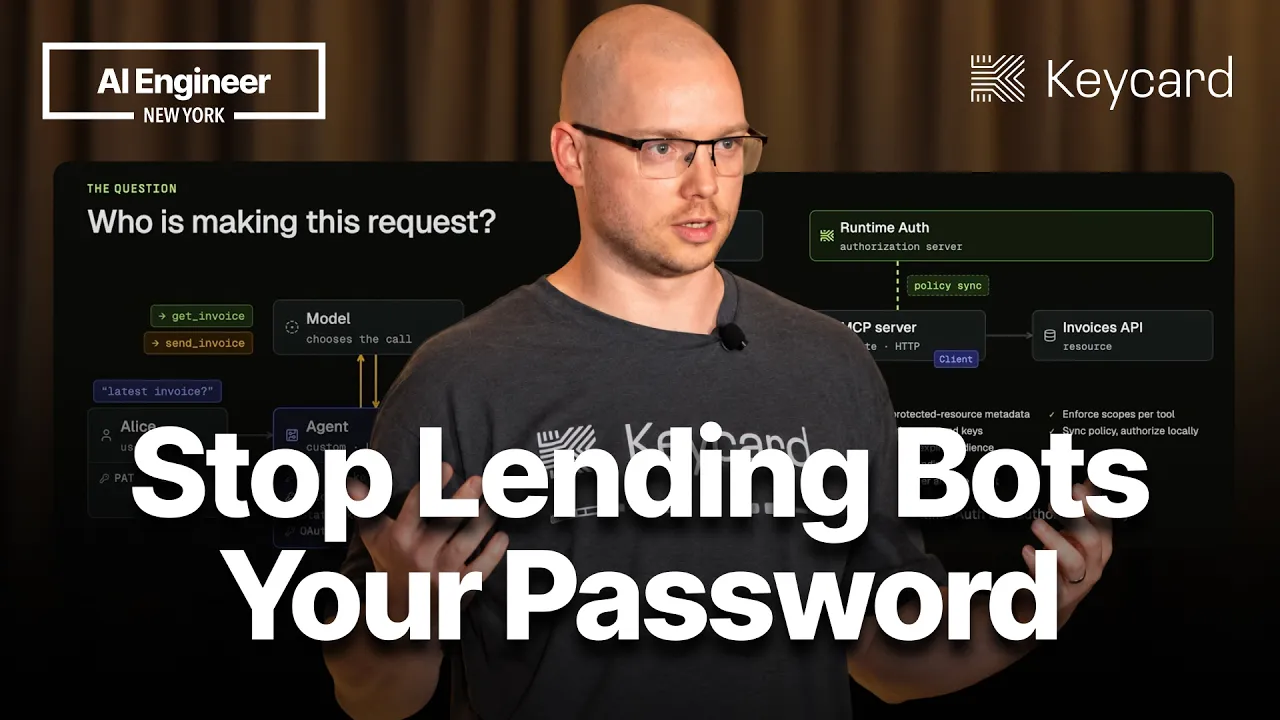
Description
When an agent sends an invoice using your token, who actually made the request? Kamil Potrec of Keycard breaks down how agents get credentials today (personal tokens, static keys, over-privileged service accounts) and what proper agent auth requires: per-agent identity, delegation, short-lived scoped credentials, federation with legacy systems, policy and audit. He compares SDKs and gateways for keeping credentials out of an agent's reach, including the gateway tradeoffs. Chapters: 0:00 Intro 0:43 How agents get credentials today 3:46 What's wrong with this picture 5:15 Using OAuth for agents 7:10 Why it gets hard at scale 8:21 What proper agent auth needs 9:52 One request, many steps 11:16 Why SDKs aren't enough 12:37 Gateways: keep credentials away from agents 14:55 Gateway tradeoffs 16:24 How Keycard approaches it 17:26 Takeaways Kamil Potrec https://keycard.ai Agent Baseline: https://agentbaseline.org Join us in SF for the second annual AIE CODE summit: https://aie.codes our last flagship summit of 2026. Applications live now!
Summary
Generated by gpt-5.6-terraAt-a-Glance
- Verdict: Watch fully
- Core thesis: Agent systems need first-class, separately authenticated agent identities, explicit delegation, short-lived scoped credentials, policy enforcement, and audit trails; user PAT pass-through, static keys, and broad service accounts cannot safely govern nondeterministic agents.
- Why it matters: This is a practical security-control-plane architecture for agentic systems using MCP, legacy APIs, and third-party tools, where the central unanswered question is whether a consequential action was authorized by the user or independently selected by the agent.
- Best use: Use it as an architecture and threat-model checklist for OpenClaw or any multi-agent/tool orchestration stack, especially before granting agents access to GitHub, email, internal APIs, databases, or SaaS systems.
Executive Summary
Kamil Potrec argues that common agent credential patterns erase the distinction between a user, an agent, and an MCP server. An agent may pass through a user's personal access token, use a static key, or invoke a service account with aggregated privileges. When an agent retrieves a pending invoice and then decides to send it, downstream systems can generally see only that the user's token was used—not whether the user authorized the send or the model autonomously chose it.
The proposed baseline is not a new agent-specific cryptographic primitive but disciplined application of established identity patterns: give every agent its own identity, represent delegation explicitly, authenticate workloads before issuing credentials, mint credentials that are narrowly scoped and short-lived, federate trust across systems, and record the full authorization chain. Legacy services need a broker/adaptive layer because they will not all gain modern OAuth support.
The speaker’s architectural preference is to move powerful downstream credentials out of the agent runtime. A runtime authorization service stores or brokers credentials, while a gateway authenticates the calling agent, evaluates policy, obtains the appropriate credential, injects it into the outbound request, and forwards it to the target service. This both prevents the agent from directly acquiring reusable credentials and enables request-level enforcement beyond what coarse legacy permissions support.
The talk is vendor-led, but the security model is high signal. It also avoids overselling gateways: they introduce latency, require non-bypassable network routing, do not solve agent identity by themselves, do not protect local tool execution, concentrate attack surface, and add TLS and distributed configuration complexity. The actionable conclusion is to treat agent authorization as a shared control-plane problem rather than delegating it to prompts, client SDKs, or LLM-generated security code.
Key Takeaways
- Claim: A token that identifies a user does not establish whether a resulting action was initiated by that user or selected by an agent acting on the user's behalf. | Evidence: The invoicing example has an agent retrieve a pending invoice, then autonomously decide to send it; an MCP server receiving Alice's token can see Alice but cannot distinguish Alice's CLI, an agent, or another tool. | Implication: Authorization and audit records need separate principals and delegation context: user identity, agent identity, and the authority under which the agent acted.
- Claim: Persistent user PATs, static agent keys, and broad service accounts are particularly unsafe for agents because agents aggregate credentials while behaving nondeterministically. | Evidence: The speaker cites users placing opaque access tokens on personal machines, difficult revocation, agents accumulating more credentials as they gain capabilities, and MCP servers using service accounts that become an aggregated bucket of permissions. | Implication: Do not give an agent durable, reusable credentials with broad downstream authority merely because it needs to call tools. | Caveat: This risk is amplified by agents' ability to be overly helpful or manipulated, but it also exists in conventional service-to-service systems.
- Claim: The minimum viable agent-auth model requires distinct agent identities, delegation semantics, scoped short-lived credentials, federated trust, policy controls, and complete auditability. | Evidence: Potrec explicitly lists per-agent or per-session identities separate from the launcher; rules for which users and agents can act for whom; no master key; just-in-time legacy credential exchange; approval policies; and logs that identify who authorized requests. | Implication: Treat identity, delegation, credential issuance, policy, and audit as required platform capabilities—not optional SDK features added after tool access is already deployed. | Caveat: No single authorization hub or uniform API standard can be assumed: organizations may have hundreds of APIs, bought agents that cannot be modified, multi-agent delegation chains, and permanent legacy software.
- Claim: OAuth-style dynamic credentialing and workload authentication should replace standing authorization wherever an agent calls a remote service. | Evidence: The proposed flow is for an agent to discover how access is obtained, authenticate itself through mechanisms such as workload identity federation, private keys, certificates, or URL-based authorization, then receive a credential limited to that interaction and tool. | Implication: Implement just-in-time credential acquisition per target and action rather than embedding API keys or provisioning permanent service-account privileges into agent runtimes. | Caveat: The speaker is technology-neutral about the workload-authentication mechanism; the requirement is that the agent authenticate before it receives credentials.
- Claim: Client SDKs alone are insufficient because security coverage is incomplete, heterogeneous, difficult to patch, and cannot reliably keep credentials away from an agent that can access its own execution environment. | Evidence: The talk identifies adoption gaps, multiple language requirements, unmodifiable purchased/coded agents, version tracking after SDK bugs, and the fact that an agent can cache or exploit credentials exposed inside its runtime. | Implication: Place critical authorization and credential handling outside the agent process, so compromised prompts, tool instructions, or optimistic agent behavior cannot expose or reuse secrets directly. | Caveat: SDKs and middleware remain useful reusable components; the objection is to treating them as the sole enforcement boundary.
- Claim: A policy-enforcing gateway backed by a runtime authorization service creates an external control point for credential injection, request attenuation, revocation, and observability. | Evidence: In the GitHub example, the gateway authenticates the caller, consults runtime authorization and policy, fetches the credential, injects it into the outbound request, and can allow email reads while blocking sends even when the legacy target only offers coarse read/write/admin permissions. | Implication: Use a gateway where external actions are high-impact and downstream authorization is coarse, but pair it with workload identity, non-bypassable egress controls, and a reliability/security plan for the gateway itself. | Caveat: A gateway adds latency, requires strong routing and network controls to prevent bypass, leaves local tool execution unguarded, becomes an attractive target, and introduces TLS, operations, and distributed configuration burdens.
- Claim: Agent authorization should be built on open, interoperable standards rather than as a closed, bespoke security layer. | Evidence: Potrec recommends reusing established software identity patterns, calls for federated trust, notes that legacy integration needs adaptive brokering, and directs viewers to agentbaseline.org for a reference implementation. | Implication: Favor components that can federate with existing identity providers, OAuth systems, APIs, and future agent platforms instead of binding the control plane to one agent framework or vendor. | Caveat: The final product framing is Keycard-specific, so its claim to provide a unified control plane should be evaluated separately from the generally applicable architecture.
Detailed Brief
What a complete agent-to-MCP authorization path must perform
- Claims: Even a single agent-to-MCP interaction entails a chain of discovery, authentication, credential issuance, signature and issuer validation, policy evaluation, possible downstream credential acquisition, and audit capture.; LLMs should not be entrusted to implement this sequence correctly on every call; enforcement should be standardized in shared infrastructure.
- Evidence: The server must publish its authorization requirements and the client must discover them before the agent obtains credentials.; The MCP server must validate token signatures, verify the issuer is trusted, and enforce current policies before communicating with downstream systems.; The speaker compares the appropriate implementation model to established shared libraries, middleware, and SDKs that are reviewed once and reused—but argues they need an external enforcement boundary.
- Caveats: The transcript provides an architectural blueprint rather than protocol-level implementation details, token formats, or a concrete migration sequence for a specific identity provider.
- Implications: Map every tool call as a credential-and-delegation chain, including the MCP server's own access to backend services; stopping analysis at the agent-to-tool boundary misses a major privilege escalation path.; Require authorization metadata discovery, issuer validation, and auditable policy decisions as acceptance criteria for production tool integrations.
Control-plane product framing and evaluation lens
- Claims: Keycard positions its offering as a composable control plane rather than an opinionated agent application framework.; Its stated components include agent identity issuance and federation, policy and audit, client and service SDKs, and an optional gateway.
- Evidence: The speaker says teams can choose only the needed components whether they are building a chat application or a full orchestration platform.; The presentation points to agentbaseline.org as a software-factory reference implementation covering the described capabilities.
- Caveats: The talk is a conference presentation from a Keycard product-team speaker and ends with a product invitation; it does not independently benchmark the implementation, demonstrate operational performance, or compare alternatives.
- Implications: Evaluate any vendor or internal build against the stated capability set: separate agent identities, delegation lineage, dynamic credential brokering, policy enforcement, audit, legacy adaptation, gateway controls, and interoperability.
Notable Concepts & Terms
- Agent identity: A cryptographic or authenticated identity assigned to the agent itself, potentially per session, and explicitly separate from the human or process that launched it.
- Delegation semantics: The ability to express and verify which user authorized which agent to act, and whether one agent may act through another; this preserves accountability across multi-agent flows.
- MCP server: A tool-facing service that can wrap internal APIs, databases, or external systems; it is a key authorization boundary because it may act for many users against privileged backends.
- Dynamic credentialing: Obtaining a narrowly scoped, short-lived credential just for a particular interaction or tool call rather than storing a standing secret in the agent.
- Workload identity federation: A mechanism for software workloads to authenticate through established identity trust relationships before receiving access, rather than relying on embedded static secrets.
- Runtime authorization service: An external service or secure enclave that brokers/vaults credentials and evaluates whether an authenticated agent may obtain authority for a requested operation.
- Gateway / proxy enforcement: A network-path control that can authenticate agents, retrieve and inject credentials, inspect and attenuate requests, enforce policy per call, and centralize audit.
- Request attenuation: Restricting a request more narrowly than the downstream credential itself permits—for example allowing email read access while blocking send operations.
Operator Notes / Why Ken Should Care
- Create a credential inventory for every agent, MCP server, tool, and downstream backend; flag user PAT pass-through, static API keys, and shared service accounts as migration candidates.
- Define an authorization-event schema that records user principal, agent/session principal, delegated authority, target system, requested operation, policy decision, credential issuer, and approval evidence.
- Put high-impact egress paths—email send, code write/merge, production changes, payments, data export—behind an external policy point that can deny individual operations even when the target API has only coarse permissions.
- Test bypass resistance: verify agents cannot call protected targets directly, retrieve injected secrets, use local tools to circumvent egress controls, or retain authority after policy revocation.
- Require human approval rules for irreversible or externally consequential actions, and distinguish approval to inspect data from approval to mutate, transmit, or publish it.
- Review agentbaseline.org as a reference architecture, but perform an independent security and interoperability review before adopting Keycard or reproducing its design.
Source/Metadata
- Title: Who Is Making This Request? Agent Auth 101 - Kamil Potrec, Keycard
- Transcript words: 7141
- Duration seconds: 1115
- Timestamp note: No timestamps or chapters were present in the supplied transcript. The transcript contains substantial duplicated passages, consistent with an approximately 18-minute talk.
Transcript
Hi everybody, my name is Camille. I work at Keycard in a product team. I'll be talking to you today about agent authentication authorization requirements. We have around 18 minutes, so that's nowhere close to being able to cover this topic. So my goal today is to give you a high-level overview of what's required to do this, how to solve these problems, and give you context to come and ask us questions at the booth downstairs. So whatever questions you have, feel free to grab me at the end or go find Peter. He has all the answers. We're going to start with this fairly simple diagram. You're probably familiar with this in any other talks you have about agents and how they communicate with MCP servers and other agents around. But what usually people don't talk about is how these agents and users communicate with each other, how they authorize and make requests. So what we come across and what we see often is that users obtain some sort of access credential. They might be called personal access tokens or just tokens. And they represent an opaque credential, identifying those users and letting the agent decide if they're going to perform this action or not. If your agent is running locally, sometimes this step is skipped and nothing else happens. When the request comes to the agents, they need credentials of their own to even perform their actions, right? A common thing that they need is an API key to talk to the model provider that allows them to do the reasoning. So whenever the LLM model decides to do some actions, they often call tools. When we need to do those tool calls, we often use remote MCP servers to perform them. And in order to communicate with them, hopefully, we need another credential to do that. And we have a couple of options that we've seen in the industry. Sometimes the agents will just use Alice's or users' PAT tokens and pass them through. Sometimes they will have their own static keys. And luckily enough, we see more and more use of OAuth dynamic credentialing happening there. But whenever an MCP server receives that token, they usually just see the user as the identity that acts with it. So the MCP server doesn't really know if it's an agent running it, Alice's CLI, or any other tool that does it. MCP servers are often used to enclose existing infrastructure. So if you have internal APIs, databases, or even external systems that are not agent friendly, we can use MCP servers to represent that communication and optimize that interaction. But in order to do that, these MCP servers often need to have access to these backend services and act for multiple users. So they cannot just use one user's PAT token because that will be limited to that scope. They often use service accounts. And those service accounts become an aggregated set of permissions so that these servers can communicate. And this is nothing new. We've seen this pattern in the past in service to service communication in traditional SaaS software. However, what's different about agents is they're not deterministic software, right? So whenever the request comes back to the agent and it sees some data, it will send it back to the model and it will decide what it wants to do with it next. In this case, we're using an abstract example of an invoicing service. So imagine the agent receives a request to look at the recent invoice. It gets it back. An invoice says it's pending. It should be sent to the user. An agent, either maliciously or is just too helpful, decides to send this invoice to a user. Now the question becomes, who is making this request? Was this Alice or was this the agent? We don't know. There's nothing to determine that in reality. So what else is wrong with this picture? There are a lot of issues with having all of these credentials laying around. So whenever users use these access tokens, they're not really attributed to anything. So Alice can quite easily take this access token and put it on her own personal machine. And then you lose all of that corporate infrastructure that might protect it from abuse. There is no easy way to revoke these credentials. So they lay there and can be abused. Agents, as they want to do more things, we give them more credentials and they start aggregating them. And again, because they're non-deterministic, we don't really know what they're going to do with those access keys. And finally, we arrive at the old problem of service accounts. Again, they just have a privileged bucket of permissions. And reality is we've been okay with the status quo in the industry before agents because we relied on software being released in a secure way, we thought about it as something that developers take care of. So we accepted the risk. Agents changed all of that because now we live in a world where there is this other actor that can behave on behalf of you. I always use this analogy. In almost every company I worked at, we have this thing when we would walk around and see if one of your colleagues left the laptop unlocked. And we would go to Slack and be like, I'm buying donuts for everybody today. And back then we knew that was not a good thing. So we would play this game, we would lock the machine down, and then we would never do it again. But agents are basically doing this all the time. We just let them ramp in with our credentials and do this all the time. So we need a better solution to do this. And funnily enough, technology to solve some of these problems existed for many, many years. We just didn't have an incentive to spend time on how to implement this properly. So instead of Alice going trying to figure out where to get access tokens, which is also terrible user experience, you can think like, why do I need to go and fetch these credentials? Why wouldn't we have agents that can advertise how to get access to them, and then embed into the client's ability to request that authorization from some external system. And then we can issue this dynamic credential that is scoped to that specific interaction and limited to the tool that was using it. And whenever it's done, it's finished. And OAuth as a technology allows us to do this. And when you think about this, we solved authentication for users a long time ago. But then for software, we decided that's not really a requirement. But we need to change this. And we need to also use technologies that we have available to us to make agents authenticate before we issue them any credentials. So we can use things like workload identity federation. There are other mechanisms. We can use private key authentication. You can use certificates. You can use URL based authorization. The mechanism doesn't really matter as long as you use it and make agents authenticate to the systems. And funnily enough, once you do that, you can just repeat the same pattern. Instead of giving these agents service accounts and adding persistent permissions to their service accounts, why don't they just every single time they want to talk to some remote server, determine what authorization is required, go to this remote service, obtain the token, and go forth. And the only difference between agents and traditional software that I mentioned is that reasoning loop. If you take that out of the equation, both the legacy software and agent are just software. So you can just reuse the same pattern for the application that you're writing now, and nothing changes. And you can re-implement the entire stack this way. So that sounds easy. So why didn't we do this before? Well, all of this becomes way, way, way tricky to do when we think about this problem at scale. There isn't one API that we have. There are hundreds of APIs that we have, and they use different ways to authenticate users. Behind those APIs, there is always some sort of authorization server that needs to authenticate the user. So in the previous picture that we had, we had one block that would have to authorize clients. Again, now you have clients who need to do this across hundreds of these services. And there isn't one agent type. We're going to have agents that you buy, so your cloud code, agents that you build. Sometimes you won't be able to change that software. So we need to find a way to do this. And there isn't one hub. So now we need to persist this delegation flow and verify how these agents are going to talk to other agents and how many hubs there can be in that loop. And finally, the biggest problem that we have is the attribution of who decided to make this action. So we now have thousands of users who need to consent to these arbitrary actions that agents are doing. So at scale, now we have to solve all of these problems altogether in order to make something useful for us. So in summary, if we want to have a proper agent authentication system, what do we need to deliver? So first of all, we need agent identities. We need a system that's going to issue these identities per agent. That might even be per session. But it must agent that you build. Sometimes you won't be able to change that software. So we need to find a way to do this. And there isn't one hub. So now we need to persist this delegation flow and verify how these agents are going to talk to other agents and how many hubs there can be in that loop. And finally, the biggest problem that we have is the attribution of who decided to make this action. So now we have thousands of users who need to consent to these arbitrary actions that agents are doing. So at scale, we have to solve all of these problems altogether in order to make something useful for us. So in summary, if we want to have a proper agent authentication system, what do we need to deliver? First of all, we need agent identities. We need a system that's going to issue these identities per agent. That might even be per session. But it must be separate from whoever launched it. Then we need to be able to express this delegation semantics. So we need to be able to say which users are authorized to perform actions with these agents, which agents can act on behalf of other users. We need to have a system that can issue scoped and short-lived credentials for everything that we do. And there cannot be any master key that allows us to do this. So we need to be able to build a federated trust of identities across them and allow them to trust each other when they exchange these systems. And we're going to have legacy software forever. You won't be able to go and hope that they will be supporting off anytime soon. So we need to be able to have an adaptive layer, a broker that allows us to securely exchange those legacy credentials just in time. And finally, you need to be able to express this with policies. Someone needs to be able to write which actions need human approval, which agents can run automatically. And things will go wrong. So in order for us to learn how to improve things, we need audit. We need to be able to say who authorized those requests and who made this possible. So there's a lot of steps to actually get this right. So what I want to show you here is just if you take one interaction between agent and MCP server, just to get this working, you will have a client and a server. Server needs to be able to publish this information. Clients need to be able to discover it. Then the agents need to be able to obtain these credentials. They need to be able to authenticate themselves to this remote server. Then when that happens, the MCP server has to be able to validate if those credentials have been correctly signed. They need to check if the issuer is trusted. They need to verify those tokens. Then there is some policy that needs to come into action. They need to enforce if the latest rules are in play. Once that happens, and they communicate to external system, they might need to obtain additional credentials to talk to it. And finally, we need to make sure that every single one of these actions is captured in an audit log. Raise of hands who thinks LLMs can do this every single time perfectly. All right. I think we're all in agreement. So this is not simple, but we have solved similar problems before. We've written shared libraries, we've written middleware, we've written SDKs in order to write these things once, verify with larger group of people if those are performing appropriately, and reuse them all the time. Which sounds like a solution to what we want to do here. But what are the problems with SDKs? So it's easy to write them these days, but you need to get them adopted by everybody. If you have gaps in your adoption, then what good are your SDKs? Then you need to write them for every single language that you have. And LLMs are probably good at writing some of these languages, but probably not the older ones that you have in your system. And then what do you do about your cloud codes, your codecs that you cannot modify? SDKs won't help you there too much. Then if you're going to have bugs, because LLMs make bugs and we write bugs, in order to fix that, you not only have to fix the SDK, but then you need to track where this SDK is used and which one of the systems consumed it. And finally, all of these previous four problems existed before, so that's nothing new. But agents have additional problems. As I said, they act and try to be too optimistic, or they can be manipulated to do things. And they proved to be very persistent in trying to bypass our controls. So do we really trust using just client-side code to manage these credentials securely? Of course, they can cache them, they can store them properly. But if they figured out that there is a credential that they can use, as long as it's within their own execution environment, we have a problem. So SDKs clearly are not going to solve this problem for many reasons, and additionally, they don't solve the problem of hiding credentials from agents. So if we take this picture, the challenge that we want to do is to get all of these tokens out of the reach of the agent. So what can we do? Well, let's try to move all of these credentials out of this execution environment and put them in some sort of secure enclave. So we can have our runtime authorization system vaulting servers that can start and broker all these credentials. And then the other problem is now how are we going to make use of them? So gateways are something we've used in the past, and they can solve this problem for us. So agents can communicate through the gateway, can request specific target to talk to GitHub, for example, and a gateway can authenticate who's calling it, talk to our runtime authorization server, validate that policies are in play, and fetch the specific credential. And then they can simply inject them into the request path and send it forward to GitHub. And what that gives us is now we have a physical control layer where there's simply no way for this agent to obtain this credential unless it's going to be very deterministic and go try to hack our gateway, or even worse, our authorization service. But most importantly, we get a couple more properties out of this. Even if we use short-lived credentials, they will have some sort of expiry time. And we still haven't figured out how to do revocation probably across distributed systems. But if you use gateways and you force all of your communication through that point, you can have instantaneous revocation because gateway can check every single request on the fly. Additionally, agents will do too much. A lot of these legacy services won't be able to scope access properly. They will have tokens that allow you either admin, read or write permissions, but aren't good enough. We want to be able to say, hey, you can read my email, but you cannot send my email. With the gateways, because we can intercept and more importantly introspect all of the requests, we can attenuate that request. We can say for this specific request, yes, there is a secure credential we're going to use. But if you're trying to send requests, we're just going to block it. We also get more observability. Because the gateway is on a network path, we can see exactly what happens for all the requests. And we don't need to change anything in our downstream services. But there's nothing for free in life. So gateways also come with some challenges. You're adding another hop to your call. So if you're really careful about your latencies, that's going to add some to it. Well, you need to force all your agents to talk to your gateway. If they can bypass it, if you don't have strong network controls, then that's not going to help you. Additionally, some agents want to have local tool execution. So you're not really guarding against that. There's nothing gateway does about your identity problem. Yes, agents still need to get some sort of authentication credentials and present it to the gateway in order to have a correct authenticated request. You're also putting a big target on this one thing that you're creating. Because now what we're saying is like every single credential will go through it. So some people will go try to hack it for you. There's a lot of technical complexities with building gateways. Some people call them proxies as well. TLS is one of those things. If you try to intercept that and try to work with all of these systems, you might run into some problems. And finally, if you're running a distributed system, you have all of these developers building agents. They need to figure out how they're going to configure the routes, the policies, the connectors, and all of those gateways. Still, someone has to say if agent A can talk to agent B via the gateway. And two, someone has to run it. So these are all the problems we have with gateways. So what we do at Keycard, we think about all of these problems all the time. So we don't think it's sensible for everybody to replicate all of these functionalities. So we've built a single control plane that allows you to both give your agents identities. We issue tokens and federate with technical complexities with building gateways. Some people call them proxies as well. TLS is one of those things. If you try to intercept that and try to work with all of these systems, you might run into some problems. And finally, if you're running a distributed system, you have all of these developers building agents. They need to figure out how they're going to configure the routes, the policies, the connectors, and all of those gateways. Still, someone has to say if agent A can talk to agent B via the gateway. And two, someone has to run it. So these are all the problems we have with gateways. So what we do at Keycard, we think about all of these problems all the time. So we don't think it's sensible for everybody to replicate all of these functionalities. So we've built a single control plane that allows you to give your agents identities. We issue tokens and federate with everything that you have going on. We provide your policies and audit to all of your requests. You can get from us all of the client SDKs that allow you to do injection and discovery. We provide you with service SDKs that you don't have to worry about how they're being authenticated. We also give you gateway if you really want to have those controls. But fundamentally, you can bring all of these components to us and pick and choose which one of these capabilities you need to build your system. Because you might be building a chat application. You might be building a complete orchestration platform. We are fairly unopinionated on the problem you're trying to solve with agents. We've managed to survive without this for decades. But agents proved themselves recently that they cannot be trusted. Reality is messy. So even if you go on a mission of trying to build some of these components, make sure that you use open standards and be interoperable with other systems. Because we're not going to win this game by playing alone. And really, don't YOLO it. Because LLMs won't be able to implement this for you. And make sure that whatever you do, check if the code written to implement these capabilities is secure. Thank you. If you want to find out about us, come to the booth. We're Kigat AI. Also, check out agentbaseline.org. We have recently released a software factory reference implementation of all of the capabilities that you've seen here. So you can learn and work with us on how to solve these problems. the answers. We're gonna start with this fairly simple diagram. You're probably familiar with this in any other talks you have about agents and how they communicate with MCP servers and other agents around. But what usually people don't talk about is how are these agents and users communicate with each other, how do they authorize and make requests. So what we come across and what we see often is that users obtain some sort of access credential. They might be called personal access tokens or just tokens. And they kind of represent opaque credential, identifying those users and letting the agent decide if they're gonna perform this action or not. If your agent is running locally, sometimes the step is skipped and nothing else happens. When the request comes to the agents, they need to credentials of their own to even perform their actions, right? Like the common thing that they need is an API key to talk to the model provider that allows them to kind of do the reasoning. So whenever the kind of LLM model decides to do some actions, they often call tools. When we need to do those tool calls, often we use remote MCP servers to perform them. And in order to communicate with them, hopefully, we need another credentials to do that. And we have a couple of options that we've seen in the industry. Sometimes the agents will just use Alice's or like users' PAD tokens and pass them through. Sometimes they will have their own static keys. And luckily enough, we see more and more use of OAuth kind of dynamic credentialing that happens there. But whenever MCP server receives that token, they usually just kind of see the user as the identity that acts with it. So MCP server doesn't really know if it's like an agent running it. Is it like Alice's CLI? Or is it like any other tool that does it? MCP servers are often used to kind of enclose existing infrastructure. So if you have like internal APIs, databases, or even external systems that are not kind of agent friendly, we can use MCP servers to represent that communication and optimize that interaction. But in order to do that, these MCP servers often need to have access to these backend services and kind of act for multiple users. So they cannot just use one user's PAD token because that will be limited to that scope. They use, they often use service accounts. And those service accounts kind of become aggregated of permissions so that these servers can communicate. And this is nothing new. We've seen this pattern in the past in kind of service to service communication in your traditional SaaS software. However, what's different about agents, they're not deterministic software, right? So whenever the request comes back to the agent and it sees some data, it will send it back to the model and it will decide to do what it wants to do with it next. In this case, we're using an abstract example of invoicing service. So imagine the agent receives a request to go and look at the recent invoice. It gets it back. An invoice says, I'm pending. It should be sent to the user. An agent, either maliciously or is just too helpful, decides to go and send this invoice to a user. Now the question becomes, who is making this request? Was this Alice or was this the agent? We don't know. There's nothing to determine that in reality. So what else is wrong with this picture? There's a lot of issues with having all of these credentials laying around. So whenever users use these access tokens, they're not really attributed to anything. So Alice can quite easily take this access token and put it on her own personal machine. And then you kind of lose all of that corporate infrastructure that might protect it from abuse. There is no easy way to revoke these credentials. So they kind of lay there and can be abused. Agents, as they want to do more things, we give them more credentials and they start aggregating them. And again, because they're kind of non-deterministic, we don't really know what they're going to do with those access keys. And finally, we arrive at the old problem of service accounts. Again, they just have a privileged bucket of permissions. And reality is we've been okay with the status quo in the industry before agents. Because we kind of relied on the software building released in a secure way, we thought about it as something that developers take care of. So we kind of accepted the risk. Agents changed all of that because now we live in a world where there is this other actor that can behave on behalf of you. I always use this analogy. In almost every company I worked at, we have this thing when we would walk around and see if one of your colleagues left the laptop unlocked. And we would go to the Slack and be like, I'm buying donuts for everybody today. And back then we knew that that is not a good thing. So we would play this game, we would lock the machine down, and then we would never do it again. But agents are basically doing this all the time. We just let them ramp in with our credentials and do this all the time. So we need a better solution to do this. And funnily enough, technology to solve some of these problems existed for many, many years. We just didn't have incentive to kind of spend time how to implement this properly. So instead of Alice going trying to figure out where to get access tokens, which is also terrible user experience, you can kind of think like, why do I need to go and fetch these credentials? Why wouldn't we have agents that basically can advertise how to get access to them, and then embed into the client's ability to go and request that authorization from some external system. And then we can issue this kind of dynamic credentials that are scoped to that specific interactions that are limited to the tool that was using it. And whenever it's done, it's finished. And OAuth as a technology allows us to do this. And when you think about this, we kind of solved authentication for users a long time ago. But then for software, we decided that that's not really a requirement. But we need to change this. And we need to also use technologies that we have available to us to make agents authenticate before we issue them any credentials. So we can use things like workload identity federation. There's other mechanisms. We can use private key authentication. You can use certificates. You can use URL based authorization. The mechanism doesn't really matter as long as you use it and make agents authenticate to the systems. And funnily enough, once you do that, then you can just kind of repeat the same pattern. Instead of giving these agents kind of service accounts and adding like persistent permissions to their service accounts, why don't they just every single time they want to talk to some remote server, kind of determine what authorization is required, go to this remote service, obtain the token, and go forth. And the only difference between agents and traditional software that we have that I mentioned is that reasoning loop. If you take that out of equation, both the legacy software and agent is just software. So again, you can just reuse the same pattern for the application that you're writing now, and nothing changes. And you can kind of go and re-implement the entire stack this way. So that sounds easy. So why we didn't do this before? Well, all of this kind of becomes way, way, way tricky to do when we think about this problem at scale. There isn't like one API that we have. There's like hundreds of APIs that we have, and they use different ways to authenticate users. Behind those APIs, there is always some sort of authorization server that needs to authenticate the user. So in the previous picture that we had, we had like one block that we would have to authorize clients. Again, now you have clients who need to do this across like hundreds of these services. And there isn't like one agent type. We're going to have like agents that you buy. So your cloud codes, agent that you build. Sometimes you won't be able to like change that software. So we need to find a way to how we're going to do this. And there isn't like one hub. So now we need to persist this kind of delegation flow and verify how are these agents going to talk to other agents and how many hubs there can be in that loop. And finally, like the biggest problem that we have is the attribution of like who decided to make this action. So we now have like thousands of users who need to consent to these arbitrary actions that agents are doing. So at scale, now we have to solve all of these problems altogether in order to make something useful for us. So in summary, if we want to have a proper agent authentication system, what do we need to deliver? So first of all, we need agent identities. We need a system that's going to issue these identities per agent. That might even be per session. But it must be separate from whoever launched it. Then we need to be able to express this delegation semantics. So we need to be able to say which users are authorized to perform actions with these agents, which agents can act on behalf of other users. We need to have a system that can issue scoped and short-lived credentials for everything that we do. And there cannot be like any master key that allows us to do this. So we need to be able to build a federated trust of identities across them and allow to trust each other when they exchange these systems. And again, we're going to have legacy software forever. You won't be able to kind of go and hope that they will be supporting off anytime soon. So we need to be able to kind of have an adaptive layer, a broker that allows us to securely exchange those legacy credentials just in time. And finally, you need to be able to express this with policies. Someone needs to be able to write which actions need human approval, which agents can run automatically. And things will go wrong. So in order for us to learn how to improve things, we need audit. We need to be able to say who authorized those requests and who made this possible. So there's a lot of steps to actually get this right. So what I want to show you here is just like, if you take one interaction between agent and MCP server, just to get this working, you will have a client and a server. Server needs to be able to publish this information. Clients need to be able to discover it. Then the agents need to be able to obtain these credentials. They need to be able to authenticate themselves to this remote server. Then when that happens, the MCP server has to be able to validate if those credentials have been correctly signed. They need to check if the issue is trusted. They need to verify those tokens. Then there is some policy that needs to come into action. They need to enforce if the latest rules are in play. Once that happens, and they communicate to external system, they might need to obtain additional credentials to talk to it. And finally, we need to make sure that every single one of these actions is captured in an audit log. Raise of hands who thinks LLMs can do this every single time perfectly. All right. I think we're all in agreement. So this is not simple, but we have solved similar problems before, right? Like we've written shared libraries, we've written middleware, we've written SDKs in order to kind of write these things once, verify with larger group of people, if those performing appropriately, and kind of reuse them all the time. Which sounds like a solution to what we want to do here. But what are the problems with SDKs? So it's easy to write them these days, but you need to get them adopted by everybody, right? Like if you have gaps in your adoption, then, well, what's good are your SDKs? Then you need to write them for every single language that you have. And LLMs are probably good at writing some of these languages, but probably not the older ones that you have in your system. And then what do you do about your cloud codes, your codecs that you cannot go and modify, right? Like SDKs won't help you there too much. Then if you're going to have bugs, because A, LLMs make bugs, we write bugs. In order to fix that, you not only have to fix the SDK, but then you need to track where is this SDK used and which one of the systems consumed it. And then finally, so all of these previous four problems existed before, so that's nothing new. But agents have additional problems. As I said, they kind of act and trying to be too optimistic, or they can be kind of manipulated to do things. And they proved to be very persistent in trying to bypass our controls. So do we really trust with using just kind of client-side code to be able to manage these credentials securely? Of course, they can cache them, they can store them properly. But if they figured out that there is a credential that they can use, as long as it's within their own kind of execution environment, we have a problem. So SDKs clearly are not going to solve this problem for many reasons, and additionally, they don't solve the problem of hiding credentials from agents. So if we take this picture, the challenge that we want to do is to get all of these tokens out of the reach of the agent. So what can we do? Well, let's try to move all of these credentials out of this execution environment and put them in some sort of secure enclave. So we can have our kind of runtime authorization system vaulting servers that can start and kind of broker all these credentials. And then the other problem is now how are we going to make use of them? So gateways are something we've used in the past, and they can solve this problem for us. So agents can communicate through the gateway, can request specific target to talk to GitHub, for example, and a gateway can authenticate who's calling it, talk to our runtime authorization server, validate that policies are in play, and fetch the specific credential. And then they can simply inject them into the request path and send it forward to GitHub. And what that gives us is now we have like a physical control layer where there's simply no way for this agent to obtain this credential unless it's going to be very deterministic and go try to hack our gateway, or even worse, our authorization service. But most importantly, we get a couple more properties out of this. Even if we use short-lived credentials, they will have some sort of expiry time, right? And we still haven't figured out how to do revocation probably across distributed systems. But if you use gateways and you force all of your communication through that point, you can have instantaneous revocation because gateway can check every single request on the fly. Additionally, agents will do too much. A lot of these legacy services won't be able to scope access properly. They will have tokens that allow you either admin, read or write permissions, but aren't good enough, right? Like we want to be able to say, hey, you can read my email, but you cannot send my email. With the gateways, because we can intercept and more importantly introspect all of the requests, we can attenuate that request. We can say for this specific request, yes, there is a secure credential we're going to use. But if you're trying to send requests, we're just going to block it. We also get more observability. Because the gateway is on a network path, we can see exactly what happens for all the requests. And we don't need to change anything in our downstream services. But there's nothing for free in life. So gateways also come with some challenges. While you're adding another hop to your call. So if you're really careful about your latencies, that's going to add some to it. Well, you need to force all your agents to talk to your gateway. If they can go bypass it, if you don't have strong network controls, then that's not going to help you. Additionally, some agents want to have kind of local tool execution. So you're not really guarding against that. There's nothing gateway does about your identity problem. Yes, agents still need to get some sort of authentication credentials and present it to the gateway in order to have a correct authenticated requests. You're also putting a big target on this one thing that you're creating. Because now what we're saying is like every single credential will go through it. So, well, some people will go try to hack it for you. There's a lot of technical complexities with building gateways. Some people call them proxies as well. TLS is one of those things. If you try to intercept that and try to work with all of these systems, you might run into some problems. And finally, if you're running a distributed system, you have all of these developers building agents. They need to figure out how they're going to configure the routes, the policies, the connectors, and all of those gateways. Still, someone has to say if agent A can talk to agent B via the gateway. And two, someone has to run it. So these are all the problems we have with gateways. So what we do at Keycard, we think about all of these problems all the time. So we don't think it's sensible for everybody to replicate all of these functionalities. So we've built a single control plane that allows you to both give your agents identities. We issue tokens and federate with everything that you have going on. We provide your policies and audit to all of your requests. You can get from us all of the client SDKs that allow you to do injection and discovery. We provide you with service SDKs that you don't have to worry about how they're being authenticated. We also give you gateway if you really want to have those controls. But fundamentally, you can bring all of these components to us and pick and choose which one of these capabilities you need to build your system. Because you might be building a chat application. You might be building a complete orchestration platform. We are fairly unopinionated on the problem you're trying to solve with agents. We're just kind of managed to survive without this for decades. But agents proved themselves recently that they cannot be trusted. Reality is messy. So even if you go on a mission of trying to build some of these components, make sure that you use open standards and to be interoperable with other systems. Because we're not going to win this game by playing alone. And then really, really don't YOLO it. Because LLMs won't be able to implement this for you. And make sure that whatever you do, check if the code written to implement these capabilities is secure. Thank you. If you want to find out about us, come to the booth. We're Kigat AI. Also, check out agentbaseline.org. We have recently released a software factory reference implementation of all of the capabilities that you've seen here. So you can learn and come and work with us on how to solve these problems. That's it. How to solve these problems. How to solve these problems. How to solve these problems. How to solve these problems. How to solve these problems. Thank you.