Rory Sutherland: completely legal marketing hacks that always work
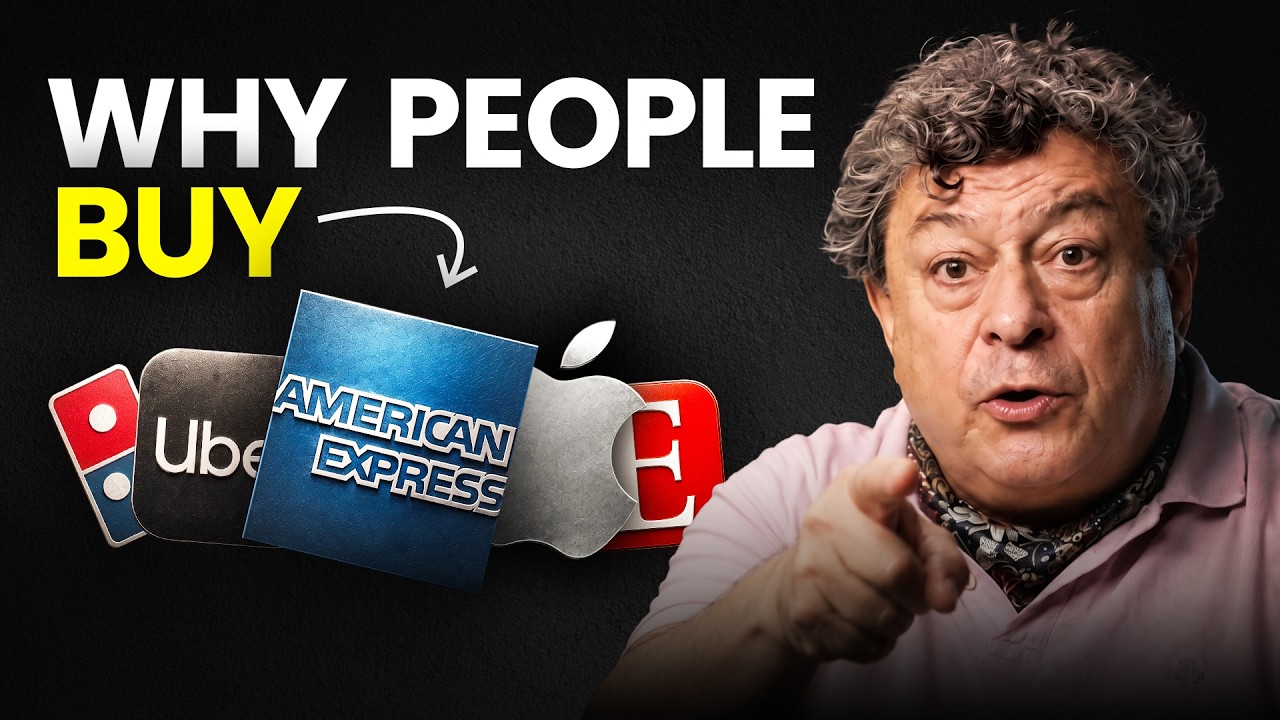
Description
*$1M Attention Guide: 15+ ways to get eyeballs on what you're building* https://clickhubspot.com/s6r0 Episode 845: Sam Parr ( https://x.com/theSamParr ) and Shaan Puri ( https://x.com/ShaanVP ) talk to marketing legend Rory Sutherland ( https://x.com/rorysutherland ). — Show Notes: (0:00) Intro (1:44) Horsepower (12:15) Reverse benchmarking (17:38) Pay attention to what irritates you (21:47) Ogilvy secrets (27:28) Marketing hacks used by Apple, UBER, McDonald's (36:35) direct response marketing 101 (1:08:50) Recommended reading — Links: • Alchemy - https://www.amazon.com/dp/B01F1HOAWA • Illusion of Choice - https://www.amazon.com/dp/0857199749 • Nassim Taleb books - https://www.amazon.com/stores/Nassim-Nicholas-Taleb/author/B000APVZ7W • Ogilvy on Advertising - https://www.amazon.com/dp/039472903X • Writing That Works - https://www.amazon.com/dp/0060956437 • When More Is Not Better - https://www.amazon.com/dp/1647820065 • Scientific Advertising - https://a.co/d/0ixEJA1B • The Choice Factory - https://a.co/d/0ixa769O — Check Out Sam's Stuff: • Hampton (joinhampton.com): My community for founders. Average member does $25m/year. Many of the guests are members. Get after it...apply: http://joinhampton.com/mfm — Check Out Shaan's Stuff: • Shaan's weekly email - https://www.shaanpuri.com • Visit https://www.somewhere.com/mfm to hire worldwide talent like Shaan and get $500 off for being an MFM listener. Hire developers, assistants, marketing pros, sales teams and more for 80% less than US equivalents. • Mercury - Shaan uses Mercury across all of his companies. you can too: http://mercury.com/ Mercury is a fintech company, not an FDIC-insured bank. Banking services provided by Choice Financial Group, Column, N.A., Members FDIC • I run all my newsletters on Beehiiv and you should too + we're giving away $10k to our favorite newsletter, check it out: beehiiv.com/mfm-challenge My First Million is a HubSpot Original Podcast // Brought to you by HubSpot Media /
Summary
Generated by gpt-5.6-terraAt-a-Glance
- Verdict: Watch fully
- Core thesis: Marketing advantage usually comes not from improving the product on the category's standard metrics, but from identifying and redesigning the overlooked psychological frictions, meanings, expectations, and trade-offs that determine adoption.
- Why it matters: For AI and software products whose underlying capabilities are converging, clear user-facing framing, reduced uncertainty, and deliberately distinctive workflow design can create more value than another incremental benchmark improvement.
- Best use: Use this as a product-marketing and GTM ideation session: audit onboarding, pricing, model selection, waiting states, support flows, and positioning for psychological bottlenecks rather than only operational or technical defects.
Executive Summary
The speaker argues that businesses systematically over-invest in physical or technical optimization while under-investing in psychology. His central distinction is between making desirable things and making things desirable: value is ultimately produced in customers' minds, not factories or feature lists. Innovation is not merely invention; it exists only when behavior changes.
His recurring method is to find the neglected dimension in a category. Instead of copying competitors' strengths, identify a routinely disappointing, unmeasured, or emotionally consequential part of the experience and make it exceptional. Examples include Uber improving booking, waiting, and payment rather than the taxi ride itself; Buc-ee's making restrooms a destination-quality feature; and Will Guidara differentiating through coffee and beer service at a top restaurant rather than duplicating its visible luxuries.
He also makes a management argument: large organizations become status-quo-biased because individual managers are punished for downside outcomes even when a portfolio of risky bets has positive expected value. Marketing and innovation are fat-tailed discovery processes, so organizations that demand prior proof for every decision eliminate the experiments that could generate outsized gains.
The most practical lessons are to translate technical capability into intuitive customer outcomes, make product trade-offs explicit before purchase, remove uncertainty at the point of action, test small details rigorously, and mine older marketing practices that were abandoned for fashion rather than because they ceased to work.
Key Takeaways
- Claim: A product becomes an innovation only when it changes customer behavior; technical specifications must be translated into a decision-relevant unit of value. | Evidence: James Watt and Matthew Boulton coined "horsepower" so mine owners could calculate how many horses they could stop feeding, rather than evaluate boiler capacity or piston strokes. The speaker compares this to Apple's "1,000 songs in your pocket" framing. | Implication: For AI products, replace model names and abstract benchmark scores with a simple, customer-native unit such as tasks completed, hours removed, tickets resolved, or workflows safely automated. | Caveat: The underlying product must still work; psychological framing is not a substitute for functional adequacy.
- Claim: The fastest path to differentiation is often reverse benchmarking: outperform the category on a neglected but salient experience dimension rather than matching competitors on their headline metrics. | Evidence: Will Guidara's team visited the world's top restaurant and focused on what was merely disappointing—the coffee and treatment of beer drinkers—then hired coffee and beer sommeliers. Uber transformed the uncertainty around booking, waiting, and paying for a taxi, not primarily the ride itself. | Implication: Map the full customer journey and look especially for the moments users dread, cannot understand, or assume will be mediocre; these are likely higher-leverage than another feature parity project. | Caveat: This does not justify neglecting core performance; the speaker's claim is that one surprising strength can reweight how customers evaluate the whole offering.
- Claim: Many supposedly technical problems are better solved by reducing perceived risk or anxiety than by improving the underlying physical metric. | Evidence: The speaker felt anxious when his electric car showed 16% battery despite 58 miles of range, while his wife's car at 56 miles of range felt normal because it displayed 56%. He contrasts adding battery capacity with changing how remaining capability is communicated; he also cites mirrors in slow elevators as a classic perceived-wait solution. | Implication: Treat uncertainty communication as a product surface: show meaningful remaining capacity, transparent progress, contingencies, and next actions rather than exposing users only to alarming internal metrics. | Caveat: Perception design should not conceal genuine operational constraints or make deceptive reliability claims.
- Claim: Small choices in copy, ordering flow, and perceived acceptance can create disproportionate conversion changes because they remove psychological bottlenecks. | Evidence: In a randomized American Express-related direct-mail test, post-only response was 5%, phone-only was 2%, and offering both options produced roughly 7%. A Gold Card campaign shifted from asking people to "apply" to telling likely qualified recipients they could "receive" the card by signing, addressing fear of rejection. | Implication: Instrument conversion paths and test for friction beyond price and product value: fear of rejection, uncertainty over delivery, lack of a preferred action channel, unclear eligibility, and insufficient reassurance. | Caveat: The examples establish that details need testing, not that any particular wording or channel choice will generalize unchanged.
- Claim: Data-only decision making creates a status-quo bias because data describes the past, while high-upside innovation requires exploration under uncertainty. | Evidence: Richard Thaler asked eight division heads whether they would take a bet with a 50% chance of lifting next-year profit by 50% and a 20% chance of reducing it by 30%; six declined, reportedly because a loss could cost them their jobs, while the CEO wanted the portfolio of bets taken. Red Bull is presented as a product that conventional research found mildly repellent but that succeeded through an intuitive leap. | Implication: Separate exploratory bets from core operating commitments, evaluate them as a portfolio, and protect teams from being judged solely on the downside of an individual experiment. | Caveat: The speaker does not advocate permanent intuition-led failure; he says decisions must be justifiable eventually, but not necessarily with complete ex ante proof.
- Claim: Explicitly framing a product's limitations as a chosen trade-off can make minimalism attractive, while unannounced cost-cutting creates disappointment. | Evidence: The proposed "Flat White or F*** Off" coffee concept offers only pre-made flat whites to exchange customization for speed; Moxy hotels openly exchange large rooms and full service for a useful social ground floor, strong Wi-Fi, and short-stay convenience. The speaker summarizes the principle as "expectation minus reality." | Implication: If simplifying an AI product, service tier, or workflow, name the trade-off directly in positioning and qualify users before they enter the experience rather than allowing them to discover constraints after purchase. | Caveat: A constrained product will still alienate customers who expect the conventional full-service offer; Moxy reportedly has a dissatisfied minority who expect a Marriott-style stay.
- Claim: Direct-response marketing remains a practical source of behavioral insight because it ties creative and channel decisions to observable action and enables disciplined experimentation. | Evidence: Historically, advertisers used coded coupons and parallel newspaper presses to run randomized creative tests. A correspondence-course headline reportedly improved by changing "Do you make mistakes in English?" to "Do you make these common mistakes in English?"—adding curiosity and reducing stigma. The speaker's testing rule is to test one variable or test an entirely different concept, not several ambiguous changes at once. | Implication: Build direct-response rigor into content and GTM: maintain testable offers, distinct tracking, and clean experiments instead of treating brand creative, onboarding, and demand generation as unmeasurable taste judgments. | Caveat: Attribution and randomized testing can be harder in modern multi-touch journeys, but the causal-testing discipline remains the point.
Detailed Brief
Pricing and business-model design can capture customer upside
- Claims: The speaker treats pricing architecture as part of marketing, not an afterthought.; Outcome-aligned pricing can both lower adoption resistance and capture more of the value created than a fixed upfront sale.
- Evidence: Watt and Boulton supplied more efficient steam engines to owners of inefficient Newcomen engines and charged one-third of the coal savings rather than a fixed machine price.; The approach concentrated early adoption in Cornwall, where coal was expensive and therefore both customer savings and supplier revenue were larger.; He characterizes this as an 1775 precursor to hardware-as-a-service and compares it with Rolls-Royce charging airlines by engine service hours.
- Caveats: The model requires a credible, measurable baseline and sufficient trust over how savings or usage will be calculated.; It is especially suitable where supplier performance materially controls the buyer's economics.
- Implications: Where an agent or automation product has measurable economic impact, consider pricing against verified usage, saved labor, avoided cost, or completed outcomes rather than only seats or generic feature tiers.
Design progress and agency into waiting experiences
- Claims: Customers tolerate effort and delay better when they see incremental progress or feel they can act.; Some interfaces work psychologically even if they provide an imperfect representation of operational reality.
- Evidence: The Uber map creates visibility into arrival; the speaker notes it may sometimes represent car density rather than exact car locations.; He suggests restaurant order-status systems could show intermediate stages rather than only "in preparation" and "ready," because small signs of reward sustain engagement.; Elevator "door close" buttons are cited as an example of the illusion of agency; placebo effects are also discussed in pain relief, where a higher-priced, condition-labeled but chemically similar medication can alter perceived relief.
- Caveats: The speaker defends benign experience design but the transcript does not set a firm ethical line for fictitious operational status.; For consequential systems, inaccurate progress signals can damage trust and create legal or safety risk.
- Implications: Use real, meaningful workflow milestones in agent interfaces—queued, gathering context, drafting, checking, awaiting approval, completed—and ensure any uncertainty or estimated status is plainly labeled.
Advertising archaeology and under-marketed audiences
- Claims: Marketing channels and creative formats are often discarded because they become unfashionable inside the industry, not because they stop working.; A focused target segment can reveal unexpected adjacent audiences, while conventional demographic imagery can hide products' usefulness to older customers.
- Evidence: The speaker says long-copy print ads, direct mail, jingles (now called sonic branding), and comic-strip advertising continue to work despite being neglected.; He argues comic-strip storytelling could be reintroduced in a manga-influenced form for younger audiences.; He cites bone-conduction headphones as marketed to runners and swimmers despite their potential usefulness for people with hearing loss, and foldable phones as useful for older users who need a larger screen.
- Caveats: Historical tactics should be adapted to current media habits and product context rather than copied cosmetically.; The audience examples are hypotheses and anecdotes, not presented as validated market-sizing research.
- Implications: Audit abandoned channels, formats, and neglected user segments as contrarian acquisition opportunities; test them against modern distribution rather than assuming category convention is customer preference.
Notable Concepts & Terms
- Horsepower: A marketing-created unit that made steam-engine value legible in the buyer's existing mental model: horses no longer needing feed.
- Reverse benchmarking: Find the category metric or experience competitors ignore, then make it dramatically better instead of copying category leaders.
- Psychological bottleneck: A hidden point of anxiety, ambiguity, rejection risk, or effort that blocks action even when the product and economics are strong.
- Expectation minus reality: The proposed determinant of satisfaction: customers accept a reduced offering when the compromise is explicit before purchase.
- Fat-tailed activities: Marketing and innovation produce a small number of disproportionately valuable outcomes, making exploration and portfolio thinking necessary.
- Direct response advertising: Advertising designed to generate a directly attributable action, historically enabling rigorous tests of copy, offers, media, and response mechanisms.
- Metacognition: Thinking about one's own thinking; the speaker presents it as a way to question default reactions and distinguish physical constraints from psychological ones.
- Advertising archaeology: Studying older, abandoned advertising methods to rediscover tactics that remain effective but face little current competition.
Operator Notes / Why Ken Should Care
- Run a customer-journey friction review for one flagship product: list every step from awareness through first successful outcome, then identify the three moments with the highest uncertainty, wait, embarrassment, or fear of failure.
- Create a customer-facing capability ladder for AI offerings that replaces model/version labels and benchmark jargon with decision-ready use cases, limits, expected quality, and cost or time saved.
- Establish an exploration budget with pre-agreed portfolio metrics so individual teams can run high-variance GTM and product experiments without treating every failed test as a performance failure.
- Review current simplifications or service limitations and rewrite positioning so users opt into the trade-off before onboarding; do not let constraints surface as surprises.
- Add clean A/B testing discipline to a single conversion path: test one micro-variable at a time or test a fully distinct concept, with explicit tracking of channel and creative.
- Evaluate outcome-aligned pricing for workflows where savings or usage can be measured credibly, while defining the baseline and attribution method before launch.
- Test one contrarian acquisition format or segment drawn from advertising archaeology rather than competing only in the prevailing channel and creative style.
Source/Metadata
- Title: Ad expert reveals the most common blunders in marketing
- Transcript words: 15933
- Duration seconds: 4517
- Timestamp note: No usable timestamps or chapter markers were present. The supplied transcript contains several duplicated passages near the middle and end.
Transcript
There are two ways of making money. You can either make desirable things, or you can make things desirable. And there's not much you can do about the laws of physics, whereas the laws of psychology are magnificently malleable. We know about you, but do you know what you're getting into at all? Up to a point. I know of the podcast quite well. I know that you're recently a social media star, even though you've been killing it for decades. I've heard a story about how someone just started uploading some of your talks, and it went viral, and then you said, maybe I should do this. It happened, I think, accidentally, and I've reversed-engineered what happened, which is that most marketing people talk about what they do. And my argument is, of necessity, I started talking about how we think. And consequently, the willingness to accept the fact that surprisingly arbitrary-seeming trivial decisions may have a monumental effect on it is actually necessary to have a proper understanding of living in a complex, interconnected system. If you believe there are important strategic things, and then there are trivial things which you delegate down to junior people, and in which you have no interest whatsoever, fundamentally, I think you're missing the point. Because the real world isn't like that. It's full of butterfly effects, silver bullets, small things, alchemy, I call my book, because you can turn lead into gold. You can literally take something which is seen as a product disadvantage and turn it into a strength. I think you had a good example of that with, have you ever heard, Sean, the story of how horsepower came to be? No. Tell that story. So, one of my great contentions is that when we look at great entrepreneurs or great inventors, Jobs, Edison, Ford, Watt, Boulton, they tend to be written up by historians as inventors. And my argument is that an invention isn't an innovation until it changes behavior. I think it's Stewart Butterfield of Slack who said something very similar. The only real measure of the effect you're having on innovation is the extent to which you change behavior. And you can invent anything you like, but if you can't get anybody to adopt it, it's an invention, but it's not an innovation. And Watt was selling steam engines to mine owners. And the purpose of the steam engine was to replace the horses they used to walk round and round in circles, draining the mines so that miners could go in and effectively mine coal, slate, whatever, without drowning. What he realized is that, as an engineer, you could talk around the calorific capacity of the boiler or the length of the piston stroke or whatever. And these people didn't want to know. So Watt and Boulton, amongst themselves, said, well, what do these people really want to know before they're prepared to buy a steam engine? They said, they want to know how many horses they no longer need to feed if they buy a steam engine. How many horses can I get rid of if I buy the steam engine? So Watt went out and invented a unit we still use today, which is called the horsepower. And the reason it's not named after a famous scientist like the Ohm or the Newton or the Coulomb or the Watt, for that matter, or Celsius or anything of that kind, is because it's a marketing unit. It was invented for marketing purposes because he could then go and say, if you buy a 25 horsepower steam engine, you can actually get rid of 75 horses, because I think the horses worked in shifts. So it does the work of 25 horses, but it does it 24 hours a day. So you can now get rid of 75 horses. And these people would go scribble, scribble, scribble, scribble, scribble, cost of horses, cost of feeding horses, cost of looking after horses. And on the back of an envelope, they could then go, we'll have two of those. By the way, it went even further than that. The Industrial Revolution was a marketing revolution every bit as much as it was an industrial revolution, because there was no point in being able to produce things in abundance if you couldn't create corresponding demand. So one of the things about the 18th and 19th century in England that happened was it was an absolutely pioneering period in terms of how people marketed things. And that included the steam engine, where Watt and Boulton would go to a mine owner. Now, let me get this right. Some people were already using Newcomen engines, which were less efficient steam engines than the Watt engine. And Watt and Boulton would go along to the people who were already using these inefficient steam engines, and this is how they priced their own steam engine. They said, we'll supply it for free. You pay us a third of the money you save on coal. So it was literally hardware as a service. Bear in mind, this was 1775. Years later, Rolls-Royce started charging airlines for jet engines in the same way. Effectively, you pay us for every hour the engine is in service. Now, what was ingenious about that was, of course, it aligned the interests of the people selling the steam engines and the people owning the mines, because the people in the country where coal was most expensive most needed to save money on coal. That was Cornwall, where there were tin mines quite a long way away from any available coalfield. So coal was more expensive there, and so the first Watt engines tended to be installed in places where coal was most expensive, which meant the mine owners saved more money and Watt and Boulton made more money. So they were actually capturing the upside. Whereas if all you'd done is said, yup, it's a hundred guineas for a steam engine, you wouldn't have been capturing any of the upside. I have to say this was pretty smart stuff. One of the worst mistakes you can make is thinking that people 500 years ago, 300 years ago, 200 years ago were thick. They were very, very clever. And probably they had less time staring at smartphones and more time to be clever, to be absolutely honest. But something I discovered the other day is the Øresund Strait in Denmark. The Danish crown wanted to charge customers duty on any cargoes passing through the straits of Denmark. And they had a kind of stranglehold over it. And the original thing was they'd send people on board and say, we'll estimate the value of your cargo and we'll charge you 10%. And they thought, this is a lot of bother. So they said to the people passing through the Øresund Strait, this is like 1350, okay, you tell us what your cargo is worth. Okay, we'll charge you 10% on that. Oh, and by the way, every now and then we'll randomly buy your cargo at the price you quoted. Dude, that's how we pay taxes. It's genius. You can do property valuation that way. You see, it simply says, you tell us what your house is worth. And the only deal is we have the right to buy your house for that amount of money. What's funny is, I think that in America, I think it's 0.4%. I could be getting the numbers off, but it's between 0.4 and 2% of Americans get audited every year. And if you do the math, I don't know, man, it might be worth pushing it and just get audited once every 30 years. You're absolutely right, yeah. Having said that, an IRS audit, from what I've heard, is a living nightmare, isn't it? Yeah, yeah, yeah. I'm not actually being serious. You know who needs the modern-day horsepower? All of the AI products. Yeah. If you have Claude and you have ChatGPT, essentially they're all making the same-looking product, right? It looks like a chat interface, and then you type something and then it gives you something back. And so they're not differentiated in the experience or the look and feel of the product that much. And then they come out with these models, and each one has a different, Opus 3.0 light, heavy, expert pro plus, and you have no idea which to use. And then they use benchmarks that are, it's like on the CRUD lightweight benchmark of coding expertise, we're at 3.779. Why don't they just have the equivalent of horsepower? Why don't they just write IQ? Yeah. Or when Apple was like, the iPhone, instead of saying it's X amount of megabytes or gigs, they said a thousand songs in your pocket. A thousand songs in your pocket. Now this is the classic thing, which is that engineers, whether they know it or not, deep down just want to impress other engineers. Okay. And so a psychological solution in their engineering community will be seen as cheating. So I make the with these models, and each one has a different Opus 3.0 light, heavy, expert pro plus, and you have no idea which to use. And then they use benchmarks that are, it's like on the crud, lightweight benchmark of coding expertise. We're at 3.779. Why don't they just have the equivalent of horsepower? Why don't they just write IQ? Yeah. Or when Apple was like, the iPhone, instead of saying it's X amount of megabytes or gigs, they said a thousand songs in your pocket. A thousand songs in your pocket. Now this is the classic thing, which is that engineers, whether they know it or not, deep down just want to impress other engineers. Okay. And so a psychological solution in their engineering community will be seen as cheating. So I make the same point about electric cars, which is you have this thing called range anxiety, and we're spending billions and billions of dollars a year trying to produce batteries with a higher energy density. It's a really good thing. I'm not saying, Hey engineers, you're wasting your time, but isn't it cheaper just to reduce anxiety rather than to increase range? Because if the way to reduce range anxiety is always to increase range, we'll end up with electric cars being heavier than they need to be, more expensive than they need to be, and, with 50 kilowatt hours sitting outside your house, 95% of the time effectively doing nothing. So reducing anxiety. And I realized, by the way, how irrational this is. Explain the story, which is, it fascinates me because one of the things I think that helps if you want to do this is to have some degree of metacognition, which is you don't just think, you think about your own thinking. It's apparently true of fighter pilots. The really good fighter pilots have good cognitive skills, but they also have good metacognitive skills. They don't just go, I'm going to do that instinctively, but they also ask, is there a reason why I shouldn't be doing that in this instance? Okay. Or this time it's different, as it were. And so my wife's car is a Mini Cooper electric, and it's got about a, I guess it's about 28, 30 kilowatt hour battery and a range of about a hundred miles. And I've got the Lotus Electra, which is 112 kilowatt hour battery, range of about 300 miles. And I got back from quite a lot of driving. I've been down to Wales and back, and the car's down to 16%. Okay. And I'm going, and all the lights have gone amber because it's at 16%. And I'm going white knuckle on this. I'm going, go on, I'm down to 16%. Oh my goodness. I'm down to 16%. Then I look at the actual range, and it's about 58 miles. Now my wife's car, that's 56%. Okay. In my wife's car, we drive around at 56%, i.e. with a range of 56 miles, all the time without the slightest smidgen of anxiety. But when that's expressed as 16%, not 56 miles, okay, I'm suddenly having conniptions and really panicking. Now, what that suggests is that range anxiety is much more a factor of psychology than it is of physics. And the problem with trying to increase battery range is that laws of physics are actually setting stone to a large part. Okay. There's not much you can do about the laws of physics, whereas the laws of psychology are magnificently malleable. And so that's the thing that really interests me because we spend a lot of time effectively trying to work within the laws of physics, which are immutable, when it would be a lot easier just to say, actually, why don't we take this undesirable thing and make it cool? Right? This is the elevators need to go faster. No, no, no. Just put a mirror in the elevator. Just put a mirror. Just put a mirror. People will be happy looking at themselves. People will be happy. And it's actually, by the way, it gets quite philosophical, this, because you suddenly realize that literally trillions of dollars of effort are invested by businesses every year in pursuit of metrics which the customer may not notice or care about. Whereas, at the same time, no money is spent on things which would actually make a huge difference. There are relatively easy wins here for both government and the private sector in saying, I'll give you an example of this. So I call this reverse benchmarking. In other words, you look at all the metrics that everybody cares about in the category. You find a metric that's been completely and ridiculously neglected, and you double down on that thing. Now, I first came across this in Will Godara's fantastic book, Unreasonable Hospitality. He goes to the number one restaurant in the world. All of his teams say, we ought to copy this. We ought to do that thing with the napkins. I really like what they do in the bathrooms with the scented jaw sticks. Let's copy that. And Godara goes, not going to copy any of that because, one, we can't afford to, and, two, they're already doing it. What I want to know from you is what, out of this evening at the world's best restaurant, Michelin three-star restaurant somewhere, was a bit disappointing, what was a bit meh. And they said the coffee was a bit average. It was nothing special. And the beer drinkers, probably the chefs who'd gone along, got treated really crappily, shabbily compared to the wine drinkers. So he goes back to his own restaurant and he appoints a coffee sommelier and a beer sommelier. And he says, your job is not just to benchmark against these people, it's to hit it out of the park. Now, if you think about it, taking something that's bad about the category, not saying we need to raise our level to the category average, but instead doing it spectacularly well, something that nobody's expecting. That was what Apple did, I would argue. Okay. That's what Buc-ee's did. I don't know if you're Buc-ee's, where are you in the US? Yeah, I lived in Texas. We were big Buc-ee guys. Yeah. Okay. It basically started with an insight around women's restrooms. Now, you could have just had averagely clean women's restrooms. You would have benchmarked. No, no, no. They're like the bloody hall of mirrors at Versailles, right? I mean, I haven't been in them, but the men's restrooms are pretty good, but the women's ones are apparently sensational. And my argument is that if you, let's say you're a hotel, okay? Everybody will focus on the rack rate and the this and the size of the room and so on and so forth. Have you ever had, even in a really expensive hotel, a laundry experience that isn't a bit of a pain in the ass? You've got to fill in a form. You've got to put it in a bag. By the way, if you get your laundry back, they never replace the bag the second day. So if you want a second lot of laundry, you've got to ring up and ask for another bag and another form. Okay. Now, what would happen if a hotel, if I stayed in a hotel which was, I'm not saying you could be totally shit, okay, as a hotel, as long as you have a brilliant laundry service. Apple is on a par technologically with other entities, but it's sensationally good at the emotional component. Buc-ee's is a thing apart. Uber doesn't have cabs that smell of urine. I'm not suggesting you can neglect the other stuff. But I think what you can do is that when you cause the customer to pay attention to something, it consequently becomes more important. Because it's surprising and because it's attention-grabbing, it therefore suddenly causes the consumer to completely re-weight their utility function. Now, one of my examples would be car rental. I don't know if you rent cars at airports, presumably, occasionally. I hate doing it. Yeah. Yeah, exactly. I hate it. Now, once you've driven out of the car park, it's the same shit. It doesn't really matter. Maybe you can make rental return a bit better, but let's not worry about that, okay? I just asked the question, why is it that when I book a taxi for $100 to pick me up from the airport here in London? They meet me at arrivals and even push my trolley with luggage to the car park, okay? But if I rent a car for $600, I've got to find and queue at the car rental desk. Then I've got to go and find, often in like 110-degree heat, I've got to go and find the car. And then, by the way, there isn't even a laminated sheet of A4 paper cars at airports, presumably, occasionally. I hate doing it. Yeah. Yeah, exactly. I hate it. Now, once you've driven out of the car park, it's the same shit. It doesn't really matter. Maybe you can make rental return a bit better, but let's not worry about that, okay? I just asked the question, why is it that when I book a taxi for $100 to pick me up from the airport here in London, they meet me at arrivals and even push my trolley with luggage to the car park, okay? But if I rent a car for $600, I've got to find and queue at the car rental desk. Then I've got to go and find, often in 110-degree heat, I've got to go and find the car. And then, by the way, there isn't even a laminated sheet of A4 paper in the car saying, this is how you open the fuel filler cap. This is how you release the handbrake. There's nothing, right? Once you're in the car, about 10, 20 minutes in, you start to enjoy it. But that initial bit, which nobody seems to be measuring, is the bit that's terrible. Now, in some cases, I would literally happily pay 100 quid if the deal is, we meet you at arrivals, okay? We take the luggage to the car, we hand you the keys, we answer your questions about how the car works. If, by the way, they also turn the air, now you could do this with electric cars, if they also turn the air conditioning on 10 minutes in advance, okay? Now you've done something which is, now there's that thing, what's that funny thing, Turo, isn't there, I think? Which, because it's humans, might be able to create something a bit like that. Yeah, they, I use Turo all the time. They have a thing where the loaner will drive to your home. And because of that, by the way, when I rent cars at large American airports, say Phoenix or something like that, I actually arrive at Phoenix, take a taxi to the hotel, and then book the car the next day. Because the downtown experience of car rental with no luggage is so much better than the airport experience with luggage. We asked you a question earlier, so how do you do it? And it sounds like one thing that I'm picking up is you pay attention to what irritates you. And instead of just complaining about it, that's great source material. I think Jerry Seinfeld says irritation is innovation. I think when he was creating his talk show, it's because he had been, for years, famous. He got invited on late-night talk shows, and he would go, and if you look at every late-night talk show, it's the exact same. There's the guy at the desk, there's the cheesy music, there's the band guy that they have forced laughter with. And when he created Comedians in Cars Getting Coffee, it was the equivalent of a talk show. He's like, what's the opposite of everything I hate about those things? And then he created something and, I think, licensed it for $100 million to Netflix, starting with irritation at the way that this thing always works. There's a British show, I don't know if this exists in the US, called Room 101. I don't know it. Room 101 is, I think it's from Orwell. It's the room to which you'd banish things that you really want to get rid of. And people will come in and just have a rant, and it will be everything from potholes, slightly boring choice, to cummerbunds, or something similar like that. Something that people just think is utterly unnecessary and needs to be eradicated. And you're absolutely right. Irritation is innovation. And so, one of the things is that I would argue that, in a sense, there are two really valuable things, one of which is what you might call the meta stuff, which is, what are you really in the business of? Now, Nassim Taleb and I had this conversation about why you actually buy the things you buy. And my jokes were, the reason you have a swimming pool isn't to swim in it. It's so that you can walk around your garden in a bathing costume without feeling like an idiot, okay? So, on a hot day, you can walk outside and lie outside without wearing many clothes, without feeling stupid, okay? And a dishwasher isn't principally valuable because it washes your crockery and plates. It's valuable because it keeps them out of sight. But when you look at these things and go, maybe it's not about this, maybe it's all about that. What you have to acknowledge is two things, I think. One, you've got to let go of two handholds at once, which is what makes it difficult. One is economic logic. If we reduce the price, more people will buy it. Economic logic has very bad predictive value, I think, in consumer behavior. And the other thing you've got to partly abandon is conventional approaches to market research, where you think that we've asked the customer what it is they want, and they will tell us. Because most of what we feel isn't even thought, let alone spoken. And also, there are very, very large areas of consumer behavior which are... They may be meta-rational at some level, but nobody will ever tell you, I would buy that product if it were more expensive. But there are plenty of documented cases of exactly that happening. I think your buddy's with Daniel K., uh... Kahneman. Yes. Yeah. And he, in his book, Thinking, Fast and Slow, I don't know if you've read that, Sean, but one of his famous examples was The Economist, I think it was, or something like that. Yes, that's right. The decoy. The decoy. Yeah. They do this thing where they say, you can get The Economist for $20 a month, and you get all of these things. And if you get the other version of The Economist, you get all of these things plus digital access. Paper only, paper plus digital, and digital only. And paper only and paper plus digital were the same price. So, you looked at that, and your mental frame was, if I get the paper version, I'm getting the digital one for free. Vanishingly few people ordered paper only. Now, if you remove the paper-only one, so, effectively, you had digital or digital plus paper, vanishingly few people chose the one in the middle. But the presence of the middle option increased by about two or three hundred percent the number of people who subscribe to paper plus digital instead of digital. I think it shifted the ratio from one direction to the other. And, by the way, that's pretty valuable to The Economist because my hunch is that their paper circulation is much more valuable in terms of advertising revenue than their digital circulation is. One of the best Ogilvy ads, my favorite ad, is David Ogilvy writes this letter. And I think it's called How We Write Ads at Ogilvy. And he has this long, maybe thousand- or two-thousand-word essay on the 18 points on how they create ads that are effective. And some people might be like, well, why would you give your secret away? And he was like, well, I'm going to teach them how we think. There's also a really interesting aspect in business, which is, if you give your secrets away, you assume that people will copy you. And the odd thing is they don't. And quite often the reason is they're just culturally incapable of doing it. So, for example, if you point out that physical direct mail is very successful for a business, you'd think that your competitors would go, well, that's a useful learning. I must do some more of that. What you then discover is no, actually, they're culturally, they just find using, for example, an old-fashioned advertising medium simply too difficult to justify, or too unfashionable, or whatever it may be, to be comfortable with it. And so even if you just give away the evidence of how you do what you do, what you find is that you're copied much less than you'd expect. You said you study how we think, or you like to talk about how we think versus what you do. Let's break that down. Okay. So if I just asked you a very simple question, that's probably very broad and you could take it any direction you want. How do we think? I think what happens is that small businesses, family-owned businesses, to some extent founder-led businesses, are an exception here. What's interesting is simply being able to understand that value is not really produced in the factory, it's produced in the mind. And that advertising medium simply too difficult to justify, or too unfashionable, or whatever it may be, to be comfortable with it. And so even if you just give away the evidence of how you do what you do, what you find is that you're copied much less than you'd expect. David Ogilvy, Ph.D.: You said you study how we think, or you like to talk about how we think versus what you do. Let's break that down. Okay, so if I just asked you a very simple question that's probably very broad, and you could take it any direction you want: How do we think? David Ogilvy, Ph.D.: I think what happens is that small businesses, family-owned businesses, and, to some extent, founder-led businesses are an exception here. What's interesting is simply being able to understand that value is not really produced in the factory, it's produced in the mind, and that there are two ways of making money. You can either make desirable things, or you can make things desirable. And each of them is as profitable as the other. For some reason, once a business hits a certain size, it gets focused on what it does, not what it means. And I think there's a kind of invisible loss there. Similarly, at the same time, I think those businesses lose the capacity to innovate as well. Something rather depressing happens, which is you effectively get caught in a mindset where you probably have a mental metaphor for your business. You're looking at it as if you're an engineer looking at a piece of machinery. And it's reductionist. It's about optimizing the parts rather than optimizing the whole. And at some level, I think that model becomes unhelpful. But also what happens, I think, is that you become more and more uncomfortable with uncertainty. And this is where it gets quite interesting. There's a wonderful story I always tell, which is Richard Thaler, the Nobel Prize-winning economist and behavioral economist, the author of Nudge. He once spoke to a board of about 10 people at a very large company. And he goes to the eight heads of the largest divisions of this company, and he asked them all simultaneously a question: Would you take a decision if it had a 50% chance of increasing your profits next year by 50% and a 20% chance of reducing your profits by 30%? And six out of the eight of them said no. And Thaler goes back and says, well, you're all good enough mathematicians, I assume, to realize these are highly favorable odds. To a gambling man, this is a very, very good bet. And yet you decline to take part. Why is that? And six out of the eight of them reply: because 20% of the time or 30% of the time, I'd lose my job. And then the interesting thing happens, which is the chief executive is sitting at the end of the table and looks aghast at the eight people and goes, but I want all of you to take those odds. Because net net, in aggregate, we'd almost certainly end up massively better off. Yes, two divisions, one division might have a slightly disappointing year, but four of them would perform spectacularly. And you realize that the way that businesses are structured, as you push responsibility and accountability further and further down the organization, they become more and more risk-averse and they become more and more uncertainty-averse. So they would prefer a definite 5 to 10% to a probabilistic 50% chance of 50%. And what happens then is that fundamentally, you become highly conservative. You're more worried about downside avoidance than you are upside opportunity. And as a result, obviously, both innovation and marketing, I would argue, are fat-tailed activities where 10% of what you do is probably more valuable than everything else. You can't tell in advance which 10% it's going to be. They are processes of exploration and discovery. And what you do is you get rid of the discovery layer in the pursuit of efficiency. And in the short term, it looks like a great idea. But in the longer term, it proves fatal, I think, because you've lost the capacity to adapt, to reinvent, to reposition in pursuit of the occasional breakthrough. Paul Jay We have a very startup-oriented audience, a lot of whom are founder-led businesses or want to be. So we could talk about how big companies turned around. But what's an example of a startup or small company that you look at and you're like, oh, they nailed it, and here's why they nailed it? Even though if this was pitched at a big company, this would never have worked, but here it is kicking ass. Paul Jay The example I always feature in my book is Red Bull, which is an example of a business that makes no sense. In other words, you could only really justify Red Bull on the basis of intuition. There was some pre-existing popularity in Thailand where I think it was bought by lorry drivers to keep awake at night. But someone there was capable of making the leap of imagination into an uncertain future where a drink which cost a lot of money came in a tiny can and research told them consumers found mildly repellent. In defiance of all the rational odds, this had potential. And it's worth noting that generally there's always a lot of data from the past, because all big data comes from the past. There generally isn't much data about the future. There are two problems there, one of which is if you insist that every single decision is based on data, all your decision-making has a status quo bias because all your data comes from the past. There isn't any data about the future. The second problem that happens is that the things you tend to focus on tend to be the same things that all your competitors are focused on, which means that you unwittingly, perhaps, become more and more similar to every other business in your category, which means you become more and more indistinguishable and less and less distinctive, which effectively means you get involved in a kind of race to the bottom. You create red water competition. And one of the things I would say is an almost unfailing trick to innovation and to brand building, actually, is to find the metric which your competitors have neglected, which they don't even bother to measure or which is difficult to measure. Quite often, it's an emotional metric rather than a time, space, cost, price, distance metric. What's an example of that? Well, Apple. Everybody was asking the question, what can a computer do in Silicon Valley in the 1970s? And Steve asked the question, yeah, but what does it feel like while you're doing it? In that industry, he asked aesthetic and emotional questions in an industry where everybody was focused on technological questions. But another example, the Uber map is an example of that, where riding in an Uber is more or less the same as riding in any other taxi. What Uber completely transformed was the experience of booking and waiting for a taxi, and at the other end of the journey, the experience of paying for it. So the Uber map, whether this was intentional or whether it was just some software guys thinking it'd be a cute thing to do: when you booked a taxi by telephone, you rang up having no idea what the likely availability or wait time would be. In many cases, they'd say, yeah, we'll have a car for you in 10 minutes. You had no idea. You had no expectation of car availability. And then when you'd booked the car, you had no idea when the car was going to show up, and you'd have to hover around on the sidewalk waving at any likely-looking passing car that appeared to be looking for your address. Suddenly, Uber changed all that because it gave you an estimate of availability. It gave you an estimate of price. It approved your payment in advance. And then it showed you on a cute map what the license plate number was of the car and where it was and how long it was going to take to get there. The funny part is, I remember Sean and I lived in San Francisco when Uber first came out, and you would pull up your app and be like, all right. You'd see the cars driving around you, and you'd be like, oh, there's one nearby. Maybe I could snag it. And I don't think that was even real. I think those were fake. I've also heard the same thing about pizza delivery, which is when they say it's in the oven, it's being prepared, it's in the oven. You just have to add: probably it's in the oven. To be honest, I don't think they're actually scanning a barcode on every pizza that goes in. There is a component to it, however, which is that if you feel that progress is being made, McDonald's probably, and KFC probably, make a mistake here in that if you order on screen at McDonald's, it basically says: in preparation, ready for collection. And they could probably play a game there where they say, being prepared, on the... on the real. I think those were fake. I've also heard the same thing about pizza delivery, which is when they say it's in the oven, it's being prepared. It's in the oven. You just have to add probably. It's probably in the oven. To be honest, I don't think they're actually scanning a barcode on every pizza that goes in. There is a component to it, however, which is that if you feel that progress is being made, McDonald's probably, and KFC probably, make a mistake here in that if you order on screen at McDonald's, it says, in preparation, ready for collection. And they could probably play a game there where they say, being prepared, on the tray. They could give you an impression of forward movement because it's all to do with dopamine and effort and reward. And consequently, it's a little like if you imagine a chimp hacking away at a termite mound. If it comes across one or two little termites, small pieces of reward, it'll keep going. It'll feel content to keep on going. Whereas if you have a long period of effort without any seeming reward, fundamentally, the experience is very, very different. I remember a brilliant case of this, and it's simply mind hacking. I make no apology for it. I probably would defend in court the practice of Domino's creating somewhat fictitious delivery cycles on the grounds that it simply makes people feel better. Now, having the cars circling around, I've heard both stories: that they are, to some extent, accurate, or they're what you might call figurative. So they show you car density without actually showing you the actual accurate location of a car. I've heard various stories about this. There are also, by the way, elevator buttons, door close, which are placebo buttons. So they don't actually speed up the closing of the doors of the elevators at all, but they give impatient people in the elevator something to do. Is that true, or is that a rumor? Yeah. No, it's effectively the illusion of agency. And I'm mixed on this because my argument gets very complicated. I mentioned this in my book, which is that Nurofen, which is kind of like Advil, and there were various variants more expensive than the standard variant, which were Nurofen for period pain, Nurofen for cold and flu. And these were formulaically, in some cases, identical to the base product. And my problem there is that the psychology of pain relief is so full of placebo effects that taking something that says for period pain and costs a little bit more will actually reduce your period pain more, even though the chemical constituents of the drug are more or less the same. But there are debates about the placebo effect, all the way from people who claim that you can do placebo surgery. There are people who claim that if you actually attempt to fit a gastric band, then you don't fit the gastric band for whatever reason, the person will still lose weight. So there are people who are absolute placebo effect fundamentalists, all the way to people who are fairly skeptical. But where it's universally agreed is in the area of analgesics and pain relief. Psychological factors, perception, play a massive role. And of course there are forms of pain which are enjoyable. This is stranger still. So if you have a cut on your shin, say, and you put some sort of antiseptic on it, you want it to sting in a way, because the sting is evidence of efficacy. The fact that it's hurting proves it's working. And so your reaction to this stinging pain is not entirely discomfort because you've reframed it as this is proof that it's doing its job. Yeah. It's like burning off the germs. Burning off the bad things, et cetera. And so this is where it gets really strange, but my argument is that nearly all organizations, and this is where innovators and family owned businesses have an advantage, because family owned businesses, for example, privately owned businesses, founder-led businesses, are free to use intuition in a way that publicly held companies aren't because most people in a publicly held organization feel that everything they do has to be rationally justifiable from the get-go. Now, what you do has to be justifiable eventually. There's no point in doing something which fails decade after decade. I get that. But the freedom to actually act on hunches, to act on intuition, to place bets for which there isn't much preexisting evidence, is an advantage to the entrepreneurial business over the established business because they can explore a much larger solution space. Hey, can I ask you a question on how you got good at this stuff? Because I know that you're a thought leader when it comes to this stuff, but you were a practitioner for years, and I think you're a direct response copywriter. Well, the story's even better. I think you were not in copywriting, got fired, and came back into the copywriting department and went to the top, which is probably a lesson in fit and knowing your strengths and your nature rather than just thinking I'm good or bad. Now, I have to admit, it wasn't an accident, in that from about week three working as a graduate trainee in Ogilvy and Mather Direct, which was the direct response wing of Ogilvy, David Ogilvy was a massive advocate of direct response advertising because he believed that you learned what works. And he was absolutely right. Really quick, define direct response to people who don't understand it. Okay. So historically, back in 1988 when I started work, when there was an internet technically, but there was no web, it typically meant direct mail and couponed press advertisements or later advertisements with a coupon or a phone number. But it was an advertisement which invited the consumer, buyer, customer, interested party to respond directly to an identifiable advertisement. So for example, here's one. It's like an ad for something, and there'll be a letter. And at the end, there's a coupon, and it says, fill this out and tell us you want to buy this vacuum. And the coupon would have a dotted line around it with a pair of scissors to encourage people to cut it out or indeed to rip it out and put it in their pocket. What would happen is on that coupon, there would also be a code. You'd be asked to quote the code if you telephoned, which related both to the creative execution and the media placement of the ad. Now, bear in mind, certainly in the 1920s, possibly in the 19th century, long before medicine and science had grasped that there was such a thing as a randomized control trial, the advertising industry had started testing this kind of thing ages ago. Direct response copywriters would, for example, test headlines by running small classified advertisements at very low cost, each with a different little headline in an ad the size of a couple of postage stamps. And they would learn which one got more responses, and they would therefore, when it came to doing more expensive large full-page advertisements, use the headline that had worked in miniature. But what had happened, and I assume this was at the behest of advertisers, but I don't know for sure, is that newspapers in the United States and the United Kingdom, when they produced newspapers, were printed on two or sometimes four parallel presses, just to produce the number of newspapers you needed. Now, when these newspapers came off the presses, they were interleaved. So it wasn't all the newspapers from printing press A went to North Boston, and all the newspapers from printing press B went to South Boston. The output from the two presses was interleaved, a bit like shuffling a deck of cards. What that meant was you could run one advertisement on press A and a different advertisement on press B, and you'd created a randomized control trial where, effectively, which of the two advertisements you saw was random. In other words, you and your neighbour might well get a different advertisement. But it solved that problem where, had you not done that interleaving, you might have had a case where all the rich people got one advertisement and all the poor people got another. And of course, statistically then, the result wouldn't be very valid. And because of this, direct response advertisers endlessly tested both creative changes and, indeed, media selection. They'd find that one medium would work four times better than another, and one creative execution would work twice as well as another. And sometimes very, very small changes would make enormous differences. So, for years, this would have run from something like the 1930s to the 1950s. There was an advertisement for a correspondence course, which taught people to write more dramatically. And the headline was originally, effectively, which of the two advertisements you saw was effectively random. In other words, you and your neighbour might well get a different advertisement. But it solved that problem where, had you not done that interleaving, you might have had a case where all the rich people got one advertisement and all the poor people got another. And of course, statistically then, the result wouldn't be very, very valid. And because of this, direct response advertisers endlessly tested both creative changes and, indeed, media selection. They'd find that one medium would work four times better than another, and one creative execution would work twice as well as another. And sometimes very, very small changes would make enormous differences. So, for years, this would have run from something like the 1930s to the 1950s. There was an advertisement for a correspondence course, which taught people to write more dramatically. And the headline was originally, Do you make mistakes in English? Then someone added the word these: Do you make these mistakes in English? Which then peaks the curiosity of the reader, so they want to know whether they're the mistakes that they're making. And then somebody else added the word common: Do you make these common mistakes in English? Which de-stigmatized the idea that if you're making these mistakes, you're an ignoramus. And so you would actually have, in direct response businesses, levels of testing at that level of detail. And the reason that's so important is that what you realize is that in psychology, there are butterfly effects all over the place. You can do surprisingly small, trivial things, and they make an inordinate difference to how people respond, how they emotionally respond, and consequently how they behave. And in many cases, that means whether they buy or whether they don't buy. And so consequently, long before there was behavioral economics, there was direct response advertising. And in fact, anybody who'd worked in direct response advertising would have gone to one of those early practitioners in behavioral economics and said, Yeah, we've known that for years. And I'll give you an example. This is something like 1991, 1992, and I'm working on direct response advertising for the phone company. And we simply were offering people the chance to pay a couple of pounds a month extra to receive what we call star services, I think in the United States, network services, which is, you could have call diversion, you could have call waiting on your phone, and you could have something else, wake up call or something like that. And if you've paid a certain amount monthly, these facilities were added to your home phone line. And we wrote people letters, and it said, either send back the pre-lasered coupon below in the postage-paid envelope, or call this number and quote this code. We gave them a choice of post or phone. And we had a slightly bonkers client who didn't want to offer the postal response. I don't know why. I have no idea why to this day. Okay. And so we said, Well, let's test it. Let's not just get rid of a coupon response, because that's dangerous. Because if you don't test this rigorously, you could end up effectively damaging your business quite significantly on a whim. And so we tested three kinds of letters, 50,000 people each, randomised, completely randomised selection, as with the newspapers. And one lot got postal only, one lot got phone only, and one lot, as before, got the choice of phone or post. Post only, 5% response rate. Phone only, 2% response rate. When you offer people a choice, it was 7%. Not quite, but almost nearly, I think, the sum total of the two independent response rates. That may not strike you as all that weird. But to an economist, this would be completely baffling, because it would suggest that the more important factor affecting whether you bought the product was not what the product was, or how much it cost, but how you were able to actually order it. And from that moment on, I remember thinking, okay, this is extraordinary, because every now and then, there are almost certainly brilliant businesses which are failing, because they've failed to unblock some sort of psychological bottleneck. In this case, the psychological bottleneck might have been that people just hated using the phone to order something. And you could have rationally spent millions and millions and millions of pounds trying to improve the product, or to spend ages demonstrating what a great product it was. And yet, if you fail at one psychological hurdle, you can doom yourself. And so, it's very painful. When people say, how do you get good at this stuff? I'll tell you my one trick, which is, I think I have ADHD. Broadly speaking, I'm not very interested in the middle of things. So, I'm interested in looking at a question from a deep philosophical level, and I'm interested in trivia. I'm not really interested in the middle, because I think in complex systems, there are two things you can do. You can tinker with the details and achieve surprisingly valuable responses, or you can effectively come up with a new paradigm for what you're doing. It's very similar to direct response advertising, where the rule is you either test one thing or you test everything. So, in direct response advertising, this would go back to the 1920s, the 1930s, people like Claude Hopkins and the early practitioners of scientific advertising, as they like to call it, which is, you either test the single word, or you come up with a completely different advertisement with a different visual. If you test five things, you can't be sure which one of the five is making a difference. Right. You've said a couple of things that I think are pretty fascinating. The first one that I wrote down was competing on a different dimension. So, you mentioned the taxi versus Uber example. And I love this, because if you just sat down with a piece of paper, you gave somebody a creative assignment, you said, hey, make a better taxi, they would almost always focus on the ride. The cost of the ride would be the first. If I could make it way cheaper, that would be great. If I could make it way faster, that would be great. If I could make it way more premium in some way, the ride. And what you pointed out was that there was a psychological bottleneck that was preventing people from doing it. When Uber first came out, I remember people thought it was overvalued. And I was living in San Francisco, they were raising money, and they were doing this analysis of what percentage of the taxi market, if Uber made up 25%, if it took 50% market share of the taxi market. And what ended up happening was in San Francisco alone, Uber tripled the taxi market within a couple of years. I have a very brilliant friend who had the idea for effectively a dynamic market in transportation before Uber. Actually, he patented something before Uber did. And he has a letter responding to his idea from Guy Kawasaki, which said, I can't really see this working in the United States. He said, Americans don't take taxis very much, maybe in New York. And actually, when you think about it, pre-Uber, LA was a motorist market if you had a car, and it was a public transport market if you didn't. The taxi market was relatively small. New York was an outlier. New York, obviously, the New York cabs were a major thing. But you're absolutely right. Everybody was looking at it as if it was purely cannibalizing an existing market. Now, what the economists and what the Harvard Business Review would say is that they achieved this through lower prices. I don't think they did. I don't think Uber is actually reliably cheaper, necessarily. Okay. I think they achieved it through better psychology. And the example I had of what I call, these are the sort of fat-tailed, Jeff Bezos puts it very well. He says, in baseball, the most you can score is four, but in business, you can hit a thousand. And I think that the fear of uncertainty and the unwillingness to experiment in business is causing people to endlessly try and hit singles at the expense of occasionally trying to hit a thousand. But how do I, Sean and I are both business owners, how do we go from being academic and also looking at past results and analyzing past results? Because what's interesting is, you guys were talking about Uber. If you read their seed deck, even they said, we think that if we knock it out the park, this might make $100 million a year. Now they make hundreds of millions every week. What can you tell me where, for the next week or two weeks, I can shift my thinking and create a framework or something like that, where I can go and deploy this stuff on my team? Maybe a habit or a question I can start asking myself, an action I can take to get this sort of different type of thinking. I'll give you a real world example. I worked on American Express, which is probably, David Ogilvie always said, if you want to be a copywriter, How do we go from being academic and also looking at past results and analyzing past results? Because what's interesting is you guys were talking about Uber. If you read their seed deck, even they said, they're like, we think that if we knock it out the park, this might make $100 million a year. Now they make hundreds of millions every week. What can you tell me where, for the next week or two weeks, I can shift my thinking and create a framework or something like that, where I can go and deploy this stuff on my team? Maybe a habit or a question I can start asking myself, an action I can take to get this different type of thinking. I'll give you a real-world example. I worked on American Express, which is probably, David Ogilvie always said, if you want to be a copywriter, spend the first five or six years of your life working in direct response, because you learn what works, you also learn what matters. You also learn what not to leave out. I'll give you an example of that. If you were selling a product by mail order and the coupon did not say somewhere, expect your product within 28 days, or it will be sent to you by post within 28 days, you'd probably halve the number of people ordering because you've now created uncertainty. You've now created a degree of ambiguity. So it also taught you attention to detail, actually, in advertising, which I think a lot of mainstream advertising misses, which is, that's all very well and good. You've made a wonderful claim. You've changed people's minds about something. But actually, if you want them to act, they require a far greater degree of certainty than could often be achieved in just a poster or a TV ad. So it was brilliant training. Working on American Express was probably the best account you could possibly work on, in the sense that they do a bit of everything. It's a brilliant brand, but it also is a very, very professional direct marketing operation. And they do everything. They do member-get-member. They do card member communications. They do acquisition communications, et cetera, all manner of stuff. David Ogilvie, by the way, always wanted American Express to do a very simple thing, which they never had the courage to do, which was to write a letter which basically said, take out the American Express card. And if you aren't happy, if you don't want to keep it after your first year, we'll refund you double the fee. And nobody ever had the courage to do it. I still think it would actually work. But here was the interesting thing working on American Express. There are little things that American Express did, like putting member-since on the card, which cost nothing, but have been worth, and American Express people have told me this, have been worth billions of dollars to American Express since the card was started. People are more reluctant to cancel because they don't want to rejoin and go back to year zero, if you like. I'm 60 years old. If I had a card with member-since 24 on it, it doesn't quite say the same thing as member-since 93 or whatever, 95, I think. Okay. So that was a tiny little bit of psychology, which cost absolutely nothing. But it also is a testament to the kind of relationship they have, which is, you're a card member. We don't just issue you a card from one year to the next. It's an intimation that they're in a relationship with you. But here's something that was, it was a client idea, although the agency helped, but it was a client idea. This is the late 80s, early 90s. We're encouraging people to get the American Express gold card, which was pretty expensive. It was something like 80 pounds back in the 80s. And we wrote long, long letters explaining all the rational reasons why you want the gold card. And this client, I think, had the leap of intuition, which was people wanted the bloody gold card anyway. Okay, it's the late 80s, right? It's a period of fairly conspicuous consumption. And he said, they want this card anyway. To be honest, we could just say it's a great-looking card, and people would apply. The reason they're not applying is fear of rejection. And so he managed to find a way in which you could actually say, all you need do to receive your card, not apply for your card, but receive your card, is sign your name on this form. What we know about you suggests you're virtually pre-approved for membership. And the reason we made this so simple is we want you as a card member. Now think about the difference there, psychologically, between applying to Yale and getting a letter from Yale saying we want you to apply. Right? Okay. Or think of it in dating terms. You're interested in a girl or a bloke, okay? And the difference in terms of your thought patterns if you thought that person was interested in you. By the way, there is, I don't know if you've read The Rules by, I think it's called The Game by Neil Strauss, actually, about the pickup artist community. It's quite an interesting book. Brother, look at us. We studied. You should see us when we were 14, okay? We, not only did we read that, there's more highlighted parts than there aren't. But the interesting thing is, for most guys, effectively propositioning everybody you fancy is a workable strategy. Most people can't bring themselves to do it because of fear of rejection, fundamentally. Most people haven't got the chutzpah to just chat up and proposition everybody they fancy because you'll get a 10% hit, maybe a 5%, 10% hit rate, which is, of course, all you need. But nonetheless, it comes at the cost of significant dents to the ego. I'm very much an amateur historian, and two major takeaways I've had from reading hundreds of history books is human nature has been the same and will always be the same. And so, you can just copy other people who have done something or be heavily inspired by them. And the second thing is that when humans talk to each other, we use these phrases like, well, just be rational. Just be the, don't be an animal. Just be rational. And it's like, well, we are animals. We are not rational people. And therefore, you can't use logic in order to build something, or you can't use too much logic in order to build something great. Humans are very irrational beings. It's very interesting because this idea that you should, this is not to say that rationality isn't valuable. It's a question of when you deploy it. And David Hume, the philosopher, said, reason is and should only be the slave of the passions. Now, there's a great book by a French mathematician called David Bessy called Mathematica, where he argues that very little progress in mathematics is actually made logically. What mathematicians do is they use maths to sense-check their dreaming, effectively. It's brought in to correct your emotional behavior when it goes wrong. But actually, the idea that in business, the explanation of a decision is more important than the outcome of a decision to your career, that the defensibility of a decision is what you're really focused on, not the quality of the outcome of the decision, what that means is that you're effectively saying you cannot use intuition, which is a bit like going to a detective and saying you can only use information which has evidential value. You can't use gossip. You can't use anecdote. You can't use intuition. You can't use a hunch. You can't use your sense of smell, as it were. You can only use evidential value to arrive at, to actually solve a crime. And it massively limits your ability to solve complex problems because what your intuition is telling you to do is where to focus your attention. And in the case of crime, you might ask a very open-ended question: Did anybody notice anything unusual last night between the hours of 8 and 10 p.m.? Now, very open question. All someone will say is a weird man drove past in a white van or something. Okay? No evidential value, but it tells you what to investigate next. And if you demand that every single business decision is based on stepping stones of pure pre-existing data and logic, you can only get to about five of the possible 25 places where a solution might be found. And the places you'll get to will already be occupied by your closest competitors because they're using the same stepping stones you are. Why didn't you ever want to start your own company? You have all these crazy, cool ideas. Well, there is one which I did inspire, which is a coffee your attention. And in the case of, in the case of crime, you might ask a very open-ended question. Did anybody notice anything unusual last night between the hours of 8 and 10 p.m.? Now, very open question. All someone will say is a weird man drove past in a white van or something. Okay? No evidential value, but it tells you what to investigate next. And if you demand that every single business decision is based on stepping stones of pure pre-existing data and logic, you can only get to about five of the possible 25 places where a solution might be found. And the places you'll get to will already be occupied by your closest competitors because they're using the same stepping stones you are. Why didn't you ever want to start your own company? You have all these crazy, cool ideas. Well, there is one which I did inspire, which is a coffee brand called Flat White or F*** Off. Wait, wait, wait, hold on. Did you say you created a coffee called F*** Off? Yeah, it exists. It might currently be in some sort of legal dispute about the trademark. Not with me. I'm happy for them to take my idea around. Somebody trademarked F*** Off? Somebody else had this idea? Let me explain the idea. Okay. It struck me that there were places where you wanted a high-quality cup of coffee, but you didn't want a queue behind people who are all customizing their own bloody drinks. And the technology with contactless payment now allows you to tap, pick up a coffee which has been made in advance, and walk off. And my argument is that the Flat White, which is a New Zealand slash Australian invention, which is, I think, the right ratio of coffee to milk and with microfoam as well. I think it's basically the happy medium of sensible coffee drinking. And this is quite interesting because my assumption was that the place to put this is they only have two versions. For the vegans, there's an oat Flat White, and there's a regular milk Flat White. You walk up, you tap your card, you pay four pounds, you pick up a pre-made coffee, and you walk off. And my logic was, at the time, train stations and airports were the natural home for this thing. They're expensive real estate, so the fact that you can sell more coffees in a given time, it's Henry Ford applied to coffee. Okay, the argument is that Starbucks and the customization and the time is absolutely wonderful if you're in downtown Santa Fe and you're meeting a friend for two hours, but it's not suited to airports and railway stations. So anyway, this thing launches. It's only at the trial stage at the moment. But something really interesting happened, which is shortly after we launched and got some publicity, someone came to us and said, actually, the natural market for this isn't even train stations and railway stations. It's conferences. Quite often, the coffee at a business conference is rubbish because it's badly made filter coffee because you have to serve a lot of people simultaneously. Or you have a customizable coffee thing, right, where there's a massive queue because everybody comes out of the plenary session. They all want a coffee so they've got something to hold in their hand and not look like an idiot, which is one of the reasons we buy coffee, by the way. Nothing to do with drinking it. It's effectively accessorizing ourselves. Okay, and the point about Flat White or F*** Off is it's high-quality coffee, not crappy filter coffee, that you can produce at scale by simply reducing the customization level. Now, here's where it gets interesting. Henry Ford was a brilliant marketer. Why did he say you can have any color as long as it's black? Because at the time, paint dried at differing speeds depending on the color. And therefore, if you had a variety of paint colors on the Ford production line, it completely messed up the flow of the production line because some cars would take longer to dry than others. And it turned out that black was the fastest-drying color. So they basically imposed black on the whole Ford fleet. So, it's absolutely fine not to give people something, to ask people to make a trade-off, so long as you make them aware of the trade-off in advance. Okay? That's why it's called Flat White or F*** Off. If you turned up at a branch of Starbucks and they said, we only serve flat whites, right? You go, what the f*** are you talking about? No, I want a frappuccino with almond milk and blah, blah, blah. No. Okay? No, you can't have that. Now, the reason it's called Flat White or F*** Off is it makes explicit the trade-off before someone turns up. So, the joke is, if anybody turns up and asks for a cappuccino, you point at the logo and you say, the answer's in the name, right? Now, there's an example of this which always fascinates me. Are you a fan of the Moxie Hotel chain? Oh, I stayed at one in New York. They're like a kind of upscale, more modern, contemporary type of chain. So, it's quite interesting because the rooms are tiny. There's no room service. There's no laundry. Okay? But the ground floor is kind of a bit like, well, a solvent WeWork. Right? Okay? And there's a 24-hour barista. There's usually someone making really quite good cocktails. You check in at the bar. You don't check in at the check-in desk. There isn't a concierge. None of that bollocks. Okay? Don't go and stay there on your honeymoon. Don't go and stay there for a week. But if you've got one or two nights to stay in a place, it's exactly what you want. Okay? It's a small room, very good TV, very good Wi-Fi. The other great advantage is after you've checked out in the morning and had breakfast, to be honest, you can hang out there for another five hours if you want to, whereas if you tried doing that in a conventional hotel, you'd feel a bit unwanted. It's basically a brilliant, brilliant, explicit trade-off. And they always said, when I spoke to them, they said, 90% of our customers love this. And the reason they love us is either because they've stayed before, they understand the trade-off and they buy into it, or else they know about how the Moxie works and they get the deal and they've decided in advance, that's the trade-off I want. 10% of their customers are expecting the Marriott and they're pissed off as hell. And it's a classic example of actually, expectation minus reality is the formula that matters. You can provide less of something so long as you don't actually disappoint. Right. Have you seen the Slate truck? Yes. What is it? So it's an absolutely minimalist electric vehicle. It's about $25,000. And you can effectively customize it with all manner of automotive bling. But the core trade-off is up front. They're like, there's no heated seats, there are no screens, there are just knobs, you've got to crank the window yourself. It's basic. We're not filling it up with stuff, but if you want simplicity and you want the price to be, it's a $25,000 electric pickup, and you're just not going to get all this random junk that every car company puts in. We're not doing that. So it was absolutely explicit. And in a sense, that's what Avis did with, we're number two, so we try harder. This is, okay, we don't have the scale of the other guys, but we make up for it somewhere else. And the consumer's very happy making trade-offs so long as they're explicit. The problem with a lot of cost reduction and efficiency pursuit in business is it isn't chosen by the consumer, it's imposed on them, which is a very, very different thing. But no, the Slate truck is a brilliant example of what you might call explicit minimalism. But it's brilliant. They underdid the competition where everybody else tries to overdo the competition. And they were just very explicit about it, and it resonated like crazy. I mean, I put, I would have never bought a pickup truck. And I put a deposit in. You put a deposit down. Did you really? I couldn't help it. I love what they, I love what they're all about. And if I'm right, I think they'll discover something really valuable, interestingly, which is everybody's talking about the idea that cars become shareable. Now, I would share my Slate truck with anybody else, right? What's the worst that happens? They vomit in it and I have to hose it down, right? I'm not going to share my existing car with anybody, right? very different thing. But no, the Slate truck is a brilliant example of what you might call explicit minimalism. But it's brilliant. They underdid the competition where everybody else tries to overdo the competition. And they were very explicit about it, and it resonated like crazy. I put, I don't even, I would have never bought a pickup truck. And I put a deposit in. You put a deposit down. Did you really? I couldn't help it. I love what they, I love what they're all about. And if I'm right, I think they'll discover something really valuable, interestingly, which is everybody's talking about the idea that cars become shareable. Now, I would share my Slate truck with anybody else, right? What's the worst that happens? They vomit in it and I have to hose it down, right? I'm not going to share my existing car with anybody, right? I don't even, don't even let my wife drive it. Right? And so, one of the, what they'll do when you do these eccentric things, as with discovering that FW or FO is an, is an, is an absolute godsend for conference organizers. What you often do when you do something eccentric is that you plan and you do your cost-benefit analysis and your feasibility study. But generally, when you do something unusual, you discover that your target audience is actually bigger than you expected. And also, it's bigger than you expected because you don't have the same competitors that everybody else does. If you think about the Marriott versus the Hampton Inn versus the Doubletree versus the Hilton, it's all kind of like, okay, right? Whereas the distinct, do you know what Moxy, why the Moxy's called the Moxy? It's because the project was called Marriott on Generation X and Y. And so it was called Project Moxy, and they never got around to coming up with a new name for it, by the way. But the interesting thing is I'm old, right? I'm 60. But my wife and I, my wife's 61, okay? Cradle snatcher. And we both, we both choose, as I said, five days, maybe five days is a bit too long to stay at a Moxy. If you've got any one- or two- or three-night stay, it's what we go for. Because actually, I'm not quite a boomer. I think, what am I? I'm probably between Gen X and boomer or something. Anyway, but I mean, I'm way outside their intended target audience. And so it's very interesting. If you focus on one target audience, you'll generally find that as a byproduct of your focus, you'll find incremental target audiences who, by the way, this is very interesting in terms of tech. Because there's a lot of tech out there which is really valuable to the old, okay? But the problem is you can't market explicitly to old people because then young people won't buy it. So, cars from, if you take something out of the Volkswagen Golf, the average age of a Volkswagen Golf buyer who's buying a new Golf is probably about 59. But when they advertise it, they don't show a 59-year-old. They show a 28-year-old or a 33-year-old or whatever. And so, quite often, you have this very interesting thing that old people are quite badly served by marketing because marketing is always really eager to show the product in the hands of young people. And there are several examples of this, one of which is bone-conducting headphones. Now, they're marketed at joggers and swimmers, and the idea is that if you have bone-conducting headphones, when you go jogging, you don't lose all spatial awareness and run in front of a bus because your ear holes are still open and all the sound is transmitted through, effectively, the bones. It's transmitted to the bones in your inner ear. Absolutely brilliant for people with hearing loss because it bypasses the stirrup and the anvil and whatever it is inside the ear, which are the bits that deteriorate when you get older, and the sound goes straight to your oral nerves. Absolute godsend to old people. No old people know about this. And the other one is, actually, I've got one here, the Samsung folding phone. Okay? Sorry, bloody camera's wandered off. There we are. You can't vent zooming in like something. Okay. But this folding phone, okay? There's a secondary market there in anybody over 60 because the standard mobile phone handset is too f***ing small. Once your eyesight goes a bit, I've had a cataract operation, okay? Your standard phone handset is pretty much unusable. So there's a whole lot of tech out there which really intrigues me because it's actually brilliant for older people, but they just aren't told about it. Hey, can I ask you one last question? You seem very well-read, very eclectic. I have this Ogilvy on Advertising book, but if I wanted to get better at writing copy but also coming up with ideas and frameworks, can you suggest a few books that I could read? Some of them, okay, some of them are very old. Obvious Adams, Robert Updegraff, published in 1916. You can read it on a single toilet visit. It's about 50, 60 pages. I'm delighted to say, I think Amazon keep reprinting it or somebody keeps reprinting it. Obvious Adams, the story of a successful businessman. You got it. Now, when you first start reading it, you'll think, Jesus, this is a bit corny, okay? But it was one of David Ogilvy's favorite books, and it's actually about an advertising man and his approach to problem solving. And everybody, it really delights me because every now and then I mention it on a podcast and it goes to number one in advertising books on Amazon in the UK. I always, I always take a bit of a thrill from this because this guy died in about 1948, and his book's still influencing people. And there's another great one called The Specialist by, I think, Charles Sale. These are some of these old American business books which are absolutely priceless. Scientific Advertising by Claude Hopkins, for example. There's a book called How to Become an Advertising Man by James Webb Young, who was at J. Walter Thompson in Chicago for many years. Now, there are other great books. Obviously, in behavioral science, Richard Shotton has written some superb books called, for example, The Choice Factory or The Illusion of Choice. And they're really, really worth reading in terms of understanding the counterintuitive aspects of human psychology, if you like. Okay, I really, really recommend them. I also recommend you just read widely. Nassim Taleb is one of my biggest influences because I think differently about statistical things now. I realize that the real world is actually fat-tailed. It's not a normal distribution, and that a small number of things have a disproportionate amount of power. In terms of writing, David Ogilvy, obviously, anything by him is very, very good, not least because he's a very, very good writer of books as well as a very good writer of advertisements. There's also a thing which is desperately difficult to get a hold of called The Copy Handbook, published by D&AD in the UK, but unfortunately, you have to buy it on eBay and they never did a reprint, and it's about 300 quid. But see if you can find that because it's great copywriters describing how they write. Drayton Bird, a British, he's kind of the British version of Lester Wunderman in direct marketing. Various books, for example, Common Sense Direct Marketing. There's a great book published by Ogilvy called, I think it's called How to Write. This is how to write in business from one business person to another. It's not so much about copywriting, but the guys there were Joel Raphaelson and Ken Roman wrote it. They were two Ogilvy, very senior people. I knew Joel. The other reason I'm suggesting old books is that an awful lot of things in advertising stop being used. This is why I suggest to anybody here listening to this who's an entrepreneur, go and look at some advertising archaeology. And the reason is that advertising people, just as engineers want to impress other engineers, advertising creatives want to impress other advertising creatives, which means they want to do something that's brand new, never been done before, da-da-da-da-da. Actually, loads of things get discarded by the advertising industry which never stop working. Long-copy press advertising never stops working. Direct mail never stops working. Jingles never stop working, although you have to call it sonic branding now. And one thing that's fascinated me which never stopped working, it just became unfashionable. If you go back to the 1950s, there are a lot of advertisements which are cartoon strips, right? They're like half-page, quarter-page cartoon stories with people speaking in speech bubbles. of things in advertising stop being used. This is why I suggest to anybody here listening to this who's an entrepreneur, go and look at some advertising archaeology. And the reason is that advertising people, just as engineers want to impress other engineers, advertising creatives want to impress other advertising creatives, which means they want to do something that's brand new, never been done before, da-da-da-da-da. Actually, loads of things get discarded by the advertising industry which never stop working. Long copy press advertising never stops working. Direct mail never stops working. Jingles never stop working, although you have to call it sonic branding now. And one thing that's fascinated me, which never stopped working, it just became unfashionable. If you go back to the 1950s, there are a lot of advertisements which are cartoon strips, right? They're half-page, quarter-page cartoon stories with people speaking in speech bubbles. David Ogilvie always said, look, that is the single most readable form of print. If you put anybody down with a newspaper, they'll read the comic strips first. And yet, for some reason, it was massive until the 1950s and even the 1960s. Lots of advertising took that form, where you told a story in print. And for whatever reason, nobody's doing it. Now, here's what's interesting, okay? What are kids into now? It's manga, right? If you actually wanted to reach young people, ironically, reverting to this 1950s form of advertising, where it's effectively, okay, it'll have to be differently illustrated, maybe, but it's effectively manga, would be about the coolest thing you could do. This is the fascinating thing. And as David Ogilvie said, you're not advertising to a standing army, you're advertising to a moving parade. And new customers, new members of new target audiences, are appearing all the time who aren't aware of the things that the people born 10 years earlier already know. And so the opportunity, I think, to literally be innovative by simply learning from the past, because the advertising industry is very bad at it. Now, as David Ogilvie would say, sometimes you had to break the rules, but you had to know the rules in order to break them, if you see what I mean. You had to be aware of the fact you're breaking a rule, and you had to have a good reason to do it. That was fine. You're a fun-ass hang. Well, I hope it's been useful. I feel like we did maybe 20% of what I think we could have talked about. And so, I think that, I think part two. We'll do a repeat. I'm very happy to do a repeat. Dude, I have all these notes. I'm about to run to my marketing team and be like, do all this. Bye. Bye. That was awesome. Total pleasure, and anytime. Really delighted. and Mitar and Mitar and Mitar and Mitar and Mitar and Mitar and Mitar and Mitar and Mitar and Mitar and Mitar Thank you. the Hampton Inn versus the Doubletree versus the Hilton, it's all kind of like, okay, right? Whereas the distinct, do you know what Moxie, why the Moxie's called the Moxie? It's because the project was called Marriott on Generation X and Y. And so it was called Project Moxie and they never got around to coming up with a new name for it, by the way. But the interesting thing is I'm old, right? I'm 60. But my wife and I, my wife's 61, okay? Cradle Slatcher. And, you know, we both, we both choose, as I said, you know, five days, you know, you know, maybe five days is a bit too long to stay at a Moxie. If you've got any one or two or three nights stay, it's what we go for. Because, actually, I'm not quite a boomer. I think, what am I? I'm probably between Gen X and boomer or something. Anyway, but I mean, I'm way outside their intended target audience. And so, you know, it's very interesting. If you focus on one target audience, you'll generally find that as a byproduct of your focus, you'll find incremental target audiences who, by the way, this is very interesting in terms of tech. Because there's a lot of tech out there, which is really valuable to the old, okay? But the problem is you can't market explicitly to old people because then young people won't buy it. So, cars from you, if you take something out of the Volkswagen Golf, the average age of a Volkswagen Golf buyer who's buying a new Golf is probably about 59. But when they advertise it, they don't show a 59-year-old. They show, you know, 28-year-old or a 33-year-old or whatever. And so, quite often, you have this very interesting thing that old people are quite badly served by marketing because marketing is always really eager to show the product in the hands of young people. And there are several examples of this, one of which is bone-conducting headphones. Now, they're marketed at joggers and swimmers and the idea is that if you have bone-conducting headphones, when you go jogging, you don't lose all spatial awareness and run in front of a bus because your ear holes are still open and all the sound is transmitted through effectively the bones, it's transmitted to the bones in your inner ear. Absolutely brilliant for people with hearing loss because it bypasses the stirrup and the anvil and whatever it is inside the ear, which are the bits that deteriorate when you get older and the sound goes straight basically to your oral nerves. Absolute godsend to old people. No old people know about this. And the other one is, actually, I've got one here, the Samsung folding phone. Okay? Sorry, bloody cameras wandered off. There we are. You can't vent zooming in like something. Okay. But this folding phone, okay? There's a secondary market there in anybody over 60 because the standard mobile phone handset is too f***ing small. You know, once your eyesight goes a bit, I've had a cataract operation. Okay? Your standard phone handset is pretty much unusable. So there's a whole lot of tech out there which really intrigues me because it's actually brilliant for older people, but they just aren't told about it. Hey, can I ask you one last question? You seem very well-read, very eclectic. I have this Ogilvy on advertising book, but if I wanted to get better at writing copy but also coming up with ideas and frameworks, can you suggest a few books that I could read? Some of them, okay, some of them are very old. Obvious Adams, Robert Updegraaff, published in 1916. You can read it basically on a single toilet visit. It's about 50, 60 pages. I'm delighted to say, I think Amazon keep reprinting it or somebody keeps reprinting it. Obvious Adams, the story of a successful businessman. You got it. Now, when you first start reading it, you'll think, Jesus, this is a bit corny, okay? But it was one of David Ogilvy's favorite books and it's actually about an advertising man and his approach to problem solving. And everybody, it really delights me because every now and then I mention it on a podcast and it goes to like number one in advertising books on Amazon in the UK. I always, I always take a bit of a thrill for this because this guy died in about 1948, you know, and his book still influencing people. And there's another great one called The Specialist by I think Charles Sale. These are some of these old American business books which are absolutely priceless. Scientific advertising by Claude Hopkins, for example. There's a book called How to Become an Advertising Man by James Webb Young who was at J. Walter Thompson in Chicago for many years. Now, there are other great books. Obviously, in behavioral science, Richard Shotten has written some superb books called, for example, The Choice Factory or The Illusion of Choice. And they're really, really worth reading in terms of understanding the counterintuitive aspects of human psychology, if you like. Okay, I really, really recommend them. I also recommend you just read widely. Nassim Taleb is one of my biggest influences because I think differently about statistical things now. I realize that the real world is actually fat-tailed, it's not a normal distribution, and that, you know, a small number of things have a disproportionate amount of power. In terms of writing, David Odelby, obviously, anything by him is very, very good, not least because he's a very, very good writer of books as well as a very good writer of advertisements. There's also a thing which is desperately difficult to get a hold of called The Copy Handbook published by D&AD in the UK, but unfortunately, you have to buy it on eBay and they never did a reprint and it's about 300 quid, but see if you can find that because it's great copywriters describing how they write. Drayton Bird, a British, he's kind of the British version of Lester Wonderman in direct marketing. Various books, for example, Common Sense Direct Marketing. There's a great book published by Ogilvy called, I think it's called How to Write. This is how to write in business from one business person to another. It's not so much about copywriting, but the guy there was Joel Raffleson and Ken Roman wrote it. They were two Ogilvy, very senior people. I knew Joel. The other reason I'm really, I'm suggesting old books is that an awful lot of things in advertising stop being used. This is why I suggest to anybody here listening to this who's an entrepreneur, go and look at some advertising archaeology. And the reason is that advertising people, just as engineers want to impress other engineers, advertising creatives want to impress other advertising creatives, which means they want to do something that's brand new, never been done before, da-da-da-da-da. Actually, loads of things get discarded by the advertising industry which never stop working. Long copy press advertising never stop working. Direct mail never stop working. Jingles never stop working, although you have to call it sonic branding now. And one thing that's fascinated me which never stopped working, it just became unfashionable. If you go back to the 1950s, there are a lot of advertisements which are cartoon strips, right? You know, they're like half-page, quarter-page cartoon stories with people speaking in speech bubbles. David Ogilvie always said, look, that is the single most readable form of print. If you put anybody down with a newspaper, they'll read the comic strips first. And yet, for some reason, it was massive until the 1950s and even the 1960s. Lots of advertising took that form where you told a story in print. And for whatever reason, nobody's doing it. Now, here's what's interesting, okay? What are kids into now? It's manga, right? If you actually wanted to reach young people, ironically, reverting to this 1950s form of advertising where it's effectively, okay, it'll have to be, you know, differently illustrated, maybe, but it's effectively manga, would be about the coolest thing you could do. This is the fascinating thing. And as David Ogilvie said, you're not advertising to a standing army, you're advertising to a moving parade. And new customers, you know, new members of new target audiences are appearing all the time who aren't aware of the things that the people born 10 years earlier already know. And so the opportunity, I think, to literally be innovative by simply learning from the past, because the advertising industry is very bad at it. Now, as David Ogilvie would say, you have to, sometimes you had to break the rules, but you had to know the rules in order to break them, if you see what I mean. You had to be aware of the fact you're breaking a rule and you had to have a good reason to do it. That was fine. You, you're a fun-ass hang. Well, I hope it's been useful. I feel like we did maybe 20% of what, what I think we could have talked about. And so, I think that, I think part two. We'll do a repeat. I'm very happy to do a repeat. Dude, I have like all these notes. I'm about to like run to my marketing team and I'm being like, do all this. Bye. Bye. That was awesome. Total pleasure and anytime. Really delighted. and Mitar and Mitar and Mitar and Mitar and Mitar and Mitar and Mitar and Mitar and Mitar and Mitar and Mitar Thank you.